American University in Cairo American University in Cairo
AUC Knowledge Fountain
AUC Knowledge Fountain
Theses and Dissertations2-1-2012
Recognizing contextual valence shifters in document-level
Recognizing contextual valence shifters in document-level
sentiment classification
sentiment classification
Sara Ahmed Morsy
Follow this and additional works at: https://fount.aucegypt.edu/etds
Recommended Citation Recommended Citation
APA Citation
Morsy, S. (2012).Recognizing contextual valence shifters in document-level sentiment classification [Master’s thesis, the American University in Cairo]. AUC Knowledge Fountain.
https://fount.aucegypt.edu/etds/1199
MLA Citation
Morsy, Sara Ahmed. Recognizing contextual valence shifters in document-level sentiment classification. 2012. American University in Cairo, Master's thesis. AUC Knowledge Fountain.
https://fount.aucegypt.edu/etds/1199
This Thesis is brought to you for free and open access by AUC Knowledge Fountain. It has been accepted for inclusion in Theses and Dissertations by an authorized administrator of AUC Knowledge Fountain. For more information, please contact [email protected].
THE AMERICAN UNIVERSITY IN CAIRO
SCHOOL OFSCIENCES AND ENGINEERING
R
ECOGNIZING
C
ONTEXTUAL
V
ALENCE
S
HIFTERS IN
D
OCUMENT
-
LEVEL
S
ENTIMENT
C
LASSIFICATION
A
THESIS SUBMITTED TO
D
EPARTMENT OF
C
OMPUTER
S
CIENCE AND
E
NGINEERING
I
N PARTIAL FULFILMENT OF THE REQUIREMENTS FOR
T
HE DEGREE OF THE
M
ASTER OF
S
CIENCE
B
Y
:
S
ARA
A
HMED
M
OHAMED
M
ORSY
S
UPERVISOR
D
R
. A
HMED
R
AFEA
A
CKNOWLEDGEMENT
In the name of Allah the most gracious and most merciful
I thank my great supervisor, Dr. Ahmed Rafea, who always helped me, welcomed my questions and gave me a lot of recommendations and suggestions. I would not have reached this phase, if it were not for his permanent support, advice, and guidance.
I would also like to express my thanks to my thesis committee members, Dr. Awad Khalil, Dr. Reem Bahgat and Dr. Sherif G. Aly, for their support, guidance and helpful feedback.
Finally, I thank my beloved parents, siblings and friends for their permanent support, appreciation and patience. I am also grateful for my husband, who has given me a lot of help and support during doing my research and while running the experiments. I would like to dedicate this thesis to them all.
A
BSTRACT
Sentiment classification is an emerging research field. Due to the rich opinionated web-content, people and organizations are interested in knowing others’ opinions, so they need an automated tool for analyzing and summarizing these opinions. One of the major tasks of sentiment classification is to classify a document (i.e. a blog, news article or review) as holding an overall positive or negative sentiment. Machine learning approaches have succeeded in achieving better results than semantic orientation approaches in document-level sentiment classification; however, they still need to take linguistic context into account, by making use of the so-calledcontextual valence shifters. Early research has tried to add sentiment features and contextual valence shifters to the machine learning approach to tackle this problem, but the classifier’s performance was low.
In this study, we would like to improve the performance of document-level sentiment classification using the machine learning approach by proposing new feature sets that re-fine the traditional sentiment feature extraction method and take contextual valence shifters into consideration from a different perspective than the earlier research. These feature sets include: 1) a feature set consisting of 16 features for counting different categories of contex-tual valence shifters (intensifiers, negators and polarity shifters) as well as the frequency of words grouped according to their final (modified) polarity; and 2) another feature set consist-ing of the frequency of each sentiment word after modifyconsist-ing its prior polarity. We performed several experiments to: 1) compare our proposed feature sets with the traditional sentiment features that count the frequency of each sentiment word while disregarding its prior polar-ity; 2) compare our proposed feature sets after combining them with stylistic features and n-grams with traditional sentiment features combined with stylistic features and n-grams; and 3) evaluate the effectiveness of our proposed feature sets against stylistic features and
n-grams by performing feature selection. The results of all the experiments show a significant improvement over the baselines, in terms of the accuracy, precision and recall, which indicate that our proposed feature sets are effective in document-level sentiment classification.
C
ONTENTS
List of Tables IV
List of Figures V
List of Algorithms VI
List of Abbreviations VII
1 Introduction 1
1.1 Problem Definition . . . 2
1.2 Motivation and Goal . . . 3
1.3 Organization of the Thesis . . . 4
2 Literature Survey 7 2.1 Contextual Valence Shifters . . . 8
2.2 Approaches for Document-level Sentiment Classification . . . 10
2.2.1 The Machine Learning Approach . . . 11
2.2.2 The Semantic Orientation Approach . . . 14
2.3.1 Theoretical Foundation of SVM: . . . 17 2.3.2 Theoretical Foundation of the Dependency Parser: . . . 18 2.4 Comparing the Approaches and Combining them into a Hybrid Approach . 19
3 Proposed Approach: Recognizing contextual valence shifters in document-level
sentiment classification 23
3.1 Document-level Sentiment Classification Phases . . . 24 3.2 Tools . . . 26 3.3 Extracting Refined Sentiment Features and Contextual Valence Shifters . . 28 3.4 Analysis of Algorithms Running Time . . . 41 3.5 Evaluation Methodology . . . 41
4 Experimental Results and Evaluation 45
4.1 Comparing Sentiment Words with their Prior Polarity Against Contextual Polarity . . . 46 4.2 Comparing All Features with Sentiment Words with their Prior Polarity Against
Contextual Polarity . . . 52 4.3 Comparing Selected Features with Sentiment Words with their Prior Polarity
Against Contextual Polarity . . . 55 4.4 Discussion of the Results . . . 58
5 Conclusion and Future Work 61
Bibliography 67
L
IST OF
T
ABLES
3.1 F4 values for sentence #: 1 . . . 31
3.2 F4 values for sentence #: 2 . . . 32
3.3 F4 values for sentence #: 3 . . . 35
3.4 F4 values for sentence #: 4 . . . 36
3.5 F4 values for sentence #: 5 . . . 37
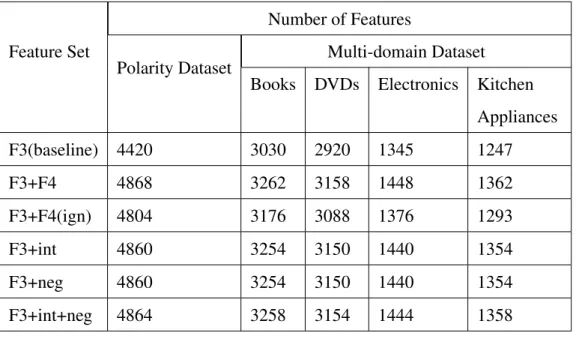
4.1 Number of features in each feature set in E1 . . . 48
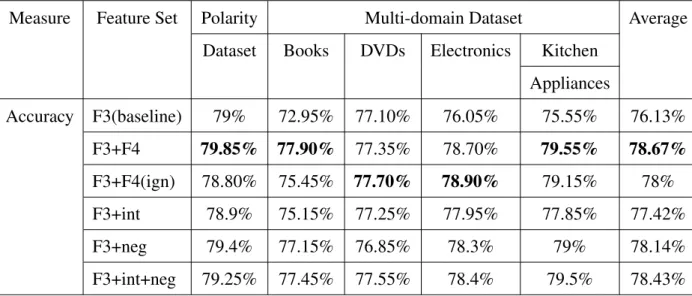
4.2 Accuracy of different feature sets in E1 . . . 49
4.3 Precision and recall of different feature sets in E1 . . . 50
4.4 Average positive and negative precision and recall of E1 experiments . . . . 50
4.5 The two-tailedt-test results for F3+F4 against F3 . . . 51
4.6 Number of features in each feature set in E2 (baseline) . . . 53
4.7 Number of features in each feature set in E2 (proposed feature sets) . . . . 53
4.8 Accuracy of different feature sets in E2 . . . 54
4.9 Precision and recall of different feature sets in E2 . . . 54
4.10 Average positive and negative precision and recall of E2 experiments . . . . 55
4.12 Accuracy of different selected feature sets in E3 . . . 57 4.13 Precision and recall of different selected feature sets in E3 . . . 57 4.14 Average positive and negative precision and recall of E3 experiments . . . . 58
L
IST OF
F
IGURES
2.1 How SVM works [15] . . . 18
2.2 An example of basic typed dependencies [11] . . . 20
2.3 An example of collapsed typed dependencies [11] . . . 20
L
IST OF
A
LGORITHMS
1 Extract Refined F3 and F4 . . . 33
2 Modify polarity(negated,intensi f ied,shi f ted) . . . 34
3 Check polarity shifters(w, f inal polarity) . . . 34
4 Negate Polarity(pol type) . . . 38
5 Intensify Polarity(pol type) . . . 38
6 Extract Intensifiers . . . 39
L
IST OF
A
BBREVIATIONS
FCA First Common Ancestor FN False Negative
FP False Positive IG Information Gain
IMDb Internet Movie Database ML Machine Learning NB Naive Bayes
NER Named Entity Recognition NLP Natural Language Processing SO Semantic Orientation
SVM Support Vector Machines TN True Negative
C
HAPTER
1
I
NTRODUCTION
People are now interested in knowing what other people think. Due to the rich opinion-ated content on the web, such as blogs, reviews, web forums, social networks and others, people can now know others’ opinions about different topics without even knowing them. Such available opinions are significant at the personal, corporate and governmental levels. At the personal level, most people now do online product research before buying any prod-ucts to know what is said in the reviews about this product and their buying decisions get affected by these reviews. People also tend to gather political opinions and sharing them on the web. At the corporate level, companies always seek their consumers’ feedback about their products and/or services by conducting surveys and focus groups, since it will be a labo-rious task to gather and analyze hundreds or thousands of reviews published online. Finally, at the governmental level, governmental organizations are interested in knowing people’s reactions towards the new rules and regulations that they set [26].
Therefore, an automated tool is needed to crawl opinions about different topics on the web, according to one’s interest, and display them in a summarized, meaningful, and less confusing or overwhelming way such that he/she does not have to manually read or analyze them. As a result, sentiment classification has been emerging as a new field in computa-tional linguistics, natural language processing (NLP) and machine learning (ML). It is the area of research that attempts to identify the sentiment/opinion of a piece of text (whether a document, sentence or phrase) that is held from the author of the text [20].
is to classify a whole document (i.e. a review, a blog, a news article ...etc) as holding an overall positive or negative sentiment. We have studied the early and current research done in this area, and we would like to improve the performance of the document-level sentiment classification by proposing new features to use.
This chapter is organized as follows: section 1.1 describes the problem definition for un-dertaking this specific area of research in our study; section 1.2 explains our motivation and goal for working in document-level sentiment classification as well as our main contributions in this study; and finally section 1.3 will list the chapters and sections in this study and what each one will talk about.
1.1
Problem Definition
Many researchers have focused their work on document-level sentiment classification, where the task is to identify the overall sentiment of a given document, assuming it holds the opinion of one author and talks about one object. There are mainly two approaches for this task: the ML and semantic orientation (SO) approaches, as will be discussed in section 2.2. Some researchers have developed document-level sentiment classification tools using the current ML algorithms, such as Support Vector Machines (SVM) and/or Naive Bayes (NB), using different feature sets to represent the documents; whereas others have centered their attentions on building sentiment dictionaries (lexicons) with all possible polar words with a corresponding number or score showing their polarity and/or semantic intensity. Both approaches have their advantages and disadvantages. For instance, the ML approach is typ-ically supervised and needs a huge annotated training data, but it yields high performance when testing on data from the same domain. On the other hand, the SO approach is unsuper-vised, yet it does not generate such good results as the ML. Hence, there have been recently some attempts to combine both approaches using different techniques, as we will show in section 2.4. One example of such hybrid approaches is to add the frequency of SO-carrying words as features in the ML approach. However, counting the frequency of sentiment words does not yield accurate results due to the contextual polarity of some of these words. Com-puting the contextual polarity of sentiment words has shown a significant improvement in
the SO approach [7, 34], but it has only been handled in sentence-level and phrase-level sentiment classification [39, 22, 8].
1.2
Motivation and Goal
Sentiment classification is different from classic text classification, since the latter de-pends on a set of keywords and phrases that can be used as features, for topical text classi-fication for instance. However, sentiment classiclassi-fication cannot depend on a set of keywords and/or phrases only, since opinions can be expressed in more subtle ways that can be hard for the computer to learn. Hence, new features were designed and explored specifically for sentiment classification, such as: a sentiment lexicon. A sentiment lexicon should contain all words and/or phrases that carry SO. Many researchers have developed different sentiment lexicons, such as SentiWordNet [13, 5] and the Subjectivity dictionary [39]. Still, using in-dividual words only to extract sentiment was not efficient, since the word’s polarity can be affected by its context; e.g. the polarity and semantic intensity of the word “good” is differ-ent from that of the words “not good” and “very good”, respectively. Also, not all sentiment words should be regarded as carrying SO in special conditions, such as conditional and con-trast words as well as modal verbs; e.g. in the sentence “Although he wasbrilliant, hefailed the exam”, the adjective brilliant should be disregarded as a sentiment word, such that the overall sentiment of the sentence is negative, from the verbfailed. Hence, the authors in [28] defined different categories for contextual valence shifters that can change the prior polarity of the SO-carrying words and hence should be considered when extracting sentiment, as we will explain in section 2.1. The authors in [39] developed a sentence-level classifier that considers two types of the contextual valence shifters; intensifiers and modifiers. In addi-tion, the authors in [7, 34] developed a sentiment lexicon (SO-CALculator) and additional features that take contextual valence shifters into consideration and then used them to extract all sentiment words and sum up their polarity scores.
The ML approach has outperformed the SO approach in the literature for the sentiment classification task. Therefore, in this research, we wanted to improve the accuracy of the document-level sentiment classifier even further by incorporating contextual valence shifters
in an effective way and refining the sentiment feature extraction method used in [9], where they extracted all SO-carrying words while disregarding their contextual polarity.
Our main contributions in this study are: 1) To refine the traditional sentiment feature extraction method that counts the frequency of each sentiment word while disregarding its contextual polarity; 2) To propose a new technique to extract contextual valence shifters in the ML approach in a way that the classifier can learn the effect of these shifters; 3) To show that our proposed feature set to handle the effect of contextual valence shifters is effective and relevant for the classifier; and 4) To improve the sentiment classification performance at the document-level by incorporating our proposed feature sets.
1.3
Organization of the Thesis
The rest of this thesis is organized as follows: chapter 2 contains 3 sections. Section 2.1 defines and explains the categories of contextual valence shifters, section 2.2 reviews the dif-ferent approaches used for document-level sentiment classification, section 2.3 explains the theoretical foundations of SVM and the dependency parser, and then section 2.4 compares these approaches and surveys the attempts to combine them together. In chapter 3, we talk about our proposed model and feature sets for document-level sentiment classification. Sec-tion 3.1 discusses the classificaSec-tion model and its different phases. Then, secSec-tion 3.2 will list the tools that we will use for developing the model and our proposed feature sets and describe each one of them. Then, we explain how we will extract the proposed features in section 3.3, section 3.4 analyzes the running time for the algorithms used in terms of big O notation and section 3.5 explains the evaluation methodology that we will follow to evaluate our proposed feature sets performance. In chapter 4, we will discuss and analyze the 3 differents sets of experiments that we have performed to evaluate the performance of our proposed feature sets against the baseline and discuss the results. Finally, in chapter 5, we will conclude the thesis and list some directions for future work. There are 4 appendices at the end of the document. Appendix A shows the feature sets used in our experiments; appendix B includes some of the lists used to extract our proposed features; appendix C explains different combinations of the variables used in the proposed algorithm and the result of each one; and appendix D shows
some sample documents from the datasets we have used in our experiments, their extracted features from both the baseline and our proposed feature sets and their classification in both cases.
C
HAPTER
2
L
ITERATURE
S
URVEY
Sentiment classification has been recently the interest of many researchers, due to the enormous opinionated web content, including blogs, reviews and social network applica-tions. Rather than searching for facts, where most search engines have focused, people are now also interested in searching for other people’s opinions on the web. For example, when buying a new product, a person is interested in knowing the opinions of those who have al-ready bought it, so he is interested in having an automated tool that crawls the reviews on this product on the web and gives him a summary of the reviews. Thus, given a certain piece of text, the tasks of sentiment classification are: 1) classify it as holding subjective or objective information (known assubjectivity analysis); 2) if it is subjective, determine its polarity as positive or negative; and 3) determine its semantic intensity as strong or weak. Researchers may focus on one or more of these tasks, and they can also focus on one or more type of text; whether it is a phrase, sentence or a document. For a more comprehensive review on sentiment classification, see [26, 20].
In this chapter, I review some of the research that has been done in sentiment classi-fication, and my focus is at the document-level, where the problem is to classify a whole document (whether a review, news article, blog . . . etc) as holding an overall positive or neg-ative sentiment. For this task, an assumption is being made that the document is subjective, talking about one object only and holding the opinion of one author [20]. There are mainly two approaches for document-level sentiment classification: the ML and the SO approaches. There has been recently some work trying to build a hybrid model combining both of them.
This chapter is organized as follows: section 2.1 defines contextual valence shifters and its importance in sentiment classification. In section 2.2, I talk more in-depth about the ML approach and the different feature sets used in the literature and then give a survey about the SO approach and the recent work done in this direction. Then, in section 2.3, I will explain in brief the theoretical foundations of SVM and the dependency parser, since they were used in the literature and will be used in our experiments. Finally, in section 2.4, I will compare both the ML and SO approaches and review the different techniques for combining them.
2.1
Contextual Valence Shifters
Traditional sentiment classification research tried to extract individual terms that indicate prior positive or negative polarity and build a dictionary of polar words. However, such indi-vidual terms are not sufficient to determine the true or contextual polarity of the document. The valence of a polar term may be modified by one or more words, the so-called “contextual valence shifters” [28]. These shifters can be categorized into several types, some of them are:
1. Negators:
The polarity of a term may be reversed by a negation term like: “not”, “never”, “ no-body” . . . etc. For example:
Heneversucceeds his exams.
The word “never” changes the polarity of the adjective “successful” from positive to negative [28].
2. Intensifiers:
A polar term may be modified by one or more intensifiers. An intensifier is an adjec-tive or an adverb that increases (called amplifier) or decreases (called down-toner) the semantic intensity of the word next to it. Adverbs often modify verbs, adverbs and nouns, whereas adjectives modify nouns only [34]. For example:
I wasveryexcited to attend the party. There islittletruth about that.
In the first sentence, the adverb “very” increases (or amplifies) the polarity of the positive adjective “excited”, so if its polarity was +2, it would be +3. In the second sentence, the adjective “little” decreases (or down-tones) the semantic intensity of the noun “truth”, from, for example, +2 into +1.
3. Modals and conditional words:
Language can express two types of events: those that truly happened (called realis
events) and those that cannot have happened (calledirrealisevents). Anirrealisevent can be conveyed using a modal operator (such as: might, couldorshould) or a condi-tional word (such as: if orunless). Polar words that occur with modals or conditional words should not be taken into consideration as carrying any SO for they do not convey any. For example:
Thisshouldbe a good movie.
If John was nice, he would have more friends.
In the first sentence, “should” neutralizes the positive polarity of the adjective “good” since it expresses the author’s expectation about the movie. In the second sentence, the conditional word “if” and the modal “would” also neutralize the words “nice” and “more”. As we can tell from this sentence that John is not nice at all [28], so it would be better to reverse the polarity of the lexical items appearing after conditional words instead of neutralizing them.
4. Presuppositional items:
These are words that can shift the base valence of the SO-carrying words towards the other polarity, such asbarely, as in “barely sufficient”. There are also some nouns and verbs that shift the polarity of the lexical items, such asfailure,neglect,lack,fail,omit
. . . etc. For example:
Hefailedto succeed the exam. Helackswisdom.
In these two sentences, the verbs “failed” and “lacks” shift the polarity of the verb “succeed” and the noun “wisdom”, respectively, so that the whole expressions “failed to succeed” and “lacks wisdom” are negative instead of positive [28].
5. Connectors:
Connectors that show contrast, such asalthough, but, on the contraryandin spite of, affect the polarity of the SO-carrying words in the sentence. For example:
Althoughhe was brilliant, he failed the exam.
In this sentence, the connector “although” neutralizes the polarity of the positive adjective “brilliant” leaving the negative verb “failed” to determine the final polarity of the sentence. Without doing this adjustment, the overall polarity would be neutral [28].
In addition to the above contextual valence shifters, there are others, such as: irony, multi-entity evaluationandgenre constraints, but these are beyond our discussion here and can be found in [28].
2.2
Approaches for Document-level Sentiment Classification
There are two assumptions when performing document-level sentiment classification: 1) The document expresses the opinion of one author; and 2) The author talks about one object only. Document-level sentiment classification techniques can be mainly divided into two approaches: ML and SO. ML algorithms have succeeded in classic text categorization, and so they were implemented for sentiment classification, but with having the target classes as “positive” and “negative”. These algorithms are discussed in detail in [31, 40]. Supervised ML algorithms, such as SVM, have been used extensively in the sentiment analysis research [20, 26]. In supervised ML, a piece of text is converted into a feature vector so that the classifier would learn from a set of data labeled with its class (called trainingdata) that a combination of specific features yields a specific class, and then it can test its accuracy of learning on another set of data (calledtestingdata). On the other hand, in the SO approach, a sentiment lexicon is built either manually, semi-automatically or automatically with each word having its semantic intensity as a number indicating whether it is positive or negative as well as its intensity. Then, this lexicon is used to extract all sentiment words from the document and sum up their polarities to determine if the document is holding an overall
positive or negative sentiment besides its intensity.
2.2.1
The Machine Learning Approach
In the ML approach, each document is represented as a feature vector with representative features for the target class as well as its correct class. Then, the feature vectors are inserted into a classifier that uses a ML algorithm for training it. A set of documents are chosen for training (calledtraining data) to build a model for predicting the class of unseen or new data (calledtesting data). Different ML algorithms have been used in the sentiment classification literature, but SVM have dominated most of the research done. The theoretical foundation of SVM is explained in brief in section 2.3.1. Various feature sets have been tried specifically for sentiment classification, as discussed in [26]. Some of the significant features that are related to our work are:
1. N-grams:
N-grams are common features to use in text classification. They are words that are frequently repeated in the corpus. They vary from uni-grams (one word only, such as
director), bi-grams (two neighboring words, such as two stars), to tri-grams (such as
science fiction film). N-grams can be useful when capturing the sentiment of the doc-ument, for example, thedirectorof a movie could have done outstanding work, so its occurrence in a review most probably indicates a positive sentiment. Many researchers have used n-grams, especially uni-grams, since they result in a high accuracy and they added other features as improvements to their systems [27, 38, 23, 1, 2, 9]. Some re-searchers use uni-grams and bi-grams [9], some use bi-grams only [41], while others use uni-, bi- and tri-grams [2, 9]. Several ML algorithms have been compared, and SVM outperformed other algorithms [27], and hence, it has been used as a common algorithm for sentiment classification, except for a few papers that have used NB or ME or a combination of two or more of them [41, 42].
2. Part-Of-Speech tag n-grams:
senti-ment [16, 14, 2]. For instance, the authors in [14] experisenti-mented the effect of a combi-nation of positive and negative nouns, verbs, adverbs and nouns and have shown that the appearance of a positive adjective followed by a noun is more frequent in posi-tive documents than in negaposi-tive ones, and that the appearance of a negaposi-tive adjecposi-tive followed by a noun is more frequent in negative documents.
3. Stylistic features:
These include lexical and structural attributes as well as punctuation marks and func-tion words, as explained in [1, 43, 2]. Thelexical featuresinclude character- or word-based statistical measures of word variation. Examples of the character-word-based lexical features are: 1) Total number of characters; 2) Characters per sentence; 3) Characters per word; and 4) The usage frequency of individual letters. Some examples of the word-based lexical features are: 1) Total number of words; 2) Words per sentence; 3) Word length distribution; and 4) Vocabulary richness measures; such as: the number of words that occur once (hapax legemona) and twice (hapax dislegemona) as well as several statistical measures like: Yule’s K, Simposon’s D and Brunet’s W measures [36]. Thestructural featuresinclude text organization and layout, for example, signa-tures, number of paragraphs, average paragraph length, total number of sentences per paragraph and others.
These features were used along with other features in sentiment classification research [1, 2, 9, 3] and they improved the system’s accuracy when added [2].
4. Negation and modification features:
These are two of the important categories of the contextual valence shifters discussed in the previous section. Early work in sentiment classification did not investigate the effect of negation or modifiers [27], as the authors only used Bag-Of-Words (BOW) and higher-order n-grams. As a result, two sentences like these: “I like this movie” and “I don’t like this movie” would be similar to each other since both contain the verb “like”, although the first one holds a positive sentiment while the second holds a negative sentiment [26]. Modifiers also play a crucial role when classifying sentiment since they can increase or decrease the semantic intensity of polar terms or even shift them towards the positive or negative sentiment, as discussed in the previous section.
Therefore, later research focused on how to detect and extract negation and modifiers and add them as features [39, 32, 18, 33, 8]. For instance, the authors focusing on sentence-level sentiment classification in [39] added a binary feature for each word token to determine whether it was negated or not in addition to other features to in-dicate whether it was modified by an adjective or adverb intensifier or one or more contextual valence shifters that they extracted: general, negative and positive polarity shifters. The general polarity shifter reverses the polarity of the word modified by it, e.g. little truth. The negative polarity shifter yields an overall negative sentiment for the overall expression, e.g. lackof wisdom. The positive polarity shifter changes the overall sentiment of the expression to positive; for example,abatethe damage [39]. In addition, the authors in [18] used a dependency parser to extract typed dependencies and developed special rules to determine the scope of each negation term. Further-more, the authors in [8] used typed dependencies and a negation and quantifiers lists to extract negated, amplified and down-toned sentiment words and build a sentence-level polarity and intensity sentiment classifier.
5. Dependency relations:
Some researchers have explored the effect of dependency relations in sentiment clas-sification, since they can hold more information than neighboring words (such as: higher-order n-grams). Dependency relations are typically extracted using a depen-dency parser. For example, the authors in [39] used a dependepen-dency parser to extract modifiers and other dependency relations (e.g. words connected by a conjunction, like
and). Also, the authors in [41] extracted bi-grams and all dependency relations as fea-tures besides uni-grams to improve the system’s performance. However, it was shown in [23] that adding dependency relations with focus on adjectives preceded by nouns and nouns that have a dependency relation with polar terms to n-grams did not improve the performance.
Researchers have tried using different ML algorithms to compare their performance in the sentiment classification task. It was shown in [27] that SVM outperforms both NB and ME when using unigrams, bigrams as well as other features; and hence, most research has used SVM and it became the default algorithm in sentiment classification. However, the
au-thors in [41] showed that uni-grams perform better on SVM, whereas higher-order n-grams and dependency relations perform better on NB, due to the nature of the algorithms them-selves. They explained the difference between the performance of SVM and NB classifiers as follows: unigrams tend to have more relevant features and less independency than higher order n-grams. The discriminative model, SVM, can capture the complexity of relevant fea-tures, whereas a more generative model, NB, performs well on bigrams and dependency relations since the feature independence assumption holds well [41].
Another problem in ML besides choosing the right features is feature selection. Since there can be redundant or irrelevant features in the feature vector that makes it unnecessarily a huge vector, feature selection is performed to reduce the dimensionality of the feature vector so that only representative features for the target class are remaining. By selecting the most relevant features for the target concept, the classifier learns better which class label to give to each vector. In addition, it reduces the running time required for the classifier on the training data, which is crucial for real-world applications [10]. Several researchers have implemented different feature selection methods that were used for classic text classification and applied them to sentiment classification [2, 9]. Other researchers have developed new algorithms for feature selection specified for sentiment classification [37, 24, 3]. But, most research uses the Information Gain (IG) heuristic as the feature selection method due to its reported effectiveness [2, 9, 17].
2.2.2
The Semantic Orientation Approach
In the SO approach, a document’s polarity is calculated as the sum of its polar terms and/or expressions. Early work in this direction calculated the phrase’s polarity as the dif-ference between the Point Mutual Information (PMI) between the phrase and the word “ex-cellent” as representative for the positive class and the PMI between the phrase and the word “poor” as representative for the negative class, with hit counts from AltaVista search engine using the NEAR operator. The PMI between two words is calculated as follows [35]:
PMI(word1,word2) =log2( p(word1&word2)
where p(word1&word2)denotes the probability that both words occur together. Later,
re-searchers tried to build sentiment lexicons for words and expressions. Some rere-searchers built a sentiment lexicon manually, such as:
1. The General Inquirer:
The General Inquirer1 (GI) is a content-analysis tool that is used for many purposes including sentiment classification. It contains several categories, such as Positiv and
Negativ that are mainly used for sentiment classification, as well as other categories for words of pleasure and pain, overstatement and understatement, and others. Each category has a list of words and word senses, so it works with Word Sense Disam-biguation to differentiate between different word senses. Also, it combines different dictionaries, such as “Harvard IV-4” and “Lasswell” dictionaries. It has been used in many sentiment classification research to build other lexicons and in the ML approach as well when using sentiment words as features such as [39, 22].
2. SO-CALculator (SO-CAL):
SO-CAL is another manually-built sentiment lexicon. The authors in [7, 34] developed a sentiment lexicon manually, incorporating SO of individual words and contextual va-lence shifters, but did not take into account word sense disambiguation. Their dictio-nary includes a separate list for sentiment bearing nouns, adjectives, adverbs and verbs with a numerical score from -5 to +5 that indicates the word’s polarity and strength. In addition, they developed a list of amplifiers (words that increase the semantic po-larity of words after them, such as verygood) and down-toners (words that decrease the semantic polarity of words after them, such as less successful). These modifiers include adjectives, adverbs and multi-word expressions. They also implemented a new method for negating words, calledshift negation, instead of the traditionalswitch negationmethod that only reverses the sign (+ or -) of the word preceded by a negated term. This method shifts the polarity of the negated words towards the opposite polar-ity by a fixed number (4), so for example the word “excellent” whose score is +5 when negated, its polarity changes to +1 (5 - 1). They achieved comparable performance to other sentiment lexicons [34].
Other researchers built sentiment lexicons using automatic sources only or a combination of both manual and automatic sources, such as:
1. The Subjectivity dictionary:
The authors in [39] built the subjectivity dictionary from both manual and automatic resources, but they used it in a ML approach by developing specific features for sentence-level sentiment classification. They started with a list of subjective clues and then expanded them using a dictionary and thesaurus as well as positive and neg-ative words from the General Inquirer. They obtained a list of about 8,000 words labeled with their corresponding prior polarity (positive, negative, neutral or both), type (strong or weak subjective) and part of speech [39].
2. SentiWordNet:
SentiWordNet was built on the English lexical database, WordNet [21], where each group of words (nouns, adverbs, adjectives and verbs) are grouped together according to their synsets and the concepts they hold. The annotation of words in SentiWordNet was done automatically through a 2-step process: a weak-supervision semi-supervised learning step, and a random-walk step. In the first step, the authors in [5] started with a small seed list of positive and negative words and searched for words with similar polarity using binary relations of WordNet. Then, in the second step, an iteration is run on the words until they converge to decide on their final polarity. Each word in SentiWordNet is associated with its Part-Of-Speech and 3 polarity types (objective, positive and negative) and each type having a score describing its intensity (from 0 to 1) [13, 5]. This sentiment lexicon has also been used in the sentiment classification research, such as [9] by incorporating them as features, as we will see in section 2.4.
The ML approach has dominated over the SO approach in the literature, since there are many features that can determine the polarity of documents. But, the SO approach has better generality across domains, as it is not domain-specific. Similar to the concern of the ML approach, which is choosing the right features, the concern in the SO approach is to build a comprehensive lexicon with correct prior polarity to the words and methods to handle the contextual polarity of them. This is what the authors in [34] have concentrated on when
building their sentiment lexicon and they argued that building a sentiment lexicon manually is more efficient than building it automatically to produce more accurate lexicons.
2.3
Theoretical Foundations
In this section, I briefly describe the theoretical foundations of both SVM and the de-pendency parser, since they were used in the literature for sentiment classification and we will use them in our experiments. Section 2.3.1 explains what the theory behind SVM is and section 2.3.2 describes what a dependency parser is and how The Stanford parser works.
2.3.1
Theoretical Foundation of SVM:
There are different books and articles that explain the SVM method. Here, we describe its theory in brief since it was used extensively in the sentiment classification literature. In a classification problem, you are given a set of labeled and unlabeled data with their target class and you want to build a model to learn to classify the unlabeled data as well as any further unseen data. If you have two target classes only, this is called a binary classification problem, otherwise it is a multi-class problem. So, in order to build this model, you need first to decide on the features that you believe are relevant when determining the target class. Then, you have to extract these features from each document, so that each document will be represented as a feature vector with each feature having its corresponding value. A classifier can be represented as a function: f(x):Rd−→Rwhere a binary classifier assigns a point to the positive class if its function value is greater than or equal to zero, and assigns it to the negative class if its function value is less than zero. SVM have been widely used in classification problems, such as text classification problems, and recently they have been also used in sentiment classification. They construct a special rule, which is called a linear classifier. A classifier is said to be linear if its function can be written as: f(x;w,b) =<w,x>+bwhere
wandb are the function parameters and<and >signs are the inner or dot product of the two vectors. The data points used for training the classifier can be represented in the form:
D={(xi,yi)|xi∈Rl,yi∈ {−1,1}} l
wherexis the feature vector of the data point with lengthlandyis the class of the point and is either 1 (for a positive class) or -1 (for a negative class). These data points can be described in al-1-dimensional hyperplane, as illustrated in figure 2.1. The goal of the classifier then is to find a hyperplane that separates the data points with the positive class from those with the negative class with the maximum margin possible from each set of points to the hyperplane, as illustrated in figure 2.1, where the data points on the margins are called “support vectors”.
Figure 2.1: How SVM works [15]
An important property of the training data in SVM is to belinearly separable, where:
yif(xi)>0,∀i=1, ...,l (2.3)
which means that the two hyperplanes of both margins can be selected in a way that there are no data points between them [15].
2.3.2
Theoretical Foundation of the Dependency Parser:
A parser, or syntactic analyzer, is a program that extracts the grammatical relationships between different phrases of the sentence. A typed dependency parser is a parser that out-puts the grammatical relations between single words of the sentence, for example, what is the subject and object of a verb. A typed dependency parser usually uses a phrase structure parser to output typed dependencies [11]. Parsers were developed probabilistically by train-ing them on manually-parsed sentences (the Penn Treebank) to try to produce the most likely
grammatical relations between the words of new (unseen) sentences. Different dependency parsers use different methods to extract typed dependencies. Here, we explain in brief how Stanford typed dependencies are extracted. To extract Stanford typed dependencies from phrase structure trees, there are mainly 2 phases:
1. Dependency Extraction:
In this phase, each sentence is first parsed with a phrase structure parser, usually a Penn Treebank parser. Then, the semantic head of each constituent in each sentence is extracted using some head rules, and then the words that depend on each head are identified.
2. Dependency Typing:
This phase is concerned with identifying the dependencies between each head word and its different dependent words by defining some patterns and then matching each one against every tree node and taking the most likely dependency.
Each dependency is represented as follows: dependency name(governor, dependent), where the governor is the parent of the relation and dependent is its child. The typed dependencies are represented as a directed acyclic graph with one root only. These are called “basic de-pendencies”, as illustrated for the sentence “Bills on ports and immigration were submitted by Senator Brownback, Republican of Kansas.” in figure 2.2. However, there are some sit-uations where prepositions and conjunctions could be treated as dependencies. So, Stanford has developed other types of dependencies, such as “collapsed dependencies”, as illustrated on the same sentence in figure 2.3 [11].
2.4
Comparing the Approaches and Combining them into a Hybrid
Approach
There are some significant differences between the ML and SO approaches. First of all, the ML approach performs better than the SO approach on a single domain; the high-est accuracy achieved on the Polarity dataset version 2.0 [25] using a classifier was 91.7%
Figure 2.2: An example of basic typed dependencies [11]
[2] versus an accuracy of 76.37% using SO-CAL [34]. Secondly, the classifier can learn domain-specific polarity; e.g. “longbattery life” (+ve) vs “longtime to focus” (-ve), unlike the lexicon where a prior polarity is known for each word. However, to build a high accu-racy classifier, we need to have a huge corpus labeled with its class (positive or negative) whereas a dictionary does not need one. This can be a labor-intensive task; to collect data from different genres (reviews, news articles, blogs . . . etc) and domains (movies, products, politics . . . etc) and label them manually. In addition, the authors in [7, 34] argued that a ML approach does not take linguistic context into account, such as negation and intensification, since there can be three features “good”, “very good” and “not good” but the classifier does not know they are related to each other. In this thesis, we are trying to solve this major drawback in the ML approach, as will be explained in chapter 3.
Since both the ML and SO approaches have some advantages and disadvantages, some researchers have attempted to combine them together to benefit from the advantages of each approach [4, 29, 30, 17, 9]. For example, the authors in [9] built a classifier with unigrams and bigrams with a threshold of 5 and stylistic features and they developed a feature-calculation strategy to extract sentiment features (verbs, adjectives and adverbs) from SentiWordNet 3.0. Similarly, the authors in [4] tried to develop a high-accuracy domain-independent system at the sentence-level by building an ensemble model of two classifiers; one with unigrams, bigrams and trigrams as features and trained on in-domain data, and the other one with sentiment words from both WordNet and the General Inquirer as features. The authors in [29] then improved this system to be self-supervised so that it does not need labeled data. They developed a two-phase model; the first one is a sentiment lexicon and a negation list to label the data and they took the high-confidence labeled documents as train-ing data to a classifier with sentiment words betrain-ing the feature set. Another technique to solve the problem of manually labeling the data was shown in [17], where the authors trained an initial classifier with sentiment features from the Subjectivity lexicon. Then, from the high-confidence labeled data, they extracted the most indicative features for each class (using the IG heuristic) as learned features to train another classifier instead of training it with self-labeled data. However, all these models did not take into account contextual valence shifters described in section 2.1. Therefore, in this thesis, we are trying to fill this gap in the current literature.
C
HAPTER
3
P
ROPOSED
A
PPROACH
: R
ECOGNIZING CONTEXTUAL
VALENCE SHIFTERS IN DOCUMENT
-
LEVEL SENTIMENT
CLASSIFICATION
In this research, we are interested in using a hybrid approach by incorporating contextual valence shifters as features into an SVM classifier in addition to other important features whose performance has been tested and proven to be significant in sentiment classification. By adding contextual valence shifters, such as negation, intensification and connectors, from a new perspective other than the ones described in chapter 2 into a ML approach, the classifier will learn how to take linguistic context into consideration. In this way, by developing a self-supervised model, as described in the literature, it would be a practical technique to use instead of using a sentiment lexicon for being an unsupervised technique.
This chapter is organized as follows: in section 3.1, I explain the classification model, its components and the different feature sets that will be used; section 3.2 will describe the different tools used for building the model; section 3.3 explains the algorithms for extracting the proposed feature sets; section 3.4 analyzes the running time for these algorithms and fi-nally section 3.5 will provide the evaluation methodology we will follow in order to evaluate our proposed feature sets.
3.1
Document-level Sentiment Classification Phases
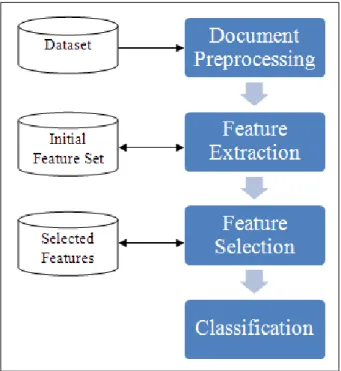
After conducting research on the current and past work done in document- and sentence-level sentiment classification, we decided to develop a document-sentence-level sentiment classifica-tion model that recognizes contextual polarity. The document-level sentiment classificaclassifica-tion model consists of several components as illustrated in figure 3.1.
Figure 3.1: The document-level sentiment classification model
The model goes through the following phases:
1. Document preprocessing:
The datasets need to be preprocessed to be ready for feature extraction. Since the multi-domain dataset is in an XML format, we had to extract only the review body and its overall sentiment using an XML parser. In addition, the two datasets have to be tokenized, tagged into their corresponding POS and parsed with their typed depen-dencies.
2. Feature extraction:
After preprocessing the documents, the feature extractor is used to generate the fol-lowing feature sets that are listed in appendix A:
(a) Content-free features (F1):
These include stylistic features: 87 lexical features, 8 punctuation marks and 150 function words. These features are described in detail in [43]. We will denote to these features as F1.
(b) Content-specific features (F2):
These include n-grams (unigrams, bigrams and/or trigrams) with a pre-defined frequency threshold. Their number varies from one dataset to another. We will denote to these features as F2.
(c) Sentiment features (F3):
We will use the Subjectivity dictionary provided by [39] to extract sentiment features. This feature set includes the frequencies of each sentiment word (found in the lexicon) in each document. Some preprocessing was performed on the dictionary to remove all words whose prior polarity was “neutral” or “both”. The total number of sentiment features varies from one dataset to another. We will denote to these features as F3. We will also refine F3 so that sentiment words modified by contextual valence shifters as well as sentiment words after conditional or contrast words or modal verbs are not counted. Moreover, we will lemmatize the words before looking them up in the lexicon to get more accurate results. We will denote to these features as ‘refined F3’.
(d) Contextual Valence Shifters (F4):
All the previous features were used in [9], so in this study, we are adding contex-tual valence shifters as a new feature set to the ML approach. We believe that this feature set will improve the baseline’s performance. In the baseline [9], the au-thors add all sentiment words disregarding any modification to sentiment words, so for example, if a sentence has the wordsnot good, the frequency of the senti-ment wordgoodwill be incremented by 1, though this is not a valid increment. Therefore, we will only count the sentiment features that were not modified by contextual valence shifters. In addition, we will use the list of intensifiers and contextual valence shifters provided by [39] as well as a list of conditional and contrast words, listed in Appendix B. We will denote to these features as F4.
3. Feature selection:
Having generated the features, we should select the most significant features that are good predictors of the class label. Since the IG heuristic was used extensively in the sentiment classification literature, as explained in section 2.2, we will use it as the feature selection method for our feature sets.
4. Classification:
In this step, the feature vectors are generated and inserted into a sparse ARFF file that is the input file for the classifier. We choose the Weka suite software to run the classifier.
3.2
Tools
We will use a set of tools and English lists in order to implement our proposed feature sets and test it against the baseline, as follows:
1. The Subjectivity dictionary, intensifiers and contextual valence shifters:
These lists are provided by [39]. The Subjectivity dictionary contains 8,221 entries (sentiment words). Each sentiment word is described using some tags, as follows:
type=<type>len=1 word1=<word>pos1=<POS>stemmed1=<stemmed>
priorpolarity=<polarity>
wheretypeis eitherstrongsubjorweaksubjrepresenting the semantic intensity of the word in most context as either strong or weak,len1represents the length of the senti-ment expression (all entries have a length of 1),word1is the word token,pos1indicates the word’s part of speech (maybe anypos– any part of speech), stemmed1 indicates whether the sentiment word should match all its unstemmed variants with the corre-sponding POS, andpriorpolarityindicates the prior polarity of the sentiment word that is out of any context.
The intensifiers list consists of 121 adjectives and 123 adverbs that are used as inten-sifiers; e.g. absolute,most, andhighly. Adjectives may modify nouns only, e.g. total
failure, whereas adverbs may modify verbs, adverbs and adjectives, e.g. it greatly affected his performance.
The contextual valence shifters list contains: 15 negation terms (single and multi-word expressions), 5 positive polarity shifters, and 72 negative polarity shifters. The negation terms typically reverse the polarity of the words after them, e.g. he never
succeeds. The positive polarity shifter changes the overall sentiment of the expression to positive; for example, abate the damage. The negative polarity shifter yields an overall negative sentiment for the overall expression, e.g. lack of wisdom. It also contains 5 multi-word expressions labeled as nonshifter. These expressions are used along with the negation terms to check if the negation term should be counted as such. For instance, the expression “not only” is a nonshifter so that “not” is not counted as a negation term [39].
2. The Stanford tagger, tokenizer and parser:
To perform the POS tagging, tokenizing and parsing, we will use the Stanford tag-ger version 3.0.11 and parser version 1.6.62. The POS tagger is a piece of software written in Java that takes raw text as an input and outputs each work token with its corresponding part of speech. It uses the Penn Treebank tag set. We use the tagger when extracting sentiment features (F3) since each sentiment word has its correspond-ing POS. The dependency parser is a program that extracts the grammatical relations (known astyped dependencies) between different words of each sentence. It also uses the Penn Treebank tag set. We use the dependency parser when extracting contextual valence shifters and intensifiers (F4).
3. Weka Suite Software:
We will use the Weka Suite Software version 3.6.43as the environment for classifica-tion. Weka is a piece of software written in Java that provides a set of ML algorithms, such as SVM, NB and others as well as feature selection methods such as IG. It also provides a number of test options, such as cross validation and percentage split. It can 1http://nlp.stanford.edu/software/tagger.shtml
2http://nlp.stanford.edu/software/lex-parser.shtml 3http://www.cs.waikato.ac.nz/ml/weka/
be run directly by inserting the dataset into the program or from the command line (when the dataset size is large).
4. MontyLingua Lemmatizer:
Instead of stemming word tokens to search for them in the Subjectivity dictionary, we prefer to lemmatize them, since the lemmatizer takes the POS into consideration unlike the stemmer. We use the MontyLingua lemmatizer version 2.14written in Python. A lemmatizer is a natural language program that takes a word in its inflected form and POS and then outputs its base form. For instance, consider the word “meeting”. If it is a noun, as in “our meeting yesterday was successful”, then its lemmatized form will still be “meeting”. But, if it is a verb, as in “we are meeting tomorrow”, then the lemmatizer will output the word “meet”.
3.3
Extracting Refined Sentiment Features and Contextual Valence Shifters
In this section, we describe in detail the algorithms we have developed to extract the refined sentiment features (refined F3) and contextual valence shifters (F4). F4 contains a set of 16 features that counts the number of intensifiers, negation, and polarity shifters grouped together according to the polarity and type of sentiment words modified by them, in addition to the frequency of sentiment words grouped together with their final (modified) polarity and type. These features are described as follows:
1. Intensifier pos strongsubj: frequency of words with positive prior polarity and strong subjectivity type preceded by an intensifier.
2. Intensifier pos weaksubj: frequency of words with positive prior polarity and weak subjectivity type preceded by an intensifier.
3. Intensifier neg strongsubj: frequency of words with negative prior polarity and strong subjectivity type preceded by an intensifier.
4. Intensifier neg weaksubj: frequency of words with negative prior polarity and weak subjectivity type preceded by an intensifier.
5. Negation pos strongsubj: frequency of words with positive polarity and strong subjec-tivity type preceded by a negation term.
6. Negation pos weaksubj: frequency of words with positive polarity and weak subjec-tivity type preceded by a negation term.
7. Negation neg strongsubj: frequency of words with negative polarity and strong sub-jectivity type preceded by a negation term.
8. Negation neg weaksubj: frequency of words with negative polarity and weak subjec-tivity type preceded by a negation term.
9. Shiftneg strongsubj: frequency of words with positive polarity and strong subjectivity type preceded by a negative polarity shifter.
10. Shiftneg weaksubj: frequency of words with positive polarity and weak subjectivity type preceded by a negative polarity shifter.
11. Shiftpos strongsubj: frequency of words with negative polarity and strong subjectivity type preceded by a positive polarity shifter.
12. Shiftpos weaksubj: frequency of words with negative polarity and weak subjectivity type preceded by a positive polarity shifter.
13. Pos strongsubj: frequency of words with positive polarity and strong subjectivity type after modifying their polarity and type if they were preceded by any of the intensifiers or contextual valence shifters.
14. Pos weaksubj: frequency of words with positive polarity and weak subjectivity type after modifying their polarity and type if they were preceded by any of the intensifiers or contextual valence shifters.
15. Neg strongsubj: frequency of words with negative polarity and strong subjectivity type after modifying their polarity and type if they were preceded by any of the intensifiers or contextual valence shifters.
16. Neg weaksubj: frequency of words with negative polarity and weak subjectivity type after modifying their polarity and type if they were preceded by any of the intensifiers or contextual valence shifters.
In order to extract these features, we have used the Stanford parser to get typed dependen-cies that show the grammatical relationships between words in each sentence and developed some algorithms. Algorithms 1 and 2 show the general steps taken to extract refined F3 and F4 in each document. Appendix C shows how F4 is computed when there are different combinations of the contextual valence shifters and intensifiers that modify the sentiment word using these algorithms. To illustrate how these algorithms work correctly with some combinations, consider the following sentences:
1. “This is a problem”:
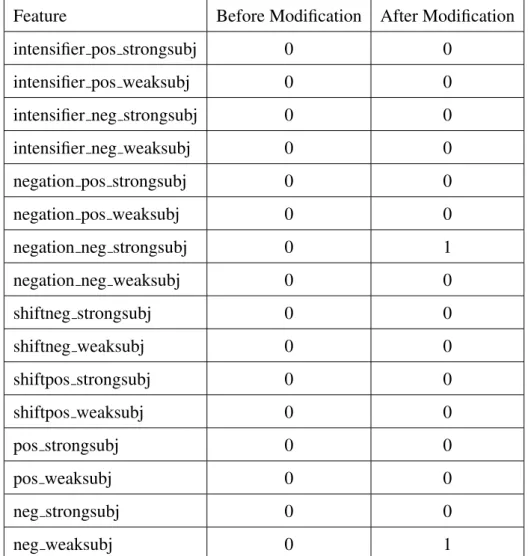
According to the Subjectivity lexicon, the prior polarity of the nounproblemis nega-tive and its type is weak (weaksubj). Since it is not preceded by a modal or conditional or contrast word or by an intensifier or a polarity shifter, its final polarity will remain the same (it will not go through any modifications). Therefore, we only want to incre-ment both the sentiincre-ment featureproblem noun and the frequency of its final polarity
neg weaksubj by 1. Thus, in algorithm 1 the sentiment word problem will only go through lines 4 and 13 - 15. In algorithm 2, it will only go through line 15, where
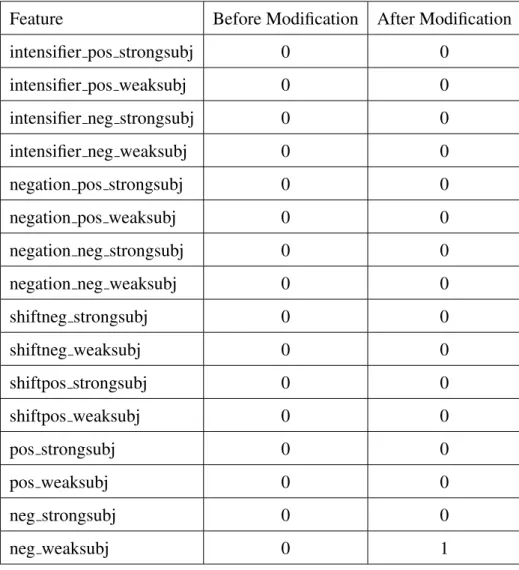
word countwill be 1, since the variablesnegated, intensifiedandshiftedare all false. After that, the sentiment feature corresponding to the noun problem noun in refined F3 will be incremented by 1 as well as the featureneg weaksubjin F4 (lines 14 and 15 in algorithm 1). Hence, the values of the 16 features of F4 for this sentence before and after modification are shown in table 3.1.
2. “This is not a problem”:
In this sentence, the noun problem is negated, so we want to increment the feature
negation neg weaksubjby 1 and decrement the sentiment featureproblem nounby 1. The algorithm will find the “neg” dependency between the negation termnotand the wordproblem and no other modifiers. Therefore, the variablenegated will be set to
Feature Before Modification After Modification
intensifier pos strongsubj 0 0
intensifier pos weaksubj 0 0
intensifier neg strongsubj 0 0
intensifier neg weaksubj 0 0
negation pos strongsubj 0 0
negation pos weaksubj 0 0
negation neg strongsubj 0 0
negation neg weaksubj 0 0
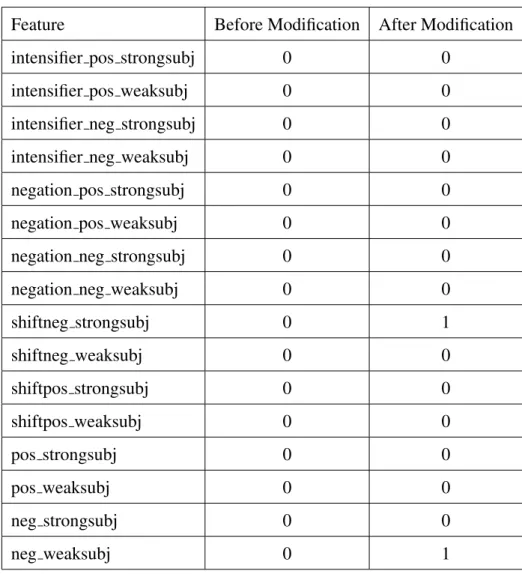
shiftneg strongsubj 0 0 shiftneg weaksubj 0 0 shiftpos strongsubj 0 0 shiftpos weaksubj 0 0 pos strongsubj 0 0 pos weaksubj 0 0 neg strongsubj 0 0 neg weaksubj 0 1
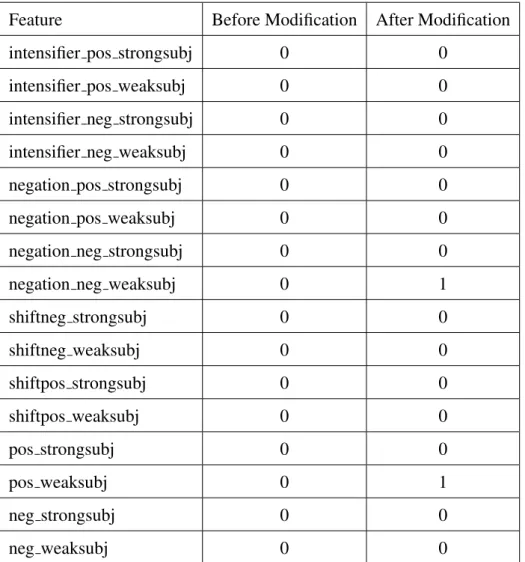
9, 11 and 12, whereword count will be -1 (since the word is negated), the negation feature with the word’s polarity,negation neg weaksubj, will be incremented by 1 and the final polarity of problem will be negated (from neg weaksubj to pos weaksubj) according to algorithm 4. Then, it will go back to algorithm 1 and in line 14 the sentiment feature of the word,problem nounwill be decremented by 1 and the feature
pos weaksubjwill be incremented by 1 in line 15. Hence, the values of the 16 features of F4 for this sentence before and after modification are shown in table 3.2.
Feature Before Modification After Modification
intensifier pos strongsubj 0 0
intensifier pos weaksubj 0 0
intensifier neg strongsubj 0 0
intensifier neg weaksubj 0 0
negation pos strongsubj 0 0
negation pos weaksubj 0 0
negation neg strongsubj 0 0
negation neg weaksubj 0 1
shiftneg strongsubj 0 0 shiftneg weaksubj 0 0 shiftpos strongsubj 0 0 shiftpos weaksubj 0 0 pos strongsubj 0 0 pos weaksubj 0 1 neg strongsubj 0 0 neg weaksubj 0 0
Table 3.2: F4 values for sentence #: 2
3. “This is a huge problem”:
In this sentence, the nounproblemis intensified by the adjectivehuge. Thus, we want to increment the featureintensifier neg weaksubjas well as the sentiment feature prob-lem nounby 1. In algorithm 1, it will find an “amod” dependency between problem
Algorithm 1Extract Refined F3 and F4
1: F3,F4⇐0
2: foreach sentence in the documentdo
3: foreach sentiment wordwfound in the sentencedo
4: f inal polarity⇐ prior polarity
5: ifwis not preceded by a modal, conditional or contrast wordthen
6: f inal polarity⇐check polarity shi f ters(w,final polarity)
7: ifwis preceded by a negation termthen
8: negated⇐T RU E
9: end if
10: ifwis preceded by an intensifierthen
11: intensi f ied⇐T RU E
12: end if
13: f inal polarity⇐modi f y polarity(negated,intensified,shifted)
14: word POS⇐word POS+word count 15: polarity type⇐ polarity type+1
16: end if{end of search for negation and intensification}
17: end for{end for each sentiment word}
18: end for{end for each sentence}
andhugein line 10 which calls algorithm 6. So, it will go through line 11 where the variable intensified will be set to TRUE. Then, it will go to algorithm 2, where the variableword countwill be set to 1 (line 15) and the featureintensifier neg weaksubj
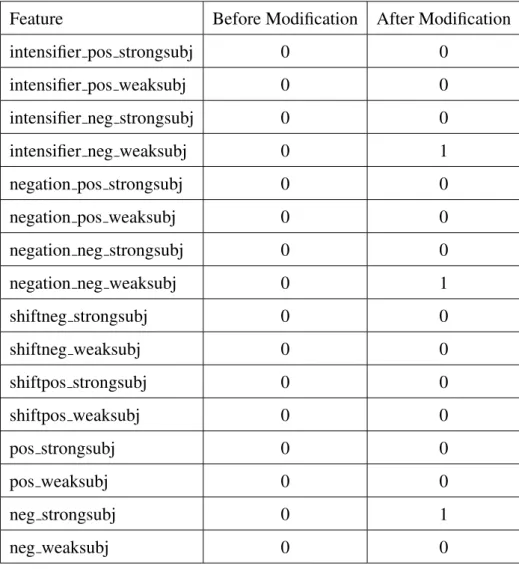
will be incremented by 1 (sinceintensifier countwill be 1 as there is only 1 intensifier, according to algorithm 6) (line 18). And then, the final polarity will be intensified, according to algorithm 5 toneg strongsubj(line 20). Then, back to algorithm 1, both featuresproblem nounandneg strongsubjwill be incremented by 1 (lines 14 and 15). Hence, the values of the 16 features of F4 for this sentence are shown in table 3.3. 4. “This is not a huge problem”:
Here, the sentiment word problem is intensified with the adjective hugeand huge is negated by the negation term not. Hence, we want to first intensify the polarity of
problem and then negate the expression huge problem by incrementing the feature
negation neg strongsubj and the sentiment featureproblem noun by 1, since there is a problem that is not huge. So, in algorithm 1, the variable negated will be set to
TRUE(lines 7 - 9). Then,intensifiedwill be also set toTRUEsince there is an “amod” dependency between huge and problem (lines 10 - 12). It will then go to algorithm 2. Since both negated and intensified are TRUE, it will go through lines 6, 7, 11
Algorithm 2Modify polarity(negated,intensi f ied,shi f ted)
1: ifnegated=T RU E then
2: ifshi f ted=T RU E then
3: word count ⇐1
4: else{shi f ted = false}
5: ifintensi f ied=T RU E then
6: f inal polarity⇐intensi f y polarity(f inal polarity)
7: word count ⇐1
8: else
9: word count ⇐ −1
10: end if
11: negation f inal polarity⇐negation f inal polarity+1
12: f inal polarity⇐negate polarity(f inal polarity)
13: end if{end ifshi f ted = TRUE}
14: else{the word is not negated}
15: word count ⇐1
16: ifintensi f ied=T RU E then
17: ifshi f ted!=T RU E then
18: intensi f ier f inal polarity⇐intensi f ier f inal polarity+intensi f ier count
19: end if
20: f inal polarity⇐intensi f y polarity(f inal polarity)
21: end if
22: ifshi f ted=T RU E then
23: word count ⇐ −1
24: shi f t f inal polarity⇐shi f t f inal polarity+1
25: end if
26: end if{end if the word is negated}return f inal polarity
Algorithm 3Check polarity shifters(w, f inal polarity)
ifwis positive, not negated and preceded by a shiftnegthen
shi f ted⇐T RU E
f inal polarity⇐neg weaksub j
else ifwis negative, not negated and preceded by a shiftposthen
shi f ted⇐T RU E
f inal polarity⇐pos weaksub j
end if
Feature Before Modification After Modification
intensifier pos strongsubj 0 0
intensifier pos weaksubj 0 0
intensifier neg strongsubj 0 0
intensifier neg weaksubj 0 1
negation pos strongsubj 0 0
negation pos weaksubj 0 0
negation neg strongsubj 0 0
negation neg weaksubj 0 1
shiftneg strongsubj 0 0 shiftneg weaksubj 0 0 shiftpos strongsubj 0 0 shiftpos weaksubj 0 0 pos strongsubj 0 0 pos weaksubj 0 0 neg strongsubj 0 1 neg weaksubj 0 0
and 12. Thus, the final polarity will be intensified, according to algorithm 5 to be
neg strongsubj and word count will be set to 1. Then, the negation feature of the final polarity will be incremented by 1 and then the final polarity will be negated according to algorithm 4 toneg weaksubj. It will then go back to algorithm 2, where the sentiment feature of the wordproblem nounwill be incremented by 1 (line 14) and the frequency of the final polarity (neg weaksubj) will be also incremented by 1 (line 15). Hence, the values of the 16 features of F4 for this sentence are shown in table 3.4.
Feature Before Modification After Modification
intensifier pos strongsubj 0 0
intensifier pos weaksubj 0 0
intensifier neg strongsubj 0 0
intensifier neg weaksubj 0 0
negation pos strongsubj 0 0
negation pos weaksubj 0 0
negation neg strongsubj 0 1
negation neg weaksubj 0 0
shiftneg strongsubj 0 0 shiftneg weaksubj 0 0 shiftpos strongsubj 0 0 shiftpos weaksubj 0 0 pos strongsubj 0 0 pos weaksubj 0 0 neg strongsubj 0 0 neg weaksubj 0 1
Table 3.4: F4 values for sentence #: 4
5. “He lacks wisdom”:
In this sentence, the nounwisdom, whose prior polarity ispositiveand type is strong-subj is preceded by a negative polarity shifter lacks. Thus, the polarity of wisdom
Al-gorithm 1 will go through line 6 where it will go to alAl-gorithm 3 and change the final polarity toneg weaksubjsince the nounwisdomis positive, not preceded by a negation term and preceded by a negative polarity shifterlacksand the variableshifted will be set toTRUE. Then, it will go to algorithm 2, whereword countwill be first set to 1 (line 15) and then changed to -1 (line 23) and the featureshiftneg strongsubjwill be incre-mented by 1 (line 24). Then, back to algorithm 1, the sentiment featurewisdom noun
will be decremented by 1 (since word countis -1) and the featureneg weaksubj will be incremented by 1 (lines 14 and 15). Hence, the values of the initial 16 features of F4 for this sentence are as follows: 0, 0, 0, 0, 0, 0, 0, 0, 0, 0, 0, 0, 0, 0, 0, 0. After modification, their values are as follows: 0, 0, 0, 0, 0, 0, 0, 0, 1, 0, 0, 0, 0, 0, 0, 1.
Feature Before Modification After Modification
intensifier pos strongsubj 0 0
intensifier pos weaksubj 0 0
intensifier neg strongsubj 0 0
intensifier neg weaksubj 0 0
negation pos strongsubj 0 0
negation pos weaksubj 0 0
negation neg strongsubj 0 0
negation neg weaksubj 0 0
shiftneg strongsubj 0 1 shiftneg weaksubj 0 0 shiftpos strongsubj 0 0 shiftpos weaksubj 0 0 pos strongsubj 0 0 pos weaksubj 0 0 neg strongsubj 0 0 neg weaksubj 0 1
Algorithm 4Negate Polarity(pol type) ifpol type=pos strongsub jthen
pol type⇐pos weaksub j
else if pol type=pos weaksub jthen
pol type⇐neg weaksub j
else if pol type=neg strongsub jthen
pol type⇐neg weaksub j
else if pol type=neg weaksub jthen
pol type⇐pos weaksub j
end if
return pol type
Algorithm 5Intensify Polarity(pol type)
ifpol type=pos weaksub jthen
pol type⇐pos strongsub j
else if pol type=neg weaksub jthen
pol type⇐neg strongsub j
end if
return pol type
To extract adjectival and adverbial intensifiers that modify sentiment words, algorithm 6 was implemented. This algorithm first searches for dependencies “amod” and “advmod” in the dependency tree with the sentiment word being the governor (or parent). The first depen-dency, “amod”, represents an adjectival modifier, where an adjective modifies a noun. The second dependency, “advmod”, represents an adverbial modifier, where an adverb modifies a verb, adverb, or adjective [12]. If the sentiment word has any of these two dependencies and the dependent (or child) is in the intensifiers list, then we increment the intensifier count of the word by 1. Most researchers have implemented this method to extract intensifiers. However, we also found that intensifiers are not necessarily followed by the sentiment word. For example, in the sentences, This problem is huge and This problem has become huge, we can see that the adjectivehuge modifies the nounproblem but it occurred after it. The
![Figure 2.1: How SVM works [15]](https://thumb-us.123doks.com/thumbv2/123dok_us/502698.2559311/30.892.245.588.326.618/figure-how-svm-works.webp)
![Figure 2.2: An example of basic typed dependencies [11]](https://thumb-us.123doks.com/thumbv2/123dok_us/502698.2559311/32.892.244.588.215.548/figure-example-basic-typed-dependencies.webp)