© ACM, (2009). This is the author's version of the work. It is posted here by permission of ACM for your personal use. Not for redistribution. The definitive version was published in Proceedings of Human Factors in Computing Systems, CHI’09, pp. 719-728. http://doi.acm.org/10.1145/1518701.1518813
Understanding, Scoping and Defining User eXperience:
A Survey Approach
Effie L-C. Law
University of Leicester
LE1 7RH Leicester, U.K.
[email protected]
Virpi Roto
Nokia Research Center
00045 Nokia Group, Finland
[email protected]
Marc Hassenzahl
Folkwang University
45141 Essen, Germany
[email protected]
Arnold P.O.S. Vermeeren
Delft University of Technology
2628 CE Delft, the Netherlands
[email protected]
Joke Kort
TNO Info. & Comm. Tech.
9701 BK Groningen, the Netherlands
[email protected]
ABSTRACT
Despite the growing interest in user experience (UX), it has been hard to gain a common agreement on the nature and scope of UX. In this paper, we report a survey that gathered the views on UX of 275 researchers and practitioners from academia and industry. Most respondents agree that UX is dynamic, context-dependent, and subjective. With respect to the more controversial issues, the authors propose to delineate UX as something individual (instead of social) that emerges from interacting with a product, system, service or an object. The draft ISO definition on UX seems to be in line with the survey findings, although the issues of experiencing anticipated use and the object of UX will require further explication. The outcome of this survey lays ground for understanding, scoping, and defining the concept of user experience.
Author Keywords
Definition, User experience, Survey, ISO, Usability
ACM Classification Keywords
H.m. Miscellaneous.
INTRODUCTION
It is an intriguing phenomenon that the notion of User Experience (UX) has been widely disseminated and speedily accepted in the Human-Computer Interaction (HCI) community, however, without it being clearly defined or well understood. The immense interest in UX in academia and industry can be attributed to the fact that HCI researchers and practitioners have become well aware of the limitations of the traditional usability framework, which focuses primarily on user cognition and user performance in
human-technology interactions. In contrast, UX highlights non-utilitarian aspects of such interactions, shifting the focus to user affect, sensation, and the meaning as well as value of such interactions in everyday life. Hence, UX is seen as something desirable, though what exactly something means remains open and debatable. In recent years, conferences, workshops, forums, and similar activities aiming to better understand UX and to develop a unified view on UX have been held (e.g., Designing for User Experience (DUX) Conference, [13, 14]). One obvious outcome of these activities is a number of diverse (quasi-) definitions and viewpoints on UX, but a consensual definition of UX is still lacking. Interestingly, some authors tend to eschew defining UX, while elaborating the significance of designing (for) UX and obstacles to attaining it [20]. The compelling question is: Why is it so challenging to reach a common definition of UX?
There are several reasons why it is hard to get a universal definition of UX. First, UX is associated with a broad range of fuzzy and dynamic concepts, including emotional, affective, experiential, hedonic, and aesthetic variables (see [7] for an overview). Inclusion and exclusion of particular variables seem arbitrary, depending on the author’s background and interest. Second, the unit of analysis for UX is too malleable, ranging from a single aspect of an individual end-user’s interaction with a standalone application to all aspects of multiple end-users’ interactions with the company and its merging of services from multiple disciplines [19]. Third, the landscape of UX research is fragmented and complicated by diverse theoretical models with different foci such as pragmatism, emotion, affect, experience, value, pleasure, beauty, hedonic quality, etc. (e.g. [2,3,4,5,12,17,21]).
Nonetheless, there would be several critical uses of a UX definition, which makes an attempt to develop one worthwhile: (i) a definition will facilitate scientific discourse, especially when scholars from multiple disciplines are involved; otherwise, communication breakdowns are bound to occur; (ii) it will enable managing Permission to make digital or hard copies of all or part of this work for
personal or classroom use is granted without fee provided that copies are not made or distributed for profit or commercial advantage and that copies bear this notice and the full citation on the first page. To copy otherwise, or republish, to post on servers or to redistribute to lists, requires prior specific permission and/or a fee.
CHI 2009, April 4–9, 2009, Boston, MA, USA. Copyright 2009 ACM 978-1-60558-246-7/09/04…$5.00.
practical applications of UX, for which UX will need to be operationalized and evaluated against measurements; (iii) it will help the teaching of the notion UX with the fundamental understanding of its nature and scope.
While reaching a shared definition is not a panacea for resolving a number of problems pertaining to UX, it serves as an initial and crucial step towards an integrated framework of UX. Specifically, outcomes of the aforementioned scientific activities on UX have enabled us to sharpen the focus as well as refine questions pertinent to different perspectives and frameworks of UX. To gather more structured feedback from a wider set of UX professionals, we decided to conduct an online survey on the nature and scope of UX, which constitutes the core of a UX definition. Presumably, the exercise of invoking collegial discussions on the basics of UX can lead to more critical insights into just what UX is (and is not) and will become.
During the period of the survey, the ISO 9241 standards series were being revised, and one of the tasks was to draft a definition of UX. Some of the members involved in this task force attended our SIG session at CHI’08 [15] and addressed how the findings of our survey would contribute to refining the draft definition. Further discussions were carried over to an international workshop on measurements of UX [16].
In the following sections, the design and implementation of the survey are first presented and followed by results and discussions. Some intermediate findings of the survey were delivered in our CHI’08 SIG session [15], and the final results are reported in this paper. Implications for future research work towards a unified view of UX and for the concurrent ISO project in defining UX are also delineated.
THE SURVEY
Rationale for Conducting a Survey
The main aim of our survey was to promote active discussions on the nature of user experience in which a heterogeneous group of people from the UX community would be involved, thereby potentially leading to a shared definition. We expected that opinions and views on UX would diverge substantially, given that the term has been applied (with or without it being defined) in a vast variety of contexts by stakeholders from industry as well as academia. Hence, we concluded that to properly take into account these people’s views we needed to get first-hand input from them. Based on the assumption that a web-based survey can effectively and efficiently reach widely distributed respondents, we developed one consisting of definitions and statements derived from the related literature and practical experiences of some veteran UX researchers and practitioners.
Specifically, in response to the open questions of the survey, respondents might come up with what they thought would be useful additional issues to consider. Thus, the
quantitative outcomes of the survey are not intended to provide some representative and balanced picture of the ‘truth’ about stakeholders’ opinions on user experience, but they rather enable us to sketch a rough picture that provides input to a further qualitative analysis of the respondents’ explanations for their answers. Such a qualitative analysis allows us to develop an understanding of existing differences and commonalities (despite differences in terminology) in the various viewpoints of this heterogeneous community of people. We hope that this understanding together with insights to be gained from discussion forums like our SIG session at CHI 2008 will lead towards a shared definition of UX.
Organization of the Questionnaire
The questionnaire used in the survey consisted of a short introduction explaining its goals followed by three sections with a set of questions: UX Statements, UX Definitions, and Your Background.
In the UX Statements section, respondents were asked to indicate their level of agreement with a set of 23 statements, using a 5-point scale (‘strongly disagree’, ‘disagree’, ‘neutral’, ‘agree’, and ‘strongly agree’). If they didn’t understand the statement they could indicate so. Statements were collected and formulated by us in an attempt to address a wide variety of issues related to UX. The list of statements (see Table 3) was inspired by a gathered pool of UX definitions (see the section “Definitions on UX”), the literature and our own experiences. As the last part of this section, respondents were asked (in an open question) to provide additional comments on the statements.
In the UX Definitions section, respondents were asked to express their opinions on one or more of a set of five definitions: what they liked and disliked about them and how they thought they could be improved. Finally, they were asked to indicate which definition they would pick, and to explain their choice.
In the Your Background section, respondents were asked to provide information on their work and education, why they are interested in UX and how central UX is to their current work. They were asked for how many years they have been working in the field of UX and User Centered Design (UCD), as well as about their country of residence and gender (Table 2).
Survey Administration and Response
The survey was implemented using Instantsurvey two subsequent rounds but remained unchanged: the first was prior to a Special Interest Group (SIG) session at the conference CHI’08 [15] and the second during and after the conference, which served as a promising venue to disseminate the survey to the HCI community at large, drawing their attention to this endeavour and inviting their contributions. As a preparation for our CHI’08 SIG session, we used our personal networks to invite people to take part
in the survey. In addition, we invited people from whom we found UX definitions on the internet. In our CHI’08 SIG session, preliminary results of the first round survey were presented as input for the discussion on developing a shared UX definition. Meanwhile, printed copies of the questionnaire with a URL for the online version were distributed amongst the general CHI’08 audience. After CHI’08, a number of mailing lists were used to further invite respondents to fill in the questionnaire (e.g., SIGCHI national mailing lists).
Table 1 shows the number of respondents in both rounds. The category ‘fully responded’ implies that the respondent has answered all the 44 questions whereas ‘partially responded’ denotes that the respondent answered only a subset of these questions (e.g. some skipped one or more statements, some failed to pick a definition, and others omitted some background questions). The category “No response” includes those who have just logged in, perhaps simply browsing the introductory page, but did not enter any data. Taking these two categories into account, the response rate for Round 1 (end-Feb to mid-March 2008) was 37%. As Round 2 (mid-April to end-May 2008) was open to people interested, it is irrelevant to compute a response rate.
Round Invited Fully responded Partially responded No response 1 146 46 8 92 2 n/a 162 59 n/a
Table 1. Response patterns of both rounds
RESULTS AND DISCUSSIONS Respondents’ Backgrounds
Altogether 275 respondents filled in the survey completely or partially. Eighty-two of them were female, 137 male, and 56 unknown (missing data). The median age was 36.5 years (Min=18, Max=59). The respondents were from 25 countries, with larger groups of respondents from Finland (48), USA (43), UK (36), and the Netherlands (32). While all of these 275 respondents rated at least one statement, only 210 of them indicated their definition choice.
Table 2 shows the background of the respondents. The majority was from industry, but with a variation in role (researcher, manager and practitioner). Not surprisingly, the majority of respondents were educated in HCI, followed by Technology/Software and Psychology/Social Sciences. For most of them, the primary interest in UX was to design better products, and they viewed UX as very central to their professional work.
On average the respondents worked for nine years (SD=6.84) in UCD and for eight in UX (SD=6.49). Naturally both measures were highly correlated (r=.73, p<.01, N=200). Interestingly, whereas the answers from industry showed no significant difference in the years of working in UCD as compared to UX (diff=.12 years, t(107)=0.29, n s.), the others did (academia: diff=3.5 years,
t(48)=4.65, p<.01; both or between: diff=2 years, t(42)=2.79, p<.01). Industry tends to more or less equate UX with UCD, whereas academia and others separate both or at least perceive UX as a more recent phenomenon (see also [22, 23]). Variable Frequency I work in … (54 Missing) Industry 113 Academia 58 Both or between 50
My primary role is … (53 Missing)
Researcher 84
Consultant/Manager 58
Practitioner 43
Student/Other 37
I was originally educated in the field of … (53 Missing)
Human-Computer Interaction 55
Psychology, Social Sciences 49
Technology, Software 40
Arts, Design 27
Other 51
Which applies the best to your primary interest in UX? (53 Missing) I am interested in understanding the nature of UX:
To design better products 123
UX per se 41
To make people happier 31
Other 27
How central is UX to your professional work? (53 Missing)
very central 126
central 80
less central 16
Table 2. General profiles of the respondents
Statements on UX
Table 3 shows the 23 statements of the survey sorted by mean agreement in descending order (column 5 “M”). While 246 of the 275 respondents indicated their agreement with a five-point scale for all the statements, the other 29 responded to at least one of the statements. The average statement response rate is 94% (cf. column 4 “response rate” for details) and the average rate of non-understandability (i.e. the percentage of respondents choosing the option “I don’t understand” for a statement) was 4%, indicating a sufficient level of comprehensibility. An exception was the statement 2 "Imagined use of a product can result in real experiences" (N=235) with the statement response rate of only 85% and non-understandability rate of 14%. We nevertheless included it in the further analysis.
In Table 3, the columns "95ci" (7 & 8) show the upper and lower bound for a 95% confidence interval of the mean agreement. In other words, if the survey would be replicated, there is a 95% chance of getting a mean within the range of the confidence interval. In general, the five- point scale employed can be divided into four regions "strong disagreement" (1-2), "mild disagreement" (2-3), "mild agreement" (3-4), and "strong agreement" (4-5). The confidence intervals of the first three statements showed a strong mean agreement (column 7, see also the
relatively low standard deviation as a measure of variation among the respondents, column 6 “SD”). The statements emphasize the importance of users' internal states and context for UX (statement 3, 5) and its temporal nature (statement 8).
The next three statements were between mild and strong agreement. The respondents agreed on the idea that UX should be grounded in current UCD practices (statement 18). In addition, the subjectivity (statement 11) and the temporal aspect (statement 23) of UX were further stressed. The subsequent 13 statements were in the area of mild agreement and are not discussed in detail.
Furthermore, the respondents mildly or strongly disagreed with the statements hinting at the possibility that UX is already covered by HCI (statement 21), merely a new name for an existing concept (emotional attachment, statement 20) or just a marketing ploy (statement 4). In addition, the respondents disagreed with an overly subjectivistic conceptualization of UX (statement 9).
In summary, the respondents understand UX as dynamic, context-dependent, and subjective, stemming from a broad range of potential benefits users may derive from a product. However, UX is not construed as something overly subjectivistic, where prediction of and design for experience would become futile. UX is seen as something
new, which must be a part of the HCI domain and be grounded in UCD practices.
Agreement Levels and Background
We are also interested to know whether differences in the understanding of UX could be attributed to differences in respondents’ background variables. Surprisingly, we found less systematic variation than expected. Out of the 230 possible differences (23 statements by 10 background variables, tested either with an F-test for a continuous background variable or a correlation for an ordinal or a categorical background variable), only twelve (5%) were highly significant (p<.01). In summary, differences in the respondents’ background variables did not strongly influence the agreement with the statements.
For the sake of brevity, we highlight and briefly discuss a subset of six out the twelve differences related to the respondents’ expertise and country of residence.
Three differences were either connected to years of expertise in UCD, years of expertise in UX or age – three highly correlated variables. The higher their expertise in UCD, the less the respondents agreed on the subjective nature of UX (statement 6, r =-.20). The same held true for expertise in UX (r = -.21). People who have worked for years in UCD or UX are likely to become aware of common characteristics in product requirements and to gain similar
# Statement N Response M SD 95 ci
/275 Rate lower upper
3 Fleeting and more stable aspects of a person's internal state (e.g.. needs. motivations) affect a person's experience of something
261 95% 4.47 .04 4.40 4.54
5 UX occurs in. and is dependent on the context in which the artefact is experienced
265 96% 4.32 .05 4.22 4.42
8 Prior exposure to an artefact shapes subsequent UX 257 93% 4.25 .05 4.16 4.34
18 Designing (for) UX must be grounded in user-centred design 265 96% 4.11 .07 3.98 4.24 23 UX can change even after a person has stopped interacting with the artefact 259 94% 3.93 .06 3.82 4.03 11 UX is based on how a person perceives the characteristics of an artefact. but
not on the characteristics per se
251 91% 3.89 .07 3.75 4.03
17 UX should be assessed while interacting with an artefact 260 95% 3.87 .06 3.75 4.00 14 Measuring UX implies determination of merits, values, and significance of an
artefact in relation to a person's goals and needs
249 91% 3.84 .06 3.73 3.96
13 We cannot design UX, but we can design for UX 249 91% 3.82 .07 3.68 3.96
1 UX is highly dynamic - it changes constantly while interacting with a product 264 96% 3.76 .07 3.63 3.89
12 Usability is a necessary precondition for good UX 269 98% 3.70 .07 3.56 3.84
2 Imagined use of a product can result in real experiences 235 85% 3.66 .06 3.53 3.78 15 UX refers to affective states, i.e., any combination of valence (good - bad.
pleasant – unpleasant) and physiological arousal (calm – excited)
252 92% 3.60 .06 3.48 3.72
22 UX must be approached qualitatively 265 96% 3.59 .07 3.46 3.72
6 UX is not about people's performance (ability to understand and use) in their relation with an artefact, but about the person's perception of that performance
266 97% 3.58 .07 3.44 3.73
16 UX can be quantified and thus compared across similar (or competitive) artefacts
263 96% 3.50 .06 3.38 3.62
7 There is a definite need for a standardized definition of the term UX 268 97% 3.49 .07 3.34 3.63 10 UX should be assessed after interacting with an artefact 255 93% 3.33 .06 3.20 3.45 19 Only an individual person can have an experience. An experience is something
personal. something 'within' a person
265 96% 3.16 .08 3.00 3.32
9 People will never have comparable UX - each and every interaction with a product results in a unique experience
268 97% 2.71 .07 2.57 2.84
21 UX is not new, it is already covered by existing engineering approaches 263 96% 2.56 .07 2.42 2.70
20 UX is equal to emotional attachment 261 95% 2.27 .06 2.15 2.39
4 UX is best viewed in terms of marketing 262 95% 1.90 .06 1.79 2.00
Def. Perspective Focus Who What How When
D1 Company How to design for
good UX
Customer Company. Its
service and products
Level1. Meet exact needs Level2. Joy to use & own Level3. Beyond checklists
During interaction
D2 Evaluation What shapes user
experience
User Psychological
state. The system
Characteristics of the system and context
After interaction
D3 User Types of product
experience
User Product Gratified senses. Attached
meaning. Emotion. During/After interaction D4 Value-based Value as interaction outcomes Not well defined Product or service and its supporting cast
Value derived from interactions
Before/During interaction
D5
Design-based
Types of artefacts Person Artefacts of
various types
Quality of experience derived from interactions
During interaction Table 6. Perspectives and basic elements of the five definitions
experiences across a number of yet different projects. It may then make user experience less subjective.
Furthermore, the higher the expertise in UX the less the respondents agreed on the need for a standard definition (statement 7, r = -.18). This addresses an important aspect of an explicit definition, which may serve as a communication tool for non-experts.
Three differences were related to the respondents' country of residence (Table 4). Note that we only included countries with a substantial number of respondents: Finland (FI), USA, UK, and the Netherlands (NL). The Finnish respondents agreed the most on the subjectivity notion of UX (statement 6), whereas those from the USA agreed the least (F(3,152)=8.18; p<.01). Likewise, the Finnish respondents agreed the most on UX as emotional attachment (statement 20), whereas their counterparts from the USA agreed the least (F(3,150)=5.65; p<.01). However, in all these cases the agreement on this statement is rather low. Similarly, the Finnish respondents more strongly agreed on a qualitative approach to UX (statement 22) as compared to the respondents from the UK or USA (F(3,152)=4.41, p<.01). #6: Subjectivity #20: Emotional attachment #22: Qualitative approach M SD M SD M SD FI 3.98 .87 2.64 1.13 3.89 .84 USA 2.93 1.09 1.93 .69 3.26 1.2 UK 3.71 1.02 2.03 .88 3.2 1.16 NL 3.47 1.16 2.00 .87 3.74 1.00
Table 4. Differences among countries of residence In summary, there exist wide gaps of opinions about UX as a subjective and emotional concept between Finnish and USA respondents. This may imply a more fundamental difference between a European (or, more precisely, Scandinavian) and USA approach to UX.
Definitions on UX
In addition to indicating agreement to the 23 statements, respondents were asked to read the five definitions (Table 5), to comment on them, to select the most preferable one and provide reasons for such a selection.
D1 All aspects of the end-user's interaction with the company. Its services and its products. The first requirement for an exemplary user experience is to meet the exact needs of the customer without fuss or bother. Next comes simplicity and elegance that produce products that are a joy to own, a joy to use. True user experience goes far beyond giving customers what they say they want, or providing checklist features. [8]
D2 A consequence of a user’s internal state (predispositions, expectations, needs, motivation, mood, etc.) the characteristics of the designed system (e.g. complexity, purpose, usability, functionality, etc.) and the context (or the environment) within which the interaction occurs (e.g. organisational/social setting, meaningfulness of the activity, voluntariness of use, etc.) [7] D3 The entire set of affects that is elicited by the interaction
between a user and a product including the degree to which all our senses are gratified (aesthetic experience) the meanings we attach to the product (experience of meaning) and the feelings and emotions that are elicited (emotional experience). [3] D4 The value derived from interaction(s) [or anticipated
inter-action(s)] with a product or service and the supporting cast in the context of use (e.g. time, location, and user disposition). [20] D5 The quality of experience a person has when interacting with a
specific design. This can range from a specific artefact such as a cup, toy or website up to larger integrated experiences such as a museum or an airport. [9]
Table 5. Five definitions used in the survey
The five definitions used in the questionnaire were selected from a larger pool of definitions. This pool was created by performing a Google web search, and by searching Google scholar as well as the ACM Digital Library. The following keyword combinations were used: “User experience” AND “definition”; “User experience is about”, “Glossary” AND “user experience”. In the Google web search the following additional keyword combinations were used: “End-user experience” AND “definition”, and “Glossary” AND “Product experience”. Unpublished definitions from Nokia and Philips were also included in the pool.
We have chosen these five definitions based on the consideration that they represent different perspectives and variously instantiate a set of basic elements (Table 6):
• Focus: The main concern to be addressed
• Who: The experiencing agent/subject of interest
• What: What is the something/object that is experienced
• How: How is the experience brought about
• When: Three possible states: before. during and after interacting with the object being experienced
Out of 275 respondents 210 indicated which of the five definitions they preferred. Table 7 displays the results:
D1 D2 D3 D4 D5
Total 46 65 44 19 36
% out of 210 22% 31% 21% 9% 17%
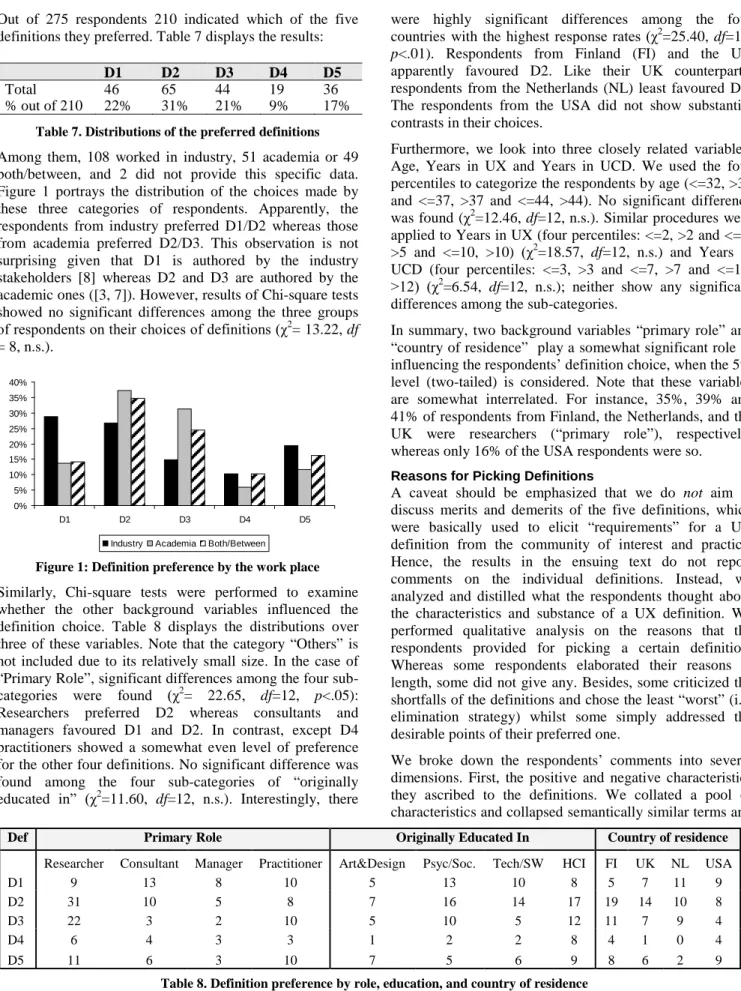
Table 7. Distributions of the preferred definitions Among them, 108 worked in industry, 51 academia or 49 both/between, and 2 did not provide this specific data. Figure 1 portrays the distribution of the choices made by these three categories of respondents. Apparently, the respondents from industry preferred D1/D2 whereas those from academia preferred D2/D3. This observation is not surprising given that D1 is authored by the industry stakeholders [8] whereas D2 and D3 are authored by the academic ones ([3, 7]). However, results of Chi-square tests showed no significant differences among the three groups of respondents on their choices of definitions (χ2= 13.22, df = 8, n.s.). 0% 5% 10% 15% 20% 25% 30% 35% 40% D1 D2 D3 D4 D5
Industry Academia Both/Between
Figure 1: Definition preference by the work place Similarly, Chi-square tests were performed to examine whether the other background variables influenced the definition choice. Table 8 displays the distributions over three of these variables. Note that the category “Others” is not included due to its relatively small size. In the case of “Primary Role”, significant differences among the four sub-categories were found (χ2
= 22.65, df=12, p<.05): Researchers preferred D2 whereas consultants and managers favoured D1 and D2. In contrast, except D4 practitioners showed a somewhat even level of preference for the other four definitions. No significant difference was found among the four sub-categories of “originally educated in” (χ2=11.60, df=12, n.s.). Interestingly, there
were highly significant differences among the four countries with the highest response rates (χ2=25.40, df=12, p<.01). Respondents from Finland (FI) and the UK apparently favoured D2. Like their UK counterparts, respondents from the Netherlands (NL) least favoured D4. The respondents from the USA did not show substantial contrasts in their choices.
Furthermore, we look into three closely related variables: Age, Years in UX and Years in UCD. We used the four percentiles to categorize the respondents by age (<=32, >33 and <=37, >37 and <=44, >44). No significant difference was found (χ2=12.46, df=12, n.s.). Similar procedures were applied to Years in UX (four percentiles: <=2, >2 and <=5, >5 and <=10, >10) (χ2=18.57, df=12, n.s.) and Years in UCD (four percentiles: <=3, >3 and <=7, >7 and <=12, >12) (χ2=6.54, df=12, n.s.); neither show any significant differences among the sub-categories.
In summary, two background variables “primary role” and “country of residence” play a somewhat significant role in influencing the respondents’ definition choice, when the 5% level (two-tailed) is considered. Note that these variables are somewhat interrelated. For instance, 35%, 39% and 41% of respondents from Finland, the Netherlands, and the UK were researchers (“primary role”), respectively, whereas only 16% of the USA respondents were so.
Reasons for Picking Definitions
A caveat should be emphasized that we do not aim to discuss merits and demerits of the five definitions, which were basically used to elicit “requirements” for a UX definition from the community of interest and practice. Hence, the results in the ensuing text do not report comments on the individual definitions. Instead, we analyzed and distilled what the respondents thought about the characteristics and substance of a UX definition. We performed qualitative analysis on the reasons that the respondents provided for picking a certain definition. Whereas some respondents elaborated their reasons at length, some did not give any. Besides, some criticized the shortfalls of the definitions and chose the least “worst” (i.e. elimination strategy) whilst some simply addressed the desirable points of their preferred one.
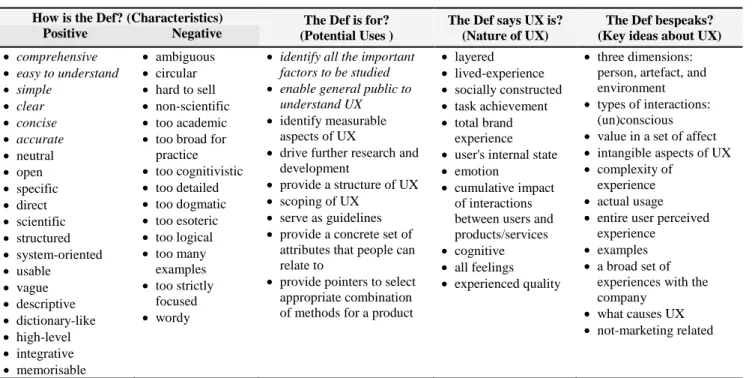
We broke down the respondents’ comments into several dimensions. First, the positive and negative characteristics they ascribed to the definitions. We collated a pool of characteristics and collapsed semantically similar terms and
Def Primary Role Originally Educated In Country of residence
Researcher Consultant Manager Practitioner Art&Design Psyc/Soc. Tech/SW HCI FI UK NL USA
D1 9 13 8 10 5 13 10 8 5 7 11 9
D2 31 10 5 8 7 16 14 17 19 14 10 8
D3 22 3 2 10 5 10 5 12 11 7 9 4
D4 6 4 3 3 1 2 2 8 4 1 0 4
D5 11 6 3 10 7 5 6 9 8 6 2 9
counted their frequencies. In the leftmost column “Positive” of Table 9, the italicized items have a frequency higher than 10 and are sorted in descending order. The respondents regarded the quality of being comprehensive, easy to understand, simple, clear, concise and accurate as most relevant for a UX definition. Interestingly, some preferable qualities such as broad and detailed are regarded as “Negative”, indicating a range of contrasting viewpoints beheld by the respondents. Second, some comments referred to the potential uses of the definitions. We grouped similar remarks and paraphrased some of them. Two most frequently mentioned uses (>10) are the first two italicized items in the corresponding column of Table 9. The emphasis on disseminating a UX definition to the general audience seems to imply that it should be formulated in laymen terms. Third, some respondents analyzed how the definitions interpret the nature of UX and which key ideas pertaining to UX they bespeak. A variety of views were expressed with no particular strongly shared ones, ranging from the debatable notion that UX is socially constructed to the recognized one that UX comprises three dimensions, viz. person, artefact, and context. Apparently, when interpreting the UX definitions, the respondents projected their own pre-conceptions about UX into the given definitions.
Furthermore, some respondents, in their comments on their preferred definitions, addressed what a UX definition should (not) have/be (cf. those aspects that are inadequately or not addressed at all in the definitions). We grouped these data into four aspects:
Temporal: This pertains to controversial arguments on when UX is brought about: before, during or after interacting with a system. Some respondents stressed that
the timeframe should cover the past, present, and future (e.g. from pre-sale perception to post-sale customer support). Interestingly, the notion of reflection has repeatedly been addressed, for instance, some respondents commented: “it [UX] involves reflecting past and anticipating future at the same time” and “subsequent reflection on experience after the initial emotion has subsided”. It implies the respondents’ assumption about the significance of the conscious aspect of experiencing, i.e., an ongoing process of reflecting on as well as in (cf. Schön’s [18] reflective practice) one’s psychological responses. Framework: As emphatically pointed out by some respondents, UX should be understood through the conceptual lens of a community of practice, which iteratively defines constructs germane to UX via its activities such as designing and critiquing objects of interest. Discipline of interaction design, UCD philosophy, hedonic/pragmatic model [5], and value-based design [2] are also relevant frameworks to consider. Besides, particularities of application contexts such as business models should inform how UX is defined.
Elements: Ingredients of a UX definition should be very well defined, as remarked by some respondents. Measurable aspects of UX such as physiological responses and user task performances (cf. traditional usability metrics) are considered relevant. So are other subjective, psychological constructs like passion, types of affects, and consumer perception. It is also important to include in the definition for whom and where it is supposed to be used.
Scoping: Some respondents tended to understand UX in terms of a broad scope, stretching beyond interaction. Others remarked that UX is not necessarily good or
How is the Def? (Characteristics) The Def is for? (Potential Uses )
The Def says UX is? (Nature of UX)
The Def bespeaks? (Key ideas about UX)
Positive Negative • comprehensive • easy to understand • simple • clear • concise • accurate • neutral • open • specific • direct • scientific • structured • system-oriented • usable • vague • descriptive • dictionary-like • high-level • integrative • memorisable • ambiguous • circular • hard to sell • non-scientific • too academic • too broad for
practice • too cognitivistic • too detailed • too dogmatic • too esoteric • too logical • too many examples • too strictly focused • wordy
• identify all the important factors to be studied • enable general public to
understand UX • identify measurable
aspects of UX
• drive further research and development
• provide a structure of UX • scoping of UX
• serve as guidelines • provide a concrete set of
attributes that people can relate to
• provide pointers to select appropriate combination of methods for a product
• layered • lived-experience • socially constructed • task achievement • total brand experience • user's internal state • emotion
• cumulative impact of interactions between users and products/services • cognitive • all feelings • experienced quality
• three dimensions: person, artefact, and environment • types of interactions:
(un)conscious • value in a set of affect • intangible aspects of UX • complexity of
experience • actual usage • entire user perceived
experience • examples • a broad set of
experiences with the company
• what causes UX • not-marketing related
narrowly equated to a cognitive process manipulated by designers. Some also argued that a definition should address what UX is rather than what causes UX.
In summary, the results of the two exercises – rating the statements and picking a definition – indicate that the respondents understand the notion of user experience very differently. However, no patterns describing how the differences systematically vary with background variables can be derived. Amongst others, “country of residence” is the only background variable that plays a significant role in influencing both the statement agreements and the definition choice. Presumably, the observed cross-continental contrasts between the European and USA respondents can be understood in terms of some basic philosophical assumptions about experience – an implication for our future research work.
REFLECTION
In this section, we discuss the topics that have evoked comments in the earlier workshops, our survey, and the related CHI’08 SIG session. We analyze these comments and share our conclusions on how to scope UX.
Social or Individual?
As we see in Table 3, the most controversial (with the highest standard deviation) statement was “Only an individual person can have an experience. An experience is something personal, something ‘within’ a person” (statement 19). The underlying topic, namely whether experience is social or individual, has been discussed in co-experience research [1] and also in the CHI’08 SIG session. Some of the survey respondents and participants of the SIG session emphasized that experience is very much bound to users’ social groups and a community may share the experience.
We agree that other people may influence the experience a lot before, during, and after interacting with a product. However, only an individual can have feelings and experiences. A group can experience together, but the experience we are investigating is still inside each individual of that group. The community forms the social context that affects user experience together with other contextual factors: physical, technology, and task context (cf. ISO13407: 1999 [11]). As agreed by most respondents, the contextual factors are important influencers of UX (statement 5). Some respondent comments are supporting our social context view, for example: “Only an individual can have an experience but I believe it can be externalised (albeit poorly) and recognised and related to by others.”
User Experience in Relation to Other Experiences
When investigating the open answers and comments in the survey, we find that some researchers do not want to restrict UX to interaction with a product or an artefact. “UX is more than interactions with products”. “Please do not use the term ‘artefact’ to describe UX. UX is not limited to artefacts”, “Users not only interact with services or
products but also with the company”, “For instance, when you see a bottle of Evian crumpled up on the street, you may well think of Evian in association with your disgust for litter and environmental disaster. That is an indirect, unconscious interaction with a product, but it still impacts how you feel about the brand and the product.”
This shows the need to define the scope of user experience more precisely. What is the relation between brand experience and user experience? How about user experience and product or service experience? Or just plain ‘experience’?
Brand experience includes not only interaction with the branded products, but interaction with the company, its products and services. Brand experience is a broader concept than user experience. Every bit of information you get about the company either from the company itself, from the media, or from other people affects your brand experience. Brand experience affects the user experience when you interact with the product: you forgive flaws for a loved brand and blame loudly the flaws in the products of a bad brand. You might even refuse to interact with products from a bad brand, see the water bottle example above. If you have never used a product, we think all we can discuss is brand experience or perhaps product experience, but not user experience. Once you do interact with a product the user experience typically affects the brand experience. Everything before the first-hand encounter with a product just builds up expectations for the user experience or affects the brand experience.
Desmet and Hekkert [3] use the term product experience when discussing the interaction with an artefact. Product experience has a narrower scope than user experience, as not all objects are commercial products. You might get the best user experience from a self-made item, or prefer a walking stick found from the woods over one bought from a shop. Also, more and more products do not work in isolation, but are dependent on external systems. A mobile phone does not work without the carrier telephone network; iTunes is an important part of iPod user experience, etc. As user experience researchers, we are definitely interested in interactions with any kind of items and systems, whether commercial or non-commercial. If we want to emphasize that experience is subjective (“I had great experience using this”) rather than a product attribute (“this product has excellent user experience”), we recommend using the term user experience over product experience.
Service experience in a broad sense can refer to face-to-face services (e.g. in a restaurant or repair point), public services (e.g. roads), digital services on the Internet servers (e.g. gambling site), or anything in between. Because of the wide variety of services, we need to be careful when talking about service experience. We argue that face-to-face services are not in the focus of user experience, because humans do not have a user interface and so one cannot ‘use’ humans. Customer services related to a product do affect
the overall UX of the product, similar to reading a test report of the product in a magazine. If a company provides an online trouble-shooting tool for problems with the product, we can examine the user experience of using that tool separately from the user experience of using the product itself. So the product UX is separate from the UX of the product–related service.
In summary, we recommend the term user experience to be scoped to products, systems, services, and objects that a person interacts with through a user interface (Figure 2). These can be tools, knowledge systems, or entertainment services, for example. In this paper, we talk about systems or products for the sake of simplicity. Face-to-face interaction between humans is outside the scope of user experience, unless there is a man-made user interface involved in the interaction.
Figure 2. UX in relation to other experiences that we can study
Experience Before, During, and After interaction
The respondents of our survey agreed that the current internal state of the person, earlier experiences, as well as the current context affect the user experience (statements 3, 5, 8). Because of the changing internal state and context, it is natural that more respondents agreed that user experience needs to be assessed while interacting with an artefact rather than after the interaction (statements 17, 10). On the other hand, respondents believed that different user experiences can be compared, in spite of the fleeting nature of the circumstances affecting UX (statement 9).
Some respondents commented that UX can or even should be investigated during and after, even long after, the interaction (cf. the section “Reasons for Picking Definitions”). Industry is typically interested in the long-term user experience, as temporary feelings are less important than the overall product user experience when people evaluate products. It would be very interesting to understand the formula from the expectations to different emotions during the interaction and all the way to the overall ‘UX score’ of a system. This is an interesting research topic for the future [6].
ISO Definition for UX
It is now interesting to investigate if the UX definition proposed by ISO (2008) [10] is in line with the views we have collected with the questionnaire and discussed in this
paper. The draft definition reads (we do not discuss the notes of the definition at this stage of the ISO ratification process):
A person's perceptions and responses that result from the use or anticipated use of a product, system or service The definition is in line with the view by most respondents about the subjectivity of UX. The definition focuses UX on the immediate consequences of use (perceptions and responses), but also introduces the concept of ‘anticipated use’. In our questionnaire, statement 2 about ‘imagined use’ was the hardest one to answer, with 14% of respondents choosing the “don’t understand” option. This suggests that clarifications are needed also for the term ‘anticipated use’, especially its relation to user’s expectations, for example, after seeing an advertisement of a product. As UX is strongly affected by contextual factors, the authors see it important to vividly imagine use cases with contextual factors to evoke realistic experiences out of anticipated use. For practitioners, it is essential to evaluate UX already in the early phases of product development, so methods for studying UX of anticipated use without an actual working system will be a very valuable support for their work. The ISO definition also addresses the object that the investigated UX is related to: product, system, or service. This means the definition is in line with our view that user experience is related to usage, and so, is a narrower concept than general ‘experience’. It is hard to pick one word for the object of UX, but it is also hard to make a list that would be comprehensive and unambiguous. Specifically, self-made or natural objects do not fit into the list, and ‘service’ is a term too broad. According to our views, user experience focuses on interaction between a person and something that has a user interface (Figure 2).
CONCLUSION
With our survey on UX, we have been able to systematically gather scientific as well as practical views on the nature and scope of UX. These heterogeneous views were conveyed by UX researchers and practitioners from academia and industry. The results show that the respondents tend to agree on a concept of UX as dynamic, context-dependent and subjective, which stems from a broad range of potential benefits users may derive from a product. UX is seen as something new, which must be a part of the HCI domain and be grounded in UCD practices. The differences in respondents’ background variables, however, can only explicate to a limited extent the variations in their agreements on the statements and in definition choices.
Presumably, respondents with a relatively longer period of working years in UX/UCD could understand UX in a way very different from their counterparts with a shorter one, and we also expected to see some significant differences between academics and practitioners. However, our survey findings suggest that years of experience and work place
Product Object System Service Space Art Brand Event Face-to-face interaction etc.
Interaction via user interface Exercise
Everything we experience
User experience Experience
seem not to have a strong impact on the respondents’ perceptions of the statements or definitions. Interestingly, some socio-cultural factors seem relevant, given the significant role played by the variable ‘country of residence’. However, it is hard to tease out the intertwined issues (e.g. different professional training and practice in UX in individual countries).
Furthermore, some topics require clarifications according to the survey data, such as the social and temporal aspects of UX, as well as the related terms. We conclude that the draft UX definition by ISO is a promising one, but the used terms will require further explanations, e.g. ‘anticipated use’ and the list of the possible objects of UX. Our work towards a shared definition on UX can now continue from a more solid grounding.
REFERENCES
[1] Battarbee, K. 2003. Defining co-experience.
Proceedings of the 2003 international Conference on Designing Pleasurable Products and Interfaces (PPPI’03) (pp. 109-113), Pittsburgh, PA, USA, June 23 - 26, 2003. New York: ACM.
[2] Cockton, G. (2008). Putting Value into E-valu-ation. In E. L-C. Law, E. T. Hvannberg, & C. Gilbert (Eds.), Maturing usability: Quality in software, interaction and value (pp. 287-317). London: Springer.
[3] Desmet. P. M. A.. & Hekkert. P. (2007). Framework of product experience. International Journal of Design. 1(1), 57-66.
[4] Forlizzi. J., & Ford. S. (2000). The building blocks of experience: An early framework for interaction designers. Proceedings of Designing Interactive Systems (DIS 2000), New York City, USA.
[5] Hassenzahl, M. (2003). The thing and I: understanding the relationship between user and product. In M. Blythe, C. Overbeeke, A. F. Monk, & P. C. Wright (Eds.), Funology: From Usability to Enjoyment (pp. 31-42). Dordrecht: Kluwer.
[6] Hassenzahl, M. & Sandweg, N. (2004). From mental effort to perceived usability: Transforming experiences into summary assessments. Proceedings of ACM CHI 2004, Extended Abstracts (pp. 1283-1286). Vienna, Austria.
[7] Hassenzahl, M., & Tractinsky, N. (2006). User Experience - a research agenda [Editorial]. Behavior & Information Technology, 25(2), 91-97.
[8] http://www.nngroup.com/about/userexperience.html (last verified 5 September 2008)
[9] http://www.uxnet.org/ (last verified 5 September 2008) [10] ISO DIS 9241-210:2008. Ergonomics of human system
interaction - Part 210: Human-centred design for interactive systems (formerly known as 13407). International Organization for Standardization (ISO). Switzerland.
[11] ISO13407:1999. Human-centred design processes for interactive systems. International Organization for Standardization. Switzerland.
[12] Jordan, P.W. (2002). Designing pleasurable products. CRC Press.
[13] Law, E. L-C., Hvannberg, E.T., & Hassenzahl, M. (2006). Proceedings of the workshop on Towards a Unified View of UX, 14 October 2006, in conjunction
with NordiCHI’06, Oslo, Norway. Online at:
http://www.cost294.org/
[14] Law, E. L-C., Vermeeren, A., Hassenzahl, M., & Blythe, M. (Eds.) (2007). Proceedings of the workshop on Towards a UX Manifesto, in conjunction with HCI Conference, Lancaster, UK, 3rd Sept. 2007. Online at: http://www.cost294.org
[15] Law, E. L-C., Roto, V., Vermeeren, A.P.O.S., Kort, J. and Hassenzahl, M. (2008). SIG on Towards a shared definition of user experience. Proceedings of ACM CHI 2008, (pp. 2395-2398), Florence, Italy.
[16] Law, E. L-C., Bevan, N., Christos, G., Springett, M., & Larusdottir, M. (Eds.) (2008). COST294-MAUSE Workshop on Meaningful Measures: Valid Useful User Experience Measurements (VUUM), 18th June 2008, Reykjavik, Iceland. (ISBN: 978-2-917490-02-0) [17] McCarthy, J., & Wright, P.C. (2004). Technology as
experience. MIT Press.
[18] Schön, D. (1983). The Reflective Practice. Basic Books, New York.
[19] Sward, D. (2006). Gaining a competitive advantage through user experience design. Online at: http://www.intel.com/it/pdf/comp-adv-user-exp.pdf [20] Sward D., & MacArthur, G. (2007). Making user
experience a business strategy. In E. Law et al. (eds.), Proceedings of the Workshop on Towards a UX Manifesto, 3 Sept. 2007, Lancaster, UK (pp 35-40). Online at: http://www.cost294.org
[21] Tractinsky, N., Katz, A.S., & Ikar, D. (2000). What is beautiful is usable. Interacting with Computers, 13, 127-145.
[22] Väänänen-Vainio-Mattila, K., Roto, V., & Hassenzahl, M. (2008). Towards practical user experience evaluation methods. In Proceedings of the COST294-MAUSE Workshop on Meaningful Measures: Valid Useful User Experience Measurement (VUUM), 18th June, 2008, Reykjavik, Iceland.
[23] Wright, P.C., & Blythe, M. (2007). User experience research as an inter-discipline: Towards a UX Manifesto. In E. Law, A. Vermeeren, M. Hassenzahl, & M. Blythe (Eds.), Proceedings of the Workshop on Towards a UX Manifesto (pp. 65-70), in conjunction with HCI Conference 2007, Lancaster, UK.