PREPRINT;FINALPAPERPUBLISHED@ISPRSJOURNAL OF PHOTOGRAMMETRY AND REMOTE SENSING,
VOL.151,PP.42-58,MAY 2019
1
V
IRTUAL
S
UPPORT
V
ECTOR
M
ACHINES WITH
S
ELF
-L
EARNING
S
TRATEGY FOR
C
LASSIFICATION OF
M
ULTISPECTRAL
R
EMOTE
S
ENSING
I
MAGERY
Christian Geiß*, Patrick Aravena Pelizari, Lukas Blickensdörfer, and Hannes Taubenböck German Remote Sensing Data Center (DFD), German Aerospace Center (DLR), 82234 Weßling-Oberpfaffenhofen, Germany; [email protected], [email protected],
[email protected], [email protected]
Abstract: We follow the idea of learning invariant decision functions for remote sensing image classification with Support Vector Machines (SVM). To do so we generate artificially transformed samples (i.e., virtual samples) from available prior knowledge. Labeled samples closest to the separating hyperplane with maximum margin (i.e., the Support Vectors) are identified by learning an initial SVM model. The Support Vectors are used for generating virtual samples by perturbing the features to which the model should be invariant. Subsequently, the model is relearned using the Support Vectors and the virtual samples to eventually alter the hyperplane with maximum margin and enhance generalization capabilities of decisions functions. In contrast to existing approaches, we establish a self-learning procedure to ultimately prune non-informative virtual samples from a possibly arbitrary invariance generation process to allow for robust and sparse model solutions. The self-learning strategy jointly considers a similarity and margin sampling constraint. In addition, we innovatively explore the invariance generation process in the context of an object-based image analysis framework. Image elements (i.e., pixels) are aggregated to image objects (as represented by segments/superpixels) with a segmentation algorithm. From an initial singular segmentation level, invariances are encoded by varying hyperparameters of the segmentation algorithm in terms of scale and shape. Experimental results are obtained from two very high spatial resolution multispectral data sets acquired over the city of Cologne, Germany, and the Hagadera Refugee Camp, Kenya. Comparative model accuracy evaluations underline the favorable performance properties of the proposed methods especially in settings with very few labeled samples.
Keywords: Classification, Support Vector Machines, Self-Learning, Active Learning Heuristics, Very High Spatial Resolution Imagery.
PREPRINT;FINALPAPERPUBLISHED@ISPRSJOURNAL OF PHOTOGRAMMETRY AND REMOTE SENSING,
VOL.151,PP.42-58,MAY 2019
2
1 Introduction
Developing methods for information extraction from remote sensing imagery has been one of the major tasks of the scientific remote sensing community in the past decades. Thereby, different strategies are followed to derive thematic classes from the image data. Due to their comparatively robust and accurate information extraction properties, supervised methods belong to the most popular group of classification approaches. The idea of such approaches is to infer a decision rule (e.g., a function) from limited but properly encoded prior knowledge (i.e., labeled training samples) to allow for an accurate association of class labels for unseen (i.e., unlabeled) samples. However, it is generally very challenging to choose the best method (most likely in terms of classification accuracy) from dozens of different existing approaches for an individual classification problem (Fernández-Delgado et al., 2014). This can be related to the No Free Lunch Theorem, which states, briefly speaking, that if a strategy is more favorable in a certain subdomain then it must be less favorable in another subdomain (Wolpert, 1996; Duda et al., 2001). Nevertheless, for the subdomain of supervised classification problems jointly dealing with i) a small amount of labeled training samples, ii) a high number of features, and iii) complex, nonlinear class distributions, a number of non-parametric machine learning algorithms can be considered as a viable option in general. Their algorithm properties make them in particular relevant for this situation.
For instance, Random Forests (Breiman, 2001) grow multiple decision trees on random subsets of the training samples. The high variance among individual trees, letting each tree vote for the class assignment and determining the respective class according to the majority of the votes, allows the accurate and robust classification of unseen samples with little need for tuning, even when many noisy variables are existent (Stumpf and Kerle, 2011). Alternatively, Support Vector Machines (SVM) is a very popular approach in this application context since they also offer the capability of effectively handling complex remote sensing classification problems (Melgani and Bruzzone, 2004; Camps-Valls and Bruzzone, 2009). They are based on the structural risk minimization principle, which suggest a tradeoff between the accuracy of an approximation and the complexity of the affiliated approximation function. SVM determine a suitable set of parameters to fit a decision surface, the so-called hyperplane, between different classes of labeled samples. To deal with nonlinear problems, the labeled samples are mapped through a nonlinear transformation ϕ(·) from the input space into a space of higher dimensionality. In that space, the optimal separating hyperplane maximizes the margin between the patterns of the different classes and the hyperplane. The maximized margin can be described by two additional, marginal hyperplanes that border the samples closest to the separating surface, the so-called support vectors (SVs) (Burges, 1998; Leinenkugel et al., 2011; Geiß et al., 2016a). Only those samples are needed to define the
model, what allows for building robust models with a high generalization capability based on
a comparatively small number of labeled training samples. Simultaneously, this algorithm property opens the opportunity to encode further prior knowledge in the classifier in a very
efficient way: When learning a classification model from labeled samples it is preferable that
the solution is robust with respect to changes in the representation of the objects in the data. Those might occur when objects in the data are transformed, e.g., due to perturbations and variations in size, alignment or noise level of the affiliated signal (Camps-Valls et al., 2014).
PREPRINT;FINALPAPERPUBLISHED@ISPRSJOURNAL OF PHOTOGRAMMETRY AND REMOTE SENSING,
VOL.151,PP.42-58,MAY 2019
3
The incooperation of such properties into the classification model (i.e., here decision functions) renders an algorithm “invariant” (Izquierdo-Verdiguier et al., 2013). In this sense, a suitable approach should account for a tailored regularization scheme to allow for a high generalization capability of learned decision functions also for unseen data with a considerable share of transformed objects.
From different options to encode invariances in SVM as e.g., discussed in (Decoste and Schölkopf, 2002), we consider in this paper the idea to generate artificially transformed
samples (i.e., virtual samples) from the training samples to augment the set of labeled samples
which the model is learned from. Recently, data augmentation strategies are frequently implemented in the context of deep learning procedures (Wang and Perez, 2017). Such techniques normally need a large pool of training data to generalize well. Consequently, ideas were followed to crop, rotate, or flip image data used for training to enlarge the training data and enhance the model accuracy (Yu et al., 2017; Nogueira et al., 2017; Audebert et al., 2018). However, as indicated, SVM allow for a very efficient way to add artificially transformed samples into the model (in contrast to e.g., neural networks), since frequently only a few samples are needed from the whole set of available labeled samples to define the model. As such, artificially transformed samples are generated only from a subset of the labeled training samples (i.e., those samples that become a Support Vector after a preliminary model run). This renders the approach in particular feasible from a computational point of view.
Interestingly, the idea to augment the training set by using virtual samples in order to render a SVM model invariant was introduced quite recently to the context of remote sensing image classification. In this manner, the authors of (Izquierdo-Verdiguier et al., 2013) encode invariances to rotations and object scales in the context of patch-based image classification (i.e., in relation to square-shaped image subsets representing objects of interest). There, invariances are pre-engineered by an expert and added to the model without further constrains.
In contrast to that, we establish a procedure that first identifies labeled samples closest to the separating hyperplane with maximum margin - the SVs – from learning an initial SVM model. Those SVs are the basis for generating artificially transformed samples, i.e., virtual samples, by perturbing the features to which the model should be invariant. In previous works, the model is relearned using SVs and virtual samples to eventually alter the hyperplane with maximum margin and enhance generalization capabilities of decisions functions. This approach is called Virtual Support Vector Machines (VSVM) (Decoste and Schölkopf, 2002; Izquierdo-Verdiguier et al., 2013). However, it is very challenging and critical to add valuable virtual samples to a model with a high degree of automatization (i.e., minimizing the amount of necessary prior knowledge). If virtual samples are not properly generated and selected, they can introduce divergence and thus reduce classification accuracy of a relearned model (Izquierdo-Verdiguier et al., 2013). Moreover, only few informative virtual samples should be considered to enable improvements in model generalization capability while keeping simultaneously computational complexity low. To address the aforementioned considerations, we follow a self-learning strategy to eventually prune virtual samples from an arbitrary
PREPRINT;FINALPAPERPUBLISHED@ISPRSJOURNAL OF PHOTOGRAMMETRY AND REMOTE SENSING,
VOL.151,PP.42-58,MAY 2019
4
invariance generation process to subsequently establish robust and sparse model solutions. To this purpose, generated virtual samples are evaluated first with respect to the Euclidean distance in feature space to their affiliated SVs and are pruned from the set of training samples if they exceed an empirically determined class-specific distance. Second, residual virtual samples are also evaluated with respect to their position to the margin and are pruned from the set of training samples if they exceed a specific margin distance. The model is relearned using SVs and residual virtual samples to establish an invariant SVM model. Thereby, determination of hyperparameters of the self-learning constraints is rendered as a further minimization objective. The term Virtual Support Vector Machines with self-learning strategy (VSVM-SL) is used in the subsequent paper when referring to this technique.
The self-learning strategy can be interpreted as an active learning procedure (Tuia et al., 2009), where the iterative human-machine interaction is substituted in favor of a singular machine-machine interaction. Related ideas were exploited in the context of semi-supervised classification approaches. Such methods iteratively label unlabeled samples based on a preliminary trained learning machine to enhance generalization capabilities in subsequent model learning stages and enable faster convergence (i.e., obtain higher accuracies for the same amount of encoded prior knowledge compared to purely supervised approaches) (Bruzzone et al., 2006). Thereby, active queries (Tuia et al., 2011) aim to enable the selection of few relevant unlabeled samples. This is done to only consider highly informative samples, for instance uncertain samples close to the border of the hyperplane (Demir et al., 2011). In this way significant improvements in accuracy become possible without taking a large number of unlabeled samples into account, and thus increase computational complexity. In addition, an unconstrained selection of unlabeled samples may lead to reduced accuracies if they add noise and blur distinctive class patterns in feature space (Dópido et al., 2013; Li and Zhou, 2015; Lu et al., 2016).
Besides the actual model learning procedure, we innovatively explore the invariance generation process in the context of an object-based image analysis (OBIA) framework (Blaschke, 2010; Geiß and Taubenböck, 2015; Geiß et al., 2016b). There, the aim is to aggregate image elements (i.e., pixels) to meaningful image objects (as represented by segments/superpixels) with a segmentation algorithm. From an initial singular segmentation level, invariances are encoded by varying hyperparameters of the segmentation algorithm in terms of scale (i.e., by establishing a hierarchical multi-level segmentation; (Bruzzone and Carlin 2006; Taubenböck et al., 2010) and shape (i.e., by considering multiple segmentation levels as obtained with varying shape-related hyperparameters).
The proposed method can be considered in particular relevant in situations where the ground sampling distance is much smaller than the objects of interest and the spectral resolution is limited as it is the case for multispectral imagery. This is related to the fact that geospatial variations of representations of objects are considered here for learning a model. Such a principle is less relevant if objects of interest are equal to the ground sampling distance (i.e., an image element corresponds to an object of interest and, thus, pixel-by-pixel techniques are more appropriate) or if objects of interest are smaller than the ground sampling distance (i.e., an image element covers multiple objects of interest and, thus, sub-pixel techniques are more
PREPRINT; appropriate
limited spectral resolution by enabling the encoding of information compared to single pixels as well
general, multispectral
GeoEye, among others, in the context of acquired
compare it to classification and multi
without self
amount of labeled training samples is available The remainder of the paper
method. Section 2 Proposed Methodology The VSVM model invariances
virtual samples. iii)
virtual samples and consider only
relearning the model. The functionality of VSVM is presented in Section learning constraints are detailed in
Section
Fig. 1. Block scheme of the proposed VSVM approach with self PREPRINT;FINAL
appropriate). The geospatial v
limited spectral resolution by enabling the encoding of information compared to single pixels as well
general, this relation multispectral sensors GeoEye, among others,
in the context of classification of acquired over urban environments compare it to classification and multi-level segmentation without self-learning
amount of labeled training samples is available remainder of the paper
. We describe the experimental setup in Section 4 and the paper is concluded
Proposed Methodology
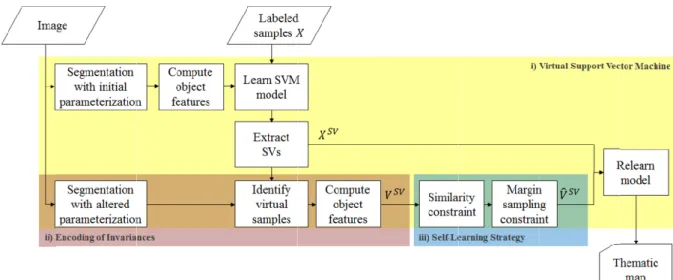
The VSVM-SL approach consists of three
model is learned and invariances by computing
virtual samples. iii)
virtual samples and consider only
relearning the model. The functionality of VSVM is presented in Section learning constraints are detailed in
Section 2.3.
Block scheme of the proposed VSVM approach with self FINALPAPERPUBLISHED
The geospatial v
limited spectral resolution by enabling the encoding of information compared to single pixels as well
this relation can occur in various remote sensing data sensors with a very high spatial resolution GeoEye, among others, feature such
classification of over urban environments compare it to classification results
segmentation learning constraints
amount of labeled training samples is available remainder of the paper
We describe the experimental setup in paper is concluded
Proposed Methodology
SL approach consists of three
is learned and affiliated SVs are extracted computing additional object features virtual samples. iii) Subsequently, a
virtual samples and consider only
relearning the model. The functionality of VSVM is presented in Section learning constraints are detailed in
Block scheme of the proposed VSVM approach with self PUBLISHED@
The geospatial variations of representations of objects limited spectral resolution by enabling the encoding of
information compared to single pixels as well
can occur in various remote sensing data with a very high spatial resolution
feature such situations
classification of VHR multispectral over urban environments. To demonstrate
results obtained
segmentation. We also provide results of
constraints. Thereby, a particular focus is on settings where only a small amount of labeled training samples is available
is organized We describe the experimental setup in
paper is concluded and future directions are drawn
SL approach consists of three
affiliated SVs are extracted
additional object features Subsequently, a self
virtual samples and consider only informati
relearning the model. The functionality of VSVM is presented in Section learning constraints are detailed in Section
Block scheme of the proposed VSVM approach with self ISPRSJOURNAL OF
ariations of representations of objects limited spectral resolution by enabling the encoding of
information compared to single pixels as well as consideration of shape can occur in various remote sensing data
with a very high spatial resolution
situations. Consequently, w multispectral
demonstrate the relevance of the obtained with features
also provide results of
. Thereby, a particular focus is on settings where only a small amount of labeled training samples is available.
is organized as follows We describe the experimental setup in Section
and future directions are drawn
SL approach consists of three main interlinked
affiliated SVs are extracted
additional object features
self-learning strategy
informative virtual samples in conjunction with SVs for relearning the model. The functionality of VSVM is presented in Section
Section 2.2. E
Block scheme of the proposed VSVM approach with self
OURNAL OF PHOTOGRAMMETRY AND ariations of representations of objects
limited spectral resolution by enabling the encoding of
consideration of shape can occur in various remote sensing data.
with a very high spatial resolution (VHR) Consequently, w multispectral imagery f
the relevance of the with features computed also provide results of VSVM
. Thereby, a particular focus is on settings where only a small
as follows. In Section
ection 3. Experimental results are and future directions are drawn
interlinked modules (
affiliated SVs are extracted. ii) Those
additional object features, which are represented in the model as
learning strategy is employed
virtual samples in conjunction with SVs for relearning the model. The functionality of VSVM is presented in Section
Encoding of
Block scheme of the proposed VSVM approach with self-learning strategy
OTOGRAMMETRY AND
VOL.151 ariations of representations of objects allow limited spectral resolution by enabling the encoding of valuable
consideration of shape-related properties. . However, especially data from (VHR) such as WorldView
Consequently, we apply the
from the WorldView the relevance of the proposed
computed from VSVM when
. Thereby, a particular focus is on settings where only a small
Section 2 we detail the proposed . Experimental results are
and future directions are drawn in Section
modules (Fig. 1 Those govern
, which are represented in the model as is employed to eventual
virtual samples in conjunction with SVs for relearning the model. The functionality of VSVM is presented in Section
ncoding of invariance
learning strategy
OTOGRAMMETRY AND REMOTE
51,PP.42-58,M allow alleviating valuable additional spectral
related properties. However, especially data from
such as WorldView e apply the proposed WorldView-II
proposed method, we from both single when learned with and . Thereby, a particular focus is on settings where only a small
we detail the proposed . Experimental results are revealed in
in Section 5.
1): i) an initial SVM govern the encoding of , which are represented in the model as
to eventually
virtual samples in conjunction with SVs for relearning the model. The functionality of VSVM is presented in Section 2.1, and the
invariances is described in EMOTE SENSING, MAY 2019 5 alleviating the additional spectral related properties. In However, especially data from -I–IV or proposed method II sensor method, we single-level with and . Thereby, a particular focus is on settings where only a small
we detail the proposed revealed in
initial SVM encoding of
, which are represented in the model as ly prune virtual samples in conjunction with SVs for , and the self-is described in
PREPRINT;FINALPAPERPUBLISHED@ISPRSJOURNAL OF PHOTOGRAMMETRY AND REMOTE SENSING,
VOL.151,PP.42-58,MAY 2019
6
2.1 Virtual Support Vector Machines
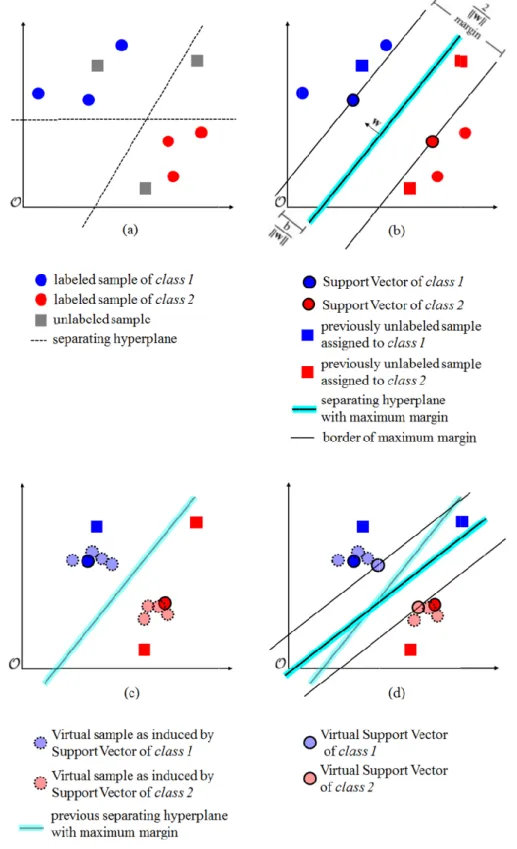
VSVM represent a modification of the popular SVM approach (Cortes and Vapnik, 1995). The latter solves a minimization objective to establish a separating hyperplane with maximum margin between labeled samples of different classes (Fig. 2a-b). Let us consider an image
and corresponding labeled samples = { , } , with ∈ ℝ and ∈ {−1, +1}. The
imagery is mapped through a nonlinear transformation ϕ(·) to a space with a higher dimensionality. Then, the minimization objective is formulated as follows:
min , , 1 2‖ ‖ + (1) subject to (〈 ( ), 〉 + ) ≥ 1 − ∀i = 1, …, n (2) ≥ 0 ∀i = 1,…, n (3)
where w is the normal perpendicular to the optimal separating hyperplane and b is the nearest
distance to the origin (O) of the coordinate system. These two parameters constitute a linear
classifier, which separates the labeled samples of different classes with maximum margin. To enhance generalization capabilities and reduce over-fitting, positive slack variables are introduced, which account for labeled samples lying on the incorrect side of the respective margin boundary. The constant C determines the trade-off between maximizing the margin and the number of incorrectly classified samples (training errors). The minimization objective of equation (1) is reformulated from its primal form to its dual form by introducing Lagrange multipliers, so that it can be solved efficiently with quadratic programming techniques (Schölkopf and Smola, 2002). Finally, a decision function is given that allows assigning a
class label to an instance of unknown class membership ∗
( ∗) = sgn ( , ∗) + (4)
with being the Lagrange multipliers and being a kernel function. The kernel function
is expressed as the dot product of mapped instances , = 〈 ( ), ( )〉. The
Lagrange multipliers are determined by optimization and feature nonzero values for instances lying on the margin – the SVs (Cortes and Vapnik, 1995; Camps-Valls and Bruzzone, 2009; Geiß et al., 2016a).
PREPRINT;
Fig. 2. Functionality of Virtual Support Vector Machines. that linearly separate the classes of the training
training samples maximum margin
artificially transformed samples
only labeled samples that became a SV after an initial model run in conjunction with affiliated to eventually alter the hyperplane with maximum margin.
relabeled
PREPRINT;FINAL
Functionality of Virtual Support Vector Machines. that linearly separate the classes of the training
samples with maximum margin. maximum margin - the SVs
tificially transformed samples
only labeled samples that became a SV after an initial model run in conjunction with affiliated to eventually alter the hyperplane with maximum margin.
relabeled according to
FINALPAPERPUBLISHED
Functionality of Virtual Support Vector Machines. that linearly separate the classes of the training
with maximum margin.
the SVs - are needed to define the model. tificially transformed samples, i.e.,
only labeled samples that became a SV after an initial model run in conjunction with affiliated to eventually alter the hyperplane with maximum margin.
their position
PUBLISHED@
Functionality of Virtual Support Vector Machines. that linearly separate the classes of the training samples
with maximum margin. Only labeled samples are needed to define the model.
i.e., virtual samples
only labeled samples that became a SV after an initial model run in conjunction with affiliated to eventually alter the hyperplane with maximum margin.
position with respect
ISPRSJOURNAL OF
Functionality of Virtual Support Vector Machines. (a) samples, (b) first Only labeled samples are needed to define the model.
virtual samples, to encode invariances
only labeled samples that became a SV after an initial model run in conjunction with affiliated to eventually alter the hyperplane with maximum margin.
with respect to the final separating hyperplane with maximum margin.
OURNAL OF PHOTOGRAMMETRY AND
(a) From an arbitrary set of first the hyperplane
Only labeled samples closest to the separating are needed to define the model. Subsequently, t
to encode invariances
only labeled samples that became a SV after an initial model run in conjunction with affiliated to eventually alter the hyperplane with maximum margin. Previously
separating hyperplane with maximum margin.
OTOGRAMMETRY AND
VOL.151
From an arbitrary set of separating
hyperplane is established that separates the closest to the separating
Subsequently, those SVs are used to to encode invariances. (d) The model is relearned u only labeled samples that became a SV after an initial model run in conjunction with affiliated
reviously unlabeled samples are separating hyperplane with maximum margin.
OTOGRAMMETRY AND REMOTE
51,PP.42-58,M
separating hyperplanes is established that separates the closest to the separating hyperplane with
hose SVs are used to (c) The model is relearned u only labeled samples that became a SV after an initial model run in conjunction with affiliated virtual samples
samples are eventually separating hyperplane with maximum margin.
EMOTE SENSING, MAY 2019
7
hyperplanes is established that separates the hyperplane with (c) generate The model is relearned using virtual samples eventually separating hyperplane with maximum margin.
PREPRINT;FINALPAPERPUBLISHED@ISPRSJOURNAL OF PHOTOGRAMMETRY AND REMOTE SENSING,
VOL.151,PP.42-58,MAY 2019
8
The VSVM approach builds upon an initially learned SVM model. This model is used to extract labeled samples that became a SV. Extracted SVs govern the encoding of invariances by altering previously modelled objects and recomputing affiliated features, which are added to the feature space as virtual samples (Fig. 2c). Those virtual samples are deployed in conjunction with SVs to relearn the model, which eventually alters the hyperplane with maximum margin (Fig. 2 d). In previous works, virtual samples as induced by SVs are called Virtual Support Vectors (VSVs). However, to allow for an unambiguous terminology, we only refer to VSVs if virtual samples become a sample closest to the separating hyperplane with maximum margin after the second model run.
It is important to note that hyperparameters of the VSVM model must not be optimized by cross-validation for the second model run. This is related to the circumstance that the number of virtual samples is always a multiple of the number of SVs (cf. Section 2.3), and thus it is possible to fit the model dominantly to virtual samples, while SVs lose influence. In addition to that, virtual samples are likely to show feature characteristics that resemble their corresponding SV. Hence, a consistent separation and simulation of unseen data in a cross-validation procedure might be violated when using a training set that contains virtual samples
(also known as data leakage). That is why we use the holdout method (Foody, 2009) instead
of cross-validation for model selection with optimal hyperparameters and consider it as an intrinsic part of the VSVM approach. Consequently, from the pool of labeled samples a
training set = { , } ∈ and test set = { , } ∈ is drawn,
whereby samples of the training set must not be included in the test set, i.e., ∩ =
∅. To account for spatial autocorrelation, and should be also compiled in a strict
spatially disjoint way to allow for unbiased estimates of model generalization capabilities (Geiß et al., 2017a). The procedure to learn VSVM is also described in the pseudocode under Algorithm 1.
__________________________________________________________________________ Algorithm 1 Virtual Support Vector Machines
___________________________________________________________________________ Inputs:
Pool of labeled samples: ,
Output:
VSVM: SVM classifier retrained with training set
1. Learn SVM model with
2. Extract SVs and add them to a pool
3. Perturb features based on to generate a pool of virtual samples
4. Compile training set = ∪
5. Learn SVM model with and select model with optimal hyperparameters based
on
PREPRINT;FINALPAPERPUBLISHED@ISPRSJOURNAL OF PHOTOGRAMMETRY AND REMOTE SENSING,
VOL.151,PP.42-58,MAY 2019
9
2.2 Self-Learning Strategy
To eventually prune uninformative virtual samples from the features space, a two-step self-learning strategy is followed by consecutive consideration of a similarity and margin sampling constraint.
1) Similarity constraint: To only employ virtual samples that encode similar properties as
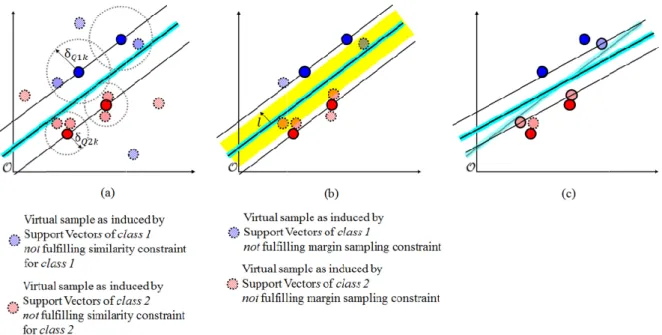
their corresponding SVs, the Euclidian distance between a virtual sample and its SV is computed in the feature space first (Fig. 3a) (Lu et al., 2016). Thereby it is assumed that virtual samples which show a large distance in the feature space with respect to their corresponding SVs do not represent reliable invariances, and are highly prone to
induce divergence in the model. The distance measure is computed as follows:
= ( − )² (5)
where , = {1,2, … , } denotes the th virtual sample derived from ; is the
th SV, = {1,2, … , }, and denotes the number of features. To eventually prune virtual samples, a maximum distance threshold is introduced. Since distances in the feature space are highly dependent on the scene characteristics and thematic class of interest, must be adjusted for an individual classification problem and a considered thematic class. To adjust in an automated manner, it is calculated per class as follows:
= 2
( − 1) ( − )² (6)
where is the number of SVs per thematic class , and and denote the th
and th SV, respectively, of class . In other words, is the mean distance in feature
space between all SVs that belong to the same thematic class . However, it can be beneficial to narrow in situations, where already a large amount of information
content is encoded in , typically induced by a high number of SVs, or to
alternatively widen it in the contrary case. To introduce this flexibility to the model,
we multiply with a factor :
= ∗ (7)
Thereby, smaller numeric values of establish a more progressive pruning of virtual samples compared to larger numeric values. Finally, virtual samples are pruned from
according to:
= ∩ ≤ (8)
where the pool contains only virtual samples that lie within the radius of with
PREPRINT;
2) Margin sampling
Tuia et al., 2011; Geiß et al., 2017 far apart from the
therefore contribute virtual samples constraint the hyperplane sample to the
virtual sample to the hyperplane can be determined for a binary SVM by adapting the decision function (4) according to:
where deploy a one
sample is fulfilling the margin sampling constraint if its smaller than
Fig. 3. Functionality of Self distance
determined
margin and are pruned from the set of t relearned using SV
The determination as a further
estimated generalization capabilit is selected
virtual samples
self-learning strategy to prune virtual samples from under Algorithm 2.
PREPRINT;FINAL
Margin sampling
Tuia et al., 2011; Geiß et al., 2017 far apart from the
therefore contribute virtual samples
constraint are mapped in the hyperplane
sample to the
virtual sample to the hyperplane can be determined for a binary SVM by adapting the decision function (4) according to:
where deploy a one
sample is fulfilling the margin sampling constraint if its smaller than
Functionality of Self to the affiliated
determined class-specific distance. margin and are pruned from the set of t relearned using SVs and
determination
as a further minimization objective estimated generalization capabilit
selected. Analogous to the unconstrained VSVM framework, the virtual samples
learning strategy to prune virtual samples from under Algorithm 2.
FINALPAPERPUBLISHED
Margin sampling constraint
Tuia et al., 2011; Geiß et al., 2017
far apart from the margin and are unlikely to become a VSV in the final model and therefore contribute in a positive
virtual samples which were not pruned from are mapped in
the hyperplane are selected. sample to the hyperplane
virtual sample to the hyperplane can be determined for a binary SVM by adapting the decision function (4) according to:
(
is a virtual sample fulfilling the similarity constraint.
deploy a one-against-one architecture for multiclass problems. Consequently, a virtual sample is fulfilling the margin sampling constraint if its
smaller than for at least one of the class
Functionality of Self-Learning Strategy.
to the affiliated SVs and are pruned from the set of training samples if they exceed a specific distance. (b)
margin and are pruned from the set of t
and residual virtual samples to eventually alter the hyperplane with maximum margin. of the hyperparameters of the self
minimization objective estimated generalization capabilit
Analogous to the unconstrained VSVM framework, the is deployed in conjunction with SV
learning strategy to prune virtual samples from under Algorithm 2.
PUBLISHED@
constraint: We follow
Tuia et al., 2011; Geiß et al., 2017
margin and are unlikely to become a VSV in the final model and in a positive
which were not pruned from are mapped into kernel space and
are selected. To specify the maximum acceptable distance of a virtual hyperplane the threshold
virtual sample to the hyperplane can be determined for a binary SVM by adapting the decision function (4) according to:
) =
is a virtual sample fulfilling the similarity constraint.
one architecture for multiclass problems. Consequently, a virtual sample is fulfilling the margin sampling constraint if its
for at least one of the class
Learning Strategy. (a)
s and are pruned from the set of training samples if they exceed a
(b) Residual virtual samples are evaluated with respect to their position to margin and are pruned from the set of training samples if they exceed a predefined distance
virtual samples to eventually alter the hyperplane with maximum margin. of the hyperparameters of the self
minimization objective. Thereby,
estimated generalization capabilities, as evaluated based on a
Analogous to the unconstrained VSVM framework, the is deployed in conjunction with SV
learning strategy to prune virtual samples from ISPRSJOURNAL OF
follow a margin sampling strategy
Tuia et al., 2011; Geiß et al., 2017c) to further prune virtual samples that are located margin and are unlikely to become a VSV in the final model and
in a positive manner to the classification result. which were not pruned from
kernel space and
o specify the maximum acceptable distance of a virtual threshold is introduced
virtual sample to the hyperplane can be determined for a binary SVM by adapting the decision function (4) according to:
,
is a virtual sample fulfilling the similarity constraint.
one architecture for multiclass problems. Consequently, a virtual sample is fulfilling the margin sampling constraint if its
for at least one of the class-specific hyperplanes.
(a) Virtual samples
s and are pruned from the set of training samples if they exceed a
Residual virtual samples are evaluated with respect to their position to raining samples if they exceed a predefined distance
virtual samples to eventually alter the hyperplane with maximum margin. of the hyperparameters of the self
Thereby, the combination as evaluated based on a
Analogous to the unconstrained VSVM framework, the is deployed in conjunction with SV
learning strategy to prune virtual samples from
OURNAL OF PHOTOGRAMMETRY AND a margin sampling strategy
to further prune virtual samples that are located margin and are unlikely to become a VSV in the final model and
to the classification result. which were not pruned from the feature space
kernel space and only virtual samples
o specify the maximum acceptable distance of a virtual is introduced
virtual sample to the hyperplane can be determined for a binary SVM by adapting the
+
is a virtual sample fulfilling the similarity constraint.
one architecture for multiclass problems. Consequently, a virtual sample is fulfilling the margin sampling constraint if its
specific hyperplanes.
Virtual samples are evaluated with respect to their s and are pruned from the set of training samples if they exceed a
Residual virtual samples are evaluated with respect to their position to raining samples if they exceed a predefined distance
virtual samples to eventually alter the hyperplane with maximum margin. of the hyperparameters of the self-learning strategy (i.e.,
the combination
as evaluated based on a classification Analogous to the unconstrained VSVM framework, the
is deployed in conjunction with SVs to relearn the
learning strategy to prune virtual samples from is also described in the pseudocode OTOGRAMMETRY AND
VOL.151 a margin sampling strategy
to further prune virtual samples that are located margin and are unlikely to become a VSV in the final model and
to the classification result. the feature space
only virtual samples in close distance to o specify the maximum acceptable distance of a virtual
is introduced (Fig. 3b).
virtual sample to the hyperplane can be determined for a binary SVM by adapting the
is a virtual sample fulfilling the similarity constraint.
one architecture for multiclass problems. Consequently, a virtual sample is fulfilling the margin sampling constraint if its distance to the hyperplane is
specific hyperplanes.
evaluated with respect to their s and are pruned from the set of training samples if they exceed a
Residual virtual samples are evaluated with respect to their position to raining samples if they exceed a predefined distance
virtual samples to eventually alter the hyperplane with maximum margin. learning strategy (i.e.,
the combination which reveals the highest classification
Analogous to the unconstrained VSVM framework, the final pool of constrained to relearn the model
is also described in the pseudocode OTOGRAMMETRY AND REMOTE
51,PP.42-58,M
a margin sampling strategy (Tuia et al., 2009; to further prune virtual samples that are located margin and are unlikely to become a VSV in the final model and to the classification result. Consequently, the feature space by the similarity in close distance to o specify the maximum acceptable distance of a virtual . The distance of a virtual sample to the hyperplane can be determined for a binary SVM by adapting the
is a virtual sample fulfilling the similarity constraint. In this work, we one architecture for multiclass problems. Consequently, a virtual distance to the hyperplane is
evaluated with respect to their
s and are pruned from the set of training samples if they exceed an empirically Residual virtual samples are evaluated with respect to their position to
raining samples if they exceed a predefined distance. (c) The model is virtual samples to eventually alter the hyperplane with maximum margin.
learning strategy (i.e., , ) is rendered which reveals the highest classification accuracy measure
pool of constrained model (Fig. 3
is also described in the pseudocode EMOTE SENSING,
MAY 2019
10
Tuia et al., 2009; to further prune virtual samples that are located margin and are unlikely to become a VSV in the final model and Consequently, by the similarity in close distance to o specify the maximum acceptable distance of a virtual The distance of a virtual sample to the hyperplane can be determined for a binary SVM by adapting the
(9)
In this work, we one architecture for multiclass problems. Consequently, a virtual distance to the hyperplane is
evaluated with respect to their Euclidean n empirically Residual virtual samples are evaluated with respect to their position to the The model is virtual samples to eventually alter the hyperplane with maximum margin.
) is rendered which reveals the highest accuracy measure, pool of constrained 3c). The is also described in the pseudocode
PREPRINT;FINALPAPERPUBLISHED@ISPRSJOURNAL OF PHOTOGRAMMETRY AND REMOTE SENSING,
VOL.151,PP.42-58,MAY 2019
11
___________________________________________________________________________ Algorithm 2 Self-learning strategy
___________________________________________________________________________ Inputs:
Pool of SVs:
Pool of virtual samples:
Output:
A pool of constrained virtual samples:
For = 1 to in
1. Compute Euclidean distance between and ;
End
2. Compute class-specific maximum distance thresholds according to (6) and (7);
3. Remain virtual samples which satisfy ≤ , and prune the others from
according to (8) to establish a pool , which contains only virtual samples that lie
within the radius of ;
For = 1 to in
4. Compute distance to hyperplane for class with decision function according to (9);
End
5. Remain virtual samples which satisfy the maximum acceptable distance , and prune
the others from to establish a final pool of constrained virtual samples ;
___________________________________________________________________________
2.3 Invariances
As stated in Section 1, encoding of invariances is established within an OBIA framework (Blaschke, 2010). There, in general, real-world objects are modelled with a segmentation algorithm and are represented as segments (i.e., superpixels). Given a complex classification scenario and very limited labeled samples, it is very likely that objects of thematic classes of interest are represented solely by a subset of its existing object variations in the training set. This is related to the circumstance that only a very limited number of objects are labeled, and optimal representation of all objects with corresponding segments is very challenging to achieve due to over- and undersegmentation (Taubenböck et al., 2010). To address the latter problem, approaches were designed to create an optimized single segmentation level from multi-level segmentation objectively (Geiß et al., 2016a). However, it remains very challenging to ensure an optimal object representation within a single segmentation level especially in complex environments such as urban areas due to a large variety of objects with completely different size and shape properties (Geiß et al., 2017b). Consequently, we follow a strategy to encode invariances by altering the hyperparameters of a segmentation algorithm (details on the segmentation algorithm and affiliated parametrization can be found in Section 3.2, where the experimental setup is described), which generates the segment-based
PREPRINT;FINALPAPERPUBLISHED@ISPRSJOURNAL OF PHOTOGRAMMETRY AND REMOTE SENSING,
VOL.151,PP.42-58,MAY 2019
12
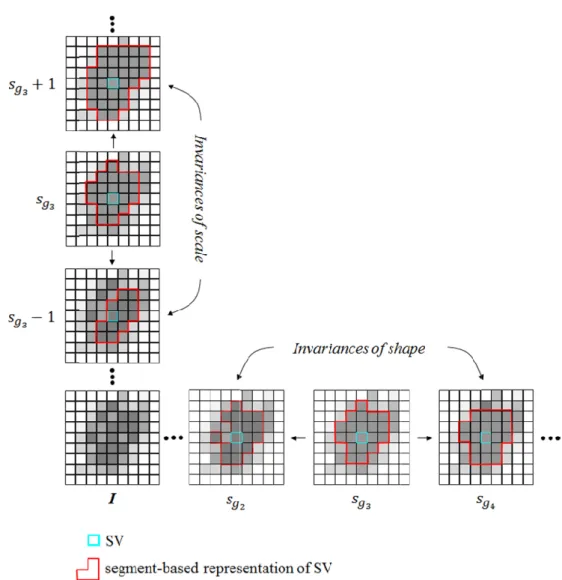
representation of objects, with respect to size (i.e., scale) and shape characteristics. From the segmentation level with an initial parameterization, object features are computed, an SVM model is learned, and corresponding SVs are extracted. In parallel, segmentation levels based on altered parameterizations with respect to the initial parameterization are generated (cf. process “segmentation with altered parametrization” in Fig. 1). Subsequent to that, SVs are located in the image domain and segments from the different segmentation levels are selected if they contain an SV (cf. Fig. 4 in the subsequent Section). Those segments are used to compute object features, which are represented in the feature space as virtual samples (cf. Fig. 2c). Consequently, the number of virtual samples corresponds to the number of SVs multiplied with the number of segmentation levels considered (cf. Fig. 4 in the subsequent Section).
1) Invariances of Scale
To generate virtual samples that aim to make the model invariant with respect to scale (i.e. size of the objects), we followed a hierarchical multi-level segmentation procedure (Geiß and Taubenböck, 2015; Geiß et al., 2016; Bruzzone and Carlin, 2006; Taubenböck et al., 2010; Aravena Pelizari, 2018). Thereby, is partitioned based on a segmentation algorithm with a
fixed set of shape-related hyperparameters at a generic segmentation level in
segments ( = 1, 2, … , ). To establish an unambiguous hierarchy of segmentation
levels, the following constraint must be fulfilled:
=
⊆ (10)
This way it is ensured that a segment at segmentation level − 1 must be included in only
one segment at level (Bruzzone and Carlin, 2006). The computation of virtual samples is
based on a series of generated hierarchical segmentation levels ∈ { − , … , −
1, , + 1, … , + } from (Fig. 4). Sizes of segments as generated by different scale
parameters range between lower bounds (i.e., as obtained with scale parameter − ) and
upper bounds (i.e., as obtained with scale parameter + ). The lower bound enables good representations of the smallest and most homogeneous real-world objects contained in while inducing oversegmentation for other real-world objects. In contrast to that, the upper bound allows for a good representation of the largest and most heterogeneous real-world objects contained in while inducing undersegmentation for other real-world objects.
PREPRINT;
Fig. 4. Example for g initial parameterization
an SV are selected and object features are computed for segments with invariances of scale and shape)
2) Invariances of
To generate virtual samples that aim to allow for a the objects, we
geometrical
Concordant to the processing scheme of scale invariance, a established, i.e.,
structure
same size but different geometries
Generally, the modifications of hyperparameters in an exhaustive way
the imagery
can benefit from more exhaustive modifications of hyperparameters if under
misleading
PREPRINT;FINAL
Example for generation of virtual samples parameterization
an SV are selected and object features are computed for segments with invariances of scale and shape)
Invariances of
To generate virtual samples that aim to allow for a the objects, we modify
geometrical properties of modelled segments
Concordant to the processing scheme of scale invariance, a established, i.e.,
structure cannot be followed same size but different geometries
Generally, the modifications of hyperparameters in an exhaustive way
imagery for different thematic classes.
can benefit from more exhaustive modifications of hyperparameters under- and oversegmentation
misleading virtual samples in an automated manner from the model again. FINALPAPERPUBLISHED
eneration of virtual samples parameterization of the segmentation algorithm
an SV are selected and object features are computed for segments with invariances of scale and shape).
Invariances of Shape
To generate virtual samples that aim to allow for a
modify hyperparameters of the segmentation algorithm that influence the properties of modelled segments
Concordant to the processing scheme of scale invariance, a
∈ { ,
cannot be followed. same size but different geometries
Generally, the modifications of hyperparameters in an exhaustive way to capture
for different thematic classes.
can benefit from more exhaustive modifications of hyperparameters oversegmentation
virtual samples in an automated manner from the model again. PUBLISHED@
eneration of virtual samples of the segmentation algorithm
an SV are selected and object features are computed for segments with
To generate virtual samples that aim to allow for a
hyperparameters of the segmentation algorithm that influence the properties of modelled segments
Concordant to the processing scheme of scale invariance, a
, … , }. Thereby, equation (10) is violated since
. Instead, segments are created that feature approximately the same size but different geometries (Fig. 4
Generally, the modifications of hyperparameters
to capture the entire spectrum of object for different thematic classes.
can benefit from more exhaustive modifications of hyperparameters oversegmentation occurs since
virtual samples in an automated manner from the model again. ISPRSJOURNAL OF
eneration of virtual samples with respect to scale and shape of the segmentation algorithm, which is used to identify SVs. an SV are selected and object features are computed for segments with
To generate virtual samples that aim to allow for an
hyperparameters of the segmentation algorithm that influence the properties of modelled segments while keeping the scale parameter constant Concordant to the processing scheme of scale invariance, a
Thereby, equation (10) is violated since
segments are created that feature approximately the 4).
Generally, the modifications of hyperparameters to establish the entire spectrum of object
for different thematic classes. As such, a more complex classification problem can benefit from more exhaustive modifications of hyperparameters
occurs since the self
virtual samples in an automated manner from the model again. OURNAL OF PHOTOGRAMMETRY AND
with respect to scale and shape , which is used to identify SVs. an SV are selected and object features are computed for segments with
n invariant model with respect to shape of hyperparameters of the segmentation algorithm that influence the while keeping the scale parameter constant Concordant to the processing scheme of scale invariance, a series of segmentation levels is
Thereby, equation (10) is violated since
segments are created that feature approximately the
to establish
the entire spectrum of object scale and object
As such, a more complex classification problem can benefit from more exhaustive modifications of hyperparameters
the self-learning
virtual samples in an automated manner from the model again. OTOGRAMMETRY AND
VOL.151
with respect to scale and shape. Here,
, which is used to identify SVs. Segments which contain an SV are selected and object features are computed for segments with altered paramet
invariant model with respect to shape of hyperparameters of the segmentation algorithm that influence the while keeping the scale parameter constant
series of segmentation levels is Thereby, equation (10) is violated since
segments are created that feature approximately the
and should be
scale and object
As such, a more complex classification problem can benefit from more exhaustive modifications of hyperparameters. Thereby
learning strategy is
virtual samples in an automated manner from the model again. OTOGRAMMETRY AND REMOTE
51,PP.42-58,M
corresponds to Segments which contain
parameterization (i.e.,
invariant model with respect to shape of hyperparameters of the segmentation algorithm that influence the while keeping the scale parameter constant
series of segmentation levels is Thereby, equation (10) is violated since a hierarchical segments are created that feature approximately the
should be carried scale and object shape present in As such, a more complex classification problem
Thereby, it is accept is designed to prune virtual samples in an automated manner from the model again. As such, EMOTE SENSING,
MAY 2019
13
corresponds to the Segments which contain rization (i.e.,
invariant model with respect to shape of hyperparameters of the segmentation algorithm that influence the while keeping the scale parameter constant. series of segmentation levels is a hierarchical segments are created that feature approximately the
carried out present in As such, a more complex classification problem acceptable to prune As such,
PREPRINT;FINALPAPERPUBLISHED@ISPRSJOURNAL OF PHOTOGRAMMETRY AND REMOTE SENSING,
VOL.151,PP.42-58,MAY 2019
14
modification of hyperparameters can be regarded as tradeoff between computational burden and exploration of potentially useful information.
3 Data and Experimental Setup
3.1 VHR Multispectral Data
The experimental analysis was carried out by classifying two test data sets, each covering a spatial extent of 1000 x 1000m. Both data sets were taken from VHR multispectral (blue/green/red/near-infrared) imagery with a geometric resolution of 0.5m acquired by the WorldView-II sensor.
The first data set was acquired over the city of Cologne, Germany, on January 31, 2014 and shows an urban area which is dominated by buildings of commercial use (Fig. 5a). It features a complex composition of urban land cover. Shadow areas can be observed primarily adjacent to buildings. In addition, the imagery represents an off-nadir acquisition. As such, facades of individual buildings can be identified in the direction of the sensor view. To reduce the computational burden for the experiments, we resampled the subset with a nearest neighbor interpolation to 1000 x 1000 pixels with 1m pixel spacing. The pixels were organized in six relevant thematic classes, namely “bush/tree”, “meadow”, “roof”, “facade”, “shadow”, and “other impervious surface” (Fig. 5b). The latter class comprises impenetrable surfaces other than building-related ones such as roads or parking lots, which feature similar spectral characteristics. The thematic classes were determined based on photointerpretation analysis under consideration of additional aerial imagery and cadastral maps (Geiß and Taubenböck. 2015; Geiß et al., 2016b).
PREPRINT;
Fig. 5. (a)
disjoint training, testing, and validation
The second data set is a 2000 x 2000 pixel subset of an acquisition over the Hagadera refugee camp in K
spatial resolution of 0.5m was kept. The test area shows a complex settlement pattern composed of
bushes, fences differentiate
“shadow” with regard to our c derived by visual image interpretation
United Nations High Commissioner for Refugees PREPRINT;FINAL
(a) WorldView
isjoint training, testing, and validation
The second data set is a 2000 x 2000 pixel subset of an acquisition over the Hagadera refugee camp in Kenya, from March 01,
spatial resolution of 0.5m was kept. The test area shows a complex settlement pattern composed of buildings
bushes, fences, walls
differentiate five thematic classes: “built “shadow” with regard to our c
derived by visual image interpretation
United Nations High Commissioner for Refugees FINALPAPERPUBLISHED
WorldView-II scene of Cologne, Germany isjoint training, testing, and validation
The second data set is a 2000 x 2000 pixel subset of an acquisition over the Hagadera refugee enya, from March 01,
spatial resolution of 0.5m was kept. The test area shows a complex settlement pattern buildings which
walls, as well as associated shadows and open spaces. A five thematic classes: “built
“shadow” with regard to our c derived by visual image interpretation
United Nations High Commissioner for Refugees PUBLISHED@
II scene of Cologne, Germany isjoint training, testing, and validation areas.
The second data set is a 2000 x 2000 pixel subset of an acquisition over the Hagadera refugee enya, from March 01, 2012 (
spatial resolution of 0.5m was kept. The test area shows a complex settlement pattern which are heterogeneous in size, orientation and materials, trees and as well as associated shadows and open spaces. A
five thematic classes:
“built-“shadow” with regard to our classification experiments (
derived by visual image interpretation under consideration of a camp map distributed by the United Nations High Commissioner for Refugees
ISPRSJOURNAL OF
II scene of Cologne, Germany; (b) a
The second data set is a 2000 x 2000 pixel subset of an acquisition over the Hagadera refugee 2012 (Fig. 6a). Un
spatial resolution of 0.5m was kept. The test area shows a complex settlement pattern heterogeneous in size, orientation and materials, trees and as well as associated shadows and open spaces. A
-up area”, “
lassification experiments (
under consideration of a camp map distributed by the United Nations High Commissioner for Refugees (UNHCR, 2012
OURNAL OF PHOTOGRAMMETRY AND
available labeled samples per class
The second data set is a 2000 x 2000 pixel subset of an acquisition over the Hagadera refugee a). Unlike the Cologne data set,
spatial resolution of 0.5m was kept. The test area shows a complex settlement pattern heterogeneous in size, orientation and materials, trees and as well as associated shadows and open spaces. A
up area”, “bush/tree”, “bare soil”, lassification experiments (Fig.
under consideration of a camp map distributed by the UNHCR, 2012
OTOGRAMMETRY AND
VOL.151
labeled samples per class
The second data set is a 2000 x 2000 pixel subset of an acquisition over the Hagadera refugee like the Cologne data set,
spatial resolution of 0.5m was kept. The test area shows a complex settlement pattern heterogeneous in size, orientation and materials, trees and as well as associated shadows and open spaces. A
”, “bare soil”,
Fig. 6b). Labeled samples were under consideration of a camp map distributed by the
UNHCR, 2012).
OTOGRAMMETRY AND REMOTE
51,PP.42-58,M
labeled samples per class; (c)
The second data set is a 2000 x 2000 pixel subset of an acquisition over the Hagadera refugee like the Cologne data set, the original spatial resolution of 0.5m was kept. The test area shows a complex settlement pattern heterogeneous in size, orientation and materials, trees and as well as associated shadows and open spaces. Accordingly, we
”, “bare soil”, “fence/wall Labeled samples were under consideration of a camp map distributed by the EMOTE SENSING,
MAY 2019
15
(c) spatially The second data set is a 2000 x 2000 pixel subset of an acquisition over the Hagadera refugee
the original spatial resolution of 0.5m was kept. The test area shows a complex settlement pattern heterogeneous in size, orientation and materials, trees and ccordingly, we /wall”, and Labeled samples were under consideration of a camp map distributed by the
PREPRINT;
Fig. 6. (a)
spatially disjoint training, testing, and validation areas.
3.2 Experimental
Regarding the encoding of invariances, we segmentation algorithm for partition of in the software environment eCognition modeled according to the so
(ℎ
Further,
segment boundaries
local mutual best fit, whereby lowest increase of object heterogeneity within the merging process is ensured
object fusion criteria, and thus the objects become l
For establishing the segmentation level with an initial emphasis on shape heterogeneity rather than on gray circumstance that manmade structures such as
environments have distinct shape and size properties, unlike, for example, natural features. Analogously, the weights for heterogeneity of smoothness and compactness were maintained equal (i.e.,
and oversegmentation for the initial segmentation and 25 for the Hagadera imagery
establish
PREPRINT;FINAL
(a) WorldView
spatially disjoint training, testing, and validation areas.
Experimental
Regarding the encoding of invariances, we segmentation algorithm for partition of in the software environment eCognition modeled according to the so
∈ [0, … ,1]) and shape
Further, ℎ is being composed of smoothness
segment boundaries
local mutual best fit, whereby lowest increase of object heterogeneity within the merging process is ensured. An increasing value of
object fusion criteria, and thus the objects become l
For establishing the segmentation level with an initial emphasis on shape heterogeneity rather than on gray circumstance that manmade structures such as
environments have distinct shape and size properties, unlike, for example, natural features. Analogously, the weights for heterogeneity of smoothness and compactness were maintained equal (i.e., h : 0.7
and oversegmentation for the initial segmentation and 25 for the Hagadera imagery
established nine additional segmentation levels with
FINALPAPERPUBLISHED
WorldView-II scene of Hagadera Refugee Camp, Kenya spatially disjoint training, testing, and validation areas.
Experimental Setup
Regarding the encoding of invariances, we segmentation algorithm for partition of in the software environment eCognition modeled according to the
so-) and shape
is being composed of smoothness
segment boundaries (ℎ
local mutual best fit, whereby lowest increase of object heterogeneity within the merging . An increasing value of
object fusion criteria, and thus the objects become l
For establishing the segmentation level with an initial emphasis on shape heterogeneity rather than on gray circumstance that manmade structures such as
environments have distinct shape and size properties, unlike, for example, natural features. Analogously, the weights for heterogeneity of smoothness and compactness were maintained
: 0.7; ℎ
and oversegmentation for the initial segmentation and 25 for the Hagadera imagery
nine additional segmentation levels with
PUBLISHED@
Hagadera Refugee Camp, Kenya spatially disjoint training, testing, and validation areas.
Regarding the encoding of invariances, we segmentation algorithm for partition of in the software environment eCognition
-called scale ) and shape homogeneity (
is being composed of smoothness
= 1 − ℎ
local mutual best fit, whereby lowest increase of object heterogeneity within the merging . An increasing value of
object fusion criteria, and thus the objects become l
For establishing the segmentation level with an initial emphasis on shape heterogeneity rather than on gray circumstance that manmade structures such as
environments have distinct shape and size properties, unlike, for example, natural features. Analogously, the weights for heterogeneity of smoothness and compactness were maintained
: 0.5). A suitable value for and oversegmentation for the initial segmentation
and 25 for the Hagadera imagery. In the experiments,
nine additional segmentation levels with
ISPRSJOURNAL OF
Hagadera Refugee Camp, Kenya spatially disjoint training, testing, and validation areas.
Regarding the encoding of invariances, we used
(i.e., fractal net evolution approach as implemented in the software environment eCognition (Baatz and Schäpe, 2000
called scale parameter
homogeneity (ℎ
is being composed of smoothness
). Fusion of adjacent objects
local mutual best fit, whereby lowest increase of object heterogeneity within the merging . An increasing value of corresponds to an increasing insensitivity of the object fusion criteria, and thus the objects become larger
For establishing the segmentation level with an initial emphasis on shape heterogeneity rather than on gray
circumstance that manmade structures such as buildings and other elements of urban environments have distinct shape and size properties, unlike, for example, natural features. Analogously, the weights for heterogeneity of smoothness and compactness were maintained
. A suitable value for and oversegmentation for the initial segmentation was
In the experiments,
nine additional segmentation levels with
OURNAL OF PHOTOGRAMMETRY AND
Hagadera Refugee Camp, Kenya; (b) available labeled samples per class; (c)
d an iterative
(i.e., fractal net evolution approach as implemented Baatz and Schäpe, 2000
parameter . It internalizes spectral
∈ [0, … ,1]),
is being composed of smoothness ℎ and compactness
Fusion of adjacent objects
local mutual best fit, whereby lowest increase of object heterogeneity within the merging corresponds to an increasing insensitivity of the
arger (Martinis et al., 2011 For establishing the segmentation level with an initial parameterization
emphasis on shape heterogeneity rather than on gray-value heterogeneity. This is due to the buildings and other elements of urban environments have distinct shape and size properties, unlike, for example, natural features. Analogously, the weights for heterogeneity of smoothness and compactness were maintained
. A suitable value for was found to be 20
In the experiments, when exploring invariance
nine additional segmentation levels with
OTOGRAMMETRY AND
VOL.151
; (b) available labeled samples per class; (c)
n iterative
bottom-(i.e., fractal net evolution approach as implemented Baatz and Schäpe, 2000). There,
It internalizes spectral ]), where ℎ
and compactness Fusion of adjacent objects
local mutual best fit, whereby lowest increase of object heterogeneity within the merging corresponds to an increasing insensitivity of the
Martinis et al., 2011 parameterization
value heterogeneity. This is due to the buildings and other elements of urban environments have distinct shape and size properties, unlike, for example, natural features. Analogously, the weights for heterogeneity of smoothness and compactness were maintained to balance the level of under found to be 20 for the
when exploring invariance
nine additional segmentation levels with altered
OTOGRAMMETRY AND REMOTE
51,PP.42-58,M
; (b) available labeled samples per class; (c)
-up
region-(i.e., fractal net evolution approach as implemented There, segments are It internalizes spectral homogeneity
= 1 −
and compactness ℎ
Fusion of adjacent objects is enabled with local mutual best fit, whereby lowest increase of object heterogeneity within the merging corresponds to an increasing insensitivity of the
Martinis et al., 2011).
parameterization, we put more value heterogeneity. This is due to the buildings and other elements of urban environments have distinct shape and size properties, unlike, for example, natural features. Analogously, the weights for heterogeneity of smoothness and compactness were maintained to balance the level of under
for the Cologne when exploring invariances of scale
altered values for
EMOTE SENSING, MAY 2019
16
; (b) available labeled samples per class; (c)
-growing (i.e., fractal net evolution approach as implemented segments are homogeneity
− ℎ .
of is enabled with local mutual best fit, whereby lowest increase of object heterogeneity within the merging corresponds to an increasing insensitivity of the
put more value heterogeneity. This is due to the buildings and other elements of urban environments have distinct shape and size properties, unlike, for example, natural features. Analogously, the weights for heterogeneity of smoothness and compactness were maintained to balance the level of under- imagery s of scale, we