I
nstitute for
S
oftware
R
esearch
University of California, Irvine
Cleidson de Souza
University of California, Irvine [email protected]
David Redmiles
University of California, Irvine [email protected]
An Interdisciplinary Perspective on
Interdependencies
May 2005
ISR Technical Report # UCI-ISR-05-7
Institute for Software Research
ICS2 210 University of California, Irvine Irvine, CA 92697-3425
The Interdisciplinary Study of Interdependencies
Cleidson de Souza1,2
David Redmiles1 1
Institute for Software Research University of California, Irvine
Irvine, CA 92697-3425
2
Departamento de Informática Universidade Federal do Pará
Belém, PA, Brazil – 66075 [email protected] [email protected]
ISR Technical Report # UCI-ISR-05-7 May 2005
Abstract:
Modularity is a very general principle for managing complex systems. It suggests the division of a system into smaller parts, called modules. This principle has been applied to complex systems in many domains, including product engineering, organizations and development processes. In any domain, modules must interact in a coordinated fashion for an effective system. Interactions imply interdependencies. Therefore, interdependencies between the modules need to be supported—analyzed, engineered, documented, developed, and managed—efficiently and effectively if the complex system is to be successful. Indeed, different disciplines have created approaches for supporting interdependencies, each with its particular perspective. This paper surveys approaches from several different disciplines, including software engineering, organization science, management, computer-supported cooperative work, and human-computer interaction. It uses a theoretical framework that supports the comparison of approaches across disciplines. This paper also creates a vocabulary for discussing interdependencies. Commonalities among the approaches are identified and suggestions for promising research areas in the study of interdependencies are described.
The Interdisciplinary Study of Interdependencies
Cleidson de Souza1,2 David Redmiles11Institute for Software Research
University of California, Irvine Irvine, CA 92697-3425
2Departamento de Informática Universidade
Federal do Pará Belém, PA, Brazil – 66075 [email protected] [email protected]
ISR Technical Report # UCI-ISR-05-7 May 2005
Abstract:
Modularity is a very general principle for managing complex systems. It suggests the division of a system into smaller parts, called modules. This principle has been applied to complex systems in many domains, including product engineering, organizations and development processes. In any domain, modules must interact in a coordinated fashion for an effective system. Interactions imply interdependencies. Therefore, interdependencies between the modules need to be supported—analyzed, engineered, documented, developed, and managed—efficiently and effectively if the complex system is to be successful. Indeed, different disciplines have created approaches for supporting interdependencies, each with its particular perspective. This paper surveys approaches from several different disciplines, including software engineering, organization science, management, computer-supported cooperative work, and human-computer interaction. It uses a theoretical framework that supports the comparison of approaches across disciplines. This paper also creates a vocabulary for discussing interdependencies. Commonalities among the approaches are identified and suggestions for promising research areas in the study of interdependencies are described.
1INTRODUCTION 4
2 BACKGROUND AND THEORETICAL FRAMEWORK 5
2.1 WHAT IS DEPENDENCE? 5
2.2 THEORETICAL FRAMEWORK 6
3 THE PRODUCT MODEL 8
3.1 PROGRAM DEPENDENCIES 9
3.2 COMPONENT-BASED DEPENDENCIES 10
3.3 ARCHITECTURE-BASED DEPENDENCIES 11
3.4 COHESION AND COUPLING 12
3.5 SOFTWARE TRACEABILITY 13
3.6 COMPONENT-BASED DESIGN STRUCTURE MATRICES 15
3.7 DISCUSSION 17
4 THE TASK MODEL 17
4.1 THOMPSON’S WORK IN ORGANIZATIONAL INTERDEPENDENCIES 18
4.2 INTERDEPARTAMENTAL INTERDEPENDENCIES 19
4.3 COORDINATION THEORY 21
4.4 ACTIVITY-BASED DESIGN STRUCTURE MATRICES 22
4.5 SOCIAL CONSTRUCTION OF INTERDEPENDENCIES 24
4.6 SOCIALIZATION OF SOFTWARE DEVELOPMENT 24
4.7 DISCUSSION 25
5 MULTI-MODELS APPROACHES 25
5.1 PROCESS MODELING LANGUAGES 25
5.2 BUILDING MECHANISMS IN CONFIGURATION MANAGEMENT TOOLS 26
6 INTEGRATING THE PRODUCT AND TASK MODELS 27
6.1 CONWAY’S LAW 27
6.2 PARNAS’ INFORMATION HIDING 28
6.3 COMBINED DESIGN STRUCTURE MATRICES 29
6.4 GRINTER’S RECOMPOSITION 31
6.5 DE SOUZA’S STUDIES 31
6.6 DISCUSSION 33
8 PROMISING RESEARCH TOPICS 34
9 CONCLUSIONS AND FUTURE WORK 36
ACKNOWLEDGEMENTS 36
10 REFERENCES 36
List of Figures
Figure 1 – Theoretical Framework and Models...8
Figure 2 – Vertical and Horizontal Traceability (Lindvall and Sandahl 1996) ...14
Figure 3 - DSM describing decisions made for a brake system (Yassine 2004) ...16
Figure 4 - A DSM without interfaces ...17
Figure 5 - A DSM with interfaces...17
Figure 6 – A typology of design/ manufacturing coordination mechanisms (Adler, 1995) ...20
Figure 7 – Coordination Mechanisms vs. Phases of Process (Adler, 1995) ...20
Figure 8 – Dependency Types and associated Coordination Mechanisms ...21
Figure 9 – Example of Design Structure Matrix after optimization ...23
Figure 10 - Example of Design Structure Matrix before optimization...23
Figure 11 - Mapping Design Interfaces and Team Interactions...30
1 Introduction
Everyday it is possible to witness technological advances that benefit people. However, such advances should not be taken for granted. The effort to build products and enable services is tremendous and requires the coordinated efforts from hundreds or thousands of people. Different aspects (constraints, goals, requirements, etc) need to be handled, making this design process extremely complex.
One way to manage complexity is to decompose systems into subsystems (Simon 1996). This has been known as modularity. Basically, modularity means that a complex system can be decomposed into smaller pieces called modules. Modularity reduces complexity because it allows (i) one to deal with the details of each part of the system in isolation (by ignoring the details of other modules) and (ii) one to deal with the overall characteristics of all modules and their relationships in order to integrate them into a coherent system (Ghezzi, Jazayeri et al. 2003). The principle of modularity has been applied to many aspects of human endeavor. In software production, by creating decomposable systems, in organizations by creating group units and teams, in product development by creating subassemblies, and in processes of product development by creating tasks (Mintzberg 1979; Langlois 1999; Scott 2003). In any case, modules are parts of a large system and need to interact in some coordinated way for an effective system. Interactions between modules are necessary for the exchange of information, energy, and/or data. These interactions imply that these modules are interdependent1. In order words,
modules rely or depend upon other modules to create the larger system. These interdependencies make it easier or more difficult to understand, extend, modify, and reuse these different modules. Therefore, their study is of fundamental importance for product, organization, and process design. Indeed, interdependencies – and dependencies - have been long studied in organization science (Thompson 1967), software engineering (Stevens, Myers et al. 1974), and computer-supported cooperative work (Malone and Crowston 1994). Each one of these disciplines, however, brings its own methods, perspectives, and assumptions to the study of interdependencies. By doing that, it is possible to advance each one of those fields, but it makes very difficult to “reuse” or adapt results across fields. A unifying framework able to summarize this diverse body of knowledge is missing. This framework would allow the identification of common themes among these diverse disciplines, but, more importantly, it allows one to identify research topics potentially useful in different disciplines.
The fundamental goal of this paper is exactly to propose this framework. This framework synthesizes arguments from a sample of approaches surveyed2 from several different disciplines,
including software engineering, organization and management sciences, computer-supported cooperative work, and human-computer interaction. It is intended to create a discipline-independent vocabulary for discussing dependencies. Paraphrasing Malone and Crowston (1994) when defined coordination theory: “by summarizing this diverse body of knowledge in a way that emphasizes its common themes, we hope to help to define a community of interest and to suggest useful directions for future progress”. Similarly, I expect to help researchers and practitioners to identify open research questions and motivate them to answer them. To the best of my knowledge, no similar work can be found in the literature.
The proposed framework is based on three models describing the possible entities that are part of a dependence3 relationship: products, tasks, and organizations. More importantly, the
1 Interdependencies are bi-directional relations: A depends on B and B depends on A. Dependencies, on the
other hand, are one-way relations: A depends on B.
2 Because the survey of all existing approaches is impossible, a representative set was chosen based on their
importance and accessibility.
framework allows relationships between these models, (e.g. how the product and the task models are associated?). The three models are described in this paper, but only the product and the task models are discussed in details. Consequently, only relationships between these two models are described in this paper. Indeed, approaches describing these relationships are particularly important because they suggest that these models are interdependent. Changes in one model cause changes in the other and vice-versa. In addition, I also describe “common themes” found across models that grew out of the analysis of the approaches surveyed. They include the degree, value, and representation of dependencies. Finally, suggestions for future research are indicated.
A note about the strategy used in this survey is necessary at this point. Initially, I surveyed the existing literature and the web for theoretical studies of dependencies (e.g., Thompson 1967) as well as empirical studies of dependencies, particularly in software development settings (e.g., Grinter 2003). Particularly in organizational science, dependencies are usually linked to the coordination mechanisms needed to manage them, thus I also briefly discuss such mechanisms. After surveying the approaches existing in different disciplines, I created the framework proposed in this paper as an explanatory mechanism to locate and contrast them. As consequence, in the next step I identified “common themes” studied in these different approaches. Finally, I identified topics that I believe are interesting for future research.
The rest of this paper is organized as follows. The next section describes the theoretical framework used in this paper. Then, sections 3 and 4 describe the product and task models, respectively. After that, section 5 describes approaches that describe both product and tasks dependencies. Approaches integrating these models are presented in section 6. This discussion is followed by the common themes identified in different models. After that, section 8 suggests directions for future research on dependencies. Finally, conclusions and ideas for future work are presented.
2 Background and Theoretical Framework
2.1 What is dependence?
I surveyed the literature to understand how different disciplines study dependence relationships. Disciplines studied include organization and management sciences, software engineering, computer supported cooperative work, and human computer interaction. Based on this survey, it is easy to notice that different disciplines adopt distinctive definitions of dependencies. For example, in management and organization sciences, Crowston (2003) discusses how other authors see dependencies as relationships between organizations: “Litwak and Hylton (1962), for example, define interdependency as when two or more organizations must take each other into account if they are to accomplish their goals.” In these same fields, other researchers define interdependencies as relationships between tasks: “[the] degree to which two or more activities interact to determine an outcome jointly” (Sorenson 2003). Finally, some authors define dependence as a relationship between two actors: define interdependence as “the extent to which unit personnel are dependent upon one another to perform their individual jobs” (Van de Ven, Delbecq et al. 1976).
Furthermore, even in the same discipline different definitions of dependence can be identified. For instance, in software engineering, Grinter (2003) broadly defines dependencies as “technical relationships in the code”, while Wilde (1990) is more specific defining a dependency as “a relationship between two components so that changes to one may have an impact that will require changes to the other”. Nevertheless, most authors define dependencies in specific contexts: program dependencies are “syntactic relationships between the statements of a program that represent aspects of the program’s control and data flow” (Ferrante, Ottenstein et al. 1987; Podgurski and Clarke 1989); component dependencies reflect the potential for one component to
affect or be affected by the elements (e.g., other components) that compose the system (Vieira 2003), and finally, architecture dependencies focus on “both the structural and behavioral relationships among components expressed in (…) formal architecture description languages” (Stafford, Wolf et al. 1998).
Based on these examples, it is not difficult to notice that (inter)dependencies have been looked at from different perspectives in the literature, including dependencies between social actors, products, organizations, and tasks. The underlying concept among these approaches is the same, though: a dependence is a relationship between two entities that exists because one must interact with the other to accomplish something “larger” than the entities themselves. Interdependencies between modules are a consequence of the need for combining these modules. For example, the different parts of a climate control system need to be integrated, but not randomly: the engine fan needs to provide airflow across the radiator, as a result the radiator is dependent on the engine fan (Pimmler and Eppinger 1994). Similarly, two classes in an object-oriented application are interdependent because they need to interact (through method calls) to produce the application behavior. Two tasks are interdependent if the actors performing them need to interact to determine an outcome jointly4 (e.g., fixing bugs in the code and regression testing the new code both contribute to the larger outcome of developing high-quality software) (Sorenson 2003). Departments of an organization are also interdependent because both are parts of the same organization, therefore concerted action might be required to achieve organizational goals. Finally, two organizations are interdependent if they need to interact to exchange resources (e.g., resource-dependence theory). For the purposes of this paper, this is the definition of interdependence that I will adopt.
Note that a dependence is not a property of the entities themselves, but rather a relationship between them. Note also that a consequence of this relationship is that one entity might need to be changed, in case the other is changed. This distinction between the dependence and its consequence is particularly important since some authors use this consequence to define a dependency.
After surveying the approaches existing in different disciplines according to the definition presented, I created a theoretical framework as an explanatory mechanism to locate and contrast them. This framework allowed me to identify “common themes” in these approaches. The next section presents such framework.
2.2 Theoretical Framework
As mentioned before, several definitions of dependency have been proposed. Some describe dependencies between products, other as relations between organizations, and finally between tasks. To account for these different approaches, the framework proposed defines three models, namely products, organizations and tasks. Each model describes the set respective set of approaches. For instance, the product5 model describes the approaches to the study of dependencies within a product or between products. Similarly, the organization (task) model describes approaches studying dependencies between organizations (tasks). In other words, the models of the framework are used to group similar approaches. The existence of these models also allowed me to study multi-model approaches, such as workflow management systems that can be used to describe dependencies between tasks, products and even organizations
4 Note that social actors are interdependent to the extent that the tasks they are performing are
interdependent. That means I am purposefully excluding more general sociological theories, such as Emerson’s power-dependence relations (Emerson, 1962).
5 The name product model is chosen to emphasize the broader scope of this work, including not only
software engineering research but also hardware product research. Therefore, a product means a software and/or hardware artifact to be built by the organization.
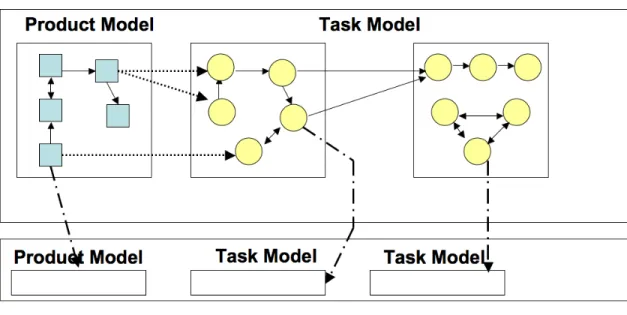
(Shrivastava and Wheater 1999). The last advantage of these models is to facilitate the understanding of approaches that link them. For instance, Grinter’s studies of recomposition suggest that product dependencies create task dependencies (2003). Each one of the models will be discussed below.
The product model describes dependencies between products or artifacts being developed by an organization. More specifically, dependence relationships either between parts of the same product or between different products. This model focuses on the structure of the artifacts and how this structure can be changed in order to manage – minimize or localize – the dependencies in the product. In addition, it emphasizes the impact that changes in one product will cause in other products. Examples of approaches located on the product model include program (Ferrante, Ottenstein et al. 1987), component (Vieira 2003) and architecture (Zhao 1997) dependencies, and traceability approaches that relate the different artifacts created during the software development process (Spanoudakis and Zisman 2004).
The second model, the organizational, focuses on how entire organizations interact in order to properly accomplish their goals. To quote Crowston (2003): “Litwak and Hylton (1962), for example, define interdependency as when two or more organizations must take each other into account if they are to accomplish their goals.” The overall focus is on dependencies between entire organizations or between organizations and their environment, in accordance with the open system’s view of organizations that recognizes the importance of organization-environmental connections, in contrast to the closed system view, which assumes that all elements and processes of interest in an organization are internal to this organization (Scott 2003). For instance, the resource-dependence approach (Scott 2003) is based on the view that the need for acquiring resources creates interdependencies between organizations. Furthermore, the importance and scarcity of these resources establishes the degree of organizational dependence. According to this approach, organizational members, naturally aware of these dependencies, will carefully choose suppliers and negotiate agreements with them in order to avoid “crippling dependencies” (Scott 2003, pg. 199). The degree of dependence between two organizations is a function of the importance of a resource given by the dependeer organization and the extent to which it is controlled by the dependee. The work surveyed in organizational dependencies can be translated into dependencies between elements of the other models, because organizations, for practical purposes, are composed of their personnel, tasks, products among other things (Scott 2003, pg. 18-24). In this case, the above mentioned resource-dependence approach can then be “translated” into product dependencies: one product (or task) in one organization requires another product from another organization. The other reason that led me to not focus on the organizational model is my research interest in the practices, the ways by which social actors manage their interdependencies. Having said that, I will not discuss the organizational model anymore in this work.
Finally, the task model is the next model of the framework. It describes how tasks or activities interact to determine an outcome jointly (Sorenson 2003). This model has also been largely studied in organization science. The focus is not only on the study the tasks performed by particular organizations, but also how the degree of interdependencies between tasks influences the choice of the associated coordination mechanisms to manage these interdependencies. As Thompson (Thompson 1967, pg. 55-56) simply puts:
“In a situation of interdependence, concerted actions come about through coordination, and if there are different types if interdependencies, we would expect to find different services for achieving coordination.”
Approaches in this model have been largely influenced by Thompson’s work. Indeed, a 1995 survey of interdependencies - in the context of managerial and organizational sciences - identified the fundamental impact of Thompson’s work in the literature of interdependencies (Staudenmayer 1997). Additional approaches include activity-based design structure matrices
(Eppinger 2001) and the coordination theory proposed by Malone and Crowston (1994). This model also includes work interdependencies between departments created by project tasks and the coordination mechanisms necessary to deal with them (Adler 1995).
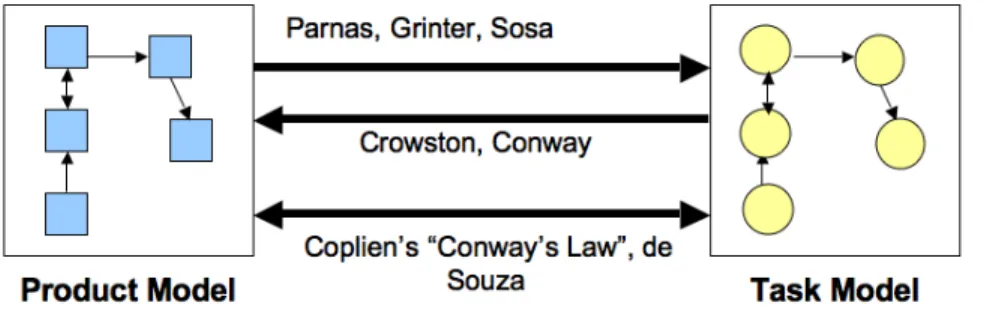
Figure 1 below presents the framework and the associated models. Each department in the organization contains its own set of tasks, since these departments usually have different goals. Every model in the framework contains its own types of elements: the product model contains products (squares on the figure) and their dependencies, the task model contains tasks (circles) and dependencies between them, and so does the organizational model. Note that some relationships between the models are also indicated. For instance, products are developed by tasks.
Figure 1 – Theoretical Framework and Models
Furthermore, these models influence each other. For instance, different studies have shown that dependencies in the product model create dependencies among actors who, therefore, need to communicate and coordinate to perform their tasks (Grinter 2003; de Souza, Redmiles et al. 2004). Similarly, interdependencies in the task model influence how organizations structure themselves (Mintzberg 1979).
The rest of this document focuses on the product and task models, because my overall research goal is to understand how software development dependencies influence –or are influenced by- the tasks that need to be performed in an organization. That is, how the product and the task models interact. As a result, relations of dependencies between two organizations are out of scope of this work.
3 The Product Model
One of the richest domains for studying dependencies in the product model is the domain of software development. The main reason being the fact that software is flexible enough to be easily changed when compared with hardware products. Thus, in software development new dependencies might be created (or removed) with minimum effort. Dependencies in this field are relationships between software development artifacts (e.g., requirements specifications, design models, and, more frequently, source code). Examples include program dependencies as syntactic
relationships between the statements of an unique program (Ferrante, Ottenstein et al. 1987; Podgurski and Clarke 1989), and dependence traceability relationships, that establish trace relations between different artifacts (Spanoudakis and Zisman 2004). Research on this area has developed algorithms and approaches for dealing with these dependencies, even quantifying them through metrics (cohesion and coupling) and elaborated representations based on graphs. All these aspects are discussed in this section.
Despite the main focus on dependencies in software engineering, I will also present a technique that can be used to describe dependencies in any product development including development of automobiles, airplanes engines, and so on.
3.1 Program Dependencies
The first place to look at dependencies in software engineering is in the source code of a software application (or in programs, as some authors refer). Ferrante and colleagues (1987) describe two very simple examples that clearly illustrate the types of dependencies that occur in a program:
“In the first case, a dependence exists between two statements whenever a variable appearing in one statement may have an incorrect value if the two statements are reversed. For example, given the two statements S1 and S2 below:
A:=B*C (Sl) D:=A*E+l (S2)
S2 depends on Sl, since executing S2 before Sl would result in S2 using an incorrect value for A. Dependencies of this type are data dependencies. Second, a dependence exists between a statement and the predicate whose value immediately controls the execution of the statement. In the sequence below with statements S3 and S4
if (A) then (S3) B:= C*D; (S4) endif
S4 depends on predicate (A) since the value of (A) determines whether S4 is executed. Dependencies of this type are called control dependencies.”
Interest in control and data dependencies is specially important in compiler research because in order to perform program optimizations, it is necessary to be aware of these dependencies avoiding semantic changes to the program (Aho, Sethi et al. 1986). Program dependencies, in particular data flow dependencies, have been used by software engineers to improve software testing by defining code coverage criteria, that is, rules used for selecting data intended to ensure that certain portions of a program’s code are “covered” or “exercised” (Podgurski and Clarke 1989). Other usages of program dependencies include fault location when debugging through program slicing (Weiser 1984), maintenance, parallelization, computer security, and code optimization (Podgurski and Clarke 1989).
In order to explicitly represent and manipulate both types of program dependencies, software engineering and programming language researchers adopt a common approach using program dependence graphs (or PDGs) (Ferrante, Ottenstein et al. 1987). According to Horwitz and Reps (1992), formally, a PDG for a program P is a directed graph whose vertices are connected by several kinds of edges. The vertices represent the statements of P, while the edges represent control and data dependencies, which are explained below:
“The intuitive meaning of a control dependence edge from vertex v to vertex w is the following: if the program component represented by vertex v is evaluated during program execution and its value matches the label on the edge, then, assuming that the program terminates normally, the component represented by w will eventually execute; however, if the value does not match the label on the edge, then the component represented by w may never execute. (…) Data dependence edges include both flow dependence edges and
def-order dependence edges. Flow dependence edges represent possible flow of values, i.e., there is a flow dependence edge from vertex v to vertex w if vertex v represents a program component that assigns a value to some variable x, vertex w represents a component that uses the value of variable x, and there is an x-definition clear path from v to w in the program’s control-flow graph.”
For simplicity purposes, researchers initially explored the construction of PDGs for simple programs, either isolated procedures or programs that contain a single procedure. Later, interprocedural approaches were explored considering several procedure calls and their parameters and return types (Aho, Sethi et al. 1986). In this case, some authors adopt the term system dependence graph (SDG) instead of PDG. A SDG is made up of a collection of procedure dependence graphs, which are essentially the same as the program dependence graphs defined above, except that they may include additional and interprocedural control and flow dependence edges to represent procedure calls (Horwitz and Reps 1992). System dependence graphs can be used to construct call graphs (Lakhotia 1993) that are used for interprocedural program optimization and program understanding (Murphy, Notkin et al. 1995). According to Callahan and colleagues, a call graph “ (…) summarizes the dynamic invocation relationships between procedures. The nodes of the call graph are the procedures in the program. An edge (pl, p2) exists if procedure pl can call procedure p2 from some call site within pl. Hence, each edge may be thought of as representing some call site in the program”(1990).
Despite their different applications in software engineering, Murphy and colleagues found out that call-graph extractors used in software development tools might provide different results (Murphy, Notkin et al. 1998). The reason why call-graph extractors provide so different results compared to those used in compilers is that “software engineering tools place a different-and in some ways more relaxed-set of requirements on call graphs, since the call graphs are most often consumed by humans for the purpose of understanding.” (ibid.)
3.2 Component-based Dependencies
Since MacIlroy (1968) initially proposed the idea of software components in 1968, several definitions of software components can be found, some of them even contradictory6. For the
purposes of this work, it is sufficient to describe a software component as physical packing of executable software with a well-defined and published interface. The notion of software component also implies higher-level abstractions than the code that it encloses, which means that in addition to the typical dependencies existing in any program (see previous section), components have additional types of dependencies. For instance, context dependence is the term used to describe the component’s need for services from the deployment environment (Szyperski 1998). This dependence can not be avoided because in order to be “pluggable”, components need necessarily to be linked to the deployment environment (e.g., Sun’s Enterprise JavaBeans and Microsoft’s .NET) where they were created (Brown and Wallnau 1998). To summarize, “components comprise a collection of aspects that can reveal different forms of dependencies in distinct levels of abstraction, making more complex the precise identification of dependencies” (Vieira and Richardson 2002). Therefore, component dependence analysis is crucial to effectively perform maintenance, evolution, testing, debugging, and management of component-based systems (Vieira 2003).
Vieira’s work (Vieira 2003) summarizes important elements of component dependence analysis. For instance, he defines a conceptual framework for component dependencies in which he describes the several types of dependencies that a component might have, including internal (e.g., data and control dependencies) and external (e.g., and inter-component dependencies and
resource dependencies like context dependencies (Szyperski 1998)). In order to properly represent all the types of dependencies surveyed, he defines a representation called deployable dependence descriptions (DDDs) that describes a component’s dependencies. DDDs can be automatically generated based on information available about the component or specified by the software engineer. When the DDDs of all components in a system are composed, a component-based dependencies model (CBDM for short) is created. Operations in this module are applied to assess overall system properties or individual components’ properties. Vieira’s approach focuses on inter-component analysis, when most approaches focus on intra-component analysis. Cadena (Hatcliff, Deng et al. 2003) is another tool that supports inter-component analysis.
3.3 Architecture-based Dependencies
Software architectures allow the definition of a high-level structure of a software system by describing a system’s components and how those components are interconnected. They might also describe how those components interact by describing the behavior of each component when it interacts with the other components. The description of software architectures can be done informally using box and arrow diagrams, or using formal software architecture description languages (ADLs for short) such as ACME (Garlan, Monroe et al. 1995), C2 (Taylor, Medvidovic et al. 1996), Rapide (Luckham, Kenney et al. 1995), and Wright (Allen and Garlan 1994). The advantage of using formal ADLs is the possibility of reasoning about properties of the architecture, for instance verifying for deadlock, component mismatches, safety and so on. In this section I am concerned in particular with architectural dependence analysis, that is, the task of identifying and analyzing the dependencies of a particular software architecture. These techniques operate on the formal architecture description of a software system instead of the source code adopted by program dependencies. They can be used to support architectural reuse, change impact analysis, regression testing, and software understanding.
Architectural-level dependence analysis was first described by Zhao (1997). He uses ACME (Garlan, Monroe et al. 1995) as the underlying architectural description language and proposes three types of dependencies among the components of the architecture, namely, component-connector dependencies, component-connector-component dependencies, and additional dependencies that describe dependencies within a connector or component. Zhao describes a software architectural dependence graph (SADG), similar to program dependence graph (PDG), that represents the dependencies between the architectural elements. Slicing techniques are then applied on this graph to facilitate architectural understanding and reuse.
Stafford and colleagues (Stafford, Wolf et al. 1998) also applied concepts from program dependence analysis to software architectures. They use RAPIDE (Luckham, Kenney et al. 1995) as the underlying architectural description language. Instead of adopting some form of graph representation like Zhao (1997), they represent the dependencies in a dependence matrix. Dependence types are based on behavioral properties of the architecture (e.g., temporal – the behavior of one component precedes or follows the behavior of another component) or on structural relationships that link components of the architecture with modules implementing them (e.g., textual inclusion – the specification for a component may be created from numerous source modules that are textually combined). In more recent work, Stafford (2001) describes Alladin, an architecture-level dependence analysis tool.
Note that ADLs play a fundamental role in architectural dependence analysis. The dependencies that can be established among components of the architecture are heavily influenced by the primitive features of the ADL chosen (Stafford, Wolf et al. 1998). For instance, event-based ADLs allow the description of temporal constraints among components introducing additional complexity to architectural dependence analysis compared to traditional program dependence analysis (Stafford and Wolf 2001). Dependence analysis was later incorporated into
other software architecture tools, such as Argus-I (Vieira, Dias et al. 2000) and Cadena (Hatcliff, Deng et al. 2003).
3.4 Cohesion and Coupling
Cohesion is a property of a software module, or program, that represents the functional relatedness of their internal elements (e.g., statements, procedures, and declarations) (Stevens, Myers et al. 1974). It is a measure of the relationships between its elements. Ideally, “elements of a module are grouped together in the same module for a logical reason, not just by change: they cooperate to achieve a common goal, which is the function of the module.” (Ghezzi, Jazayeri et al. 2003). That is, a module has high cohesion if all of its elements are related strongly, and low cohesion otherwise.
The internal cohesion of a module is measured in terms of the strength of binding elements within the module. Cohesion occurs on the scale of weakest (least desirable) to strongest (most desirable) in the following order (Constantine and Yourdon 1979): coincidental, logical, temporal, communication, sequential, functional, and informational. Coincidental cohesion occurs when the elements within a module have no apparent relationship to one another. This results when a large, monolithic program is "modularized" by arbitrarily segmenting the program into several small modules, or when a module is created from a group of unrelated instructions that appear several times in other modules. Logical cohesion implies some relationship among the elements of the module; for example, in a module that performs all input and output operations, or all error handling operations. A logically bound module often combines several related functions in a complex and interrelated fashion. Temporal cohesion implies that all components, which are activated at a single time (e.g., start up or shut down), are brought together. Modules with temporal cohesion exhibit many of the same disadvantages as logically bound modules. The elements of a module possessing communicational cohesion refer to the same input data or produce the same output data. For example, "print and punch the output file" is communicationally bound. Sequential cohesion of elements occurs when the output of one element is the input for the next element. Functional cohesion is a strong, and hence desirable, type of binding of elements in a module because all elements are related to the performance of a single function. Finally, informational cohesion of elements in a module occurs when the module contains a complex data structure and several routines to manipulate the data structure. Each routine in the module exhibits functional binding. Informational binding is the concrete realization of data abstraction. The difference between informational cohesion and communicational cohesion is that communicational cohesion implies the all code in the module is executed on each invocation of the module while the other requires that only one functionally cohesive segment of the module be executed on each invocation (Sommerville 2000).
It is important to mention that these cohesion classes are not strictly defined, they might even overlap, which means that sometimes it is not easy to decide under which cohesion category a program unit should be classified. Furthermore, it is also possible and desirable to extend this classification to accommodate new programming paradigms. Sommerville (2000) added a new class of cohesion related to object-oriented approaches:
“Object cohesion – each operation provides functionality which allows the attributes of the object to be modified, inspected or used as basis for service provision.”
Therefore, a cohesive object is one that models a single entity (concept or abstraction) and all the operations required to manage or deal with that entity are part of the object. That means that subclasses that inherit attributes and methods from their parent classes cannot be seen as a single-unit entity, therefore they have reduced coupling compared to classes that do not inherit methods
from others. Of course, inheritance might reduce coupling, but it supports software reuse, another desired goal in software development.
While cohesion measures the degree of dependencies that occur within a module, coupling measures the relationships between different modules. The term coupling is used as a measure of the interdependencies between two modules (Stevens, Myers et al. 1974; Ghezzi, Jazayeri et al. 2003). If two modules depend on each other heavily by having strong interconnections, they are said to have high coupling, otherwise, the modules are said to have low coupling and are almost independent of each other.
Coupling between modules occurs under different situations. For instance, given two modules x and y, if the x refers to the inside of y (it branches into, change data in or alters a statement in y), then these modules are said to have content coupling (Fenton and Pfleeger 1997). Another example of coupling happens when modules make use of shared variables (common coupling) or interchange control information (control coupling) (Constantine and Yourdon 1979). Stamp coupling happens when an entire data structure is passed as a parameter to a called module that only uses some of the fields from this data structure. In data coupling, two modules are said to be data coupled if all arguments are homogeneous data items. If a data structure is passed then the called module must use all the fields. Data coupling is a desirable goal. Two modules which are data coupled are easier to maintain since changes in one are less likely to impact the other. Loose coupling is achieved by ensuring that details of the data representation are held within a component. Its interface with other components should be through a parameter list. If shared information is necessary, the sharing should be limited to those components, which need access to the information. To summarize I will describe a scale from less desirable to most desirable coupling: content, common, control, stamp, and data.
Coupling often implies that if one wants to reuse a software module, he or she will also have to import all the other modules with which it is coupled. That is, high coupling reduces the reusability of a software module. According to Stevens et al. (1974):
“The fewer and simpler the connections between modules, the easier it is to understand each module without reference to other modules. Minimizing connections between modules also minimizes the paths along which changes and errors can propagate into other parts of the system, thus eliminating disastrous “ripple” effects where changes in one part cause errors in another, necessitating additional changes elsewhere, giving rise to new errors, etc.”
The concepts of coupling and cohesion are interrelated, while cohesions refer to the degree of interconnection (or relatedness) among the parts of a single module, cohesion refers to the strength of the interconnections between different modules. Both concepts help establishing the quality of a particular design (Sommerville 2000). In fact, by designing modules with high cohesion and low coupling, maintainability is achieved. If it becomes necessary to change a system, the part to be changed is easily identified because it can be found in a single place. It is not necessary to modify different parts of the program if a change has to be made. In other words, ideally, modules with high cohesion and low coupling are easier to analyze, understand, modify, test or reuse them separately (Ghezzi, Jazayeri et al. 2003).
3.5 Software Traceability
Dependence relationships between software development artifacts have also been studied under the name traceability. Software traceability is defined as “the ability to relate artifacts created during the development of a software system to describe the system from different perspectives and levels of abstraction with each other, the stakeholders that have contributed to the creation of the artifacts, and the rationale that explains the form of the artifacts” (Spanoudakis and Zisman
2004). In a survey of the area Spanoudakis and Zisman (2004) identified seven possible types of relationships between software artifacts. Dependence is one of them. According to these authors, in software traceability, not all authors use the term dependence to refer to this type of relationship; other names used include causal conformance, developmental relations, and correspondence to name a few.
Traceability was first conceived to describe and follow the life of a requirement. Originally, called requirements traceability, “with its emphasis on supporting the customer in ensuring that the requirement agreed upon are met” (Lindvall and Sandahl 1996). As part of this emphasis, researchers have studied interdependencies between requirements. For instance, Carlshamre and colleagues (2001) conducted a survey in five different companies and found out that “each of the cases [companies] had roughly 20% singular requirements” (requirements that do not depend on others) and that “by identifying the 20% ‘most dependent’ requirements, one can cover between 67% and 79% of all dependencies”. Other empirical studies suggest that requirements indeed do affect each other (Dahlstedt and Persson 2003) and can be found in a diverse range of software development organizations (Ramesh and Jarke 2001). These empirical data highlight the importance of handling requirements dependencies during the specification of software development projects. The interested reader might refer to Dahlstedt’s and Person’s work (2003), which reviews requirement interdependencies and summarize part of the work and models developed in the area.
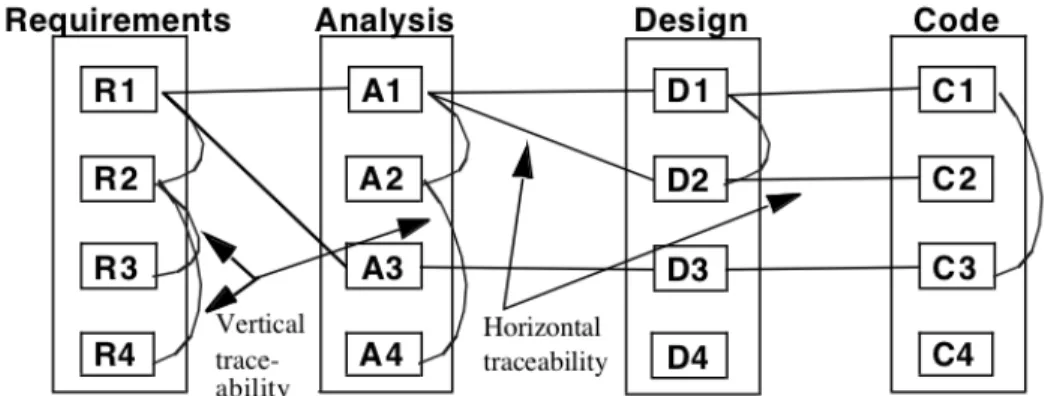
While requirements dependencies involve a relationship between two artifacts of the same type, traceability dependencies also involve artifacts of different types7. Furthermore, these
artifacts could potentially be created at different moments in the software development process. For instance, a dependence might exist between a requirement and the design diagram that realizes this requirement. Lindvall and Sandahl (1996) classify these approaches as vertical and horizontal traceability. Vertical relationships exist between the same type of artifacts, while horizontal relationship exist between different types of artifacts. Figure 2 below exemplifies this classification.
Figure 2 – Vertical and Horizontal Traceability (Lindvall and Sandahl 1996)
The existence of a dependence link between the requirements and the analysis and later to a design document that implements this requirement, is then, seen as something positive or beneficial, because it indicates that this particular requirement has been addressed by the software being implemented. Furthermore, some authors believe that requirements interdependencies can support software reuse: if similar requirements are identified when the stated requirements are compared with existing requirements, then this indicates a possible reusable component (Dahlstedt and Persson 2003).
7 Program, component, and architecture dependencies also involve relationships between artifacts of the
3.6 Component-based Design Structure Matrices
The design structure matrix (from now on called, DSM) is a tool that displays the relationships between elements of a system in a compact, visual, and analytically advantageous format (Browning 2001). Initially proposed by Steward (1981) to describe relationships in product development processes, it has been actually used to analyze complex like organizations, products and processes8. To model such diverse uses of DSM, Browning (2001) classified DSM in four
main types:
- Component-based DSMs are used to model system architectures, or products based on components and/or their interdependencies;
- Team-based DSMs model organization structures according to people and/or groups; - Activity-based DSMs model processes and networks of activities and the information
flow among those activities; and
- Parameter-based DSMs model low-level relationships between design decisions and parameters, systems of equations, subroutine parameter exchanges, etc.
These four types of DSMs are aggregated into two main categories: static and time-based DSMs (Browning 2001). The distinction between them is based on the simultaneous existence of the elements. In static matrices, the elements of the DSM exist simultaneously. In time-based matrices the ordering of rows and columns indicate a flow through time so that some elements precede others: an element can only exist after the preceding element ceases to exist. Component and team-based DSMs are static and therefore analyzed with clustering algorithms. Activity and parameter-based DSMs are time-based and typically analyzed using sequencing algorithms. Despite these differences, concepts underlying the DSM approach are very similar and are described below.
Basically, a DSM is a square matrix where rows (and columns) describe the elements that compose a complex system. A mark X in row i, column j indicates that element i interacts with or is dependent on element j. The diagonal of the matrix is not used. Figure 3 presents a DSM describing decisions made for a brake system. It tells the reader that decisions about the “ABS Modular Display” (row 6) are affected by decisions made about the “Wheel Torque” (column 2). That is, inspecting a decision located in a particular row tells the reader which other decisions affect this one. Conversely, by reading down column 2 (“wheel torque”) it is possible to find out it influences decisions about the “rotor diameter”, “ABS modular display”, “piston-rear size”, “piston-front size”, and “booster reaction ration” (rows 5, 6, 8, 10 and 13, respectively).
Figure 3 - DSM describing decisions made for a brake system (Yassine 2004)
It is possible to replace the marks (X’s) in the matrix by values quantifying the strength or degree of the dependence between two elements. For instance, Pimmler and Eppinger (1994) adopt a scale from -2 to +2 to indicate if a dependence is detrimental, neutral or required in a component-based DSM. Eppinger (2001) describes the frequency of team interactions in team-component-based DSMs ranging from daily to monthly interactions.
In both static and time-based matrices, the analysis is based on reordering the rows and columns of the matrix. Analysis of component-based DSMs are described below, while the analysis of activity-based DSMs are described in section 4.4.
In general, in component-based DSMs, the elements of the matrix that are used in the rows and columns are the modules that comprise the product being analyzed. For instance, the components of a car, computer, airplane engine, or software application. These DSMs are analyzed using clustering algorithms that aim to find “subsets of DSM elements that are mutually exclusive or minimally interacting” (Yassine 2004). The ultimate goal is to identify modules of a system that are as independent as possible.
Pimmler and Eppinger (1994) classify the dependencies between two components in four types:
- Spatial, the need for adjacency or orientation between two elements; - Energy, a energy transfer between two elements;
- Information, the need for information or signal exchange between two elements; and - Materials, the need for materials exchange between two elements.
Rather than having a single mark (“X”) indicating the existence of the dependence between the elements, each intersection between a row and a column contains now another matrix of four elements describing the strength of the dependence according to these four types of dependence. Clustering can be applied according to one of these four dimensions and new insights might rise based of the four, possibly different, configurations of the product that the clustering algorithm will provide.
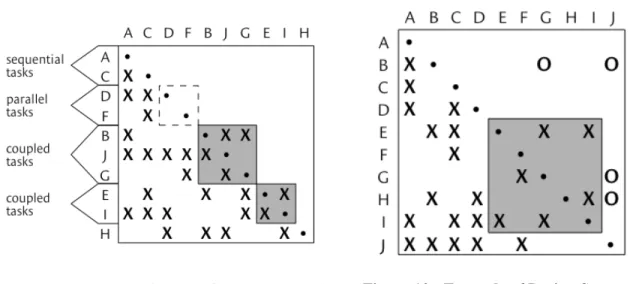
Baldwin and Clark (2000) adapted DSMs to make use of the information hiding principle (Parnas 1972). More specifically, a component of a DSM is separated into their interfaces and implementation parts. Interfaces are called design rules, while implementation parts are called hidden parameters. By separating the interface and implementation parts of a DSM component, they minimize the dependencies of the overall product improving its design. Interfaces are represented separately in these adapted DSMs to indicate their fundamental role. The resulting design structure matrix can then be clustered to generate modular designs. Figure 4 below presets a DSM without the usage of interfaces, while Figure 5 presents one that was changed trough the
addition of interface I to minimize the dependence between components B and A. Both Figures are from (Sullivan, Griswold et al. 2001),
Figure 4 - A DSM without interfaces Figure 5 - A DSM with interfaces
Design-structure matrices have also been applied to software design. Sullivan et al. (2001) apply DSMs to software design and extend them to model environment variables in which the software is intended to be used. Their goal is to be able to account changes in the environment and their implications in the software design.
3.7 Discussion
Two main types of methods can be identified among the approaches dealing with dependencies in the product model: methods pursuing the analysis of product dependencies and methods pursuing the record of product dependencies. In the former case, I find program, component and architecture dependencies, as well as cohesion and coupling measures. The first three approaches share the usage of the program dependence graph or variations as representations for product dependencies. And, most importantly, they share the analytical goal of identifying and analyzing dependencies in the product to be able to answer questions about reusability, maintenance and understanding. In general, component and architecture dependencies are the evolution of program dependencies that arose of the need to deal with other abstractions (component and architectures) for building applications. Similarly, cohesion and coupling are measures of the degree of dependence within a module or between modules. That is, they require an analysis of the dependencies in one or more product to identify their intensity.
The second type of approaches is mostly associated with the record of dependencies so that they can be later used. Dependence relationships in software traceability are recorded to be later used to facilitate change impact analysis, maintenance and reuse approaches. The assumption underlying this approach is that recording dependencies is beneficial to the software development process, because this information aids the execution of some software development activities. In addition, in order to record dependencies it is necessary to adopt a representation for them (Spanoudakis and Zisman 2004).
The issue of identifying dependencies is more present on the first group of approaches where this task can be mostly automated since the structure of the software can be analyzed. One of the ultimate goals of traceability approaches is to be able to do this automatic identification (Spanoudakis and Zisman 2004).
4 The Task Model
In contrast to the software engineering literature, most work in organizational science has adopted the perspective of dependencies between tasks or activities. The main reason for that is the seminal work of Thompson (1967). Research on dependencies in this model is directly connected to work in coordination mechanisms for managing these dependencies. The concern with coordination practices occurs because tasks must, in some sense, be performed by actors, who will inevitably need to deal with these dependencies. Dependencies between tasks also influence
an organization’s structure, since, often, most organizations structure themselves to minimize the coordination required in their work (Mintzberg 1979).
4.1 Thompson’s Work in Organizational Interdependencies
Thompson’s (1967) work in interdependencies is an example of contingency models in organizational science. It is based on the open system’s view that recognized the importance of organization-environmental connections, in contrast to the closed system view, which assumes that all elements and processes of interest in an organization are internal to it. Contingency theory:
“(…) insists that there is no single best way in which to design the structure of an organization. Rather, what is the best or most appropriate structure depends -is contingent on- what type of work is being performed and on what environmental demands or conditions confront the organization.” (Scott 2003)
In his work, Thompson divides an organization in three levels. The technical level is the one responsible for effectively carrying out the functions of the organization, transforming inputs into outputs. The managerial level is the part of the organization that designs and controls the technical level, by finding inputs, allocating personnel to the units, and so on. Finally, the institutional level is ensured with the relationships of the organization and the wider environment, establishing its domains, boundaries and legitimacy. Based on these organizational levels and on the insight of the open systems approach, Thompson argues that, to the extent possible, organizations try to seal off their core technology from environmental influences by adopting different buffering tactics. An example of such tactic is coding, which is the classification of inputs before inserting them into the technical core, such as quality control in assembly lines that inspect parts before they are placed in the production line and “triage” of patients according to the severity in emergency rooms (Scott 2003, pg. 199-200). Other tactics include stockpiling and leveling. Organizations need to seal off their technical core because the external environment might influence the organization. For instance, organizations depend on each other when they exchange resources (products, knowledge, information, personnel, and so on). In summary, “bridging tactics might be viewed as a response to –as well as a stimulus for – increasing organizational interdependence” (Scott 2003, pg. 203).
According to Thompson, three possible types of interdependencies can be identified among parts of an organization, or more specifically between tasks performed within an organization. Pooled interdependence links almost independent entities. Brokers, for example, provide this function. Sequential interdependence occurs in cases where serial dependence exists; assembly lines in a factory typically operate with this type of interdependence. Finally, reciprocal interdependence between two entities A and B covers cases where A affects B’s output and B affects A’s output. A reciprocal interdependency is like a baseball team, where each part focus on the whole for a while, then hands it off to another part, and gets back when this part’s expertise is required (Mortensen and Hinds 2002). According to the naming scheme used in this paper, pooled tasks are independent, sequential tasks are dependent, and reciprocal tasks are interdependent.
Thompson theorized that a relationship exists between the type of interdependence and the coordination mechanisms9 used. Pooled interdependencies are solved by using standardization of
the work flow, sequential interdependencies are addressed using planning and scheduling, and finally, reciprocal forms of interdependencies require mutual adjustments. Moreover, he argues that organizations structure themselves in such a way to minimize the coordination costs required to perform. Since reciprocal interdependencies are the most costly, the lowest-level units will
group to deal with them. Then, higher-groups are then formed to handle the remaining sequential interdependencies in the organization. Finally, groups, if necessary, are formed to handle any remaining pooled interdependencies. Note that, by doing that, organizations will create a hierarchy of units, similar to a process of successive clustering. Mintzberg (1979) calls this criteria for unit grouping in organizations work-flow interdependencies. This happens when groups of operating tasks are organized to reflect the sequence of tasks that need to be performed. The advantages of this approach are briefly described below:
“members of a single unit have a sense of territorial integrity; they control a well-defined organizational process; most of the problems that arise in the course of their work can be solved simply, thought their mutual adjustment; and much of the rest, which must be referred up the hierarchy, can still be handled within the unity, by that single manager in charge of the work-flow.”(Mintzberg 1979)
4.2 Interdepartamental Interdependencies
Paul Adler (1995) describes a field study where he focuses on the relationship between product design and manufacturing processes, i.e., how these two processes need to be coordinated to release new or improved products, avoiding designs that are not “manufacturable” or missing changes that would reduce the manufacturing cost. His work is based on field studies conducted in nine organizations that print circuit boards for electronic components and four organizations dealing with operations in hydraulic tubing for aircrafts. Adler’s work focuses on interdepartmental interdependencies “created by project tasks thus, abstracting from interdependencies due to the broader organizational context in which the department operate.” He adopts Thompson’s ideas about coordination approaches to deal with interdependencies. In addition, he uses the team approach proposed by Van de Ven et. al. (1976)10. In addition, he also
considers the progress of the project according to three phases: pre-project, product and process design phase, and manufacturing phase. However these phases are used for analytical purposes only, they are not as clearly defined in the organizations’ daily work. As Adler points out, “the development of capabilities is an ongoing process, and both product and process design often evolve after the manufacturing release”. Based on these four coordination mechanisms and project phases, he develops a taxonomy drawing on data from his field work. This taxonomy is described below:
10 According to Van De Ven, the team approach “refers to situations where the work is undertaken jointly
by unit personnel who diagnose, problem-sole and collaborate in order o complete the work”. The team approach distinguishes from Thompson’s mutual adjustment by the simultaneity of multilateral interactions and which typically requires physical proximity. There is no measurable time lapses in the work done by the team members.
Figure 6 – A typology of design/ manufacturing coordination mechanisms (Adler, 1995)
This taxonomy describes which coordination mechanisms are used in each phase of the design/manufacturing process. It is later translated into a normative theory generated from his data. Accordingly, managers could use this normative theory to decide which coordination mechanisms to use in their project. This theory is summarized below (Figure 7) and basically argues that an increasing novelty of fit issues requires more “elaborated” coordination mechanisms, and, at the same time, a decreasing analyzability of fit issues requires more coordination effort in later phases of the project (Adler 1995, pg. 159). Finally, Adler discusses the cost – benefits tradeoffs that underlie his normative theory.
Figure 7 – Coordination Mechanisms vs. Phases of Process (Adler, 1995)
Adler’s work is one of the few that takes into account temporal aspects. Note also that the temporal aspect of interdependencies arose from his data. As he describes:
“(…) as the phases of work unfold within a time-bound project, departments typically experience different degrees and types of interdependencies, and they interact with varying intensities and via different coordination mechanisms. And as a result, in the course of a
product development project, neither interdepartmental interdependencies nor coordination mechanisms are constant over time.”
However, Adler analyzes how different tasks require different coordination mechanisms over time, instead of how the same task might change its coupling with other tasks over time. I will discuss this in more details in section 8.
4.3 Coordination Theory
In an important paper in 1994 Malone and Crownston (1994) summarized the body of knowledge, at that time, about coordination under the name of coordination theory. Coordination theory draws results from different fields such as computer science, organization theory, economics, biology, sociology, social psychology, linguistics, law, and political science. In writing the paper, they had different goals, including to define a community of interest, to suggest useful directions for future research, and most importantly, to facilitate the “transport” of results back and forth between these different fields.
Coordination is defined as the management of interdependencies between activities, therefore acknowledging a long history of emphasizing dependencies in organization theory starting with Thompson (see section 4.1). Based on this definition, it is easy to note that interdependencies play a fundamental role in this theory. Indeed, this theory is based on study of the types of dependencies that might exist between two activities, and, consequently the types of coordination mechanisms used to manage them.
Interdependencies are seen as occurring between two activities or tasks. The authors argue that it is not necessary to study interdependencies between components or artifacts because they “explicitly or implicitly, affect the performance of some activities”. Therefore, viewing interdependencies as solely occurring between activities simplifies the approach.
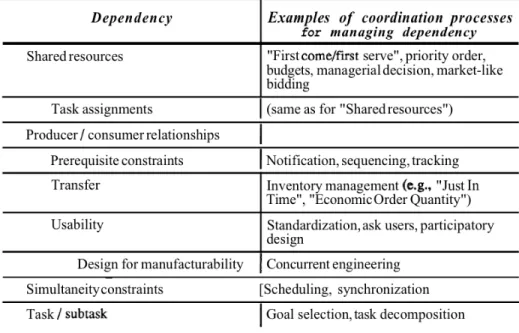
Interdependencies and associated coordination mechanisms are classified as: managing shared resources, managing producer/consumer relationships, managing simultaneity constraints, and managing task/subtask dependencies. In addition, two other activities are considered: group decision-making and communication. All these approaches are described in Figure 8.