In the following report, Hanover Research examines best practices in math interventions across all grade levels. This report provides an overview of common practices, summarizes rigorous academic evaluations of math interventions, and concludes with profiles and evaluations of seven math intervention programs.
Best Practices in Math
Interventions
T
ABLE OF
C
ONTENTS
Executive Summary and Key Findings ... 3
Section I: Literature Review ... 5
INTRODUCTION ... 5
RESPONSE TO INTERVENTION (RTI) ... 5
Components of RtI ... 6
ACADEMIC EVALUATIONS ... 7
EARLY DETECTION ... 11
Section II: Program Profiles ... 14
FRACTION FACE‐OFF! ... 16
Program Description ... 16 Evaluation and Assessment ... 16 HOT MATH TUTORING ... 17 Program Description ... 17 Evaluation and Assessment ... 18 NUMBER WORLDS ... 19 Program Description ... 19 Evaluation and Assessment ... 20
I CAN LEARN PRE‐ALGEBRA AND ALGEBRA ... 21
Program Description ... 22 Evaluation and Assessment ... 22 DREAMBOX LEARNING ... 23 Program Description ... 23 Evaluation and Assessment ... 24 ENVISIONMATH ... 25 Program Description ... 25 Evaluation and Assessment ... 25 DO THE MATH ... 26 Program Description ... 26 Evaluation And Assessment ... 27
E
XECUTIVE
S
UMMARY AND
K
EY
F
INDINGS
I
NTRODUCTIONSchool districts are faced with a multitude of academic intervention decisions, and the
choice of a mathematics intervention is one of great importance. This curricular review and
assessment, conducted by Hanover Research, is intended to provide additional insight on
this topic. Information contained in the following report is predominantly drawn from
national educational councils, organizations, or centers, as well as scholarly publications.
Predominant sources include the What Works Clearinghouse, The Best Evidence
Encyclopedia, and The National Council for Intensive Interventions, as well as the National
Center for Learning Disabilities and the National Council of Teachers of Mathematics. The
report is organized into two sections:
Section I: Literature Review begins with a brief introductory overview of standardcomponents of intervention programs, before providing insight into general best
practices of math intervention programs as identified by national councils,
associations, and research centers. The section then examines research specifically
dedicated to interventions for elementary age students published in academic
journals and conducted by research centers.
Section II: Program Profiles identifies seven math instruction and intervention programs whose effectiveness has been identified by a credible authority. This section provides an overview of each program and describes the supporting research.
K
EYF
INDINGS
Hanover Research identified seven mathematics intervention programs with broadsupport from the research community. Credible authorities suggest the following programs are likely to significantly improve students’ mathematics abilities: o Fraction Face‐Off! o Hot Math Tutoring o Number Worlds o I CAN Learn Pre‐Algebra and Algebra o DreamBox Learning o enVisionMATH o Do The Math
Three crucial practices should be applied to all mathematics interventions: universalscreening, explicit and systematic instructional methods, and data‐based decision
making. The American Institutes for Research and the What Works Clearinghouse
recommend that educators should screen all students in order to identify those in
need of supplementary assistance. Additionally, the National Council of Teachers of
Mathematics and the What Works Clearinghouse found that explicit and systematic
instructional methods are highly effective strategies. Lastly, the use of data to drive decision making is a common theme that unites recommendations from the American
Institutes for Research, the Institute of Educational Sciences, and the National Center on Intensive Interventions.
Several research studies indicate additional practices that may effectively improvestudents’ mathematics performance, including: the dedication of at least 10 minutes to “fluent retrieval of basic arithmetic facts,” the development of students’ systemized
approach to all problem types, and the nurturing of students’ confidence.
Recommendations specific to principals and other school leaders include providing
implementation support at all levels of multi‐tiered systems and allowing individual
schools to select intervention programming that suits their specific core curricula.
General consensus among researchers indicates that elementary school mathinterventions are essential to avoiding later difficulties. Research is united in the belief that early detection and remedy of math difficulties eliminates future struggles
with increasingly complex and abstract mathematical concepts studied throughout
secondary grades. Researchers have identified “fluency and proficiency with basic
arithmetic combinations and the increasingly accurate and efficient use of counting
strategies” as indicators of early math proficiency.
Research‐based mathematics interventions typically use decidedly engaging tactics,such as role‐playing or technology‐assisted learning. While engaging students is
viewed as a top priority, interventions typically emphasize distinctive qualities. For
instance, Hot Math emphasizes students’ mastery of word problems, while Fraction
Face‐Off aims to improve students’ proficiency with fractions.
S
ECTION
I:
L
ITERATURE
R
EVIEW
After a brief introductory overview of standard components of intervention programs, this
section provides insight into general best practices of math intervention strategies as
identified by national councils, associations, and research centers. The section then
specifically examines research regarding interventions for elementary age students.
I
NTRODUCTIONDue to the rising popularity of Response to Intervention (RtI), the pool of resources
describing Scientifically Research‐Based Interventions (SRBIs) is focused on this particular
practice. Although its features are found throughout many models of interventions, it is
generally defined by a systematic and proactive plan to assist struggling students. RtI is
more specifically characterized by a multi‐tiered early intervention structure comprised of
research‐based, increasingly rigorous instructional interventions for students who have not
responded to frequent student progress evaluations. This model can be applied to many
types of interventions and it is discussed intermittently throughout this section.
R
ESPONSE TOI
NTERVENTION(R
TI)
The Center on Response to Intervention, a division of the American
Institutes of Research, espouses a
highly data‐driven model of RtI (Figure
1.1), as data‐based decision making is central to all components. Student data
inform educators’ screening and
program design, as well as individual
student movement between varying
intensity levels of the support system.2
The goal of the universal screening
process is to identify students who
need additional support in achieving
academic success. Initial assessments
should include all students, and should
be consistent, evidence‐based, and
culturally‐responsive. Furthermore, this
phase must incorporate multiple stages
1
Contents taken verbatim from: “Essential Components of RTI.” Center on Response to Intervention.
http://www.rti4success.org/essential‐components‐rti
2
“Data‐Based Decision Making.” Center on Response to Intervention. http://www.rti4success.org/essential‐
components‐rti/data‐based‐decision‐making
Figure 1.1: Essential Components of RTI
Source: The American Institutes for Research1
DATA‐BASED DECISION MAKING UNIVERSAL SCREENING PROGRESS MONITORING MULTI LEVEL PREVENTION SYSTEM
TIERIII ‐INTENSIVE
Supplemental interventions
for high risk students. One‐
on‐one sessions. 5‐10%
TIERII ‐STRATEGIC
Supplemental interventions for
students at somerisk, conducted
in small‐group break‐out
sessions. 10‐15%
TIERI ‐BENCHMARK
Standards‐alligned instruction for all students,
conducted in normal class sessions. 75‐85%
of “additional testing or short‐term progress monitoring to corroborate students’ risk
status.”3 In order to evaluate students’ response to intervention, progress monitoring
should be conducted either on individual students or classes as a whole. Progress
monitoring should also be consistent, evidence‐based, and culturally‐responsive.4 The
structure of the intervention programing is fundamentally based on a multi‐level
prevention system. This framework is explained in full in the following subsection.
C
OMPONENTS OFR
TI
SRBIs comprise three tiers, which increase in intensity. As they experience math
interventions, students are evaluated using Curriculum Based Measurement (CBM) methods to determine their progress, and students who are not responding to their current tier are advanced to a more intensive tier.
Figure 1.2: Three‐Tiered Intervention Program Levels
Source: The RtI Network5
As illustrated in Figure 1.2, SRBI programs are often based on multi‐tiered intervention
structures that establish specific criteria for defining student success and identifying
educational needs, with an emphasis on progressing students to the point at which no
3
“Universal Screening.” Center on Response to Intervention. http://www.rti4success.org/essential‐components‐
rti/universal‐screening
4
“Progress Monitoring.” Center on Response to Intervention. http://www.rti4success.org/essential‐components‐
rti/progress‐monitoring
5
Shapiro, E. S. “Tiered Instruction and Intervention in a Response‐to‐Intervention Model.” RTI Action Network,
National Center for Learning Disabilities. http://www.rtinetwork.org/essential/tieredinstruction/tiered‐
interventions are required. Each tier represents a different model of instruction that varies
based upon a student’s academic needs.6 While such interventions are most frequently
based on a three‐tiered model, this is not always the case. For example, some schools or
districts may subdivide individual tiers and decide to offer more than three levels of
intervention.7 Broadly speaking, the levels of an RtI model represent the closeness with
which an instructor, counselor, or other school administrator must work with a student in
order to produce the standardized (“benchmark”) results.
In Tier I, instruction is standards‐based and delivered to the general classroom, utilizing
both small‐group and whole‐class delivery formats. Tier II provides targeted, supplemental
instruction to students whose assessment data suggest they are not making adequate
performance in response to Tier I instruction. Tier III provides intensive, research‐based
instruction for students who do not adequately respond to Tier II interventions. Tier III level
interventions may serve as either a supplement or a replacement for core classroom and
Tier I and Tier II level instruction. Tier III supports are provided as a replacement for traditional classroom instruction only when the student’s performance is significantly below grade level standards.
A
CADEMICE
VALUATIONSIn reviewing mathematics interventions, Hanover sought the findings of meta‐analyses
conducted by the Best Evidence Encyclopedia and the What Works Clearinghouse. The Best Evidence Encyclopedia (BEE) from Johns Hopkins University School of Education's Center for
Data‐Driven Reform in Education aims to equip educators and researchers with useful,
evidence‐supported information about the merit of a variety of educational practices across
the K‐12 spectrum. While the BEE has not published an exhaustive review of mathematics
programs targeted at struggling students (as it did in 2009 for literacy intervention
programs), it has produced three general reviews of mathematics programs: “Effective
Programs in Elementary Mathematics: A Best‐Evidence Synthesis” (2007), “Effective
Programs in Middle and High School Mathematics: A Best‐Evidence Synthesis” (2008), and
“The Effectiveness of Educational Technology Applications for Enhancing Mathematics
Achievement in K‐12 Classrooms” (2011).8
Another valuable source for meta‐analyses is The What Works Clearinghouse (WWC), an
online database provided by the U.S. Department of Education‘s Institute of Education
6
Shapiro, E.S., Op. cit.
7
“Essential Components of RTI – A Closer Look at Response to Intervention.” National Center on Response to
Intervention. April 2010, p.1. http://www.rti4success.org/sites/default/files/rtiessentialcomponents_042710.pdf
8
[1] Slavin, R. and Lake, C. “Effective Programs in Elementary Mathematics: A Best‐Evidence Synthesis.” Best Evidence
Encyclopedia, February 2007. http://www.bestevidence.org/word/elem_math_Feb_9_2007.pdf
[2] Slavin, R., Lake, C., and Groff, C. “Effective Programs in Middle and High School Mathematics: A Best‐Evidence
Synthesis.” Best Evidence Encyclopedia, October 2008.
http://www.bestevidence.org/word/mhs_math_Oct_21_2008.pdf
[3] Cheung, A. and Slavin, R. “The Effectiveness of Educational Technology Applications for Enhancing Mathematics
Achievement in K‐12 Classrooms: A Meta‐Analysis.” Best Evidence Encyclopedia, July 2011.
Sciences (IES). The IES has produced reports reviewing 226 math intervention studies, each
based on an exhaustive search of published and unpublished research.9 The WWC reviews
the effects of math programs on student outcomes in mathematics achievement. The
effects of an intervention are rated within a given outcome domain by the WWC as positive,
potentially positive, mixed, no discernible effects, potentially negative, or negative.10
The WWC developed a math intervention practice guide for RtI based on recommendations
from a diverse, expert panel of instructors and researchers, as well as a body of “high
quality experimental and quasi‐experimental studies” that met criteria established by the
WWC.11 This combination of expert opinions substantiated and supported by evidence‐ based study results indicated a set of recommendations and their classification into varying
levels of effectiveness: strong, moderate, or low. Figure 1.3 summarizes these
recommendations and their established level of supporting evidence.
Figure 1.3: Recommendations and Corresponding Levels of Evidence
RECOMMENDATION LEVEL OF EVIDENCE
Tier I
1. Screen all students to identify those at risk for potential mathematics
difficulties and provide interventions to students identified as at risk. Moderate
Tiers II and III
2. Instructional materials for students receiving interventions should focus
intensely on in‐depth treatment of whole numbers in kindergarten through
grade 5 and on rational numbers in grades 4 through 8. These materials
should be selected by committee.
Minimal
3. Instruction during the intervention should be explicit and systematic. This
includes providing models of proficient problem solving, verbalization of
thought processes, guided practice, corrective feedback, and frequent
cumulative review.
Strong
4. Interventions should include instruction on solving word problems that is
based on common underlying structures. Strong
5. Intervention materials should include opportunities for students to work
with visual representations of mathematical ideas and interventionists
should be proficient in the use of visual representations of mathematical
ideas.
Moderate
6. Interventions at all grade levels should devote about 10 minutes in each
session to building fluent retrieval of basic arithmetic facts. Moderate
7. Monitor the progress of students receiving supplemental instruction and
other students who are at risk. Minimal
8. Include motivational strategies in tier 2 and tier 3 interventions. Minimal
Source: What Works Clearinghouse and the Institute of Education Sciences12
9
“Math.” What Works Clearinghouse. http://ies.ed.gov/ncee/wwc/topic.aspx?sid=9
10
“Glossary.” What Works Clearinghouse. http://ies.ed.gov/ncee/wwc/glossary.aspx
11
“Assisting Students Struggling with Mathematics: Response to Intervention (RtI) for Elementary and Middle
Schools.” What Works Clearinghouse, 2009.
http://ies.ed.gov/ncee/wwc/pdf/practice_guides/rti_math_pg_042109.pdf
12
Research from the National Council of Teachers of Mathematics (NCTM) conducted a meta‐ analysis encompassing over 50 studies on mathematics interventions in search of effective
strategies for increasing the performance of special education and low‐achieving students.
Although researchers were clear in their disclaimer that these results were not definitive, they indicated that their conclusions are applicable to students of many ability levels.13 Researchers examined six instructional strategies and calculated effect sizes for each. Effect
sizes of 0.2 are considered small (comparable to a possible increase of students’
standardized test scores by eight percentile points), 0.4 moderate, and 0.6 or greater large (a possible increase of students’ standardized test scores of 25 percentile points).
As indicated by results presented in Figure 1.4, systematic and explicit instruction was the
only strategy to register a large or moderate to large effect on both low‐achieving and
special education students. The other five strategies did not translate across student group
type. Peer‐assisted learning and formative data‐sharing with students produced moderate
to large effects in low‐achieving students that were not experienced by their counterparts in
special education. Researchers considered techniques “systematic and explicit” when
teachers demonstrated a specific strategy for tackling a problem, which students then used
in independent work. Demonstrations typically involved extremely clear procedures and
questions. Contrarily, “student think‐alouds” were more student‐centric and involved asking students to articulate their thinking process as they solved math problems.
Figure 1.4: Effect Sizes of Instructional Strategies
INSTRUCTIONAL STRATEGY EFFECT SIZE SPECIAL EDUCATION STUDENTS LOW‐ACHIEVING STUDENTS
1. Visual and graphic descriptions of problems 0.50 N/A
2. Systematic and explicit instruction 1.19 * 0.58 *
3. Student think‐alouds 0.98 * N/A/
4. Use of structured peer‐assisted learning activities
involving heterogeneous ability groupings 0.42 0.62 *
5. Formative assessment data provided to teachers 0.32 0.51
6. Formative assessment data provided directly to students 0.33 0.57*
*Indicates a large or moderate to large effect size.
Source: The National Council of Teachers of Mathematics14
NCTM provides a qualitative summary of these results, suggesting that math intervention
programs adhere to a set of recommendations, including that instruction should:
Be in a small group of no more than six
Address skills that are necessary for the unit at hand
Be quite explicit and systematic 13“Effective Strategies for Teaching Students with Difficulties in Mathematics.” The National Council of Teachers of
Mathematics, 2007.
http://www.nctm.org/uploadedFiles/Research_News_and_Advocacy/Research/Clips_and_Briefs/Research_brief_ 02_‐_Effective_Strategies.pdf
14
Require the student to think aloud as she or he solves problems or uses graphic representation to work through problem‐solving options
Balance work on basic whole‐number or rational‐number operations (depending ongrade level) with strategies for solving problems that are more complex15
The National Association of Elementary School Principals also provides recommendations to school principals regarding math instruction in the form of a white paper. The white paper,
which adapted content from the Department of Education’s Doing What Works, outlines
Response to Intervention implementation processes in elementary and middle school math,
providing specific action items for instructors and administrators. 16 This comprehensive
guide provides several concrete recommendations for instructional practices, including
dedicating at least 10 minutes to “fluent retrieval of basic arithmetic facts,” helping
students develop a systemized approach to all problem types, and building confidence and
motivation through praise.17 Recommendations specific to principals and other leaders in
school administration include providing implementation support at all levels of multi‐tiered systems and allowing individual schools to select intervention programming that suits their specific core curricula.18
The National Center on Intensive Intervention (NCII), a subdivision of the American
Institutes for Research, conducted an evaluation of math intervention practices at five
exemplary school districts: Hancock, West Virginia; Okaloosa, Florida; Scituate,
Massachusetts; Alton, Illinois; and Jenison, Michigan.19 The evaluation focused on students
with severe learning difficulties, but the findings may be applicable to all students:
In all sites, intensive intervention was defined as a component of a multi‐tieredsystem of support. These systems provided an infrastructure to support services for
students with the most intensive needs, including those with disabilities, within the general education system.
The use of data to drive instructional decision making was pervasive in all sites,especially with respect to academic progress monitoring. In contrast, the use of
diagnostic assessment data and behavioral progress‐monitoring data was less defined and consistent.
All sites placed a heavy emphasis on capacity‐building practices related to intensiveintervention, including creating and maintaining broad stakeholder buy‐in, building
staff expertise, being flexible with scheduling, and making connections between
intensive intervention and other related initiatives.
15
Bulleted items adapted from: Ibid., p. 2.
16
“Response to Intervention in Elementary‐Middle Math.” The National Association of Elementary School Principals.
http://www.naesp.org/sites/default/files/Math_Intervention_blue.pdf 17 Ibid., pp. 4‐6. 18 Ibid., pp. 7‐8 19
“Implementing Intensive Intervention: Lessons Learned from the Field.” National Center on Intensive Intervention,
October 2013, pp. 1‐68.
Meaningful engagement and involvement of families in decisions about program planning was important for supporting implementation of intensive intervention.
Identification and service delivery for special education occurred separately from andafter a student received intensive intervention within the tiered intervention system.
Staff defined intensive intervention as a process involving adaptation of a secondaryintervention (Tier 2), consistent with components of NCII’s data‐based
individualization framework. However, staff spoke more frequently and concretely
about making quantitative rather than qualitative adaptations to interventions.
Although all sites described using secondary intervention programs (Tier 2) as afoundation for intensifying intervention, fidelity of implementation of these programs was inconsistent.20
E
ARLYD
ETECTIONWhile math interventions at the middle and high school levels are vital, general consensus among researchers suggests that interventions at the elementary school level are essential
to avoiding later difficulties. This body of work is united by the belief that early detection
and remedy of math difficulties eliminates future struggles with increasingly complex and
abstract mathematical concepts studied throughout secondary grades. As such, this section of the report focuses on the nature and effect of math interventions among students in the primary grades.
Much of the research within this general topic is dedicated to identifying effective screening
methods that reliably detect kindergarteners and first graders who experience difficulties.
Studies concerned with early mathematics indicate that students who enter first grade with
gaps in mathematical understanding are likely to experience continued effects of this
deficiency throughout their educational careers.21
A 2005 article published in the Journal of Learning Disabilities compiled available research
on mathematics difficulties (MD) and identified the importance of “fluency and proficiency
with basic arithmetic combinations and the increasingly accurate and efficient use of
counting strategies”22 Lack of basic mathematic fluidity (i.e., immediate access to basic
arithmetic combinations such as 3+6) is limited for almost all young students who struggle
20
Taken verbatim from: Ibid., p. 1.
21
[1] Gersten, R., et al. “Screening for Mathematics Difficulties in K–3 Students.” Center on Instruction at RMC
Corporation, 2011, p. 3.
http://www.centeroninstruction.org/files/Screening%20for%20Math%202nd%20Ed%202‐3‐12.pdf
[2] Jordan, N. C. et al. “Early Math Matters: Kindergarten Number Competence and Later Mathematics Outcomes.”
Developmental Psychology, 2009, 45, pp. 850–867. Accessed via ProQuest.
[3] Morgan, P., L., Farkas, and Q. Wu. “Five‐Year Growth Trajectories of Kindergarten Children With Learning
Difficulties In Mathematics.” Journal of Learning Disabilities, 2009, 42, pp. 306–321. Accessed via ProQuest.
[4] Duncan, G. et al. “School Readiness and Later Achievement.” Developmental Psychology, 2007, 43, pp. 1428–1446.
22
Gertsen, R., N. Jordan, and J. Flojo. “Early Identification and Interventions for Students with Mathematics
Difficulties.” The Journal of Learning Disabilities, August 2005, 38:4, pp. 302.
with math. Researchers produced a causal claim that the mechanics of finger‐counting
methods, necessary when students cannot automatically compute basic math concepts,
cause delays in understanding classroom‐based demonstration of advanced math
functions.23
Using these observations and further analysis, Gertsen, et al. proposed valid indicators of
potential MD in kindergartners, which included the following areas: difficulty with
arithmetic combinations (including poor integer magnitude comparison skills, hesitation in
identifying numbers, and poor memory span) and undeveloped counting methods.24 The
study identified The Number Knowledge Test as a screening exam that researchers consider
to be a broad assessment that strongly predicts MD. A description of the tool is provided
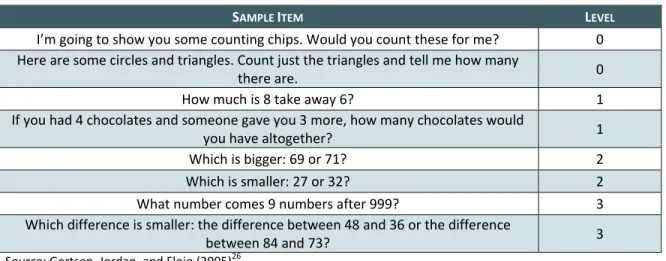
below, and Figure 1.5 on the following page provides sample items from the assessment.
The Number Knowledge Test is an individually administered 10–15 minute measure
that assesses students’ procedural and conceptual knowledge related to whole
numbers. The test examines students’ understanding of magnitude, their counting
ability, and their competence with basic arithmetic operations.25
Figure 1.5: Sample Items from the Number Knowledge Test
SAMPLE ITEM LEVEL
I’m going to show you some counting chips. Would you count these for me? 0
Here are some circles and triangles. Count just the triangles and tell me how many
there are. 0
How much is 8 take away 6? 1
If you had 4 chocolates and someone gave you 3 more, how many chocolates would
you have altogether? 1
Which is bigger: 69 or 71? 2
Which is smaller: 27 or 32? 2
What number comes 9 numbers after 999? 3
Which difference is smaller: the difference between 48 and 36 or the difference
between 84 and 73? 3
Source: Gertsen, Jordan, and Flojo (2005)26
A later literature review, also conducted by Gertsen and a team of researchers for The
Center on Instruction at RMC Corporation, developed the following set of conclusions about early mathematics screening for students in grades K–3:
There are notable differences between the needs of kindergarten students and first‐grade students. Screening tools can identify these differences, which may be due to
lack of exposure to mathematics before elementary school or the transition to a
formal educational environment. 23 Ibid. 24 Ibid., p. 293. 25
Taken verbatim from: Ibid., p. 297.
26
Constant changes to curricula, which are common occurrences, may contribute tostudents’ “late‐onset” need for mathematic interventions.
The literature reviewed in this study does not indicate strategies to detect whichstudents, despite the fact that they have mastered elementary mathematical skills,
will later struggle with more advanced and abstract concepts (i.e., fractions, ratio, proportion and geometry) in fourth and fifth grade.
Working memory continues to be an accurate indicator of mathematical proficiency,although there is not a clear consensus about how to improve working memory
among students in mathematics.
There is a scarcity of research that addresses multiple proficiency assessmentbatteries and timed assessments, as well as the role of assessment tools within an RtI framework.27
27
Gertsen, R., Clarke, B., and Jordan, N. “Screening For Mathematics Difficulties in K–3 Students.” RMC Research
Corporation, Center on Instruction, 2007, pp. 17‐19.
S
ECTION
II:
P
ROGRAM
P
ROFILES
The following section examines seven math instruction and intervention programs that have been determined to be effective by a credible authority. For each tool, this section provides
a description of the program and the results of research evaluating the efficacy of the
program. After a brief overview of the program, each profile consists of two sections:
Program Description examines target ages and program focus, delivery methods, the
frequency and typical length of sessions, and the curricular design.
Evaluation and Assessment identifies research and assessment results of the program. Although Hanover mentions a range of studies, we emphasize the most scientifically reliable
and methodologically sound studies, which are identified by established, independent
organizations. These include three previously discussed organizations: The Best Evidence
Encyclopedia (BEE), the What Works Clearinghouse (WWC), and the National Center on
Intensive Intervention (NCII). Each organization’s evidence standards are indicated below.
The BEE criteria include the following requirements:o Studies involved children within the target age range.
o Studies used control groups.
o Studies used random assignment in placing students into the test or control
group.
o Though studies could take place in any country, reports had to be available in
English.
o Studies were a minimum of 12 weeks in duration. 28
The WCC’s evidence standards vary slightly based on academic grade level, but largelyalign with the BEE’s requirements and include the following elements:
o Topic Area Relevance. The study must focus on the effects of a mathematics intervention on one or more measures of mathematics achievement.
o Sample Relevance. The WWC High School Mathematics area appropriately
reviews interventions for the specified age group (either elementary, middle, or high school grades).
o Geographic Relevance. The study must have been conducted in the United
States (including the 50 states, the District of Columbia, territories, and tribal entities).
o Outcome Relevance. The study must include at least one student achievement
measure that demonstrates sufficient reliability or face validity.29
28
Adapted from: Slavin and Lake, Op. cit.
29
[1] Bulleted items taken verbatim from: “WWC Evidence Review Protocol for High School Mathematics
Interventions, Version 2.0.” The What Works Clearinghouse, 2010, p. 2.
http://ies.ed.gov/ncee/wwc/pdf/reference_resources/hsm_protocol_v2.pdf
[2] See also: “WWC Evidence Review Protocol for High School Mathematics Interventions, Version 2.0.” The What
The NCII conducted a meta‐analysis of program evaluations, which resulted in theidentification of five programs with convincing positive evidence based on the
following criteria:
o Participants have been identified as “at‐risk” (i.e., within the bottom 30th percentile on a local or national norm, or sample mean below 25th percentile on local or national test; or students with identified disability).
o Evaluation design was based on responsible methodology, including random
assignments, statistically and demographically comparable treatment and
control groups, and no attrition bias.
o Fidelity of implementation was measured satisfactorily and reached levels of 75 percent or greater.
o Targeted and broader measures of effectiveness are reliable. All measures of
both types must be psychometrically reliable with consistency coefficients
greater than 0.59.30
Regression analyses in the NCII examination revealed various effect sizes of the programs in
question. Effect sizes of 0.25 or larger are considered to be “substantively important,”
indicating a strong relationship between participation in a particular intervention and
attainment of an increased academic outcome. As seen in Figure 2.1, NCII found Fraction
Face‐Off! and Hot Math Tutoring to be the most effective across targeted and broader
measures.
Figure 2.1: Effect Sizes of NCII‐Evaluated Programs
PROGRAM NAME STUDY
NUMBER OF
OUTCOME
MEASURES
MEAN EFFECT SIZE
TARGETED
MEASURES
BROADER
MEASURES
focusMATH Intensive
Intervention Styers & Baird‐Wilkerson (2011) 15 0.23* N/A
Fraction Face‐Off! Fuchs, Schumacher, Long, Namkung,
Hamlett, et al. (2012) 4 1.81* 0.92*
Hot Math Tutoring Fuchs, Fuchs, Craddock, Hollenbeck,
Hamlett, et al. (2008) 3 1.15* 0.60*
Number Rockets Fuchs, Compton, Fuchs, Paulsen,
Bryant, et al. (2005) 7 0.45* 0.10
Pirate Math
Individual Tutoring
Fuchs, Powell, Seethaler, Cirino,
Fletcher, et al. (2009) 6 0.65* 0.56*
*Effect Size is statistically significant for at least one measure, greater than .25
Source: American Institutes for Research31
“WWC Evidence Review Protocol for Middle School Mathematics Interventions, Version 1.1.” The What Works
Clearinghouse, 2009. http://ies.ed.gov/ncee/wwc/pdf/reference_resources/msm_protocol_1.1.pdf
30
“Instructional Intervention TRC.” National Center for Intensive Intervention.
http://www.intensiveintervention.org/chart/instructional‐intervention/headers#field_part
31
“Academic Intervention.” The National Center on Intensive Intervention.
F
RACTIONF
ACE‐O
FF!
Fraction Face‐Off!, which was developed, tested, and distributed by Vanderbilt University,
aims to improve fourth grade students’ knowledge and comprehension of fractions.32 It is
intended for use among small‐group tutoring programs and each session takes
approximately 30 minutes with a recommended three sessions per week for 12 weeks.33
Instructors are encouraged to undergo a day‐long training program to prepare, although
very detailed teacher’s manuals accompany the program. There are no technology
requirements for the program.
P
ROGRAMD
ESCRIPTIONFraction Face‐Off! “uses explicit instruction to address two types of understanding about
fractions: the part/whole interpretation of fractions and the measurement interpretation of
fractions.”34 Program developers Lynn Fuchs (Ph.D.), Robin Schumacher (Ph. D.), and Doug
Fuchs (Ph.D.) view fraction‐mastery as essential for later success in algebra and higher level mathematics, which was the guiding philosophy of the program design.
The Fraction Face‐Off! model uses an engaging athletic theme, with students playing the
imaginary role of professional athletes. Each lesson requires teamwork (in activities like The
Relay and Fraction Sprint) and individual effort. Students’ fraction proficiency is expanded
by opportunities to earn “fraction money,” which can be redeemed for prizes at “The
Fraction Store” only after demonstrating understanding of fraction denominations that
equal one whole dollar.
E
VALUATION ANDA
SSESSMENTAs previously mentioned, a study conducted by the program’s designers – Fuchs,
Schumacher, and Fuchs – was recognized by the NCII as a methodologically sound
evaluation that indicated promising mean effects.
This study was conducted at a site in Nashville,
Tennessee over one year.36 Participants included
281 students, of which 130 were assigned to a
control group and 129 underwent the program.
Students were all defined as “at‐risk,” meaning
below the 35th percentile on the Wide Range
Achievement Test–4. This group was further
delineated into severe risk (less than 17th
percentile) and less severe risk (between the 18th
and 34th percentiles). The study collected
32
“Fraction Face‐Off!” Vanderbilt University. http://kc.vanderbilt.edu/pals/pdfs/fraction_face_off.pdf
33
“Fraction Face‐Off! (previously Fraction Challenge).” The National Center on Intensive Intervention.
http://www.intensiveintervention.org/chart/instructional‐intervention‐tools/12928
34
“Fraction Face‐Off!” Op. cit.
35
Ibid.
36
“Fraction Face‐Off! (previously Fraction Challenge),” Op. cit.
Figure 2.2: Fraction Face‐Off! Evaluation Effect Sizes
MEASURE EFFECT SIZE
Targeted Measures
Comparing Fractions 1.64***
Fraction Number Line 1.07***
Fraction Calculations 2.48***
Broader Measures
NEAP Performance 0.85***
***p ≤ .001
information about students’ race and ethnicity, socio‐economic status, disability status, and gender.37 As is evident in Figure 2.2, Fraction Face‐Off indicated the largest effect on students’ ability to compare and calculate fractions. It had a lesser but significant effect on
students’ success using a fraction number line and increased performance on the National
Assessment of Educational Progress (NEAP) Exam.
H
OTM
ATHT
UTORINGHot Math is designed to help third grade students improve their mastery of word problems. It is intended for use in small‐group tutoring programs. Like Fraction Face‐Off!, Hot Math
was developed, evaluated, and distributed by researchers at Vanderbilt University.38 Each
session lasts approximately 20‐30 minutes, and the program is delivered three times per
week for 13 weeks. Although this program is intended for use in tutoring programs, it can
also be implemented alongside the Classroom Hot Math program, which is used two times
per week for 30‐45 minutes.39 Instructors are encouraged to undergo a day‐long training
program to prepare, although very detailed teacher’s manuals accompany the program.
There are no technology requirements for Hot Math.40
P
ROGRAMD
ESCRIPTIONLynn Fuchs describes Hot Math as a combination of “explicit instruction and self‐regulation
strategies with instruction on transferring solutions to novel math problems.”41 She explains
that this program, which is based on schema theory, supports:
Solution strategies for four word‐problem types, and
How to transfer those solution strategies to word problems with unexpected features,such as problems that include irrelevant information, or that present a novel question
requiring an extra step, or that include relevant information presented in charts or
graphs, or that combine problem types, and so on.42
Figure 2.3 describes the Classroom Hot Math curriculum, which indicates a foundation for
the tutoring program. Hot Math is comprised of five, three‐week units that explore a
different aspect of word problems: 37 Ibid. 38
“Mastering Mathematics: Improving Mathematics Outcomes for Students.” The Conversation, February 4, 2014.
http://leadspartnership.ca/theconversation/289/
39
“Hot Math Tutoring.” The National Center on Intensive Intervention.
http://www.intensiveintervention.org/content/hot‐math‐tutoring
40
Ibid.
41
“Groundbreaking Work from Vanderbilt: Response to Mathematics Intervention.” Special Edge, 2006, 19:2.
http://www.calstat.org/publications/article_detail.php?a_id=51&nl_id=6
42
Bulleted items taken verbatim from: “Mastering Mathematics: Improving Mathematics Outcomes for Students,”
Figure 2.3: Hot Math Classroom Curriculum
UNIT DESCRIPTION
Checking your work Focuses on the basics of checking over finished work covering these areas:
Sense, Lining Up, Math, Labels, and Signs.
Buying Bags
Teaches students specific strategies on how to solve word problems that
deal with buying things in groups. (e.g. If lollipops come in bags of 10, and
Judy needs 23 lollipops, how many bags does she need to buy?)
Shopping List
Teaches students how to solve multi step problems dealing with buying
multiple things at multiple prices (e.g. I need to buy 2 apples for $1 each and
4 bananas for $2 each, how much will I spend?)
Half Teaches students a specific strategy for finding half of a group of objects.
Pictograph Teaches students how to 'solve' pictographs and use the information to
answer questions.
Source: Vanderbilt University43
E
VALUATION ANDA
SSESSMENTA study conducted by the program’s designers was recognized by the NCII as a
methodologically sound evaluation that indicated promising mean effects.44 The study
examined the effects of Hot Math Tutoring Intervention on 84 third grade students across
120 classrooms. All participants scored below the district criterion designating risk for math
learning disabilities (below the 24th percentile) on the Test of Computation Fluency.45 Fifty‐
six students were in the treatment group and 28 students were in the control group. The
study collected information about students’ race
and ethnicity, socio‐economic status, disability
status, and gender. Measures captured students’
comprehension across three problems types that
ranged from problems that closely‐related to
learned math content to those that required
creative application of skills. Figure 2.4 presents
the study’s findings, which indicate that Hot Math
Tutoring has the strongest effect on improving
student’s performance on problems that are
directly related to its content. This strength decreases as questions require more advanced applications. The following list summarizes each measure:
Immediate Transfer: Number correct (0‐44), Incorporates novel problems in the sameformat as the problems used for problem‐solution instruction; none of the cover
stories are used for instruction.
43
“Hot Math: Teaching Math Problem Solving with Explicit Instruction to Transfer and Self‐Regulation Strategies.”
https://kc.vanderbilt.edu/pals/pdfs/hot_math.pdf
44
[1] “Hot Math Tutoring,” Op. cit.
[2] Fuchs, L. et al. “Effects of Small‐Group Tutoring with and without Validated Classroom Instruction on At‐Risk
Students' Math Problem Solving: Are Two Tiers of Prevention Better Than One?” The Journal of Educational
Psychology, 2008, 100:3, pp. 491‐509. http://www.ncbi.nlm.nih.gov/pmc/articles/PMC2536765/pdf/nihms‐
62377.pdf
45
“Hot Math Tutoring,” Op. cit.
Figure 2.4: Hot Math Tutoring Evaluation Effect Sizes
MEASURE EFFECT SIZE
Targeted Measures Immediate Transfer 1.15* Broader Measures Near Transfer 0.82* Far Transfer 0.38 *p ≤ .001
Near Transfer: Number correct (0‐79), Incorporates novel problems that vary fromthe problems used for problem‐solution instruction in terms of one or more of the
transfer features addressed in Hot Math Tutoring: unfamiliar vocabulary, different
question, irrelevant information, or combination of problem types.
Far Transfer: Number correct (0‐72), Designed to mirror real‐life problems; variesfrom the problems used for instruction in multiple ways; is formatted to look like a
commercial, standardized test; presents a multi‐paragraph with four questions; some
of the information needed to answer the question is removed from the multi‐
paragraph narrative and placed in figures or question stems; contains multiple pieces
of numeric and narrative irrelevant information; provides opportunities for students
to formulate decisions.46
N
UMBERW
ORLDSNumber Worlds is an intervention program targeted at students that are one to two grades
below grade‐level in mathematics. Lessons take 45‐60 minutes and are intended to
supplement students’ daily mathematics instruction. A placement test assigns students to
the appropriate level and unit. Number Worlds offers a prevention program for students in
pre‐kindergarten through first grade, an intervention program for students from first
through eighth grade, and an algebra readiness program for students in sixth through eighth grade.47
P
ROGRAMD
ESCRIPTIONPrevention Levels A‐C, detailed in Figure 2.5, are targeted at students in pre‐kindergarten
through first grade who enter school with an “impoverished math understanding” and who are at risk of math failure in later grades.48
Figure 2.5: Number Worlds Program Description, Levels PK‐1 LEVEL A PRE‐KINDERGARTEN LEVEL B KINDERGARTEN LEVEL C GRADE 1
Children acquire well‐developed
counting and quality schemas
Children develop a well‐consolidated
central conceptual structure for
single‐digit numbers
Children link their central conceptual
structure of number to the formal
symbol system
Source: Number Worlds49
Figure2.6 details Intervention Levels D‐J, as well as the Algebra Readiness intervention.
These are intended for students in first through eighth grade that are at least one level
behind in math. Students take six four‐week intensive units per grade, with the goal of
developing “on‐level mathematical proficiency.”50 A selection of sample lessons is available
46
Bulleted items taken verbatim from: Ibid.
47
“Scope & Sequence.” Number Worlds. http://sranumberworlds.com/scopesequence.html
48
Ibid.
49
Table contents taken verbatim from: Ibid.
50
online alongside guidelines for implementing Number Worlds (and Everyday Mathematics,
another McGraw Hill product) within an RTI framework.51
Figure 2.6: Number Worlds Program Description, Grades 1‐8
LEVEL D GRADES 1‐2 LEVEL E GRADES 2‐3 LEVEL F GRADES 3‐4 LEVEL G GRADES 4‐5 LEVEL H GRADES 5‐6 LEVEL I GRADES 6‐7 LEVEL J GRADES 7‐8 ALGEBRA READINESS GRADES 6‐8 Number Sense Number Sense Number Sense Number Sense Number Sense Number Sense Number Sense Whole Numbers and Operations Number and Pattern Relationships Number and Pattern Relationships Number and Pattern Relationships Number and Pattern Relationships Number and Pattern Relationships Operation Sense and Computation Expressions and Equations Rational Numbers
Addition Addition Addition and
Subtraction Multiplication Fractions, Decimals, and Percents Proportional Reasoning Proportional Reasoning Operations on Rational Numbers Subtraction Subtraction Multiplication and Beginning Division Division Multiplication
and Division Algebra Algebra
Equations and Functions Geometry and Measurement Geometry and Measurement Geometry and Measurement Geometry and Measurement Geometry and Measurement Geometry and Measurement Geometry and Measurement The Coordinate Plane and Graphing Data Analysis and Applications Data Analysis and Applications Data Analysis and Applications Data Analysis and Applications Data Analysis and Applications Data Analysis and Applications Data Analysis and Applications Algebra
Source: Number Worlds52
E
VALUATION ANDA
SSESSMENTThe Number Worlds website states that, since its development in the mid‐1980s, the
intervention “has been the only such program to show proven results through years of
rigorous field testing. These tests show how students who began at a disadvantage
surpassed the performance of students who began on‐level with their peers, simply with
the help of the Number Worlds program.”53 The website links to an article titled “Program
Lifts Students’ Math Scores: Officials Statewide Gains Are Dramatic.” This article highlights
the performance of students in kindergarten and first grade at three Kentucky elementary
schools. These students were placed in a Number Worlds math intervention program and
51
[1] “Sample Lessons.” Number Worlds. http://sranumberworlds.com/sample.html
[2] “Response to Intervention: Everyday Mathematics with SRA Number Worlds.” The McGraw Hill Companies.
https://docs.google.com/viewer?a=v&q=cache:8IzV6W3iVWAJ:www.asdk12.org/depts/titleone/binder/Everyday _math_w_numberworlds.pdf+&hl=en&gl=us&pid=bl&srcid=ADGEESh4Ek5ARNjQnSBp_VSiVt8HkLSRxnuzgneFcr3L krRMZEUhgUD5YIR9AgwwxrvxTYisCnxZg7H_wpFLyLN3WMOS3EHg80jKjIEguBz__4ND5gm7LEn_K1kxXe97RlDrde8 KQuq5&sig=AHIEtbTH_Q3OpD‐IU0RDcHWixVh7VP7RlQ&pli=1 52 Ibid. 53
subsequently “posted one to two years of growth in math skills in one year and outscored
their peers on norm‐referenced tests.”54
In addition, the creator of Number Worlds, Sharon Griffin, Ph.D., has published a number of
papers on the program and math education in general.55 Aside from papers authored by
Griffin, Hanover found the following studies on Number Worlds conducted by SKF
Educational Services:
“The Effectiveness of SRA/McGraw‐Hill Number Worlds Program on Fluency in MathCalculation for Middle School Students Identified with Special Needs”56 This study
sample consisted of 23 students enrolled in a low‐income middle school in central
Ohio. The study determined that “for approximately 83% of students in this sample,
Number Worlds is highly to moderately effective.”57
“The Effectiveness of SRA/McGraw‐Hill Number Worlds: A Response to InterventionModel of Service Delivery”58 This study sought to investigate the impact of Number
Worlds on the achievement of at‐risk kindergarten and fourth grade students. The
study sample consists of three kindergarten students and three fourth‐grade students
enrolled in a low‐income elementary school in central Ohio. Preliminary results
showed “that the Number Worlds program increases fluency in identifying numbers
for Kindergarten students and in completing multiplication facts for fourth graders.”59
However, it must be noted that these reports appear to have been specifically funded by
McGraw‐Hill. Additionally, the small sample sizes used in each study do not suggest that
they are particularly reliable indicators. Neither the WWC nor the BEE identifies studies on
Number Worlds that meet their methodological qualifications.
I
CAN
L
EARNP
RE‐A
LGEBRA ANDA
LGEBRAI CAN Learn Pre‐Algebra and Algebra is tailored to the need of ethnically diverse, inner‐city
students in grades 6‐12 and is designed to meet general state and national math
standards.60 However, the fact that I CAN Learn is computer‐based makes it an expensive
form of math intervention: a 30‐seat technology lab can cost at least $100,000, with an
additional $150,000 for the software, according to estimates from a group of researchers
54
Campbell, J. “Program Lifts Students’ Math Scores: Officials: Statewide Gains are Dramatic.” October 29, 2007.
Messenger‐Inquirer. http://sranumberworlds.com/downloads/news/MessengerInq‐NW_v4.pdf
55
“Program Authors.” Number Worlds. http://sranumberworlds.com/authors.html
56
“The Effectiveness of SRA/McGraw‐Hill Number Worlds Program on Fluency in Math Calculation for Middle School
Students Identified with Special Needs.” SKF Educational Services, LLC.
http://www.mheresearch.com/assets/products/6ea9ab1baa0efb9e/Number_Worlds_effectivewithspecialneedss tudents.pdf
57
Ibid.., p. 10
58
“The Effectiveness of SRA/McGraw‐Hill Number Worlds: A Response to Intervention Model of Service Delivery” SKF
Educational Services, LLC.
http://www.mheresearch.com/assets/products/6ea9ab1baa0efb9e/shannon_flaum.pdf
59
Ibid., p. 9.
60
“I CAN Learn Pre‐Algebra and Algebra.” Promising Practices Network.
whose article featuring I CAN Learn was published in the American Economic Journal:
Economic Policy.61 This estimate does not include yearly maintenance costs.
P
ROGRAMD
ESCRIPTIONMark Dynarski, the director of the Center for Improving Research Evidence at Mathematica Policy Research, indicated that the power of this program lies in its use of technology, as it targets students who are struggling academically, frequently due to missed class time, and allows them to work at their own pace. “That’s a power of technology,” Mr. Dynarski said. “That is one of its real strengths.”62
The pre‐algebra curriculum, which also incorporates elementary aspects of geometry and
statistics, comprises 130 lessons and 45 hours of instructional video.63 Its units include the
following:
Numbers and Operations
Mathematical Reasoning
Algebraic Expressions and Equations
Integers, Decimals, Fractions and Percents
Ratios and Proportions
Square Roots
Measurement
Basic Geometry
Graphs and Functions64
The structure of the I CAN Learn Math algebra curriculum is largely similar; however, it
presents more complex and abstract content than the pre‐algebra program. It places a
larger emphasis on preparing students for success in “high‐stakes tests,” such as state exit
exams and college readiness assessments like the SAT and ACT.65 Its curriculum comprises
180 lessons that address the following elements:
Algebraic System of Numbers and Operations
Algebraic Expressions
Graphing Equations and Inequalities
Foundations of Functions
Systems of Linear Equations and Inequalities
Polynomial Operations
Quadratic Equations and Functions
Probability and Statistics
Matrices
Logarithms66
E
VALUATION ANDA
SSESSMENTThe What Works Clearinghouse identified a study conducted on I CAN Learn Pre‐Algebra
and Algebra interventions that meets its methodological qualifications. WWC indicated
there is “strong evidence of a positive effect with no overriding contrary evidence.”67
61
Cavanagh, S. “Computer‐Aided Instruction Led to Algebra Gains.” Education Week, March 10, 2009.
http://www.edweek.org/ew/articles/2009/03/10/25adapt.h28.html
62
Cavanagh, Op. cit.
63
“Pre‐Algebra.” I CAN Learn Education Systems. http://www.icanlearn.com/pre_algebra.html
64
Bulleted items taken verbatim from: Ibid.
65
“Algebra.” I CAN Learn Education Systems. http://www.icanlearn.com/algebra.html
66
Bulleted items taken verbatim from: Ibid.
67
“Middle School Math.” The What Works Clearinghouse, July 30, 2007, p. 2.
Researchers designed a randomized study of 2,400 students in eighth grade across 13
schools in Orleans Parish schools, with one portion of classes using I CAN Learn programs,
and others using the standard curriculum. Specifically, 1,082 students were administered
the I CAN Learn Pre‐Algebra and Algebra programs, and 1,318 students acted as a control
group and received traditional mathematics instructional methods.68 Student’s progress was
measured against pre‐ and post‐test results in the Louisiana Educational Assessment
Program (LEAP).69
A separate study, published in 2009 by the American Economic Journal: Economic Policy,
found similar, positive effects. This study was a randomized study of late middle‐ and early
high school students in urban districts across 17 schools.70 Their performance was measured
against pre‐ and post‐test results in state standardized exams and designed algebra exams.
Researchers addressed its high price point and suggested that this program may offer the
same success at a lower price point than costs associated with decreasing class sizes.71 This
study was not acknowledged by the WWC as one that met evidence standards.
D
REAMB
OXL
EARNINGDreamBox Learning, developed by DreamBox Learning, Inc., provides another example of an
online program, but is intended for younger students in grades K‐6. Its homepage indicates
that the program is broadly focused on numbers and operations, place value, and number
sense. Additionally, it is aligned to Common Core State Standards and seeks to create a
“seamless integration” of instruction time with formative and summative assessment.72
DreamBox recommends that students spend 90 minutes per week with the program.73
P
ROGRAMD
ESCRIPTIONThis program is anchored by its Intelligent Adaptive Learning capabilities, which are highly
data‐driven. Dreambox collects over 50,000 data points per hour for each student, which
are analyzed to determine individual students’ problem solving methods. This allows the
program to adapt the lesson and the “level of difficulty, scaffolding, sequencing, number of
hints, and pacing as appropriate.”74 Dreambox espouses the transparency that its program
brings as being essential to engaging teachers, administrators, and parents. Ease of
information about “how students are moving through the curriculum, with up‐to‐date
68
“I CAN Learn Pre‐Algebra and Algebra.” The What Works Clearinghouse.
http://ies.ed.gov/ncee/wwc/pdf/intervention_reports/wwc_icanlearn_031009.pdf
69
Ibid., p. 3.
70
Barrow, L., L. Markman, and C. Rouse. "Technology's Edge: The Educational Benefits of Computer‐Aided
Instruction." American Economic Journal: Economic Policy, 2009, 1:1, pp. 52‐74.
http://www.aeaweb.org/articles.php?doi=10.1257/pol.1.1.52
71
Ibid.
72
“How to Successfully Plan for CCSS for Math.” DreamBox Learning. http://www.dreambox.com/white‐
papers/successfully‐plan‐ccss‐math
73
“DreamBox Learning.” The What Works Clearinghouse. http://hepg.org/hel/article/556
74
“Intelligent Adaptive Learning.” DreamBox Learning. http://www.dreambox.com/intelligent‐adaptive‐