Brief Screening Tests for Dementia
Wendy J Lorentz, BA
1, James M Scanlan, PhD
2, Soo Borson, MD
3Key Words:dementia screening methods, primary care, general practice, short tests
Objective: To compare brief dementia screening tests as candidates for routine use in pri-mary care practice.
Method: We selected screening tests that met 2 criteria: 1) administration time of 10 min-utes or less in studies including individuals with, and without, dementia; and 2) perform-ance characteristics evaluated in at least 1 community or clinical sample of older adults. We compared tests for face validity, sensitivity, and specificity in a clearly defined subject sample; for vulnerability to sociodemographic biases unrelated to dementia; for direct com-parison with an accepted standard; for acceptability to patients and doctors; and for brevity and ease of administration, scoring, and interpretation by nonspecialists.
Results: Thirteen instruments met our inclusion criteria. Very short tests (1 minute or less) proved unacceptable by several criteria. Standard instruments requiring more than 5 min-utes to complete, including the best-studied Mini-Mental State Examination (MMSE), were found to be too long for routine application. Several failed other performance tests or could not be adequately assessed. Short tests taking between 2 and 5 minutes that can be adminis-tered by nonspecialists with little or no training and are relatively unbiased by language and education level appear to be superior to both shorter and longer instruments.
Conclusions: Three tests showed the most promise for broad application in primary care settings: the Mini-Cog, the Memory Impairment Screen, and the General Practitioner As-sessment of Cognition (GPCOG). Formal practice intervention trials are now needed to validate the utility of short screens with regard to implementation, effect on rates of diag-nosis and treatment of dementia patients, and outcomes for patients, families, and health care systems.
(Can J Psychiatry 2002;47:723–733)
See page 731 for funding support and page 732 for author affiliations.
Clinical Implications
· Methods currently exist that can likely improve recognition of dementia in elderly primary care patients.
· No single dementia screening tool has been shown to pass all the relevant performance tests needed to include it in a guideline-level recommendation.
· Not all screening methods are equal, and care must be used in interpreting the results of pub-lished studies. Proof of the value of widespread screening must be estabpub-lished by health serv-ices intervention trials in primary care practserv-ices.
Limitations
· We included only papers published in English.
· We did not explicitly consider application costs.
· We make no recommendations regarding practical responses to positive and false-negative screens.
Should doctors screen their elderly patients for
cognitive impairment?
Because of the high prevalence and social costs of dementias in late life and the emergence of useful therapies, a growing consensus favours cognitive screening as part of routine pri-mary care of the elderly (1–4). The goals of cognitive screen-ing in primary care differ considerably from those of dementia epidemiology, and methods for evaluating its utility will also differ. Routine dementia screening in primary care could achieve several useful objectives in addition to dementia de-tection: it could sensitize primary care physicians to the possi-bility of declining cognition in their older patients, accelerate translation of research advances into actual practice, promote development of quality standards for dementia care across practice sites and styles, and encourage design of proactive strategies for population-based health care of dementia pa-tients and their families (5,6).
Screening will become increasingly important as the elderly population grows, because dementia prevalence dramatically increases with age (7), and most dementia detection will occur at the primary rather than specialty care level. To meet the unique objectives of screening in primary care, instruments that are brief, reliable, and simple to use are of primary impor-tance. This paper examines various brief dementia screens with the goal of identifying those that 1) best classify subjects with, and without, cognitive impairment, 2) are most suitable for primary care, and 3) are likely to be used routinely by physicians.
Is screening being done? If not, why not?
Dementia screening in primary care settings is infrequent, and questions asked about cognition during a primary care visit generally follow no standard format (8). Several studies con-ducted in primary care settings over the past 20 years docu-ment high rates of missed dedocu-mentia diagnoses (5). More recently, Valcour and others found that dementia was missed in 67% of all affected patients and in 91% of cases when im-pairment was mild (9). General practitioner surveys have dis-covered that only 24% of Canadian (10) and 39% of Australian (3) doctors surveyed routinely screen for dementia using any recognized method. Many of these physicians are familiar with standard dementia screens—the best known be-ing the Mini-Mental State Examination (MMSE) (11)—but consider them too long and too difficult to interpret. Some be-lieve that the process of dementia screening itself would be threatening to patients and are therefore reluctant to do it. However, if a brief and simple instrument were proven effec-tive, 93% of physicians surveyed said they would use it (10). Administration time is a critical determinant of the acceptabil-ity of routine dementia screening. What is too long? Increas-ingly scarce contact time between doctors and patientsdictates that screening should be possible in a fraction of the time allowed for a typical office visit, or perhaps even be done by office staff while patients wait for appointments (5). The average length of a primary care visit varies from 7.5 minutes in the UK (12) to 19 minutes in the US (13). Screens that can be administered in 5 minutes or less would seem the most likely to be useable in primary care. Given that the MMSE typically requires 5 to 10 minutes to give (although, as for all screens, it requires less time for robust, cognitively intact younger elderly and more time for very old individuals with dementia) and is still underutilized by doctors, we therefore emphasize instruments completed in 10 minutes or less.
Contrasting Approaches to Dementia
Screening
Dementia screening tools fall into 3 main categories: cogni-tive tests administered to patients, questions about cognition and function asked of proxy informants, and functional as-sessments that use direct observation-of-test tasks. Cognitive tests provide a snapshot of current cognitive performance, while informant-rated screens can provide a longitudinal view of changes in cognition-dependent behaviours over time. Some instruments combine elements of both approaches in a single composite tool. Direct assessments of function observe the patient’s ability to perform specific tasks, usually related to activities of daily living. The Medication Management Test (14), which measures a patient’s ability to learn and use a hy-pothetical daily medication regimen, is an example of this ap-proach that has been validated against direct cognitive screening. However, functional screens are considerably less developed than cognitive- and informant-based approaches and will not be further addressed here.
Conceptual and Methodological Issues in
Evaluating Screening Instruments
Several factors influence the effectiveness of screening in-struments. Therefore, results should always be interpreted with the study design and goals in mind. In general, screening instruments perform best when the target sample has a high proportion of individuals with dementia and the severity of impairment in cases is high. They perform worst in samples containing infrequent cases of mild dementia. This means that studies examining different tests in samples dissimilar along these dimensions will not be directly comparable. Typical ways of reporting performance, such as sensitivity, specific-ity, and predictive values of positive and negative tests, are not fixed properties of test instruments but features of how they perform under specific applications to specific study samples. Tests should be validated against a diagnostic standard ap-plied equally to subjects with, and without, dementia and to those with mild, ambiguous, and questionable impairments. If
the entire sample is not subjected to stringent neuropsychiatric evaluation (for example, if normal subjects are classified only by a screening test and not approached with the same diagnos-tic rigour as are subjects with dementia), individuals with mild cognitive impairment could be inadvertently classified as nor-mal. If screening tests are examined in clinical or convenience samples that maximize differences between normal subjects and those with dementia (a common and appropriate initial step in instrument development), results will not constitute a definitive performance test in “real-world” application. If studies are conducted on samples that restrict subjects’ educa-tion and language (such as samples including only those with at least an 8th grade education who speak English), these sam-pling constraints could hinder generalizability.
Ideally, tests should be validated in population-based samples that represent the target groups in which a screen will ulti-mately be used. A reasonable compromise with this gold stan-dard calls for efforts to validate instruments in samples representing as broad a range as possible of education levels and ethnolinguistic and cultural backgrounds. Examining het-erogeneous samples is particularly important in regard to screens considered for use in primary care settings. This is be-cause minority elders are the fastest-growing population of older adults in developed countries such as the US (15) and pose the greatest challenges for dementia screening.
Tests can also be validated by comparing them with a known reference standard, such as the MMSE, on the same popula-tion. Stuss states that cognitive screening tests must be for-mally compared to effectively choose between them (16). (Various studies that have done this [16–18] favour compari-sons using receiver-operating characteristics [ROC], because these are better measures of performance when cut-off points are not standard or do not apply to a given sample.)
Characteristics of an Ideal Dementia Screening
Instrument
A dementia screening tool appropriate for routine use in the primary care setting must be brief; easy to administer; accept-able to older persons; minimally affected by education, sex, age, and other factors unrelated to dementia; and have high sensitivity and specificity (19). Because the performance characteristics of screening instruments vary widely, depend-ing on the study sample characteristics, instruments proposed for general use should perform as well or better in the same sample as do well-established methods such as the MMSE. The optimal screen should directly test cognitive processes considered central to a diagnosis of dementia—most particu-larly, Alzheimer’s disease (AD), the most prevalent form. The minimum domains tested should therefore include a test of short-term memory and an indicator of executive function.
The ideal screen should also be sensitive to very mild and pre-clinical stages of dementia.
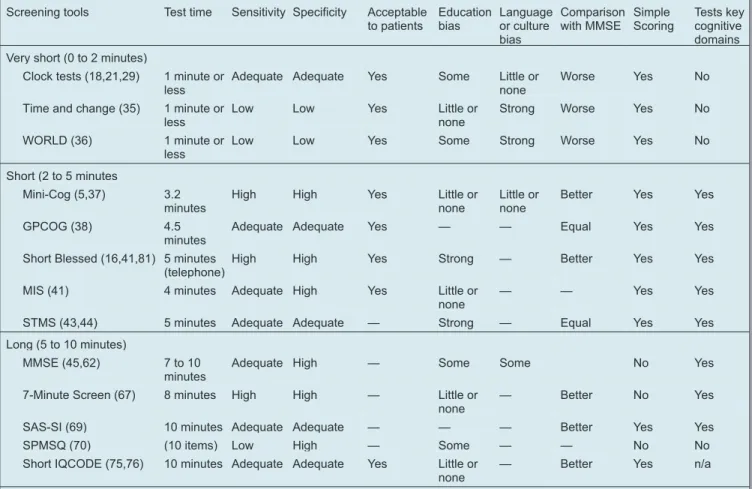
Because physicians have repeatedly indicated that admini-stration time is a key determinant of whether dementia screens are used, we have grouped this review of screening instru-ments roughly by testing time (Table 1). The instruinstru-ments are divided into very short screens (0 to 2 minutes), short screens (2 to 5 minutes), and standard screens (5 to 10 minutes).
Very Short Screens (0 to 2 Minutes)
Clock Drawing Tests
Clock drawing tests (CDTs) are widely accepted cognitive screening tools, despite the lack of a single standard for ad-ministration or scoring. As a group, a major strength of CDTs is their capacity to reflect, in composite form, the intactness of many interdependent cognitive functions. These include long-term memory, auditory processing, strategy planning, visual memory and reconstruction, visual-spatial function, motor programming and execution, numerical knowledge, abstract thinking, concentration, frustration tolerance, and in-hibition of impulsive responding and of the tendency to be pulled astray by perceptual features (20). In an extensive re-view of CDTs, Shulman found that most achieve sensitivities and specificities of about 85%, can take less than 1 minute to administer, and are acceptable to patients (21).
All CDTs ask the subject to draw a clock face reading a given time, but specific instructions vary among test methods. Some clock tests present a predrawn circle (22–25), while others re-quire the subject to draw a circle freehand (26–28). Numerous guidelines have been proposed for scoring both the quantita-tive and qualitaquantita-tive aspects of clock drawings (22,24–28), and several papers have directly compared various CDT methods (18,21,29–31). Overall, the Shulman and Mendez methods, included in most comparison studies, have proven among the most reliable, but still modest, predictors of dementia, with ROC analyses giving areas under the curve of 0.79 for the Shulman and 0.78 for the Mendez (18). Royall compared sev-eral CDTs to a version explicitly designed to reflect executive control (CLOX 1), finding good correlations with scores on the MMSE and an interview measure of executive dysfunc-tion (30). Borson reported that the CERAD CDT did better than the MMSE and the Cognitive Abilities Screening Instru-ment in detecting deInstru-mentia in poorly-educated English-speaking subjects, but its overall performance was not ade-quate for dementia screening (32). Storey reached a similar conclusion, finding that CDTs should not be used alone as the sole dementia screening test (18).
The efficacy of CDTs for detecting dementia is influenced by the severity of cognitive impairment. Scanlan compared 7 ex-pert systems and ratings applied by inexperienced judges to a
single set of 80 clock drawings (29). All systems worked well in identifying subjects without dementia and subjects with se-vere dementia. In cases of mild and moderate dementia, how-ever, some scoring methods were clearly better than others, with Mendez’ method performing best, followed by the CERAD method. Among the better CDT systems, Mendez’ is superior for longitudinal research designs, but, with 20 possi-ble points and the need for specialized scoring rules close at hand, it is too complex for initial screening in primary care. Shulman agrees that the simpler scoring methods are best (21).
Other limitations of CDTs include adverse performance ef-fects of low education (24,32–34) and advanced age (24,33). Language spoken (32) and sex (31) have no direct effects on performance, and not all investigators find an effect of age (31).
Despite their limitations, however, CDTs may have distinct advantages in certain situations, because they can be used by individuals with little or no experience in cognitive assess-ment and minimal training in test administration. Scanlan (29)
found that a simple binary rating of clock drawings (normal or abnormal) by untrained raters was surprisingly effective in classifying subjects as having dementia or not, though inferior to the best systems studied (Mendez and CERAD). A com-mon mistake of naïve scorers was failure to recognize incor-rect spacing of numbers on the clock face as abnormal. Training directed at this type of error should improve concor-dance between naïve and expert raters and could improve de-mentia detection rates in geriatric care settings where detailed cognitive assessment is not an option.
Time and Change Test
The Time and Change Test, developed by Froehlich , has 2 sections: telling time from a preset clock and making change for a dollar using ordinary coins (35). While very brief (report-edly < 1 minute) and unaffected by race or education in initial testing (35), tradeoffs between sensitivity and specificity for this test were unacceptable. To meet desirable standards for dementia detection, the test requires refinement and recalibration.
Table 1 Brief dementia screens
Screening tools Test time Sensitivity Specificity Acceptable to patients Education bias Language or culture bias Comparison with MMSE Simple Scoring Tests key cognitive domains Very short (0 to 2 minutes)
Clock tests (18,21,29) 1 minute or less
Adequate Adequate Yes Some Little or none
Worse Yes No
Time and change (35) 1 minute or less
Low Low Yes Little or
none
Strong Worse Yes No
WORLD (36) 1 minute or less
Low Low Yes Some Strong Worse Yes No
Short (2 to 5 minutes
Mini-Cog (5,37) 3.2 minutes
High High Yes Little or
none
Little or none
Better Yes Yes
GPCOG (38) 4.5
minutes
Adequate Adequate Yes — — Equal Yes Yes
Short Blessed (16,41,81) 5 minutes (telephone)
High High Yes Strong — Better Yes Yes
MIS (41) 4 minutes Adequate High Yes Little or
none
— — Yes Yes
STMS (43,44) 5 minutes Adequate Adequate — Strong — Equal Yes Yes
Long (5 to 10 minutes)
MMSE (45,62) 7 to 10 minutes
Adequate High — Some Some No Yes
7-Minute Screen (67) 8 minutes High High — Little or none
— Better No Yes
SAS-SI (69) 10 minutes Adequate Adequate — — — Better Yes Yes
SPMSQ (70) (10 items) Low High — Some — — No No
Short IQCODE (75,76) 10 minutes Adequate Adequate Yes Little or none
— Better Yes n/a
Dash marks denote that data are unavailable or unpublished. n/a = not applicable.
GPCOG = General Practitioner Assessment of Cognition; IQCODE = Informant Questionnaire for Cognitive Decline in the Elderly; MIS = Memory Impairment Screen; MMSE = Mini Mental State Examination; SAS-SI = Short and Sweet Screening Instrument; STMS = Short Test of Mental Status; SPMSQ = Short Port-able Mental Status Questionnaire; WORLD = The WORLD test.
WORLD Test
The “spell ‘world’ backwards” item of the MMSE was modi-fied to create a stand-alone screen, the WORLD Test. Subjects are asked to spell world forwards and backwards, and then to arrange its letters in alphabetical order (36). In a sample of 127 subjects, 57% of whom suffered from dementia, the WORLD Test gave a sensitivity of 85% and a specificity of 88%. Edu-cation biased results, but age and sex did not. The test is easy to score. Tests of this type are bound by cultural and linguistic factors as well as by education and literacy, and would there-fore be difficult to use over a broad range of subjects.
Summary: Very Short Screens
CDTs used as dementia screens have the advantages of brev-ity, acceptability to patients, and, in some cases, simple scor-ing. Their performance may be less strongly affected by level of education, language, and other variables not related to de-mentia than are some other screens, but they lack a measure of short-term memory. In general, clock tests may not be accu-rate enough for use as a stand-alone dementia screen. Like clock tests, the Time and Change Test is extremely brief, but it is not sufficiently developed for general application. The WORLD Test is highly constrained by demographic variables irrelevant to dementia classification.
Short Screens (2 to 5 Minutes)
Mini-Cog
The Mini-Cog was developed as a very brief screen for pri-mary care settings. It can be administered with minimal train-ing in an average of 3.2 minutes (5,37). In the Mini-Cog, a memory test (specifically, recall of 3 unrelated words) is in-cluded because memory loss is a core symptom of dementia and develops early in AD, the most common dementia of later life. A CDT (adapted from CERAD) is included as a distractor for the memory task, and adds important information reflect-ing a broad array of cognitive competencies impaired in de-mentias. A third consideration in the Mini-Cog’s development is the increasing ethnic diversity of elderly populations, which has established a need for simple tests that are relatively free of language, education, and cultural biases. The Mini-Cog had high sensitivity (99%) and specificity (96%) in a community sample of 249 ethnolinguistically di-verse elderly, one-half of whom had dementia and one-half of whom were cognitively intact. Its performance was unfected by education or language, whereas the MMSE was af-fected by both (5). Further testing in a mainstream epidemiological sample of 1119 older adults with a dementia prevalence of 6.3% identified individuals with dementia as well as the MMSE and a standard neurocognitive battery (19). The sensitivities of these 3 approaches ranged between 0.75 and 0.79, with specificities of 88% to 90%.
In a multiethnic sample, the Mini-Cog detected most of the subjects with mild dementia and essentially all the subjects with moderate and severe dementia—many of whom were not recognized by their physicians as cognitively impaired (6). In addition, over one-half of the subjects with mild cognitive im-pairments (that is, below the threshold for a dementia diagno-sis) were detected by the Mini-Cog.
General Practitioner Assessment of Cognition
The General Practitioner Assessment of Cognition (GPCOG), developed by Brodaty, is an example of a test that combines cognitive and informant data (38). Comprising 9 cognitive questions and 6 informant-rated items, it was (like the Mini-Cog) developed for primary care. The GPCOG was compared with the MMSE and the Abbreviated Mental Test (AMT) in a nonrandom sample of 283 community-dwelling elderly pa-tients with memory complaints or aged 75 years and over. Of this sample, 29% were definitely diagnosed with dementia; an additional 18% were thought to have dementia, but collat-eral history could not be obtained. Non-English-speaking sub-jects were excluded. When both cognitive and informant portions were completed, the GPCOG detected subjects with dementia about as well as the MMSE. Administration time is estimated at 4 to 5 minutes, with a sensitivity of 0.85 and a specificity of 0.86. Two-fifths of the individuals without de-mentia who scored in the demented range on this screen were found to have subthreshold cognitive impairments, suggest-ing utility in detectsuggest-ing those with mild cognitive impairment (MCI). Physicians who participated in this study found the GPCOG acceptable and feasible for use in their practices. However, at least 1 of the instruments from which the GPCOG was derived (the CAMCOG [39]) is significantly biased by sociodemographic factors, urging caution when interpreting scores.
Short Blessed Test
The Short Blessed Test (SBT), also known as the 6-CIT or the 6-OMC, is a 6-question test developed as a more concise ver-sion of the Blessed Information Memory Concentration Test (BIMC) (40). The 6 questions take approximately 5 minutes to administer and query time orientation (that is, year, month, and time of day), ability to count backwards from 20 to 1, abil-ity to say the months of the year in reverse order, and abilabil-ity to repeat a memory phrase. The SBT was tested on 287 nonran-domly selected patients and community control subjects, comprising a sample with 53% of subjects having dementia (12). SBT and MMSE scores were highly correlated overall (r
= 0.91), but the SBT was superior for detecting mild dementia and more sensitive to subthreshold impairments. Test scores are adversely affected by age and education (16).
Memory Impairment Screen
The Memory Impairment Screen (MIS), developed by Buschke, comprises 4 items administered in 4 minutes (41). In a sample of 438 English-speaking community volunteers (11% with dementia, which is only slightly higher than the population prevalence), sensitivity was 80% and specificity was 96%, using the optimal cut-off score. Age, education, and sex did not significantly affect performance. In comparison with a 3-item recall task (42) in a partly randomly selected population with a similar prevalence of dementia (11%), the MIS showed superior sensitivity and specificity.
Short Test of Mental Status
The Short Test of Mental Status (STMS) is a 5-minute test very similar in content to the MMSE. It encompasses orienta-tion, attenorienta-tion, learning, arithmetic calculaorienta-tion, abstracorienta-tion, information, construction, and recall (43). In a sample of 180 English-speaking subjects (48% with AD or other dementia), sensitivity of the STMS was 92% and specificity was 91% at a cut-off of 29 out of a possible 38 points. However, perform-ance was highly correlated with education, limiting its value as a screen for general use. In a replication study of 267 indi-viduals, 41% of whom had dementia, sensitivity was some-what lower (86%), but specificity was somesome-what higher (94%), when scores were adjusted for age and education con-founders (44).
Summary: Short Screens
All the screens in this group share certain core components. All include a test of short-term memory with either 3 (Cog), 4 (MIS), or 5 items (GPCOG and SBT). Both the Mini-Cog and the GPCOG use a CDT. In theory, the Mini-Mini-Cog and the GPCOG should be more efficient than the MIS, because their recall distracters generate useful information that con-tributes to dementia detection, whereas the distracter task in the MIS does not. However, there has been no direct test of the comparative performance of these 3 approaches.
The short screens examined here share the advantages of re-quiring 5 minutes or less to administer, of testing core compo-n e compo-n t s o f d e m e compo-n t i a s y compo-n d r o m e s , a compo-n d o f d i s p l a y i compo-n g good-to-excellent psychometric properties. Relative to the es-tablished standard of the MMSE, 3 of the 4 tests (Mini-Cog, GPCOG, and SBT) have been shown to perform as well (GPCOG in a clinical sample and Mini-Cog in an epidemiol-ogical sample) or significantly better (Mini-Cog in a multieth-nic sample and SBT in a climultieth-nical sample). Some have the additional advantage of relative freedom from bias by educa-tional attainment Cog and MIS) or language (Mini-Cog). While the GPCOG is also presented as being free from education bias, the actual data and analyses demonstrating these effects have not been published.
The weaknesses of these procedures are relatively minor. The full form of the GPCOG involves obtaining informant data as well as cognitive testing. This requires clinicians to contact and gain the assistance of a knowledgeable individual, gener-ally assumed to be a family member. Unlike the other 3 tests, the SBT has been shown to have significant education biases, and it may also have language or cultural biases that have yet to be examined.
“Standard” Screens (7 to 10 Minutes)
Mini-Mental State Examination
The Mini-Mental State Examination (MMSE) remains the most familiar and widely used cognitive screening test world-wide (45). In various forms, its 17 items have been in use for almost 30 years, and it has been translated into many lan-guages and modified in various ways. It takes, on average, 5 to 10 minutes to administer and covers orientation, registration, short-term memory, attention, calculation, visuoconstruc-tional skills, and praxis. Points are given for correct answers, and the traditional cut-off score for dementia in mixed neurop-sychiatric samples is < 24/30. In varying samples, appropriate cut-off scores must be established and reset for optimal per-formance (46).
MMSE scores are affected by age, education level, cultural background, social class, literacy, and language (16,47–61). Since the MMSE was released, there have been several at-tempts to adjust for the performance biases introduced by these factors (62). In a study of over 4000 MMSEs given to predominantly white, English-speaking, primary care patients (63), optimal performance could be achieved only by adjust-ing cut-offs for education and age, a feature that makes the MMSE complex and time consuming for general use. Moreo-ver, most participant physicians found the MMSE too long and believed that it contributed little to their recognition of de-mentia. Importantly, this belief was not empirically tested against research diagnoses.
Several attempts have been made to extract from the MMSE the items that best predict dementia, to shorten the screening process but still retain its familiar concepts. Braekhus ana-lyzed the individual items on the MMSE (64). This author found that, with a cut point of 23/24, 12 items which could be scored binomially performed as well as the whole instrument. Magaziner proposed a shorter 7-item version that signifi-cantly predicted total score and suggested that selective weightings of specific questions can adjust for age and educa-tion biases (55). Wind reduced the MMSE to 4 items that de-tected dementia as well as the full MMSE (51). Other attempts to reduce education or ethnolinguistic bias or length of the MMSE include those of Mungas (47), Molloy (65), and Gan-guli (66). Each emphasizes modifications for a particular
cultural group, a strength for research and clinical use when a population is large but an impediment in multicultural settings.
The 7-Minute Screen
The 7-Minute Screen (7MS), developed by Solomon for rapid diagnosis of probable AD cases, comprises 4 tests (that is, ori-entation, memory, clock drawing, and verbal fluency) and takes an average of 7 minutes and 42 seconds to administer (67). Developed on a sample of 120 English-speaking sub-jects, 50% of whom had probable AD, the 7MS correctly iden-tified 92% of subjects with, and 96% of subjects without, dementia. It detected patients with mild and very mild demen-tia better than the MMSE (using the standard cut point). Age, education, and sex had no significant effects on test perform-ance, but all subjects had at least 8 years of education. Results from a follow-up study in a primary care sample suggested that the 7MS could be an effective screen in that setting (68), but tests of its practicality have not yet been done. This test re-quires considerable training, together with a specially de-signed, hand-held computer programmed to yield a likelihood of dementia and AD, based on individual test results entered by the tester.
Short and Sweet Screening Instrument
The Short and Sweet Screening Instrument (SAS-SI) (69) de-rives from analysis of tests used in the population-based MoVIES study of dementia prevalence and incidence. In a sample of 1366 predominantly white subjects, the component items combined detected dementia better (sensitivity and specificity or 94% and 91%, respectively) than did a full neu-ropsychological battery. Used by itself, it can be given in 10 minutes. However, the SAS-SI does not contain a memory test and therefore does not test a core symptom of dementias in general and of AD in particular.
Short Portable Mental Status Questionnaire
The Short Portable Mental Status Questionnaire (SPMSQ) was among the first cognitive screening tests designed for geriatric application; it was first reported the same year as the MMSE (70). This 10-item test aims to detect “organic brain syndrome” and is easy to score. It covers short- and long-term recollection, orientation, current event information, and mathematical tasks. The number of errors determines whether the subject is classified as having intact intellectual function-ing or mild, moderate, or severe intellectual impairment. To develop population norms for this test, the SPMSQ was ad-ministered to a random population sample of 997 elderly white and African-American southerners in the US. Error scores were assessed as percentiles of the population, assum-ing a priori that 10% or less of the population were likely to be impaired. In a subsequent comparison with a clinical sample of 133 elderly patients, 40% of whom had a psychiatric
diagnosis of dementia, the SPMSQ had a sensitivity of 67% and a specificity of 96%. The same evaluation of an institu-tional sample with a 34% prevalence of dementia showed a sensitivity of 26% and a specificity of 98%. A language- and content-modified version administered to 2407 Spanish-speaking elderly in 3 separate studies (71) found large effects of literacy on error scores but showed that short versions were as informative as the longer test. As in the original study by Pfeiffer (70), cut-off scores had to be adjusted for education and literacy. The test has been criticized for its lack of a learn-ing and memory task (43).
Summary: Standard Screens
The MMSE has a long history of use in many populations and can have acceptable psychometric properties, but administra-tion time and cut-off score adjustments for educaadministra-tion, literacy, language, and age compromise its general utility. (Similar concerns pertain to the STMS.) While reduced forms of the MMSE are promising, they will require testing for educa-tional and linguistic biases.
The 7MS has excellent psychometric properties when used to separate AD patients from cognitively normal individuals who speak English and have at least 8 years of education. Its specialized administration, scoring, and training require-ments, as well as its length, limit its value in primary care. The SAS-SI also has acceptable psychometric properties but, at 10 minutes, is clearly too long. It does not test memory, compro-mising its face validity.
Informant- or Proxy-Rated Screening
Instruments
Informant-based tools can be as effective as cognitive tools for dementia screening and have many advantages: they can measure change longitudinally, they can be used for subjects unable to do cognitive testing for any reason, they are relevant to everyday cognitive activities, and they can be used cross-culturally (72). Jorm and others also point out that intelli-gence, education, and physical disabilities do not affect infor-mant tests, but that the inforinfor-mant’s personality, relationship with the patient, and observational capacities do (73).
Informant Questionnaire for Cognitive Decline in the Elderly
The IQCODE, developed by Jorm, assesses prior cognitive decline over time, based on ratings of everyday cognitive abilities (74). Informants are asked about the subject’s change in capabilities in relation to performance 10 years ago, rating change on a 5-point scale (1 = much better, 3 = little change, 5 = much worse). The original test had 26 questions, but a short-ened 16-question version has proven just as effective, with a correlation between the 2 versions of 0.98 (75,76). The short
IQCODE takes an average of 10 to 12 minutes (range 8 to 15 minutes) to administer (Borson, unpublished data).
The IQCODE has been tested in several non-English-speaking populations with varying levels of education and lit-eracy. A study of Thai elderly with 4 years of education or less found the predicted negative correlation between scores on a short version of the IQCODE and the Thai MMSE but no ef-fect of age, education, or sex (77). Three items carried most of the instrument’s power to classify cognitive status: learning to use new gadgets, knowing the day and month, and handling everyday arithmetic problems. The IQCODE has also been examined in Chinese (78), Japanese (79), and Spanish (80) versions, further supporting its cross-cultural validity. Jorm and others compared the Canberra Interview for the Eld-erly, a cognitive test battery that includes the MMSE, with the IQCODE (73). They found that mean IQCODE scores of 4 or 5 (representing moderate or severe decline in everyday cogni-tive abilities) coincided with a decline in scores on the MMSE and several other cognitive tests over the previous 3.5 years. A follow-up study (76) found that subjects with baseline IQCODE scores as near normal as 3.5 were likely to show de-teriorating performance on directly administered cognitive tests over a period of 7 to 8 years, suggesting that knowledge-able informants are knowledge-able to identify small changes in everyday abilities that presage future decline.
Summary: Informant- or Proxy-Rated Screens
Informant-based dementia screens provide an estimate of change over the long time periods typically seen in evolving dementias, evaluate cognitive abilities related to everyday function, and appear minimally affected by cultural, educa-tional, and language biases. However, proxy screens do not substitute for direct cognitive assessment in practice settings, since many older patients do not arrive at the doctor’s office with someone who has known them well for a long time and is willing to discuss the subject’s failing abilities (which may be against cultural or personal norms). In a general practice study (38), 38% of patients thought to have possible or probable de-mentia failed diagnostic criteria because no reliable history of cognitive decline could be obtained—a history that must come from someone who knows the patient intimately. Also, existing proxy screens are too long for primary care use: even the “short” IQCODE needs 10 minutes or more. A promising line of investigation uses item reduction analyses to create ultra-short IQCODE versions containing only the essential dementia-detecting items. Early work with Thai elderly sug-gests that as few as 3 items may be sufficient (77), but addi-tional study is needed to determine the number and nature of the questions that most consistently and reliably detect de-mentia and whether these are affected by ethnocultural factors.Remote Dementia Screening: Telephone and
Mail Screens
Several cognitive- and informant-based dementia screening tests have been adapted for telephone administration, includ-ing a 5-minute telephone version of the SBT (81) that corre-lates highly (r= 0.96) with face-to-face administration, and the Telephone Interview for Cognitive Status (TICS) (82), which correlates highly(r= 0.94) with the MMSE. The 11-question TICS was tested in a clinical sample of 133 patients, 75% of whom had probable AD, giving a sensitivity of 94% and specificity of 100% (82) and discriminating between sub-jects with mild dementia and normal subsub-jects. The time taken to administer the test was not provided. Scores were unrelated to age but were affected by education. Several other telephone screening instruments (the Structured Telephone Interview for Dementia Assessment [STIDA] [83], the Dementia Ques-tionnaire [84], and the Minnesota Cognitive Acuity Screen [85]) take longer to administer than the 10 minutes we set for inclusion in this review.
Dementia screening has also been attempted by mail. Ball used a survey that included a clock completion test (CCT) and questions about various putative AD risk factors (86). Re-sponse rates were inadequate for population screening (63%) and were much lower among subjects determined to have de-mentia, and scores were not closely related to SBT scores. The CCT failed to detect the 82% of individuals with SBT scores below the dementia-screening cut point. This approach merits further development as a population screening concept but does not work well in its present form.
Summary and Comments
Evaluating dementia-screening tests is a complex task. Re-ports of excellent sensitivity and specificity for a given instru-ment must consider whether performance may be inflated by high rates of dementia in the study sample, by high average se-verity of cognitive impairment among affected persons, or by exclusion of subjects with demographic characteristics that compromise many screens. The practical aspects of test ad-ministration must be measured against the constraints of pri-mary care practice.
Brevity, effectiveness, freedom from biases irrelevant to de-mentia status, and simplicity are the key characteristics of an effective dementia-screening tool. Some longer tests may have higher diagnostic precision but are inefficient for use in general practice settings because of time requirements; com-plexity of administration, scoring or interpretation; and biases associated with demographic factors. Such biases degrade the performance of longer tests to a greater extent than shorter tests. A brief, simple screen that works across a broad range of ages, education levels, languages, and other possible con-founding variables would be ideal.
Achieving a balance between minimum administration time and maximum performance is a goal for cognitive screening as part of the primary care of older adults. The shortest tests developed to date are diagnostically inferior to longer ones: none has consistently performed as well or better than the MMSE, and none contains a test of short-term memory. For these reasons, very short screens (taking 1 minute or less) can-not be recommended for routine application. In general, the short screens (2 to 5 minutes) have much better psychometric properties. Most have been compared with the MMSE in the same study sample, and are at least equal to it in sensitivity, specificity, and general accuracy. All such instruments de-scribed here also test short-term memory, which is universally recognized as a core feature of most if not all dementias. Some short screens have been shown to detect a proportion of sub-jects with MCI who are either in the very earliest stages of an evolving progressive dementia or have suffered a cognitive insult that has left them with mild stable deficits. The Mini-Cog is an example of a test that detects such individuals with much greater efficacy than do physicians caring for them. The “long” short screens (5 to 10 minutes) have simply proven too long for routine use in primary care; this, and other limitations compromise the likelihood that proxy screens such as the IQCODE will be widely applied in clinical settings. Informant-based screens can help primary care physicians when the results of cognitive screening are ambiguous and when family members are seen as part of a dementia workup. Critical tests of the value of dementia screening in primary care are lacking, and important unresolved issues merit explo-ration in practice-based health services trials. The first issue is whether any screening procedure will be adopted in the pri-mary care setting, either by physicians or other office staff (with the approval of the doctors they support and the blessing of cost-conscious practice managers). The second issue is whether implementing such screening will improve case find-ing and, if so, whether better detection will lead to better man-agement and better outcomes for patients and their families. Now that promising short screens are available, these qutions are ripe for systematic inquiry. Reliable answers are es-sential for developing a healthy dementia care policy for the world’s aging societies.
Funding Support
This review was supported by a grant from the US National Institute on Aging, AG 05136.
References
1. Doraiswamy PM. Current cholinergic therapy for symptoms of Alzheimer’s Dis-ease. Prim Psychiatry 1996;56–68.
2. Gambert SR. Is it Alzheimer’s disease? Postgrad Med 1997;101:42–9, 52. 3. Brodaty H, Howarth GC, Mant A, Kurrle SE. General practice and dementia. A
national survey of Australian GPs. Med J Aust 1994;160:10 – 4.
4. Knopman DS. The initial recognition and diagnosis of dementia. Am J Med 1998;104:2S–12S.
5. Borson S, Scanlan JM, Brush M, Vitaliano PP, Dokmak A. The Mini-Cog: a cog-nitive “vital signs” measure for dementia screening in multi-lingual elderly. Int J Geriatr Psychiatry 2000;15:1021–7.
6. Borson S, Scanlan, J. Mini-Cog: improving primary care physicians’ detection of milder cognitive syndromes. Abstract presented at The 8th International
Confer-ence on Alzheimer’s Disease and Related Disorders; July 20 –25, 2002; Stock-holm.
7. Hebert LE, Scherr PA, Beckett LA, Albert MS, Pilgrim DM, Chown MJ, and others. Age-specific incidence of Alzheimer’s disease in a community popula-tion. JAMA 1995;273:1354 –9.
8. Cheok AS, Cohen CA, Zucchero CA. Diagnosing and managing dementia pa-tients. Practice patterns of family physicians. Can Fam Physician
1997;43:477–82.
9. Valcour VG, Masaki KH, Curb JD, Blanchette PL. The detection of dementia in the primary care setting. Arch Intern Med 2000;160:2964 –8.
10. Bush C, Kozak J, Elmslie T. Screening for cognitive impairment in the elderly. Can Fam Physician 1997;43:1763–8.
11. Folstein MF, Folstein SE, McHugh PR. Mini Mental State: a practical method for grading the cognitive state of patients for the clinician. J Psychiatr Res 1975;12:189–98.
12. Brooke P, Bullock R. Validation of a 6 item cognitive impairment test with a view to primary care usage. Int J Geriatr Psychiatry 1999;14:936–40. 13. Flocke SA, Frank SH, Wenger DA. Addressing multiple problems in the family
practice office visit. J Fam Pract 2001;50:211–6.
14. Gurland BJ, Wilder DE, Chen J, Lantigua R, Mayeux R, Van Nostrand J. A flexible system of detection for Alzheimer’s disease and related dementias. Ag-ing (Milano) 1995;7:165–72.
15. Day JC. Population projections of the United States by age, sex, race and His-panic origin: 1992 to 2050. USBureau of the Census. Curr Pop Rep 1996:25–1130.
16. Stuss DT, Meiran N, Guzman A, Lafleche G, Wilmer J. Do long tests yield a more acurate diagnosis of dementia than short tests? A comparison of 5 neurop-sychological tests. Arch Neurol 1996;53:1033–9.
17. Watson YI, Arfken CL, Birge SJ. Clock completion: n objective screening test for dementia. J Am Geriatr Soc 1993;41:1235–40.
18. Storey JE, Rowland JT, Basic D, Conforti DA. A comparison of five clock scor-ing methods usscor-ing ROC (receiver operatscor-ing characteristic) curve analysis. Int J Geriatr Psychiatry 2001;16:394–9.
19. Borson S, Scanlan JM, Ganguli M, Chen P. Validation of the Mini-Cog in a population-based sample of older adults. Abstract presented at the 14th Annual Meeting of the American Association for Geriatric Psychiatry; February 23–26, 2001; San Francisco (CA).
20. Freedman M, Leach L, Kaplan E, Winocur G, Shulman KI, Delis DC. Clock drawing: a neuropsychological analysis. New York: Oxford University Press; 1994. p 3–8.
21. Shulman KI. Clock-drawing: is it the ideal cognitive screening test? Int J Geriatr Psychiatry 2000;15:548–61.
22. Manos PJ, Wu R. The ten point clock test: A quick screen and grading method for cognitive impairment in medical and surgical patients. Int J Psychiatry Med 1994;24:229–44.
23. Shulman K, Shedletsky R, Silver I. The challenge of time: clock-drawing and cognitive function in the elderly. Int J Geriatr Psychiatry 1986;1:135–40. 24. Lam LC, Chiu HF, Ng KO, Chan C, Chan WF, Li SW, Wong M. Clock-face
drawing, reading and setting tests in the screening of dementia in Chinese elderly adults. J Gerontol B Psychol Sci Soc Sci 1998;53:353–7.
25. Wolf-Klein GP, Silverstone FA, Levy AP, Brod MS. Screening for Alzheimer’s disease by clock drawing. J Am Geriatr Soc 1989;37:730–4.
26. Mendez MF, Ala T, Underwood KL. Development of scoring criteria for the clock drawing task in Alzheimer’s disease. J Am Geriatr Soc 1992;40:1095–9. 27. Morris JC, Heyman A, Mohs RC, Hughes JP, van Belle G, Fillenbaum GG, and
others. The consortium to establish a registry for Alzheimer’s disease (CERAD). Part I. Clinical and neuropsychological assessment of Alzheimer’s disease. Neu-rology 1989;39:1159–65.
28. Sunderland T, Hill JL, Mellow AM. Clock drawing in Alzheimer’s disease. A novel measure of dementia severity. J Am Geriatr Soc 1989;37:725–9. 29. Scanlan JM, Brush M, Quijano C, Borson S. Comparing clock tests for dementia
screening: Naive judgments vs. formal systems—what is optimal? Int J Geriatr Psychiatry 2002;17:14–21.
30. Royall DR, Mulroy AR, Chiodo LK, Polk MJ. Clock drawing is sensitive to ex-ecutive control: a comparison of six methods. J Gerontol B Psychol Sci Soc Sci 1999;54:328–33.
31. Brodaty H, Moore CM. The clock drawing test for dementia of the Alzheimer’s type: a comparison of three scoring methods in a memory disorders clinic. Int J Geriatr Psychiatry 1997;12:619–27.
32. Borson S, Brush M, Gil E, Scanlan JM, Vitaliano PP, Chen JC, and others. The clock drawing test: utility for dementia detection in multi-ethnic elders. J Geron-tol Med Sci 1999;54A:M534–M540.
33. Lieberman D, Galinsky D, Fried V, Grinshpun Y, Mytlis N, Tylis R. Factors af-fecting the results of the clock drawing test in elderly patients hospitalized for physical rehabilitation. Int J Geriatr Psychiatry 1999;14:325–30.
34. Ainslie NK, Murden RA. Effect of education on the clock-drawing dementia screen in non-demented elderly persons. J Am Geriatr Soc 1993;41:249–52. 35. Froehlich TE, Robison JT, Inouye SK. Screening for dementia in the outpatient
setting: The time and change test. J Am Geriatr Soc 1999;46:1506–11. 36. Leopold NA, Borson AJ. An alphabetical ‘WORLD’: A new version of an old
37. Scanlan JM, Borson S. the mini-cog: receiver operating characteristics with ex-pert and naive raters. Int J Geriatr Psychiatry 2001;16:216–22.
38. Brodaty H, Pond D, Kemp NM, Luscombe G, Harding L, Berman K, and others. The GPCOG: a new screening test for dementia designed for general practice. J Am Geriatr Soc 2002;50:530–4.
39. Huppert FA, Brayne C, Gill C, Paykel ES, Beardsall L. CAMCOG—a concise neuropsychological test to assist dementia diagnosis: socio-demographic determi-nants in an elderly population sample. Br J Clin Psychol 1995;34 ( Pt 4):529–41. 40. Katzman R, Brown T, Fuld P, Peck A, Schechter R, Schimmel H. Validation of a
short orientation-memory-concentration test of cognitive impairment. Am J Psy-chiatry 1983;140:734–9.
41. Buschke H, Kuslansky G, Katz M, Stewart WF, Sliwinski MJ, Eckholdt HM, and others. Screening for dementia with the memory impairment screen. Neurol-ogy 1999;52:231–8.
42. Kuslansky G, Buschke H, Katz M, Sliwinski M, Lipton RB. Screening for Alz-heimer’s disease: the memory impairment screen versus the conventional three-word memory test. J Am Geriatr Soc 2002;50:1086–91.
43. Kokmen E, Naessens JM, Offord KP. A short test of mental status: description and preliminary results. Mayo Clin Proc 1987;62:281–8.
44. Kokmen E, Smith GE, Petersen RC, Tangalos E, Ivnik RC. The short test of mental status. Correlations with standardized psychometric testing. Arch Neurol 1991;48:725–8.
45. Folstein MF, Folstein SE, McHugh PR. Mini Mental State: A practical method for grading the cognitive state of patients for the clinician. J Psychiatr Res 1975;12:189–98.
46. Kukull WA, Larson EB, Teri L, Bowen J, McCormick W, Pfanschmidt ML. The mini-mental state examination score and the clinical diagnosis of dementia. J Clin Epidemiol 1994;47:1061–7.
47. Mungas D, Marshall SC, Weldon M, Haan M, Reed BR. Age and education cor-rection of mini-mental state examination for English and Spanish-speaking eld-erly. Neurology 1996;46:700–6.
48. Bird HR, Canino G, Stipec MR, Shrout P. Use of the mini-mental state examina-tion in a probability sample of a Hispanic populaexamina-tion. J Nerv Ment Dis 1987;175:731–7.
49. Uhlmann RF, Larson EB. Effect of education on the mini-mental state examina-tion as a screening test for dementia. J Am Geriatr Soc 1991;39:876–80. 50. O’Connor DW, Pollitt PA. The influence of education, social class and sex on
mini-mental state scores. Psychol Med 1989;19:771–6.
51. Wind AW, Schellevis FG, Van Staveren G, Scholten RP, Jonker C, Van Eijk JTM. Limitations of the mini-mental state examination in diagnosing dementia in general practice. Int J Geriatr Psychiatry 1997;12:101–8.
52. Holtsberg PA, Poon LW, Noble CA, Martin P. Mini-mental state exam status of community-dwelling cognitively intact centenarians. Int Psychogeriatr 1995;7:417–27.
53. Weiss BD, Reed R, Kligman EW, Abyad A. Literacy and performance on the mini-mental state examination. J Am Geriatr Soc 1995;43:807–10.
54. Freidl W, Schmidt R, Stronegger WJ, Irmler A, Reinhart B, Koch M. Mini men-tal state examination: influence of sociodemographic, environmenmen-tal and behav-ioral factors and vascular risk factors. J Clin Epidemiol 1996;49:73–8. 55. Magaziner J, Bassett SS, Hebel JR. Predicting performance on the mini-mental
state examination. Use of age- and education-specific equations. J Am Geriatr Soc 1987;35:996–1000.
56. Escobar JI, Burnam A, Karno M, Forsythe A, Landsverk J, Golding JM. Use of the mini-mental state examination (MMSE) in a community population of mixed ethnicity. J Nerv Ment Dis 1986;174:607–14.
57. Jorm AF, Scott R, Henderson AS, Kay DW. Educational level differences on the mini-mental state: the role of test bias. Psychol Med 1988;18:727–31.
58. Crum RM, Anthony JC, Bassett SS, Folstein MF. Population-based norms for the mini-mental state examination by age and educational level. JAMA
1993;269:2386–91.
59. Fratiglioni L, Jorm AF, Grut M, Vitanen M, Holmen K, Ahlbom A, and others. Predicting dementia from the mini-mental state examination in an elderly popula-tion: The role of education. J Clin Epidemiol 1993;43:281–7.
60. Murden RA, McRae RD, Kaner S, Bucknam SE. Mini-mental state exam scores vary with education in blacks and whites. J Am Geriatr Soc 1991;39:149–55. 61. Liu HC, Teng EL, Lin KN, Hsu TC, Guo NW, Chou P, and others. Performance
on a dementia screening test in relation to demographic variables. Study of 5297 community residents in Taiwan. Arch Neurol 1994;51:910–5.
62. Tombaugh TN, McIntyre NJ. The mini-mental state exam: a comprehensive re-view. J Am Geriatr Soc 1992;40:922–35.
63. Tangalos EG, Smith GE, Ivnik RJ, Petersen RC, Kokmen E, Kurland LT, and others. The mini-mental state examination in general medical practice: clinical utility and acceptance. Mayo Clin Proc 1996;71:829–37.
64. Braekhus A, Laake K, Engedal K. The mini-mental state examination: identify-ing the most efficient variables for detectidentify-ing cognitive impairment in the elderly. J Am Geriatr Soc 1992;40:1139–45.
65. Molloy DW, Standish TI. A guide to the standardized mini-mental state exami-nation. Int Psychogeriatr 1997;9 Suppl 1:87–94.
66. Ganguli M, Chandra V, Gilby JE, Ratcliff G, Sharma SD, Pandav R, and others. Cognitive test performance in a community-based nondemented elderly sample in rural India: the Indo-US Cross-National Dementia Epidemiology Study. Int Psychogeriatr 1996;8:507–24.
67. Solomon PR, Hirschoff A, Kelly B, Relin M, Brush M, DeVeauz RD, and others. A 7 minute neurocognitive screening battery highly sensitive to Alzheimer’s dis-ease. Arch Neurol 1998;55:349–55.
68. Solomon PR, Brush M, Calvo V, Adams F, DeVeaux RD, Pendlebury WW, and others. Identifying dementia in the primary care practice. Int Psychogeriatr 2000;12:483–93.
69. Belle SH, Mendelsohn AB, Seaberg EC, Ratcliff G. A brief cognitive screening battery for dementia in the community. Neuroepidemiology 2000;19:43–50. 70. Pfeiffer E. A short portable mental status questionnaire for the assessment of
or-ganic brain deficit in elderly patients. J Am Geriatr Soc 1975;23:433–41. 71. Gornemann I, Zunzunegui MV, Martinez C, Onis MD. Screening for impaired
cognitive function among the elderly in Spain: reducing the number of items in the short portable mental status questionnaire. Psychiatry Res 1999;89:133–45. 72. Jorm AF. Methods of screening for dementia: A meta-analysis of studies com-paring an informant questionnaire with a brief cognitive test. Alzheimer Dis As-soc Disord 1997;11:158–62.
73. Jorm AF, Christensen H, Henderson AS, Jacomb PA, Korten AE, Mackinnon A. Informant ratings of cognitive decline of elderly people: relationship to longitudi-nal change on cognitive tests. Age Ageing 1996;25:125–9.
74. Jorm AF, Scott R, Cullen JS, MacKinnon AJ. Performance of the informant questionnaire on cognitive decline in the elderly (IQCODE) as a screening test for dementia. Psychol Med 1991;21:785–90.
75. Jorm AF. A short form of the informant questionnaire on cognitive decline in the elderly (IQCODE): development and cross-validation. Psychol Med
1994;24:145–53.
76. Jorm AF, Christensen H, Korten AE, Jacomb PA, Henderson AS. Informant rat-ings of cognitive decline in old age: validation against change on cognitive tests over 7 to 8 years. Psychol Med 2000;30:981–5.
77. Senanarong V, Assavisaraporn S, Sivasiriyanonds N, Printarakul T, Jamjumrus P, Udompunthuruk S, and others. The IQCODE: an alternative screening test for dementia for low educated Thai elderly. J Med Assoc Thai 2001;84:648–55. 78. Fuh JL, Teng EL, Lin KN, Larson EB, Wang SJ, Liu CY, and others. The
infor-mant questionnaire on cognitive decline in the elderly (IQCODE) as a screening tool for dementia for a predominantly illiterate Chinese population. Neurology 1995;45:92–6.
79. White LR, Ross GW, Petrovitch H, Masaki KH, Chiu D, Teng EL. Estimation of the sensitivity and specificity of a dementia screening test in a population-based survey. Neurobiol Aging 1994;15:S42.
80. Morales JM, Gonzalez-Montalva JI, Bermejo F, Del-Ser T. The screening of mild dementia with a shortened Spanish version of “informant questionnaire on cognitive decline in the elderly.” Alzheimer Dis Assoc Disord 1995;9:105–11. 81. Kawas C, Karagiozis H, Resau L, Corrada M, Brookmeyer R. Reliability of the
Blessed telephone information-memory-concentration test. J Geriatr Psychiatry Neurol 1995;8:238–42.
82. Brandt J, Spencer M, Folstein M. The telephone interview for cognitive status. Neuropsychiatry Neuropsychol Behav Neurol 1998;1:111–7.
83. Go RC, Duke LW, Harrell LE, Cody H, Bassett SS, Folstein MF, and others. De-velopment and validation of a structured telephone interview for dementia as-sessment (STIDA): the NIMH Genetics Initiative. J Geriatr Psychiatry Neurol 1997;10:161–7.
84. Kawas C, Segal J, Stewart WF, Corrada M, Thal LJ. A validation study of the dementia questionnaire. Arch Neurol 1994;51:901–6.
85. Knopman DS, Knudson D, Yoes ME, Weiss DJ. Development and standardiza-tion of a new telephonic cognitive screening test: the Minnesota cognitive acuity screen (MCAS). Neuropsychiatry Neuropsychol Behav Neurol 2000;13:286–96. 86. Ball LJ, Ogden A, Mandi D, Birge SJ. The validation of a mailed health survey
for screening of dementia of the Alzheimer’s type. J Am Geriatr Soc 2001;49:798–802.
Manuscript received and accepted September 2002.
1Medical Student, University of Washington School of Medicine, Seattle,
Washington.
2
Research Scientist, University of Washington School of Medicine, Seattle, Washington.
3
Professor of Psychiatry and Behavioral Sciences, University of Washington School of Medicine, Seattle, Washington.
Address for Correspondence:Dr S Borson, Box 356560, UWMC, 1959 NE Pacific Street, Seattle, WA 98195
Résumé : Tests rapides de dépistage de la démence
Objectif : Comparer des tests rapides de dépistage de la démence comme candidats à une utilisation de routine dans les soins primaires.
Méthode : Nous avons choisi des tests de dépistage qui satisfaisaient à 2 critères : 1) une durée d’ad-ministration de 10 minutes ou moins dans le cadre d’études comprenant des sujets avec et sans démence; et 2) des caractéristiques de rendement évaluées dans au moins 1 échantillon
com-munautaire ou clinique de personnes âgées. Nous avons comparé les tests quant aux aspects suivants : la validité apparente; la sensibilité et la spécificité dans un échantillon de sujets nettement définis; la vulnérabilité aux biais sociodémographiques non liés à la démence; la comparaison directe avec une norme acceptée; l’acceptabilité pour les patients et les médecins; ainsi que la brièveté et la facilité d’administration, de notation et d’interprétation par des non-spécialistes.
Résultats : Treize instruments satisfaisaient à nos critères d’inclusion. Des tests très brefs (1 minute ou moins) se sont avérés inacceptables selon plusieurs critères. Les instruments normalisés nécessitant plus de 5 minutes à remplir, y compris le très étudié mini-examen de l’état mental (MMSE), se sont révélés trop longs pour une application de routine, et plusieurs ont échoué aux tests de rendement ou ne pouvaient pas être évalués adéquatement. Les tests rapides prenant de 2 à 5 minutes qui peuvent être administrés par des non-spécialistes peu ou pas formés et qui sont relativement non biaisés par la langue ou le niveau d’instruction semblent être supérieurs aux instruments plus brefs et plus longs. Conclusions : Trois tests sont les plus prometteurs pour une application répandue dans des établisse-ments de soins primaires : le Mini-Cog, le test de dépistage de diminution de la mémoire, et l’évalua-tion de la cognil’évalua-tion de l’omnipraticien (GPCOG). Il faut des essais officiels d’intervenl’évalua-tion dans la pratique pour valider l’utilité des tests rapides quant à la mise en oeuvre, à l’effet sur les taux de diag-nostics et de traitements des patients souffrant de démence, et aux résultats pour les patients, les fa-milles et les systèmes de santé.