D — Taxing consumption
D
—
T
AXING CONSUMPTION...273
Broad-based consumption taxes are efficient ... 273
Consumption is a sustainable and stable base ... 274
A broad-based consumption tax should be part of a fair tax and transfer system ... 275
A broad base and single rate of tax is simplest... 276
Future directions ... 276
D1.
A
CASH FLOW TAX...279
D1–1 An alternative approach to taxing consumption ... 279
A cash flow tax can be a simple way of utilising the consumption base ... 279
Financial cash flows, such as interest or taxes, would be excluded ... 281
Treatment of negative cash flows... 282
D1–2 A CFT could be simpler for small business ... 283
D1–3 A sustainable tax base... 284
D2.
T
HE GOODS AND SERVICES TAX...285
D2–1 The current GST can be complex and costly ... 285
The breadth of Australia’s GST base is around the OECD average... 285
A narrower GST does not mean it is fairer, but adds complexity ... 286
The invoice-credit method has compliance benefits but costs as well... 286
GST compliance can be costly … ... 288
… especially for small business ... 289
D2–2 Alleviating compliance costs on some transactions ... 290
Treat some business-to-business transactions as if they were GST-free?... 290
Use reverse charging more widely? ... 290
Keep excise-inclusive prices in the GST base ... 291
D3.
P
AYROLL TAX...293
D3–1 Taxing labour income ... 293
Who bears the burden of payroll tax?... 294
D3–2 Current payroll taxes are complex and narrow-based... 297
Payroll tax is particularly complex across State borders ... 299
Reform of payroll tax has been mixed across States ... 300
D3–3 Broad-based taxes to capture the value-add of labour? ... 301
Administer payroll tax through the PAYG system? ... 302
D4.
T
AXING FINANCIAL SERVICES...303
D4–1 The case for taxing consumption of financial services ... 303
D4–2 The nature and consequences of current arrangements ... 304
Current treatment compared to consumption benchmark... 304
Current treatment of financial services under the GST is inefficient ... 306
Impact on Australia as a regional financial services centre... 308
D4–3 Alternative ways to tax consumption of financial services... 308
The addition method... 309
Tax calculation account method ... 312
D. Taxing
consumption
Key points
Consumption is potentially an efficient and sustainable tax base.
Consumption taxes can be levied directly on individuals by taxing only wages or allowing deductions under income tax for savings, or indirectly by taxing sales of goods and
services that individuals buy.
While Australia’s main consumption tax — the indirect invoice-credit GST — is an efficient tax relative to most other taxes levied in Australia, its design is complex.
Another means of taxing consumption would be to tax the difference between businesses’ cash inflows and outflows (excluding wages from outflows; that is, the value-add of labour would be taxed). So long as the tax remains broad and at a single rate, the efficiency, compliance and administrative costs associated with such a cash flow tax would be significantly lower than with other consumption taxes, including those that States levy and that form a significant part of their revenue base but are particularly inefficient, such as insurance duties.
Over time, such a broad-based cash flow tax could be used to finance the abolition of other taxes, including payroll tax and inefficient State consumption taxes. Such a tax would also provide a sustainable revenue base to finance future spending needs.
For the tax system to support Australia in making the most of the opportunities and meeting the challenges of the 21st century, it needs to raise revenue from efficient and sustainable tax bases. One of the most efficient and sustainable tax bases is consumption. A tax on
consumption does not tax the normal return to capital, encouraging investment and saving. From a macroeconomic perspective, consumption is generally less volatile than income or wealth, and therefore provides a more stable revenue source. As the population ages, an indirect broad-based consumption tax is likely to become increasingly important, since it taxes the capital income of retirees as it is spent, which might otherwise largely be untaxed under an income tax.
Australia’s goods and services tax (GST) is narrow compared to its potential base, taxing only 57 per cent of consumption — in contrast to the New Zealand GST, which taxes consumption on a comprehensive basis (see Section D2 The goods and services tax). Few, if any, countries have significantly broadened their main consumption tax base after
introduction (Heady 2009, p. 21).
Broad-based consumption taxes are efficient
A broad-based consumption tax is one of the most efficient taxes available to governments (OECD 2008b). For a small open economy, investment is likely to be more mobile than
levied on investment. Further, a single-rate consumption tax does not distort the timing preferences of consumption for individuals. The same tax is paid regardless of whether a person consumes now or in the future, imparting no bias for or against saving.
While consumption taxes are usually levied indirectly on the sale of goods and services, a consumption tax can also be levied as a direct tax. This can be achieved by taxing personal expenditure (that is, exempting income that is saved) or through a pre-paid consumption tax (which taxes only labour income, and exempts earnings from savings).
Nearly all countries pursue consumption taxation through taxes on goods and services. Personal expenditure taxes were implemented briefly in India and Sri Lanka in the 1960s and 1970s (Shome 1995, p. 50), but the worldwide trend since then has been to tax consumption through indirect taxes such as the value added tax (Ebrill 2001, pp. 4–13). There would be few benefits and significant difficulties in implementing a direct consumption tax in Australia (see Box D–1). The rest of this section therefore considers indirect approaches to taxing consumption.
Box D–1: Problems associated with direct consumption taxes
Potential problems with introducing a direct consumption tax include:
• significant vertical and intergenerational shifts in incidence depending on whether the tax applies to consumption only from income earned after the introduction of the tax;
• equity concerns if such a tax replaced the progressive personal income tax;
• economic efficiency costs associated with higher marginal rates of tax on personal incomes, especially if this causes different rates of tax on consumption over a person’s lifetime;
• difficulties under pre-paid direct consumption taxes in taxing economic rents. For example, a pre-paid direct consumption tax, such as a broad-based payroll tax, taxes only the returns to labour. If an employee invests their wages and receives a windfall return, this additional economic rent would go untaxed. An indirect tax can capture this economic rent when it is spent on goods and services; and
• loss of revenue integrity. For example, while it could be easy to understate or avoid declaring cash income on a tax return, it is much more difficult to avoid paying tax-inclusive prices on most purchases.
Consumption is a sustainable and stable base
Total household consumption as a percentage of GDP has been relatively stable for a long time (see Chart D–1 Panel A). This suggests that a tax on consumption would provide a relatively sustainable revenue base that grows in line with the broader economy. The GST is slightly less robust because it does not cover the full consumption base. The Productivity Commission (2005, p. T11.5) found that by 2044–45 GST revenues may decline slightly as a share of GDP because tax-exempt consumption such as health care is expected to grow.
D — Taxing consumption
This finding highlights the desirability of having a broad-based consumption tax rather than narrower taxes on specific goods and services. Narrower-based taxes — such as those on the consumption of fuel, alcohol and tobacco — are not stable, as expenditures on such goods have not remained stable over time. (Chart D–1 Panel B highlights how specific consumption taxes can be variable.) Underlying changes in consumption of specific goods and services can be influenced by tax, as well as changing consumer preferences, new technology or
government policy. Together, these factors can affect the production and consumption of different goods. Taxes on specific products can be used to deliver desired social or market outcomes (see Section E Enhancing social and market outcomes), while the broad-based consumption tax provides a sustainable revenue source.
Chart D–1: Stability of household consumption expenditure shares over time
Panel A: Household consumption over time Panel B: Expenditure on selected commodities over time 0 20 40 60 80 100 1959-60 1975-76 1991-92 2007-08 0 20 40 60 80 100 Household consumption
Per cent of GDP Per cent of GDP
0 1 2 3 4 5 1959-60 1975-76 1991-92 2007-08 0 1 2 3 4 5 Alcohol Tobacco Vehicle operation (including fuel)
Per cent of GDP Per cent of GDP
Source: ABS (2009a). Consumption expenditure includes indirect taxes.
A broad-based consumption tax should be part of a fair tax and transfer
system
The principal equity objection to a broad-based consumption tax is that it is regressive — that is, households that spend more of their income (typically households at the lower end of the income distribution) pay more tax as a proportion of their income than households that spend less of their income (typically households at the higher end of the income
distribution). This appears to contravene the principle of vertical equity — that those with more capacity to pay (here viewed according to income) should pay relatively more tax. Viewed from the perspective of lifetime consumption opportunities, consumption taxes are less inequitable. In many cases, a person saves in order to consume more at a later point in time. Provided these savings are spent on taxed commodities, their lifetime tax burden is not reduced by virtue of savings in the earlier periods. Their consumption tax is smoothed over a lifetime, rather than concentrated on the years in which it is earned.
the higher end of the income distribution). The transfer system, together with progressive personal taxation, is better suited to this task, and should be the primary means through which the government influences the distribution of income in the economy (see Section A1 Personal income tax).
In part, the transfer system responds automatically to changes in consumption taxes that raise prices, because transfer payments linked to the consumer price index will also rise. However, given that consumption patterns do vary across income groups, some changes to the consumption tax system might require more targeted assistance.
A broad base and single rate of tax is simplest
A consumption tax system designed to minimise compliance and administration costs would probably impose high rates of tax on easily measured goods (such as fuel and tobacco) at easily controlled points (for example, a large factory or a national border). However, to raise an amount of revenue sufficient to sustain revenue needs of the 21st century, the rates of tax needed on such a small number of goods would introduce large biases into production and consumption decisions in the economy.
An efficient, broad-based consumption tax necessarily draws in very large numbers of taxpayers. As such, a premium should be placed on simplicity. A single rate of tax that does not require taxpayers to discriminate between different forms of consumption is likely to be the simplest approach, as well as being highly efficient (see Box D–2: Efficiency and
simplicity).
Future directions
Recommendation 55:
Over time, a broad-based cash flow tax — applied on a destination basis — could be used to finance the abolition of other taxes, including payroll tax and inefficient State
consumption taxes, such as insurance taxes. Such a tax would also provide a sustainable revenue base to finance future spending needs.
Recent reforms of indirect taxes in Australia have seen the GST replace a number of inefficient indirect taxes, such as the wholesale sales tax, financial institutions duty, debits tax and a range of stamp duties. Australia also has a pre-paid consumption tax levied on a narrow base (payroll tax) as well as a number of narrow-based taxes on particular products (such as insurance duties). Many of the indirect taxes levied by the States apply both to businesses and consumers (such as stamp duty on motor vehicles and insurance).
It would be possible to replace the current narrow state taxes base with a low, single-rate, broad tax on the difference between inflows and outflows of cash (excluding wages; that is, the value-add of labour would be taxed) of businesses. In large part this could simply be added to existing tax reporting obligations of businesses. By exempting business export sales, this tax would apply to the consumption base.1 By using existing tax reporting
D — Taxing consumption
mechanisms, a new cash flow tax could more readily be based on the automated systems increasingly used by businesses.
A cash flow tax (see Section D1 A cash flow tax) that applies a single rate of tax to the net cash flow position of an entity would perhaps be the simplest possible utilisation of the consumption base, as it does not distinguish between different goods and services, or between different types of taxpayers. Such a cash flow tax could have very low
administration and compliance costs if it utilised existing GST systems, such as the business activity statement. One concern is that the cash flow tax does not have the integrity due to the self-enforcement incentives of the invoice-credit method GST (see Section D2 The goods and services tax).
The introduction of a tax on cash flows would be a significant change to Australia’s tax system requiring additional analysis and community consultation.
Box D–2: Efficiency and simplicity
To be efficient, the consumption tax base should be spread across most forms of
consumption. Provided that decisions about labour supply are independent of purchase decisions, and provided income tax is set efficiently, a single-rate tax on all goods and services is more efficient than different taxes on different commodities (Atkinson & Stiglitz 1976, p. 65). The earlier Ramsey (1927) rule of setting tax rates for products according to their own-price elasticity of demand does not hold when income effects are taken into account, and the price of one commodity affects demand for others (Cnossen 2009). Corlett and Hague (1953) suggested that the ideal consumption tax would tax all consumption at a single, ad valorem, rate. However, in practice not all consumption is derived from goods and services that can be taxed — for example, it is practically
impossible to directly tax leisure. In theory this means that a single rate of tax may be less efficient than setting higher tax rates on those goods and services consumed as
complements to untaxed goods. In fact, Corlett and Hague first proposed such a tax system for complements to (untaxed) leisure. Another significant untaxed commodity is home production — generally consumption taxes increase the incentive to produce (untaxed) goods and services at home (Sørenson 2009, p. 30).
However, in practice taxing goods or services on the basis of complementarity with leisure would be difficult to implement. This reflects the fact that most goods and services can be used for leisure or work, so to tax consumption only it would be necessary to know what purpose the person purchasing the product intended to use it for. Further, the need to impose multiple rates would cause significant administration and compliance costs. As any efficiency gains from such an approach are likely to be small, in most cases these would be outweighed by compliance costs.
Rather than moving away from a single tax rate, selective subsidies aimed at redressing work disincentives are likely to be more effective. For example, child care subsidies can ameliorate the tax system’s incentive to provide child care at home (see Section F4 Child care assistance). Further, additional taxes on specific commodities can still be an effective tool to obtain specific social or market objectives other than revenue-raising.
D1. A cash flow tax
Key points
A simple cash flow tax (CFT) designed to tax private consumption as broadly as possible could be an important element of Australia’s tax system into the 21st century.
A CFT could tax the difference between an entity’s cash outflows (purchases) and cash inflows (sales). Cash outflows related to labour remuneration would not be deductible. To ensure that the tax fell on consumption in Australia, exports would not be taxed, but imports would be. While financial flows (such as interest payments) would not be
included in a simple CFT, they should be taxed through an equivalent tax on the domestic consumption of financial services.
A broad-based CFT at a single rate could replace many other taxes on consumption, while significantly reducing tax compliance costs, particularly for small business. The CFT could also provide a sustainable source of revenue to fund government services, while
significantly reducing tax-induced biases to consumption choices.
D1–1 An alternative approach to taxing consumption
A cash flow tax can be a simple way of utilising the consumption base
There are a number of ways to impose a consumption tax, including the invoice-credit method (see Section D2 The goods and services tax), the ‘additive’ method (discussed in Section D4 Taxing financial services) and the ‘direct subtraction’ method, so called because the tax applies to cash receipts after payments (excluding payments for the labour services of employees) are subtracted.The invoice-credit method (used for GST) is suitable when tax authorities cannot rely on cash flow financial statements to ensure tax compliance. This could be because of the many
exemptions from the tax base, which mean that cash flows from different goods and services require different tax treatments. Under this approach, entities must use a formal tax invoice to substantiate tax liabilities and credits for all goods and services bought and sold, adding to compliance burdens on business. The additive method may be suitable in some cases (for example, financial services), but requires additional calculations, such as deducting a normal return to capital before taxing profit.
The direct subtraction method is the simplest and likely to be the most consistent with the needs of a modern economy, as it can run off standard business cash flow management practices. For example, where the GST relies on concepts such as ‘supplies’ and ‘creditable acquisitions’ that have no business meaning, a cash flow tax would rely on cash flow concepts already familiar to business.
The CFT is sometimes called a ‘business activity tax’ because it focuses on taxing entities, rather than outputs. For example, the United States Treasury (2007, pp. 19–38) has
considered a direct subtraction business activity tax to replace business income taxes in the United States.
Unlike the transaction-based GST that taxes goods and services, the CFT is based on
accounts. There would be no compliance need to show CFT on invoices, as this would not be needed to support a deduction (or an input tax credit under GST) for other businesses. Rather than adding up tax payable or refundable for each individual sale or acquisition (as necessary for an invoice-credit GST), a taxpayer would apply a single rate of tax to their net cash flow position (see Chart D1–1). The broader the cash flows included in the base, the simpler the tax is for those in the system.
Chart D1–1: Cash flow tax
Tax liability = tax rate (net cash flows)
Timber company Furniture maker Retailer Final consumer Total government revenue $3 remitted Table sold to consumer for $150 $5 remitted $7 remitted Cash in $50 Cash out $0 net cash flow $50
Raw materials sold to furniture maker for $50
Table sold to retailer for $120 Cash in $120 Cash out $50 net cash flow $70 Cash in $150 Cash out $120 net cash flow $30
This example shows a 10% CFT rate.
Under the CFT, taxable cash inflows would include inflows such as sales but not revenue from exports, as goods and services consumed outside Australia should not be taxed under an Australian consumption tax. Likewise, imports of goods would be taxed at the border. Deductible cash outflows would make no distinction between capital and non-capital expenses, but would exclude cash payments related to labour remuneration (as the value of labour, unlike the value of most other inputs, would not have been subject to the tax, ensuring that there would be no bias between in-sourcing and out-sourcing labour).
D1 — A cash flow tax
Similarly, no deduction would be available for imports of services (which cannot be taxed at a border).
Principle
A cash flow tax — using the direct subtraction method — can be a simple way of taxing consumption.
Financial cash flows, such as interest or taxes, would be excluded
The broadest possible consumption tax would include all cash flows, including those related to interest payments and receipts. This is described technically as a ‘real plus financial’, or ‘R+F’, tax base. This would effectively tax the value generated in all sectors of the economy, including businesses that generate revenue by charging interest rather than selling tangible goods or services.
There would be a number of benefits from levying the CFT on an R+F base. First, it would provide a more neutral form of consumption taxation — products that rely more on the value add from financial services would not enjoy a relative price advantage to other products.
While theoretically attractive, imposing an R+F-based tax on existing businesses would affect assets that have already been financed by debt. From the perspective of a lender, interest payments and repayment of principal would become taxable in the hands of the lender after the introduction of the tax but no deduction would have been provided for the original loan. To avoid this, complex transitional arrangements would be necessary and these would severely undermine the simplicity of a CFT. This problem would be widespread as nearly all entities engage in at least some purely financial transactions during their business lifecycle. However, as most value in the economy is generated from the production of non-financial goods and services, this problem can be avoided without significantly undermining the tax base. The solution could lie in what is known as a ‘real’ or ‘R base’ cash flow tax, which involves removing cash flows associated with financial services from the taxable base. While an R base would not be as comprehensive as an R+F base, and requires a distinction to be drawn between (untaxed) financial and (taxed) non-financial cash flows, it is nevertheless an appropriate base with which to tax the non-financial sector, particularly as most of the value add in an economy can be effectively taxed by restricting the CFT to non-financial cash flows. The sale and purchase of most goods and services would be included, but payments of principal or interest would not.
To ensure a broad and neutral consumption tax base, the value add of those sectors of the economy that could not be captured using an R base cash flow tax should instead be taxed using an equivalent tax specific to financial services. Three models for taxing the
consumption of financial services are outlined in Section D4 Taxing financial services. Cash flows relating to other taxes — for example, company tax — would not be included in an R base cash flow tax, as they are financial flows. Instead, a CFT liability would be
Treatment of negative cash flows
If an entity’s cash outlays exceeded its cash receipts, it would be in a negative net cash flow position. In this case, a cash refund should be provided. The effect of providing an
immediate refund is to exempt the normal return to capital from tax (see Box D1–1), thereby ensuring that the tax only falls on consumption.
This introduces a potential revenue risk, as the government would be required to make cash payments to businesses that claim to be in a net refund position. The GST already operates on this basis, as input tax credits are refundable. However, unlike the GST, a claim for a refund under the CFT need not be supported by a tax invoice issued by a third party (although evidence of payments would still be needed).
Box D1–1: A cash flow tax does not tax the normal return to capital
The normal return to capital can be thought of as that part of the return from an
investment that compensates the investor for loss of purchasing power (inflation) and for deferring consumption (‘the return to waiting’). In the absence of risk, a proxy for the normal return would be the risk-free interest rate.
The value of an investment is equal to the present value of the cash flows it is expected to generate. In the case of a risk-free marginal investment — that is, one that is expected only to generate a normal return — the value of the asset would be equal to the future cash flows of the asset discounted at the risk-fee interest rate.
For example, if the risk-free interest rate were 5 per cent, an asset that generated cash flows of $4,600, $4,400 and $4,200 in years 1, 2 and 3 respectively would be worth $12,000. If the investment were immediately expensed, as occurs under a cash flow tax, it would give rise to a negative tax liability (or tax refund) at the time of purchase. Where that investment generated future cash flows that were not reinvested, those cash flows would generate future tax liabilities. In net present value terms, no tax would be imposed on this investment. Year 0 $ Year 1 $ Year 2 $ Year 3 $ Cash receipts 4600 4400 4200 Cash outlays (12,000)
Net cash flow position (12,000) 4,600 4,400 4,200
Tax due/(refundable) at 5 per cent (600) 230 220 210
Present value of tax due/(refundable) (600) 219 200 181
Net tax paid on this investment (in present value terms)
0
If the cost of purchasing this investment were immediately expensed, it would give rise to a tax benefit at the time of purchase. Where that investment generated future cash flows that were not reinvested, taxes would be imposed on those cash flows. Overall, over the life of the investment, the effect of providing a tax benefit would be that the normal return to capital would not be taxed. That is, only above-normal returns would be taxed.
Because cash outlays on capital expenditure would be immediately deductible in full, new or growing businesses would likely be in a tax loss position in the early years, with tax
D1 — A cash flow tax
liabilities arising in later years (when the business becomes profitable). They would receive an initial refund on their negative cash flow, but when they generate positive cash flows in later years they would incur a CFT liability. This is similar in effect to the government sharing the risks in the business by taking a position equivalent to a silent equity partner. Businesses that export a significant proportion of what they produce would be expected to have a negative net cash flow for the purpose of CFT, as export sales (goods or services consumed outside Australia) would be excluded from the tax base. This means that
exporters would be in a net refund position. However, this revenue loss would be balanced by taxing imports (foreign goods or services consumed inside Australia) under the CFT. Similarly, as the CFT would exclude financial flows, businesses that provide predominantly financial services, but purchase real goods and services, would be in a net refund position under a CFT. However, coverage of the financial sector through a financial services tax (see Section D4 Taxing financial services) would ensure that the domestic consumption of financial services would still be taxed on an equivalent basis.
D1–2 A CFT could be simpler for small business
By avoiding complex exemptions and special rules, a CFT could be radically simpler than existing consumption taxes, while also improving the efficiency of the tax system. Indeed, in a similar way to individuals being able to have personal income tax returns pre-filled and sent to them as a default (see Section G4 Client experience of the tax and transfer system), a single-rate, broad-based CFT provides the opportunity for many businesses to significantly reduce their compliance costs. A CFT could be reported through a simpler business activity statement using fewer labels than the statement used for the GST.
Relying on the natural systems of businesses, such as financial or payroll systems, can reduce compliance costs (see Section G4 Client experience of the tax and transfer system). With the CFT, companies or sole traders with very simple tax affairs might use a bank account to have their CFT liability calculated automatically (see Box D1–2).
Box D1–2: Automatic tax accounts
A simple business without export flows or complex financial transactions might choose to run all their business transactions through a single ‘automatic tax account’. This service might be offered by their bank, which could automatically calculate net cash flows
(excluding financial flows and payroll costs). Some banks might offer to report this liability electronically to the ATO, eliminating the need for the business to provide separate returns for the CFT.
This leaves more time for running a business, and less time to worry about tax. A similar idea was recently canvassed for tax reform in the United States (President’s Advisory Panel on Federal Tax Reform 2005, pp. 126–128).
D1–3 A sustainable tax base
The long-term sustainability and simplicity of an efficient consumption tax depends on its design and structure. The tax needs to be robust to short-term pressures to make changes to pursue other policy objectives. To be sustainable, a comprehensive broad-based tax should remain simple over time.
The current GST system achieves stability of the tax base by requiring unanimous agreement between the Australian government and the States before any changes can be made to the base or rate of GST. However, while this administrative arrangement has been effective in protecting the GST tax base, it makes it difficult to make improvements to the GST, as any government has an effective veto.
A direct subtraction method tax would not require the same institutional arrangement as a GST. Because net cash flows, rather than individual goods and services, would be taxed, there would be no need for the GST’s system of invoices to enforce different tax treatments for different goods or services. The direct subtraction method would allow specific entities — such as very small businesses — to be removed from the system entirely, without making the system more complicated for those entities that remain (given that the tax makes no
distinction between cash flows to or from ‘registered’ or ‘unregistered’ entities).
Finding
A destination-based cash flow tax, calculated on a direct subtraction basis, could be an efficient, simple and sustainable method of taxing domestic consumption.
D2. The goods and services tax
Key points
The GST is Australia’s principal consumption tax. To improve the operation of the GST there might be opportunities to make greater use of GST-free or reverse charging
treatment for some business-to-business transactions. However, cases where the benefits outweigh the additional complexity are likely to be few, given the existing GST base and the GST’s invoice-credit architecture.
D2–1 The current GST can be complex and costly
The breadth of Australia’s GST base is around the OECD average
The goods and services tax (GST), adopted in 2000, is a type of value added tax (VAT). A VAT taxes a business’s sales, but refunds tax paid on their purchases. Consumers, who do not receive a refund, therefore bear the burden of the tax. In this way, the VAT is a type of consumption tax.The Asprey Committee (1975) proposed a VAT to replace the wholesale sales tax and extend the consumption tax base to services. This followed European practice from the 1960s and 1970s, where VATs replaced inefficient taxes on business turnover and narrow sales taxes (Ebrill et al. 2001, p. 6). Except in the case of New Zealand’s GST, VATs around the world do not tax the consumption base on a comprehensive basis (see Chart D2–1).
Chart D2–1: VAT revenue ratio, 2005(a)
0.0 0.1 0.2 0.3 0.4 0.5 0.6 0.7 0.8 0.9 1.0 1.1 Me xi co Ita ly Greec e P ort ugal P ol and Hungary Be lg iu m Franc e Canada Tur key Germ any S w eden Spai n Au st ra lia Norway OE CD Au str ia Fi nl and Net herl ands Denm ark Ic el and Ir el and Ko re a Japan S w itz erl and Lux em bourg 0.0 0.1 0.2 0.3 0.4 0.5 0.6 0.7 0.8 0.9 1.0 1.1 New Zeal and Cz ec h Republ ic
VAT revenue ratio VAT revenue ratio
S ol vak Republ ic Uni ted K ingdom
(a) Unweighted average used for OECD. The VAT revenue ratio = (VAT or GST revenue)/([consumption (including government consumption) — VAT or GST revenue] x standard VAT or GST rate). An ‘ideal’ value added tax, which would apply at a single rate on all domestic consumption, would have a VAT revenue ratio of 1. A VAT revenue ratio above 1 can reflect investment in residential housing that is taxed on a prepaid basis (and rents are input taxed) but is not included in national
New Zealand’s GST has approached full coverage of the consumption tax base.
New Zealand does this by taxing almost all goods and services, including public services. There are very few exemptions, and only for technical reasons. Australia’s GST base is close to the OECD average, raising revenue from little more than half of the consumption base (see Chart D2–1).
A narrower GST does not mean it is fairer, but adds complexity
Income redistribution to make Australia fairer is primarily the job of the personal income tax and transfer system (see Section A1 Personal income tax). This means that other taxes and charges can be used in the most efficient way, reducing the overall complexity of the system. It is very difficult to target GST exemptions on some products to certain groups.
For example, while the proportion of income spent on GST-free food does fall with income, absolute actual expenditure on GST-free food is almost six times greater for the highest than the lowest income groups. Among food categories, expenditure only on powdered milk, canned meat and offal actually falls with income (ABS 2005). As a result, more than one-third of the $5 billion exemption for GST-free food (Australian Government 2009, p. 205) benefits households in the highest 20 per cent of the income distribution. These sorts of exemptions add significantly to the complexity of the GST.
The invoice-credit method has compliance benefits but costs as well
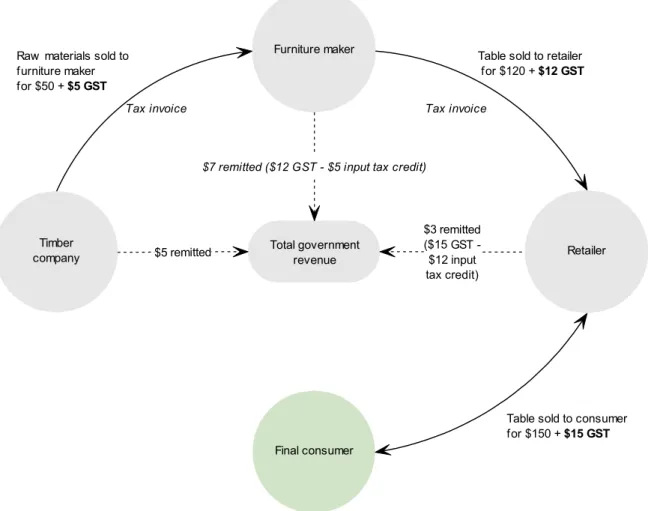
An individual sale or purchase of a commodity can be ‘taxable’ (that is, tax is payable on the sale of taxable goods, and tax paid previously in the supply chain is refunded), ‘GST-free’ (that is, tax is not payable on the sale of GST-free goods, and tax paid previously in the supply chain is refunded) or ‘input taxed’ (that is, no tax is payable on the supply of input-taxed goods, but the tax previously paid in the supply chain is not refunded).The need to determine the tax status of each sale or purchase requires the use of tax invoices to provide evidence of liability to GST or eligibility for a refund. The ‘invoice-credit method’ (illustrated in Chart D2–2) attributes a tax liability (for sales), or an input tax credit (for purchases) to individual transactions, for which a ‘tax invoice’ must be generated. The net amount is remitted to the Australian Tax Office (ATO).
D2 — The goods and services tax
Chart D2–2: Invoice-credit method consumption tax
Tax liability = tax rate (output) minus tax rate (input)
Timber company
Furniture maker
Retailer Raw materials sold to
furniture maker
for $50 + $5 GST
Final consumer Total government
revenue
Table sold to retailer
for $120 +$12 GST
$3 remitted ($15 GST -$12 input tax credit)
Table sold to consumer
for $150 +$15 GST
$5 remitted
$7 remitted ($12 GST - $5 input tax credit)
Tax invoice Tax invoice
There is an argument that tax invoices make the GST ‘self-enforcing’, as a business purchaser of a taxed good or service requires a valid tax invoice from their supplier in order to receive an input tax credit. While this imposes an additional compliance burden for taxpayers, it creates an additional audit trail for the ATO.
However, the inherent compliance benefits of an invoice-credit method should not be overstated. While business consumers have an incentive to ask for a tax invoice, consumers have no need for a tax invoice, as they cannot claim a tax credit. As such, tax collected at the final retail stage is not self-enforcing. Moreover, the existence of a tax invoice may assist but does not in itself ensure compliance. A false tax invoice might be used to make a claim for a credit. A missing or absent tax invoice may be used to understate sales.
In addition, the widespread use of tax invoices as a basis of systematic cross-checking between tax paid and tax claimed, while simple in concept, is costly in practice (see Box D2-1). The ATO’s compliance program is built largely on voluntary compliance, with targeted audit activity in response to emerging risks, rather than auditing millions of routine transactions.
Box D2–1: Cross-checking invoices in practice — South Korea
South Korea introduced its invoice-credit VAT in 1977. To ensure compliance, taxpayers were required to send copies of each tax invoice to the tax authority’s central computer centre for cross-checking.
These cross-checking programs reduced the number of cases where matching sales and purchase invoices could not be found, although many of the remaining cases resulted from transcription errors rather than fraud. However, the cross-checking program was cancelled after the resources costs for administrator, and the compliance costs for taxpayers, were found to outweigh the benefits.
Adapted from Ebrill et al. 2001, p. 150.
GST compliance can be costly …
The costs incurred by business in complying with the GST arise from registration requirements, issuing tax invoices, distinguishing between different types of supplies, reporting and remitting GST to the ATO, computing and software requirements, record keeping and auditing, understanding the GST law, and impacts on cash flow.
The Board of Taxation (2007, p. 112) has highlighted GST-specific compliance issues in the course of its review of small business tax compliance costs. It found that working out exemptions and concessions is a confusing and time-consuming task. Small businesses also find it difficult to classify supplies into taxable, GST-free and input-taxed items for tax purposes, and into capital and non-capital items for the business activity statement (BAS). The requirement to receive and retain all tax invoices for five years is also costly. In addition, the not-for-profit sector, comprising around 700,000 organisations, can incur significant compliance costs associated with the GST. While the sector receives GST concessions, compliance with the regime is reportedly difficult, at least partly because of the regular use of untrained volunteers for administration.
There has been no comprehensive quantitative study of GST compliance costs in Australia. A study of compliance costs in the UK suggests that VAT compliance costs decrease as a proportion of sales as sales increase, with compliance costs ranging from 0.003 per cent of taxable sales for large businesses to almost 2 per cent for small businesses (Sandford et al. 1989, p. 116). Estimates of compliance costs under a VAT system as reported by the United States Government Accountability Office (2008, p. 16) suggest that small business with sales under $50,000 face a cost of compliance of 2 per cent of annual sales, compared with
0.04 per cent for businesses with sales over $1 million.2
Compliance costs increase when different supplies are given different tax treatments. While most supplies are taxable, some supplies are GST-free, or input-taxed.
D2 — The goods and services tax
… especially for small business
In 2007–08, approximately 2.6 million entities were registered for GST, of which nearly two million lodged a BAS. More than half a million taxpayers were in a net refund position. Of those taxpayers that had a net GST liability, less than one thousand were responsible for 40 per cent of ATO GST liabilities. Almost one million taxpayers had a positive GST liability of less than $10,000 (see Chart D2–3). This suggests that a large number of very small
businesses bear the compliance costs of the GST while contributing very little to overall revenue collection.
Chart D2–3: Net GST liabilities by amount, 2007–08
486 396 2,189 2,416 18,266 107,854 910,513 438,478 51,323 5,941 4,939 708 729 426,878 0 100,000 200,000 300,000 400,000 500,000 600,000 700,000 800,000 900,000 1,000,000 $ -10,000,0 00 or more $ -5,000,0 00 to $ -9,999 ,999 $ -1,000,0 00 to $ -4,999 ,999 $ -500,0 00 to $ -999 ,999 $ -100,0 00 to $-499, 999 $ -10,0 00 to $ -99 ,999 $ -1 to $ -9,999 $ 0 to $ 9,999 $ 10,0 00 to $99 ,999 $ 100,0 00 to $499 ,999 $ 500,0 00 to $999 ,999 $ 1,000 ,000 - $4,99 9,999 $ 5,000, 000 - $9,999 ,999 $10,00 0,000 or mo re -30 -20 -10 0 10 20 30 40
Number of GST accounts (Bar) Net GST liabilities $billion (Line)
Net annual GST liability
Source: ATO 2009.
While businesses with an annual turnover below $75,000 and non-profit organisations with a turnover below $150,000 are not required to register, many are still voluntarily registered. In 2007–08 around half GST registrations were voluntary. This could be due to pressure from their business customers to register so they correspond with their customers’ accounting systems and allow their customers to claim input tax credits.
Moreover, once a business has registered for the GST, there is often little incentive to
deregister. Deregistration can be complicated, requiring a range of adjustments in relation to previously claimed input tax credits.
The take-up of a range of optional small business concessions has been very low. For
example, in 2007 only 2 per cent of eligible small business (roughly 2,400 out of 110,000) used a simplified accounting method to calculate GST (Board of Taxation 2008, p. 50). This
suggests that the perceived benefits of some concessions are not great.
Findings
Complying with the GST is costly for many businesses — particularly small businesses. Much of this complexity is structural, and flows from differential tax treatment of different goods and services. The smallest businesses can be under pressure to be in the GST
D2–2 Alleviating compliance costs on some transactions
Treat some business-to-business transactions as if they were GST-free?
One approach to reducing business compliance costs within the existing GST system would be to allow more transactions between two registered entities to be treated as if they were GST-free. It would be necessary to target those areas where the compliance benefits of providing this treatment outweigh the additional complexity of introducing yet another treatment.This approach would not require significant changes to existing accounting systems but would treat more supplies as if they were GST-free. It would avoid some of the cash flow costs associated with the GST — that is, additional finance would not be needed to pay the GST-inclusive price, only to have the GST component subsequently returned as an input tax credit. The impact on cash flow could be particularly beneficial for acquisitions of large one-off capital items.
Some supplies are input-taxed. A business acquiring goods or services that are input-taxed receives no credit for the embedded tax. This means that the tax ‘cascades’ through the supply chain, introduces biases into production decisions and ultimately results in higher prices for business consumers and exports. The ability to treat some ‘input-taxed’ supplies as if they were GST-free for business might reduce this bias, although it would increase
complexity, and would require alternative arrangements to ensure that the household consumption is taxed (see, for example, Section D4 Taxing financial services).
Greater use of GST-free treatment would involve an increased risk to revenue, as more revenue would be collected at the final sale, at which point consumers have little incentive to demand a tax invoice. In addition, the benefits would need to be weighed against the
additional complexity that would arise from introducing further classifications into the GST system.
Use reverse charging more widely?
An alternative proposal would be to allow businesses to agree to reverse charge a greater number of transactions (see Box D2–2). Reverse charging is currently used to tax some imported services. Making greater use of reverse charging would have cash flow benefits for the purchasing business. However, the reverse charge approach would not remove the compliance costs associated with identifying business-to-business transactions.
Reverse charging would be similar in effect to a retail sales tax, as some transactions within the supply chain would be excluded from GST, provided that the recipient is registered for GST.
D2 — The goods and services tax
Box D2–2: Reverse charging
Under a reverse charge mechanism, the recipient of a supply is responsible for remitting GST that would otherwise be remitted by the supplier. The recipient is also entitled to claim input tax credits where it has made a creditable acquisition. Thus at the time of acquisition the recipient will be liable to remit the GST and will be entitled to claim input tax credits. The two amounts, generally, would exactly offset one another, while
maintaining the normal GST revenue result. The amount of GST charged is 10 per cent of the GST-exclusive price of the taxable supply.
Under the existing Australian system, reverse charging is limited to supplies made by non-residents. Practical difficulties in remitting GST may arise where the non–resident does not have a presence in Australia. To overcome this, the non-resident supplier and the Australian recipient may, subject to certain conditions, agree that the GST on the supply should be paid by the recipient rather than the supplier. In addition, a compulsory reverse charge regime operates for some non-resident supplies of services.
The non-resident supplier is not required to issue a tax invoice and the recipient is not required to hold a tax invoice in order to claim an input tax credit. The reverse charging arrangements are intended to reduce compliance costs for non-residents.
This approach might reduce some compliance costs associated with the current GST system. It also reduces the risk to revenue of paying input tax credits where no GST has been paid. Such an approach would shift the cash flow benefits that some suppliers currently enjoy (that is, collecting GST before it is due to be paid to the ATO) to the purchasing business. This would be of particular benefit in relation to large, infrequent transactions. However, it might disadvantage others, such as primary producers, who currently receive payment for their supplies before they are liable to pay GST.
While widespread entitlement to GST-free or reverse charging transactions runs the risk of raising compliance costs and increasing revenue risks, the benefits might outweigh these risks in particular, confined circumstances. A more detailed investigation would be necessary before either strategy could be adopted.
Recommendation 56:
The government should consider making greater use of GST-free business-to-business transactions or reverse charging, provided the potential compliance cost savings outweigh the additional complexity costs and risks to revenue.
Keep excise-inclusive prices in the GST base
GST is charged at 10 per cent on taxable goods and services. In the case of excisable goods such as petrol, beer, spirits and tobacco, GST is imposed on the market price, after the imposition of excise. This leads to a ‘tax on tax’ situation.
Removing this ‘tax on tax’ would narrow the consumption tax base, reducing overall efficiency by shifting relative prices between taxed and untaxed commodities. It would
excisable goods and for those who purchase them. For example, if fuel excise were removed from the GST calculation, a business user of petrol would not be entitled to an input tax credit for that proportion of the price that is attributable to excise.
If a tax on specific product is used to set a price to consumers that reflects wider costs of consumption or production (as recommended in Section E Enhancing social and market outcomes), this price should be subject to GST to ensure equivalent treatment with other prices in the economy.
Finding
Excise-inclusive prices are properly included in the GST base. Charging GST only on the ‘excise-exclusive’ value of goods or services would add significantly to the complexity of the GST, and reduce its efficiency.
D3. Payroll tax
Key points
Existing payroll taxes are more complex and less efficient than they could be because of tax-free thresholds and other exemptions.
A broad-based consumption tax, such as a cash flow tax, would tax returns from labour and would provide additional revenue, providing scope to remove current payroll taxes.
D3–1 Taxing labour income
Labour income (effectively the value-added from working) is the most important tax base for developed countries (see Section A1–2 Income from work and deductions). In Australia, employee compensation (which is the largest part of labour income) has accounted for around half of gross domestic product (GDP) for the past 50 years (see Chart D3–1).
Chart D3–1: Compensation of employees as a proportion of GDP over 50 years
0 10 20 30 40 50 60 70 1959-60 1966-67 1973-74 1980-81 1987-88 1994-95 2001-02 2008-09 0 10 20 30 40 50 60 70
Per cent of GDP Per cent of GDP
Source: ABS (2009a).
Because payroll taxes are generally levied on all components of employee remuneration, they are designed to tax the value-added from labour. As such, payroll taxes are similar to the labour component of Australia’s personal income tax as well as the goods and services tax — they all generate revenue by reducing the real return from working.
Labour is relatively immobile, but high tax rates can deter certain people from participating in the labour market. Therefore taxes on labour income can be relatively efficient. Australia’s future tax system will need to raise significant revenues from the value-added by labour. However, as Sections A1–2 Income from work and deductions and D Taxing consumption show, this value-added can be taxed in many ways.
Who bears the burden of payroll tax?
While businesses are legally responsible for remitting payroll tax, in the long run they are unlikely to bear the burden of the tax (in terms of returns to capital).
In the short run, the situation is not always as clear. Businesses demand labour so they can produce goods and services (to earn a return on capital), while workers supply labour in return for wage income. Who bears the burden of a rise in the payroll tax rate will depend on which factor (capital or labour) is relatively ‘inelastic’ — that is, which one has fewer options for avoiding the tax.
Different businesses will be in different situations. For example, an increase in payroll tax rates may not feed through to lower wages until wages can be renegotiated. In the short run, businesses can bear some of the burden (or receive some of the benefit) from changes to payroll tax, and many say they do (see Box D3–1).
Box D3–1: Why do businesses feel the burden of payroll tax?
Businesses often lobby governments to lower payroll tax rates or increase exemption thresholds. Why do they do this if payroll tax is actually paid by labour in the long run? Some businesses may believe they bear the burden of payroll tax simply because they are the ones with the legal liability to remit the tax and are able to observe the compliance costs they incur. However, others may be seeking the short-term profits from payroll tax relief caused by markets taking time to adjust and shift the benefit to labour.
Exemptions have an unpredictable impact on the market. Due to the threshold exemption, for example, a taxpaying firm may be in competition with exempt firms. Each type of firm will have a different cost structure (for example, the taxpaying firms might employ more capital equipment relative to labour). When a growing business in that sector enters the payroll tax system for the first time, it may need time to adjust its cost structure and is likely to make lower profits in the short run.
The opposite may happen if the tax-free threshold rises, taking a small number of
competitors out of the tax net, and giving them the chance to make additional profits in the short run. That is, if there is an unanticipated cut in the rate of payroll tax, businesses are likely to enjoy additional profits briefly until competition causes prices to fall or wages to rise.
These effects may lead businesses to conclude that they bear the burden of the tax. While not considering the timeframe issues, Carling (2008, p. 6) takes a similar view, stating that ’even though most of the economic incidence of payroll tax may not fall on employers, the illusion that it does may be so strong that it actually influences business behaviour’. For example, a business might prefer to locate in a jurisdiction with lower payroll taxes believing this will increase the return to its capital, even if in the long run this actually results in paying employees higher wages.
The ‘short run’ is an imprecise concept; generally defined as the period during which capital is fixed in its current use. For example, if a business thinks that demand for its product has fallen, it may continue to produce in the short run because it is expensive to move or re-tool
D3 — Payroll tax
the existing machinery. For a capital-intensive manufacturer, then, the short run may be more than a year. For more labour-intensive industries such as house building most machinery is rented, rather than owned, and labour can be adjusted rapidly in response to demand. For these businesses, the short run may be only a few months.
In the long run, investment will flow elsewhere and any plant or equipment will be sold. Capital is very mobile across Australia and the world, whereas workers are less mobile. As a result, a payroll tax reduces the demand for labour, lowering wages to the point where the return on capital is again equal to the world level. Capital owners such as shareholders and lenders will seek higher returns by locating their investment elsewhere. So, while a business may relocate or shut down to avoid the tax, the underlying capital invested in that business will be applied elsewhere in order to earn the prevailing after-tax return. In the long run, the supply of capital is likely to be significantly more responsive (that is, ‘elastic’) to the effects of a payroll tax than labour. This means that labour tends to bear the burden of such taxes rather than capital owners (Freebairn 2009; IPART 2008; Carling 2008; Ryan 1995). In the long run, payroll tax therefore has a very similar effect to the labour component of personal income tax.
There is one more significant effect of payroll tax — it is likely that all workers, not just those in businesses remitting payroll tax, bear the tax burden through lower wages
(Freebairn 2009). In the long run, businesses will pass the burden of payroll tax onto workers, so some workers are likely to leave businesses that remit payroll tax and seek higher wages in businesses that do not. The influx of workers trying to get jobs in the exempt sector means that such businesses will not have to pay as much to attract workers. This means that workers in untaxed businesses receive lower incomes than they would have otherwise, effectively sharing the payroll tax burden (see Box D3–2).
In effect, the narrow-based payroll tax is a tax on all workers, but one that is levied in a very inefficient way because it pushes into the untaxed sector some workers who would be more productive in the taxed sector. This implies a decline in average labour productivity,
Box D3–2: A payroll tax on some firms can affect workers in all firms
Even though a payroll tax may be levied only on businesses with payrolls above a certain threshold, the effect of the tax may be felt by those working in businesses with payrolls below the threshold.
Chart D3–2 illustrates a simple model which shows the impact of a narrow-based payroll tax. The model assumes that the total labour supply is fixed and that businesses are split into two categories: large and small. The tax is only imposed on payrolls of large
businesses.
Chart D3–2: The effect on wages and employment of a narrow payroll tax
W1 W0
W (tax) Wages
(small business) (large business)Wages
SB E0 E1 LB
W1 W0
Increased employment in small business = Decreased employment in large business Demand (SB)
Demand (LB)
Demand (LB tax)
Source: Freebairn 2009.
The total labour supply is the distance between SB and LB on the chart. The demand for labour by small businesses slopes downward from the left hand side of the chart (Demand (SB)), while the demand for labour by large businesses slopes downward from right to left on the chart (Demand (LB)). Before a payroll tax is introduced, each worker gets paid the equilibrium wage W0. The distribution of workers in large and small business is indicated by E0; that is, the distance SB–E0 represents the number of workers in the small business sector, and LB–E0 represents the number of workers in the large business sector.
The introduction of a payroll tax on the wages received by employees of large businesses results in each employee now costing the firm more. Demand for labour in the taxed sector therefore contracts, reflecting the extra cost now payable to government, and the new demand curve is shown as Demand (LB tax).
D3 — Payroll tax
Box D3–2: A payroll tax on some firms can affect workers in all firms (continued)
In the short run, wages may be inflexible and large business may have sunk costs that make it costly to reduce wages or withdraw capital. But in the long run, as capital is mobile, large business fully shifts the burden of the tax to workers in the form of lower wages, and the existing LB–E0 workers in the large business sector will have their wages reduced from W0 to W (tax). As wages in the (untaxed) small business sector are still at W0, the prospect of higher wages will entice some large business workers to move to the small business sector. As this movement happens, wages in both sectors converge to W1 and employment in small businesses increases from SB–EO to SB–E1, while employment in large businesses falls from LB–E0 to LB–E1.
There are two main results from this analysis:
• A narrow-based payroll tax (imposed only on certain employers) will reduce wages for
all workers in the economy.
• The imposition of a narrow-based payroll tax changes the composition of employment, moving some workers away from jobs where they would be more productive (in the absence of the tax).
Principles
In the long run, the burden of a stable labour income tax, such as payroll tax, is likely to fall on workers rather than on capital.
In the short run, however, an unexpected increase (decrease) in the payroll tax burden might be borne partly by the owners of capital through lower (higher) returns.
The burden of a relatively narrow-based labour income tax, such as the current State payroll taxes, is likely to be shared between workers in the taxed and non-taxed sectors. This also means that some workers are not working in their most productive jobs, with the result that overall labour force productivity is reduced.
D3–2 Current payroll taxes are complex and narrow-based
Payroll tax is levied by all States on businesses with payrolls above certain thresholds. Payroll tax was originally introduced by the Federal Government in 1941 to fund child endowment. Since the Australian government passed control of the payroll tax to the States in 1971, every State has used this tax to meet a significant part of its revenue requirements. In 2009–10, the States expect to collect $16.8 billion in payroll taxes, representing around
32 per cent of their own-source tax revenues.
The existing State payroll taxes are not as broad-based as they could be. Existing payroll taxes in all States include three major exemption categories (there are differences in the detail between States), including:
• activity exemptions — these exclude businesses according to their dominant activity (for example, charities, non-profit hospitals, local councils and the Australian government); and
• payment exemptions — these exclude the wages of people in certain circumstances, such as payments for maternity leave and payments made to apprentices.
Each State has a different threshold exemption as well as a different tax rate (see Table D3–1).
Table D3–1: Current payroll tax rates, thresholds and revenue estimates for 2009–10
State New South
Wales Victoria Queensland(a) Australia South Australia Western Tasmania Northern Territory Australian Capital Territory
Rate 5.75% 4.95% 4.75% 4.95% 5.5% 6.1% 5.9% 6.85%
Threshold $638,000 $550,000 $1 million $600,000 $750,000 $1.01 million $1.25 million $1.5 million
Revenue $6,172 $4,074 $2,736 $915 $2,216 $257 $157 $267
(a) Queensland differs in that it does not provide a deduction equal to the threshold for all taxpayers. Instead it ‘claws back’ the threshold on payrolls between $1 million and $5 million. Above $5 million there is no deduction in Queensland.
Source: State revenue offices, State budget papers (mid-year update for Qld and Vic). Rates and thresholds are as at 1 July 2009.
Arguably, the threshold exemptions operate as a barrier to business growth as the compliance and payroll tax costs provide an incentive to remain small.
The overall effect of the exemptions is that a significant proportion of employee
remuneration is not subject to the tax. A comparison of current payroll tax revenues with the amount that would be collected at current rates from its theoretical base — represented by the national accounts measure of compensation of employees — suggests that around 43 per cent of employee compensation is exempt (see Chart D3–3).
State government tax expenditure data suggest that the threshold exemptions explain most of the difference between theoretical and actual payroll tax collections. This exemption reduces the efficiency of payroll tax revenue, as it distorts labour use away from its highest value use (see Box D3–2). A narrower tax base also means the tax rate has to be higher to raise a given amount of revenue.
Chart D3–3: Exemptions from theoretical payroll tax base, 2008–09
0 20 40 60 80 100
NSW VIC QLD SA WA TAS NT ACT Total
0 20 40 60 80 100
Subject to payroll tax Not subject to payroll tax
Per cent Per cent
D3 — Payroll tax
The threshold exempts most businesses from being liable for payroll tax. For example, the current NSW threshold (which is lower than most other States) exempts around 91 per cent of NSW businesses from payroll tax (IPART 2008). State government departments are generally liable for payroll tax.
Payroll tax is particularly complex across State borders
Employers face a number of complexities in complying with their payroll tax obligations. The definition of wages for payroll tax purposes differs from that for income tax and workers’ compensation.
Exempt employers must ensure they remain eligible for the exemption activity. Employers must continually identify the instances where an employee’s wage, in whole or part, becomes exempt or ceases to be exempt, and move those wages into, or out of, the payroll tax calculation as required.
Businesses close to the threshold are likely to have to calculate their payroll amounts regularly to determine whether or not they have a liability to register for payroll tax. Threshold exemptions require complex grouping rules that deem related entities to be one business for the purposes of the threshold. These rules are necessary to prevent businesses from taking advantage of the threshold by artificially splitting up their operations into a number of smaller entities.
When payroll tax became an own-source of revenue for the States, payroll taxpayers
operating in more than one State were required to submit regular (usually monthly) payroll tax returns and payments to each State in which they employed people. With business increasingly operating on a national and global basis, around half of payroll taxpayers now employ in more than one State.
To prevent business from receiving a full threshold deduction in each State, the threshold deduction is applied in respect of the employer’s total Australian wages, but the liability is calculated in respect of the wages paid to workers employed in that State.
Where an employee works in more than one State there are complex rules for determining which State receives the payroll tax.
In 1971 the States enacted uniform payroll tax legislation with a uniform tax rate of 2.5 per cent. Over the following years, that uniformity was gradually eroded as States changed their tax rates and thresholds, extended the base to include other forms of remuneration, introduced anti-avoidance measures and enacted specific exemptions and rebates in response to local revenue and taxation issues. Recently, through the Council of Australian Governments’ ‘national seamless economy’ initiative, all jurisdictions have taken steps to harmonise their payroll tax legislation, which has resulted in harmonised legislation in most States. However, States still differ on the basis of thresholds and rates.
Many submissions to the Review have highlighted how the compliance costs for businesses with employees in several States are higher than necessary due to these complexities.
Apart from the impact on employers, the duplication of revenue authority infrastructure, including administration, compliance staff and IT systems, increases the administration costs of Australia’s tax system.
Finding
Exemptions in the payroll tax base introduce biases into the allocation of labour across the economy and lead to complexity in administration and compliance, particularly when the exemptions differ (even slightly) between States.
Reform of payroll tax has been mixed across States
Aggregate labour income as a percentage of GDP has been relatively stable over time (see Chart D3–1) so that even the current narrow-based payroll taxes are one of the more stable and predictable sources of State revenue (IPART 2008).
Over the past 20 years, the States have moved to broaden the payroll tax base and lower the rate. The major base-broadening decisions have involved the addition to the base of non-cash fringe benefits and superannuation contributions.
In New South Wales, Victoria and South Australia, base-broadening has also resulted from average wages rising faster than the level of the threshold. For example, Victoria’s threshold has risen from $500,000 in the early 1990s to $550,000 today. During this time, average wages have nearly doubled, so it is likely that that a higher proportion of businesses are now liable for payroll tax in Victoria. This potentially reduces the efficiency costs of raising revenue from payroll tax as fewer businesses can now change their activities to avoid paying the tax. Some other States have taken the opposite approach. Western Australia, Tasmania, Northern Territory and the Australian Capital Territory have narrowed their payroll tax base by increasing the threshold faster than the growth in wages. These States have generally been slower to reduce their payroll tax rates. Chart D3–4 compares two States with similar threshold exemption levels in 1992–93, and contrasts their actual level over time to what the threshold level would have been had it been indexed to the movement in average wages.
D3 — Payroll tax
Chart D3–4: Level of payroll tax thresholds in two States, compared with hypothetical indexation of the 1992–93 level to average wages
0.4 0.6 0.8 1 1.2 1.4 1.6 1992-93 1994-95 1996-97 1998-99 2000-01 2002-03 2004-05 2006-07 2008-09 0.4 0.6 0.8 1 1.2 1.4 1.6
NSW actual If 1992-93 level indexed ACT actual
$A million $A million
Source: Treasury estimates, NSW Treasury (2009), ABS (2009f).
On average, these changes made by the States over the past 15 years have increased the payroll tax base from around 45 per cent to 57 per cent of its theoretical level across all States (see Chart D3–3). At the same time as the base has been broadened, there has been a general decline in rates. For example, Victoria has significantly reduced its rate, from 7 per cent in 1990–91 to 4.95 per cent today.
Finding
Some States have broadened their payroll tax base by limiting growth in the payroll tax threshold, while other States have narrowed their base by rapidly increasing the threshold.
D3–3 Broad-based taxes to capture the value-add of labour?
Recommendation 57:
State payroll taxes should eventually be replaced with revenue from more efficient broad-based taxes that capture the value-add of labour.
The Review has considered replacing the existing payroll taxes with a tax on employee remuneration administered through the pay as you go (PAYG) withholding system.
However, a more efficient, equitable and sustainable means of taxing labour income would be a broad-based consumption tax.
Consumption is made up of labour income and any excess returns to other factors of
production (such as capital). In particular, a broad-based consumption tax would be applied to all businesses selling goods and services, including the self-employed. As the base is broader than just labour income, the rate of tax would need to be lower for any given