The pause/play button actor-network: lecture capture recordings
and (re)con
fi
guring multi-spatial learning practices
Karl Luke
School of Medicine, CardiffUniversity, Cardiff, UK
ABSTRACT
Lecture recording is an increasingly common practice in UK universities, whereby audio, video, and multimedia content from lecture theatres can be captured and distributed online. Despite a large body of recent lecture capture literature, much of the empirical research adopts positivist paradigms, which overlooks the complex and unpredictable nature of teaching and learning. Addressing this knowledge gap, this exploratory case study adopts sociomaterial approaches, specifically perspectives from the domain of actor-network theory (ANT), to view learning technologies as complex assemblages involving heterogeneous human and non-human entities oractors.
This paper explores the entanglements involved in enacting online pedagogy and learning across spatiotemporal dimensions using trace ethnography and visualisation mapping. Examining the student-led study practices revealed that multitasking and fluid task switching, between contrasting networks and spaces, was a significant activity during the playback of lecture recordings. Exploring an innocuous and ubiquitous practice, such as video pausing, affords nuanced perspectives into the sociomaterial entanglements involved in enacting study practices. Moreover, adopting multimodal sensitivities reveals how often overlooked modes, such as iconography, can become actors within an assemblage. This may offer new insights into how modes help produce or stabilise configurations and advance efforts in attending to the non-human within actor-networks.
ARTICLE HISTORY Received 9 January 2019 Accepted 14 December 2019 KEYWORDS Actor-network theory; multimodality; lecture capture; visualisation mapping; learning spaces
Introduction
Lecture recording, using semi-automated systems, is an increasingly common practice in UK univer-sities, having grown significantly in recent years. Such lecture capture solutions typically produce digital audio and/or video recording of lectures, usually synchronised with displayed lecture materials (such as digitalfiles and presentations), which are subsequently published online via institutional Virtual Learning Environments (VLEs) (Newton, Tucker, Dawson, & Currie,2014). In 2018, 75% of UK universities reported having institutionally supported lecture capture systems (Walker et al.,2018). Within such institutions, lecture capture technologies are increasingly employed in large undergradu-ate classes (Witthaus & Robinson,2015). The recent interest in lecture capture has been partly attrib-uted to lowering financial costs associated with lecture capture technologies, increased student access to computers and smart mobile devices, greater availability of broadband connectivity, and strong student demand (Newton et al.,2014).
© 2020 The Author(s). Published by Informa UK Limited, trading as Taylor & Francis Group
This is an Open Access article distributed under the terms of the Creative Commons Attribution-NonCommercial-NoDerivatives License (http:// creativecommons.org/licenses/by-nc-nd/4.0/), which permits non-commercial re-use, distribution, and reproduction in any medium, provided the original work is properly cited, and is not altered, transformed, or built upon in any way.
CONTACT Karl Luke lukek1@cardiff.ac.uk @karl_luke INTERACTIVE LEARNING ENVIRONMENTS
However, such systems raise a number of issues related to how lecture capture is used as an edu-cational resource. Much of the recent lecture capture literature focuses on quantitative measures of change, such as student attainment or physical classroom attendance (Karnad,2013; Nordmann & McGeorge, 2018; Witthaus & Robinson,2015). Such empirical research around lecture capture is largely offered in the positivist tradition, which views teaching and learning as observable, measur-able and quantifiable, rather than complex and unpredictable (Wahyuni,2012). Such research may be seen as oversimplifying the multifaceted workings of lecture capture, which is little acknowledged or explored in the current literature (Morris, Swinnerton, & Coop,2019). Addressing this knowledge gap, this paper offers an exploratory case study which explores how students’learning practices, involving lecture recordings, are enacted using sociomaterial approaches; a position which appears to be cur-rently absent within existing lecture capture literature. Influenced by perspectives offered by actor-network theory (ANT) this paper also seeks to contribute to the evolving body of sociomaterial litera-ture offered by educational researchers through an account of the novel methodology deployed here. This paper also explores the coupling of ANT with multimodal sensitivities, which may give nuanced insights into how teaching and learning practices are enacted, across spatiotemporal dimensions.
Actor-network theory
By adopting a sociomaterial perspective, underpinned by key concepts from ANT, research sensitivity here was orientated towards accounting for lecture capture practices that are“in the making”(Law,
2009). This position illuminates the heterogeneous“things”, such as people, artefacts, tools, docu-ments, and objects, involved in shaping and enacting practices. ANT is not seen as a concrete expla-natory theory but offers methods and perspectives for understanding the“messy practices”(Law,
2009, p. 142) involved in empirically grounded cases. Moreover, ANT brings into focus heterogeneous
actors–objects of all kinds–and seeks to de-centre the human and the social in educational issues. ANT studies deploy a unique vocabulary to describe how networks operate and (dis)connect, which are not easily decodable or intuitive (Cressman,2009). ANT terminology can be problematic and lead to misunderstandings, whereby alterative metaphors to describe actors and networks have been introduced in the literature (Fenwick & Edwards,2010). Such terminology will be used throughout this paper and are therefore worth exploring for clarity.
Heterogeneity/symmetry
A key feature of ANT centres on removing distinctions between the human and the non-human, the social and the material, culture and nature and so on. Such distinctions are of no analytical impor-tance; rather researcher sensitivity is directed towards the agency of different entities–oractors–
and the actions they perform, who they (dis)connect with, and the effects of such interactions. Latour (1992,2005) has debated substituting the more human-centered concept ofactorwith that of the more agency-reminiscent termactant, in an attempt to avoid conceptual human-centeredness. However, the termactorstill prevails in recent literature and for matters of clarity the termsactant
andactorare used interchangeably and as synonyms in this paper. Actants are defined as“entities that do things”(Latour,1992, p. 241), emphasising thegeneralised symmetry(Callon,1986) between humans and non-humans (e.g. tools, programmes, documents, objects, machinery, technologies).
Relationality/associations
Importantly, ANT recognises actants, or actors, as not being single entities and are non-existent by themselves. Instead actors exist within an assemblage of materials, brought together and linked to perform a particular function (Callon, 1986; Latour, 2005). ANT positions all actants as being capable of exerting force and joining together in a network, capable of changing and being
changed by each other to form (provisional) stability. Thus, networks are dynamic entities that are constantly the object of (re)negotiation, emerging through enactments, relations and associations between assemblies of material“things”. The relationalism between actors, to perform a particular function and form instances of (momentary) stability, is what ANT scholars have termed anetwork
orassemblage(Latour,2005).
Such relationalism also allows for reversibility between the termsactorsandnetworks, whereby an actor should always be considered simultaneously as a network itself, hence the hyphenated term actor-network (Latour, Jensen, Venturini, Grauwin, & Boullier,2012). Latour (2005) provides a useful illustration of the dualistic characteristics of actor-networks in an example of the lecture theatre, which is of specific importance here. The lecture theatre can be viewed as bounded entity, or
black box (Callon, 1986), as well as a complex and heterogeneous network, accumulating actors such as the lecturer, presentation scripts, students, a computer, seats, a projection screen, and so forth. Equally, however, it is possible to conceive each of these actors as being networks in/on them-selves. For example, the lecturer is a network consisting of different actors, including the lecturer’s clothes, laptop, lecture notes, curriculum guides, and so on. All these actors, within the lecturer actor-network, bind together in a particular way and (co)define who the lecturer is within specific moments of association.
Actor-networks and mobility
ANT exposes networks which can expand andflow across spaces, distances and/or time (Fenwick & Edwards,2010). ANT conceptualises space as contingent and spatiality is thus examined explicitly here in relational terms, whereby space is active and undergoing continual (re)constitution (McGre-gor,2004; Murdoch,1998). ANT scholars argue that spatiotemporal dimensions can be understood in network terms whereby space is “identified by the pattern of relations of which it is made up” (Sørensen, 2009, p. 76). Similarly, temporal dimensions are forged within network colorations, whereby there is a simultaneous interaction between the sociomaterial in the immediate environ-ment and with the sociomaterial that is spatially and temporally removed from the situation, but are no less present in effect (McGregor,2004; Nespor,1994). As Nespor (2003) argues:
The space of the classroom is extended into the student’s residence, and the student’s out of school time is syn-chronized not just with the professor’s pacing of course materials, but also to an institutional calendar, which organises‘learning’into arbitrary units of time like semesters. (p. 94)
The concept ofimmutable mobilesis key to early ANT scholarship (Latour,1986) and is one way to describe how networks begin toflow in/on themselves. Immutable mobiles act at a distance and are easily transportable actors which maintain their identity or inherent characteristics between net-works, allowing informationflow from one actor-network to another. Law and Singleton (2005) argue that it is irrelevant whether the immutable mobile is tangible (e.g. a textbook) or abstract (e.g. a ped-agogical strategy). The key feature is that such actors are identifiable andflow, unchanged, between particular network configurations. Immutable mobiles are relevant here as they are seen as“ impor-tant dynamics in the power relations circumscribing education”(Fenwick & Edwards, 2010, p. 18), which can assessable powerful centres that accumulate thick webs of heterogeneous actor-networks.
Research design
Actor-network theorists assert that in order to understand practices researchers need to“undertake the analytical and empirical task of exploring possible patterns of relations, and how it is that these get assembled in particular locations”(Law,2009, p. 157). Such a position requires an account of the heterogeneous actors entangled within the studied phenomenon and the relations between different actors. To follow the distributed agency of heterogeneous actors and explore their (dis)con-nections, this study adopted trace ethnography and visualisation mapping techniques (Decuypere &
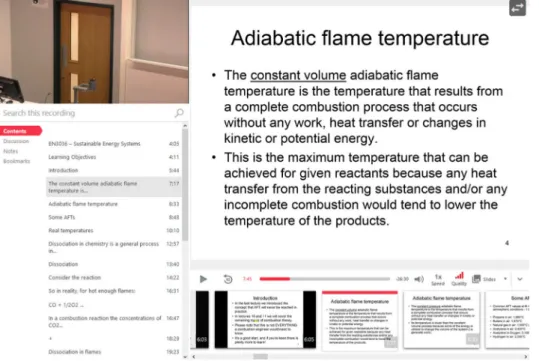
Simons,2016a; Latour et al.,2012). The study was informed by data provided by one academic par-ticipant and three student parpar-ticipants, enrolled on an undergraduate engineering programme at a Russell Group university; an association of twenty-four public research-intensive universities in the United Kingdom. The study reports on the student practices involving one lecture capture recording, with a duration of 34 minutes and 13 seconds (Figure 1).
Ethnographic research is seen as a suitable methodology in the studying of sociomaterial phenomena (MacLeod, Cameron, Ajjawi, Kits, & Tummons, 2019; Nimmo, 2011). Ethnography seeks to provide detailed descriptions of“undisturbed”natural settings and assemble accounts by trying to obtain an “insider’s view” into the studied phenomenon. Moreover, this research adopted perspectives offered by multi-sited ethnography, which advocates following people, con-nections, associations, and relationships across spaces (Coleman & von Hellermann, 2011). Here, research data is linked across different spaces and times instead of focusing on one site and assuming it to be a bounded entity.
Screen recording with video
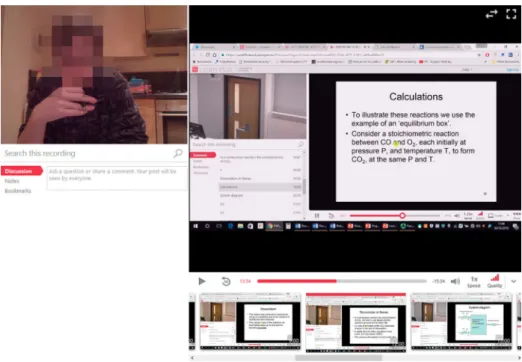
Guided by an ethnographic desire to gain an insider perspective, an approach to empirically observe the student-led practices involving the lecture capture artefact was required. Screen recording soft-ware has been previously employed by researchers as a tool to capture the on-screen activities of participants alongside recordings of real-time interactions via a webcam (Bhatt & de Roock,2014; Geisler & Slattery,2007). The student participants in this study were invited to capture their screen actions, with embedded video, using the software tool Panopto (Figure 2). The video data collected amounted to a total of over 160 minutes and produced a rich multimodal rendition of the students’ situated activities, on- and off-screen. In doing so, it provided unprecedented access“from within the members’practices”(Fenwick & Edwards,2010, p. 154), across spatial–temporal configurations. Indi-vidual semi-structured interviews, with each of the three student participants, were also conducted.
Figure 1.The lecture capture artefact with navigation menu (left) and thumbnails (bottom right). Reproduced with permission of the publisher, © Panopto.
The interviews explored the ways in which participants perceived and enacted practices involving lecture recordings in their lifeworlds.
Multimodal analysis of student produced data
The screen recordings attractively lent themselves to multimodal analysis (Jewitt, 2014; Kress,
2014). Multimodal analysis presents a critical framework to decode and “read” texts and was deployed in an attempt to obtain a nuanced view when analysing non-human actors, such as tools, texts and objects. By analysing the screen recorded actions of the participants, from a per-spective of multimodality, allowed the researcher to expose multimodal elements (e.g. navigational buttons, icons, text, images, framing) and explore their connectedness in the observed activities. A textual narrative was produced to document the observed actors, interactions, and relational effects presented in the student-produced videos. All observer notes were coded using theoretical thematic analysis (Braun & Clarke,2006) for instances of actor-networks and their relations. Analys-ing the actor-network codes collectively also exposed patterns and combinations in formAnalys-ing over-arching themes.
Tracing and mapping
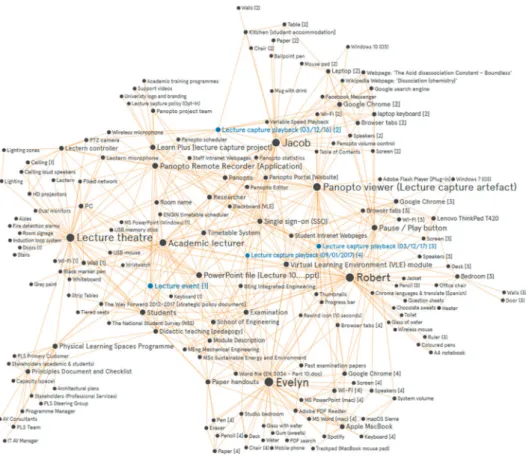
Trace ethnography and visualisations representing actor-networks has been scarcely used in socio-material studies but is seen as a valuable technique in following the distributed agency of hetero-geneous actants and scrutinising compositions (Decuypere & Simons, 2014; Latour et al., 2012; O’Keeffe,2016). Drawing upon thefield of visual network analysis, visualisation mapping techniques were deployed to analyse the collected data (Brughmans,2010; Knox, Savage, & Harvey,2006). Actors were depicted visually as a set of vertices, ornodes, relating to the concept ofpunctualization, which
“converts an entire network into a single point or node in another network”(Callon,1991, p. 153). An undirected interaction line, or edge, was set between nodes each time some kind of action occurred
Figure 2.Example of a screen capture artefact, produced by a student participant, with picture-in-picture display. Reproduced with permission of the publisher, © Panopto.
between two (or more) actors. The produced visualisations (Figure 3) were integral to the study inves-tigation and instrumental in probing the distributed areas of lecture capture practice (Decuypere & Simons,2014; Latour et al.,2012).
Findings
Sociomaterial network effects: note-taking and sociomaterial arrangements
Despite the notion that lecture capture offers“student-centric”approaches to teaching and learning (Karnad,2013), a sociomaterial perspective reveals a dichotomy whereby the systems of power emer-ging from the university fundamentally shape and structure interactions with the recorded artefact. Student viewing of lecture capture videos was a key activity in preparation for a forthcoming exam (Figure 4).
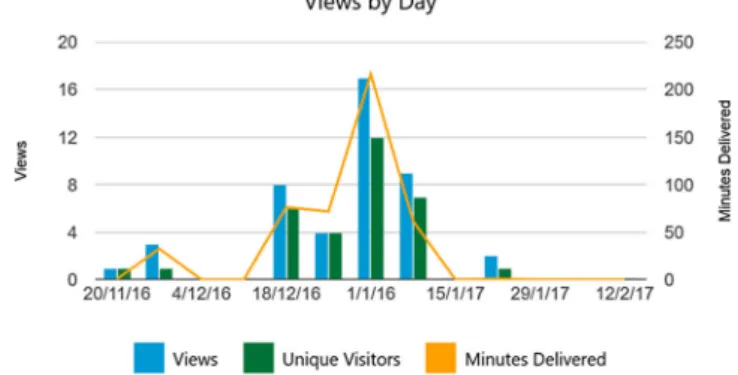
Statistics provided by the lecture capture system revealed a peak in cohort access and playback of the lecture capture artefact in the two weeks prior to the exam (Figure 5). This is foreshadowed in the lecture capture literature, which suggests that students make greater use of lecture capture record-ings as a revision tool in the days preceding examination (Elliott & Neal,2016; Karnad,2013; Witthaus & Robinson,2015). The course examination profoundly mediated thestudent–lecture recording inter-action, as does the use of Single Sign On authentication whereby the artefact is restricted to enrolled students on the course. From an ANT perspective, the examination not only shaped the content pre-sented in the original lecture event but also mobilised the lecture capture actor-network into the student learning practices, outside of the lecture theatre environment.
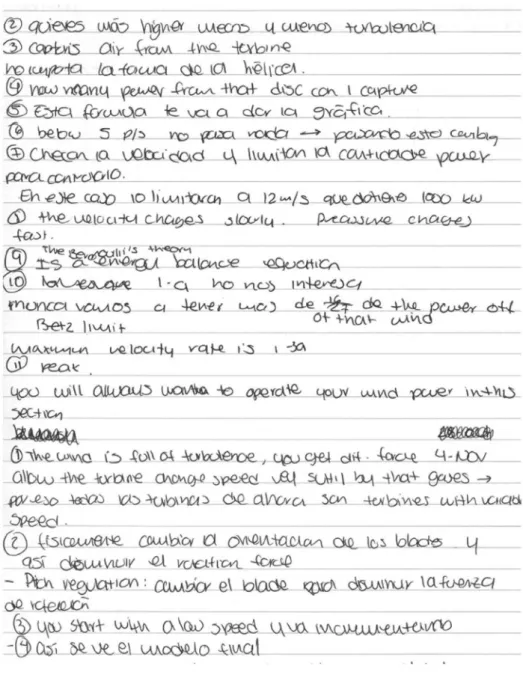
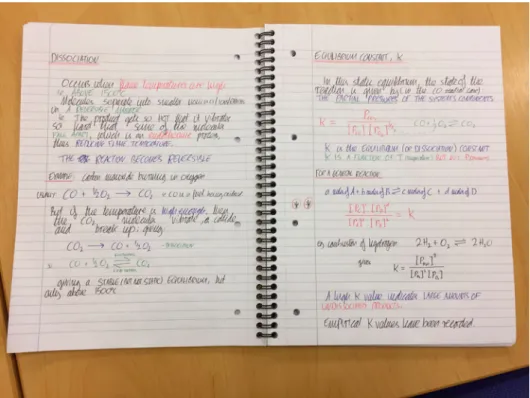
Reviewing the student-produced screen recordings revealed that note-taking by the student actors was a key activity mediated by the lecture capture artefact and was instrumental in shaping their sociomaterial study practices (Figures 6 and 7). This practice can be viewed in terms of a complex sociomaterial arrangement, involving diverse spaces and many interacting actors. Vignette 1 illustrates how one student organised and structured note-taking activities, which vividly acknowl-edges the active roles played by heterogeneous actor-networks, such as lecture notes, a notepad, past examination papers, a desk, a chair, coloured pens, the Virtual Learning Environment (VLE), intra-net webpages, Single Sign On authentication, and lecture capture artefacts.
Figure 4.Module description detailing module delivery and assessment requirements (taken from the module area within the institutions’Virtual Learning Environment).
Figure 5.Video analytics showing amount of lecture capture views during the examination period, which took place on 12/01/17. Reproduced with permission of the publisher, © Panopto.
I had the printed notes from the lectures with me and some question sheets. I had other notes which, like in this book here, are my written notes. I had some old past papers as well. I’ve got a big desk which is well over a metre wide and two thirds deep in the corner of my room. I’ve got a nice office chair. And I also had my rulers and coloured pens and pencil and stufflike that which I just keep sort of on the desk so when, well you can see the notes here, that helps me remember things. And I write certain things which are critical. I write them in different colours. Then I went onto Learning Central [Virtual Learning Environment], the university website, signed in, went to the modules and then chose the Panopto [lecture capture tool] section. (Vignette 1; Student participant 1)
Previous studies have reported that note-taking is a significant activity for university students when watching lecture recordings and such study practices can support self-regulated learning of pre-viously-taught material (Morris et al.,2019; Nordmann et al.,2018). Studies report that the technical
affordances of lecture capture, such as the possibility to stop and rewind the recordings, provide stu-dents with control over their learning and allows for extensive note-taking (Elliott & Neal,2016; Nord-mann et al.,2018). However, a sociomaterial approach can advance perspectives by emphasising that lecture capture note-taking is an assemblage of many heterogeneous actants, not just the between the technology and student, but involves elements such as multimodal buttons, notepads, pens, rulers, websites, and past examination papers. Any of these actants can influence the workings of the assemblage. Moreover, each research participant engaged in practices of enmeshing analogue and digital media, as illustrated in Vignette 1. Interestingly, each participant exhibited a preference to making handwritten notes, which can be viewed as“embodied inscription practice”(Gourlay & Oliver, 2018, p. 88), and may suggest a desire for learners to handle and interact with physical objects as well as engage with digital media.
Lecture capture and spatiotemporal (re)configurations
The materiality of the lecture capture artefact enrols the knowledge, practices, and discourses from distant space-times that constructed the original lecture event, which extend into the lecture space, and mediate its composition and interactions (e.g. AV technologies, lecture capture software, univer-sity timetable, curriculum, textbooks, the PowerPoint file, the lecturer’s understanding, students’ knowledge). Inseparably, the materiality of the lecture capture artefact also assembles the relational technologies (e.g. devices, video codecs, programming languages and code, icons, text, audio) responsible for successful playback of the event recording over networked connections. As an immu-table mobile, the lecture capture can extend the spatiality of the original lecture event into new environments, and help assemble and translate new actor-network configurations, as illustrated by the following vignette:
Figure 7.Example of notes taken by student participant 2.
I combine it [watching lecture recordings] with going to a café, going to a library, or to my place to study. What I don’t want it to be is just go to café for study, or just go to the library. I need to change the environment because I get bored. If I’m just in a library everything is so quiet. I can’t just be with everyone not talking. Sometimes when I decide to be in my room it is because I want to be in my pyjamas and be in my bed reading. (Vignette 2; Student participant 3)
The relational technologies involved in the playback of lecture recordings permit suchfluid move-ments between heterogeneous actor-network configurations, whereby teaching and learning is not confined as taking place in enclosed or contained spaces.
Analysis of the produced visualisations supports the view that practices involving the lecture capture artefact operate within and across hybrid spaces (Farrell & Holkner, 2004; Thompson,
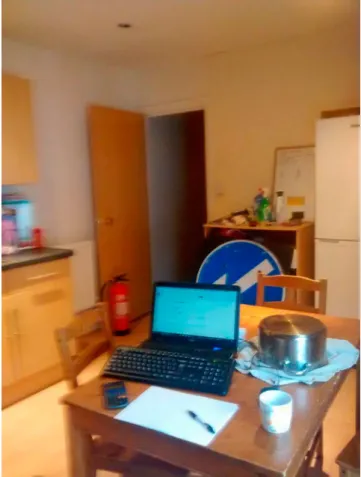
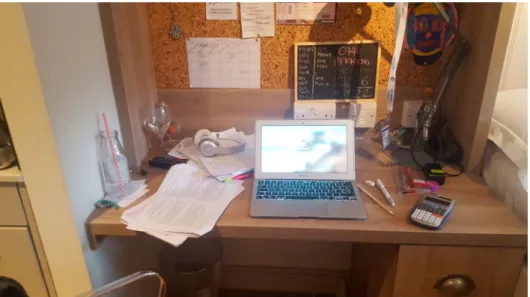
2012b) – temporally, spatially, and relationally – whereby there is a meshing of physical and virtual spaces mediated by a range of actors. For example, the same lecture capture artefact has the potential to extend into different physical environments, such as libraries, cafés, and bedrooms (Vignette 2), whereby each and every playback of the session will offer a unique sociomaterial con-struction. However, despite the notions of fluidly and mobility described in Vignette 2, all of the student-produced screen recordings collected in this study took place within the home environments of the participants (Figures 8and9). Vignette 3 points to pre-constructed study routines, whereby the participant has negotiated study practices within the spatiality of familiar environments.
That was my bedroom as I’ve got a shared student house. I could go in the living room I suppose but people come and go through there. So, no. I do all my study in the house in my room at my desk. (Vignette 3; Student partici-pant 2)
Despite the notions of“anytime, anywhere”access associated with lecture recording (Morris et al.,
2019), this study reveals that students may be markedly sensitive to location and their study assem-blages require careful attention, crafting and arrangement (Gourlay & Oliver,2018). Extending this, as Thompson (2012b) observes, despite the promise of the mobility of learning technologies, to learn efficiently some stability and predictability is required. For example, assembling the study practices associated with reviewing a recorded lecture required reliable connectivity to the Internet, and ample room to amass and organise physical actants (e.g. textbooks, note-books, pens, calculators, rulers, worksheets).
To advance perspectives and gain nuanced perspectives into how these actors (dis)connect and mediate the study practices of students, across different environments, a sociomaterial examination of the workings of the lecture capture artefact is now offered.
Fluidity and the pause/play actor-network
The student participants engaged in blended learning practices, negotiating multi-spatial environ-ments, whereby the affordance of multitasking andfluid switching between contrasting actor-appli-cations was a significant activity. The playback of the lecture recordings took place within the multifunctional spatiality of the computer screen (Decuypere & Simons,2016b), which competed for positioning amongst various other actors, such as websites, the VLE, electronic documents, soft-ware applications, web browsers, anti-virus softsoft-ware, and media players. Moreover, any of these actors carried the potential to interrupt learning activities at any given time, for example via an update request or service notification.
Analysis of the student-produced videos revealed that the practice of pausing and resuming the lecture recording in order to carry out specific tasks, such as note-taking or visiting webpages, was frequency used by all participants. When the lecture recording is first opened the synchronised audio/video begins playing automatically and the“pause”icon is displayed within the navigation panel. Upon interaction and clicking of the“pause” icon, the state of the button changes to that of a“play”symbol (Figure 10). The play/pause button communicates through digital codes, co-ordi-nating actions with other actors. When paused, the video source and the screen capture freeze in place. The progress bar and the timestamp code halt. The audio of the capture stops transmitting
Figure 9.Photograph of study environment, provided by student participant 3.
via the computer speakers. Similar to Thompson’s (2012a) observations concerning the keyboard
“delete”button, it can thus be seen that the pause/play button enrols other actants in performing specific functions. It is an assemblage and a complex arrangement of hardware, software, commands, semiotic signs, networks, and codes working discreetly when activated.
Exploring the ubiquitous use of semiotic devices, such as graphical symbols and icons to represent multimedia controls, suggests that the play/pause button can also be considered an immutable mobile. A triangle to represent“play”and parallel lines for“pause”can be viewed as“contemporary signage”(Gall & Breeze,2005, p. 421), whereby they have become standardised icons by the Inter-national Organization for Standardization (ISO) and the InterInter-national Electrotechnical Commission (IEC). Their use can commonly be found on physical devices and application software, such as web-based media players, DVD/Blu-ray players, remote controls, multimedia keyboards, and software interfaces. It is reported that the symbols date back to the 1960s and were used as tape transport symbols on reel-to-reel tape decks (Gardiner,2010). In this actor-network, the play icon was originally designed to represent the direction that the tape would move, via the orientation of the arrow. ANT perspectives illustrate how these icons have become stabilised and predictable black boxes (Callon,
1986), yet are highly mobile, able to detach themselves from their origins. The icons have become so entrenched in many heterogeneous networks that they have become an accepted standard in repre-senting and enacting a specific action–that of“playing”or“pausing” –which is instrumental in pro-ducing networked relational effects.
Analysis of the student-produced videos revealed that each participant interacted and clicked on the play/pause icon a total of 15 times on average. In doing so, the practice of pausing the lecture capture afforded learners the opportunity to interact with digital actants (e.g. web browser tabs, VLE areas, online past examination papers, online search engines, websites) and physical instruments (e.g. handouts, notebooks, pens, rulers). The actor-network of the play/pause button functioned as a
“valve”(Thompson,2012a, p. 101) to mediate between a person, online/offline spaces, and study practices. Moreover, the play/pause button functioned to “presence” and“absence” other actors (Law & Singleton,2005) and in doing so“configures spaces for pedagogic purposes”(Thompson,
2012a, p. 101). The material practices afforded by the play/pause button shaped interactions with the lecture capture, and enacted online and offline learning practices in particular ways. Such prac-tices would fall apart if the button itself was absent and students were unable to pause/resume recordings.
The assemblage of the pause/play button also acted as a barrier against information overload, whereby the use of the pause button was instrumental in helping to consolidate new knowledge:
I’ll start watching. If someone comes in and starts cooking, you can’t hear it, so you’ll just stop. Take a break, and then you start again. Which is probably for the best because watching for a whole hour isn’t the best way of doing it. You turn offpart the way through and yeah you just get bored. Whereas doing smaller sections, you actually know what’s going on. Which is why, in the actual lectures, I don’t particularly like them, and why I don’t try and do anything otherwise you get overloaded and lose track. (Vignette 4; Student participant 1)
Such perspectives point towards studying practices which are in a constant state of negotiation, between conflicting actor-networks as well as network effects such as boredom. As discussed, the play/pause button was instrumental in forming “assemblages of relations” (Law, 2012, p. 157),
Figure 10.Lecture recording navigation bar. Top row displays the play icon (depicting pause state of recording). Bottom row dis-plays the pause icon (depicting play state of recording). Reproduced with permission of the publisher, © Panopto.
(dis)connecting other actants through oscillations between absence and presence, affording each student to assemble learning practices differently. All three students had multiple web browser tabs and applications open whilst playing the lecture capture artefact. The pause/play button allowedfluid movement between the spatiality of the screen and across applications, which deliv-ered multiple performances in this study, not all of which can be viewed as harmonious with study practices. For example, the use of the pause button afforded one student the ability to switch between the lecture capture and a social networking site, where they engaged in an informal group conversation. For another learner, the pause button allowed them to check an incoming message on a mobile phone. Therefore, within these sociomaterial study practices it can be seen that the pause button served conflicting qualities. It brought to presence worthy and credible actants for studying (e.g. pens, notepads, handouts, relevant webpages, past examination papers), but also mobilised actors capable of disrupting network activity (e.g. mobile phones, social media sites, music players).
The following quote illustrates how one student navigated, negotiated, and disconnected from various actor-networks that encircled them, in an attempt to assemble sociomaterial networks most conducive for learning:
I’m quite easily distracted by FaceBook or Whatsapp [social networking platforms]. If a message comes through or something, then there’s a little notification comes on your computer. Ifind that very distracting, so I know I turn them all off. And the same as on my telephone. They are turned offas well. So, I have to decide I am going to look at this now instead of those apps or things grabbing my attention. (Vignette 5; Student participant 1)
However, it should be noted, whilst cognitions and reasoning provided by the participants can be captured, analysed and interpreted, neither mentalist nor materialist reasons account for human actions; they are hybrids of both (Latour, 1986). ANT reminds us that human accounts of actions are influenced by complex domains, grounded in the cognitions of the person, for example beliefs, values and assumptions, as well as directly emergent from the physical world in which they interact.
Discussion
This paper reports on how students use recorded lectures in authentic scenarios. It is reported that students use recorded lectures to serve different purposes (Nordmann & McGeorge,2018), and this study reveals that reviewing recordings for exam preparation was supported and supplemented by various other sociomaterial practices, distributed widely across space and time. Importantly, the observed study practices materialised within emergent connections and partially through the ad-hoc use of available artefacts, such as external websites, VLE documents, past examination papers, and handouts. Moreover, the sociomaterial agency of the lecture capture artefact per-mitted unpredictable interactions whereby students seamlessly transitioned between spaces, such as social networking platforms, mobile phones, and online media players. Recent literature suggests that learners struggle to multitask effectively and learners task switch which negatively impacts learning (Kirschner & De Bruyckere,2017). The nuanced insights provided by ANT sensi-tivities in this study can illuminate the complex, messy, and dynamic situations that produce con-ditions which are more or less supportive for learning. Such perspectives also suggest entangled learning states whereby bifurcations between formal and informal learning are weakened (Kumpu-lainen & Sefton-Green, 2012; Zürcher, 2015). These are important insights; educationists, technol-ogies, and environments should pursue ways of attending to this complexity (Goodyear & Carvalho,2013).
Conceiving practices as enacted through sociomaterial relations commands attention to how space and time are (re)configured (McGregor,2004; Murdoch, 1998). The use of the pause button enacts time as a persistent switching between different activities. Spatially, these different perform-ances enact space as being something multifunctional, accessible via the use of the pause/play actant. Middleton (2016) positions audio recordings asflexible learning spaces, capable of connecting
academics and students beyond formal study spaces. Similarly, the lecture capture artefact can be seen as a rich, multimodal learning space, connecting various actors, unconstrained by time or place. Moreover, as an immutable mobile the lecture capture recording can extend the spatiality of the original lecture event into new locations, and help assemble and translate new actor-network configurations. In doing so, it is postulated that space and time are folded and (re)configured in the practice of lecture recording, forming the sociomaterial construction of the “hybrid” edu-cational actor (Perrotta, Czerniewicz, & Beetham, 2016), held together by innocuous but powerful actors such as the play/pause button. Furthermore, the temporal dimensions of the lecturer can be significantly altered by capture technologies, whereby their voice and actions can be paused, replayed, stopped, and even accelerated. As such, ANT demonstrates that we cannot assume that the same network effects of knowledge distribution and pedagogy are translated verbatim during the process of lecture recording and subsequent reviewing by students. As Fenwick and Edwards (2010) argue,“pedagogical encounters change radically when its things change”(p. 5). These insights have important implications for how teaching and learning is conceived, and reveals the intricacies encircling lecture recording.
Exploring the compositional aspects of multimedia learning objects, as mediators for connecting and enacting sociomaterial learning practices beyond the environment of the actual object, has important implications for how future interactive objects and learning environments are designed. Importantly, this shifts perspectives away from considering learning technologies as being isolated from authentic and emergent practices, whereby attention is focused solely on presentational design or “affordances” of an artefact or environment (Wright & Parchoma,2011). Rather, focus should be directed to understanding learning technologies through the“emergent design of tech-nology-in-use” (Johri,2011, p. 212) and studied holistically as an “embedded practice”(Sørensen,
2009, p. 79). Moreover, ANT positions learning as a network effect of materialising assemblages, and not only a cognitive achievement or way of interacting, whereby teaching and learning “do not exist and cannot be identified as separate from the networks through which they are enacted”(Fenwick & Edwards,2010, p. 41).
Problematically, ANT does not offer a coherent framework and ANT-informed research is often messy and heterogeneous (Fenwick & Edwards,2019). ANT is highly contested (e.g. Jones,2016) but it is argued that the radical perspectives offered by ANT allow educationalists to appreciate the complexity of educational institutions and the active role of technology in this context (Hannon, 2012). If used practically, with a study focus, ANT can provide innovative analytical approaches into evaluating learning designs and a vocabulary for interpretations which helps dis-lodge pre-existing notions and thoughts. Indeed, ANT is perhaps best seen as a playful,“adaptable, open repository”(Mol, 2010, p. 253). Embracing this“open repository”philosophy, this study has deployed sensitivities offered from the domain of multimodality to explore theperformativequalities of modes (Barad,2003). In doing so, coupling ANT with multimodal analysis licenses researcher sen-sitivity towards viewing heterogeneousmodesasactors. Adopting multimodal analysis may provide practical insights into how often overlooked modes of a text, such as icons, layout and framing (Kress,
2014), may become actors within an assemblage.
Conclusion
Ethnographically informed, this ANT study focused on local, narrative construction and sought to write descriptions of how networks come together and stabilise or fall apart, rather than create con-crete interpretations of why (Latour,2005). Producing visualisations provided valuable visual insights into the distributed areas of lecture capture practice and offered opportunities for scrutinising how practices are enacted, and the types of spaces produced. This paper has argued that technologies, such as lecture capture, are not produced in a vacuum, and space and time are entangled in complex ways throughout the production, distribution, and reviewing of recordings (Gourlay & Oliver,2018).
In examining the student-led study practices, multitasking and task switching between contrast-ing actor-networks and spaces was a significant activity. Exploring an innocuous and ubiquitous prac-tice, such as pausing, affords nuanced perspectives into the sociomaterial entanglements involved in enacting online pedagogy and learning across spatiotemporal dimensions (McGregor, 2004; Murdoch,1998).
Moreover, adopting multimodal sensitivities, reveals how often overlooked modes (Kress,2014), such as iconography, can become actors within an assemblage. Coupling ANT with multimodal sen-sitivities has uncovered how a pervasive everyday practice, such as pausing, can profoundly shape interactions and produce enactments of learning across different environments. Combining ANT with multimodality is little explored in ANT literature, and this may offer new insights into how modes help produce or stabilise configurations and advance efforts in attending to the non-human within actor-networks (Thompson & Adams,2013).
This paper offers insights from a specific STEM undergraduate programme, at a UK Russell Group University, which is highly regulated by course attendance to lectures and course examinations. These actants had a profound mediating effect on the foci of this study. Although the findings may not be generalisable across academia, future studies could build upon the innovative approaches reported to undertake similar sociomaterial research across other disciplines and dis-courses offering lecture capture. Whilst this study embraces the specificity of case study research, it would be particularly interesting to redeploy this novel methodology in other contexts, though any potential reuse of such methods will inevitably involve tracing different networks. Specifically, it would be of interest to investigate results from larger sample sizes of learners, across multiple dis-ciplines, and explore the effects of different assessments and lecture content (e.g. didactic material based on information/theories or participatory/discussion based) on networked learning practices.
Disclosure statement
No potential conflict of interest was reported by the author.
Notes on contributor
Karl Lukeis a lecturer in Medical Education at CardiffUniversity. Prior to this position, Karl was responsible for the man-agement and provision of the lecture capture service at the University. Karl was involved in designing, developing and implementing strategies to support both staffand students in using video capture technologies effectively for teaching and learning. Karl has also worked as a Learning Technologist at the University and has over 14 years’experience of designing for teaching and learning in a digital age. Karl’s research interests include the use of video in higher education, multimodality and sociomateriality.
ORCID
Karl Luke http://orcid.org/0000-0002-7765-6126
References
Barad, K. (2003). Posthumanist performativity: Toward an understanding of how matter comes to matter.Signs: Journal of Women in Culture and Society,28(3), 801–831.
Bhatt, I., & de Roock, R. (2014). Capturing the sociomateriality of digital literacy events.Research in Learning Technology,21
(4).https://doi.org/10.3402/rlt.v21.21281
Braun, V., & Clarke, V. (2006). Using thematic analysis in psychology.Qualitative Research in Psychology,3(2), 77–101. Brughmans, T. (2010). Connecting the dots: Towards archaeological network analysis.Oxford Journal of Archaeology,29
(3), 277–303.
Callon, M. (1986). Some elements of a sociology of translation: Domestication of the scallops and thefishermen of St Brieuc Bay. In J. Law (Ed.),Power, action and belief: A new sociology of knowledge?(pp. 196–223). London: Routledge. Callon, M. (1991). Techno-economic networks and irreversibility. In J. Law (Ed.),A sociology of monsters: Essays on power,
technology and domination(pp. 132–161). New York, NY: Routledge.
Coleman, S., & von Hellermann, P. (Eds.). (2011).Multi-sited ethnography: Problems and possibilities in the translocation of research methods. Oxon: Routledge.
Cressman, D. (2009).A brief overview of actor-network theory: Punctualization, heterogeneous engineering & translation. Burnaby: Centre for Policy Research on Science and Technology, Simon Fraser University.
Decuypere, M., & Simons, M. (2014). An atlas of academic practice in digital times.Open Review of Educational Research,1
(1), 116–143.
Decuypere, M., & Simons, M. (2016a). Relational thinking in education: Topology, sociomaterial studies, andfigures.
Pedagogy, Culture & Society,24(3), 371–386.
Decuypere, M., & Simons, M. (2016b). What screens do: The role(s) of the screen in academic work.European Educational Research Journal,15(1), 132–151.
Elliott, C., & Neal, D. (2016). Evaluating the use of lecture capture using a revealed preference approach.Active Learning in Higher Education,17(2), 153–167.
Farrell, L., & Holkner, B. (2004). Points of vulnerability and presence: Knowing and learning in globally networked com-munities.Discourse: Studies in the Cultural Politics of Education,25(2), 133–144.
Fenwick, T., & Edwards, R. (2010).Actor-network theory in education. Oxon: Routledge.
Fenwick, T., & Edwards, R. (Eds.). (2019).Revisiting actor-network theory in education. Abingdon: Routledge.
Gall, M., & Breeze, N. (2005). Music composition lessons: The multimodal affordances of technology.Educational Review,
57(4), 415–433.
Gardiner, B. (2010, August 16). The secret histories of those @#$%ing computer symbols. Retrieved fromhttp://gizmodo. com/5612630/the-secret-histories-of-those-ing-computer-symbols
Geisler, C., & Slattery, S. (2007). Capturing the activity of digital writing: Using, analyzing, and supplementing video screen capture. In H. A. McKee & D. N. DeVoss (Eds.),Digital writing research: Technologies, methodologies, and ethical issues
(pp. 185–200). Cresskill, NJ: Hampton Press.
Goodyear, P., & Carvalho, L. (2013). The analysis of complex learning environments. In H. Beetham & R. Sharpe (Eds.),
Rethinking pedagogy for a digital age: Designing for 21st century learning(2nd ed., pp. 49–63). Oxon: Routledge. Gourlay, L., & Oliver, M. (2018).Student Engagement in the digital university: Sociomaterial assemblages. Oxon: Routledge. Hannon, J. (2012, April). The objects of e-learning: Rethinking implementation, or not learning from the history of tech-nology. In V. Hodgson, C. Jones, M. de Laat, D. McConnell, T. Ryberg, & P. Sloep (Eds.),NLC 2012. Proceedings of the eighth international conference on networked learning 2012 (pp. 111–119). Maastricht, Netherlands: Maastricht School of Management.
Jewitt, C. (2014). Different approaches to multimodality. In C. Jewitt (Ed.),The Routledge handbook of multimodal analysis
(2nd ed., pp. 31–43). London: Routledge.
Johri, A. (2011). The socio-materiality of learning practices and implications for thefield of learning technology.Research in Learning Technology,19(3), 207–217.
Jones, C. (2016, May). Experience and networked learning. In S. Cranmer, M. de Laat, T. Ryberg, & J. A. Sime (Eds.),NLC 2016. Proceedings of the 10th international conference on networked learning 2016 (pp. 481–488). Lancaster: Lancaster University.
Karnad, A. (2013).Student use of recorded lectures: A report reviewing recent research into the use of lecture capture tech-nology in higher education, and its impact on teaching methods and attendance. London: London School of Economics and Political Science. Retrieved fromhttp://eprints.lse.ac.uk/50929/1/Karnad_Student_use_recorded_2013_author. pdf
Kirschner, P. A., & De Bruyckere, P. (2017). The myths of the digital native and the multitasker.Teaching and Teacher Education,67, 135–142.
Knox, H., Savage, M., & Harvey, P. (2006). Social networks and the study of relations: Networks as method, metaphor and form.Economy and Society,35(1), 113–140.
Kress, G. (2014). What is mode? In C. Jewitt (Ed.),The Routledge handbook of multimodal analysis(2nd ed., pp. 60–75). London: Routledge.
Kumpulainen, K., & Sefton-Green, J. (2012). What is connected learning and how to research it?International Journal of Learning and Media,4(2), 7–18.
Latour, B. (1986). Visualization and cognition: Thinking with eyes and hands. Knowledge and Society: Studies in the Sociology of Culture Past and Present,6, 1–40.
Latour, B. (1992). Where are the missing masses? The sociology of a few mundane artifacts. In W. E. Bijker & J. Law (Eds.),
Shaping technology/building society: Studies in sociotechnical change(pp. 225–258). Cambridge, MA: The MIT Press. Latour, B. (2005).Reassembling the social: An introduction to actor network theory. Oxford: Oxford University Press. Latour, B., Jensen, P., Venturini, T., Grauwin, S., & Boullier, D. (2012).‘The whole is always smaller than its parts’: A digital
test of Gabriel Tarde’s monads.The British Journal of Sociology,63(4), 590–615.
Law, J. (2009). Actor network theory and material semiotics. In B. S. Turner (Ed.),The new Blackwell companion to social theory(pp. 141–158). Oxford: Blackwell Publishing.
Law, J. (2012). Collateral realities. In F. D. Rubio & P. Baert (Eds.),The politics of knowledge(pp. 156–178). London: Routledge.
MacLeod, A., Cameron, P., Ajjawi, R., Kits, O., & Tummons, J. (2019). Actor-network theory and ethnography: Sociomaterial approaches to researching medical education.Perspectives on Medical Education,8(3), 177–186.
McGregor, J. (2004). Spatiality and the place of the material in schools.Pedagogy, Culture & Society,12(3), 347–372. Middleton, A. (2016). Reconsidering the role of recorded audio as a rich,flexible and engaging learning space.Research in
Learning Technology,24(1), 1–13.
Mol, A. (2010). Actor-network theory: Sensitive terms and enduring tensions. Kölner Zeitschrift für Soziologie und Sozialpsychologie. Sonderheft,50(1), 253–269.
Morris, N. P., Swinnerton, B., & Coop, T. (2019). Lecture recordings to support learning: A contested space between stu-dents and teachers.Computers & Education,140, 103604.
Murdoch, J. (1998). The spaces of actor-network theory.Geoforum; Journal of Physical, Human, and Regional Geosciences,
29(4), 357–374.
Nespor, J. (1994). Knowledge in motion: Space, time and curriculum in undergraduate physics and management. Philadelphia, PA: Falmer Press.
Nespor, J. (2003). Undergraduate curricular as networks and trajectories. In R. Edwards & R. Usher (Eds.),Space, curriculum, and learning(pp. 93–122). Greenwich, MA: Information Age Publishing.
Newton, G., Tucker, T., Dawson, J., & Currie, E. (2014). Use of lecture capture in higher education–Lessons from the trenches.TechTrends,58(2), 32–45.
Nimmo, R. (2011). Actor-network theory and methodology: Social research in a more-than-human world.Methodological Innovations Online,6(3), 108–119.
Nordmann, E., Kuepper-Tetzel, C., Robson, L., Phillipson, S., Lipan, G., & Mcgeorge, P. (2018).Lecture capture: Practical rec-ommendations for students and lecturers. Retrieved fromhttps://doi.org/10.31234/osf.io/sd7u4
Nordmann, E., & McGeorge, P. (2018).Lecture capture in higher education: Time to learn from the learners. Retrieved from
https://doi.org/10.31234/osf.io/ux29v
O’Keeffe, C. (2016). Producing data through e-assessment: A trace ethnographic investigation into e-assessment events.
European Educational Research Journal,15(1), 99–116.
Perrotta, C., Czerniewicz, L., & Beetham, H. (2016). The rise of the video-recorder teacher: The sociomaterial construction of an educational actor.British Journal of Sociology of Education,37(8), 1251–1267.
Sørensen, E. (2009).Materiality of learning, technology and knowledge in educational practice. New York: Cambridge University Press.
Thompson, T. L. (2012a). I’m deleting as fast as I can: Negotiating learning practices in cyberspace.Pedagogy, Culture & Society,20(1), 93–112.
Thompson, T. L. (2012b). (Re/dis) assembling learning practices online withfluid objects and spaces.Studies in Continuing Education,34(3), 251–266.
Thompson, T. L., & Adams, C. (2013). Speaking with things: Encoded researchers, social data, and other posthuman con-coctions.Distinktion: Journal of Social Theory,14(3), 342–361.
Wahyuni, D. (2012). The research design maze: Understanding paradigms, cases, methods and methodologies.Journal of Applied Management Accounting Research,10(1), 69–80.
Walker, R., Voce, J., Jenkins, M., Barrand, M., Hollinshead, L., Craik, A.,…Brown, V. (2018).2018 survey of technology enhanced learning for higher education in the UK. Oxford: Universities and Colleges Information Systems Association. Retrieved fromhttps://www.ucisa.ac.uk/publications/tel_2018
Witthaus, G. R., & Robinson, C. L. (2015).Lecture capture literature review: A review of the literature from 2012–2015. Loughborough: Centre for Academic Practice, Loughborough University.
Wright, S., & Parchoma, G. (2011). Technologies for learning? An actor-network theory critique of‘affordances’in research on mobile learning.Research in Learning Technology,19(3), 247–258.
Zürcher, R. (2015). A sociomaterial model of the teaching-learning continuum.European Journal for Research on the Education and Learning of Adults,6(1), 73–90.