Does Herding Behavior Reveal Skill?
An Analysis of Mutual fund Performance
HAO JIANG and MICHELA VERARDO
ABSTRACT
We uncover a negative relation between herding behavior and skill in the mutual fund industry. Our new, dynamic measure of fund-level herding captures the tendency of fund managers to follow the trades of the institutional crowd. We …nd that herding funds underperform their an-tiherding peers by over 2% per year. Di¤erences in skill drive this performance gap: anan-tiherding funds make superior investment decisions even on stocks not heavily traded by institutions, and can anticipate the trades of the crowd; furthermore, the herding-antiherding performance gap is persistent, wider when skill is more valuable, and larger among managers with stronger career concerns.
Keywords: Herding, mutual funds, performance, ability, imitation, alpha. J.E.L. codes: G11, G20, G23.
Hao Jiang is at Michigan State University. Michela Verardo is at the London School of Economics. Corresponding author: Michela Verardo ([email protected]). We thank two anonymous referees, an anonymous Associate Editor, and the Editor, Kenneth Singleton, for many insightful comments and suggestions. We are grateful for comments from Amil Dasgupta, Dong Lou, Christopher Polk, ×ukasz Pomorski, René Stulz, Sheridan Titman, Dimitri Vayanos, Paul Woolley, and Kathy Yuan, as well as from conference participants at the 2011 IDC Summer Conference, 2012 WFA, and 2015 CFA UK Society and seminar participants at the Universities of Aarhus, Amsterdam, Arizona, BI Oslo, Cattolica Milan, Cologne, Drexel, Erasmus Rotterdam, ESSEC, IESE Barcelona, Kent, London School of Economics, Lugano, Mannheim, Michigan State, Nottingham, Reading, and Vienna. Verardo gratefully acknowledges …nancial support from the Paul Woolley Centre at the London School of Economics. The authors have no con‡icts of interest to disclose.
Theories of herding behavior predict that people tend to “follow the crowd”for a variety of reasons, for instance, to appear as talented as others or to learn from others.1 One important yet under-explored feature of these models is the idea that less skilled individuals may herd on the decisions of their predecessors, while those with superior ability may be more likely to deviate from past actions— to the point of exhibiting antiherding behavior. Despite the rich implications of this intuition, however, there is little empirical evidence on the relationship between skill and the tendency to follow the crowd.
In this paper we investigate the link between herding behavior and skill in the context of the mutual fund industry, which is an ideal setting to study the relation between herding and skill for two reasons. First, ample evidence shows that mutual funds and other institutional investors tend to herd in their buying and selling decisions.2 Second, an extensive empirical literature on mutual fund performance analyzes the returns and investment decisions of mutual fund managers in an attempt to measure unobservable skill.3
To address the question of whether investors can identify skilled and unskilled mutual fund managers by observing their tendency to herd, we create a dynamic measure of fund-level herding that captures the tendency of a fund manager to imitate the trading decisions of the institutional crowd. We then test whether di¤erences in herding behavior across funds predict mutual fund performance and whether skill drives the link between herding and future performance.
In line with the theoretical literature, our measure of fund herding is based on the intertemporal correlation between the trades of a given fund and the collective trading decisions that institutional investors have made in the past.4 Each quarter we estimate the relation between a fund’s trades
and past institutional trades. We then average this relation over previous periods in the life of the fund to obtain a measure of herding tendency. We control for a stock’s market capitalization, book-to-market ratio, and past returns to account for potential correlated trading induced by common investing styles. After …ltering out these common information components, our measure of herding captures a fund’s tendency to imitate the past trading decisions of the crowd.
Our estimates of fund herding reveal a large degree of heterogeneity in herding behavior, with some funds exhibiting a tendency to follow the crowd while others show a propensity to trade in the opposite direction. These di¤erences in fund herding have strong predictive power for the cross-section of mutual fund returns. The top-decile portfolio of herding funds underperforms the bottom-decile portfolio of antiherding funds by 2.28% on an annualized basis, both before and after
expenses. We obtain similar results when we account for exposures to factors such as the market risk premium, size, value, momentum, and liquidity: the alphas from di¤erent multi-factor models vary between 1.68% and 2.52% on an annualized basis. Accounting for time-varying factor exposures yields a predicted performance gap of 2.04% per year. In multivariate predictive regressions, fund herding can predict four-factor alphas after controlling for fund size, age, turnover, expense ratios, net ‡ows, and past performance. Furthermore, fund herding remains a strong predictor of mutual fund performance when we control for determinants of herding behavior that have been shown to predict mutual fund performance.5 Taken together, our results strongly support the view that herding behavior captures unobservable skill.
How do di¤erences in skill lead to di¤erences in herding behavior? Theoretical models of sequen-tial decision-making suggest that di¤erences in ability or information quality can drive di¤erences in herding tendencies. For example, reputational herding models predict that while managers tend to follow their predecessors to enhance the market’s perception of their ability, managers with supe-rior ability might choose to antiherd, “going against market trends”(Avery and Chevalier (1999)). Models of sequential information acquisition predict that earlier-informed investors anticipate the actions of later-informed investors and hence can pro…t by reversing their positions, thus exhibiting antiherding behavior (Hirshleifer, Subrahmanyam, and Titman (1994)). Models of informational cascades predict that while agents tend to disregard their information signals to follow the crowd, higher-precision individuals are more likely to use their information (Bikhchandani, Hirshleifer, and Welch (1992)).6
We conduct a number of tests to deepen our understanding of the link between heterogeneity in herding behavior and skill. First, we test whether antiherding funds consistently make better investment decisions than herding funds, irrespective of the decisions of the institutional crowd. Speci…cally, we analyze the performance of mutual funds’investment choices for the subset of stocks that are not heavily traded by institutions. The results show that stocks that constitute large bets by antiherding funds outperform stocks held mostly by herding funds: the di¤erence in returns is large and signi…cant, with an average Carhart alpha of 38 bps per month. Antiherding funds therefore make better investment decisions than their herding peers, even on stocks that are not subject to potential price pressure caused by institutional herds.
Second, we examine time-series variation in the performance gap between herding and antiherd-ing funds. If di¤erences in skill drive di¤erences in herdantiherd-ing behavior, we should observe a widenantiherd-ing
of the performance gap in times of greater investment opportunities in the mutual fund industry, which skilled funds would be better able to exploit. Using stock return dispersion, average idio-syncratic volatility, and investor sentiment to capture time-varying investment opportunities, we …nd that the performance gap between herding and antiherding funds is indeed signi…cantly larger during and after periods in which opportunities for active managers are more valuable.
Third, we show that the performance gap between herding and antiherding funds is persistent, with return di¤erentials that are large and signi…cant over horizons of up to two years after the measurement of fund herding. This result suggests that the link between herding behavior and future performance is not due to chance.
Fourth, we consider a sequential information acquisition framework in which earlier-informed investors trade ahead of others and subsequently pro…t by unwinding their positions, thereby ex-hibiting antiherding behavior (Froot, Scharfstein, and Stein (1992), Hirshleifer, Subrahmanyam, and Titman (1994)). In this setting, earlier-informed investors are able to anticipate the trades of later-informed investors. We show that the trades of antiherding funds can predict the trades of the institutional crowd, suggesting that their outperformance is related to superior ability and informational advantages.
Inspired by the theoretical literature on reputational herding, we next study how skill interacts with career concerns to shape the response of mutual fund managers to reputational incentives. We build on previous work on career concerns in the mutual fund industry (Chevalier and Ellison (1999)) and argue that imitating the crowd can represent a rational response to career concerns. We …rst show that inexperienced managers face higher probabilities of termination and herding can reduce inexperienced managers’greater likelihood of termination. When we introduce skill in our analysis, we …nd that, as predicted, the negative relation between herding behavior and future performance is stronger for inexperienced managers. This result suggests that, among career-concerned managers, a strong herding tendency reveals lack of skill, whereas antiherding might signal superior ability in the absence of a su¢ ciently long performance record.
We conclude our empirical analysis by conducting a series of tests to assess the robustness of the predictive ability of fund herding for mutual fund performance. We start by showing that our results are not sensitive to the empirical methodology used to estimate fund herding; they continue to hold if we estimate the trade regression after …ltering out not only investment styles such as size, value, and momentum, but also a large set of stock characteristics such as liquidity, idiosyncratic volatility,
net issuance, industry membership, and revisions in analyst earnings forecasts. We also show that the fund ‡ows channel does not drive our …ndings, as our predictive regressions of performance include a control for fund ‡ows,7 and we estimate fund herding after controlling for a fund’s own past trades, which accounts for trade persistence induced by persistent capital ‡ows. Finally, we show that our results are not sensitive to how we measure fund performance: in particular, the results continue to hold when we use performance measures based on funds’holdings or trades.
Our analysis brings together and extends two large bodies of empirical work that thus far have evolved separately. First, we contribute to the literature on mutual fund performance, which seeks to address the challenge of identifying skilled managers in the cross-section of mutual funds. Recent studies in this literature construct new measures of skill based on funds’holdings and trades in an attempt to …nd reliable predictors of mutual fund returns. Our evidence on the predictability of mutual fund performance uncovers the role of herding behavior as a powerful tool to capture the distribution of skill among mutual fund managers.
Second, we contribute to the empirical literature on herding behavior. First, we introduce a dynamic measure of fund-level herding behavior and relate it to managerial skill in the mutual fund industry. Previous studies estimate institutional herding using stock-level measures of the clustering of trades in a given period, with a focus on their impact on stock prices.8 In contrast,
our measure of fund herding enables us to investigate the dynamic link between imitative behavior and skill while controlling for fund characteristics and …ltering out common information signals, common preferences, and common investment styles. Second, we shed new light on the dynamics of herding behavior over a manager’s career cycle. Chevalier and Ellison (1999) show that younger mutual fund managers are less likely to make investment decisions that deviate from their peers. We extend this analysis by using our dynamic measure of imitation and analyzing its interaction with managerial ability. We show that di¤erences in herding behavior reveal di¤erences in skill for less experienced managers, who cannot rely on a long performance record to signal their ability. Our results represent an important step toward understanding how incentives shape managerial behavior in the presence of cross-sectional dispersion in skill.
The remainder of this paper is structured as follows. Section I describes the construction of our measure of fund-level herding. Section II presents our main results on the ability of fund herding to predict mutual fund performance. Section III presents tests that identify skill as the driver of the link between fund herding and future performance. Section IV investigates the relation
between skill and herding in the presence of reputational concerns. Section V provides results of several robustness tests using alternative estimates of fund herding and fund performance. Section VI presents evidence on whether investors respond to the information contained in fund herding. Section VII concludes the paper.
I.
Fund Herding
In this section we begin by describing the data. We then describe the estimation of our measure of fund herding, namely the tendency of mutual funds to follow past institutional trades.
A. Data
Our sample consists of all actively managed U.S. equity funds from 1990 to 2009. Data on monthly fund returns and other fund characteristics come from the CRSP Mutual Fund database, and data on fund stock holdings come from the Thomson Reuters Mutual Fund Holdings data-base. As we wish to capture active mutual funds that invest primarily in U.S. equities, we …rst exclude index funds from our sample. We then follow Kacperczyk, Sialm, and Zheng (2008) and eliminate balanced, bond, money market, sector, and international funds, as well as funds that do not primarily invest in US common equity.9 To address the incubation bias documented by Elton, Gruber, and Blake (2001) and Evans (2010), we further exclude observations prior to the reported fund inception date, and funds whose net assets fall below $5 million. We also require that funds have at least 10 stock holdings to be eligible for consideration in our analysis. This process leaves us with 2,255 distinct mutual funds.
To compute aggregate institutional trades, we use data from Thomson Reuters Institutional Holdings database, which collects institutional investors’13F …lings.10 Finally, we obtain stock price
and return data from the CRSP monthly stock …les and accounting information from Compustat. Panel A of Table I reports descriptive statistics for our pooled sample of 56,116 fund-quarters. The characteristics include fund size (total net assets under management, in millions of dollars), fund age (in years), fund turnover, expense ratio, quarterly net ‡ows (computed as the growth rate of assets under management after adjusting for the appreciation of the fund’s assets), and quarterly net fund returns. An average fund in our sample manages 1.6 billion dollars of assets, is 17 years old, has an annual expense ratio of 1.27%, and has an annual turnover ratio of 85%. The average
fund achieves an average net return of 1.55% per quarter and attracts 1.32% net money ‡ow. These numbers are in line with those typically reported in the mutual fund literature.
[Insert Table I about here]
B. Fund Herding Measure
We de…ne fund herding as the tendency of a mutual fund to imitate past actions of the institu-tional crowd. Theoretical models of herding behavior analyze the incentives and choices of agents who decide whether to follow the crowd after looking at the decisionspreviously made by other agents (Scharfstein and Stein (1990), Banerjee (1992), Bikhchandani et al. (1992)). This dynamic imitative behavior implies an intertemporal correlation between the action of an agent and the previous actions of the crowd. In line with this idea of sequential decision-making, our measure of herding captures dynamic imitation of past actions. The empirical literature on herding has not su¢ ciently emphasized the inherently dynamic nature of imitative behavior. The most commonly used measure of institutional herding, introduced by Lakonishok, Shleifer, and Vishny (1992, LSV), is based on the proportion of funds that buy the same stock in the same quarter. However, this measure is not ideal for capturing a fund’s tendency to imitate the crowd, for two main reasons. First, it is constructed at the stock level, and thus is a stock characteristic rather than a fund characteristic. Second, it describes the clustering of mutual funds’ trades in a given stock at a given point in time rather than a dynamic tendency to follow the decisions of the crowd.11
With our new approach, we focus on developing a measure that is more closely related to the theoretical concept of herding. Our measure has two novel characteristics: (i) it is estimated at the fund level, and (ii) it captures the dynamic link between the decisions of a fund and the decisions made by the crowd in the past. To capture the actions of a fund, we use its trades, and to represent the crowd in a comprehensive way, we use the set of all institutional investors. Speci…cally, for each fund j and quarter t, we run a cross-sectional regression of fund trades on past aggregate institutional trades:
T radei;j;t= j;t+ j;t IOi;t 1+ 1j;tM omi;t 1+ 2j;tM Ci;t 1+ 3j;tBMi;t 1+"i;j;t: (1)
The dependent variable is the percentage change in the number of split-adjusted shares of stock i in the portfolio of mutual fund j during quarter t: T radei;j;t = (Ni;j;t Ni;j;t 1)=Ni;j;t 1.12
The main independent variable is the change in the aggregate institutional ownership of stock i during quarter t 1, where institutional ownership is the fraction of shares outstanding of stock i owned by institutional investors (13F institutions): IOi;t 1 =Ni;t 1=Ni;tout1 Ni;t 2=Ni;tout2. The trade regressions control for three stock characteristics representing the main investment styles of mutual funds: momentum,M omi;t 1, the return on stock imeasured during quartert 1; market capitalization,M Ci;t 1, the natural log of the market capitalization of stockiat the end of quarter t 1; and book-to-market, BMi;t 1, the log book-to-market ratio of the stock at the end of the previous quarter. To render the magnitude of the slope coe¢ cients comparable across funds and over time, we standardize both the dependent and the independent variables such that they have a mean of zero and a standard deviation of one for each fund-quarter.13
The slope coe¢ cient, j;t, captures the association between manager j’s trades in the current quarter and institutional trades in the previous quarter, and forms the building block of our measure of fund herding. The inclusion of stock characteristics in the trade regressions is a novel aspect of our approach to estimating fund-level herding: it allows us to control for commonalities in investment styles and institutional preferences, which could give rise to correlated trades across money managers. We include a stock’s past returns to control for the tendency of mutual funds to engage in positive feedback trading (Grinblatt, Titman, and Wermers (1995)). We also include a stock’s market capitalization and book-to-market ratio to control for the possibility that a common investment style may induce correlated trading (Barberis and Shleifer (2003), Froot and Teo (2008)). The slope j;t can therefore be interpreted as a partial correlation coe¢ cient between current fund trades and past aggregate trades, which captures imitation and is not confounded by common preferences or other determinants of comovement in trading decisions.
We next construct our measure of fund-level herding, F Hj;t, which captures the average ten-dency of a fund to follow past institutional trades. In particular, we adopt a rank inverse-weighting scheme that assigns higher weights to more recent observations. For each fundj and quartert, we compute the weighted average of j;t during the fund’s history up to quartert, with weights that vary inversely with the distance of the coe¢ cients from quartert:
F Hj;t= t P h=1 1 h j;t h+1 t P h=1 1 h : (2)
By attributing higher weights to more recent coe¢ cients, this measure re‡ects more strongly the fund’s most recent trading decisions. A mutual fund investor who observes the history of fund j’s trades would plausibly want to use as much information as possible to estimate the fund’s average tendency to herd, while updating his estimate with fresh information each quarter. Attributing more weight to more recent information allows the investor to account for changes in the fund’s trading behavior and for the decay of the information content of fund trades over time.14
Panel B of Table I presents descriptive statistics for the coe¢ cients j;t and the fund herding measure F Hj;t. The statistics include mean, standard deviation, and several quantiles computed cross-sectionally each quarter and then averaged over the 80 quarters in our sample. The results show that on average betas are equal to 2.30%, with a standard deviation of 18.73%. Fund herding has a similar mean, at 2.42%, and considerably lower standard deviation, at 7.12%.15 Most impor-tantly, these results show that fund herding exhibits substantial heterogeneity, varying from –8.81% (5th percentile) to 13.86% (95th percentile). It is precisely this cross-sectional heterogeneity that is the focus of our analysis on fund herding, performance, and skill.
II.
Fund Herding and Future Performance
To investigate the link between herding behavior and skill, we start by testing whether fund herding has predictive power for the cross-section of mutual fund performance. We examine both net returns and gross returns, which add back fees and expenses. We start from univariate portfolio tests. We then estimate predictive regressions that control for multiple fund characteristics.
A. Portfolios
In this subsection we use portfolio-based analysis to examine the link between fund herding and future performance. At the end of each quarter, we sort mutual funds into 10 portfolios based on our measure of fund herding, F Hj;t. We then compute equally weighted returns for each decile over the subsequent quarter, both net and before fees and expenses. We also estimate the risk-adjusted returns of these portfolios as intercepts from time-series regressions using the capital asset pricing model (CAPM), the three-factor model of Fama and French (1993), the four-factor model of Carhart (1997), and the …ve-factor model of Pástor and Stambaugh (2003). To allow for time-variation in factor loadings, we follow Ferson and Schadt (1996) and assume a linear
relation between factor loadings and …ve conditioning variables: a January dummy and four lagged macroeconomic variables, namely, the one-month Treasury bill yield, the aggregate dividend yield, the term spread, and the default spread.
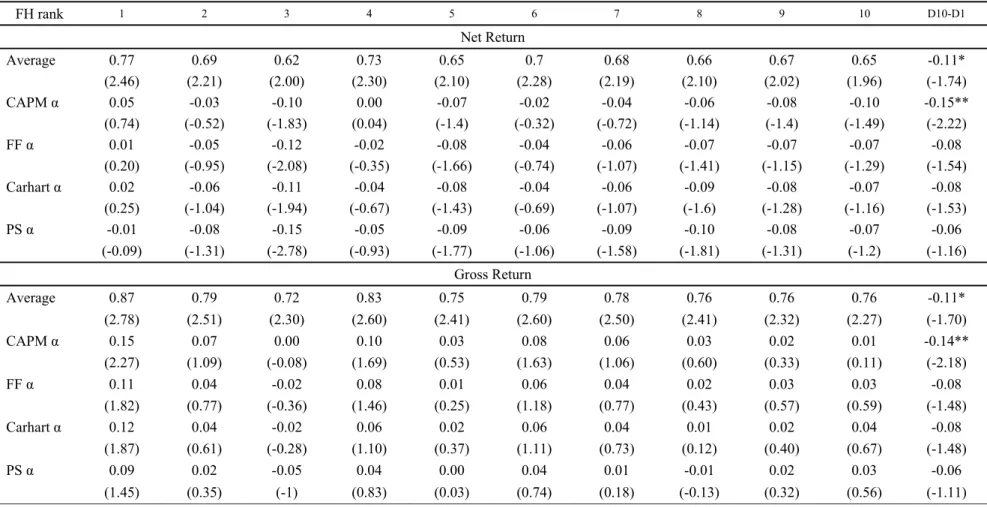
Table II presents the portfolio results. The top row reports the average value of fund herding for each decile portfolio, measured at the end of quarter t. Funds in the top decile exhibit a strong tendency to follow past institutional trades, with mean values of fund herding reaching 15.3%, whereas funds in the bottom decile exhibit antiherding behavior, with large and negative values of fund herding reaching 10:4%. Fund returns are measured in each month of quarter t+ 1. The panel for net returns shows that, in the quarter following portfolio formation, the funds with the highest herding tendency in decile 10 underperform the funds with the highest antiherding tendency in decile 1 by19bps per month, which implies a return di¤erential of 2.28% per year. The performance di¤erential between herding and antiherding funds cannot be attributed to di¤erences in risk loadings or investment styles, as the di¤erences in alphas from the CAPM, Fama and French, Carhart, Pástor and Stambaugh, and Ferson and Schadt models are 21, 17, 16, 14, and 17
bps per month, all statistically signi…cant. If we consider gross fund returns, the results paint the same picture: herding funds in decile 10 strongly underperform their antiherding peers in decile 1. Overall, the performance di¤erential between herding and antiherding funds ranges between 1.68% and 2.52% on an annualized basis.
The results above show that cross-sectional di¤erences in fund herding can signi…cantly predict di¤erences in mutual fund performance, which suggests that fund herding is related to mutual fund skill. The performance di¤erential between herding and antiherding funds is economically important, especially when considered in light of existing evidence on cross-sectional dispersion in mutual fund performance.
[Insert Table II about here]
B. Determinants of Fund Herding
In this subsection we investigate the relation between fund herding and several fund charac-teristics previously shown to be associated with fund performance. Table III reports the results. The …rst column presents coe¢ cient estimates from a cross-sectional regression of fund herding on fund size, age, expense ratio, turnover, net ‡ows, and performance (measured by a fund’s
Fama-French alpha estimated over the previous three years). The results show that funds with a stronger propensity to herd tend to be older and less active, as indicated by the lower portfolio turnover. Other fund characteristics such as expense ratios and past performance do not play a signi…cant role in explaining cross-sectional di¤erences in mutual fund herding.
[Insert Table III about here]
We also consider recently developed measures of mutual fund skill that might be viewed as naturally linked to our measure of fund herding; since these measures have been previously used to predict fund returns, we include them as controls in our analysis of fund herding and performance. First, herding funds might underperform their peers if they do not deviate from their benchmarks; Cremers and Petajisto (2009) show that funds with lower active share, that is, whose portfolios overlap more with their benchmark, tend to underperform. Second, they might underperform if they rely more on public information, as shown by Kacperczyk and Seru (2007). Third, they might underperform if their investment decisions di¤er from those of funds with good past performance, as documented by Cohen, Coval, and Pástor (2005).16
The second column of Table III shows that fund herding is related to these three measures in intuitive ways: funds with a higher tendency to herd exhibit lower active share, stronger reliance on public information, and weaker similarity with the investment decisions of successful funds. As an alternative measure of the degree to which a fund deviates from its benchmark, in the third column of the table we use tracking error. The results show a negative relation between fund herding and tracking error, which provides further evidence that antiherding funds exhibit a relatively higher tendency to deviate from benchmarks. In summary, the evidence in this section suggests that less skilled and less active funds appear to herd more.
C. Predictive Regressions
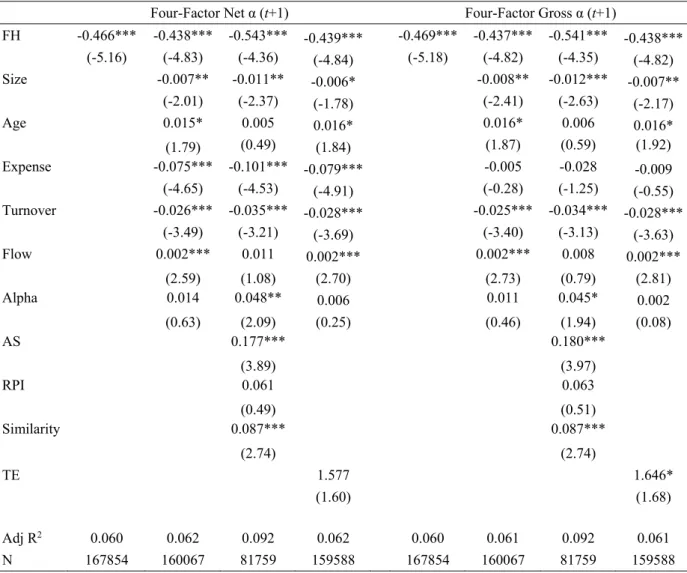
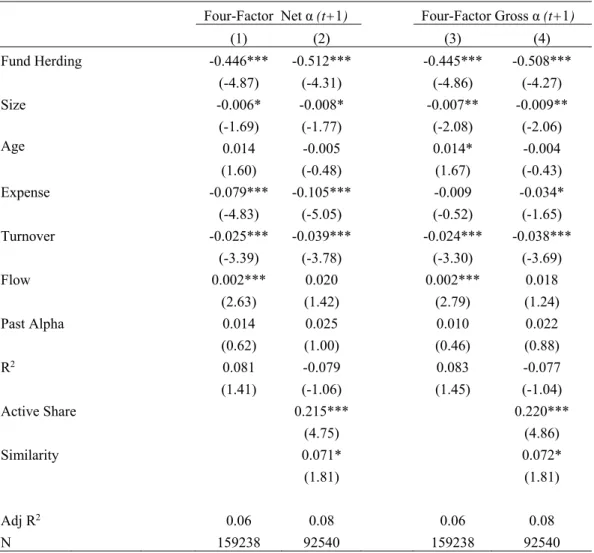
Given the association between fund herding and fund characteristics documented in the previous subsection, we now use multivariate regressions to examine the robustness of the predictive power of herding for mutual fund performance. Our measure of performance is the monthly four-factor alpha of Carhart (1997), estimated over the months in quarter t+ 1as the di¤erence between the realized fund return in excess of the risk-free rate and the expected excess fund return from a four-factor model that includes the market, size, value, and momentum four-factors. The four-factor loadings are
estimated from rolling-window time-series regressions of fund returns over the previous three years. Herding and fund characteristics are measured using information available at the end of quartert. Table IV presents the predictive panel regression results. We …rst control for fund size, age, portfolio turnover, expense ratio, net ‡ows, and past alpha. We then include controls for the measures described in the previous subsection that are related to fund herding: active share, reliance on public information, similarity with past winners, and tracking error. We measure fund performance using both net and gross fund returns. To control for aggregate movements in fund returns over time, we include time …xed e¤ects in the regressions. Furthermore, since the residuals might correlate within funds, we cluster the standard errors by fund.17
We …nd that fund herding reliably predicts mutual fund performance. The …rst column of Table IV shows that a univariate regression of four-factor net alphas on past herding yields a slope coe¢ cient of 0:466, with a t-statistic of 5:16. To provide intuition on the economic magnitude of this coe¢ cient, we note that a fund with a herding tendency of 1.65 standard deviations above average underperforms a fund with a herding tendency of 1.65 standard deviations below average by 11 bps per month, or 1.32% per year.18 Controlling for the in‡uence of fund characteristics
(second column) reduces the slope coe¢ cient only slightly to 0:438, with a t-statistic of 4:83. Inclusion of other measures of skill or other measures of deviation from benchmarks, such as active share, reliance on public information, similarity with successful funds, or tracking error, does not reduce the ability of fund herding to predict mutual fund performance. Furthermore, the results do not change if we measure alphas using gross returns.
[Insert Table IV about here]
In general, the fund characteristics relate to future fund performance in a way that is consistent with previous …ndings. For example, consistent with Chen et al. (2004), fund size is negatively related to future performance. Consistent with Carhart (1997), fund turnover is negatively related to future performance. Past ‡ows have a positive relation with future performance, consistent with the smart-money e¤ect documented by Gruber (1996) and Zheng (1999), although their signi…cance is not robust to the introduction of further controls for skill. Expense ratios are unrelated to future gross performance, but negatively predict future net alphas, which deduct fees and expenses. Past alphas are not signi…cantly related to future performance. Finally, active share and similarity with past winners signi…cantly predict mutual fund performance.
We conclude that cross-sectional di¤erences in fund herding provide investors with valuable information on the distribution of mutual fund skill. Even after controlling for characteristics related to both fund herding and fund performance, fund herding retains its economic importance and statistical signi…cance.
III.
Does Herding Behavior Reveal Skill?
The predictive power of fund herding for mutual fund performance suggests that herding be-havior reveals unobservable skill. In this section we deepen our analysis of the link between herding behavior and managerial skill. We organize our investigation into four parts.
First, we test whether antiherding funds consistently make better investment decisions than herding funds, even when considering stocks that are not heavily traded by the institutional crowd, thus revealing that they are generally more skilled. Second, we test whether the performance gap between herding and antiherding funds widens in times of greater investment opportunities in the mutual fund industry, when managerial ability is more valuable. Third, we test whether this performance gap is persistent over longer horizons, to further check that it is due to di¤erences in skill rather than chance. Finally, we test whether antiherding funds might be able to acquire information earlier than others and exploit their informational advantage by exhibiting antiherding behavior and superior performance.
A. Revealing Skill through Investment Choices
Di¤erences in skill across funds should be re‡ected in di¤erent investment choices. If the performance gap between herding and antiherding funds is driven by skill, antiherding funds should consistently make better investment decisions than those of their herding peers. We test this hypothesis by analyzing the future returns of the stocks held in the portfolios of funds characterized by di¤erent herding tendencies. We focus on the subset of stocks with small changes in institutional ownership, as these stocks are least likely to drive our estimates of fund herding. This stock-level analysis has the advantage of providing a clean identi…cation of the link between herding and skill by excluding potential alternative channels related to price pressure or chance.
This test is designed as follows. Each quarter t, we sort all stocks on the absolute value of their prior-quarter change in institutional ownership and select those in the bottom tercile of the
distribution. We then aggregate the positions of all funds that own these stocks, accounting for each fund’s herding tendency. Speci…cally, we scale the weight of stockiin the portfolio of fundj (wji;t)
using a simple transformation of our fund herding measure: we demean the herding decile rank of each fund, rank(F Htj), ‡ip its sign, and divide by 10. This simple rescaling implies that stocks in the portfolio of herding funds get a negative weight and stocks in the portfolio of antiherding funds get a positive weight. Moreover, the weight of each stock re‡ects the strength of the herding tendency of the funds that own it. We thus obtain a stock-level measure of fund herding:
Si;tF H = J X j=1 wi;tj rank(F H j t) rank(F H j t) 10 ! : (3)
We test whether this stock-level measure of fund herding predicts stock returns. At the end of each quarter we sort stocks into quintiles based onSi;tF H and compute their monthly returns in the subsequent quarter. If heterogeneity in the propensity to herd captures di¤erences in stock-picking ability across funds,Si;tF H should predict cross-sectional di¤erences in stock returns. In particular, if antiherding funds are more skilled than their herding peers, then stocks with higher Si;tF H, which are mostly held by antiherding funds, should outperform those with lowerSi;tF H, which are mostly held by herding funds.
Table V reports average monthly returns for the …ve portfolios of stocks sorted onSi;tF H, as well as alphas estimated using di¤erent performance evaluation models. The results strongly indicate that stocks that represent large bets by antiherding funds outperform stocks that are mostly held by herding funds. The di¤erences in returns are large and signi…cant, irrespective of the model used to estimate alphas; focusing on Carhart alphas, for example, the return gap is on average 38 bps per month. Importantly, this analysis is restricted to stocks that, by construction, are not likely to drive our fund herding estimates. This implies that the performance di¤erential between herding and antiherding funds is not likely to be driven solely by herding and antiherding trades, but rather by investment decisions related to unobservable skill. Moreover, this implies that the return di¤erentials reported in Table V are attributable to di¤erences in the ability of managers to pick stocks, rather than to potential price pressure induced by changes in institutional ownership.19
B. Time-Varying Opportunities and the Value of Skill
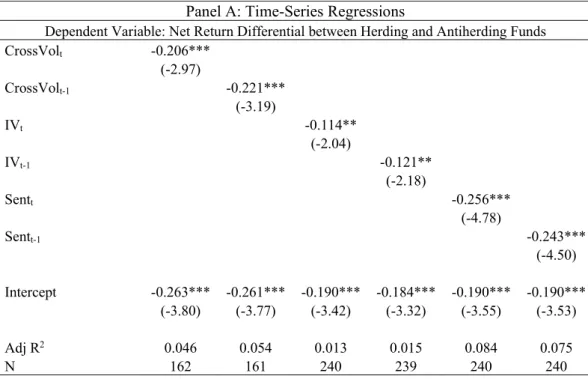
To the extent that the performance gap between herding and antiherding funds is driven by di¤erences in skill, it should increase in times of greater investment opportunities in the mu-tual fund industry, when investment skill is more valuable. We test this hypothesis using three measures of investment opportunities in the mutual fund industry. First, we consider the cross-sectional dispersion in stock returns used by Ankrim and Ding (2002), Petajisto (2013), and Pás-tor, Stambaugh, and Taylor (2017). As in previous literature, we measure return dispersion us-ing the Russell-Parametric Cross-Sectional Volatility Index for U.S. equities, which is given by CrossV olt = qPNi=1wi;t 1(Ri;t Rm;t)2, where Ri;t is the return on stock i in month t, Rm;t is the return on the market portfolio in montht, andwi;t 1 is the beginning-of-period, ‡oat-adjusted capitalization weight of stocki.20 As the cross-sectional dispersion in stock returns around the mar-ket increases, both the potential gain from outperforming the marmar-ket and the potential loss from underperforming it increase, and hence the spread in performance between skilled and unskilled managers is likely to widen. The second measure of time-varying pro…t opportunities for mutual funds is average idiosyncratic volatility (IV), which is computed as the cross-sectional mean of the residual standard deviation from daily Fama-French regressions estimated for each …rm-month. The third measure is the investor sentiment index (Sent), which is constructed as in Baker and Wurgler (2006).
We present two sets of results. First, we estimate time-series regressions of the monthly return di¤erential between herding and antiherding funds (decile portfolios 10 and 1, before and after fees) on return dispersion, idiosyncratic volatility, and investor sentiment. The results are reported in Panel A of Table VI. The negative and statistically signi…cant coe¢ cients indicate that the di¤erence in performance between herding and antiherding funds widens both during and after periods of high investment opportunities for active mutual funds, in line with our conjecture.
[Insert Table VI about here]
We next use our panel regression framework to test whether the cross-sectional di¤erences in performance predicted by fund herding are linked to variation in pro…t opportunities. Our main independent variables are fund herding and its interaction with return dispersion, idiosyncratic volatility, and investor sentiment. We also control for fund size, age, expense ratio, turnover, ‡ows, and past alpha. The results are reported in Panel B of Table VI. The coe¢ cient estimates on
fund herding are negative and signi…cant, and of similar magnitude to our baseline results. The estimated coe¢ cients on the interaction terms are signi…cantly negative, particularly for return dispersion and investor sentiment, which suggests that the performance gap between herding and antiherding funds is greater during and after periods of high investment opportunities in the mutual fund industry.
Our analysis of the time-varying performance of herding funds complements recent work by Kacperczyk, Van Nieuwerburgh, and Velkamp (2014, 2016), who focus on fund managers’cognitive ability in processing information and propose a measure of managerial skill that emphasizes market timing in recessions and stock picking in booms. Our results suggest that the tendency of mutual funds to follow the crowd is particularly e¤ective at capturing managerial skill during and after periods in which pro…t opportunities and …rm-speci…c information are more valuable.
C. Performance Persistence
The literature on mutual fund performance has long recognized the challenge in separating mutual fund skill from chance. One may thus wonder if herding funds underperform due to bad luck, while antiherding funds are simply be lucky. To test this potential alternative explanation, we examine the persistence in the performance di¤erential between herding and antiherding funds. Each quarter we group funds into decile portfolios on the basis of their herding tendency and track their performance over the subsequent two years. If the performance gap between herding and antiherding funds were random, we would expect it to weaken and revert to zero as we extend the holding horizon, while if performance is related to skill, we would expect a certain degree of persistence.
The results of this analysis, presented in Table VII, reveal that the performance gap related to herding is remarkably persistent. For example, net and gross return di¤erentials are 15 bps per month in the subsequent six months and persist when we extend the holding period to nine months and 12 months. Similarly, the di¤erence in four-factor alphas between herding and antiherding funds is 11 bps and persists to a horizon of one year. At longer horizons the performance gap starts to taper o¤, but remains economically important and statistically signi…cant. This high degree of persistence lends further support to the hypothesis that the association between fund herding and future performance is related to skill.
[Insert Table VII about here]
D. Anticipating the Actions of the Crowd
In this subsection we consider a gradual information acquisition framework to study di¤erences in skill between herding and antiherding funds. In this setting, investors who acquire information earlier than others are more likely to display antiherding behavior. In particular, these earlier-informed investors are likely to exploit their informational advantage by trading ahead of others, and then unwinding their positions when the trades of the later-informed investors cause prices to more fully re‡ect information, thus realizing a pro…t (Froot, Scharfstein, and Stein (1992), Hirshleifer, Subrahmanyam, and Titman (1994)). An immediate implication of this theoretical framework is that the earlier-informed investors are able to anticipate the trades of the later-informed investors. We use this implication to test whether the trades of antiherding funds can anticipate the trades of other institutions, thus identifying antiherding funds as the skilled, earlier-informed investors in this economic setting.
Using Fama-MacBeth (1973) cross-sectional regressions, we estimate the ability of herding and antiherding funds to anticipate the trades of the crowd in the subsequent quarter ( IOt+1) and in the subsequent year ( IOt+1:t+4). Table VIII presents the results. The estimates show that antiherding funds can signi…cantly predict aggregate institutional trades; the coe¢ cients on the current trades of antiherding funds are positive and statistically signi…cant in all regression speci…-cations. In contrast, the trades of herding funds are not related to subsequent institutional trades. When we include several stock characteristics in the regression speci…cation, we …nd that past ag-gregate trades, market capitalization, and stock turnover have negative predictability for agag-gregate trades, while the trading decisions of antiherding funds retain their positive and signi…cant predic-tive power. These results provide further evidence of a skill channel that might link di¤erences in herding behavior to di¤erences in mutual fund performance.
[Insert Table VIII about here]
IV.
Skill and Reputational Herding
Theoretical models of reputational herding generally predict that managers have an incentive to imitate the actions of their predecessors to enhance the market’s perception of their ability.
Under some conditions, however, managers with superior ability have weaker incentives to herd, choosing instead to deviate from past actions. For example, Scharfstein and Stein (1990) emphasize that factors such as relative performance ranking or the reward for new investment ideas could encourage skilled managers to anti-herd. Moreover, a number of reputational herding models focus on the evolution of career concerns and herding incentives over a manager’s career cycle, and derive implications for herding and antiherding behavior conditional on managerial experience.21 In this line of research, Avery and Chevalier (1999) develop a model in which experienced managers who are aware of their superior ability choose to anti-herd, “demonstrating their self-con…dence by going against market trends.” In a di¤erent setting, Prendergast and Stole (1996) show that agents who know their expertise may take bold actions to signal that they are talented.22
In this section we study how skill interacts with career concerns to shape herding and antiherding incentives. We focus on three questions. First, building on Chevalier and Ellison (1999), we ask whether there is evidence of career concerns among the mutual fund managers in our sample, and whether herding might provide an incentive to attenuate such concerns. Second, we test whether managers with stronger career concerns respond to these potential incentives to herd. Finally, we study the degree to which herding and antiherding choices reveal skill for managers experiencing di¤erent levels of career concerns.
Chevalier and Ellison (1999) examine a sample of mutual fund managers over the period 1992 to 1994. Measuring managers’experience with age, and measuring herding behavior using deviations from their peers’ investment decisions in a given period, the authors …nd that younger managers are more likely to be …red for deviating from their peers and are more likely to cluster with their peers’investment decisions. We extend this analysis using our dynamic measure of fund herding. To translate our investigation at the manager level, we restrict our sample to the subset of mutual funds that are managed by an individual manager, excluding team-managed funds. This …lter leaves us with about 40% of the original sample. We construct two measures of managerial experience: (i) general experience, de…ned as the number of years during which a manager appears on the CRSP database, and (ii) fund-speci…c tenure, de…ned as the number of years during which a manager is employed in a given fund.
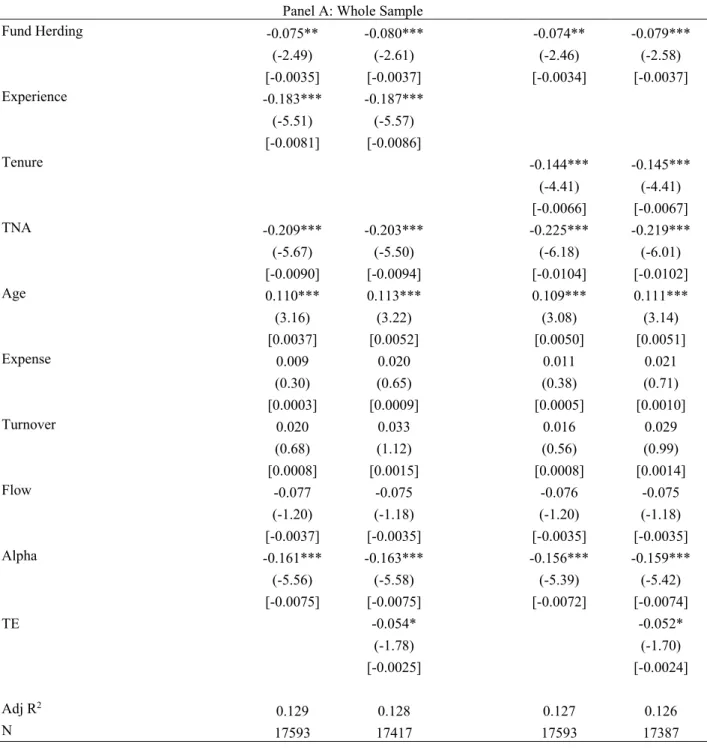
We start by estimating the determinants of the probability of termination for a fund manager. We measure terminations by keeping track of all instances in which managers lose their position with a fund and disappear from our sample.23 We estimate logit regressions in which the dependent
variable is an indicator for whether the manager of a given fund in quarter t is no longer in our sample from quartert+ 1onward. Table IX, Panel A, reports both the estimated logit coe¢ cients and the marginal e¤ects associated with an in…nitesimal increase in the variable of interest when all other variables are held at their mean values. The results show that less experienced managers face a higher probability of termination: the coe¢ cient estimates on both general experience and fund-speci…c tenure are signi…cantly negative. The coe¢ cient on fund herding is negative and signi…cant, indicating that managers have incentives to follow the crowd in order to decrease the probability of negative career outcomes. The results also show that high past performance decreases the probability of termination, fund size and fund age are signi…cant, and tracking error has a marginally signi…cant e¤ect. To gain a more intuitive understanding of the magnitude of the impact of herding behavior, we compute the predicted probability of termination for two managers who belong to the top and bottom deciles of the distribution of fund herding. We calculate that, holding all other variables at their mean values, an antiherding manager faces a 5.5% probability of termination, whereas a herding manager faces a lower probability of termination of 4.2%. To the extent that following the crowd helps reduce the probability of termination, we can infer that reputational incentives contribute to herding behavior.
In Panel B of Table IX we analyze the impact of herding on termination probabilities conditional on experience (above and below cross-sectional median values). The results show that the impact of herding is large among low-experience managers, whereas it is insigni…cant for high-experience managers. We …nd that, among low-experience managers, the probability of termination is 7.4% for antiherding managers and 5.1% for herding managers; in contrast, these probabilities are very similar (4.4% and 4%) among experienced managers. Similarly, the bene…t of herding translates into a 2.1% lower probability of termination among managers with shorter fund-speci…c tenure, but a 0.8% lower probability of termination for managers with longer tenure. Our evidence on termination probabilities indicates that herding behavior might constitute a rational response to reputational incentives that vary over a manager’s career.
[Insert Table IX about here]
Do mutual fund managers respond to such reputational incentives? We estimate cross-sectional regressions of fund herding on managerial experience, controlling for fund characteristics. The results in Table X show that less experienced managers are more likely to herd; the negative
association between experience and herding holds both for general experience and for fund-speci…c tenure. These results are consistent with Chevalier and Ellison (1999) and, like their study, support models of reputational herding that predict stronger herding incentives for more career-concerned managers. We contribute to their investigation by analyzing this question in a richer framework, using a measure of herding that is dynamic and thus better able to capture the idea of intertemporal imitation.
[Insert Table X about here]
Finally, we take our investigation further by analyzing di¤erences in performance across man-agers that di¤er in the intensity of both their career concerns and their herding tendency. At the end of each quarter, we sort all mutual fund managers into four groups based on fund herding; we also sort them independently into managers with low, medium, and high levels of experience. For each group we compute subsequent net returns and four-factor alphas. The results are presented in Table XI. We …nd that di¤erences in herding behavior predict large and signi…cant di¤erences in performance for funds with less experienced managers. In particular, using our proxy for general experience, the performance gap between herding and antiherding funds is –18bps per month for inexperienced managers and becomes insigni…cant for the most experienced managers. Using our measure of fund-speci…c tenure, the performance di¤erential associated with di¤erences in herding behavior is –22bps for inexperienced managers, decreases to –16bps for managers with a medium level of experience, and becomes zero for the most established managers.
These results show that di¤erences in herding behavior reveal skill more strongly for inexperi-enced, career-concerned managers. Among these managers, a strong herding tendency reveals lack of skill, whereas antiherding behavior o¤ers an opportunity to signal high ability in the absence of a su¢ ciently long track record. Prior literature documents a link between herding behavior and career concerns. Our investigation adds a new perspective by emphasizing the role of skill as a driver of heterogeneity in herding behavior in the presence of reputational incentives.
V.
Robustness Tests
In this section we perform two sets of robustness tests on the ability of fund herding to predict mutual fund performance. First, we estimate fund herding from trade regressions that control for a large number of …rm characteristics that may a¤ect the trading decisions of money managers. We also control for potential serial dependence in a fund’s own trades. Second, we test the robustness of the association between herding behavior and performance using two alternative measures of mutual fund performance.24
A. Alternative Measures of Fund Herding
A.1. Controlling for Multiple Stock Characteristics
In the trade regressions used to estimate fund herding, we control for three main variables that describe investment style: momentum, market capitalization, and book-to-market. Here we consider additional stock characteristics that might in‡uence money managers’ trading decisions: stock turnover, idiosyncratic volatility, revisions in analyst earnings forecasts, …rm share issuance, bid-ask spread, Amihud illiquidity, and 10 industry dummies. We include stock turnover and other liquidity measures because institutions exhibit a preference for liquid stocks, as documented in Gompers and Metrick (2001), which would induce a mechanical correlation between a fund’s trades and past institutional trades. Similarly, idiosyncratic volatility (Bennett, Sias, and Starks (2003)), revisions in analyst earnings forecasts (Kacperczyk and Seru (2007)), and past share issuance (Jiang (2010)) could play a role in generating a correlation between the trades of a given fund and past institutional trades. Finally, we include industry controls because prior research presents evidence of industry herding (Choi and Sias (2009)) and documents a link between mutual fund performance and the industry concentration of mutual fund portfolios (Kacperczyk, Sialm, and Zheng (2005)). Since these stock characteristics have been shown to predict returns, they may a¤ect future fund performance.25 We orthogonalize aggregate institutional trades with respect to these characteristics by estimating the following cross-sectional regression in each quarter t for all of the stocks in our
sample:
IOi;t = 0t+ 1tM omi;t+ 2tM Ci;t+ 3tBMi;t+ 4tT urni;t+ 5tIV oli;t+ 6tF Revi;t+
+ 7tIssuei;t+ 8tSpreadi;t+ 9tAmihudi;t+ 9 X k=1
9+k;tIN Di;tk +"i;t; (4)
whereT urni;t is the number of shares traded for stockiin quarter tscaled by shares outstanding; IV oli;t is the residual standard deviation from a regression of the daily excess returns of stockion the Fama and French three factors in quartert;F Revi;t is the change in consensus analyst earnings forecasts scaled by stock price at the end of the previous period; Issuei;t is the share issuance for …rm i in the previous year (the natural log of the split-adjusted shares outstanding at the end of quarter tdivided by the split-adjusted shares outstanding at the end of quartert 4);Spreadi;t is the end-of-day quoted bid-ask spread scaled by the midquote, averaged over a quarter; Amihudi;t is the Amihud (2002) daily illiquidity measure, averaged over a quarter; and IN Di;tk is a dummy variable indicating industry membership based on the Fama and French 10-industry classi…cation. We next estimate cross-sectional regressions of fund trades on past residual institutional trades, by fund and by quarter, and average these quarterly coe¢ cients over the life of a fund to obtain a new measure of fund herding. Based on this new measure, we rank funds into decile portfolios and estimate their performance in the following quarter. The results, presented in Table XII, are very similar to those of our baseline case. For example, the return gap between herding and antiherding funds is now –16bps per month (–19bps in the baseline case); when measured by Carhart alphas, the performance gap is now –15bps per month (–16bps in the baseline case). We conclude that the predictive power of fund herding is robust to di¤erent ways of estimating the tendency of a mutual fund to follow past institutional trades.
[Insert Table XII about here]
B.2. Controlling for Past Own Trades
Persistent fund ‡ows and stealth trading could potentially a¤ect our fund herding measure by generating autocorrelated fund trades, and could a¤ect performance through price pressure and subsequent reversals.26 To control for this possibility, and to ensure that fund herding captures imitation in sequential trading decisions, we reestimate our baseline fund trade regressions while
controlling for funds’own past trades in a given stock,T radei;j;t 1:
T radei;j;t = j;t+ j;t IOi;t 1+ 1j;tM omi;t 1+ 2j;tM Ci;t 1+ 3j;tBMi;t 1+
+ 4j;tT radei;j;t 1+"i;j;t: (5)
As with our baseline regression, we use the estimates of j;t to compute fund herding, the average tendency to herd for each fund in each quarter, and test whether it predicts performance. The results, presented in Table XIII, con…rm the strong negative relation between fund herding and future performance. The return di¤erential between herding and antiherding funds is –17bps per month (net or gross), and the four-factor alpha di¤erential is –14bps per month. We conclude that our results are robust to controlling for the correlation in a fund’s own trades over time.
[Insert Table XIII about here]
B. Alternative Measures of Mutual Fund Performance
The measures of mutual fund performance used in our empirical analysis are based on fund returns, both before and after fees and expenses. In this subsection we reestimate the baseline predictive panel regressions of Table IV using three alternative measures of performance, which are based on mutual funds’stock holdings and trades. We …nd supportive evidence for a negative and signi…cant relation between fund herding and future performance. The results are presented in Table XIV.
Our …rst alternative measure of performance is the holdings-based Characteristic-Selectivity measure (CS) developed by Danielet al. (1997):
CSt+1 = N X
i=1
wi;t(Ri;t+1 Rbi;t+1); (6)
where wi;t is the weight of stock i in the portfolio of a fund at the end of quarter t; Ri;t+1 is the monthly return of stock i during quarter t+ 1; and Ri;tb +1 is the corresponding monthly return on the characteristic-based benchmark portfolio for stock i. The benchmark portfolios are formed on the basis of size, industry-adjusted book-to-market, and momentum. The …rst two columns of Table XIV present the estimated coe¢ cients from predictive panel regressions of fund performance on fund herding and other fund characteristics measured in the previous quarter. The results show
that herding funds exhibit inferior stock-picking ability than their antiherding peers, suggesting that they are less skilled.
As a second alternative measure of performance, we use the trade-based measure of Grinblatt and Titman (1993, GT):
GTt+1= N X
i=1
(wi;t wi;t 4)Ri;t+1; (7)
where wi;t and wi;t 4 are the weights of stock i in the fund’s portfolio at the end of quarters t and t 4;and Ri;t+1 is the monthly return of stock iduring quarter t+ 1. This measure re‡ects the covariance between the change in the portfolio weights of a stock and its subsequent return. Following Grinblatt and Titman (1993), we compute the change in weights over the year that precedes the measurement of returns. Columns (3) and (4) of Table XIV show that fund herding negatively predicts performance as captured by the GT measure.
[Insert Table XIV about here]
Finally, we compute the GT measure with respect to the future trades of a fund. We ask whether the trading decisions that mutual funds make after we measure their herding behavior yield di¤erent returns for herding and antiherding funds. Speci…cally, we consider a fund’s trades over the year that follows the measurement of fund herding (quarters t+ 1 tot+ 4) and compute the monthly returns to these trades in the subsequent quarter, t+ 5:
GTt+5= N X
i=1
(wi;t+4 wi;t)Ri;t+5; (8)
wherewi;t+4 and wi;t are the weights of stocki in the fund’s portfolio at the end of quarterst+ 4 and t; and Ri;t+5 is the monthly return of stock i during quarter t+ 5. The last two columns of Table XIV show that fund herding predicts the returns derived from the trading decisions that funds make over the subsequent year. In particular, herding funds tend to make trading decisions that result in future inferior returns, whereas the trading decisions of antiherding funds tend to yield superior performance. These results lend further support to the skill channel in explaining the link between herding and future performance. Di¤erences in herding behavior identify di¤erences in the subsequent trading decisions of mutual funds, which lead to di¤erences in performance.
for mutual fund performance, and further reinforce the link between fund herding, future perfor-mance, and managerial ability.
VI.
Do Investors Respond to Fund Herding?
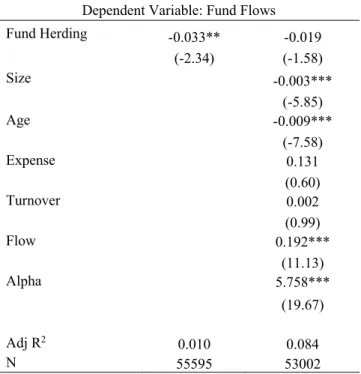
In this section we ask whether mutual fund investors are aware of the predictability of fund performance associated with herding. In other words, we ask whether investors switch money out of herding funds, which have lower expected future performance, and into antiherding funds, which have higher expected future performance. To address this question we regress the percentage fund ‡ows in quarter t+ 1on a fund’s herding tendency and a number of fund characteristics measured in quarter t. The results, reported in Table XV, indicate a generally negative but statistically insigni…cant relation between mutual fund herding and future fund ‡ows. These …ndings suggest that, on average, mutual fund investors do not respond aggressively to the information about future performance that is captured by our measure of fund herding.
[Insert Table XV about here]
From a practical point of view, these results highlight the investment value of our fund herding measure for mutual fund investors: tilting their portfolio toward antiherding funds and away from herding funds could substantially improve their investment returns. From a theoretical point of view, these results may help explain the strong predictive ability of fund herding for mutual fund performance. In the equilibrium model of Berk and Green (2004), mutual fund investors react strongly to signals revealing managerial ability, such as past performance, actively switching money across mutual funds. As a result, in equilibrium, these signals have no forecasting power for fund performance. The results of our test suggest that the inability of investors to fully appreciate the link between fund herding and managerial skill may help explain the signi…cant forecasting power of fund herding documented in our paper.
VII.
Conclusions
In this paper we investigate the link between herding behavior and managerial ability in the mutual fund industry. We begin by creating a new, dynamic fund-level measure of herding to
capture the intertemporal correlation between a manager’s trades and past institutional trades, after accounting for the tendency of funds to invest in the same styles or engage in momentum trading. We then test whether this measure of fund herding can predict cross-sectional di¤erences in mutual fund performance.
We …nd that herding behavior strongly and negatively predicts the cross-section of mutual fund returns. The top decile portfolio of funds with the highest herding tendency underperforms the bottom decile portfolio of antiherding funds by about 2.28% on an annualized basis, both before and after expenses. We obtain similar results when we adjust the fund returns to account for their risk exposures: the underperformance of herding funds is 1.92% based on Carhart (1997) four-factor alphas. Our regression results show that the predictive ability of fund herding is distinct from the e¤ect of past performance, other fund characteristics, and other measures of skill.
We next provide further evidence that the negative association between fund herding and future performance is related to managerial skill. First, we …nd a large and signi…cant return di¤erential between the holdings of herding and antiherding funds, even after excluding stocks that are heav-ily traded by the institutional crowd, suggesting that antiherding funds make consistently better investment decisions than their herding peers. Second, we show that the performance gap between herding and antiherding funds is stronger in periods of greater investment opportunities for mutual fund managers, when skill is more valuable. Third, we show that this performance gap is persistent over long horizons. Fourth, we show that the trades of antiherding funds can anticipate those of the institutional crowd, suggesting that they might acquire information earlier than others.
To deepen our investigation of herding and skill, we study how the interaction between abil-ity and career concerns shapes managers’ reaction to reputational incentives. We …nd that the performance gap between herding and antiherding funds is especially strong among inexperienced managers, suggesting that herding and antiherding choices might be used to signal skill by managers with stronger career concerns.
Our analysis is inspired by the theoretical literature on sequential decision-making, which, under a range of di¤erent economic frameworks, points to a negative association between people’s ability and their tendency to imitate past decisions. Consistent with the implications of these theoretical models, our …ndings establish a strong link between cross-sectional di¤erences in skill and the dynamics of imitative behavior. The evidence presented in this paper calls for further investigations, both empirical and theoretical, of the role played by managerial ability in shaping
sequential decision-making processes.
Initial submission: 17 April 2013; Accepted: 3 November 2017 Editors: Bruno Biais, Michael R. Roberts, and Kenneth J. Singleton
Notes
1See, for example, Scharfstein and Stein (1990) for a model of reputational herding and
Bikhchan-dani, Hirshleifer, and Welch (1992) and Banerjee (1992) for models of informational cascades. The relevant theoretical literature on herding behavior is reviewed in Section IV.
2Papers that document herding behavior among money managers and relate it to stock returns
include Lakonishok, Shleifer, and Vishny (1992), Grinblatt, Titman, and Wermers (1995), Nofsinger and Sias (1999), Wermers (1999), Sias (2004), and Dasgupta, Prat, and Verardo (2011a).
3Fama and French (2010) …nd evidence of inferior and superior performance in the extreme tails
of the cross-section of mutual fund alphas. Studies that develop measures of skill that identify extreme performers include Kacperczyk, Sialm, and Zheng (2005, 2008), Cohen, Coval, and Pástor (2005), Kacperczyk and Seru (2007), Cremers and Petajisto (2009), Cohen, Polk, and Silli (2010), and Pástor, Stambaugh, and Taylor (2017), among others.
4Models of herding behavior are inherently dynamic and involve an agent making a decision after
observing the actions of other agents (e.g., Scharfstein and Stein (1990), Bikhchandani, Hirshleifer, and Welch (1992)). In empirical studies, institutional herding is typically measured either as the aggregate propensity of institutional investors to buy a given stock at the same time, or as the correlation of aggregate institutional demand over adjacent quarters. With these measures, it is di¢ cult to capture both the nature and the implications of sequential decision making for individual funds.
5We consider active share (Cremers and Petajisto (2009)), reliance on public information
(Kacper-czyk and Seru (2007)), and similarity to funds with good past performance (Cohen, Coval, and Pástor (2005)).
6More recently, Eyster and Rabin (2014) show that rational agents who observe the actions of
multiple predecessors become aware of the information redundancy conveyed by past herds and form beliefs of the opposite sign, exhibiting anti-imitation behavior.
7Mutual fund ‡ows have been linked to price pressure and subsequent reversals in stock returns
and fund performance. For empirical evidence, see Coval and Sta¤ord (2007) and Lou (2012); for a theoretical analysis, see Vayanos and Woolley (2013).
8Grinblatt, Titman, and Wermers (1995) explore the link between mutual fund herding and
the fraction of funds buying and selling the same stock in the same quarter (Lakonishok, Shleifer, and Vishny (1992)), averaged across stocks for a given fund. Using data on 274 mutual funds during the period 1975 to 1985, they …nd that the association between this measure of herding and fund performance is subsumed by the tendency of mutual funds to buy past winners. In a similar framework, Wei, Wermers, and Yao (2015) aggregate the LSV stock-level measure of herding across stocks traded by a given fund and show that funds with a lower herding measure (higher contrarian measure) outperform the rest of the funds.
9We exclude funds with any of the following investment objectives as provided by Thomson
Reuters: International, Municipal Bonds, Bond and Preferred, and Balanced. Furthermore, we use the portfolio composition data provided by CRSP to exclude funds that on average invest less than 80% or more than 105% in common equity. Our sample starts in 1990 because of the small number of funds in the earlier period of the sample. Speci…cally, at the start of 1984, we have 102 distinct mutual funds; the number grows to 174 at the start of 1990 and increases to 1,230 at the end of 2009.
10All institutions with more than $100 million under discretionary management are required to
report to the SEC all equity positions greater than either 10,000 shares or $200,000 in market value.
11In the empirical literature on institutional investors, Sias (2004) emphasizes the need to consider
the dynamic nature of herding. He measures institutional demand for a stock by the fraction of institutional traders who are buyers (similar to LSV). He then de…nes aggregate institutional herding as the slope coe¢ cient from a cross-sectional regression of institutional demand in quarter ton institutional demand in quartert 1. Dasgupta, Prat, and Verardo (2011a) construct a stock-level measure of herding based on persistent institutional buying or selling activity for the same stock over a number of consecutive quarters.
12We do not consider initiations of new positions or deletions of current ones, that is, we require
a fund to have nonzero holdings at the beginning and at the end of a quarter to compute a trade in a given stock. However, our results do not change if we include these trades, as we show in the Internet Appendix. The Internet Appendix is available in the online version of the article on The Journal of Finance website.
13This choice is motivated by Sias (2004), who standardizes the dependent and independent
variables in cross-sectional regressions of institutional demand over adjacent quarters. We obtain similar results if we do not standardize the variables in the trade regressions, as we show in the
Internet Appendix.
14This type of inverse-weighting scheme is often used in the literature. For example, Chen and
Jiang (2006) apply it to compute a consensus measure from analyst forecasts that are issued up to a given date, assigning higher weights to more recent forecasts as they contain more updated information. In the Internet Appendix we show that the results of our analysis are qualitatively similar if we de…ne fund herding as the simple quarterly beta or as the equally weighted average of betas over the lifetime of a fund.
15Measured over the lifetime of the average fund in our sample, the standard deviation of betas
is 17.43%. After averaging the betas as in (2), the standard deviation of fund herding over the lifetime of a fund is 5.72%.
16These three measures are constructed as follows. Active Share is computed as the fraction of
the fund’s portfolio holdings that di¤ers from its benchmark index holdings. Reliance on public information,RPI, is theR2 of a regression of fund trades on changes in analyst stock recommenda-tions, speci…ed as in Kacperczyk and Seru (2007). For robustness we also compute an alternative measure of reliance on public information using the R2 from our trade regressions (1). We obtain similar results. Similarity is constructed as in Cohen, Coval, and Pástor (2005). Speci…cally, each quarter we …rst construct a proxy for the quality of a given stock by averaging the prior three-year Fama-French alpha of all funds trading the stock using the portfolio weights they place on the stock. We then aggregate the quality of all stocks traded by a given fund, based on its portfolio composition, to obtain a quarterly fund-level measure of quality. We obtain similar results if we use the holdings-based measure of Cohen, Coval, and Pástor (2005) rather than their trades-based measure (see also Pomorski (2009)).
17Following Petersen (2009) and Thompson (2011), we also consider two-way clustering by both
funds and time and obtain similar results.
18In the pooled sample, the standard deviation ofF H
j;t is 0:0698:
19In the Internet Appendix we show that changes in institutional ownership, IO, do not predict
stock returns in a way that can explain the performance gap between herding and antiherding funds. In particular, IO does not predict price pressure or return reversals in the periods in which we measure fund performance.
20We obtain the index from the Frank Russell Company.