© LFTRC & KCC Volume No. 15, issue 2, 2004, pp. 61-76
“Making Up” a Masters Programme: CMM and the co-construction of
teaching and learning processes in time and space
Jeremy Kearney
University of Sunderland
ABSTRACT
This article describes a Masters programme, the M.Sc in Systemic Organisation and Management, which is based at the University of Sunderland in England. Over the last ten years it has used CMM as both an interpretive heuristic and, more importantly, as a practical theory which has guided the practice of the teaching process and the work of the students in their organisations. Drawing on CMM’s commitment to the “communication perspective”, which sees our social worlds as made and remade through patterns of communication, and the emergent nature of human interactions, the article illustrates the multi-layered use of CMM ideas, models and practices in the co-construction of a teaching and learning process.
One of my favourite motifs from Coordinated Management of Meaning (CMM) is Barnett Pearce’s idea of the “Heyerdahl Solution” (1994). He named this idea as a result of reading a story told by Thor Heyerdahl in his book Aku Aku (1960). During a visit to Easter Island Heyerdahl was, like everyone else, mystified by the giant stone carvings of heads. However, he resisted the temptation to create hypotheses to explain them as others had done (e.g. built by Egyptians, left by aliens from another planet visiting earth) but instead asked one of the natives of the island if he knew how to make another statue. When the man replied that he could, Heyerdahl then employed him to do so and, as he describes in his book, over the next few weeks he watched as the Easter Islanders repeated the forms of practice learned over generations to make a new stone head which took its place beside the others.
Pearce describes this as the “Heyerdahl solution” to the question of how events and social worlds come into being. As he says “instead of asking why or even by whom, Heyerdahl asked how they were made” (1994, p.69). He suggests that we can “apply the Heyerdahl solution to the events and objects of the social world...(and) rather than treating (them) as found things, or asking why or for what purpose or whose fault it is, let’s ask how they are made” (p.69)
As one of the essential features of CMM is the “communication perspective”, which sees our social worlds as made and remade through patterns of communication (Pearce, 1989), I feel that the characterisation of this perspective as the “application of the Heyerdahl solution” to the social processes of our daily lives is a very appropriate way to guide a CMM approach to practice (Pearce & Pearce, 2004).
This article describes the use of CMM both as an interpretive theory and as a practical theory in relation to a teaching and learning context, a Masters programme in Systemic Organisation and Management at the University of Sunderland in England. The programme not only teaches CMM as a theoretical framework with a range of concepts and tools for analysing social contexts
but also uses CMM as a practical theory (Cronen, 1995) that functions as a guide for practitioners (which in this case includes both teachers and students). Therefore the application of the Heyerdahl solution, which focuses on how contexts and relationships are made, maintained and remade, is a core activity of the programme. The questions “What are we making together?” and equally importantly, “What do we want to make together in the future?” are signature questions and are used to think about and act on relationships between teachers and students, between the student group, between students and their organisational contexts and between teachers and the University.
While CMM has been utilised in many different contexts such as therapy, consultation, training, management and conflict resolution, and in many educational settings (see other articles in this issue), as far as I am aware, this is the first time it has been used as the guiding framework and practical model for a full academic programme. Although it would be inaccurate to say that CMM was overtly identified as the underlying framework from day one, it has always infused the programme’s ethos and created a local culture in which the programme and CMM have evolved together. CMM itself has developed and broadened over the last ten years with, among other innovations, the exploration of transcendent storytelling and the LUUUTT model (Pearce and Pearce, 1998), ideas of systemic eloquence (Oliver, 1996), the public dialogue approach (Pearce and Pearce, 2000; Spano, 2001) and work with moral conflicts (Pearce and Littlejohn, 1997). These ideas have entered into the programme via study of the literature, course seminars and joint teaching with those developing these new ideas and involvement by teachers and students in conferences and workshops, not to mention a myriad of personal contacts and email correspondence. Therefore, uniquely over the last ten years, the programme has continued to be a workshop for the exploration of CMM ideas and practices and has itself continued to be made and re-made under the influence of CMM, while at the same time continuing to meet the formal requirements of an academic context.
Background to the Masters programme
The Masters programme at Sunderland was developed in collaboration with the Kensington Consultation Centre (KCC) in London. It arose out of the author’s interest in the application of systemic ideas and his links with KCC, a leading centre for systemic teaching and practice.
Both organisations had been running training courses for managers based on systemic ideas and the aim in creating the M.Sc was to offer a collaborative programme based on systemic/ constructionist thinking at full Masters level. The original Masters programme (titled M.Sc in Systemic Management) was developed in 1994 and was aimed at senior and middle managers in health, social work and related professions. However, as the programme developed, and in line with CMM thinking, it became less concerned with the particular contexts of students’ work settings and more focused on applying the ideas and practices appropriately within different contexts. As a result, in 2000, the programme was broadened to take students from a diverse range of settings including managers, consultants and practitioners and expanded to work in different cultures - the UK, Ireland, Finland and Sweden. It was also re-titled at this stage, the
M.Sc in Systemic Organisation and Management. This article focuses most specifically on the work with the student groups in Sunderland and Dublin (where the programme is run in collaboration with the Clanwilliam Institute), as the author is programme leader and the main teacher at these two sites..
Although the earlier Certificate-level programme at the University of Sunderland from which the Masters developed included a systemic perspective, overall it had a fairly traditional management focus with a curriculum that included such standard management topics as, “theories of management”, “time management” and “management of change” . Therefore, when the Masters programme was designed in 1994 a conscious decision was made to make sure the whole programme involved a systemic/constructionist perspective in both its content and process. While the structure and curriculum of the programme are to some extent constrained by the academic context of a university setting, great efforts were made to design a course that would (i) encourage a clear link between the ideas and models taught on the course and the practice contexts of the students, (ii) create an emergent process of learning and (iii) develop reflexive abilities in the students.
To facilitate these aims the programme is designed on a part-time, modular basis which is studied over a period of 36 months. It is only delivered in a part time mode as one of its essential features is the interactive and reflexive link between the theoretical ideas and their application in the workplace. Students who do not have a current practice context are not able to join the programme. So while there is a clear “curriculum” for the programme and teachers provide specific inputs on theoretical ideas, models of practice and techniques of intervention, they are more concerned to facilitate the structure and process of the programme and use the current material from students’ workplaces as the “content”. Therefore the programme operates a series of 2 or 3 day workshops taking place about six weeks apart with a seminar day in between each workshop. The different modules at each stage are taught concurrently to facilitate the interweaving of research material, theoretical ideas and their application in practice. The image of the “double helix” model is used to conceptualise this approach with theory and practice as the two strands of the helix weaving around each other and coming together and crossing over at particular points, i.e. the workshop and seminar days. As each block of teaching is followed by time spent in the workplace carrying out tasks and activities relevant to the specific organisational context, students are able to apply the theoretical ideas studied during the teaching workshops to current issues in their own practice. They are then able to bring the issues and problems that arise to the following workshop where they receive feedback from colleagues and teaching staff. This approach assists the students in developing a model of reflexive practice.
In terms of formal content, the programme is influenced by a wide range of theoretical material including systemic ideas (Bateson, 1973; Selvini Palazolli et al, 1978; Hoffman, 1981; Cronen & Lang, 1994; Evans & Kearney, 1996), social constructionist thinking (Pearce, 1989, 1992; Shotter, 1993a, 1993b; Gergen, 1999, 2001; Burr, 1995), as well as other writers such as Senge (1990), Foucault (1972, 1979a, 1979b) and Wittgenstein (1953). Drawing on a systemic/ constructionist framework, it is possible to utilise many different models and practice techniques as long as they
are applied appropriately in each individual context. Some of the tools that are used include the “reflecting team” (Andersen, 1987, 1990), Appreciative Inquiry (Hammond, 1996; Anderson et al, 2001) systemic interviewing and consultation models (Cecchin, 1987; Campbell et al, 1991; Campbell et al, 1994; Pearce, 1995), circular questioning (Selvini Palazolli et al, 1980; Penn, 1982; Tomm, 1987a, 1987b), working with moral conflicts (Pearce & Littlejohn, 1997) and the public dialogue approach (Pearce & Pearce, 2000, Spano, 2001).
While these descriptions of the philosophy, structure and curriculum of the Masters programme are important parts of the overall context, it is in the use of CMM as an interpretative and more importantly, a practical theory, which frames the on-going teaching and learning processes and it is this I wish to focus on in more detail in this paper.
The use of CMM as a framework for guiding practice
In relation to the Masters programme CMM has been used in a variety of different ways to provide a framework, a theory, a collection of tools and a guide for practitioners:
(i) it is used to conceptualise the development of the structure and curriculum of the programme,
(ii) at the same time CMM and its applications are taught as part of the content of the programme,
(iii) it is also used to frame the on-going teaching and learning experience of the programme and, in particular, the commitment of the programme to create a space in which content is co-constructed with the students as an on-going process,
(iv) the students also utilise CMM both in the process of the group activities on the programme and,
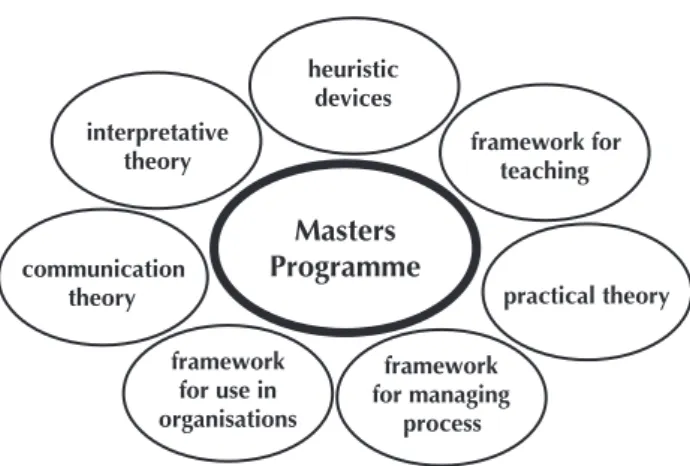
(v) in the specific application of CMM ideas and practices within their own work settings. One of CMM’s own heuristic devices, the daisy model, can be used to illustrate the multi-layer influence of CMM on the programme:
Figure 1 - Uses of CMM on the Masters Programme
Masters Programme interpretative theory heuristic devices framework for teaching practical theory framework for managing process communication theory framework for use in organisations
Applying the Heyerdahl solution
One of the features that makes this Masters different other programmes is that the question “What are we making together?” is applied to all aspects of the teaching and learning process. The following examples will hopefully illustrate the operation of the principles and practices outlined above in the making and re-making of the programme itself, the interactions with the students and the students’ interventions in their organisations.
Example 1: reading as a constructive process
Part of the programme structure is that students are required to read key articles and texts in the systemic/constructionist literature and one of the common “complaints” from students in the first year of the programme is that this theoretical reading is “too difficult”. Experience has shown that changing the articles read has little effect and the meaning of what is complex and what is simple changes from group to group. Instead the Heyerdahl solution has been applied to this “problem” and students have been encouraged to look at how the articles are made rather than see them as difficult and fixed objects. Students are encouraged to “read” differently and not see articles as texts written by experts but rather to see them as having been put together or “made” in a particular way. Therefore they are advised not to try and read an article from front to back (and as a result usually get bogged down after about three pages) but instead to read the abstract first and then the conclusion, then look for sections that seem interesting to them, write notes in the margins and highlight words, phrase and sentences they don’t understand or don’t agree with. In these ways their monolithic view of the complexity and difficulty of the material is challenged and gradually broken down as they find sections, pieces, words that are familiar, interesting or exciting. As part of the same process small groups of students are given responsibility for reading a particular article and then presenting it to the rest of the group using the reflecting team model, where the reflecting teams listen to their colleagues talk about the article out loud. This approach helps to move away from a process in which the group convince each other that a particular piece is “too difficult”. For while the students presenting the article can say this, the reflecting teams listening are required to respond in an appreciative or questioning manner, e.g. starting their responses with phrases like “I am curious about...”, “I would like to know more about...”, “I was interested in...”. In this way some difference is created between group members and space is created for some people to “understand” the article while others still struggle with it. These reading seminars then become a process of training people in the “skill” of reading and critically reviewing academic articles. This ability prepares them to match the academic “grammar” of the university and its requirements in relation to the presentation of assignments for assessment. Experience has shown that later on in the programme students often remember their early struggles with reading material as an important part of their learning process.
Patterns of learning in time and over time
One of the key aspects of the programme is that it is seen as a process which takes place over a time period of three years and is co-constructed between the teachers and the students. This
creates an overall time frame within which certain other time sequences can be identified such as: the three separate years of the programme, the individual workshops and seminars, separate days within a particular workshop, and even particular moments within a specific day. Each of these time periods offer the opportunity to either maintain a certain structure in the learning process or to construct something new.
Certain patterns are observable over these different time frames. For example, looking at the overall time frame of the programme, in the first year students are focussed on engaging with the new theoretical ideas and learning to practice particular skills, such as circular questioning, systemic interviewing, appreciative inquiry and taking reflecting positions, and so they play a limited part in the construction of the overall programme, i.e. in terms of its teaching content and structure. However, as the material used in the workshops is from their own organisational contexts, and these always provide unique and innovative situations to work with, the teaching team adapt the teaching inputs and structure to match what is emerging. By the second year, students have some facility with the techniques and ideas and are able to apply them reflexively in their own work contexts. They are then able to play more of a role in the practical construction of the programme, requesting particular inputs. They also often becoming reflexive in terms of the programme itself and reflect back and challenge particular aspects of the teaching and learning process.
Using the “hierarchy model” which examines relationships between multiple levels of context (Pearce, 1989) another familiar pattern between the first and the second year can be identified. In the first year initially the context level of “self” is often the highest marker for students as they construct and re-construct a role for themselves in relation to other systems (such as their organisation, their staff, their clients, etc) whether it be as a manager, practitioner, consultant or other specialist. The other systems of influence are often seen as restrictive and controlling (senior management), demanding and challenging (staff members, clients) or outside their sphere of influence (policy makers, government officials, directors of the organisations, etc). In this early period there is often little sense that they have influence or can play a part in controlling these other systems. In other words, in CMM terms, they feel constrained by prefigurative forces (a sense of obligation towards themselves or the users of the service) and contextual forces (actions required by the existing context) (Pearce, 1989). They act the way they do “because of” situations or actions that occurred previously.
However, by the second year, students have generally engaged with the idea that relationships are co-constructed and have had some experience of achieving change in some interactions. The higher contextual marker becomes the organisation (whatever that might be) and they are more able to locate themselves within it and start to understand different points of intervention they can use to influence policy. Here students are more able to generate practical force (to act in ways that leads to the outcomes they want) and implicative force (to actually start to influence the wider systems they are involved in). At this stage they are acting “in order to” make something happen.
In some ways this sense of time can be seen as examples of the “serpentine model” (Pearce, 1994) in which the programme is a continuing sequence of co-constructed actions in which it is possible to make some predictions about particular episodes and potential outcomes but it is equally likely that new episodes will occur and unforeseen outcomes emerge.
One of the important ways of using this longer time frame, which can help students join in a co-constructed process by reflecting on their learning on the programme and their actions within their organisations, is through the use of student presentations. These take place at the beginning and end of each year and serve as “context markers” (Bateson, 1973) and also as ways of constructing the future. At the beginning of the first year each student is asked to make a presentation using visual formats to give their view of how their organisational context looks at that time and also to visualise how they would like it to look. At the end of the first year, students again present their organisational context as they see it but now connect to the present by comparing it with the ideal they had put forward a year earlier, connect back to the past by relating the current picture to their earlier one and connect to the future by again constructing an ideal for a year on. In this way students are constantly reflecting on their relationship with their organisations and their part in the processes of change.
Constructing a learning process over time Example 2 : uncertainty, dialogue and emergent process
A student, who was also a senior manager in a large voluntary organisation working with young people, came to one of the workshop days and requested a consultation on an issue that was concerning her at work. With her agreement, one of her fellow students volunteered to carry out a systemic interview with her and another four students agreed to act as the interviewer’s consultation team. The rest of the group were asked to observe the different processes that were taking place, i.e. the original student’s story about her concerns, the process between the interviewer and the student and the process between the interviewer and her consultation team.
In the interview the manager expressed her concern about how different parts of the organisation were implementing the agency’s policy on dealing with the risk of violence and staff safety. As this was explored it emerged that different sections of the organisations were responding in different ways to similar violent incidents towards staff by young people who used the service. The manager had been asked to re-write the policy document covering this issue in a way that would ensure it was applied uniformly across all parts of the organisation but she felt stuck as to how to do this in a way that would meet the needs of the staff yet without excluding the more difficult young people. The interviewer explored various aspects of this problem with the manager and in discussion with his consultation group tried to propose various ways forward. But the conversation started to go around in circles as the manager could not see a way of meeting the needs of the staff without disadvantaging the young people. In the final break with his consultation group, both the interviewer and his consultants acknowledged that they also felt stuck about how to move the process forward.
At this point the wider, observing group were asked to comment and some of the observations were:
- that the manager’s stuckness started to be mirrored by the interviewer and his consultation team
- that just as the manager felt responsible for producing a document that would meet everyone’s needs, so the interviewer felt responsible for producing a solution to the manager’s problem.
- that this has seemed to happen when particular words were used like “risk”, “staff safety” and “consistency”
Some discussion then took place about the meaning of these words as “speech acts” (Pearce, 1989), the meaning of which were embedded in layers of context within the organisation and it was suggested that it might be important to understand what responses these words evoked within the organisation, particularly among front line staff and the users of the service. The consultation ended at this point without any particular guidance to the manager but with a recognition that the process was unfinished. It is worth noting that these types of consultation processes during teaching sessions often end in an incomplete way. One reason is because the aim is not to prescribe a specific outcome or solution, but rather to create a process which allows the consultee space to reflect on the process taking place in the organisation, and at the same, enable other students in the group to experience different aspects of a consulting process from different person positions. Another reason is that the time frame of the programme allows the consulting process to continue over two or more workshop sessions, or to extend over the whole year (or even longer, in some cases).
When the group met again about three weeks later, the manager reported that she had decided not to re-write the policy document herself but, in order to be fair to all those involved, to engage in a dialogue with all parts of the organisation, including the young people, on how to go forward with this issue. She was not clear where this process would lead but felt that this was the most appropriate action at that point in time. Some time was spent during this workshop helping the manager plan the “dialogue” process, both in terms of its structure - “who should be involved?”, “what permissions were needed?” and practices - using circular questions, appreciative inquiry and systemic interviewing.
About three months later at another workshop, the manager described the process that had taken place and what had been the outcome. As a result of the dialogue process, which had involved many interviews, questionnaires and group sessions, all parts of the organisation has participated in thinking about the meaning of “risk”, “safety” and “consistency” in the context of the organisation’s work. What had emerged was the need to see these issues in relation to the needs of the user group. This had the effect of reconstructing the meaning of the words to include both staff and users’ safety, and had also emphasised the organisation’s responsibility to meet the needs of the users even if they were being difficult and aggressive.
overall policy frame, that parts of the organisation could apply sanctions differently for what might seem to be the same offence, depending on the particular circumstances in each case. The staff of the organisation and the young people had established what might be called a policy of “inconsistent” consistency and, as a result of the dialogue process, were able to do this in a way that still made it possible for the organisation as a whole to “know how to go on” in a coherent way. The policy worked because everyone understood how it had been “made”.
In her reflections on the consultation process that had taken place on the course, the manager said that, while it had not provided any answers, it had shown her that her “stuckness” was important and that she needed to understand the meaning for the organisation of the particular speech acts of risk, safety and consistency. In the process of doing this the policy had emerged.
Constructing a learning space
Part of the process of the programme is to create a “learning space” in which students can explore themselves and their roles in the context of their organisations and bring issues from their work settings into the classroom. The programme becomes a place where contextual reconstruction can be facilitated (Branham & Pearce, 1985). As a key aim of the programme is to enable students to influence their organisations in constructive ways, the programme looks at not only helping people understand the contexts they work in but also act to reconstruct them.
In order to create spaces in which opportunities for learning can occur, each workshop session starts with a go-around where students can raise any issues they like but in particular they are asked to think about any differences they have noticed in themselves or others since the previous session. Two specific ways of identifying these differences are to focus on “elusive constructive moments” (ECMs) or “unwanted repetitive patterns” (URPs). The phrase “elusive constructive moments” is one used on the programme to describe those moments when one suddenly becomes aware of how things connect. This might be an insight into a particular theoretical idea, or how a series of actions relate to each other or a realisation that an intervention to shift a system has become possible. An unwanted repetitive pattern is a CMM notion of patterns of interaction which are driven by particular logical forces (Cronen et al, 1979). These patterns are created and re-created by people in particular relationship contexts. By getting students to pay attention to such moments they became aware of the part they play in re-constructing positive or unhelpful patterns.
In order to become more aware of ECMs and URPs students are encouraged to act differently in common situations, such as informal interactions with colleagues or meetings. For example, by not disagreeing immediately with someone whose ideas they don’t like, by staying silent and allowing others to speak or by being positive about a suggestion rather than ignoring it, in order to create difference and then to observe the feedback to see whether it is a “difference that makes a difference” (Bateson, 1973). In this way they can create the opportunity for ECMs to occur or at least become more aware of the part they play in maintaining URPs.
In many cases the students stories of ECMs and URPs provide an opportunity for some theoretical analysis or practical consultation which uses these moments as ‘content’.
The exploration of these “moments” of either stuckness or insight offer excellent opportunities to utilise such CMM models as the “hierarchy model”, which explores multiple levels of embedded contexts, and “strange loops”, which are a means of analysing conflicts between different levels of context (Cronen et al, 1982; Pearce, 1994). As all the students are working within organisations, the effects of the rights, duties, obligations and affordances available to each individual in their context have a powerful impact on how they feel able to act and the concept of “logical force” is very helpful in providing a model for understanding. Within the “learning space”, using the group as consultants, the effects of “pre-figurative” and “contextual” forces can be examined and the possible actions that might encourage “practical” and “implicative” forces can be explored as described in the example below.
In these moments the role of teacher also becomes that of consultant and facilitator whose job is to manage the process, even though the outcome is emergent and uncertain (Kearney, 2004). Example 3: contextual reconstruction utilising implicative force
In a go-around at the beginning of a workshop session, one of the students mentioned that she had noticed a URP in relation to her work context. She worked as a staff development officer who had some responsibility for organising the accreditation of some medical training programmes. She had noticed that she was getting frustrated in her efforts to get people to participate as assessors in the accreditation process for this training and that this was a pattern that had happened before. Responding to a suggestion of the programme leader she agreed to engage in a consultation process around this issue. The programme leader then interviewed her about the issues raised in front of the rest of the student group who were requested to act as a reflecting team.
One of the issues arising from the consultation was that the reason people did not want to act as assessors was because they would be assessing their peers (i.e. other medical colleagues) and they did not wish to be responsible for actually making formal judgements about colleagues’ training programmes. Another issue was that as people took part in the accreditation process on a voluntary basis, their commitment was limited and so their participation was variable. Following discussion with the reflecting teams, it was possible to identify a “strange loop” that was operating in this interaction.
Figure 2:
Organisation formal accreditation is needed
Relationship we are a group of peers
Role Assessor ≠ Colleague
The “loop” here is that if some medical staff take the role of assessors, they are then involved in making judgements about their colleagues. On the other hand, if they take the position as a colleague, they can only make suggestions about the training programmes and have limited influence on the quality of training. This conflict was held in place by the higher contextual level of relationship, which privileged the peer relationships between medical colleagues.
The consultation process also revealed that the student was involved in a similar conflict in relation to her own position. She was ambivalent about her own role in the accreditation process as she was unsure whether she wanted to manage the overall process or to be part of one of the accreditation teams. Again, following discussion with the reflecting teams, it was possible to identify another strange loop in which, if she took the role of manager of the accreditation process she would need to tell the accreditation teams what to do. On the other hand, if she was herself part of one of the accreditation teams, she could not control the process. Again, this conflict was held in place by the higher contextual level of relationship, which placed her in a consultant relationship to a group of peers.
Figure 3:
Organisation X is responsible for organising accrediation process
Relationship I (X) am in a consulting relationship
Role Manager ≠ Team member
Episode Instruct people ≠ Advise people
One practical way of actually addressing the contradictions involved in a strange loop is to “play out” both side of the loop. So with the student’s agreement, the programme leader decided to examine the student’s dilemma using the technique of the “empty chair” from Gestalt therapy in which two chairs represent the two sides of the dilemma. The subject moves between each of the chairs and as they do so they explore out loud each of the ambivalent positions, identifying the positives and negatives of each (Perls et al, 1973). During the exercise the student spoke from the chair which represented the ” wish to manage” side of the loop and said she was unhappy about having all the responsibility for the accreditation process without the power to implement it and that she was receiving no extra payment for the work.
At this point the reflecting teams were asked to offer suggestions to the student making sure that they were framed within a mode of curiosity or appreciative language. Some of the questions the groups put forward were:
- a curiosity to know how those responsible for the accreditation process would respond if she were to ask for payment to manage the process?
- wondering what was stopping her resigning from such a difficult position?
- wondering what would happen if she discussed this dilemma with the colleague involved? These proposals were not discussed but were left “hanging in the air” as it were and the student was invited to take away with her whatever ideas she thought might be useful.
About a month later when the course met again, the student reported that, following on from the consultation , she had decided to take some direct action and had approached her superiors to express her dissatisfaction with the current situation and the limitations of what she was able to do. She said that, to her surprise, the management group agreed with her points and said they had been thinking along the same lines themselves. As a result it was agreed to pay her a fee and to allow her to manage and reorganise the accreditation system. She reported that she had already begun this process by bringing together the peer group responsible for accrediting programmes and working jointly with them to devise systems and procedures for formal accreditation. A number of working groups had been set up to carry out specific tasks.
In reflecting on the process that had taken place, the student said that the consultation had clarified the ambivalence of her own position and she realised that that was what she need to sort out first of all. She also realised that she was entitled to payment for the work she was doing and therefore had decided act to achieve a positive outcome, even though she was uncertain how her managers might respond. The other impetus that encouraged her to act was that she realised she had the expertise and ability to set up the formal accreditation process if she was given the power to do so. All these factors generated sufficient implicative force to reconstruct the context.
The use of time and space
The use of time and space in the programme can be seen as similar to one of the more recent developments in CMM, the three level public dialogue process model which emerged from the work of the Public Dialogue Consortium (PDC) in Cupertino, California (Pearce & Pearce, 2000; Spano, 2001). PDC is a not-for-profit organisation involved in a multiyear, citywide, collaborative community action project and it utilises many CMM ideas in its work. The model has three levels based on episodic structures of different sizes and is an elaboration of the CMM concept of “episode” . At the broadest level, “strategic process design”, there is a plan for an overall sequence of events leading towards a particular outcome which may last from weeks to years. This is similar to the timescale and structure of the overall Masters programme. At the second level, “event design”, the focus is on particular activities, such as focus groups, meetings, town hall events, that take place within a bounded time frame of perhaps a couple of hours to a day or two. At this level, the wider strategic design provides a context for a connection with earlier events and prefigures those that follow it. In the Masters programme, the workshops and seminar days serve the same function and as mentioned earlier, the image of the “double helix” overtly focuses on these links and the programme’s use of student presentations (mentioned
above) draws attention to the connections between the past, present and future.
The third level focuses on “communication facilitation skills” which emphasises the importance of acting appropriately in the “moment” if events are to run successfully. As Spano (2001) says “it is a standard operating principle of PDC that public dialogue is made possible through the creative and effective application of various communication skills and techniques” (p. 13). As described above, a similar principle underlies the operation of the Masters programme in which the management of the process is vital to the achievement of the outcome.
Conclusion
The Masters programme has had the unique advantage of being able to utilise and experiment with the multi-layered possibilities offered by CMM within the context of a three year academic course. This has enabled work to continue over an extended time period with the same group of students so that the influence of CMM on both teaching processes and the activities carried out by students in their organisations can be identified. At the same time, the structure of the programme and its commitment to the teaching and learning as co-constructed activities has focused attention on the importance of creating a learning space where what is being made in the “moment” can be explored.
CMM has shown its ability to be highly useful in both these contexts, while at the same time providing students with theories, models and tools which they can use in their own practice.
Acknowledgements
The author wishes to acknowledge the great influence of KCC staff, particularly Christine Oliver, and colleagues at the Clanwilliam Institute in Dublin, through discussions and joint teaching, on the ideas presented in this article. However, the author is solely responsible for the content. He would also like to thank all the students who have helped to co-construct the Masters programme over the last ten years.
Please address correspondence about this article to: Jeremy Kearney, Director, Centre for Social Research and Practice, School of Health, Natural and Social Sciences, University of Sunderland, Priestman Building, Green Terrace, Sunderland SR1 3PZ, Email: jeremy. [email protected]
References
Andersen, T. (1987) The reflecting team: Dialogue and meta-dialogue in clinical work. Family Process, 26, 415-428.
Andersen, T. (ed) (1990) The Reflecting Team: Dialogues and dialogues about dialogues. Broadstairs: Borgmann.
Anderson, H., Cooperrider, D., Gergen, K.J., Gergen, M., McNamee, S. & Whitney, D. (2001) The Appreciative Organisation. Taos Institute: New Mexico.
Bateson, G., (1973) Steps to an Ecology of Mind. London: Paladin.
Branham, R. J., & Pearce, W. B. (1985). Between text and context: Toward a rhetoric of contextual reconstruction. Quarterly Journal of Speech, 71, 19-36.
Burr, V. (1995) An Introduction to Social Constructionism. London: Routledge.
Campbell, D., Draper, R. & Huffington, C. (1991) A Systemic Approach to Consultation. London: Karnac Books.
Campbell, D., Coldicott, T., & Kinsella, K., (1994) Systemic Work with Organisations : A new model for managers and change agents. London: Karnac.
Cecchin, G., (1987) Hypothesising, circularity and neutrality revisited : An invitation to curiosity. Family Process. 26, pp. 405-413.
Cronen, V. E. (1995) Practical theory and the tasks ahead for social approaches to communication. In W. Leeds-Hurwitz (ed.) Social Approaches to Communication. New York: Guilford Press.
Cronen, V.E., Johnson, K.M. & Lannamann M.A. (1982) Paradoxes, double binds and reflexive loops : An alternative theoretical perspective. Family Process. 21, 91-112.
Cronen, V. E., & Lang, P. (1994). Language and action: Wittgenstein and Dewey in the practice of therapy and consultation. Human Systems, 5, 5-43.
Cronen, V. E., Pearce, W. G., & Snavely, L. (1979). A theory of rules structure and episode types, and a study of perceived enmeshment in unwanted repetitive patterns. In D. Nimmo (Ed.), Communication yearbook III (pp. 225-240). New Brunswick, NJ: Transaction. Evans, D. and Kearney, J. (1996) Working in Social Care: A systemic approach. London:
Arena.
Foucault, M. (1972) The Archaeology of Knowledge and the Discourse on Language. New York: Harper.
Foucault, M. (1979a) Discipline and Punish. Harmondsworth: Penguin.
Foucault, M. (1979b) On governmentality. Ideology and Consciousness. 6, 5-24. Gergen, K.J. (1999) An Invitation to Social Construction. London: Sage.
Gergen, K.J. (2001) Social Construction in Context. London: Sage.
Hammond, S (1996) The Thin Book of Appreciative Inquiry. Thin Book Publishing Co. Heyerdahl, T. (1960) Aku-Aku:The secret of Easter island. New York: Pocket Books.
Hoffman, L (1981) Foundations of Family Therapy: A conceptual framework for systems change. New York: Basic Books.
Kearney, J. (2004) Knowing how to go on: Towards situated practice and emergent theory in social work. In Reflecting on Social Work - Discipline and Profession. (eds) R. Lovelock, K. Lyons and J. Powell, CEDR/Ashgate.
Oliver, C. (1996). Systemic eloquence. Human Systems, 7, 247-264.
Pearce, W. B., (1989) Communication and the Human Condition. Carbondale: University of Southern Illinois Press.
Pearce, W. B., (1992) A campers guide to constructionisms. Human Systems. Vol 3. No. 3-4. pp.139-162.
Pearce, W.B. (1994) Interpersonal Communication : Making social worlds. New York: Harper Collins.
communication. in Lawrence R. Frey (Ed.). Innovations in Group Facilitation: Applications in natural settings. Cresskill, N. J.: Hampton Press.
Pearce, W.B. and S. Littlejohn (1997) Moral Conflict: When social worlds collide. London: Sage.
Pearce, W. B., & Pearce, K. A. (1998). Transcendent storytelling: Abilities for systemic practitioners and their clients. Human Systems, 9, 167-184.
Pearce, W. B. & Pearce, K. A. (2000) Extending the theory of the coordinated management of meaning (CMM) through a community dialogue process. Communication Theory, 10, 4, 405-423.
Pearce, W. B and Pearce, K.A (2004). Taking a communication approach to dialogue. In R. Anderson, L. Baxter & K. Cissna (Eds.) Dialogue: Theorizing difference in communication. Thousand Oaks, CA: Sage.
Penn, P. (1982) Circular questioning. Family Process. 21, 267-280.
Perls, F., Hefferline, R. and Goodman, P. (1973) Gestalt Therapy. Harmondsworth: Penguin Books.
Selvini Palazzoli, M., Boscolo, L., Cecchin, G. and Prata, G. (1978) Paradox and Counter Paradox. New York: Jason Aronson.
Selvini Palazzoli, M., Boscolo, L., Cecchin, G. and Prata, G. (1980) Hypothesising-circularity-neutrality: Three guidelines for the conductor of the session. Family Process, 19, 3-12. Senge, P. M. (1990) The Fifth Discipline : The art and practice of the learning organisation.
New York: Doubleday.
Shotter, J. (1993a), Cultural Politics of Everyday Life: Social constructionism, rhetoric and knowing of the third kind. Buckingham: Open University Press.
Shotter, J. (1993b) Conversational Realities: Constructing life through language. London: Sage.
Spano, S (2001) Public Dialogue and Participatory Democracy: The Cupertino community project. Cresskill: Hampton Press.
Tomm, K. (1987a) Interventive interviewing, part 1: Strategising as the fourth guideline for the therapist. Family Process. 26, 3-15.
Tomm, K., (1987b) Interventive interviewing, part 2:. Reflexive questioning as a means to enable self healing. Family Process. 26: 167-183.