Working Paper Series
ISSN 1518-3548
Speculative Attacks on Debts, Dollarization and Optimum
Currency Areas
ISSN 1518-3548 CGC 00.038.166/0001-05
Working Paper Series
Edited by:
Research Department (Depep) (E-mail: [email protected])
Reproduction permitted only if source is stated as follows: Working Paper Series n. 40. Authorized by Ilan Goldfajn (Deputy Governor for Economic Policy).
General Control of Subscription: Banco Central do Brasil
Demap/Disud/Subip
SBS – Quadra 3 – Bloco B – Edifício-Sede – 2º subsolo 70074-900 Brasília – DF – Brazil
Phone: (5561) 414-1392 Fax: (5561) 414-3165
The views expressed in this work are those of the authors and do not reflect those of the Banco Central or its members. Although these Working Papers often represent preliminary work, citation of source is required when used or reproduced.
As opiniões expressas neste trabalho são exclusivamente do(s) autor(es) e não refletem a visão do Banco Central do Brasil. Ainda que este artigo represente trabalho preliminar, citação da fonte é requerida mesmo quando reproduzido parcialmente.
Banco Central do Brasil Information Bureau Address: Secre/Surel/Diate SBS – Quadra 3 – Bloco B Edifício-Sede – 2º subsolo 70074-900 Brasília – DF – Brazil Phones: (5561) 414 (....) 2401, 2402, 2403, 2404, 2405, 2406 DDG: 0800 992345 Fax: (5561) 321-9453 Internet: http://www.bcb.gov.br E-mails: [email protected] [email protected]
Speculative Attacks on Debts, Dollarization and
Optimum Currency Area
∗
Aloisio Araujo
†Márcia Leon
‡Abstract
The purpose of this article is to contribute to the discussion of thefinancial aspects
of dollarization and optimum currency areas. Based on the model of self-fulfilling debt
crisis developed by Cole and Kehoe [4], it is possible to evaluate the comparative welfare of economies, which either keep their local currency and an independent monetary policy, join a monetary union or adopt dollarization. In the two former monetary regimes, governments can issue debt denominated, respectively, in local and common currencies, which is completely purchased by national consumers. Given this
ability, governments may decide to impose an inflation tax on these assets and use
the revenues so collected to avoid an external debt crises. While the country that issues its own currency takes this decision independently, a country belonging to a monetary union depends on the joint decision of all member countries about the common monetary policy. In this way, an external debt crises may be avoided under the local and common currency regimes, if, respectively, the national and the union central banks have the ability to do monetary policy, represented by the reduction in the real return on the bonds denominated in these currencies. This resource is not available under dollarization. In a dollarized economy, the loss of control over national monetary policy does not allow adjustments for exogenous shocks that asymmetrically
affect the client and the anchor countries, but credibility is strengthened. On the
other hand, given the ability to inflate the local currency, the central bank may be
subject to the political influence of a government not so strongly concerned withfiscal
discipline, which reduces the welfare of the economy. In a similar fashion, under a
common currency regime, the union central bank may also be under the influence of
a group of countries to inflate the common currency, even though they do not face
external restrictions. Therefore, the local and common currencies could be viewed as a way to provide welfare enhancing bankruptcy, if it is not abused. With these peculiarities of monetary regimes in mind, we simulate the levels of economic welfare for each, employing recent data for the Brazilian economy.
Keywords: dollarization, optimum currency area, speculative attacks, debt crisis, sunspots
JEL Classification: F34, F36, F47, H63
∗We are grateful to Professor Peter Kenen, Professor Ricardo Cavalcanti and Professor Arilton
Teixeira.
†Getulio Vargas Foundation and Instituto de Matemática Pura e Aplicada (IMPA).
1
Introduction
The traditional criteria for two or more countries to establish an optimum currency area are based on the theoretical underpinnings developed in the 1960s by Mundell [18], McKinnon [15] and Kenen [14]. According to these prerequisites, the less is the need to vary the exchange rate between the local currency and that of its partner in order to adjust for imbalances between the two economies, the greater will be the advantages of a country’s giving up its own currency and independent monetary pol-icy. In general, these classic criteria indicate that the candidate countries must have certain common characteristics, such as: (i) mobile productive factors andflexibility of these markets; (ii) open trade and financial interdependence; (iii) symmetry of shocks and productive cycles; and (iv) diversified products and portfolios. In the 1990s, after the Treaty of Maastricht, new criteria for macroeconomic convergence were established for countries wishing to join the European Monetary Union. These criteria, growing out of the European experience in consolidating the EMU, include structural reforms and market liberalization along with strengthening the monetary andfiscal positions of the various national economies.
During the second half of the 1990s, most emerging economies were hit hard by
financial and foreign exchange crises. The successive crises suffered by Mexico in 1994-5, Southeast Asian countries in the second half of 1997, and Russia the following year spread beyond their local origins to infect the international financial market in general. Some models, such as that of Cole and Kehoe [4] for the Mexican crisis, theorize that these crises result from a reversal of expectations by foreign investors worried about the level and maturity of government debt to international bankers. According to Radelet and Sachs [19], a central element in the Southeast Asian crisis of 1997 was a high inflow of short-term capital, making these countries vulnerable to a financial panic. Once a crisis hits a determined country, it can easily spread to others that also have weak fundamentals. These models exemplify situations in which afixed exchange rate (much used in the 1990s) to attract foreign capital winds up increasing credit risk based on greater exposure to international liquidity caused
by excessive foreign debt. This occurred not only in Mexico, Southeast Asia and Russia, but also in Brazil in 1998-9.
Currently, external savings are still essential to equilibrium in the balance of payments of some countries. For an economy needing to finance public spending and whose main objective is price stability, the recommendation is to exercise fiscal discipline and a rigid monetary policy to increase credibility and therefore lower the interest rates demanded by foreign lenders. However, some economists argue that adopting the currency of an anchor country — in short, dollarization — can also provide this credibility gain (Hanke e Schuler [12]). An intermediate step between dollarization and sticking to a local currency regime is joining a monetary union in which a group of countries adopt a common currency and establish a set of rules and reciprocal benefits. This enables increased credibility without giving up all control over monetary policy, as long as the union’s central bank is sufficiently independent. The elimination of the risk of devaluation and reduction of credit risk are benefits strongly expected of dollarization. Nevertheless, Chang [3], Goldfajn and Olivares [11] and Morandé and Schmidt-Hebbel [17] warn that dollarization is no guarantee of reduced credit risk.
We propose to investigate one of the aspects of the debate over dollarization, monetary union and local currency regime with independent monetary policy as it applies to countries heavily dependent on foreign capital. Our central focus is to as-sess the welfare of these economies under each of these arrangements, when there is a positive probability of a default on the government external debt. As the interna-tional lenders believe the government is unlikely to honor its debts, they will decide to suspend new credits which induces the borrowing country to a default. Given a benevolent government, our purpose is to compare the welfare of the residents of a country subject to an exogenous shock, that affect the mood of the international creditors about lending to the country in question. We carry out this exercise for the three monetary regimes under study, keeping in mind the characteristics of each one of them, as described below.
Under dollarization, the national government loses control over the monetary policy. Due to the high cost of later reverting to a moreflexible regime, it can become powerless to react to external shocks unless there is strong symmetry between the effect of such shocks on its economy and that of the anchor country. In counterpart, dollarization provides large credibility gains because monetary policy rests with the U.S. Federal Reserve Bank, which is strongly committed to low inflation. With monetary union, each member country has some power to influence the common monetary policy through its vote in the decision-making system. It provides a lesser commitment to price stability than dollarization because it allows devaluation of the common currency to correct for external imbalances. This commitment can become weaker to the extent that the central bank may be under political pressures exerted by certain member countries. Finally, under a regime of purely local currency and independent monetary policy, the government has complete flexibility to make monetary adjustments, but this freedom can make such regime the least credible among the three types.
The welfare analysis for the three monetary regimes uses as a reference the self-fulfilling debt crisis model of Cole and Kehoe ([4], [5] and [6]). This model can be viewed as an approximation of a dollarized economy subject to a speculative attack on its public debt held by international bankers. To represent the monetary union and local currency regimes, we modify the original model by including public debt denominated in common currency and local currency respectively, which is purchased by the national consumers. The issuance of a portion of public debt in local currency or in common currency is not an option for dollarized economies. But a national government issuing local currency can decide only to pay a fraction of the real return on the bonds denominated in local currency to domestic creditors, use the revenues so raised to pay the debt to international bankers and avoid an external crisis. Also, a country belonging to a monetary union can find an alternative to an external debt crisis if it obtains extra resources through a decision of the central authority to abate the real return of the debt denominated in common currency. In
a similar fashion Sims [22] stands against dollarization and favors surprise inflation as a solution to smooth situations of fiscal stress. Sargent [20], commenting on Sims0 paper, points out the lack of models that discuss the issue of dollarization. We pretend to bring some contribution to this debate.
In our work, we show that to create an inflation tax on debts denominated in local and in common currencies can be preferable in terms of the welfare of residents than to suspend payment on dollar-denominated external debt. On the one hand, a default on dollar debt can contract economic activity and exclude a country from the international credit market, in turn lowering productivity. On the other hand, a partial payment of local currency or common currency debts does not carry over to subsequent periods. It occurs one time only and thus does not reduce productivity, since domestic creditors know that this partial default is temporary and seeks only to obtain extra resources quickly to avoid the greater harm of a moratorium on the external debt. However, the alternative of imposing an inflation tax enables governments to put pressure on central banks, with the goal of resorting to a partial moratorium in order to increase public spending, even when there is no external crises to be avoided. Hence, we intend to investigate under which conditions it is most advantageous for an economy to maintain or not a flexible monetary policy.
For the purpose of simulating the model for the Brazilian economy in recent years and calculating the levels of welfare mentioned above, we first present the changes in the original model that allow it to incorporate local currency and partial payment of debts denominated in this currency. We specify in more detail the extension of the Cole-Kehoe model to a situation of monetary union and include the chance that the union central bank, under political pressure, will surprise the private sector with an unexpected monetary policy that particularly serves the interests of a sub-group of member countries. We further take into account the expectation of the private sector that asymmetric shocks can affect the national and central government types. If there are no antagonisms between the optimal choices of the two governments, then monetary union provides a level of welfare as good as that obtainable in case
the member country had maintained an independent monetary policy.
On a more methodological ground, this paper could be viewed as a part of the literature on general equilibrium with bankruptcy, which asserts that on an incomplete markets situation the introduction of the possibility of bankruptcy can be welfare enhancing (see Dubey, Geanakoplos and Zame [9] for static economies and Araujo, Pascoa and Torres [2] in infinite horizon economies). The introduction of local currency could give rise to the possibility of a better bankruptcy technology through inflation than just the repudiation of the foreign debt which can be quite costly. However that may not be the case if the local central bank is too weak to deal with fiscal indiscipline.
2
The Cole-Kehoe Model with Local Currency
Cole and Kehoe developed a dynamic, stochastic general equilibrium model in which they consider the possibility of a self-fulfilling crisis of public debt held by interna-tional bankers occurring. Among the results, these authors describe an optimal government debt policy and show that when the debt is located in the crisis zone, a self-fulfilling crisis can occur, and that in order to leave this critical region it is optimal either to run down the debt or draw out its average maturity.
We modify the original Cole-Kehoe model in order to assess the welfare of an economy with two currencies, one local and the other the dollar. This extension of the Cole-Kehoe model brings a new perspective to the discussion of dollarization — the original model being analogous to that of a dollarized economy, and the two-currency model reproducing an economy that issues local two-currency and maintains an independent monetary policy. With this new version, we evaluate the expected welfare of an economy able to create an inflation tax and use the revenue so generated to avoid an external debt crisis. The local currency is added to this model with the subterfuge that the government carries public debt in local money and the inflation tax is extracted from consumers when the government decides on the maturity date to reduce the real return in local-currency debt held by the public.
Compared with the original version, we include the following variables in the model with local currency: debt in local currency, D, another sunspot variable, η, and a variable to represent the government decision whether or not to reduce the real value of local-currency debt, ϑ. In other aspects, this model closely follows that of Cole-Kehoe. There are three participants: consumers, international bankers and the government. Besides there is another public debt instrument: bonds denominated in dollars, B. We assume that dollar-based debt is only acquired by international bankers and any suspension in payment is always total, while local-currency debt is only taken up by consumers and repayment is suspended partially. Uncertainty is incorporated in the model by the two exogenous sunspot variables,ζ andη. Realiza-tion of the sunspot variable ζ indicates the bankers’ confidence that the government will not default on the dollar debt, while η denotes the consumers’ confidence that the government will not create an inflation tax on the local currency debt to avoid a default on the external debt. Therefore, the realization of η reveals the type of government, whether more concerned with the stability of prices or output. The probability that the bankers’s confidence is below the critical value π is equal to π, which corresponds to the probability of a self-fulfilling dollar debt crisis occur-ring, i.e. P (ζ ≤π) = π. On the other hand, the probability that the consumers’ confidence is below the critical value ξ is equal to ξ, which is the probability that government will create an inflation tax to avoid an external default (a government more concerned with avoiding recession), i.e., P (η≤ξ|ζ ≤π) =ξ.
The model with local currency and independent monetary policy also consid-ers the possibility that the government will declare a partial moratorium on local-currency debt even though there are no problems in financing dollar debt. Inter-national bankers roll over their loans but still there is a surprise reduction in the real value of debt in local currency for the purpose of generating extra government revenues. We suppose that the private sector attributes probability ψξ that the central bank will act in this manner at a certain instant. When the constant ψ is equal to1/ξ, the private sector is certain that the central bank practices a monetary
policy strongly influenced by government political interests (denoted as a weak cen-tral bank). At the other extreme, when the constant ψ is zero, the central bank is independent (denoted as strong) and resorts to a partial moratorium only to avoid an external debt crisis.
In the following section we make a second modification to the original Cole-Kehoe model, representing the case of a monetary union. The main characteristics of a monetary union are the adoption of a common currency, creation of a central bank for the union and a voting system for, among other purposes, adjusting the parity of the common currency in relation to the dollar. Our modifications seek to assess the welfare of an economy belonging to a monetary union, subject to a speculative attack on its dollar debt with positive probability and the possibility that this crisis can be contained by lowering the real return of the debt in the common currency. In a monetary union, a speculative attack on one member can be transmitted to the other partners through the channel of coordinated monetary policy. The monetary union has the option of avoiding a moratorium on external debt by countries in crisis and resorting to inflating the common money, depending on the relative weight each country carries in the union’s voting system.
3
A Monetary Union Model
The monetary union model is still one with two currencies, the common (rather than local) one and the dollar. Each country can issue debt in these two currencies, but the recourse to partial payment of debt in common currency is under greater control than if it could issue its own money, insofar as a partial default depends on the approval of the majority of member countries.
This version incorporates I economies and a central government, equivalent to the Council of the European Union, constituted as the decision-making body for all members. Each country i, i = 1, . . . , I, issues bonds denominated in the common currency, Di, and the central government decides whether or not to reduce this
governments.
This model is similar to the extension of the Cole-Kehoe model to a country with its own local currency and independent monetary policy. We suppose that there is only one good, produced with physical capital and inelastic labor supply. The price of this reference good is normalized at one dollar, orptunits of the common currency,
in all member countries. International bankers hold dollar-denominated bonds of each country i of the union,Bi, i= 1, . . . , I , and in case a determined government is unable to honor this debt, payment is always totally suspended (i.e., a country does not undertake a partial default of dollar debt). Furthermore, consumers only acquire bonds denominated in the common currency issued by the government of their own country i, Di, and in this case a moratorium can be partial.
Additionally, for each countryi, there are two sunspot variables, ζi andηi. The
expected value of ζi constitutes the expectation of international bankers regarding the decision of the government of country i to honor its dollar debt. This expecta-tion is reflected in the bond prices foreign lenders are willing to pay. If the dollar debt level of countryiis below the crisis zone, then the realization of the variableζi is not relevant, because creditors are not worried about its result in order to make loans to this country. However, if the dollar debt level is in the crisis zone, then an unfavorable realization of this variable indicates a speculative attack on this debt. In this case, the external creditors do not roll over their loans because they believe that the government will fail to honor its obligations. With suspension of foreign credits, the government chooses to suspend payments and suffer the consequences, namely: falling output and lack of new dollar loans in the future. Given the positive proba-bility of this state occurring next period, then the international bankers pay less for the government dollar debt, than they would otherwise. On the other hand, real-ization of the ηi variable reflects at all moments whether each national government
is more worried about stability of prices or national output. This sunspot variable performs a relevant function when the national governments conjecture on inflating the common money to avoid an external crisis in their economies. Nevertheless, if
no member country is under speculative attack on its dollar debt, then the realiza-tion of this variable for the member countries as a group becomes irrelevant, since there is no reason to inflate. The difference between realization ofηi for each coun-try corresponds to the political risk the corresponding national government faces in adopting a common currency. Antagonistic types of national governments can result in different preferences regarding the conduct of a common monetary policy. This same question is analyzed by Alesina and Grilli [1], but using a different theoretical approach.
The relative influence (or weighting) of each country in the union’s voting sys-tem, λi, and the realization of the ηi variables will characterize the type of central
government, whether more concerned with stability of output or prices. The results of the weights λi and the realizations of ηi for all the countries is synthesized in the
random variable ηu. The realization of the sunspot variables ηi and ηu indicates whether the government of country i and the central government are in harmony regarding price versus output stability. When ηi and ηu reveal that both govern-ments are of the same type, then one can say that there is symmetry between the shocks faced by the government of country i and the union’s central government. Otherwise there is asymmetry.
3.1
Description of the market participants
(i) Consumers of Countryi 1
Each country has an infinite number of consumers who live forever and have utility function given by
E
∞
X
t=0
βt£ icit+v¡git¢¤
with i being the weighting of the utility of private consumption, ci, in relation to
the utility of public consumption ,v(gi). The consumer budgetary constraint at time
1All the parameters, variables and functions that are not defined in this subsection can be found
t is
cit+kit+1−kti+qtidit+1 ≤¡1−θi¢ £aitf¡kti¢−δikit¤+ϑutdit
At all points in time, the consumers of countryidesignate a part of their savings to buy government bonds in common currency,di
t+1, at a price ofqitunits of the good
per bond and receive ϑut units of the good per bond for the total bonds acquired in the previous period, di
t. The common-currency debt consists of zero-coupon bonds
maturing in one period, that pay one unit of the good at the price in common currency effective in the preceding period. The price of one bond at time t is qei
t in
units of common currency. With pt as the price of one unit of the good in common
currency at time t, each consumer pays qi t =
e
qti
pt
units of the good for each bond at this time. In the following period, if the government does not undertake a partial default, then the creditor receives a full unit of the good, the same as with a dollar-denominated bond. In this case, ϑut equals 1. However, if the government decides to abate the real value of its common-currency debt, then the consumer receives ϑut = φu, 0 < φu < 1 units of the good, instead of a full unit. In the model with local currency, payment for bonds in local currency is denoted by ϑitDit, which
includes the decision variable for the national government, ϑit, rather than for the central government, ϑut.
We also assume that at the start, each consumer holdsdi
0 units of the
common-currency debt of country i andki
0 units of the good.
(ii) International Bankers
There are an infinite number of international bankers, living forever, with utility function corresponding to E ∞ X t=0 βtxt
The budgetary constraint at time t is given by xt+ I X i=1 qt∗ibit+1 ≤x+ I X i=1 zitbit
which includes purchase and redemption of dollar debt of the I countries of the monetary union. Each banker pays q∗i
t per dollar-denominated bond of country i at
time t, bit+1. We suppose that each bond matures in one period and pays out one
unit of the good att+ 1if there is no suspension of debt payments. Besides this, we assume that at the initial moment, external creditors holdbi0 bonds of the dollar debt
of each country i and that the supply of credits from international bankers meets the demand for loans from these countries without competition causing a liquidity crisis.2
(iii) National Government
It is considered to be benevolent in that it seeks to maximize the welfare of its domestic consumers. The lack of a commitment to pay off its debt and to define a path for borrowing and spending allows multiple equilibria. At time t, the government of country i makes the following choices: a) dollar new borrowing level, Bi
t+1; b) common-currency new borrowing level , Dit+1; c) whether or not to
partially default on its old common-currency debt, ϑut; d) whether or not to default on its old dollar debt,zi
t; and e) current government consumption,git. The budgetary
constraint at time t, expressed in real terms, equals
gti+zitBti+ϑutDti ≤θi£aitf¡Kti¢−δiKti¤+qt∗iBti+1+qtiDti+1
which can be rewritten as,
gti ≤θi£aitf¡Kti¢−δiKti¤−ztiBti+q∗tiBti+1+ (1−ϑut)Dit+qitDit+1−Dti (1)
There is no seigniorage in the above expression. The national government raises additional revenue by lowering the real value of its common-currency debt held by consumers and not through expanding the money supply. This revenue is denoted by (1 − ϑut)Dti, where ϑ
u
t can take on two values: 1 or φ u
= 1
1 +χu, with χ u
2Fratszcher [10], Hernández and Valdés [13] and Van Rijckeghem and Weder [23] justify the
presence of a common lender as one of the causes for the crises in emerging market countries during the 1990s. However, we do not include this possibility in the present model.
being the inflation rate. Abatement of common-currency debt means fewer goods in the economy if the national government uses this recourse to settle its dollar debts and hence to avoid a default. The lesser the number of goods that can be acquired in countryiimplies an increase in the internal price of the goods. Therefore, the reduction in the real return of common-currency debt Dti is a means of taxing
it, similar to an inflation tax. Based on this, we alternatively use the expressions lowering (or reducing, abating) common currency debt and inflating the common currency, although we do not explicitly describe the monetary market.
With dollarization, countryionly has debts in dollars. In this case, the govern-ment of countryi cannot independently chooseϑit or vote for choiceϑut. In a regime of local currency, country i issues debt in its own currency and so Dti is not zero as
it is for dollarization.
(iv) Central Union Government
This entity, also assumed benevolent, has a different role than a national govern-ment. It has two main functions: (i) to decide on the reduction factor for debt in common currency, ϑut, weighted by the respective decisions of the member countries according to their relative influence in the voting system, λi, i = 1, . . . , I; and (ii) to collect the revenues of all countries of the monetary union obtained by inflating the common currency and thereafter to distribute this money through transfers to the member countries. The total revenue raised is equal to
I
P
i=1
(1−ϑut)Di
t and its
choice variable ϑut corresponds to:
ϑut = 1 if P j λj ≥ 2 3 I P i=1 λi φu otherwise
with λj the weight attributed to a country j which is worried about price stability. If the sum of the weights of the countries that do not wish to inflate the common currency is greater than two-thirds of the total votes, then the central government chooses ϑu = 1.
Whenever the central government decides to inflate the common currency, if no member country can disproportionately pressure the union’s central bank for extra resources, then each national government receives transfers equal to the abatement of debt in common currency extracted from consumers of that country. Otherwise, the central government can give in to pressures from a certain country and earmark a relatively greater share of this inflation tax to that country, reducing the share transferred to the other members. We denote by i the fraction of the transfers from the central to national government of country i relative to the total revenue raised in this country through lowering common-currency debt. Hence, a country with low bargaining power with the central government is defined as having0≤ i<1. If this
country has relatively greater influence over the central government, the situation is
i >1, and if the central government of the union is not subject to undue pressures
from any country, then i = 1.3 Thus, when i 6= 1, the budgetary constraint for a national government i specified in (1) now can be rewritten as follows:
git≤θ i£ aitf ¡ Kti ¢ −δiKti ¤ −zitB i t+q∗ i t B i t+1+ i (1−ϑut)D i t+q i tD i t+1−D i t
We also assume that at the initial period for each countryithe supply of dollar debt B0i is equal to its demand for this debt, bi0; the supply of common-currency
debt Di
0 is equal to the demand for this type of debt, di0; and the aggregate capital
stock per worker, Ki
0, is equal to the individual capital stock, k0i. We also maintain
the hypothesis of Cole-Kehoe that if the government of country i fails to pay its dollar debt in the current period, then output will fall to αi, with 0 < αi < 1,
and remain at this level thereafter. Similarly, we suppose that if the central union government decides to pay only 0 < φu < 1 units of the good per bond instead of a full unit, then output does not fall, consumers receive φu units of the good per common-currency bond, and believe that the government will only henceforth start
3Cooper and Kempf [8] study two regional power configurations. In thefirst, two groups are
able to pressure the central monetary authority to inflate the common currency, and in the second,
only one of the regions benefits from seigniorage. Their work inspired the inclusion of countries
with different bargaining power levels over the central bank in this extension of the Cole-Kehoe
paying this quantity of goods per bond.4
3.2
An equilibrium
Following the Cole-Kehoe model, we define a recursive equilibrium for country i belonging to a monetary union, with a strong central bank (independent of political pressures). Suppose the weighting λi of each nation in the voting system of the union is known to all and invariable.
3.2.1 Timing
• The sunspot variables ζit, ηit and ηut are realized and the aggregate state of
economyi is si t = (Kti, Bti, Dti, ait−1, ϑ u t−1, ζ i t, ηit,ηut);
• The government of each countryi, taking the dollar bond price scheduleq∗i t =
q∗i(si
t,Bti+1) as given, chooses the level of new dollar debt to offer, Bti+1;
• The government of each country i, taking the common-currency bond price schedule,qti=qi(sit,Bt1+1,. . .,BtI+1) as given, chooses the level of new
common-currency debt to offer,Di
t+1, and each country knows the supply and demand
of common-currency bonds for other member countries;
• International bankers, taking as given q∗i
t for each country i and ϑ u
t, choose
the level of dollar bonds to acquire, bi
t+1, i= 1,. . ., I;
• Consumers, considering qt∗i, qti and ϑ u
t as given, choose the level of
common-currency bonds issued by their country that they want to buy, di t+1;
• The central government decides whether or not to inflate the common currency, ϑut;
• The national governments decide whether or not to default on their dollar debts, zti, and choose their current consumption, gti ;
4This latter hypothesis means that at the time the government creates an inflation tax, the
return on a common-currency bond is less than in prior periods. As will be seen below, the return
isφu/βand not1/βor(1−ξu+φuξu)/βas previously. At later times, the price which consumers
• Consumers, taking ait =ai(ait−1, zti) as given, choosecit andkti+1.
3.2.2 States and value functions of agents from country i
Consumers make decisions at two points in time: first, they choose the level of common-currency bonds, d0i, and then they decide on ci and k0i. We assume that
in choosing d0i, consumers know their state variables ki, di, si, B0i and D0i. Also,
they know the aggregate state, si, B0i and λi for all countries. Upon deciding d0i,
the consumers’ state is (ki, di,si,B01, . . ., B0I,D0i). Givensi andλi, fori = 1, . . ., I, the private sector knows the type of central government and thus whether or not inflation is a recourse that will be used to avoid an external debt crisis for the union in the current period. If more than two-thirds of the countries have dollar debts in the crisis zone, then depending on the realization of ηu, the central government may
decide to inflate the common currency. Once inflated, this alternative is no longer available and from then on the realization of ηu is no longer relevant. Given si and
B01, . . ., B0I, consumers of country i know q∗i(si, B0i) and assess the willingness of
international bankers to roll over their loans, zi. Additionally, they anticipate the
decisions of national governments regardinggi and of the central government about
ϑu. Therefore, at the time of choosingd0i, they have rational expectations concerning
q∗i, qi, gi, zi, ϑu and ai(si, zi) and know the decisions they will henceforth make
about ci andk0i.
In deciding about ci and k0i, consumers already know the price of a
common-currency bond,qi, and also the price paid by international bankers for dollar bonds,
q∗i. In addition, they have already discovered zi, ϑu and gi. Hence, in choosing ci
and k0i, the state of a representative consumer of country i is (ki, di, si, B01, . . .,
B0I, D0i, q∗1, . . ., q∗I, gi, zi, ϑu) and his value function corresponds to
Vci(ki, di, si, B01, . . . , B0I, D0i, q∗1, . . . , q∗I, gi, zi, ϑu) (2) = max ci,k0i,d0i © ici+v(gi)+ β EVci[k0i, d0i, s0i, B01(s01), . . . , B0I(s0I), D0i(s0i), q∗01, . . . , q∗0I, g0i, z0i, ϑ0u]} s.t.
ci ≤ (1−θi)[ai f(ki)−δiki] +ϑudi−qid0i +ki−k0i ci, k0i ≥ 0 d0i ≥ −∆ s0i = ¡K0i¡si, B01, . . . , B0I, D0i, q∗i, gi, zi, ϑu¢, B01, . . . , B0I, D0i, ai¡si, zi¢, ϑu, ζ0i, η0i, η0u¢ g0i = g(s0i, B0i¡s0i¢, q∗¡s0i, B0i¡s0i¢¢, D0i¡s0i¢, q¡s0i, B01¡s01¢, . . . , B0I¡s0I¢¢, ϑ0u) z0i = z(s0i, B0i¡s0i¢, q∗¡s0i, B0i¡s0i¢¢, D0i¡s0i¢, q¡s0i, B01¡s01¢, . . . , B0I¡s0I¢¢, ϑ0u) ϑ0u = ϑu¡s01, B01¡s01¢, q∗1¡s01, B01¡s01¢¢, D01¡s01¢, q¡s0i, B01¡s01¢, . . . , B0I¡s0I¢¢, . . . , s0I, B0I¡s0I¢, q∗I¡s0I, B0I¡s0I¢¢, D0I¡s0I¢, q¡s0i, B01¡s01¢, . . . , B0I¡s0I¢¢¢
with ∆ a positive constant.
In turn, in choosingb0i, international bankers knowbi,si,B0i andD0i for all the countries of the monetary union. Besides this, they take as given qi, q∗i and ϑu ,
since these depend on si, B0i andD0i, which are known for all i. Hence, the state
of a representative banker corresponds to (b1, . . ., bI, s1, . . ., sI, B01, . . ., B0I, D01,
. . ., D0I) and his value function is:
Vb(b1, . . . , bI, s1, . . . , sI, B01, . . . , B0I, D01, . . . , D0I) = (3) max x,b01,...,b0I x+ β EVb(b01, . . . , b0I, s01. . . , s0I, B01 ¡ s01¢, . . . , B0I¡s0I¢, D01¡s01¢, . . . , D0I¡s0I¢) s.t. x+ I X i=1 q∗(si, B0i)b0i ≤x+ I X i=1 zi¡si, B0i, q∗¡si, B0i¢, D0i, q¡si, B01, . . . , B0I¢, ϑu¢bi ϑu = ϑu¡s1, B01, q∗1¡s1, B01¢, D01, q1¡s1, B01, . . . , B0I¢, . . . , sI, B0I, q∗I¡sI, B0I¢, D0I, qI¡sI, B01, . . . , B0I¢¢ x≥0
b01, . . . , b0I ≥ −Λ with Λ a positive constant.
The government of country i also makes decisions at two moments in time. At
first, when choosing B0i and D0i, the government knows si, q∗i(si, B0i) and qi(si,
B01, . . . , B0I) for itself and all other member countries. Thereupon, it chooses gi and
zi. In the Cole-Kehoe model with local currency, the decisions of countryi forgi,zi
andϑidepend only onsi and its own choices regardingB0i andD0i. In our monetary
union model, the choice of gi andzi also depends onϑu
.
In accordance with the timing, the government of country i knows the decision of the central government forϑu on choosinggi(si,B0i,q∗i(si, B0i),D0i,qi(si, B01,. . .,
B0I), ϑu) andzi(si, B0i, q∗i(si, B0i), D0i, qi(si,B01,. . .,B0I), ϑu), and recognizes that
through its actions it can affect the prices that external creditors are willing to pay for its dollar debt, q∗i(si, B0i) and production parameter ai(si, zi). In addition, it
perceives that the choices of national governments regarding B0i for all i affect ϑu
, qi(si,B01,. . .,B0I) and the optimal decisions of consumersci(ki, di,si, B01, . . .,B0I,
D0i,q∗1,. . . ,q∗I,gi,zi,ϑu
),k0i(ki,di,si,B01,. . .,B0I,D0i,q∗1,. . . ,q∗I,gi,zi,ϑu
) and d0(ki, di, si,B01,. . .,B0I, D0i). Thus, when the national government choosesB0i and
D0i, it takes as givenq∗i,qi,gi,zi, ϑu
,ci andk0i, and its value function corresponds
to: Vgi(si) = (4) max B0i,D0ic i(si, B01, . . . , B0I, D0i, q∗1, . . . , q∗I, gi, zi, ϑu) +v(gi) +βEV gi(s0i) s.t. gi =gi¡si, B0i, q∗i¡si, B0i¢, D0i, qi¡si, B01, . . . , B0I¢, ϑu¢ zi =zi(si, B0i, q∗i¡si, B0i¢, D0i, qi¡si, B01, . . . , B0I¢, ϑu) ϑu = ϑu¡s1, B01, q∗1¡s1, B01¢, D01, q1¡s1, B01, . . . , B0I¢ , . . . , sI, B0I, q∗I¡sI, B0I¢, D0I, qI¡sI, B01, . . . , B0I¢¢ s0i ={B0i, D0i, K0i¡si, B01, . . . , B0I, D0i, q∗i, gi, zi, ϑu¢, ai¡si, zi¢, ϑu, ζ0i, η0i, η0u}
After national and international creditors have decided about rolling over their loans, the government of countryidecides whether to pay its dollar debt, comparing the relative levels of welfare for zi ∈ {0, 1}, given ϑu ∈ {φu, 1}. The choice of zi determines the level of productivity,ai(si,zi), and of current government spending,
gi, which must be positive. The policy functions zi(si,B0i,q∗i,D0i,qi,ϑu) andgi(si, B0i, q∗i,D0i, qi, ϑu) are solved for:
max gi,zi c i(si, B01, . . . , B0I, D0i, q∗1, . . . , q∗I, gi, zi, ϑu) +v(gi) +βEV gi(s0i) (5) s.t. gi+ziBi+ϑuDi ≤θi[ai¡si, zi¢f(Ki)−δiKi]+q∗i¡si, B01, . . . , B0I¢B0i+qi³si, B0i´D0i gi ≥ 0 zi = 0and ϑu = 1 or zi = 0and ϑu =φu or zi = 1and ϑu = 1 or zi = 1and ϑu =φu s0i ={B0i, D0i, Ki¡si, B01, . . . , B0I, D0i, q∗i, gi, zi, ϑu¢, ai¡si, zi¢, ϑu, ζ0i, η0i, η0u} When the central government chooses ϑu, it knows si, B0i(si) and D0i(si), for
each country i, and also knows how its action will affect the decisions of national governments regarding zi and gi, and of consumers regarding ci and k0i. Thus,
having information about si for each country i, the central government is able to
assess the preference of each one concerning ϑu, ϑu = 1 or φu. If more than two-thirds of the total votes are from countries that prefer an inflation tax, then the central government chooses ϑu equal to φu.
The choice of ϑu may be the result of the following procedure. Given the initial state si, B0i and D0i for all i, the central government envisions what would be
the choice of each member country for the debt abatement factor ϑi in case each country had its own currency and independent monetary policy. Considering these
individual choices, the central government estimates the expected welfare of each country i and the weighted sum of these levels, W, using the weights attributed in the voting system. The central government chooses ϑu by equating W to the weighted sum of the welfare of all members of the union, when it supposes that ϑu is chosen by all of them instead of ϑi. This produces the result
W = I X i=1 λiVgi(si)≡Vgu ¡ s1, . . . , sI¢ where Vgu is the value function of the central government.
3.2.3 Definition of an equilibrium
An equilibrium corresponds to a list of value functions Vci for the representative consumer of country i, Vb for the representative international banker, Vgi for the national government of countryiandVgufor the central government; policy functions ci,k0iandd0ifor the consumer of countryi,x,b01, . . . , b0Ifor the international banker, B0i, D0i, gi and zi for the national government of country i and ϑu for the central
government; price functions for the public debt in dollars of country i, q∗i, and for the debt in common currency of country i, qi, and an equation of motion for the
aggregate capital stock, K0i, for all i= 1, . . . , I, such that:
(i) givenB01, ..., B0I, D0i, q∗i, gi, zi andϑu, Vci is the value function to solve the problem of the representative consumer of country i, problem (2), and ci, k0i
andd0i are the optimal choices of this consumer;
(ii) given B01, ..., B0I, D01, ..., D0I, q∗1, ..., q∗I, q1, ..., qI, z1, ..., zI and ϑu, V b
is the value function to solve the problem of the representative international banker, problem(3), andx andb01, ..., b0I are the optimal choices;
(iii) given q∗i, qi, gi, zi, ϑu, ci and K0i , V
gi is the value function to solve the problem of the national government of country i , problem (4), and B0i and
D0i are its optimal choices. Furthermore, given ci, K0i, V
gi, B0i, D0i and ϑu, the functions gi andzi are the solutions that maximize problem (5);
(iv) givenB0i,D0i andϑi for alli, along with the weightsλi, the central government chooses ϑu; (v) B0i(si) ∈ b0i(Bi, si, B0i, D0i); (vi) D0i(si) =d0i(Di, si, B01, . . . , B0I, D0i); (vii) K0i(si, B01, . . .,B0I,D0i, q∗1, . . ., q∗I,gi,zi, ϑu)= k0i(Ki, Di,si, B01,. . .,B0I, D0i, q∗1, . . .,q∗I, gi, zi, ϑu).
3.3
Characterization of the equilibrium
Depending on the realization of the sunspot variablesζi,ηi andηu, dollar debt crises
for countryican occur with positive probability. In constructing an equilibrium, we assume an uniform distribution in the interval [0,1] for ζi, ηi and ηu. Nevertheless,
these three variables are not independent.5 We suppose this property applies only
to ζi and ηu and ζi
and ηi. In this fashion, the probability that external lenders
lose confidence in the government of country i and that the central government is willing to resort to inflation to avoid a drop in output corresponds to the product P(ζi ≤ πi)
· P(ηu
≤ ξu), which is equal toπiξu.
The crisis zone of probability πi(1
− ξu) for the dollar debt of country i is denoted by the interval (bi(kni, Di), Bi(kπiξu
, Di, πi, ξu)].6 Now suppose that a
group of member countries, the sum of whose votes is equal to at least two-thirds of the total, have dollar debts in their respective crisis zones. Then, there is a positive probabilityξu that the central government will partial default the common-currency debt. For any country i, given the initial state si = (kπiξu
, Bi, Di, ai −1, ϑ u −1, ζ i, ηi, ηu), withai −1 = 1andϑ u
−1 = 1, there are eight possible outcomes, depending on the
realization of the sunspot variables. These possible situations can be described by a tree diagram that indicates a partition of the sample space Ω, where Ω = {(ζi, ηi,
ηu): 0
≤ζi ≤1,0≤ηi
≤1, 0≤ηu
≤1}. We assumeπi,ξi and ξu are real numbers
5In the model with local currency, we suppose that ζ and η are independent and identically
distributed with an uniform distribution function in the interval [0,1].
6The capital stocks kniandkπiξu
are chosen when there is a probability of a dollar-debt crisis
in the interval [0,1] and use the notation H for each of the intervals 0≤ ζi ≤ πi,0
≤ ηi
≤ ξi and 0 ≤ ηu
≤ ξu and T, for the intervals πi < ζi
≤ 1, ξi < ηi
≤ 1 and ξu < ηu ≤ 1. Hence, event B, denoted by (H, H, H), corresponds to the subset of Ω given by {(ζi, ηi, ηu): 0< ζi
≤ πi, 0 < ηi
≤ ξi, 0< ηu
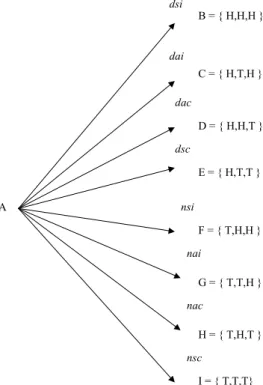
≤ξu)}; eventC, denoted by (H, T, H) corresponds to {(ζi, ηi, ηu): 0 ≤ζi ≤πi, ξi < ηi <1, 0≤ηu ≤ ξu)}; and so on through event I (Figure 1).
Figure 1 is a tree diagram for any country i and initial aggregate state si (rep-resented by point A), known at the beginning of period t. The branches of the tree indicate the probabilities that the market participants face before realization of the sunspot variables at time t. The probability of event B is specified by dsi. If this outcome occurs, the national government of country i does not default on the dollar debt and the central monetary authority declares a partial moratorium on the common—currency debt because the central government is revealed to be in favor of stabilizing output, being of the same type as the national government. The probability of outcome C is given by dai. Outcome C is similar to B, except that the shocks that reveal the central and national government types are asymmetric. The shocks are symmetric for events B, E, F and I. The remaining outcomes of Figure 1 correspond to asymmetric shocks.
All the events of Figure 1 are mutually exclusive, and given the assumption of independence between the sunspot variablesζi andηu, the summed probabilities of
outcomes B andC correspond to the probabilityπiξu; the sum of the probabilities of outcomes D and E to πi(1
− ξu); that of events F and G to (1−πi)ξu; and finally, the sum of the probabilities of the final two events equals (1 − πi)(1 − ξu). With perfect correlation between the shocks on the types of central and national governments, then the central government is willing to inflate the money anytime the national government is also willing to do so. This is the case of perfect symmetry between the shocks analyzed in this article.
By assumption, once the central government has inflated the common currency, this recourse is thereafter no longer available. In this fashion, if the events B, C,
F or G occur and the dollar debt is in the crisis zone, then there is a probability πi that a dollar debt crisis will occur in the following period. The crisis zone in this
case is denoted by (b(kni, Di),B(kπi,Di,πi,φu)]. The upper bound of this interval indicates that there was a partial moratorium on common-currency debt, given by the term φu.
In the next step to construct an equilibrium, we describe the optimal behavior of the market participants, supposing that: (i) at least two-thirds of the votes are from member countries with dollar debts in their respective crisis zones; and (ii) there has not been any external debt crisis in any of the countries of the monetary union, nor partial moratoria of common-currency debt, up to the initial state (i.e., ai−1 = 1 for alli andϑ
u
−1 = 1).
Consumers and International Bankers
The behavior of consumers of country i and of international bankers depends on their expectations regarding whether the national government will default on the dollar debt and the central government will inflate the common currency in the following period.
Consumers of Country i
We assume that consumers know ϑut, gi
t and zti when making their decisions as
to ci
t and kti+1. Additionally, we suppose that they take these variables as given
in deciding on di
t+1. Given q∗ti, Bit+1 and Dti+1, git depends only on the consumer’s
decision aboutdi
t+1, which is done at periodt and with the choice ofqti. In the next
period, givenBt+2, Dt+2 and q∗t+1, there are four possible choices for kit+2 and three
for qi
t+1, according to the realization of the sunspot variablesζ
i andηu and also on
the levels of Bi
t+2, for i = 1, . . ., I. Hence, fixing kt+2 and qit+1, the optimization
problem at time t corresponds to:
max
ci
t,kit+1,dit+1
s.t.
cit+kit+1−kti+qtidit+1 =¡1−θi¢ £ait f¡kti¢−δikit¤+ϑutdit
cit+1+kti+2−kit+1+qit+1dit+2 =¡1−θi¢ £ait+1 f¡kit+1¢−δikti+1¤+ϑut+1dit+1 cti, cit+1, kti+1, dit+1 ≥0
The first-order condition for optimal individual capital accumulation, kit+1, is the
same as in the original Cole-Kehoe model. The expression for the Cobb-Douglas output function, f(k) = Akν, is given by:
kit+1 = (·µ 1 β −1 ¶ 1 1−θi +δ i ¸ 1 Et £ ai t+1 ¤ Aiνi ) 1 νi−1 (6) The optimal capital, kti+1, depends on consumers’ expectations regarding the
pro-ductivity of the economy in the following period. The first-order condition with relation to dit+1 results in the following expression:
qti =βEt
£
ϑut+1¤
The possible values for capital accumulation are: kπiξu , kπi
, kdi and kni. If
consumers expect a dollar debt crisis to occur with probability πi(1
− ξu), they are at point A of the tree diagram in Figure 1. They choose capital kπiξu, which
is obtained by substituting the expression Et[at+1] = 1 − πi(1 − αi)(1 − ξu) in
the first-order condition (6). In addition, national creditors pay β(1 − ξu + φuξu) per common-currency bond. Even with an expectation of symmetric or asymmetric shocks, consumers chooseki
t+1equal tokπ iξu andqi t =β(1−ξ u +φuξu), because the private sector believes the probability is ξu that the central government will inflate the common money in the following period, regardless of whether the shocks on the types of governments are correlated or not. Consumers chooseki
t+1equal tokπ
i if the government undertakes a partial default on the common-currency and if they believe that the national government will suspend payment on dollar debts with probability πi in the following period. In this case, they are in one of the statesB,C,F orGof
the tree diagram. They choose ki
t+1 =kπ
i
pay βφu for common-currency bonds no matter what the new dollar debt is. From each of the outcomes B, C, F or G, there are two new branches, representing two possible events: to default or not on dollar debt. Now symmetry of shocks between the national and central governments is no longer important, because there is no longer any chance for the central government to abate the common-currency debt. The third capital stock kdi, given by E
t[at+1] = αi, is chosen if the government
defaults on dollar debt. Besides this, the consumers pay βφu per common-currency bond if there was a partial moratorium previously. Otherwise (represented by events D orE), they pay β(1− ξu +φuξu). In the period following outcomesDorE, four other events are possible, depending on the realization of the sunspot variables ηi
and ηu: inflation of the common money and symmetry of shocks, with probability si; inflation of the common currency and asymmetry of shocks, with probability ai; no inflation and symmetry, sc; and no inflation and asymmetry, ac. The sum of the probabilities si andai corresponds to ξu, and of scandac to (1 − ξu).
Finally, if consumers are certain that the government will not default on dol-lar debt in the next period, then they choose ki
t+1 equal to kni, corresponding to
Et[at+1] = 1, and pay eitherβφu orβ(1− ξu +φξu), depending on whether or not,
respectively, the central government has resorted to inflating the common currency.
International Bankers
The optimization problem of international bankers at timet corresponds to:
max xt,b1t+1,...,bIt+1 xt+βEt[xt+1] s.t. xt+qt∗1b 1 t+1+. . .+q∗ I t b I t+1 =x+z 1 tb 1 t +. . .+z I tb I t
and the first-order condition for bi t+1 is:
q∗ti =βEt
£
zti+1¤
If international bankers believe that a dollar debt crisis will occur with probability πi(1
by countryi. If the central government has undertaken a partial default in common-currency debt in the current period and external creditors believe that the national government will default the dollar debt with probability πi in the following period, they pay β(1−πi) for dollar debt. However, if the government currently defaults
on the dollar debt, then international bankers only acquire the bonds of country iif the price is zero. Finally, if external creditors are sure that the government will not resort to a dollar debt moratorium in the following period, they choose q∗ti equal to
β.
3.4
The crisis zone
Before describing the behavior of national governments, we define the crisis zone of countryiwhen the common-currency debt isfixed atDi and the inflation the central
government can impose is given by the abatement factor for common-currency debt, φu.
Crisis zone of probability πi(1
−ξu)
The lower boundbi(kni, Di, ξu
)of the crisis zone of probabilityπi(1
−ξu) is the highest dollar debt level, Bi, givenkni,Di andξu, for which the following restriction
is satisfied in equilibrium: Vniξu¡si,0,0, Di, qi¢≥Vdi¡si,0,0, Di, qi¢ (7) where si = (kni,Bi,Di, ai −1,ϑ u −1, ζ
i,ηi,ηu) is an initial state in which the national
government did not resort to a moratorium on dollar debt (ai
−1 = 1), the central
government did not undertake a partial moratorium on common-currency debt (ϑu−1
= 1), and only the realization of the sunspot variable ηu matters. The welfare
levels Vniξu
(si,0,0, Di, qi) andVdi(si,0,0, Di, qi)refer to the government decision,
respectively, not to default and to default on the dollar debt, even if it does not sell new dollar bonds at a positive price at the current period. The second and third positions of the argument of the welfare functions mean that B0i andq∗i are
zero. New debt in common currency is sold for qi equal to β(1
long as there is an expectation of inflating the common currency in the next period. Otherwise, it is sold for β.
The upper bound of the crisis zone,Bi(kπiξu
, Di, πi, ξu), is the highest level of dollar debt for which international bankers extend loans to country i, given prob-ability πi(1−ξu) of a dollar debt crisis occurring in the following period. It is calculated as the highest level of dollar debt such that the following restrictions are simultaneously satisfied in equilibrium:
Vπiξu¡si, B0i, q∗i, Di, qi¢≥Vdi¡si, B0i, q∗i, Di, qi¢ (8)
and
Vπi¡si, B0i, q∗i, Di, βφu¢≥Vdi¡si, B0i, q∗i, Di, βφu¢ (9) where the initial aggregate state of the condition (8) is now defined by si = (kπiξu
, Bi, Di, 1, 1, ζi , ηi, ηu), with ai −1 = 1, ϑ u −1 = 1, ζ i > πi, any ηi and ηu > ξu .7 The welfare levels Vπiξu (si, B0i, q∗i, Di, qi) and Vdi(si, B0i, q∗i, Di, qi) correspond to
the decision of the national government, respectively, not to declare (zi = 1) and
to declare (zi = 0) a moratorium on dollar debt, and of the central government
not to inflate the common currency (ϑu = 1). This condition guarantees that for a given initial aggregate state si = (kπiξu
, Bi, Di, 1, 1, ζi, ηi, ηu), with ζi > πi,
any ηi and ηu > ξu
, the government of country i repays its dollar debt as long as it manages to sell new dollar debt at price q∗i and new common-currency debt at
price qi, accumulating a capital stock of K0i.
Analogously, restriction (9) determines that the government of countryi prefers to honor its dollar obligations rather than resort to a moratorium, given the state si =(kπiξu
,Bi,Di,1,1,ζi, ηi,ηu), withζi
≤πi andηu
≤ξu, as long as it is able to sell new dollar debt atq∗i and new common-currency debt atβφu
. The welfare levels Vπi
(si, B0i, q∗i, Di, βφu) and Vdi(si, B0i, q∗i, Di, βφu) result, respectively, from a
decision of the national government not to default and to default on dollar debt as
7The realization of the sunspot variable ηi may take any value, because we are not making
assumptions about the correlation between ηi and ηu. This correlation is irrelevant to national
governments and international bankers, when they are taking decisions about the level of dollar debt.
the central government undertakes a partial moratorium on common-currency debt (ϑu = φu).
There is a third condition that must be satisfied to obtain the upper bound of the crisis zone. It is identical to condition (9), except that the realization of the sunspot variables areζi > πi andηu ≤ξu. Given these outcomes, the expectation of national and international creditors is that the national government will not default on the dollar debt and the central government will inflate the common currency (zi
= 1 and ϑu = φu). Based on this belief, they buy dollar debt for β(1 − πi) and
common-currency debt for βφu. The optimal new dollar debt also has to satisfy the condition that the welfare of not defaulting is greater than defaulting. This is the cost for country ito join a monetary union. Unfavorable realizations of the sunspot variablesζi for the majority of countries can lead the central government to resort to a partial moratorium of common-currency debt even if the external sector of country i is not in any difficulty.
Crisis zone of probability πi after inflation
It is possible to define a crisis zone of probabilityπi, denoted by (bi(kni, Di,φu
), Bi(kπi
, Di, πi, φu)]. The lower bound is similar to that calculated by condition (7),
assuming there was abatement of common-currency debt. Calculation of the upper bound considers, besides this assumption, that the national government prefers not to default on dollar debt, given that it sells B0i at positive priceq∗i andDi at price
βφu. We thus obtainBi(kπi
, Di, πi,φu) as the highest level ofBi, given the initial aggregate state si = (kπi , Bi, Di, 1, φu, ζi, ·, ·), withai −1 = 1, ϑ u −1 = φ u, ζi > πi,
and any ηi andηu, that satisfy the following restriction:
Vπi¡si, B0i, q∗i, Di, βφu¢≥Vd¡si, B0i, q∗i, Di, βφu¢ (10)
where Vπi
(si, B0i, q∗i, Di, βφu) and Vd(si, B0i, q∗i,Di, βφu) refer to the welfare
levels of national government i when it decides, respectively, not to default and to default on dollar debt.