NASA DESK GUIDE
FOR
SUITABILITY AND SECURITY CLEARANCE
PROCESSING
Version 2
Agency Human Resources Division NASA Headquarters SREF-3000-0003 January 2008
Document History Log
Status (Basic/Revision
/Cancelled)
Revision
Date Description of Change
Basic 12/20/06 Basic Release
Revision (Version 2)
1/7/08 Changes Incorporated into Version 2: • Added Document History Log.
• Section 2, References: updated with new references. • Paragraph 3.1, New Hire Process – Up to Submission
of Investigative E-form Procedures: added new information to the Important note box.
• Paragraph 4.2, HSPD-12 Responsibilities: added information for Requestor and for PIV Representative. • Section 7, National Security Clearance Level
Determination: added note box with information on new policy regarding professional development for security personnel.
• Section 9, Background Investigation Level
Determination: added an explanation that some of the charts used in this section, from NPR 1600.1, are being updated, but the corrected information is provided in this document.
• Figure 9-02, Background Investigation Levels with National Security Requirements: updated chart. • Figure 9-03, Background Reinvestigation Levels with
National Security Requirements: updated chart. • Section 11, Suitability Adjudication: added appeal
information.
• Appendix C, Step-by-Step Suitability Determination Instructions: replaced all Suitability Adjudication Worksheet screen shots with new screen shots for NASA Form 1761, Suitability Adjudication Worksheet. • Appendix D, Standard Suitability Adjudication
Worksheet: replaced screen shots with new NASA Form 1761 screen shots.
• Attachment 3, Personal Identification Verification (PIV) Card Issuer (PCI) Procedures: replaced with new directive.
TABLE OF CONTENTS Page SECTION 1 INTRODUCTION...9 1.1 Purpose ...9 1.2 Background ...9 1.3 Applicability ...9
1.4 About this Document...9
SECTION 2 REFERENCES...10
SECTION 3 PROCESS OVERVIEW...12
3.1 New Hire Process – Up to Submission of Investigative E-form Procedures...15
3.2 Suitability/Security Adjudication Procedures ...17
SECTION 4 RESPONSIBILITIES...18
4.1 General Responsibilities ...18
4.2 HSPD-12 Responsibilities...19
SECTION 5 DOCUMENTING NATIONAL SECURITY AND PUBLIC TRUST DESIGNATIONS ...21
SECTION 6 POSITION RISK FACTORS...22
6.1 Position Risk Designations ...22
6.2 Mission Critical Space System Personnel Reliability Program (MCSSPRP) ...23
6.3 IT Position Risk Designations...24
SECTION 7 NATIONAL SECURITY CLEARANCE LEVEL DETERMINATION...27
7.1 Special-Sensitive (SS) ...27
7.2 Critical-Sensitive (CS) ...28
7.3 Noncritical-Sensitive (NCS)...28
SECTION 8 CODING OF POSITION SENSITIVITY LEVEL DESIGNATION FOR NATIONAL SECURITY POSITIONS ...29
8.1 Special-Sensitive (SS) ...29
8.2 Critical-Sensitive (CS) ...30
8.3 Noncritical-Sensitive (NCS)...30
SECTION 9 BACKGROUND INVESTIGATION LEVEL DETERMINATION ...31
9.1 Background Investigation Levels – No National Security Requirements ...31
9.2 Background Investigation Levels – National Security Requirements ...32
Page
SECTION 10 E-QIP ...35
SECTION 11 SUITABILITY ADJUDICATION ...36
APPENDICES APPENDIX A ACRONYMS AND ABBREVIATIONS ...37
APPENDIX B POSITION RISK DESIGNATION STEP-BY-STEP INSTRUCTIONS...39
APPENDIX C STEP-BY-STEP SUITABILITY DETERMINATION INSTRUCTIONS...51
APPENDIX D STANDARD SUITABILITY ADJUDICATION WORKSHEET ...55
ATTACHMENTS ATTACHMENT 1 OFFICE OF PERSONNEL MANAGEMENT SUITABILITY GUIDELINES CHART...57
ATTACHMENT 2 OFFICE OF PERSONNEL MANAGEMENT ISSUE CHARACTERIZATION CHART ...63
ATTACHMENT 3 PERSONAL IDENTIFICATION VERIFICATION (PIV) CARD ISSUER (PCI) PROCEDURES...71
LIST OF FIGURES Figure 3-01 Suitability and Security Clearance Process Flow Chart – Part 1...13
3-02 Suitability and Security Clearance Process Flow Chart – Part 2...14
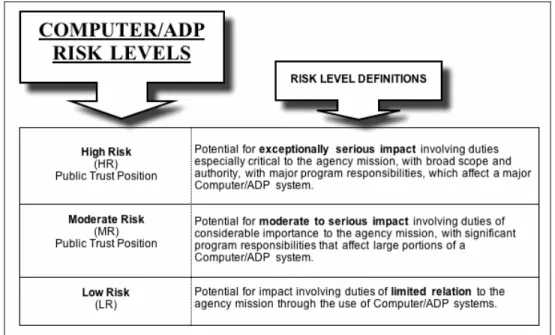
6-01 Computer/ADP Risk Levels and Definitions...26
9-01 Background Investigation Levels with No National Security Requirements ...31
9-02 Background Investigation Levels with National Security Requirements ...32
9-03 Background Reinvestigation Levels with National Security Requirements ...32
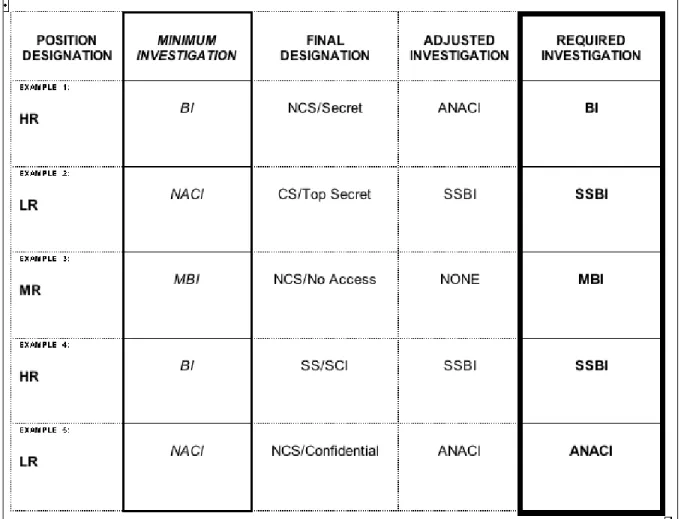
9-04 Examples of Background Investigation Levels Required...34
Figure Page
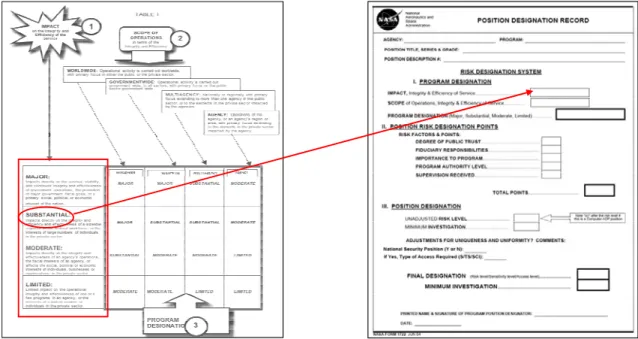
B-02 Table to Identify Impact Level and Location to Record...40
B-03 Table to Identify Scope of Operations and Location to Record...40
B-04 Table to Identify Program Designation and Location to Record ...41
B-05 Table to Identify Risk Points and Location to Record ...41
B-06 Table to Identify Risk Level and Investigation and Location to Record ...42
B-07 Uniqueness and Uniformity Descriptions...43
B-08 Location of Uniqueness and Uniformity Comments...44
B-09 Location of National Security and Access Type Designations...45
B-10 National Security Levels and Location of Comments Area...46
B-11 Computer/ADP Levels and Location of Comments Area...47
B-12 Examples of Position Designations and Related Investigations ...48
B-13 Location of Final Designation and Minimum Investigation Fields ...49
B-14 Location of Signature and Date Lines...50
C-01 Suitability Adjudication Worksheet Header Area ...51
C-02 Derogatory Information Example ...52
C-03 Applicant Suitability Example...52
SECTION 1 – INTRODUCTION 1.1 Purpose
The purpose of this desk guide is to provide guidance to National Aeronautics and Space
Administration (NASA) Center Human Resources Offices (HROs) with regards to the HRO role in Suitability and Security Clearance processing. This guide enables NASA Center HROs to ensure the following:
1. Consistency when determining risk designations and security clearance levels for NASA positions.
2. Appropriate background investigations are conducted.
3. Consistency when determining suitability for Federal employment.
1.2 Background
The need for this guide has increased as the rules and procedures for determining suitability and security issues have become more defined. In addition, Homeland Security Presidential Directive (HSPD)-12, Policy for a Common Identification Standard for Federal Employees and Contractors, directs that all Government agencies enhance facility and information system security. This guide was developed with Center participation to provide HRO personnel with a complete understanding of security and suitability as these issues relate to the Human Resources (HR) processes.
1.3 Applicability
This desk guide is for use by NASA Center HRO personnel. While other departments may be mentioned, the instructions and procedures are specifically meant for HRO personnel.
1.4 About this Document
This document is a compilation of regulations, processes, and other information HRO personnel can use in suitability and security clearance processing. Throughout this desk guide, there are references to helpful documents and additional information. If the reader is directed to an appendix or attachment, the reader should reference appendices or attachments included with this document, unless another document is specified. The following appendices and attachments are included in this document:
• Appendix A, Acronyms and Abbreviations
• Appendix B, Position Risk Designation Step-By-Step Instructions
• Appendix C, Step-By-Step Suitability Determination Instructions
• Appendix D, Standard Suitability Adjudication Worksheet
• Attachment 1, Office of Personnel Management Suitability Guidelines Chart
• Attachment 2, Office of Personnel Management Issue Characterization Chart
SECTION 2 – REFERENCES
Various regulations govern suitability and security clearances. The following references were used in the preparation of this desk guide:
a. 5 Code of Federal Regulations (CFR) Part 731: Suitability b. 5 CFR Part 732: National Security Positions
c. Executive Order 10450: Security Requirements for Government Employees d. Executive Order 12968: Access to Classified Information
e. Executive Order 13434: National Security Professional Development
f. Federal Information Processing Standards (FIPS) Publication (PUB) 201: Personal Identity Verification (PIV) of Federal Employees and Contractors, March 2006 g. Homeland Security Presidential Directive (HSPD)-12, Policy for a Common
Identification Standard for Federal Employees and Contractors h. NASA Form 1761, Suitability Adjudication Worksheet
i. NASA Interim Directive (NID) (NPR-1600.1): Personal Identity Verification Policy and Procedures, NM 1600-52
j. NASA Procedural Requirements (NPR) 1600.1, NASA Security Program Procedural Requirements
k. Office of Human Capital Management (OHCM) Personnel Bulletin: 2004-32-VS, Human Resources – Security Project, October 26, 2004
l. OHCM Personnel Bulletin: 2005-06-VS, Status of Human Resources – Security Project, March 21, 2005
m. OHCM Personnel Bulletin: 2005-09-VS, Security Metrics, April 14, 2005
n. OHCM Personnel Bulletin: 2005-22-VS, Personnel Security and Suitability, July 14, 2005
o. OHCM Personnel Bulletin: 2005-39-VS, Review of Established and Occupied Position, November 29, 2005
p. OHCM Personnel Bulletin: 2005-45-CS, Personal Identity Verification (PIV) Card Issuance Procedures, December 16, 2005
q. OHCM Personnel Bulletin: 2006-15-CS, Personnel Security Issues, Updates, and Reminders, March 20, 2006
r. Office of Security and Program Protection memo: Clarification regarding NIST FIPS 199 System Security Category Determination and OPM Position Risk Level
SECTION 3 – PROCESS OVERVIEW
This section contains the process flow charts for submission of investigative e-forms and suitability and security adjudication. Following the flow charts, specific procedures and additional information are included.
The charts in this section are intended to show the suitability and security clearance process for new
NASA Civil Servant employees only. Reinvestigations will be tracked and initiated by the Security Office. If derogatory information is discovered during an investigation, the investigation results will be forwarded to HR for suitability adjudication. Instructions and a worksheet to help with the suitability adjudication can be found in Appendix C, Step-By-Step Suitability Determination Instructions, and Appendix D, Standard Suitability Adjudication Worksheet.
Note: To continually improve the suitability and security clearance process and comply with all regulations, these procedures may change. If they do, you will be notified. All notifications and updates should be kept with this desk guide to reference as needed.
These procedures are recommended and were developed to reduce the length of time required for suitability and security clearance processing, as well as to reduce the number of times the
investigative process changes hands between HRO and the Security Office. Ultimately, it is incumbent upon each Center HRO to work out a specific arrangement with the Center Security Office. The primary HRO concerns are as follows:
1. Form 1722 on positions are to be completed by HRO.
2. Applicant information is entered into the Workforce Transformation Tracking System (WTTS).
ROI is returned to NASA from OPM If no security clearance needed, ROI is sent to Center Security Office Center Security Office receives ROI HR takes steps to remove employee or find a position
that does not require a security
clearance
Center Security Office reviews ROI
Derogatory information? Security Office forwards ROI to HRO HR conducts final suitability adjudication Security notifies HR of clean ROI HR finds employee suitable Employee Suitable? HR takes steps to remove employee HR notifies OPM of suitability determination Suitability/Security Adjudication End End HR Returns ROI to Security Office 90-day Window Yes Yes No Yes No No Yes OPM Review Concludes Responsibilities
HRO Supervisor CAF Security Office Applicant
Security Clearance required? No If security clearance is needed, ROI is received by CAF CAF adjudicates for security clearance Adjudication successful?
CAF sends ROI to Center Security Office CAF notifies Center HRO of unsuccessful security clearance adjudication OPM notified of unfavorable adjudication 30-day Window Resume here if HR ordered copies of ROI
These procedures encompass the flow charts in this section and include additional information and explanation on the process. Notice that these procedures are separated into two sections according to the separation of the flow charts. In some of the steps, additional background or explanatory information is provided in italics.
3.1 New Hire Process – Up to Submission of Investigative E-form Procedures
1. Supervisor initiates a request to fill the position and creates a Position Description (PD). 2. Supervisor reviews the Program and PD and makes an initial Security Clearance and Position
Risk Level determination.
3. HR Reviews the Program and PD; finalizes the Position Risk Designation and Security Clearance Level in coordination with the Supervisor. The NASA FM 1722 is in the process of being automated. It is anticipated that this information will flow automatically from WTTS into IdMAX, the new badging system.
4. The vacancy is advertised; a selection is made; and a letter is sent to the applicant stating employment is contingent upon favorable adjudication for suitability and, if necessary, a security clearance.
5. HR updates WTTS. As part of the new HSPD-12-compliant credentialing process, the HRO will take on the role of Sponsor for new employees. This role requires applicant information to be entered into the IdMAX system. If WTTS is being updated and used to its full capability, the transfer of information from WTTS to IdMAX will be completely hands off, eliminating the need for the HR Specialist to log into a separate system to enter applicant information. Because IdMAX is used to verify identity of an individual, it is imperative that applicant information be entered correctly and completely. For example, the full first name of the applicant must be entered into the first name field. Security cannot accurately verify identity with only the first initial. The name entered into WTTS must match the name presented on the I-9 documents.
6. HR determines if the applicant has an applicable Background Investigation on file with the Office of Personnel Management (OPM). A check is made via the OPM database. NASA must follow the principles of reciprocity. Your office must get access to the Personnel Investigation Processing System (PIPS) to see if an investigation is on file for an applicant. If an applicant has a background investigation on file that is of the correct level for the vacancy for which they applied, the HRO can contact the losing agency to determine reciprocity or NASA can request a copy of the results from OPM rather than pay for a new investigation. This could lead to a substantial cost savings for the Agency.
7. Is there an applicable Background Investigation on file?
a. If no, HR initiates Electronic Questionnaires for Investigations Processing (e-QIP) for the applicant. Proceed to step 8.
b. If yes, HR orders copies of the Report of Investigation (ROI). Proceed to step 9. 8. Applicant fills out investigative e-form in e-QIP.
9. Applicant provides two forms of identification.
10. HR verifies citizenship. The applicant name that is entered into WTTS must match the I-9 documents that are used to verify citizenship. If the documents and WTTS do not match, Security will not be able to validate the applicant’s identity and the applicant therefore will not be able to receive a badge.
11. Security fingerprints the applicant and verifies identity based on I-9 documentation. 12. Security sends fingerprint results to HR for initial suitability determination. HR will need to
electronically attach the fingerprint results to the investigative e-form to submit to OPM.
13. HR makes initial suitability determination based on initial review of investigative e-form, results from fingerprints, and Official Form (OF) 306. An applicant does not become an employee
until Entrance on Duty (EOD). Therefore, if the applicant is not suitable for Federal employment based on the initial suitability determination, the offer is rescinded.
14. Is the initial suitability determination favorable?
a. If no, the offer is rescinded and the applicant’s process ends. b. If yes, EOD.
Important: EOD is the beginning of a 14-day window to complete the
remaining steps in this part of the process. HR must submit investigative e-form to OPM within 14 days of EOD.
Pre-appointment waiver rules include the following:
a. Prior to completion of the required pre-appointment investigation, if clear justification exists to warrant a waiver, it may be authorized by Center Directors and the Assistant Administrator for Security and Program Protection to approve an emergency appointment or reassignment to a Critical-Sensitive or Noncritical-Sensitive position.
b. Special-Sensitive positions must complete pre-appointment investigation. Pre-appointment investigation requirements shall NOT be waived for positions designated as Special-Sensitive.
c. Critical-Sensitive positions need a waiver.
d. Noncritical positions do not have to have a waiver.
15. Has HR ordered copies of the ROI from OPM for a Background Investigation on file? a. If yes, skip to paragraph 3.2, Suitability/Security Adjudication Procedures. b. If no, HR reviews investigative e-form for completeness.
16. Is a Security Clearance needed?
a. If yes, HR codes the investigative e-form so the Central Adjudication Facility (CAF) receives the ROI. Proceed to step 17. The CAF is held to a 30-day window for
adjudication and any delays by improper coding could result in disciplinary action against NASA by OPM.
b. If no, HR codes investigative e-form so Center Security Office receives the ROI. Proceed to step 17.
17. HR submits investigative e-form to OPM. Proceed to paragraph 3.2, Suitability/Security Adjudication Procedures.
3.2 Suitability/Security Adjudication Procedures
Important: The Suitability Adjudication part of the process can take no more than 90 days. In addition, if a Security Clearance is required, the CAF portion of the process can take no more than 30 of the 90 days.
1. ROI is returned to NASA from OPM. 2. Is a Security Clearance required?
a. If yes, proceed to step 3. b. If no, proceed to step 7. 3. CAF receives the ROI.
4. CAF adjudicates for security clearance. 5. Is the adjudication successful?
a. If yes, CAF sends the ROI to the Center Security Office. Then proceed to step 8. b. If no, CAF notifies the Center HRO of unsuccessful security clearance adjudication
and CAF notifies OPM of unfavorable adjudication. Then proceed to step 6. 6. If CAF notifies HRO of unsuccessful adjudication, HR takes steps to remove the employee
or find a position that does not require a security clearance. This process ends.
7. If no Security Clearance is required (per step 2 above), the ROI is sent to the Center Security Office.
8. The Center Security Office receives the ROI. 9. The Center Security Office reviews the ROI. 10. Is there derogatory information?
a. If yes, the Security Office forwards the ROI to HRO. Then proceed to step 11. b. If no, Security notifies HR of a clean ROI. Then proceed to step 13.
11. HR conducts the final suitability adjudication. 12. Is the employee suitable?
a. If yes, proceed to step 13.
b. If no, HR takes steps to remove the employee. Then proceed to step 14. 13. HR finds the employee suitable.
14. HR notifies OPM of suitability determination. 15. HR returns ROI to Security Office.
SECTION 4 – RESPONSIBILITIES 4.1 General Responsibilities
The information contained in this section is taken from the Personnel Bulletins as listed in Section 2, References. The information extracted pertains to requirements as they relate to HROs.
No personnel actions associated with recruitment, hiring, or position change shall take place without the appropriate prior assignment of position risk designation and position sensitivity level.
No individual shall be issued a permanent NASA Civil Servant employee photo identification (ID) without, at a minimum, appropriate establishment of position sensitivity, risk designation,
submission of required investigative e-form, and an initial favorable suitability determination. As part of the in-processing function for new employees, each Center HRO is responsible for:
1. Completing, reviewing, and submitting investigative e-form in a timely manner.
2. Providing, at the earliest possible time but no later than two (2) working days prior to EOD, the following information on each prospective employee to Security:
• Name
• Date of birth
• Place of birth (city, state, country)
• Social Security Number (SSN)
Security will conduct an initial investigation (e.g., fingerprints) and, if any derogatory information is found, Security will forward the results to HRO to make an initial suitability determination. In unusual cases where it is not possible to provide such information within that time frame, the HRO will coordinate with Security to explain the circumstances and provide the information as quickly as possible.
3. Using e-QIP to the maximum extent possible. All Standard Form (SF) 85, SF 85P, and SF 86 questionnaires shall be completed in e-QIP. HROs will have a Submitting Office Number (SON). Please confirm that your office already has a SON. If not, PIPS Form 12 should be submitted to OPM to obtain one. HROs are assigned a SON by OPM to enable electronic submission of investigative forms and allow HRO personnel to inquire about case status. At this time, PIPS Form 12 is available at the OPM e-QIP portal under the title,
PIPS on the Portal. The completed form must be faxed.
4. Advising all new employees who do not indicate prior Federal service, at the time the offer of employment is made, on completing the appropriate investigative e-form.
5. Completing SF 75 for employees with prior Federal service to determine if the individual’s current level of investigation is sufficient to meet the requirements of the position. If so, no additional investigative e-form needs to be generated; if not, appropriate e-form must be initiated.
6. Ensuring background investigations done by other agencies are accepted if they are of the appropriate level for the position, under the principles of reciprocity.
7. Assuring that new employees, or employees whose security requirements have changed, submit the appropriate investigative e-form.
8. Monitoring progress on completion of investigative e-form. Ideally, new employees will complete the e-form on or before EOD. In all but the most unusual circumstances, e-form
may be completed after EOD but must be completed in sufficient time to be reviewed and submitted to OPM within 14 days of EOD, as required by the CFR.
9. Ensuring that investigation level matches position requirements.
10. Reviewing completed e-form for any initial “red flags,” and consulting with Security personnel as necessary.
11. Ensuring that investigative e-form is coded correctly to ensure that the ROI is returned to the appropriate office (i.e., CAF or Center Security Office).
12. Transmitting investigative e-form to OPM.
13. Making suitability determinations in coordination with the selecting official. Where a manager makes a decision not in accordance with HR recommendations, the HR specialist will document the circumstances.
14. Ensuring that form 79A is completed with the notification of the adjudication determination and returned to OPM.
4.2 HSPD-12 Responsibilities
The HSPD-12 directive that was signed by President George W. Bush mandates that each Federal Agency take more precautions in ensuring the safety of physical and logical assets. FIPS 201 specifically outlines the steps that each Agency must take to comply with HSPD-12. The process will verify the identity of all persons who access NASA facilities or systems and has several “touch points” with HR:
• Position Risk Designations
• Background Investigations
• Federal Employment Suitability Determinations
o Initial Suitability
o Final Suitability
• New Hire Sponsor Role
NID (NPR-1600.1), Personal Identity Verification (PIV) Policy and Procedures, NM 1600-52, provides specific information on processes, roles, and responsibilities relating to NASA issuing federal credentials. The following roles and responsibilities were compiled from the NID, as well as other applicable sources, and summarize the responsibilities for HSPD-12 personnel.
Position Risk Designations – HSPD-12 mandates that, at a minimum, each Federal employee will have a National Agency Check and Inquiries (NACI) background investigation done. However, many NASA programs and projects have positions that warrant a higher level of background investigation. To ensure that NASA employees are investigated at the appropriate level, a Position Risk Designation must be determined and NASA Form (NF) 1722 should be on file to validate the designation. Each position must be reviewed to ensure that the correct level of background investigation has been done on the employee holding that position. For New Hires, this process should be completed prior to the vacancy being advertised.
Background Investigations – Once the correct level of background investigation is determined by the Position Risk Designation for New Hires or position changes, the HRO is responsible for the timely completion and submission of investigative e-form to OPM via the e-QIP system. This will require the HRO to have a SON.
Federal Employment Suitability Determination – The HRO has the responsibility to adjudicate each New Hire for Federal Employment Suitability. This includes an initial suitability determination prior to EOD, which is made with limited information, and the final suitability determination, which is made using the Report of Investigation from OPM.
Requestor – This individual is authorized to create the initial request for an applicant to receive a badge and to perform the initial entry of the applicant’s demographic data into the system for the PIV badge request. The Requestor for NASA employees is the HRO, for contractors is the contractor organization, and for grantees is the grant provider. The Requestor may also be the Sponsor, but may not be the Enrollment Official, Issuance Official, or PIV Authorizer.
New Hire Sponsor Role – In working with the HSPD-12 Implementation team, the HRO has been designated the “Sponsor” for New Hires. As defined in FIPS 201, the Sponsor is the person who “requests the issuance of a PIV credential to the Applicant.” As Sponsors, the HRO will need to ensure that all necessary information is entered into WTTS. The data flow from WTTS into the new badging system, IdMAX, will start the badging process by supplying Security with needed information.
PIV Card Applicant Representative– In working with HSPD-12, an HR Specialist or Contracting Officers Technical Representative (COTR) acts as a Point of Contact (POC) for applicants in
adhering to processes, providing documents, and obtaining badges. This position is also responsible for adhering to all applicable procedures and directives, is responsible for protecting personal
privacy of all applicants, and acts as a POC for applicants denied a badge due to missing or incorrect information. In addition, this position may act on behalf of an applicant who is not available for performing required actions.
SECTION 5 – DOCUMENTING NATIONAL SECURITY AND PUBLIC TRUST DESIGNATIONS
Effective March 21, 2005, National Security and public trust designations are to be documented on NF 1722, NASA Position Designation Record. Centers may add supplemental information to the basic designation record as they deem necessary. Refer to NPR 1600.1, NASA Security Program Procedural Requirements, for additional information.
SECTION 6 – POSITION RISK FACTORS
Position Risk Designations determine the level of background investigation required for a person to hold a position. However, even if the Position Risk Designation is set at one risk level, if the
position requires access to information or a facility that falls under National Security, the designation may be increased. Additionally, if other position factors such as Computer Category Positions are applicable, the designation may be increased. This section provides information on the various Position Risk Designations.
The information contained in this section is taken from NPR 1600.1, NASA Security Program Procedural Requirements. The information extracted pertains to requirements as they relate to HROs. Refer to NPR 1600.1, NASA Security Program Procedural Requirements, for additional information.
6.1 Position Risk Designations
Each position will be designated at a High, Moderate, or Low risk level depending on the position’s potential for adverse impact to the integrity and efficiency of the Agency (5 CFR 731.106). The Center HRO, in coordination with the supervisor, is responsible for making these risk
determinations. Any High Risk or Moderate Risk position is also considered to be a Public Trust position. The process for making risk determinations is outlined in Appendix M of NPR 1600.1, NASA Security Program Procedural Requirements. Refer to Appendix B, Position Risk Designation Step-By-Step Instructions.
Note: If an employee is working part time in more than one position, the higher level Position Risk Designation takes precedence when determining the
appropriate level of background investigation.
There are three levels of risk: High Risk (HR), Moderate Risk (MR), and Low Risk (LR).
1. High Risk (HR): A position that has potential for exceptionally serious impact involving duties especially critical to the Agency or a program mission of the Agency with broad scope of policy or program authority such as:
a. Policy development and implementation; b. Higher level management assignments;
c. Independent spokespersons or non-management positions with authority for independent action;
d. Significant involvement in life-critical or mission-critical systems; or
e. Relatively high risk assignments associated with or directly involving the accounting, disbursement, or authorization of disbursement from systems of dollar amounts of $10 million per year or greater, or lesser amounts if the activities of the individual are not subject to technical review by higher authority to ensure the integrity of the system.
f. Positions in which the incumbent is responsible for the planning, direction, and implementation of a computer security program; has a major responsibility for the direction and control of risk analysis and/or threat assessment, planning, and design of the computer system, including the hardware and software; or, can access a system during the operation or maintenance in such a way, and with the relatively high risk for causing grave damage or realize a significant personal gain.
2. Moderate Risk (MR): A position that has the potential for moderate to serious impact involving duties of considerable importance to the Agency or a program mission of the Agency with significant program responsibilities and delivery of customer services to the public such as:
a. Assistants to policy development and implementation; b. Mid-level management assignments;
c. Non-management positions with authority for independent or semi-independent action;
d. Delivery of service positions that demand public confidence or trust; or e. Positions with responsibility for the direction, planning, design, operation, or
maintenance of a computer system and whose work is technically reviewed by a higher authority at the high risk level to ensure the integrity of the system. Such positions may include but are not limited to:
1) Access to and/or processing of proprietary data, Privacy Act of 1974, and Government-developed privileged information involving the award of contracts;
2) Accounting, disbursement, or authorization for disbursement from systems of dollar amounts of less than $10 million per year; or
3) Other positions as designated by the Agency head that involve degree of access to a system that creates a significant potential for damage or personal gain less than that in high risk positions.
3. Low Risk (LR): Positions that have the potential for impact involving duties of limited relation to the Agency mission with program responsibilities which affect the efficiency of the service. It also refers to those positions that do not fall within the definition of a high or moderate risk position.
6.2 Mission Critical Space System Personnel Reliability Program (MCSSPRP)
If a position allows access to any mission-critical areas or is located in a mission-critical area, the position is categorized as Personnel Reliability Program (PRP). If the position also has access to National Security information, a security clearance may also be required. Refer to Section 8, Coding of Position Sensitivity Level Designation for National Security Positions, for additional information.
1. Those personnel occupying positions that involve unescorted access to mission-critical space systems areas, mission data, or mission-specific Information Technology (IT) systems
including those activities related to access to and/or manipulation of command and control systems of all NASA space-assets (e.g., shuttle, International Space Station (ISS), NASA satellites, other exploration vehicles, etc.) where inappropriate actions could result in damage and/or loss of the asset and/or critical data, or result in the loss of life and/or serious injury. 2. Persons requiring unescorted access to Mission Essential Infrastructure (MEI) assets will be
6.3 IT Position Risk Designations
If a position allows access to certain IT functions, the Position Risk Designation may be raised. Positions that are designated at the Moderate or High risk levels are deemed to be Public Trust positions.
Note: If an employee is working part time in more than one position, the higher level Position Risk Designation takes precedence when determining the
appropriate level of background investigation.
Descriptions of the three IT positions are as follows:
IT-1 Position - Any IT position whose duties, responsibilities, and authorities involve accessing information or system controls that if misused can reasonably be expected to cause exceptionally serious adverse impact.
IT-2 Position - Any IT position whose duties, responsibilities, and authorities involve accessing information or systems that if misused can reasonably be expected to cause serious adverse impact or allow for great personal gain.
IT-3 Position - Any other IT position whose duties, responsibilities, and authorities involve accessing information that if misused could reasonably be expected to have minimum adverse impact on the Agency’s mission.
Position risk-level determinations are inclusive of many factors, IT positions and/or access being an important factor. Provided below are categories of IT positions and/or specific duties that may influence the risk-level designation for each individual position.
1. In accordance with the Federal Information Systems Management Act (FISMA), the Office of Management and Budget (OMB) Circular A-130, and NPR 2810.1, NASA has established requirements and procedures to assure an adequate level of protection for NASA IT
systems, which includes the appropriate security screening of all individuals having access to NASA IT systems:
a. HIGH RISK or 6C positions include positions in which the incumbent is responsible for planning, directing, and implementing a computer security program; has major responsibility for directing, planning, and designing an IT system, including the hardware and software; or, can access a system with relatively high risk for causing grave damage or realizing a significant personal gain. High risk IT positions may include positions, which involve the following:
1) Development or administering Agency IT Security Programs, directing,
controlling IT risk analysis and threat assessments, or conducting investigations; 2) Significant involvement in life-critical or mission-critical systems; (See section
3.5.6 [of the NPR 1600.1, NASA Security Program Procedural Requirements] for further requirements);
4) Access to data or systems whose misuse can cause very serious adverse impact or result in significant personal gain; or
5) Assignments involving accounting, disbursement, or authorization of $10 million or more per year.
b. MODERATE RISK or 5C positions include positions where the incumbent is
responsible for directing, planning, designing, operating, or maintaining IT systems and whose work is technically reviewed by a higher authority (at the high risk level) to ensure the integrity of the system: Moderate risk IT positions may involve:
1) Systems design, operation, testing maintenance or monitoring which is under technical review of IT-1 and includes:
a. Those that contain the primary copy of data whose cost to replace exceeds $1 million dollars;
b. Those that control systems which affect personal safety and/or physical security, fire, or Hazmat warning safety systems;
c. Privileged information on contract awards in excess of $10 million dollars; or
d. Accounting disbursement or authorization of more than $1 million dollars but less than $10 million dollars per year.
2) Access to data or systems whose misuse can cause serious adverse impact or result in personal gain, which includes but is not limited to:
a. Proprietary data;
b. Privacy Act protected information; or
c. Export Control Regulation, International Traffic in Arms Regulations (ITAR), and the Militarily Critical Technologies List (MCTL)
information.
3) Limited privileged access to NASA IT Systems designated as Moderate Risk systems.
c. LOW RISK or 1C positions are all IT system positions that do not fall in the categories above and includes all non-sensitive positions and all other positions involving IT Systems whose misuse has limited potential for adverse impact or sensitive data is protected with password and encryption. Low risk IT positions may involve:
1) General word processing; or
2) Systems containing no IT-1 or IT-2 level information or IT-1 or IT-2 level information that is protected from unauthorized access.
2. Specific requirements and criteria for designating Computer/Automated Data Processing (ADP) risk levels are contained in NPR 1600.1, Appendix M, Designation of Public Trust Positions and Investigation Requirements.
The following figure may help in determining the appropriate Computer/ADP risk levels:
SECTION 7 – NATIONAL SECURITY CLEARANCE LEVEL DETERMINATION
National security clearance levels are determined based on the level of access needed to classified information. After determining which sensitivity level the particular position requires, refer to Section 8, Coding of Position Sensitivity Level Designation for National Security Positions, to determine what level of background investigation needs to be conducted.
The information contained in this section is taken from NPR 1600.1, NASA Security Program Procedural Requirements. The information extracted pertains to requirements as they relate to HROs. Refer to NPR 1600.1, NASA Security Program Procedural Requirements, for additional information.
Overview
Some positions at NASA will require the employee to obtain and maintain a Security Clearance. The determination of the need for a Security Clearance and the subsequent level of clearance will be made by the supervisor. HRO personnel are responsible for ensuring the appropriate background investigation is ordered based on position requirements.
Note: A recent change was published requiring professional development for persons in national security positions. The policy, requirements, and
responsibilities can be found in Executive Order 13434: National Security Professional Development.
All positions with National Security duties and responsibilities must have a sensitivity-level designation to ensure the appropriate level of investigative screening is done to comply with Executive Order 10450: Security Requirements for Government Employees and Executive Order 12968: Access to Classified Information. As stated in 5 CFR Part 732, a sensitive position is defined as “…any position within a department or agency the occupant of which could bring about, by virtue of the nature of the position, a material adverse effect on the National Security.”
Consequently, sensitivity level designation is based on an assessment of the degree of damage that an individual could cause to National Security. Apply the sensitivity levels described in this part as an Adjustment in the Risk Designation System to arrive at a final designation. There are three sensitivity levels: Special-Sensitive, Critical-Sensitive, Noncritical-Sensitive. They are defined in the following paragraphs.
7.1 Special-Sensitive (SS)
A Special-Sensitive position is any position that the NASA Administrator determines to be at a higher level than Critical-Sensitive due to special requirements that complement E.O. 10450 and E.O. 12698 (such as Director of Central Intelligence Directive [DCID] 6/4 that sets investigative requirements and access to Sensitive Compartmented Information [SCI] and other
7.2 Critical-Sensitive (CS)
A Critical-Sensitive position is any position with potential for exceptional or grave damage to the National Security. Critical-Sensitive positions involve any of the following:
• Access to Top Secret classified information;
• Development or approval of war plans, or plans or particulars of future, major, or special operations of war, or critical and extremely important items of war;
• National Security policy-making or policy-determining positions;
• Investigative duties;
• Issuance of personnel security clearances;
• Duty on personnel security boards; and
• Any other positions related to National Security requiring the same degree of trust.
7.3 Noncritical-Sensitive (NCS)
A Noncritical-Sensitive position is any position with potential for significant or serious damage to the National Security. Noncritical-Sensitive positions involve any of the following:
• Access to Secret or Confidential classified information, or
• Duties that may directly or indirectly adversely affect the National Security operations of the agency or the government.
Note: The designation of Non-Sensitive is not shown in the table [Figure 9-04, Examples of Background Investigation Levels Required] because a
Non-Sensitive position is the same as a Low Risk position; both require the same level of investigation: a NACI.
Sensitivity level designations override Public Trust (i.e., HR and MR) designations due to the
national interest or security. However, the basic risk level of a position needs to be determined first. If National Security duties and responsibilities are no longer a part of a position, the position reverts to its Public Trust designation. Additionally, if the Public Trust risk level designation requires a higher level of investigation than the National Security sensitivity level, the higher level of investigation must be conducted. For example, if the basic position description is HR, but the position requires Secret access, the position would have an adjusted designation of
Noncritical-Sensitive because of the Secret access. The investigation required would be a
Background Investigation (BI) for the HR position, and not an Access National Agency Check with Inquiries (ANACI) for the Noncritical-Sensitive designation due to Secret access. The higher level of investigation prevails because of the more intensive screening required of an HR position, a BI investigation being a higher level of investigation than an ANACI.
SECTION 8 – CODING OF POSITION SENSITIVITY LEVEL DESIGNATION FOR NATIONAL SECURITY POSITIONS
After using Section 7, National Security Clearance Level Determination, to determine which sensitivity level the particular position requires, use this section to determine what level of background investigation needs to be conducted. For instance, if the position is defined as in paragraph 7.2, Critical-Sensitive, the level of background investigation required can be found in paragraph 8.2, Critical-Sensitive.
The information contained in this section is taken from NPR 1600.1, NASA Security Program Procedural Requirements. The information extracted pertains to requirements as they relate to HROs. Refer to NPR 1600.1, NASA Security Program Procedural Requirements, for additional information.
Overview
The proper coding of position sensitivity for National Security positions is required on Optional Form 8, Position Description, or NF 692, Position Description, and optional on the SF 50 and 52 (See 5 CFR part 732). NASA managers and supervisors must use the following codes whenever establishing position sensitivity for access to Classified National Security Information (CNSI): National Security Position Sensitivity Level Codes:
• Special-Sensitive: 4
• Critical-Sensitive: 3
• Noncritical-Sensitive: 2
Center HROs are responsible for managing a Risk Designation System in accordance with 5 CFR 731-106(a). They shall coordinate, in a timely manner, with managers, supervisors, and the Center Chief of Security (CCS) to accomplish designation of positions requiring access to CNSI. After the appropriate position sensitivity determination has been assigned, the Center HRO or Security Office shall initiate the appropriate investigation.
8.1 Special-Sensitive (SS)
Positions requiring access to any of the levels of classified information outlined below shall be designated Special-Sensitive. Individuals in or selected for these positions must undergo a Single Scope Background Investigation (SSBI), using SF 86, and be favorably adjudicated prior to being granted access to:
a. Top Secret (TS) SCI
8.2 Critical-Sensitive (CS)
Positions requiring access to any of the levels of classified information outlined below shall be designated Critical-Sensitive. Individuals in or selected for these positions must undergo an SSBI, using SF 86, and be favorably adjudicated prior to being granted access to:
a. Top Secret (TS)
b. NATO Top Secret
8.3 Noncritical-Sensitive (NCS)
Positions requiring access to any of the levels of classified information outlined below shall be designated Noncritical-Sensitive. Individuals in or selected for these positions must undergo, at a minimum, an ANACI, using SF 86, and be favorably adjudicated prior to being granted access. Exceptions to classified access investigative requirements for these positions shall be made only as provided for in section 2.6 above [Refer to NPR 1600.1, NASA Security Program Procedural Requirements.]
a. Secret or Confidential b. NATO Secret/Confidential
Pre-appointment investigation requirements shall NOT be waived for positions designated Special-Sensitive.
Pre-appointment waivers may be authorized by Center Directors and the Assistant Administrator for Security and Program Protection to approve an emergency appointment or reassignment to a Critical- Sensitive or Noncritical-Sensitive position prior to completion of the required
SECTION 9 – BACKGROUND INVESTIGATION LEVEL DETERMINATION
The background investigation level is an OPM-designated requirement based on position risk factors, not on National Security. This section specifically addresses position risk.
The information contained in this section is taken from NPR 1600.1, NASA Security Program Procedural Requirements. The information extracted pertains to requirements as they relate to HROs. Refer to NPR 1600.1, NASA Security Program Procedural Requirements, for additional information. Some of the charts pertaining to this section are currently being updated in NPR 1600.1. Those outdated charts are not being used here; corrected information is provided in this document.
The level of risk and/or sensitivity associated with a position will determine the level of background investigation that is required for the employee filling that position. At a minimum, a NACI
investigation must be completed for all Federal employees.
9.1 Background Investigation Levels – No National Security Requirements
For positions with no National Security requirements, use the chart below to determine the appropriate level of background investigation required:
RISK LEVEL MINIMUM REQUIRED INVESTIGATION
LOW Risk NACI - National Agency Check and Inquiries MODERATE Risk
[Public Trust Position] MBI - Minimum Background Investigation
HIGH Risk
[Public Trust Position] BI - Background Investigation
PRP
[Public Trust Position] NACI – National Agency Check and Inquiries Figure 9-01. Background Investigation Levels with No National Security Requirements
9.2 Background Investigation Levels – National Security Requirements
For positions with National Security Requirements, use the following chart to determine the level of background investigation required for an initial investigation:
WHICH INVESTIGATION TO REQUEST
If the requirement is
for
And the person has this access
Based on this investigation Then the investigation required is Using standard
CONFIDENTIAL None None ANACI A
SECRET; “L” CONF, SLc; “L” Out of Date Investigation ANACI TOP SECRET, SCI; “Q”
None None SSBI
None; CONF, SEC; “L” current or out of date NACLC TS, SCI; “Q” out of
date SSBI SSBI-PR C
Figure 9-02. Background Investigation Levels with National Security Requirements
Reinvestigations will be tracked and initiated by the Security Office. For positions with National Security requirements, the following chart is used to determine the level of background investigation required for a reinvestigation:
REINVESTIGATION REQUIREMENTS
If the requirement is for
And the age of the investigation is
Type required if there has been a break in
service of _____
CONFIDENTIAL 0 to 14 yrs. 11 mos. 0-23 months 24 months or more
REINVESTIGATION REQUIREMENTS
Type required if there If the requirement is And the age of the
has been a break in for investigation is
service of _____
SECRET; “L” 0 to 9 yrs. 11 mos. None (NOTE 1)
TOP SECRET, SCI;
“Q” 10 yrs. or more SSBI-PR
0 to 4 yrs. 11 mos. None (NOTE 1) SSBI
5 yrs. or more SSBI-PR
NOTE 1: As a minimum, review an updated Standard Form 86 and applicable records. A reinvestigation (NACLC or SSBI-PR) is not required unless the review indicates the person shall no longer satisfy the standards of EO 12968.
Figure 9-03. Background Reinvestigation Levels with National Security Requirements 9.3 How to Determine Investigation Level Required
Sensitivity level designations override Public Trust (i.e., HR and MR) designations due to the
national interest or security. However, the basic risk level of a position needs to be determined first. If National Security duties and responsibilities are no longer a part of a position, the position then reverts to its Public Trust designation. Additionally, if the Public Trust risk level designation requires a higher level of investigation than the National Security sensitivity level, the higher level of investigation must be conducted. For example, if the basic position designation is HR, but the position requires Secret access, the position would have an adjusted designation of
Noncritical-Sensitive because of the Secret access. The investigation required would be a BI for the HR position, and not an ANACI for the Noncritical-Sensitive designation due to Secret access. The higher level of investigation prevails because of the more intensive screening required of an HR position, a BI investigation being a higher level of investigation than an ANACI. In all cases, if a position requires one level of clearance and National Security requirements indicate a different level of clearance, the highest level identified must be used for that position. The following figure shows five examples:
SECTION 10 – E-QIP
Please confirm that your office already has a SON. If not, PIPS Form 12 should be submitted to OPM to obtain one. HROs are assigned a SON by OPM to enable electronic submission of investigative e-forms and allow HRO personnel to inquire about case status. At this time, PIPS Form 12 is available at the OPM e-QIP portal under the title, PIPS on the Portal. The completed form must be faxed.
Per OPM guidance, effective April 1, 2006, all Agencies must use e-QIP to submit investigative e-forms. OPM will provide Center HROs with a SON upon request to allow HROs to submit SF 85/SF 85P/SF 86 to OPM via the e-QIP system. The SON is assigned to the HRO to allow HRO personnel to submit investigative e-form to OPM. You must use a valid SON to identify yourself as an HR person and to allow OPM to receive the submission. Step-by-step instructions on entering and submitting investigative e-form via e-QIP can be found on the OPM e-QIP portal.
Note: To access the portal, you must have a user name and password. Please notify the designated e-QIP contact to have an account created.
SECTION 11 – SUITABILITY ADJUDICATION
OHCM Personnel Bulletin: 2005-22-VS, Personnel Security and Suitability, mandated that all Center HROs will conduct suitability determinations. This includes initial (prior to EOD) and final suitability adjudication. Training is available from several OPM-approved vendors. While initial suitability determinations must be made with limited information (e.g., results of fingerprint check, SF 306, initial review of SF 85/ SF 85P/SF 86, etc.), final suitability determinations should be made using all available information including the ROI received from OPM.
ROIs will be sent to the Center Security Office either directly from OPM or from the CAF if a security clearance is needed. After review, if any derogatory information exists, the Security Office will forward the ROI to the HRO. Upon the receipt of the ROI from Security, HR Specialists will adjudicate the information using the Suitability guidelines as set forth in 5 CFR 731.202 by OPM.
Note: The background investigation level of the suitability adjudicator must be at least the same level as the ROI being reviewed (e.g., If you are reviewing an ROI for an MBI, you must have at least an MBI.).
The OPM suitability guidelines, Issue Characterization Chart, Step-by-step suitability determination instructions, and the NASA suitability worksheet can be found in this document.
Appeals
Per guidelines outlined in 5CFR 731.501, Appeal to the Merit Systems Protection Board, if an applicant is determined to be unsuitable for employment, that individual may appeal the
determination through the Merit Systems Protection Board appeals process. Upon evaluation, the Board either affirms the determination or remands the case to OPM or the appropriate agency. The Board’s determination is final and cannot be appealed again.
APPENDIX A – ACRONYMS AND ABBREVIATIONS
Acronyms that are used in this desk guide are identified upon first use in this document. Thereafter, the acronym is used. In cases where the first or only instance of the use of an acronym is in a table or graphic, it may not be spelled out on first reference. Since many acronyms and abbreviations have multiple meanings, the following list includes those used in this guide and the applicable meaning:
ACRONYM/
ABBREVIATION MEANING
ADP Automated Data Processing
ANACI Access National Agency Check with Inquiries
BI Background Investigation
CAF Central Adjudication Facility
CCS Center Chief of Security
CFR Code of Federal Regulations
CNSI Classified National Security Information
COTR Contracting Officers Technical Representative
CS Critical-Sensitive
DCID Director of Central Intelligence Directive
e-QIP Electronic Questionnaires for Investigations Processing
EOD Entrance on Duty
FIPS Federal Information Processing Standards
FISMA Federal Information Systems Management Act
HR High Risk
HR Human Resources
HRO Human Resources Office
HSPD Homeland Security Presidential Directive
ID identification
ISS International Space Station
IT Information Technology
ITAR International Traffic in Arms Regulations
LR Low Risk
MBI Minimum Background Investigation
MCSSPRP Mission Critical Space System Personnel Reliability Program
MCTL Military Critical Technologies List
MEI Mission Essential Infrastructure
MR Moderate Risk
NACI National Agency Check and Inquiries
NASA National Aeronautics and Space Administration
NCS Noncritical-Sensitive
NF NASA Form
NID NASA Interim Directive
NIST National Institute of Standards and Technology
NPR NASA Procedural Requirements
ACRONYM/
MEANING ABBREVIATION
OHCM Office of Human Capital Management
OMB Office of Management and Budget
OPM Office of Personnel Management
PCI PIV Card Issuer
PD Position Description
PIPS Personnel Investigation Processing System
PIV Personal Identification Verification
POC Point of Contact
PRP Personnel Reliability Program
PUB Publication
ROI Report of Investigation
SCI Sensitive Compartmented Information
SF Standard Form
SON Submitting Office Number
SS Special-Sensitive
SSBI Single Scope Background Investigation
SSN Social Security Number
TS Top Secret
APPENDIX B – POSITION RISK DESIGNATION STEP-BY-STEP INSTRUCTIONS
This appendix contains step-by-step instructions to assist in determining Position Risk/Access Designation and the associated investigation required.
Getting Started
You will need the following items to complete NF 1722:
• NPR 1600.1, Appendix M, Designation of Public Trust Positions and Investigation Requirements
• Position Description
• Input from the Supervisor of the position, including Position Description (PD) and security clearance needs
Procedure:
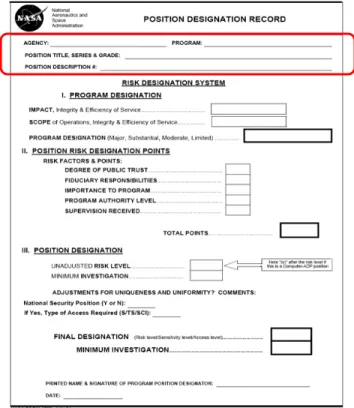
1. Fill out the header information at the top of NF 1722 to include: a. Agency – Center
b. Program
c. Position, Title, Series, & Grade d. Position Description Number
The following figure shows the location of these fields on NF 1722:
2. Locate Table 1 in the NPR 1600.1, Appendix M. Using the definitions on Table 1, identify the level of Impact (i.e., Major, Substantial, Moderate, or Limited) of the program and record it on NF 1722. The following figure shows Table 1 and the location of the field on NF 1722:
Figure B-02. Table to Identify Impact Level and Location to Record
3. Using the definitions on Table 1, identify the Scope of Operations (e.g., Worldwide, Governmentwide, MultiAgency, or Agency) of the position and record it on NF 1722, as shown in the following figure:
4. Using Table 1, identify the final Program Designation (i.e., Major, Substantial, Moderate, or Limited) and record it on NF 1722 as shown in the following figure:
Figure B-04. Table to Identify Program Designation and Location to Record
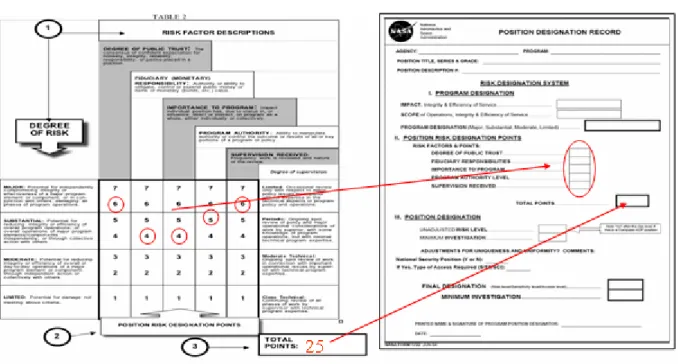
5. Using Table 2, identify the Risk Points associated with the position in each Risk Factor. Record the points and total on NF 1722 as shown in the following figure:
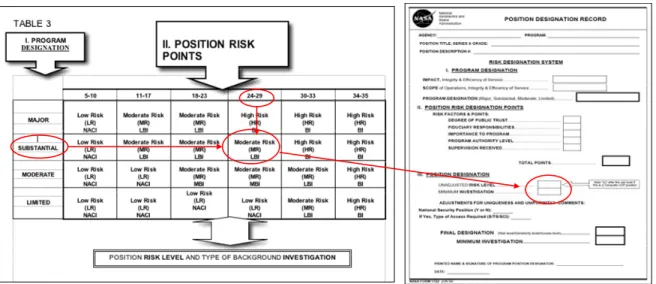
6. Using Table 3, locate the applicable Program Designation and Position Risk Points. Then locate the intersection of these two elements. Record the Unadjusted Risk Level
and the Minimum Investigation on the NF 1722 as shown in the following figure:
7. Evaluate the position to determine if there are any adjustments needed for uniqueness and uniformity. Some positions, by the very nature of the duties and responsibilities of the program or the position, may require designation at a certain level of risk. Final adjustment in the designation process must take into account unique factors specific to positions and the organizational need for uniformity of operations. Adjustments serve to raise the risk level designation of a position or convert the designation from a risk level to a sensitivity level. As a consequence, the level of investigation is often raised. Use the descriptions in the following chart to determine if adjustments should be made:
Uniqueness. Some factors that can cause a uniqueness adjustment, that are unique and are not fully accounted for in the program or position designation system, are listed here:
• Special investigative or criminal justice duties. • Positions requiring possession and use of a firearm. • Significant public health duties.
• Significant public safety duties.
• Access to or control of highly sensitive but unclassified information. • Access to sensitive financial records.
• Potential for realizing significant personal gain.
• Control of an automated monetary system (such as key access entry).
• Few-of-a-kind positions with special duties (such as Special Assistant to Agency Head).
• Support positions with no responsibilities for preparation or implementation of Public Trust program policies and plans but involving regular contact with, and ongoing knowledge of, all or most of such material (such as Budget Analyst, Special Assistant).
• Any of the criteria appearing in 5 CFR 732 or E.O. 12968.
• Computer-ADP; any of the criteria under OMB Circular A-130 or Federal Information Security Act (FISMA) of 2002.
• Any other factors the Agency thinks relevant (these must be documented).
Uniformity. There may be a clearly indicated need for uniformity in position designations, because of authority level or program designation level; two examples that can cause adjustment are listed here:
• The NASA Administrator may adjust position designations at the same authority level to assure uniformity within the Agency (for example, managers of major Agency programs at the same level of authority may be designated at the same level of risk).
• If the NASA Administrator determines the designation levels of programs override and negate any specific risk considerations associated with individual positions within NASA or a NASA program, he/she may designate all positions within a program at the risk level required to protect the integrity and best promote the efficiency of the service.
8. Make any necessary adjustments based on uniqueness and uniformity characteristics. Record on NF 1722 as shown in the following figure:
9. Determine if the position is a National Security position and what type of access is required. Note that you will need input from the Supervisor and/or Security to determine this. Record this information in the NF 1722 as shown in the following figure:
10. For National Security positions, determine the Risk, Sensitivity, and Access levels for the position and record it in the Comments area of NF 1722 as shown in the following figure:
11. For Computer/ADP positions, determine the adjusted Risk level and record it in the
Comments area of NF 1722 as shown in the following figure:
12. For the final designation, determine if there are any adjustments required.
a. If there are no adjustments, your Final Designation is the same as the information on NF 1722 in Section III, Position Designation, on the Unadjusted Risk Level and
Minimum Investigation lines.
OR
b. If there are adjustments, the highest level of Risk and Investigation must be used as the final designation.
The following figure shows five examples:
BI is a higher level background investigation than an ANACI and therefore must be used as the final, minimum investigation.
Figure B-12. Examples of Position Designations and Related Investigations
Note: If an employee is working part time in more than one position, the higher level position risk determination takes precedence when determining the
13. Enter the resulting information in the Final Designation and Minimum Investigation
fields on NF 1722 as shown in the following figure:
14. Print and sign your name and indicate the date on the appropriate lines on NF 1722 as shown in the following figure:
APPENDIX C – STEP-BY-STEP SUITABILITY DETERMINATION INSTRUCTIONS
This appendix contains step-by-step instructions to assist in determining suitability. The instructions provide details for filling out NF 1761, Suitability Adjudication Worksheet.
Procedure:
1. On the Suitability Adjudication Worksheet, fill out the header information as shown in the following figure:
Figure C-01. Suitability Adjudication Worksheet Header Area
2. Review the ROI and document each item of derogatory information on the Suitability Adjudication Worksheet, ensuring the following items are addressed:
• List each piece of derogatory information as a separate item.
• List date of arrest or incident.
• Write a description of the incident – use specific words from the ROI– do not embellish or add color.
• List corresponding Suitability Factors from 5 CFR 731.202. Refer to Attachment 1, Office of Personnel Management Suitability Guidelines Chart.
• List any Additional Considerations from 5 CFR 731.202. Refer to Attachment 1, Office of Personnel Management Suitability Guidelines Chart.
• List First and Second Ranking according to Issue Characterization Chart. Refer to Attachment 2, Office of Personnel Management Issue Characterization Chart. The following figure shows an example of a derogatory item listed on the worksheet (Note that the Control Date for this example is listed in the header information as June 28, 2006):
Figure C-02. Derogatory Information Example
3. On the Suitability Adjudication Worksheet, in the Adjudicator’s Analysis of Issues
section, record a short analysis of the issues, ensuring you adhere to the following:
• Be specific.
• Use wording directly from the ROI.
• Do not embellish or add color.
4. Click to select the box beside the appropriate description as shown in the following example:
5. The adjudicator makes the final Suitability Determination and the decision is approved by his/her supervisor as shown in the following example: