Privatization and the Environment
Susumu Cato
Graduate School of Economics, University of Tokyo
Abstract
We investigate the privatization policy of an industry where the production process generates emissions. We show that the high degree of negative externality leads to production
substitution from the public firm to private firms. Moreover, we show that, if the degree of negative externality is sufficiently high, then a mixed oligopoly is preferable to a pure oligopoly for social welfare, even if the number of firms in the market is large. Furthermore, we consider free entry of private firms.
I thank to Hiroaki Ino, Akifumi Isihara, Katsuhito Iwai, Tomohiro Kawamori, Toshihiro Matsumura, Shigeru Matsumoto and Noriyuki Yanagawa for their helpful conversation and comments. I also thank an anonymous referee for valuable comments. I have benefited from seminars at Kyoto University and Hakone. Needless to say, all errors are of course mine. Further, I gratefully acknowledge the Japan Society for the Promotion of Science (JSPS) Research Fellowships for Young Scientists and Grant-in-Aids for JSPS Fellows of the Ministry of Education, Culture, Sports, Science and Technology, Government of Japan.
Citation: Cato, Susumu, (2008) "Privatization and the Environment." Economics Bulletin, Vol. 12, No. 19 pp. 1-10 Submitted: April 24, 2008. Accepted: June 23, 2008.
1
Introduction
In many countries, including those in Europe, Central Asia, South Asia, and Africa, we can ob-serve many mixed markets where state-owned public enterprises compete against private firms. The privatization of state-owned public firms has been a worldwide trend since the 1980s, and most governments in the abovementioned regions plan further privatization. In fact, in Japan, the priva-tization of the postal services and postal bank was decided at an extraordinary session of the Diet in 2005.
The studies on mixed oligopolies revealed that in an industry that is sufficiently competitive (i.e., the number of firms in the market is sufficiently large), privatization improves welfare. In fact, in the early years, competitive sectors in many developing and developed countries were privatized. However, in recent times, the sectors that are structurally complex, such as the energy industry and the water industry, are beginning to be privatized. One of the features of such industries is that the firm’s production activity often lead to environmental damage. In other words, the degree of negative externality is high, and emission or pollution make the environment harmful for the residents of the surrounding areas.
The purpose of this paper is to investigate the relationship between privatization policy and the negative externalities caused by production processes. In particular, we examine an effect of external diseconomy in the context of a mixed oligopoly, and argue about which industry should be privatized. In our framework,N private firms and one state-owned public firm compete in Cournot fashion. Both types of firms pollute the environment and produce homogeneous goods. The public firm maximizes social welfare, and private firms maximize their own profit. Due to the privatization policy, the public firm’s goal changes from social welfare to the maximization of its own profit. Since the public firm’s goal is the social welfare, it considers the environmental damage. On the other hand, private firms maximizes their profit and ignores environmental damage.
We show that an increase in the degree of external damage causes production substitution from the public firm to private firms. As a result, we find that when emissions result in sufficiently high environmental damage, social welfare is hindered by privatization even if there exist a number of private firms. We try to indicate a reason why a mixed oligopoly is better than a pure oligopoly with sufficiently high externality in the context of production substitution from the public firm to private firms. Our result suggests that an industry having a high degree of negative externality should not be privatized. Further, the privatization of an industry with a low degree of externality may improve social welfare if the number of firms in the market is sufficiently large. Moreover, we consider free-entry of private firms. In the free-entry equilibrium, an increase in the degree of negative externality does not affect the equilibrium output of private firm and total output. We show that a mixed oligopoly is preferable to a pure oligopoly if and only if the profit of the public firm is larger than the difference in damage between the mixed market and pure market.
We mention related literatures. First, our model is related to the vast literature on the studies of mixed markets. The pioneering work of De Fraja and Delbono (1989) illustrates that the privatization of public firms might improve welfare. Matsumura (1998) studies the partial privatization of public firms, and provides a detailed explanation for the effect of production substitution. Matsumura and Kanda (2005) consider privatization policy under free-entry of private firms. Kato (2006) investigate the effects of tradable emission permits in a mixed oligopoly. Second, our motivation is related to the studies of markets with externality since Meade (1952). Baumol and Oates (1988) gave the comprehensive argument for this issue.
externality. In Section 3, we show our comparative static result and the main result. We investigate free-entry equilibrium in Section 4. Section 5 concludes this paper. The Appendix includes the proofs of propositions.
2
The Model
We consider an industry in which N + 1 firms produce homogeneous goods. In the market there is one state-owned public firm and N private firms that compete in quantities. The zero-th firm is the public firm and its objective is to maximize social welfare. The remaining N firms are private and seek to maximize their own profit. We denote the inverse demand function by P(Q), where P
is the price, and Q is the total output. P(Q) is twice continuously differentiable with P0(Q) < 0. We further assume that P0(Q) +qP00(Q)< 0. This is the standard assumption and guarantees the stability of equilibrium: each firm’s best reply is downward sloping.1
In our model, thei-th firm’s technology depends not only on its outputqi, but also on the amount of emissionei. Therefore, thei-th firm decides its output level qi ∈ R+ and the amount of emission
ei ∈R++. All firms have the same technology and the typical cost function is C(ei, qi).2 We assume that C is continuous, Cq > 0, and Cqq > 0. This assumption is standard in this issue.3 Further, we assume that Ce < 0 for 0< ei < ¯e and Ce > 0 for ei > e¯. That is, the cost C is decreasing in
ei for 0 < ei < e¯, and increasing in ei for ei > e¯. Assumptions on cross derivative are as follows:
Ceq =Cqe <0 for 0< ei <¯eand Ceq=Cqe>0 for ei >e¯. This implies that the marginal costCq is decreasing in ei for ei ∈0< ei <e¯, and increasing in ei for ei >e¯.4 By our assumptions, each firm has no incentive to chooseei >e¯. In this means, ¯e is the maximum emission level.5
We measure the pecuniary environmental damage caused by the production activity by D(E;γ), where γ ∈ R+, the total emissions E =
PN
i=0ei, DE(E;γ) > 0, Dγ(E;γ) > 0, DEγ = DγE > 0,
and DEE > 0. The parameter γ represents the degree of negative externality.6 Therefore, a large value of γ indicates a strong external diseconomy in the industry, and we assume thatD(E; 0) = 0. This implies that if γ = 0, there exists no externality in the market. We further assume that
Cee+DEE(E;γ)>0.
Social welfare consists of consumer surplus, firms’ profits, and the pecuniary environmental dam-age: W = Z Q 0 P(q)dq−pQ+ N X i=0 Πi−D(E;γ) = Z Q 0 P(q)dq− N X i=0 C(ei, qi)−D(E;γ) (1) where Πi is firmi’s profit.
1Precisely, this condition only implies that each private firm’s best reply is downward sloping. P0(Q)<0 guarantees
that the public firm’s best reply is downward sloping.
2If the public firm’s cost function is different from those of the private firms, we can obtain the same result of this
paper. For simplicity, we assume that both the public firm and private firms use identical technology.
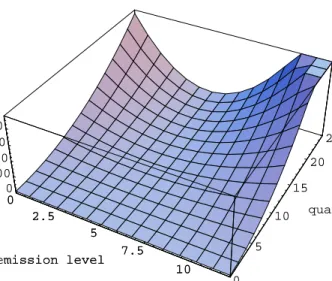
3For example, see De Fraja and Delbono (1989) and Matsumura (1998). 4An example of cost function satisfying our assumptions is
C(ei, qi) =(ei−e¯)
2+a
2 q
2
i
wherea >0. The shape of this cost function is described in Figure 2 (pp. 11).
5We can also interpret ¯eas the environmental standard prescribed by the government or a treaty. 6IfD(E;γ) =γd(E), whered0(E)>0, we interpretγ as the social weight of environmental damage.
We investigate two regimes: (i) mixed oligopoly and (ii) pure oligopoly. In a mixed oligopoly, there exists one public firm, whereas, in pure oligopoly, the public firm is privatized and maximizes its own profit. In pure oligopoly, (N + 1) private firms with homogeneous technology compete in quantities. Let WM and WP denote welfares in mixed oligopoly and pure private oligopoly, respectively.
Note that if γ = 0, all firms including the public firm choose the highest technology, i.e., ei = ¯
e,∀i ∈ {0, . . . , n}. In this case, our model corresponds to typical mixed oligopoly model such as De Fraja and Delbono (1989). This implies that our model is the generalization of the standard mixed oligopoly model. We suppose that WP > WM if γ is in the neighborhood of zero, and that privatization is preferable. This assumption is not essential. Based on many papers on the mixed oligopoly, it is known that if a market is sufficiently competitive, this inequality is holds.7
3
The Results
Clearly, since private firms ignore environmental damage, then each of them chooses the maximum emission level, i.e., ei = ¯e,∀i ∈ {1, . . . , n}. Thus, the reduced maximization problem of a private firm is as follows:
max qi
Πi subject to ei = ¯e. Therefore, there areN + 2 first-order conditions:8
∂W ∂q0 = 0 and ∂W ∂e0 = 0 (public firm), ∂Πi ∂qi
= 0 for i= 1, . . . , N (private firms).
The second order condition of private firms is also satisfied. Moreover, we assume that the second-order condition of the public firm is also satisfied.9 We are interested in the equilibrium in
which the outcomes of private firms are symmetric, i.e., q1 = q2 =, . . . ,= qN. Let qs∗ denote the equilibrium output of the public firm and qp∗ denote the equilibrium output of each private firm. Furthermore,Q∗ denote the equilibrium total output.
As we mentioned earlier, the equilibrium emission level of private firms ep∗ is ¯e. Moreover, by the first order conditions, the equilibrium emission level of the public firm, es∗, and the equilibrium outputs of the private firms and the public firm, qs∗ and qp∗, satisfy the following equations:
P0(Nqp∗+qs∗)qp∗+P(Nqp∗+qs∗)−C
q(¯e, qp∗) = 0, (2)
P(Nqp∗+qs∗)−C
q(es∗, qs∗) = 0, (3) −Ce(es∗, qs∗)−DE(E∗;γ) = 0. (4) First, we present the following comparative static results.
7See De Fraja and Delbono (1989) and Matsumura (1998).
8In this paper, we focus on the interior solution ofes∗. However,es∗= 0 for large values of the parameterγ, while
es∗= ¯efor small value. It is noteworthy that our result (proposition 2) is valid.
9The Hessian of the public firm’s objective is H =
µ
P0−C
qq −Ceq
−Ceq −Cee−DEE 
. The Hessian H is a negative definite if and only ifP0−C
qq <0 and (P0−Cqq)(−Cee−DEE)−Ceq2 >0. By those assumptions, the former is satisfied. Moreover, we suppose that the latter is satisfied. In this paper, we further assume that−Cqq(−Cee−DEE)−Ceq2 >0.
Proposition 1. (i)dqs∗ dγ <0,(ii) dqp∗ dγ >0,(iii) dQ∗ dγ <0 and (iv) des∗ dγ <0.
The proof of this proposition is provided in the Appendix. According to this proposition, an increase in the exogenous parameter γ leads to production substitution from the public firm to private firms. That is, when the exogenous parameter γ increases, the equilibrium output of the private firms increases, and the public firm’s output decreases.
The intuition of this result is as follows. First, since the public firm considers environmental damage, when the degree of externality (γ) increases, it chooses a lower emission level. Second, since choosing a lower emission level implies that the public firm’s level of technology relatively decreases, the output of the public firm, in turn, decreases. Finally, the reply function of private firms is downward sloping, and they increase their outputs. The key of this result is strategic substitute in oligopolistic quantity-competition.
Next, we consider the important question about which industry should be privatized and will obtain the answer by a simple proposition. To begin with, by a simple application of the envelope theorem for the maximization problem of the public firm, we can obtain the following:
dWM dγ ={P(Q ∗)−C q(¯e, qp∗)}N dqp∗ dγ −Dγ(N¯e+e s∗;γ), (5) dWP dγ =−Dγ((N + 1)¯e;γ). (6)
The following inequality is the sufficient condition of the single crossing property. Figure 1 shows the typical situation when this inequality holds.
dWM dγ > dWP dγ ⇔ Dγ((N + 1)¯e;γ)−Dγ(Ne¯+e s∗;γ)− {C q(¯e, qp∗)−P(Q∗)}N dqp∗ dγ ⇔ Dγ((N + 1)¯e;γ)−Dγ(Ne¯+es∗;γ)−P0(Q∗)qp∗N dqp∗ dγ >0 Since es∗ ∈ (0,¯e), by assumption, D γ((N + 1)¯e;γ)−Dγ(Ne¯+es∗;γ) > 0. By proposition 1, −P0(Q∗)qp∗Ndqp∗ dγ >0. Therefore, dW M dγ > dW P dγ holds. We, now, present our main result as follows.
Proposition 2. Suppose that Wp > WM for γ = 0. There exists γ∗ such that WP < WM for
γ > γ∗, and WP > WM for γ < γ∗.
This proposition contains a simple and important policy implication. Suppose that a market is competitive and privatization is preferable when γ is sufficiently low. However, if the degree of negative externality is sufficiently high (γ > γ∗), the government’s plan to privatize the public firm reduces the total surplus. This suggests that when the government decides whether to privatize the public firm, it must check the degree of negative externality (γ). The industry in which a sufficiently high negative externality exists should not be privatized.
The intuition of this result is as follows. We should emphasize that there exist two effects: a direct effect and an indirect effect. The direct effect is emission reduction by the public firm. In this case, environmental damage in the mixed oligopoly is lower than in the pure oligopoly. The indirect
W
γ γ∗
WM
WP
Privatization is better Mixed oligopoly is better Figure 1: Welfare Comparison
effect is production substitution from the public firm to private firms. The direct effect (reducing emission by the public firm) decreases the public firm’s output and increases private firms’ outputs. In this case, production substitution occurs. Since the public firm is a welfare maximizer, a slight decrease inq0 does not harm welfare, i.e.,dWM/dq0 = 0. On the other hand, private firms maximize
their own profit; therefore,dWM/dq
i =P(Q∗)−Cq(¯e, qp∗)>0 for alli∈ {1, . . . , n}. Hence, a slight increase in the production of private firm improves welfare. Therefore, production substitution from the public firm to private firms improves the social welfare.
Note that the first term on the right-hand side of equation (5) is positive, while the second term is negative. The former is the effect of production substitution, and the latter is the effect of environmental damage. In this sense, the direct effect is relatively better for the social welfare, while production substitution definitely improves welfare. To sum up, in a mixed oligopoly, an increase in the degree of externality has two opposing effects on welfare.10
4
Free-entry Equilibrium
In this section, we consider a mixed oligopoly with the free-entry of private firms. Precisely, we consider the following game. We suppose that the entry cost of a public firm is sunk. In the first stage, each private firm chooses whether or not enter the market. In the second stage, each firm entering the market independently chooses its output level and emission level.
The first order conditions of firms is the same as Section 3. We are interested in the symmetric equilibrium, q1 =q2 =, . . . ,=qN. Let qs∗∗,es∗∗,qp∗∗,Q∗∗, and N∗∗ denote the equilibrium output of the public firm, the equilibrium emission level of the public firm, the equilibrium output of each pri-vate firm, the equilibrium number of pripri-vate firms, the equilibrium total output, and the equilibrium number of private firms, respectively. In the free-entry equilibrium, the following equation must be
10In this paper, all firms have identical technology. When the public firm’s technology is different from private’s
satisfied:
P(N∗∗qp∗∗+qs∗∗)qp∗∗−C(¯e, qp∗∗) = 0. (7) Hence, qs∗∗, es∗∗, qp∗∗, and N∗∗ satisfy four equations (see equation (11), (12), (13), and (14) in the Appendix).
The following results show how the degree of negative externality affect the variables.
Proposition 3. (i)dq p∗∗ dγ = 0,(ii) dQ∗∗ dγ = 0,(iii) dqs∗∗ dγ <0,(iv) des∗∗ dγ <0, and (v) dN∗∗ dγ >0.
Proof of this proposition is in the Appendix. According to Proposition 3, the exogenous parameter
γ does not affect the equilibrium output of private firm and total output. That is, in the free-entry equilibrium, the equilibrium output of private firmqp∗∗, and total output Q∗∗ are independent ofγ. Remind that when the number of private firm is exogenous, an increase in the degree of negative externality (γ) lead to production substitution from the public firm to private firms. On the other hand, when the number of private firm is endogenous, an increase in the degree of negative externality (γ) does not cause this production substitution effect.
Lemma 3 (i) (ii) is related to Lemma 2 of Matsumura and Kanda (2005). They investigate the effect of partial privatization in the free-entry equilibrium. Lemma 2 of them says that the equilibrium output of each private firm and total output is independent to the degree of partial privatization.
We define the equilibrium welfare in the mixed oligopoly with free-entry as follows:
WM F =
Z qs∗∗+N∗∗qp∗∗
0
P(q)dq−C(es∗∗, qs∗∗)−N∗∗C(¯e, qp∗∗)−D(es∗∗+N∗∗e¯;γ) The envelop theorem implies the following:
dWM F dγ =N ∗∗{P(Q∗∗)−C q(¯e, qp∗∗)} dqs∗∗ dγ +{P(Q ∗∗)qp∗∗−C(¯e, qp∗∗)}dN∗∗ dγ −eD¯ E dN∗∗ dγ −Dγ =−eD¯ E(Ne¯+es∗∗;γ) dN∗∗ dγ −Dγ(N¯e+e s∗∗;γ) where we use Proposition 3 (i) and equation (7).
Since DE >0,Dγ >0, and dN
∗∗
dγ >0, we have the following simple result.
Proposition 4. dWM F/dγ <0.
By this proposition, an increase in the degree of negative externality (γ) always damages social welfare. When the number of private firm is exogenous, an increase in the degree of negative externality (γ) lead to not only a negative effect but also a positive one on welfare. On the other hand, in the free-entry equilibrium, this welfare-improving effect does not exist. This is because an increase in the degree of negative externality (γ) does not cause production substitution from the public firm to private firms.
Next, we discuss the effect of the privatization policy in the long-run. Let WP F denote the equilibrium welfare in the pure oligopoly with free-entry. EM F and EP F is the total emission level in the mixed and pure market, respectively.
Proposition 5. WM F > WP F if and only if Π
0 > D(EM F;γ)−D(EP F;γ).
In the long-run, a mixed oligopoly is preferable to a pure oligopoly if and only if the profit of the public firm is larger than the difference in damage between the mixed market and pure market. This result is robust when the public firm’s technology is different from private firms’.
The number of firms in the mixed oligopoly is less than one in the pure oligopoly.11 This implies
that EM F < EP F.12 Hence, D(EM F;γ)−D(EP F;γ) is negative. Proposition 5 implies that even if the public firm’s profit is negative, the privatization policy may harm the social welfare. This result is related to Proposition 3 of Matsumura and Kanda (2005). They show that the privatization policy is preferable if and only if the profit of the public firm is positive. The important difference between our model and theirs is the existence of externality. There exists no externality in the model of Matsumura and Kanda (2005), while there exists the negative externality in our model. The results of them and Proposition 5 suggest that the existence of the negative externality allows the negative profit of the public firm.
We give a further remark. In the our model, all firm have identical technology. For this case,
WM F > WP F always holds.13 We explain why this holds. Since C00 > 0, P = C0(qs) implies that
P qs−C(qs)≥P q−C(q) for allq. The equality holds iff q=qs. P > C0(qp) impliesqs6=qp. Hence, by the zero profit condition, Π0 =P qs−C(qs)> P qp−C(qp) = 0. SinceD(EM F;γ)−D(EP F;γ)<0,
WM F > WP F. This result does not hold when the public firm’s technology is different from private firms’.
5
Concluding Remarks
In this paper, we investigated a mixed market industry in which the production process generates emissions and considered whether a public firm should be privatized. We find that the privatization policy is detrimental to welfare in an industry in which the degree of negative externality is sufficiently high, even if the market is sufficiently competitive.
It is noteworthy that under high negative externality, a mixed oligopoly has two advantages over a pure oligopoly in the terms of social welfare. First, since the public firm considers environmental damage, the damage is smaller in a mixed oligopoly. Second, if the negative externality is high, the public firm reduces its excess production. As a result, the public firm’s level of technology declines and this causes production substitution from the public firm to private firms. Since in a private firm, price is necessarily higher than the marginal cost; thus, in a mixed market, the production level of private firms is relatively low from the perspective of social welfare. Therefore, in the short-run analysis, production substitution improves the welfare. On the other hand, in the long-run analysis, where the number of private firms is endogenous, this welfare-improving effect of production substitution is not exist.
11In the proof of Proposition 5, we show that the total output and the output of each private firm in the mixed
oligopoly are same as those in the pure oligopoly. This implies the price does not change by the privatization in the long-run. P =C0(qs) andP > C0(qp) implies qs > qp. The number of private firms in the mixed oligopoly is
(Q−qs)/qp, so the number of firms is (Q−qs)/qp+ 1. On the other hand, the number of firms in the pure oligopoly
isQ/qs. (Q−qs)/qp+ 1 =Q/qs−qs/qp+ 1< Q/qs.
12Note that each private firm choose the maximum emission level ¯e, while the public firm may choosee 0<e¯. 13This result is related to Proposition 4 of Matsumura and Kanda (2005).
Appendix
Proof of Proposition1. (i)(ii)(iv) From equations(2)(3)(4), by using the implicit function theorem, we can obtain the following:
J P 00q+P0 0 NP0 P0−C qq −Ceq 0 −Ceq −Cee−DEE dq p∗/dγ dqs∗/dγ des∗/dγ =− 00 −DEγ (8) where J =NP00q+ (N + 1)P0−C qq. Since J =N(P00q+P0) +P0−Cqq, by assumptions, J <0. Therefore, by Cramer’s formula, we obtain the following equations:
dqp∗ dγ =− CeqDEγ(P00q+P0) ∆ (9) dqs∗ dγ = DEγCeqJ ∆ (10) des∗ dγ = (P0−C qq)DEγJ−NP0DEγ(P00q+P0) ∆ = P0DEγ(P0−Cqq)−CqqDEγJ ∆
where ∆ =J× {(−Cee−DEE)(P0−Cqq)−Ceq2} −NP0(−Cee−DEE)(P00q+P0). Note that ∆ =J{−Cqq(−Cee−DEE)−Ceq2 }+J(−Cee−DEE)P0 −NP0(−Cee−DEE)(P00q+P0)
=J{−Cqq(−Cee−DEE)−Ceq2 }+ (−Cee−DEE)P0{J −N(P00q+P0)} =J{−Cqq(−Cee−DEE)−Ceq2 }+ (−Cee−DEE)P0(P0−Cqq).
By our assumptions, we have thatJ <0,−Cqq(−Cee−DEE)−Ceq2 >0,−Cee−DEE >0,P0 <0, and P0−C
qq >0. Hence, ∆<0.
SinceCeqDEγ(P00q+P0)>0 andDEγCeqJ >0, we obtain that dq
p∗
dγ >0 and dqs∗
dγ <0, respectively. Moreover, our assumption implies thatCqqDEγJ <0 andP0DEγ{P0−Cqq}>0. Thus, de
s∗
dγ <0. (iii) dQdγ∗ =Ndqdγp∗ +dqdγs∗. By using equation(9)(10), we obtain the following:
dQ∗
dγ =−
DEγCeq{P0−Cqq}
∆ <0.
Q.E.D. Proof of Proposition 3. The variables qs∗∗, es∗∗, qp∗∗, N∗∗ satisfies the following simultaneous equa-tions:
P0(N∗∗qp∗∗+qs∗∗)qp∗∗+P(N∗∗qp∗∗+qs∗∗)−C
q(¯e, qp∗∗) = 0 (11)
−Ce(es∗∗, qs∗∗)−DE(N∗∗e¯+es∗∗;γ) = 0 (13)
P(N∗∗qp∗∗+qs∗∗)qp∗∗−C(¯e, qp∗∗) = 0. (14) From equations (11)(12)(13)(14), by using the implicit function theorem, we can obtain the following: K dqp∗∗/dγ dqs∗∗/dγ des∗∗/dγ dN∗∗/dγ =− 0 0 −DEγ 0 , (15) where K ≡ NP00q+ (N + 1)P0−C qq P00q+P0 0 P00q2+P0q NP0 P0−C qq −Ceq P0q 0 −Ceq −Cee−DEE eD¯ EE NP0q+P −C q P0q 0 P0q2 .
(i) From equation (15), we obtain the following:
dqp∗∗ dγ = DEγ |K| ³ (P00q2+P0q)C eqP0q−(P00q+P0)CeqP0q2 ´ = 0. (16)
(ii) Dividing the fourth row of equation (15) by P0q, we obtain the following:
dqs∗∗
dγ +q
p∗∗dN∗∗
dγ = 0. (17)
Since dQ∗∗/dγ =dqs∗∗/dγ+qp∗∗dN∗∗/dγ, we obtain the result. (iii) Rearranging equation (17), we obtain that
dN∗∗ dγ =− 1 qp∗∗ dqs∗∗ dγ . (18)
Rearranging the second row of equation (15),
Cqq
dqs∗∗
dγ +Ceq des∗∗
dγ = 0 (19)
where we use equation (17). This implies that
des∗∗ dγ =− Cqq Ceq dqs∗∗ dγ . (20)
Moreover, rearranging the third row of equation (15),
−Ceq dqs∗∗ dγ −(Cee+DEE) des∗∗ dγ + ¯eDEE dN∗∗ dγ =DEγ. (21)
After substituting equation (18) (20) into (21), this equation can be expressed alternatively as dqs∗∗ dγ ³ q Ceq (Cqq(Cee+DEE)−Ceq2)−eD¯ EE ´ =DEγ. (22)
Since (Cqq(Cee+DEE)−Ceq2)>0 andCeq<0 by assumptions, we have that Cqeq(Cqq(Cee+DEE)−
C2
eq)−eD¯ EE <0. Hence, we obtain that dqs∗∗/dγ <0.
(iv) By equation (19) and (iii) of Proposition 3, we obtain this result. (v) By equation (17) and (iii) of Proposition 3, we obtain this result.
Q.E.D. Proof of Proposition 5. First, we show that the total output QM F in the mixed market is equal to the total output QP F in the pure market. In the pure oligopoly, the number of private firms and the private firm’s output is derived from (11) (14) by setting qs = 0. In the proof of Lemma 3, the private firm’s output qp is independent of the public firm’s output qs. Hence, in the free-entry equilibrium, the privatization does not change the private firm’s output, i.e., qp = qp∗∗. In the free-entry equilibrium, the zero profit condition holds, so the price equal to the average cost of each private firm:
P(Q) = C(¯e, qp)
qp .
This equation implies that if the private firm’s output does not change, the total output does not change. Hence, the privatization does not change the total output.
Next, we prove the statement of proposition. Remind that social welfare consists of consumer surplus, firms’ profits, and the environmental damage. Since the privatization does not change the total output, consumer surplus in the mixed oligopoly is same as one in the pure oligopoly. Moreover, profits of private firms is always zero in the free-entry equilibrium. These conditions imply that WM F > WP F if and only if Π
0 > D(EM F;γ)−D(EP F;γ). Q.E.D.
References
[1] Baumol W. J., and W. E. Oates (1988) The Theory of Environmental Policy (2nd Ed), Cam-bridge: Cambridge University Press.
[2] Cato, S. (2006) “External diseconomy may improve welfare under a mixed market” mimeo. [3] De Fraja G., and F. Delbono (1989) “Alternative strategies of public enterprise in oligopoly”
Oxford Economic Papers 41, 302–311.
[4] Kato, K. (2006) “ Can allowing to trade permits enhance welfare in mixed oligopoly?” Journal of Economics 88, 263–283
[5] Lahiri S., and Y. Ono (1988) “Helping minor firms reduce welfare” Economic Journal 98, 1199– 1202.
[6] Matsumura T. (1998) “Partial privatization in mixed oligopoly” Journal of Public Economics
[7] Matsumura T., and O. Kanda (2005) “Mixed oligopoly at free entry markets” Journal of Eco-nomics 84, 27–48.
[8] Meade J. E. (1952) “External economies and diseconomies in a competitive situation”Economic Journal 62, 54–67. 0 2.5 5 7.5 10 emission level 0 5 10 15 20 25 quantity 0 2000 4000 6000 8000 Cost 0 2.5 5 7.5 10 emission level