Networked Information Retrieval
as Distributed Problem Solving
Tim Oates, M. V. Nagendra Prasad and Victor R. Lesser
Computer Science Department, LGRC
University of Massachusetts
Box 34610
Amherst, MA 01003-4610
f
oates,nagendra,lesser
g@cs.umass.edu
Recent years have seen an explosion in the amount of information available in electronic form, forcing the developers of information retrieval (IR) systems to re-evaluate their model of the world. Early IR systems assumed that the users would supply both a query and corpus (data source) against which the query is to run. Even though the user may have access to multiple corpora, the user, rather than the IR system, is tasked with knowing which one is most likely to contain the correct answer. When a user has access to a number of data sources as large as, say, the number of anonymous FTP sites in the Internet, it is no longer possible for them to know which of the possible sources is most relevant to a query or to manually submit a query against more than a very small fraction of those sources. Clearly, something more is required of the IR system. The problem, as described, seems amenable to an agent based solution. In response to a query, multiple autonomous agents can be released to search this distributed \information space" in a cooperative manner for relevant items. Top level queries drive the creation of partially elaborated information gathering plans, resulting in the employment of multiple semi-autonomous, cooperative agents for the purpose of achieving goals and subgoals within those plans1.
The task of information retrieval in a distributed setting can be viewed in general terms as either distributed processing or distributed problem solving (DPS). Distributed processing is characterized by complete independence of subproblems. Agents need nothing other than local information to arrive at a subproblem solution of the required quality which can be synthesized with other agent subproblem solutions to arrive at a global solution. Distributed problem solving, on the other hand, is characterized by the existence of interdependencies between subproblems assigned to the individual agents, leading to a need for them to coop-erate extensively during problem solving. They rely on communication to detect and exploit
This material is based upon work supported by the NSF Center for Intelligent Information Retrieval,
ONR contract N00014-92-J-1450, ARPA under ONR contract N00014-92-J-1698. The content of the infor-mation does not necessarily reect the position or the policy of the Government and no ocial endorsement should be inferred.
1For a more formal model that characterizes the environment and problem solving, please refer to [13].
these interdependencies between subproblems. At the start, agents have only partial and incomplete views of global solution requirements. In spite of this deciency in information, they may arrive at partial and tentative results which may be exchanged by the agents work-ing on subproblems that are interdependent, to reduce the uncertainty that surrounds local problem solving. That is, agents may exploit the interdependencies between subproblems to their benet. This is the essence of the functionally accurate, cooperative (FA/C) paradigm presented by Lesser et. al. [11, 12] as an approach to distributed problem solving.
Below, we will present the FA/C paradigm in more detail, using examples from dis-tributed information retrieval to highlight its features. Imagine a user deciding to go on a vacation. She gives a travel planner program a few of her preferences for the vacation. Say she gives her specications as a vacation for 3 or 4 days around July 20th, preferably in Massachusetts. In addition, either through user specications or through user modeling, the travel planner knows that this particular user prefers historical sites or nature spots. The travel planner has to plan for at least four dierent aspects of the vacation | places/sites to visit, weather situation, accommodation and conveyance. So it sends o four agents to deal with the corresponding types of databases. However, the agents have to interact during the process of information retrieval and planning, both among themselves and with the travel planner.
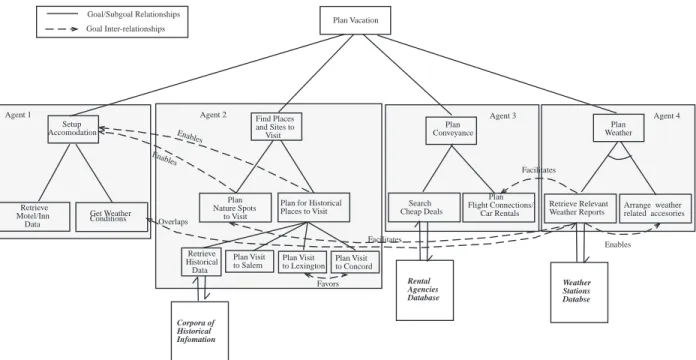
Complex distributed search spaces, such as the one in the example above, are charac-terized by various soft and hard constraining goal interrelationships like facilitates, enables, overlaps and subsumes (see Figure 1). The ability to exploit these interrelationships to avoid negative interactions and take advantage of positive interactions can enhance the search quality by providing better solutions in possibly lesser time. In a distributed intelligent information retrieval (DIIR) task, potentially useful constraints may exist between dierent pieces of information, either via content or as a function of problem solving activity. The discovery and exploitation of such constraints is necessarily a dynamic and incremental pro-cess that occurs during problem-solving and entails communication of partial results among agents in a timely and selective manner, to augment each agent's local view with a more global view. Figure 1 shows some of the subgoal interrelationships in the travel planning ex-ample. A facilitates interrelationship implies that the values of a solution output parameter of the facilitating goal can, in some way, determine an optional goal specication parameter of the facilitated goal. The planning of ight connections and car rentals has weather report data as an optional goal specication parameter to achieve this goal. Availability of weather reports facilitates the planning process for car rentals and ight connections by eliminating or attributing low importance to retrieval of ight reservation and car rental availability on those days when the weather is not conducive to travel. Even though Agent 2 can plan for car rentals and ights without the weather data, it is better o procrastinating planning for the ight schedule until the availability of weather information. In the meanwhile, it can search for airlines oering cheaper deals. Along similar lines, retrieval of weather reports facilitates planning for outdoor spots. On the other hand, a plan of the places to visit will enable the accommodation agent to start its work on planning for places to stay during nights. An enables interrelationship implies that the enabling goal produces an solution out-put parameter value that determines a required goal specication parameter of the enabled goal. The place at which accommodations are to be secured is a required goal specication parameter for the \Setup Accommodation" goal. Note that abstractions of plans are all that
is needed for the accommodation agent to start its work. Thus, while agent 2 is eshing out the details of the abstract plan of the places to visit, agent 1 can, in parallel, start its work. Similarly, a favors interrelationship says that once you made the eort to design a plan to go to Concord, a plan for going to Lexington is obtained by minor modications to the plan for Concord. An overlaps interrelationship says that the two agents involved may be doing similar work and can hence benet by sharing their partial results. An overlaps interrelationship exists between two goals that share determinants of some of their solution output parameters.
Given the incomplete nature of the local views of the individual agents, another impor-tant aspect of FA/C systems is the explicit recognition of the role of solution and control uncertainty. Coupled with the fact that resources and time for conducting a search are lim-ited in real-life problems, this leads to the notion of satiscing search. The environment in an information acquisition task is characterized by the fact that the supply of available data is almost limitless, whereas time, money and computational resources are not. Rather than being able to retrieve an exhaustively complete and accurate response to a query, interme-diate results from disparate sources must be pieced together to form consistent islands of information that can be incrementally rened to form a more accurate solution depending on the extent of available resources and time.
Another aspect of the FA/C paradigm is the explicit recognition and exploitation or avoidance of redundancy, leading to increased robustness or decreased resource demands depending on the context and the structure of the domain. For example, the Internet may contain \mirror" sites for certain data repositories or it may contain redundant data from dierent sources for the same task. Data from dierent sources may be of dierent quality or may be organized dierently. A particular task could possibly do with low quality data which perhaps could be locally acquired. Redundancy could be permitted if the control costs outweigh the benets of avoiding it. Alternatively, if we are dealing with faulty systems or poor quality data, redundancy could help resolve the uncertainty in the retrieved data by providing additional constraints.
We believe that distributed information retrieval tasks characterized by complexity, het-erogeneity and unstructured data environments, can be viewed as a distributed problem-solving task within the FA/C paradigm. The benets of such a view not only stem from the fact that it provides a comprehensive conceptual model for the myriad of methods being proposed for intelligent information retrieval (IIR), but also from the fact that the view pro-vides a direct map from the wealth of existing methods in distributed Articial Intelligence (DAI) to the distributed information retrieval domain. These methods have evolved over more than a decade, since the time the FA/C paradigm was rst proposed[11]. Below, we discuss various techniques and systems from DAI that may have direct bearing on DIIR viewed as a DPS task. These methods were originally proposed in contexts dierent from information retrieval, and most of them were developed as techniques to study, understand and exploit various aspects of the FA/C paradigm.
This paper draws upon a long history of thought in DAI to present a model of cooperative retrieval of distributed information. We briey touch upon various implemented aspects of FA/C that have direct relevance to the DIIR task. Decker and Lesser[6, 7] provide detailed studies of quantitative trade-os involved in explicit recognition and exploitation of task interrelationships for use in multi-agent coordination. Garvey and Lesser[8] discuss
to-time algorithms which basically endow the local problem solver with abilities to deal with real-time considerations and goal inter-dependencies. Such a scheduler is, perforce, satiscing in the solutions it provides and relies on the use of approximate processing techniques. Carver and Lesser[4, 5] present RESUN and its distributed derivative DRESUN as architectures that explicitly recognize and resolve uncertainties associated with the partial, evolving solutions in the interpretation domain. Interpretation is viewed as an incremental process of resolving sources of uncertainty (SOUs) through directed and intentional accrual of evidence. This seamless integration of data-driven bottom-up and goal-driven top-down processes opens up a huge set of opportunities for IIR. Information on hand can in turn serve to instantiate and actively direct further retrieval process to resolve the deciencies in the partial data.
We hope that this paper encourages IR system designers to take a radically new view of distributed information retrieval as a distributed problem solving activity. Distributed infor-mation retrieval systems proposed in the literature typically either do not fully exploit the potential of knowledge-intensive methods for retrieval[1, 2, 3, 9] or tend toward distributed processing, failing to exploit the dependencies between agents working on dierent aspects of a retrieval task[10, 14]. Cooperating to enhance eciency of a resource-limited retrieval process or negotiating to dynamically resolve conicts and inconsistencies in the retrieved data, leading to further search or retrieval, may be important aspects of DIIR systems in the future. Our model is an initial step in this direction. In fact, this complex view may be more appropriately termed information acquisition - an incremental plan-based information seeking activity. We also suggest that existing methods in DAI can serve to leverage future implementations of DIR systems based on this view.
Plan Vacation
Enables Facilitates
Facilitates Favors
Agent 1 Agent 2 Find Places Agent 3 and Sites to Visit Plan Conveyance Plan Weather Search Cheap Deals Plan Flight Connections/ Car Rentals Plan for Historical
Places to Visit Plan
Nature Spots to Visit
Retrieve Relevant
Weather Reports Arrange weatherrelated accesories Plan Visit
to Salem Plan Visitto Lexington Plan Visit to Concord Retrieve Motel/Inn Data Overlaps Goal/Subgoal Relationships Goal Inter-relationships Retrieve Historical Data Setup Accomodation Get Weather Conditions Enables Enables Corpora of Historical Infomation Rental Agencies Database Weather Stations Databse Agent 4
Figure 1: Goal Tree for the Vacation Planning Example
[1] M. C. Bowman, P. B. Danzig, U. Manber, and M. F. Schwartz, \Scalable Internet Re-source Discovery: Research Problems and Approaches", Communications of the ACM, 37(8), 1994, pp 98 - 107, cntd on 114.
[2] J. P. Callan, W. B. Croft, and S. M. Harding, \The INQUERY Retrieval System", in Proceedings of the 3rd International Conference on Database and Expert Systems Applications, pp 78-83, 1992.
[3] J. Callan, Personal Communication, July 1994.
[4] N. Carver and V. Lesser., \A New Framework for Sensor Interpretation: Planning to Resolve Sources of Uncertainty", in Proceedings of AAAI-91, 1991, pp 724-731.
[5] N. Carver, Z. Cvetanovic, and V. Lesser., \Sophisticated Cooperation in FA/C Dis-tributed Problem Solving Systems", in Proceedings of AAAI-91, 1991, pp 191-198. [6] K. S. Decker and V. R. Lesser, \Generalizing the Partial Global Planning Algorithm",
International Journal of Intelligent and Cooperative Information Systems 1(2), June 1992, pp 319-346.
[7] K. Decker and V. R. Lesser, \ Quantitative Modeling of Complex Computational Task Environments", in Proceedings of the Eleventh National Conference on Articial Intel-ligence, pp 217-224, Washington, 1993.
[8] A. Garvey and V. R. Lesser, \Design-to-time Real-Time Scheduling", IEEE Transac-tions on Systems, Man, and Cybernetics: Special Issue on Scheduling, Planning, and Control, 23(6), 1993.
[9] M. Huhns, U. Mukhopadhyay, L. M. Stephens, and R. Bonnell, \DAI for Document Retrieval: The MINDS Project", in Distributed Articial Intelligence ed. by M. Huhns, Pittman Publishing/Morgan Kaumann Pub., pp. 249-284.
[10] C. A. Knoblock, and Y. Arens, \An Architecture for Information Retrieval Agents", in Working Notes of the AAAI Spring Symposium on Software Agents, 1994, pp. 49-56. [11] V.R. Lesser and D. Corkill., \Functionally accurate, cooperative distributed systems",
in IEEE Transactions on Systems, Man, and Cybernetics, 11(1), 1981, pp. 81-96. [12] V.R. Lesser., \A retrospective view of FA/C distributed problem solving", IEEE
Sys-tems, Man, and Cybernetics, 21(6), 1991, pp. 1346-1363.
[13] T. Oates, M. V. Nagendra Prasad, V. R. Lesser., \A Distributed Problem Solving View of Networked Information Retrieval", Forthcoming Technical Report, Department of Computer Science, University of Massachusetts at Amherst, 1994.
[14] E. M. Vorhees, \Software Agents for Information Retrieval", in Working Notes of the AAAI Spring Symposium on Software Agents, 1994, pp. 126-129.