KNOWLEDGE ON COMPANY VALUATION: AWARENESS OF
DISPARITY BETWEEN MARKET AND FUNDAMENTAL VALUES
Aleš Trunk1,
Geodetic Institute of Slovenia Igor Stubelj 2,
University of Primorska, Slovenia [email protected]
Abstract:
In this paper we present the case of Slovenian public limited companies based on the discounted free cash flows to equity and comparing it with market value of equity capital of companies before and during the financial-economic crisis. The purpose of this paper is to discuss the equity value of companies, as well as present the importance of fair and honest company valuations. The fundamental value of equity capital of a company is important for both management and external shareholders. The wide disparity between market and fundamental values can lead to high value adjustments, which reduces investors confidence in the capital market. This has had a negative impact on the operations of financial institutions, and individual as well as company investment; especially on developing financial markets during a financial-economic crisis. This paper shows the problem of company valuation on small and emerging capital markets which have a short history of data.
Keywords: market and fundamental values of equity, knowledge, fair and honest company valuations, Slovenian public limited companies, management
1Aleš Trunk completed his Masters at the Faculty of Management, University of Primorska. Within his research
work he focuses on the area of corporate finance. He is currently employed by the Geodetic Institute of Slovenia (GIS).
2Igor Stubelj completed his Doctorate at the Faculty of Management, University of Primorska. His expertise
includes the field of corporate finance. He has many years experience within the area of corporate finance for small businesses. His research focuses on company valuation, expense capital and financial markets. He is currently employed at the Faculty of Management, where he lectures on subjects related to finance and assists with educating and advising on the area of corporate finance.
1.
THE IMPORTANCE OF COMPANY VALUATION
The most frequent reasons for company valuation are: a) the purchase or sale of all or part of the company's equity value or ownership share, b) the execution of acquisition procedures, c) withdrawal and payment of a shareholder, d) mergers or acquisitions, e) buyout of the management, f) increase or decrease of (share) capital, g) rehabilitation, liquidation or bankruptcy value of the company's estate which is in bankruptcy proceedings and h) internal audit of assets and financial position of the company to support the adoption of strategic financial decisions (Fiducaria 2009).
In order to valuate a company, a number of different valuating models can be used, varying from simple to highly sophisticated (Domodaran 2006). The main aim of valuating a company is, by using appropriate valuation methods and techniques, to uncover what the actual value of the company is (Fires 2009). The model chosen is dependent on the purpose of the valuation, the data available to us and other factors (Brealey in Myers 2001).
Static and dynamic valuation models are recognized. Static valuation models are based on the comparison of various indicators (indicators which are calculated on the basis of profit, book value or income). When using dynamic valuation models it is necessary to predict future input parameters, which are required to calculate the value of the company. Valuating companies using a dynamic model highly depends on the analyst’s evaluation of the input parameters. By taking the correct data into account we can very accurately define the fundamental value of the company (Brigham in Ehrhardt 2005).
One of the great limitations in the valuation of companies in the Slovenian capital market is the small size of the market and the consequent small number of companies. The Slovenian capital market is not mature. Many changes in the Slovenian financial environment in times of transition mean a shorter history of useful data for analysis. The partially formed ownership structure of companies (incomplete privatisation) and the influence of politics on business have had and will continue to have an impact on Slovenian public limited companies (Stubelj 2010).
This paper is divided into four parts; the second section presents the theoretical foundations of company valuation, the third section the case of Slovenian public limited companies. The fifth section provides a conclusion and implications for management and the public.
2. THE
THEORETICAL
FOUNDATIONS OF COMPANY VALUATION
Knowing the fundamental value is important for making the right decisions on different levels (investors, employees, country, buyers, suppliers, banks...) (Koller, Goedhart in Wessels 2005). The financial market plays an important role in the financial system. It is a good/bad financial asset transfer mechanism between entities with financial surpluses and entities with financial deficits (Kendall 1998). Due to market imperfections and perceived expectations of investors, there is a discrepancy between the market price of the company and its internal value. The internal value is a value based on a comprehensive analysis and assessment of a company. It is expressed as the current value of all the company's expected cash flow from doing business, discounted to the current value by using the appropriate discount rate. The internal value is also called "true" or "real" value of a company (Bertoncel 2006). The effects of the financial-economic crisis which have severely shook and swung the global financial markets causing share prices on the stock market to fall, have also been felt in Slovenia.
Stubelj (2010) indicates that valuating companies is a utilitarian activity. The assessment should bring benefits to the users of that service. Due to the great benefits that can arise from a good valuation estimate, analysts and experts in the field of valuation designed a large number of models based on different assumptions. The starting point and the determinants of each valuation model vary. However, the essential element of all models is the future benefits to investors. There are models based on profits, dividends, investment opportunities, free cash flow, as well as models based on comparative analysis. We use different valuation models when assessing the fundamental value of companies (e.g. a discounted cash flow model, a model of comparable companies listed on the stock exchange, the net asset value model, etc.), depending on the individual valuation factors (Brigham and Ehrhardt 2005).
NLB (2012) states that there are various purposes for which we carry out a valuation of the fundamental value of a company: a) acquisitions, mergers, sale and purchase of the company or part of the company, recapitalisation, separation and spin-off, withdrawal of shareholders, management buyouts and leveraged buyouts, b) investment decisions, c) accounting reports, d) taxpurposes, e) legal disputes.
In recent years a number of companies have closed down, the level of unemployment has drastically risen, equity indices have been overthrown and some countries are on the verge of bankruptcy due to incorrect monetary policies of central banks. The consequences of this financial crisis could paralyse the global economic system (Norberg 2009). The market value of equity capital of the majority of Slovenian public limited companies on the stock exchange has therefore decreased. In times of economic boom the market value of companies was incredibly high. The large difference between the market value and fundamental value of equity capital was proven by Stubelj (2010) who in his research stated that market values can be higher due to: a) investors who have “insider” information about the company increasing share prices; b) expected high acquisition value of the company; c) purchasing of shares for too high prices (for speculative reasons) in order to sell the company for a higher price; d) lack of investment opportunities for the investor on the Slovenian capital market. These factors have contributed to a dramatic decrease in value during times of financial-economic crisis (from 2008 onwards). The share prices of Slovenian companies have decreased a lot more than on some more developed financial markets. This can be seen on the stock market index; the Slovenian stock market index decreased by 60% between 2007 and 2012 (LJSE 2012), whereas on the developed financial markets like Dow Jones, NYSE, S&P, the stock market index decreased by only 15%. On the financial market NASDAQ the stock market index even increased by 8% in 2007 (MWatch 2012).
3.
THE CASE OF SLOVENIAN PUBLIC LIMITED COMPANIES
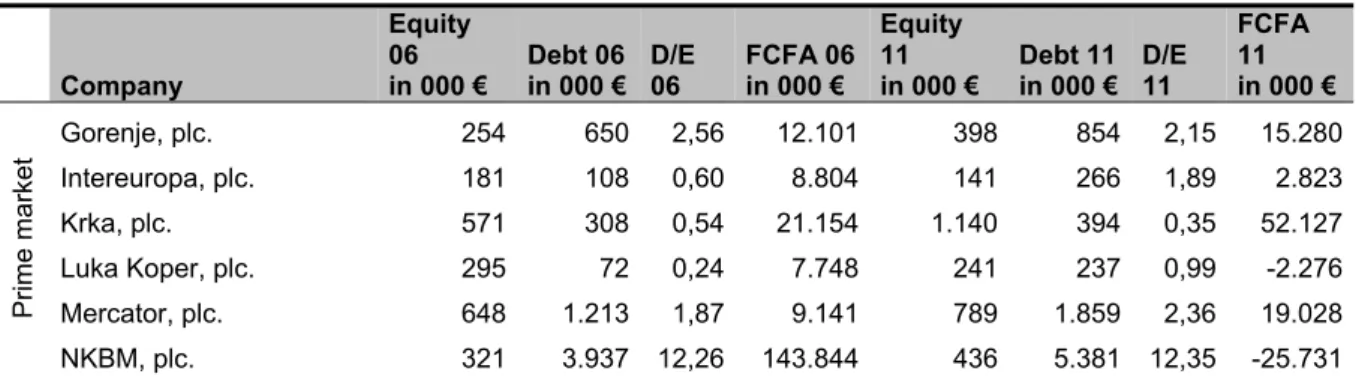
The purpose of this chapter is to present the equity values of Slovenian public limited companies before and during the financial-economic crisis. This value is based on the discounted free cash flows, which belong to equity capital. It will then be compared to the market value of the company. Due to the abnormal reduction in the market value of shares during the financial-economic crisis we are interested in the difference between the fundamental and market values of companies before the crisis and now, during the crisis.
We used secondary data from the Ljubljana stock exchange website (number of shares and price) as well as data found in the annual reports of the selected companies, which was also taken from their respective company websites. There are a total of 67 public limited companies on the Slovenian stock exchange; we evaluated all the Slovenian companies in the prime market (9 companies) and all the companies in the standard market (16 companies) in the period between 2006 and 2011, quoted on the stock exchange on the 31st December 2006 and 31st December 2011. Sampling has its flaws, which we already encounter when we gather data or prepare the sample – and of course this influences our results and their appropriateness for generalization to the entire population (Nastav 2011). The shares of the selected companies represent almost 90% of the total market capitalisation of all shares in the chosen time period. Therefore we can consider our sample representative of the Slovenian share market.
Table 1: The selected companies (sample)
Company Equity 06 in 000 € Debt 06 in 000 € D/E 06 FCFA 06 in 000 € Equity 11 in 000 € Debt 11 in 000 € D/E 11 FCFA 11 in 000 € Prime market Gorenje, plc. 254 650 2,56 12.101 398 854 2,15 15.280 Intereuropa, plc. 181 108 0,60 8.804 141 266 1,89 2.823 Krka, plc. 571 308 0,54 21.154 1.140 394 0,35 52.127 Luka Koper, plc. 295 72 0,24 7.748 241 237 0,99 -2.276 Mercator, plc. 648 1.213 1,87 9.141 789 1.859 2,36 19.028 NKBM, plc. 321 3.937 12,26 143.844 436 5.381 12,35 -25.731
Source: Annual company report
The market value of equity capital of Slovenian public limited companies has fallen sharply during the crisis. In light of these facts we can assume that the market values of the Slovenian public limited companies before the crisis were exaggerated and did not reflect the fundamental value of equity capital of the company. Our basic theory is that the fundamental value of equity capital better reflects the market value of equity capital in today's times of crisis than before the crisis. We tested the validity of our theory with the hypothesis that the fundamental values of Slovenian public limited companies are closer to their market values now (2011) than before the crisis (2006).
Table 1: Fundamental and market value of equity capital 2006-2011 in 000 €
On 31. 12. 2006 On 31. 12. 2011
Company Fundamental value Market value Fundamental value Market value
Prime market Gorenje, plc. 58.567 323.300 85.155 79.534 Intereuropa, plc. 142.358 202.776 18.144 3.398 Krka, plc. 179.567 2.768.162 549.872 1.874.042 Luka Koper, plc. 143.346 660.380 -20.290 99.400 Mercator, plc. 82.138 809.214 59.184 553.508 NKBM, plc. 625.389 216.061 -96.441 123.629 Petrol, plc. 216.287 1.031.196 111.283 323.585 Telekom Slovenije, plc. 500.980 1.988.942 409.926 411.604 Zavarovalnica Triglav, plc. 19.720 214.336 2.134 227.351 Standar d mark et Abanka Vipa, plc. 313.007 260.513 -50.454 115.200 Aerodrom Ljubljana, plc. 57.067 218.262 23.483 39.104 Delo Prodaja, plc. 10.424 11.981 -691 16.019 Etol, plc. 21.994 52.063 5.301 18.333 Iskra Avtoelektrika, plc. 12.580 28.869 15 24.286 Istrabenz, plc. 48.079 92.981 -1.793 16.006 Petrol, plc. 397 446 1,13 13.884 442 1.095 2,48 28.864 Telekom Slovenije, plc. 989 482 0,49 46.123 815 760 0,93 41.072 Zavarovalnica Triglav, plc. 375 1.706 4,54 3.946 489 2.473 5,05 854 Standar d mark et Abanka Vipa, plc. 215 2.682 12,47 73.038 231 4.027 17,41 -18.378 Aerodrom Ljubljana, plc. 97 12 0,12 4.170 123 6 0,05 1.905 Delo Prodaja, plc. 23 11 0,47 620 12 27 2,22 -185 Etol, plc. 61 15 0,24 1.189 23 24 1,04 544 Iskra Avtoelektrika, plc. 43 126 2,96 2.086 43 133 3,12 5 Istrabenz, plc. 402 647 1,61 3.511 13 364 27,13 -3.479 Kompas MTS, plc. 49 6 0,12 672 50 7 0,15 2.903 Mlinotest, plc. 25 16 0,64 589 29 29 0,97 49 Nika, plc. 4 2 0,51 36 2 1 0,64 -4 Pivovarna Laško, plc. 303 382 1,26 1.826 125 444 3,54 6.844 Pozavarovalnica Sava, plc. 102 255 2,49 2.463 148 434 2,93 -3.135 Salus, plc. 43 27 0,62 2.239 53 34 0,65 4.690 Sava, plc. 433 242 0,56 2.086 166 445 2,69 6.881 Terme Čatež, plc. 92 36 0,39 2.208 99 100 1,01 2.914 Unior, plc. 119 207 1,74 2.045 122 198 1,63 -44 Žito, plc. 72 47 0,66 1.959 69 52 0,76 -963
Kompas MTS, plc. 10.723 2.717 31.639 3.568 Mlinotest, plc. 9.393 17.943 488 6.425 Nika, plc. 826 2.933 -30 3.419 Pivovarna Laško, plc. 23.308 348.681 33.180 96.399 Pozavarovalnica Sava, plc. 20.104 222.572 -16.524 54.396 Salus, plc. 27.677 85.065 42.094 29.160 Sava, plc. 27.206 463.554 27.068 24.084 Terme Čatež, plc. 39.269 112.277 17.992 88.470 Unior, plc. 21.313 19.516 -187 34.061 Žito, plc. 31.023 59.684 -10.643 30.242
4.
KNOWLEDGE ON COMPANY VALUATION - IMPLICATIONS FOR
MANAGERS AND OTHER STAKEHOLDER
The paper shows how important is the knowledge on company valuation to make right decision for management and other stakeholders. The market value of equity capital of Slovenian public limited companies has fallen sharply since the financial-economic crisis began. We assumed that the market values of the Slovenian public limited companies before the crisis were exaggerated and did not reflect the company’s fundamental value of equity capital. We valuated the fundamental value of equity capital of Slovenian public limited companies (25 plc.) on the basis of discounted free cash flow, which is a part of equity. Knowing the fundamental value of equity capital of a company is key for: a) acquisitions, mergers, sale and purchase of the company or part of the company, recapitalisation, separation and spin-off, withdrawal of shareholders, management buyouts and leveraged buyouts, b) investment decisions, c) accounting reports, d) tax purposes, e) legal disputes, f) for making the right decisions on different levels (investors, employees, country, buyers, suppliers, banks...). It should be noted that the estimated fundamental value of the company is based on many assumptions which could influence the bias of the assessor, especially in the case of a small financial market with a short history where only recent data is available.
The problems of valuating are also the assumptions and decisions of the assessor introducing subjectivity into the estimated value. Due to the aforementioned the estimated value can deviate from the fundamental value which has an effect on the behaviour of all company shareholders. It is important that the assessor takes in to account all the relevant information which is necessary for estimating value and on the basis of this information carry out the best possible valuation of variables which are included in the valuating model. All their decisions must have grounds. The users of this estimate must interpret the value, taking into account all assumptions and limitations. According to Norman (2008), this also opens an ethical question. This paper also faced the problem of valuating in a small and developing capital market, with a short data history. In the valuation we used data from developed capital markets to help us, which requires additional assumptions.
This paper also raises the question of ethical conduct of company shareholders, who with their unethical behaviour reduce the efficiency of the capital market. Reasons for high share prices and large discrepancies in the market value of shares from the fundamental value of shares can also be: a) investors who have “insider” information about the company increasing share prices; b) expected high acquisition value of the company; c) purchasing of shares for too high prices (for speculative reasons) in order to sell the company for a higher price; and d) lack of investment opportunities for the investor on the Slovenian capital market.
Abnormally large corrections of share prices which occurred because of external factors like the financial-economic crisis have been very damaging to the Slovenian capital market as well as financial institutions on the Slovenian market. A large decline in trust in particular has threatened the operations of financial institutions and individual as well as company investment. Due to the abnormal importance of the operations of the financial system and the influence on the economy, regulators should be able to detect and prevent large differences between the fundamental and market value of companies (Stubelj 2009).
The timely detection of inflated market share prices and the application of efficient mechanisms would also be sensible to explore, as it would prevent the market share prices from being inflated. It would also be sensible to design a qualitative research in order to investigate the relationships of all major shareholders (e.g. owners, managers, investors, employees, banks, suppliers...) to the problem of company valuation and examine the reasons which influence a distorted or unfair company value.
REFERENCE LIST
1. Bertoncel, A. (2006). Acqusition valuation: How to value a going concern. Naše gospodarstvo, 52(5–6), 116–125.
2. Brealey, R. A., in S. C. Myers (2001). Principles of corporate finance. New York: McGraw-Hill. 3. Brigham, E. F. in M. C. Ehrhardt. (2005). Financial Management: Theory and Practice.
Masson, OH (ZDA): South-Western.
4. Fiducari. (2009). Razlogi za vrednotenje podjetij. Retrived from: Http://www.fiduciaria-si.eu/podrocja_svetovanja (10. 7. 2012).
5. Fires. 2009. Vrednost podjetja. Retrived from: Http://www.fires.si/vrednotenje_podjetij.html (4. 8. 2012).
6. Kendall, Robin A. H. 1998. Risk management for executives: a practical approach to controlling business risks. London: Pitman: Financial Times.
7. Koller, T., M. Goedhart in D. Wessels. 2005. Valuation: Measuring and managing the value of companies. Hoboken, N.J. (ZDA): Willey.
8. LJSE. (2012. Arhiv vrednosti indeksov. Retrived from: http://www.ljse.si/cgi-bin/jve.cgi?doc=1289&sid=vDosywe
z3KCpxxx2 (10.6.2012).
9. MWatch. (2012). Index. Retrived from: http://www.marketwatch.com/investing/index/nya (10.6.2012).
10. Nastav, Bojan. 2011). Statistika v ekonomiji in financah. Koper: Univerza na primorskem: Fakulteta za management.
11. NLB. (2012). Vrednotenje podjetij. http://www.nlb.si/vrednotenje-podjetij (15. 4. 2012).
12. Norberg, Johan. (2009). Financial fiasco : How America's infatuation with homeownership and easy money created the economic crisis. Washington: Cato Institute.
13. Norman, Peter. (2008). Plumbers and Visionaries : securities Settlement and Europe's Financial Market. Chichester: Wiley.
14. Stubelj Igor. (2009). Strošek lastniškega kapitala podjetja : primer ocene za izbrane slovenske delniške družbe. Management, let. 4, št. 1 (pomlad 2009), str. 21-38
15. Stubelj, Igor. (2010). Vrednotenje podjetij na podlagi pričakovanih dobičkov. Koper: Univerza na primorskem: Fakulteta za management.