ADVISOR Enterprise Difficulty-Importance-Frequency (DIF) Model
Fact Sheet
February 23, 2011
Bill Melton, Ph.D. & J. (Jay) Bahlis, Ph.D., P.Eng. (514) 745-4010 x 21
1. Purpose: To provide a review of the function and validity of the Difficulty-Importance-Frequency (DIF) Model in ADVISOR.
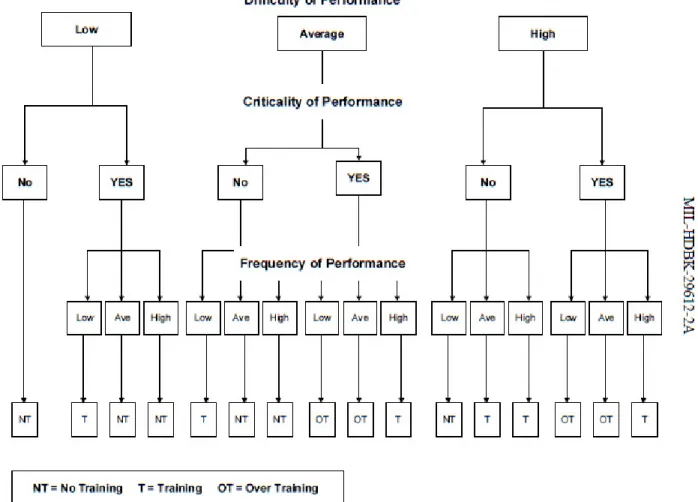
2. Description of the Difficulty-Importance-Frequency (DIF) model as used in ADVISOR. The DIF Model is used in ADVISOR to determine if training for Task is/is not needed. Based on task’s difficulty, importance and frequency, the DIF model indicates whether personnel require training in order to perform the Task. Based on user’s input of the level (high, medium, low) of difficulty, importance and frequently the following recommendations are provided along with the reasons.
a. No Train – implies that instruction is not needed to perform the Task.
b. Train – implies that instruction/exercises are needed to attain and retain the required knowledge, skills and attitudes.
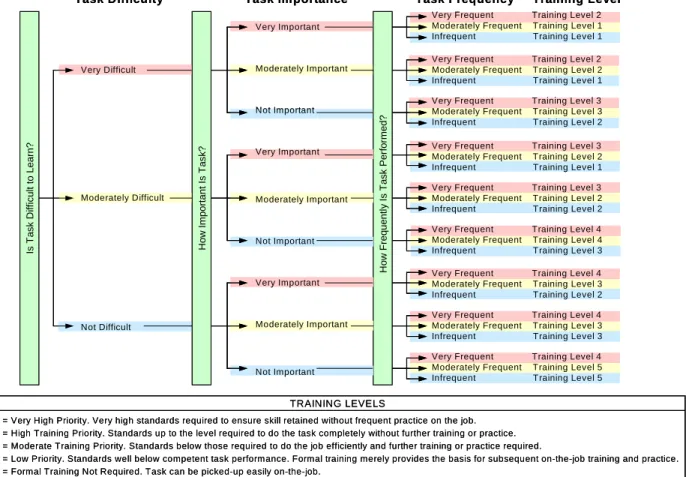
c. Over Train – implies that practice beyond what is required for retention is needed. The automated selection process providing these recommendations is identical to the DIF model created by Florida State University and published in military regulations (Fig 1) and standards over the past 30 years. ADVISOR also supports the Modified Ohio State SCID DIF Task Model (Fig 2). The variations created by Department of Energy are applications to specific training requirements not adjustments to the functioning of the model itself.
Task Difficulty Task Importance Task Frequency Training Level H o w F req ue ntl y I s T a sk Pe rf o rmed ? Ho w Imp o rt a n t Is T a sk? Very Difficult Moderately Difficult Not Difficult Is T a sk D iff ic u lt to L ear n ?
1 = Very High Priority. Very high standards required to ensure skill retained without frequent practice on the job. 2 = High Training Priority. Standards up to the level required to do the task completely without further training or practice. 3 = Moderate Training Priority. Standards below those required to do the job efficiently and further training or practice required.
4 = Low Priority. Standards well below competent task performance. Formal training merely provides the basis for subsequent on-the-job training and practice. 5 = Formal Training Not Required. Task can be picked-up easily on-the-job.
TRAINING LEVELS Very Important Moderately Important Not Important Very Important Very Important Moderately Important Moderately Important Not Important Not Important
Very Frequent Training Level 2 Moderately Frequent Training Level 1 Infrequent Training Level 1 Very Frequent Training Level 2 Moderately Frequent Training Level 2 Infrequent Training Level 1 Very Frequent Training Level 3 Moderately Frequent Training Level 3 Infrequent Training Level 2 Very Frequent Training Level 3 Moderately Frequent Training Level 2 Infrequent Training Level 1 Very Frequent Training Level 3 Moderately Frequent Training Level 2 Infrequent Training Level 2 Very Frequent Training Level 4 Moderately Frequent Training Level 4 Infrequent Training Level 3 Very Frequent Training Level 4 Moderately Frequent Training Level 3 Infrequent Training Level 2 Very Frequent Training Level 4 Moderately Frequent Training Level 3 Infrequent Training Level 3 Very Frequent Training Level 4 Moderately Frequent Training Level 5 Infrequent Training Level 5
Task Selection Model
Task Difficulty Task Importance Task Frequency Training Level
H o w F req ue ntl y I s T a sk Pe rf o rmed ? Ho w Imp o rt a n t Is T a sk? Very Difficult Moderately Difficult Not Difficult Is T a sk D iff ic u lt to L ear n ?
1 = Very High Priority. Very high standards required to ensure skill retained without frequent practice on the job. 2 = High Training Priority. Standards up to the level required to do the task completely without further training or practice. 3 = Moderate Training Priority. Standards below those required to do the job efficiently and further training or practice required.
4 = Low Priority. Standards well below competent task performance. Formal training merely provides the basis for subsequent on-the-job training and practice. 5 = Formal Training Not Required. Task can be picked-up easily on-the-job.
TRAINING LEVELS Very Important Moderately Important Not Important Very Important Very Important Moderately Important Moderately Important Not Important Not Important
Very Frequent Training Level 2 Moderately Frequent Training Level 1 Infrequent Training Level 1 Very Frequent Training Level 2 Moderately Frequent Training Level 2 Infrequent Training Level 1 Very Frequent Training Level 3 Moderately Frequent Training Level 3 Infrequent Training Level 2 Very Frequent Training Level 3 Moderately Frequent Training Level 2 Infrequent Training Level 1 Very Frequent Training Level 3 Moderately Frequent Training Level 2 Infrequent Training Level 2 Very Frequent Training Level 4 Moderately Frequent Training Level 4 Infrequent Training Level 3 Very Frequent Training Level 4 Moderately Frequent Training Level 3 Infrequent Training Level 2 Very Frequent Training Level 4 Moderately Frequent Training Level 3 Infrequent Training Level 3 Very Frequent Training Level 4 Moderately Frequent Training Level 5 Infrequent Training Level 5
Task Selection Model
Fig 2 Modified Ohio State SCID DIF Task Model
3. The effective use of the DIF model is supported by the following: a. The DIF model is in current use by the following organizations.
The US Army Training and Dodtrine Command and its centers and schools have utilized the DIF Model since the model’s creation as a part of Training Pamphlet (TP) 350-30 in 1975. Current use includes its use in 88A - Transportation Captain's
Aviation Training Consulting, LLC describes their use of DIF as a part of their methodology in the following manner: “ATC earns the trust of our clients by utilizing the approved Instructional Systems Development (ISD) and Systems Approach to Training (SAT) methodology. This methodology allows ATC to develop solutions that address large-scale, complex training programs.”
http://www.atc-hq.com/services.html
Ki-Yoon Kim, Department of Business Administration, Kwangwoon University, Seoul, Korea and Ken Surendran, Computer Science Department, Southeast Missouri State University Cape Girardeau, MO 63701, U.S.A., used the DIF Model in their
development of ”A Curriculum Development For Information Security Manager Using DACUM” http://isedj.org/isecon/2001/39a/ISECON.2001.Kim.txt
H. Michel O’Connor, Department of Emergency Medical, Faculty of Health Sciences, Queen’s University, Kingston, Ontario, Canada in his article “Training undergraduate medical students in procedural skills” for Emergency Medicine (2002) 14, 131-135 in the Medical Education Series, recommends the use of DIF for “deciding between the ‘nice to know’ and ‘need to know’ content” of skill training.
http://merc.mui.ac.ir/jclub/DocLib1/1/procedural%20skills.pdf
The “MORS Workshop Out brief: Improving Defense Analysis Through Better Data Practices” utilized DIF in their Task Analysis.
http://www.dtic.mil/ndia/2004test/mon/tutorial/7outbrief.ppt
Although the above list is not exhaustive, it reflects the adoption of the DIF model by a variety of users supported by entries currently on the Internet.
b. Standards and government regulations that incorporate the DIF model include: MIL-HDBK-29612-2A provides the CDF model which is a direct derivative of the
DIF model.
Training Circular (TC) 25-10 Appendic C describes the difficulty-importance -frequency(DIF)model, as a method for prioritizing tasks for training.
https://atiam.train.army.mil/soldierPortal/atia/adlsc/view/public/8526-1/tc/25-10/appc.htm
TRADOC Regulation (TR) 350-70
http://www-tradoc.army.mil/tpubs/regs/r350-70/350_70_gloss_sec2.htm includes theDIF Model and the SYSTEMS
APPROACH TO TRAINING (SAT) BASIC COURSE provides instruction on the DIF model. http://www.wood.army.mil/dcltsf/Documents/SATCrsItin.doc
Department of Energy (DOE) Handbook 1001-96 Guide to Good Practices for Training and Qualification of Instructors includes the DIF Model.
http://www.au.af.mil/au/awc/awcgate/doe/hdbk1001.pdf
Human resource Development (HRD) 408: Glossary of Terms includes the DIF model as one of several models available for use in selecting tasks for training.
International Atomic Energy Agency (IAEA)-TECDOC-1392, Development of Instructors for Nuclear Power Plant Personnel Training included use of the DIF Model. http://www-pub.iaea.org/MTCD/publications/PDF/te_1392_web.pdf Although the above list of standards and policy documents is not exhaustive, it reflects the acceptance of the DIF model by a variety of regulatory agencies supported by entries currently on the Internet.
4. Research to support the validity of DIF model.
The initial research supporting the development of the model was done over 30 years ago and is not available for review. The 30 years of use by the Departments of Defense and Energy provide far more rigorous validity support than any validity testing data which might have been generated when the DIF model was created. Decisions made using this model, like so many other models of its kind, are only as sound as the answers to the questions input by the users.
5. Other viable alternative systems for determining whether training for a Task is/is not needed include the 4-factor model, the 8-factor model and the training emphasis model. The
occupational survey organizations within the Army, Navy and Air Force who conduct primary job analysis have multifactor and training emphasis models which they use in surveying large populations of job incumbents and supervisors to determine task criticality and rank order tasks for training. While these models are newer and have recent validation data their use provides significant challenges for the average user including time, coordination and cost considerations. The analysis of the data they collect provide ranking of tasks for training, requires specially designed computer programs and sometimes expert’s interpretation.
6. Comparison of the DIF model with other models used for task selection for training. The DIF model has been used effectively by individuals, small groups and large survey populations in both its original and in specially tailored forms proving its versatility and usefulness. It is both simple and intuitive making it easy to teach to both users and survey populations. Unlike the multifactor models it has not been changed over the years to address factors of interest to new users and researchers providing the DIF a continuity of use and interpretation over the years that allows easy comparison of results over time.