KNOWLEDGE, PERCEIVED RISK AND
INVOLVEMENT
by
Carla Guse Janse van Vuuren
Submitted in fulfilment towards the degree M.Com. (Business Management) in the Faculty of Economic and Management Sciences at Stellenbosch University
Supervisors: Dr CD Pentz Prof R du Preez
i
PLAGIARISM DECLARATION
By submitting this thesis electronically, I declare that the entirety of the work contained therein is my own, original work, that I am the sole author thereof (save to the extent explicitly otherwise stated), that reproduction and publication thereof by Stellenbosch University will not infringe any third party rights and that I have not previously in its entirety or in part submitted it for obtaining any qualification.
March 2018 Signed:
Copyright © 2018 Stellenbosch University All rights reserved
ii
ACKNOWLEDGEMENT
I would first like to extend my sincere gratitude to the following individuals that contributed to the successful completion of this study:
Firstly, my two thesis supervisors Dr. Chris Pentz of the Department of Business Management at Stellenbosch University and Prof. Ronel du Preez of the Department of Industrial Psychology at Stellenbosch University. Thank you for your trusted supervision, motivation, and patience in completing this study. Both on a professional and personal level, I am grateful for your inputs and guidance.
Prof. Martin Kidd of the Centre of Statistical Consultation at Stellenbosch University, for your expertise and guidance in the data analysis. Your personal interest in the study and countless inputs are greatly appreciated.
My colleagues and friends of the Department of Business Management and Industrial Psychology for your support and guidance.
Prof. Callie Theron and Mrs. Lucea Toerien for your continuous interest in my study - I appreciate that your door was always open for discussion.
My friends and family for your love, support, interest, and motivation throughout the completion of the study.
I must express my very profound gratitude to my parents, Johan and Wilna Guse, for providing me with unfailing support and continuous encouragement throughout my years of study and through the process of researching and writing this thesis. My husband, Gerhard, for your continuous support, your inputs, guidance, and for allowing me the freedom to pursue my dreams. This accomplishment would not have been possible without them.
Finally, my Creator for blessing me with a curious mind which inspires the will to challenge myself and through hard work and determination reach my goals. Thank you for the unfailing grace and guidance. Gloria in excelsis Deo.
“My gange het vasgehou aan u spore, my voetstappe het nie gewankel nie.” Psalms 17:5.
iii
ABSTRACT
Historically, Old World wine countries such as Italy, France, Germany and Spain had a reputation of producing superior wine in terms of quality and taste. However, since the early 1990’s, New World wine countries such as South Africa, the United States, Australia, Argentina, New Zealand and Chile have shown affluence in the global wine market. In particular, a significant growth in sales (both domestic and international) has been evident for South African wines between 2009 and 2013. Even though this growth extended to both commercial and academic interest of the South African wine market, it has been suggested that the market may expand at a slower rate between 2014 and 2018. To some extent the slower expansion rate has been evident since the major global and local social, political and environmental changes that took place from the early 2000’s that in turn brought about changes in consumers’ wine purchase behaviour.
These changes cannot however be viewed in isolation as the one has a knock-on effect on the other. For instance, within the South African context some historical social and political issues had to be addressed since 1994 to re-establish and strengthen the South African wine industry, both locally and internationally. Initiatives in the early 2000’s such as introducing and encouraging Fairtrade (since 2008), the establishment of the Biodiversity and Wine Initiative as well as Wieta (the wine and agri-industry ethical trade initiative) have aimed to build the reputation of the South African wine industry toward a fair and representative industry (Bek, McEwan & Binns, 2011). In addition, globally consumers are becoming more environmentally conscious and consequently retailers had to change product offerings. A noticeable change has been within the United States’ wine industry where a number of retailers (such as Walmart & Tesco) are offering wines advocating sustainable, organic and biological practices (Taylor, 2018). These product offerings does not only influence and change local, but also international demand and trends. In 1998 sustainability guidelines were introduced to the South African wine industry and ever since the initiatives had increased to ensure greater sustainability within the sector. For instance, since 2010 all bottles had to be labelled with an Integrity and Sustainability seal indicating that the wines were produced using such practices (WOSA, 2017).
iv
Such initiatives, among other, have changed the competitive and consumer landscape globally and as a result could have a slower growth effect on global consumption patterns. A somewhat noticeable slower growth rate has been reported for the South African wine industry (compared to sales from 2009 – 2013) at the end of 2016 indicating shifts in consumer purchasing patterns (SAWIS, 2016:19). This change in purchasing patterns may create a need for realigning wine marketing strategies to grow market share.
Noticeable areas of interest within global wine research pertain to purchasing and consumption situations. In an attempt to better understand the complex nature of wine purchasing, it has been suggested that researchers focus on more sophisticated variables, rather than only for example demographics that influence wine purchase decision making. As such, previous research investigated the influence of subjective product knowledge, the role of perceived risk, and the effect of level of product involvement on choice attributes. In this context, a void is apparent in literature in that no published scientific literature could be identified that measures the combined influence of these variables on wine purchase behaviour. In addition, industry leaders noted the need for a better understanding of the purchase behaviour of South African wine consumers. Thus, the research problem of this study was formulated as: Does different levels of subjective product knowledge, perceived risk and product involvement contribute to differences in volume of South African (New World) wine purchased per month for consumers’ own consumption? This problem statement gave way to the primary objective of the study, namely to determine if different levels of subjective product knowledge, perceived risk and product involvement contribute to differences in wine purchase for own consumption in South Africa.
During purchase decision making, wine consumers rely heavily on product attributes as quality indicators that may guide decision making, as the wine cannot always be tasted prior to purchase. Nevertheless, no academic literature could be identified that determines the importance of unique combinations of choice attributes and how they vary for levels of knowledge, perceived risk and product involvement. The secondary objective of this study is therefore to determine whether the unique combinations of product attributes vary for different levels (low, moderate and high) of subjective product knowledge, perceived risk and product involvement.
v
The study is based on a review of literature covering aspects of wine marketing, consumer behaviour, consumer decision making, especially subjective product knowledge, perceived risk, level of product involvement and product attributes. This review of literature was followed by an empirical, survey-based study to investigate wine purchase behaviour pertaining to subjective product knowledge, perceived risk, level of product involvement, and product attributes within a South African context. To provide the necessary context and theoretical point of departure for this study, it was deemed important to propose a conceptual theoretical framework of wine consumer decision making. An online questionnaire was subsequently developed to gather data from a non-probability convenience sample of South African wine consumers. From the results of an exploratory factor analysis the reliability of the perceived risk scale was questionable, thus none of the objectives pertaining of this construct could be reported. With respect to subjective product knowledge and level of product involvement, the findings indicated that different levels (low, moderate and high) of subjective product knowledge and product involvement do in fact influence the volume of wine purchased for own consumption. In addition, the most and least important product attributes were identified for each level of subjective product knowledge and product involvement and the significant differences between groups were highlighted.
To summarise, grape variety was identified as the most important product attribute for all three levels of subjective product knowledge, while alcohol content and opinion of sales representative were the least important product attributes. However, grape variety was significantly more important (compared to the other attributes) to moderate and high subjective product knowledge respondents. Relatively similar results were reported for level of product involvement, aside from friends/family recommendations being the most important product attribute for low product involvement respondents. Even so, friends/family recommendations and grape variety were still significantly more important than the other product attributes for low product involvement respondents. It is therefore strongly recommended that South African wine marketers take note of the importance of grape variety when developing marketing strategies.
vi
OPSOMMING
Vanuit ‘n historiese oogpunt het ou Wêreld wyn lande soos Italië, Frankryk, Duitsland en Spanje 'n reputasie vir die vervaardiging van uitstekende wyn in terme van kwaliteit en smaak. Sedert die vroeë 1990's toon Nuwe Wêreld wyn lande soos Suid-Afrika, die Verenigde State van Amerika, Australië, Argentinië, Nieu-Seeland, en Chili egter toenemende groei in die globale wynmark. In die besonder is daar ʼn beduidende toename in verkope (beide plaaslike en internasionaal) vir Suid-Afrikaanse wyne tussen 2009 en 2013. Al het hierdie groei tot beide kommersiële en akademiese belangstelling in die Suid-Afrikaanse wynmark gelei, word dit voorspel dat die mark teen 'n stadiger koers kan uitbrei tussen 2014 en 2018. Tot 'n sekere mate kan die stadiger groeikoers terug gedateer word tot die merkwaardige globale sosiale, politieke en omgewingsveranderinge wat sedert die vroeë 2000's plaasgevind het, wat gelei het tot veranderinge in wyn verbruikers se aankoop gedrag.
Hierdie veranderinge kan egter nie in isolasie gesien word nie, aangesien die een ‘n oorspoel effek op die ander het. Byvoorbeeld, binne die Suid-Afrikaanse konteks moes daar sekere historiese sosiale en politieke kwessies aangespreek word sedert 1994 om die Suid-Afrikaanse wynbedryf, beide plaaslik en internasionaal, te herstel en te versterk. Inisiatiewe in die vroeë 2000's soos Fairtrade (sedert 2008), die vestiging van die Biodiversiteits- en Wyn-inisiatief asook Wieta (die etiese handelsinisiatief van die wyn en landboubedryf) het gemik om die reputasie van Suid-Afrikaanse wyne te bou en te versterk tot 'n regverdige en verteenwoordigende bedryf (Bek, McEwan & Binns, 2011). Daarbenewens word verbruikers wêreldwyd meer omgewingsbewus en gevolglik moet kleinhandelaars produkaanbiedinge verander. 'n Merkbare verandering is binne die Amerikaanse wynbedryf waar 'n aantal kleinhandelaars (soos Walmart & Tesco) wyne aanbied wat volhoubare, organiese en biologiese praktyke voorstaan (Taylor, 2018). Hierdie produkte beinvloed en verander nie net plaaslike, maar ook internasionale vraag en tendense. In 1998 is volhoubaarheidsriglyne vir die Suid-Afrikaanse wynbedryf ingestel en vandaar het die inisiatiewe toegeneem om groter volhoubaarheid in die sektor te verseker. Byvoorbeeld, sedert 2010 moes alle bottels geëtiketteer word met 'n “Integrity and Sustainability” seël wat aandui dat die wyne met sulke gebruike geproduseer word (WOSA, 2017).
vii
Sulke inisiatiewe het onder andere die mededingende en verbruikers landskap wêreldwyd verander en kan gevolglik 'n stadiger groei-effek op globale verbruikspatrone hê. 'n Effens noemenswaardige stadiger groeikoers is aan die einde van 2016 vir die Suid-Afrikaanse wynbedryf gerapporteer (vergeleke met verkope vanaf 2009 - 2013) wat die verskuiwings in verbruikers aankooppatrone aandui (SAWIS, 2016: 19). Hierdie verandering in aankooppatrone kan 'n dringendheid skep vir die herbelyning van wynbemarkingstrategieë om markaandeel te vermeerder. Opvallende areas van belangstelling in globale wyn navorsing het betrekking tot die aankoop en verbruik situasies. In 'n poging om die komplekse aard van wyn aankope beter te verstaan, word voorgestel dat navorsers fokus op meer gesofistikeerde veranderlikes wat 'n invloed het op wyn aankoop besluitneming. Vorige studies het die invloed van subjektiewe produkkennis, die rol van waargenome risiko en die effek van vlak van produk betrokkenheid op keuse veranderlikes ondersoek. In hierdie konteks is daar ʼn duidelike leemte in die literatuur, aangesien geen gepubliseerde wetenskaplike literatuur geïdentifiseer kan word wat die gekombineerde invloed van hierdie veranderlikes meet nie. Daarbenewens het bedryfslede kennis geneem van die behoefte aan 'n beter begrip van die aankoopgedrag van Suid-Afrikaanse wynverbruikers. Dus is die navorsingsprobleem van hierdie studie geformuleer as: Dra verskillende vlakke van subjektiewe produkkennis, waargenome risiko en produkbetrokkenheid by tot die verskil in volume van Suid-Afrikaanse (Nuwe Wêreld) wyn wat per maand aangekoop word vir verbruikers se eie verbruik? Hierdie probleemstelling het gelei tot die primêre doel van die studie, naamlik om vas te stel of verskillende vlakke van subjektiewe produkkennis, waargenome risiko en produkbetrokkenheid bydra tot verskille in wyn aankope vir eie verbruik in Suid-Afrika. Tydens aankoopsbesluitneming is wynverbruikers tot ʼn groot mate afhanklik van produk veranderlikes wat dien as gehalte aanwysers en wat sodoende besluitneming kan beïnvloed, aangesien die wyn nie altyd voor die aankoop geproe kan word nie. Nieteenstaande kon geen akademiese literatuur geïdentifiseer word wat die belangrikheid van unieke kombinasies van keuse veranderlikes en hoe hulle verskil vir vlakke van kennis, waargenome risiko en produk betrokkenheid bepaal. Die sekondêre doel van hierdie studie is dus om vas te stel of die unieke kombinasie van produk veranderlikes varieer vir verskillende vlakke (lae, matige en hoë) van subjektiewe produkkennis, waargenome risiko en produk betrokkenheid.
viii
Die studie is gebaseer op 'n oorsig van literatuur wat aspekte van wynbemarking, verbruikersgedrag, verbruikersbesluitneming, en veral subjektiewe produkkennis, waargenome risiko, vlak van produk betrokkenheid en produk veranderlikes insluit. Dié oorsig van literatuur is opgevolg met 'n empiriese opname-gebaseerde studie om wyn aankoop gedrag te ondersoek met betrekking tot subjektiewe produkkennis, waargenome risiko, vlak van produk betrokkenheid en produk veranderlikes binne 'n Suid-Afrikaanse konteks. Om die nodige konteks en teoretiese vertrekpunt vir hierdie studie te verskaf, is dit belangrik geag om 'n konseptueel teoretiese raamwerk van verbruikersbesluitneming voor te stel. 'n Aanlyn vraelys is gevolglik ontwikkel om data in te samel vanuit 'n nie-waarskynlikheid gerief steekproef van Suid-Afrikaanse wyn verbruikers. Uit die resultate van 'n verkennende faktorontleding was die betroubaarheid van die waargenome risiko skaal twyfelagtig, en kon geen van die doelwitte met betrekking tot hierdie konstruk gevolglik gerapporteer word nie. Met betrekking tot subjektiewe produkkennis en vlak van produk betrokkenheid, het die bevindinge aangedui dat verskillende vlakke (lae, matige en hoë) van subjektiewe produkkennis en produk betrokkenheid die volume wyn wat aangekoop word vir eie gebruik beïnvloed. Daarbenewens is die mees en mins belangrike produk eienskappe geïdentifiseer vir elke vlak van subjektiewe produkkennis en produk betrokkenheid en die beduidende verskille tussen groepe uitgelig.
Om op te som, druif variëteit is geïdentifiseer as die belangrikste produk eienskap vir al drie vlakke van subjektiewe produkkennis, terwyl alkohol inhoud en opinie van verkoopsverteenwoordiger die minste belangrike produk veranderlikes was. Druif variteit was egter aansienlik belangriker (in vergelyking met die ander veranderlikes) vir matige en hoë subjektiewe produkkennis respondente. Relatief soortgelyke resultate is getoon vir vlak van produk betrokkenheid, behalwe vir aanbevelings van vriende/familie wat die belangrikste produk veranderlike vir lae produk betrokkenheid respondente was. Net so was vriende/familie aanbevelings en druif variteit steeds aansienlik meer belangrik as die ander produk veranderlikes vir lae produk betrokkenheid respondente. Gevolglik word daar sterk aanbeveel dat Suid-Afrikaanse wyn bemarkers kennis neem van die belangrikheid van druif variëteit tydens die ontwikkeling van bemarkingstrategieë.
ix
TABLE OF CONTENTS
PLAGIARISM DECLARATION ... I ACKNOWLEDGEMENT ... I ABSTRACT……… ... III OPSOMMING. ...VICHAPTER 1 INTRODUCTION AND BACKGROUND ... 1
1.1 INTRODUCTION ... 1
1.2 LITERATUREREVIEW ... 5
1.2.1 Understanding New World wine consumers ... 6
1.2.2 Subjective product knowledge and wine purchase behaviour ... 7
1.2.3 Perceived risk and wine purchase behaviour ... 7
1.2.4 Level of product involvement and wine purchase behaviour ... 8
1.2.5 Wine attributes and wine purchase behaviour ... 9
1.3 RESEARCHDESIGN ... 9
1.3.1 Secondary research ... 10
1.3.2 Primary research ... 11
1.4 ORIENTATIONOFTHESTUDY ... 13
1.5 CONCLUSION ... 13
CHAPTER 2 A HISTORICAL OVERVIEW OF WINE ... 14
2.1 INTRODUCTION ... 14
2.2 ABRIEFHISTORYOFWINEANDTHEWINEINDUSTRY ... 15
2.3 THEDIFFERENTIATEDSOUTHAFRICANWINEINDUSTRY ... 21
2.4 CONCLUSION ... 22
CHAPTER 3 CONSUMER DECISION MAKING: PRODUCT ATTRIBUTES, PRODUCT KNOWLEDGE, PERCEIVED RISK AND INVOLVEMENT ... 24
3.1 INTRODUCTION ... 24
3.2 INPUT(EXTERNALVARIABLES) ... 26
3.3 PROCESS(INTERNALVARIABLES) ... 37
3.3.1 An overview of consumer decision making... 37
3.3.2 Internal psychological variables ... 44
x
3.5 PERCEIVEDRISKANDWINEPURCHASEBEHAVIOUR ... 61
3.6 LEVELOFPRODUCTINVOLVEMENTANDWINEPURCHASEBEHAVIOUR ... 66
3.7 OUTPUT:POST-PURCHASE ... 69
3.8 THEROLEOFPRODUCTATTRIBUTES,PRODUCTKNOWLEDGE,PERCEIVEDRISK ANDLEVELOFPRODUCTINVOLVEMENTINWINEPURCHASEBEHAVIOUR ... 71
3.9 CONCLUSION ... 72
CHAPTER 4 RESEARCH METHODOLOGY ... 74
4.1 INTRODUCTION ... 74
4.2 RESEARCHPROCESSOVERVIEW ... 74
4.3 RESEARCHPROBLEM,OBJECTIVESANDHYPOTHESESREVISITED ... 75
4.4 RESEARCHDESIGN ... 77 4.4.1 Secondary research ... 78 4.4.2 Primary research ... 80 4.4.2.1 Measurement instrument ... 81 4.4.2.2 Sampling ... 83 4.5 DATAANALYSIS ... 88 4.6 CONCLUSION ... 91
CHAPTER 5 RESULTS AND DISCUSSION ... 92
5.1 INTRODUCTION ... 92
5.2 FACEVALIDITYANDRELIABILITYANALYSISOFTHEMEASUREMENTINSTRUMENT..92
5.2.1 Reliability analysis for subjective product knowledge ... 94
5.2.2 Reliability analysis for perceived risk ... 94
5.2.3 Reliability analysis for level of product involvement ... 99
5.3 SAMPLEPROFILE ... 99
5.4 HYPOTHESISTESTING ... 103
5.4.1 Results and discussion of secondary objectives ... 103
5.4.1.1 Importance of product attributes and levels of subjective product knowledge ... 104
5.4.1.2 Importance of product attributes within groups for subjective product knowledge ... 107
5.4.1.3 Differences in importance of product attributes between low, moderate and high product knowledge groups ... 110
5.4.1.4 Importance of product attributes and levels of product involvement ... 118
5.4.1.5 Importance of product attributes within groups for level of involvement ... 121
5.4.1.6 Differences in importance of product attributes between low and high levels of involvement ... 124
xi
5.4.2.1 Differences between levels of subjective product knowledge and the volume of
wine purchased for own consumption ... 131
5.4.2.2 Differences between levels of product involvement and the volume of wine purchased for own consumption ... 132
5.5 SUMMARYOFFINDINGS ... 134
5.6 CONCLUSION ... 134
CHAPTER 6 CONCLUSIONS, IMPLICATIONS AND RECOMMENDATIONS ... 136
6.1 INTRODUCTION ... 136
6.2 SYNOPSISOFTHESTUDY ... 137
6.3 MANAGERIALRECOMMENDATIONS ... 139
6.3.1 Subjective product knowledge recommendations ... 139
6.3.1.1 Importance of product attributes: Within group subjective product knowledge .... 141
6.3.1.2 Importance of product attributes: Between group results for subjective product knowledge ... 142
6.3.1.3 Managerial recommendations for subjective product knowledge... 142
6.3.2 Level of product involvement recommendations ... 154
6.3.2.1 Importance of product attributes: Within group results for level of product involvement ... 155
6.3.2.2 Importance of product attributes: Between group results for level of involvement ... 156
6.3.2.3 Managerial recommendations for level of involvement ... 156
6.4 LIMITATIONSOFTHESTUDY ... 168
6.5 SUGGESTIONSFORFUTURERESEARCH ... 169
6.6 CONCLUSION ... 170
REFERENCES ... 171
APPENDIX A: WINE ATTRIBUTES ... 197
APPENDIX B: QUESTIONNAIRE... 198
APPENDIX C: A CHRONOLOGICAL TIMELINE ... 203
APPENDIX D: THE CONSUMER PROBLEM RECOGNITION PROCESS ... 210
APPENDIX E: A FRAMEWORK OF PROBLEM RECOGNITION ... 211
APPENDIX F: WINENET RESEARCHER PROFILE ... 212
APPENDIX G: FOOD AND WINE PAIRING INFOGRAPHIC EXAMPLE ... 213
APPENDIX H: EXAMPLES OF WINE BOTTLE NECK TAGS ... 214
xii
LIST OF FIGURES
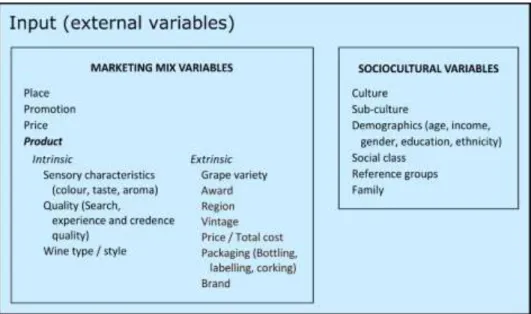
FIGURE 3.1: CONCEPTUAL THEORETICAL FRAMEWORK: CONSUMER DECISION MAKING ... 25
FIGURE 3.2: INPUT (EXTERNAL VARIABLES) COMPONENT OF THE CONSUMER DECISION MAKING PROCESS. ... 26
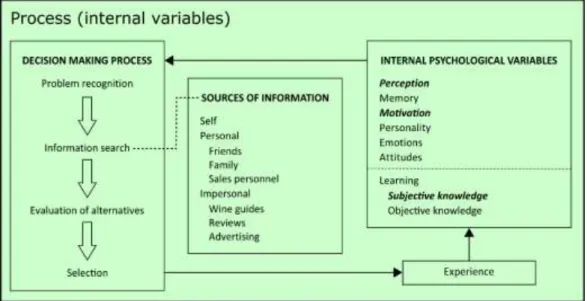
FIGURE 3.3: PROCESS COMPONENT OF THE CONSUMER DECISION MAKING PROCESS ... 38
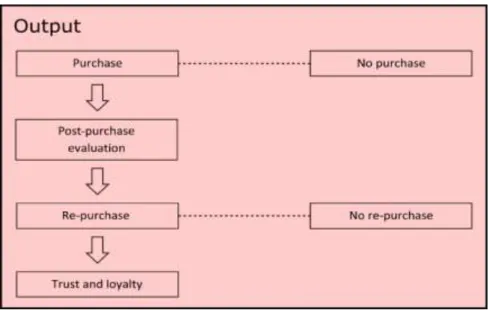
FIGURE 3.4: OUTPUT COMPONENT OF THE CONSUMER DECISION MAKING PROCESS ... 69
FIGURE 4.1: RESEARCH PROCESS ... 75
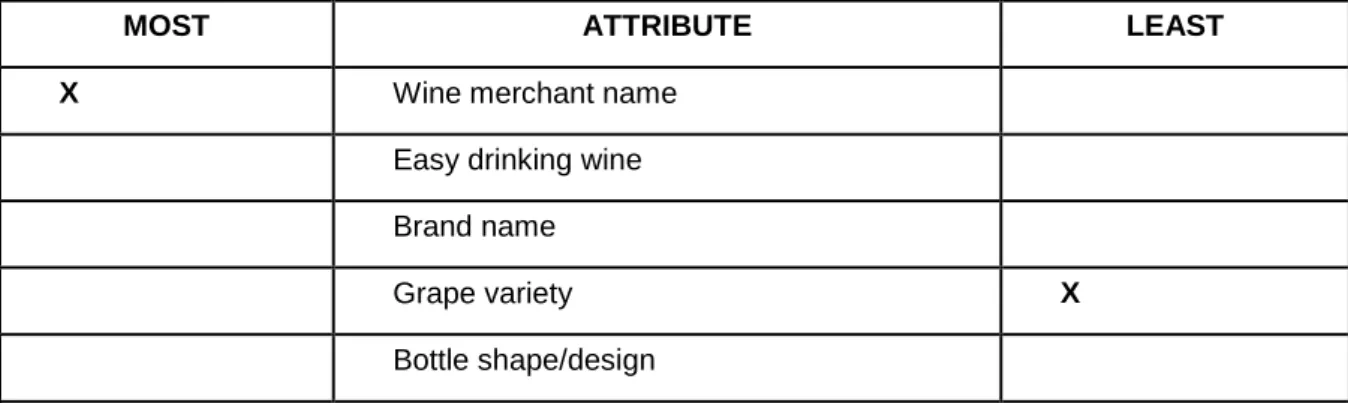
FIGURE 4.2: BWS ITEM EXAMPLE ... 83
FIGURE 4.3: STAGES IN THE SELECTION OF A SAMPLE ... 84
FIGURE 5.1: HORN’S PARALLEL ANALYSIS SCREEPLOT FOR PERCEIVED RISK FACTOREXTRACTION ... 96
FIGURE 5.2: SIGNIFICANT DIFFERENCES BETWEEN PRODUCT ATTRIBUTES: LOW SUBJECTIVE PRODUCT KNOWLEDGE RESPONDENTS ... 108
FIGURE 5.3: SIGNIFICANT DIFFERENCES BETWEEN PRODUCT ATTRIBUTES: MODERATESUBJECTIVE PRODUCT KNOWLEDGE RESPONDENTS ... 109
FIGURE 5.4: SIGNIFICANT DIFFERENCES BETWEEN PRODUCT ATTRIBUTES: HIGH SUBJECTIVE PRODUCT KNOWLEDGE RESPONDENTS ... 110
FIGURE 5.5: TWO-WAY MIXED MODEL ANOVA RESULTS FOR SUBJECTIVE PRODUCTKNOWLEDGE ... 111
FIGURE 5.6: SIGNIFICANT DIFFERENCES BETWEEN PRODUCT ATTRIBUTES: LOW PRODUCT INVOLVEMENT RESPONDENTS ... 122
FIGURE 5.7: SIGNIFICANT DIFFERENCES BETWEEN PRODUCT ATTRIBUTES: MODERATEPRODUCT INVOLVEMENT RESPONDENTS ... 123
FIGURE 5.8: SIGNIFICANT DIFFERENCES BETWEEN PRODUCT ATTRIBUTES: HIGH PRODUCT INVOLVEMENT RESPONDENTS ... 124
FIGURE 5.9: TWO-WAY MIXED MODEL ANOVA RESULTS FOR SUBJECTIVE PRODUCTKNOWLEDGE ... 125
FIGURE 5.10: RESULTS FOR THE ONE-WAY ANOVA: DIFFERENCES BETWEEN LEVELS OF SUBJECTIVE PRODUCT KNOWLEDGE AND VOLUME OF WINE PURCHASED FOROWN CONSUMPTION ... 132
FIGURE 5.11: DIFFERENCES BETWEEN LEVELS OF PRODUCT INVOLVEMENT AND VOLUME OFWINE PURCHASED FOR OWN CONSUMPTION ... 133
xiii
LIST OF TABLES
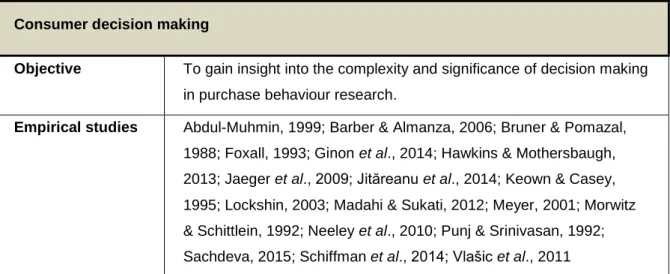
TABLE 4.1: SUMMARY OF EMPIRICAL WORK REVIEWED AS PART OF SECONDARY RESEARCH PROCESS .... 78
TABLE 5.1: RELIABILITY ANALYSIS FOR SUBJECTIVE PRODUCT KNOWLEDGE, PERCEIVED RISK, AND LEVEL OF PRODUCT INVOLVEMENT ... 93
TABLE 5.2: VARIMAX ROTATION FOR PERCEIVED RISK FACTOR LOADING ... 96
TABLE 5.3: RED WINE PRICE RANGE ... 101
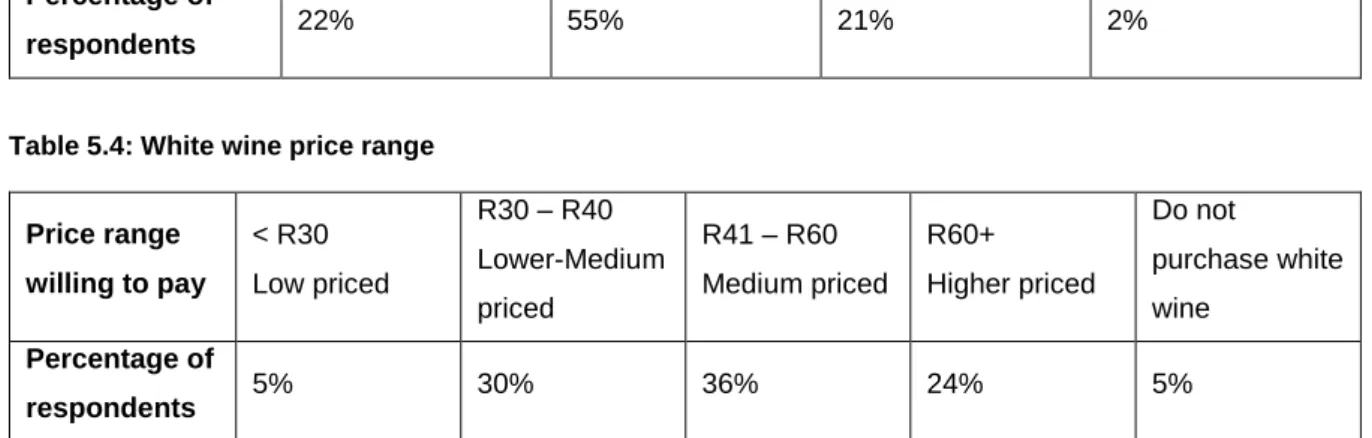
TABLE 5.4: WHITE WINE PRICE RANGE ... 101
RABLE 5.5: ROSÉ WINE PRICE RANGE ... 102
TABLE 5.6: LOW SUBJECTIVE PRODUCT KNOWLEDGE – RANKING OF IMPORTANCE OF PRODUCT ATTRIBUTE ... 104
TABLE 5.7: MODERATE SUBJECTIVE PRODUCT KNOWLEDGE – RANKING OF IMPORTANCE OF PRODUCT ATTRIBUTE ... 105
TABLE 5.8: HIGH SUBJECTIVE PRODUCT KNOWLEDGE – RANKING OF IMPORTANCE OF PRODUCT ATTRIBUTE ... 106
TABLE 5.9: SUMMARY OF SUBJECTIVE PRODUCT KNOWLEDGE: LEVELS, BWSIMPORTANCE RANKING AND SIGNIFICANCE BETWEEN-GROUPS ... 112
TABLE 5.10: LOW PRODUCT INVOLVEMENT – RANKING OF IMPORTANCE OF PRODUCT ATTRIBUTE ... 118
TABLE 5.11: MODERATE PRODUCT INVOLVEMENT – RANKING OF IMPORTANCE OF PRODUCT ATTRIBUTE . 119 TABLE 5.12: HIGH PRODUCT INVOLVEMENT – RANKING OF IMPORANCE OF PRODUCT ATTRIBUTE ... 120
TABLE 5.13: SUMMARY OF LEVEL OF PRODUCT INVOLVEMENT: LEVELS, BWS IMPORTANCE RANKING AND SIGNIFICANCE BETWEEN-GROUPS ... 126
TABLE 5.14: DIFFERENCES BETWEEN LEVELS OF SUBJECTIVE PRODUCT KNOWLEDGE AND VOLUME OF WINE PURCHASED PER MONTH FOR OWN CONSUMPTION ... 131
TABLE 5.15: DIFFERENCES BETWEEN LEVELS OF PRODUCT INVOLVEMENT AND VOLUME OF WINE PURCHASED PER MONTH FOR OWN CONSUMPTION ... 133
CHAPTER 1
INTRODUCTION AND BACKGROUND
1.1 INTRODUCTION
Historically, Old World wine countries such as Italy, France, Germany and Spain had a reputation of producing superior wine in terms of quality and taste. This reputation was built by utilising more traditional than modern production methods, the perceived quality of the terroir (the location of the vineyard, the inclination of the soil, the humidity of the air, rainfall, and flora and fauna), and overall prestige associated with a region of origin in the marketplace. However since the early 1990’s, New World wine countries such as South Africa, the United States, Australia, Argentina, New Zealand, and Chile have started to show affluence in the global wine market (Truong, 2012).
A pivotal turning point was set in motion after a blind tasting at a Paris Wine Tasting in 1976, where nine French judges rated red and white wines from California (New World wines) better than French wines (Old World wines) (Slinkard, 2014). Consequently, consumers’ perception of New World wines started to change and for more than a decade (1996 - 2013) the export volumes for New World wines have grown dramatically. This increase in global demand suggests that the upsurge in New World wine production is no temporary anomaly (Cusmano, Morrison & Rabellotti, 2010; Marketline, 2014).
Since the early 2000’s, major social, political and environmental changes influenced the global wine industry leading to changes in consumers’ wine purchase behaviour. These changes include climate changes, volatile product demand, developments in legislation, ethical trade and economic factors (SAWIS VinIntell, 2012; SAWIS VinIntell, 2012; SAWIS VinIntell, 2012; SAWIS VinIntell 2013). As a result, shifts in consumer purchasing patterns may create a need for realigning wine marketing strategies to grow market share (Cusmano et al., 2010).
The South African wine market in particular has gained both academic and commercial interest due to its growth rate between 2009 and 2013. However, it has been
suggested that the market may expand at a slower rate between 2014 and 2018. Industry stakeholders attribute the slower expansion rate to: the unpredictability of the Rand exchange rate; the intense wine segment rivalry; increasing availability of non-wine product alternatives in the market and troublesome global economic circumstances (for example instability of the European Union, the United States’ stagnating economy and gradual market growth shown for China) (Marketline, 2014; WOSA, 2013). Following on from the suggested slower expansion rate and the increasing amount of competition in the market (Cusmano et al., 2010; Von Armin & Herbst, 2009), South African wine marketers face unique challenges in the future. The challenge for South African wine brands to sustain a profitable market share has sparked research interest in gaining insight into consumer decision making and the factors that could influence wine purchase behaviour.
A particular area of interest within global wine research pertains to purchasing and consumption situations. Numerous studies have reported that various consumption situations may explain differences in consumer purchase behaviour (Agnoli, Begalli & Capitello, 2011; Camillo, 2012; Jaeger, Danaher & Brodie, 2009; Lockshin & Hall, 2003; Quester & Smart, 1998). Wines are furthermore purchased for different occasions each with different consideration sets, adding to the complexity of understanding wine purchasing behaviour. These occasions may include purchasing wine for own consumption, or to give as a gift, or for a dinner party with friends/family (Quester & Smart, 1998; Von Armin & Herbst, 2009). For the study at hand the assumption is made that when consumers purchase wine for own consumption, this action includes consumption. Lacey, Bruwer and Li (2009) propose that the volume of wine purchased be reported as bottles per month (as this is a relatively easy measure for consumers to indicate). Therefore, when referred to wine purchase (behaviour) the concept of consumption is included and the measurement of units of purchase (and the assumed consumption) is based on the volume of wine purchased (bottles per month).
The number of choices individuals must routinely make has proliferated and alongside this, a unique network of variables influence consumer decision making, and therefore understanding consumer decision making within a given purchase situation has become complex (Gustafson, 2015). For instance, within purchase decision making,
consumers have varying abilities and confidence levels in making decisions and as a result consumers can feel anxious and inexperienced, increasing the levels of perceived risk associated with the purchase decision. Perceived risk can be defined as a consumer’s level of uncertainty and anxiety in making a purchasing decision and is largely driven by a lack of experience and wine product knowledge (Lacey et al., 2009; Schiffman, Kanuk, Brewer, Crous, du Preez, Human, Janse van Rensburg, Raninger, Tshivhase, Shrosbree & Ungerer, 2014:155). Inexperience and the complexity of the product (as the quality of the wine cannot always be determined prior to purchase), consequently motivates consumers to utilise risk-reduction strategies to assist in coping with uncertainty (Lacey et al., 2009). One risk-reduction strategy used by consumers to cope with uncertainty is to increase product knowledge prior to purchase. It can be suggested that inexperienced consumers feel that a lack of wine knowledge leads to increased uncertainty and results in a higher level of perceived risk associated with the buying decision, versus those consumers with higher product knowledge.
In an attempt to reduce perceived risk, consumers seek guidance from predominantly product cues (extrinsic, described as what is on the bottle, such as labelling, and intrinsic characteristics such as taste) and some other sources such as references, sales promotions and previous experience (Ginon, Ares, Issanchou, Laboissière & Deliza, 2014; Lockshin 2003; Oosthuizen, 2015). These sources of information contribute to a consumer’s subjective product knowledge and could reduce the perceived risk experienced when making product choices without adequate levels of product knowledge.
Subjective product knowledge is a multidimensional construct that refers to a consumer’s perceived familiarity with a product category (Viot, 2012). Research findings have suggested that consumers are more inclined to allow subjective product knowledge to guide behaviour, including purchase and financial decisions, than objective product knowledge, which is actual knowledge of a product category (Galegroup, 2014; House, Lusk, Jaeger, Traill, Moore, Valli, Morrow & Yee, 2004). There are various levels of wine knowledge, ranging from expert to novice wine consumers (Johnson & Bastian, 2007). Consumers are characterised as expert if their
level of wine knowledge is above average, moderate if their knowledge level is average, and novice if they show a below average level of wine knowledge.
Consumer knowledge has been a significant focus in consumer behaviour research and findings have uncovered a relationship between levels of product involvement and purchase behaviour, while there is some empirical support that the level of product involvement (high, moderate and low) may influence a consumer’s overall need for information on a product prior to purchase (Bian & Moutinho, 2008; Hollebeek, Jaeger, Brodie & Balemi, 2007; Quester & Smart, 1998). Bruwer and Huang (2012) define the level of wine involvement as the extent of personal relevance of wine-related purchase decisions. Although the level of product involvement is an important variable in wine marketing segmentation, scant scientific research findings have been published on the impact thereof when purchasing New World wines such as South African wines.
Previous research investigated the influence of subjective product knowledge (Dodd, Laverie, Wilcox & Duhan, 2005; Moorman, Diehl, Brinberg & Kidwell, 2014), the role of perceived risk (Bruwer, Fong & Saliba, 2013; Lacey et al., 2009), and the effect of level of product involvement on choice attributes (Barber, Ismail & Dodd, 2007; Hollebeek et al., 2005). Within this context, there is an apparent void in the literature in that no published scientific literature could be identified that measures the combined influence of these variables. In addition, through discussions with industry leaders (for instance Marketing Director at Cape Legends Distell, Sales Director at Cape Legends Distell) a greater understanding on the purchase behaviour of South African wine consumers is of utmost importance to gain insights and align marketing strategies alike. Thus the problem statement for this study was formulated as: Do different levels of subjective product knowledge, perceived risk and product involvement influence the volume of South African (New World) wine purchased per month for consumers’ own consumption?
Consequently, the primary objective was to determine if:
1) Different levels of subjective product knowledge, perceived risk and product involvement contribute to differences in wine purchase for own consumption in South Africa.
It can be argued that a higher level of product involvement results in an extensive product-related search for information, hence an increase in subjective product knowledge could lead to the reduction of perceived risk and ultimately a change in purchase behaviour. However a fundamental question remains: Which unique combinations of product attributes are important given various levels of subjective product knowledge, perceived risk and product involvement when purchasing wine for own consumption?
No academic literature that determines the importance of unique combinations of choice attributes and how they vary for levels of knowledge, perceived risk and product involvement, could be identified. This observation resulted in the secondary
objectives, namely to:
2) Identify which wine product attributes are considered important for a sample of South African wine consumers when purchasing a bottle of wine for own consumption, and
3) determine whether the unique combinations of product attributes vary for different levels (low, moderate, and high) of subjective product knowledge, perceived risk and product involvement.
Current non-consumers of wine fall outside the scope of this study as the focus is on current wine consumers’ subjective product knowledge, perceived risk and product involvement. The following section will provide a brief literature overview on the principle areas of the study.
1.2 LITERATURE REVIEW
In the introduction, wine was described as a highly complex product due to the fact that consumers do not always have the opportunity to taste the specific wine prior to purchase, and the fact that consumers purchase wine for different occasions which involves different consideration sets. It is therefore the purpose of the study to gain insight into consumer purchasing behaviour when selecting a bottle of wine for own consumption. The focus of the following section is to discuss subjective product knowledge, perceived risk and level of product involvement in relation to its influence on consumer wine purchase. Firstly, a contextual distinction should be made between
the Wines of the World and how various differences between Old and New World wines influence consumer purchase behaviour.
1.2.1 Understanding New World wine consumers
The distinction between Old World and New World wines provide consumers with a way to simplify and categorise proposed differences amongst wines produced in various countries (De Magistris, Groot, Gracia & Albisu, 2011). Some consumers believe that Old World wines represent sophisticated wine making methods and as a result of these methods produce superior wines, while others view these techniques as conservative and an attempt to protect historic trade methods. By contrast, New World wines are regarded by some industry stakeholders as experimental and innovative, thereby encouraging new product developments. Following the establishment and encouragement of an innovative orientation amongst New World winemakers, these wines could be regarded as the wines of the future (Banks & Overton, 2010). As the wines produced by different countries are believed to differ, so too are there differences between consumers that purchase the Old World versus the New World wines. The difference in flavour, variety and national origin are some of the indicators that have been reported to influence consumer choice (Muhammad, 2011).
In essence, marketers can use the distinction between consumers who purchase Old and New World wine as a means of segmentation combined with research on demographic segmentation (including factors such as age, gender, income, ethnicity, education and life stage). These findings lead to greater insight into purchase behaviour, and therefore to targeted marketing activities (Barber & Almanza, 2006; De Magistris et al., 2011). Subsequently the interest in wine consumer behaviour research has increased in volume and scope. Documented and peer reviewed research outputs are becoming more sophisticated as variables such as personality, involvement, product knowledge, perceived risk and motivation for purchase are included in wine purchase research (Jităreanu, 2012). For the purpose of the study at hand, the influence of different levels of subjective product knowledge, perceived risk and level of product involvement on wine purchase was investigated. This study was a result of an identified gap in wine consumer research, to determine the combined influence of these constructs on wine purchase behaviour within a New World wine context.
1.2.2 Subjective product knowledge and wine purchase behaviour
Measuring the impact of knowledge on consumer decision making has long been a focal point in marketing and consumer behaviour literature (House et al., 2004). Park and Lessig (1981) introduce the concept of consumer knowledge as a two-dimensional construct that includes the actual and perceived consumer knowledge of a particular product. Shortly thereafter, Brucks (1985) propose a refinement through three categories of consumer knowledge namely: objective product knowledge, subjective product knowledge and prior experience. However, according to Brucks (1985), knowledge based on experience is not significantly linked to behaviour. Similarly, it has been suggested that subjective product knowledge influences consumer behaviour in a more significant way compared to objective knowledge (Viot, 2012).
Viticulturist Richard Rose advocates that to increase wine consumption, specifically in the South African market, marketers must focus on increasing consumers’ wine knowledge (Strategy key to growing SA wine industry in difficult times, 2013). This strategy could result in increased product knowledge, lower levels of perceived risk and ultimately (together with other factors such as promotional and brand awareness campaigns) positively impact wine purchase behaviour. Additionally, after investigating the influence of subjective wine knowledge for expert and novice wine drinkers, Viot (2012) suggests that future research studies should investigate subjective product knowledge based on three levels: expert, moderate and novice consumers.
1.2.3 Perceived risk and wine purchase behaviour
The concept ‘perceived risk’ was introduced to consumer behaviour research in the early 1960’s by Raymond Bauer and can be defined as the instance where a product does not live up to a consumer’s expectations, multiplied by the probability that this dissatisfaction will occur (Horvat & Došen, 2013). Since the 1960’s, perceived risk has been one of the pillars of consumer behaviour literature, particularly when investigating consumer decision making. With any purchase decision a level of risk is involved, as the consequences of an action can be uncertain and may in some cases be unpleasant (Stone & Grønhaug, 1993). However, perceived risk is not a
one-dimensional construct. Six types of perceived risk have been suggested: functional risk; physical risk; financial risk; social risk; psychological risk and lastly, time risk (Bruwer et al., 2013; Lacey et al., 2009).
The concept of perceived risk was introduced to wine research in the late 1980’s by Mitchell and Greatorex (1989). These researchers focused in particular on consumers from the United Kingdom, and how perceived risk influenced consumer decision making when purchasing wine (Mitchell, 1988; Mitchell & Greatorex, 1989). Following on from their findings, Spawton (1991) proposed that the majority of wine consumers are highly sensitive to risk when purchasing wine and subsequently identifying risk-reduction strategies to alleviate risk has been a noticeable focus area in wine research. Some of the risk-reduction strategies include: using extrinsic cues to alleviate intrinsic quality, tasting the wine prior to purchase and gaining insight (wine knowledge) prior to purchase. Lacey et al. (2009) suggests that perceived risk, when purchasing wine for a specific consumption occasion (for example own consumption), should be investigated in more detail.
1.2.4 Level of product involvement and wine purchase behaviour
Historically, the level of involvement was used in research within the field of political persuasion. However, involvement eventually branched into consumer behaviour literature (Barber, Taylor & Strick, 2009). Zaichkowsky (1985) described the concept of involvement as the degree of perceived relevance of a product based on a consumer’s inherent needs, interests and values. Similarly, Rothschild (1984) referred to involvement as a state of motivation, whereby personal relevance of the purchasing decision determines this level of motivation. This level of personal relevance depends upon various psychological stimuli namely: attention/processing involvement, personal/situational involvement, audience/process involvement and enduring/product involvement (Jaeger et al., 2009). Enduring or product involvement represents a more permanent or long-term concern with the product decision. Previous research on wine consumption suggested that the level of product involvement may depict a consumer’s purchase quantities, overall perception of service delivery in store, satisfaction (prompting future sales) and references to others
(Barber et al., 2009). Based on this suggestion it is expected that the level of product involvement may influence wine purchasing for different consumption occasions.
1.2.5 Wine attributes and wine purchase behaviour
Due to the complex nature of wine purchasing, one of the major challenges for wine marketers is to determine which product attributes predominantly drive consumer choice (Ginon et al., 2014). In some cases, wine consumers have to rely on product attributes when selecting a bottle of wine. Many wine marketers use intrinsic and extrinsic product attributes to communicate superior quality or differentiating characteristics to consumers in an attempt to drive sales (Viot, 2012).
Ginon et al. (2014) and Viot (2012) suggest twenty five statistically significant wine attributes that can influence wine consumer decision making (refer to Appendix A). However, the question remains, what unique combinations of product attributes do South African consumers utilise in selecting a bottle of wine for own consumption?
The following section will provide a brief overview on the proposed research design that was used to collect and analyse the data in an attempt to answer the research questions discussed.
1.3 RESEARCH DESIGN
The research design provides a framework for researchers whereby methods and procedures are specified and used to collect, measure and analyse the necessary information (Sreejesh, Mohapatra & Anusree, 2014:27). For the purpose of this study, quantitative research was conducted to answer the research questions and test the stated hypotheses.
The following section will explain the use of primary and secondary research. This section also briefly describes the target population, methods, sampling process, fieldwork and the data analysis methods that were used in this study.
1.3.1 Secondary research
Secondary research is one of the first steps in the research process, where previous data, not composed for the purpose of the specific study, is collected. Secondary research has some major advantages: the availability of the literature and data, it is less expensive, it can be collected relatively fast, by collecting secondary data time and money is saved and secondary data eliminates the sampling and processing of data (Sreejesh et al., 2014:21; Zikmund & Babin, 2007:160). Disadvantages of secondary research may influence the use thereof namely: the data may be outdated, the definitions of certain terms may be different, the secondary researcher may have used different units of measurements and the data may lack critical information to confirm the accuracy of the data (Silver, Stevens, Wrenn & Loudon, 2013:42; Zikmund et al., 2010:161).
As discussed earlier, previous research investigated the influence of subjective product knowledge (Dodd et al., 2005; Moorman et al., 2014; Viot, 2012), the role of perceived risk (Bruwer et al., 2013; Lacey et al., 2009), and the effect of the level of product involvement on choice attributes when selecting a bottle of wine (Barber et al., 2007; Hollebeek et al., 2005). Therefore, this study is a semi-replica study that was conducted to determine how different levels of subjective product knowledge, perceived risk, and product involvement influence the volume of wine purchased (bottles purchased per month) for own consumption, more specifically in the South African wine market. This study attempted to fill a gap in New World wine research due to a lack of insight into variables that influence purchase behaviour within the South African market (Von Armin & Herbst, 2009).
Although secondary research (in the form of academic articles, textbooks and electronic information) assisted the researcher in gaining a better understanding of the constructs under investigation, it was essential to conduct primary research to solve the specific research problem and achieve the research objectives.
1.3.2 Primary research
Primary research allows the researcher to collect data addressing a specific research question, hence providing insight into a managerial problem (Silver et al., 2013:117). Primary data were collected to fill the gaps in the existing body of literature.
Sample design: The sample design provides an outlay of the procedure to identify
and select the target population, the sampling frame used, the sample size, the procedure for ultimately selecting the sampling elements and how and by whom the sampling units will be reached (Zikmund et al., 2010:616).
For the purpose of this study, the target population was described as: South African wine drinkers, male and female individuals of all races, aged above the legal South African drinking age of eighteen. Screening questions were asked to ensure that the respondents were South African citizens, above the legal drinking age and whether the respondent has purchased a bottle of wine in the past three months. Viot (2012) suggests that respondents who answer questions pertaining to wine purchasing and in particular the level of product involvement, had to have purchased the product in at least three months prior to completing the questionnaire. A non-probability convenience sample with a sample size of between 200 and 300 respondents (completed questionnaires) was suggested to analyse the data statistically (Kidd, 2015).
Data collection and fieldwork: A self-administrated questionnaire (refer to Appendix
B) was used to gather primary data. When investigating wine purchase decision making, it has been suggested that data obtained by incorporating hypothetical usage situations shows more concrete predictions of purchase behaviour than found in traditional consumer behaviour measurements of attitudes (Lai, 1991; Quester & Smart, 1998). Therefore, it is important to stress that the questionnaire was based on purchase for own consumption.
A questionnaire attempts to describe events and explore the reasons for activities to identify characteristics of the target market, making this method of data collection appropriate for the study at hand. Alongside the ability to describe events and explore
the reasons for activities, questionnaires provide relatively quick, inexpensive, efficient and accurate access to certain information regarding the population (Zikmund et al., 2010:186). The questionnaire for this study consists of six sections and a total of 75 items. Section A is a screening section (nationality and date of birth), followed by Section B addressing the importance of product attributes by using 25 best-worst scaling (BWS) items. Section C includes eight items on subjective product knowledge and the respondent’s level of perceived risk is determined in Section D by means of 22 items. Section E comprises of six items that measure level of product involvement, and lastly Section F gathered demographic information. The questionnaire design and layout will be discussed in detail in Chapter 4.
Data processing and analysis: The raw (numeric) data collected from the
measurement instrument was cleaned and coded, after which a database was compiled in a Microsoft Excel spreadsheet. This database was transferred to a statistical analysis software programme (Statistical Package for the Social Sciences – SPSS version 23), after which a series of statistical analyses were conducted. Two categories of data analysis techniques are evident: descriptive and inferential analysis.
Descriptive analysis: Descriptive analysis transforms data into an understandable format whereby basic characteristics of the population or sample can be displayed (Zikmund et al., 2010:413). The final section of the online survey requested respondents to provide basic demographic information such as: age, gender, gross monthly household income, ethic orientation and provincial residency. The output from this section (alongside screening questions in Section A) assisted the researcher to profile the sample and make more specific managerial recommendations.
Inferential analysis: When testing hypotheses, researchers are interested in determining whether the relationships found in the data may be inferred to the population from which the sample was drawn (Duncan, 2003:3-4). Therefore an inferential analysis should be conducted. To test the hypotheses measuring the influence of different levels of subjective product knowledge, or perceived risk, or product involvement, and the importance of different product attributes on purchase behaviour the use of Analysis of variance (ANOVA) as a statistical technique can be proposed. To test the difference between levels of subjective product knowledge, or
perceived risk, or level of product involvement and the volume purchased (bottles purchased per month) the use of one-wayANOVA was suggested.
1.4 ORIENTATION OF THE STUDY
The proposed study consists of the following chapters. Chapter 1 provides an overview of the study at hand, an introductory discussion on key concepts (subjective product knowledge, perceived risk and level of product involvement), objectives and the purpose of the study. Chapter 2 provides insight on wine as a product and the wine industry - in particular the South African wine industry, followed by Chapter 3, that reviews literature on consumer decision making and wine consumer purchase behaviour based on the key concepts introduced in Chapter 1. Chapter 4 presents the research design and methodology. This chapter also provides more insight on the measurement instrument used, sampling procedure and the selection of respondents, fieldwork and data analysis. Chapter 5 reports and discusses the results obtained through primary research. Lastly, Chapter 6 deliberates the research conclusions and provides managerial recommendations with regards to realigning marketing strategies to grow market share within the South African wine market. Additionally, future research areas will be proposed and this chapter concludes with the limitations of the study.
1.5 CONCLUSION
The significant social, political and environmental changes since the early 2000’s may give way to a shift in consumer purchasing patterns. This shift may create a need for realigning marketing strategies within the wine industry. The wine industry in particular has gained academic and commercial interest pertaining to the optimisation of marketing strategies. In a highly complex marketing environment, understanding the influence of different choice attributes on consumer purchase behaviour can be vital in developing marketing strategies to create a competitive advantage. As such, this study attempts to gain insight into South African wine consumer purchase behaviour and factors that influence decision making when selecting a bottle of wine for own consumption. The following chapter will provide insight into the history of wine and in particular reflect on the South African wine industry and the history thereof.
CHAPTER 2
A HISTORICAL OVERVIEW OF WINE
2.1 INTRODUCTION
Prior to the 1960’s, wine producers were mostly production focused as investments in the establishment and optimisation of vineyards and the winery were key. From the 1960’s onwards, the supply and distribution chains drew some attention after which, only in the late 1980’s, a consumer and marketing orientation was introduced within the wine industry (Hall & Mitchell, 2008:306). This shift in orientation placed marketers under pressure to create consumer-led products due to changing demands and competitive pressure (Gluckman, 1990).
Since 1995, global wine consumption has increased noticeably and together with sustained high levels of production, a highly competitive market has emerged (Jităreanu, 2012). Subsequently marketing has become increasingly important in the wine industry. However, wine marketers face enormous challenges – some not faced by other industries. In short, these challenges entail that there is virtually no consumer brand loyalty toward wine as wine consumers enjoy experimenting with what is on offer, experiencing wines by different producers or trying different grape varietals. Additionally, the wine market is known to be saturated due to the high number of brands available (Wagner, Olsen & Thach, 2007:2-3). Therefore wine marketers face the challenge of having to differentiate brands in a highly cluttered marketing environment. To add to these industry challenges, consumers find selecting a bottle of wine bewildering due to the fact that the quality of wine cannot always be evaluated prior to the purchase, and consumers are under time pressure during purchasing (Neeley, Min & Kennett-Hensel, 2010; Lamb, Hair, Mc Daniel, Boshoff & Terblanche, 2012:36). Both industry challenges and consumer decision making challenges form part of the complex nature of the wine industry.
To address these marketing challenges, one should first explore and understand the history of wine, as well as the unique nature of particularly the South African wine industry. This chapter will allude to these themes, after which a justification of the
importance of consumer purchase behaviour insight (within New World wine countries) will be presented.
2.2 A BRIEF HISTORY OF WINE AND THE WINE INDUSTRY
Wine is an ancient alcoholic beverage, and the historic usage and relevance of wine can be found in many examples, such as the vine cuttings that were sometimes buried with the dead in the belief that these vines could be planted in the afterlife (based on Egyptian beliefs), Assyrian buildings displaying wine-related carvings and depictions of vines on some ancient coins. Furthermore, there are many references to wine in the Bible, of which the turning of water into wine to serve guests at a wedding ceremony is most well-known (Estreicher, 2004).
The Neolithic period (8 500 – 4 000 B.C.) is known for the establishment of permanent settlements (including houses, tamed animals and farming) and included the planting of vines and seeds. Due to the high amount of alcohol found in wine it was used to make drinking water safer (the alcohol acted as a purifier) and for medicinal purposes. Additionally, wine became part of religious rituals and gatherings. Consequently, wine formed an integral part of human interaction. Socrates, the classic Greek philosopher, invented the symposium – meaning “drinking together”, hence the origin of social drinking. Evidently, a rich ancient culture of wine is prominent in the history of Egypt, Greece and Rome (Estreicher, 2014).
After the fall of the Roman Empire (in 476 C.E.) waves of the so-called “Barbarians” (Greeks and Romans used this term in reference to their encounters with different foreign cultures) flooded Europe, seeking land and power. Many Barbarians converted to Christianity and perpetuated the planting of vineyards in the vicinity of churches. The impact of Islam and the Arabs is also present in the history of wine, as the Arabs invented wine distillation technology in the 8th century. The subsequent transfer of
knowledge from Islamic countries to Western Europe influenced developments in medicine, science and technology (Hutchinson, 2006).
Distillation technology extended to a number of European countries by the late Middle-Ages, which resulted in the development of greater sophistication in wine making
methods. The second half of the 15th century marked the start of a new era of Western
Civilisation and wine history with the expansion of trade. In 1498, Vasco de Gama rounded the Cape of Good Hope for the first time. Due to the fact that the Dutch had to provide supplies to ships en route around the Cape, a trade post was set up by the Dutch East India Company (Vereenigde Oost-Indische Compagnie, VOC) at the Cape of Good Hope in 1652. The first settlers arrived in South Africa in 1652 where Jan Van Riebeeck planted the first vines (Vitis vinifera) near Cape Town in 1655 (Estreicher, 2014). On the 2nd of February 1659, Jan van Riebeeck made the following entry into
his diary:
“Today – praise be to heaven – for the very first time the grapes of the Cape were pressed for winemaking...” (South African Wine, 2009)
This diary entry announced the date on which the first South African grapes were pressed for winemaking, signifying the first entry into the South African wine history books (Estreicher, 2004; Van Zyl, 1987). Jan van Riebeeck’s entry in his diary correlates with the popular ancient sayings that wine can be enjoyed as “a chemical symphony”, “bottled poetry” and “captured sunshine” (McGovern, Fleming & Katz, 1996:xii). The diary entry, marking the first pressing of wine, was made seven years after the founding of the Dutch settlement by Jan van Riebeeck at the foot of Table Mountain. Jan van Riebeeck planted these first vines in the Dutch East Indian Company’s garden, after which he extended the vineyards by planting at Bosheuwel, an area of just over a 100-hectare along the Amstel River (Hands & Hughes, 2001:15). These cuttings were mostly imported from Western France (Estreicher, 2014; SA Wine Industry Directory, 2000:11). Van Riebeeck’s example was soon followed by local farmers who were impressed by the quality of the Commander’s vines and by the weight of his crops (Estreicher, 2004; Hughes, Hands & Kench, 1992:10).
However, Governor Simon van der Stel, who arrived in the Cape in 1679, was not satisfied with the quality of the wine produced in South Africa and expressed his concern about the “revolting sourness” of the local wines (Stevenson, 2005:442). As a result, Van der Stel proposed the establishment of a wine estate at Constantia in 1685, on the lower slopes of Table Mountain in Cape Town suggesting that this location could solve the “sourness” issue due to the quality of the terroir and climate
conditions (GrootConstantia, 2015; SA Wine Industry Directory, 2000:11). In 1688 the young South African wine industry was given a major boost with the arrival of 200 French Huguenots (Stevenson, 2005:442). Many of the French Huguenots had detailed knowledge of winemaking and therefore improved the Cape’s wine quality, and by the early 1700’s South African wines were held in high esteem (Estreicher, 2004; SA Wine Industry Directory, 2000:11).
As time progressed, the Cape wine viticulture was established beyond the boundaries of the Cape Peninsula, with many farms in the Stellenbosch and Drakenstein (now known as Franschhoek) regions. By the 1700’s the Drakenstein region was producing more wine than the Stellenbosch and Constantia wine farms (SA Wine Industry Directory, 2000:11). In 1699 Simon van der Stel was succeeded as governor by his son, Willem Adriaan, who used his wine farming expertise to further enhance the quality of the farms in the Cape (Estreicher, 2004).
In 1761, the Constantia wine farm exported wine to Europe and by 1778 reached a level of quality that was recognised throughout Europe (GrootConstantia, 2015; Hands & Hughes, 2001:17). In 1788 the Cloete family acquired the Groot Constantia wine farm and produced natural sweet wines that were appreciated by European kings, emperors, statesmen and merchants (GrootConstantia, 2015; SA Wine Industry Directory, 2000:11; Hughes et al., 1992:20). These sweet wines remained the Cape’s best-known and most desirable wines for almost two centuries.
In 1806, the French Revolutionary forces entered Holland and the British occupied the Cape. The British, who were cut off from supplies of French wines, began exporting South African wines to all the corners of the empire. The exports led to South African wines becoming well known in the British Empire, which enhanced its growing reputation abroad (Stevenson, 2005:442). In 1825 the British Government imposed heavy tariffs on the importation of French wines, which led to rapid increases in Cape wine sales (Hughes et al., 1992: 20). Exports of Cape wines to Britain alone had reached 45,000 hectolitres (one million gallons) per year by 1859. However, Richard Cobden and William Gladstone from Britain negotiated a confidential commercial treaty with the French, which had a devastating effect on wine trade between Britain and South Africa (Cape wines). The effect of these secret negotiations resulted in a
major decrease in wine sales for the Cape: 22,000 hectolitres in 1860, 5,700 hectolitres in 1861 and by 1965 as little as 4,200 hectolitres were exported (Stevenson, 2005: 442). To compound matters, the South African wine industry suffered a further decline in sales during the 19th century due to epidemics of powdery mildew and
Phylloxera Vastarix (a vine disease) while global, political and market forces led to a tremendous over-production of wine in 1918 resulting in a major drop in wine prices (SA Wine Industry Directory: 2000:11).
Relief was brought to the decrease in demand of export wine (sales), when gold and diamonds were discovered in the 19th century in South Africa. This discovery led to an
increase in the demand for vineyards, but the sudden wealth of immigrants (due to the discovery of gold and diamonds) and the onset of the Boer War, lead to a drop in wine production at home and abroad (Estreicher, 2014; Stevenson, 2005:444).
In 1918 KWV (Ko-operatieve Wijnbouwers Vereniging van Zuid-Afrika Beperkt) was formed by Charles WH Kohler whose vision was to regain local and international renown for the South African wine industry (SA Wine Industry Directory 2000: 11). KWV, a government-backed institution, decided to distil half of the country’s annual wine production into brandy as a primary action to regain the Cape’s wine reputation and enhance the quality of the wine produced (Stevenson, 2005: 444). KWV brought an era of secure income and financial growth for wine producers. The actions by the KWV, in conjunction with developments in scientific and technological expertise, helped rekindle the South African wine industry. KWV converted into a company in December 1997 and joined forces with the Wine Industry Trust in February 1999. A major motivation for converting to a company was to enhance wine related research and support new farmers from previously disadvantaged groups (Estreicher, 2004; SA Wine Industry Directory, 2000:11).
Due to ever changing consumer demands and industry trends, the wine industry is constantly developing and posing a challenge for marketers. Until the late 1990’s the wine market was dominated by wines from countries such as Italy, France, Spain, and Germany but this has changed since wines from Australia, Chile, Argentina, China and South Africa gained interest (Estreicher, 2004, 2014; Pesme, 2017). Therefore literature makes a distinction between Old and New World wine countries, showcasing