BUSN29-Master Thesis
Lund University
May 2013
Branded applications - Function triumphs Brand?!
An exploratory study of branded applications’ role in the brand building process
Authors: Lidia Vukcevic and Malin Willgottson
Master programme: International marketing & Brand management Supervisor: Ulf Elg
Examinator: Annette Cerne Date: 24.05.13
Acknowledgments
We would like to thank all the respondents for participating in the focus groups. Their willingness to share their opinions and experiences gave us a unique insight to the consumer perspective on mobile marketing, which contributed to the aim of this thesis. We would also like to express our gratitude to Stefan Persson and Ola Secher at Nespresso, as well as John Wernvik from Kungsörnen for their participations. Without their view on mobile application in relation to branding we would not have been able to complete this thesis. Our special thanks goes to our dedicated supervisor Ulg Elg, for his support and continuous feedback.
Lund, May 2013
_____________________ ______________________
Abstract
Title: Branded applications - Function triumphs Brand?
-An exploratory study of branded applications’ role in the brand building process Date of the Seminar: 2013.05.29
Course: BUSN29, Degree project in Global marketing Authors: Vukcevic, Lidia and Willgottson, Malin Supervisor: Elg, Ulf
Keywords: Brand building process, High/low involvement brands, Mobile marketing, Branded applications.
Thesis purpose: The primary purpose of this thesis is to explore the role of branded applications in the different steps of the brand building process. Further, an investigation of whether this differs between a high and low involvement brand will be conducted from both a consumer and managerial perspective.
Methodology: Given the aim of this study a qualitative method was conducted, which consisted of three in-depth interviews and four focus groups. The in-depth interviews were conducted with managers from Kungsörnen and Nespresso.
Theoretical perspective: This thesis is based on theory regarding the brand building process from the consumer perspective as well as theory around mobile marketing and applications. An extended framework of Melin’s (1997) model of the brand building process and Pelsmacker, Geuens and Bergh’s (2010) e-communication framework served as the basis for the empirical data collection.
Empirical data: The empirical data has been collected through in-depth interviews conducted in-person with Nespresso and by telephone with Kungsörnen. To gain understanding of how consumer view mobile applications four focus groups were executed. Conclusion: The research reveals that since consumers have accepted mobile applications and do not see it as a marketing tool, marketers can exploit this new communication channel to strengthen the brand. By creating an application that makes the consumer engage with the brand they have the ability to create awareness and positive attitudes towards the brand. Hence, by using mobile applications as a complement to other communication channels, this study shows that branded applications have a primary role during the brand engagement and brand awareness phase of the brand building process. If the marketers manage to achieve engagement and awareness, it can in turn lead to more loyal consumers and brand advocacy.
Definitions and abbreviations
Application (app): Downloadable software that achieves certain tasks and provides value for the user of a mobile device (Mobile Marketing Association, 2009b).
Brand: In this thesis brands are defined as: ““A brand is a name that symbolizes a long-term engagement, crusade or commitment to a unique set of values, embedded into products, services and behaviours, which make the organization, person or product stand apart or but stand out.”(p.12)
Brand advocacy: A form of word of mouth marketing that describes how willing the consumers are to recommend the brand (Lantos, 2010)
Branded application: Applications that are attached to a specific brand, which display the brand identity (Mobile Marketing Association, 2009b; Bellman et al., 2011)
Brand awareness: The ability of possible customers to remember that a special brand belongs to a specific product (Kotler & Pfoertsch, 2010).
Brand engagement: Is the personal involvement between the consumer and the brand, which acts as the driving force behind decision-making and loyalty (Buckingham, 2008; Kapferer, 2012).
Brand image: The image is created by the public from all the brand messages they receive and consists of the features consumers associate with the brand (Kapferer, 2012; Shimp, 2008).
Brand loyalty: When a consumer stays true to a brand by repurchasing and using that brand prior to competitors (Hanson & Kalyanam, 2007; Aaker & McLoughlin, 2010)
High involvement product/brand: High involvement products are more expensive, the perceived risk is higher and the time to evaluate the purchase is higher (Kumar, 2007). Since the thesis focus is on product brands we will use the term high involvement brand, which indicates that the specific brand provides high involvement products.
Integrated marketing communication (IMC): To use the best available communications channels in a coordinated way to achieve the brand’s communication objectives (Holland, 2010).
Low involvement product/brand: Low involvement products have lower price, the risk is perceived lower and the interest from the consumer is lower (Kumar, 2007; Dahlen, Lange & Smith 2010). Since the thesis focus is on product brands we will use the term low involvement brand, which indicates that the specific brand provides low involvement products.
Mobile marketing: In this thesis mobile marketing is defined as: “A set of practices that enables organizations to communicate and engage with their audience in an interactive and relevant manner
through any mobile device or network” (Mobile Marketing Association, 2009a).
Native application: The downloadable version of a brand’s application (Magrath & McCormick, 2012).
Premium brand: The typical characteristics for a premium brand are excellent quality, high price, selectively distributed through the highest quality channels and carefully advertised (Quelch, 2006). Product brand: A product brand has a unique name and should be seen as delivering one unique brand promise (Ghauri & Cateora, 2010; Keller, 2011).
Pull-based mobile marketing: Content sent to a mobile device upon request from the customer (Smutkupt, Krairit & Khang, 2011).
Push-based mobile marketing: When consumers receive advertising to a mobile device by or on behalf of an advertiser, which is not requested (Leppäniemi & Karjaluoto 2008).
Table of Content
1. INTRODUCTION ... 1 1.1.BACKGROUND ... 1 1.2.PROBLEM FORMULATION ... 2 1.3.PURPOSE ... 4 1.4.LIMITATIONS ... 4 2. THEORETICAL FRAMEWORK ... 5 2.1.BRANDING ... 5 2.1.1. Brand Definition ... 5 2.1.2. Product brand ... 5 2.1.3. Premium brand ... 6 2.1.4. High-and low-involvement ... 62.2BRAND BUILDING PROCESS ... 7
2.2.1 Brand engagement and brand sensitivity ... 8
2.2.2 Brand awareness ... 8
2.2.3 Brand image ... 9
2.2.4 Brand Loyalty and added value ... 9
2.2.5 Brand advocacy ... 10
2.3BRAND COMMUNICATION ... 10
2.3.1 Online Communication ... 10
2.3.2 Integrated Marketing Communication, IMC ... 11
2.4E-COMMUNICATION FRAMEWORK ... 11
2.5INTRODUCTION TO MOBILE MARKETING ... 13
2.5.1 Mobile marketing ... 13
2.5.2 Mobile Applications ... 15
2.5.3 Branded Applications ... 15
2.5.4 Building loyalty through applications ... 16
2.5.5 Consumer acceptance of mobile marketing ... 17
2.5.6 Opportunities and Challenges ... 18
2.6SUMMARY - EXTENDED MODEL ... 18
3. METHODOLOGY ... 20
3.1RESEARCH METHOD ... 20
3.1.1 Philosophical assumptions ... 20
3.1.2 Role of theory ... 21
3.2MULTIMETHOD APPROACH ... 21
3.3COMPARATIVE CASE STUDY ... 22
3.4.CHOICE OF PARTICIPATING COMPANIES ... 22
3.4.1 Introduction of participating Companies ... 23
3.4.2 Interviewee description ... 23
3.4.3 In-depth interviews ... 24
3.5FOCUS GROUPS ... 25
3.6SAMPLING ... 28
3.7METHOD OF ANALYSIS ... 29
3.8RELIABILITY AND VALIDITY ... 29
3.9LIMITATIONS ... 31
4. EMPIRICAL FINDINGS AND ANALYSIS ... 33
4.1NESPRESSO ... 33
4.1.1 The Nespresso Brand ... 33
4.1.2 The Nespresso application ... 35
4.2KUNGSÖRNEN ... 37
4.2.1 Kungsörnen’s brand ... 37
4.2.2 Kungsörnen’s application ... 38
4.4CONSUMERS’ VIEW ON MOBILE APPLICATIONS ... 40
4.4.1 General understanding of mobile marketing and applications ... 40
4.4.2 Purpose of downloading an application ... 41
4.4.3 Benefits and expectations of applications ... 43
4.5CONSUMER’S PERSPECTIVE -NESPRESSO ... 44
4.5.1 Nespresso’s image ... 44
4.5.2 Impression of application ... 45
4.5.3 Purpose of use ... 47
4.5.4 Influence of the application on the brand relationship ... 48
4.6CONSUMER’S PERSPECTIVE -KUNGSÖRNEN ... 49
4.6.1 Kungsörnen’s image ... 49
4.6.2 Impression of application ... 50
4.6.3 Purpose of use ... 52
4.6.4 Influence of the application ... 53
4.7MAIN FINDINGS- CONSUMER PERSPECTIVE ... 54
4.8COMPARISON ... 55
4.8.1 General understanding of mobile applications ... 55
4.8.2 Influence of high and low involvement ... 55
4.8.3 Expectations and benefits ... 57
4.9OPPORTUNITIES AND CHALLENGES ... 58
4.9.1 Brand engagement ... 58 4.9.2 Brand awareness ... 59 4.9.3 Brand image ... 59 4.9.4 Generating trial ... 60 4.9.5 Loyalty ... 60 4.9.6 Brand advocacy ... 61 4.9.7 Content ... 61 4.9.8 Design ... 62
4.9.9 Privacy and intrusion ... 62
5. NEW PERSPECTIVES ON BRANDED APPLICATIONS ... 63
6. CONCLUSIONS ... 66
6.1CONTRIBUTION ... 68
6.2MANAGERIAL IMPLICATIONS ... 69
6.3LIMITATIONS AND FUTURE RESEARCH ... 69
REFERENCE LIST ... 71
APPENDIX ... 76
Table of Figures
Figure 1. The brand building process from a consumer perspective……….…….…….…...…7Table of Tables
Table 1. E-‐communication Framework …...………....……...……...12Table 2. Push-‐ and Pull-‐based mobile marketing...14
Table 3. Opportunities and challenges with mobile applications……….………….………….…....18
Table 4. Extended theoretical framework...19
1. Introduction
The rapid growth of Internet has changed the market and new evolving communication channels have forced marketers to fundamentally rethink and change their brand strategies (Varadarajan & Yadav, 2009). Internet has changed the way consumers interact with brands and it is no longer enough to stand apart, brands need to stand above to be ahead of competition (Kapferer, 2012). Today, consumers are expecting to be able to interact with brands both online and offline, all the time and everywhere (Schenck, 2013) and the invasion of smartphones in consumers everyday life has brought even more challenges and opportunities for marketers to consider when developing their brand strategies.
1.1. Background
Internet was the first channel to enable many-to-many communication (Denny, 2012) and one-way messages where advertisers send out a message and expect consumers to react is part of the past (Schenck, 2013). The new channels and technologies have transformed the media and have changed consumers’ role from being passive into becoming co-creators who share their experiences among each other (Wind, 2008; Christodoulides, 2009). Consumers expect engagement and marketers need to respond to the consumers’ demand in order to earn attention (Denny, 2012). Thus, understanding how consumers behave on the Internet when searching for information enables the marketers to use the right marketing channel to reach their target audience (Goldschmidt, 2003).
The globalization and technological development has intensified competition, which has increased the importance of brands since the consumer tends to choose the safe and well-known brand, which they trust (Bergstrom, 2000). Internet has also increased the importance of building strong brands since the customers nowadays are loyal to brands and not products (Goodson, 2012). Prior to the Internet consumers were loyal to brands by necessity and not by choice. However, this changed when Internet evolved and today consumers are able to compare suppliers in real time, all the time, with the help of laptops and mobile devices, thus loyalty today is foremost by choice (Reichheld & Schefter, 2000). Hence, to stay competitive a brand needs to offer more than a strong brand image or a superior product (Kapferer, 2012). Nowadays, brand loyalty is the only thing that will guarantee a brand’s survival and creating loyal customers is therefore the centre of many managers attention (Mohammad, 2012; Amine, 1998).
It is widely recognized that Internet has become a vital part of consumers’ everyday life and marketers have understood that they need to incorporate online marketing and make changes in their strategies to meet the consumers’ demands. However, the issue today is to understand how consumers use Internet to interact with brands. Although the time spent online is still in favour for Desktops, the growth rate for average time spent per day on mobile devices stands for 51,9% and the share of Internet traffic coming from Smartphones and tablets is increasing (eMarketer, 2012). Moreover, mobile channels have provided the market with connectivity and context-aware search, which enables brands to target and interact with consumers on the
go as well (Deighton & Kornfeld, 2009; Crosett, 2012). Although marketing through mobile devices creates both challenges and opportunities, marketers cannot neglect the importance of mobile devices if they want to stay ahead of competition (Crosett, 2012).
1.2. Problem formulation
The development in mobile technology and the increasing penetration rate of mobile devices has changed the environment in which marketers operate (Varnali &Toker, 2010). Mobile marketing is defined as ”a set of practices that enable organizations to communicate and engage with their audience in an interactive and relevant manner through any mobile device or network” (Mobile Marketing Association, 2009a), has as a result gained importance both in practice and in research (Leppäniemi & Karjaluoto, 2008). As mobile technology has become the fastest growing marketing communication platform (Rohm et al., 2012), and the allocated time spent on mobile devices increases, more emphasis should be on mobile marketing (Crosett, 2012). E- marketing has for a long time been the main focus for marketers but even if people spend their days on the Internet, they do not spend it on the Web (Anderson & Wolff, 2010). During the past few years there has been a shift away from the Web to platforms that use Internet for transport but not for display, i.e. mobile applications. Mobile applications are all around us and from the minute we wake up we start using them. We check our e-mail on the iPad by the breakfast table - that is one application, we listen to our favourite radio channel on our way to work- that is another application, at work we keep ourselves updated with the latest news in the field with the help of a third application and when we get home we enjoy listening to Spotify while preparing dinner (Anderson & Wolff, 2010). All these applications have changed consumers’ behaviour and if marketers continue to ignore the consumers’ demand for more mobile-friendly sites and applications they risk losing both traffic and sales (Crosett, 2012). Hence, marketers need a solid strategy for their mobile marketing and they need to integrate their mobile tactics with their overall marketing mix (Marketing Charts, 2013).
The increasing usage of mobile devices has generated new branding opportunities for marketers around the world. Since a growing number of people tend to be connected to the Internet through their mobile devices, they are always on the market and always a potential audience for marketers (Deighton & Kornfeld, 2009). Hence, mobile media has a unique targeting potential, as mobile devices are personal, location aware, always with the consumer and interactive (Khan, 2012). This enables brands to reach their target market anywhere at anytime, with a tailored message (Varnali & Toker, 2010: Khan, 2012). The release of the Smartphone and especially the iPhone allowed marketers to extend their mobile interaction with consumers well beyond SMS and mobile advertising (Chiem et al., 2010). Mobile applications became the new form of mobile marketing, which enabled marketers to use the full potential of the mobile forum as they now have the ability to create an on-going brand awareness and brand engagement with consumers (Chiem et al., 2010).
The huge potential that mobile applications have in generating real time access to consumers and a meaningful relationship that lasts (Dredge, 2011), has with time resulted in growing investments in branded applications (Magrath & McCormick, 2012). However, according to a
research conducted by Deloitte most of these branded apps prove unsuccessful (Dredge, 2011). Low quality and pure marketing content is said to contribute to application failures, and studies have shown that applications need to be relevant and provide functionality that is meaningful to the consumer if they are to succeed (Shankar & Balasubramanian, 2009; Dredge, 2011). How and why brands implement branded applications is therefore of interest, and more research is needed to gain in-depth understanding of how applications are and can be used in the brand building process.
As it often is with new technology practice progress more rapidly than theory development, and more research is therefore needed to aid marketers in their implementation of mobile marketing (Holland, 2010). During the last couple of years the interest for mobile marketing has grown and research in the field is emerging (Shankar & Balasubramanian, 2009). However, the conducted research is still very scattered across disciplines and our understanding of mobile marketing is lacking (Leppäniemi & Karjaluoto, 2008: Shankar & Balasubramanian, 2009). Current literature mainly focuses on consumers’ acceptance of mobile marketing and the barriers and opportunities with implementing mobile marketing (Holland, 2010). Leppäniemi and Karjaluoto (2005) created a conceptual framework based on the diverse findings regarding consumers’ willingness to accept mobile marketing, and with time it seems as if an agreement has emerged concerning the factors that influence consumer acceptance of the new mobile communication channel (Holland, 2010). While research around mobile acceptance may be abundant (Varnali & Toker, 2010) little research focuses on how to actually use mobile marketing when acceptance is reached (Holland, 2010).
A lot of research is also still focused around Push-based mobile marketing, SMS and mobile advertisements (Bellman et al., 2011), and there is still a lot to explore regarding Pull-based mobile marketing such as applications. Applications, branded apps in particular, are still in their infancy, and further research is therefore needed to explore best practices (Mobile Marketing Association, 2009b). Practitioners have also expressed a need for more specific, in-depth consumer research, which explores consumers’ willingness to use and interact with the brand through branded applications (Persson, 2013). Current research around mobile applications state that there are major benefits to capture from developing an application, which all could help strengthen the brand. Increased brand awareness, brand loyalty and brand advocacy are just a few of the benefits that brands can profit on if they develop branded applications (Friedrich et al., 2009; Mobile Marketing Association, 2009b; Udell, 2012), but more empirical research is needed if practitioners are going to be able to draw any conclusions from the findings. Hence, there is a need for a better understanding of the role of mobile applications in the brand building process. Pelsmacker, Geuens and Bergh, (2010) have developed a framework from a study made by Insight Consulting, which displays when different e-communication channels should be used given the specific marketing goal. However, in this framework push- and pull-based mobile marketing are seen as one entity, but as the consumer respond to these differently, a separate exploration of when to use mobile applications is needed. This would answer to the gap in theory and give practitioners recommendations of how to use branded applications when acceptance is reached.
Bellman et al. (2011) were the first researchers to test the actual impact of branded applications on consumers. With the help of five different hypotheses they investigated how different aspects, such as product relevance and the application’s design, influence consumer attitudes and behaviour towards the brand. Their findings clearly state that branded applications have a persuasive impact and increase the consumers’ interest in the brand. The relevance of the product is however not suppose to influence the effectiveness of the application, which is quite hard to believe since it is difficult to imagine that anyone would download an application for a low-involvement product. These are interesting findings, but it still leaves many questions unanswered. Since Bellman et al. (2011) agrees that this finding is questionable further exploration in this area is of interest. Questions such as “Does the brand relevance affect how consumers interact with the brand through applications?” and “Are consumers more willing to download a branded app for a high-involvement brand than a low-involvement brand?”, are questions that need further in-depth investigation and this gap in current literature leads us to the purpose of the thesis presented below.
1.3. Purpose
The primary purpose of this thesis is to explore the role of branded applications in the different steps of the brand building process. Furthermore, the aim is to investigate if this differs between a high and low involvement brand, which leads us to following question:
• How do consumers view mobile applications and how can their attitudes be compared to the managerial perspective?
1.4. Limitations
The purpose is limited to business-to-consumer brands and will not include any research regarding business-to-business brands. Hence the aim is to include the consumer perspective to attain better understanding of how mobile applications can be used to engage with consumers in different brand building steps. Further, this research will precede from a brand perspective, hence technologies regarding what opportunities and challenges conceived with applications will not be taken into consideration.
2. Theoretical framework
In this section the thesis’ theoretical framework is presented. Firstly, the main brand concepts and the brand building process are discussed, which serves as the basis for the next section where brand communication is explored. This section is then followed by a general discussion regarding mobile marketing and is continued by a current description of status quo regarding branded mobile applications. Finally, an extended framework is presented which combines and summarizes the theory discussed.
2.1. Branding
This brand section first introduces different concepts that are relevant for the aim of this study. As the focus is on the brand building process a model of this process will be presented from a consumer perspective, which serves the thesis’ purpose. The different steps in the model are described more thorough, and complemented with brand advocacy, which has become an increasingly important step in the branding process since information sharing is such a big part of everyday life. The following section address brand communication and online communication and is concluded with a presentation of a communication framework. 2.1.1. Brand Definition
According to Kapferer (2012) there are several definitions of a brand. The author explains that there is a difference between a consumer based definition, which defines the brand as “a set of mental associations, held by consumer, which add to the perceived value of a product or service” (Keller, 1998, cited in Kapferer, 2012, p.7) and a legal definition, which defines the brand as “a sign or a set of signs certifying the origin of a product or service and differentiating it from the competition”(p.8). Likewise Kapferer (2012) argue that a brand is more than a product and it is not enough for the product to have a name to be called a brand. Melin (2002) supports this by defining a product as something produced in the factory, which can be copied and quickly become out-dated, while a brand is unique and the key factor influencing the consumers’ buying decision. Further, Kapferer (2012) argue that a brand is more than tangible assets because it commands different intangible qualities such as trust, respect, passion and engagement. Although all these definitions address the brand as something more than a product and are perceived to add value, there have been a lot of changes in the marketing strategies due to new technologies and increased competition. Therefore in this thesis brands will be defined according to Kapferer’s (2012, p. 12) latest definition:
“A brand is a name that symbolizes a long-term engagement, crusade or commitment to a unique set of values, embedded into products, services and behaviours, which make the organization, person or product stand apart or but stand out.”
2.1.2. Product brand
Ghauri & Cateora (2010, p. 302) define a product brand as “one product, one brand and one promise”. By using a product brand, the company use one exclusive positioning for each product (Kapferer, 2012), thus every product brand should provide a unique brand promise
(Keller, 2011). Xie and Boggs (2006) explain that the main opportunity with this strategy is the product brand’s flexibility, which enables companies to target different needs and segments. Hence, with a product brand portfolio companies have the ability to occupy a whole market (Kapferer, 2012).
2.1.3. Premium brand
Quelch (2006) explains that the definition of premium can differ depending on category but the typical characteristics for a premium brand are excellent quality, high price, selectively distributed through the highest quality channels and carefully advertised. Further, Quelch (2006) argues that premium brands can be found in almost every product category. However, Kapferer (2012) explains that premium should not be compared with luxury since premium brands are typical seen as trading up brands. Nespresso, Victoria’s Secret and Belvedere Vodka are examples of typical premium brands and according to Kapferer (2012) premium brands are of high quality but they lack “the magic of luxury” (p. 67). Hence it is necessary to separate these definitions.
2.1.4. High-‐and low-‐involvement
According to Kumar (2007) products with high and low involvement can have various definitions. High involvement products are more expensive, the perceived risk is higher and the time to evaluate the purchase is higher. In contrast, low involvement products have lower price, the risk is perceived lower and the interest from the consumer is lower (Kumar, 2007; Dahlen, Lange & Smith 2010). Kumar (2007) suggest that cars and watches can be defined as high involvement products, while detergent and jeans are examples of low involvement products.
As the characteristics for high and low involvement products differ, the buying situation is different, thus the advertising tactics need to be adapted depending on the product type (Stone & Desmond, 2006). Dahlen, Lange and Smith (2010) explain that for low involvement products, the advertising should be designed to remind people about the product. Hence, information about low-involvement products is not important and it can therefore be placed in media where the information space is lower. Further, Stone and Desmond (2006) clarifies that low-involvement consumers generally base their buying decision on associations; if the product is familiar or if they have positive associations with the brand. In contrast, consumers demand more information about high involvement products (Dahlen, Lange & Smith 2010) and thus media that have space for information is more appropriate. Therefore, Stone and Desmond (2006) suggest that advertising for these products should focus on peripheral features such as colours and use expert spokespersons to best communicate their brand/product.
Since the thesis focuses on product brands we will use the term low involvement brand, which indicates that the specific brand provide low involvement products, and high involvement brand, which indicates that the specific brand provide high involvement products. The authors consider that the main rules that apply to high/low involvement
products can be reflected to the high/low involvement brand. This viewpoint is supported by the research conducted by McWilliams research (1997), which indicates that the level of consumer involvement in the purchasing decision is determined by the product category and not the specific brand. Hence, products and brands within fast moving consumer goods sector are considered to be low involvement, while more experiential brands/products are seen as high involvement.
2.2 Brand building process
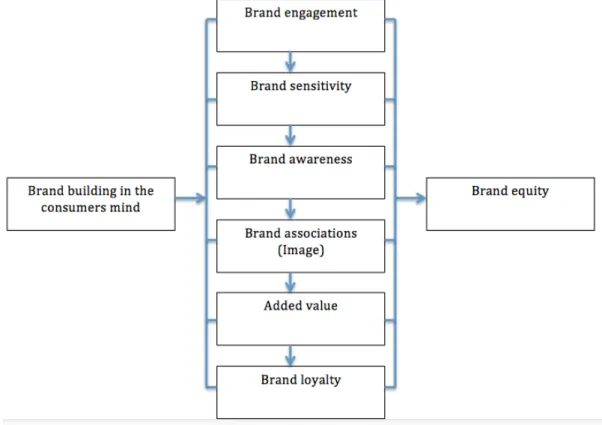
Melin (1997) state that the goal for every brand should be to create loyal consumers and has created a framework where he explains the brand building process from the consumer perspective. For a company to be able to influence the consumers’ choice of brand it is important to understand how the brand can create added value. As the marketers should strive to create loyalty the challenge is to create an attractive and unique brand. Hence, there is a need to analyse the central concepts in the brand building process and see how each step can influence the consumers’ brand loyalty and strengthen the brand (Melin, 1997).
Fig 1. The brand building process from a consumer perspective
According to Melin (1997) these concepts are central in consumer behaviour theory, and they have also been emphasised by several recognized authors as the main concepts to consider when strengthening the brand (Aaker, 1996; Kapferer, 2012). Given the thesis purpose each step of the brand building process will be presented in more detail below.
2.2.1 Brand engagement and brand sensitivity
According to Melin (1997) the primary activity for a brand is to create engagement between the brand and consumer and Buckingham (2008) states that brand engagement is an essential feature because it will affect the consumers’ decision-making and loyalty to the brand. Further, Kapferer (2012) describes that a high level of engagement will strengthen the consumer relationship, which in turn will affect brand loyalty. Hence for a consumer that has high engagement there is no substitutability. Lacroix (2010) supports this and states that engagement will affect the commitment toward additional products from the brand and the unwillingness of switching brand. According to Melin (1997) by creating brand engagement, marketers want to generate brand sensitivity, which refers to the brand being the consumers’ primary information source when selecting brand.
According to Tuten (2008) when brands want to enhance the engagement marketers should provide action-oriented experiences allowing consumers to interact with their brand. Brand engagement develops and maintains relationship with the consumer and is successful when it is perceived as a meaningful, memorable and on going. Hence, Tuten (2008) refers to social media as a perfect platform for developing and maintaining brand engagement. In support, Hanna, Rohm and Crittenden (2011) argue that it is not longer solely about reaching the customers with a brand message and needs instead to to engage on a continuous basis with their consumers by capturing and maintaining their attention. Thus a blend of both traditional and social media is needed. Further Gambetti and Graffigna (2010) state that in this new customer-centric marketing, where the customer is empowered, brand engagement plays a significant role.
2.2.2 Brand awareness
According to Melin (1997) the next step in the brand building process is to create brand awareness and Kotler and Pfoertsch (2010, p. 313) define brand awareness as “the ability of possible consumers to remember that a special brand belongs to a special product”. Kotler and Pfoertsch (2010) argue that brand awareness can be separated into different levels depending on how well and with what help a consumer can recall a brand. Further, Shimp (2008) argues that brand awareness is a vital part for new brands to achieve awareness and for established brands to maintain awareness.
Aaker and McLoughlin, (2010) state that brand awareness can provide several competitive advantages. Keller (1998) describes one major advantage to be that it could influence customers’ buying decision based on strong brand associations. Brand awareness influence consumers’ choice because people tend to be drawn to the familiar and thus for low-involvement brands it can be the major factor influencing the buying decision (Barroso & Llobet, 2012; Aaker & McLoughlin, 2010).
Brand awareness will be created by on-going visibility, enhancing familiarity and powerful associations with related offerings and buying experience (Keller, 1998). Advertising can be used to enhance brand awareness and make consumers include brands in their purchasing
choice (Barroso & Llobet, 2012). Consumers are bombarded everyday with an increasing number of marketing messages, thus building awareness is challenging. Hence, Aaker and McLoughlin (2010) describe that to achieve visibility; brands need to become creative and go beyond the normal media channels to create attention.
2.2.3 Brand image
When creating brand awareness marketers need to define which brand image to attempt (Kapferer, 2012). According to Melin (1997) brand associations are essential since they should produce a strong, positive and competitive brand image. Shimp (2008) clarifies this and describes brand image as the features consumers associate with the brand. Hence, the public defines the brand’s image with the help of the brand messages that are received and it is their perceptual concept of a brand (Kapferer, 2012, Aaker & Biel, 1993). Thus, marketers will always tend to shape a reflection or an image of the buyer, which it appears to address (Kapferer, 2012).
Prior to the Internet, brand image was communicated through traditional media with push messages with the aim to persuade the consumers about how wonderful the brand is. If something contradicted this image, it was suppressed and the marketer had control over the brand image (Christouploples, 2009). However, the post-Internet era changed this and made consumers develop their own perception of the brand’s image which not necessarily corresponded to the image the brand wanted to communicate. Hence, the market today is more transparent and the brand image is therefore more exposed (Christouploples, 2009).
Kapferer (2012) stresses that companies need to be aware of what image they want to have before projecting an image to the public. Hence marketers need to know what to send out before the consumers receive it and starts scrutinize it.
2.2.4 Brand Loyalty and added value
Pelsmacker, Geuens and Bergh (2010) reason that in order to become a successful brand, the brand has to differentiate itself and the consumer has to perceive these differences as unique benefits compared to competitors. Hem and Iversen (2003) explain that leading brands should constantly innovate to meet their consumers changing needs if they are to provide added value. This is important in order to keep their brand trustworthy and for consumers to know what makes the brand stand apart from competitors (Simões & Dibb, 2001; Hem and Iversen, 2003). Creating added value is essential since it in the long run should link to brand loyalty (Melin, 1997).
Melin (2002) explains that creating competitive preferences to other brands enables the brand to attract a broad base of loyal consumers. Hem and Iversen (2003) argue that a vital building block when creating loyalty is trust, which the brand will achieve only if it is able to match the perceived value of the consumer with the brand purchased. According to Mohammad (2012) brand loyalty is not only beneficial for market share but also enables companies to grow and to enter new markets. Hanson and Kalyanam (2007) state that repurchase is one way to measure brand loyalty, but Amine (1998) argues that true brand loyalty also depends on consumer satisfaction and involvement. The level of consumer commitment to the brand,
will affect how resistant the consumers are to offers from competitors and depending on the involvement to the brand, the consumer are more or less willing to refer the brand to others (Hanson & Kalyanam, 2007). Aaker and McLoughlin, 2010 stress the importance of loyalty since even though a product can duplicate or surpass, competitors needs to add value for the consumer to actually switch brand (Aaker & McLoughlin, 2010). Hence, this is what makes brand loyalty an enormous sustainable competitive advantage.
According to Melin’s (1997) model of the brand building process, all these brand concepts cause brand equity, hence brand equity reflects the assets linked to the brand and comprise the collected value of brands (Aaker, 1996; Pelsmacker, Geuens & Bergh, 2010). However, this thesis focuses on the process and thus brand equity will not be explored further.
2.2.5 Brand advocacy
The presented brand building process does not include brand advocacy but since today’s consumers are engaging not only with brand but also with other consumers, it is an essential concept when discussing online channels. Consumers actually tend to rely more on third parties than on traditional advertising when making their buying decision (Hanna, Rohm &
Crittenden, 2011) and Lantos (2010) defines brand advocacy as how willing the consumer is
to recommend the brand to peers. Further, Kirby and Marsden (2006) explain that by transforming loyal customers into brand advocates and taking advantage of people who love their brand, marketers can use brand advocacy as a powerful and cost-effective word-of-mouth strategy, which may improve their brand image and brand engagement (Kirby & Marsden, 2006; Lantos, 2010).
2.3 Brand communication
According to Hem and Iversen (2003) the role of the brand becomes more vital when the consumer is addressed with product choices. It is therefore of importance that the brand’s added value and exclusiveness is communicated which is best achieved by being coherent through all communication channels (Kapferer, 2012). Kapferer (2012) stresses the weight of communication and that brands should communicate the intangible assets and values and the brand’s uniqueness, which cannot be revealed by the package.
2.3.1 Online Communication
According to Lindström and Andersen (2000) a large number of brands are built upon one-way communication. One-one-way communication is characterised by monologues such as television, radio, ads and billboards, which all are channels where there is no interaction between the brand and the consumer (Lindström & Andersen, 2000; Richardson, 2001). However, new technologies have enabled marketers to move toward two-way mass conservation strategies where interaction is in focus (Pelsmacker, Geuens & Bergh, 2010). The Internet has brought some major changes to the market, such as greater transparency, cost efficiencies and more empowered consumers (Gay, Charlesworth & Esen, 2007).
Keller (2011) states that marketers must recognize the Web has empowered the consumer and that every action made by the marketers will be scrutinized. Internet has enabled the consumer to become active and engage with the brand, which marketers can benefit from this by working together with consumers to best satisfy their needs and wants (Chen, 2004; Kapferer, 2012; Keller, 2011). Internet should therefore be seen as a powerful tool for co-creating value and brand advocacy (Keller, 2011;Sawhney, Verona & Prandelli, 2005). 2.3.2 Integrated Marketing Communication, IMC
One of the biggest challenges for marketers is how to use and put together the best set of communication channels to both maximize short-term and long-term goals (Keller. 2011). The main objective of Integrated Marketing Communications (IMC) is to use the best available communications channels in a coordinated way to achieve the brand’s communication objectives (Holland, 2010). Peltier, Schibrowsky and Schultz (2003, p. 93) defines IMC as “a concept of marketing communication planning that recognizes the added value of using a comprehensive plan to evaluate the strategic roles of a variety of communications disciplines”. Marketers with an IMC approach will thus evaluate all forms of communication, all channels and all brand contact points, when they plan and execute their marketing communication strategies (Leppäniemi & Karjaluoto, 2008). For this approach to be as effective as possible the marketers need to be neutral when choosing media channel and evaluate each communication tool according to its effectiveness and efficiency (Keller, 2011). Hence, IMC is about choosing a set of different communications option that share the same content, but also present different advantages, so that the “whole is greater than the sum of its parts” (Keller, 2011).
2.4 E-‐communication framework
Pelsmacker, Geuens and Bergh, (2010) have developed a framework based on the study conducted by Insight Consulting, which aims to emphasise which online channels that are best applicable depending on which marketing goal the company strives to achieve. Since this framework includes both brand concepts that are part of the brand building process as well as mobile marketing, this model is of interest for this thesis. Hence, it gives a good understanding of the current research made within the field. However, this model do not separate push and pull marketing, thus it is of interest to investigate whether this model can be extended based on existing theories about mobile applications. The authors have chosen to present Pelsmacker, Geuens and Bergh’s (2010) collected findings in a table to give a better overview of their framework. The framework is presented on following page.
Table. 1. E-communication framework
What When How
Generating brand awareness Companies want to create or reinforce
brand awareness
Online advertising, content sponsorship, advergames and viral
marketing
Shaping brand image and brand attitudes
Companies strive to improve the consumer’s knowledge and judgement about a brand, reinforce or change the way the brand is perceived
by the consumers.
Brand sites, online advertising, anchor deals, email-marketing, mobile marketing, online contests and
peer-to-peer games
Generating trial
Companies want to attract new consumers or reaching consumers
who have never tried the product category before
Mobile marketing, email marketing, online contests, couponing and
e-sampling
Creating loyalty
Companies strive to influence consumers buying behaviour and
satisfy their need.
Email marketing, brand websites, virtual communities, e-rewarding games and online loyalty promotions
2.5 Introduction to Mobile Marketing
The growing use of mobile devices has increased the interest for mobile marketing and more research is being conducted to shed light on the still unexplored phenomenon. The following section aims to give the reader a better understanding of mobile marketing and especially mobile applications. Hence, existing literature and theories will be summarized and unexplored areas will be pointed out.
2.5.1 Mobile marketing
Mobile Marketing is a complex phenomenon, which has complicated the process of creating a single established definition (Leppäniemi & Karjaluoto, 2008). However, a growing consensus around the proper definition is emerging and the definition created by the Mobile Marketing Association (2009a) is probably the most widely used definition today. As mentioned the Mobile Marketing Association (2009a) defines Mobile Marketing as ”a set of practices that enables organizations to communicate and engage with their audience in an interactive and relevant manner through any mobile device or network ”. Hence, Mobile marketing is a two-way or multi-way communication channel, which could include mobile advertising, promotion, customer support and other CRM activities (Shankar & Balasubramanian, 2009).
Even though Mobile marketing has the ability to reach the target market at any time, the audience that can be reached is limited to the people that actually have a mobile device, example iPad or iPhone, and opt-in to receive messages from marketers (Shankar & Balasubramanian, 2009). Another constraint related to mobile marketing has to do with the bandwidth capacity and the screen size, which limits the type of communication that can take place on a mobile device. Information-intensive messages are thus not suitable for this media. However, the advantage of the brief and precise communication that takes place through mobile marketing is that it opens up for a more frequent interaction between the brand and the customer (Shankar & Balasubramanian, 2009). Mobile devices also often have one unique user, which enable marketers to target customers with a more personalized message (Khan, 2012; Mobile Marketing Association, 2009b). Hence, mobile devices enable very precise targeting and as the users are highly involved with the content provided this communication channel is very effective compared to other media (Mobile Marketing Association, 2009b). Given this discussion the two main benefits related to mobile marketing are the location specificity and portability of the mobile devices (Shankar & Balasubramanian, 2009). Nowadays, many mobile devices have GPS capabilities, which identify the consumers’ physical location. This enables marketers to target the consumers with location specific promotional offers based on the consumers’ preferences and behaviour. The fact that the mobile devices are small and can be carried around is another benefit, but the real advantage lies in that it is constantly with the user and frequently used throughout the day (Shankar & Balasubramanian, 2009). This makes it possible for the brand to communicate with the target market at anytime, at anyplace (Varnali & Toker, 2010: Khan, 2012). Mobile marketing also has the ability to better measure and track consumer response, as well as a lower unit cost of communication compared to mass marketing (Shankar & Balasubramanian, 2009).
Mobile marketing include several different channels, such as Mobile Websites, Mobile applications, SMS, MMS and Mobile videos (Mobile Marketing Association, 2009b; Chiem et al., 2010). Until 2007 when the iPhone was released, marketers primarily relied on SMS, MMS and Mobile advertising when creating a mobile marketing campaign (Chiem et al., 2010). These technologies proved promising in reaching short-term sales at a low cost, but had several limitations (Chiem et al., 2010). First of all the consumers had a tendency to view these campaigns as irritating, the mobile equivalent to telemarketing, and they also lacked the ability to create on-going brand awareness (Samanta, Woods, & Ghanbari, 2009; Chiem et al., 2010). It was not until the introduction of mobile applications, closely connected to the release of the Smartphone, that Mobile marketing saw its full potential (Chiem et al., 2010). Mobile applications have generated new ways for marketers to promote their brand and have also made it easier to build a long-lasting relationship with the target market (Chiem et al., 2010).
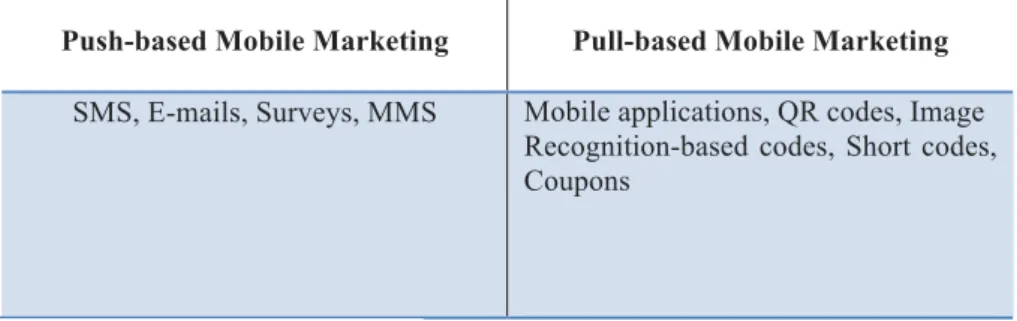
Since mobile marketing includes both push and pull type marketing (Karjaluoto et al., 2007) it is useful to acknowledge the distinction between Push-based mobile marketing and Pull-based marketing. Leppäniemi & Karjaluoto (2008, p.53) defines Push-based mobile marketing as “any content that is sent by or on behalf of an advertiser or marketer to a mobile device at a time other than when the subscriber requests it”. This type of mobile marketing includes SMS, emails, surveys and other push-based advertising. Pull-based mobile marketing is on the other hand content sent to a mobile device upon request from the customer (Smutkupt, Krairit & Khang, 2011). In mobile marketing it could be a request for a coupon, or any other type of related communication initiated by the consumer (Leppäniemi & Karjaluoto, 2008). Push marketing has as mentioned dominated mobile marketing for several years, but since mobile applications were introduced, which are especially designed for pull marketing, the trend has changed (Smutkupt, Krairit & Esichaikul, 2010; Bellman et al. 2011).
Push-based Mobile Marketing Pull-based Mobile Marketing
SMS, E-mails, Surveys, MMS Mobile applications, QR codes, Image Recognition-based codes, Short codes, Coupons
Table 2. Push- and Pull-based mobile marketing
2.5.2 Mobile Applications
During the last couple of years the mobile application segment has rapidly expanded across the globe (Mobile Marketing Association, 2009b). The Mobile Marketing Association (2009b, p. 1) defines mobile applications in the following way: “Software or content that consumers download to or find pre-installed on their mobile phone and then resides on the phone.” Examples of mobile applications are: games, newsreaders and social forums. Moreover, applications consist of software that runs on a mobile gadget, which achieve specific tasks and offer value for the user (Mobile Marketing Association, 2009b).
When discussing mobile applications a distinction between the Mobile web site, the Mobile web app and the Native app is needed (Magrath & McCormick, 2012). Magrath and McCormick (2012, p.100) define the Mobile Web site in the following way: “The Mobile Webs site - the un-optimized web site entered via the mobile browser”. The Mobile Web app is described as the brand’s website optimized into an application that can be entered through the mobile browser. The Native app is on the other hand the downloadable version of the brand’s application (Magrath & McCormick, 2012). Chiem et al. (2010, p. 46) defines downloadable applications (Native apps) as “ programs designed specifically to add functionality to mobile handsets and are able to interact directly with the technical features of the phone”. Whenever mobile applications are mentioned in this paper the authors refer to the definition of Native apps. Hence, mobile applications are either pre-installed on the mobile device or can be downloaded by the consumer from an app-store (Magrath & McCormick, 2012; Mobile Marketing Association, 2009b). Mobile applications are only available for those customers with appropriate mobile devices, but nowadays applications are common on most phones (Mobile Marketing Association, 2009b). Mobile applications have the ability to give users access to services that need faster, more complex and not necessarily connected user experiences, which is what sets mobile applications apart from browsing the mobile web (Mobile Marketing Association, 2009b).
Another distinction that can be made between different mobile applications has to do with their creative style. Bellman et al. (2011) made a clear distinction between informational and experiential applications. The Informational style has a utilitarian or information-gathering approach; an example of this is banking applications where the content provided clearly helps the consumer with a certain task. Experiential applications on the other hand provide enjoyment and entertainment, thus the outcome is more like a treat for the consumer. Examples of this are game applications and podcast applications (Bellman et al., 2011). 2.5.3 Branded Applications
Mobile devices have created a whole new marketing platform, where marketers have the ability to create applications and other communication channels solely dedicated to their brand (Friedrich et al., 2009). The increased acceptance of mobile marketing and m-commerce has led a number of brands to invest resources in Native apps (Magrath & McCormick, 2012). These applications that are attached to a specific brand (Mobile Marketing Association, 2009b) are classified as “Branded apps”. Bellman et al. (2011, p. 191) define branded apps as “software downloadable to a mobile device which prominently
displays a brand identity, often via the name of the app and the appearance of a brand logo or icon, throughout the user experience”. The increased interest in branded apps has its roots in the applications’ high level of user engagement and the positive effects this has on attitudes towards the specific brand (Bellman et al., 2011). Compared to other forms of advertising branded applications are seen as useful and are welcomed by the consumers, which makes it a powerful communication tool (Bellman et al., 2011).
According to Udell (2012) branded applications have unlike more traditional mobile activities the ability to pass on valuable and educational information about the brand and/or its products. It is common to include more instructional content such as product tips and other helpful guidelines that aid consumers to more effectively utilize and integrate the brand in their daily life. Hence, the main idea is that an educated consumer is a more engaged consumer, and the information given by the applications helps consumers to appreciate the brand’s value and creates brand advocacy (Udell, 2012).
It is important that branded apps support the brand’s core qualities and that the brand integrity is maintained across all communication channels (Udell, 2012; Magrath and McCormick 2012). Ideally, the branded app should reinforce the features that the consumers already associate with the brand, which will strengthen the connection between the consumer and the brand (Udell, 2012). The brand name and logo should also be built into the application in such a way that the brand is easily recognized (Magrath & McCormick, 2012). This will increase brand awareness and induce trust and authenticity to the application (Magrath & McCormick, 2012). It is also of great importance that the application is of good quality (Dredge, 2011) so that it lives up to reputation that the brand has. Brands that are unable to maintain a consistency in what they communicate about their brand to consumers risk losing part of the customer base (Udell, 2012).
Research has shown that ninety-one per cent of the top brands (defined by Interbrand 2011 Best Global Brands report) have a presence in at least one of the major app stores such as Google Android Market and Apple App Store. This indicates that companies have realized that app stores offer a unique channel to promote their brands and reach their target market (Distimo, 2011). However, Bellman et al. (2011) stress that as more brands have realized the importance of being present in app stores the harder it has become to get noticed. Hence, to get a new branded app to stand out from a 100.000 others they need a separate, convincing advertising campaign (Bellman et al., 2011). However, brands that dare to tap into the enormous potential of branded apps may actually deliver competitive advantages against the many brands that still have not taken the opportunity to communicate with consumers through applications (Udell, 2012).
2.5.4 Building loyalty through applications
Brands have for a long time been aware of the benefits of mobile marketing, but it is not until now that the entry barriers have been lowered to make mobile marketing economically feasible that brands can draw on its full potential (Friedrich et al., 2009). Now that the financial and economic barriers have been defeated brands have the opportunity to address the
advantages of mobile marketing: real-time access to customers, deep insight into customer behaviour and value generation for consumers. Those who invest in these opportunities will be compensated by deeper consumer engagement, increased brand loyalty and enhanced customer lifetime value (Friedrich et al., 2009).
Branded applications are still at an early stage and best practices are yet to be explored (Udell, 2012; Mobile Marketing Association, 2009b). However, everyone knows that offering an entire application for free creates a unique opportunity to enhance brand awareness (Mobile Marketing Association, 2009b). Applications are the perfect opportunity to communicate directly with consumers in a more meaningful and personal manner to achieve a long-term relationship (Dredge, 2011), this is however not done overnight. Brands interested in launching branded apps need to apply a consumer-centric approach, and include content that is relevant, timely and actionable (Udell, 2012). Brands also need a thorough understanding of the customers’ usage patterns, which means that they need to know how, why and when a specific application is used if they are to take advantage of the mentioned benefits (Mobile Marketing Association, 2009b).
In the end it all comes down to the creation of brand engagement, which means that consumers initiate the contact with the brand (Chiem et al., 2010). Successful applications should therefore include incentives that encourage consumers to engage with the brand. The long-term advantage of brand engagement is an increase in the consumers’ preference for the specific brand (Chiem et al., 2010), i.e. brand loyalty.
An important aspect to consider when discussing the potential benefits of mobile marketing is that brand loyalty is not attained with technology (Reichheld & Schefter, 2000). Reichheld and Schefter (2000) state that without delivering superior customer experience the mobile marketing efforts will not generate loyal customers. This rule has not changed with mobile applications, but what has changed is the pace at which brands need to improve their products and services to stay competitive and retain loyal customers (Reichheld & Schefter, 2000). 2.5.5 Consumer acceptance of mobile marketing
Mobile devices have over the years gained acceptance across regions and cultures, and have in many ways become a lifestyle icon that consumers cannot be without (Friedrich et al., 2009). However, a majority of consumers that use mobile devices do not appreciate unwanted intrusion in their mobile environment (Shankar & Balasubramanian, 2009). Mobile Marketing has often been criticized for generating unsolicited messages, that irritates consumers and raises concerns for privacy issues (Smutkupt, Krairit & Esichaikul, 2010). Spam is actually viewed as the main negative influence on consumers’ acceptance of mobile marketing. The best way to deal with this issue is to make sure that mobile marketing activities only are used when consumers have given their permission (Smutkupt, Krairit & Esichaikul, 2010). It is therefore of great importance to get consumers to opt-in to receive mobile marketing through other media channels such as the TV and Web (Shankar & Balasubramanian, 2009). Consumers tend to opt-in when they feel that the mobile messages generate substantial benefits for them. It could be direct benefits such as specific offers for a desired product, but
in the end it all comes down to the fact that the messages need to be highly relevant to the consumers if they are to be successful (Shankar & Balasubramanian, 2009).
Intrusion and privacy concerns are however issues most common within push-based mobile marketing such as text messaging (Bellman et al., 2011). Mobile applications on the other hand, which make use of pull advertising, tend to overcome these issues. Hence, here it is the consumer who initiates the contact with the brand by downloading the application and they can also easily control how much information they disclose by customizing the application (Bellman et al., 2011).
Over the years it seems as if an agreement is emerging concerning the key factors that affect consumer acceptance of mobile marketing in general (Holland, 2010). Research made indicate that if marketers are able to build trust through acceptable permission-based systems and create messages that meet consumers’ demand for value and entertainment, consumers are likely to accept this new media channel (Holland, 2010).
2.5.6 Opportunities and Challenges
Summarized you will find the opportunities and challenges with mobile applications as well as the long-term benefits and negative effects on the brand
Opportunities Challenges
Precise targeting, Location and behavioural specific Promotional offers, Ability to track consumer response,
High involvement, Real-time access to customers Anywhere, Deep insight into customer behaviour, Value
Generation for consumers
Screen size of mobile devices, Limited audience, Bandwidth capacity, Consumer engagement,
Privacy issues, Unsolicited messages
Long-term benefits Long-term negative effects
Brand awareness, Long-lasting Relationships with consumers, Engaged consumers, Brand advocacy, Competitive advantages, Brand loyalty, Enhanced
customer lifetime value
Losing sales, Losing parts of their customer base, Losing traffic.
Table.3 Opportunities and challenges with Mobile Marketing 2.6 Summary -‐ extended model
To be competitive in today's dynamic market the theory stress the importance for brands to obtain loyal consumer. However, to create loyal consumer brands need to engage their consumers, create awareness of their existence and have an appealing image. Hence, brands need to create added value in order to generate loyalty. Further, theory emphasise that marketers need to achieve coherence in all their communication channels in order to strengthen the brand and use the different channels to reach out to the consumers. Nowadays the importance of peer recommendations have made brand advocacy an efficient concept for brands to take advantage of in order to influence their consumers and strengthen their brand.
As the competitive environment has intensified, branding has become increasingly important and marketers need to stay in tune with evolving communication channels that offer new
opportunities to promote the brand. Mobile applications are the newest media, which since 2007 has gained a lot of attention. However, branded application is still a fairly unexplored phenomenon and there is still a lot to discover. Given the huge potential that this media has the aim is to explore how and when it can be used to strengthen the brand. Current research has stated several benefits with mobile marketing but further empirical research is needed to shed light on the practical role of branded applications in reaching the different steps in the brand building process.
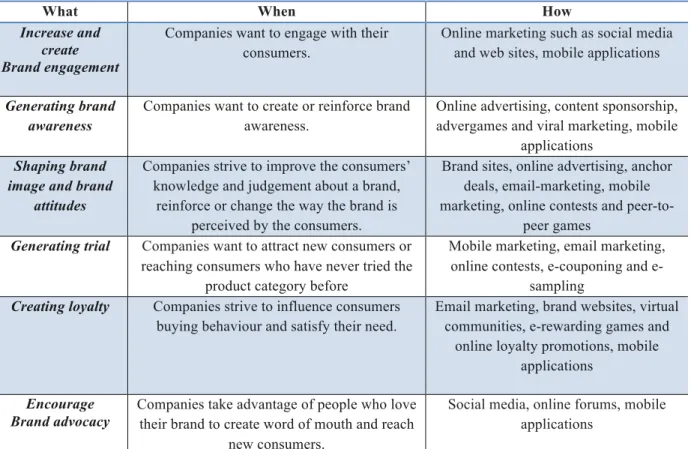
Given the literature review around the brand building process and mobile applications the Pelsmacker, Geuens & Bergh (2010) framework can be extended with two more brand concepts; brand engagement and brand advocacy. This model could also be modified so that it mirrors the different steps in the brand building process, which is presented below. As marketers need loyal consumers to generate brand advocacy, the authors have decided to include it as the last step in the framework. Combining these two models and including the current literature around mobile applications have obtained a general understanding of mobile applications role in the brand building process. This framework will be further explored when analysing the empirical findings. However, the aim is not primarily to test this model, but by exploring the role of mobile applications in the brand building process contributions to this model may be achieved.
What When How
Increase and create Brand engagement
Companies want to engage with their consumers.
Online marketing such as social media and web sites, mobile applications
Generating brand awareness
Companies want to create or reinforce brand awareness.
Online advertising, content sponsorship, advergames and viral marketing, mobile
applications
Shaping brand image and brand
attitudes
Companies strive to improve the consumers’ knowledge and judgement about a brand,
reinforce or change the way the brand is perceived by the consumers.
Brand sites, online advertising, anchor deals, email-marketing, mobile marketing, online contests and
peer-to-peer games
Generating trial Companies want to attract new consumers or reaching consumers who have never tried the
product category before
Mobile marketing, email marketing, online contests, couponing and
e-sampling
Creating loyalty Companies strive to influence consumers buying behaviour and satisfy their need.
Email marketing, brand websites, virtual communities, e-rewarding games and
online loyalty promotions, mobile applications
Encourage Brand advocacy
Companies take advantage of people who love their brand to create word of mouth and reach
new consumers.
Social media, online forums, mobile applications