Clarifying the Relationships between Systems
Engineering, Project Management, Engineering
and Problem Solving
Joseph KasserTemasek Defence Systems Institute National University of Singapore,
Block E1, #05-05
1 Engineering Drive 2, Singapore 117576
Derek Hitchins ASTEM
Consultant Systems Architect
Abstract. This paper resolves the problem of the overlap between systems engineering and project management. The paper uses the“systems engineering–the activity”(SETA) paradigm to view the activities performed in realizing a system. The paper:
1. Shows that problem solving and systems engineering are identical in concept but vary in de-tail depending on whether the problem is complex or non-complex.
2. Provides a concept map showing a non-overlapping relationship between the activities known as project management, systems engineering, Engineering and holistic thinking in the SETA paradigm.
3. Links risk management activities and domain knowledge into the relationships. Key words systems engineering, project management, engineering, problem solving. 1. Introduction
The relationship between systems engineering, project management, engineering and problem solving in the literature is confusing, containing overlaps and contradictions. This paper attempts to clarify the situation based on research that distinguished between the following two systems engineering para-digms (Kasser, 2013a) Chapter 29):
systems engineering–the role (SETR), a job being what systems engineers do in the work-place, and
systems engineering –the activity (SETA), an activity that can be, and is being, performed by anyone.
Section 2 compresses 15 years of research into the nature of systems engineering by summarising the nature of two different systems engineering paradigms, SETR and SETA.
Section 3 discusses the overlap between systems engineering and problem solving and showing that the high degree of correlation between the so called“systems engineering process”and the“problem solving process”may be explained as follows, in situations where the problem is:
Small the set of activities to remedy the problematic or undesirable situation (the remedial ac-tion) is known as the“problem solving process”.
Large or complex, the remedial action has become known as the“systems engineering pro-cess”whereas it is really the“solution system developmentprocess”(SDP) commonly known as the system development lifecycle (SDLC) in which systems engineering takes place. Section 4 discusses the systems engineering, project management and engineering activities in the various phases of the SDP.
Section 5 provides a concept map showing the relationship between the activities known as project management, systems engineering, Engineering and holistic thinking in the SETA paradigm. It also links risk management activities and domain knowledge into the relationships. The concept map
Asia-Pacific Council on Systems Engineering Conference (APCOSEC), Yokohama, 2013
shows a non-overlapping relationship between systems engineering, project management and engi-neering and an explanation for why they have been perceived as overlapping.
2. Systems Engineering the Role (SETR) and Systems Engineering the Activity (SETA) Systems engineering means different things to different people. This section summarizes the differ-ences between SETR - the role or job description of the systems engineer and SETA - a set of activi-ties known as systems engineering.
2.1. SETR
SETR is a subjective definition. It can be a job title such as network systems engineering, control sys-tem engineering, communications syssys-tems engineering, etc. In many instances the type of syssys-tem is dropped from the title. The on-the-job activities performed in such a role include, systems engineer-ing, design, engineerengineer-ing, project management, testengineer-ing, etc. SETR is performed in many domains, gen-erally associated with technology and is often process-centric. SETR can also be defined as a philoso-phy and a way of life (Hitchins, 1998) which Kasser interpreted as the application of holistic thinking to problem solving (Kasser, 2013b).
2.2. SETA
SETA is a set of activities. The following criterion was used to determine if an activity does or does not belong in the set of activities known as SETA (Kasser and Hitchins, 2009; Kasser, et al., 2009):
If the activity deals with parts and their interactions as a whole, then it is an activity within the set of activities to be known as SETA.
If the activity deals with a part in isolation, then the activity is not an activity within the set of activities to be known as SETA but is part of another set of activities (‘something else’), e.g., Engineering, project management, software engineering, etc.
SETA is a return to Hall’s definition of “systems engineering as a function1not what a group does2” (Hall, 1962) page 11). Hall added “By recognizing the scope of the function it becomes possible to dissect it, to understand its problems and to reconstruct it to make it more efficient than it is today”. This paper continues that work.
Perceptions from the Functional holistic thinking perspective show that SETA is performed in all do-mains and jobs as an enabling discipline providing a set of thinking tools to “concentrate on the
de-sign and applications of the whole as distinct from the parts … looking at a problem in its entirety,
taking into account all the facets and all the variables and relating the social to the technical” (Kasser, 2013a).
1Activity. 2Role.
2.3. Mapping SETR and SETA
Due to the various ways in which SETA and non-SETA have been allocated to personnel3performing SETR and non-SETR, in any specific organisation at any specific time, roles and activities do not overlap 100%. Thus a person with the role or job title of systems engineer will perform a number of activities that include systems engineering, project or engineering management, and engineering. And an engineer might perform a mixture of engineering and systems engineering.
3. Problem Solving and Systems Engineering
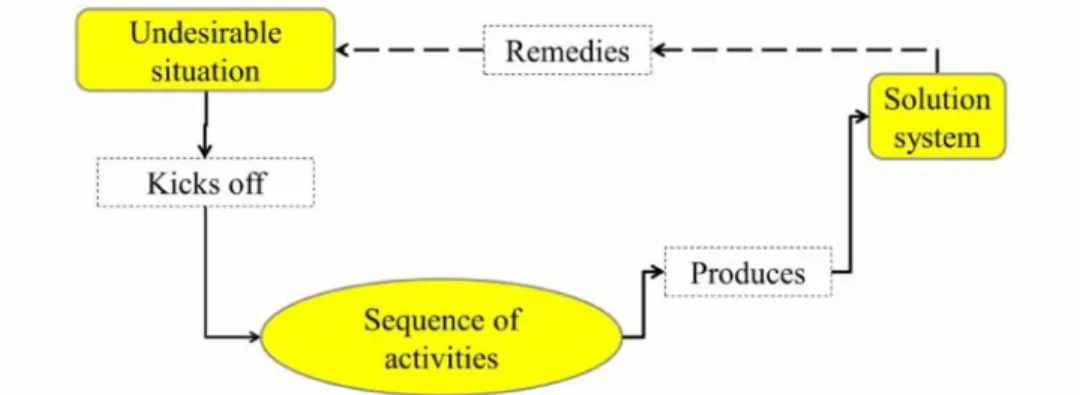
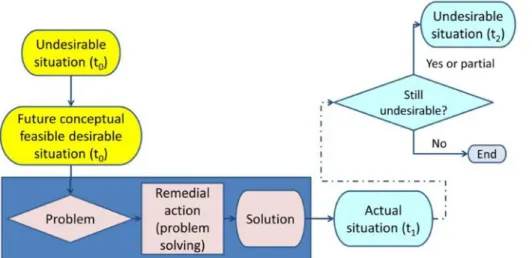
Unlike the traditional approach to problem-solving which begins with a problem and ends with a solu-tion, the holistic approach takes a wider perspective and begins with a problematic or undesirable sit-uation because “problems do not present themselves as givens; they must be constructed by someone from problematic situations which are puzzling, troubling and uncertain” (Schön, 1991). From the Big picture perspective, the context for systems engineering can be shown as in Figure 1 and begins with the existence of a problematic or undesirable situation. Figure 1 can be expanded into Figure 2 (Kasser, 2013b) page 261) which converts the undesirable situation into a solution system operating in the context of a Feasible Conceptual Future Desired Situation (FCFDS). From this perspective, the observer becomes aware of an undesirable situation that is made up of a number of related factors. A project is authorized to do something about the undesirable situation. The problem solver tries to un-derstand the situation, determine what makes the situation undesirable and then create a vision of a FCFDS. The problem then becomes one of how to move from the undesirable situation to the FCFDS. Once the problem is identified, the remedial action is taken to create and transition to the solution sys-tem which will operate in the context of the FCFDS. The so-called“systems engineering process”is identical to the problem solving process. The confusion between the “systems engineering process” and the problem solving process can be resolved by recognizing that when the problem is:
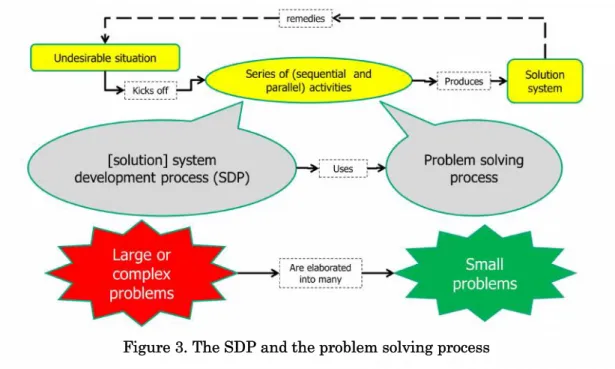
Small or non-complex the sequence of activities in the remedial action is known as the“ prob-lem solving process”.
Large or complex, the sequence of activities in theremedial action is known as the “systems engineering process” instead of the SDP. This is in accordance with Jenkins’ definition of systems engineering as“the science of designing complex systems in their totality to ensure that the component subsystems making up the system are designed, fitted together, checked and operated in the most efficient way”(Jenkins, 1969).
This relationship is shown in Figure 3.
3The word ‘personnel’ is used to avoid the semantically loaded terms engineers, systems engineers, project manager, etc. Figure 2. Holistic approach to managing problems and solutions
Asia-Pacific Council on Systems Engineering Conference (APCOSEC), Yokohama, 2013
4. Activities Performed During the System Development Life Cycle
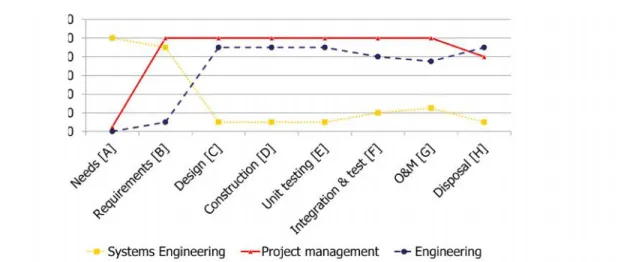
The Japan Aerospace Exploration Agency (JAXA) explains the relationship between project man-agement and systems engineering during the SDP for projects in Layer 2 of the HKMF as shown in Figure 4. The figure can be extended and expanded as shown in Figure 5 to show the nominal rela-tionship between the activities known as systems engineering, project management and engineering over the SDP4not duringthe “systems engineering process”. Consider the activities in each phase of the SDP organised according to the nine phases in the HKMF (Kasser, 2013a).
4Activities as opposed to roles or job descriptions, see (Kasser, 2013a) Chapter 29. Note that systems engineering and engi-neering of systems are recursive because a subsystem at one level in the system hierarchy can be and often is a system in itself.
Figure 4 Project management and systems engineering in the system develop-ment process ((JAXA, 2007))
4.1. The Needs Phase
This phase takes place in the A paradigm of systems engineering (Kasser, 2012). It contains the early stage systems engineering activities addressing the problem and determining the conceptual solution and is based on Hall, Gelbwaks and Hitchins (Hall, 1962; Gelbwaks, 1967; Hitchins, 1992) and the summary in Brill (Brill, 1998), where:
Systems engineering begins with a focus on converting a problematic or undesirable situation to a FCFDS and creating the Concept of Operations (CONOPS)5. The skills needed to do this go beyond the systems thinking shown in Figure 4 because while systems thinking helps to understand the situation, it is the perceptions from the Generic and Continuum perspectives of holistic thinking (Kasser, 2013b) that help to identify the problem and the FCFDS. Systems engineering also performs feasibility studies on potential ways to realize conceptual solutions to determine feasibility, risks and cost and schedule estimates. Systems engineering then de-signs the whole solution system, identifying the environment, other interacting systems, the subsystems, parts, interactions, functional architecture, physical architecture, etc., etc., - but still all of the whole.
Project management does not have a project yet because the scope of the solution and its re-alization are still being developed.
Engineering assists systems engineering by performing engineering work at the system level. 4.2. The Requirements Phase
The activities in this phase depend on whether the project is following the A or B paradigms (Kasser, 2012).
4.2.1. The A Paradigm
In the A paradigm, this phase is where the conceptual solution produced in the needs phase is con-verted to a matched set of specifications for the system and subsystems and their infrastructure, where:
Systems engineering. In the product domain, systems engineering produces the matched set of specifications for the system and subsystems and their infrastructure. In the process do-main, systems engineering works with project management to create a unique process to be
5The FCFDS describes the solution system (Functional perspective), the CONOPS describes the context and environment in which the FCFDS will operate and how that operation is anticipated to occur (Big picture and Operational perspectives). Depending on the situation, an FCFDS may be associated with several CONOPS or several FCFDS may be associated with a CONOPS.
Figure 5. Representation of the nominal amount of systems engineering, project man-agement and engineering of systems activities in the different phases of the SDP
Asia-Pacific Council on Systems Engineering Conference (APCOSEC), Yokohama, 2013
used in the subsequent phases of the SDP (Biemer and Sage, 2009) page 153) producing the Systems Engineering Master Plan (SEMP), Test and Evaluation Master Plan (TEMP) and other pertinent plans as well as the System Requirements Document/Database (SRD).
Project management generally contributes the knowledge about the schedule and cost to the unique process created by systems engineering.
Engineering includes the activities pertinent to the subsystems. 4.2.2. The B Paradigm
In the B paradigm, the SDP commences here, so since there was no needs phase, a conceptual solu-tion does not exist. Consequently:
Systems engineering elicits and elucidates requirements to create as much of the specifica-tions for the system and subsystems and their infrastructure as they can. As for the CONOPS, Frittman and Edsonwrote that “a recent survey showed that 1/3 of all programs queried did not have a CONOPS (Roberts, 2008) page 39). Similarly, in a series of interviews and sur-veys conducted for this research, the majority of respondents indicated that a CONOPS was
“critical” to the system’s success, but was under-utilized. Comparable studies on CONOPS
have pointed out that even when a CONOPS is written it is often after the system is developed
and done so in an effort to satisfy a Milestone Decision requirement; this “box-checking” a
c-tivity strips the CONOPS of its intended role in the creative process (Nelson, 2007) pages
5-6)”(Frittman and Edson, 2010).
Project management creates the project plan assisted by the product domain knowledge pro-vided by systems engineering, engineering6and other cognizant personnel.
Engineering includes the activities pertinent to the subsystems. 4.3. The Design Construction and Unit Testing Phases7
These are the phases where the bulk of the technical activities move from systems engineering to en-gineering following the process created in the requirements phase, namely:
Systems engineering monitors and adjusts the technical system budgets for the performance, mass, power of the various subsystems, and performs other system level activities including troubleshooting at the system level, and planning the integration and system tests.
Project management monitors and controls the system development process ensuring that re-quired resources are available where and when needed.
Engineering creates, verifies and validates the subsystems in accordance with the SEMP, TEMP and other plans.
4.4. The Integration and System Test Phases
These are the phases where systems engineering picks up again as the system is integrated and tested, namely:
Systems engineering performs systems integration and system tests. These activities include the conceiving and design of integration and test equipment, simulators and other necessary support equipment.
Project management continues to monitor and control the system development process ensur-ing that required resources are available where and when needed.
Engineering performs subsystem or unit level activities. In a complex system, each subsys-tem may require its own syssubsys-tems engineering in accordance with the dictum ‘one person’s system is another person’s subsystem’. So the engineering as perceived from this system is systems engineering when perceived from the perspective of the subsystem.
6Which could be why project planning is mostly taught in project management classes in education programs conforming to the B paradigm.
7The scope of the activities will depend on the nature of the system being developed. If the system is a process, a COTS-based product or a human system, then the nature and scope of the activities will be different.
4.5. The Operations and Maintenance Phase
This phase is also known as the in-service phase and contains more systems engineering activities than the previous phase. This phase includes the activities involved in operating the system, support to maintain operations, improvements to the whole to enhance effectiveness, and to accommodate changes in the nature of the problematic or undesirable situation over time.
Systems engineering comprises the system level activities involved in operating and upgrad-ing the system.
Project management monitors and controls the activities ensuring that required resources are available where and when needed.
Engineering comprises the unit level activities involved in operating and upgrading the sys-tem.
4.6. The Disposal Phase
The disposal phase which contains the set of activities that dispose of the system is where:
Systems engineering comprises the system level activities involved in disposing of the sys-tem.
Project management monitors and controls the activities ensuring that required resources are available where and when needed.
Engineering comprises the unit level activities involved in disposing of the system. 5. The Relationships between the Activities
The relationships between the systems engineering, project management and engineering activities performed to realize a solution system are shown in Figure 6. The top part of the figure is Figure 1 providing the context to the SDP. An entity associated with the undesirable situation kicks off the SDP which consists of a set of activities performed in series and in parallel (a process) which produc-es a solution system which is dproduc-esigned to remedy the undproduc-esirable situation. The activitiproduc-es in the SDP can be divided into project or engineering management, systems engineering and engineering where:
Domain knowledge is the underpinning information used by holistic thinking in the perfor-mance of the activities performed in a SDP which require knowledge of the problem, solution and implementation domains.
Holistic thinking is the thinking tools that use the domain knowledge to identify and remedy problems in undesirable situations in the activities known as project management, engineering and risk management.
Risk management is the set of activities that anticipate, prevent and mitigate risks in the problem, solution and implementation (product and process) domains used in the activities known as project management, systems engineering and engineering.
Project management is the set of activities known as planning, organizing, directing and con-trolling (Fayol, 1949) page 8). Project management incorporates risk management to manage process risks.
Systems engineering (SETA) is the set of activities defined in Section 2.2 and incorporates risk management to manage system level product risks when designing and integrating the overall system/interacting subsystems.
Engineering is the set of non-SETA engineering activities that create subsystems incorporat-ing risk management to manage product risks.
The concept map shown in Figure 6 shows a non-overlapping relationship between systems engineer-ing, project management and engineering. In Figure 6 engineering activities may ‘provide’ by creat-ing, by buildcreat-ing, by purchasing commercial-off-the-shelf (COTS) products, by changing a process, by reorganizing a human activity system or by a combination of all or some of the above.
Asia-Pacific Council on Systems Engineering Conference (APCOSEC), Yokohama, 2013 Fig ur e 6. Th e rela tion sh ip s bet w een th e ac tiv it ies in th e SD P in th e SE TA p ar ad ig m
As discussed in Section 2.3, the role or job of the system engineer, engineer and project manager is to perform an appropriate mixture of the activities known as systems engineering, engineering and pro-ject management as well as any other pertinent activities to the project. Each person’s role in SETR will be different because the mixture of activities depends on the organizational situation and is dif-ferent. This is why, project management, systems engineering and engineering have been perceived as being overlapping.
6. Summary This paper:
Used the SETA paradigm to view the activities performed in systems engineering. Resolved the overlap between systems engineering and problem solving.
Provided a concept map showing a non-overlapping relationship between the project man-agement, systems engineering, Engineering and holistic thinking activities in the SETA para-digm.
Linked risk management activities and domain knowledge into the relationship. 7. Conclusion
The distinction between the SETR and SETA paradigms clears up the overlaps and conflicts in the literature between project management, systems engineering and Engineering, and provides a view of the relationships between the activities performed to realize a system.
8. Author’sBiographies
Joseph Kasser has been a practicing systems engineer more than 40 years and an academic for about 16 years. He is a Fellow of the Institution of Engineering and Technology (IET), an INCOSE Fellow, the author of “Holistic thinking: creating innovative solutions to complex problems”, “A Framework for Understanding Systems Engineering” and “Applying Total Quality Management to Systems
Engi-neering” and many INCOSE symposia papers. He has received a number of awards for performing
and directing systems engineering includingNASA’s Manned Space Flight Awareness Award (Silver Snoopy). He holds a Doctor of Science in Engineering Management from The George Washington University. He is a Certified Manager and holds a Certified Membership of the Association for Learn-ing Technology. He also started and served as the inaugural president of INCOSE Australia and served as a Region VI Representative to the INCOSE Member Board. He has performed and directed systems engineering in the UK, USA, Israel and Australia. He gave up his positions as a Deputy Di-rector and DSTO Associate Research Professor at the SEEC at the University of South Australia in early 2007 to move to the UK to develop the world’s first immersioncourse in systems engineering as a Leverhulme Visiting Professor at Cranfield University. He is currently a Visiting Associate Profes-sor at the National University of Singapore.
Derek Hitchins retired from full time academic work in 1994 on medical grounds, and is now a part-time consultant, teacher, visiting professor and international lecturer. Formerly, he held the British Aerospace Chairs in Systems Science and in Command and Control, Cranfield University at RMCS Shrivenham. Prior to that, he held the Chair in Engineering Management at City University, London. Derek joined the Royal Air Force as a Cranwell apprentice and retired as a wing commander after 22 years, to join industry. His first industry appointments were as the System Design Manager of the Tornado F3 Avionics, Technical Co-ordinator for UKAIR CCIS, and UK Technical Director for the NATO Air Command and Control System (ACCS) project in Brussels. He subsequently held posts in two leading systems engineering companies as Marketing Director, Business Development Director and Technical Director before becoming an academic in 1988. His current research is into system thinking, system requirements, social psychology & anthropology, Egyptology, command & control, system design and world-class systems engineering. He has published three systems engineering books: "Putting Systems to Work", John Wiley & Sons, in 1992; "Advanced Systems Thinking,
Engi-neering and Management," Artech House, 2003; and, “Systems Engineering: A 21st Century Systems Methodology,” John Wiley & Sons in 2007/2008. He inaugurated the IEE’s PG M5 —Systems
Engi-Asia-Pacific Council on Systems Engineering Conference (APCOSEC), Yokohama, 2013
neering. He also started the UK Chapter of INCOSE and was its inaugural president. He is an IN-COSE Fellow, an ININ-COSE "Pioneer" and a Charter Member of the Omega Alpha Association. 9. References
Biemer, S. M. and Sage, A. P., "Systems Engineering: Basic Concepts and Life Cycle," Agent-Directed Simulation and Systems Engineering, L. Yilmaz and T. Oren (Editors), Wiley-VCH, Weinheim, 2009.
Brill, J. H., Systems Engineering ---A Retrospective View, Systems Engineering 1 (1998), no. 4, 258-266.
Fayol, H., General and Industrial Management, Sir Isaac Pitman and Sons, Ltd., London, 1949. Frittman, J. and Edson, R., 2010, Illustrating the Concept of Operations (CONOPs) Continuum and its
Relationship to the Acquisition Lifecycle, proceedings of Naval Post Graduate School. 6th Annual Acquisition Research Symposium.
Gelbwaks, N. L., AFSCM 375-5 as a Methodology for System Engineering, Systems Science and Cybernetics, IEEE Transactions on 3 (1967), no. 1, 6-10.
Hall, A. D., A Methodology for Systems Engineering, D. Van Nostrand Company Inc., Princeton, NJ, 1962.
Hitchins, D. K., Putting Systems to Work, John Wiley & Sons, Chichester, England, 1992.
Hitchins, D. K., 1998, Systems Engineering…In Search of the Elusive Optimum, proceedings of Fourth Annual Symposium of the INCOSE-UK.
JAXA, Basics of Systems Engineering (draft ) , Version 1B, Japan Aerospace Exploration Agency, 2007.
Jenkins, G. M., "The Systems Approach," Systems Behaviour, J. Beishon and G. Peters (Editors), Harper and Row, London, 1969, p. 82.
Kasser, J. E., "Getting the Right Requirements Right," the 22nd Annual International Symposium of the International Council on Systems Engineering, Rome, Italy, 2012.
---, A Framework for Understanding Systems Engineering (2nd Edition), CreateSpace Ltd., 2013a. ---, Holistic Thinking: creating innovative solutions to complex problems, Createspace Ltd., 2013b. Kasser, J. E. and Hitchins, D. K., A framework for a systems engineering body of knowledge, 0.6,
Report to the Fellows Committee, International Symposium of the International Council on Systems Engineering, 2009.
Kasser, J. E., Hitchins, D. K. and Huynh, T. V., 2009, Reengineering Systems Engineering, proceedings of the 3rd Annual Asia-Pacific Conference on Systems Engineering (APCOSE). Nelson, G., 2007, The ConOps in a Self-Similar Scale Hierarchy for Systems Engineering,
proceedings of Conference on Systems Engineering Research.
Roberts, N., "An Analysis of Concept of Operation Development," Steven's Institute of Technology, 2008.