Transparency, Liberalization and Financial Crises
Gil Mehrez
Georgetown UniversityDaniel Kaufmann
✢ The World BankAugust 19, 99
Abstract
We investigate the effect of financial liberalization on the probability of a banking crises in economies with poor transparency We construct a model with imperfect information where banks cannot distinguish between aggregate shocks on the one hand, and government’s policy and firms’ quality, on the other. Thus, a sequence of positive shocks or non-transparent policy causes banks to increase their credit above the optimal level given the underlying value of the firms. Once banks discover their large exposure, they are likely to roll-over bad loans rather than declare their losses. This delays the crisis, but increasing its magnitude. Empirical investigation using data on 56 countries from 1977 to 1997 supports the theoretical model. We find that the probability of a crisis is higher in the period following financial liberalization, significantly so in countries with poor transparency.
JEL Classification Codes: D83, G14
Keywords: Financial liberalization, transparency, Financial crisis
✢
We gratefully thank Akiko Terada for excellent research assistantship. We also thank Sergio Schnukler and Tara Vishwanath for comments and suggestions. The findings, interpretations, and conclusions expressed in this paper are entirely those of the authors and do not necessarily represent the view of the World Bank, its Executive Directors, or the countries they represent. Contact address: The World Bank, NW, Washington, DC 20433. E-mail address contact: gmehrez @worldbank.org
1. Introduction
The importance of transparency of economic activity and policy has sprung to the for front of economic research following the recent financial and banking crises in Mexico, South East Asia and Russia. Evidence from other countries that have experienced long period of poor transparency and low growth rate suggest that poor transparency may have adverse affect on long term growth as well.1
Most economic models emphasized the effect of transparency at the micro level on firms’ behavior, and at the macro level on agents response to unobserved monetary or fiscal policy. At the micro level for example, Myers and Majluf (1984) argue that managers will borrow rather than issue equity when they have private information about the firm’s profit. At the macro level, recent attentions have been paid to the relationship between international common lenders behavior and poor transparency. For example, Calvo (1999), Calvo and Mendoza (1999), and Kodres and Pritsker (1998) show that costly information about
international investments can produce herding and contagion effects. Zeira (1999) shows that poor transparency may lead to “informational overshooting” in the stock market.
This paper analyses how poor transparency combined with new and deregulated
financial markets may lead to unsustainable investment, and large exposures and vulnerability of financial institutions. The reason for this outcome is the process by which new financial markets acquire information on borrowers. Initially, when financial markets are deregulated, banks have very limited information on specific borrowers. In addition, even if banks have the necessary information they might not have the skills to use it efficiently. Thus, banks lend
small amounts to many borrowers (i.e., credit rationing occurs as in Stiglitz and Weiss (1981)). As a result, investment is low and inefficient, projects with high productivity get the same amount of credit as projects with low productivity. As time passes, information on specific projects (borrowers) is revealed and banks update their credit accordingly. They increase credit to projects with high productivity and decrease credit to projects with low productivity. If the economy is transparent (i.e., there is no uncertainty regarding the true outcome of the projects) the learning process is fast and efficient in the sense that the updated belief are correct, and the banking system is solid. If, on the other hand, transparency is poor in the sense that the priors are uncertain and the revealed information is very noisy, the learning process may lead to inefficient and unsustainable allocation of credit. That is, even though banks adjust their belief rationally, in the sense that they update their belief based on their priors and the new information, a series of positive shocks or non transparent policy would increase in banks’ exposure and vulnerability.
The analysis has several policy and empirical implications. The main policy implications are as following. First, an increase in transparency such as increase in the transparency of fiscal and monetary policies or of macro economic data, would decrease the probability that financial liberalization would lead to a crisis. Second, policy makers should be very alert about banks’ behavior during periods of high economic activity, especially if they posses bad information not available to the public. Third, financial crises can occur regardless of financial liberalization, but financial liberalization combined with poor transparency increases the probability of a crisis. This does not imply that countries should not liberalize their financial system or that financial liberalization always result in a crisis. It implies only that countries that liberalize their financial sector should make every effort to
increase transparency. Fourth, if financial institutions become vulnerable, it is very likely that their condition will deteriorate rather than improve. In other words, financial institutions have incentive to role over loans rather than declare their losses and adjust their loans. Thus, delaying adjustments (e.g., bail out, closing down banks) may be costly in the sense that it is likely to increase the magnitude of the crises.
In order to test whether indeed financial liberalization combined with poor transparency increases the probability of a banking crisis – we construct a data set of 56 countries from 1977 to 1997. The empirical results suggest that financial liberalization increases the
probability of a crisis during the five years following a liberalization. We further find that the probability of a crisis following a liberalization is higher in countries with poor transparency than in countries that are transparent.
This paper is constructed as following. In the next section we present a dynamic model of credit and investment and discuses the role of transparency. Section 3 discusses how financial liberalization with poor transparency may lead to financial crisis and discusses some policy implications. Section 4 presents empirical evidence in support of the model. Section 5 concludes.
2. A Simple Model of Investment with Poor Transparency
Suppose an economy with many heterogeneous projects. Each project yields different returns for the same level of investment. The return of each project increases with the level of investment but at a decreasing rate, i.e., marginal productivity is positive and decreasing. There is a free entry to each project and all investors in the same project receive the same returns. That is, both the first investor and the n investor receive the average return.
Specifically, assume that there is a continuum of projects, distributed uniformly along the unit interval. Let R*j,be the return of project j.
* j
R , depends on three elements – a project specific
quality (productivity) θ*j, the level of investment in the project, Ij, and an aggregate shock, V, that affects all projects in the economy.
) , , ( * * V I Rjθj j (1) 0 0 0 0 2 2 > ƒ ƒ < ƒ ƒ > ƒ ƒ > ƒ ƒ V R R I R R θ θ
The discussion above describes investment opportunities in the economy, i.e., the demand for credit. In the next section, we discuss the supply of funds to investors.
2.1 Financial Institutions
The supply of funds to projects is provided by financial institutions that operate in a perfect competition environment taking the interest rate for deposits and the interest rate for borrowers (investors) as given. Financial institutions are required by regulators to hold equity proportional to their lending (deposits), e.g., reserve requirements.
We first describe the equilibrium in an economy with complete information and then discuss the dynamics in an economy with incomplete information, i.e., poor transparency. In
an economy with complete information, the profits of a financial institutions from lending an amount I to firm j are
) (r rs
I − , (2)
where r is the interest rate which financial institutions charge borrowers, and rsis the interest rate they pay to depositors (both are given to the banks). Let the equity (reserve) deposits ratio be δ . Thus, the required equity (reserve) is δI, and the returns for financial intermediaries from a loan of I are
δ δ ) ( ) ( s r rs I r r I − = − . (3)
In words, the returns from lending I are equal to the interest rate spread divided by the required equity (reserves) ratio.
The level of investment in each project is determined by the project’s specific productivity. Each project is financed until its returns are equal to r
I V I R r j( j, j, ) * * θ = . (4)
Thus, the level of investment in each project depends on the project specific productivity, θ*j, the state of the aggregate economy, V, and the interest rate, r. Assuming that the function R* is invertible and separable, equation (4) can be solved to yield the level of investment in each project as a function of the project specific productivity, the aggregate shock, and the interest rate. 2 ) , , ( * V r g Ij= θj . (5)
Finally, aggregate investment can be derived simply by aggregating over all projects in the economy,
(
( , ,))
() 1 0 * j d r V I I= j θj . (6)One can use the model above to solve for the equilibrium interest rate in a general equilibrium framework. Our focus, however, is to discuss the affect of poor transparency on the dynamic of credit and the vulnerability of the financial sector. Thus, we assume that the interest rate are given and investigate the effects of poor transparency on financial
institutions’ lending behavior.
2.2 The Role of Transparency in Banks’ Decision Making
Consider an economy where financial institutions have limited information about specific projects, for example, an economy where the financial system has been liberalized or deregulated. Assume that initially financial institutions cannot distinguish between projects. Their only information is that projects’ quality (returns), θ*j, are drawn from a normal distribution with unknown mean µand variance of 1.
) 1 , ( ~ * µ θj N (7)
Even though µ, the mean of the projects’ quality is unknown, financial institution have prior belief that µ is drawn from a normal distribution with meanα and variance 2
α σ . ) , ( ~ α σα2 µ N
The initial priors are given exogeneously (the beliefs may be correct in the sense that µ=α or may be incorrect) and are updated every period as new information becomes available.
In addition, the aggregate shock or policy, V, is unobserved. It is known, however, that the aggregate shock each period is drawn from a normal distribution with zero mean and variance 2 V σ . ) , 0 ( ~ v2 t N V σ (8)
At the end of each period, the returns of all projects are observed. The returns, however, are a combination of the project’s quality and the aggregate shock (or policy), V. Since V is unobserved, it is impossible to learn the quality of each project with certainty. The new information, however, can be used to update the priors.
2.3 Initial Period
In the initial period, given their information set, financial institutions can not distinguish between projects. Thus, they treat every projects as if it is a random draw from a normal distribution with mean αand variance of σc2(σV2,σa2,1). Thus, they lend to all projects the
same amount where the exact amount depends on the required rate of return by financial institutions, assume that financial institutions are risk neutral and require a return of rF. The
level of lending, therefore, is determined such that expected return from lending is equal to F r , where δ ) 1 ( ) ) ( ( )) ( 1 ( ) ) ( ( ) 1 ( 1 s r j j j F r dj r I R prob I R r I R prob r r + − < + + ? + = − . (9)
The first term is the return when the loan is repaid, that is, the probability that projects’ returns are greater than r, times the interest rate. The second term is the returns from projects with returns below r, that is the probability of given returns times the return integrated over all
possible returns less than r. The third term is the interest rate paid to depositors. Equation (9) can be solved to yield the level of investment as a function of r, rF,rS and the prior belief.
) , , , , ( F S C2 j rr r I =Ψ α σ . (10)
The allocation of credit is inefficient in a sense that all projects receive the same amount of credit regardless of the productivity. Projects with low productivity receive too much credit while projects with high productivity receive too little credit.
2.4 Proceeding periods
In the end of each period, the returns from each project are realized. That is, banks observe Rj(θ*j,Ij,V), but not θ*j or V. For simplicity, assume that θj* +V are observed
but one can not distinguish between θ*j and V, i.e., one can not distinguish between the cases
where projects have high productivity and the economy had a bad shock (α is high and V is negative), and the case where projects have low productivity and the economy had a positive shock (αis low and V is positive).
The dynamics of investment (credit) depends on the updating of the information which in turns depend on the priors and the realizations of V. The prior belief is that the mean productivity of projects is ) , ( ~ α σα2 µ N . (11)
At the end of the period, the observed returns have a mean equal to θ +V where =
j j θ
θ .
Therefore, the new information is that
) , ( ~ V2 N N θ σ µ (12)
Thus, one can use bayesian inference to update the priors using the new information, ) , ( ~ 2 * N N j j N θ θ α σ θ − + , (13) where 2 2 2 2 1 1 V V N σ σ σ θ σ α α α α + + = , and 2 2 2 1 1 1 V N σ σ σ α + =
If the priors are very uncertain, i.e., 2 α
σ is large, then the posterior belief depends mainly on
the new information. On the other hand, if the priors are certain, i.e., σα2 =0, then the new information allows us to distinguish between the firms, but the belief about the mean productivity does not depend on the new information.
At the beginning of the next period credit is allocated according to the new priors. In the end of the second period θ =µ −V is observed and the priors are updated. Specifically, the
priors are that
) , ( ~N αN σN2
µ .
and the new information is that
) , ( ~ V2 N N θ σ µ .
Thus, the priors are updated using the bayesian rule above. The situation then repeats itself. Given the new priors, lending decisions are made. At the end of the period, θ =µ−Vis
The dynamics of investment, assuming that the banks have to declare all their losses at once, is determined by the zero profit condition. Credit to project j is such that the expected return of the financial institution from investing in project j is equal to F
r ,. δ ) 1 ( ) ) ( ( )) ( 1 ( ) ) ( ( ) 1 ( 1 s r j j j F r dj r I R porb I R r I R prob r r + − < + + ? + = − . (14)
Equation (14) yield the level of investment in each project as a function of r, rF,rS
j θ - θ ,
the priors and the history of aggregate shock,
) , , , , , ( F S j N N2 j g rr r I = θ −θ α σ (15)
Finally, aggregate investment could be calculated simply by aggregating (15) over all projects.
3. Exposures, Vulnerability and Transparency
In this section we discuss two issues. First, we describe how a country can become exposed and vulnerable when financial institutions follow a rational policy as described above. Second, we describe the conditions under which banks would choose to role over loans to unprofitable projects, and hence delay the adjustment and increase the probability and magnitude of a crisis.
Consider an economy with very uncertain priors that has experienced a success of positive aggregate shocks (notice that these shocks do not necessarily have to increase over time) or an unobserved expansionary policy. As a result, financial institutions have updated their prior upward above the real productivity of each project. Note that it does not require the
priors to be incorrect. It only requires some level of uncertainty. In economies with certain priors, σα2 ∪0, the updating process is very slow and hence the financial system is very
unlikely to get exposed. On the other hand, in economies with uncertain priors, large 2 α σ , the
adjustment is fast, and hence credit may increase fast and the financial system is more likely to become vulnerable.
Consider now the banks’ response when it is realized that firms’ productivity is below the expectation (suppose due to a negative realization of V). The response depends on the extent of the losses, on future expectations, and on the financial regulations (e.g., the required equity ratio or the ability to hide bad loans). Banks can either declare the losses and adjust the lending according to the new information, or role the loans over and hide the losses. On the one hand, if a bank declare its losses, it can adjust its lending according to the new
information. On the other hand, if the banks roles its loans over, it does not have to declare its losses and hence decrease its equity, but it can not adjust its loans according to the new information.
Specifically banks’ losses (profits) for a given realization, V, and for a given prior are
(
+ − +)
= j j s j j I priors V r Id j R c (1 ( ( / )/ ) (1 ) () (16)The first term represents the returns over all projects. The returns are a function of the
realization, V, and the lending amount to each project. The second term is the interest paid to depositors.
For simplicity suppose that banks can either declare all the losses, c, or role over all its loans. Bank will choose to role over all the loans if
c I I r dj new I R porb r I R new r I R prob r r s r j j j j j j F − √√↵ + − < + + ? + ≤ − − − − δ ) 1 ( .) inf / ) ( ( ) ) ( 1 ( .) inf / ) ( ( ) 1 ( 1 1 , 1 , 1 , (17) In words, if the bank declare its losses and adjust its loans, its new equity is δI−cand the expected return is rF(δI−c). On the other hand, if the banks role the loan over its returns are given in the nominator. If the gains from rolling the loans over and “having” higher equity are greater than the losses from not adjusting the credit, the bank will role the loans over. It is very likely, however, given the updating process that banks overestimating the firms quality and hence are very likely in a worse condition than they estimate. Hence, delaying the adjustment is very likely will increase the banks losses and vulnerability.
4. Empirical and Policy Implications Policy Implications
The theoretical analysis has several policy and empirical implications. The main policy implications are as following. First, an increase in transparency decreases the probability of a crisis. Better transparency decreases the probability of banks confusing transitory shock or policy with firms’ specific fundamentals and hence decreases the probability of a crisis. Second, one should be very alert to the conditions of the banking sector following
liberalization and an expansionary period, especially if it (e.g., the government) possesses information not available to the public. Third, if financial institutions become vulnerable, it is very likely that the situation will deteriorate rather than improve. In other words, even if bank equity is large enough such that there is no moral hazard problem, financial institutions may still decide to role loans to bad projects. Moreover, banks may underestimate their
vulnerability. Thus, delaying the financial adjustment (e.g., declaring losses and adjusting the loans) may be very costly in the sense that it will increase the probability and magnitude of a crisis.
Empirical Implications
The analysis has several econometrics implications that we test in the following section. The model implies that poor transparency by itself does not increase the probability of a crisis. However, poor transparency, combined with noisy priors (such as in new deregulated financial markets) increases the probability of a crisis. That is to say that the fact that some countries with poor transparency have not experienced a crisis while other with better
transparency have, does not imply that poor transparency has no effect on the probability of a crisis. Our econometric investigation therefore has two parts. First, we test whether the probability of a crisis increases after financial liberalization takes place. Second, we test whether the probability of a crisis depends on the combination of financial liberalization and poor transparency.
4.1. Data and Estimation
There are several empirical studies that estimate the causes of financial crises using macro and financial variables. Kaminsky and Reinhart (1998) investigate a data set of 20 countries between 1970 and mid 1995 and show that the increase in growth domestic credit two years ago which they argue is a proxy for financial liberalization can help explain banking crises. Caprio (1999) argue that “premature liberalization could be cited in virtually all cases” of financial crises. Demirguc Kunt and Deteragiache (1998b) estimate the
probability of a banking crisis using a data set of 53 countries between 1980 and 1995. They identify several macro, financial, and institutional variables that explain the probability of a crisis. They argue that the banking crises are more likely to occur in liberalized financial system. While these findings are consistent with our model, the model’s predictions are more settled. The model’s two econometric predictions are as following. The first prediction is that banking crises are more likely to occur only in the period following financial liberalization and not in any liberalized financial system. The reason is that in established financial system the priors are very certain and hence the adjustment is very slow while in recently liberalized financial system the priors are very uncertain and hence the adjustment is very fast. The second prediction is that the probability of a financial crisis is higher in the period following
liberalization in countries with poor transparency. The reason is that poor transparency increases the probability of confusing firms’ quality and aggregate or policy shock.
In order to test these predictions we constructed a data set of 56 countries between 1977 and 1997. In addition to financial liberalization and transparency variables, which we describe below, the data set includes macro economic and financial variables that are identified by Demirguc Kunt and Deteragiache as increasing the probability of a financial crisis. The macroeconomic variables are: GDP growth rate, inflation rate, change in terms of trade, real interest rate, and exchange rate depreciation rate. The financial variables are: M2 to gross international reserve ratio, claims on private sector as percent of GDP, bank liquid reserves to bank assets ratio and real credit growth two years ago. The source of the data is the
International Financial Statistics and the World Bank GDF & WDI.
Data on financial liberalization episodes are based mainly on Williamson and Mahar (1998), Lindgren, Garcia, and Saal (1996), and Drees and Pazarbasioglu (1998). Williamson and Mahar survey 51financial liberalization episodes in 28 countries between 1977 and 1994, Lindgren, Garcia, and Saal survey 6 financial liberalization episodes in 3 countries, and Drees and Pazarbasioglu survey 4 financial liberalization episodes in 2 countries between 1986 and 1992. Data on banking crises are constructed based on the data and description in Lindgren, Garcia, and Saal (1996) and Demirguc-Kunt and Detragiache (1998)3
. Since the crises may affect the macroeconomic variables, we delete the five years following the crises. If the crisis lasts longer than five years, we drop the observations while the crisis lasts.4
3 We drop three countries, Guyana, Papua New Guinea, and Zaire in our regression estimations because of lack
of macro/financial data. Therefore, there are 89 financial liberalization and 57 banking crises from 56 countries in the final sample.
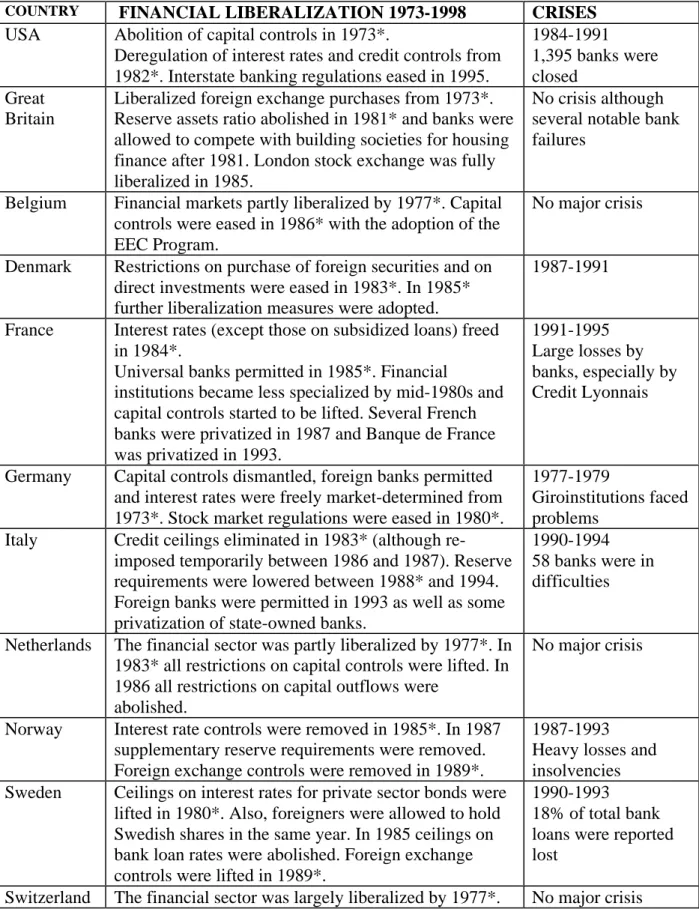
Table 1 presents the countries in our sample, the periods and types of financial liberalization, and the periods of banking crises. The financial liberalization varies in their scope and magnitude. Some liberalization episodes were a move from very control financial sector to a partial liberalized financial sector, while some were a shift from partial
liberalization to full liberalized financial sector. Some financial liberalization were taken at a very slow rate while others were taken at very rapid rate. Due to the data limitations we do not distinguish between the degree of liberalization, and consider all liberalization episodes the same.5
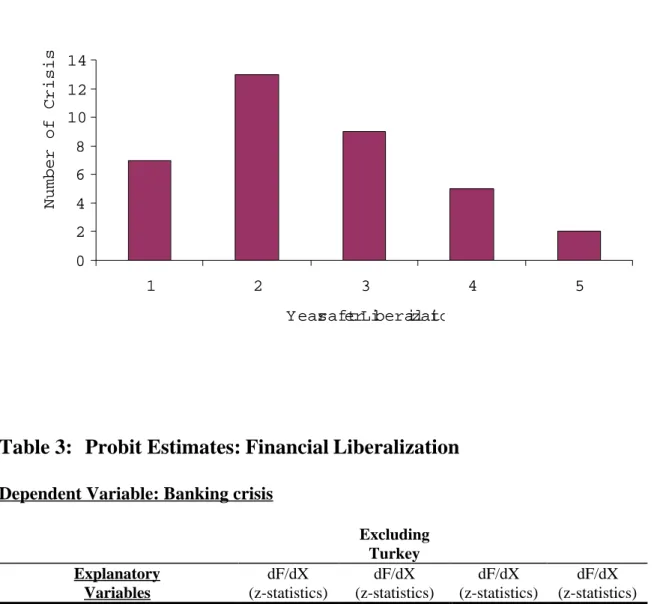
Table 2 presents some descriptive statistics about liberalization and banking crises. There are 92 episodes of liberalization in our sample and 60 episodes banking crises. 36 out of the 60 (60 percent) crises were preceded by a liberalization in the previous 5 years. 15 crises occurred before liberalization and 9 occurred more than 5 years after stabilization. Out of the 92 episodes of financial liberalization, 40 (44 percent) were followed by banking crisis in the next 5 years. Figure 1 presents the distribution of the duration between a crisis and a
liberalization for those crisis that were preceded by liberalization. Out of 36 crises that occurred in the 5 years following a liberalization, 13 occurred 2 years after liberalization, 9 crises occurred 3 years after liberalization, and 5 crises occurred 4 years after stabilization.
4.2. Estimation results
Our first goal is to show that banking crises are more likely to occur only in the period following liberalization. In other words, financial liberalization increases the probability of a
crisis only in the initial periods of adjustment. In order to show that our model can improve existing relevant literatures and as a robustness check, we first present the results based on the same countries and definition of financial liberalization and crises as Demirguc-Kunt and Detragiache (1998b). The only additional variable is a dummy variable that takes the value of 1 if financial liberalization had occurred in the previous 5 years and 0 otherwise. To ease interpretations, we report the effects of one-unit changes in the dependent variables on the probability of a crisis (expressed in percentage points) evaluated at the mean value of the data. We also report the associated z-statistics that test the null hypothesis of no effect.
The first column in table 3 presents results of a probit model where the dependent variable takes the value of 1 during years with a financial crises and 0 otherwise (excluding 5 years after the crises starts or while the crises last). The macroeconomic variables have the expected signs and are significant except for the growth rate of terms of trade and the claims of the private sector as a share of GDP. In this specification, the probability of a crisis increases both in the 5 years following a liberalization and in a liberalized financial systems.
These results, however, are very sensitive to the sample and the definition of financial liberalization. In the second column we report the results excluding Turkey6
. The results now are very different. The probability of a crisis is higher only during the 5 years following a liberalization and there is no evidence that the probability of a crisis is higher in liberalized financial system.
The evidence is even stronger once we use date of financial liberalization based on Williamson and Mahar (1998) and Drees and Pazarbasioglu (1998) surveys (see table 1). Column 3 reports the results (including Turkey) using the adjusted dates of financial
6 One reason to exclude turkey is that Turkey had additional banking crises during 1980-95, but these crises were
liberalization. The coefficients of the financial liberalization dummy variable is insignificant (and negative) while the coefficients of the dummy variable for the 5 years period following a financial liberalization variable is significant and positive. Thus, there is a strong evidence that countries that liberalized in the last 5 years have higher probability of a crisis. There is no evidence that liberalized financial system increases the probability of a crisis.
Finally, in the fourth column we present the results using our complete data set. 7 The probability of a banking crisis in countries that have had financial liberalization in the past 5 years is higher by almost 9% in this specification.
To conclude, the results provide strong evidence to the model’s prediction that the probability of a crisis is higher following a financial liberalization. There is little evidence that banking crisis is more likely to occur in liberalized financial system after controlling for the liberalization period.
4.3. Transparency
In this section we turn to test whether the increase in the probability of a crisis depends on transparency as the model predicts. That is, do countries that liberalize their financial sector are more likely to have a banking crisis if transparency is poor?. One difficulty in carrying out this test is that we do not have good data about transparency. Thus, we use two measures to construct a proxy for transparency. First, we use an index of corruption. The source of the corruption index isPolitical Risk Services, Syracuse, New York (ICRG indices). The index ranges from 0 to 6, where highly corrupted countries take a value 6 while non-corrupted countries take a value of 0. Using this index we create a transparency dummy
variable that takes the value of 1 if the corruption index is greater than or equal to 3, (which is about the median), and a value of 0 if the index takes a value less than 3.8
Second we use a combination of the size of the public sector and corruption to create a variable of transparency. Kopits and Craig (1998) argue that the transparency in government behavior is reflected mainly in the structure and functions of the public sector, such as financing operations. Thus, we create a measure of transparency by combining the ratio of credits directed to the government and the public sectors to total domestic credits, and corruption.9
We define country with large (small) public sector if the share is greater (smaller) than the median. We combined this measure with our measure of corruption and create three transparency dummies: a dummy for poor transparency that takes the value of 1 if a country is corrupt and has large public sector and 0 other wise. A dummy for medium transparency that takes the value of 1 if a country is corrupt and has small public sector or is not corrupt but has large public sector and 0 other wise. A dummy for good transparency that takes the value of 1 if a country is not corrupt and has a small public sector and 0 other wise.
One caveat of using corruption as a proxy for transparency is that corruption by itself may affect the probability of a crisis. Financial liberalization may offer new opportunities for corruption which may lead to financial crisis. Further more corruption and transparency are very likely to be determined simultaneously. We leave this issue, however, for future research.
Table 4 presents the effect of transparency on the probability of a financial crisis. In the first column we test whether poor transparency increases the probability of a crisis. Thus, we
8 The results are robust to the exact definition.
add transparency, using the first proxy as an explanatory variable, to the probit model above. There is no evidence that poor transparency increases the probability of a crisis.
Next we turn to test whether poor transparency increases the probability of a crisis in the period following financial liberalization as the model predicts. We interact the
transparency dummy variable with the dummy variable of financial liberalization in the previous 5 years. That is, we create two dummy variables: One dummy takes value of one if there was a financial liberalization in the previous 5 years and transparency is poor, and zero otherwise. The other dummy takes value of one if there was a financial liberalization in the previous 5 years and transparency is good, and zero otherwise. The results are presented in the second column in table 4. Financial liberalization increases the probability of a crisis in both cases. However, The probability of a crisis in countries with poor transparency that undertake financial liberalization is higher by 10 percent compare to countries with good transparency (21.89 compare to 11.55). Furthermore, the coefficients of the two dummies are significantly different at 14%. This result suggests that poor transparency increases the probability of a financial crises following financial liberalization.
The results using our second definition of transparency are presented in the third
column. The results are consistent with the findings above. The increase in the probability of a crisis following financial liberalization decreases with the level of transparency (17.37, 12.73 and 6.66 for poor, medium and high transparency respectively).
Finally, as a robustness test we present the results using lag values of the macro and financial variables. One could argue that this is a better specification since banking crises affects the macro and financial variables at the same period. Since our focus here is the effects of liberalization and transparency and not the effects of macro and financial variables we
present the result only as a robustness test to the effects of liberalization and transparency on the probability of a crisis. The results are presented in the last column. The effects of financial liberalization are robust to lagged specifications. However, the macro and financial variables are not robust to lagged specification.
5. Conclusions
The main conclusion of the analyses is that the probability of a financial crisis is higher during the period of transition when the prior information set is uncertain. One such case of transition is when countries undertake financial liberalization. We show that the probability of a banking crisis is higher in the 5 years following the financial liberalization. Furthermore, we show that the increase in the probability of a crisis is much higher in countries with poor transparency.
It is important, however, to note that this does not mean that countries should not
liberalize their financial sector. Rather, the lesson is that countries should be more transparent, especially during a period of transition. In this sense, it is better to liberalize the financial system slowly in countries with poor transparency in order to slow down the speed of adjustment.
References
Aghion, Philippe, Philippe Bacchetta, and Abhijit Banerjee, 1999. “Capital Markets and the Instability of Open Economies.” Mimeo, January 1999.
Calvo, G., 1999, “Contagion in Emerging Markets: When Wall Street Is a Carrier,” University of Maryland.
Calvo, G. and E. Mendoza, 1999, “Rational Herd Behavior and the Globalization of Securities Markets,” National Bureau of Economic Research. Working Paper Series; No. 7153:1-[40], June 1999
Campos, Ed, Root, Hilton L, 1994. “Information Aggregation and Economic Development: The Case of East Asia” University of Western Ontario, Papers in Political Economy: 50 December 1994, pp. 53.
Caprio, Gerald, Jr. and Daniela Klingebiel, 1996. “Bank Insolvencies, Cross-country Experience.” The World Bank, Policy Research Working Paper 1620, 1996. Demirguc-Kunt, Asli and Enrica Detragiache, 1998a. “The Determinants of banking
Crises in Developing and Developed Countries.” IMF Staff Papers, Vol. 45, No.1, March 1998.
Demirguc-Kunt, Asli and Enrica Detragiache, 1998b. “Financial Liberalization and financial Fragility.” IMF working paper ; WP/98/83, June 1998.
Drees, Burkhard and Ceyla Pazarbasioglu, 1998. “The Nordic Banking Crises- Pitfalls in Financial Liberalization?” IMF Occasional Paper 161, April 1998.
Kaminsky, Graciela and Carmen Reinhart, 1998. “The Twin Crises: The Causes of Banking and Balance-of-Payments Problems.” American Economic Review; 89:473-500, June 1999
Kaufmann, Daniel, Gil Mehrez, and Sergio Schmukler, 1999. “Predicting Currency
Fluctuations and Crises: Do Resident Firms Have an Informational Advantage?”, The World Bank, July 1999.
Kopits, George and Jon Craig, 1998. “Transparency in Government Operations.” IMF Occasional Paper 158, January 1998.
Kodres, L. and M. Pritsker, 1998, “A Rational Expectations Model of
FinancialContagion,” United States Board of Governors of the Federal Reserve System. Division of Research and Statistics. Finance and Economics Discussion Series; No. 1998-48:1-56, December 16, 1998
Myers, Stewart C and Nicholas S. Majluf, 1984. “Corporate and financing and
investment decisions when firms have information that investors do not have” Journal of Financial Economics (Netherlands); 13:187-221 June 1984
Lindgren, Carl-Johan, Gillian Garcia, and Mattew I. Saal, 1996. “Bank Soundness and macroeconomic Policy.” International Monetary Fund, 1996.
Pill, Huw and Mahmood Pradhan, 1995. “Financial Liberalization in Africa and Asia.” IMF Working Paper No. 95/123, November 1995.
Stiglitz, Joseph and Andrew Weiss, 1981. “Credit Rationing in Markets with Imperfect Information.” American Economic Review; v71 n3 June 1981, pp. 393- 410
Williamson, John and Molly Mahar, 1998. “A Survey of Financial Liberalization.” Essays in International Finance, No.211, November 1998.
Zeira, Joseph, 1999. “Informational overshooting, booms, and crashes.” Journal of Monetary Economics, v43 1999, PP 237–257.
Table 1: Financial Liberalization and Banking Crises
COUNTRY FINANCIAL LIBERALIZATION 1973-1998 CRISES
USA Abolition of capital controls in 1973*.
Deregulation of interest rates and credit controls from 1982*. Interstate banking regulations eased in 1995.
1984-1991 1,395 banks were closed
Great Britain
Liberalized foreign exchange purchases from 1973*. Reserve assets ratio abolished in 1981* and banks were allowed to compete with building societies for housing finance after 1981. London stock exchange was fully liberalized in 1985.
No crisis although several notable bank failures
Belgium Financial markets partly liberalized by 1977*. Capital controls were eased in 1986* with the adoption of the EEC Program.
No major crisis
Denmark Restrictions on purchase of foreign securities and on direct investments were eased in 1983*. In 1985* further liberalization measures were adopted.
1987-1991
France Interest rates (except those on subsidized loans) freed in 1984*.
Universal banks permitted in 1985*. Financial
institutions became less specialized by mid-1980s and capital controls started to be lifted. Several French banks were privatized in 1987 and Banque de France was privatized in 1993.
1991-1995 Large losses by banks, especially by Credit Lyonnais
Germany Capital controls dismantled, foreign banks permitted and interest rates were freely market-determined from 1973*. Stock market regulations were eased in 1980*.
1977-1979
Giroinstitutions faced problems
Italy Credit ceilings eliminated in 1983* (although re-imposed temporarily between 1986 and 1987). Reserve requirements were lowered between 1988* and 1994. Foreign banks were permitted in 1993 as well as some privatization of state-owned banks.
1990-1994 58 banks were in difficulties
Netherlands The financial sector was partly liberalized by 1977*. In 1983* all restrictions on capital controls were lifted. In 1986 all restrictions on capital outflows were
abolished.
No major crisis
Norway Interest rate controls were removed in 1985*. In 1987 supplementary reserve requirements were removed. Foreign exchange controls were removed in 1989*.
1987-1993 Heavy losses and insolvencies Sweden Ceilings on interest rates for private sector bonds were
lifted in 1980*. Also, foreigners were allowed to hold Swedish shares in the same year. In 1985 ceilings on bank loan rates were abolished. Foreign exchange controls were lifted in 1989*.
1990-1993 18% of total bank loans were reported lost
Canada Financial sector was largely liberalized during the period examined. In 1980* foreign banks were permitted, although with some regulations. Reserve requirements were eliminated in the early 1990s.
1983-1985
15 members of the Canadian Deposit Insurance
Corporation failed Japan Controls on capital inflows and interest rate regulations
were eased from 1979*. Controls on capital outflows eased in the 1986*. The requirements of bank
specialization were reduced by 1993. Further liberalization to be implemented by 2001.
1991-1997
Finland Regulations on bank lending rate were abolished in 1986*. In 1986 exchange control regulations were lifted on long-term foreign borrowing. Cross border capital movements were liberalized in 1991*.
1991-1993 Liquidity crisis in 1991
Greece The process of liberalization of capital movements started in 1987* with the adoption of the EEC Program. Abolition of exchange rate controls in 1994*.
1991-1995
Ireland Restrictions on acquirement of foreign securities were eased in 1979*. Restrictions on long-terms capital outflows were eased in 1988*. Regulations on exchange control were lifted in 1993.
1985
Austria Interest rate liberalized in 1980*
Portugal Controls on purchases of foreign securities were relaxed in 1989*. In 1992* regulations on exchange control were lifted.
1986-1989
Turkey Interest rate ceilings on loans and deposits eliminated in 1980*. Direct credit was phased out in 1988. Capital flows were liberalized in 1990*.
1982-1985 five banks were rescued
1991 1994
Bank closures Australia Deposit rate controls lifted in 1980*. Capital account
liberalized in 1984. Most loan-rate ceilings abolished in 1985. Capital markets deregulated in 1986*.
1989-1990 government intervention to cover bank losses New Zealand
Foreign exchange controls removed in 1984*. Interest rates controls eliminated in 1985* as well as
requirements for financial institutions to purchase government securities. Stock exchange was liberalized in1986.
1987-1990
South Africa Interest rate controls and credit ceilings were removed in 1980*. Restrictions on bank competition were eliminated and new banks were allowed in 1984*.
1977 1985 Argentina Credit controls were initially removed in 1977* but
re-imposed in 1981. The initial liberalization of 1977 was reversed in 1982. Deposit rates were freed in 1987*.
1980-1982 168 banks closed down
Credit controls were substantially reduced in 1993*. 1989-1990 bank failure
accounted for 40% of financial system assets
Brazil Interest rate ceilings removed in 1976 and re-imposed in 1979. Deposit rates were fully liberalized in 1989*. Entry barriers reduced after 1991. Controls on capital inflows were strengthened while controls on outflows were loosened in the 1990s.
1994-1997
29 banks subjected to intervention
Chile Commercial bank interest rates were liberalized in 1974. New foreign banks admitted in 1977*.Capital controls were gradually eased since 1979. Controls were re-imposed in 1982 and eased again in 1985*.
1981-1983 bank failures
Colombia Deposit rates were market-determined in 1980*. The remaining controls on interest rates were lifted by 1994*. The large capital inflows in the early 1990s led to the re-imposition of reserve requirements on foreign loans in 1993 after having been relaxed in 1991.
1982-1987 central bank
intervened to rescue commercial banks
Ecuador Interest rate liberalized in 1986*. 1995
Guatemala
Guyana Interest rate liberalized in 1991*. 1993-1995
Honduras Interest rate liberalized in 1990*.
Jamaica Interest rate liberalized in 1991*. 1994-1995.
Mexico Deposit and loan rates liberalized in 1989*. Government gave discretion over foreign direct
investment in 1972. Portfolio flows were decontrolled even further in 1989. National banks were privatize in 1992* and the entry of new banks was permitted.
1982 1995
Accumulated losses estimated at 12-15% of GDP
Paraguay Capital controls were removed in 1988*. Foreign exchange controls were liberalized in 1993*.
1995 government intervention Peru Capital controls and interest rate controls were
removed in 1991*. Subsidized lending was eliminated in 1992*
No major crisis
El Salvador Interest rate liberalized in 1991*. 1989
Uruguay Interest rate liberalized in 1980*. 1981-1985
Venezuela Reserve requirements were reduced in the early 1990s. Interest rate controls and foreign exchange controls were liberalized in 1991*. 1994 Insolvent banks accounted for 30% of financial system deposits
Israel Restrictions on investment were eased in 1987* and restrictions on capital flows started to be eased.
Subsidized interest rates on priority lending was phased
1983-1984
nationalization of the major banks
out in 1991*. Directed-credit system was abolished in 1990.
Jordan Interest rate liberalized in 1988*. 1989-1990
Egypt Interest rates and foreign exchange controls were lifted in 1991*.Ceilings on credit to private sector were lifted too. Foreign banks were permitted to conduct business in foreign currency in 1992*.
1981-1983 1990-1991
Syria
Sri Lanka The exchange rate was unified in 1978. Capital controls on inflows of capital were eased in 1978*. Foreign banks were permitted since 1979.Restrictions on capital outflows remain.
1989-1993
nationalization of the major banks
India Partially liberalized in 1992*. 1991-1995
Indonesia Most deposit and loan rates were freed in 1983.* The monopoly of state-owned banks over the deposits of state-owned enterprises were removed in 1989*. New foreign banks were allowed to establish joint ventures in 1988.
1992-1998
Korea Controls on outward and inward foreign investment were gradually eased since 1983*.
1985-1986 Malaysia Interest rates and capital accounts were liberalized by
1978.*Controls on interest rates were then re-imposed in 1985 and completely eliminated in 1992*.
1985-1988
Nepal Interest rates were liberalized by 1989*. 1988-1994
Papua New Guinea
Interest rate liberalized in 1980* 1989-1995
Philippines Interest rates controls mostly phased out over 1981*-85. Direct credit partly abolished in 1983. Restrictions on all current and capital transactions eliminated over 1992-1995. Restrictions on foreign-bank branching lifted in 1994*.
1981-1987
banks accounting for 1.6% of the banking system failed in 1981 Singapore Financial sectors largely liberalized by 1977*.
Exchange and capital controls were freed in 1978*.
1982 Thailand Restrictions on inwards long-term investments were
eased in 1985*. Direct credit was gradually eliminated after 1980. Foreign banks were permitted in 1990. Ceilings on loan rates were removed in 1992*.
1983-1987
15% of bank assets were non-performing Kenya Ceilings on interest rates were removed in 1991*. 1985-1989
liquidity and solvency problems
Mali 1987-1989
Nigeria Interest rate liberalized in 1990*. 1991-1995
Tanzania Controls on interest rates were eased in 1986*. Exchange controls were abolished in 1992*.
1988-1994 state-owned
commercial banks were insolvent
Togo Interest rate liberalized in 1993*. 1993-1995
Uganda Interest rate liberalized in 1991*. 1994
Zaire Interest rate liberalized in 1980*. 1991-1995
Zambia Limits on remittances of profits and dividends were eased in 1990*. Exchange controls were abolished and interest rates were liberalized in December 1993*.
1995
* presents the year of financial liberalization in our data set. Sources on financial liberalization:
- Pill, H., Pradhan, M. “Financial Indicators and Financial Change in Africa and Asia”. IMF Working Paper No. 95/123. Washington D.C.: November 1995. (for Kenya, Tanzania and Zambia).
- Demirguc, Asli and Enrica Detraagiache, “Financial Liberalization and Financial Fragility.” IMF working paper ; WP/98/83, June 1998 (for Austria, Ecuador, Guyana, Honduras,
Jamaica, El Salvador, Uruguay, Jordan, Papua New Guinea, Nigeria, Togo, Uganda, and Zaire)
- Drees, B., Pazarbasioglu, C. “The Nordic Banking crises. Pitfalls in Financial
Liberalization?”. IMF Occasional Paper No. 161. Washington D.C.: April 1998 (for Sweden, Norway and Finland).
- Bakker, A. 1996. “The Liberalization of Capital Movements in Europe”. The Netherlands: Kluwer Academic Publishers (for Belgium, The Netherlands, Greece, Ireland and Portugal). - Lindgren, C., Garcia, G., Saal, M. 1996. “Bank Soundness and Macroeconomic Policy”. IMF. Washington D.C. (for Paraguay)
- Williamson, J., Mahar, M. 1998. “A Survey on Financial Liberalization”. Essays in
International Finance No. 211. International Finance Section (for Argentina, Australia, Brazil, Canada, Chile, Colombia, Egypt, France, Germany, Great Britain, India, Indonesia, Israel, Italy, Japan, Korea, Malaysia, New Zealand, Nigeria, Peru, The Philippines, Singapore, South Africa, Sri Lanka, Thailand, Turkey, USA, and Venezuela).
Sources on Banking Crisis:
- Caprio, G., Klingebiel, D. 1996. “Bank Insolvencies. Cross country Experience” Policy Research Working Paper No. 1620. World Bank. (for Australia, New Zealand, Chile, Colombia, Mexico, Peru, Venezuela, Egypt, Sri Lanka, Singapore, Kenya, Zambia).
- Demirguc, Asli and Enrica Detraagiache, “Financial Liberalization and Financial Fragility.” IMF working paper ; WP/98/83, June 1998 (for Austria, Thailand, Togo, and Uganda) - Drees, B., Pazarbasioglu, C. 1998. “the Nordic Banking Crisis: Pitfalls in Financial Liberalization?”. IMF Occasional Paper No. 161. (for Norway, Sweden, Finland).
- Lindgren, C., Garcia, G., Saal, M. 1996. “Bank Soundness and Macroeconomic Policy”. IMF. Washington D.C. (for Argentina, Brazil, Canada, Denmark, Ecuador, Finland, France, Germany, Greece, Guyana, India, Indonesia, Ireland, Israel, Italy, Jamaica, Jordan, Japan, Korea, Malaysia, Mali, Mexico, Nepal, Netherlands, Nigeria, Norway, Papua New Guinea,
Paraguay, Peru, The Philippines, El Salvador, South Africa, Sweden, Switzerland, Tanzania, Turkey, Uruguay, USA, Venezuela, and Zaire).
Table 2: Banking Crises and Financial Liberalization
Total Number of Banking Crisis 60
Prior to the financial liberalization 15
Five years after liberalization 36
More than five years after liberalization 9
Total Number of Liberalization 92
Number of liberalization which did not have a crisis in the next 5 years 52 Number of liberalization which had a crisis in the next 5 years 40
Figure 1: Duration Between Liberalization and a Crisis
(in countries which had banking crisis following liberalization)
Table 3: Probit Estimates: Financial Liberalization
Dependent Variable: Banking crisis
Excluding Turkey
Explanatory dF/dX dF/dX dF/dX dF/dX
Variables (z-statistics) (z-statistics) (z-statistics) (z-statistics)
GDP growth -0.54*** -0.48*** -0.41*** -0.40***
(-4.21) (-3.83) (-4.10) (-4.07)
Terms of Trade Growth -0.02 -0.02 -0.02 -0.02
(0.44) (-0.41) (-0.49) (-0.42)
Real Interest Rate 0.03** 0.04** 0.04*** -0.01
(2.30) (2.27) (2.61) (-0.29)
Inflation Rate 0.04** 0.03 0.03** 0.00
(2.38) (1.18) (2.02) (-0.24)
M2/Foreign Exchange Reserves 0.09 0.08 0.08* 0.06
(1.45) (1.41) (1.73) (1.30)
Private Credit as % of GDP 0.02 0.02 0.01 0.01
(0.88) (0.95) (0.59) (0.47)
Bank Cash and Reserves/Assets -0.04 -0.03 -0.03 -0.01
(-1.10) (-0.82) (-1.08) (-0.58)
2 Period Lagged Credit Growth 0.07** 0.08*** 0.06** 0.045*
(2.44) (2.61) (2.33) (1.85) GDP per Capita -0.00** -0.00** -0.00* -0.00* 0 2 4 6 8 10 12 14 1 2 3 4 5
Y ears after Liberalizatio
(-2.39) (-2.18) (-1.90) (-1.90)
Financial Liberalization 2.37 1.29 -0.58
(1.59) (0.83) (-0.38)
Financial Liberalization in the past 2.43 3.65*1
5 years with D & D dates2 (1.46) (1.89)
Financial Liberalization in the past 9.31*** 8.60***
5 years with our dates (3.20) (5.06)
Number of Observations 632 624 632 728 Log likelihood -87 -82 -81 -89 ***Significant at 1% **Significant at 5 % * Significant at 10% 1 Significant at 6 %
Table 4: Probit Estimates: Financial Liberalization and Transparency
Dependent Variable: Bank Crisis
1 period Lagged Macro and Financial Var.
Explanatory dF/dX dF/dX dF/dX dF/dX
Variables (z-statistics) (z-statistics) (z-statistics) (z-statistics)
GDP growth -1.09*** -1.03*** -1.00*** 0.03
(-4.55) (-4.55) (-4.09) (1.12)
Terms of Trade Growth 0.02 0.01 0.03 0.07
(0.19) (0.11) (0.32) (0.58)
Real Interest Rate 0.00 0.00 0.00 0.00
(0.78) (0.76) (1.05) (-0.10)
Inflation Rate 0.00 0.00 0.00 0.01
(-0.49) (-0.38) (-0.55) (0.21)
M2/Foreign Exchange Reserves 0.18 0.18 0.13 0.19
(1.61) (1.58) (1.03) (1.26)
Private Credit as % of GDP 0.05 0.04 0.05 0.03
(1.50) (1.35) (1.31) (0.60)
Bank Cash and Reserves/Assets 0.05 0.04 0.04 0.06
(0.74) (0.58) (0.48) (0.73)
2 Period Lagged Credit Growth 0.00 -0.01 0.00 0.01
(-0.23) (-0.27) (-0.12) (0.57)
GDP per Capita -0.00* -0.00* -0.00* 0.00
(-1.88) (-1.90) (-1.91) (-1.48)
Transparency 0.99
(0.42) Financial Liberalization in the previous
5 years
13.82*** (5.53) Poor Transparency * Fin Liberalization
in the previous 5 years
21.89*** (5.29) Transparency * Fin Liberalization in
the previous 5 years
11.55*** (3.52) High Transparency 6.66** 6.90* (1.86) (1.77) Medium Transparency- 12.73*** 10.43** (3.04) (2.47) Poor Transparency 17.37** 13.84* (1.94) (1.70) Number of Observations 665 677 677 644 Log Likelihood -151 -154 -165 -174 ***Significant at 1% **Significant at 5 % * Significant at 10%