An Android Malware Detection Framework-based on Permissions and Intents
Sushma Verma
*and S.K. Muttoo
#*Scientific Analysis Group, Delhi - 110 054, India #University of Delhi, Delhi - 110 054, India
*E-mail: [email protected] AbstrAct
With an exponential growth in smartphone applications targeting useful services such as banks, healthcare, m-commerce, security has become a primary concern. The applications downloaded from unofficial sources pose a security threat as they lack mechanisms for validation of the applications. The malware infected applications may lead to several threats such as leaking user’s private information, enforcing malicious deductions for sending premium SMS, getting root privilege of the android system and so on. Existing anti-viruses depend on signature databases that need to be updated from time to time and are unable to detect zero-day malware. The Android Operating system allows inter-application communication through the use of component reuse by using intents. Unfortunately, message passing is also an application attack surface. A hybrid method for android malware detection by analysing the permissions and intent-filters of the manifest files of the applications is presented. A malware detection framework is developed based on machine learning algorithms and on the basis of the decision tree obtained from ID3 and J48 classifiers available in WEKA. Both algorithms gave same results with an error percentage of 6 per cent. The system improves detection of zero day malware.
Keywords: Permissions, intents, pruning, clustering, classification
1. INtrODUctION
Smartphones have become a very soft and vulnerable target for malicious application developers. Malicious software is a common problem for every software platform, and the android platform is no exception. The most serious threats for android users come from applications. However, the markets
especially the unofficial markets lack a mechanism to validate
whether these applications are malware or not1,2. So, malware
may leak user’s private information without their knowledge or consent. Android relies on granular permissions to avoid granting full privileges to third-party applications. However, the permission system on Android is complex. There are at least 135 permissions. The developers as well as the users are unaware of the actual scope of each permission. Intents in the Android operating system provide a inter-application message passing system which is used to link applications. However, message passing acts as an application attack surface which can be used to modify, steal or sniff the content of messages leading to compromising user privacy. A malicious application can inject malicious messages resulting in user data breaches and violating application security policies. This creates room for exploitations; malicious applications disguise themselves amongst the hundreds of thousands of normal ones.
In the traditional method of malware detection, signature
is the only basis. The existing anti-viruses depend on signature database that needs to be updated from time to time and are unable to detect zero day malware2
We propose a hybrid detection framework on the basis of Permission and Intents which will be treated as features
to detect malware infected applications using classifiers such
as ID3 and J48 on the training set in WEKA. The system effectively detects zero day malware.
2. relAteD reseArch WOrK
The increased usage of smartphones can be combined with tremendous increase in the security breaches due to the exploitation of the increasing number of android application -related vulnerabilities. The continuing exponential growth in the usage of the smart mobile technology has necessitated
the research in security solutions for mobile devices. Boksasp
and Utnes3 investigates the used by the application to identify
the suspicious applications. The focus of the thesis is not to identify malicious applications but to identify permissions which can indicate malicious behaviour. Derby and Wilson4
analyses 3rd party apps for possible ways a malicious Intent
could trigger privileged calls by the app. Zarni and Zaw5
develops a framework for classifying Android applications using machine-learning techniques-based on permission features to detect malware or normal applications5.
A large scale study on application permissions and risk signals6 analysed the effectiveness of the permission systems
2016, DESIDOC
Received : 01 April 2016, Revised : 12 July 2016
for Android, Chrome and Facebook platforms to investigate privacy risks attempting to trick users into granting unsafe permissions. Droidranger7 examines the permissions requested
by the applications on the Google Play and third party markets by behavioural foot printing. Felt8, et al. reported over-privileged
applications are detected-based on permissions in the Android platform. These permissions are useful for the analysis of our malicious data set. A survey of mobile malware in the wild by Pporter9, et al. details their analysis of the incentive behind
malicious applications and the effectiveness of measures taken to prevent infections and identifying malicious applications. It explains the motivation behind several types of malicious behaviour, and the measures taken to prevent it.
A methodology for empirical analysis of permission-based security models and its application to androidby Barrera10
illustrates the permissions category wise and discusses ways to improve the android permission model. Analyses
of feature-based selection and classification algorithms for
permission-based android malware analysis was carried out by Pehlivan11, et al. and Mas’ ud12, et al.
3. PrOPOseD MethODOlOgy
Our methodology aims at developing a detection system that focuses on feature extraction and selection to measure and characterise the malicious applications on the basis of
permissions and intents specified in the manifest file of the
application. We have used information gain algorithm for feature selection. The features thus constructed from the
selected feature sets are fed to the classifier using WEKA. The
permission-based detection is carried out using the algorithm derived from the decision tree obtained from C4.5 (J48)
classification and intent-based detection is carried out using the
algorithm derived from the decision tree obtained from ID3
classification. According to the hybrid framework proposed as
depicted in Fig. 1.
If a sample application is detected as infected by both
permission and intent-based detection then it is classified
as Malicious.
If a sample application is detected as not infected by
permission-based detection and is detected as infected by intent-based detection or vice-versa then it is suspicious application.
If a sample application is detected as not infected by both
permission-based and intent-based detection then it is a benign application.
The steps involved in the process are as follows:
Collection of both infected and benign applications from
Google Play and other unofficial markets.
Extraction of features (useful information) from each
•
application which includes the permissions requested, intents etc.
Organisation of the collected features into structured
•
database
Classify the malwares using machine learning
•
algorithms.
Propose a hybrid malware detection framework-based on
•
both permissions and intents.
3.1 Feature collection
The datasets were generated using both infected and non-infected Android applications. A total of 850 applications were
downloaded from the Android official app market – Google
Play and 620 malicious apps from contagiomini dump13. All
downloaded files were scanned using commercial antivirus
virustotal14.
3.2 Feature extraction
To apply any machine learning classifier, it is important to first collect the relevant features. dex2jar and JdGui is used to disassemble apk file. Features are extracted from
AndroidManifest.xml. Some of the features that were used for
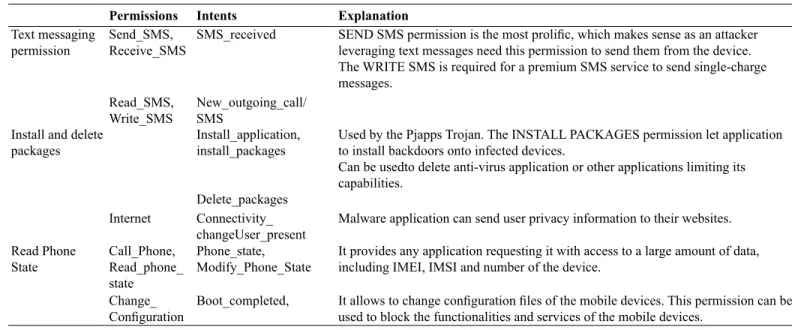
classification are as listed in Table 1.
The Androidmanifest.xml file thus obtained is converted
into .arff format to be analysed in WEKA. The permissions
requested that are specified in the <uses-permission> and
the intents can thus be extracted and used as features for
classification.
Two databases are created one containing the permissions requested by all the apps and the other containing the intents of the apps. The permission database include the various attributes including standard permissions, the name of the malware in case of malicious app, infected attribute indicates whether the app is infected or non-infected app. The intent database
consists of the flag to indicate the presence or lack of an intent
marked as “1” or a “0” in the respective column. Figure 2 shows some of the Android applications permissions used for malware detection.
3.2.1 Permission-based Detection
Some of the malicious permissions are explained as follows:Text messaging permissions, Read Phone State, Install
and delete packages, internet, change configuration.
3.2.2 Intent-based Detection
Presence of malware in an application can be detected
Figure 1. Framework for android malware detection system- based on hybrid features.
on the basis of the intents (message passing) used by the application. An Intent is a message that includes a recipient and optionally includes data. Intents can be sent between three of the four components: activities, services, and broadcast receivers. They can be used to start activities; start, stop, and bind services; and broadcast information to broadcast receivers.
confidentiality or integrity can be compromised if a sender
does not correctly specify the recipient of the message leading to interception by the attacker. The content of messages can be
sniffed, modified, stolen, or replaced, which can compromise
user privacy and violate application security policies. Android provides a sophisticated message passing system, in which Intents are used to link applications. It is must to explicitly set the exported attribute in the intent to true or false, else its default value which is true, can invoke any other application on the system8. The detection is-based on one type of intent i.e.
action type. We analyse the intents along with the permissions for classifying malicious and benign apps.
Some of the common intents used in applications are analysed to understand their functioning4.
ACTION_DIAL
• : Perform a call to someone specified
by the data. This Intent cannot be used to call emergency
numbers or premium numbers by malicious applications.
AcTion_cAll_BuTTon: This intent is used to •
involve the dialerby pressing the “call button” ACTION_CREATE_SHORTCUTOutput: An
•
Intent representing the shortcut is used to create a SHORTCUT_INTENT
ACTION_DATE_CHANGED: This intent is used to
•
change the date of the system thereby disabling lot of applications such as browser to seize working. ACTION_DELETE: Delete the given data from its
•
container.
ACTION_INSTALL_PACKAGE: This intent is used
•
tolaunch application installer. It can be used to install malicious applications.
ACTION_MAIN: Start as a main entry point, does not
•
expect to receive data.
ACTION_MEDIA_REMOVED: External media has
•
been removed.
The subsequent sections will describe the application of machine learning algorithms to identify malicious and suspicious applications in Android and their results.
3.3 Feature selection
All these permissions may not be relevant in detecting the infected app and can result in false positives thereby misleading the learning algorithm and increasing complexity and run-time. These adverse effects are even more crucial when applying. The application of machine learning methods on mobile devices can lead to adverse effects as these are often restricted by processing and storage-capabilities such as battery power. Thus there is a
Table 1. Features used for classification
Permissions Intents explanation
Text messaging
permission Send_SMS, Receive_SMS SMS_received sEnd sms permission is the most prolific, which makes sense as an attacker leveraging text messages need this permission to send them from the device. The WRITE SMS is required for a premium SMS service to send single-charge messages.
Read_SMS,
Write_SMS New_outgoing_call/ SMS Install and delete
packages Install_application, install_packages Delete_packages
Used by the Pjapps Trojan. The INSTALL PACKAGES permission let application to install backdoors onto infected devices.
Can be usedto delete anti-virus application or other applications limiting its capabilities.
Internet Connectivity_
changeUser_present Malware application can send user privacy information to their websites. Read Phone
State Call_Phone, Read_phone_ state
Phone_state,
Modify_Phone_State It provides any application requesting it with access to a large amount of data, including IMEI, IMSI and number of the device. Change_
configuration Boot_completed, it allows to change configuration files of the mobile devices. This permission can be used to block the functionalities and services of the mobile devices.
need for selecting the most relevant features out of the dataset
that are sufficient for detecting the infected app.in order to improve the efficiency of classification these redundancy
and inconsistency features must be eliminated which is done by Feature Selection. We have used the information gain algorithm for feature selection. This method results in selecting the k best features from the extracted features of android
applicationpackage files. it depends on entropy of the attributes
and selects the largest value of gain as the best feature.
3.4 Malware Detection using clustering and classifiers
The selected features are collected into the signature database and divided into training data and test data and used by standard machine learning techniques to detect the android
malware applications. in the first step we have used K-means
clustering to obtain k disjoint clusters on training datasets each cluster depicts a region of similar features instances in terms of Euclidean distances between the instances and their cluster centroids. However, K-Means clustering may lead to anomalies in case of overlapping type of data. So we use decision tree
classifiers to classify each cluster. K-means method is cascaded
with decision tree learning by using the instances in each K-means cluster. However, K-Means clustering may lead to anomalies in case of overlapping type of data. So we use
decision tree classifiers to classify each cluster. K-means method
is cascaded with decision tree learning by using the instances in each K-means cluster. We have used K-means clustering as it guarantees at least a local minimum of the criterion function, thereby accelerating the convergence of clusters on large datasets. It is an iterative algorithm which organises the training set in vectors with a dimension equal to the number of features to be evaluated leading to k number of clusters.
K-means consists of two steps:
1. Calculate the centroid for each cluster.
2. Calculate the distance of the training set vectors from each cluster centroid
3. Assign the training set vector to the closest cluster centroid.
4. Move the cluster centroids to the mean of the respective cluster’s training sets.
The steps are repeated until the algorithm converges. Convergence is achieved when the second step no longer assigns any vectors to new cluster centroids.
The distance between the n-dimensional vectors (x) and a given cluster centroid is given by:
2
x− µ
where x is a training example, and µ is the cluster centroid. In the experiments, it was seen that in case of seed ie. Centroid µ (equal to 12), the error percentage was 15.3846 per cent which was the least error percentage obtained.
3.5 classification
As the training set is usually very large, the branches and layers of generated tree using J48 decision tree algorithm are more, so it is necessary to prune the decision tree. We have
also used id3 and c4.5 classification algorithms to obtain a
relationship between the attributes that would make it possible to detect whether an app is infected or not. The experiments show that out of 620 instances of infected applications, 605
were correctly classified using id3 and the error percentage
was only 6 per cent as can be seen from the Table 2. The table shows that ID3 gives better results for permissions whereas J48
performs better for intents. However any of the two classifiers
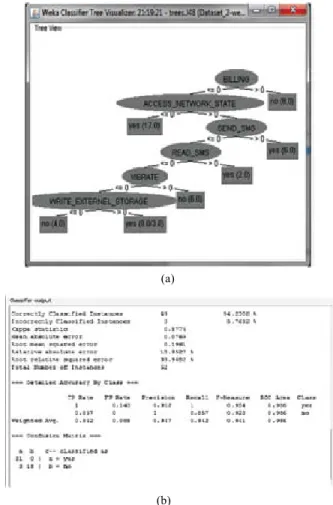
from ID3 or J48 can be used for detection purposes.The Fig. 3 below shows the resultant tree obtained from the database by applying J48 with pruning through which an app can be detected as being infected or not infected.
4. exPerIMeNtAl resUlts
We have performed our experiments on an Intel Pentium
core 2 duo 2.33 GHz processor with 2GB rAm. Benign
Machine learning
technique Algorithm No. of correctly detected apps No. of incorrectly detected apps total no. of apps error percentage (per cent) Accuracy percentage (per cent)
Clustering k-means 1087 382 1470 26 74
classification ID3 1352 108 1470 8 92
classification J48 1381 88 1470 6 94
table 2. Parameters for confusion matrix from experimental results
Figure 3. (a) J48 decision tree and ( b) result of J48 classification
with pruning using WeKA.
(a)
apps were downloaded from the Android official app market –
Google Play and the malicious apps from contagiominidump13.
The collected apps were classified as malicious or benign by
using virustotal14.
Our dataset consists of 620 malicious samples and 850
benign applications. We first extracted features and then built ArFF file from the extracted features used to train the dataset
by using K-means clustering algorithm. The database is then divided into two - the training data set and the testing data set.Selection of most relevant features out of the dataset is done by using information gain algorithm. It determines the useful attributes in a given set of training feature vectors for discriminating between the classes. Once the training model
has been developed, we used decision tree-based classification
algorithms ID3 and C4.5 (or J48) for each cluster to classify the malware applications using machine learning tool kit Weka15
and then the testing set was used to test the efficiency of the model in detecting infected apps. Both algorithms gave same
results with an error percentage of 6 per cent.
The following confusion matrices were created from the
results obtained from the classifiers.
true Positive (tP): Number of benign applications correctly
identified.
False Positive (FP): Number of malware applications wrongly
identified.
true Negative (tN): Number of malware applications
correctly identified.
False Negative (FN): Number of benign applications which
are wrongly identified.
true Positive rate (tPr): Percentage of correctly identified
benign applications TPR = (TP / TP+FN)
False Positive rate (FPr): Percentage of wrongly identified
malware applications FPR= (FP / TN+FP)
Overall Accuracy (Acc): Percentage of correctly identified
applications
ACC= (TP+TN / TP+TN+FP+FN)
The performances of classifiers were evaluated using the
true positive rate, false positive rate and overall accuracy.
5. cONclUsION
We have implemented a framework for detecting malicious android applications using permission and intent-based analysis. After extracting several permissions and intents as features from several downloaded, feature set was reduced using information gain algorithm. The database is then divided into two - the training data set and the testing data set. We then
used k-means clustering followed by the J48 and id3 classifier
using the training data to correctly detect malware among the given applications. From the experiments conducted and data
collected thereof, we conclude that the J48 classifier produces
the best results with an accuracy of 94 per cent. Performances were compared in terms of accuracy and error percentage derived from the confusion matrix. The hybrid approach for malware detection of android applications will enhance the security of the mobile device. Future work may include
evolving and comparing improved classification algorithms for
detection of malicious applications.
reFereNces
1. Zdnet.http://www.networkworld.com/article/2223327/ security/fbi-warns-loozfon--finfisher-mobile-malware-hitting-android-phones.html (Accessed on 07 March 2016)
2. Vaibhav Rastogi, Y.C. & Jiang, Xuxian. Evaluating anti-malware against transformation attacks. NU-EECS-13-01, March 2013.
3. Boksasp, T.u.; E. Android apps and permissions:
Security and privacy risks. NTNU - Trondheim, Norwegian University of Science and Technology 2012 (Norway, 2012.). (Master’s thesis)
4. Kelly Casteel, K.; Owen Derby, oderby & Dennis Wilson, Dennisw. Exploiting common intent vulnerabilities in android applications. In Proceedings of the 18th
ACM conference on Computer and communications, 2012.
5. Zarni Aung, W.Z. Permission-based android malware detection. In Proceedings of the International Journal of Scientific and Technology Research., 2013, 2(3). 6. Chia, P.; Y.Y. & Asokan, N. Is this app safe? A
large scale study on application permissions and risk signals. In Proceedings of the 21st International
World Wide Web Conference, 2012.
7. Zhou, Y.; Z.W.; Zhou, W. & Jiang, X. Droidranger: Hey, you, get off of my market: Detecting malicious
apps in official and alternative Android markets.
In Proceedings of the 19th Annual Symposium on
Network and Distributed System Security, 2012. 8. A. P. Felt, E.C., S. Hanna, D. Song, & D. Wagner,
Stowaway: Android permissions demystied. In Proceedings of the 18th ACM Conference on Computer
and Communications Security, 2011.
9. Porter A.; Felt, M.F.; Chin, E.; Hanna, S. & Wagner, D. A survey of mobile malware in the wild. In Proceedings of the 11th Workshop on Security and Privacy in
Smartphones and Mobile Devices, 2011. Chicago, IL, USA, pp. 3-14. doi: 10.1145/2046614.2046618
10. Barrera, d.; Kayacik, H.; van oorschot, P. & somayaji,
A. A methodology for empirical analysis of permission-based security models and its application to android. In Proceedings of the ACM conference on Computer and Communications Security, 2010. Chicago, IL, USA, pp. 73-84. doi: 10.1145/1866307.1866317
11. Pehlivan, u.; Baltaci, nuray; Acartürk, cengiz & Baykal, nazife. The analysis of feature selection
methods and classification algorithms in permission-based Android malware detection. IEEE Symposium on Computational Intelligence in Cyber Security
(cics), 2014. doi 10.1109/cicYBs.2014.7013371
12. Mas’ ud, M.Z. Analysis of features selection and machine learning classifier in android malware detection. International Conference on Information Science & Applications (ICISA), IEEE, 2014.
13. Contagiominidump.www.contagiominidump.blogspot. com. (Accessed on 05 February 2016)
14. Virustotal.www.virustotal.com. (Accessed on 24 February 2016)
15. WEKA.http://www.cs.waikato.ac.nz/~ml/weka/. (Accessed on 17 March 2016)
AcKNOWleDgeMeNts
I would like to thank my Director, Ms Anu Khosla, Scientist ‘G’ for giving me the opportunity to working the area of security and privacy in mobile computing andall those who directly or indirectly provided support in the area of malware analysis. And author is thankful to University of Delhi for providing research grant videRC/2015/9677.
cONtrIbUtOrs
Ms sushma Verma obtained his MSc (Ccomputer Science) from J.K. Institute of Applied Physics and Electronics , Allahabad University in 1993. She joined DRDO, Ministry of Defence in May 1993 and working there as scientist. Her area of specialisation includes mobile security, mobile malware analysis, formal verification and information security.
Dr s.K. Muttoo obtained his MSc (Mathematics), MPhil (Mathematics) and PhD from University of Delhi in 1976, 1978 and 1982, respectively. He also did his MTech (CSDP) from IIT Kharagpur in 1990 and joined Department of Computer Science , University of Delhi as Reader in 1991. His area of specialisation include coding theory, cryptography and information hiding techniques. He is life member of Computer society of India and Cryptographic Society of India.