Procedia Computer Science 60 ( 2015 ) 784 – 791
1877-0509 © 2015 The Authors. Published by Elsevier B.V. This is an open access article under the CC BY-NC-ND license (http://creativecommons.org/licenses/by-nc-nd/4.0/).
Peer-review under responsibility of KES International doi: 10.1016/j.procs.2015.08.238
ScienceDirect
* Neeraj Namdev. Tel.:+91-9907596280. E-mail address:[email protected]
19th International Conference on Knowledge Based and Intelligent Information and Engineering Systems
Recent Advancement in Machine Learning based Internet Traffic
Classification
Neeraj Namdev
a,*, Shikha Agrawal
a, Sanjay Silkari
a aDepartment of Computer Science and Engineering, RGPV, Bhopal,462033, IndiaAbstract
With the advancement of technology and communication system, use of internet is giving at a tremendous role. This causes an exponential growth of data and traffic over the internet. So to correctly classify this traffic is a hot research area. Internet traffic classification is a very popular tool against the information detection system. Although so many methods had been develop to efficiently classify internet traffic but among them machine learning techniques are most popular. A brief survey on various supervised and unsupervised machine learning techniques applied by various researchers to solve internet traffic classification has been discussed. This paper also present various issues related to machine learning techniques that may help interested researchers to work future in this direction.
© 2015 The Authors. Published by Elsevier B.V. Peer-review under responsibility of KES International.
Keywords: : Internet; Machine learning techniques;Traffic classification
1. Introduction
Internet traffic defines as the density of data or information present on the Internet or in another language we can say it’s a flow of data on the internet. Internet traffic classification has power to solve many network difficulties and manage different type of network problems. There are some basic function provided to government, Internet service provider (ISPs) and network administrator through Internet traffic classification. It can be used for intrusion detection system by finding patterns of denial of service (Dos) and other attacks.
It can be used for intrusion detection system by finding patterns of denial of service (Dos) and other attacks. It can also help to ISPs to monitor network traffic flow and troubleshoot the faults and other problems, it can also be used in “lawful inspection” of the payload of a packet by government to obtain users information.
There are two types of internet traffic classification techniques Port based and Payload based techniques:
1.1 Port Based Technique
Port based technique most popular and common technique for traffic classification. In this technique every packet in an IP traffic carries port numbers (source port number and destination port number) which assigned by IANA[11]. The applications have well known and registered port number but this is not necessary that all applications have registered port number, some new generation applications like peer to peer (P2P), online gaming type application do not have registered port numbers, these applications uses random port numbers so due to this it is very difficult to classify such type of application using port based
© 2015 The Authors. Published by Elsevier B.V. This is an open access article under the CC BY-NC-ND license (http://creativecommons.org/licenses/by-nc-nd/4.0/).
technique.
1.2 Payload based Technique:
Payload based technique overcomes the problems of port based technique. It avoids the total dependency on the semantics of port numbers. This is a deep packet inspection technique (DIP), in this technique they are matching payload of the packets with the well known signature. In this technique they can setup constrains or rules according to different application types for payload matching. This technique give very good results, it classify approx 100 % of packets correctly but only when packets are not encrypted. Payload based technique is very accurate but it have two major drawbacks. First is it cannot deal with encrypted packets because we cannot apply deep packet inspection(DPI) technique in encrypted packets and second one is it have low processing efficiency, it take too much time to classify the packets.
There are many of communication devices accessing resources and getting request to carry out their work and there is a lot of information exchanged over the internet, so accurate classification is very essential not only for QOS (Quality of service) and to maintain availability of resources but also processing of information efficiently.
2. Machine Learning Techniques
Looking to the importance of internet various machine learning techniques has been applied to classify internet traffic accurately and efficiently. The next subsection on introduction of ML techniques is given, which is followed by discussion on application of some of the ML techniques for solving internet traffic classification problems. There are two types of ML techniques first is supervised learning (Classification) and another one is unsupervised Learning (Clustering).
2.1. Supervised Learning Technique:
Supervised learning based on attributes of a class i.e. in this we choose samples on the basis of attributes collected by the whole data. The machine learning is provided with a collection of sample instances, pre-classified into classes. The output of the learning process is a classification model that is constructed by examining generalizing from providing instances. In classification approaches mainly have two phases (steps), training and testing. Learning phase that examine the provided data (called the training dataset) and constructs (builds) a classification model. And the model that has been built in the training phase is used to classify new unseen instances, in this paper we discuss the some well known supervised machine learning techniques and discuss also about issues related to different techniques.
2.2. Unsupervised Learning Techniques
Unsupervised learning techniques using the concept of clustering. In contrast, clustering methods, we create clusters of having same features but clustering is not provided with guidance. In clustering there is no need of the training phase.
3. Application of Machine learning approaches for Internet traffic classification
.
3.1. Supervised (classification) MethodsSupervised techniques as follows:
3.1.1. Bayes Net Method
Bayes Net approach generally known as Belief Network. It is a Probabilistic model which uses the graph model to represent the set of random variables and their conditional dependencies. Bayes Net uses the concept of directed acyclic graph (DAG) to represent the set, in which each node represent a variable and edges among the nodes represent the relative dependencies between random variables and these relative dependencies in the graph are calculated by well known statistical and computational methods. There are two phases of bayes net approach first phase is learning of network structure, in which uses various types of search algorithm like hill climbing, tabu search etc. for identified a good network structure and second is estimate probabilistic table for each random variable. In [2013], Kuldeep singh et al. [2] uses five machine learning algorithms (MLP, RBF, C4.5, Naïve Bayes, Bayes Net) to classify real time IP traffic. In this they prepared dataset by using a packet capturing tool Wireshark and captured packets for duration of 2 second and prepared datasets and now they apply feature selection algorithms to eliminate irrelevant features for this they using correlation and consistency based feature selection algorithms for feature reduction. Correlation based FS (feature selection) algorithm is used for identifying and reducing number of features which are redundant and not defining a particular type of traffic of internet and consistency based FS algorithm first compute different number of subsets of features and after that it select the optimal subset of features which contain less number of features. Result reported in this paper show 91% of classification accuracy of Bayes net. In 2012 S. Agrawal et al. [7] uses three machine learning algorithm (C4.5, Bayes Net and RBF) to classify internet traffic classification for academic perspective. They classify the website of an educational institution into two category first is an educational website which includes website
like www.ieeexplore.ieee.org, www.sciencedirect.com etc., and the second one is non educational website which include like www.yahoomassenger.com, www.movies.com etc. they prepared dataset by using network capturing tools Wireshark and captured traffic of an educational institution for the duration of 1 minute in middle session of a day and prepare samples for testing and training purposes. They measure the performance on the basis of classification accuracy and training time, and they got that Bayes Net gives the better performance as compared to other two methods C4.5 and RBF. Bayes Net gives 76.67% classification accuracy with training time of 2 seconds. In 2012 Jaspreet Kaur et al. [6] uses five well known machine learning algorithms (Naïve Bayes, C4.5, RBF, MLP, Bayes Net) to classify the educational and non-educational websites. In this paper they use two types of data sets for classification, one is a full feature dataset and another one is reduced feature datasets with CFS (Correlation based feature selection) and CON (Consistency based feature selection) feature reduction algorithms. In case of the full feature dataset, the efficiency was decreases due to large number of features and that’s why they use reduced feature dataset. In this Bayes Net gives 96.6% classification accuracy with full feature dataset but the number of samples in a dataset is low.
3.1.2. Feed forward Neural Network classifier
The feed forward neural network show in fig.1 was the first and simplest type of artificial neural network methods. In this network, the information moves in only one direction, forward, from the input nodes, through the hidden nodes (if any) and to the output nodes. There are no cycles or loops in the network.
Input layer Hidden layer Output layer
Fig. 1 Feed forward neural networkWhere,
Transfer function f is determined by the user Input = Aj (1 j k)
Weight = Wij (1 i u, 1 j k ) F = transfer function define by user Output=ji (1 i u)
B bias added = bi (1 i u)
Here transfer function and weight are adjustable according to the output gain.
In 2011 Wengang Zhou et al. [14] proposed an approach based on a feed forward neural network for accurate traffic classification and combined it with FCBF (Fast Correlation Based Feature) feature selection algorithm. FCBF is used for eliminating the redundant features and chosen the valuable features and feed forward neural network work as classifier. In this Bayesian regularization technique is used for training and this technique reduces a linear combination of squared errors and squared network parameters to keep safe the model from over-fitting for the datasets. In this paper, proposed method is compared with naïve bayes method and experimented result verifies that the proposed method is more robust and better. In 2007 Tom Auld et al. [19] proposed a novel approach of machine learning based on a Bayesian neural network for Internet traffic classification. In this they use a Bayesian framework using a neural network model to classify traffic without accessing the port host umber information, data is collected from a set of flows which taken from two distinct days eight months apart from each other and they consist of ten sets of classified TCP (transport control protocol) traffic flow, author reported 95.3% classification accuracy with large number of training samples.
3.1.3. Naive Bayes classifier
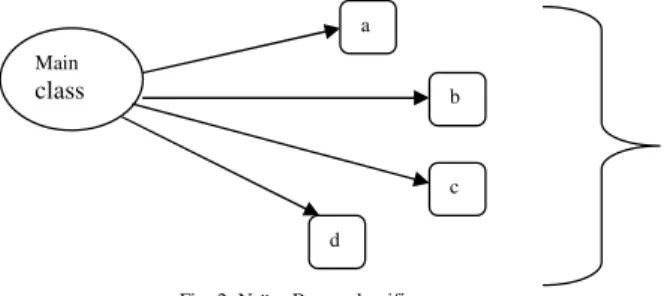
A Naive Bayes classifier is a simple classifier based on applying Bayesien theorem with strong and weak independence assumption. In the simplest way a Naive Bayes classifier assumes that the presence or absence of a particular feature of a class has not any relation with the presence or absence of any other features given in the same class variable. A Naïve-Bays ML algorithm has a simple structure show in fig.2 in which the class node is the parent node of all other nodes. A basic structure of Naïve Bayes Classifier fig. 3 in which one node class represents main class and others are like a, b, c and d represents other features or attribute nodes of a particular sample. There is no structure learning procedure is required in naïve bayes classifier so it is very easy to construct as compare to other classifiers
f
f
f
Output layer a1 a2 a3Fig. 2 Naïve Bayes classifier
In 2013 Jun Zhang et al. [3] uses classify internet traffic by Aggregating Correlated Naive Bayes Prediction and get high accuracy with this approach. They proposed new (bag-of-flow) BoF-based traffic classification technique is to aggregate the Naive Bayes (NB) predictions of the correlated flow. They proposed a new approach of classification to utilize the information among the correlated traffic flows produced by the traffic. In the approach of classification there are two steps, in a first step the single naïve Bayes predictor generates the posteriori class-conditional probabilities or each flow and in a second step the aggregated predictor aggregates the flow predictions to determine the final class for BoFs. In 2012 Hamza Awad Hamza Ibrahim et al [8] this paper compared classification accuracy of ten (ZeroR, PART, DecisionStump, J48, J48graft, LADTree, NBTree, Random Forest, RandomTree and REPTree) machine learning algorithm to classifies real time interactive applications such as Online TV and Skype, they capture internet traffic using Wireshark after that select the features from traffic flow like (packet length, packet header etc.) for reducing training time and increase processing efficiency. RandomForest provided the best result as compare to all other algorithms, it gives 99.8% classification accuracy and DecisionStump provide lowest training time is 0.05 seconds but they uses less number of data samples. In 2011, Yu Wang et al. [15] uses A Token-based Approach to classify internet traffic using machine learning. In this the whole process divided into two stages, first stage is offline training and second stage is online classifies. The features are extracted from the packet payload instead of flow statistics. Every flow is represented by a feature vector, in which each item indicates the occurrence of a particular token, i.e., a common substring and then ML algorithm is applied. Author reported that this gives very good result.
3.1.4. C4.5 Decision tree classifier
C4.5 is a popular decision tree Machine Learning algorithm used to develop Univariate decision tree. C4.5 is an enhancement of Iterative Dichotomiser 3 (ID3) algorithm which is used to find simple decision trees. C4.5 is also called a Statistical Classifier because of its good ability of classification. C4.5 makes decision trees from a set of training data samples, with the help of information entropy concept. The training data set contains of a greater number of training samples which are characterized by different attributes and it also consists of the target class. C4.5 selects a particular attribute of the data at each node of the tree which is used to split its set of data samples into subsets in one or another class. It is based on the criterion of normalized information gain that is obtained by selecting an attribute for splitting the data. The attribute with the highest normalized information gain is chosen and made a decision. After that, the C4.5 algorithm repeats the same action on the smaller subsets. C4.5 has made various improvements to ID3 like it can handle both continuous attributes and discrete attributes, it can handle training data with missing attribute values, it can also handle attributes with differing costs etc. In 2012 Dong Shi et al. [9] they used to classify and identify the network with both supervised and unsupervised learning techniques. They use two types of dataset full features based and optimized features based. Here experiment result shows that the supervised ML algorithms give better result with feature reduction algorithms as compare to unsupervised ML algorithms. Simulation result concludes 99% classification accuracy with C4.5 algorithm. In 2011 LiTing hu et al. [11] presents a machine learning approach for real time internet traffic classification. They use C4.5 decision tree Machine learning algorithm as a classifier and they also used FCBF (Fast Correlation Based Filter) algorithm to reduce the redundant features and increase processing efficiency. Performance matrices used for both i.e. classification accuracy and classification cost (time cost). They use traffic flow statistics for testing, this approach gives us high classification accuracy. Author reported 92.38% classification accuracy with testing time 1412 seconds. In 2011 Kuldeep Singh et al. [12] they use five machine learning algorithm (MLP, RBF, C4.5, Bayes Net, Naïve Bayes) as classifier to classify the real time internet traffic classification along with using different feature selection algorithms which are Correlation based FS, Consistency based FS and Principal Components Analysis based FS algorithms. In this the correlation based FS is used to identify and remove redundant and irrelevant features as possible. It uses an evaluation procedure that examines the usefulness of individual feature along with the level of inter-correlation among the features. The consistency based FS is used to evaluate the subset of features simultaneously and select optimal subset. The Principal Components Analysis (PCA) based FS maps the data points from a high dimensional space to a low dimensional space while keeping all the relevant linear structure unchanged. In this paper C4.5 ML algorithm gives the best result in all above it gives over 90% classification accuracy. In 2009 Abuagla Babiker Mohammed et al. [17] an online near real time flow-based internet traffic classification [NOFITC]. is proposed here C4.5 machine learning algorithm as a classifier and the above mentioned open source code consist of two section, the first section work for offline classification using C4.5 and the second one is work in an interactive mode. In this they modified the algorithm and add some new functionality to work algorithm for online classification. The main difference between this approach and the previous approach of classification is that the Net Flow collection filter, pre-processing and classification
Main class a b c d
are done in an online manner rather than offline manner, author reported 3.5 % errors on an average.
3.1.5. Radial Basis Function Neural Network
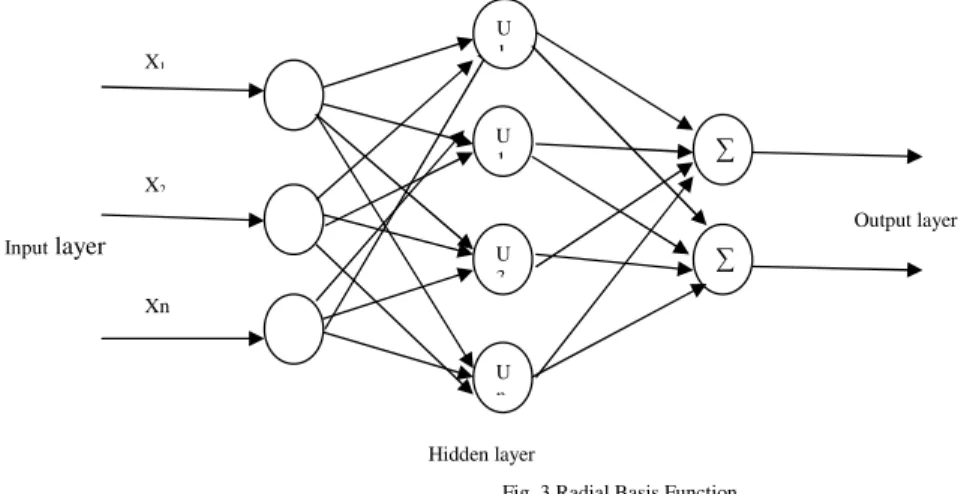
Radial basis function (RBF) networks have three layers architecture: an input layer, a hidden layer with a non-linear RBF function it an activation function and a linear output layer. Radial Basis Function (RBF) is a multilayer feed forward artificial neural network which uses radial basis functions at each hidden layer neuron. The output gain of this RBF neural network is a weighted linear superposition of all these basis functions. The basic model of RBF neural network is shown in Fig. 3. In this network, weights for input-hidden layer interconnections are fixed, while the weights for hidden-output layer interconnections are trainable. Following input - output mapping function 1 as:
Y(X) = Wi U (ŒX - XiŒ)
(1) Where,
U () basis function of hidden layer whish is applied at each neuron of hidden layer, M basis functions consisting of the Euclidean distance between applied inputs X, Y(x) output mapping function.
Fig. 3 Radial Basis Function
In 2013 Mussab M. Hassan et al. [5] uses hybrid statistical traffic classifier to classify the P2P (peer to peer) traffic. Here also the works in two steps, firstly offline heuristics learning corpus generation and second is online statistical classification, In this first part, Heuristic classify the traffic flow and second part machine learning algorithm are used to classify network traffic. They apply 64 ML algorithms to classify traffic and find that RBF ML algorithms give good result. In 2010 Murat Soysal et al. [16] compare and evaluate of machine learning algorithms to classify the flow based network and they find that supervised machine learning algorithm gives the best result in traffic classification as compare to unsupervised machine learning algorithms.
3.2. Unsupervised (Clustering) Methods
Clustering is an unsupervised machine learning approach, in which produces cluster samples according to the similarity of flow feature values. It does not have the training phase like supervised machine learning methods. Clustering focuses on finding patterns in the input data. The main objective of clustering is to group the packets that have similar patterns. In clustering instances having similar properties can be put into the same group. There are three conditions are made when grouping the packets, which are as follows:
• If group is exclusive then packets can be put into a single group.
• If packets having the properties of multiple groups then packets can be put into many groups.
• If the group can be probabilistic then the packet can belong to a group with a fixed probability.
3.2.1 DBSCAN based Approach
DBSCAN (Density-based spatial clustering of applications with noise) is a data clustering algorithm. It is a density based clustering algorithm, it finds the number of clusters starting from the estimated density distribution of the corresponding nodes. There are two input parameters here, first is epsilon (Eps) and second is minimum number of points (minPts). Epsilon (Eps) is the space around a particular point object that is used to determine its Eps-neighborhood for a given point p and minPts is the minimum number of points within its eps-neighborhood. The concept of DBSCAN based on two parameter density-reachablity and density-connectivity, which formed the clusters in DBSCAN algorithm. Density-reachablity, a point p is density reachable
Inputlayer U n U 3 U 1 U 1 Yu X1 X2 Xn Hidden layer Output layer
from a point q in respect of Eps and minPts if there is a all points like p1,p2,p3…….pn are reachable from point q i.e. p1=q, p2=q……pn=q is called density reachablity. Density-connected, a point p is density connected to a point q if both points are density reachable from an object point o. In 2013 Shezad Shaikh et al. [4] they classify network flows using DBSCAN algorithm. In this proposed method, they performed two operations first is clustering and the second is classification. In clustering, the large dataset is divided into small sets of similar data. These small sets are called clusters. They use the available labeled flows to obtain a mapping from the clusters to the different known classes the result. In this method they reported higher percentage of overall classification accuracy In 2009 Caihong Yang et al. [19] apply an unsupervised machine approach for internet traffic classification based on DBSCAN algorithm. They considered two classification matrices first one is overall accuracy and the second one precision. They analyze that, the overall accuracy of classification increases with high number of minPts and value of Esp is greater than or equal to 0.03 and precision value also decreases with high value of Esp. DBSCAN algorithm has more potential compare then other clustering techniques because of minimal requirements of domain knowledge to determine the input parameters: eps and minPts. It can also discover clusters with arbitrary shape and produce the better clusters compare than other. In this research, they got 87% overall classification accuracy.
3.2.2. Expectation Maximization based (Autoclass) Approach
It is an iterative method for looking maximizes likelihood parameters and produces clusters. There are mainly two steps in expectation maximization method, first is Expectation step and the second one is Maximization step. In first step estimate that what parameter is using random numbers and in a second step the uses mean and variance to re-estimate the parameter, this process continuously proceeds till then they reached with a local maximize and this process is repeated. In 2006 Jeffrey Erman and Anirban et al. [22] applied expectation maximization (EM) based clustering algorithms for internet traffic classification and also classify the internet traffic by using a naïve Bayes classification approach and comparative study of results shows that EM approach give better result as compare to naïve Bayes. The comparative results show that 91% classification accuracy.
3.2.3. K-Means based Approach
K-Means clustering algorithm is a partitioned-based algorithm; it partitioned objects of a dataset into K disjoint subsets. It maximize the homogeneity of the cluster and minimize the square-error where square-error calculated as the distance between each object and the center or mean of a cluster. The centers of K cluster are initially chosen randomly and after that dataset partitioned into nearest cluster. K-Means iteratively computes new centers and clusters respectively and this process continues until the clusters are stabilized. In 2006 Jeffery Erman et al. [23] uses two machine learning algorithms (K-Mean and DBSCAN) to classify the internet traffic. For traffic classification on a publicly available dataset of Auckland university. Performance of both algorithms compared with Autoclass (EM) algorithm and they find that K-Means and DBSCAN algorithms perform well as compared to EM algorithm, result reported that with K-Means clustering algorithm gives 85% classification accuracy
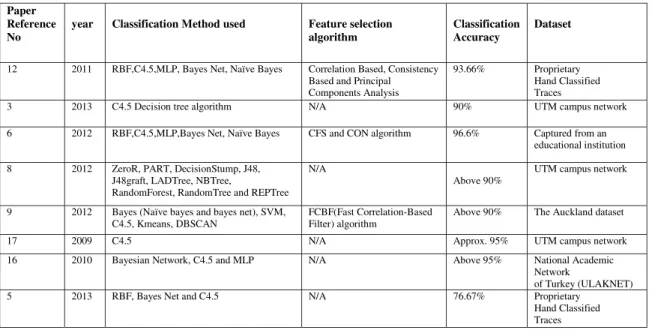
Table 1. Performance of various methods
Paper Reference No
year Classification Method used Feature selection algorithm
Classification Accuracy
Dataset
12 2011 RBF,C4.5,MLP, Bayes Net, Naïve Bayes Correlation Based, Consistency Based and Principal Components Analysis
93.66% Proprietary Hand Classified Traces
3 2013 C4.5 Decision tree algorithm N/A 90% UTM campus network
6 2012 RBF,C4.5,MLP,Bayes Net, Naïve Bayes CFS and CON algorithm 96.6% Captured from an educational institution 8 2012 ZeroR, PART, DecisionStump, J48,
J48graft, LADTree, NBTree,
RandomForest, RandomTree and REPTree
N/A Above 90%
UTM campus network
9 2012 Bayes (Naïve bayes and bayes net), SVM, C4.5, Kmeans, DBSCAN
FCBF(Fast Correlation-Based Filter) algorithm
Above 90% The Auckland dataset
17 2009 C4.5 N/A Approx. 95% UTM campus network
16 2010 Bayesian Network, C4.5 and MLP N/A Above 95% National Academic Network
of Turkey (ULAKNET)
5 2013 RBF, Bayes Net and C4.5 N/A 76.67% Proprietary
Hand Classified Traces
Table 2. Advantages and Disadvantages of Different types of Approaches
4. Conclusion
This survey paper presents recent advancement on internet traffic classification based on machine learning techniques. Previous researchers work done in this area shows the superiority of machine learning techniques over traditional techniques for internet traffic classification. Machine learning not only overcome the problems of traditional techniques but also improves its efficiency in this domain. Although many supervised and unsupervised machine learning techniques had been applied till now, still than is lots of scope to improve the accuracy and processing speed with the increase in the size of dataset. So in future research may progress in this direction.
15 2011 Naïve Bayes, MLP, C4.5 AdaBoost Above 90% Chinese educational site on the Internet 2 2013 MLP,RBF,C4.5,Bayes Net and Naïve
Bayes
Correlation based Feature Selection algorithm and Consistency based Feature selection algorithm
91.87% Proprietary Hand Classified Traces
11 2012 C4.5 Decision Tree FCBF(Fast Correlation-Based Filter) Algorithm
95.21% Captured at Ohio
University 14 2011 Feed-forward Neural Network FCBF(Fast Correlation-Based
Filter) Algorithm
95% Proprietary Hand Classified Traces
21 2007 Bayesian trained neiral network N/A 95% Captured at Genome
campus
23 2006 K-Means and DBSCAN N/A 80% Data traces at University
of Auckland
22 2006 EM Algorithms N\A 90% Data traces at University
of Auckland
19 2009 DBSCAN N\A 87% NSL-KDD dataset
Classification Method
Advantage Disadvantage Unsupervised ML techniques
DBSCAN
clustering
• Can handle clusters of different shapes and sizes.
• Minimal Knowledge requirement to determine input parameter.
• Work well with large datasets
• DBSCAN cannot cluster data sets well with large differences in densities.
• DBSCAN is not entirely deterministic.
K-Means based clustering
• Working process is fast.
• It is robust and easier to understand.
• It does not work well with clusters of Different size and Different density.
• Difficult to predict K-Value. Expected
Maximization • It is fastest algorithm for learning. • EM algorithm needs to be repeated several times. Supervised ML Techniques
Naïve bayes classifier
• Easy to implement.
• We are getting good results in most of the cases.
• Assumption of class conditional independence.
• Dependencies among classes cannot be modeled by Naive Bayesian Classifier.
C4.5 and C5.0
• Easy to implement
• We Can use it with both values categorical and continuous
• It can Deal with noise
• Small variation in data can lead to different decision trees.
• Does not work very well on a small training set RBF
• We use enough number of nodes to find high accuracy.
• Simple layer structure.
• Training time is very long and it increases when we increase the numbers of node.
•
5. References
1. Yibo Xue and et al. Traffic Classification: Issues and Challenges; International conference on computing, networking and communication (ICNC); IEEE, 2013; p. 545-549.
2. Kuldeep Singh and et al. A Near Real-time IP Traffic Classification Using Machine Learning; International Journal of Intelligent Systems and Applications(IJISA); 2013;vol. 5; p 83-93.
3. Jun Zhang and et al. Internet Traffic Classification by Aggregating Correlated Naive Bayes Predictions; IEEE transactions on information forensics and security; vol. 8,;2013;p. 5-15.
4. Shezad Shaikh1and et al. Implementation of DBSCAN Algorithm for Internet Traffic Classification; International Journal of Computer Science and Information Technology Research (IJCSITR); 2013; p. 25-32.
5. Mussab M. Hassan and Muhammad N. Marsono. A Hybrid Heuristics-Statistical Peer-to-peer Traffic Classifier; International conference on computer system and industrial information (ICCSII); 2013; IEEE; p. 1-6.
6. Jaspreet Kaur and et al. Internet Traffic Classification for Education Institutions Using Machine Learning; International Journal of Intelligent Systems and Applications (IJISA); 2012; MECS; vol. 4; p. 37-45.
7. S. Agrawal and et al. Machine Learning Classifier for Internet Traffic from Academic Perspective; International Conference on Recent Advances and Future Trends in Information Technology (RAFIT); 2012; IJCA; p. 4-9.
8. Hamza Awad Hamza and et al. Taxonomy of Machine Learning Algorithms to classify realtime Interactive applications; International Journal of Computer Networks and Wireless Communications (IJCNWC); 2012; IRACST; p. 69-73.
9. DONG Shi and et al. The Study of Network Traffic Identification Based on Machine Learning Algorithm; Fourth International Conference on Computational Intelligence and Communication Networks; 2012; IEEE; p. 205-208.
10. Bin Hu and Yi Shen. Machine Learning Based Network Traffic Classification: A survey; Journal of Information & Computational Science; 2012; p. 3161-3170.
11. LiTing Hu and LiJun Zhang. Real-time Internet Traffic Identification Based on Decision Tree; World Automation Congress (WAC); 2012; IEEE; p. 1-3. 12. Kuldeep Singh and S. Agrawal. Performance Evaluation of Five Machine Learning Algorithms and Three Feature Selection Algorithms for IP Traffic
Classification; Evolution in Networks and Computer Communication; ; IJCA; 2011; p. 25-32. 13. IANA, http://www.iana.org/assignments/port-numbers (as of May 2011).
14. Wengang Zhou and et al. Internet Traffic Classification Using Feed-forward Neural Network; International Conference on Computational Problem-Solving (ICCP); 2011; IEEE; p. 641-646.
15. Yu Wang and et al. Internet Traffic Classification Using Machine Learning: A Token-based Approach; Fourteenth International Conference on Computational Science and Engineering (CSE); 2011;IEEE; p. 285-289.
16. Murat Soysal and Ece Guran Schmidt. Machine learning algorithms for accurate flow-based network traffic classification: Evaluation and comparison; ELSEVIER; 2010; vol. 67; p. 451-467.
17. Abuagla Babiker and et al. Near Real Time Online Flow-based Internet Traffic Classification Using Machine Learning (C4.5); International journal of engineering (IJE); 2009; vol. 3; p. 370-379.
18. Yu Liu. A Survey of Machine Learning Based Packet Classification; Symposium on Computational Intelligence for Security and Defense Applications(CISDA),;2009;IEEE.
19. Caihong Yang and et al. Internet Traffic Classification Using DBSCAN; WASE International Conference on Information Engineering (ICIE); IEEE; 2009; p. 163-166.
20. Thuy T.T. Nguyen and Grenville Armitage. A survey of Techniques for Internet traffic classification using Machine Learning; Communications Surveys & Tutorials;IEEE; 2008;vol. 10; p. 56-76.
21. Tom Auld and Andrew W. Moore. Bayesian Neural Networks for Internet Traffic Classification; IEEE Transactions on Neural Networks; IEEE; 2007;vol. 18; p. 223-239.
22. Jeffrey Erman and et al. Internet Traffic Identification using Machine Learning; Global Telecommunications Conference(GLOBECOM);IEEE; 2006; p. 1-6. 23. Jeffrey Erman and et al. Traffic Classification Using Clustering Algorithms; SIGCOMM workshop on Mining network data;ACM 2006; p.281-286