Project management manual
manual number: SM011
© NZ Transport Agency
First edition, effective from July 2010 ISBN 978-0-478-36434-7 (print) ISBN 978-0-478-36435-4 (online)
Material in it may be reproduced for personal or in-house use without formal permission or charge, provided suitable acknowledgement is made to this publication and the NZ Transport Agency (NZTA) as the source. Requests and enquiries about the reproduction of material in this publication for any other purpose should be made to: NZ Transport Agency
Private Bag 6995 Wellington 6141
The permission to reproduce material in this publication does not extend to any material for which the copyright is identified as being held by a third party. Authorisation to reproduce material belonging to a third party must be obtained from the copyright holder(s) concerned. Disclaimer
The NZTA has endeavoured to ensure material in this document is technically accurate and reflects legal requirements. However, the document does not override governing legislation. The NZTA does not accept liability for any consequences arising from the use of this document. If the user of this document is unsure whether the material is correct, they should make direct reference to the relevant legislation and contact the NZTA.
More information Published 2010
ISBN 978-0-478-36434-7 (print) ISBN 978-0-478-36435-4 (online)
If you have further queries, call our contact centre on 0800 699 000 or write to us:
NZ Transport Agency Private Bag 6995 Wellington 6141
This publication is available on the NZTA’s website at
Foreword
The NZ Transport Agency (NZTA) is charged with contributing to an affordable, integrated, safe, responsive and sustainable land transport system. We work in partnership with regional and local authorities, the New Zealand Police, the transport industry and communities to achieve this.
Within the NZTA the Highways and Network Operations group is responsible for developing state highway projects based on thorough analysis and, where appropriate, extensive consultation to ensure they can be implemented cost effectively while delivering immediate and long-term gains to road users and the economy as a whole.
Good project management is a key to ensuring that projects are managed effectively, to a high standard and deliver expected results. The NZTA does not undertake work in house and contracts out many aspects of its work. Project management is a key element of ensuring that projects are delivered on budget and on time to make sure that customers get the benefits that the transport project delivers as soon as possible.
This Project management manual covers all aspects of project management from feasibility to project completion and aims to guide project managers that are new to the organisation and act as a reference document for more experienced project managers. The guide is critical to ensuring there is consistency among our approach to undertaking projects and that the projects we undertake are successful.
I encourage the use of this manual by all project managers and people wanting to gain a better understanding about the elements of good project management. We welcome suggestions from NZTA staff on how the Project management manual
can be improved to ensure that it continues to meet the needs of all NZTA staff to deliver successful projects for our customers.
Document management plan
1) Purpose
This management plan outlines the updating procedures and contact points for the document.
2) Document information
Document name Project management manual
Document number SM011
Document availability This document is located in electronic form on the NZ Transport Agency’s website at
Document owner Emer Beatson
Document sponsor Kevin Doherty
3) Amendments and review strategy
All corrective action/improvement requests (CAIRs) suggesting changes will be acknowledged by the document owner.
Comments Frequency
Amendments (minor revisions)
Updates incorporated immediately they occur. As required.
Review (major revisions)
Amendments fundamentally changing the content or structure of the document will be incorporated as soon as practicable. They may require coordinating with the review team timetable.
At least annually.
Notification All users that have registered their interest by email to [email protected] will be
advised by email of amendments and updates.
Immediately.
4) Other information (at document owner’s discretion)
There will be occasions, depending on the subject matter, when amendments will need to be worked through by the Review team before the amendment is actioned. This may cause some variations to the above noted time frames.
5) Distribution of this management plan
Record of amendments
Amendment number
Process owners
The following post holders are responsible for the accuracy, review and periodic updating of the individual processes which constitute the Project management manual.
No Process Owner Name Date
1.1 Establishment Chief Advisor Engineering Services Peter Spies July 2010
1.2 Resources Chief Advisor Engineering Services Peter Spies July 2010
2.1 Scope definition Manager Network Optimisation Graham Taylor July 2010
2.2 Consultation Land Use and Transport Integration Manager Dougal List July 2010
2.3 Environmental and social Development Services Manager Carl Reller July 2010
24 Resource management Land Use and Transport Integration Manager Dougal List July 2010
2.5 Integrated planning/TDM Integrated Planning Manager David SIlvester July 2010
2.6 Scope verification Development Services Manager Carl Reller July 2010
2.7 Scope control Manager Network Optimisation Graham Taylor July 2010
3.1 Risk Assurance and Compliance Manager Garry Butler July 2010
4.1 Cost estimation Project Services Manager Richard Quinn July 2010
4.2 Funding Programming Manager Cate Quinn July 2010
5.1 Programming for time Programming Manager Cate Quinn July 2010
6.1 Quality Project Services Manager Richard Quinn July 2010
6.2 Value engineering Project Services Manager Richard Quinn July 2010
6.3 Network operations review Operations Manager Dave Bates July 2010
6.4 Peer reviews Project Services Manager Richard Quinn July 2010
6.5 Road safety audit and inspection Traffic and Safety Manager Fabian Marsh July 2010
7.1 Documentation Project Services Manager Richard Quinn July 2010
8.1 Property management National Property Manager Malcolm Watson July 2010
8.2 Procurement Project Services Manager Richard Quinn July 2010
8.3 Tendering Project Services Manager Richard Quinn July 2010
9.1 Contract management Chief Advisor Engineering Services Peter Spies July 2010
9.2 Communication Senior Communications Advisor Janice McDougall July 2010
9.3 Contract administration Project Services Manager Richard Quinn July 2010
9.4 Financial management PROMAN Team Leader Jenni Horton July 2010
9.5 Change control Project Services Manager Richard Quinn July 2010
9.6 Cost control Chief Advisor Engineering Services Peter Spies July 2010
9.7 Disputes resolution Chief Advisor Engineering Services Peter Spies July 2010
9.8 Supplier performance Project Support Team Leader Ursula Cardiff July 2010
10.1 Project close-out Operations Manager Dave Bates July 2010
Review process
Each process owner is entitled to instigate a review of their process at any time. However, on an annual basis the manual owner will request that each process owner confirms the current validity of their process. Any changes that are required and signed off by the process owner will be updated on the intranet and issued to all controlled copy holders.
Should it be deemed by the manual owner that the manual requires a more thorough overhaul, then the SM011 Steering Group can be recalled to manage the change process or advise on points of discussion.
Abbreviations
ACENZ Association of Consulting Engineers New Zealand
AEE Assessment of environmental effects
AMP Asset management plan
ARRB Australian Road Research Board
ATMS Advanced Traffic Management System
Austroads Association of Australasian Roading Authorities
BCR Benefit cost ratio
BUDMT Business Unit Decision-Making team
CAS Crash analysis system (accident information)
CCCS Conditions of contract for consultancy services
CE Cost estimate
CMR Cost management review
CoPTTM Code of practice for temporary traffic management (SP/M/010)
CPI Consumer price index
CPP Competitive pricing procedures
CSvue monitoring system The NZ Transport Agency consent database management tool.
CQP Consultants/Contractors quality plan
DC Design – construct
DE Design estimate
DLP Defects liability period
D&PD Design and project documentation
ECI Early contractor involvement
EIA Environmental impact assessment
EOY End of year
EVM Earned value management
FAP Funding allocation process
FE Feasibility estimate
FMIS Financial Management Information System
GIS Geographical Information System
GL code General ledger code
GPS Government Policy Statement
HHA Heavy Haulage Association
HNO Highways and Network Operations group
HOV High occupancy vehicle
I&R Investigation and reporting
IFT Information for tenderers
IPA Independent professional advisor
IPENZ Institute of Professional Engineers New Zealand
ISO International Standards Organisation
KPI Key performance indicator
KRA Key result area
LAR Limited access road
LGA Local Government Act
LINZ Land Information New Zealand
LLR Lessons learned review
LRS Location reference system
LTCCP Long-Term Council Community Plan
LTMA Land Transport Management Act 2003
LTP online Land Transport Programme Online
LTPS Long-term Procurement Strategy
MSQA Management, surveillance and quality assurance
MOU Memorandum of understanding
M&V Measure and value (contract type)
NLTP National Land Transport Programme
NoR Notice of requirement (for designation)
NTC Notice to contractor
NTE Notice to engineer
NTT Notice to tenderer
NZTA NZ Transport Agency
OE Option estimate
PACE Performance assessment by coordinated evaluation
PADS Property Acquisition and Disposal System
PAG Project Advisory group
PE Pre-design estimate
PET Proposal Evaluation team
PFR Project feasibility report
PS Professional services
PSMC Performance-specified maintenance contract
PT Passenger transport
PW Physical works
QA Quality assurance
RAMM Road Assessment Maintenance and Management System
RAP Risk-adjusted programme
RCA Road controlling authority
RFT Request for tender
RFP Request for proposal
RMA Resource Management Act 1991
ROI Registration of interest
RoNS Roads of national significance
RP&P Regional Partnerships and Planning group
RSA Road safety audit
RTC Regional Transport Committee
SAR Scheme assessment report
SE Scheme estimate
SEA Social and environmental assessment
SES Social and environmental screens
SH State highway
SHM State highway manager
SHPRC State Highway Programme Review Committee
SIA Statement of intent and ability
STMS Site traffic management supervisor
TDM Travel demand management
TET Tender Evaluation team
TLA Territorial local authority
TMC Traffic management coordinator
TMP Traffic management plan
TTM Temporary traffic management
UDP Urban Design Protocol
USP Utility service provider
VAC Value Assurance Committee
VFM Value for money
VPD Vehicles per day
W&C Walking and cycling
Table of contents
Foreword i
Document management plan ii
Record of amendments iii
Process owners iv
Review process v
Abbreviations vi
Table of contents x
How to use this manual xiii
Introduction xiv
Flow charts xv
Project development life cycle xvi
Process xvii Part 1 – Checklist 1 Feasibility 2 Investigation 9 Design 18 Construction 26 Process Part 2 - Processes Part 3 - Forms and examples Part 4 - Guidelines 1. Establishment 1.1 Establishment 37 150 234 1.2 Resources 41 153 251 2. Development 2.1 Scope definition 46 154 254 2.2 Consultation 47 158 258
Process Part 2 - Processes Part 3 - Forms and examples Part 4 - Guidelines 2.4 Resource management 51 160 261 2.5 Integrated planning/travel demand management 54 161 262 2.6 Scope verification 63 162 263 2.7 Scope control 67 167 264 3. Risk 3.1 Risk 69 168 265 4. Cost 4.1 Cost estimation 71 169 278 4.2 Funding 72 170 285 5. Time
5.1 Programming for time 77 175 291
6. Quality
6.1 Quality 80 176 304
6.2 Value engineering 85 177 306
6.3 Network operations review 86 178 312
6.4 Peer reviews 91 188 321
6.5 Road safety audit and inspection 100 192 326
7. Documentation 7.1 Documentation 108 204 327 8. Procurement 8.1 Property management 110 205 345 8.2 Procurement 114 206 353 8.3 Tendering 115 207 359 9. Project control 9.1 Contract management 116 208 361
Process Part 2 - Processes Part 3 - Forms and examples Part 4 - Guidelines 9.2 Communication 123 209 369 9.3 Contract administration 125 210 370 9.4 Financial management 127 214 376 9.5 Change control 132 215 382 9.6 Cost control 136 219 386 9.7 Disputes resolution 140 220 396 9.8 Supplier performance 142 222 398 10. Close-out 10.1 Project close-out 143 223 400 10.2 Contract close-out 147 229 403
How to use this manual
Manual
structure
This manual is in four parts and is designed for ease of use by both new and experienced project managers. Experienced project managers, once familiar with the content, should only need to reference part 1 of the manual. However, the rest of the manual contains more detailed information.Part 1 of the manual is purely a checklist of what needs to be done for each of the four phases of a typical project:
feasibility
investigation
design, and
construction.
The remaining three parts of the manual are broken down into 32 processes, each of which describe what needs to be done, or indicate where information can be found, in order to satisfy the checklist in part 1.
Part 2 of the manual tells the project manager what has to be done in order to manage a compliant project.
Part 3 of the manual contains forms (and examples of forms), which project managers will need to complete to achieve the requirements described in part 2.
Introduction
The Project management manual (the manual) is for all NZ Transport Agency (NZTA) project managers to use to deliver their projects on time, to budget and to the required standard.
This manual does not attempt to guide the project managers on general project management principles. Nor does it repeat details of the various processes which are documented in other NZTA’s manuals (see Standards and guidelines manual (SM/P/21)). It is intended to provide guidance for users on where to find details of the various processes they are expected to follow for all sizes and procurement methods.
The manual sets out guidance on project management practice that is specific to the NZTA business and which has been developed over recent years by various NZTA project managers. This guidance attempts to document lessons learnt as we have developed and delivered projects and to provide advice on the best way to progress through various mandatory processes while avoiding pitfalls along the way. Any steps avoided should be clearly documented in the project plan, particularly for smaller projects.
International best practice Austroads / Project Management Institute A guide to the project management body of knowledge
Cost estimation
manual
(SM014)
Project management manual (SM011)
Contract procedure manual (SM021) State highway professional services contract proforma manual (SM030) PROMAN manual (SM042) Procurement manual Quality management system manual (AC/Man/1), State highway maintenance contract proforma manual (SM032), etc
Context
This manual should be read in conjunction with the Austroads’ Guide to project delivery
developed by an Austroads’ committee in 2007 which included the NZTA representation. This guide sets out in detail general project management practices and processes relevant to the development and delivery of roading projects.
Flow charts
Project
development
flow chart
The flow chart broadly illustrates the four life cycle stages in the development and implementation of a project, together with the compilation and prioritisation of the overall programme. The flow chart is not conclusive, representing those key activities and outputs which comprise that stage of a projects life cycle. While the life cycle stages from feasibility, investigation, design and construction are generally consecutive, the programme
development activities are undertaken on an annual basis and provide the forward outlook (programme/plan) for all remaining stages of any one project.
Process flow
chart
The flow chart provides an overview of when each of the manual processes applies as a project progresses through the life cycle phases. As illustrated, some processes will have definitive periods of application within a phase (eg Establishment and Contract close-out), others will only have intermittent application (eg Network operations review and Supplier performance), and some which have continuous application throughout the entire project (eg Quality).Process
Number Process Feasibility Investigation Design Construction
1.1 Establishment
1.2 Resources
2.1 Scope definition
2.2 Consultation
2.3 Environmental and social
2.4 Resource management 2.5 Integrated planning/TDM 2.6 Scope verification 2.7 Scope control 3.1 Risk 4.1 Cost estimation 4.2 Funding
5.1 Programming for time
6.1 Quality
6.2 Value engineering 6.3 Network operations review
6.4 Peer reviews
6.5 Road safety audit and inspection
7.1 Documentation 8.1 Property management 8.2 Procurement 8.3 Tendering 9.1 Contract management 9.2 Communication 9.3 Contract administration 9.4 Financial management 9.5 Change control 9.6 Cost control 9.7 Dispute resolution 9.8 Supplier performance 10.1 Project close-out 10.2 Contract close-out
Part 1 – Checklist
Feasibility 2 Investigation 9 Design 18 Construction 26 Process PageFeasibility
Investigation
1.1Design
Construction
Feasibility
1. Establishment1.1 Establishment Recognise problem, need or opportunity.
Formulate goal and objectives.
Prepare project charter.
Obtain project number.
Prepare project plan.
Sponsor’s approval of project plan.
Setup project file.
Option assessment.
Prepare feasibility estimate order of magnitude costs and benefits.
Identify assumptions and constraints.
Prepare business case (project feasibility report).
Appoint project manager.
1.2 Resources Plan resources for feasibility phase.
Appoint resources for feasibility phase.
Manage team during feasibility phase.
Plan resources for investigation, design and construction phases.
Prepare project handover report.
FEASIBILITY
Feasibility
Investigation
1.1Design
Construction
2. Development2.1 Scope definition Confirm problem and/or opportunity.
Determine/confirm project objectives.
2.2 Consultation Consultation with the NZ Transport Agency (NZTA) and strategic partners.
Review consultant's consultation strategy.
Review consultant’s preliminary statement of identified Māori interest.
Consultation with Tāngata Whenua.
2.3 Environmental and social
Prepare professional services form (PSF) 13 Social and environmental management (PSF/13) provided in the NZTA’s State highway professional services contract proforma manual (SM030) appendix 4. 2.
Prepare PSF 2a Checklist for statutory approvals, consents and agreements (PSF/2a) provided in SM030 appendix 4.2.
2.4 Resource management
Review project feasibility report for scoping of potential statutory approvals.
Document the strategic context.
Contact regional integrated planning manager, regional transportation planning manager, environmental management specialist and urban design specialist.
Complete land use assessment report.
Complete urban design assessment report.
Complete environmental management assessment report.
Complete public transport assessment report.
Complete walking assessment report. 2.5 Integrated
planning/travel demand management
Complete cycling assessment report.
2.6 Scope verification Submit final strategic study/ feasibility report.
Air quality assessment.
Cycling, walking, public transport and land use impact assessment report.
Obtain feasibility report sign-off.
2.7 Scope control Review project scope.
Define scope change.
Analyse impacts.
Feasibility
Investigation
1.1Design
Construction
3. Risk
3.1 Risk Develop activity risk file (risk register and treatment plan).
Identify major risks and opportunities for the project.
Review risk assessment.
4. Cost
4.1 Cost estimation Prepare feasibility estimate.
Review estimate (peer review or parallel estimate).
4.2 Funding State highway strategy studies procedure.
5. Time
5.1 Programming for time
Develop Highways and Network Operations (HNO) ‘holistic’ programme and set baseline.
Mark up for progress monthly.
Receive and approve consultants’ detailed programme.
FEASIBILITY
Feasibility
Investigation
1.1Design
Construction
6. Quality6.1 Quality Define quality reviews and approvals timing.
Review and accept supplier quality plans.
Review project outputs for fitness of purpose.
Formally review each supplier’s quality system.
Obtain required formal approvals.
Carry out quality inspections and/or audits of completed outputs.
Keep appropriate records.
6.2 Value engineering Not applicable.
Agree with Operations team which project feasibility reports (PFR’s) are worth doing.
Jointly review with Operations team all completed PFR’s.
Agree with Operations team which PFR’s should be developed as projects. 6.3 Network
operations review
Ensure that all PFR’s consider maintenance requirements.
6.4 Peer reviews Carry out review of professional services contract documents for strategy studies.
Carry out conceptual review.
Carry out cost review.
Carry out economic evaluation review.
Carry out review of professional services contract documents.
Carryout initial project review for strategic studies.
Commission feasibility/Concept road safety audit (RSA). 6.5 Road safety audit
and inspection
Complete decision-tracking form.
Apply for departure approval.
7. Documentation
7.1 Documentation Prepare professional services contract documentation.
Feasibility
Investigation
1.1Design
Construction
8. Procurement
Consider cost and social/environmental/cultural implications of scheme(s) on owners and neighbours. 8.1 Property
management
Preserve the ability to design away from significant problem properties if required.
Provide preliminary land requirement plan or schedule of properties likely to be affected.
8.2 Procurement Prepare tender documentation.
Advertise tender (or call for registration of interest)l
Evaluate (or negotiate) tender.
Contact probity auditor, if necessary.
Arrange pre-letting meeting, if necessary.
Award contract.
8.3 Tendering Ensure that the correct procedures for tendering have been followed, reference the NZTA’s Contract
procedures manual (SM021).
9. Project control
9.1 Contract management
No specific contract management responsibility.
9.2 Communication Develop a communication plan and establish a budget for strategic studies.
Discuss communication matters at strategic studies project meetings and monitor.
Complete procurement strategy.
Obtain contract number.
Complete approval to advertise.
Draft the request for tender (RFT) and consider page limits carefully.
Advertise contract (or call for registration of interest).
Provide master RFT to tenders secretary.
Tender queries.
Opening tender process.
Approvals to award.
Check appropriate insurance coverage.
PROMAN action.
Update LTP online information. 9.3 Contract
administration
FEASIBILITY
Feasibility
Investigation
1.1Design
Construction
9. Project control continued
Create project structure.
Prioritise project and request inclusion in the regional annual planning process. 9.4 Financial
management
Apply for funding for strategic studies.
Maintain a project structure.
Verify supplier invoices for payment.
Notify contingent liabilities.
Verify forecast and accrual values and provide commentary on variances on a monthly basis.
Prepare and submit funding review changes as required.
Update project status and complete year end processing requirements.
Update annual plan data.
9.5 Change control Review the professional services contract.
Establish a baseline.
Review the minimum standards Z series in SM030.
Review all requests for additional services and ensure that they are justified and beneficial.
Look at the impact of the change and perform integrated change control.
Seek approval for the proposed change.
Adjust the baseline in a timely manner.
Manage the project to the new baseline.
Monitor the results of the change.
9.6 Cost control Review the contract.
Manage actual changes.
Design good cost reports to detect potential problems.
Forecast frequently.
9.7 Dispute resolution Ensure professional services contracts include dispute resolution provisions or reference to
clause 10 Conditions of contract for consultancy services (CCCS).
Maintain regular and interactive communication with consultants/stakeholders to minimise any disputes.
Undertake dispute resolution process as required.
9.8 Supplier performance Complete interim performance evaluations.
Feasibility
Investigation
1.1Design
Construction
10. Closeout
10.1 Project close-out Completed project:
Complete final summary report.
Pass actions to asset manager.
Suspended project:
Update project plan.
Update PROMAN financials.
Closed project.
Terminated project.
Forward memo to Business Unit Decision-Making team (BUDMT).
Complete performance reviews. 10.2 Contract
close-out
Obtain all expected deliverables.
Complete final payments.
Resolve any contingent liabilities.
Notify consultants that contract is complete.
Close contract files.
INVESTIGATION
Feasibility
Investigation
1.1Desi
g
n
Construction
Investigation
1. Establishment1.1 Establishment Develop project charter (sponsor’s brief).
Appoint Highways and Network Operations (HNO) project manager and allocate internal resources.
Establish project register/document control.
Develop preliminary scope statement.
Write the project management plan.
Approve the project management plan.
1.2 Resources Appoint resources for the investigation phase.
Manage team during investigation phase.
Review design phase resources.
Prepare project handover report, if necessary.
Arrange handover, if necessary.
2. Development
2.1 Scope definition Review/analyse the outcomes from the project feasibility report (PFR).
Review/analyse the outcomes from the scoping report (large projects).
Confirm/determine project objectives.
Undertake investigation and reporting (I&R) stage.
2.2 Consultation Review and approve consultation plan.
Establish consultation project in the stakeholder relationship management system.
Review and approve statement of identified Māori interests.
Ensure agreed consultation is undertaken appropriately.
Review and approve report on the outcome of consultation undertaken.
2.3 Environmental and social
Prepare/update professional services form (PSF) 13 Social and environmental management form (PSF/13) provided in the NZ Transport Agency’s State highway professional services contract proforma manual (SM030) appendix 4. 2.
Prepare/update PSF 2a Checklist for statutory approvals, consents and agreements (PSF/2a) provided in SM030 appendix 4.2.
Feasibility
Investigation
1.1Desi
g
n
Construction
2. Development continuedObtain resource consents for drilling, etc. 2.4 Resource
management
Review and approve consenting strategy.
Review draft assessment of environmental effects (AEE) to support statutory applications (notice of requirement, resource consents).
Finalise and lodge statutory applications if included in the investigation and reporting (I&R) contract.
Meet with submitters if required.
Prepare and present proposal at hearing if required.
Assess decisions and recommendations.
Seek approval to decisions and any conditions if required.
Negotiate with appellants if required.
Consult with planning and government agency partners, local authorities, rail, public transport, freight operators and other relevant road user groups.
Complete audit report for cycling, walking, public transport and priority lane connections.
Incorporate land use impact report recommendations.
Incorporate environmental management recommendations.
Incorporate urban design recommendations. 2.5 Integrated
planning/travel demand management
Incorporate integrated traffic assessment recommendations, eg where appropriate, priority lanes and traffic management.
INVESTIGATION
Feasibility
Investigation
1.1Desi
g
n
Construction
2. Development continued2.6 Scope verification Seek approval for:
air quality assessment report
archaeological assessment
erosion and sediment control management plan
landscape plan
procurement strategy
for traffic and construction noise mitigation plan
stormwater management plan
urban design framework
vibration management plan.
Incorporation of cycling, walking, public transport, priority land recommendations into the design phase.
Mitigate against land use impact.
Obtain strategic study/scoping report/scheme assessment report approval.
2.7 Scope control Review project scope.
Define scope change.
Analyse impacts.
Obtain approval to scope change.
3. Risk
3.1 Risk Update risk register.
Develop option risks for comparison.
Feasibility
Investigation
1.1Desi
g
n
Construction
4. Cost4.1 Cost estimation Prepare and submit funding application assessment (investigation and reporting (I&R)).
Prepare and review options estimate.
Prepare and review scheme estimate.
Prepare and review pre-design estimate.
4.2 Funding Complete LTP online funding application and collate required attachments.
Obtain approval to seek funds from Business Unit Decision-Making team (BUDMT).
Lodge application in LTP online and liaise with regional partnerships and programmes (RPP) case manager.
Apply for funds in PROMAN.
5. Time
5.1 Programming for time
Develop Highways and Network Operations (HNO) ‘holistic’ programme and set baseline.
Mark up for progress monthly.
Input into HNO Programming team risk adjusted programme process for large projects.
Receive and approve consultants’ detailed programme.
Review progress against detailed programme.
6. Quality
6.1 Quality List the standards, guidelines and specifications that apply to the contract.
Establish key performance indicators to define quality standards.
Define quality reviews and approvals timing.
Review and accept supplier quality plans.
Review project outputs for fitness of purpose.
Formally review each supplier’s quality system.
Obtain required formal approvals.
Carry out quality inspections and/or audits of completed outputs.
INVESTIGATION
Feasibility
Investigation
1.1Desi
g
n
Construction
6. Quality continued6.2 Value engineering Apply value management principles prior to preparation of options.
Apply value management principles prior to preparing the scheme estimate.
Undertake value management process prior to finalising the pre-design estimate.
Agree who the Operations team representative is for the investigation and reporting (I&R) phase.
Jointly develop I&R request for tender (RFT) with Operations team representative.
Involve Operations team representative throughout development of scheme assessment report.
Involve Operations team representative in scheme approval process. 6.3 Network
operations review
Agree all consent conditions with Operations team representative.
6.4 Peer reviews Carry out:
cost review
economic evaluation review
scheme assessment review
conceptual review if required
review of professional services contract documents for design phase if applicable
initial project review.
Commission scheme assessment road safety audit (RSA). 6.5 Road safety audit
and inspection
Sign off outstanding issues.
Complete decision-tracking form.
Assess departures required.
Apply for and confirm departure approval.
Additional RSA requirements for design and construct contract:
assemble contract documents
commission scheme assessment RSA review of contract documents
incorporate results of review in contract documents
commission scheme assessment RSA review of tender submissions.
7. Documentation
7.1 Documentation Prepare professional services contract documentation. May include provision for design and
construction phases.
Feasibility
Investigation
1.1Desi
g
n
Construction
8. ProcurementMake contact with landowners. 8.1 Property
management
Obtain land entry agreement for investigation. Use compulsory purchase process if necessary.
Obtain landowners sign-off on notice of requirement.
Produce an approved land requirement plan.
Instruct senior project manager to appoint an acquisition supplier to acquire land.
Use advance purchase by negotiation for critical sites.
Assist property manager or acquisition supplier with negotiations with landowners.
Initiate compulsory purchase if necessary
8.2 Procurement Prepare tender documentation.
Advertise tender.
Evaluate (or negotiate) tender.
Award contract.
8.3 Tendering Ensure that the correct procedures for tendering have been followed, reference the NZ Transport
Agency’s Contract procedures manual (SM021).
9. Project control
Check robustness of investigation and reporting (I&R) phase contract document.
Review consultant’s contract deliverables. 9.1 Contract
management
Hold consultant to tender proposals.
Hold consultant to contract requirements.
Ensure consultant is paid on time.
Ensure consultant’s performance is monitored.
9.2 Communication Develop a communication plan and establish a budget.
INVESTIGATION
Feasibility
Investigation
1.1Desi
g
n
Construction
9. Project control continued
Complete procurement strategy.
Obtain contract number.
Complete approval to advertise.
Draft the request for tender (RFT) and consider page limits carefully.
Advertise contract.
Provide master RFT to tenders secretary.
Tender queries.
Opening tender process.
Approvals to award.
Check appropriate insurance coverage.
PROMAN action.
Review and update LTP online 9.3 Contract
administration
Approve payments.
Apply for investigation funding.
Maintain a project structure. 9.4 Financial
management
Verify supplier invoices for payment.
Notify contingent liabilities.
Verify forecast and accrual values and provide commentary on variances on a monthly basis.
Prepare and submit funding review changes as required.
Update project status and complete year end processing requirements.
Feasibility
Investigation
1.1Desi
g
n
Construction
9. Project control continued
9.5 Change control Review the professional services contract.
Establish a baseline.
Review the NZ Transport Agency (NZTA) standard professional services specification for investigation and reporting and contract management and Z series.
Review all requests for additional services and ensure that they are justified and beneficial.
Look at the impact of the change and perform integrated change control.
Seek approval for the proposed change.
Adjust the baseline in a timely manner.
Manage the project to the new baseline.
Monitor the results of the change.
9.6 Cost control Review the contract.
Manage actual changes.
Design good cost reports to detect potential problems.
Forecast frequently.
9.7 Dispute resolution Ensure professional services contracts include dispute resolution provisions or reference to
clause 10 Conditions of contract for consultancy services (CCCS).
Maintain regular and interactive communication with consultants/stakeholders to minimise any disputes.
Undertake dispute resolution process as required.
Ensure professional services contracts include dispute resolution provisions or reference to clause 10 Conditions of contract for consultancy services (CCCS).
9.8 Supplier performance Complete interim performance evaluations.
INVESTIGATION
Feasibility
Investigation
1.1Desi
g
n
Construction
10. Closeout10.1 Project close-out Completed project:
Complete final summary report.
Pass actions to asset manager.
Suspended project:
Update project plan.
Update PROMAN financials.
Close project.
Terminated project:
Forward memo to Business Unit Decision-Making team (BUDMT) (project estimated cost
<$4.5 million).
Submit a report to group manager Highways and Network Operations (project estimated
cost >$4.5 million).
Complete performance reviews. 10.2 Contract
close-out
Obtain all expected deliverables.
Complete final payments.
Resolve any contingent liabilities.
Notify consultants that contract is complete.
Close contract files.
Feasibility
Investigation
Desi
gn
Construction
Design
1. Establishment1.1 Establishment Review project charter.
Update project management plan.
1.2 Resources Appoint resources for the design phase.
Manage team during design phase.
Review construction phase resources.
Arrange handover (if necessary).
2. Development
2.1 Scope definition Not applicable.
2.2 Consultation Review and approve consultation plan.
Review and approve updated statement of identified Māori interest.
Ensure agreed consultation is undertaken appropriately.
Review and approve report on the outcome of consultation undertaken.
2.3 Environmental and social
Prepare professional services form (PSF) 13 Social and environmental management form (PSF/13) provided in the NZ Transport Agency’s State highway professional services contract proforma manual (SM030) appendix 4. 2.
Update PSF 2a Checklist for statutory approvals, consents and agreements (PSF/2a) provided in SM030 appendix 4.2.
2. Development continued
Finalise and lodge statutory applications.
Meet with submitters, if required. 2.4 Resource
management
Prepare and present proposal at hearing, if required. Assess decision and recommendations.
Seek approval to decision and conditions, if required
Negotiate with appellants, if required
Mitigate against land use impact.
Incorporate cycling, walking, public transport, priority lane, traffic management and urban design recommendations into design plus other recommendations that arise through investigation phase.
2.5 Integrated planning/travel demand management
DESIGN
Feasibility
Investigation
Desi
gn
Construction
2. Development continued2.6 Scope verification Pavement design plan.
Road safety audit.
Public transport, priority lanes, walking and cycling plans.
Structures specimen design.
Landscape planting plan.
Erosion and sediment control site plan.
Traffic and construction noise detail plan.
Stormwater management site plan.
Urban design plan.
Consent management system update.
Building consent(s).
Obtain design sign-off.
2.7 Scope control Review project scope.
Define scope change.
Analyse impacts.
Obtain approval to scope change.
3. Risk
3.1 Risk Update risk register.
4. Cost
4.1 Cost estimation Prepare and submit funding application assessment (design and project documentation
(D&PD)).
Prepare design estimate.
4.2 Funding Complete LTP online funding application and collate required attachments.
Obtain approval to seek funds from Business Unit Decision-Making team (BUDMT).
Lodge application in LTP online and liaise with regional partnerships and programmes (RPP) case manager.
Feasibility
Investigation
Desi
gn
Construction
5. TimeRefine Highways and Network Operations (HNO) ‘holistic’ programme (if necessary). 5.1 Programming for
time
Mark up for progress monthly.
Input into HNO programming team risk adjusted programme process for large projects.
Receive and approve consultants’ detailed programme.
Review progress against detailed programme.
6. Quality
6.1 Quality List the standards, guidelines and specifications that apply to the contract.
Establish key performance indicators to define quality standards.
Define quality reviews and approvals timing.
Confirm the suppliers comply with all contractual requirements.
Confirm the suppliers comply with all systems and processes.
Seek approval to change the project plan for all deviations from standards.
Review and accept supplier quality plans.
Review project outputs for fitness of purpose.
Formally review each supplier’s quality system.
Obtain required formal approvals.
Carry out quality inspections and/or audits of completed outputs.
Keep appropriate records.
6.2 Value engineering Undertake value management process prior to finalising the design estimate.
DESIGN
Feasibility
Investigation
Desi
gn
Construction
6. Quality continuedAgree who the Operations team representative is for the design and project documentation (D & PD) phase.
Involve Operations team representative throughout development of the project design.
Agree all consent conditions with Operations team representative.
Agree all land purchase conditions with Operations team representative.
Involve Operations team representative in physical works request for tender (RFT) approval process.
Agree with Operations team representative responsibilities for second coat seals.
Agree with Operations team representative maintenance responsibilities during construction. 6.3 Network
operations review
Involve Operations team representative in review of alternative designs received as necessary.
6.4 Peer reviews Carry out cost review.
Carry out economic evaluation review.
Carry out physical works contract document review.
Carry out conceptual review if required.
Carry out other specialist reviews as appropriate, eg geotechnical, traffic signals.
Carry out probity audit review of evaluation.
Carry out review of professional services contract documents for management, surveillance and quality assurance (MSQA) phase if applicable.
Carry out initial project review if necessary.
Carry out progress project review.
Carry out cost review.
Commission detailed design road safety audit (RSA). 6.5 Road safety audit
and inspection
Sign off outstanding issues.
Complete decision-tracking form.
Assess departures required.
Feasibility
Investigation
Desi
gn
Construction
7. Documentation7.1 Documentation Prepare physical works contract documentation. Will most likely include provision for the
construction phase.
Prepare professional services management, surveillance and quality assurance (MSQA) documentation for construction phase if not included in existing commission. Review contract documents.
8. Procurement
Request that the property manager uses compulsory acquisition provisions (if necessary). 8.1 Property
management
Ensure physical works contractor obligations to owners are included in schedule of works.
8.2 Procurement For all non-block capital improvement contracts, prepare and have approved a stage 1 project
procurement strategy.
Prepare project procurement strategy.
Prepare tender documentation.
Advertise tender.
Evaluate (or negotiate).
Award contract.
8.3 Tendering Ensure that the correct procedures for tendering have been followed, reference the
NZ Transport Agency’s Contract procedures manual (SM021).
9. Project control
Check robustness of design and project documentation (D&PD) phase contract document.
Review consultant’s contract deliverables. 9.1 Contract
management
Hold consultant to tender proposals.
Hold consultant to contract requirements.
Ensure consultant is paid on time.
Ensure consultant’s performance is monitored.
Ensure coordination with land acquisition consultant.
9.2 Communication Develop a communication plan and establish a budget.
DESIGN
Feasibility
Investigation
Desi
gn
Construction
9. Project control continued
Complete procurement strategy.
Obtain contract number.
Draft the request for tender (RFT) and consider page limits carefully.
Complete approval to advertise.
Advertise contract.
Provide master RFT to tenders secretary.
Tender queries.
Opening tender process.
Approvals to award.
Check appropriate insurance coverage.
PROMAN action.
Review and update LTP online 9.3 Contract
administration
Approve payments.
Apply for design funding.
Maintain a project structure. 9.4 Financial
management
Verify supplier invoices for payment.
Notify contingent liabilities.
Verify forecast and accrual values and provide commentary on variances on a monthly basis.
Prepare and submit funding review changes as required.
Update project status and complete year end processing requirements.
Feasibility
Investigation
Desi
gn
Construction
9. Project control continued
9.5 Change control Review the professional services contract.
Establish a baseline.
Review the NZ Transport Agency standard professional services specification for design and project documentation and contract management and Z series.
Review all requests for additional services and ensure that they are justified and beneficial.
Look at the impact of the change and perform integrated change control.
Seek approval for the proposed change.
Adjust the baseline in a timely manner.
Manage the project to the new baseline.
Monitor the results of the change.
9.6 Cost control Review the contract.
Manage actual changes.
Design good cost reports to detect potential problems.
Forecast frequently.
9.7 Dispute resolution Ensure professional services contracts include dispute resolution provisions or reference to
clause 10 Conditions of contract for consultancy services (CCCS).
Maintain regular and interactive communication with consultants /stakeholders to minimise any disputes.
Undertake dispute resolution process as required.
9.8 Supplier performance Complete interim performance evaluations.
DESIGN
Feasibility
Investigation
Desi
gn
Construction
10. Closeout10.1 Project close-out Completed project:
Complete final summary report.
Pass actions to asset manager.
Suspended project:
Update project plan.
Update PROMAN financials.
Closed project.
Terminated project:
Forward memo to Business Unit Decision-Making team (BUDMT) (project estimated cost
<$4.5 million).
Submit a report to group manager Highways and Network Operations (project estimated
cost >$4.5 million).
Complete performance reviews. 10.2 Contract
close-out
Obtain all expected deliverables.
Complete final payments.
Resolve any contingent liabilities.
Notify consultants that contract is complete.
Close contract files.
Feasibility
Investigation
1.1Desi
g
n
Construction
Construction
1. Establishment1.1 Establishment Review project charter.
Update project management plan.
1.2 Resources Appoint resources for construction phase.
Manage team during construction phase.
Arrange handover, if necessary.
2. Development
2.1 Scope definition Not applicable.
2.2 Consultation Inform the public of the timing and potential disruption associated with proposed works.
Review consultants’ consultation strategy.
2.3 Environmental and social
Update professional services form (PSF) 13 Social and environmental management form (PSF/13) provided in the NZ Transport Agency’s (NZTA) State highway professional services contract proforma manual (SM030) appendix 4. 2.
Update PSF 2a Checklist for statutory approvals, consents and agreements (PSF/2a) provided in SM030 appendix 4.2.
Review minimum standard (MS) Z/4 Contractor’s social and environmental management plan (MS Z/4).
Review contractor’s quality plan – environmental management (provided in the NZTA’s State highway maintenance contract proforma manual (SM032)
Final update of PSF/13.
2.4 Resource management
Ensure works are undertaken in compliance with the statutory requirements/ conditions set out in decisions.
Ensure any required monitoring is undertaken and reported appropriately.
Mitigate against land use impact during construction.
Ensure non-car users are catered for and if they are diverted away from the main route that they are provided with a usable, practical facility.
Communicate disruptions with affected road users, local community and business groups.
Ensure non- car users are happy with design or if there are any modifications/enhancements necessary.
2.5 Integrated planning/travel demand management
CONSTRICTION
Feasibility
Investigation
1.1Desi
g
n
Construction
2. Development continued2.6 Scope verification Request for tender (RFT) for physical works.
Environmental management plan (including noise, dust, erosion and sediment control, storm water, etc).
Post-construction.
Asset owner’s manual.
Consent closure and handover.
2.7 Scope control Review project scope.
Define scope change.
Analyse impacts.
Obtain approval to scope change
3. Risk
3.1 Risk Update risk register in collaboration with the contractor.
Update risk profile on a quarterly basis.
4. Cost
4.1 Cost estimation Prepare and submit funding application assessment (construction).
Prepare construction estimate.
Update construction estimate following award
4.2 Funding Complete LTP online funding application and collate required attachments.
Obtain approval to seek funds from Business Unit Decision-Making team (BUDMT).
Lodge application in LTP online and liaise with regional partnerships and programmes (RPP) case manager.
Feasibility
Investigation
1.1Desi
g
n
Construction
5. TimeRefine Highways and Network Operations (HNO) ‘holistic’ programme (if necessary).
Mark up for progress monthly. 5.1 Programming for
time
Input into HNO programming team risk adjusted programme process for large projects.
Receive and approve consultants’ detailed programme.
Receive and approve contractors’ detailed programme.
Review progress against detailed programme.
6. Quality
6.1 Quality List the standards, guidelines and specifications that apply to the contract.
Establish key performance indicators to define quality standards.
Define quality reviews and approvals timing.
Review and accept supplier quality plans.
Review project outputs for fitness of purpose.
Formally review each supplier’s quality system.
Obtain required formal approvals.
Carry out quality inspections and/or audits of completed outputs.
Keep appropriate records.
CONSTRICTION
Feasibility
Investigation
1.1Desi
g
n
Construction
6. Quality continuedAgree who the Operations team representative is for the construction phase.
Keep Operations team representative adequately informed during construction.
Involve Operations team representative in practical completion inspection.
Involve Operations team representative in agreement to grant practical completion.
Involve Operations team representative in defects liability inspection.
Agree with Operations team representative remedial treatment for defects.
Continue to manage the project throughout the defects liability period.
Ensure that all deliverables (as-built information, etc) is provided to the Operations team representative.
6.3 Network operations review
Supply information to the Operations team representative for:
state highway/motorway declaration
speed limit declaration
limited access road declaration.
6.4 Peer reviews Carry out economic evaluation review.
Carry out conceptual review if required.
Carry out other specialist reviews as appropriate, eg commissioning of traffic signals.
Carry out initial project review.
Carry out progress project review.
Commission post-construction road safety audit (RSA).
Address all issues raised. 6.5 Road safety audit
and inspection
Assess risks associated with serious or significant issues not resolved.
Report risk assessment associated with the above to the NZ Transport Agency National Office.
7. Documentation
Feasibility
Investigation
1.1Desi
g
n
Construction
8. ProcurementInform property manager of construction date to enable clearance of tenants for construction.
Manage work requirement for owners, fencing, etc.
Meet with owners to get contractor obligation sign off.
Ensure that legal boundary survey is completed to confirm land take.
Legalise land and status of the land held under the route, including gazettal. 8.1 Property
management
Declare all property not required by the project as surplus and assist with disposal as required.
8.2 Procurement For all non-block capital improvement contracts, prepare and have approved a stage 2 project
procurement strategy.
Prepare tender documentation.
Advertise tender or invite registration of interest.
Evaluate (or negotiate) tender.
Hold pre-letting meeting if necessary.
Seek approval to award contract.
Award contract.
8.3 Tendering Ensure that the correct procedures for tendering have been followed, reference the
NZ Transport Agency’s Contract procedures manual (SM021).
9. Project control
Check robustness of physical works and management, surveillance and quality assurance (MSQA) contract documents.
Review consultant’s contract deliverables. 9.1 Contract
management
Hold consultant to tender proposals.
Hold consultant to contract requirements.
Ensure consultant is paid on time.
Ensure consultant’s performance is monitored.
Ensure consultant manages physical works contract as required.
Ensure contractor is paid on time.
Ensure contractor’s performance is monitored.
Ensure all deliverables are provided to network operations at the end of the defects liability period.
CONSTRICTION
Feasibility
Investigation
1.1Desi
g
n
Construction
9. Project control continued
9.2 Communication Develop a communication plan and establish a budget.
Discuss communication matters at project meetings and monitor.
Complete procurement strategy.
Obtain contract number.
Draft the request for tender (RFT) and consider page limits carefully.
Complete approval to advertise.
Advertise contract.
Provide master RFT to tenders secretary.
Tender queries.
Opening tender process.
Approvals to award.
Check appropriate insurance coverage.
PROMAN action.
Approve payments. 9.3 Contract
administration
Performance bonds and bond in lieu of retentions.
Apply for construction funding.
Maintain a project structure. 9.4 Financial
management
Verify supplier invoices for payment.
Notify contingent liabilities.
Verify forecast and accrual values and provide commentary on variances on a monthly basis.
Prepare and submit funding review changes as required.
Update project status and complete year end processing requirements.
On substantial completion update the project, phase and work unit status of the project.
On financial completion, update the project, phase and work unit status to reflect the project completion.
On financial completion notify the finance processing team leader to close project general ledger codes.
Feasibility
Investigation
1.1Desi
g
n
Construction
9. Project control continued
9.5 Change control Physical works:
Review the contract documents.
Establish a baseline.
Identify change and potential sources of change.
Log in all change requests.
Document and categorise all change requests.
Evaluate and assess the value and benefit of the change.
Look at the impact of the change and perform integrated change control.
Seek approval for the proposed change.
Adjust the baseline and if necessary the project management plan.
Communicate the change to stakeholders.
Manage the project to the new baseline.
Monitor the results of the change.
Management, surveillance and quality assurance:
Review the professional services contract.
Review the NZ Transport Agency (NZTA) standard professional services specification for
management, surveillance and quality assurance (MSQA).
Review the NZTA standard professional services specification for contract management.
Review all requests for additional services and ensure that they are justified and beneficial.
Look at the impact of the change and perform integrated change control.
Seek approval for the proposed change.
Adjust the baseline in a timely manner.
Manage the project to the new baseline.
Monitor the results of the change.
9.6 Cost control Physical works:
Establish a budget for the construction phase.
Align estimates with cash flow and schedule.
Monitor expenditures as work progresses.
Manage actual changes.
Examine cost trends and control impact of cost changes.
Calculate cost variance line by line to identify specific problem areas.
Forecast the cost of the remaining works to complete frequently.
Report real project status.
Take or recommend corrective action as necessary.
Update cost baseline.
Employ earned value technique.
Management, surveillance and quality assurance (MSQA):
Read your contract.
Manage actual changes.
Design good cost reports to detect potential problems.
CONSTRICTION
Feasibility
Investigation
1.1Desi
g
n
Construction
9. Project control continued
9.7 Dispute resolution Ensure physical works contracts include dispute resolution provisions and reference to section
13, NZS 3910:2003 Conditions of contract for building and civil engineering constructions.
Maintain regular and interactive communication with consultants/contractors/stakeholders to minimise any disputes.
Undertake dispute resolution process as required.
9.8 Supplier performance Complete interim performance evaluations for professional services contracts.
Complete final performance evaluation for professional services contracts (at end of defects liability period).
Complete interim performance evaluations for physical works contract.
Complete final performance evaluation for physical works contract (at end of defects liability period).
10. Closeout
10.1 Project close-out Closeout consents.
Complete pre-opening fit for purpose inspection.
Issue certificate of practical completion.
Complete project handover to area asset manager.
Review the project plan.
Forward outputs to be included in future projects.
Reconcile final project cost.
Obtain the project sponsor’s sign-off on the final project plan.
Register the project closure on the project register.
File all records.
Close and archive project files.
Notify consultants that contract is complete.
Close contract files.
Feasibility
Investigation
1.1Desi
g
n
Construction
10. CloseoutComplete performance reviews for professional services and physical works contracts. 10.2 Contract
close-out
Obtain all expected deliverables for professional services and physical works contracts.
Complete final payments for professional services and physical works contracts, including retentions for the latter.
Release all bonds for physical works contracts.
Resolve any contingent liabilities for professional services and physical works contracts.
Close professional services and physical works contract files.
Part 2 – Processes
1.1 Establishment 37
1.2 Resources 41
2.1 Scope definition 46
2.2 Consultation 47
2.3 Environmental and social 50
2.4 Resource management 51
2.5 Integrated planning/travel demand management 54
2.6 Scope verification 63
2.7 Scope control 67
3.1 Risk 69
4.1 Cost estimation 71
4.2 Funding 72
5.1 Programming for time 77
6.1 Quality 80
6.2 Value engineering 85
6.3 Network operations review 86
6.4 Peer reviews 91
6.5 Road safety audit and inspection 100
7.1 Documentation 108 8.1 Property management 110 8.2 Procurement 114 8.3 Tendering 115 9.1 Contract management 116 Process Page
9.2 Communication 123 9.3 Contract administration 125 9.4 Financial management 127 9.5 Change control 132 9.6 Cost control 136 9.7 Disputes resolution 140 9.8 Supplier performance 142 10.1 Project close-out 143 10.2 Contract close-out 147
ESTABLISHMENT Process 1.1 Establishment
2.1
1.2
1.1
2.2
2.5
2.4
2.3
2.6
4.1
3.1
2.7
4.2
6.2
6.1
5.1
6.3
7.1
6.5
6.4
8.1
9.1
8.3
8.2
9.2
9.5
9.4
9.3
9.6
10.1
9.8
9.7
10.2
1 Establishment
1.1 Establishment
Projects require a definition or a common starting point. The Project Management Institute (PMI) defines a project as a temporary endeavour undertaken to create a unique product, service or result.1 Projects may arise from a problem, opportunity or compliance
requirement. For many organisations however, projects are simply change initiatives. For the NZ Transport Agency (NZTA), many projects are initiated via the annual planning process or strategy study. The reasons for a project may vary. A number of fatalities or serious injury crashes at a given location may indicate a problem with road geometry that needs correction. Other projects may originate from a long-term transport planning need, a strategic study or a corridor management plan. In some cases, the need for a project can arise directly from a government directive, eg the seven roads of national significance arose from the Government Policy Statement (GPS) on land transport funding.
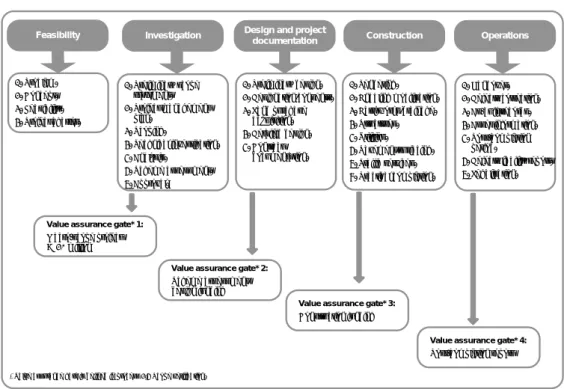
The figure below show the overall project life cycle and stage gate review process. Figure 1: Project life cycle and value assurance gate process
Investigation
Feasibility Design and project
documentation Construction Operations
1. Preliminary scope statement. 2. Project management plan. 3. Scoping. 4. Technical investigation. 5. Analysis. 6. Scheme assessment. 7. Approval. 1. Problem. 2. Concept. 3. Feasibility. 4. Project charter. 1. Preliminary design. 2. Designation/consents. 3. Land purchase acquisition. 4. Detailed design. 5. Contract documentation. 1. Tendering. 2. Enabling mobilisation. 3. Earthworks/drainage. 4. Structures. 5. Utilities. 6. Pavement/surfacing. 7. Traffic services. 8. Practical completion. 1. Handover. 2. Defects correction. 3. As-built records. 4. Asset information. 5. Post-completion period.
6. Defects liability report. 7. Legalisation.
Value assurance gate* 1:
Macro-scope project >$20 million
Value assurance gate* 2:
Scheme assessment/ design funding
Value assurance gate* 3:
Construction funding
Value assurance gate* 4:
Post-completion report
* Value assurance gate is defined in process 2.6 Scope verification.
Introduction
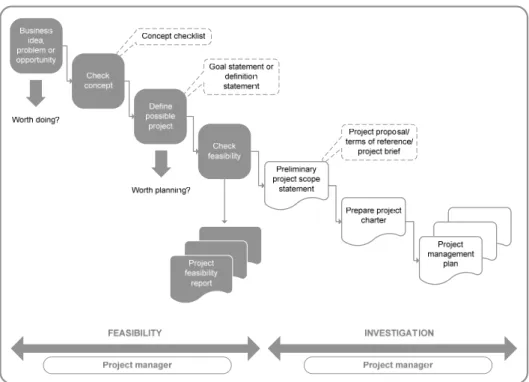
The establishment (or initiating) phase of a project is therefore a key step in the project life cycle. It is where the rationale for the project is documented for future reference by the project team. It is also where the project’s feasibility and success criteria are established thus providing the foundation for the investigation, development and construction phases.