1
Review Article
Software Defined Wireless Sensor Networks Application
Opportunities for Efficient Network Management: A Survey
Kgotlaetsile M. Modieginyane
1, Babedi B. Letswamotse
2, Reza Malekian
3,*and
Adnan M. Abu-Mahfouz
41, 2, 3 Department of Electrical, Electronic and Computer Engineering, University of Pretoria,
Pretoria 0002, South Africa,
4 Council for Scientific and Industrial Research, Meraka Institute *Correspondence: [email protected]; Tel.: +27-12-420-4305 Abstract
Wireless Sensor Networks (WSNs) are one the most widely adopted information technologies of modern networking and computing platforms. Today’s network computing applications are faced with a high demand of powerful network functionalities. Functional network reach is central to customer satisfaction such as in mobile networks and cloud computing environments. However, efficient management of WSNs remains a challenge, due to problems supplemental to them. Recent technology shift proposes Software Defined Networking (SDN) for improving computing networks. This review paper highlights application challenges faced by WSNs for monitored environments and those faced by the proposed approaches, as well as opportunities that can be realized on applications of WSNs using SDN. We also highlight Implementation considerations by focusing on critical aspects that should not be disregarded when attempting to improve network functionalities. We then propose a strategy for Software Defined Wireless Sensor Network (SDWSN) as an effort for application improvement in monitored environments.
Keywords
Wireless Sensor Networks, Software Defined Networking, Internet of Things, Software Defined Wireless Sensor Networks.
1. Introduction
Wireless sensor networks are sensor network technologies which are widely deployed on environmental monitoring, atmospheric monitoring, process monitoring, material sensing, security applications, etc. These networks operate on collective networking and computing of individual sensors based on their physical sensing properties and processing capabilities. Sensors nodes, cooperatively communicate and relay aggregated data to the main network control system for further processing and acting. In this regard, these sensors, must have an ability to conform to the collective networking functionalities as governed by their respective network policies.
2
In WSNs, sensor nodes can be randomly deployed, in essence allowing opportunities for applications even in inaccessible areas [1]. This feature about sensor networks, allows the possibility of deploying a large number of sensors over intuited areas for as long as communications can be established and sustained among these sensor nodes. A wireless sensor network consists of, but not limited to; a wireless sensor network server, routers, switches, sensor nodes, etc. depending on the design setup as required for its purpose. Depending on the purpose of the WSN, sensor nodes communicate amongst themselves as a means to forward sensed data to the network sink, which will then be passed by the network sink to the WSN server for further processing.In this paper, we consider challenges experience in WSN applications. We provide brief introductions to both SDN and SDWSN and also highlight their technological prospects in WSN applications. This paper further considers challenges that are currently pointed out as being faced by both the SDN and SDWSN approaches, in question of whether they could improve general WSN applications. We also advice on network critical aspects such as security, reliability and scalability, since these are some of the most core features that needs to be carefully considered when planning to improve or optimize network functionalities. More emphasis is put on considerations that needs to be taken at the network planning phase, so that any issue be accounted for before implementing the network.
This paper also reflects on issues surrounding the adoption of the SDN technology in general industry networks. Our inference towards these issues comes in the form of concerns and questions that needs to be looked at with careful considerations. In these concerns, we interrogate the SDN approach applied in WSNs as to whether this technology will introduce flexibility, improve the management as well as the overall performance of WSNs. Some of the concerns which in our view are of surface interest are; resource access, traffic routing, process scheduling and abstraction as well as network programmability.
We therefore point out that, through careful considerations of the advices provided by this survey, an enormous improvement in WSN technologies can be achieved in terms of network structure and support. Secondly, these considerations could provide answers to some of the issues concerning the adoption of SDN technology in WSN applications.
The rest of the paper is divided into the following sections: Section 2 discusses WSNs use cases, Section 3 discusses WSN protocols and topologies; Section 4 discusses WSNs, their applications and limitations. Section 5 considers SDN and its improvement positions, the advancements of SDN into mobile and wireless networks, Section 6 discusses SDN standard protocol and security aspects. Section 7 introduces the recently proposed concept of SDWSN, the work done, the challenges and considerations regarding the adoption of the SDWSN concept. Section 8 provides a way forward into the future research. Finally, Section 9 provides concluding remarks and indicates what we have learnt throughout the paper.
3
2. WSN Case studies
2.1. General Perspective for Designing WSN Application Systems
To design deployable and functional WSN systems, several factors and elements needs to be made in terms of case studies. As the same as with other systemic technologies, the development of each WSN application system is led by a requirement or need for that system. These requirements are at times influenced by technology markets or ongoing research approaches and developments. Following this phase, case studies are conducted to best understand the requirements, factors, elements, constraints, strategies and the feasibilities for implementing these technologies. For WSNs, these studies include but not limited to; understanding the size of the network to be designed, hardware and software requirements for the network design, the cost to implement the network as well as the resources to sustain and maintain that network. Other important case studies include; human related factors and the area wherein the network will be deployed.
2.2. Detailed Factors for Developing WSN Application Systems
Due to the technological market and research developments as described above, application systems need to solve a certain problem. This leads to a more detailed understanding and listing of technical requirements in terms of hardware and software needed to build these systems. These technical aspects include:
The type of sensor hardware to be used.
Operational characteristics of these sensors.
Operational platform to deploy these application systems.
Choice of routing protocols and considerations for operational standards, for both the network infrastructure and sensors.
The actual network structure
Network security
Other technicalities to be considered include; mechanisms for power resources for these systems, data mining aspects, level of radio frequency operation and identification and scalability options for the network design.
3. WSNs Routing Protocols and Network Topologies
3.1. Routing Protocols
To improve WSN system operations and applications, several access and routing protocols have been developed and applied which include [2] the following:
Medium Access Control (MAC) protocol – whose main strategy is to reduce high energy consumption, since sensor nodes in a WSN systems are battery powered thereby resulting in a limited network lifetime. MAC protocol attributes for WSNs
4
include collision avoidance, network scalability, efficient bandwidth utilisation, improved throughput and latency, etc. Low Energy Adaptive Clustering Hierarchy (LEACH) protocol – which is the fundamental protocol to propose some level of data fusion as well as a focus to implement a strategy for low power utilisation in hierarchical WSNs.
Ad hoc On-Demand Vector (AODV) routing protocol – its main objective is to reduce packets flooding which causes overhead within the network. One critical functionality of this protocol is to utilize routing tables to store routing information. This assist in situations where sensor nodes needs to send packets to targeted destinations.
Sensor Protocols for Information via Negotiation (SPIN) – These types of protocols are based on sensor nodes negotiations for allowing data transmission and resource adaptation mechanisms for energy saving.
Geographic and Energy Aware Routing (GEAR) protocol – It is based on the energy and location of sensor nodes which are on their transmission paths towards their targeted regions. Also, focused on WSNs energy optimization. Transmitted packets are targeted for a region. Its implementation facilitates the trade-off between energy and distance.
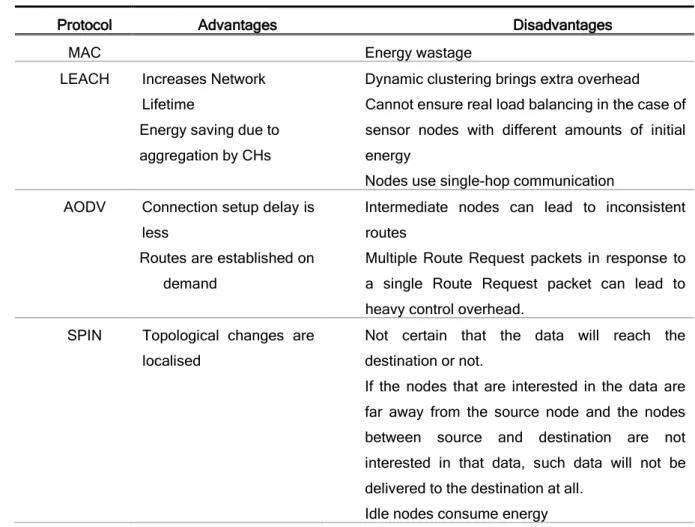
Table 1 discusses the advantages and disadvantages of the protocols discussed above. Table 1: Advantages and disadvantages of WSN protocols
Protocol Advantages Disadvantages
MAC Energy wastage
LEACH Increases Network Lifetime
Energy saving due to aggregation by CHs
Dynamic clustering brings extra overhead Cannot ensure real load balancing in the case of sensor nodes with different amounts of initial energy
Nodes use single-hop communication AODV Connection setup delay is
less
Routes are established on demand
Intermediate nodes can lead to inconsistent routes
Multiple Route Request packets in response to a single Route Request packet can lead to heavy control overhead.
SPIN Topological changes are localised
Not certain that the data will reach the destination or not.
If the nodes that are interested in the data are far away from the source node and the nodes between source and destination are not interested in that data, such data will not be delivered to the destination at all.
5
3.2. Network TopologiesCommonly known WSN topologies [3] are described below. Other forms of sensor network topologies are designed as a combination or extension of these network topologies due to the design requirements decided for different deployments.
Star topology: – In this type of a network structure, sensor nodes transmit data only through a central device (can be a sensor or gateway). Considered for small network. A failure in any sensor node except the central device, does not affect the network or other sensor nodes. Not expensive to implement this architecture, as nodes share one central device.
Tree topology: - Efficient for optimizing the power consumption or to extend the communication range of the network. Some level of scalability can be achieved in this type of a network. This architecture can be easily managed or maintained since the network is divided into branches or segments. If the root node fails, the lower structure also fails. This network design is not expensive to implement.
Mesh topology: - All the sensor nodes within the same radio or communication range are connected. To reach a far destination device, data is transmitted through neighbouring nodes. Very fault tolerant since there are a lot of path options for other sensor nodes to successfully transmit data should one node fail. However, it is expensive to implement this type of a network.
Heterogeneous topology: - This results as a form of combination two or more of the above topologies. This type of a network implementation is somehow, reliable, scalable, flexible and effective in its operation. However, it is expensive to implement this network architecture, since it is a combination of two or more network topologies of different capabilities.
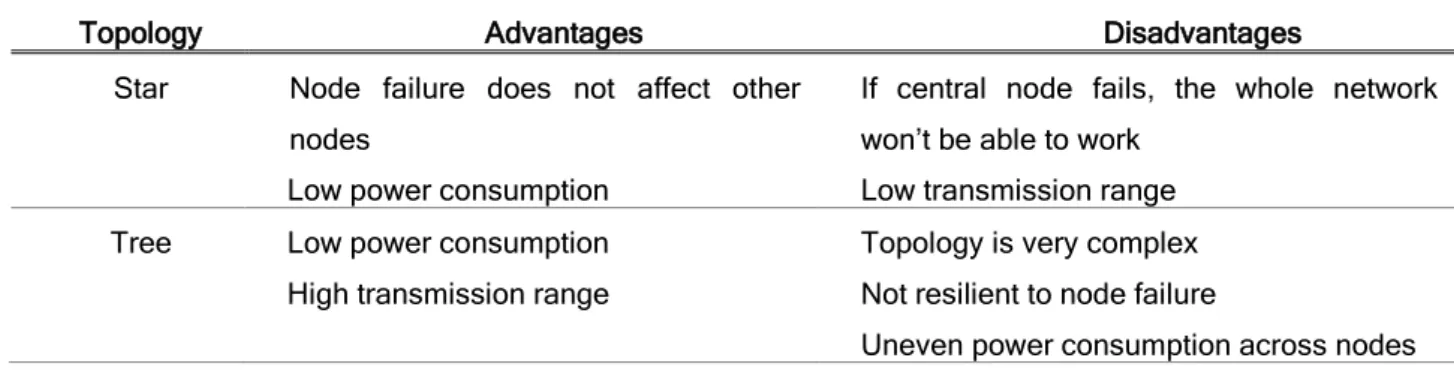
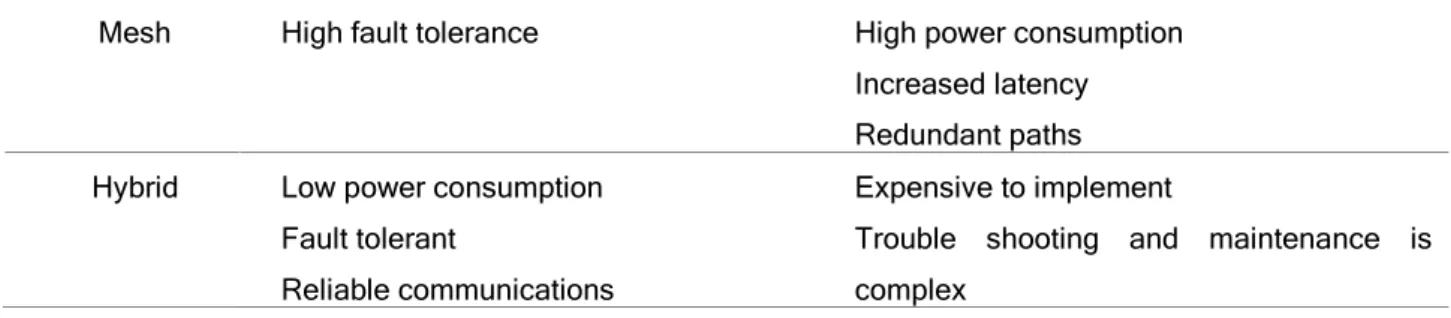
Table 2 discusses the advantages and disadvantages of the topologies discussed above. Table 2: Advantages and disadvantages of WSN topologies
Topology Advantages Disadvantages
Star Node failure does not affect other nodes
Low power consumption
If central node fails, the whole network won’t be able to work
Low transmission range Tree Low power consumption
High transmission range
Topology is very complex Not resilient to node failure
Uneven power consumption across nodes GEAR Increases Network
Lifetime
Helps in balancing energy consumption
6
Mesh High fault tolerance High power consumption
Increased latency Redundant paths Hybrid Low power consumption
Fault tolerant
Reliable communications
Expensive to implement
Trouble shooting and maintenance is complex
4. WSN Challenges and Deployment Considerations
Even though WSNs are the most widely adopted information technologies of modern networking and computing platforms due to their simplicity of deployment and cost effectiveness, managing them is a difficult task pointing to their resource constrained nature. However, applications of WSNs have continued to grow regardless of the challenges experienced in their use. Basically, WSNs are envisioned to be deployed on large scale, as millions of wireless sensor nodes will be working cooperatively to transmit critical data and as well being connected to the internet as an effort for the realization of internet of things (IoT) [4] [5].
In cases when accessing a WSN remotely, a network sink may also be used as gateway to connect to the internet [6]. This phenomenon about WSNs can be regarded as an opportunity for network computing innovation.
WSN technologies have been successfully developed and implemented in a wide range of applications as discussed before. These technologies are now commercialized according to their range and specificity of application. Table 3 illustrates some of the commonly used systems or technologies developed for critical applications.
Table 3: Common WSN applications and their technology systems.
Application Condition Parameters Technologies
Agriculture Planting: Soil preparations Soil: pH, Nutrients, Humidity, etc.
AgroSense, AgriServe, etc.
Animals: Moving patterns and behavior.
Position, Animal Tracking, etc.
ZebraNet, WiSense Military Surveillance [Safety and
Security]
Infrared, Motion, etc. Ultra-Stable Tripods, Radar, EcoKit, etc. Health Operative or Intensive
Care
Heartbeat, Pulse, Rate, BP, Temperature, etc.
iMONNIT, Wisense, Autonomous Systems and Biomechatronics Infrastructure Surveillance, Control and Temperature, Motion, Camera Systems,
7
Systems such as those used in health, military and environmental monitoring are some of the most commercialized technologies around the area WSNs. These technologies play a pivotal role in everyday living as some of them are mission critical systems. The wide adoption of WSN technologies is since these systems are affordable and not difficult to implement. However, the cost of implementing such technologies depends on their range (in terms of size and purpose) of operation. Due to factors, such as their affordability, ease to expand and not conforming to a particular network topology, WSN technologies could be adopted and optimized as the fundamental structure for the IoT network paradigm.Commonly reported challenges include; sensor node energy limitations, low memory and processing capacity, low channel bandwidth and being application specific [7], [8]. A lot of work has been done particularly on energy limitations such as in [9], [10] as an effort to improve the node energy utilization on WSNs. In addition to that, other methods of energy harvesting have been proposed as a means to leverage this limitation on sensor nodes [11], [12].
However, only to a certain extent, this particular energy issue has been moderated as it is still one of the serious challenges in WSNs [13], since it affects the lifetime of a WSN directly. Other reported challenges such as in [14], [15] are, high latency in communication (which occurs as a result of multi-hop routing), traffic congestion, processing delays on intermediate nodes due to the packet-based routing nature of WSNs.
In the context of optimum energy usage for systems on built environments, different approaches of efficient energy utilization have been proposed such as in [16] where system or machine retrofitting strategies for maximum energy conservation are applied on the actual control rather than optimizing the overall power support. Other methods of efficient energy management have been introduced in terms of scheduled power utilization [17] wherein power flow control and energy efficient predictive control [18] methods and approaches for hybrid systems are introduce as a means to lessen high power consumption over scheduled periods. Based on the proposed strategy, another controller functionality will be to write container rules or applications which will operate on certain network devices such as routers and programmable sink nodes. This functionality will apply software focused strategies which will
Prediction, Measurements, Maintenance
Infrared, Vibration, Strain, Stress, Air-Flow
SensoNode, VIBCODE Transducer, etc.
Transportation, Automotive
Asset tracking, Presence Radio Frequency, Accelerometer, etc.
Trackers, RFIDs, Smart Logistics, etc.
Water Quality Observation and Control pH, Iron, Nutrients, Color, etc.
Libelium Smart Water, etc.
8
be responsible for load balancing, ensuring that the bandwidth is resourcefully utilized as well perform quick search operations for data transmission to complement efficient processing, thereby reducing high delays.Since WSNs are energy and processing limited, important considerations must be made before the deployment phase of the network. These considerations includes, but not limited to; understanding phenomena/event requirements and the deployment environment (as this will assist in deciding on relevant equipment and their capability, and also whether there are no radio frequency disturbances within the area (in case of industrial or city/infrastructure deployments)), sensor network connectivity (i.e. critical measure must be taken to maintain connectivity), the ability of the network to self-configure in adverse or intrusion situation [19], [20] choice of wireless protocol depending on the sensor type to be used as protocols/standards differ in power usability, throughput and communication range [21], [22]. We therefore put emphasis towards these considerations, so that if necessary; any software or resource oriented limitation be accounted for during the network planning phase.
5. SDN and Its Implementation Challenges
5.1. Case Studies for Designing SDN
The concept of implementing SDN strategies to modern computer networks is imagined as a possible solution for common challenges experienced on them. However, due to the novelty of this networking paradigm, it remains unclear as to how this strategy can be fully applied to the effectiveness of today's networking technologies.
In this paper, we carry out case studies for designing SDN strategies for most network environments. To start with, we discuss components that makes up a functional network, since these are critical when designing any network. A network is a platform of inter-linked, connected or interfaced hardware and software developed and operated by either human or machine capacity. It is therefore, an involving task to implement a functional network that uses new computing strategies such as SDN in production networks.
Case studies carried out in this paper, reveals some systematic and situational challenges that needs to be considered when designing SDN technologies. These includes:
The type and cost of infrastructure which will be required to host and support this new technology.
The capacity or skilled personnel required to operate or maintain the network
Platforms and software needed to command the network
Security features and levels which will be required for this technology
Other critical aspects that could be considered in cases of designing as well as these networks include:
Cost implications of implementing a new technology, in this case SDN.
The risk of shifting to a new technology as opposed to optimizing the working old technology (traditional network).
9
The task and costs of developing new procedures, protocols and applicationswhich will support the new technology
It is therefore, important to understand and properly implement the functionalities of each component needed to support any new technology, since the opposite will render this technology to be inefficient and irrelevant even though it is expensive.
5.2. SDN Architecture
SDN is a framework that decouples the control plane and the data plane in order to allow network administrators to automatically and dynamically manage and control a large number of network devices, services, topology, traffic paths, Quality of Service (QoS) and packet handling policies using high level programming languages and Application Programming Interfaces (APIs) of their choice [23].
We also describe an SDN approach using OpenFlow as shown in Figure 1. OpenFlow by Open Networking Foundation (ONF); is a standard communications interface defined between the control and forwarding layers of an SDN architecture, which allows direct access to and manipulation of the forwarding plane of network devices such as routers and switches, both physical and virtual (hypervisor-based) [24].
Figure 1. An overview of SDN architecture.
Even though SDN applications promise to improve the overall networking experience by shifting complex processing functionalities from the network equipment to the controller based device or platform, SDN itself has its own implementation challenges most especially on existing networks such as; infrastructural support for smooth transitions to SDN environments, flexible hardware for SDN deployment or applications, etc. [25].However, as part of the proposed approach, this work intends to solve this problem by implementing controller
10
functionalities that will be able to store current processing states and concurrently perform some automation on the base Operating System (OS) to support critical network devices for abstracted operations. This will also allow an opportunity to implement virtual network components which will act as actual devices in performing other network state applications. Other concerns and challenges are that; steady development is still needed to apply SDN concepts at network infrastructure level, since there is currently no general accord yet on how the control/programmable logic can be achieved, there is currently no global standardization for SDN [26].5.3.SDN Challenges and Opportunities in WSNs
Today’s network computing applications are faced with a high demand of powerful network functionalities and performance. This high demand is mainly motivated by advancements in the area of computing spanning provider networks, data centers, cloud computing environments, etc.
However, resourceful management of WSNs is a serious challenge, due to problems supplemental to them. Conversely, advancements and improvements in the manufacturing of computing or networking devices has awarded researchers and developers opportunities to experiment on these devices as an effort to enhance network computing capabilities and experience. Upon these concerns, recent network technology shift proposes SDN as a means to improve computing networks. SDN refers to a software platform or framework that implements a controlling function of the underlying network infrastructure through software defined means.
An improvement position is that, since resource management and process control are so difficult in WSNs due to their sensor properties and structural complexity, SDN aims at bringing convenient control mechanisms to WSNs [27, 28]. Current studies indicate that this capability will allow the controlling unit (the controller) to easily manage network resources as well as preparing a platform for other networking applications [29, 30].
One of the main objectives of SDN strategy is to ease up the process of network management. Primarily, SDN transforms a network administration problem into a simplified network programmable one. The suggestion is that by applying SDN, the complexity of sensor networks management can be simplified. With the flexibility gained by the introduction of SDN to sensor networks new protocols can be employed very easily without the need to reprogram or reconfigure any sensor node [31].
Distinctively, one of the core strategies of SDN in computing networks is to make an effort of visualizing the network architecture more clearly and comprehensive, as this will:
11
Allow operators to quickly come up with measures that are most relevant for specificnetwork problems.
Encourage innovation in computing networks to prepare for or meet future demands. Introduce programmability on and implement software handling (assuming software
compatible resources or devices) of network resources as an effort to advance or optimize network performance. This is the surface objective of SDN in network computing.
Allow easy access of network resources so as to manipulate them as necessary. Improve the way computing networks are observed or visualized and thus permitting
network operators to easily manage and maintain adjacent network resources.
A well compatible and structured SDN oriented network is aimed at achieving the mentioned strategic goals as an effort to improve the overall network computation. In this notion, an SDN based WSN is mostly anticipated to improve on its computing capabilities if of cause some SDN approach requirements are observed and met. Therefore, based on the settings proposed by SDN, the resource limitation nature of WSNs can be radically reduced.
5.4. SDN versus Traditional Network (Non-SDN Network)
Traditional strategies of networking have proved to be capable and reliable for over the years. This points to the fact that large, medium and small size network architectures have been successfully implemented using these strategies to date. In today’s technological demand for powerful systems, traditional ways of network computing face a tough time in terms of efficiency and management. In this regard network innovation becomes difficult to realize in traditional networks.
This is mainly because, in addition to the network devices being proprietary, the network control is implemented on each forwarding device, thereby making it hard to access and operate on the functionalities of these hardware.
On the contrary, SDN approach implements the network controlling mechanism separate from the data forwarding plane. The network control is performed on the centralized SDN controller whereas data forwarding is performed by the adjacent network devices. A programmable switch such as an OpenFlow switch is directly connected to the SDN controller for programmable instructions and process manipulation. Therefore, the fundamental networking strategies as implemented by both these network architectures, directly reflects their operational nature.
Some arguments still exist in terms of management and performance of SDN based networks and traditional network. These arguments are mainly looked at as comparisons between these two network technologies as an effort to highlight which technology brings benefits. These arguments are also further interpreted to the act of making decisions as to which technology
12
could be used and for what intent that technology could be used. Table 4 gives these arguments in terms of comparisons.Table 4: Comparison between an SDN network and a traditional network
The adoption of SDN in industrial networks remains a tough decision or even a hard step to take as SDN is still a new knowledge in computing networks and somewhat on the trial stages for adoption in such networks. A lot of work around SDN still needs to be done such as; issues regarding network device interoperability from different vendors, a comprehensive strategy for SDN infrastructure and at least an advocacy for secure SDN networks. We therefore infer that upon the realization of the above-mentioned aspects of SDN technology, the adoption of SDN as an effort for network computing improvement and innovation will be significantly advanced.
5.5. Wireless and Mobile SDN
The concept of SDN was initially proposed for wired networks, as time went by and the concept proved to be successful on legacy wired networks, it also opened opportunities for other networks such as wireless, mobile and sensor networks to name a few. The introduction of SDN to these networks present a possibility of improving network coverage and connectivity
Potential SDN Traditional (Non-SDN) Network
Operate Features
Separation of the control and data forwarding planes. Easily controlled and deployed.
Hard-structured and logically coupled operations. Very complex control.
Implementation Fast and easily implemented. Adapt to the need of application environment. Time involving to implement. Operate on dedicated environments.
Stability Currently technological supports. unstable with few Stable with great network support. Architecture Software oriented with resource customizable features. Centralized
network intelligence.
Hard-structured and operated on dedicated and proprietary devices. Configuration Configuration can be largely done remotely. Software monitoring and
operation done centrally.
Network devices need to be configured directly and individually. Management Easily managed using APIs. Can be easily modified depending on the
network demand.
Difficult to manage as network devices are solely proprietary and hard to access.
Maintenance Can be easily maintained as new services or network upgrades can be done easily without affecting the whole network.
Difficult to maintain as the whole network might be affected by a small change in the network. Error Checking Easy to check network errors as software module are dedicated to do
this. Therefore, errors can be quickly isolated easily from the network.
Error checking is extremely time consuming and difficult to isolate as operators have to the check whole network even for small errors.
Novelty Network innovation becomes easy as new features of the network could be attached to the existing infrastructure. Does not need to revisit the whole network processing.
A simple change will require a serious study and understanding of the whole network structural design. Therefore, innovation is possible but difficult to implement.
13
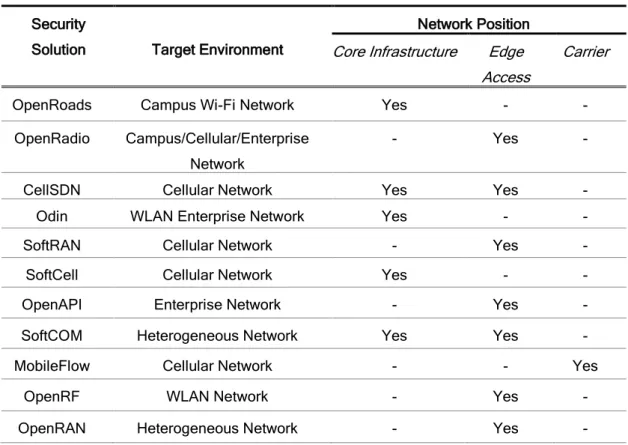
and also reduce the cost of implementing changes when upgrading networks. Table 5 presents the already existing SDN based solution on mobile and wireless networks.Table 5: Mobile and Wireless SDN
The introduction of SDN to wireless and mobile networks gave birth to some of the pioneering projects, one of the first efforts of combining SDN and Wide Local Area Networks (WLANs) was from the Cambridge University, and they deployed their SDN based solution called OpenRoads [32] on their campus network. OpenRoads is an innovation focused OpenFlow-based open source platform that separates network service from the underlying physical infrastructure, allowing free movement of users between any wireless infrastructures.
SoftCOM [33] cloud-based, systemic future network architecture that influences the power of SDN and improves telecom operators’ competitiveness by transforming the manner in which network and business operations are managed. Odin [34] is a SDN wireless framework that introduces programmability to enterprise WLANs, it was envisaged to benefit enterprises by providing support in the form of authentication, load balancing, mobility, interference management, authorization and accountability.
In an effort to simplify data network management some projects were established, CellSDN [35] being the pioneer project. CellSDN provides scalable, fine-grain real time control with
Security
Solution Target Environment
Network Position
Core Infrastructure Edge Access
Carrier
OpenRoads Campus Wi-Fi Network Yes - -
OpenRadio Campus/Cellular/Enterprise Network
- Yes -
CellSDN Cellular Network Yes Yes -
Odin WLAN Enterprise Network Yes - -
SoftRAN Cellular Network - Yes -
SoftCell Cellular Network Yes - -
OpenAPI Enterprise Network - Yes -
SoftCOM Heterogeneous Network Yes Yes -
MobileFlow Cellular Network - - Yes
OpenRF WLAN Network - Yes -
14
extensions. CellSDN comes with the benefit of introducing new saves easily at reduced cost. The network is easy to manage and easily incorporated with other wireless technology. The challenges of CellSDN are radio resource management, asymmetric edges, fine-grained policies and unplanned mobility.SoftCell [36] is a scalable architecture that supports fine-grained policies for mobile devices in cellular core networks, using commodity switches and servers. Through workload analysis and fine-grained policy support, SoftCell improves the flexibility and scalability of Long Term Evolution (LTE) networks.
Later on, OpenRadio [37] and SoftRAN [38] were proposed with the aim of introducing SDN innovation power to the wireless access domain. OpenRadio is a programmable wireless data plane that supports network evolvability, it provides modular and declarative programming interfaces across the entire wireless stack. OpenRadio allows various wireless protocols to be implemented on multicore platforms. It provides modular and declarative interfaces for programming wireless protocols and also provide support for application specific services. OpenRadio also comes with several challenges. Firstly, heavy decision planes would incur excessive performance bottleneck and inefficient utilization of wireless resources. Also, if a heavy sequential algorithm prohibits pipelined parallelism, logic-heavy blocks will no execute well on multi-core architecture. “Moreover, OpenRadio assumes decision/processing separation is significant in signal processing blocks. However, some blocks that need to take decisions, like packet-search block, are best expressed with some embedded decision code. If the gap in average and worst-case run times becomes too high, maintaining the deterministic semantic on that block could become very inefficient” [37].
SoftRAN is a software defined control plane for radio access networks that extracts all base stations as a virtual big base station. SoftRAN achieves simplified network management through plug and play control algorithms. It facilitates efficient utilization of wireless resources since the controller has the global view on the network load and the cell interference and also provides better mobility support and reduces costs. Other solutions to Radio Access Networks and cloud environment were also introduced.
OpenRF [39] is a self-configuring SDN based cross layer architecture for managing Multiple Input Multiple Output (MIMO) signal processing, it permits commodity WIFI Aps to manage interferences in access points which are on the same channel. OpenRAN [40] is a cloud computing based Software Define Radio Access Network architecture for heterogeneous wireless networks. It provides open, controllable, flexible and evolvable wireless networks. MobileFlow [41] an SDN based mobile network architecture for future carrier networks, its benefits are flow-based forwarding model that promotes a rich environment for innovation at the core of the mobile network. MobileFlow also provides support for fine-grained policy
15
enforcement and is able to interact with Evolved Packed Core (EPC) network elements and software definitions of various mobile networks.6. Security in SDN
Each and every systematic platform, structure or environment must entail some level of security. In general security is an integral part of every computing systems. Most importantly, security in these computing systems or devices must be considered and be accounted for during the planning phase of such systems. In addition to securing these systems, each system must be incorporated with intelligent security measures that the system should undertake at times when the system is compromised. We then emphasized that, as improvements in computing networks are such highly anticipated; security must be well thought of. Security in SDNs is still a major concern. In this regard, the following questions arises:
How will security be implemented in SDN infrastructure?
If implemented in a central point only (e.g. central controller), what will happen in the event where the controller is intruded?
Should there be some level of security in every part of the SDN architecture?
These questions need to be answered through extensive research, development and system testing.
7. Software Defined Wireless Sensor Networks (SDWSN)
This section covers the SDWSN case studies, general overview of SDWSN, existing work, challenges and technological considerations regarding the adoption of the SDWSN concept.
7.1. Case studies for designing SDWSN application systems
Several technologies of WSN systems have been used for a wide range of applications due to their simplicity of implementation and cost effectiveness. Even though this has been the case, the high demand for extensively powerful systems of WSNs has rendered older technology systems and strategies to be less effective. This has therefore resulted in exploring other approaches for either optimizing current WSN application systems or developing new technologies. After conducting some literature survey of current approaches applied to WSNs to improve their applications as well as testing some operations of WSNs applications through simulations, the authors in this paper proposes a SDWSN system strategy as illustrated in Figure 4 as a possible solution for challenges experienced in WSN application systems. The case study together with some simulation results have revealed some limitations in these types of systems even though they are operational to some level. Technical limitations learned from the conducted studies include:
Lack of innovation in current WSN strategies to cater for compute intensive applications that require highly responsive systems.
16
Inability to support concurrent processes for different application needs. Lack of global access to operate different network devices.
Involving tasks of detecting and troubleshooting faulty network points.
Difficulty in deploying new efficient protocols in an effort to optimize the overall network performance.
7.2. Strategies for Developing SDWSN systems: Solving WSN technology challenges
The main drive to implement SDWSN is motivated by the SDN paradigm strategy to implement flexible and simple to manage computer networks. In addition to this, SDWSN strategy aims to implement networking technologies that allows the central view of the whole network. This paradigm change also introduces some level of programmability in production or application networks as a means to empower system administrators as well as network engineers to easily manage and optimize these networks. As a direction to implement SDWSN systems that can solve WSN application system challenges listed in sub-section 7.1, several key elements have been identified as possible solutions to decline these fundamental limitations such as:
The need to develop software-oriented protocols for WSN systems which will be mandated to cater for different application processes on the fly.
To develop software injection techniques to support programming abstractions for sensor networks. As this will influence the manufacturing platform for open programmable sensor.
To develop highly encrypted software oriented algorithms to secure the control and data plane.
To develop software strategies that will be responsible for data manipulation and presentation.
To develop controller application strategies for accessing and updating sensor properties to best suite different application needs and operation parameters.
7.3. Overview of SDWSN
Due to the recent growth for sensor network applications in wireless communication and computing technologies, a lot of such application systems for WSNs have been prototyped and some partially developed and continue to be tested for efficient performance. However, some challenges such as function virtualizations and application automation remains to be serious concern to realize dynamic and fully efficient WSN applications. SDWSN [30] is a potential solution to these problems since it proposes a programmable control that acts independent of the underlying network devices.
SDWSN refers to a networking paradigm that entails separating the control mechanism of an operational wireless sensor network from the data forwarding plane of the underlying vertically integrated network system. In essence SDWSN is a networking computing model that uses SDN techniques in WSNs applications systems as a means to simplify and enhance WSNs’ systems operations.
17
An SDN approach to WSNs is also anticipated to improve the network computing complexity of WSNs such as in monitoring environments pointing to issues of data redundancy, communication overhead, sensor broadcast delay and high sensor energy depletion. WSNs for monitoring applications maintains to be projected as life integral technologies in future control and security systems. Factors such environmental changes (weather) and network equipment deterioration remains to be an uncontrollable concern in WSN monitoring systems. In this regard SDWSN also aims to improve the network function visualization as an effort to advance the network resource sharing and at the same time enhancing the overall network computing performance.By introducing SDN techniques to WSNs, the network intelligence and control will be centralized. Sensor nodes will be performing only forwarding tasks, whereas compute intensive tasks will be performed by the controller without affecting the overall energy consumption of the entire network, hence the sensors won’t consume much energy since they no longer run intensive control functions. The benefit is that the controller is not resource constrained since it runs on a machine with more resources compared to a sensor node. Moreover, the controller will have the global view of the network meaning that it will be aware of the sensor battery level and therefore it will make optimal routing decisions based on state information.
As part of an anticipation to advance WSN application systems that are secure by employing SDN computing strategies, the proposed architecture intends to develop and implement security algorithms as part of the controller functionality. These algorithms will be implemented on each level of the network through some form of function virtualization. Since the course of developing powerful security is an ongoing process, vigorous forms of system testing could also be used to exploit the system of any security weaknesses. This process will then inform future implementations of powerful security features.
SDWSN is also aimed at introducing a simplified implementation of a software oriented strategies for broad WSN computing systems by means of moderating sensor and other network resources workload for as far as data traffic and computing is concerned. An improvement position is that, since resource management and process control are so difficult in WSNs due to their sensor properties and structural complexity, SDN aims at bringing convenient control mechanisms to WSN [26, 27] by simplifying the whole network infrastructure.
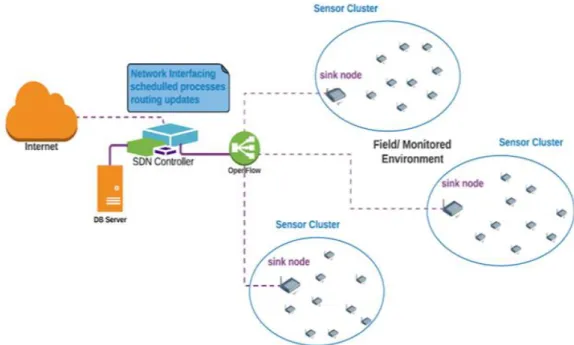
A SDWSN strategy as depicted in Figure 2 consist of, a field sensor cluster which is deployed on a remote environment for phenomenal sensing such that the cluster is directly connected to a wireless sink sensor node. This architecture has the following components:
18
OpenFlow Switch
Sink Node
Sensor Nodes, forming a Sensor Cluster
The SDN controller maintains the global view of the whole network through the OpenFlow switch and other network devices, such that; the sink node and all the adjacent sensor nodes. In this architecture, all the sensor nodes as well as the OpenFlow switch acts as data forwarding devices. The centralized SDN controller together with all the sink nodes, forms the control plane of the architecture. From the centralized controller through the OpenFlow switch, the sink node allows communication to certain sensors through some wireless transmission capability. Therefore, sensor clusters can be reached through this communication link for necessary sensor operations such as; updates, status check, sensor identification and isolation, etc. These sensors nodes must be compatible for systematical software manipulation and updating, thus to allow the SDN orientation.
Figure 2: Software Defined Wireless Sensor Network Architecture.
Since the SDWSN proposes a centralized but flexible and programmable controller, simple network processes could be performed at the cluster level by implementing some network automation functionality on the sink node. These actions would be applied or performed based on requisitions or prompts at such levels (i.e. at sensor cluster level). This in some instances will allow the controller to be in a ready state for high processing demand applications of the network that needs efficient processing, such as routing and enforcing some QoS. Therefore, this would offload the controller from high data processing demands that should be maintained always.
19
Furthermore, to offload the SDWSN controller from compute intensive tasks, some level of automation could be implemented on the SDN customized sink node, where simple and low-level rules would be executed on the sink node. This will also increase the low-level of programmable functionality within the overall architecture, form a basis for on-demand application development at the network level and moreover, it would increase SDWSN innovation opportunities. Considering these possibilities, a simple sink-oriented sensor status rule for removing an inactive node on the cluster network is described in Figure 3 in terms of a container, where status elements form a class objects of this container:Figure 3: A simple container state rule implemented on the sink node. Some state rules depending on the application need could also be written to fulfil such
processes either on the sink node or even on the switch. Simple status rules such as; updating the sensor data, introducing new functionalities either at switch-level or cluster-level, etc.
7.4. Existing work on SDWSN
At least some amount of work if not much has been done on SDWSN, the first attempt to combine SDN and WSN to solve the inherent problems experienced in WSNs was presented in [31]. The authors proposed a Software Defined Wireless Sensor Network architecture that clearly separates the control plane and the data plane. It also features Sensor OpenFlow which is the main component of SDWSN as a standard communication protocol between the two planes. Later, SDWSN was used in Smart Grid WSNs [42] where it is said to have minimized complexity and power optimization in sensor nodes. The work in [43] proposed the use of SDN as a means to smartly manage WSNs, they suggested that the controller be placed at the base station and their paper argues that smart management using SDN envisions solving some of the inherent problem that come with WSNs.
One of the limitations experienced in WSNs is high sensor energy consumption. As a strategy, the concept of SDWSN intends to reduce high energy consumption on sensor nodes through
20
some means of shifting other processing tasks to the SDN controller. Sensor nodes will only operate as packets forwarding devices. Some work [44] attempted to solve this energy consumption issue by proposing a general SDWSN framework where the controller is placed at the base station and the sensor nodes performs only packet switching. They used OpenFlow as the core communication protocol between the controller and the switching elements. The proposed architecture minimized the energy consumption as anticipated but only to a certain level.In the work on [45], an SDWSN prototype was proposed to improve the adaptability and energy efficiency for WSN monitoring systems. In their work, an energy-efficient cognitive SDWSN prototype based on reinforced learning (RL) was developed for monitoring systems, wherein complex data fusion is managed centrally on the control plane while low complexity computations are done on the data plane.
Authors in [46] proposed a multi-tasking energy efficient routing algorithm for SDWSNs. In order to make the network convenient, their algorithm chooses control nodes to allocate various tasks. This selection of control nodes is conceived as a (Non-deterministic Polynomial-time hard) NP-hard problem considering the residual energy of the nodes and the transmission distance. They used a non-linear particle swarm optimization as a solution to the NP-hard problem. Their simulations suggest that their algorithm is energy efficient and thus prolongs the network lifetime.
An SDN based sleep scheduling algorithm SDN-ECCKN [47] that reduces the total time of transmission of a network at the same time maintaining the network connectivity, hence prolonging the network lifetime was proposed by Wang et al. All the computations are performed by the controller rather than the sensor nodes and there is no sensor-sensor propagation in their algorithm. Their simulations suggest that SDN-ECCKN shows significant improvement compared to Energy Consumed Uniformly-Connected K-Neighborhood (ECCKN) considering network lifetime, number of functional nodes and number of isolated nodes.
Authors in [48] investigated how to design an energy efficient reprogramming strategy with guaranteed quality-of–sensing for a sensing task. They proposed an Integer Linear Programming (IPL) based algorithm which has a low computation complexity to address the issues such as reprogramming sensor selection and program distribution routing.
An energy efficient SDWSN with wireless power transfer was introduced by [49], where they proposed an optimal placement of minimum number of energy transmitters and energy-efficient scheduling of these transmitters. They investigated a trade-off between maximum energy charged in the network and fair distribution of energy for assigning the energy transmitter. A binary integer linear programming problem was formulated while satisfying the limitations on minimum energy charged by each sensor. For given energy charging tasks, they proposed an energy-efficient scheduling scheme for energy transmitters, where branch and bound algorithm was used to find the optimal solution. Finally, the authors highlighted that, compared to traditional WSNs with wireless power transfer; energy consumption can be reduced considerably by scheduling energy transmitters in SDWSNs.
21
Due to the application-specific nature of WSNs, it remains a challenge to manipulate its sensor nodes after a full system deployment as these sensors are built for their specific applications. In this regard, a work by Miyazaki et al. [50] proposes an SDWSN approach to curb this challenge by means of sensor node (reconfigurable sensor nodes composed of an ultra-low power Field Programmable Gate Array (FPGA) and a Microcontroller Unit (MCU) role assignment. In their proposition, a wireless communication was used to inject roles on certain sensor nodes, thereby allowing the possibility to manipulate or even update the functionality of these sensor nodes depending the system’s application requirement. Based on their system operation, they reported that their system produced some extent of network flexibility and indicated some potential to serve as a standard structure for WSN deployments depending on different user application requirements.Another SDWSN attempt to improve traffic routing and WSN sensor programmability is that from the work in [51] which introduced an SDN solution for WSN systems, which was intended for reducing the amount of information exchange between the SDN controller and the adjacent sensor nodes and also for enabling these sensor nodes to be programed as finite state machines. From that work, they reported that their system approach increased network elasticity and also provided simplified network programmability since it gave the system developers freedom to use programming languages of their choice when implementing the SDN controller. Joint Routing and Resource control (JRRC) protocol for Software Defined Sensor Networks (SDSNs) which rearranges routes and allocate resources for new applications and network services in real-time to maximize the overall throughput was proposed in [52]. Their simulations reveal that the controller is capable of allocating resources reasonably to maximize the throughput depending on the network state.
Authors in [53] investigated the possibility of an SDN based localization algorithm, they then proposed a Crameo-Rao Lower Bound (CRLB) based localization node selection algorithm. They formulated an integer linear programming problem based on energy satisfaction by using the controller's network global intelligence. The most reliable nodes for localization were chosen by calculation of the contribution of each anchor node in the CRLB metric. Their simulation results indicate that their SDN based localization algorithm achieves considerable improvement in localization performance
In our view this adds to be a great improvement in the aspect of WSN network programmability especially with the ability to use any high-level programming language when implementing the SDN controller, since the controller build language choice is one of the aspects highlighted in this paper.
Even though SDWSN is regarded as a potential solution for some limitations experienced in WSN as well as an opportunity to optimize this technology particularly by simplifying the network and is management, there is still a serious lack of available strategies or implementations of clear and stateful SDWSN developments, as much as there is little literature regarding this venture. Some few developments in this field, have at least proposed on some strategies of operating systems as well as on the possibility of implementing multiple controller architecture. However, clear technologies in this venture are yet to be done. Of course, ongoing research
22
using different simulation platforms is currently the hope to achieving the best outcome of this proposed strategy to improve WSN technologies. A work in [54] has proposed a method of testing new protocols presented as TinySDN tool. Their proclamation is that, this tool enables some SDWSN functionality using TinyOS. They also presented that their architecture provides an opportunity of having multiple controllers for SDWSN.In [55], the authors proposed TinySDM, a Software Defined Measurement Architecture for WSNs. TinySDM has numerous abilities such as providing support for conducting various measurement tasks, allowing easy customization of various measurement task and allowing efficient deployment of new measurement tasks. They implemented TinySDM on the TinyOS platform and evaluated its performance in a testbed comprised of 60 nodes. The task that were implemented were: end-to-end delay, PAD, Domo and Sympathy. Their results suggest that TinySDM is flexible, efficient and easily programmable.
In another attempt on applying SDWSN concept as a solution to WSN challenges, the authors in [56] proposed TinySDN, a hardware independent TinyOS based software defined wireless sensor networking nodes framework that enables multiple controllers within the wireless sensor network. It incorporates the SDN enabled sensor nodes and a programmable SDN controller. This framework is aimed at addressing the following challenges:
Leveraging in-band control
Higher communication latency
Smaller link layer frames
Limited energy supply
The results of their experimentations revealed that TinySDN enables the achievement flexibility provided by the SDN concept, while it also introduced a memory overhead but it does not hinder features related to WSN applications.
One of the main functionalities for SDWSN is to accredit simple-programmability as well as to clarify WSNs management for any applicable commitment – that is; being able to implement some level of programming on these sensor networks and at the same time being able to easily manipulate them for any network demand. Moreover, SDWSN deployments or systems must be less or considerably expensive since this architecture promotes a system where less sophisticated network components such as more routers and switches are used. Some work in this area have considered sensor network adaptability measures depending on the prompts or the demands lifted by the network, whereas other proposals focused on optimizing nodes functionalities by implementing their systems using sensor nodes that can be configured with some level of programmability. Some technological achievements have been realized such as in the work by Miyazaki et al. [57] where software defined sensor nodes which can be configured for dynamic operation, changes due to sensor specific task requirements.
A new approach that takes advantage of the SDNWISE envisioned state information to support QoS provision in WSNs was proposed by [58]. Their approach is based on using state to report the level of congestion on each node to the controller.
23
Authors in [59] proposed a system architecture of a typical WSN administered by remote server or cloud through IoT. In order to influence the Physical Sensor Cloud (PSC) to capture physical process data in an efficient manner, their architecture gives full control of the network operation to the cloud server.SensorSDN is a novel SDN based architecture for WSNs that can be used for various IoT systems which was proposed by [60]. Firstly, they proposed new control plane services for reinforcing automatic topology discovery, sensor mobility, sensor virtualization and managing network policies. Moreover, they proposed SDN based customizable flow tables on existing
Low-Rate Wireless Personal Area Networks
(LR-WPAN) technologies to meet therequirements of different sensor packets. Finally, their architecture allows a programmable cross-layer optimization between the MAC layer and the network layer as well as data aggregation to support fine grained flow processing.
Some work on cloud computing [61] proposed a Cloud-Assisted SDWSN (CSDWSN) where SDWSN capabilities were optimized using cloud servers. This work focused on providing resource and revenue sharing approach with some coalition development amongst CSDWSN service providers.
Flauzac et al. [62] proposed and application of SDN in WSNs with a structured and hierarchical management. They argued that their approach of applying structured and hierarchical SDN, promises to solve some of the existing problems in WSN management. Their work proposed a cluster based architecture with multiple base stations as hosts for performing SDN control functions and also as cluster heads at the same time. They further proposed a software defined cluster sensor network (SDCSN), a general architecture where the controller can communicate with other SDN domains through some border controllers.
7.5. Challenges and Considerations
One critical challenge in SDWSN is the efficient assignment of spectrum resources to the virtual network, which then contributes to the spectrum resource problem [63]. However, dynamic programming and graph theory based spectrum sharing algorithm is proposed in [63], wherein a performance improvement in this regard was achieved. Once more, there is a concern as to say; since SDN propose to facilitate a control of the underlying network from a dedicated point, it is alleged that the whole network will collapse in case where the controller is disrupted or somehow fail. Also, with the current envision about Internet of Things through WSNs, it must be considered as to whether a relevant infrastructure can be realized/achieved on SDWSNs. Subsequent to uncertainties that surrounds the standard architecture as well as the effective adoption of SDN technologies in production or application networks, some level of understanding is needed regarding its structural components and the fundamental benefits that SDN proposes to bring. Due to the distinctive architectural model of SDN, network customization and resource optimization in WSNs could be achieved using this approach, thereby improving the overall network performance. SDN is also aimed at providing network stability and flexibility in WSNs, through the enhancement of some of the critical network aspects such as; process scheduling, traffic routing, resource access, network abstraction and programmability. Congruently, SDWSN aims at improving resource utilization and “open” network programmability in WSNs.
24
8. Future directions: Technology and research opportunitiesIn the case of WSNs, a lot of work [64, 65], has been done. In our view WSNs [66, 67] remains to be the basis platform for next generation networks of their kind, especially if solutions towards sensor energy limitations, communication bandwidth challenges, sensor memory and computation issues [68], can be realized. Also, if the manufacturing industry for wireless networking devices could develop or introduce technologies that will be more energy sustainable [69], can be customized without impeding on their operating systems or firmware, etc. serious benefiting will be achieved. On the other hand, this is a clear indication and also an opportunity on the research side regarding a lot of work that is yet to be done.
Of most interest, approaches such as employing SDN on WSNs are already in place even though currently nothing huge has been realized in these approaches. Somehow serious collaborations between industries and the research community can achieve a lot towards these technology improvements, as both parties will be mutually benefiting. Looking at the radical improvements and changes in today’s network computing as well as reported achievements in this field, it is most certain that in the future more sophisticated but easy to use and manage technologies will be realized.
Hence, our position regarding research and technological gaps as highlighted above and in other sections of this paper, is that at least some extent of direction has been established. However, due to the everyday increasing technological growth and demands, much improvement is still needed. Some level of attention needs to be drawn towards the SDN/OpenFlow northbound and southbound interfaces as these parts of the framework are of empirical means to the overall technological approach. We project that these interfaces still need to be further explored for efficient network understanding as well as resource optimization. In terms of future work as well as a means of technological improvement, we have identified the following research opportunities:
SDN controller virtualization for multi-controller sensor clusters: A case of software strategy improvement in sensor network agility and management.
Enhanced global network experience: Improvements on northbound interface
communication.
Southbound interface optimization for efficient device access and controller communication: Leveraging sensor node memory and computation.
SDN strategies for runtime and computational overhead in sensor clusters: A case of smart algorithm development.
25
9. Conclusions
This paper looked at challenges experienced in WSNs as well as making critical analysis as to why careful considerations must be made before the deployment of WSNs especially for monitoring applications. Critical factors affecting applications of WSNs have also been discussed with advices that needs to be considered towards the network planning phase. We have also proposed a method of implementing simple state rules on the sink node as an effort to improve the SDWSN programmability as well as to offload the controller of such low-level compute tasks. This would enforce some QoS as SDN customized sink nodes would support manifestation of concurrent processes within the network. As a technological position, information regarding current developments using SDN techniques have been provided. These SDN paradigm developments proposed some technological advancements in the field of WSNs. Proposed systems promise to mitigate inherent problems experienced by in WSNs. However, different propositions using different approaches exist, as a means to determine which approach brings better results in terms of performance and management of WSNs. Yet, it remains a challenge in terms of understanding the scope and standard of technological advancement since these approaches have been implemented on different platforms, tools, hardware, programming languages, etc.
The systematic view of a SDN architecture seems to be complex, however its capability to customizing WSNs will make a huge impact around the evolution of computing networks. Recent research developments focus on the realization of Internet of Things (IoT), which is aimed at interconnecting billions of devices. This however, can only be realized if apart from extensive research, development and testing, careful considerations are made especially on; routing protocols, operational standards, radio communication range, equipment, etc. We therefore envision the SDN approach in WSNs to be a promising direction, as this approach will extremely evolve these application systems.
Acknowledgements
The authors would like to acknowledge the National Research Foundation (NRF) of South Africa (grant number: RDYR160404161474 and IFR160118156967) through their excellent support both in motivation and funding to the realization of this ongoing research venture. Conflicts of Interest
All the authors declare that there are no conflicts of interest in this work. References
[1]. I.F. Akyildiz, W. Su, Y. Sankarasubramaniam, E. Cayirci. “Wireless sensor networks: a survey.” Elsevier Science B.V.: Computer Networks, Vol. 38, pp. 393-422, Jan. 2002.
26
[2]. S.K. Singh, M.P. Singh, and D K Singh, "Routing Protocols in Wireless Sensor Networks –ASurvey", International Journal of Computer Science & Engineering Survey (IJCSES), Vol.1, No.2, pp. 63-83, November 2010
[3]. Jaco Marais, Reza Malekian, Ning Ye, “A review of the topologies used in smart water meter networks: A wireless sensor network application“, Journal of Sensors, Hindawi, Article ID: 9857568, PP.1-12, 2016
[4]. ITU-T (Telecommunication Standardization Sector of ITU), “Applications of Wireless Sensor Networks in Next Generation Networks,” Series Y.2000: Next Generation Networks, 28 Feb 2014.
[5]. J. Wannenburg and R. Malekian, “Body Sensor Network for Mobile Health Monitoring, a Diagnosis and Anticipating System”, IEEE Sensors Journal, Vol.15, No. 12, pp. 6839 - 6852, 2015.
[6]. E. Nigussie, A. Hakkala, S. Virtanen and J. Isoaho, “Energy-aware Adaptive Security Management for Wireless Sensor Networks,” in Conf. A World of Wireless, Mobile and Multimedia Networks (WoWMoM), 2014 IEEE 15th International Symposium on. Sydney, NSW, 19-19 June 2014.
[7]. M. Kabiri and J. Vahidi. “Analysis of Performance Improvement in Wireless Sensor Networks Based on Heuristic Algorithms Along with Soft Computing Approach”. Journal of mathematics and computer Science, vol. 13, pp. 47-67, Sept. 2014.
[8]. J. Ko, C. Lu, M. B. Srivastava, J. A. Stankovic, A. Terzis, and M. Welsh. “Wireless Sensor Networks for Healthcare”. Proceedings of the IEEE, Vol. 98, No. 11, pp. 1947-1960, Nov. 2010.
[9]. H. Ghasemzadeh, M. Rezaeian, F. D. Touranposhti, M. M. Ghasemian, “BN-LEACH: An Improvement on LEACH Protocol using Bayesian Networks for Energy Consumption Reduction in Wireless Sensor Networks,” in Proc. IEEE 7th International Symposium on Telecommunications (IST’2014). Tehran, Iran, pp. 1138-1143 September 9-11, 2014.
[10]. S. M. Nam; T. H. Cho, “Improvement of Energy Consumption and Detection Power for PVFS in Wireless Sensor Networks,” in Proc. IEEE, Seventh International Conference on Mobile Computing and Ubiquitous Networking (ICMU), January 6-8, Singapore, Singapore, 2014. [11]. P. Gyorke and B. Pataki, “Application of energy-harvesting in wireless sensor networks using
predictive scheduling”, In Instrumentation and Measurement Technology Conference (I2MTC), 2012 IEEE International., Graz., 2012, pp. 582 – 587.
[12]. G. Liu, X. Zhang and Y. Liu, “Distributed estimation based on game theory in energy harvesting wireless sensor networks”, in Control Conference (CCC), 2014 33rd Chinese, Nanjing, 2014, pp. 401 – 404.
[13]. J. Jessen, M. Venzke, and V. Turau, “Design considerations for a universal smart energy module for energy harvesting in wireless sensor networks”, in Intelligent Solutions in Embedded Systems (WISES), 2011 Proceedings of the Ninth Workshop , Regensburg, Germany, 2011, pp. 35 – 40.