Sec-Lib: Protecting Scholarly Digital Libraries
From Infected Papers Using Active Machine
Learning Framework
NIR NISSIM 1,2, AVIAD COHEN1,3, JIAN WU4, ANDREA LANZI5, LIOR ROKACH1,3, YUVAL ELOVICI1,3, AND LEE GILES6
1Malware Lab, Cyber Security Research Center (CSRC), Ben-Gurion University, Beersheba 84105, Israel 2Department of Industrial Engineering and Management, Ben-Gurion University, Beersheba 84105, Israel 3Department of Software and Information Systems Engineering, Ben-Gurion University, Beersheba 84105, Israel 4Computer Science Department, Old Dominion University, Norfolk, VA 23529, USA
5Computer Science Department, University of Milan, 20122 Milan, Italy
6Computer Science and Engineering Department, Pennsylvania State University, State College, PA 16801, USA Corresponding author: Nir Nissim ([email protected])
ABSTRACT Researchers from academia and the corporate-sector rely on scholarly digital libraries to access articles. Attackers take advantage of innocent users who consider the articles’ files safe and thus open PDF-files with little concern. In addition, researchers consider scholarly libraries a reliable, trusted, and untainted corpus of papers. For these reasons, scholarly digital libraries are an attractive-target and inadvertently support the proliferation of cyber-attacks launched via malicious PDF-files. In this study, we present related vulnerabilities and malware distribution approaches that exploit the vulnerabilities of scholarly digital libraries. We evaluated over two-million scholarly papers in the CiteSeerX library and found the library to be contaminated with a surprisingly large number (0.3-2%) of malicious PDF documents (over 55% were crawled from the IPs of US-universities). We developed a two layered detection framework aimed at enhancing the detection of malicious PDF documents, Sec-Lib, which offers a security solution for large digital libraries. Sec-Lib includes a deterministic layer for detecting known malware, and a machine learning based layer for detecting unknown malware. Our evaluation showed that scholarly digital libraries can detect 96.9% of malware with Sec-Lib, while minimizing the number of PDF-files requiring labeling, and thus reducing the manual inspection efforts of security-experts by 98%.
INDEX TERMS Scholarly, digital, library, paper, PDF documents, malware, malicious documents, distri-bution.
I. INTRODUCTION
The number of scholarly documents (English language) accessible on the Web is enormous, estimated at over 114 mil-lion PDF documents [5], of which over 27 milmil-lion (∼24%) can be easily accessed without payment or subscription [5]; since then, the estimated number of scholarly documents on the Web raised significantly. These documents are freely available in part because researchers publish draft versions of their papers on their professional home pages (often within the domains of universities), before the final versions are published by the publishers.
The associate editor coordinating the review of this manuscript and approving it for publication was Luis Javier Garcia Villalba.
Researchers also publish their research on their home pages to increase exposure, reach researchers around the world, and gain citations and recognition for their work [6], [7]. In order to assist researchers, many scholarly digital libraries and search engines collect and index the author’s version. Thus, the papers can be easily downloaded worldwide. This free collection of scholarly documents is a valuable resource for most researchers and academics who may not have a comprehensive subscription to all publishers’ content.
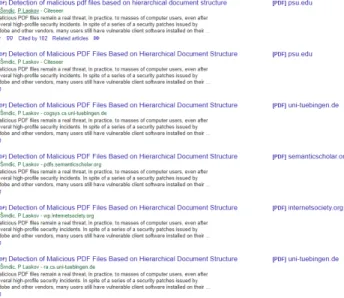
Figure 1 presents a snapshot of search results for a searched paper using Google Scholar. At the bottom of the page, one can access all 15 versions of the paper, already indexed by Google Scholar, simply by clicking on the blue
FIGURE 1. Google Scholar’s search results for a given academic paper, including 14 additional versions of the paper.
FIGURE 2. Some of the additional versions of the searched paper, including those available for free.
‘‘All 8 versions’’ link; in this way, free and convenient ver-sions are literally at the user’s fingertips, as seen in Figure 2. Note that there are several versions from different sources (e.g., psu.edu, uni-tuebingen.de, semanticscholar.org).
Researchers heavily use scholarly digital libraries to access and download scholarly documents [33]. For exam-ple, according to a survey by EBLIDA,1 there are a total of 5,974 academic libraries in Europe; however, this number is far from complete given that it is based on information provided by only 25 countries participating in the survey. Nevertheless, the number of registered users of these libraries is 39,328,294. As Europe represents only part of the world’s research activity, the global usage of scholarly digital libraries is much higher.
Universities are considered to be highly reputable insti-tutions that primarily focus on research, the goal of which is to contribute new and valuable knowledge to the world. Therefore, they are considered a trusted content source with no malicious intent. Correspondingly, the websites of their academics and researchers (which often reside on the insti-tution’s network domain) are also thought to contain only trusted content, free of malicious PDF documents. In a cir-cular fashion, academic digital libraries tend to harvest these allegedly trusted sites without hesitation or fear, and do not
1http://www.eblida.org/activities/kic/academic-libraries-statistics.html
even scan them to detect malicious content.2 In addition, their reputation as sources of trusted scholarly documents makes digital libraries an attractive platform from which to take advantage of and distribute malicious PDF docu-ments. Attackers are aware of this chain of trust and use social engineering techniques in which they take advantage of the heavy use and blind trust of researchers in schol-arly digital libraries and the papers (PDF documents) they download from them; once one researcher within an orga-nization is infected, it can quickly become a major cyber security incident for the entire organization’s computational system [32]. Researchers’ Web pages have become a target that can be used to launch attacks.3In addition, researchers, professors, and research students are naturally attractive can-didates for attack, because, due to the nature of their work, they have access to confidential and sensitive information, such as nuclear knowledge, medical records, aviation, and educational records and materials (e.g., student data, exams, etc.). Moreover, some researchers collaborate with govern-mental agencies and industry, which allows them access to national and confidential information from governments (such as computational criminology), national institutions, and companies’ intellectual property, while other researchers collaborate with healthcare institutions and hospitals, and are connected to their networks and computerized systems [34].
Previous studies have presented many methods of improv-ing the detection of malicious PDF documents [1], [2]. These studies focused on detection techniques based on analyzing the malicious PDF documents when they have already been downloaded to the host machine. To the best of our knowl-edge, no study has addressed the issue at an earlier stage, before downloading, a stage at which it might be possible to prevent malicious PDF documents from being mass dis-tributed through legitimate channels and exiting platforms, and thus, markedly improve the detection of malicious PDF documents, including those found on popular, well-known, and extensively used sources of PDF documents, such as scholarly digital libraries. These libraries can be intentionally used as a free and very successful platform for distribut-ing PDF malware quickly and easily to a desired group of victims with access to valuable information. An academic paper arouses little suspicion, particularly if an attacker wants to distribute a new zero-day attack quickly in the shape of a benign PDF document. Zero-day attacks4 utilizes new attack techniques or new vulnerabilities5that are difficult to detect, particularly by the anti-virus tools commonly used by organizations such as universities and academic digital libraries for scanning PDF documents. Thus, these libraries can easily be used as a new and convenient platform for
2According to the CiteSeerX team, some of whom are authors of this
paper. 3 http://www.nytimes.com/2013/07/17/education/barrage-of-cyberattacks-challenges-campus-culture.html?pagewanted=all&_r=0. 4 http://www.bullguard.com/bullguard-security-center/pc-security/computer-threats/what-are-zero-day-attacks.aspx 5http://www.pctools.com/security-news/zero-day-vulnerability/
distributing zero-day attacks. One should take into consid-eration that these libraries are a very dynamic environment in which a large number of papers are added daily; thus, even advanced detection solutions for PDF malware based on machine learning algorithms [1] will lose their generalization capabilities regarding the detection of unknown PDF mal-ware, since both for benign and malicious PDF documents the data and patterns concealed in them change rapidly and often. Consequently, an efficient and frequent update process is required in order to maintain and improve the detection of PDF malware in light of the daily additions of new PDF documents into these scholarly digital libraries.
Smutz and Stavrou [52] suggested a variant of the query by committee [55] method to improve the detection of PDF classifier. Their method included mutual agreement analysis which was found effective at identifying specific samples to be added to the training set, resulting in significant improve-ment in the classifier’s performance compare to when random sampling method was used. However, this method requires maintaining an ensemble of different classifiers, a require-ment that can be dismissed by using methods of another active learning approach that enables the use of only one classifier. Keeping pace with newly created documents was demon-strated in recent years by Nissim et al. [11], [15], [20], using active learning (AL) methods [38], which have been integrated and used in the solution we present in this study. The contributions of our paper are fourfold:
1) We are the first to demonstrate the vulnerability of large public databases such as scholarly digital libraries, as well as the first to present several simple approaches and techniques that can be used to compromise these libraries and utilize them for malicious purposes. 2) We are the first to reveal the malicious use of scholarly
digital libraries and also the first to estimate the extent of this phenomenon. Using current anti-viruses, after indexing we were able to assess which papers contained malware. To support our findings and emphasize the severity of the phenomenon, we also performed further analysis one year after our initial evaluation of papers that were collected by the CiteSeerX digital library over a period of eight years.
(3) We are the first to investigate very large databases, such as scholarly digital libraries that are traditionally thought to be secure and harmless, and showed how they can be maliciously used as a platform for malware distribution and leveraged for targeted cyber security attacks. We also evaluated the impact of the presence of malicious documents in a scholarly digital library. (4) In this study we also present and implement Sec-Lib,
a comprehensive and adaptive detection framework aimed at enhancing the security of very large databases such as scholarly digital libraries. Sec-Lib encom-passes both deterministic and advanced machine learn-ing approaches (e.g., active learnlearn-ing for updatlearn-ing based on the frequent changes in these libraries) in order to provide a comprehensive solution for the detection
of malicious papers (PDF malware) in scholarly dig-ital libraries. While the machine learning approaches used in Sec-Lib are based on our previous work [11], we have extended and improved our original approach, by adding deterministic detection layers to Sec-Lib and rigorously and empirically evaluating Sec-Lib, using real data originating from a scholarly digital library and demonstrating that it can substantially reduce the number of malicious PDFs included in these libraries. II. BACKGROUND
As indicated previously, the Web contains more than 114 mil-lion scholarly documents [5], and this number represents a significant attack surface for adversaries who want to take advantage of the fact that scholarly digital libraries are considered trusted and their content (PDF documents) is downloaded by many users worldwide. In order to grasp the potential harm that can be caused by the presence of malicious PDF documents in a scholarly digital library, we briefly describe targeted attacks conducted via schol-arly digital libraries using malicious PDF documents. Then, we present the possible attacks that can be launched by a malicious PDF document mistakenly considered a benign scholarly document, and the techniques used to achieve this. In so doing, we aim to raise the awareness of scholarly digital libraries, as well as innocent researchers and readers, regarding the power of a malicious PDF document, so that they will increase their vigilance against such attacks and employ the best security means possible.
A. TARGETED ATTACKS VIA SCHOLARLY DIGITAL LIBRARIES USING MALICIOUS PDF DOCUMENTS
Sophisticated attackers interested in sensitive and novel knowledge about a specific domain, such as nuclear energy, can launch a targeted attack by inserting an attractive, yet malicious, paper that addresses nuclear energy into digital libraries, engaging and tempting researchers to download the paper. It is noteworthy that the attacker does not need to be a co-author of the paper. Our investigation showed that most scholarly digital libraries (such as Google Scholar) crawl academic websites and index the papers they find, disregard-ing any mismatches between the author’s affiliation and the website that stores the paper. Thus, an attacker can take a popular paper written by someone else, inject malicious code into it, and upload it to several websites. When the victim opens the malicious PDF document, a malicious code will be executed in the victim’s computer. This malicious code may allow the attacker to exfiltrate data from the victim’s machine and send it to a remote server controlled by the attacker.
This type of attack is within the realm of reality, for the pre-viously mentioned reasons, and also because users consider non-executable files safer than executables, and thus are less suspicious of PDF documents, especially when downloaded from popular and trusted scholarly sources. Unfortunately, non-executable files such as PDF documents are as dan-gerous as executable files, since their readers can contain
vulnerabilities that, when exploited, can allow an attacker to execute malicious actions on the victim’s computer. Syman-tec’s Internet Security Threat Report (ISTR6) 2016 indicates that malicious PDF documents are used for targeted attacks, especially via malicious emails. Note that since that time, the number of targeted attacks on Adobe Reader has almost doubled. In the following section, we elaborate on several of the most common techniques and attacks involving the use of malicious PDF documents.
B. POSSIBLE ATTACK TECHNIQUES USING PDF DOCUMENTS
Before explaining how scholarly digital libraries can be easily used as a platform to leverage and distribute attacks world-wide, we present some of the many ways PDF documents can be used maliciously when created or manipulated by an attacker.
1) JAVASCRIPT CODE
PDF documents may contain embedded JavaScript code or code retrieved from URIs [22], including 3D content, form validation, and mathematical calculations. Typically, a mali-cious JavaScript code in a PDF document attempts to exploit a vulnerability in the PDF viewer in order to divert the nor-mal execution flow to the embedded nor-malicious code. This is achieved by a heap spraying7attack. JavaScript also allows the download of an executable file that may contain malicious content. Alternatively, JavaScript code can access websites, whether malicious or benign.
2) CODE OBFUSCATION AND FILTERS
Code obfuscation is used legitimately to prevent reverse engi-neering of proprietary applications. However, it can also be used by attackers to hide malicious content. Filters are used in PDFs to compress data for encoding and reducing file size, and are frequently used by attackers to conceal mali-cious content. Available filters and their primary purposes are discussed by Baccas and Kittilsen [23], [24].
3) EMBEDDED FILES
A PDF document can contain other file types, such as HTML, JavaScript, SWF, XLSX, EXE, or even another PDF docu-ment, which can be used to embed malicious files that are frequently obfuscated. When special techniques are applied, the embedded file can be opened without alerting the user. Maiorca et al. [25] presented a novel evasion technique called ‘‘reverse mimicry,’’ which was designed to evade state-of-the-art malicious PDF detectors based on their logical structure8 [21]. Mimicry attacks inject malicious content into a benign PDF while maintaining its benign structure.
6
https://www.symantec.com/content/dam/symantec/docs/reports/istr-21-2016-en.pdf
7Heap Spraying - A technique used in exploits to assist random code
execution.
8PDF logical structure is a hierarchy of structural elements, each
repre-sented by a dictionary (see the PDF file structure section).
This method can be automated easily and does not require knowledge of the structural features used in the maliciousness detector.
4) FORM SUBMISSION AND URI ATTACKS
Hamon [4] presented practical techniques that can be used by attackers to execute malicious code from a PDF document. The author showed that security mechanisms, such as the Protected Mode of Adobe Reader X or the URL Security Zone Manager of Internet Explorer, can easily be disabled by changing the corresponding registry key. Moreover, a URI9 address can be used (instead of a URL), directing the user to any type of file located remotely, including executables.
It should be noted that Adobe Reader version X, released in 2011, included a new sandbox isolated environment, Protected Mode Adobe Reader (PMAR), that ensures that malicious code operations cannot affect the operating system. Nevertheless, most organizations (including universities) do not keep up with the newest versions of PDF readers, and thus, are exposed to many of the well-known attacks. C. ANALYZING VULNERABILITIES OF POPULAR SCHOLARLY DIGITAL LIBRARIES
Now, we briefly present the most popular libraries, their market share, and their uniqueness, and then explain the vulnerabilities that exist within them. In addition, we present new vulnerabilities that we utilized to demonstrate potential attacks. We present three libraries in which we found a vul-nerability.
1) GOOGLE SCHOLAR
Google Scholar10 is a free public Web search engine for scholarly literature. It indexes nearly 100 million scholarly documents and is considered the largest scholarly digital library, encompassing 87% of the total number of the existing scholarly documents [5]. Current articles are indexed and can be found when searched. A user clicking on an article that appears on the results page of Google Scholar is usually directed to the article’s Web page on the publisher’s official website. In addition to articles on the publisher’s website, other versions of the papers, from other places on the Web are also indexed (e.g., papers from a researcher’s Web page on an academic institution’s website).
In order to demonstrate contamination of a digital library such as Google Scholar, we used the Web page of a researcher at a known university (details are not provided for privacy reasons). The articles on the researcher’s Web page were indexed by Google Scholar previously and can be accessed by clicking the ‘‘All X versions’’ link under the relevant article in Google Scholar, as shown in Figure 1. With no connection to the researchers’ names appearing in Figure 1, in our case, after we had obtained the permission of the researcher
9URI– ‘‘a compact string of characters for identifying an abstract or
physical resource,’’ RFC2396. A URI is an extension of a URL, used for identifying any Web resource (not limited to Web pages).
mentioned above, we downloaded the most popular paper (a PDF document) from his web page and injected a malicious JavaScript into it using a PDF editing program called PDF-Fill11 (such that the malicious JavaScript code is launched when the new article’s file is opened). Then, we replaced the benign paper with this new malicious version of the paper on the researcher’s website. Now, the malicious paper is available for downloading through Google Scholar using the original indexing information that was neither changed nor updated in light of the replacement of the paper behind the published URL. The vulnerability in Google Scholar lies in the indexing mechanism, which checks only the title and author’s name and pays no attention to whether a new file was uploaded with the same title and author’s name.
As far as we could determine, Google Scholar does not verify that the uploaded paper is related to the researcher’s home page. Thus, a malicious PDF document that carries the same title and authors of a popular paper can easily be created and placed on other Web pages unconnected to a researcher’s home page within a university. These malicious papers can easily be promoted with an acceptable payment to Google for a promoted link. In this way, the attacker uses several elements of existing tools and services to launch his/her attack. First, the attacker takes advantage of the pop-ularity of a particular paper, second he/she uses the fact that Google Scholar is a trusted source of information, and third the attacker exploits a vulnerability in the Google Scholar indexing mechanism. Consequently, the attacker achieves his/her attack goals by redirecting the download traffic to the malicious version of the paper.
2) CiteSeerX
CiteSeerX12 is a growing scientific literature digital library and search engine that focuses primarily on literature in the areas of computer and information science. It is unique in that it collects papers solely from researchers’ home pages from the domains of universities and physically stores the papers themselves and creates links to the papers. The result is that the library contains over four million academic papers in PDF format, and its total size is estimated at about 3.8 terabyte.
According to the way in which CiteSeerX collects aca-demic documents, we identified several methods by which a malicious PDF paper could be indexed and stored by a popular digital library. A malicious paper could be uploaded to a researcher’s website directly. This can happen uninten-tionally if the paper was infected by a malware resident on the researcher’s computer before it was placed on the website. Alternatively, the paper could be contaminated using a free, malicious PDF creator that injects malicious code into the edited papers. Another likely scenario is that the researcher’s page could be hacked, with the attacker replacing a benign paper with a malicious one. In each of these examples, a mali-cious paper finds its way to the researcher’s home page within
11http://www.pdfill.com/ 12http://csxstatic.ist.psu.edu/about
an academic institution’s trusted domain, making it available for uploading by CiteSeerX, as well as to the general public worldwide.
3) SOCIAL NETWORK BASED SCHOLARLY DIGITAL LIBRARIES
ResearchGate13(founded in 2008) is a social networking site for scientists and researchers, enabling them to share papers, communicate, and find collaborators. Today, it has more than six million members. ResearchGate is also considered an academic digital library as its members can upload and share papers with other members.
Academia.edu14 (launched in September 2008) is a platform for academics for sharing research papers, moni-toring their impact, and following researchers in a partic-ular field. Over 63 million academics have signed up to Academia.edu, adding ∼21 million papers. Academia.edu attracts over 19 million unique visitors a month.
ResearchGate and Academia.edu are examples of schol-arly academic digital libraries affiliated with social networks for researchers whose purpose it is to share data, papers, and knowledge with other researchers.
To utilize scholarly digital libraries for malware distribu-tion, an attacker can create a fictitious profile of a famous researcher through Academia.edu. The attacker can then upload several of the researcher’s well-known papers in order to boost the profile’s credibility and gain the trust of col-leagues. After several weeks, when the profile is active and papers have been downloaded from the profile, the attacker can easily upload a malicious version of the same papers in order to perform an attack. A malicious PDF document (a non-zero-day malicious PDF document) that should be recognized by an anti-virus tool will not be rejected when uploaded, since such scholarly digital libraries have limited security mechanisms. In this way, social relationships and trust can be used in order to leverage to a social network-based library for the distribution of a PDF malware.
4) ADDITIONAL EXISTING SCHOLARLY DIGITAL LIBRARIES The following are additional existing scholarly digital libraries that we have not yet checked for vulnerabilities; however, we assume that vulnerabilities exist and should be further investigated.
Microsoft Academic Search15(MAS) is a free public Web search engine for academic papers and literature, developed by Microsoft Research for the purpose of algorithm research on object-level vertical search, data mining, entity linking, and data visualization. Microsoft Academic Search consists of almost 50 million scholarly documents and is considered one of the top alternatives to Google Scholar [5].
13http://www.researchgate.net/ 14https://www.academia.edu/
Web of Science16is an online subscription-based scientific citation indexing service maintained by Thomson Reuters that provides comprehensive citation search. It consists of nearly 50 million scholarly documents and is, along with MAS, among the largest academic digital libraries after Google Scholar [5]. One should note that Web of Science does not index the PDF documents, as Google Scholar does. PubMed17 is a free search engine that primarily accesses the MEDLINE database of references and abstracts on life sciences and biomedical topics. The United States National Library of Medicine at the National Institutes of Health main-tains the database as part of the Entrez system of information retrieval. PubMed comprises over 24 million citations of biomedical literature from MEDLINE, life science journals, and online books. Citations may include links to full-text content from PubMed Central and publishers’ websites.
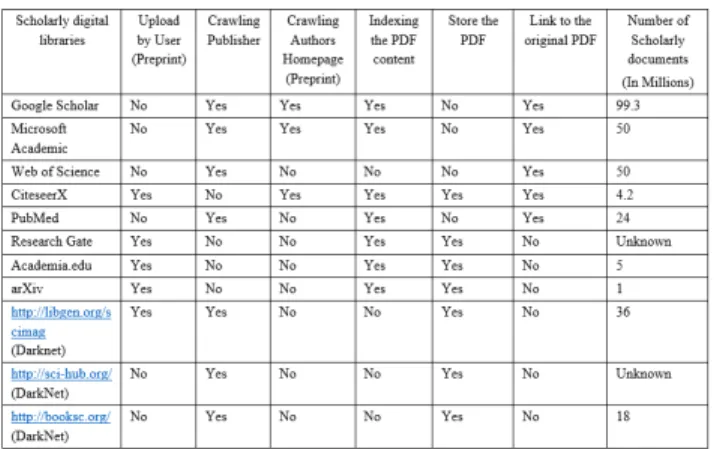
arXiv is an automated electronic repository and distri-bution server for research articles, consisting of electronic preprints of scientific papers in the fields of mathematics, physics, astronomy, computer science, quantitative biology, statistics, and finance, which can be accessed online. Almost all scientific papers within arXiv are self-archived, meaning that they were uploaded by the users themselves. Table 1 sum-marizes some interesting details about the scholarly digital libraries mentioned in this section, as well some libraries from the Darknet.
TABLE 1. Summary of Scholarly digital libraries’ details regarding to their crawling, indexing and redirecting approaches to the scholarly
documents.
The largest libraries, Google Scholar, MAS, and Web of Science, do not rely on papers uploaded by users as they collect (crawl) papers from the publishers and do not store them. Note that there are several closed grouped libraries within the Darknet, such as Libgen, Sci-hub and Booksc, and we assume that specifically in these closed libraries the probability and percentage of malicious papers is higher than in the known and wide-open libraries. This assumption should be scrutinized in future research.
16https://apps.webofknowledge.com/ 17http://www.ncbi.nlm.nih.gov/pubmed
III. SCANNING CiteSeerX FOR PDF MALWARE
As part of this collaborative study with the CiteSeerX team, we scanned and analyzed the CiteSeerX digital library as our dataset. Our goal was to determine whether this platform had already been used, either intentionally by an attacker or unin-tentionally by an innocent researcher, to distribute malicious PDF documents, and in so doing, to measure the extent of harm that can be caused by such a scenario. When we began scanning, the CiteSeerX library contained 4,044,118 aca-demic papers in PDF file format that were collected until the time this study began. The papers originated from more than 188 countries and most continents and were written by 1.3 million different authors from 4,963 universities.
We used the VirusTotal18 service to scan the entire CiteSeerX library for malicious PDF documents. VirusTotal, a subsidiary of Google, is a free online service that provides comprehensive analysis of files and websites (URLs) by a set of∼63 anti-virus engines and website scanners. VirusTotal allows a user to submit suspicious files for analysis. After the analysis, VirusTotal provides a report that lists suspicious files identified by each of the anti-virus engines. Note that we considered a PDF document malicious, if at least five different anti-viruses identified it as a malicious file. A. SCANNING RESULTS OF CiteSeerX IN 2015
In this section we present the results and provide an analysis of the results regarding the process of scanning of the PDF documents within the CiteSeerX library. We provide an anal-ysis of aspects of both crawling and downloading the mali-cious papers, on the basis of a worldwide breakdown. Some of these scanning results were presented in our preliminary paper published recently [19], however in the current work we explain it more comprehensively, and also present our novel detection methodology, Sec-Lib, and its evaluation in terms of the detection of PDF malware in scholarly digital libraries. 1) CRAWLED MALICIOUS PAPERS
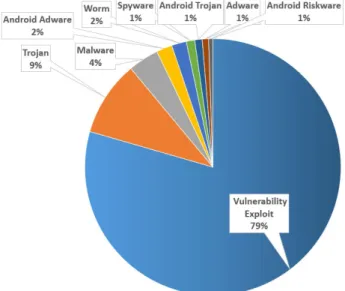
Of the 4,044,118 PDF files that were submitted for analysis from the CiteSeerX library, only 2,586,820 were actually scanned by VirusTotal due to our license and network band-width limitations. Of these files, 753 (∼0.3%) were found and classified as malicious by VirusTotal’s anti-virus engines. Figure 3 presents the breakdown of the threats identified.
The threat categories were provided by the identifying anti-virus engine. As can be seen in Figure 3, 72% of the malicious files were identified a vulnerability exploitation.19 Usually, a vulnerability in the PDF document format is exploited utilizing an embedded JavaScript code.209.5% of the malicious files were classified as a Trojan, a malicious program that when executed performs covert actions that have not been permitted by the user. 7.5% of the malicious files
18https://www.virustotal.com/
19http://searchsecurity.techtarget.com/definition/exploit
20
FIGURE 3. Breakdown of the threats identified among the 753 malicious PDF documents found by VirusTotal on the CiteSeerX library.
contained JavaScript code that was recognized as malicious. JavaScript code can be identified as malicious although it does not exploit any vulnerability and is considered malicious when the code signature is known to represent a malicious code. 3.9% of the malicious files were classified as malware, which means that malicious software (e.g., Exe, PDF, etc.) was found embedded in them. 3.4% of the malicious files contained a threat (Adware,21 Trojan, or Riskware22) tar-geting the Android operating system widely used on mobile devices. 1.9% of the malicious files contained a computer worm,23 which is a malicious program that can propa-gate by autonomously copying itself from one machine to another. A small percentage of files (1.1%) were classified as Spyware,24which is a malicious computer program aimed at collecting personal information from the victim’s computer. Although it does not damage the victim’s computer, it can cause damage to the victim by stealing sensitive informa-tion. Adware is a program aimed at supporting advertising and operates without the user’s permission. An additional 5,775 files were identified as malicious by the Fortinet anti-virus, because they contained a suspicious threat called ‘‘HTML/Redirector.BK!tr.’’ These files might be malicious, since they may direct the user to malicious destinations such as websites, IP addresses, and servers. Deeper analysis is required to reach a final decision; however, in case these files would be found to be malicious, and the percentage of malicious PDF documents in the CiteSeerX library will increase from 0.3% to 2%, this situation will emphasizes the phenomenon of scholarly digital library contamination we describe in this paper.
21http://www.pctools.com/security-news/what-is-adware-and-spyware/ 22http://usa.kaspersky.com/internet-security-center/threats/riskware 23http://www.pctools.com/security-news/what-is-a-computer-worm/ 24http://www.microsoft.com/security/pc-security/spyware-whatis.aspx
FIGURE 4. Distribution of the malicious scholarly documents based on the geographical location from which they were crawled by CiteSeerX scholarly digital library.
Figure 4 presents the distribution of the malicious schol-arly documents according to the geographical location from which they were crawled by the CiteSeerX scholarly digital library. More than 55% of the malicious papers in CiteSeerX were crawled from IP’s belonging to US universities, whereas about 33% were crawled from IP’s belonging to European universities. Asia includes several countries, e.g., China, Russia, and Korea, which on the one hand are known to have a large population of researchers and on the other have been found to be the origin of many malware samples. Because of this, we were surprised to find that only 5.9% of the mali-cious papers were crawled from IP’s belonging to an Asian institution; we did not find any malicious papers crawled from Russia or Korea which are the origin of a great deal of malicious content, especially malicious Android applications found in application markets [10].
In Table 2, we can see the top 11 European countries in terms of the percentage of malicious scholarly documents crawled from researcher’s homepages and websites associ-ated with IP addresses belonging to these countries. While Germany was found to be the origin of 10.7% of the malicious
TABLE 2.Breakdown of the distribution of the malicious scholarly documents based on the geographical location from which they were crawled by CiteSeerX scholarly digital library (of the entire world’s malicious papers).
papers in CiteSeerX among all of the countries around the world, it is the origin of more than 31% of the malicious papers in CiteSeerX among all European countries. It was followed by the United Kingdom (6.04%), Holland (2.74%), and France (2.61%). The other European countries not men-tioned here were the origin of less than 0.41% of malicious scholarly documents of the entire world’s malicious papers in CiteSeerX.
2) DOWNLOADED MALICIOUS PAPERS
We now present the impact and power of an attack stemming from malicious papers published in a scholarly digital library. Using CiteSeerX’s database and its website’s historic log files, we extracted and aggregated information regarding the download data of the malicious papers we found. We faced a ‘big data’ problem due to the enormous amount of data we needed to extract and process, and therefore, we extracted the downloading information for only the top 31 malicious papers identified by a large number of anti-virus engines out of the total 723 malicious papers that were found. We focused on the download statistics for the five preceding years, and there-fore, we can provide conclusions regarding relevant down-load trends. In addition, we also used GNU Parallel25to boost the speed and reduce the very long running time. The data comprised 5197 successful downloads of malicious papers (during 2009-2014) which resulted from just 31 malicious papers crawled by CiteSeerX’s, meaning that scholarly digital libraries have had an average ‘damage coefficient’ of167 in the last five years.
Note that the papers are downloaded based on the inter-est they create among readers in the scientific community, regardless of how malicious and dangerous they are. There-fore, the number of times papers are downloaded is not dependent on their level of maliciousness. Thus, the papers that were identified as malicious are in fact randomly selected in terms of the number of downloads; consequently, this number is not affected when other (more malicious or less malicious)randomly selected papers are chosen @perioBy calculating the damage coefficient, our goal was to present the damage rate for the most dangerous papers and emphasize the importance of the phenomenon of scholarly digital library contamination with malicious papers.
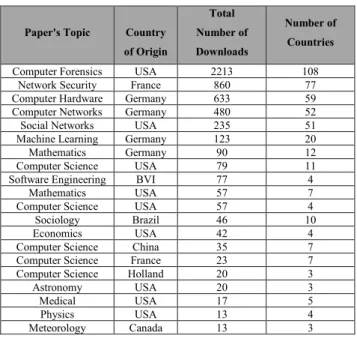
The average number of different countries that downloaded malicious papers was 16, covering all of the continents (except for Antarctica), which constitutes extremely wide coverage of the world’s research population within univer-sities and other institutions. Table 3 presents information regarding the top 20 most downloaded malicious papers (from CiteSeerX) during the last five years. The most down-loaded malicious paper is on the topic of computer forensics and apparently was a malicious version of a very popular paper; it was downloaded 2213 times in 108 different coun-tries on all continents (except for Antarctica). The popular
25http://www.gnu.org/software/parallel/
TABLE 3.Top 20 most downloaded malicious scholarly documents during the last five years, their country of origin, and the number of countries in which they were downloaded.
topics among malicious papers were related to computers, such as cyber security and computer science.
Figure 5 presents the distribution of the malicious schol-arly documents according to the geographical location from which they were downloaded from CiteSeerX scholarly dig-ital libraries. More than 40% of the malicious papers in CiteSeerX were downloaded from US IPs, whereas about 28% were downloaded from Asian IPs.
FIGURE 5. Distribution of the malicious scholarly documents according to the geographical location from which they were downloaded from CiteSeerX scholarly digital library.
Figure 4 shows that the US was the origin of more than 55% of the malicious papers in CiteSeerX. The data presented in Figure 5 and Table 4 indicates that the US was also the most popular destination of malicious papers and the location of more than 40% of the downloads of malicious papers, fol-lowed by India (9.52%), China (5.04%), and the UK (3.77%). As can be seen, using a scholarly digital library as a platform,
TABLE 4. Top countries downloading most of the malicious scholarly documents from CiteSeerX during the last five years.
an attacker can easily distribute a worldwide attack through a malicious scholarly document.
IV. Sec-Lib: A FRAMEWORK FOR MALWARE DETECTION IN SCHOLARLY DIGITAL LIBRARIES
After our discovery of malicious PDF documents in the CiteSeerX scholarly digital library, we informed CiteSeerX team about the malicious PDF documents, as well as the potential harm that could be caused by not attending to this problem. We also shared our ideas and practical solutions regarding how to address the issue with CiteSeerX. These ideas and solutions presented in this paper were used to develop the Sec-Lib framework. Sec-Lib is a comprehen-sive detection system aimed at enhancing the security of very large databases, such as scholarly digital libraries. Such databases share characteristics, including: 1) being frequently updated with many new files (e.g. PDF documents) on a daily basis, 2) being affected by external factors, such as the discovery of new vulnerabilities and attack techniques that can be exploited via the hosting program of such files (e.g. Adobe reader), and 3) containing new malicious versions of papers that already exist within the database. Sec-Lib inte-grates two security layers in order to enhance the detection of malicious PDF documents within scholarly digital libraries. The first layer includes a set of deterministic and rule based detection solutions aimed at the detection of 1) known mal-ware, 2) known vulnerabilities, and 3) incompatibility of PDF documents. The second layer consists of several advanced machine learning based methods for the efficient detection of unknown malicious PDF documents, as well as improving the detection capabilities of the framework on a frequent basis.
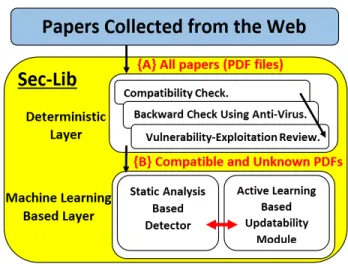
Figure 6 demonstrates the Sec-Lib framework and its two layers. The dynamic database consists of the existing papers in the digital library as well as the new papers which are published daily and collected from the Web according to the library’s policy. This policy might include collecting
FIGURE 6. Sec-Lib framework.
papers from authors’ official websites, open access journals, forums, etc. Then, in step {A} all of these PDF documents are inspected in the deterministic first layer which is partic-ularly aimed at the detection of known PDF malware and its variants, and includes:
• A compatibility check of PDF documents to ensure that they can be properly opened by users before they are made available to library users. (96.5% of malicious PDF documents are incompatible).
• Filtering by the backward check module which filters all
of the known malicious PDF documents using an anti-virus signature repository.
• An additional review of each new PDF
vulnerability-exploitation identified.
Note that we don’t apply the machine learning based layer (second layer) directly on all of the PDF documents for the following reasons. 1) Before implementing the machine learning algorithms, we execute anti-virus software, thereby allowing the anti-virus software to detect as many known malicious files as possible (based on its existing signatures) in the first deterministic layer. It is well-known that machine learning algorithms have had great success in detecting new variants of malware, as well as in assisting in the crafting of signatures for malware. Despite this success, their false pos-itive and false negative rates are typically higher than those of anti-virus software (especially in light of the increased use of adversarial machine learning approaches [55]). Since a system like Sec-Lib is expected to cope with an enormous number of new PDF files on daily basis, Sec-Lib should be efficient and employ a multilayer process; therefore, we use the anti-virus in the first layer and employ the machine learning based detector in the next layer on the remaining files (those files that the anti-virus software couldn’t detect as malicious due to its limited detection capabilities).
2) There is no reason to use machine learning solutions on incompatible files, both malicious and benign, as these incompatible files are not openable, and thus, will not be
transferred to the user. These two modules manage to filter out (in advance) all of the files that don’t require classification by a machine learning algorithm, while focusing the machine learning-based layer on the remaining more hard to detect files. Since scholarly digital libraries consist of millions of files, a practical solution must be efficient and only focus its efforts on files that cannot be handled by the other deter-ministic components. Therefore, machine learning solutions are aimed at compatible and unknown PDF documents, both malicious and benign.
Once step {A} is completed, we are left with compatible PDF documents which might contain new unknown PDF malware. These files undergo deep inspection in step {B} (in the second layer) which features a machine learning based approach aimed at new unknown malware detection and includes two advanced components:
• A detector that is based on machine learning techniques
and aimed at malicious PDF document detection, which efficiently leverages the statically extracted properties of the structural hierarchies in the PDF documents.
• An active learning-based module and methodology for
frequent and efficient update of both the detector and anti-virus tools with new informative PDF documents, especially new malicious ones.
We now elaborate on each of the components in the deter-ministic first layer:
A. COMPATIBILITY CHECK OF PDF DOCUMENTS
In our previous works [2], [11] we observed that many mali-cious files are not compatible with the PDF document format specifications according to the Adobe PDF Reference26and cannot, in fact, be opened by the PDF reader and viewed by the user. When the user tries to open an incompatible file (malicious or benign), the PDF reader is not able to open it and provides an error message. If it is a malicious PDF document, the malicious operation is executed; if it is a benign file, nothing occurs. However, in both cases the file remains unopened and cannot be viewed by an innocent user. Thus, it is clear that there is no reason to deliver an incompatible file to the user, and this observation should be taken into account in academic digital libraries, which can easily identify such files and mark them as suspicious, or even block them from being published before they are ever opened by an innocent user. Incompatibilities of PDF documents are originated in cases which the crafted PDF documents do not meet the PDF document format specifications according to the Adobe PDF Reference. One example of incompatibility of PDF documents can be observed at the end of the file in the line between ‘‘startxref’’ and ‘‘%%EOF’’ lines. This line should contain a number serving as a reference (offset) to where the last cross reference table section is located in the file. In cases of incompatibility, the number that appears is incorrect. This incompatibility and many others can be easily
26http://www.adobe.com/content/dam/Adobe/en/devnet/acrobat/pdfs/
pdf_reference_1-7.pdf
determine using simple check of the PDF document content in light of the known specifications.
B. BACKWARD CHECK USING ANTI-VIRUS TOOLS
One of the vulnerabilities we found in academic digital libraries (particularly Google Scholar) relies on the fact that once a new paper is initially uploaded and indexed, it is then assumed to be scanned to verify that it is virus free. However, in cases in which the clean paper file behind the indexed link is later replaced by a malicious version, the file is not rescanned and is now the paper version is available as a malicious file through these libraries. We suggest applying a simple check of the hash function behind each indexed file after it is first uploaded (therefore it is backward check). By comparing the original hash function to a daily hash function of each indexed file, a mismatch between the daily hash of the file and the original version acquired on the initial upload will serve as an indication that the file should be further scanned using Anti-Virus to verify that it is virus free. This idea can also be improved by adding an additional condition, so that the files for which there is a mismatch between the abovementioned hash functions, will only be scanned if the user asks to access this paper, otherwise a scanning operation will not be performed. On the one hand, this improvement will significantly reduce the amount of inspections required, while protecting the users from down-loading malicious PDF papers. However, on the other hand, this idea will require an online check when the user wants to download the file, an operation that will increase the time it takes for a user to request and receive a desired paper.
In addition, most benign documents don’t usually use JavaScript, OpenAction or the embedding option of the PDF format. This is particularly true for academic papers which don’t have any reason to use these option. Thus, a simple approach in the case of scholarly digital libraries is to remove any element that can be used for malicious purposes (includ-ing JavaScript code, OpenAction commands or embedded files) from the PDF paper. However, such an approach might lead to a loss of data and or functionality or cause the file to become incompatible; thus, rather than changing the file’s content by removing parts of the file, we prefer detecting the malicious content of known malware using AV tools and ML algorithms for unknown malware.
C. NEW PDF MALWARE BACKWARD CHECK
While the vulnerabilities of new PDF documents are iden-tified from time to time by virus experts, the length of the discovery period might be quite long. Meanwhile, the new vulnerability is being used and distributed in additional PDF documents. If a zero-day malware contains such new vulnera-bilities, it will probably evade the widely used anti-virus tools for some time. Therefore, as new vulnerabilities are discov-ered and anti-virus tools are updated accordingly, we suggest a periodic re-check of new vulnerabilities in order to provide a comprehensive and backward review of a process that could
easily be automated for all of the files already exist in the scholarly digital library.
This idea can be improved upon in exactly the same manner we suggested in the previous subsection, by adding the con-dition of conducting this check only if the user asks to access this paper. The consequences and effects of this will be the same as was mentioned in the previous subsection, both in terms of efficiency and time delay.
We now elaborate on each component of the machine learning based second layer.
D. AN ACTIVE LEARNING BASED DETECTION METHODOLOGY FOR UNKNOWN MALWARE DETECTION
Before we present the active learning based detection methodology, one must first understand the motivation for active learning in very large databases and repositories. In addition, since active learning process is strongly related to the induction of an updated detection model, which is based on informative features, then we will also cover the features on which we were based on when we induced the detection model.
Currently, anti-virus packages are not sufficiently effec-tive at intercepting malicious PDF documents, even in the case of highly prominent PDF threats (Tzermiaset al.[8]). According to many studies (surveyed by Nissimet al.[1]), machine learning methods can effectively distinguish between malicious and benign PDF documents [1]. Yet, when applying machine learning based solutions, it is not enough to create a one-time detection model, since a natural concept drift process exists ([11], [13]), specifically in the malware domain [13]. This is due to the fact that benign files and newly created malware contain new properties and features that haven’t been seen by the detection model, as well as existing features with very different values than those the detection model has been trained on (for instance, these new features may result from new elements in the file structure). In addition, the malware domain is very dynamic, since attackers are continually seeking out new ways of attacking, new vulnerabilities that can be exploited, and new targets. These changing parameters affect the file’s structure which affect the features extracted from the analyzed file, and thus, significantly reduce the detection capabilities of the detection models which are not updated and remain outdated. Recent studies have successfully applied active learning based solu-tions for efficient malware detection (e.g. [2], [9], [11], [14], [15], [20], [35]), and concentrated on the updatability process and enhancement of the detection capabilities of the detection model, striving to improve efficiency and speed in these areas. An enhanced and updated detection model will have greater ability to detect future malware. It is therefore essential to update the detection model constantly and frequently with new files (malicious and benign) in order to maintain detec-tion accuracy over time, especially in large repositories such as scholarly digital libraries.
Since scholarly digital libraries contain vast amounts of papers and files to analyze and examine, we suggest con-ducting static analysis which is fast, lightweight, and analyzes the general descriptive content in the PDF document, rather than dynamically analyzing the JavaScript code as many approaches do. These above mentioned desired elements in static analysis can be achieved by an approach that utilizes the meta-features of the content and structure of the PDF document [3]. The advantage of using meta-features such as structural paths [3] is that they are not affected by code obfuscation. The structural path feature extraction method-ology was shown to be a very effective method to discrim-inate between malicious and benign PDFs, even for new and unknown malicious files created two months after the classification model was created.
Instead of analyzing JavaScript code or any other content, this approach makes use of essential differences in the struc-tural properties of malicious and benign PDF documents. It parses the PDF documents and extracts their structural paths which are the paths in the file’s hierarchical object tree that characterize the document’s structure. Each struc-tural path is analogous to a set of relations between the objects within the PDF document. For example, the ‘‘. . . /JS’’ path means that the PDF document contains JavaScript code. The structural paths represent the file’s properties and actions, therefore they actually represent the file’s genes rather than a current behavior of the file which can be post-poned or delayed according to specific conditions.
Note that this structural feature extraction approach has an additional significant advantage in that it does not directly rely on any specific attack element or PDF file component (e.g., it doesn’t depend on the presence of JavaScript as was proposed by [54] or embedding malicious executables). This approach identifies the discriminative features based on an analysis of the entire dataset, between the given classes. This approach will suggest using the identified features regardless of the specific attack technique; in this way, the approach will be able, with our AL advancement, to also identify newer attack techniques within the malicious PDF files.
Figure 7 provides a simple example of the conversion of a PDF document into a set of structural paths. The PDF code is treated as a tree of objects. Note that only the paths of the leaves in the structural tree are counted.
When an attacker injects malicious content into the PDF document, the file structure inevitably changes. Thus, this approach can easily discriminate between benign and mali-cious files. This approach has several advantages. First, it is not affected by code obfuscation, filtering, and other encryp-tion methods used for hiding and concealing malicious code in the PDF document, since it doesn’t actually analyze the embedded JavaScript code.
Second, it is robust towards mimicry and reverse mimicry attacks, since our detection framework implements and is based on the structural feature extraction methodology pro-posed in previous work [21]. In an experiment that included 5,000 malicious and 5,000 benign files, the authors of that
FIGURE 7. Example of the conversion of a PDF document to a set of structural paths.
study showed that this structural feature extraction method-ology is resilient to mimicry attacks in 99.975% of the cases they checked. Since our framework utilizes this fea-ture extraction methodology and even improves it with an active learning module that constantly updates the detection capabilities, our framework would be at least as resilient to mimicry attacks as the work which presented this method-ology [21]. Finally, it is very fast and lightweight, since the analysis is done statically and does not require any execution of the PDF document. Because of this, analysis is conducted quite quickly at the rate of 28ms for an average file [21]. Using the PdfFileAnalyzer27parser we parsed the compatible PDF documents and extracted all of the unique structural paths that were found within our dataset. We applied the information gain feature selection method, and this resulted in the 100 most distinctive and prominent paths. Each of these paths was used as a feature. Each PDF document was repre-sented as a vector of Boolean features so that the presence (1) or absence (0) of a structural path within a PDF document is represented by 1 or 0 respectively.
There are three main approaches for feature selection:
filter methods,wrapper methods, andembedded methods[51] Filter methods use a metric to evaluate the correlation of each individual feature to the target class. The information gain
feature selection method [50] is a type offilter method[51] which assigns a higher score to features that contribute more to discrimination between the classes. Information gain is based on entropy calculations. The entropy E(S) character-izes the disorder of an arbitrary set of instances. The higher the entropy the greater the disorder. Equation 1 presents the formula for calculating the entropy of a set of items S (e.g., feature’s values), based on C subsets of S (e.g., item classes). The information gain measures the expected reduc-tion of entropy caused by dividing the examples according to attribute A, in which V is the set of possible values of A,
27 http://www.codeproject.com/Articles/450254/PDF-File-Analyzer-With-Csharp-Parsing-Classes-Vers as shown in Equation 2. E(S)=X cC −|Sc| |S| ·log2 |Sc| |S| (1) IG(S,A)=E(S)− X vV(A) |Sv| |S| ·E(Sv) (2)
Table 5 shows the 14 most prominent features of the 100 selected features. Their rank and selection criterion are also included in the table. It is interesting to note that none of the 14 prominent features are associated with any of the elements that are known to be utilized in attacks (e.g., embed-ding files, JavaScript, etc.); such a fact only points to the generality of the features, in terms of their ability to distin-guish between malicious and benign PDF files without con-sideration of the attack’s technical aspects. This is a great of importance, since these features will probably also work well when new vulnerabilities or attacks are utilized or invented. TABLE 5.The 14 most prominent features as they were ranked and selected by the information gain method.
Leveraging the abovementioned structural feature extrac-tion approach [3] using machine learning algorithms will induce the detection model. After understading the com-ponents of the induced detection model, on the following subsection we deeply explain why and how we suggest apply-ing our active learnapply-ing framework [2], [11] for enhancapply-ing the capabilities of the detection model in light of the mass creation and addition of new PDF documents to the scholarly digital libraries daily. We now describe the active learning-based framework.
E. METHODOLOGY FOR IMPROVING DETECTION OF MALICIOUS PDF DOCUMENTS.
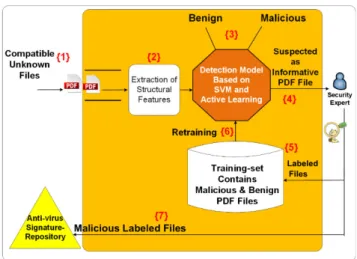
The machine learning based layer of Sec-Lib is depicted in Figure 8. It can be seen that the methodology deals with the process of detecting and acquiring new malicious PDF docu-ments through maintaining the updatability of the anti-virus and detection model. If the file is informative enough or is
assessed as likely being malicious, it will be acquired for manual analysis. As Figure 8 shows, the compatible and unknown PDF documents are transported from the determin-istic first layer and scrutinized within the second layer of the Sec-Lib framework {1}.
FIGURE 8. The process of detecting and maintaining the updatability of the detection model and anti-virus tool using AL methods.
Then, the prominent and relevant structural paths are extracted from the remaining PDF documents (which are compatible and unknown documents), and each of these paths was used as a feature. Each PDF document is now represented as a vector of Boolean features, so that the presence (1) or absence (0) of a structural path within a PDF document is represented by 1 or 0 respectively. Then the vectors repre-senting the files are introduced to the detection model which is based on SVM and AL.
The detection model scrutinizes the PDF documents and provides two values for each file: a classification decision using the SVM classification algorithm and a distance calcu-lation from the separating hyperplane {3}. A file that the AL method recognizes as informative and has indicated should be acquired is sent to an expert who manually analyzes and labels it {4}.
The goal of the manual analysis process carried out by a human expert for malware detection is to decide whether the informative file that was selected is malicious or benign, and accordingly assign a label (malicious or benign) to each file based on indicators found when the file is analyzed statically or dynamically (during run-time). In order to better understand the file’s behavior and the operation the file is actually performing during its run-time, a comprehensive dynamic analysis process must be applied. In this process, the human expert executes the file in an isolated and emulated computational environment referred to as sandbox [39], [40]. Using sandbox, the security expert is able to trace the file’s behavior in an environment that is identical to the compu-tational environment that the file will be opened in by the users: the people who will really read a given paper and open the file. Such an environment includes popular operation
systems, the relevant PDF reader version, network commu-nication, etc. In this way, the security expert can identify many of the operations taking place during the file’s run-time, and therefore malicious and dangerous operations associated with the inspected file can be recognized. Such operations might include 1) unneeded communication with an unknown remote server (can be used to exfiltrate sensitive and private information from the victim’s computer, 2) extensive encryp-tion operaencryp-tions on the victim’s hard drive (can be a good indication of a ransomware [41] attack in which the attacker encrypts the victim’s files and documents, which cannot be accessed until the victim pays the attacker demanding the ransom), 3) extensive usage of CPU and memory (can be a good indication of a cryptojacking attack [42] in which the attacker utilizes and exhausts the computational resources of the victim’s computer in order to mine cryptocurrencies28 on behalf of the attacker). On the other hand, running the informative file in Sandbox, is a secure way to understand the file’s behavior while preventing any damage or infection to users’ computers and systems. The main shortcoming of manual analysis is that the process is not straightforward, and it requires a human expert as well as computational time and resources. Therefore, our active learning-based framework helps us focus the human expert’s efforts and time on the most informative files only, aiming to obtain as much new information for the detection model as possible and keeping it updated given the volume of new malicious files created on a daily basis.
By acquiring these informative PDF documents, we aim to frequently update the anti-virus software by focusing the expert’s efforts on labeling PDF documents that are most likely to be malware or on benign PDF documents that are expected to improve the detection model. Note that informa-tive files are defined as those that when added to the training set improve the detection model’s predictive capabilities and enrich the anti-virus signature repository. Accordingly, in our context, there are two types of files that may be considered informative. The first type includes files in which the classi-fier has limited confidence as to their classification (the prob-ability that they are malicious is very close to the probprob-ability that they may be benign). Acquiring them as labeled exam-ples will probably improve the model’s detection capabili-ties. In practical terms, these PDF documents will have new structural paths or special combinations of existing structural paths that represent their execution code (inside the binary code of the executable). Therefore these files will probably lie inside the SVM margin and consequently will be acquired by the SVM-Margin strategy that selects informative files, both malicious and benign, that are a short distance from the separating hyperplane.
The second type of informative files includes those that lie deep inside the malicious side of the SVM margin and are a maximal distance from the separating hyperplane. These PDF
28
documents will be acquired by the Exploitation method (to be explained later) and are also a maximal distance from the labeled files. These informative files are then added to the training set {5} for updating and retraining the detection model {6}. The files that were labeled as malicious are also added to the anti-virus signature repository in order to enrich and maintain its updatability {7}. Updating the signature repository also requires an update to clients utilizing the anti-virus application. This second layer includes two main phases: training and detection/updating.
1) TRAINING
A detection model is trained over an initial training set that includes both malicious and benign PDF documents. After the model is tested over a stream that consists only of unknown files that were presented to it in the first trial (trials can take place every day / week / month), the initial performance of the detection model is evaluated.
2) DETECTION AND UPDATING
For every unknown PDF document in the stream, the detec-tion model provides a classificadetec-tion, and the AL method pro-vides a rank representing how informative the file is, and the methodology will consider acquiring the files based on this ranking. After being selected and receiving their true labels from the expert, the informative PDF documents are acquired by the training set, and the signature repository is updated as well, just in case the files are malicious. The detection model is retrained over the updated and extended training set which now also includes the acquired examples that are regarded as being very informative. At the end of the trial, the updated model receives a new stream of unknown files on which the updated model is once again tested and from which the updated model again acquires informative files. Note that the goal is to acquire as many malicious PDF documents as possible, since such information will maximally update the anti-virus tool that protects most organizations as well as Web services such as scholarly digital libraries.
We employed the SVM classification algorithm using the radial basis function (RBF) kernel (gamma=3) in a super-vised learning approach. We used the SVM algorithm for the following reasons: 1) SVM has been successfully used to detect worms [14], [26], classify malware into species, and detect zero-day attacks [27], 2) the trained SVM classifier is a black box that is hard for an attacker to understand [26], 3) SVM has proven to be very efficient when combined with AL methods [2], [11], [15], [20], and 4) SVM is known for its ability to handle large numbers of features which makes it suitable for handling the large number of structural paths extracted from the PDF documents [16].
Lastly, based on our preliminary experiments, we found that the SVM classifier with RBF kernel gamma = 3, outperformed all other classifier, kernels, and parameter combinations.
In our experiments we used Lib-SVM implementa-tion [17], in order to classify the PDF files into two classes,
benign and malicious, in a binary classification problem. We chose Lib-SVM, which supports the multi-class classi-fication, so that our framework will be able to support future research and additional detection problems which might be associated with multiple classes. We integrated our detection framework within the Weka29machine learning environment. We chose the RBF kernel due to the fact that a complex function is required in order to well distinguish between the malicious and benign classes of PDF documents. Attackers try to evade detection by inserting benign functionalities in the malicious PDF documents, or alternatively, try to hide the malicious elements and functionalities in the malicious file, thus making the malicious files very similar to the benign files. This results in data which is hard to classify and affects the ability of an induced model to discriminate between the benign and malicious PDF documents. The RBF kernel is able to find better separations among the complex data, and thus, is a sophisticated and subtle kernel function suitable for our use.
F. SELECTIVE SAMPLING AND ACTIVE LEARNING METHODS
Since our Sec-Lib framework and AL methodology aims to provide solutions to real problems it must be based on a sophisticated, fast, and selective high-performance sam-pling method. We compared our proposed AL methods to other strategies, and the four methods considered are briefly described below:
1) RANDOM SELECTION (RANDOM)
While random selection is obviously not an active learning method, it is at the ‘‘lower bound’’ of the selection methods discussed. We are unaware of an anti-virus tool that uses an active learning method for maintaining and improving its updatability. Consequently, we expect that all AL methods will perform better than a selection process based on the random acquisition of files.
2) THE SVM-SIMPLE-MARGIN AL METHOD (SVM-MARGIN) The SVM-Simple-Margin method [18] (referred to as SVM-Margin) is directly related to the SVM (support vec-tor machine) classifier [36], [37]. Using a kernel function, the SVM implicitly projects the training examples into a different (usually a higher dimensional) feature space denoted byF. In this space there is a set of hypotheses that are consis-tent with the training set, and these hypotheses create a linear separation of the training set. Among the consistent hypothe-ses, referred to as the version space (VS), the SVM identifies the best hypothesis with the maximum margin. To achieve a situation where the VS contains the most accurate and consistent hypothesis, the SVM-Margin AL method selects examples from the pool of unlabeled examples, reducing the number of hypotheses. This method is based on simple heuristics that depend on the relationship between the VS and
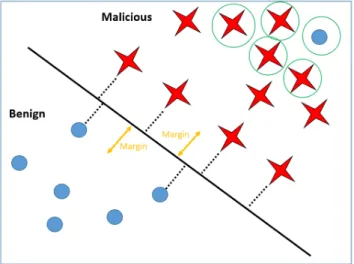
SVM with the maximum margin. Calculating the VS is com-plex and impractical where large datasets are concerned, and therefore, the simple heuristic is used. Examples that lie closest to the separating hyperplane (see Figure 9 in which the selected examples from both classes are colored in red and lie inside the margin) are more likely to be informative (may improve the classifier’s capabilities) and therefore are acquired and labeled.
FIGURE 9. The examples (colored in red) that will be selected according to the SVM-Margin AL method’s criteria.
This method, in contrast to ours, selects examples accord-ing to their distance from the separataccord-ing hyperplane, only to explore and acquire the informative files without relation to their classified labels, i.e., not specifically focusing on malware instances. The SVM-Margin AL method is very fast and can be applied to real problems; yet, as its authors indicate [18], this agility is achieved, because it is based on a rough approximation and relies on assumptions that the VS is fairly symmetric and that the hyperplane’s Normal (W) is centrally placed, assumptions that have been shown to fail significantly [28]. The method may query instances in which the hyperplane does not intersect theVS, and therefore, may not be informative. The SVM-Margin method for detecting instances of PC malware was used by Moskovitchet al.[29] whose preliminary results found that the method also assisted in updating the detection model but not the anti-virus applica-tion itself; however, in this study the method was only used for a one day trial. We compared its performance to our proposed AL methods for a longer period, in set of experiments which consider a daily process of detection of PDF documents and their acquisition, which reflects what happens in reality. This serves as our baseline AL method, and we expect our method to improve the new malicious PDF detection and acquisition seen in SVM-Margin.
3) EXPLOITATION: OUR PROPOSED ACTIVE LEARNING METHOD
Our method, ‘‘Exploitation’’ [9], is based on SVM classifier principles and is oriented towards selecting examples most likely to be malicious that lie furthest from the separating hyperplane. Thus, our method supports the goal of boosting
the signature repository of the anti-virus software by acquir-ing as much new malware as possible. For every fileXthat is suspected of being malicious, Exploitation rates the distance from the separating hyperplane using Equation 3 based on the Normal of the separating hyperplane of the SVM clas-sifier that serves as the detection model. In fact, Equation 3 calculates the distance between the vector that represents the inspected file (X) to the separating hyperplane of the detection model. The separating hyperplane of the SVM is represented by W (Equation 4). W is the Normal of the separating hyperplane and is actually a linear combination of the most important examples Xi (supporting vectors) and their labels Yi (e.g., malicious or benign), multiplied by Lagrange multipliers (α) and the kernel function K that assists in achieving linear separation in higher dimensions. Accord-ingly, the distance in Equation 1 is simply calculated between example X and the Normal (W).
Dist(X)= n X 1 αiyiK(xix) ! (3) w= n X 1 αiyi8(xi) (4) In Figure 10, the files that were acquired (marked with a green circle) are the files classified as malicious and have the max-imum distance from the separating hyperplane. Acquiring several new malicious files that are very similar to and belong to the same virus family is considered a waste of manual analysis resources, since these files will probably be detected by the same signature. Thus, acquiring one representative file for this set of new malicious files will serve the goal of efficiently updating the signature repository. In order to enhance the signature repository as much as possible, we also check the similarity between the selected files using the ker-nel farthest first (KFF) method suggested by Baramet al.[30]
FIGURE 10. The criteria by which Exploitation acquires new unknown malicious PDF documents. These files lie the farthest from the hyperplane and are regarded as representative files.