S T U D Y O N I N T E R N A T I O N A L
INTERNET CONNECTIVITY
I N S U B - S A H A R A N A F R I C A
m a r c h
2 0 1 3
T e l e c o m m u n i c a t i o n D e v e l o p m e n t S e c t o r Printed in SwitzerlandInternational Telecommunication Union Telecommunication Development Bureau Place des Nations CH-1211 Geneva 20 Switzerland www.itu.int
Study on international Internet
connectivity
in sub-Saharan Africa
March 2013
This report has been prepared by Mr Abossé Akue-Kpakpo, under the direction of the Regulatory and Market Environment Division (RME) of the Telecommunication Development Bureau (BDT), in close coordination with ITU-T Study Group 3. The content of this report was presented during the seminars and meetings of the regional groups of the ITU Study Group 3 for Africa (SG3RG-AFR) in May 2012 and for Latin America and the Caribbean (LAC SG3RG) in March 2012.
Foreword
It is my pleasure to introduce this report on International Internet Connectivity (IIC) in sub-Saharan Africa; this is part of a series of regional reports that address the present situation of Internet connection as well as future developments and challenges.
These reports have been developed through collaboration between the ITU Telecommunication Development Bureau (BDT) the Telecommunication Standardization Bureau (TSB) in view of supporting policy makers, national regulatory authorities and operators in understanding the many aspects of international Internet connectivity.
The digital revolution of the 21st century is being underpinned and in many cases driven by the growth, access and use of the Internet, but it has also led us to a modern indicator of division and poverty: exclusion from this revolution, from access to the Internet or telephone, and from the benefits of today's information society.
This report sets out concrete recommendations to enable conditions for healthy and dynamic competition in the market as well as for the reduction of the cost of Internet connection at the international level and proposes measures to encourage use of the Internet, and to promote development of local content especially in developing countries.
I hope that the results from this report will assist the ITU Membership in their efforts to address the issues surrounding Internet connectivity and ensure the continuing promotion of digital inclusion for all.
Brahima Sanou Director Telecommunication Development Bureau
Table of contents
Page
I Introduction ... 1
II Focus on Internet connection in sub-Saharan Africa ... 1
II.1 The different forms of Internet connection in sub-Saharan Africa ... 2
II.1.1 Wired Internet connection ... 2
II.1.2 Wireless (or radio) Internet connection ... 3
II.2 Internet use in sub-Saharan Africa ... 4
II.2.1 The number of users per hundred inhabitants in sub-Saharan Africa ... 4
II.2.2 Trends in the number of Internet users per hundred inhabitants ... 6
II.2.3 Comparison of numbers of Internet users vs. mobile phone users per hundred inhabitants ... 7
II.2.4 Comparison of the number of Internet users per hundred inhabitants with the rest of the world ... 8
II.3 Correlation between Internet use and other factors ... 9
III Analysis of the value chain in the provision of Internet access in sub-Saharan Africa ... 10
III.1 Key players in the provision of Internet connectivity ... 10
III.1.1 Institutional stakeholders ... 10
III.1.2 Operators and providers ... 12
III.1.3 Interest groups ... 16
III.2 Bottlenecks in the provision of Internet connectivity ... 17
III.2.1 The Internet service provision market ... 17
III.2.2 The market for Internet backbone provision ... 18
III.3 Causes of dysfunctions in the Internet connection market ... 21
III.3.1 Endogenous reasons for observed dysfunctions ... 21
III.3.2 Exogenous factors impeding the development of Internet connection ... 23
IV Reasons for the high cost of Internet connection ... 24
IV.1 The cost of Internet connection in sub-Saharan Africa ... 24
IV.1.1 Charges for wired broadband Internet connection ... 24
IV.1.2 Tariffs for wired broadband Internet connection and the minimum wage ... 26
IV.1.3 Comparison of wired broadband tariffs with those applied elsewhere in the world ... 27
IV.1.4 Comparison of tariffs for wired broadband Internet connection with the minimum wage in Africa and the rest of the world ... 28
IV.2 Reasons for the high cost of Internet connection in sub-Saharan Africa ... 30
IV.2.1 Inadequate investment in basic infrastructure ... 30
IV.2.2 Unfavourable economic market conditions ... 31
IV.2.3 Insufficient competition in certain market segments ... 33
Page
V Recommendations for developing broadband and reducing the costs of Internet
connection ... 36
V.1 Optimization of international bandwidth use and reduction of the associated costs ... 36
V.1.1 Optimizing the use of the international bandwidth ... 37
V.1.2 Reducing the cost of the international Internet bandwidth ... 38
V.2 Facilitating construction of basic broadband infrastructure ... 39
V.2.1 Cooperative stakeholders ... 39
V.2.2 Objectives of the cooperative ... 40
V.3 Improving the legislative and regulatory framework in order to promote competition . 41 V.3.1 Application of existing laws and regulations ... 41
V.3.2 Adoption of texts promoting infrastructure construction ... 41
V.4 Developing and implementing a plan for mass Internet access ... 41
V.4.1 Programme description ... 41
V.4.2 Programme funding ... 42
V.5 Strong political action at the regional level ... 43
VI Conclusion ... 43
References ... 45
I Introduction
Information and communication technologies (ICTs) have undergone a tremendous expansion in the past decade thanks to the mobile phone revolution and the exponential growth of the Internet. Information is now available instantly and globally. There were more than 6 billion mobile phones worldwide at the beginning of the current year, and over 1 billion people now use the Internet.
This digital revolution of the 21st century is based on the Internet, which is the revolution's driving force. Without a high-speed Internet connection or at least a mobile telephone, the citizen is excluded from today's information society. In some countries, the essential role of this tool is well understood and the right to means of communication and to broadband Internet access is spoken of as a fundamental right. Discussions on this information revolution in sub-Saharan Africa involve much talk of the rapid development of mobile telephony. Internet connectivity on the other hand is seldom mentioned as evidence that sub-Saharan Africa has successfully entered the information society, and indeed the Internet is poorly developed in that region.
So is sub-Saharan Africa becoming marginalized because of its lack of Internet connectivity?
The subject will be covered in this study in four main chapters. The first of these (Chapter II) will be devoted to an overview of Internet connection in sub-Saharan Africa. In its first part, it describes the various types of Internet connection in Africa and likely future developments. Its second part focuses on Internet use in sub-Saharan Africa and draws comparisons with the rest of the world.
Available literature classes Internet connection in sub-Saharan Africa as being among the most expensive in the world. In Chapter III, this issue of costs is addressed by first analysing the Internet access value chain. This analysis covers the various actors in the provision of Internet connection and the role played by each one. The various bottlenecks that can lead to inefficiencies and associated costs are considered in the second part of that chapter.
Analysing the value chain for the provision of Internet connection enables us, in Chapter IV, to tackle the various reasons for the high cost of Internet access in the sub-Saharan region. Internet tariffs in the region is considered based on a particular type of offer (wired broadband Internet connection) and draw comparisons between countries within the region and between them and the rest of the world. Tariffs are compared with the minimum wage for the countries of the region concerned in order to show the relative cost of Internet use in relation to consumers' purchasing power. The final section of the chapter examines the causes of the high cost of Internet connection in sub-Saharan Africa with a view to making some specific recommendations.
Chapter V sets out those concrete recommendations to reduce the cost of Internet connection and to create conditions conducive to vibrant and healthy competition. These proposals also cover measures that will be needed to encourage the mass use of the Internet.
II
Focus on Internet connection in sub-Saharan Africa
The Internet arrived in sub-Saharan Africa from the early 1990s onwards: Kenya in 1993, Uganda and Nigeria in 1995, Togo in 1996. In most of those countries, Internet connection began with analogue telephone lines.
This section considers the different existing forms of Internet connection in the sub-region. This is followed in the second part by a study of Internet use based on an analysis of the number of Internet users per hundred inhabitants. The final section focuses on possible links between levels of Internet use and factors such as a country's relative wealth, population and geographical area.
II.1
The different forms of Internet connection in sub-Saharan Africa
Nowadays, two types of Internet connection are found: wired connection and wireless connection.
II.1.1 Wired
Internet
connection
There are two forms of wired connection: switched and non-switched connection. In the former, a switch routes Internet traffic to an Internet node, while in the latter, devices such as DSLAMs (Digital Subscriber Line Access Multiplexers) are used to route traffic to the Internet node.
II.1.1.1 Switched wired Internet connection
There are two forms of switched Internet connection: analogue connection, and connection via an Integrated Service Digital Network (ISDN) system.
Analogue connection uses an analogue telephone line and offers a theoretical bit rate of 56 kbit/s, although in practice customers can obtain an effective rate of not more than 45 kbit/s, depending on the quality of the copper wire.
By contrast, ISDN connection provides a bit rate of up to 128 kbit/s by simultaneously using the two 64 kbit/s channels provided by the digital connection mode. It constitutes a clear improvement over analogue connection. This form of connection is offered throughout sub-Saharan Africa except in one or two countries in which social problems over a number of years have led to the decline of the wired network.
Switched Internet connections are billed as local phone or trunk (intercity) calls. This penalizes users in provincial areas: the Internet node is often installed in a capital, so that all users connecting to the Internet server from outside that area are billed for trunk calls, which are more expensive for these users. This kind of invoicing has been rectified in many West African countries by setting a single national tariff, less expensive than a local call, in order to promote Internet access.
In Togo, for example, a national number (808 80 80)1 has been set up to allow connection to the Internet. It is charged at USD 0.01 (one cent) for three minutes at peak time, for 4.5 minutes in the first off-peak hour and for 6 minutes in subsequent off-peak hours. At the time this number was set up, local calls cost USD 0.01 for 1.5 minutes.
II.1.1.2 Non-switched wired Internet connection
Non-switched Internet connection includes leased lines (dedicated lines in some countries) and ADSL (Asymmetric Digital Subscriber Line). A leased line involves leasing under contract of a cable by a wired network operator to a company for the purpose of connection to the Internet.
ADSL is available in most countries of sub-Saharan Africa. However, its expansion is generally hampered by the small size of the pool of subscribers. In addition, the lack of regulations on local loop unbundling, or ineffective enforcement where such regulations exist, also impede the rapid development of ADSL in most countries south of the Sahara.
II.1.2 Wireless
(or
radio) Internet connection
Wireless (or radio) Internet connection can be based on any one of four technologies: Wireless Local Loop (WLL), GSM (Global System for Mobile Communications), CDMA (Code Division Multiple Access) and WiMAX (Worldwide Interoperability for Microwave Access).
II.1.2.1 Wireless Local Loop
The local loop is used to serve localities or areas without wired telephone lines. It is often used by Internet service providers (ISPs). This is the case, for example, of Café Informatique in Togo or Connecteo in Burkina Faso. In general, those ISPs have a licence and are allocated a frequency by the national regulatory authority (NRA).
II.1.2.2 Internet connection with GSM
GSM also provides Internet connection using GPRS (General Packet Radio Service), EDGE (Enhanced Data Rates for Global Evolution) and 3G. The service uses a PCMCIA (Personal Computer Memory Card International Association) modem or a USB (Universal Serial Bus) key.
The future of broadband Internet connection lies essentially with GSM 3G because it is the most widespread network in sub-Saharan Africa. 3G is already in operation in some countries such as Nigeria, Ghana and Kenya. Studies are under way with a view to its eventual introduction in Niger, the Democratic Republic of the Congo or Benin.
II.1.2.3 Internet connection with CDMA
CDMA technology has been adopted by many incumbent operators in an effort to make up for delays in constructing wired networks and reduce waiting lists of applicants for wired lines by providing a fixed wireless line. This technology has been used with some degree of success by some operators in order to offer Internet access to users.
Two types of Internet connection are available with this technology: low-speed connection (up to 256 kbit/s), and the EVDO (Evolution – Data Optimized) version offering speeds of up to 2 Mbit/s and beyond, depending on the particular variant used.
II.1.2.4 Internet connection with WiMAX
WiMAX appeared in the sub-Saharan region from around 2005 onwards and dozens of such networks now exist in the region. The future of this type of connection in sub-Saharan Africa will depend on the evolution of this technology worldwide.
Internet connection in sub-Saharan Africa will undoubtedly continue to favour wireless systems owing to the low telephone land line density. In WAEMU (West African Economic and Monetary Union) countries, for example, there were only about 1.5 million land lines in 2010 for nearly 90 million people; clearly, sub-Saharan Africa will not be able to provide its entire population with Internet access using wired lines. Furthermore, the trend will undoubtedly be towards mobile systems based on the GSM standard, since this is the most developed network in sub-Saharan Africa. This will make use of 3G, which is already available in some countries (Ghana, Kenya, Mali, Nigeria, and Senegal). Licences are being granted in many other countries.
CDMA is also available, and is currently the second largest network in terms of the number of subscribers. The broadband version of CDMA with EVDO is being used in some countries (Togo, Burkina Faso, Uganda and Benin).
Finally, ADSL will also remain in use as it offers a better quality than wireless systems. However, growth here will depend on the resumption of investment in the wired network.
II.2
Internet use in sub-Saharan Africa
It is not easy to determine the actual Internet penetration in sub-Saharan Africa. Internet subscriptions do not accurately reflect Internet use in the region because in general, an Internet subscription (fixed or mobile) is shared by several people.
In addition, many people have access to the Internet through their jobs or at schools and colleges, especially at university level. Furthermore, the primary source of Internet connectivity in many countries is cybercafés. In several countries, CMC (Community Multimedia Centres) are created mainly in rural areas to facilitate Internet access for rural populations
In the face of this difficulty, the number of Internet users per hundred inhabitants is used as defined and used by the International Telecommunication Union (ITU). The data used are from the ITU database.
II.2.1
The number of users per hundred inhabitants in sub-Saharan Africa
Internet penetration in sub-Saharan Africa remains very low. The chart below shows the number of users per hundred inhabitants for all 45 countries of sub-Saharan Africa.
Figure 1: Number of Internet users per hundred inhabitants in 2010, by country
Source: ITU database.2
2
Data for Sierra Leone and Sudan are not available.
0 5 10 15 20 25 30 35 40 45 Afrique du Sud Bénin Botswana Cameroun Centrafricaine (République) Congo (République) Côte d’Ivoire Éthiopie Gambie Guinée-Bissau Guinée Lesotho Madagascar Mali Mozambique Niger Ouganda São Tomé-et-Príncipe Seychelles Soudan Tanzanie Togo Zimbabwe Series1 Zimbabwe Togo Tanzania Sudan Seychelles São Tomé and Principe Uganda Niger Mozambique Mali Madagascar Lesotho Guinea Guinea-Bissau Gambia Ethiopia Côte d'Ivoire Congo (Republic of) Central African Republic Cameroon Botswana Benin South Africa
The statistics on the number of Internet users per hundred inhabitants show that for all countries in sub-Saharan Africa, only Cape Verde (30 users) and Seychelles (41 users) crossed the "bar" of 30. To both countries, Nigeria (28.43) and Mauritius (24.90) can be added. These four countries constitute the "top four" and are clearly well ahead of the others.
Another group of countries can be considered to have an average of between 10 and 25 users per 100 inhabitants. These include Angola (10), Kenya (20.98), Senegal (16), Tanzania (11), Uganda (12.50) and Zimbabwe (11.5).
At the lower end of the cohort, there are countries with barely more than one user per hundred inhabitants. Their situation can be described as alarming and urgent action must be taken to create a genuine information society in those countries. Examples are Guinea (0.9), Niger (0.83), the Democratic Republic of the Congo (0.72) and Liberia (0.07).
These statistics show that the number of Internet users per hundred inhabitants remains low for all countries in sub-Saharan Africa. With this rate of Internet use, it will be difficult to create a genuine information society or to use ICTs (Information and Communication Technologies) as a tool for economic and social development.
II.2.2
Trends in the number of Internet users per hundred inhabitants
The observation made in the preceding paragraph refers to the situation as it was in 2010; but are there more encouraging signs now? In an effort to answer this question the evolution of this indicator over the period 2006 to 2010 is analysed in this section..
Average growth in the number of Internet users in sub-Saharan Africa over that period was about 35 per cent, which is relatively satisfactory. However, it conceals significant disparities between countries. The average growth is actually carried by some ten countries with growth rates above 50 per cent. They include the Central African Republic (160 per cent), Angola (106 per cent), Malawi (106 per cent), Nigeria (103 per cent) and Mozambique (99 per cent).
Among the ten countries that are actually carrying the overall growth, seven have an Internet usage rate of less than 10 per cent. The Central African Republic and Malawi, despite high average growth over the period 2006-2010, have very low rates of Internet use (2.3 and 2.26 per cent respectively).
Finally, there are some ten countries for which growth rates barely exceed 10 per cent. They include the Seychelles (4.33 per cent), Guinea Bissau (4.37 per cent), Zimbabwe (4.37 per cent) and Togo (6.28 per cent).
The low growth in the number of users in the Seychelles can be explained by the slow-down that normally occurs once the rate of use has risen to a certain level.
To perform a detailed analysis and show these disparities, this indicator will be studied for a number of countries selected on the basis of location, in order to cover the entire sub-Sahara region, and on the basis of geographical size (area) and national trends in ICTs.
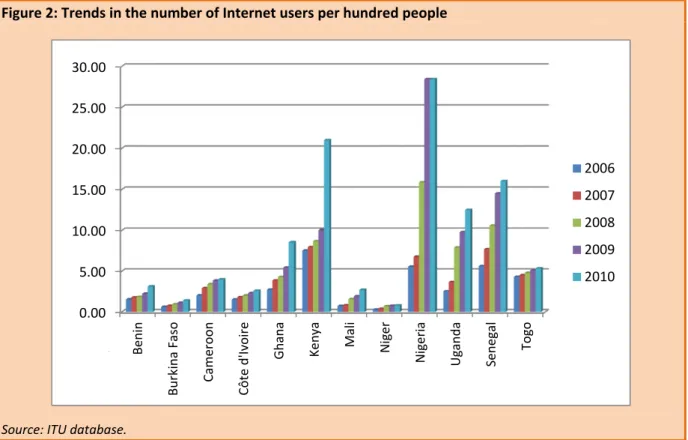
Figure 2 shows trends in the number of Internet users per hundred inhabitants for the twelve selected countries.
Figure 2: Trends in the number of Internet users per hundred people
Source: ITU database.
The performance of Nigeria (between 2008 and 2009) and Kenya (between 2009 and 2010) are remarkable and deserve to be highlighted. Both countries have doubled the number of Internet users per hundred inhabitants over the respective periods. Growth for Nigeria in 2010 was almost zero; this can be explained by poor information or by network problems due to the strong growth in 2009.
Ghana, Senegal, and Uganda have also experienced steady growth, which suggests that they may significantly increase Internet use by their citizens.
For Cameroon and Togo, growth rates fell over the period in question. This is worrying because the Internet market is far from being saturated, as the number of Internet users per hundred inhabitants barely exceeds 5 per cent in either country.
On the other hand, Benin, Burkina Faso, Mali and Niger are also experiencing steady but low growth. The rate of Internet use is still low in those countries and it is not possible to predict with any certainty that the Internet market will become more dynamic and competitive.
II.2.3
Comparison of numbers of Internet users vs. mobile phone users per hundred
inhabitants
To measure the low level of Internet use, the Internet and mobile markets were compared, using the ratio of mobile users to Internet users in each country. Given that the mobile market is very competitive and sets a standard to follow in the Internet sphere, this ratio is an indicator of the effort being made to improve Internet access.
A high ratio shows that the Internet market is atrophied or that the mobile market is more dynamic and competitive than the Internet market. If the ratio is low, it indicates that the Internet market is close to that of mobile in terms of competitiveness.
In the long term, that ratio should ideally decrease from one year to the next, to reflect an Internet market that is growing faster than the mobile market. An increase in this ratio over time would, on the other hand, show that the mobile market continues to grow faster than the Internet market.
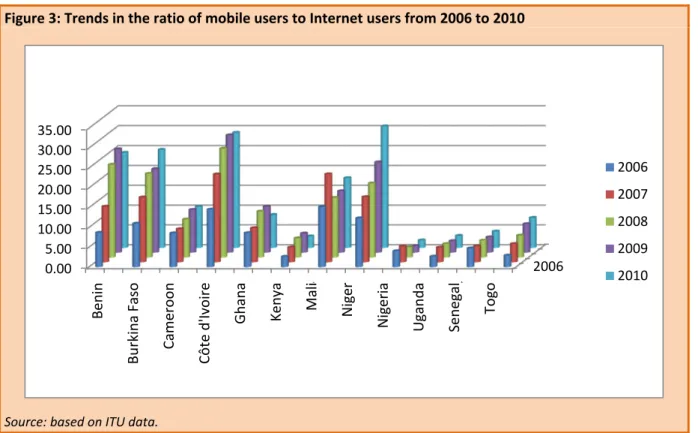
Figure 3 shows the general trend in this ratio for the 12 selected countries over the period 2006-2010. 0.00 5.00 10.00 15.00 20.00 25.00 30.00 2006 2007 2008 2009 2010 Benin
Burkina Faso Cameroon Côte d'Ivoire
Ghana Kenya Mali Niger Nigeria
Uganda Senegal
Figure 3: Trends in the ratio of mobile users to Internet users from 2006 to 2010
Source: based on ITU data.
Among the selected countries, Benin, Burkina Faso, Côte d'Ivoire, Mali and Niger have a ratio that is too high and indicates that the Internet market is not sufficiently dynamic and competitive. That is especially the case in Niger, where there are thirty times more mobile users than Internet users.
By contrast, Kenya, Nigeria, Senegal, Uganda, and, to a lesser extent, Ghana and Togo, all have relatively low ratios: in these countries there are around five times more mobile users than Internet users.
Over the study period (2006-2010) this ratio increased significantly for Burkina Faso, Côte d'Ivoire and Niger. That growth indicates that the mobile market is actually becoming more competitive than the Internet.
The number of mobile users compared to the number of Internet users increased slightly in Cameroon and Togo.
Finally, the case of Kenya and Nigeria should be noted, as they show declining ratios for the last two years of the study period. The ratio for Nigeria in 2010 was lower than in 2006. This demonstrates that the Internet market in both countries has become dynamic and competitive.
II.2.4
Comparison of the number of Internet users per hundred inhabitants with the rest
of the world
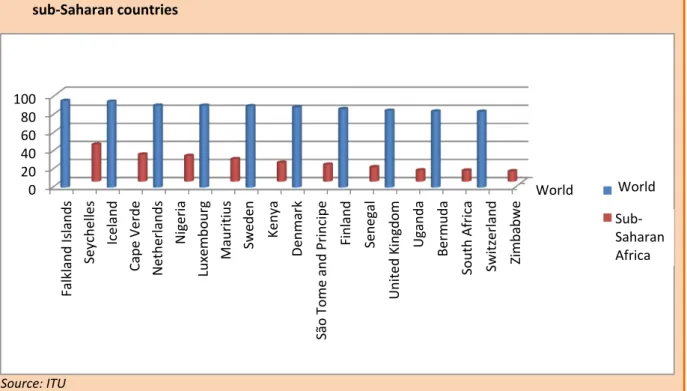
Having compared the number of Internet users to that of mobile users, it would be useful to compare that ratio with the rest of the world. To do this, a comparison was made with the ten top countries in the world in terms of Internet use. Figure 4 compares the top ten countries/territories in the world with the top ten in sub-Saharan Africa in terms of rankings.
2006 0.00 5.00 10.00 15.00 20.00 25.00 30.00 35.00 2006 2007 2008 2009 2010 Benin
Burkina Faso Cameroon Côte d'Ivoire
Ghana Kenya Mali Niger Nigeria
Uganda Senegal
Figure 4: The top ten countries/territories in the world in terms of Internet use compared to the top ten sub-Saharan countries
Source: ITU
Two observations can be made: the rate of Internet use remains low in sub-Saharan Africa compared to the rest of the world; and the gap widens as one moves down the rankings.
Thus the ratio for the Seychelles (the top of the Internet use ranking for the sub-Saharan African countries) is about 43 per cent of that of the Falkland Islands (which leads the rest of the world in that respect). However, the ratio for Zimbabwe (tenth in sub-Saharan Africa) is only 14 per cent that of Switzerland (tenth in the world).
Finally, it should be noted that the difference between the first and the tenth in the rest of the world is 10 points, while the analogous gap in sub-Saharan Africa is 30 points.
II.3
Correlation between Internet use and other factors
For this, natural factors were considered, namely, a country's wealth measured in terms of GDP (Gross Domestic Product), geographical area and population.
Among the ten countries with the highest GDP in sub-Saharan Africa, only Mauritius and the Seychelles are among the countries that make most use of the Internet. Botswana, Equatorial Guinea, and Gabon, which are among the five countries with the highest GDP, have low ratios (between 6 and 8).
On the other hand, Mozambique and Zimbabwe, which are among the bottom 15 African nations in terms of GDP, have Internet use rates that place them among the top 15 African nations.
It can therefore be concluded that the number of Internet users per hundred inhabitants is not necessarily linked to a country's wealth.
Is a country's geographical size (area) a handicap to Internet use? The difficulties facing communications networks in large developing countries, such as the Democratic Republic of the Congo (DRC), Niger, or Sudan, could be mentioned. However, Angola, Nigeria, and Tanzania are among the ten largest countries in sub-Saharan Africa but have an acceptable ratio.
Conversely, a small geographical area, which may be easier for operators to cover, is not synonymous with a high rate of Internet use. While the two leading countries in sub-Saharan Africa in terms of Internet use rates (Cape Verde and the Seychelles) are small in terms of area, many other small countries have very low rates of Internet use (Gambia, Guinea Bissau and Burundi).
Series1 0 20 40 60 80 100 Fa lk lan d Sey chelles Island Cap-Vert Pays bas Nigéria Luxembo u rg Ma
urice Suède Ken
ya Da nemark Sã o Tomé-et-Príncip e Fin lan de Sén ég al Ro yau m e Uni Ouganda Bermu d e A friq ue du Su d Suis se Zimbabwe Series1 Series2 Falkland Islands Seychelles Iceland
Cape Verde Netherlands
Nigeria Luxembourg Mauritius Sweden Kenya Denmark São Tome and Principe Finland Senegal United Kingdom Uganda Bermuda
South Africa Switzerland Zimbabwe
World World Sub-Saharan Africa
The final criterion, population, does not prove to be a factor in the rate of Internet use, either. Countries such as Gabon, Lesotho and Guinea Bissau, with populations of less than 5 million, have low levels of Internet use, while Nigeria, the most populous country on the continent, is among the top five sub-Saharan countries in terms of rates of Internet use.
Internet use in a country depends on the will of the public authorities to provide citizens with the means to connect to the Internet for their economic and social development. That will is reflected in the establishment of legal and regulatory conditions that promote competition in the provision of services, the adoption of the economic and fiscal measures needed to facilitate access to services, and the implementation of programmes and projects to achieve rapid development of basic infrastructure.
III
Analysis of the value chain in the provision of Internet access in
sub-Saharan Africa
Low levels of Internet use may be partly explained by the way in which the Internet connection market functions. For this reason, the first section analyses the value chain for the provision of Internet connection, identifying the relevant players and their respective roles. The potential barriers to competition that might exist in different segments of the Internet connection market are highlighted, and then the internal and external causes of those problems and their possible implications for the Internet connection market are analysed.
III.1
Key players in the provision of Internet connectivity
An analysis of the Internet supply chain in sub-Saharan Africa indicates that there are three main categories of stakeholder: institutional stakeholders; operators and suppliers; and interest groups.
III.1.1 Institutional
stakeholders
These include states (governments), national regulatory authorities (NRAs) and regional economic communities (RECs). These institutional players at their respective levels make the laws and regulations that influence the functioning of the market.
III.1.1.1 State stakeholders
States decree policies in the field of ICT through sector-based statements of policy. These statements embody their vision for the ICT sector and take the form of strategies and plans of action for the sector. As a result, states are major "centre stage" players, as their policy statements in the ICT sector constitute the framework for developments in the industry.
In Benin, for example, the "Policy and Strategy Document for the Telecommunications, ICT and Postal Sector", which is the main statement of policy for the sector, devotes its first two strategies to the legal and institutional framework and to infrastructure. In this way, the Government of Benin intends to establish a new legal framework with a "Code of electronic communications and postal services" which will rationalize the sector by defining transparent ground rules.
Governments also influence the sector by constructing government infrastructure in the context of e-government policies. For example, Burkina Faso and Togo have started to develop a national broadband infrastructure, which may be open to private companies.
the development of ICTs in their countries and act as implementing agencies of government projects in the field of ICT.
III.1.1.2 National regulatory authorities
With the exception of the Republic of Guinea, all countries in sub-Saharan Africa have an autonomous and independent national regulatory authority (NRA). In the Republic of Guinea, the national regulatory authority is under the direct supervision of the telecommunications ministry.
National regulatory authorities are responsible among other things for:
• facilitating universal access to basic telecommunication services;
• creating conditions for competition between different stakeholders and preventing malpractice or anti-competitive practices by dominant operators;
• creating a climate conducive to investment in telecommunications and ICTs;
• increasing public confidence in telecommunications markets by implementing transparent regulatory policies;
• protecting users' rights, including rights to protection of personal data;
• increasing the telecommunications connectivity of all users by implementing effective interconnection procedures;
• optimizing the use of scarce resources such as the radio spectrum and numbering.
NRAs intervene in the Internet access market by controlling wholesale and retail prices and enforcing regulations.
In this sense, the NRAs have to ensure interconnectivity of networks and infrastructure sharing, and these are legal requirements under the telecommunications codes of many countries. These two aspects of regulation are necessary for the rapid development of Internet connectivity in sub-Saharan Africa and will be considered in depth in subsequent paragraphs that focus on factors that tend to impede growth in Internet use.
III.1.1.3 Regional economic communities
There are over ten regional economic communities (RECs) in sub-Saharan Africa. Most have a mechanism for defining and implementing a regional ICT policy.
In general, this policy is based on the adoption of regulatory provisions allowing an open market and free competition in order to attract investment, harmonization of regulations, and development of infrastructure and services.
Regional economic communities are also involved in the market through infrastructure development or ICT promotion programmes.
The WAEMU3 in 2006 launched a programme to modernize inter-state links with the aim of creating an optical fibre network linking pairs of Member States. This programme is not yet completed. There are still two missing links, namely the optical fibre links between Benin and Burkina Faso and between Mali and Niger.
3
The EMCCA4 launched the CAB (Central Africa Backbone) which will connect, in the first phase, Cameroon, Chad and Central African Republic, and in the second phase, the Republic of the Congo, Gabon, Equatorial Guinea, the Democratic Republic of the Congo, and Sao Tome and Principe. Niger, Nigeria and Sudan may join later on.
A number of regional communities have also established regulators' associations, such as WATRA (the West Africa Telecommunications Regulators' Association) of ECOWAS,5 ARICEA (the Association of Regulators in Information and Communications for Eastern and Southern Africa) of COMESA,6 CRASA (the Association of Regulators in Communications in southern Africa) of SADC,7 and ARTAC (the Telecommunications Regulators' Association of Central Africa) of ECCAS.8
The African Union in June 2008 established the AATR (African Assembly of Telecommunications Regulators). It is not yet very active in the African regional Internet connection market.
III.1.2 Operators and providers
There are three main stakeholders, depending on the state of development of the markets studied:
• the Internet service provider;
• the national or international backbone provider;
• the Internet access provider.
In some closed markets, these three players may be subsumed in a single operator. In such cases, the operator controls the service within the supply chain from end to end.
In some countries, the incumbent operator is present in all segments of the Internet connection market, with or without an affiliated subsidiary.
III.1.2.1 Internet service provider
The Internet service provider (ISP) provides the service to the end user, and provides the necessary equipment to connect to the Internet as well as services such as website hosting, email and technical systems management.
The ISP registers with an Internet access provider (IAP) responsible for providing access and carrying customers' traffic. As a result, the service provider is highly dependent on the access provider.
The work of the service provider does not require a major start-up investment. A server, authentication software and a connection with the access provider are sufficient. There is thus no economic (or financial) barrier to entering this market. This should make for strong competition in this market segment, with benefits to customers.
Unfortunately, the market in sub-Saharan Africa is not as competitive as it should be. The reasons are often attributable to fact that the access providers, in most cases the former incumbent operators, retain
4
Economic and Monetary Community of Central Africa.
5
a monopoly or significant market power. An analysis of the difficulties affecting the functioning of this market segment is made in the second part of this chapter.
III.1.2.2 National or international backbone provider
The national backbone provider plays a vital role in providing access to the Internet, acting as the intermediary between the local or national access provider and the international access provider. The national backbone provider's optical fibre network carries the client's Internet traffic from the local or national level to the international Internet access provider.
The role of this intermediary is important in the sub-Saharan region, particularly for landlocked countries that need access to a submarine cable landing station.
With the exception of a few countries, including the Central African Republic and Chad, all African countries are connected to the Internet via a submarine cable landing station. Landlocked countries are connected through a backbone provider in the same way as coastal countries that do not have a landing station.
Because of this dependence and the higher cost of satellite bandwidth charged in the sub-Saharan region, a special analysis of Internet connection via submarine cable was undertaken.
III.1.2.3 Internet access provider
Internet access providers fall into three main categories:
1 global Internet access providers;
2 regional Internet access providers; and
3 national Internet access providers.
III.1.2.3.1 Global Internet access providers
These providers have a worldwide Internet network and peering agreements in several regions of the world. They therefore have the technical means to access all Internet networks without paying additional fees. They are classed as "type I" providers. There are as yet no providers of this magnitude in sub-Saharan Africa.
III.1.2.3.2 Regional Internet access providers
These providers operate within a region. They have either a traffic exchange agreement or a transit agreement with a type I provider and in turn provide services to national or local access providers. They are called "type II" providers.
There are still no providers of this kind in sub-Saharan Africa. This may change with the appearance of telecommunication groups (consortia) in Africa and initiatives regarding Internet bandwidth management. Three examples of this type of initiative can be cited: the Mombasa Internet Exchange Point (IXP) in Kenya; the Orange – Sonatel group; and the MTN group.
The Mombasa IXP is regional in scope and has the advantage of being located in a city which is the landing point of a number of submarine cables that serve almost all the countries of East Africa. The IXP can promote the development of activities by exchanging regional traffic and becoming a regional Internet access provider or even a global provider, through peering agreements.
The Orange – Sonatel Group might be the prototype of this type of access provider, for three reasons:
• its membership of a global group;
• the value of the network through its subsidiaries Orange Guinea, Orange Guinea Bissau, Orange Mali, and Orange Niger;
• the availability of infrastructure through participation in the Atlantis, SAT 3 and ACE submarine cables.
The MTN Group, which is mainly a mobile telecommunications provider, could take advantage of its position through its subsidiaries in the coastal countries of West Africa (Benin, Côte d'Ivoire, Ghana, Liberia, Nigeria), central Africa (Cameroon and Congo) and East Africa (Sudan), in order to become a regional access provider.
The MTN group has more subsidiaries than Orange Sonatel and its network has considerable higher net worth. In addition, MTN could, from South Africa, connect directly to Asia as well as Europe.
III.1.2.3.3 National Internet access providers
In sub-Saharan Africa, it is possible to distinguish between two types of such national providers depending on the type of their Internet connection. In general, new entrants use a satellite connection. Groups have been set up, such as Africa on Line, A Link (a subsidiary of the Atlantic Telecom group) and Connecteo, but are still far from dominating the Internet connection market in the way mobile phone operators dominate theirs.
The great majority of incumbent operators use a submarine cable for international Internet connection. All the national access providers operate at national or local level and do not have any international infrastructure. They conclude transit agreements with type I or type II providers and pay transit fees.
III.1.2.3.4 Providers of Internet access via submarine cable
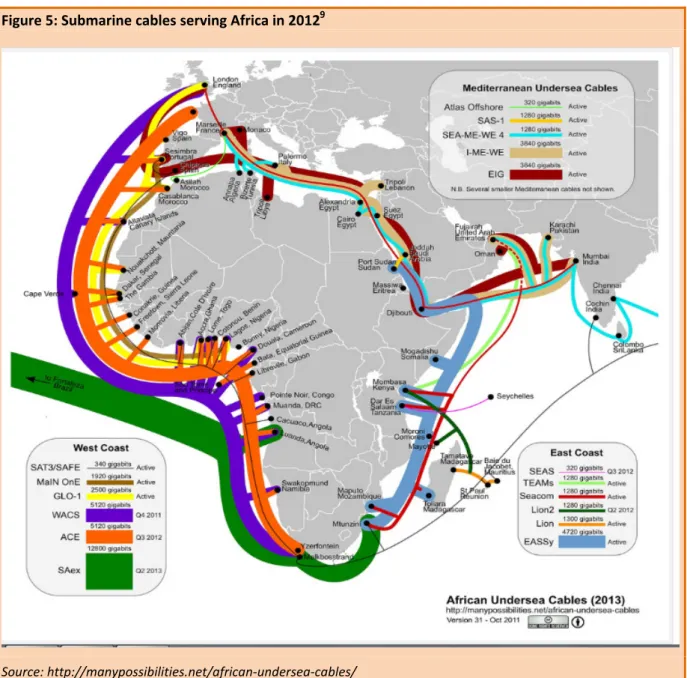
In 2002, there was only one submarine cable – SAT 3 – along the West African coast for Internet connection. Telecommunications operators that participated in a consortium for construction and maintenance of the submarine cable are all incumbent operators. Landlocked West African countries that are not members of the consortium have thus become dependent on SAT 3, which remains indispensable in the provision of international Internet connection. These countries have developed terrestrial optical fibre infrastructure to connect to SAT 3 in order to minimize the relatively high costs of satellite connection and ensure better quality of service with the submarine cable.
Prices recorded in 2006 for international Internet connection on SAT 3 in Angola, Cameroon, Ghana and Senegal varied between USD 3 000 and USD 15 000 for a bandwidth of 2 Mbit/s, while prices recorded for 2 Mbit/s via satellite varied between USD 7 000 and USD 24 000, in other words, up to three times more expensive than SAT 3.
It took until 2009, with the arrival of the SEACOM cable, and subsequently EASSy in 2010, bringing Internet connection to the southern and eastern coasts of Africa, for the incumbent operators' monopoly to be challenged.
Figure 5: Submarine cables serving Africa in 20129
Source: http://manypossibilities.net/african-undersea-cables/
Internet connection via international submarine cable will become more widely available when the West African coast, from 2012 onwards, is served mainly by five submarine cables (SAT3, Main One, Glo One, WACS and ACE). The East African coast will be served mainly by three submarine cables (SEACOM, EASSy and LION 2).
This increase in the number of submarine cables means that almost all the coastal cities will be served with the exception of Bissau. In 2012, all the coastal states will be served by a submarine cable. Landlocked countries will then have the opportunity to choose the submarine cable they want to connect to according to the price charged for international Internet bandwidth. For example, Burkina Faso may choose to connect to SAT 3 via Benin or Côte d'Ivoire, to WACS through Togo, or to ACE via Benin or Côte d'Ivoire.
9
The boundaries and names shown and the designations used on this map do not imply official endorsement or acceptance by ITU.
This competition benefits coastal as well as landlocked countries. Some cities will have more than one submarine cable (SAT 3, Glo One and ACE in the case of Dakar; SEACOM, EASSy, TEAMS and LION 2 in the case of Mombasa). This may force consortia to compete.
The second consequence is the participation of private operators and financial institutions such as GLO (Nigeria's second biggest mobile operator) and MTN (a mobile operator) or ADB (the African Development Bank) in the submarine cable consortia in sub-Saharan Africa. The participation of these two categories of players will eliminate the negative effects of monopoly and lead to pricing based on actual costs incurred. Having more submarine cables will stimulate competition and reduce the price of international Internet connection via submarine cable.
III.1.3 Interest
groups
Interest groups often have considerable bargaining power and can influence the functioning of the Internet connection market. This section looks at specific examples of associations of operators, service providers and consumers.
III.1.3.1 Operators' associations
Operators' associations are able to influence decisions in the ICT sector. Some of these associations are national, as in the case of Côte d'Ivoire's UNITEL (National Union of Telecommunications Companies). UNITEL campaigns among other things to persuade the Ivorian Government to lower taxes and duties on telecommunications. In August 2010 it succeeded in bringing about a suspension of duties on incoming international traffic.
Other associations such as WATC (West African Telecommunications Conference),10 on the other hand, are regional in scope. The WATC helped to reduce right-of-way charges in the West African subregion by over 40 per cent between 2006 and 2011. This joint action has reduced the transit costs incurred by landlocked countries of West Africa seeking access to the submarine cable.
III.1.3.2 Associations of service providers
There are many associations of Internet service providers in sub-Saharan Africa, particularly in English-speaking countries. The main goal of those associations is to protect their members' interests and to promote their technical and managerial activities.
These associations have amalgamated at the African level to form the AfrISPA (African Internet Service Providers' Association).
Some associations of Internet service providers have a real influence on the Internet connection sector. To illustrate this, the example of Kenya is considered.
Kenya has two Internet exchange points, the first in Nairobi and the second in Mombasa. The latter is managed by the Telecommunications Service Providers' Association of Kenya (TESPOK), a non-profit organization representing ISPs and telecom operators.
The first Kenya Internet exchange point (KIXP) was launched in Nairobi in 2000 before the full liberalization of the telecommunications market. The same year, the KIXP was forced to suspend its operations by order of the Communications Commission of Kenya (CCK), the national regulatory agency,
following a complaint from Telkom Kenya (Kenya's incumbent operator) alleging infringement of its monopoly on routing of international traffic.
After a year of talks, CCK in November 2001 granted KIXP a licence, making Kenya the first country in the world to license an IXP.
III.1.3.3 Consumer associations
Some consumer groups have a general influence on the telecommunications market. Their actions focus on quality of service and especially prices of products and telecommunication services.
In some countries, consumer associations are represented on the governing bodies of national regulatory authorities.
III.2
Bottlenecks in the provision of Internet connectivity
The bottlenecks in question are due mainly to the fact that the entire infrastructure used in providing the Internet connection is in the hands of the incumbent operator. In the value chain, these companies are vertically integrated and control the process from end to end.
Competition is sometimes imperfect and incumbents may use a number of ploys to restrict competition.
III.2.1 The Internet service provision market
The dependence of Internet service providers on Internet access providers makes them vulnerable. The reasons include:
• anti-competitive practices;
• denial of access to the wired local loop;
• incumbent operators competing with service providers;
• refusal to lease international bandwidth.
III.2.1.1 Anti-competitive practices
These occur routinely and are mainly related to the wired local loop. They may take the form of unacceptable delays in conversion to ADSL or in creating user names and passwords on dedicated servers, in the case of low-speed PSTN connections.
Such practices are also perpetrated by technicians employed by incumbent operators when failures occur on customers' lines, and repair times may be abnormally long.
As mentioned in the previous chapter, some incumbent operators have established a national number with uniform pricing to encourage Internet connection from analogue telephone lines. Unfortunately, this advantageous pricing is not passed on to the customers of Internet service providers. As a result, customers of ISPs are penalized as regards Internet connection and are obliged to subscribe to the incumbent operator. This discriminatory practice distorts competition.
In good practice, ISPs would be charged wholesale rates and would undertake to sell to their customers at retail prices based on actual costs incurred. Many ISPs have suffered from this situation and been forced out of the market.
III.2.1.2 Denial of access to the local loop
Denial of access to the local loop used by incumbents is a violation of regulatory provisions and delays the population's access to broadband. It hinders competition, and does not promote lower fares.
The Additional Act A/SA of 02.01.2007 on access and interconnection of networks and services in the ICT sector in ECOWAS11 established the principle of unbundling the wired local loop. Article 26: Local loop unbundling, requires that states ensure that their regulations guarantee that:
a) new entrants are allowed to access the local loop in a predefined schedule;
b) the new entrant is committed, by the terms and conditions of service, to a minimum level of infrastructure deployment, while dominant operators are committed to providing the new entrant with access to copper pairs together with the possibility of co-siting on its own premises to facilitate unbundling;
c) the unbundling tariff and technique including services on request of the national regulatory authority (NRA), are approved by the latter;
d) the national regulatory authority is required to ensure that new entrants have access to relevant information needed for unbundling, dominant operators are required to undertake electronic exchange with their competitors of information on unbundling, and there are provisions for establishing an unbundling schedule with a view to liberalizing fixed lines, priority being given initially to shared access unbundling;
e) recommendations are made on "scissors" tests to compare retail and unbundling prices to eliminate anti-competitive behaviour by dominant operators.
This directive has unfortunately been implemented in few if any member countries of ECOWAS.
III.2.1.3 Competition with ISPs by incumbent operators
In many countries, incumbent operators are direct competitors with their own customers, competing, through the parent organization or a subsidiary, with the Internet service providers. This competition might be beneficial if the incumbent operator in the Internet connection market were set up as an independent subsidiary, with separate accounts and its own independent human, logistical and even technical resources.
III.2.1.4 Refusal to lease international bandwidth
Refusal to lease international bandwidth has been used to restrain competition in the Internet access market. This refusal has taken two forms. One is a categorical refusal on the grounds that the service provider does not have a license to provide telecommunications services to the public.
In some countries, on the other hand, the tariffs are set prohibitively high for small service providers. In Ghana, GISPA (the Ghana Internet Service Provider Association) has decided to consolidate all service providers and to lease bandwidth on a wholesale basis. This has resulted in lower prices for its members, averting a situation in which some would be unable to compete.
GISPA was able to obtain from Ghana Telecom, the incumbent operator, a reduction of 40 per cent of the lease price of international bandwidth on SAT 3 for its members.
III.2.2 The market for Internet backbone provision
Two key factors make this market uncompetitive. First, the lack of infrastructure resulting in poor interconnection between countries; and second, the ownership of almost all infrastructure by former incumbent operators which engage in monopolistic practices with regard to infrastructure access.
III.2.2.1 Lack of infrastructure
The infrastructure leasing market is generally uncompetitive as a result of the lack of broadband infrastructure.
To illustrate this, the case of Niger in West Africa is considered. Niger is a landlocked country that borders on seven countries (Algeria, Benin, Burkina Faso, Chad, Libya, Mali, and Nigeria). Among those seven countries, four (Algeria, Benin, Libya, and Nigeria) are coastal countries with submarine cable landing stations.
The lack of infrastructure between Niger and its neighbours effectively forces Niger to use the Cotonou landing station of the SAT 3 submarine cable because the country is connected only via Benin. Niger is therefore chronically dependent on the Cotonou landing station and cannot take advantage of competition to negotiate a lower price.
Competition is, however, theoretically possible for Niger because Sonitel (the incumbent operator) has built an optical fibre link to the border of Burkina Faso. Unfortunately, Onatel (Burkina Faso's incumbent operator, now privatized) has not completed the section to the border with Niger. This stretch of optical fibre is not a priority for Onatel, which has other optical fibre links with Côte d'Ivoire, Mali and Togo. In Figure 6, the map of the WAEMU intra-community optical fibre network shows Niger and its neighbouring countries, with sections that are in use or planned.
Figure 6: Optical fibre links in WAEMU12
Source: WAEMU Commission.
The construction of Burkina Faso's link to the Niger border will offer Niger the choice of connection to Côte d'Ivoire, Senegal and Togo, via Mali. Niger will be able to use that competition to leverage lower prices, securing its Internet connection and even that of neighbouring countries. In July 2009 and January 2010, technical problems affecting SAT 3 in Cotonou left the country completely isolated and reliant on satellite links to the outside world.
By developing sections that have been planned, Niger will move from a position of dependence to one of a transit country with a backup capability in the event of technical failures. Niger could then provide a backup service for Benin, Côte d'Ivoire and Togo if SAT 3 breaks down.
III.2.2.2 Monopoly of existing infrastructure
This monopoly has resulted in the refusal to lease bandwidth on optical fibre or radio relay links, despite the available spare capacity. For example, in some countries in West Africa, mobile operators do not have access to incumbent operators' infrastructure which they need in order to use the international Internet bandwidth. In some countries, they have to go through a VSAT link, which costs more. This situation has also been noted in central Africa.
However, article 3 ("Processing of requests for interconnection and negotiations") of Directive No. 08/08-UEAC-133-CM-18 of November 2008 concerning interconnection and access to networks and electronic communication services in the member countries of CEMAC makes the following stipulations:
1) The operators of electronic communications networks open to the public shall grant interconnection requests from other public network operators or providers of electronic communications services of the same State or another Member State of the Community. The technical and financial terms and conditions of interconnection services, including the technical quality of services provided, time allowed for making services available to customers and availability of services, shall be determined by these operators under transparent and non-discriminatory conditions that are at least equivalent to those applied to their own services or those of their subsidiaries or partners.
2) Operators of public electronic communications networks receiving an application for interconnection shall negotiate in good faith. Member States shall determine, in their national regulations, the period within which replies shall be given to such applications. That period shall not exceed two months.
The duration of negotiations may not exceed three months from the date of the application for interconnection. At the end of three months, the negotiations shall be deemed to have failed if no agreement has been reached.
3) Interconnection may be refused only if the application is unreasonable, particularly with regard to interoperability or compatibility and if the operator does not have the necessary technical capacity. Any refusal must be duly justified and notified by the operator concerned. The national regulatory authority shall be informed of any refusal to provide interconnection.
4) Any national regulatory authority may require, subject where necessary to financial penalties, that interconnection be carried out immediately pending the conclusion of an interconnection agreement, if it considers urgent action to be necessary in order to preserve competition and protect the interests of users. The decision by the national regulatory authority shall be reasoned and may be taken only after the parties have had an opportunity to submit their own observations.
5) Operators in possession of information as a result of negotiations or the implementation of interconnection agreements may use it only for purposes expressly provided for when that information is communicated. Such information may not be disclosed to other services, subsidiaries or partners for which it might provide a competitive advantage.
There should be no difficulties with regard to leasing of infrastructure. CEMAC and ECOWAS guidelines have resolved the issues related to the sharing and leasing of basic infrastructure.
III.3
Causes of dysfunctions in the Internet connection market
The reasons for dysfunctions are historical, regulatory, and sometimes political in nature. These "endogenous" factors are analysed in the first part of this section.
There are also external or "exogenous" obstacles to the development of connectivity. These impediments will be considered in the second part.
III.3.1 Endogenous reasons for observed dysfunctions
Historical factors, difficulties in applying regulations, and a lack of political will, are the main endogenous causes of dysfunctions in the Internet connection market.
III.3.1.1 Historical factors
The historical factors arise from the fact that incumbent operators that ran the telecommunications sector for states remain, in many countries, the major players in the industry and tend to behave in a monopolistic way.
In many countries, these operators own the basic infrastructure and make access to these facilities difficult or impossible for other competitors.
Some of these incumbents have not been privatized and are owned entirely by the state. In other countries, governments still hold a proportion of the shares in the incumbent operator.
III.3.1.2 Regulatory challenges
There are major difficulties in applying regulations in sub-Saharan Africa. These are related to the question of the independence of the regulatory authorities.
Directive 01/2006/CM/WAEMU13 on harmonization of policy for control and regulation of the telecommunication sector stipulates specific rules which are intended to ensure the independence of the regulatory authorities. Article 4, concerning "Status, independence and transparency", states that:
"Member States shall guarantee the independence of national regulatory authorities from the political authorities, from any organization responsible for providing the networks, equipment or telecommunications services, and from any other organization involved in the sector, by ensuring that these authorities are legally distinct and functionally independent.
In particular, Member States that retain ownership or control over companies that provide the network and /or telecommunication services in the sector shall ensure the full and effective separation of regulatory functions, on the one hand, and activities associated with ownership or management of companies, on the other.
To that end, Member States shall adopt the necessary measures to ensure:
− the collegial nature of any decisions by their deliberative bodies;
− the incompatibility of holding office as a member of any of their decision-making bodies with any other activity in the same area and with any governmental function;
− the establishment of a system of fixed remuneration for members;
− the recruitment of members through a transparent call for applications;
− immunity of members from dismissal, except in cases of proven serious misconduct;
− that terms of office may be renewed no more than once;
− the prohibition for staff to hold any other remunerated position or any direct or indirect interest in companies in this sector;
− the implementation of monitoring activities by properly certified staff;
− the publication of an annual report;
In some countries, these provisions have not all been respected, particularly those relating to recruitment, incompatibility of functions, immunity from dismissal and renewal of terms of office of members of regulatory authorities.
In one country, the director of the regulatory authority was dismissed by presidential decree. In another, a director held a senior position in the ruling party. In many WAEMU countries, general directors of regulatory authorities have not been recruited through a transparent call for applications.
III.3.1.3 Lack of political will
The situation in a number of countries suggests a lack of political will to achieve rapid advances. The economic situation of states has often given rise to practices which might suggest that there is no real will to achieve progress.
Such claims are supported by three main findings concerning: the implementation of regulations adopted at the economic community level in national law; the implementation of certain decisions; and the renewal of licences for mobile phone operators and the award of 3G licences.
For example, within the WAEMU, laws and regulations adopted by the community since 2007 have been brought into effect in the national legislation of only three of the eight member countries.
Licence renewals have caused problems in most of the West African countries. Mobile operators have on occasion been suspended for days on end, causing inconvenience for customers and loss of revenue for all the stakeholders concerned.
The fixing of 3G licence fees also suggests a reluctance to make rapid progress in the ICT market, especially that of Internet connection, which is the driver of growth for other sectors of the economy.
III.3.2 Exogenous factors impeding the development of Internet connection
Several exogenous factors also limit access to the Internet in sub-Saharan Africa, namely:
• the cost of access to Internet connection;
• non-availability of an energy source;
• illiteracy.
III.3.2.1 Cost of Internet access
The cost of Internet connection for a user comprises two elements: the cost of equipment and the monthly fees payable for Internet connection.
Access to mobile communications can be obtained in many countries in sub-Saharan Africa for less than USD 20, which includes a mobile terminal (basic model), a SIM card provided by the mobile operator, and call credit of up to USD 2. Billing is based on prepaid subscription; a minimum of USD 1 worth of calls per month guarantees continuity of the subscription. This type of package is available with several operators in Burkina Faso, Côte d'Ivoire and Togo.
Unfortunately this arrangement does not apply to Internet connection, for which a terminal (smartphone, tablet, laptop or desktop) is required.
At least USD 120 has to be paid for a smartphone,14 which is more than six times the cost of a basic mobile device offered by mobile telephony operators. A tablet, laptop or desktop computer costs at least
14
USD 500.15 If you have a computer, you must purchase a USB stick for the mobile Internet and buy a subscription, which will cost at least USD 30. A monthly flat-rate subscription for a mobile Internet connection will cost at least USD 20 a month.
In general, a mobile Internet subscription costs up to seven times more than a mobile telephone subscription. It should be noted that operators have begun to issue scratch cards for hourly, daily and weekly Internet connection packages.
III.3.2.2 Difficulties of access to a power supply
A second factor limiting access to the Internet concerns the availability of an energy source. In the ECCAS area the rate of household electrification varies from 3 to 35 per cent.16 For mobile networks, users have managed to find solutions and portable phone charging has become an established activity, using solar chargers or car batteries; USD 0.10 to charge a mobile. In many rural areas, the power networks of the mobile operators are used to charge mobile phones.
Those solutions cannot be applied to laptop computers, with their high energy consumption and relatively low autonomy. Smartphones also require more frequent charging, increasing users' costs in relation to their purchasing power.
III.3.2.3 The problem of illiteracy
A final factor that hinders the development of the Internet is illiteracy. In the WAEMU area, the average rate of illiteracy is around 33 per cent for adults, so theoretically, one in every three potential Internet customers is unable to use the service because he or she can neither read nor write.
IV
Reasons for the high cost of Internet connection
Internet connection in sub-Saharan Africa is more expensive than in the rest of the world. This section will show that tariffs in general use in sub-Saharan Africa are high, and the possible reasons for these high costs.
IV.1
The cost of Internet connection in sub-Saharan Africa
To show that the charges for Internet connection remain very high in sub-Saharan Africa, the lowest rates in the sub-region are considered, by comparing them with the minimum wage in countries where Internet connection costs less.
The best prices for Internet connection in sub-Saharan Africa are then compared with those in the rest of the world, as well as the Internet connection price to minimum wage ratio for countries that charge the best prices in Africa.
IV.1.1 Charges for wired broadband Internet connection
Internet connection in sub-Saharan Africa is expensive in both absolute and relative terms. To support this claim, this section looks at the tariffs for access to wired broadband applied in different countries in sub-Saharan Africa.
The price of Internet connection used for this analysis is the minimum tariff, i.e. the lowest that one can expect to pay for access to the service. If in a given country the service is provided as a package (double play, triple play or quadruple play) or by bandwidth class, the tariff chosen is the lowest one available. Broadband is defined as a connection of256 kbit/s. The tariffs studied are those applied to residential customers for an "unlimited" monthly package. Promotional or exceptional rates are outside the scope of this analysis.
The analysis covers the ten countries with the lowest tariffs in sub-Saharan Africa and the ten with the highest tariffs. Attention is focused more on the ten countries with the lowest tariff for wired broadband Internet connection.
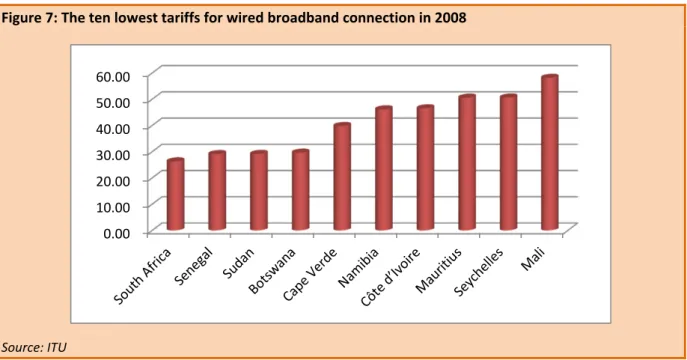
Figure 7 shows the ten lowest tariffs for wired broadband Internet connection in sub-Saharan Africa.
Figure 7: The ten lowest tariffs for wired broadband connection in 2008
Source: ITU
Among those ten countries, there are five that are among the top ten countries for the rate of Internet use. These are Cape Verde, Mauritius, Senegal, the Seychelles, and South Africa. It is assumed that low Internet connection costs are a significant factor in increasing the demand for Internet connection in a country.
The absence of Nigeria in this classification is due to the relatively poorly developed wired network compared to the mobile sector. The same is true of Kenya, where many customers are cancelling their wired Internet subscription in favour of 3G mobile Internet subscriptions.
The ten lowest tariffs for Internet access range from USD 26.31 in South Africa to USD 58.16 in Mali, which means a relatively large differential of USD 32.15 between the price of South Africa and that of Mali. Similarly, the tariff is USD 29.64 in Botswana and USD 46.53 in Côte d'Ivoire.
The ten highest tariffs, according to these data, range from USD 170 in Uganda to over USD 1 000 in Burkina Faso. These tariffs were applied to leased lines intended mainly for businesses; at that time, wired broadband was not available to households. These tariffs were very high, even for businesses.
There is evidently no direct correlation between the tariff charged and indicators such as population and per capita GDP. The population gives an idea of the potential market, and per capita GDP an impression of the financial capacity of the public to subscribe to a broadband Internet connection. The examples of Côte d'Ivoire and Senegal show that this correlation is not a direct one.
Côte d'Ivoire in 2009 had an estimated population of 21.4 million and a per capita GDP of USD 1 052. In 2009, Senegal's population was 12.2 million people and its per capita GDP was USD 968. Côte d'Ivoire thus has a larger potential market and its population a greater financial capacity than Senegal, and yet the tariff applied in Côte d'Ivoire is one and a half times higher than in Senegal.
0.00 10.00 20.00 30.00 40.00 50.00 60.00
Given that in many countries in sub-Saharan Africa, a large part of the population lives on less than two US dollars a day, these tariffs are high indeed.
IV.1.2 Tariffs for wired broadband Internet connection and the minimum wage
Internet connection tariffs may seem high in themselves but more reasonable in relation to purchasing power, if the Internet connection tariff represents only a very small proportion of purchasing power as reflected by the minimum wage.
For this analysis, the minimum wage as defined by the International Labour Office was used.17 The minimum wage was preferred to the average wage because in a genuine information society it is assumed that any citizen should have access to ICTs, and the minimum wage represents the part of the population with the lowest purchasing power.
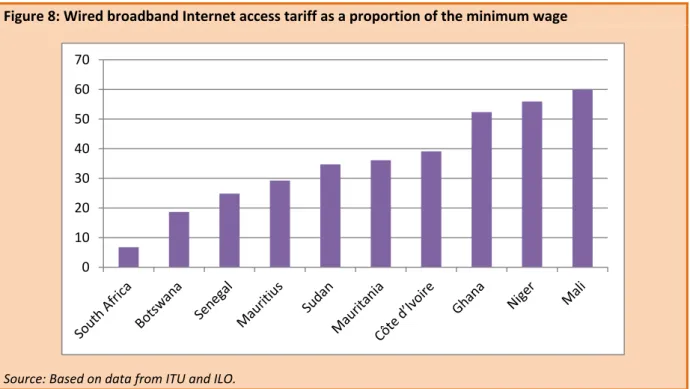
The ratio of the wired broadband Internet access tariff to minimum wage was used: i.e. the proportion of the minimum wage that will be spent on a broadband Internet subscription.
As data on the minimum wage for Cape Verde, Namibia, and the Seychelles were not available, these countries have been replaced by Ghana, Mauritania, and Niger.
Figure 8 shows this ratio for the ten countries with the lowest tariffs.
Figure 8: Wired broadband Internet access tariff as a proportion of the minimum wage
Source: Based on data from ITU and ILO.
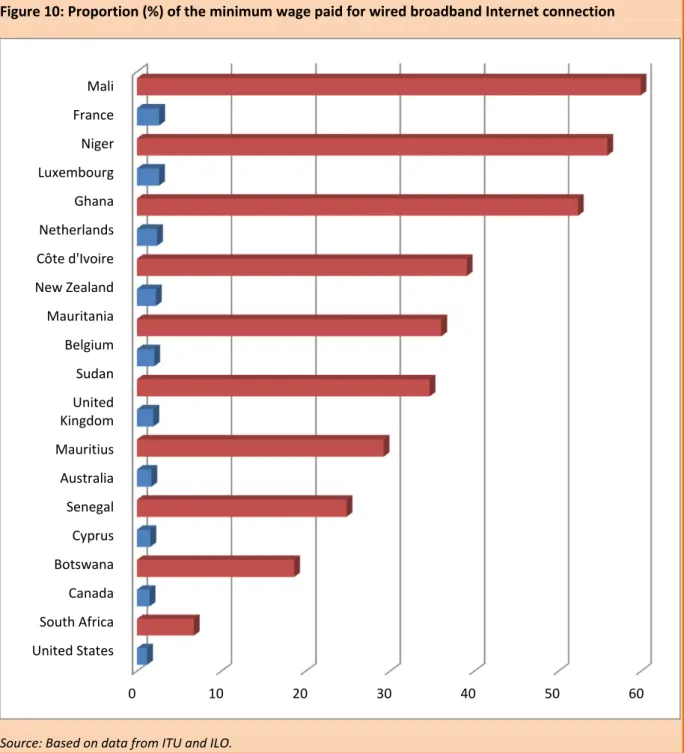
The proportion of the minimum wage represented by the broadband Internet access tariff varies from 6.75 per cent in South Africa to 59.96 per cent in Mali. Within that range, it is 24.85 per cent in Senegal and 52.35 per cent in Ghana. Over one third (34.70 per cent) of the minimum wage in Sudan, and almost two-thirds in Mali, must be spent in order to obtain a wired internet broadband connection.
0 10 20 30 40 50 60 70
These percentages are very high and give a clear idea of the high cost of Internet connection. It is easy to imagine that for much of the population in sub-Saharan Africa, having an unlimited Internet connection is a pipe dream.
IV.1.3 Comparison of wired broadband tariffs with those applied elsewhere in the world
It was shown in the previous paragraph that