Leveraging Large Amounts of Weakly Supervised Data for
Multi-Language Sentiment Classification
Jan Deriu
ZHAWAurelien Lucchi
ETH ZurichValeria De Luca
ETH ZurichAliaksei Severyn
Google ResearchSimon Müller
SpinningBytes AGMark Cieliebak
SpinningBytes AGThomas Hofmann
ETH ZurichMartin Jaggi
EPFLABSTRACT
This paper presents a novel approach for multi-lingual sentiment classification in short texts. This is a challenging task as the amount of training data in languages other than English is very limited. Previously proposed multi-lingual approaches typically require to establish a correspondence to English for which powerful classi-fiers are already available. In contrast, our method does not re-quire such supervision. We leverage large amounts of weakly-supervised data in various languages to train a multi-layer con-volutional network and demonstrate the importance of using pre-training of such networks. We thoroughly evaluate our approach on various multi-lingual datasets, including the recent SemEval-2016 sentiment prediction benchmark (Task 4), where we achieved state-of-the-art performance. We also compare the performance of our model trained individually for each language to a variant trained for all languages at once. We show that the latter model reaches slightly worse - but still acceptable - performance when compared to the single language model, while benefiting from better general-ization properties across languages.
Keywords
Sentiment classification; multi-language; weak supervision; neural networks
1.
INTRODUCTION
Automatic sentiment analysis is a fundamental problem in natu-ral language processing (NLP). A huge volume of opinionated text is currently available on social media. On Twitter alone, 500 mil-lion tweets are published every day. Being able to manually pro-cess such a high volume of data is beyond our abilities, thus clearly highlighting the need for automatically understanding the polarity and meaning of these texts. Although there have been several pro-gresses towards this goal, automatic sentiment analysis is still a challenging task due to the complexity of human language, where the use of rhetorical constructions such as sarcasm and irony
eas-c
2017 International World Wide Web Conference Committee (IW3C2),
published under Creative Commons CC BY 4.0 License.
WWW 2017,April 3–7, 2017, Perth, Australia. ACM 978-1-4503-4913-0/17/04.
http://dx.doi.org/10.1145/3038912.3052611
.
ily confuse sentiment classifiers. Contextualization and informal language, which are often adopted on social media, are additional complicating factors. The Internet is also multi-lingual and each language has its own grammar and syntactic rules.
Given all these difficulties, it is not surprising that the perfor-mance of existing commercial systems is still rather poor, as shown in several recent studies [6, 27]. The benchmark work of Ribeiro
et al.[27] showed that even the performance of the best systems largely varies across datasets and overall leaves much room for im-provement. Hence it is important to design a method that general-izes well to different domains and languages.
Contributions.The majority of current research efforts in
sen-timent analysis focuses on the English language. This is partially due to the large number of resources available in English, includ-ing sentiment dictionaries, annotated corpora and even benchmark datasets. An example is the SemEval competition, which is one of the largest competitions on semantic text evaluation and covers several tasks for sentiment analysis [24].
However, only 26.3% of the total number of internet users in 2016 are English speakers [15] and only 34% of all tweets are written in English [21]. Hence there is a strong incentive to develop methods that work well with other languages. In this work, we fo-cus on the question of how sentiment analysis can be done for mul-tiple languages by leveraging existing technologies. Our method is the state-of-the-art approach for sentiment analysis on Twitter data which recently won the SemEval-2016 competition [9]. Here we additionally explore how to best adapt this approach to other lan-guages. The core component of our system is a multi-layer convo-lutional neural network (CNN), trained in three phases: i) unsuper-vised phase, where word embeddings are created on a large corpus of unlabeled tweets; ii) distant supervised phase, where the network is trained on a weakly-labeled dataset of tweets containing emoti-cons; and iii) supervised phase, where the network is finally trained on manually annotated tweets. For English, this system achieved an F1-score of 62.7% on the test data of SemEval-2016 [9].
Although existing CNN approaches [31, 9] can a-priori be trained on any language other than English, these nevertheless require a large amount of training data. Yet resources in languages other than English are lacking, and manually labeling tweets is a time-consuming and expensive process. Two straightforward solutions that do not require manual work can be envisioned: (1) automat-ically translate the data into English and run the existing English classifier; or (2) train a CNN using only weakly-labeled tweets without using any supervised data. It is expected that a fully-trained CNN would perform better than the aforementioned cases.
How-ever, it is unclear if such improvement is significant and justifies the need of manually labeling thousands of tweets.
In this paper, we investigate how to effectively train and optimize a CNN for multi-lingual sentiment analysis. We compare the per-formance of various approaches for non-English texts. In details, our main contributions are:
• An evaluation of the state-of-the-art CNN approach similar to the one proposed in [9] on three new languages, namely French, German and Italian
• A thorough analysis of the influence of network parame-ters (number of layers, hyper-parameparame-ters) and other factors, e.g. the amount of distant-supervised and supervised data, on end-to-end performance
• For each language, a comparison of various approaches for sentiment analysis: (i) full training of the CNN for the con-sidered language; and (ii) automatically translating the texts into a language (English) where a sentiment classifier already exists. Other baseline methods, described in the experimen-tal section, are also compared
• In addition, we show that a single CNN model can be suc-cessfully trained for the joined task on all languages, as op-posed to separate networks for each individual language. This approach has the advantages of removing the reliance on (possibly inaccurate) language identification systems and it can be easily extended to new languages and multi-language texts. We provide detailed comparison to similar per-language models, and show that the proposed joint model still per-forms relatively well
• Public release of the source code as well as pre-trained mod-els for all languages tested in this paper, on
http://github.com/spinningbytes/deep-mlsa
2.
RELATED WORK
In the following, we provide an overview of the most relevant works, related to the application of neural networks to sentiment classification, distant supervision and training multi-lingual text classifiers.
Neural networks. Neural networks have shown great promise
in NLP over the past few years. Examples are in semantic analysis [33], machine translation [12] and sentiment analysis [34]. In par-ticular, shallow CNNs have recently improved the state-of-the-art in text polarity classification demonstrating a significant increase in terms of accuracy compared to previous state-of-the-art tech-niques [18, 17, 10, 32, 16, 28, 9]. These successful CNN models are characterized by a set of convolution filters acting as a slid-ing window over the input word sequence, typically followed by a pooling operation (such as max-pooling) to generate a fixed-vector representation of the input sentence.
CNNs vs RNNs. Recently, recurrent neural network
architec-tures (RNNs), such as long short-term memory networks (LSTMs), have received significant attention for various NLP tasks. Yet these have so far not outperformed convolutional architectures on polar-ity prediction [29, Table 4]. This has been evidenced by the recent SemEval-2016 challenge [24], where systems relying on convolu-tional networks rank at the top. In fact, long-term relationships captured well by LSTMs are of minor importance to the sentiment analysis of short tweets. On the contrary, learning powerfuln-gram feature extractors (which convolutional networks handle very well)
contributes much more to the discriminative power of the model, since these are able to effectively detect sentiment cues. Addi-tionally, LSTMs are much more computationally expensive than CNNs, preventing their application to very large collections like the one used in this paper (hundreds of millions tweets).
Distant-supervised learning. The use of semi-supervised or
unsupervised learning has been an active research direction in ma-chine learning and particularly for various NLP applications. There is empirical evidence that unsupervised training can be beneficial for supervised machine learning tasks [11]. In this paper, we con-sider a variant of unsupervised learning named distant pre-training which consists in inferring weak labels from data without manual labels. This approach has been used for text polarity classification where significantly larger training sets were generated from texts containing emoticons [13, 32]. Severyn and Moschitti [32] have shown that training a CNN on these larger datasets, followed by additional supervised training on a smaller set of manually anno-tated labels, yields improved performance on tweets.
Multi-language sentiment classification.Sentiment
classifica-tion has drawn a lot of attenclassifica-tion in the past few years both in in-dustry and academia [24, 6]. Yet most of the research effort has been focusing on tweets written in one language (mostly English). One exception is the work of Boiy and Moens [4] that studied the portability of a learned sentiment classification model across do-mains and languages. They focused on French, Dutch and English, and showed that significant disparities between these languages can severely hinder the performance of a classifier trained on hand-crafted features.
The major factor that limits the development of accurate mod-els for multi-lingual sentiment analysis is the lack of supervised corpora [2, 7]. Most of the existing approaches addressing this problem [22, 1] try to transfer knowledge from English – for which tools, labelled data and resources are abundant – to other languages for which resources are rather limited. An example is the approach introduced in [22], which transfers hand-crafted subjectivity an-notation resources - such as a per-word sentiment lexicon - from English to Romanian. A similar approach introduced in [1] con-sists in translating a target language to English and then to use an English sentiment classifier rather than one specific to the target language. Several approaches have also been proposed to build dis-tributed representations of words in multiple languages. The work of Wicket al.[35] used a Wikipedia corpus of five languages to train word embeddings, and then used anchor terms (names, cross-lingual words) to align the embeddings. Gouwset al.[14] proposed a method to create bilingual word vectors by requiring words that are related across the two languages.
All the aforementioned approaches rely on having access to a set of correspondences between English and the target language. Some of these methods also require translating the target language to En-glish. Yet machine translation is a very challenging task in NLP and represents an additional source of error in the classification system, due to various problems such as sparseness and noise in the data [7]. Furthermore, such methods crucially rely on accurate language identification, which is a very difficult task, especially on short texts. See e.g. [20, 19] for an overview of these methods and their limitations in generalizing to different domains.
In this work, we also investigate the performance of a language-independent classifier consisting of a CNN trained on all languages at once. This approach is similar to the Naïve Bayes classifier pro-posed in [25], excepts that it relies on simple hand-crafted word-level features instead of the CNN architecture used in this work.
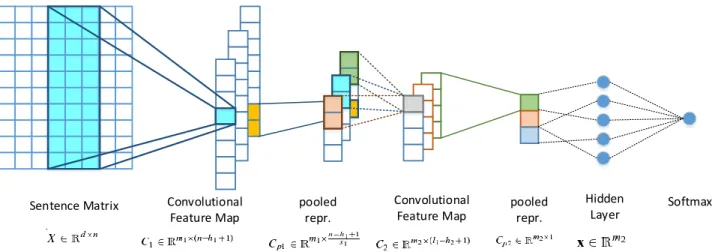
Sentence Matrix Convolutional Feature Map pooled repr. Convolutional Feature Map pooled repr. Hidden Layer Softmax
Figure 1: Architecture of the proposed CNN model with 2 convolutional layers
3.
MODEL
Our model follows a multi-layer CNN architecture, which we firstly introduced in [9]. Given an input sequence of words, the corresponding sequence of word embeddings is fed as input to the first 1d convolutional layer. Each convolutional filter here operates in a sliding window fashion along the input dimension (details are described below). This layer is followed by a max-pooling opera-tion whose output is then fed into the next convoluopera-tional layer. We extend a single-layer CNN, originally proposed in [32, 18, 17], to two convolutional and pooling layers. The resulting network archi-tecture is illustrated in Figure 1 and in its basic variant consists of two consecutive pairs of convolutional-pooling layers followed by a single hidden layer and a soft-max output layer. In the following, we describe in detail each layer and corresponding parameters.
3.1
Convolutional Neural Network
Embedding layer.Each word is associated with ad-dimensional
vector (embedding). An input sequence ofnwords is represented by concatenating their embeddings, yielding a sentence matrixX∈
Rd×n.Xis used as input to the network.
Convolutional layer.This layer applies a set ofmconvolutional filters of lengthhover the matrixX. LetX[i:i+h]denote the con-catenation of word vectorsxitoxi+h. A featureciis generated for
a given filterFby: ci:=
X
k,j
(X[i:i+h])k,j·Fk,j (1)
The concatenation of all vectors in a sentence defines a feature vec-torc ∈ Rn−h+1. The vectorscare then aggregated from allm
filters into a feature map matrixC ∈ Rm×(n−h+1). The filters
are learned during the training phase of the neural network, as de-scribed in Section 3.2. The output of the convolutional layer is passed through a non-linear activation function, before entering a pooling layer.
Pooling layer. The pooling layer aggregates the input vectors
by taking the maximum over a set of non-overlapping intervals. The resulting pooled feature map matrix has the form:Cpooled∈
Rm×
n−h+1
s , wheresis the length of each interval. In the case of
overlapping intervals with a stride valuest, the pooled feature map
matrix has the formCpooled ∈ Rm×
n−h+1−s
st . Depending on
whether the boundaries are included or not, the result of the frac-tion is rounded up or down respectively.
Hidden layer. A fully connected hidden layer computes the
transformationα(W∗x+b), whereW∈Rm×mis the weight
matrix,b∈IRm
the bias, andαthe rectified linear (relu) activa-tion funcactiva-tion [23]. The outputx∈Rmof this layer can be seen as
an embedding of the input sentence.
Softmax.Finally, the outputs of the previous layerx∈Rmare
fully connected to a soft-max regression layer, which returns the classyˆ∈[1, K]with largest probability, i.e.,
ˆ y= arg max j P(y=j|x,w,a) = arg max j ex|wj+aj PK k=1e x|wk+aj, (2)
wherewjdenotes the weights vector of classj, from which the dot
product with the input is formed, andajthe bias of classj.
Network Parameters. The following parameters of the neural
network are learned during training:θ={X,F1,b1,F2,b2,W,a}, withXthe word embedding matrix, where each row contains the d-dimensional embedding vector for a specific word;Fi,bithe
fil-ter weights and biases of convolutional layers; andWandathe weight-matrix for output classes in the soft-max layer.
3.2
Learning the Model Parameters
The model parameters are learned using the following three-phase procedure: (i) creation of word embeddings; (ii) distant-supervised phase, where the network parameters are tuned by train-ing on weakly labelled examples; and (iii) final supervised phase, where the network is trained on the supervised training data.
Preprocessing and Word Embeddings.The word embeddings
are learned on an unsupervised corpus containing 300M tweets. We apply a skip-gram model of window-size 5 and filter words that occur less than 15 times [32]. The dimensionality of the vector rep-resentation is set tod= 52. Our experiments showed that using a larger dimension did not yield any significant improvement.
Training.During the first distant-supervised phase, we use emoti-cons to infer noisy labels on tweets in the training set [26, 13].
SwissCheese: 3-Phase Training with Distant Supervision Twitter cat 0.12 0.91 0.32 cats 0.33 0.23 0.73 cute 0.24 0.33 0.11 … Word Embeddings
Adapted Word Emb. :-) :-( word2vec GloVe Distant Supervision Supervised Training Raw Tweets (200M) Smiley Tweets (90M) . Annotated Tweets (18k) Unknown Tweet cat 0.21 0.75 0.23 cats 0.25 0.27 0.65 cute 0.12 0.32 0.04 … Predictive Model 3 -Phas e T ra in in g A pp li ca tio n
Figure 2:Training Phases Overview.
Table 1:Data used for training the CNN model.
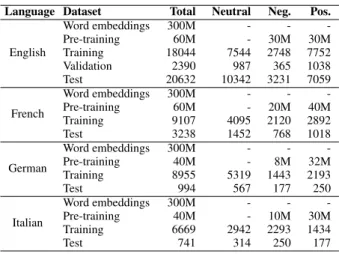
Language Dataset Total Neutral Neg. Pos.
English Word embeddings 300M - - -Pre-training 60M - 30M 30M Training 18044 7544 2748 7752 Validation 2390 987 365 1038 Test 20632 10342 3231 7059 French Word embeddings 300M - - -Pre-training 60M - 20M 40M Training 9107 4095 2120 2892 Test 3238 1452 768 1018 German Word embeddings 300M - - -Pre-training 40M - 8M 32M Training 8955 5319 1443 2193 Test 994 567 177 250 Italian Word embeddings 300M - - -Pre-training 40M - 10M 30M Training 6669 2942 2293 1434 Test 741 314 250 177
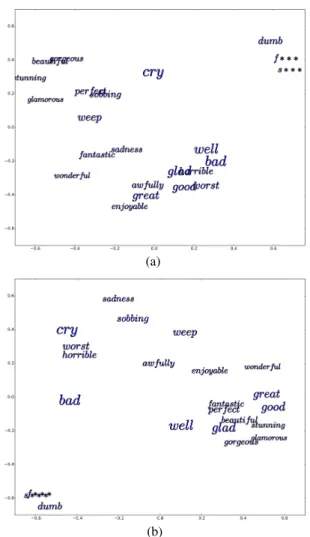
Details of the training set obtained from this procedure are listed in Table 1, "Pre-training" rows. Note that the data used for this pre-training phase do not necessarily overlap with the data used to create the word embeddings. The neural network was trained on these datasets for one epoch, before finally training on the super-vised data for about 20 epochs. The word embeddingsX∈Rd×n
are updated during both the distant- and supervised training phases by applying back-propagation through the entire network. The re-sulting effect on the embeddings of words are illustrated in Figure 7 and discussed in Section 5.
Optimization.During both training phases, the network
param-eters are learned usingAdaDelta[36]. We compute the score on the validation set at fixed intervals and select the parameters achieving the highest score.
Figure 2 shows a complete overview of the three phases of the learning procedure.
4.
EXPERIMENTAL SETTING
4.1
Data
We used a large set of 300M tweets to create the word em-beddings for each language, as well as a distant supervision
cor-pus of40-60M tweets for each language, where each tweet con-tained at least one emoticon (positive or negative smiley). Smi-leys were used to automatically infer weak labels and subsequently removed from the tweets. This idea of distant-supervised learn-ing was described in [13, 32, 31]. For the final supervised phase, we used publicly available labeled datasets for English [24], Ital-ian [30] and French [8]. The German corpus was newly created by the authors and is available athttp://spinningbytes.
com/resources. An overview of the datasets used in our
ex-periment, including the number of labelled tweets per dataset, is given in Table 1.
Data Preparation.Each tweet was preprocessed in three steps:
(i) URLs and usernames were substituted by a replacement token, (ii) the text was lowercased and (iii) finally tokenized using the NLTK tokenizer.
4.2
Sentiment Analysis Systems
In our experiments, we compare the performance of the follow-ing sentiment analysis systems:
• Random forest(RF) as a common baseline classifier. The RF was trained onn-gram features, as described in [25]
• Single-language CNN(SL-CNN). The CNN with three-phase training, as described in Section 3, is trained for each single language. In a set of experiments, the amount of training in the three phases is gradually reduced. The system using all available training data for one language is also referred to as ’fully-trained CNN’
• Multi-language CNN(ML-CNN), where the distant-supervised phase is performed jointly for all languages at once, and the final supervised phase independently for each language. For the pre-training phase, we used a balanced set of300M that included all four languages, see Table 1, ’Pre-training’
• Fully multi-language CNN(FML-CNN), where all training phases were performed without differentiation between lan-guages. The pre-training data is the same as in ML-CNN
• SemEval benchmark.In addition, results on the English dataset were compared to the best known ones from the SemEval benchmark1. For the data sets in the other three languages, no public benchmark results could be found in literature
• Translate: this approach uses Google Translate2 (as of Oct 2016) to translate each input text from a source language to a target language. It then uses the SL-CNN classifier trained for the target language to classify the tweets
4.3
Performance Measure
We evaluate the performance of the proposed models using the metric of SemEval-2016 challenge, which consists in averaging the macro F1-score of the positive and negative classes3. Each ap-proach was trained for a fixed number of epochs. We then selected the results that yielded the best results on a separate validation set. For French, German and Italian, we created a validation set by randomly sampling 10% of the data. For English we used the
test2015set as validation set andtest2016for testing from
the SemEval-2016 challenge, see Validation set in Table 1.
1http://alt.qcri.org/semeval2016/
2https://translate.google.com/
3Note that this still takes into account the prediction preformance on the neutral class.
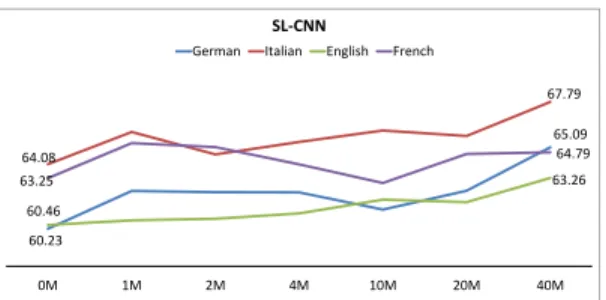
60.23 65.09 64.08 67.79 60.46 63.26 63.25 64.79 0M 1M 2M 4M 10M 20M 40M SL-CNN
German Italian English French
Figure 3:Results obtained by varying the amount of data during the distant supervised phase.Each CNN was trained for one epoch.
4.4
Implementation Details
The core routines of our system are written inTheano[3] ex-ploiting GPU acceleration with theCuDNNlibrary [5]. The whole learning procedure takes approximately 24-48 hours to create the word embeddings, 20 hours for the distant-supervised phase with 160M tweets and only 30 minutes for the supervised phase with 35Ktweets.
Experiments were conducted on ’g2.2xlarge’ instances of Ama-zon Web Services(AWS) withGRID K520GPU having 3072 CUDA cores and 8 GB of RAM.
5.
RESULTS
In this section, we summarize the main results of our experi-ments.
The F1-scores of the proposed approach and competing base-lines are summarized in Table 2. The fully-trained SL-CNNs sig-nificantly outperforms the other methods in all four languages. The best F1-score was achieved for Italian (67.79%), followed by Ger-man (65.09%) and French (64.79%), while the system for English reached only 62.26%. The proposed SL-CNNs outperform the cor-responding baselines from literature and RF.
Leveraging Distant Training Data. We increased the amount
of data for the distant-supervised phase for SL-CNN. Figure 3 com-pares F1-scores for each language when changing the amount of tweets from 0 to 40M. The scores without distant supervision are the lowest for all languages. We observe a general increase of F1-score when increasing the amount of training data. The perfor-mance gain for English, Italian and German is around 3%, while it is more moderate for French.
Table 2:F1-scores of compared methods on the test sets.The high-est scores among the three proposed models are highlighted in bold face. ML-CNNand FML-CNNare two variants of the method presented in Section 5.1.
Method Language
English French German Italian
SL-CNN 63.49 64.79 65.09 67.79 ML-CNN 61.61 - 63.62 64.73 FML-CNN 61.03 - 63.19 64.80 RF 48.60 53.86 52.40 52.71 SENSEI-LIF [24] 62.96 - - -UNIMELB [24] 61.67 - - -60.0 53.5 57.5 52.4 63.3 59.8 59.4 62.1 63.3 60.5 64.1 61.3 64.8 63.3 67.8 65.1 fr en it de SL-CNN
Full Random CNN Random Word Embeddings No Distant Supervision Fully Trained
Figure 4: Results obtained by initializing the CNNs with differ-ent word embeddings.The fully trained variant typically performs better than the other three variants, thus demonstrating the impor-tance of initializing the words vectors as well as performing distant-supervised training. 61.40 65.09 60.49 67.79 60.35 63.49 58.07 64.79 0.1 0.2 0.3 0.4 0.5 0.6 0.7 0.8 0.9 1 Supervised Training-Set Size
German Italian English French
Figure 5: Results obtained by varying the amount of supervised data. The maximum number on the y-axis corresponds to the total number of training tweets given in Table 1.
Supervised data. In Figure 5 we report the F1-scores of each
model for increasing amount of supervised data. We observe a score increase of 2-4% when using 100% of the available data in-stead of 10%.
Word Embeddings.We investigate the importance of
initializa-tion of word embeddings and the interacinitializa-tion of the latter with the distant supervised phase in four scenarios: (i) using randomly ini-tialized word embedding weights, not updated during the distant-supervised phase (namedFull Random CNN), (ii) using randomly initialized word embeddings, updated during the distant-supervised phase (Random Word Embeddings), (iii) using word2vec embed-dings without distant supervision (No Distant Supervision) and (iv) using word2vec embeddings, updated during the distant-supervised phase using160Mtweets (Fully trained CNN). Results in Figure 4 demonstrate that theFully trained CNN approach performed the best in almost all cases. These results prove that the quality of ini-tialization as well as updating the large number of word vector pa-rameters during training of the network yield significant improve-ments.
Figure 7 illustrates the effect of the distant-supervised phase on the word embeddings. For visualization purposes, principal com-ponent analysis (PCA) was used to project the word embeddings onto two dimensions. We see that the geometry of the word em-beddings reflects the distance in terms of sentiment between pairs of words. Figure 7(a) shows the initial word embeddings created by word2vec, before the distant-supervised phase. Taking as an
ex-Table 3: Summary of the network parameters used for experimental results. L2 is the default architecture used by our approach. The alternative L1 and L3 architectures are discussed in Figure 8.
Number of layers Number of filters Filter window sizeh Size of max-pooling windowwand stridingst
L1 1 300 h1= 5 None L2 2 200 h1= 4,h2= 3 w1= 4,st1= 2 L3 3 200 h1= 4,h2= 3,h3= 2 w1= 4,st1= 2,w2= 3,st2= 1 58.51 60.20 59.25 60.91 60.46 63.26 0M 4M 8M 16M 40M 80M 160M English Test Set
FML-CNN ML-CNN SL-CNN 61.07 62.72 60.65 63.62 60.23 65.09 0M 4M 8M 16M 40M 80M 160M German Test Set
FML-CNN ML-CNN SL-CNN 61.73 61.24 63.05 64.24 64.08 67.79 0M 4M 8M 16M 40M 80M 160M Italian Test Set
FML-CNN ML-CNN SL-CNN
Figure 6:Results obtained by varying the amount of data during the distant supervised phase. Each CNN was trained for one epoch. We rescaled the curve forSL-CNNto match the amount of data used per language by the multi-language approaches. For example, while the multi-language approaches were trained with40M tweets (10Mtweets per language), eachSL-CNNmodel was trained with10M tweets from the same language. Each experiment set, up to160Mtweets, contains the same number of tweets per language.
(a)
(b)
Figure 7:Word embeddings projected onto a 2-dimensional space using PCA before (a) and after (b) the distant-supervised training phase. 59 59.5 60 60.5 61 61.5 62 62.5 63 63.5 64 0M 1M 2M 4M 10M 50M 90M
SL-CNN English Test Set
1 Layer 2 Layers 3 Layers
Figure 8:F1-score on the English corpus as a function of the num-ber of network layers. These results were obtained by training the
SL-CNN models with different number of layers, as specified in Table 3, on different amounts of data during the distant-supervised phase. Each CNN was trained for one distant epoch.
ample the pair of words "good" and "bad", it is clear that these two words often appear in the same context and are thus close to each other in the embedded space. The similarity score of these two vectors is0.785. After the distant-supervised phase, the semantic of the space is changed and the distance between words come to re-flect the difference in terms of sentiment. As shown in Figure 7(b), negative and positive words are neatly separated into two clusters. In this case, the similarity score between the word embeddings of "good" and "bad" becomes−0.055. Finer grained clusters are also revealed in the second embedding. For example, words that convey sadness are close together.
Comparing Network Architectures. One common question
asked by practitioners relates to the influence of the number of lay-ers on the performance of a neural network. We thus evaluated the performance of various architectures with multiple layers. In order to reduce the number of experiments, we evaluated the
per-Table 4: Translation experiment. We translated each source lan-guage to each target lanlan-guage and used the model trained on the target language to predict tweets polarity.
Source Target
English Italian German French English 63.49 59.87 57.53 58.47 Italian 64.37 67.79 61.57 60.19 German 61.86 61.66 65.09 61.22 French 65.68 63.23 61.5 64.79
formance of the single-language model SL-CNN on the English set and varied the number of convolutional/pooling layer pairs from 1 to 3. We evaluated a total of 12 networks. Here, we only report the best set of parameters for each number of layers in Table 3 and cor-responding F1-scores in Figure 8. The network performance gen-erally improves with the number of layers, if a sufficient amount of training data is used in the distant-supervised phase. For the task of sentiment classification, current recurrent architectures such at LSTMs still do not perform as well as CNNs, see e.g. [29, Table 4] and the discussion in the related work section.
Translation Approach.In Table 4 we report results of the trans-lation experiment described in Section 4.2. The F1-score is higher when not translating tweets to another language for English, Ital-ian and German. As an exception, we obtained better results when translating French to English and using the English model to pre-dict sentiments.
5.1
Comparison to multi-language classifiers
Figure 6 summarizes F1-scores of the three CNN variants de-scribed in Section 4.2, namely SL-, ML- and FML-CNN, when varying the amount of distant-supervised phase. When compar-ing the three CNN variants, we see thatSL-CNNgets slightly bet-ter scores thanML-CNNandFML-CNN. The difference in perfor-mance between the single and multi-language models is around 2% on average. However, one benefit of the multi-language models over the single-language ones is their ability to deal with text in mixed languages. To check this hypothesis, we used thelangpitool [20] to extract a set of 300 tweets from the German corpus containing English words. Although these tweets were classified by Twitter as German, they contain a significant number of English words (some of them entirely written in English). We also man-ually inspected this set and discarded tweets that did not contain English. We then retrained the two models on the training set from which we first removed the set of 300 tweets. When evaluating on this subset,ML-CNNobtained an F1-score of 68.26 whileSL-CNN
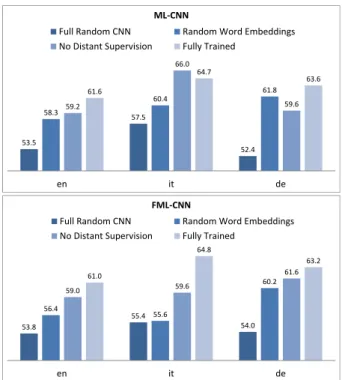
obtained 64.07. When manually inspecting the results, we clearly observed thatML-CNNwas better at classifying tweets that were entirely in English or contained several English words. The effect of using different word embedding initializations in the multilin-gual networks is summarized in Figure 9.
6.
CONCLUSION
We described a deep learning framework to predict the senti-ment polarity of short texts written in multiple languages. In con-trast to most existing methods, our approach does not rely on es-tablishing a correspondence to English but instead exploits large amounts of weakly supervised data to train a multi-layer CNN di-rectly in the target language. Through a thorough experimental
53.5 57.5 52.4 58.3 60.4 61.8 59.2 66.0 59.6 61.6 64.7 63.6 en it de ML-CNN
Full Random CNN Random Word Embeddings No Distant Supervision Fully Trained
53.8 55.4 54.0 56.4 55.6 60.2 59.0 59.6 61.6 61.0 64.8 63.2 en it de FML-CNN
Full Random CNN Random Word Embeddings No Distant Supervision Fully Trained
Figure 9: Results obtained by initializing the CNNs with different word embeddings. As for the results obtained with theSL-CNN
model, the fully trained variant typically performs better than the other three variants, both for theML-CNNandFML-CNNmodels.
evaluation, we addressed some fundamental questions around the performance of such model. First, we demonstrated that the strat-egy used to train these models plays an important role in the ob-tained performance. Two important factors are a good initialization for the word vectors as well as pre-training using large amounts of weakly supervised data. Second, we compared the performance of a language and a multi-language approach. The single-language model reaches the best performance and it even outper-forms existing state-of-the-art methods on all the datasets of the SemEval-2016 competition. The multi-language approach performs comparably well or slightly worse than its single-language counter-part, while exhibiting several advantages: it does not need to know
a priorithe language(s) used in each tweet; the model can be easily extended to more languages; and it can cope with texts written in multiple languages.
Acknowledgments.
This research has been funded by Commission for Technology and Innovation (CTI) project no. 18832.1 PFES-ES, and by Spin-ningBytes AG, Switzerland.
7.
REFERENCES
[1] M. Araujo, J. Reis, A. Pereira, and F. Benevenuto. An evaluation of machine translation for multilingual
sentence-level sentiment analysis. InProceedings of the 31st Annual ACM Symposium on Applied Computing, pages 1140–1145, 2016.
[2] A. Balahur and M. Turchi. Multilingual sentiment analysis using machine translation? InProceedings of the 3rd Workshop in Computational Approaches to Subjectivity and Sentiment Analysis, 2012.
[3] J. Bergstra, O. Breuleux, F. F. Bastien, P. Lamblin, R. Pascanu, G. Desjardins, J. Turian, D. Warde-Farley, and Y. Bengio. Theano: a CPU and GPU math compiler in Python.Proceedings of the Python for Scientific Computing Conference (SciPy), pages 1–7, 2010.
[4] E. Boiy and M.-F. Moens. A machine learning approach to sentiment analysis in multilingual web texts.Information retrieval, 12(5):526–558, 2009.
[5] S. Chetlur and C. Woolley. cuDNN: Efficient Primitives for Deep Learning.arXiv preprint, pages 1–9, 2014.
[6] M. Cieliebak, O. Dürr, and F. Uzdilli. Potential and limitations of commercial sentiment detection tools. In
ESSEM@ AI* IA, pages 47–58, 2013.
[7] K. Dashtipour, S. Poria, A. Hussain, E. Cambria, A. Y. A. Hawalah, A. Gelbukh, and Q. Zhou. Multilingual sentiment analysis: State of the art and independent comparison of techniques.Cognitive Computation, 2016.
[8] DEFT.https://deft.limsi.fr/2015/, 2015. [9] J. Deriu, M. Gonzenbach, F. Uzdilli, A. Lucchi, V. De Luca,
and M. Jaggi. Swisscheese at semeval-2016 task 4: Sentiment classification using an ensemble of convolutional neural networks with distant supervision.Proceedings of SemEval, pages 1124–1128, 2016.
[10] C. N. dos Santos and M. Gatti. Deep Convolutional Neural Networks for Sentiment Analysis of Short Texts. In
COLING, pages 69–78, 2014.
[11] D. Erhan, Y. Bengio, A. Courville, P.-A. Manzagol, P. Vincent, and S. Bengio. Why does unsupervised pre-training help deep learning?The Journal of Machine Learning Research, 11:625–660, 2010.
[12] J. Gao, X. He, W.-t. Yih, and L. Deng. Learning continuous phrase representations for translation modeling. InACL, 2014.
[13] A. Go, R. Bhayani, and L. Huang. Twitter Sentiment Classification using Distant Supervision. Technical report, The Stanford Natural Language Processing Group, 2009. [14] S. Gouws, Y. Bengio, and G. Corrado. Bilbowa: Fast
bilingual distributed representations without word alignments. InProceedings of the 32nd International Conference on Machine Learning, 2015.
[15] IWS.http:
//www.internetworldstats.com/stats7.htm,
2016.
[16] R. Johnson and T. Zhang. Semi-supervised Convolutional Neural Networks for Text Categorization via Region Embedding. InAdvances in Neural Information Processing Systems 28, pages 919–927, 2015.
[17] N. Kalchbrenner, E. Grefenstette, and P. Blunsom. A Convolutional Neural Network for Modelling Sentences. In
ACL - Proceedings of the 52nd Annual Meeting of the Association for Computational Linguistics, pages 655–665, 2014.
[18] Y. Kim. Convolutional Neural Networks for Sentence Classification. InEMNLP 2014 - Empirical Methods in Natural Language Processing, pages 1746–1751, 2014. [19] M. Lui and T. Baldwin. Cross-domain feature selection for
language identification. InIn Proceedings of 5th
International Joint Conference on Natural Language Processing, 2011.
[20] M. Lui and T. Baldwin. langid. py: An off-the-shelf language identification tool. InProceedings of the ACL 2012 system demonstrations, pages 25–30. Association for Computational Linguistics, 2012.
[21] Mashable.http://mashable.com/2013/12/17/
twitter-popular-languages/#gaFEjWnHPkql,
2013.
[22] R. Mihalcea, C. Banea, and J. M. Wiebe. Learning multilingual subjective language via cross-lingual projections. InACL, 2007.
[23] V. Nair and G. E. Hinton. Rectified linear units improve restricted boltzmann machines. InProceedings of the 27th International Conference on Machine Learning, pages 807–814, 2010.
[24] P. Nakov, A. Ritter, S. Rosenthal, V. Stoyanov, and F. Sebastiani. SemEval-2016 task 4: Sentiment analysis in Twitter. InProceedings of the 10th International Workshop on Semantic Evaluation, SemEval ’16, June 2016. [25] S. Narr, M. Hulfenhaus, and S. Albayrak.
Language-independent twitter sentiment analysis.
Knowledge Discovery and Machine Learning (KDML), LWA, pages 12–14, 2012.
[26] J. Read. Using emoticons to reduce dependency in machine learning techniques for sentiment classification. In
Proceedings of the ACL student research workshop, pages 43–48. Association for Computational Linguistics, 2005. [27] F. N. Ribeiro, M. Araújo, P. Gonçalves, F. Benevenuto, and
M. A. Gonçalves. A benchmark comparison of state-of-the-practice sentiment analysis methods.arXiv preprint arXiv:1512.01818, 2015.
[28] S. Rothe, S. Ebert, and H. Schutze. Ultradense Word Embeddings by Orthogonal Transformation.arXiv, 2016. [29] S. Semeniuta, A. Severyn, and E. Barth. Recurrent Dropout
without Memory Loss.arXiv, 2016.
[30] sentipolc.http://www.di.unito.it/~tutreeb/
sentipolc-evalita16/data.html, 2016.
[31] A. Severyn and A. Moschitti. Twitter Sentiment Analysis with Deep Convolutional Neural Networks. In38th
International ACM SIGIR Conference, pages 959–962, 2015. [32] A. Severyn and A. Moschitti. UNITN: Training Deep
Convolutional Neural Network for Twitter Sentiment Classification. InSemEval 2015 - Proceedings of the 9th International Workshop on Semantic Evaluation, 2015. [33] Y. Shen, X. He, J. Gao, L. Deng, and G. Mesnil. A latent
semantic model with convolutional-pooling structure for information retrieval. InProceedings of the 23rd ACM International Conference on Conference on Information and Knowledge Management, pages 101–110, 2014.
[34] R. Socher, A. Perelygin, J. Y. Wu, J. Chuang, C. D. Manning, A. Y. Ng, and C. Potts. Recursive deep models for semantic compositionality over a sentiment treebank. InProceedings of the conference on empirical methods in natural language processing, volume 1631, page 1642, 2013.
[35] M. Wick, P. Kanani, and A. Pocock. Minimally-constrained multilingual embeddings via artificial code-switching. 2015. [36] M. D. Zeiler. ADADELTA: An Adaptive Learning Rate