This is the author’s version of a work that was submitted/accepted for pub-lication in the following source:
Boles, Wageeh & Peach, Deborah (2013) Work integrated learning: Ex-posure to professional practice : expectations and challenges. In Lem-ckert, Charles, Jenkins, Graham, & Lang-LemLem-ckert, Susan (Eds.) 24th Annual Conference of the Australasian Association for Engineering Edu-cation (AAEE2013), Griffith School of Engineering, Griffith University, Gold Coast, Queensland, Australia.
This file was downloaded from: http://eprints.qut.edu.au/65898/
c
Copyright 2013 Wageeh Boles and Deborah Peach
The authors assign to AAEE and educational profit institutions a non-exclusive licence to use this document for personal use and in courses of instruction provided that the article is used in full and this copyright state-ment is reproduced. The authors also grant a non-exclusive licence to AAEE to publish this document in full on the World Wide Web (prime sites and mirrors), on Memory Sticks, and in printed form within the AAEE 2013 conference proceedings. Any other usage is prohibited without the express permission of the authors.
Notice: Changes introduced as a result of publishing processes such as copy-editing and formatting may not be reflected in this document. For a definitive version of this work, please refer to the published source:
Work integrated learning: Exposure to professional
practice: expectations and challenges
Wageeh Boles and Deborah Peach Queensland University of Technology Corresponding Author Email: [email protected]
Structured Abstract
BACKGROUND
Prior to graduation engineering students are expected to provide evidence of relevant experience in the workplace. This experience is expected to provide opportunities for exposure to the profession and to help students develop confidence, skills and capabilities as emerging professionals.
PURPOSE
This investigation considers the expectations and challenges in implementing WIL programs in different contexts. While this will inform the next iteration of engineering course development at QUT the issues and interventions described provide useful insights into options available and engineering curriculum design more broadly.
DESIGN/METHOD
This comparative analysis across three phases highlights expectations and challenges including stakeholder responsibilities, expectations, and assessment. The study draws on the findings of a 2005 investigation into the purpose and provision of WIL and findings of a 2012 Faculty review of the current WIL model.
RESULTS
The enhancement of WIL through a series of developmental phases highlights strengths and
weaknesses of various models. It is anticipated that this investigation will inform course development decisions on a whole-of-course approach to WIL that improves student engagement and learning experience.
CONCLUSIONS
The importance of WIL is not disputed. However with industry expectations, increasing student numbers and cohort diversity the ways in which students and industry currently engage in WIL are not sustainable and more creative, flexible and engaging approaches are needed.
KEYWORDS
Introduction
Students benefit enormously from periods of work experience. Work experience assists students with their studies; it helps them apply their theoretical knowledge to real situations; make sense of what they have learned and to identify aspects of their studies on which they need to concentrate; become more aware of systems, methods, designs, and the processes of industry; and can often provide opportunities for graduate employment (Job Access, 2012; Booth, Francesconi & Frank, 2002).
Work Integrated Learning (WIL) is a formalised form of work experience with specific learning outcomes and expectations. For engineering students WIL is a way of assisting students to become work ready and to develop as reflective practitioners, sustained by professional and ethical principles (Boles, Murray, Campbell & Iyer , 2006). Engineers Australia expects that students will undertake:
professional engineering practice integrated throughout their program to enable them to develop an engineering approach and ethos, and to gain an appreciation of professional engineering ethics. The purpose of this is to facilitate their entry into the profession and to better prepare them to be able to develop the generic graduate attributes (Engineers Australia, 2007).
This requirement was once expressed as a minimum duration of experience working at various levels in professional engineering but “is now seen as an aggregate of exposure to industry practice that can be built up from a varied number of activities” (Edwards, 2007, p.1). Accreditation of engineering programs now depends upon:
demonstrated development of attributes including effective communication, the ability to work in multi-disciplinary teams, utilisation of a systems approach to design, and an understanding of the social, cultural and ethical responsibilities of the professional engineer … Students need to not only be aware of sustainability but also have the opportunity to prepare, practice, and reflect upon these issues (Howard, 2009, p.178). Exposing engineering students to engineering practice with opportunities to engage with industry and develop an understanding of the workplace have been important elements of Australian engineering courses for many years. In addition to engagement with industry through mechanisms such as guest lecturers and site visits, engineering students at QUT are also required to aggregate at least 60 days (or the equivalent) of practical experience during their course. This in part satisfies Engineers Australia accreditation as described above. However, the 2013 ACED project Enhancing Industry Engagement in Engineering Degrees Project (King, 2013)argues that more must be done to ensure that students of engineering have stronger exposure to engineering practice and that universities in collaboration with industry address issues of authentic graduate learning outcomes, attrition and graduate employment. The ACED makes several recommendations including the integration of active, student-centred learning approaches with an increased focus on professional skills beyond the technical and more effective use of WIL. This paper traces changes made in the undergraduate engineering course at QUT since 2003 to improve WIL and the student learning experience (Boles, Beck & Hargreaves, 2005; Peach, Gomez & Ruinard, 2013), and reflects on lessons learnt and ways to continuously improve the way WIL is managed,
resourced and enacted through the curriculum.
Context
QUT students of engineering are required to complete a minimum of 60 days of work experience. It is suggested that this requirement be taken in two work placements. The first work placement is expected to provide students with exposure to workplace relations, management structures, and workflow processes. In the past the first placement of 30 days was not necessarily in an engineering firm or organisation. However, since 2007 students
them develop an understanding of their chosen profession; strengthen their CV; and start to build valuable networks in the engineering field. The second placement must be undertaken in an engineering industry relevant to their course. Students must be supervised by a
professional engineer, thus providing them with the opportunity to gain deeper insights into professional engineering practice.
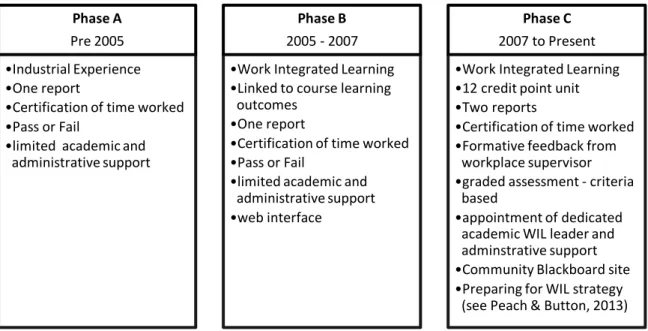
WIL is a priority curriculum area for QUT and within engineering disciplines since 2005 a process of continuous improvement has been underway. These efforts have been focussed on achieving better learning outcomes for students by ensuring that the development of professional skills and aptitudes is supported and valued within the curriculum. Table 1 summarises changes made over three time intervals i.e. pre-2005, 2005-2007; 2007 – present.
Table 1: Phases of WIL development in engineering pre-2005 to present
In Phase A it was observed that the quality of the industry experience reports, and by extension the benefits gained from the experience, varied widely. There was lack of clarity, on the part of students and some academic staff, of industrial experience objectives and reporting requirements. These concerns prompted support for a large ($130,000), university-funded, learning and teaching grant: Integrating workplace learning and professional
education: implementing a student centred, objectives driven and outcomes focused framework (Boles, Beck & Hargreaves, 2005).
The project addressed the objectives, structure, development and evaluation of workplace learning, focussing on integrating workplace learning with the academic curriculum. The objectives of the project were to:
1. Identify appropriate workplace learning objectives in relation to the specific courses.
2. Review student learning outcomes for each of the three courses and the current approaches for implementing and assessing them.
3. Extract and articulate components of course objectives that are best achieved through work based learning.
4. Devise and integrate appropriate assessment methods that facilitate and ensure student attainment of workplace learning objectives.
Phase A
Pre 2005 •Industrial Experience •One report
•Certification of time worked •Pass or Fail
•limited academic and administrative support
Phase B
2005 - 2007 •Work Integrated Learning •Linked to course learning
outcomes •One report
•Certification of time worked •Pass or Fail
•limited academic and administrative support •web interface
Phase C
2007 to Present •Work Integrated Learning •12 credit point unit •Two reports
•Certification of time worked •Formative feedback from
workplace supervisor •graded assessment - criteria
based
•appointment of dedicated academic WIL leader and adminstrative support •Community Blackboard site •Preparing for WIL strategy
5. Design and implement professional development programs for academic and industry professionals to ensure sustainable and continuous involvement and collaboration.
6. Build a web-based facility and resource centre that supports students and staff and enables the incorporation and achievement of the above objectives. The intended framework and implemented system purposely centred on the students, their learning environment and outcomes, and utilised the flexibility provided by advances in educational technologies in an increasingly knowledge based and learning economy. The project aimed to ensure that graduates had progressed along the career development continuum from being a novice to, at the least, an advanced beginner. The project
highlighted the importance of workplace learning and the expectation that graduates would have acquired a range of workplace skills and experiences during their degree.
The most important goal of the project was to enhance students’ learning outcomes from the workplace components of their course. This was enabled by the identification of workplace learning objectives specifically linked to, and derived from the learning objects of the targeted courses. The achievement of the project’s goal contributed to the design and integration of assessment approaches targeting the evaluation of students’ attainment levels of the set objectives. In 2005 the Work Integrated Learning (WIL) program became available for the first time in engineering, thus marking the start of the second interval i.e. Phase B. Phase B was designed to streamline students’ industrial experience and align course objectives with activities in the workplace. In so doing, Phase B aimed to ensure that students accelerated their career development and were work ready and therefore more valuable as graduate employees. This Phase was supported by a web-based facility
designed to assist students before, during and after their work placement. Whilst this Phase went a considerable way towards enhancing students’ learning outcomes from industrial experience, it was superseded by a more encompassing, faculty-wide approach to WIL in Phase C.
The development of the learning outcomes was done in response to the overall course learning outcomes. One of the major sources guiding those learning outcomes was the expectations set by Engineers Australia accreditation criteria. These criteria included
knowledge and skills that connected the theoretical knowledge with the context and relevant application areas likely to be encountered by practicing engineers. To do so, feedback from industry representatives on the faculty industry liaison committee, as well as their peers, was obtained in a number of ways, including discussions held during the course design process. Data was also collected through surveys and during special workshops held with engineers invited from industries congruent with the majors planned, for example power engineering, aerospace avionics, and telecommunications. The process of aligning learning outcomes and incorporating industry, staff and student input continued in Phase C, as part of a continuous improvement process.
The changes made in Phase C were driven in part by major, university-wide initiatives to improve the quality of WIL (Peach, 2012). It coincided with a restructuring of the engineering course which included the introduction of a mandatory, 12 credit point WIL unit to be
undertaken in conjunction with the minimum 60 days of work experience. The faculty-wide model, still in place, emphasises the value of workplace exposure and the work environment as a place of authentic learning (Franz, 2007; Savage, Davis, Miller, 2010). The model is regarded as cost-effective, cohesive, and pedagogically sustainable with the capacity to serve large scale, high volume cohorts with disciplinary diversity between and within the cohorts.
The faculty-wide model is conceptualised around three learning phases of WIL i.e. preparatory; placement; and retrospective. The preparatory phase involves reaching students early in their degree to raise awareness about WIL requirements and includes a
Community Blackboard site; brief information sessions each semester in core second year classes; and voluntary lunch time seminars run each semester in collaboration with the Careers and Employment Service. The placement phase involves completing 60 days of relevant work experience before graduation. Students can commence this experience once they have completed the equivalent of the first two years of the degree. The experience may be paid or unpaid and can be completed in one or two periods during the end-of-year
vacation, mid-semester vacation or on a part-time basis. The retrospective phase involves enrolment in the credit-bearing WIL unit.
The unit is delivered in blended mode and includes: a 5 hour seminar on campus and 3 x 1.5 hour online, webinars during the semester. The introduction of blended approaches in 2011 is a significant feature of the unit. This approach affords students greater flexibility to engage with real time classes whilst working in diverse locations (e.g. regional, remote, and
international). A 2012 review indicated that the blended learning approach has helped reduce students’ feelings of isolation in large (evening) lectures; encouraged peer learning and peer networks; introduced a range of interactions in class time; improved communication
processes; and empowered students through opportunities to contribute and lead parts of a session (Peach, Gomez, Ruinard, 2013).The assessment in Phase C includes two reports. The first report includes a detailed analysis of aspects of the work environment and
outcomes of the WIL placement. The second report is a detailed reflection on 5 episodes based on field notes, work log entries, and relevant research.
Expectations and Challenges
There is nothing new about professional and business communities placing demands upon higher education to produce work-ready graduates. However, at a time of increased student enrolments, increased student diversity, and an increased emphasis on risk management there are tensions about the kinds of WIL programs that universities are able and prepared to offer (Peach & Gamble, 2011). Changes made to the way WIL is offered to engineering students at QUT is an example of trying to ensure that students have strong exposure to engineering practice; that these experiences are meaningful and clearly linked to course learning outcomes; and that the model of delivery is cost-effective, cohesive, and
pedagogically sustainable. These efforts have led to improvements but also raised other issues.
For example, the priority in Phase B was to enhance students’ learning outcomes from the workplace components of the course. To do this a set of workplace objectives that students had to address in the workplace were developed. These objectives took into account Engineers Australia accreditation criteria and the QUT Graduate Capabilities. This process of identifying subsets of workplace objectives revealed inadequacies in existing course objectives with some needing to be ‘unpacked’ and others lacking. This process also highlighted that diverse work placements offer different kinds of experiences e.g. some students were not significantly engaged in technical applications and could therefore not be expected to meet compulsory objectives related to technical tasks. Subsequently, the focus in Phase C shifted to a holistic rather than task focussed approach. Described by Orrell (2007) as a ‘transformative stakeholder ethos’ where a process of inquiry and discovery yields both generic and discipline based learning. The work plan tool developed in Phase B which prioritised compulsory observations and selected optional applications was adapted so students could self-identify personal, professional and discipline specific areas of strength and weakness and negotiate their work plan in consultation with workplace supervisors. In both Phases B and C student e-portfolio was promoted as an effective tool to gather evidence and reflect on workplace learning. However, student take up of this tool remains low.
In Phase B assessment was based on three components; students’ self-assessment, a written report, and an industry supervisor report. After building and executing their work plan, students were required to submit a report on their work experience and were assessed as
complete or incomplete. Without dedicated academic oversight and administrative support marking, tracking of marks, and responding to student assessment queries was a significant problem in Phase B. Phase C assessment is based on two written reports (including work logs and reflective field notes) and formative feedback from workplace supervisors. The reports in Phase C are graded using criteria focussed on content, presentation and
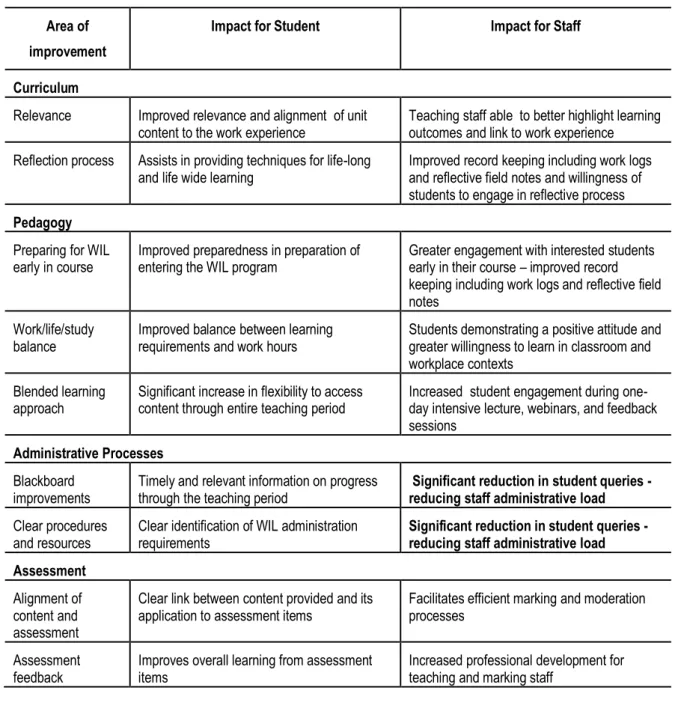
professional writing. Students must demonstrate both technical and non-technical lessons learnt in the workplace (see Peach & Button, 2013). Academic leadership and administrative support is provided through a dedicated WIL Director and administrative officer. This has enabled a timely, streamlined approach to assessment and marking. As a result expectations and requirements are much clearer and student queries have decreased. A summary of other improvements and their impact identified in the 2012 review are provided in Table 2.
Table 2: Phase C: Summary of areas of improvement and impact (Peach, Gomez & Ruinard, 2013)
Area of improvement
Impact for Student Impact for Staff
Curriculum
Relevance Improved relevance and alignment of unit content to the work experience
Teaching staff able to better highlight learning outcomes and link to work experience Reflection process Assists in providing techniques for life-long
and life wide learning
Improved record keeping including work logs and reflective field notes and willingness of students to engage in reflective process
Pedagogy
Preparing for WIL
early in course Improved preparedness in preparation of entering the WIL program Greater engagement with interested students early in their course – improved record keeping including work logs and reflective field notes
Work/life/study
balance Improved balance between learning requirements and work hours Students demonstrating a positive attitude and greater willingness to learn in classroom and workplace contexts
Blended learning
approach Significant increase in flexibility to access content through entire teaching period Increased student engagement during one-day intensive lecture, webinars, and feedback sessions
Administrative Processes
Blackboard
improvements Timely and relevant information on progress through the teaching period Significant reduction in student queries - reducing staff administrative load
Clear procedures
and resources Clear identification of WIL administration requirements Significant reduction in student queries - reducing staff administrative load Assessment
Alignment of content and assessment
Clear link between content provided and its application to assessment items
Facilitates efficient marking and moderation processes
Assessment feedback
Improves overall learning from assessment items
Increased professional development for teaching and marking staff
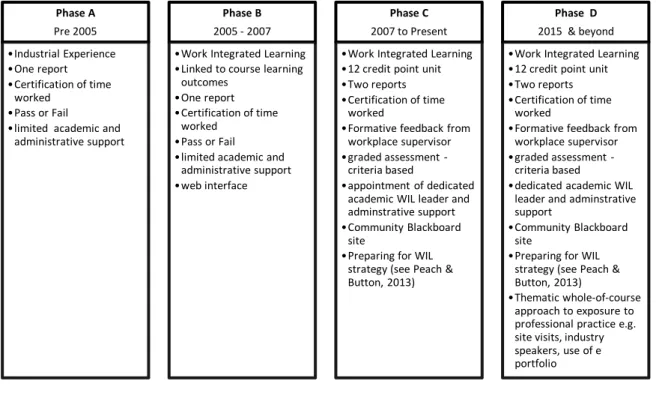
informed by current course renewal processes, could include a course-wide, developmental approach to specific graduate capabilities. In conjunction with the existing WIL model a carefully planned and document set of activities could be introduced in the design stream of the course. These activities might consist of, for example, industry guest lectures, site visits, and presentations by engineering societies such Engineers Australia. Students would begin earlier to assemble a portfolio of evidence related to graduate attributes and professional skill development. These experiences would inform subsequent work experience and the WIL unit would become a complementary and important component of the learning experience.
Table 3: The next phase of WIL development in engineering
Exposure to professional practice will remain a priority curriculum area. To strengthen this exposure as urged by the ACED (King, 2013) an embedded, whole of course approach to the development of graduate capabilities and professional skills – in conjunction with the WIL program should be considered. Such an approach will require consideration of issues such resourcing; managing risk; working sustainably with large and diverse cohorts; and
determining who is responsible.
Conclusion
This paper examines expectations and challenges in different phases of WIL in engineering at QUT from 2005 till the present time. This process of continuous improvement has
focussed on achieving better learning outcomes for students by ensuring that the development of graduate capabilities, professional skills and aptitudes is supported and valued within the curriculum. Phase A did not work well, with variations in the quality of industrial experience and learning outcomes, prompting changes to a more structured
approach (Phase B). Phase B focussed on ensuring that WIL learning outcomes aligned with Engineers Australia accreditation criteria and course learning outcomes. In Phase B the need for dedicated academic leadership and administrative support was identified. This was rectified to a great extent in Phase C. Phase C shifted to a holistic rather than task oriented approach to work experience in order to be cost-effective, cohesive, and pedagogically
Phase A Pre 2005 •Industrial Experience •One report •Certification of time worked •Pass or Fail
•limited academic and administrative support
Phase B
2005 - 2007 •Work Integrated Learning •Linked to course learning
outcomes •One report •Certification of time
worked •Pass or Fail •limited academic and
administrative support •web interface
Phase C
2007 to Present •Work Integrated Learning •12 credit point unit •Two reports •Certification of time
worked
•Formative feedback from workplace supervisor •graded assessment -
criteria based
•appointment of dedicated academic WIL leader and adminstrative support •Community Blackboard
site
•Preparing for WIL strategy (see Peach & Button, 2013)
Phase D
2015 & beyond •Work Integrated Learning •12 credit point unit •Two reports •Certification of time
worked
•Formative feedback from workplace supervisor •graded assessment -
criteria based
•dedicated academic WIL leader and adminstrative support
•Community Blackboard site
•Preparing for WIL strategy (see Peach & Button, 2013)
•Thematic whole-of-course approach to exposure to professional practice e.g. site visits, industry speakers, use of e portfolio
sustainable. However, concentrating all required learning outcomes and exposure to professional practice in one unit is neither sufficient nor productive. The current ways in which students are exposed to professional practice are not sustainable. Creative, flexible, and engaging approaches are needed such as a course-wide, developmental approach to specific graduate capabilities and professional skills. That is, it is worth considering an approach supported by carefully planned and documented developmental activities in conjunction with work experience and a WIL unit.
References
Booth, A., Francesconi, M.& Frank, J. (2002). Temporary jobs: stepping stones or dead ends? The Economic Journal, 112 (480), F189–F213, June 2002.
Boles, W., Beck, H., & Hargreaves, D. (2005). Deploying bloom’s taxonomy in a work integrated learning environment. In Proceedings of the ASEE/AAEE 4th Global Colloquium on Engineering Education, 26-30 September 2005, Sydney.
Boles, W., Murray, M., Campbell, D., & Iyer, R. (2006) Engineering the Learning Experience:
Influences and Options. In 17th Annual Conference of the Australasian Association for Engineering Education, 10-13 December 2006, Auckland.
Edwards, D. (2007). Integrating Work Integrated Learning. International Conference on Engineering Educ (ICEE). Retrieved 30 August 2011 from http://www.ineer.org/Events/ICEE2007/papers Engineers Australia (2007). Engineers Australia Policy on Accreditation of Professional Engineering
Programs. Retrieved 20 August 2013 from
http://www.engineersaustralia.org.au/sites/default/files/shado/Education/Program%20Accreditation/ AMS%20Engineering%20Technologist/P02ET%20Policy%20on%20Accreditation%20of%20Prof_ %20Engineering%20Programs.pdf.
Franz, J. (2007). Work Integrated Learning for design: A scholarship of integration. ConnectED 2007 International Conference on Design Education. Sydney: University of New South Wales.
Howard, P. (2009). Articulating the learning: Professional practice made explicit. Asia-Pacific Journal ofCooperative Education 10(3). 177-188
JobAccess, An Australian Government Initiative (2012). Retrieved 26 August 2013 from http://www.jobaccess.gov.au/content/work-experience
King, R. (2013). Australian engineering education and project context [PowerPoint Slides]. Presented at NRSWS Industry-Education Forums, June 2013.
Orrell, J. (2007). Keynote address, ACEN-Q WIL Symposium. Retrieved 7 February 2007 from www.waceinc.org
Peach, D. (2012). Getting stuck in together : improving work integrated learning from an Australian institution and faculty perspective. In Zegwaard, Karsten E. (Ed.) Proceedings of the 15th New Zealand Association for Cooperative Education Conference (Nurturing Good Practice: "Getting Stuck in Together"), New Zealand Association for Cooperative Education (NZACE), University of Waikato, Hamilton, New Zealand, pp. 9-14.
Peach, D. & Button, C. (2013). Work Integrated Learning for Engineers – the effective use of
alternative learning environments. Manuscript submitted to 2013 Australasian Association for Engineering Education (AAEE) Annual Conference, Gold Coast.
Peach, D. & Gamble, N. (2011) Scoping work integrated learning purposes, practices and
issues. In Billett, Stephen & Henderson, Amanda (Eds.) Developing Learning Professionals: Integrating Experiences in University and Practice Settings. Springer, Dordrecht, The Netherlands.
Peach, D., Gomez, R. & Ruinard, E. (2013). Reconstructing spaces and places
through blended work integrated learning. In Frielick, S., Buissink-Smith, N., Wyse, P., Billot, J., Hallas, J. and Whitehead, E. (Eds.) Research and Development in Higher Education: The Place of Learning and Teaching, 36 (pp 336 - 345). Auckland, New Zealand, 1 – 4 July 2013.
Savage, S., Davis, R. & Miller, E. (2010). Professional education in built environment and design.
[Australian Learning & Teaching Council (ALTC) Final report]. Brisbane: Australia. Retrieved August 12 2013 from http://eprints.qut.edu.au
Acknowledgements
The authors wish to acknowledge the conceptual and editorial assistance provided by Fleur Webb in the development of this paper.
Copyright statement
Copyright © 2013 Wageeh Boles and Deborah Peach: The authors assign to AAEE and educational non-profit institutions a non-exclusive licence to use this document for personal use and in courses of instruction provided that the article is used in full and this copyright statement is reproduced. The authors also grant a non-exclusive licence to AAEE to publish this document in full on the World Wide Web (prime sites and mirrors), on Memory Sticks, and in printed form within the AAEE 2013 conference proceedings. Any other usage is prohibited without the express permission of the authors.