Blocking and non-blocking concurrent hash tables in multi-core
systems
´
AKOS DUD ´AS
Budapest University of Technology and Economics Department of Automation and Applied Informatics
1117 Budapest, Magyar Tud´osok krt. 2 QB207 HUNGARY
S ´ANDOR JUH ´ASZ
Budapest University of Technology and Economics Department of Automation and Applied Informatics
1117 Budapest, Magyar Tud´osok krt. 2 QB207 HUNGARY
Abstract: Widespread use of multi-core systems demand highly parallel applications and algorithms in everyday computing. Parallel data structures, which are basic building blocks of concurrent algorithms, are hard to design in a way that they remain both fast and simple. By using mutual exclusion they can be implemented with little effort, but blocking synchronization has many unfavorable properties, such as delays, performance bottleneck and being prone to programming errors. Non-blocking synchronization, on the other hand, promises solutions to the aforementioned drawbacks, but often requires complete redesign of the algorithm and the underlying data structure to accommodate the needs of atomic instructions. Implementations of parallel data structures satisfy different progress conditions: lock based algorithms can be deadlock-free or starvation free, while non-blocking solutions can be lock-free or wait-free. These properties guarantee different levels of progress, either system-wise or for all threads. We present several parallel hash table implementations, satisfying different types of progress conditions and having various levels of implementation complexity, and discuss their behavior. The performance of different blocking and non-blocking implementations will be evaluated on a multi-core machine.
Key–Words: blocking synchronization, non-blocking synchronization, hash table, mutual exclusion, lock-free, wait-free
1
Introduction
Parallel programs have been around for more than a quarter of a century, and recently they have moved into the focus of research again. The general avail-ability of multi-core processors brings the demand for high performance parallel applications into main-stream computing promoting new design concepts in parallel programming [1].
The most crucial decision when designing paral-lel data structures and algorithms is finding an optimal balance between performance and complexity. Shavit in [1] argues that “concurrent data structures are diffi-cult to design.” Performance enhancements often re-sult in complicated algorithms requiring mathemati-cal reasoning to verify their correctness, whereas sim-pler solutions fall short of the required performance or have other unfavorable properties.
Critical sections assure correct behavior by limit-ing access to the shared resources. Every runtime en-vironment supports various types of synchronization primitives supporting this type of parallel program-ming, and they usually require only a few changes in code or data. Critical sections and other primitives correspond to the level of abstraction of the
program-ming environment making the life of programmers easier. But simplicity comes with the cost of unfa-vorable properties, such as the risk of deadlocks, live-locks, priority inversion, and unexpected delays due to blocking [2, 3, 4, 5], not mentioning the increased risk of programming errors [6].
Non-blocking synchronizations promote them-selves as true alternatives to locking. Such algo-rithms employ atomic read-modify-write operations supported by most modern CPUs. The basic idea is that instead of handling concurrency in a pessimistic way using mutual exclusion, concurrent modifications of a data structure are allowed as long as there is a fail-safe guarantee for detecting concurrent modifica-tion made by another thread. (Rinard used the term “optimistic synchronization” to describe this behavior [5].) Complex modifications are performed in local memory and then in an atomic replace step they are committed into the data structure.
The biggest advantage of non-blocking synchro-nization is complete lock-freeness. As there are no locks, the problems mentioned at blocking synchro-nization do not arise. These methods also provide better protection from programming errors and from
faulty threads not releasing locks, resulting in higher robustness and fault tolerance [7]. The tradeoff with non-blocking algorithms is that they are more com-plex and harder to design, even when they seem sim-ple [8].
The right choice depends on the required perfor-mance and expected guarantees. There are two types of requirements: safety and liveness. Safety means that data structures work “correctly” without losing data or breaching data integrity. The result of con-current operations performed on a parallel data struc-ture are correct, according to the linearizability con-dition [9, 10], if every operations appears to take ef-fect instantaneously at some point between it’s invoca-tion and its response. Thelivenessproperty captures the fact whether the interfering parallel operations will eventually finish their work. Liveness condi-tions are different for blocking- and non-blocking al-gorithms. For blocking algorithms, usually deadlock-freedom or starvation-deadlock-freedom are expected, while non-blocking algorithms can be lock-free [11, 12] or wait-free [13, 14].
In this paper hash tables are used to illustrate the wide range of design options for parallel data struc-tures. We discuss the implementation details and the performance costs of applying various approaches de-signing a concurrent hash table.
The rest of the paper is organized as follows. Sec-tion 2 presents the related literature of parallel al-gorithms and hash tables. Lock based solutions are discussed in Section 3 followed by the non-blocking algorithms in Section 4. After the implementation details, their performance is evaluated in Section 5 through experiments. The conclusions are discussed in Section 6.
2
Blocking- and non-blocking
syn-chronization in hash tables
Hash tables [17] store and retrieve items identified with a unique key. A hash table is basically a fixed-size table, where the position of an item is determined by a hash function. The hash function is responsible for distributing the items evenly inside the table in or-der to provide O(1) lookup time. The difference be-tween the two basic types of hash tables (bucket- and open address), is the way they handle collisions, i.e. when more than one item is hashed (mapped) to the same location. Bucket hash tables chain the colliding items using external storage (external means not stor-ing within the original hash table body), while open-address hashing finds a secondary location within the table itself.
Hash tables are perfect candidates for
optimiza-tion in parallel environments. The hash table itself is an abstract concept and there are various imple-mentation options, which all demand different paral-lelization approaches. Best performance is observed when the hash table uses arrays as external storage [18, 19, 20], which will require structural changes in case of a non-blocking implementaion.
The most notable downside of blocking synchro-nization is the level of parallelism they provide; or rather they fail to provide. Limiting the number of parallel data accesses to a single thread at one time by a single critical section guarding the entire hash table significantly reduces overall performance. To over-come this issue, finer grained locking can be applied. Larson et al. in [21] use two lock levels: a global ta-ble lock and a separate lightweight lock (a flag) for each bucket. The implementation by Lea in [22] uses a more sophisticated locking scheme with a smaller number of higher level locks (allocated for hash table blocks including multiple buckets) allowing concur-rent searching and resizing of the table. When consid-ering large hash tables with a couple million or more buckets the use of locks in high quantities can be chal-lenging. Most environments do not support this many locks, and with custom implementations one has to be concerned with memory footprint and false shar-ing limitshar-ing the efficiency of caches [24, 25, 26].
There is no general consensus about blocking synchronization. Some argue that mutual exclusion locks degrade performance without any doubt [5, 11] and scale poorly [16], while others state that con-tention for the locks is rare in well designed systems [2, 27], therefore contention does not really impact performance [28]. The strongest reservation about blocking synchronization, and what is probably most relevant for advocating non-blocking solutions, is that they build on assumptions, such as critical sections are short, and the operating system scheduler is not likely to suspend the thread while it is in the critical section. These assumptions, however, may not always hold.
To ensure greater robustness and less depen-dency on the operating system a parallel data struc-ture can be implemented using the compare-and-exchange/compare-and-swap (CAS) operations. This method is founded on the fact that all modern archi-tecture provide hardware support for atomic combined read-write operations (e.g the CMPXCHG instruction in the x86 architecture) that allow the non-destructive manipulation (setting the value of a memory location with somehow preserving its old content) of a single machine word. Herlihy describes the basic concept of transforming sequential algorithms into non-blocking protocols this way [29]: first the object to be modified is copied into local memory in its current state, then the modifications are performed on this local copy
in-Figure 1: Progress conditions of parallel data structures described by Herlihy and Shavit [33].
stance, and finally the change is committed back us-ing the CAS instruction. If another thread has mod-ified the same data in the meantime, the operation is retried.
With this method complete lock-free data struc-tures and algorithms can be built, as it was to linked list by Harris [30], Valois [12] and Michael [25], whose works were further extended to resizable hash tables by Shalev and Shavit in [31]. Both Gao el al. [8] and Purcell and Harris [32] built a lock-free open address hash tables.
Non-blocking algorithms are generally hard to design. This is in fact the case for parallel hash tables built on the CAS primitives. The entire organization of the data has to be revised: arrays having given the best performance in single threaded case are no longer a storage option as an additional level of indirection has to be introduced into accessing an element in or-der to allow transactional modification with a single CAS operation. Failing to perform CAS successfully the complete transaction has to be retried which re-quires restructuring of code to allow this fallback exe-cution path. All in all, a completely new hash table is required with careful design of placement and align-ment in memory.
Other concerns about non-blocking implementa-tions include the fact that atomic operaimplementa-tions are more expensive than simple writes [8]. Michael even went as far as saying that they are “inefficient” [11], and so are the algorithms, that avoid the use of locks [16].
There is an inherent hierarchy, or rather struc-ture among both the blocking and the non-blocking algorithms with regards to the assumptions they are based on, and the level of progress they provide. Sev-eral liveness conditions are known in the literature for quite some time, yet there has been no handle on their relation until recently. Herlihy and Shavit presented a “unified explanation” [33] of the progress properties. They placed these properties in a two-dimensional structure, where one axis defines maximal or min-imal progress (informally: expect at least a single
thread minimal, or all threads to complete actions -maximal); the other axis defines the assumptions of the operating system scheduler. Algorithms are either blocking or non-blocking, and they can depend on the scheduler or can guarantee the level of progress re-gardless of schedulers support. Fig. 1 describes this structure of progress conditions (as in [33]).
This system of classification of parallel algo-rithms helps with comparing different implementa-tions focusing on their merits both in terms of perfor-mance and in robustness. Wait-free algorithms are the “best” but usually the most complex, while lock-free algorithms are simpler to create. There is a similar re-lationship between starvation-free and deadlock-free algorithms, given that they are also more dependent on the operating system. The practical importance of the obstruction-free and clash-free conditions is yet to be discovered.
3
Blocking hash tables
Blocking synchronization mechanisms are usually easier to implement. Locks and critical sections are inherent part of all programming languages and en-vironments and they are described on an abstraction level the programmer is familiar with, therefore is is straightforward to use them.
3.1 Deadlock-free hash table
Being conceptually simpler does not mean that block-ing algorithms require no design. The basic ex-pectation from lock-based data structures is to be
deadlock-free, that is, threads cannot delay each other forever. The simplest way of guaranteeing deadlock-freedom is using a single lock in the data structure, which basically serializes all accesses. This single lock protects the data structure at each entry point. Alg. 1 shows the implementation of the insert method in a deadlock-free hash table. A similar guard is to be
Algorithm 1Deadlock-free concurrent hash table using a single table lock.
initialize:
table_lock: mutex insert( data ):
table_lock.enter() // acquire lock, blocks until successful insert_internal( data ) // perform the insert as usual
table_lock.release() // release the lock
Algorithm 2Deadlock-free concurrent hash table using fine-grained locking.
initialize:
bucket_locks[]: mutex insert( data ):
bucketIdx = hash( data ) // maps the item to a bucket
bucket_locks[bucketIdx].enter() // acquire lock, blocks until successful insert_internal( data ) // perform the insert as usual
bucket_locks[bucketIdx].release() // release the lock
placed around each operation to make the data struc-ture completely thread-safe and deadlock-free.
More sophisticated locking mechanisms use mul-tiple locks. Fine-grained locking can deliver much better level of parallelism and performance. For ex-ample in case of bucket hash tables each bucket can be protected with a dedicated lock. Since each basic op-eration (except for rename) works in a single bucket, the implementation is still deadlock-free. In case of large hash tables, it might not be feasible to use tens of thousands, or even millions of locks. In such cases, the buckets can be assigned to groups, where each bucket is only member of one group but one group contains multiple buckets [23]. Protecting each group with a single lock delivers good level of parallelism (depending on the number of threads and the number of groups). Alg. 2 shows the deadlock-free hash table with fine-grained locking.
The only requirement about the locks used in the aforementioned implementations is that they work correctly, that is, they allow a single thread to reside within the critical section. There is no fairness guaran-tee, such as allowing the access to the critical section only in the same order as it was requested. Simple spin-locks (also known as busy-wait loops) spinning on a test-and-set instruction [34, 24] as well as mu-texes offered by the programming environment can be used. Other options include using reader-writer locks, which allow concurrent readers and a single writer. This type of lock, as long as only a single one is ac-cessed by each operation, is still deadlock-free; the only difference is that the appropriate type of access (shared or exclusive) is determined by the operation (i.e. find requires read access while insert requires write access).
3.2 Starvation-free hash table
Deadlock-freedom guarantees only that there are threads that make progress (specifically the one that currently owns the lock). It does not specify that all threads must complete their operations. A more re-strictive condition is starvation-freedom, which re-quires thatallthreads get the access to the critical sec-tion eventually. With test-and-set locks this cannot be guaranteed, as it is possible that a thread always looses in the race for the lock.
In order to guarantee starvation freedom with mu-tual exclusion, threads should enter the critical sec-tion in the same order as they request it. Queue-locks satisfy this requirement. Using Mellor-Crummey and Scott’sticket lock[24] the bucket hash table is mod-ified as shown in Alg. 3 for a single table lock; fine-grained bucket level locks can be implemented sim-ilarly. (The interlocked-incinstruction increases the value of the integer in an atomic step and returns the new value.)
4
Non-blocking hash tables
Their undesired properties often limit the usability of blocking synchronizations. Even in the absence of deadlocks and starvation, the level of parallelism is limited: threads hinder each others progress caus-ing priority inversion and problems that occur when a thread crashes and does not release a lock by error. Non-blocking synchronization mechanisms promote themselves as alternatives to lock based methods of-fering better scalability and robustness.
Algorithm 3Starvation-free concurrent hash table using a single table lock.
initialize:
currently_served: int, initially 1 ticket_counter: int, initially 0 insert( data ):
my_ticket = interlocked_increment( ticket_counter ) // get ticket
while( my_ticket != currently_served ) // wait until my ticket is served
nop // no operation, spin-wait
insert_internal( data ) // perform the insert as usual interlocked_increment( currently_served ) // notify next in line
4.1 Linked list-based lock-free bucket hash table
The sensitive operation within the hash table is com-mitting a new entry into the bucket, or removing an entry. Using a linked list for realizing the buckets the hash table can be implemented in a non-blocking fashion. Alg. 4 shows the CAS based linked-list lock-free bucket hash table algorithm. This algorithm works only if there are no deletes from the hash table. Deletes can be supported as well, with some modifi-cations [12].
It is easy to see that this implementation is lock-free. There are no locks or mutual exclusion in the code, hence there are no indefinite delays. That is to say, there is one case: the CAS operation can fail if the target memory location has been changed by another thread. It will, however, always succeed for a single thread, thus the data structure is lock-free. As for cor-rectness, this algorithm is linearizable, the CAS be-ing the linearization point (where the changes appear atomically for the entire system).
4.2 Array based lock-free bucket hash table
Linked-lists are not always the best choice for bucket hash tables. Data prefetch mechanisms and cache lines containing multiple items mask the memory ac-cess latency when iterating through the items in arrays while prefetching is of no use when traversing a linked list. This can yield an increase in the amount of cache misses deprecating performance.
The incompatibility between compare-and-swap and arrays lies in the fact that CAS works with ma-chine word size values only, meaning that an item in the array larger than 4 or 8 bytes cannot be written atomically. The compromise is as follows. The buck-ets are implemented with arrays, but when a new item is to be added, a new array is allocated copying the previous contents and adding the new one, then CAS-ing the pointer to this new array into the hash table body (see Alg. 5). Only one concurrent insert will succeed causing the other one to retry. Deleting items works the same way, except the new array will not
contain the item to remove. Search operations are not affected by this as long as they hold the pointer to the bucket as they know it.
This implementation is, similarly to the linked-list based one, lock-free but not wait-free for the same reasons discussed previously. The linearization point is the CAS operation.
This approach wastes the new array allocation and copy operation in case of contention for the same bucket, which is an obvious performance drawback. The gain on the other hand is the faster searching ca-pability in the array.
De-allocating the unused arrays is also a problem. When a new array replaces the previous one, the old one should be de-allocated, given that no one else uses it. In garbage collected systems this is handled by the environment, but in other cases this is the responsibil-ity of the programmer. The solution is either reference counting, or if possible, not deallocated memory un-til it is safe (after parallel operations have been com-pleted).
4.3 Wait-free hash table
The last hash table presented in this section takes a dif-ferent approach compared to all previously discussed implementations. All the solutions above required, to some extent, the modification of the hash table code: placing the locks and the critical sections, reorganiz-ing the entire table into linked lists or use the compare-and-exchange operation. Let us present an algorithm, which uses no locks and is not only non-blocking but completely wait-free, and requires no modifications inside the hash table. To our knowledge this is the first wait-free hash table in the literature.
The main problem with parallelism from the point of view of data structures is concurrent modification of the same storage slot. If different threads worked with different hash tables, this would not be a problem anymore. Instead of the traditional scenario where each thread is capable of executing any work we spe-cialize our threads by assigning individual work ar-eas to them in a way that these working arar-eas do
Algorithm 4CAS based lock-free concurrent bucket hash table with linked list.
typedef node: key, value, next initialize:
buckets[]: pointer to node insert( data ):
myItem = create( data ) // creates the node from the data l = buckets[ hash( data ) ] // linked list representing the bucket while( true ): // loop for CAS retries
curr = l;
while curr.next != NULL: // check each item in the list if( matches( data, curr ) ):
return curr; curr = curr.next
if( CAS( curr.next, myItem, NULL ) ) // link the new item to the end
return myItem // CAS succeeded (item is inserted) or retry
Algorithm 5CAS based lock-free concurrent bucket hash table with array.
initialize:
buckets[]: pointer to array insert( data ):
while( true ): // loop for CAS retries h = hash( data )
myArray = buckets[ h ] // the current bucket idx = find_in_array( myArray, data ) // check the current data
if idx != -1: // found
return myArray[ idx ]
newArray = allocate_new_copy( myArray, data ) // create new array, copy existing // data and insert new
if( CAS( buckets[ h ], newArray, myArray ) ) // replace bucket
return // CAS succeeded (item is inserted) // or retry
not overlap (separate functions, pipeline stages, spa-tial domains or graph branches). A specific request (insert/find) can only be served by one thread, and it is up to the right selection of domains that pro-vides the load balance. The selection rules are usually based on data decomposition as functional decompo-sition generally provides limited scalability and we easily reface the bottleneck problem of critical sec-tions on the level of control organization. According to our knowledge this kind of cooperation is never mentioned in the literature of shared memory algo-rithms, but the idea is not unknown in distributed sys-tems, where there low cost shared memory synchro-nization is not available, thus a coarser grained coop-eration must be maintained between the nodes by di-rected point-to-point messages or implicit work allo-cation rules (e.g. distributed file servers, horizontally partitioned data bases, documents groups allocated to separate web servers).
The universe of items that the concurrent hash table stores is partitioned into several subtables, and each of these hash table partitions is unambiguously mapped to a single working thread. When a thread is ready to perform work, it checks the next work item
in a central queue, and decides if it should process it. The decision is completely decentralized, and all threads must come to the same conclusion: one and only one of them chooses the item for processing. There is no communication between the threads, thus no overhead.
The decision whether to process an item is based on the item itself. Each item is unambiguously mapped to a thread by calculating a hash value from the data. In case of a hash table this is quite easy, as the items have a key, which, by definition, uniquely determines them. (This concept, however, we note, is generalizable to other data structures and problems. For example, sorting can be performed this way as well: the hash function can divide the items by their value: smaller than a threshold goes to one thread, larger to another [35].)
The critical element in this case is the central queue. It must be wait-free for the hash table sys-tem to be wait-free, and it must map the isys-tems to the requesting threads. There are wait-free queue algo-rithms in the literature, such as the one by Michael et al. [?]. Let n be the number of processing threads (and consequently the number of hash tables). Using
Algorithm 6Wait-free algorithm for hash tables.
initialize:
hash_tables[]: hash table, one for each thread queues[]: wait free queues, one for each thread addRequest(data):
h = hash( data )
queues[h].enqueue( data ) processingThreadFunction():
while true
i = queues[threadId].dequeue() // get item from the threads queue h = hash( i )
hash_tables[threadId].insert( i ) // insert into the table
nwait-free queues every processing thread receives a dedicated queue. Assigning an item to a thread needs to hash the data and add it to the right queue. The overhead this time is the pre-calculation of the hash by the process that would generally only insert the re-quest into a queue. Algorithm 6 presents the solution. The biggest advantage of this solution, besides being wait-free, is that the internal hash tables are un-aware that they are used in a multithreaded environ-ment. Any hash table implementation could be used and its source code does not need to be altered.
The difference between Alg. 6 and traditional par-allel hash tables is that here the threads need to be aware that they are accessing different hash tables. It is not the responsibility of the hash table to han-dle parallelism, but it is left up to the threads them-selves. This can be viewed as a “relaxation” of the requirements of the data structure, as Shavit calls it [1]. It might require changes in the algorithms using the hash table to support this behavior, but the gain is wait-freedom. (We also note that data parallel algo-rithms are likely to be easier to adopt to this behav-ior as they already distribute work among threads in a similar fashion.)
This wait-free implementations cannot be de-scribed by any of the generally used correctness cri-teria. It is not linearizable, as changes are not atomic. It is not sequentially consistent [3] either, because it is not clear which point is the invocation of a hash table operation, and when the method returns: all op-erations are split into two phases, first insertion into the right queue, and the completing the work. This type of operation is not compatible with the general description of concurrent objects by histories, invoca-tions and response events.
5
Performance evaluation
Vastly different hash table implementations were pre-sented in the previous sections. Some are already
known in the literature, while others present new ideas. They all feature different properties: the non-blocking solutions are all more robust, while the lock based tables are simpler. Let us examine how simplic-ity and compromises in the implementation translates into performance.
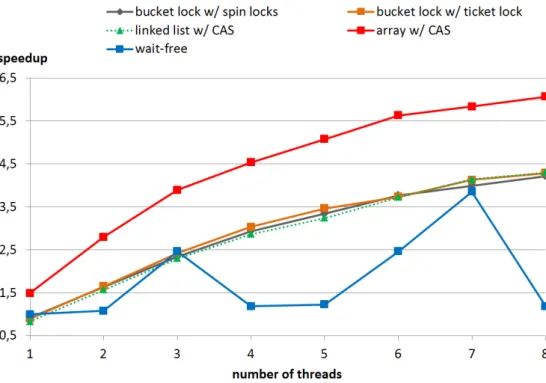
All off the parallel hash tables were implemented in C++ with careful optimization. They are all of the same structure: a bucket hash table with either a linked list or an array representing the buckets. The ta-bles were initialized by inserting 8 million items into them, and a subsequent 8 million find queries were executed. The wall-clock execution time was mea-sured. The insert and find operations were executed under two circumstances: in the first case the num-ber of buckets of the hash tables was chosen to result in a single item per bucket on average, thus the con-tention for the buckets is small (Fig. 2); the latter case used tenth of the number of buckets causing high con-tention (Fig. 3). The results are an average of 5 in-dependent executions on a state-of-the-art Intel Core i7-2600 CPU with 8 (logical) execution units.
Using a single lock is not evaluated below as it is expected to have very little speedup, if any due to high contention for the single lock. The speedup is measured by comparison to the single threaded execu-tion of the same operaexecu-tions using a very similar hash table implementation without locks or CAS; as a mat-ter of fact, the very same table is used by rule based cooperation.
The lock based (bucket lock w/ spin locks and bucket lock w/ ticket lock) and the linked list based w/ CAS have quite similar performance. The maxi-mal speedup is between around 3-3.5 and 4-4.5 for 8 concurrent threads depending on the number of buck-ets used by the table. The lock-free solutions are both faster than the lock based solutions by a small mar-gin under little contention, but the true power of the lock-free solutions show with high contention: array based w/ CAS is by far the best one reaching almost 6.5 speedup. Considering the overhead with the
con-Figure 2: Speedup of the various parallel hash tables with little contention for the buckets.
Table 1: Hash table realizations for the various progress conditions of parallel data structures. non-blocking, independent blocking, dependent
every method makes progress
wait-free w/ queues table lock w/ ticket lock, bucket lock w/ ticket lock some method
makes progress
linked list-based w/ CAS, array-based w/ CAS
table lock w/ spin lock, bucket lock w/ spin lock
stant array allocations and copy operations can only be due to the good cache behavior and prefetch friendli-ness exhibited by the array.
The wait-free solution, rule based cooperation, achieves a 2.5-3.5 speedup at its peek performance for 7 threads. It is not as fast as either the lock-based or the lock-free solutions, but at the same time it guaran-tees progress for all threads at all times and that inter-nally it can work with arbitrary hash table implemen-tations. The drop in performance under heavy loads for 4 and 5 threads in Fig. 3 is due to uneven load bal-ancing of items among the threads. This points out another bottleneck in this wait-free implementation.
Lock-free solutions can deliver the same, if not better performance than lock based solutions. The cost is the complexity of the algorithms. The wait-free algorithm requires restructuring of code, but not the structure of the hash table, and in exchange for global progress guarantee we pay with a significant performance loss.
Guaranteeing stronger progress conditions, such as starvation-freeness or wait-freeness, result in per-formance loss. As an engineering choice the faster but less resilient solutions seem like a good trade-off, while the complicated progress guarantees should only be chosen when they are indeed necessary. Per-formance in lock-based solutions is manageable by choosing the level of granularity for locking, which is closer to an engineering solution, while there is no such directly tunable parameter for lock-free algo-rithms.
6
Conclusion
Parallel data structures are hard to design in a way that they remain simple while delivering good perfor-mance at the same time. Lock based solutions are sim-pler, but cannot guarantee much in terms of safety and robustness; non-blocking algorithms are much more complicated, and a compromise is required to balance performance and simplicity. In this paper we used hash tables to illustrate the vast amount of options for creating concurrent data structures. Their structure is relatively simple and both locking and non-blocking algorithms can be implemented with some effort.
Ta-ble 1 lists the various hash taTa-ble types organized ac-cording to the progress conditions they satisfy [33].
Lock based solutions, when designed carefully, such as using fine-grained locking for regions in the bucket hash table, have really good performance. Such locking solutions are relatively lightweight and inter-thread communication in multi-core machines (via the locks) is very cheap allowing to achieve up to 4.5 times speedup for 8 concurrent threads.
CAS based non-blocking solutions represent a different type of parallel hash tables. Their inter-nal structure require careful redesign, whereas, when carefully tuned, they have the same performance as the lock based solutions. The usual argument that they are more robust is masked by the fact that they are complex and therefore hard to verify.
The final options we presented,rule based coop-erationis in our knowledge the first wait-free hash ta-ble in the literature. It wraps the hash tata-ble with an addition layer, which handles the parallel access, thus requires no internal modifications of the original hash table and is still able to achieve a reasonable speedup.
Acknowledgements: This work was partially sup-ported by the European Union and the European So-cial Fund through project FuturICT.hu (grant no.: T ´AMOP-4.2.2.C-11/1/KONV-2012-0013).
References:
[1] N. Shavit, Data structures in the multicore age, Communications of the ACM 54 (3) (2011) 76. [2] J. H. Anderson, Y.-J. Kim, T. Herman,
Shared-memory mutual exclusion: major research trends since 1986, Distributed Computing 16 (2-3) (200(2-3) 75–110.
[3] L. Lamport, How to make a correct multiprocess program execute correctly on a multiprocessor, IEEE Transactions on Computers 46 (7) (1997) 779–782.
[4] H. H. Michael Hohmuth, Pragmatic Nonblock-ing Synchronization for Real-Time Systems, in: Proceedings of the General Track: 2002 USENIX Annual Technical Conference, 2002.
[5] M. C. Rinard, Effective fine-grain synchroniza-tion for automatically parallelized programs us-ing optimistic synchronization primitives, ACM Transactions on Computer Systems 17 (4) (1999) 337–371.
[6] P. Gill, Operating Systems Concepts, 1st Edi-tion, Vol. 2006, Laxmi Publications, New Delhi, India, 2006.
[7] G. E. Blelloch, B. M. Maggs, Parallel algo-rithms, in: Algorithms and theory of computa-tion handbook, 2010, Ch. 25, p. 25.
[8] H. Gao, J. F. Groote, W. H. Hesselink, Lock-free dynamic hash tables with open addressing, Dis-tributed Computing 18 (1) (2005) 21–42. [9] M. P. Herlihy, J. M. Wing, Linearizability: a
cor-rectness condition for concurrent objects, ACM Transactions on Programming Languages and Systems 12 (3) (1990) 463–492.
[10] M. P. Herlihy, J. M. Wing, Axioms for con-current objects, in: Proceedings of the 14th ACM SIGACT-SIGPLAN symposium on Prin-ciples of programming languages - POPL ’87, ACM Press, New York, New York, USA, 1987, pp. 13–26.
[11] M. Michael, Nonblocking Algorithms and Preemption-Safe Locking on Multiprogrammed Shared Memory Multiprocessors, Journal of Parallel and Distributed Computing 51 (1) (1998) 1–26.
[12] J. D. Valois, Lock-free linked lists using compare-and-swap, in: Proceedings of the Four-teenth Annual ACM Symposium on Principles of Distributed computing, ACM Press, New York, New York, USA, 1995, pp. 214–222. [13] M. Herlihy, Wait-free synchronization, ACM
Transactions on Programming Languages and Systems 13 (1) (1991) 124–149.
[14] M. P. Herlihy, Impossibility and universality re-sults for wait-free synchronization, in: Proceed-ings of the seventh annual ACM Symposium on Principles of distributed computing - PODC ’88, ACM Press, New York, New York, USA, 1988, pp. 276–290.
[15] M. Herlihy, V. Luchangco, M. Moir, Obstruction-Free Synchronization: Double-Ended Queues as an Example, in: Proceedings of the 23rd International Conference on Dis-tributed Computing Systems, IEEE Computer Society Washington, DC, USA, 2003, pp. 522–259.
[16] H. Attiya, R. Guerraoui, D. Hendler, P. Kuznetsov, The complexity of obstruction-free implementations, Journal of the ACM 56 (4) (2009) 1–33.
[17] D. E. Knuth, The art of computer programming, Vol 3, Addison-Wesley, 1973.
[18] M. Mitzenmacher, Good Hash Tables & Mul-tiple Hash Functions, Dr. Dobbs Journal (336) (2002) 28–32.
[19] G. L. Heileman, W. Luo, How Caching Affects Hashing, in: Proc. 7th ALENEX, 2005, pp. 141– 154.
[20] A. Sachedina, M. A. Huras, K. K. Romanufa, Resizable cache sensitive hash table (2003). [21] P.-A. Larson, M. R. Krishnan, G. V. Reilly,
Scaleable hash table for shared-memory multi-processor system (Apr. 2003).
[22] D. Lea, Hash table
util.concurrent.ConcurrentHashMap, revision 1.3, in JSR-166, the proposed Java Concurrency Package (2003).
[23] ´A. Dud´as, S. Juh´asz, S. Kolumb´an, Perfor-mance analysis of multi-threaded locking in bucket hash tables, ANNALES Universitatis Scientiarum Budapestinensis de Rolando E¨otv¨os Nominatae Sectio Computatorica 36 (2012) 63– 74.
[24] J. M. Mellor-Crummey, M. L. Scott, Algorithms for scalable synchronization on shared-memory multiprocessors, ACM Transactions on Com-puter Systems 9 (1) (1991) 21–65.
[25] M. M. Michael, High performance dynamic lock-free hash tables and list-based sets, in: ACM Symposium on Parallel Algorithms and Architectures, 2002, pp. 73–82.
[26] M. Greenwald, Non-blocking Synchronization and System Design, Phd thesis, Stanford Uni-versity (Aug. 1999).
[27] L. Lamport, A fast mutual exclusion algorithm, ACM Transactions on Computer Systems 5 (1) (1987) 1–11.
[28] F. Fich, V. Luchangco, M. Moir, N. Shavit, P. Fraigniaud, Obstruction-Free Step Complex-ity: Lock-Free DCAS as an Example, in: P. Fraigniaud (Ed.), Lecture Notes in Com-puter Science, Vol. 3724 of Lecture Notes in Computer Science, Springer Berlin Heidelberg, Berlin, Heidelberg, 2005, pp. 493–494.
[29] M. Herlihy, A methodology for implementing highly concurrent data structures, in: Proceed-ings of the second ACM SIGPLAN symposium on Principles & practice of parallel program-ming - PPOPP ’90, ACM Press, New York, New York, USA, 1990, pp. 197–206.
[30] T. L. Harris, A Pragmatic Implementation of Non-blocking Linked-Lists, in: DISC ’01 Pro-ceedings of the 15th International Conference on Distributed Computing, 2001, pp. 300–314.
[31] O. Shalev, N. Shavit, Split-ordered lists, Journal of the ACM 53 (3) (2006) 379–405.
[32] C. Purcell, T. Harris, Non-blocking hashtables with open addressing, in: Proceedings of the 19th International Symposium on Distributed Computing, Springer-Verlag GmbH, Krakow, Poland, 2005, pp. 108–121.
[33] M. Herlihy, N. Shavit, On the Nature of Progress, in: A. Fern`andez Anta, G. Lipari, M. Roy (Eds.), Principles of Distributed Sys-tems, Lecture Notes in Computer Science, Vol. 7109 of Lecture Notes in Computer Science, Springer Berlin Heidelberg, Berlin, Heidelberg, 2011, pp. 313–328.
[34] T. Anderson, The performance of spin lock alter-natives for shared-money multiprocessors, IEEE Transactions on Parallel and Distributed Sys-tems 1 (1) (1990) 6–16.
[35] E. Horowitz, A. Zorat, Divide-and-Conquer for Parallel Processing, IEEE Transactions on Com-puters C-32 (6) (1983) 582–585.
![Figure 1: Progress conditions of parallel data structures described by Herlihy and Shavit [33].](https://thumb-us.123doks.com/thumbv2/123dok_us/1602041.2716600/3.892.207.692.161.303/figure-progress-conditions-parallel-structures-described-herlihy-shavit.webp)