Univeristy
of
Cape
Town
PERCEPTIONS OF CLOUD COMPUTING
IN THE SOUTH AFRICAN GOVERNMENT
A DISSERTATION
SUBMITTED TO THE DEPARTMENT OF COMPUTER SCIENCE
UNIVERSITY OF CAPE TOWN
FOR MINOR DISSERTATION PRESENTED IN PARTIAL FULFILMENT
OF THE REQUIREMENTS FOR THE DEGREE OF
MASTER OF SCIENCE (MIT)
BY
DEENA CHETTY
SUPERVISED BY:
PROFESSOR HUSSEIN SULEMAN
The copyright of this thesis vests in the author. No
quotation from it or information derived from it is to be
published without full acknowledgement of the source.
The thesis is to be used for private study or
non-commercial research purposes only.
Published by the University of Cape Town (UCT) in terms
of the non-exclusive license granted to UCT by the author.
University
of
Cape
ii
Declaration
I, Deena Chetty, student number (CHTDEE001), hereby declare that I know the meaning of plagiarism and declare that all of the work in the dissertation, save for that which is properly acknowledged, is my own.
_____________________________ Deena Chetty
iii
Abstract
The South African government is unable to provide efficient Information Technology (IT) services to the citizens because of the fragmented approach in government where each department procures their own IT services and equipment. This leads to a silo approach and no sharing across the departments. The rapid technology advancements are creating new opportunities and a new way of working. Government is unable to respond to the demand and the rigid procurement makes getting a new service or equipment a laborious task. The departments do not have buying power because of the silo approach. There are no economies of scale, integration and interoperability that will make technology less expensive and shared across government. The diverse environments that have different technologies are growing and becoming increasingly more complex and unmanageable. The suppliers are going directly to the departments by bypassing the government mandate. Cloud computing is an option to assist government but the adoption of cloud computing is slow.
If the situation remains the same or if nothing is done to improve the government ICT services, the service delivery for efficient ICT services to citizens will decline. An example is: People will need to take time off from their jobs in order to go to a government department and then wait in the long queues to get a basic service - this will create frustration and dissatisfaction towards the SA government. This is time consuming as each time that a person will need a service then they will have to go to the government department for a service that could have been offered as an ICT service.
A survey was conducted for the government users and the primary objectives was to determine the awareness of government IT employees about cloud computing and government IT employee readiness to implement cloud computing solutions.
The results show that government users are in favour of using cloud computing and understand the many benefits and challenges. Poor security is the number one disadvantage; and the government department must ensure that the data in cloud computing is kept secure. E-Mail, ECM and ERP software are the most used software in government that must move to cloud computing. A government cloud and community cloud must be used in order to keep data secure. For a successful adoption of cloud computing, the important drivers that must be considered includes: scalability of infrastructure, reduce cost as it is pay for what is used, skills training and ensure business continuity.
iv
Acknowledgements
I want to thank God for giving me this opportunity and the perseverance to complete my studies. I would like to thank Professor Hussein Suleman for his patience, advice and support during the dissertation. He is very knowledgeable and a brilliant supervisor that is always willing to assist and to provide guidance.
I would also like to thank my parents, Malan and Kay Kuppusamy, for all the support and encouragement. Also, not forgetting my family, my wife Jolene, son Ethan and daughter Carmel, for fully supporting me.
v
CONTENTS
Chapter 1. Introduction ... 1
1.1 What is Cloud Computing? ... 1
1.2 Why focus on the SA Government ... 2
1.3 Contribution and Limitation ... 3
1.4 Research Goals ... 3
1.5 Summary of Dissertation ... 3
Chapter 2. Literature Review ... 4
2.1 Introduction ... 4
2.2 What is Cloud Computing? ... 6
2.3 Advantages of Cloud Computing ... 9
2.4 Electronic Government ... 10
2.5 Issues in Cloud Computing ... 12
2.6 Summary ... 17
Chapter 3. Research Design ... 19
3.1 Research Objectives ... 19
3.2 Research Question ... 19
3.3 Research Approach ... 19
3.4 Target Audience ... 19
3.5 Survey ... 21
3.5.1 Process and Design ... 21
3.5.2 Method for Analysis ... 22
3.5.3 Response Rate ... 22
3.5.4 Final Survey... 22
Chapter 4. Data Results and Analysis ... 23
4.1 Responses... 23
4.2 Results Approach ... 24
4.3 General ... 25
4.4 User Perspectives ... 30
4.5 Cloud Computing Opportunities ... 33
4.6 Adoption of Cloud Computing ... 41
4.7 Administrator Perspectives ... 49
4.8 Cloud Computing Challenges ... 52
4.9 Overall Research Summary ... 64
Chapter 5. Conclusion ... 67
Chapter 6. Future Research ... 74
Annex A : Draft Surveys... 75
Annex B : Message to Respondents ... 76
Annex C : Survey ... 77
Annex D : Summary of Survey Responses ... 88
Annex E : Abbreviations ... 89
vi
FIGURES
Figure 1: Milestones of Computing History ... 5
Figure 2: Literature Review Approach ... 5
Figure 3: Survey Results ... 23
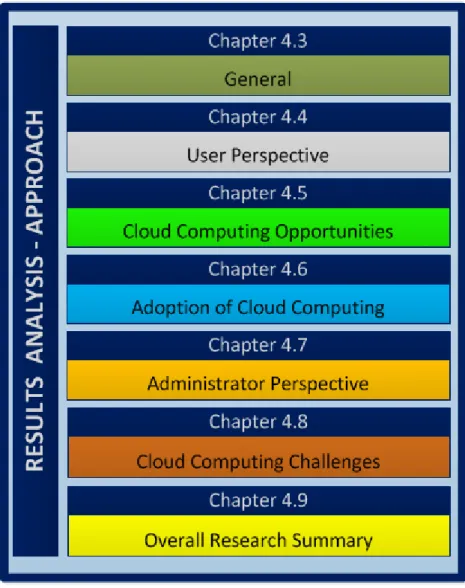
Figure 4: Results Analysis – Approach ... 24
Figure 5: Job Level ... 25
Figure 6: Technology Decisions ... 26
Figure 7: Years in Government ... 27
Figure 8: Number of Employees ... 28
Figure 9: Level of Government Department ... 28
Figure 10: Heard About Cloud Computing ... 30
Figure 11: Government using Cloud Computing ... 31
Figure 12: Used a Cloud Computing Application ... 32
Figure 13: Trends ... 34
Figure 14: Enhance IT Services... 35
Figure 15: Traditional Approach ... 36
Figure 16: Leverage Cloud Computing ... 39
Figure 17: Deploy in the Cloud ... 40
Figure 18: Accountability for Adoption ... 41
Figure 19: Benefits ... 42
Figure 20: Adoption of New Technologies ... 43
Figure 21: Adoption in Government ... 44
Figure 22: Adoption for Citizens ... 45
Figure 23: Standards and Policies ... 46
Figure 24: Important Drivers ... 47
Figure 25: Cloud Deployment ... 50
Figure 26: Different Paradigms ... 51
Figure 27: Current Software ... 52
Figure 28: Disadvantages ... 53
Figure 29: Cloud Secure ... 54
Figure 30: Data in Cloud ... 55
Figure 31: Concerns about adoption of Cloud Computing ... 56
Figure 32: Challenges ... 57
Figure 33: Relevant Technology ... 58
Figure 34: Investment ... 59
Figure 35: Drivers for Adoption ... 60
Figure 36: Skills ... 61
Figure 37: Long Term Plan for Skills ... 62
TABLES Table 1: Technology Usage ... 33
Table 2: Software Used in Government (Observed Frequency) ... 37
Table 3: Software Used in Government (Expected Frequency) ... 37
Table 4: Software Used in Government (Chi-Square Analysis) ... 38
1
Chapter 1. Introduction
1.1 What is Cloud Computing?
The SA government wants to use new technology to provide better services to its citizens and IT has drastically improved over the last few years with new functionality and lower cost. The government’s IT landscape has been slowly transforming to meet the needs of the citizens. The introduction of cloud computing will require government to make decisions for investments into the government IT landscape in order to provide better services.
The traditional thinking about IT is where infrastructure is bought upfront and the platforms are installed on the infrastructure and services are installed that use the platform and infrastructure. This upfront investment is made without really knowing if the service will work. Cloud computing has changed this paradigm whereby the consumer does not need to buy the infrastructure, platform or services but rather rent it for a specific time and pay for what is used. This can be compared to the water that we get in our homes; we don’t know how it reached our homes or where it is stored but if we want water we open the tap and we pay only for what is used. Similarly, if there is a requirement for an IT service such as an email service, the cloud provider will provide access to an email service over the Internet - this is known as Software-as-a-Service (SaaS) - without having to buy servers, software or network equipment.
With rapid development of processing and storage technologies and the success of the Internet, the computer resources have become cheaper and more powerful. Cloud computing provides many benefits such as no upfront investment, lowering of operating costs and high scalability, where the cloud resources can be increased or decreased based on the demand (Zhang, Cheng & Boutaba, 2010).
The people of South Africa are exposed to high quality IT services that are available in the private sector and with this knowledge they are demanding similar services in government. The trend is that many of the services are being made available over the Internet instead of the old approach of being in extranets. Cloud computing is changing the way that IT is being provided and managed where, traditionally hardware and software were bought and managed through its life-cycle. The limitation was on the capacity as it was not scalable and if a new service is required then additional hardware and software needs to be procured, installed and provisioned.
2
However, with cloud computing the paradigm has changed from ownership to rental where the asset is not bought but rented for a specific time and only pay for the usage. Cloud computing can fill a need that makes the user more empowered and they can control what they want and how they want it.
Cloud computing fits into an integrated hardware and software provisioning where the hardware and software is now scalable, elastic and easily provisioned. If a new service is required it can be provisioned in a few minutes with a few configuration settings to setup the new environment. Some of the benefits include (Varia, 2010):
Just-in-time Infrastructure: It is not limited by capacity and services can be quickly provisioned as it is managed centrally.
Usage based costing: The user only pays for what they use. This is a new way of thinking by giving the user more choice and allowing them to control their usage.
Virtual Administration: The administrators will move up the technology stack and learn how to manage abstract cloud resources using scripts.
Multi-tenancy: Multiple users can share physical resources.
Disaster Recovery and Business Continuity: The way the cloud is architected, it will have disaster recovery and business continuity in place.
Security: There will be security in the way the cloud is designed by ensuring the data is protected while in transit and while at rest.
There are different definitions of cloud computing and, according to the National Institute of Standards and Technology (NIST), after sixteen updates to the definition, the final definition of cloud computing is:
“Cloud computing is a model for enabling ubiquitous, convenient, on-demand network access to a shared pool of configurable computing resources (e.g., networks, servers, storage, applications and services) that can be rapidly provisioned and released with minimal management effort or service provider interaction."
Source: (http://csrc.nist.gov/publications/nistpubs/800-145/SP800-145.pdf)
1.2 Why focus on the SA Government
According to Jansen & Grance (2011) from NIST, the public cloud providers’ default offerings generally do not have specific government department’s security and privacy requirements for
3
cloud computing - the standard cloud offering may not be well suited for the government if it is not customised.
The South African State Information Technology Agency (SITA) has been established to consolidate the IT requirements for government and this includes being a service provider to government and also to assist government to get services from industry (State IT Agency, 2006). Due to the dynamics of the government-specific requirements, SITA made a strategic decision that it will become a cloud service provider to government. The cloud computing strategy was approved by the SITA Executive team and the management board. SITA will assist government by providing these cloud services within the government network so the data does not leave the government network.
1.3 Contribution and Limitation
The contribution of this study will provide a view on cloud computing in government that includes awareness about the understanding of cloud computing, the opportunities that are available with cloud computing, the transition of old technology to the adoption of cloud computing, the challenges with adopting cloud computing and the administrator perspectives.
The limitations of the study: There may be a lack of knowledge from some of the respondents about cloud computing and equal representation of respondents from all spheres of government departments.
1.4 Research Goals
There has been much interest in cloud computing and whether it does offer any real value as compared to mainframe and traditional computing. The purpose of this dissertation is to determine the perceptions of the SA government towards cloud computing that would determine whether the SA government users understand cloud computing, cloud computing adoption, issues about cloud computing and factors to be considered in the South African government context.
1.5 Summary of Dissertation
The dissertation research was approached by first reviewing the current literature on cloud computing and the SA government. The primary research method used was a quantitative methodology (survey) to determine the perceptions of cloud computing within the SA government. The survey included respondents only from the SA government and the findings from both the literature review and the survey were used to develop the key findings on the perceptions.
4
Chapter 2. Literature Review
2.1 Introduction
Cloud computing means entrusting data to information systems that are managed by external parties on remote servers in the cloud (Ryan 2011) and cloud computing is described (Dillon, Wu & Chang 2010) as a model for enabling convenient, on demand network access to a shared pool of configurable computing resources that can be rapidly provisioned and released with minimal management effort or service provider interaction. Unlike a simple terminal acting as a user interface to a mainframe, a computer in the cloud computing paradigm possesses significant power to provide a certain degree of local computing and caching support.
There has been a shift with the early eighties that emphasised on mainframes (Reddy 2011) then it was the client-server model that took over both operation and control of technological infrastructure from the user - now cloud computing is a new delivery model for IT services with a new consumption paradigm for its users. Therefore cloud computing has become a significant technology trend and could reshape the IT sector and the IT marketplace (Voas & Zhang 2009). Cloud computing is a breakthrough technology (Hofmann 2010) that will continue to unleash new innovations and bring new efficiencies and advantages to business where it removes infrastructure and capital expense as a barrier to entry and allows start-up companies to scale up cheaply and rapidly.
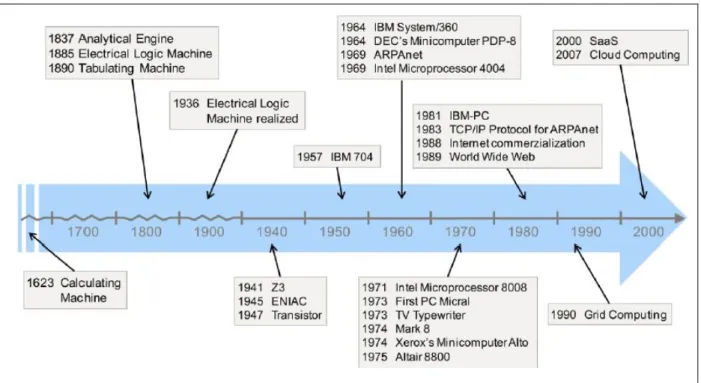
The operating models of the sixties and seventies is similar to cloud computing as it is an old trend that is coming back: centralised, shared computing resources (Bohm, Leimeister, Riedl & Krcmar 2010), the operators of today’s datacenters, such as Amazon or Google, are confronted with a similar situation; they strive to utilise their immense resources in a better way - Figure 1 shows the milestones of the computing history.
5 Figure 1: Milestones of Computing History
(Source: Bohm, Leimeister, Riedl & Krcmar 2010)
The approach for the literature review is in Figure 2:
6 2.2 What is Cloud Computing?
Cloud computing is a model of accessing a shared pool of computing resources like networks, storage, services, and applications on demand, without worrying about how these resources are made available (Sri 2011). Cloud computing clients (Ramgovind, Eloff & Smith 2010) have to now trust 3rd party cloud providers, especially on the availability of cloud service as well as data security. The resources have the intelligence to be rapidly marshalled depending on the need / rate of consumption and released when required. As a concept, cloud computing (Kim, Kim, Lee & Lee 2009) is not entirely new and it is similar to the time-sharing systems of the 1960s, and the network computing and grid computing of the 1990s. In 1961, computing pioneer John McCarthy predicted that computation may someday be organised as a public utility (Foster, Zhao, Raicu & Lu 2008). Cloud computing is thought to be an innovative term (Aymerich, Fenu & Surcis 2008) that is probably one of the most important new technologies in the ICT area.
Cloud computing is hinting at a future (Aymerich, Fenu & Surcis 2008) in which we will not compute on local computers, but on centralised facilities operated by third-party compute and storage utilities. In minimising potential security/trust issues as well as adhering to governance issues facing cloud computing, a prerequisite control measure is to ensure that a Service Level Agreement (SLA) is in place and maintained when dealing with outsourced cloud service providers (Ramgovind, Eloff & Smith 2010). Traditional security mechanisms such as identity, authentication, and authorisation are no longer enough for clouds in their current form as the security controls in cloud computing are mostly not different from security controls in any IT environment. However, because of the cloud service models employed, the operational models, and the technologies used to enable cloud services, cloud computing may present different risks to an organisation than traditional IT solutions (Hashizume, Rosado, Fernandez-Medina & Fernandez 2013). Cloud computing facilitates the delivery of computing-on-demand much like other public utilities such as electricity and gas (Wei & Blake 2010). What makes cloud computing so powerful is that it is based on a system of modularity (Greengard 2010) and the use of virtualization and a cloud platform allows organisations to break down services and systems into smaller components, which can function separately or across a widely distributed network. The growth of cloud computing (accessing computer resources provided through networks rather than running software or storing data on a local computer) exemplifies this shift to the cloud (Bughin, Chui & Manyika 2010).
7
Cloud computing provides a powerful IT infrastructure at a modest cost in which servers can be located almost anywhere and interfaces can be changed and customised quickly. It frees individuals and small businesses from worries about quick obsolescence and a lack of flexibility but, at the same time, large organisations can consolidate their IT infrastructure across distributed locations (Greengard 2010). The advances in technology open up new problems to be solved and new possibilities for further advancement; many people still think of knowledge as advancing towards a final state (Scardamalia & Bereiter 2006). Even government entities can benefit by enabling services to consumers on a shared basis (Greengard 2010) while consumer acceptance of Web-based cloud services for everything from e-mail to video is of course becoming universal and companies are following suit (Bughin et al. 2010). Cloud computing is defined as a large pool of easily usable and accessible virtualised resources (such as hardware, development platforms and/or services) in which these resources can be dynamically re-configured to adjust to a variable load (scale), allowing also for optimum resource utilization (Vaquero, Rodero-Merino, Caceres & Lindner 2009). The pool of resources is typically exploited by a pay-per-use model in which guarantees are offered by the provider by means of customized service level agreements (Vaquero et al. 2009).
Liu, Tong, Mao, Bohn, Messina, Badger & Leaf (2012) provided the definition of IaaS, PaaS and SaaS according to the National Institute of Standards and Technology (NIST) Cloud Computing Referencing Architecture, as shown below:
Infrastructure as a Service (IaaS) - To provision processing, storage, networks, and other fundamental computing resources where the consumer is able to deploy and run arbitrary software, which can include operating systems and applications. The consumer does not manage or control the underlying cloud infrastructure but has control over the operating systems, storage, deployed applications, and possibly limited control of select networking components.
Platform as a Service (PaaS) - To deploy onto the cloud infrastructure consumer-created or acquired applications created using programming languages and tools supported by the provider. The consumer does not manage or control the underlying cloud infrastructure including network, servers, operating systems, or storage, but has control over the deployed applications and possibly application hosting environment configurations.
Software as a Service (SaaS) - To use the provider’s applications running on a cloud infrastructure. The applications are accessible from various client devices through a thin client interface such as a Web browser. The consumer does not manage or control the underlying cloud infrastructure including network, servers, operating systems, storage, or
8
even individual application capabilities, with the possible exception of limited user-specific application configuration settings. The key security basics should be carefully considered as a fundamental part of the cloud SaaS application development (Soofi, Khan, Talib & Sarwar 2014) and deployment process include; data security, network security, data locality, data integrity, data segregation, data access, authentication and authorization, data confidentiality, web application security, data breaches, virtualisation, availability, backup and identity management.
The new architecture includes cloud computing and service-oriented architecture. It should be applied in the public sector because cloud computing permits uniformly covering the whole country with e-government solutions (Cellary & Strykowski 2009), independently of divergence of local administrative units that may be richer and poorer and better or worse prepared to provide e-services. The use of cloud technologies is rapidly increasing; many new services applying big data are appearing; there is a considerable increase in traffic, its types and quality (Pluzhnik, Nikulchev & Payain 2014), this trend requires bandwidth control and the development of new principles of operation of the network. Aymerich et al. (2008) describes that the software services are stored in the cloud, rather than being spread over the single computers connected on the Internet and another feature is the moving and storing of the data from a user’s device onto a cloud, enabling the user to access information from anywhere.
Various deployment models are proposed based on the cloud computing environments availability and the intended access methods (Amini, Bakri, Safavi, Javadinia, & Tolooie 2014) and the access permission or limitation depends on the type of information, business processes and organisation characteristics. Mell & Grance (2011) and Mohlameane & Ruxwana (2014) agree that the cloud deployment options are: public, private, hybrid and community cloud. Public cloud - The cloud infrastructure is provisioned for open use by the general public. It may be owned, managed, and operated by a business, academic, or government organization, or some combination of them. It exists on the premises of the cloud provider.
Private cloud - The cloud infrastructure is provisioned for exclusive use by a single organization comprising multiple consumers (e.g., business units). It may be owned, managed, and operated by the organization, a third party, or some combination of them, and it may exist on or off premises.
Hybrid cloud - The cloud infrastructure is a composition of two or more distinct cloud infrastructures (private, community, or public) that remain unique entities, but are bound
9
together by standardized or proprietary technology that enables data and application portability (e.g., cloud bursting for load balancing between clouds).
Community Cloud - The cloud infrastructure is provisioned for exclusive use by a specific community of consumers from organizations that have shared concerns (e.g., mission, security requirements, policy and compliance considerations). It may be owned, managed, and operated by one or more of the organisations in the community, a third party, or some combination of them, and it may exist on or off premises.
2.3 Advantages of Cloud Computing
Cloud computing can easily handle peak load situations without the need for additional hardware infrastructure that would remain largely underutilized (Aymerich et al, 2008) while the resources can be virtualised and presented to customers as virtual servers, which they manage themselves. The system delivers greater scalability as it is possible to add “on-demand” computational resources, sometimes also derived from underutilised business servers. Both developed and developing nations will benefit through cloud-based software as a service model (Greengard, 2010). For example a software product developed in the USA can be extended and supported by a developer in another place and the software can be purchased at a lower cost by eliminating components that are not relevant to a developing country’s needs.
A cloud computing user will need only to pay for the computing services and, with cloud computing, new Internet services can be developed and deployed without capital acquisitions of hardware or large human integration expenses (Wei and Blake 2010). The user benefits includes that the user is no longer tied to a traditional computer to use an application and in future any device that can access the Internet will be able to run a cloud-based application and users will not have to worry about storage capacity, compatibility or other matters when accessing an application on the cloud (Aymerich et al. 2008) - the user can be sure of getting the latest version without having to upgrade the version.
Carlin & Curran (2011) describe five key attributes of the cloud architecture over similar technology:
Multi-tenancy (shared resources): Cloud computing is based on a business model in which resources are shared at the network, host and application level.
Massive scalability: Cloud computing provides the ability to scale to tens of thousands of systems as well as the ability to massively scale bandwidth and storage space.
10
Elasticity: Users can rapidly increase and decrease their computing resources as needed, as well as release resources for other users when they are no longer required.
Pay As You Go (PAYG): Users pay for only the resources they actually use and for only the time they require them.
Self-provisioning of resources: Users self-provision resources, such as additional systems (processing capability, software & storage) and network resources.
Cloud computing offers numerous competitive advantages to today’s businesses (Nkhoma & Dang 2013) as it offers the distributive IT hardware and software which saves the costs of the organisation’s IT infrastructure and this feature is especially beneficial for small and medium size business as they can adopt emerging software easily without requiring to purchase but share. The adoption of cloud computing is gaining momentum with the modernisation of legacy applications (Buyya, Broberg & Goscinski 2011) and positioning the updated applications in the clouds. Fresh applications are being implemented and deployed on clouds to be delivered to millions of global users simultaneously at an affordable rate. Some of the main reasons for adopting cloud computing (Babu, Babu, & Rangaewamy 2013) are economics of scale, reduce unnecessary software and IT support and increase computing power. Service provisioning is an important aspect of cloud computing because it directly impacts the user experience of the service (Whaiduzzaman, Gani, Anuar, Shiraz, Haque, & Haque 2014) as new users and companies seeking cloud services are constantly emerging with the vast diversity among the available cloud services makes it difficult for the customer to decide whose services to use or even to determine a valid basis for their selection. Cloud computing in other parts of the world; such as Vietnam (Kshetri 2010), is driven by the government’s belief that this technology will help the country build a skilled workforce and the universities, government ministries and telecommunication vendors have adopted the cloud. Many United States of America (USA) government agencies are outsourcing organisational functionality of email to cloud systems such as Gmail and Google applications due to the potential for greater costs savings from scalable architectures and open products (Weber 2011). The Bangladesh government has a fragmented education systems and need to give priority to human resource development thorough education by using cloud computing technologies to achieve this (Noor, Mustafa, Chowdhury, Hossain & Jaigirdar 2010) as cloud computing technology binds the resources into a single domain.
2.4 Electronic Government
Electronic government (e-government) is the use of ICT and the Internet as a tool to achieve a better government with the use of technology (Magro 2012). Al-wazir & Zheng (2012) defines
11
e-government as the use of ICT as a platform for exchanging information, providing services and transacting with citizens, businesses and other arms of government. There are still many questions and concerns about the progress and future of e-government (Magro 2012) and the role of governments in shaping global economic policy will expand in the coming years. Technology is vital in this evolution by facilitating the creation of new types of public goods while helping to manage them more effectively (Bughin, Chui & Manyika 2010). The public sector should take advantage of the improved conditions for development and deployment of e-government solutions as this can be achieved through the adoption of new architectures, such as cloud computing and service-oriented architecture, in the public sector (Cellary & Strykowski 2009). An example within government is the education department that can benefit from using cloud computing and collaboration technologies can improve educational services, giving students cost-effective content and online instructors (Bughin et al. 2010). One of the most promising paradigms for education is e-learning and it is commonly referred to as the intentional use of networked ICT in teaching and learning (Alshwaier, Youssef & Emam 2012). There are many implementations of cloud computing across the public sector all around the world (Wyld 2010) and, in many instances, government will be the leading sector in the development of cloud computing across the wider economy. Cloud computing permits us to uniformly cover the whole country with e-government solutions, independently of divergence of local administrative units that may be better or worse prepared to provide e-services (Cellary & Strykowski 2009).
Governments, research institutions and industry leaders are rushing to adopt cloud computing (Foster, Zhao, Raicu & Lu 2008) to solve their ever-increasing computing and storage problems arising in the Internet Age. Technologies are changing as the knowledge advances and the technology changes what people do and what they can do (Spector 2013). The new technology trends and business models such as the emergence of Web 2.0, which is a shift from high-touch, high-margin, high-commitment provisioning of service to touch, margin, low-commitment self-service (Armbrust, Fox, Griffith, Joseph, Katz, Konwinski, Lee, Patterson, Rabkin, Stoica & Zaharia 2009) i.e. High-touch is where the customers require a lot of guidance and there is a greater degree of customisation involved and high-margin is associated with low-volume businesses while mass-market and commoditised businesses have thin margins.
Armbrust et al (2009) explains about the new application trends:
Mobile interactive applications – This must be highly available and these services will rely on large data sets that are hosted in large datacentres. Not all mobile devices enjoy connectivity to the cloud 100% of the time.
12
Parallel batch processing - Cloud computing presents a unique opportunity for batch-processing and analytics jobs that analyse terabytes of data and can take hours to finish.
The rise of analytics – A growing share of computing resources is now spent on understanding customers, supply chains, buying habits, ranking, and so on. While online transaction volumes will continue to grow slowly, decision support is growing rapidly, shifting the resource balance in database processing from transactions to business analytics.
2.5 Issues in Cloud Computing
There have been concerns about data privacy and security associated with unauthorised access and use of information stored in the cloud for malicious purposes (Kshetri 2010). According to an October 2008 IDC report, many organisations consider security concerns to be the most serious barrier to cloud adoption. Some of the barriers facing the cloud model (Hoffman 2010) are on-going challenges with interoperability, portability and migration, where in an on-premises model, enterprises control their infrastructure and platforms at any time but in the cloud, the customer will be locked in to a provider and no longer controls their own IT. Customers are faced with challenges to choose a right cloud platform to migrate their services on and the problems are if their applications and data can be exchanged with other solutions - this defines the problems of interoperability and portability of applications, services and data (Kostoska, Gusev & Ristov 2013).
Businesses and consumers have expressed distrust in the cloud and are cautious of using it to store high-value data or important personal information (Kshetri 2010). Consumers and small organisations have relatively simpler requirements for adopting a new technology than medium to large organisations and have much less to lose if the adoption goes wrong. There are at least seven types of adoption issues for cloud computing. These include outage (availability), security, performance, compliance, private clouds, integration and cost (Kim, Kim, Lee & Lee 2009). There is a lack of well-defined SLA by cloud providers (Hoffman, 2010) and there are some who have better than best-effort SLA. Cloud computing raises privacy and confidentiality concerns (Ryan 2011) because the service provider has access to all the data and could accidentally or deliberately disclose it or use it for unauthorised purposes. Security information systems, including computers and networks, is a fundamental prerequisite for a digital government to function to the expectation of its people (Shih & Li 2006) and security is one of the biggest challenges to the cloud model. The users must trust the provider and for organisations whose existence depends upon safeguarding customer data, trade secrets, classified
13
information or proprietary information. The public cloud providers don’t offer sufficient protection as most providers find it hard, if not impossible, to meet standards for auditability and comply with legislation such as Sarbanes- Oxley and the Health and Human Services Health Insurance Portability and Accountability Act (Hoffman 2010). There is a worry in the community about cloud computing security. One of the risks that people see is that providers have to manage millions of customers and this presents a challenge as many people are worried that the cloud service providers will not be able to cope with the large scale or that the infrastructure will not be able to scale properly with large amounts of usage (Carlin & Curran 2011).
Cloud computing and Web services run on a network structure so they are open to network attacks and one of these attacks is the distributed denial of service attack. If a user could hijack a server then the hacker could stop the Web services from functioning and demand a ransom to put the services back online. (Jamil & Zaki 2011). One of the biggest cloud computing concern is security with applications and data being hosted by a service provider. Data is no longer under the control of management and prone to vulnerabilities with hosting application and data in shared infrastructures. This increases the potential of unauthorised access and raise concerns such as privacy, identity management, authentication, compliance, confidentiality, integrity, availability of data, encryption, network security and physical security (Carroll, Van Der Merwe & Kotze 2011).
Patil & Lai (2005) mentions that people have an interest in preserving their privacy and they also are interested in disclosing sufficient contextual information to colleagues to facilitate smoother communication and enable the job they need to do. Most awareness applications have permission structures that provide users with some degree of control over the information that is disclosed about them. Weber (2011) says that privacy is closely related to security and only 2% of European businesses have adopted Infrastructure as a Service (IaaS) according to the analyst company Forrester Research due to privacy concerns. Privacy is important for organisations (Carlin & Curran 2011), especially when an individual’s personal information or sensitive information is being stored but it is not yet completely understood whether the cloud computing infrastructure will be able support the storing of sensitive information without making organisations liable for breaking privacy regulations - many believe that cloud authorisation systems are not robust enough.
14
The world privacy forum report mentioned that privacy fears are just the tip of the iceberg (Weber 2011), as people and businesses take advantage of Internet-based services, they may find trade secrets in the hands of competitors, private medical records made public and e-mail correspondence in the hands of government investigators, without any prior notice. The security will depend on the cloud deployment option that will be used, such as public, private or hybrid cloud (Ramgovind et al. 2010). Security can be defined in a three-level hierarchy:
Management level
System level
Application and data level
The policies and procedures determined at the management level sets out the guidelines and rules that govern the security implementation at the other two lower levels.
Agencies assessing risk in the context of cloud computing should consider both the potential security benefits and potential vulnerabilities (Kundra, 2011). Potential security benefits of using cloud computing services include:
The ability to focus resources on areas of high concern as more general security services are assumed by the cloud provider;
Potential platform strength resulting from greater uniformity and homogeneity, and resulting improved information assurance, security response, system management, reliability, and maintainability;
Improved resource availability through scalability, redundancy and disaster recovery capabilities; improved resilience to unanticipated service demands;
Improved backup and recovery capabilities, policies, procedures and consistency; and
Ability to leverage alternate cloud services to improve the overall security posture, including that of traditional data centres.
Wyld (2009) and Armbrust, Fox, Griffith, Joseph, Katz, Konwinski, Lee, Patterson, Rabkin, Stoica & Zaharia (2010) describe the top issues facing government leaders in the shift to using cloud computing:
1) The need for scalability
The IT resources will need to become more flexible and agile as cloud computing turns the economics of IT on its head, due to an unprecedented elasticity of resources (Wyld 2009) - in
15
everyday use, elasticity is commonly thought of not just as the ability of an object to stretch out when needed, but to also contract as necessary.
2) The need for high reliability and availability
Cloud providers invest a great deal in their systems to provide for reliability and assure that their services and user data will be available on demand (Wyld 2009) - cloud providers typically guarantee a particular benchmark for the availability of their services as a SLA. Organisations worry about whether utility computing services will have adequate availability and this makes some wary of cloud computing (Armbrust et al. 2010). Cloud vendors could offer specialised hardware and software techniques in order to deliver higher reliability, presumably at a high price.
3) The need for securing data in the cloud
Many of the security issues involved in protecting clouds from outside threats are divided among many parties (Armbrust et al. 2010), including: the cloud user is responsible for application-level security, the cloud provider is responsible for physical security, and likely for enforcing external firewall policies. Privacy and security concerns will need to be addressed as public data and applications move into a cloud environment as it is a very big issue for government, in terms of someone else having control of government information (Wyld 2009). The primary security mechanism in today’s clouds is virtualization, which protects against most attempts by users to attack one another or the underlying cloud infrastructure. The security for intermediate layers of the software stack is shared between the user and the operator; the lower the level of abstraction exposed to the user, the more responsibility goes with it (Armbrust et al. 2010).
4) The need for open standards and interoperability
Government IT executives consistently express a fear of being locked into vendors, due to the high switching costs—both in dollars and in time and effort—that would be incurred when switching between cloud computing providers (Wyld 2009).
5) The need to revise procurement practices
One of the challenges going forward will be to make acquiring cloud-based services (Wyld 2009) as easy as possible.
16
A legal issue is the question of transfer of legal liability where cloud computing providers would want customers to be liable and not them. An incident occurred where the Federal Bureau of Investigation (FBI) raided a Dallas data centre because a company whose services were hosted there was being investigated for possible criminal activity but a number of innocent bystander companies hosted in the same facility suffered days of unexpected downtime, and some went out of business (Armbrust et al. 2010). IT functions and data are shifting to cloud computing as there are significant legal concerns that impact both the private and the public sectors where current software licenses commonly restrict the computers on which the software can run (Wyld 2009) and users pay for the software and then pay an annual maintenance fee.
7) The need to regulate the cloud market
Due to the economies of scale and scope involved, cloud computing could lead to a huge monopoly (Wyld 2009). This could make Windows versus Apple look like kid’s stuff - competition may well make cloud-based applications and storage even more attractive on a cost basis to potential enterprise customers. This area needs to be monitored closely by governmental authorities to assure competition and choice among cloud providers (Wyld 2009).
8) The need to redefine the roles of the IT workforce
Gain cultural buy-in from employees to get them to do something differently, as it is absolutely essential that cultural change must accompany the technology shift (Wyld 2009). Many in IT will have to overcome the idea of data and applications not residing within their control.
9) The need to assess the return on investment of cloud computing
Cloud computing can deliver cost savings by outsourcing IT operations and as much as three to five times more cheaply than in-house data centres and hosted applications (Wyld 2009).
10)The need for government cloud coordination
Government agencies will establish their own private cloud environments; analysts have forecast that we are likely to see agencies sharing data centres and cloud services to facilitate collaboration and to share costs (Wyld 2009).
17 2.6 Summary
Cloud computing is a model of accessing a shared pool of computing resources like networks, storage, services, and applications on demand, without worrying about how these resources are made available (Sri, 2011). What makes cloud computing so powerful is that it is based on a system of modularity (Greengard, 2010) and the use of virtualisation and a cloud platform allows organisations to break down services and systems into smaller components, which can function separately or across a widely distributed network.
As technologies are evolving, knowledge is also advancing which influences what people can do (Spector 2013). Governments, research institutions and industry leaders are rushing to adopt cloud computing (Foster, Zhao, Raicu & Lu 2008) to solve their ever-increasing computing and storage problems arising in the Internet Age. The adoption of cloud computing is gaining momentum with the modernisation of legacy applications (Buyya, Broberg & Goscinski 2011) and positioning the updated applications in the clouds. The main reasons for adopting cloud computing (Babu, Babu, & Rangaewamy 2013) despite the many advantages that cloud computing brings to the companies are related to economics of scale that includes spending on hardware and software and IT support.
Cloud computing in other parts of the world; such as Vietnam (Kshetri 2010), is driven by the government’s belief that this technology will help the country build a skilled workforce and the universities, government ministries and telecommunication vendors have adopted the cloud. Cloud computing can easily handle peak load situations without the need for additional hardware infrastructure that would remain largely underutilised (Aymerich et al. 2008) while the resources can be virtualised and presented to customers as virtual servers, which they manage themselves. The system delivers greater scalability as it is possible to add “on-demand” computational resources, sometimes also derived from underutilised business servers. Both developed and developing nations will benefit through cloud-based software as a service model (Greengard 2010). The benefits of using cloud computing includes: just-in-time infrastructure, usage based costing, virtual administration, multi-tenancy, disaster recovery and business continuity and enhanced security (Varia 2010).
Security information systems, including computers and networks, is a fundamental prerequisite for a digital government to function to the expectation of its people (Shih & Li 2006) and security is one of the biggest challenges to the cloud model. Businesses and consumers have
18
expressed distrust in the cloud and are cautious of using it to store high-value data or important personal information (Kshetri 2010). Consumers and small organisations have relatively simpler requirements for adopting a new technology than medium to large organisations and have much less to lose if the adoption goes wrong. There is a lack of well-defined SLA by cloud providers (Hoffman 2010) and there are some who have better than best-effort SLA. Cloud computing raises privacy and confidentiality concerns (Ryan 2011) because the service provider has access to all the data and could accidentally or deliberately disclose it or use it for unauthorised purposes.
19
Chapter 3. Research Design
3.1 Research Objectives
The research aims to determine the perceptions of cloud computing in the SA government. The primary objectives are to determine the awareness of government IT employees about cloud computing and the understanding of cloud computing, cloud computing adoption, issues about cloud computing and factors to be considered in the South African government context. This chapter will describe the components of the research, the design and testing of the survey.
3.2 Research Question
The research question for this paper is: Does the South African government users understand the basic concepts, challenges and adoption for cloud computing.
3.3 Research Approach
The approach that was chosen was a quantitative one as it provides more flexibility to reach a wider audience that is not limited to a specific location. This was a requirement as the target audience was located throughout South Africa.
The research collection method that was used was an on-line survey (SurveyMonkey). An e-mail was sent to the respondents with a message. The 1st pilot and 2nd pilot survey emails can be found in Appendix A.
The on-line survey made it easy for the respondents to use, rather than e-mail or hard copy surveys, and all the data was saved to a central database for data analysis. The survey was anonymous and no personal information was captured. When the survey closed, the data was extracted into Microsoft Excel and then analysed. The complete survey can be found in Appendix B.
3.4 Target Audience
Cloud Computing is a new IT paradigm and therefore the target audience were selected based on them working in an IT role in the different government departments. In order to obtain a wide range of responses, it also includes the different spheres of government i.e. local, provincial and national.
20
The sampling approach used was to obtain respondents from different departments to identify any issues with regards to the on-line survey tool and/or with the questions, including the context, wording, technical terms, ease of understanding and time to complete the survey. Five respondents were selected for the 1st pilot survey and then ten respondents were selected for the 2nd pilot survey. There were more respondents in the 2nd survey as the survey was updated with feedback from the 1st survey and a wider audience was required to give input before the
finalisation of the final survey.
The 1st draft survey design was completed on 4 October 2013 and the respondents were provided with the survey via email. The feedback to improve the survey is below:
Three questions were not clear;
One question was ambiguous;
One question was confusing and needed to be simplified;
Four questions needed more detail;
Two questions were repeated although worded differently;
It was difficult to answer from an email survey as the format gets distorted; and
Overall, the survey was too long as it had fifty questions and took on average between 12 to 15 minutes to complete a single survey.
From the above feedback received on the 1st draft survey, the 2nd draft survey was designed and made available to a wider audience using the on-line survey tool (SurveyMonkey), This was completed on 24 October 2013. There were no changes requested to the on-line survey as all the concerns were addressed.
The following limitations were encountered for the survey:
Some respondents had difficulty connecting/completing the survey;
Not to make every question mandatory as respondents would cancel the whole survey;
Some respondents could not answer the survey due to lack of knowledge; and
21 3.5 Survey
3.5.1 Process and Design
The survey was designed from the lessons learnt from the literature review and the process behind formulating the questions began with the following high-level questions:
1) General
The respondent’s demographics
2) User Perceptions (Sri, 2011); (Ramgovind, Eloff & Smith, 2010); (Liu, Tong, Mao, Bohn, Messina, Badger & Leaf 2012); (Aymerich et al. 2008) and (Mell and Grance 2011)
Do government employees know what cloud computing means?
Do government employees know the different forms of cloud computing?
Do government employees understand the advantages and disadvantages?
3) Cloud Computing Opportunities (Greengard, 2010); (Wei & Blake, 2010); (Carlin & Curran 2011) and (Buyya, Broberg & Goscinski 2011)
Do government employees understand the opportunities that cloud computing creates?
4) Adoption of Cloud Computing (Foster, Zhao, Raicu & Lu, 2008); (Spector 2013) and (Armbrust et al. 2009).
Do government employees understand the requirements for adopting cloud computing?
Are government IT employees ready to implement cloud computing solutions
5) Administrator Perceptions (Kundra 2011); (Ramgovind et al. 2010); (Kshetri 2010); (Hoffman 2010); (Ryan 2011) and (Carlin & Curran 2011).
Do government employees know how to deploy cloud computing solutions?
Do government employees understand what were the challenges for implementation?
Do government employees know what were the different deployment options?
6) Cloud Computing Challenges (Wyld 2009) and (Armbrust et al. 2010).
Do government employees understand the challenges for adopting cloud computing?
The survey comprises of mainly closed questions that are quick and easy to answer to achieve a higher response rate.
22 3.5.2 Method for Analysis
The qualitative research is used for this paper in the form of a survey. By using qualitative research is to identify and confirm relationships of the data and before qualitative data can be used, it must be edited, coded and maybe transformed to ensure that it can be properly used in statistical analysis (Hair, Money, Samouel & Page 2007) – the qualitative data will be analysed as below:
Prepare data for analysis o Editing o Missing data o Data transformation Conduct analysis o Descriptive analysis o Statistical analysis
Evaluate findings to assess whether they are meaningful
The format adopted for the majority of the survey questions is the five-point Likert scale as this scale is easily understood by the respondents and it has specific options that must be chosen. According to the Oxford dictionary definition, a Likert scale is a scale used to represent people’s attitudes to a topic.
The five-level Likert scale is:
Strongly agree
Agree
Neither agree nor disagree
Disagree
Strongly disagree
3.5.3 Response Rate
The target was to obtain as many responses as possible.
3.5.4 Final Survey
The final survey (Appendix B and C) was made available on the Internet via SurveyMonkey on 25 October 2013 after receiving input from the draft and the final on-line survey was created.
23
Chapter 4. Data Results and Analysis
Once the survey had been completed, it was analysed as shown below:
To compile the data collected
To verify if there was a complete understanding of the questions
To check the areas that are doing well
To check the areas that need improvements
The results are shown in graphs and/or tables with detailed explanation and feedback for each question. Thereafter the linking of the data to the literature review will show whether there is agreement or not, the obstacles that were encountered for the research and recommendations regarding the perceptions of cloud computing in the SA government, as well as the suggestions for future research that relates to cloud computing.
4.1 Responses
The survey closed on 7 November 2013 and there had been a good response to the survey with the overall response rate of 48% as shown in Figure 3:
Respondents invited 149
Surveys completed 71
Response rate 48%
24
The response rate of 48% is acceptable for this study and the survey was hosted on a secure server by the survey service provider. The survey was closed on 7 November 2013 and this data was downloaded into a Microsoft Excel spreadsheet. The actual responses have been downloaded to analyse the data.
4.2 Results Approach
The results were presented in seven categories and the design of the survey (3.4.1 Process and Design) is aligned to the results analysis (4.2 Results Approach). To ensure data integrity and validity, no data was added for any missed questions by the respondents.
25 4.3 General
To gain a better understanding about the respondents, they were first asked general questions about their job level, time working in government, number of employees and level of government.
Question 1: What is your job level?
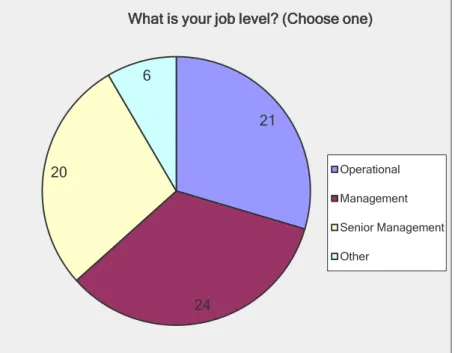
To determine what the job levels are, the respondents could choose from the four options: operational, management, senior management or other. The results in Figure 5 show that the majority of the responses are in management, followed by the operational level and the lowest being senior management. This may lead to the results being more from a management perceptive.
Figure 5: Job Level
21
24 20
6
What is your job level? (Choose one)
Operational Management Senior Management Other
26
Question 2: What technology decisions do you make?
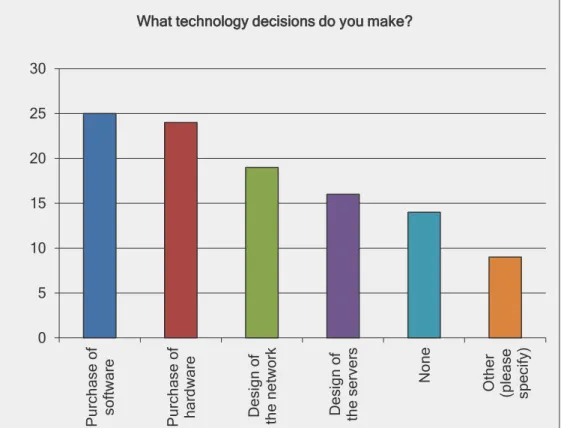
To assess the decision-making in government departments, the respondents indicated what were the decisions they make around technology. The results in Figure 6 show that the highest response was for the purchase of software and the lowest being the design of the network. However, 24 of the respondents indicated that they do not have an influence on the technology decisions, which indicates that these respondents may fall into the operational job level from Question 1. The 16 respondents indicated other, in which their technology decisions include advisory, problem management, development & integration, process implementations, security and architecture. The biggest drivers for technology decisions that are made are for the purchase of hardware and software.
Figure 6: Technology Decisions
0 5 10 15 20 25 30 P urc has e o f soft w are P urc has e o f ha rd war e De sig n o f th e n etwork De sig n o f th e s erv er s No ne O the r (plea se spe cify )
27
Question 3: How long have you been working in government?
The time spent working in government provides a good indicator of the respondent’s experience. The more experience in years shows an increase in maturity of understanding government. The results in Figure 7 show that there is good representation of 45 respondents who have been in government for more than 10 years. Only 3 respondents have been in government for less than a year and in total 60 respondents have been in government for more than four years, which shows a good understanding of government. The respondents with more than ten years’ service show that management makes up the majority, which indicates that management in government is the easiest way that leads to promotion.
Figure 7: Years in Government
Question 4: What is the total number of employees in your government department?
The size of a government department may be measured by the number of employees. The respondents could choose from four options and the results in Figure 8 show that the majority of responses are between 1 000 and 3 000 and the following band is between 3 000 and 10 000 – the results together is 54 respondents. This shows that the respondents are from medium to large departments. 3 8 5 10 45
How long have you been working in government? (Choose one)
Less than 1 year Between 1 year to 4 years Between 4 years to 7 years
Between 7 years to 10 years
28 Figure 8: Number of Employees
Question 5: At what level within the South African government, does your government department operate?
Government departments operate at different levels within government; the respondents were provided with three options: local, provincial or national level. This is important as local, provincial and national governments have different focus areas and priorities. From the results in Figure 9, the majority of responses are from the national level departments and the least represented is the local level. This implies that the survey is representative of the national level and includes only a small portion from provincial (6 respondents). These results will be more accurate for national level and not so much for provincial and even less applicable to the local government because 62 respondents are from the national level.
Figure 9: Level of Government Department
8
32 22
8
What is the total number of employees in your government department? (Choose one)
Less than 1 000 Between 1 000 and 3 000 Between 3 000 and 10 000 More than 10 000 2 6 62
At what level within the South African government, does your government department operate? (Choose one)
Local Level Provincial Level National Level
29
Summary
The management and senior management are the majority of the respondents. The decision making is spread across the different job levels and not limited to management or senior management only. 45 Respondents are working for more than 10 years in government and the bulk of the respondents are from medium to large departments with 62 respondents in national departments.
30 4.4 User Perspectives
Introduction
The respondents provided their view about awareness on cloud computing, the basic administrator capabilities and general questions about their departments.
Question 6: Have you heard about cloud computing?
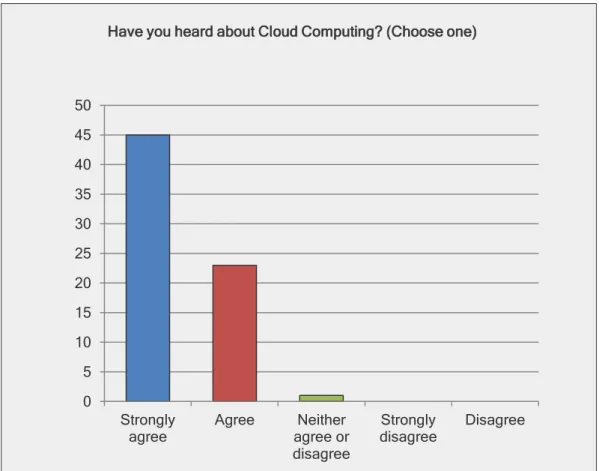
To determine whether there is awareness about cloud computing, the respondents were asked whether they heard about cloud computing. They were provided with five options and the results in Figure 10 show that the majority had heard about cloud computing in which 68 respondents had selected strongly agree or agree. This adds validity to the results of the survey and it is expected that the respondents will be able to provide good feedback based on their views. No respondents indicated that they disagree or strongly disagree about hearing about cloud computing. There was 1 respondent who indicated that they neither agree nor disagree - that was at an operational level with more than 10 years in government. Going forward the data set for the 1 respondent that selected neither agree or agree will be removed.
Figure 10: Heard About Cloud Computing
Strongly
agree Agree agree orNeither
disagree Strongly disagree Disagree 0 5 10 15 20 25 30 35 40 45 50
31
Question 7: Do you think that the government should use cloud computing?
Government wants to make IT services more assessible and cost effective to citizens. The respondents had to think about whether government should use cloud computing. In Figure 11, 55 respondents were in favour of government using cloud computing while 4 respondents did not agree on using cloud computing. The respondents in the larger departments that had 1 000 or more employees were more in favour of cloud computing.
Figure 11: Government using Cloud Computing
Question 8: Have you used a cloud computing application?
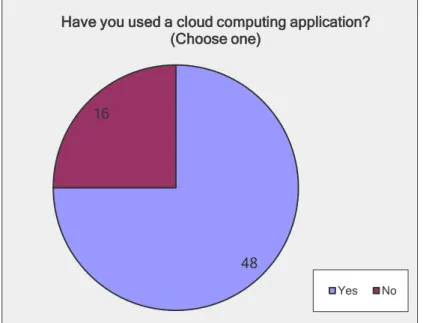
The respondents were presented with two options in order to determine whether they have used a cloud computing application so they may already have a view of the advantages and disadvantages. The two options: yes or no; and 48 respondents selected that they used a cloud computing application. The results in Figure 12 show the 16 that selected they have not used a cloud application and from this 13 respondents have been in government for more than 10 years. They also may not be fully aware that they could have used a cloud computing application without knowing it was a cloud service, for example: Gmail, Yahoo mail, Dropbox and even this
35 20 5 3 1 0 5 10 15 20 25 30 35 40 Strongly
agree Agree Stronglydisagreeagree orNeither disagree
Disagree
Do you think that the government should use cloud computing? (Choose one)
Strongly agree Agree
Strongly disagree Neither agree or disagree Disagree
32
survey (SurveyMonkey). The chances are very likely that most if not all the respondents have in fact used a cloud service.
Figure 12: Used a Cloud Computing Application
Summary
68 respondents have heard about cloud computing and many of the larger departments (1 000 and more employees) were in favour of cloud computing to be used in government. Cloud computing services are readily available over the Internet and the majority of respondents indicated that they have used this service.
48 16
Have you used a cloud computing application? (Choose one)
33 4.5 Cloud Computing Opportunities
Introduction
Cloud computing will create opportunity and the respondents were asked about their perception of government, the new way of using cloud services, usage of specific software and important drivers of cloud computing.
Question 9: Do you think that government is currently utilising technology effectively to deliver better services to the citizen?
To determine whether government is using technology effectively to deliver better services, the respondents were presented with five options and only 7 respondents indicated that government is utilising technology effectively. 48 Respondents do not think that the government is using technology effectively to deliver better services and this indicates that government is lacking in using technology effectively.
A comparison is made to the job levels in government in order to determine the perceptions among the different job levels. For responses where they do not think government is using technology effectively, the majority of responses (as shown in Table 1), are from the management and senior management levels. The managers and senior managers have the power to lead and direct the use of technologies in government.
Job level Government is not
using technology effectively
Government is using technology
effectively
Row Total Expected Frequency Senior Management 17 1 18 16 Management 18 2 20 17 Operational 9 4 13 11 Other 4 4 3 Column Total 48 7 55
Table 1: Technology Usage By using the chi-square test of independence:
Frequency observed (Fo) & Frequency expected (Fe)
The (Fo – Fe)*2 / Fe formula is used to determine if there is a relationship. Senior Management - (Fo – Fe)*2 /Fe = (17-16)*2 / Fe = 0.12 (not related) Management - (Fo – Fe)*2 /Fe = (18-17)*2 / Fe = 0.11 (not related)