Davison County
Davison County Region 6 Full Scale Exercise
Full Scale Exercise
May 15, 2014
A
FTER
A
CTION
R
EPORT
/I
MPROVEMENT
P
LAN
June 25, 2014
A
DMINISTRATIVE
I
NFORMATION
1. The title of this document is Davison County Full Scale Exercise AAR 2014. 2. There is no classification for this document and is considered an “Open” document. 3. Points of Contact:
Davison County Emergency Management Name: Jeff Bathke
Title: Davison County Emergency Management Director Address: 200 E. 4th Ave.
City, State, Zip: Mitchell, SD 57301 Office Phone: 605-995-8615
E-mail: [email protected]
Name: Nathan Wegner
Title: Davison County Emergency Management Deputy Director Address: 200 E. 4th Ave.
City, State, Zip: Mitchell, SD 57301 Office Phone: 605-995-8615
C
ONTENTS
Administrative Information ... Page 2
Contents ... Page 3
Executive Summary ... Page 4
Major Strengths ... Page 4
Primary Areas for Improvement ... Page 4
Section 1: Exercise Overview ... Page 5
Exercise Details ... Page 5
Exercise Schedule ... Page 6
Exercise Planning Team Leadership ... Page 6
Participating Organizations ... Page 6
Number of Participants ... Page 7
Section 2: Exercise Design Summary ... Page 8
Exercise Purpose and Design ... Page 8
Exercise Objectives, Capabilities, and Activities ... Page 8
Scenario Summary ... Page 9
Section 3: Analysis of Capabilites ... Page 11
Target Capability: Communications ... Page 11
Target Capability: Onsite Incident Management ... Page 12
Target Capability: Emergency Public Information and Warning ... Page 13
Section 4: Conclusion ... Page 14
Appendix A: Improvement Plan... Page 15
Appendix B: Comments Summary... Page 16
Exercise Design and Conduct: Assessment ... Page 17
Exercise Design and Conduct: Results ... Page 18
E
XECUTIVE
S
UMMARY
The Davison County Region 6 Full Scale Exercise conducted on May 15, 2014 was developed to raise awareness of the Emergency Plan, assist in identifying gaps in the planning process and identify needs for additional planning, training, and organization, and to familiarize the Key Positions with what it will take to respond to an emergency or disaster situation. The Target Capabilities identified for this exercise are listed below:
Objective 1: Communications (Required)
Objective 2: On-Site Incident Management (Required)
Objective 3: Emergency Public Information and Warning
The purpose of this report is to analyze exercise results, identify strengths to be maintained and built upon, identify potential areas for further improvement, and support development of additional subjects to be included in the planning process.
Major Strengths
The major strengths identified during this exercise are as follows:
1. The EOC staff were anticipating the needs of the “Incident Commanders” at the
disaster site, showing they were “ahead of the incident”.
2. Press releases were accurate, detailed, and spaced appropriately to give the community the information they needed.
3. Entire exercise was well planned and executed.
Primary Areas for Improvement
Throughout the exercise, the following opportunities for improvement were identified. The primary areas for improvement, including recommendations, are as follows:
1. More ICS trained staff to assist completing the paperwork and mission.
2. Better communication between the EOC and Incident Commanders on resources requested. (The EOC was ordering resources they assumed the IC would need). 3. Update the Resource list on the WebEOC, as it is out of date and missing several
contractors who have equipment we could use in an emergency.
4. Better layout of the EOC, or even use a different room. The phones, computers, tables, and large pillar all need addressed.
Although there were many other subjects brought to the surface that need additional attention in the planning process, these were the main areas that are in need of refinement and continued work. The participation of the participants and their interaction was crucial to the successful outcome of the exercise itself.
S
ECTION
1:
E
XERCISE
O
VERVIEW
Exercise Details
Exercise Name
Davison County Region 6 Full Scale Exercise 2014
Type of Exercise
Full Scale Exercise
Exercise Start Date
May 15, 2014
Exercise End Date
May 15, 2014
Duration
1000-1345 (3.75 Hours)
Location
EOC @ Davison County Courthouse, Mitchell, SD)
Sponsor
SD OEM Region 6: Yankton, Bon Homme, Hutchinson, Hanson, Davion, Miner, Sanborn, Beadle, Kingsbury, and Brookings Counties.
Program
EMPG
Mission
Select those that apply: Common, Respond
Capabilities
Communications (Required)
On-site Incident Management (Required)
Emergency Public Information and Warning
Scenario Type
Exercise Schedule
The Davison County Region 6 Full Scale Exercise was conducted on May 15, 2014 at the Emergency Operations Center (EOC) in the Davison County Courthouse, Mitchell, SD starting at 0900.
Schedule May 15, 2014
0900 Exercise Site Setup
0900 Exercise Players report to EOC 0915 Exercise Players Briefing 0930 Controller/Evaluator Briefing 1000 Exercise begins (BEGINEX) 1330 Exercise ended (ENDEX) 1345 Hot Wash / Debriefing 1400 Exercise Site Cleanup 1400 Exercise Ends
All Controller, Observer, Evaluator, and Participant comments and evaluations were due into the Emergency Manager at the end of the exercise.
Exercise Planning Team Leadership
Exercise planning was conducted primarily by the Davison County EM Jeff Bathke. The Leadership Team consisted of the following Davison County LEPC members:
1. Deputy EM Nathan Wegner 2. Mayor Ken Tracy
3. Commissioner Denny Kiner
4. Chief of Public Safety Lyndon Overweg 5. Auditor Susan Kiepke
6. Deputy Auditor Karen Knadle 7. Sheriff Steve Brink
8. Assistant Fire Chief Paul Morris 9. Fire Marshall Marius Laursen 10.Red Cross Director Summer Geraets
Participating Organizations
Mitchell DPS (PD, Fire, EMS), Davison County Sheriff’s Office (observer), Davison County Emergency Management, Davison County Auditor, American Red Cross. The Regional Red Cross Director, Ray Sorensen and his Intern Jessica Sopko were at the
EOC and able to participate in the exercise.
The following Agencies were simulated participants SD HWY Patrol, Davison County Highway Department, Avera Queen of Peace Hospital, Davison County Search and Rescue, Schoenfelder Construction, Vanderpol Construction, City of Mitchell Street Department
Number of Participants
Players –13 Responders @ the EOC. We did not have actual victims, just simulated. Controller/Facilitators – 1
Evaluators – 1 Observers – 1
S
ECTION
2:
E
XERCISE
D
ESIGN
S
UMMARY
Exercise Purpose and Design
This Full Scale Exercise was designed to “test” the “plan” and raise awareness of the Emergency plan to be utilized during emergency or disaster operations.
This exercise serves to identify where plans may need to be refined or modified, and thus lead to a strengthening preparedness. It will focus on the policies, processes, procedures, planning, and resources of Emergency Operations as well as the working relationships and communications both internally and externally of the jurisdiction.
Goal
To determine whether current Plan(s) created and Training accomplished to this point adequately addresses anticipated challenges faced by the community and jurisdiction as a result of an emergency or disaster, and identify those gaps in both planning and coordination that remain.
Exercise Objectives, Capabilities, and Activities
Capabilities-based planning allows for exercise planning teams to develop exercise objectives and observe exercise outcomes through a framework of specific action items that were derived from the Target Capabilities List (TCL). The capabilities listed below form the foundation for the organization of all objectives and observations in this exercise. Additionally, each capability is linked to several corresponding activities and tasks to provide additional detail.
Based upon the identified exercise objectives below, the exercise planning has decided to demonstrate the following capabilities during this exercise. Not all Capability’s will be addressed by every scenario:
OVERARCHING CAPABILITIES Capability #1: Communications
Develop and Maintain Plans, Procedures, Programs, and Systems
Develop and Maintain Training and Exercise Programs
Alert and Dispatch
Provide Incident Command/First Responder/First Receiver/Interoperable Communications
Provide Emergency Operations Center (EOC) Communications Support
Provide Federal Facilities, Task Force, and Recovery Assistance Interoperable Communications
Capability #2: Onsite Incident Management
Develop and Maintain Plans, Procedures, Programs, and Systems
Develop and Maintain Training and Exercise Programs
Direct Onsite Incident Management
Implement Onsite Incident Management
Establish Full Onsite Incident Command
Conduct Resource Management
Develop Incident Action Plan (IAP)
Execute Plan
Demobilize Onsite Incident Management
Capability #3: Emergency Public Information and Warning
Activate the emergency public information system
Determine the need for a joint public information system
Establish and participate in information system operations
Establish avenues for public interaction and information exchange
Issue public information, alerts, warnings, and notifications
Scenario Summary
The Scenario utilized for this exercise is based on a severe weather event with multiple Tornados striking two towns within your County.
It is 6:30pm on Tuesday – a large crowd is attending the County Pork Council’s annual pork loin supper and other activities associated with the County Achievement Days. It has been a warm, humid day and although thunderstorms are predicted, no severe weather is forecast.
A thunderstorm is building to the northwest, but since there is a tent setup and other facilities to get out of potential rain, activities are proceeding as normal.
At 6:45pm, the thunderstorm has greatly intensified and is moving rapidly to the SE. Now, the thunderstorm appears that it is headed towards the Fairgrounds. The National Weather Service issues a Tornado Warning for the storm, as the 911 dispatcher receives a call from a storm spotter reporting a tornado being sighted just to the northwest of town. The sirens are sounded. People at the Fairgrounds begin to look for shelter with some getting in vehicles and trying to leave, but traffic becomes congested quickly just as the rain hits. The tornado is reported to be tracking towards the southwest part of town and it appears that the Fairgrounds are directly in the path.
7:00pm – the storm has passed but there is extensive damage at the Fairgrounds complex, several homes in the area, and the assisted living center. Multiple minor injuries are reported to dispatch and some people are seriously hurt as well.
Another storm cell is building to the south and west of the original storm. This storm appears to be on-track to affect the community to the south. A tornado is also reported from this storm and strikes the town with a damage path running NW to SE in the town. Several homes and
businesses are damaged and there is a great amount of tree damage in the town. It is difficult to ascertain the extent of the damage due to the amount of debris clogging the streets and making travel impossible.
S
ECTION
3:
A
NALYSIS OF
C
APABILITIES
This section of the report reviews the performance of the exercised capabilities, activities, and tasks. In this section, observations are organized by capability and associated activities. The capabilities linked to the exercise objectives of this Exercise are listed below, followed by corresponding activities. Each activity is followed by related observations, analysis, and recommendations.
Target Capability:
Communications
Communications
Develop and Maintain Plans, Procedures, Programs, and Systems
Develop and Maintain Training and Exercise Programs
Alert and Dispatch
Provide Incident Command/First Responder/First Receiver/Interoperable Communications
Provide Emergency Operations Center (EOC) Communications Support
Provide Federal Facilities, Task Force, and Recovery Assistance Interoperable Communications
Return to Normal Operations
Observation: Good communication between the EOC and Incident Commander (Jason Forrest). More information is needed on certain assets, such as C.O.W.s and Emergency Services Over-ride on Cellular calls. Established protocols and intervals for PIO
briefings. Identified PD could send out a NIXEL text. Good communication (simulated) with utility company and equipment companies. Communication was identified as the most important aspect of the exercise.
Analysis: The Team was very prepared for the event, extensive preparation and planning was obvious. A binder was provided to each member in the EOC, which was filled with great information. However, additional information was identified to be inserted for future exercises. Mayor Tracy did a good job of listening to all the activities and preparing regular press releases to the media. Although much of the exercise was simulated, the Team “played the game” and thought about situations that were likely to happen, such as Emergency Services having to sit at the edge and wait for the Utility Company to shut off power to downed power lines. The Team was unprepared to receive email communication from the Incident Commander (Jason), but was able to move a functioning laptop into the EOC and ready to communicate in a matter of minutes.
Recommendations: The Team plans to continue to discuss ways to improve during the monthly LEPC meetings, and focusing on how to do a better job for future exercises or real World emergencies. Communication (phone and computer) need to be up and
running prior to the exercise. (Note: since the exercise one desk phone has been moved to a better position and all computers have been 1) assigned a generic user name/password,
2) been connected to the network, and 3) had all print drivers installed.) When an inject is received by phone, it would be best to call attention to the room, then put the phone on speaker so everyone can hear the entire message in the original format.
Target Capability:
Onsite Incident Management
Onsite Incident Management
Develop and Maintain Plans, Procedures, Programs, and Systems
Develop and Maintain Training and Exercise Programs
Direct Onsite Incident Management
Implement Onsite Incident Management
Establish Full Onsite Incident Command
Conduct Resource Management
Develop Incident Action Plan (IAP)
Execute Plan
Demobilize Onsite Incident Management
Observation: Extensive preparation by the Emergency Management office allowed the Team to have a good plan prior to the exercise. A meeting was held the day prior to the exercise with the key players for a dry run, as well as to review the materials in the exercise binder. The Incident Briefing was conducted verbally, off of an ICS 201 format; which allowed the Team to have a good understanding of the scenario and their
responsibilities. Logistics was thinking ahead of the injects, searching for assets they assumed we may need for the exercise. An ICS 202 form was completed, which included an Incident Action Plan with several other documents.
Analysis: The Team was very prepared for the event, extensive preparation and planning was obvious. Having the opportunity to go through the ICS forms the day before the exercise was essential, as trying to explain these during the exercise would be very
difficult. It is important to note several members of the Team have never been involved in an ICS format exercise or training, so familiarization of the forms and the process of completion was stressed during preparation. Most blank ICS forms used during the exercise were readily available. The Incident briefing identified the scenario, as well as the responsibilities of the Team members. The Team opted to use the Emergency Support Function (ESF) format in assigning responsibility of the injects. Following the Incident Briefing, the Logistics Team started to brainstorm what assets they would need initially, as well as a few hours into the event; such as emergency lighting.
Recommendations: The biggest recommendation is to not allow the Emergency
Manager to be the EOC Manager, just too much for one person to take on. Also, having a dedicated person to just receive the injects. Logistics did an exceptional job finding assets, but needs to have the equipment list updated. The equipment listed for the contractors is out of date. A dedicated report writer should be working on the Incident Action Plan and the ICS 209 from the start, with no additional responsibilities.
Target Capability:
Emergency Public Information and Warning
Emergency Public Information and Warning
Activate the emergency public information system
Determine the need for a joint public information system
Establish and participate in information system operations
Establish avenues for public interaction and information exchange
Issue public information, alerts, warnings, and notifications
Observation: Mayor Tracy did a good job of listening to all the activities and preparing regular press releases to the media. The media was also informed of subsequent press release times. The public was notified via radio and NIXEL that HWY 16 would be closed for Emergency traffic only. The hospital was contacted (simulated) to develop an overflow plan for the ER.
Analysis: The Mayor actually left the EOC, went into the Lobby of the Courthouse, and simulated giving the press release to the media. Getting the initial information out as soon as possible was seen as a way to reduce the amount of rumors starting. The MPD and MFD are utilizing social media as a way to inform the public. Due to the potential number of victims, it was important to coordinate with the hospital staff to develop a triage plan; to include an alternate ER.
Recommendations: The biggest recommendation is to look at developing social media accounts for the Emergency Management office, as to not have to rely on the MPD or MFD to send out information. Also, better communication with the local hospital on alternative plans in the event of a major incident. We are fairly confident the hospital has plans in place and routinely review them, but the EOC staff are not familiar with such plans.
S
ECTION
4:
C
ONCLUSION
Significant work has taken place in this Jurisdiction to prepare the community and jurisdiction for an Emergency Operation. Stakeholders have been brought to the table and “planning” has taken place. This effort should continue even after the Plan is reviewed to make sure further planning and revisions are completed.
As a result of the exercise, areas of refinement, areas that need completion, and additional planning areas may have been identified.
Continual planning, training, and exercising will ensure prepared staff and communities for actual response situations in their communities.
A possible definition of a successful Exercise might include terms such as participation, engagement, thoughtful discussion, awareness of issues and challenges, and a learning process. All of these terms could be utilized to describe portions or all of the exercise conducted.
Now the real work begins, many areas have been identified through this vehicle and now the challenge lies in refining and completing those items identified.
A
PPENDIX
A:
I
MPROVEMENT
P
LAN
This IP has been developed specifically for the Davison County Region 6 Full Scale Exercise as a result of this Exercise. These recommendations draw on the After Action Report and the evaluator comments.
Capability Recommendation Capability
Element Primary Responsible Agency Start Date Completio n Date
Communications The Team plans to continue to discuss
ways to improve during the monthly LEPC meetings, and focusing on how to do a better job for future exercises or real World emergencies. Communication (phone and computer) need to be up and running prior to the exercise. (Note: since the exercise one desk phone has been moved to a better position and all computers have been 1) assigned a generic user name/password, 2) been connected to the network, and 3) had all print drivers installed.) When an inject is received by phone, it would be best to call attention to the room, then put the phone on speaker so everyone can hear the entire message in the original format.
Equipment Davison County Emergency Manager June 2014 March 2015 Onsite Incident Management
Not allow the Emergency Manager to be the EOC Manager, just too much for one person to take on. Also, having a dedicated person to just receive the injects. Logistics did an exceptional job finding assets, but needs to have the equipment list updated. The equipment listed for the contractors is out of date. A dedicated report writer should be
working on the Incident Action Plan and the ICS 209 from the start, with no additional responsibilities. Planning, Training, Exercising, Staffing, Equipment Davison County Emergency Manager June 2014 March 2015 Emergency Public Information and Warning
To look at developing social media accounts for the Emergency
Management office, as to not have to rely on the MPD or MFD to send out information. Also, better communication with the local hospital on alternative plans in the event of a major incident. We are fairly confident the hospital has plans in place and routinely review them, but the EOC staff are not familiar with such plans. Planning, Training Davison County Emergency Manager June 2014 March 2015
A
PPENDIX
B:
C
OMMENTS
S
UMMARY
P
ARTICIPANTC
OMMENTS(G
ENERALC
OMMENTS)
1. Based on the exercise today and the tasks identified, list the top 3 strengths of your plan or jurisdiction.
The EOC staff were anticipating the needs of the Incident Commanders, showing they were “ahead of the incident”.
Press releases were accurate, detailed, and spaced appropriately to give the community the information they need.
Entire exercise was well planned and executed.
2. Based on the exercise today and the tasks identified, list the top 3 areas that need improvement in your plan or jurisdictional response.
More ICS trained staff to assist completing the paperwork.
Resource list on the WebEOC is not accurate, as it is out of date and missing several contractors who have equipment we could use in an emergency.
Better layout of the EOC, or even use a different room. The phones, computers, tables, and large pillar all need addressed.
3. Identify the corrective actions that should be taken to address the issues identified above. For each corrective action, indicate if it is high, medium, or low priority.
Solicit additional staff and ensure all Team member complete ICS training in next three months. (Medium)
Update the Resource list on the WebEOC, as it is out of date and missing several contractors who have equipment we could use in an emergency. (High)
Reach out to other Emergency Managers, Regional Directors, etc. for ideas on the layout of the EOC. The phones and computers have been addressed. The table and the large pillar are both issues that need addressed. (Low)
4. Describe the corrective actions that relate to your area of responsibility. Who should be assigned responsibility for each corrective action?
The Emergency Manager will seek out additional staff, who will not be utilized in other places during an incident. The Deputy Emergency Manager will track ICS courses completed and encourage those in need to complete them.
The Emergency Manager, Deputy Emergency Manager, and Commissioner Kiner will update the Resource list on the WebEOC.
The Emergency Manager will reach out to other Emergency Managers, Regional Directors, etc. for ideas on the layout of the EOC. The Emergency Manager contacted
Tech Solutions prior to the exercise to have a phone moved and to have the computers networked. They did not complete this work order until after the exercise.
5. List the applicable equipment, training, policies, plans, and procedures that should be reviewed, revised, or developed. Indicate the priority level for each.
The Team should continue to brainstorm ideas that will make the exercise more efficient. (Low)
The Team should complete the required ICS Courses. (Medium)
The LEOP and the EOC Plan need reviewed and possibly updated. (High)
E
XERCISED
ESIGN ANDC
ONDUCT:
A
SSESSMENTTabulation Data taken from Assessment Form: Table C1.
P
ARTII
–
E
XERCISED
ESIGN ANDC
ONDUCT:
A
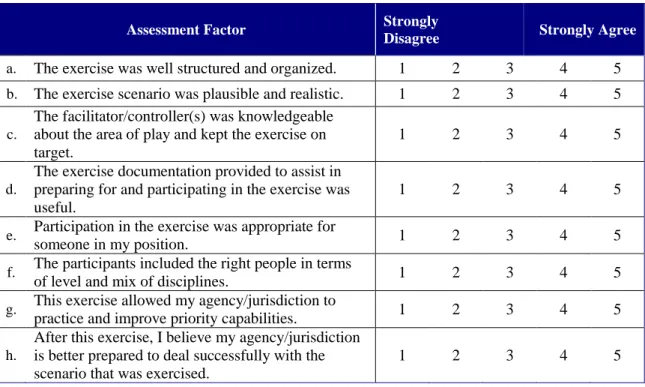
SSESSMENTPlease rate, on a scale of 1 to 5, your overall assessment of the exercise relative to the statements provided below, with 1 indicating strong disagreement with the statement and 5 indicating
strong agreement.
Table C.1:Participant Assessment
Assessment Factor Strongly
Disagree Strongly Agree
a. The exercise was well structured and organized. 1 2 3 4 5
b. The exercise scenario was plausible and realistic. 1 2 3 4 5
c.
The facilitator/controller(s) was knowledgeable about the area of play and kept the exercise on target.
1 2 3 4 5
d.
The exercise documentation provided to assist in preparing for and participating in the exercise was useful.
1 2 3 4 5
e. Participation in the exercise was appropriate for
someone in my position. 1 2 3 4 5
f. The participants included the right people in terms
of level and mix of disciplines. 1 2 3 4 5
g. This exercise allowed my agency/jurisdiction to
practice and improve priority capabilities. 1 2 3 4 5
h.
After this exercise, I believe my agency/jurisdiction is better prepared to deal successfully with the scenario that was exercised.
E
XERCISED
ESIGN ANDC
ONDUCT:
R
ESULTS Participant # a b c d e f g h Participant Average 1 4 4 4 4 4 4 4 4 4.0 2 5 5 5 5 5 5 5 5 5.0 3 5 5 5 5 5 5 5 5 5.0 4 5 5 5 5 5 5 5 5 5.0 5 5 5 5 5 5 4 4 5 4.8 6 5 5 5 5 5 5 5 5 5.0 7 5 4 5 5 4 4 5 5 4.6 8 5 5 5 5 5 5 5 5 5.0 9 5 4 5 4 4 4 5 5 4.5 10 5 5 5 5 5 5 5 5 5.0 11 5 5 5 5 5 5 5 5 5.0 4.91 4.73 4.91 4.82 4.73 4.64 4.82 4.91 4.8 General Comments Everyone was organized and communicated very well
EOC had good anticipation of events
Career fire department/police department with trained professional responders
All parties involved communicate well with each other
Davison County EM is more involved
Players have a lot of experience and knowledge
Efficient and accurate information out to the public
Organization
Need more staff
Current EOC room in courthouse will not be big enough for a true event
Work with Jeff, it is a continuing process to make these improvements
Position specific training for all parties
Review and update EOC Manual
Excellent exercise compared to others I have been involved in.
Exercise was a success
PHOTOS
Photo #1: EOC table set up with manuals, nameplates, and a sign in sheet.
Photo #2: Marker board showing the ESF’s under Operations, Planning, Logistics, Finance, and PIO; to show the participants their anticipated responsibilities.
Photo #3: Maps of target area and marker board to list the injects, who from, and the status.