Tracking known security vulnerabilities
in third-party components
Master’s Thesis
Tracking known security vulnerabilities
in third-party components
THESIS
submitted in partial fulfillment of the requirements for the degree of
MASTER OF SCIENCE
in
COMPUTER SCIENCE
by
Mircea Cadariu born in Brasov, Romania
Software Engineering Research Group Department of Software Technology
Faculty EEMCS, Delft University of Technology Delft, the Netherlands
www.ewi.tudelft.nl
Software Improvement Group Rembrandt Tower, 15thfloor Amstelplein 1 - 1096HA Amsterdam, the Netherlands
c
Tracking known security vulnerabilities
in third-party components
Author: Mircea Cadariu Student id: 4252373
Email: [email protected]
Abstract
Known security vulnerabilities are introduced in software systems as a result of de-pending on third-party components. These documented software weaknesses are hiding in plain sight and represent the lowest hanging fruit for attackers. Despite the risk they introduce for software systems, it has been shown that developers consistently download vulnerable components from public repositories. We show that these downloads indeed find their way in many industrial and open-source software systems. In order to improve the status quo, we introduce the Vulnerability Alert Service, a tool-based process to track known vulnerabilities in software projects throughout the development process. Its usefulness has been empirically validated in the context of the external software product quality monitoring service offered by the Software Improvement Group, a software consultancy company based in Amsterdam, the Netherlands.
Thesis Committee:
Chair: Prof. Dr. A. van Deursen, Faculty EEMCS, TU Delft University supervisor: Prof. Dr. A. van Deursen, Faculty EEMCS, TU Delft Company supervisor: Prof. Dr. Joost Visser, Software Improvement Group Company co-supervisor: Dr. Eric Bouwers, Software Improvement Group Committee Member: Prof. Dr. Jan van den Berg, Faculty TBM, TU Delft
Preface
While the name written on the first page is mine, I am only partially responsible for the document you are currently holding in your hand. It is the output of many peopole’s efforts and dedication and I would like to express my gratitude in the following lines.
I would like to thank Prof. Dr. Joost Visser, for welcoming me to conduct my master thesis in the form of an internship at the Software Improvement Group (SIG) and for his advice at multiple stages of the project. At SIG, I am very grateful to have had the opportunity to work closely with Dr. Eric Bouwers, my daily supervisor, whose guidance throughout the project I sincerely appreciate. I also thank Prof. Arie van Deursen, for his academic supervision, thorough review of the thesis document and for all the Friday morning discussions which have always resulted in the discovery of new avenues to explore within the boundaries of my research topic.
It has been a great pleasure for me to grow professionally and personally in the SIG environment surrounded by so many highly skilled professionals. A warm “thank you” in this regard goes to Dennis Bijlsma, Theodoor Scholte and Axel Eissens, who have helped me with technological aspects throughout my internship and provided me with valuable improvement suggestions for the thesis document. I would also like to express my gratitude for the numerous conversations with the members of the research department, which have always had the result of challenging me with new perspectives. I also grew fond of the spirit of camaraderie that was present among our team of interns.
Finally, I would also like to thank my parents and my girlfriend Merete, for their continuous support and motivation.
Mircea Cadariu Delft, the Netherlands August 27, 2014
Contents
Preface 1 Introduction 1.1 Definitions 3 1.2 Research Context 4 1.3 Problem Statement 5 1.4 Research Method 5 1.5 Research Questions 5 1.6 Thesis structure 62 Requirements for a method to track vulnerable components
2.1 Research Subjects 7
2.2 Interview phases 8
2.3 The requirements table 8
2.4 Discussion 9
2.5 Conclusion 10
3 Vulnerability Knowledge Providers
3.1 Database Selection 11
3.2 Vulnerability Information Elements 12
3.3 Comparison Matrix 13
3.4 Discussion 13
3.5 Interviewing 15
3.6 Conclusion 16
4 The Vulnerability Alert Service
4.1 Process description 18
4.2 The Vulnerability Checker 20
4.3 Vulnerability checker reliability 25
4.4 Conclusion 29
5 Known Vulnerabilities in software project dependencies
5.1 Research Questions 31
5.2 Software Subjects 31
CONTENTS
5.4 Maven study design 32
5.5 Maven study results 34
5.6 Proprietary projects study design 36
5.7 Proprietary projects study results 36
5.8 Conclusion 39
6 Evaluating the Vulnerability Alert Service
6.1 Study design 41 6.2 Interview Findings 44 6.3 Observations Findings 45 6.4 Discussion 46 6.5 Threats to validity 46 6.6 Conclusion 47 7 Related Work 7.1 Known Vulnerabilities 49
7.2 Empirical Studies on Known Vulnerabilities 50
7.3 The Security of Maven Components 50
8 Conclusions and Future Work
8.1 Answering the research questions 53
8.2 Future Work 55
Bibliography
A Interview-Requirements Introductory Text B Interview Form
C Requirements Formulation and Justification D Interview - Vulnerability Databases
D.1 Introduction 73
List of Figures
1.1 Projects,third-party components and known vulnerabilities 2
1.2 Vulnerability Lifecycle 3
4.1 The Vulnerability Alert Service 17
4.2 DependencyCheck scanning process 22
4.3 Exaple POM file 24
4.4 Jetty 6.1.20 in the POM file 24
4.5 Process for obtaining the ground truth dataset for recall study 26
5.1 The study execution procedure 33
5.2 Frequency Distributions for number of components and number of vulnerable
components 35
5.3 Vulnerable vs Clean projects with regards to known vulnerabilities in their
dependencies 37
5.4 Distribution of the number of vulnerable libraries across proprietary software
projects 37
6.1 Usefulness Evaluation Study Design 42
Chapter 1
Introduction
Nowadays, software underpins most of the important transactions that enable current busi-nesses. These transactions have to be conducted in a safe and secure manner, otherwise malicious attackers can leverage them to their own needs, which often results in severe negative consequences for the users and product owners. Damages range from big financial loss to losing the clients’ trust. One of the most resonating examples to illustrate the potential losses comes from the electronic payments domain - in 2008, the payment processor of Heartland Payment Systems suffered from an SQL Injection attack and relinquished access to 134 million credit and debit cards [5]. The company lost 50% of its market capitalization and spent over $42 million on settlement costs.
Given these potential losses, protection against security breaches is of paramount im-portance. Traditional security defense mechanisms, such as anti-virus scanners, firewalls or intrusion detectors, do not directly tackle the security problem, they only “clean up the mess that unsecure software leaves” [23]. Therefore, these software tools target only the symptoms of insecure software. Exactly like with the wellness of our health, fighting disease symptoms, while neglecting the immune system in the long term is not adequate. To improve the immune system, effort should be invested into developing more secure software in the first place, through involving strong security awareness right in the software development process [23].
TheOWASP Top Ten[10] is one initiative that promotes security awareness in the context of software development. It assembles and describes the most critical software security flaws that expose applications to malicious threats. Amongst its entries, we find at the time of writing,Using Components with Known Vulnerabilities[8], as a result of the exploitation risk they introduce. Despite this guideline, approximately 1 out of 4 library downloads from the Maven Central Repository features a software component with a known vulnerability [75], despite OWASP’s guidelines that suggests avoiding them.
Known vulnerabilities, besides heavily downloaded, are also easy to track by attackers. To illustrate this problem, consider Shodan1, a search engine which has been shown to be useful in identifying Internet-facing industrial control systems [17]. In our context, it can show the specific web server implementations that underpin active web applications. A
1. INTRODUCTION
simple keyword search query on Shodan containing the termJetty 6.1.1retrieves the Internet addresses of 464 hosts that expose their online services using this open-source web server [67] which features several known vulnerabilities (at the time of writing, associated with this component are 7 known vulnerabilities1, among which one is considered high severity2). The same mechanism can be used to enlist the machines which are suffering from the Heartbleed vulnerability3, by querying foropenssl. Thus, the ingredients for an automated large scale exploit that targets hosts which run on third-party software with known vulnerabilities are set. We can conclude that known vulnerabilities lower the bar for the skill required to successfully exploit software systems, and malicious attackers do not think twice before exploiting this low hanging fruit. Actually, studies show an increase in exploits after the vulnerability disclosure as high as three orders of magnitude [16].
This is the status quo that we aim to challenge. Thus, the goal of this thesis is to propose a method to continuously track known vulnerabilities in third party components of software systems and assess its usefulness in a relevant context. The driving thought is that known vulnerabilities are indeed widespread and easy to exploit, but they can also be leveraged for benign purposes, such as to improve security awareness and ultimately determine corrective measures that reduce the opportunity for security breaches.
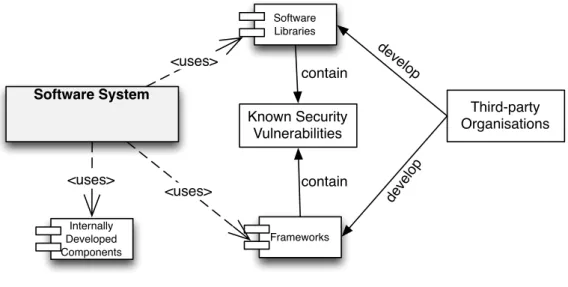
Software System Software Libraries Frameworks Internally Developed Components <uses> <uses> <uses> Third-party Organisations Known Security Vulnerabilities deve lop deve lop contain contain
Figure 1.1: Projects,third-party components and known vulnerabilities
1http://nvd.nist.gov/view/vuln/search-results?adv search=true&cpe=cpe%3a%2fa%3amortbay%3ajetty%3a6.1.1%3arc0 2http://nvd.nist.gov/view/vuln/detail?vulnId=CVE-2009-4611
Definitions
1.1
Definitions
Nowadays, software systems include multiple components, some of which are developed “in-house”, or by third-party organizations. Some of the third-party components have known vulnerabilities, as shown in Figure 1.1. In this context, we explainknown vulnerabilityand
componentas used in the scope of this thesis.
1.1.1 Known Vulnerabilities
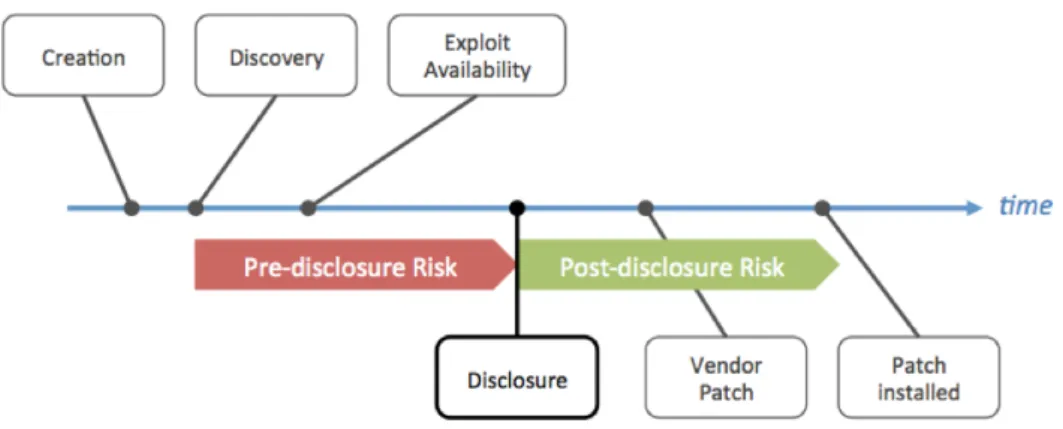
Figure 1.2: Vulnerability Lifecycle
According to the ISO 27005 standard, a vulnerability is“A weakness of an asset or group of assets that can be exploited by one or more threats”[34]. An asset is“anything that can have value to the organization, its business operations and their continuity, including information resources that support the organization’s mission”[33]. Vulnerabilities have a lifecycle, which starts from its creation when it is introduced in the source code by the developer, and finishes when a patch for it is installed, illustrated in Figure 1.2 [28]. In the context of this thesis, we focus on thePost-disclosure Risksegment, vulnerabilities that have been disclosed and therefore consideredpublicly known. Among these, we consider vulnera-bilities which have been assigned a CVE identifier, the most authoritative standardization scheme for known vulnerabilities.
The Common Vulnerabilities and Exposures (CVE) identifiers were introduced in 1999 to enable interoperability and comparison between the existing security tools at the time [1] [40]. They are currently maintained by MITRE [7], an American not-for-profit organization that has the responsibility, among others, to manage the research and federally funded development centers.
1.1.2 Components
In the literature we can find many definitions for a software component. The most charis-matic comes from Michael Feathers: “Acomponentis an object in a tuxedo. That is, a
1. INTRODUCTION
piece of software that is dressed to go out and interact with the world”[11]. On a more pragmatic note, Clements defines it as being“an implementation unit of software that pro-vides a coherent unit of functionality”[24]. Additionally, Szyperski stated that“software components enable practical reuse of software parts and amortization of investments over multiple applications”[70].
Within this thesis, we focus onthird-partysoftware components as an instantiation of the definitions provided by Clements and Szyperski. Therefore, we target components developed within an external organization. They may be proprietary or open-source. Examples of commonly used third-party components belonging to the Java ecosystem include libraries such as Log4j1 but also frameworks such as Apache Struts2. We use Martin Fowler’s definition of libraries and frameworks [?]:
Alibraryis essentially a set of functions that you can call, these days usually organized into classes. Each call does some work and returns control to the client.
Aframework embodies some abstract design, with more behavior built in. In order to use it you need to insert your behavior into various places in the framework either by subclassing or by plugging in your own classes. The framework’s code then calls your code at these points.
1.2
Research Context
The research presented in this thesis has been conducted within the Software Improvement Group (SIG), a consultancy company based in Amsterdam, the Netherlands. Among its services, it provides Software Risk Assessment [72], Software Monitoring [38] [39] and Security Risk Assessment [77]. The professionals that enable SIG’s consultancy services take the role of external quality evaluators for the software systems developed by the client companies. The client companies range from banks to national public transportation companies and governmental organizations.
The Software Monitoring service is used to track the evolution of the product quality indicators throughout the software product’s development lifecycle [15]. At regular intervals, representatives of the client companies upload the most recent version of the code base. Alerts are produced on the detection of noteworthy maintainability specific measurements deviations from the previously uploaded snapshot.
The alerts are aggregated in a user interface called the Monitor Control Center (MCC). The MCC is staffed by technical consultants who after validating alert usefulness proceed in conducting a root cause analysis of the signalled quality deviation. In case the root cause analysis results in concrete and actionable findings, the technical consultants proceed to communicate them to the designated responsibles within the client company.
1http://logging.apache.org/log4j/2.x/ 2http://struts.apache.org//
Problem Statement
1.3
Problem Statement
We formulate our research goal using the the Goal/Question/Metric template [14]:
In this project, we aim to improve the the process of detecting security vulnerabilities in software projects caused by known vulnerabilities in projects’ third party components, from the viewpoint of a software evaluator, in the context of evaluating external software systems.
In the context of external quality evaluations, investigations to find vulnerable compo-nents are tedious due to the moving parts inherent to the process – a multitude of projects, programming ecosystems, components and vulnerabilities.
The pull-based method in which, at regular intervals, projects are proactively inspected does not scale for this context. What scales, is the opposite approach, push-based, in which events are generated that draw attention to the elements worthy of investigation. In line with the maintainability oriented approach described in Section 1.2, these events can be called
vulnerability alerts, and can signal the presence of a known vulnerability in a dependency used in a software project. Our aim is to construct a tool-based mechanism that produces such alerts to occur and evaluate their added value in our research context.
We consider the research to be successful if we gather enough evidence to support the claim that the generated events areusefulfor the context from which they emerged. Evidence of usefulness are indicators that the process has indeed improved, at least in terms of efficiency, as parts of the process have been automated.
1.4
Research Method
Research activities in software engineering are differentiated by the type of problem they tackle [26]. Withknowledge problems, the research approach entails collecting evidence that fails to refute knowledge claims, through using, for example, controlled experiments in which theories are probed. The other type of research topics are the so-calledpractical problems, solved in a specific context, but for which analysis is conducted to understand the potential to be generalized across the immediate research context. Our research task matches the latter case. Therefore, we employ its corresponding research method.
Following Wieringa et al.’s guidelines for reporting on a practical problems [73][74], we separate the research process in four phases: (1) problem analysis, (2) requirements analysis, (3) solution design and validation and (4) solution evaluation. We group the research questions according to these steps.
1.5
Research Questions
Our main research question is:
• How can we automatically produce useful alerts triggered by vulnerable compo-nents found in software projects?
1. INTRODUCTION
• Requirements Analysis
– Which design considerations are important for methods to track components with known vulnerabilities?
• Solution Design and Validation
– Where can we find vulnerability data?
– How can we produce alerts on discovering vulnerable components in software projects?
• Solution Evaluation
– Are the produced alerts useful within the research context?
1.6
Thesis structure
Each research phase introduced in Section 1.4 is discussed in a separate thesis chapter. This chapter is the output of the Problem Analysis phase. In Chapter 2, we present the important design considerations that emerged from the Requirements Analysis research phase. In Chapter 3, we survey the sources from which vulnerability information can be obtained through manual or automatic means. The Vulnerability Alert Service, our tool-based process to track known vulnerabilities in third-party components of software projects in the context of external software quality monitoring is presented in Chapter 4. The rest of the chapters contain empirical studies that focus either on the prevalence of the problem of depending on components with known vulnerabilities in practice or on the usefulness of the proposed solution in the research context.
Chapter 2
Requirements for a method to track
vulnerable components
Using the GQM method template [14], we define the second phase in our research project:
Our goal is to understand the important requirements for solutions to track vulnerable components from the viewpoint of external quality evaluators in the context of external software quality evaluations.
The mechanism through which we gather this information is interviews with the potential users of the method selected from our research context. Researcher-administered interviewing was selected as a method as it is a efficient way to capture the users’ opinion on the matter. We borrow Polychniatis’s interviewing procedure as it was put in practice with good results within the same context [53]. This chapter presents the outcome of this study.
2.1
Research Subjects
The SIG consultancy services are executed by two types of professionals: technical and general consultants. Technical consultants analyse software and report (technical) findings. To reduce the workload an alert service performs an automated scan for noteworthy changes every time new source code is uploaded, as descrined in Section 1.2. Together with the general consultants they translate these findings into practical advice for customers. Four technical consultants and three general consultants were selected to participate in this stage of the research process as subjects. The (slightly) larger number of technical consultants compared to the number of general consultants can be attributed to the fact that monitoring the presence of known vulnerabilities in third-party components of software projects falls under the responsibility of the technical department and is in its nature a technical aspect of software development. Nonetheless, we also wanted to capture the general consultant’s opinion on the matter, so we also invited a comparable number for our interviews.
2. REQUIREMENTS FOR A METHOD TO TRACK VULNERABLE COMPONENTS
2.2
Interview phases
Each interview meeting consisted of three phases: anintroductionphase followed by two phases, one for gathering requirementsand one for theirprioritization. Interviews were limited to 30 minutes, in order to focus the discussion and favor gathering the top of mind requirements which would be considered the most important. In the next sections, we provide details on the interview phases.
The introduction phase begun with the author’s personal introduction, for the purpose of the interviewee getting acquainted with the interviewer. This was followed by a short introduction of the research project aims and the goals of the current interview (the inter-viewee received the introductory text included in Appendix A). This stage ended with a question/answer period in which the interviewee could clarify any doubts. After all questions were answered and the interviewee understood the context and the purpose of the current activity, the interview progressed to the next stage. This introductory phase lasted for a maximum of 5 minutes in order to allow enough time for the subsequent phases which involve collecting research data through their responses.
The next stage had the purpose of establishing the requirements of the solution. The form included in Appendix B was used. Firstly, the interviewer stated the question from the form, and wrote down the interviewees responses in the form’s table. This phase was constricted to 15 minutes, to allow ample time for the prioritization phase.
The final stage of the interview aimed at assigning priorities for the requirements, using the MoSCoW method [51]. This method was chosen because it provided a structured procedure for requirements prioritization. In addition, it is a well-known approach in the research context, so using it removed the need for explanations. For each requirement gathered in the first phase, the consultant assigned one of the following labels next to its entry in the table:
• MUST(M)– A requirement that was highly important for the solution to be considered a success.
• SHOULD(S)– An important requirement for the solution, but not vital to its success.
• COULD(C)– A “nice to have” requirement – not necessary but desirable.
• WON’T (W)– A requirement which had been agreed not to be integrated in the
prototype artifact, but could be considered in the future.
This step lasted until the end of the interview, therefore it was constrained to 10 minutes. This time frame proved to be too large, as the subjects in most cases went through the requirements list and assigned the priorities almost instantly.
2.3
The requirements table
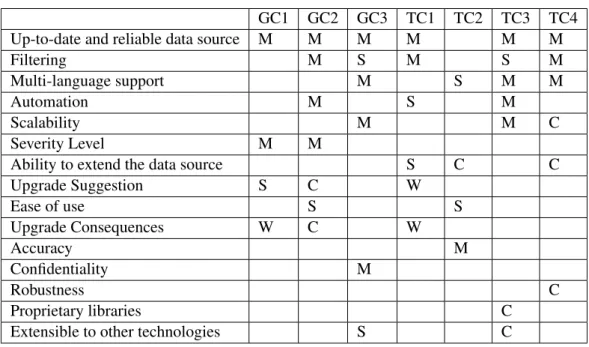
An overview of the results from this research phase is presented in Table 2.1. Each column represents the subjects’ responses and each row presents the requirements gathered from the
Discussion
GC1 GC2 GC3 TC1 TC2 TC3 TC4
Up-to-date and reliable data source M M M M M M
Filtering M S M S M
Multi-language support M S M M
Automation M S M
Scalability M M C
Severity Level M M
Ability to extend the data source S C C
Upgrade Suggestion S C W Ease of use S S Upgrade Consequences W C W Accuracy M Confidentiality M Robustness C Proprietary libraries C
Extensible to other technologies S C
Table 2.1: Requirements and their prioritization by consultants
interviews. For a detailed description of each requirement, we refer the reader to Appendix C. When multiple consultants expressed the same demand with different wording, we merged the description into a single representative term and searched for an established definition. For example, when the interviewees said that libraries and known vulnerabilities should “provide a usable ratio between true positives and false positives”, we considered that they were referring to the concept ofaccuracy.
In each table cell, we inserted the priority rating – assigned by the consultant (represented in the current column) to the requirement (represented in the current row). To be able to rank the requirements according to their “general priority” in the table, we converted the four priority levels pertaining to the MoSCoW method, to their integral number counterparts (values ranging from 1 to 4). We then summed up all the cells in which the consultants mentioned the respective requirement and assigned it a priority. After we obtained a sum for all the requirements, we used this value to sort the requirements accordingly.
2.4
Discussion
From the consultants’ responses we observed that the most important requirement was to base the solution on a high quality data source (up-to-date and reliable).
Through interviewing at SIG we also discovered a requirement that we would have not thought about without being involved in the context of use. In the consultancy practice, non-disclosure agreements are signed which disallow the consultants to offer information regarding the subject software systems to third-parties. This brought up the confidentiality requirement, where we were explicitly requested to only process information on SIG premises.
2. REQUIREMENTS FOR A METHOD TO TRACK VULNERABLE COMPONENTS
This means avoiding any external calls with information from the software systems, because that leads to unwanted information disclosure towards third parties.
A rather surprising insight from the gathered data was that only one consultant (technical) suggested accuracy to be a requirement. An important prerequisite of useful solutions are signalling vulnerabilities in libraries which indeed are part of the input software systems. An explanation for this omission might be that the consultants took the accuracy of the output for granted, so they were inclined to think about more “compelling” requirements, instead of correct matching to start with.
We also learned that filtering was another important function for the consultants. It was expressed by the majority of subjects with high priority levels. Filtering allows the users to flexibly declare which alerts are interesting and should be signaled or should be omitted. Also, a smaller number of consultants selected multi-language support to be a high priority requirement, which derived from the fact that they work with projects written in various programming languages.
Scalability was suggested by half of the consultants, but each time with high priority. It was proposed more often by technical consultants than general consultants. This is because as technical consultants, they targeted their requirements not only on the function of the tool, but also on construction attributes of it. Another example of the difference in focus was the fact that more general consultants than technical consultants proposed the feature of upgrading to a newer version of an outdated library, with a known vulnerability. They desired firstly an indication that a newer version exists, and information on the consequences of a possible upgrade.
2.5
Conclusion
In this chapter we presented the requirements for solutions for tracking known vulnerabilities in software projects in the context of external product quality monitoring. We will use it in the subsequent research steps as a frame of reference for screening relevant technologies.
Chapter 3
Vulnerability Knowledge Providers
We learned during the research step presented in the previous chapter that the most important requirement for methods to track known vulnerabilities in software projects is to use an up-to-date and reliable data source. This shows the importance of the quality of the data source in the context of external software product monitoring. Therefore, we have conducted a survey and comparison of the active publicly available vulnerability providers in order to understand the current landscape with its viable options in the light of this requirement. We also conducted an interview in order to understand what are the most important elements that these vulnerability knowledge providers offer in order to obtain another reference point useful for their critical evaluation. The findings of the interview along with the survey are used to define the vulnerability data source that we will use throughout our research project. This study was conducted also by Roschke et al. for a different purpose, attack graph construction [59].
3.1
Database Selection
We obtain the databases set through a search engine using the queryvulnerability database
(January 2014). We include every resource that we could find in which individual vulner-abilities are stored in a structured manner. The vulnerability databases that we found and included this study are:
• National Vulnerability Database (NVD) from NIST [49]
• the Open Source Vulnerability Database [52]
• VDB from DragonSoft [25]
• the advisories from Secunia [63]
• Symantecs SecurityFocus database [69]
• Securiteam database [64]
3. VULNERABILITYKNOWLEDGEPROVIDERS
• Rapid7 vulnerability and exploit database [58]
• Carnegie Mellon‘s Software Engineering Institute Security Notes [65]
• HPI-VDB from the Hasso-Plattner-Institut [4]
3.2
Vulnerability Information Elements
The vulnerability information elements are the names of the columns provided by the vulnerability databases. We created the set of total vulnerability information elements by collecting all the unique column names of our set of vulnerability databases. Each description is taken from the vulnerability database documentation where existent, otherwise we investigated a number of entries in order to be able to assign a relevant description.
• CVE identifier– uniquely identifies vulnerabilities across databases, described also in Section 1.1.1 (e.g.: CVE-2013-21651)
• CWE identifier - Common Weaknesses and Exposures identifier, it is used to label vulnerabilitytypes[3] (e.g.: Missing Encryption of Sensitive Data2)
• Impact- the type of attack that the vulnerability allows (e.g: Denial of Service)
• CVSS- the severity of the vulnerability [43] (e.g.: high)
• Description - a textual description of the vulnerability (e.g.: Cross-site scripting (XSS) vulnerability in web/servlet/tags/form/FormTag.java in Spring MVC in Spring Framework 3.0.0 before 3.2.8 and 4.0.0 before 4.0.2 allows remote attackers to inject arbitrary web script or HTML via the requested URI in a default action3.)
• Solution- the solution to eliminate the vulnerability, e.g.: upgrate to the subsequent minor version
• Attack From- where does an exploiting attack originate from (e.g.: remote site)
• Popularity- the number of people that viewed the vulnerability entry in vulnerability database (for web-based interfaces)
• Discoverer- the entity or person that discovered this vulnerability
• Loss Type- the type of negative consequence that happens upon a successful exploit (e.g: Availability, Confidentiality, Integrity)
• Similar Vulnerabilities- Other vulnerabilities which have been identified to be similar with the current vulnerability
1http://web.nvd.nist.gov/view/vuln/detail?vulnId=CVE-2013-2165 2http://cwe.mitre.org/data/definitions/311.html
Comparison Matrix
• OS- the target operating system
• CPE id - the common platform enumeration identifier which is used to identify applications by specifying its vendor, product identifier and version, among others [21] (e.g.: cpe:/a:springsource:spring framework:3.0.1)
• Vulnerable Software- other ways for identifying vulnerable applications, other than using CPE ids.
• Publishing Date- the date at which the vulnerability was introduced in the database
• Date Public- the date at which the vulnerability was disclosed by the vendor or other entity
• Date Last Update- the date at which the entry in the vulnerability database was modified
• Discovery Date- the date at which the vulnerability was discovered
• References- links to external urls, such as the vendor web page where the vulnerability was first announced (e.g.: the link to the the bug tracker entries that developers created for the vulnerability)
3.3
Comparison Matrix
Using the vulnerability information elements presented in the previous section we create a Comparison Matrix presented in Table 3.1. In addition, we include in the table the number of vulnerability elements, the number of records and whether or not the database maintainers offer an XML export or other machine-processable means of consuming the data. We include the XML export aspect aligned with theautomationrequirement presented in the previous chapter.
3.4
Discussion
As we can see from the Comparison Matrix, some vulnerability databases identify their contents using the standardized CVE identifier, while others use their own custom way. Among these, some do however reference the respective CVE entry for the vulnerability in theReferences.
Half of the vulnerability databases specify the impact of the vulnerabilities, thereby providing the means to categorize the vulnerabilities according to the type of attack they allow for (e.g: Cross-Site Scripting, Denial of Service). The majority of databases (7 out of 10) provide the severity of the vulnerability, by giving the standardized CVSS score used to rate the severity of vulnerabilities [2].
Half of the vulnerability databases contain the “Attack From” element which states the locality from which the attack allowed by this vulnerability could be expected - local or remote.
3. VULNERABILITYKNOWLEDGEPROVIDERS NVD OSVDB Secunia DragonSoft SecurityF ocus SecuriT eam X-F orce Rapid7 CER T SEI HPI-VDB CVE ID x x x x x x x x CWE ID x Impact x x x x x x CVSS x x x x x x x Description x x x x x x x x Solution x x x x x x x Attack From x x x x x Popularity x x Disco v erer x x x x Loss T ype x V ulnerability T ype x Similar V ulns x OS x x CPE ID x x V uln. Soft. x x x x x Publishing Date x x x x x x x x x Date Public x x x x Date Last Update x x x x x x References x x x x x x Nr . of vuln. el. 13 13 9 8 5 6 7 7 10 7 Nr . of records 59217 100392 48731 5457 58920 ? 88937 ? ? 58578 XML export yes no no no no no no no no no T able 3.1: V ulnerability Databases
Interviewing
Out of all the databases, only two do not provide a textual description of a vulnerability. This description could be used in order to understand, among others, the context of the vulnerability, such as the preconditions or the postconditions of an attack. A description of the solutions that could be applied to remove the vulnerability is included in all but the SecurityFocus and SecuriTeam databases, this usually means a suggestion to upgrade to a specific version in which the vulnerability was removed.
Two databases, Secunia Advisories and OSVDB propose a Popularity indicator, which represents the number of times the web page for a specific vulnerability entry was displayed.
With regards to referencing the affected software by each vulnerability, most of the databases have their own way of identifying the affected software, only NVD and HPI-VDB use the standardized CPE (Common Platform and Enumeration) identifier.
Almost all the databases include the Publishing date, which means the date in which the specific vulnerability entry was introduced in the database.
A smaller number of databases includes in addition the Date Public field, which could be used to retrieve the date at which the vulnerability was firstly officially disclosed.
The Date Last Update value could be found in 6 out of the 10 considered databases, and represents the date at which the specific vulnerability entry in the database was modified.
The NVD database from NIST is the only one which provides an XML export with the database contents. The other databases provide only web browser access, therefore leveraging the information contained in them would involve an intricate process which includes HTML scraping. This brings forward the intuition that the other providers do not publish their data to be retrieved programatically, even if they make it available to the public through the browser.
Given the initial impression after the analysis, the NVD database seems a prime candidate to be used as the data source for vulnerability information that we can use for the rest of our research project. But this brings the question whether we miss out on some information by not including the information from the other databases. What exactly can we miss out? Firstly, thedescriptive powerof the vulnerabilities stored in the NVD database can be increased by matching on the CVE identifier in multiple databases and augmenting the vulnerability information elements in the NVD with the elements present in the other databases for that CVE identifier. For example, the NVD CVE vulnerabilities do not contain a Popularity attribute, but we may be able to provide it by linking with other databases by CVE id. Secondly, in the other databases, there are entries that are not labeled with a CVE, so including only the NVD database as knowledge provider couldlimit the total number of vulnerabilitiesthat can be retrieved.
3.5
Interviewing
In order to validate our choice, an interview was set up with an SIG consultant with extensive experience in security assessments. We wanted to find out which are the most important vulnerability information elements and see how many of them are contained in NVD.
3. VULNERABILITYKNOWLEDGEPROVIDERS
3.5.1 Design
The interview model employed is based on the MoSCoW [51] method, because it provides a structured approach to acquire data for prioritization pruposes. The elements that have to be rated by the interviewee are all the possible vulnerability information elements that are present in the range of vulnerability databases, which we are interested in understanding their priority and hence their importance.
3.5.2 Results
The result of the interview is present in this documents Appendix D. For the NVD database, the interview subject gave the responses leading to the following aggregated results:
• MUST - 2/2 of the MUST elements are present in NVD
• SHOULD - 4/7 of the SHOULD elements are present from NVD
• COULD - 7/9 of the COULD elements are present from NVD
• WONT - 0/1 of the WONT elements are present from NVD
3.6
Conclusion
The conclusion that stems from this analysis is that we can confidently use the NVD database throughout the rest of our research. The NVD contains most of the important vulnerability information elements that describe a known vulnerability, so motivation to devise a solution for unifying the vulnerability databases is supported only for the quantity of vulnerabilities consideration.
Chapter 4
The Vulnerability Alert Service
In this chapter, we present the Vulnerability Alert Service, an event-based process for tracking third-party components with known vulnerabilities in software projects throughout their development.
We start this chapter with a series of steps which form the basis for the process. Some of them are automated by a software application – a vulnerability checker, which we present after the process steps. For presenting the vulnerability checker, we firstly show the rationales involved in selecting one solution among the few alternatives identified. We then show the way we extended it in order to be applied in our research context as part of the Vulnerability Alert Service. Finally, we show the results of an assessment of the software tool with regards to its reliability for the purpose of identifying vulnerable components in software projects.
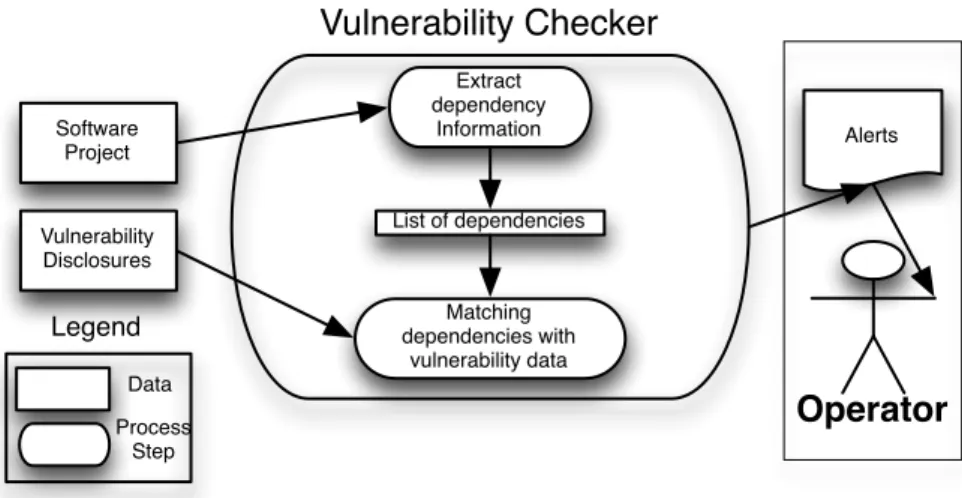
Matching dependencies with vulnerability data Extract dependency Information Alerts
Vulnerability Checker
Operator
Data Process Step Legend Software Project Vulnerability Disclosures List of dependencies4. THEVULNERABILITYALERT SERVICE
4.1
Process description
The process is illustrated in Figure 4.1. Asprocess inputwe have two elements: a software project and vulnerability data. Using Fawcett et al.’s activity monitoring problems[27] terminology, the inputs are derived from the positive activity indicators. For our context, these are: a project is found to include a library with known vulnerabilities, or a vulnerability was disclosed that is found to affect one of the libraries of the monitored projects.
This input is destined for thevulnerability checker which has two tasks: extract de-pendency data, recognize them and match them with known vulnerabilities. The software projects are input for the extracting task, which produces a list of recognized dependencies. This list and vulnerability disclosures are input for the matching task.
Upon a successful match, the application generates an alert, which is consumed by a human operator. After acknowledging them, the operator proceeds to filter the alerts based on usefulness, and then reports them to the interested party.
After presenting the overall process, we proceed to explain the tasks of extracting, recognizing and matching.
4.1.1 Extracting dependency data
We can extract dependency-related information from software projects from multiple sources. Consider for example Java projects. We can use any of these sources, depending on the state of the input project:
• bytecode – the set of instructions to be executed on the Java Virtual Machine resulted by translating the Java application’s resources into executable format by the Java compiler. It integrates the instructions originating from the custom code, but also from the third-party code from which we want to extract dependency information.
• JAR files from the project’s directory – archive files to distribute Java resources to be used in software projects. These can be used for gathering information about the presence of third-party libraries and frameworks within the software application’s filesystem directory. Relevant content can be obtained from the code contents or manifest (documentation) files.
• import statements in source code – Java’s mechanism to include functionality from different source files into the current source file.
• build manifest files – these files are processed by build management applications when projects are being built, and they mention third-party dependencies in specific locations.
The first approach intuitively implies that we are matching by “content”, so matching on subsets of the application code. The second and the third imply that we try to match on application “name”. The next step after extracting information from either of these sources is dependency recognition.
Process description
4.1.2 Recognizing dependencies
Recognizing dependencies means translating the dependency list that was received after the extraction process to a list of CPEs. The CPE identifiers are described in detail in [22]. For example, the CPE identifier for the Java library Apache Commons FileUpload is:
cpe:/a:apache:commons fileupload:1.0.
In the case we extract information from imports or build manifest files, we are working at the same level of abstraction with CPEs –application names. If we want to use the bytecode, then we are working with one level of abstraction lower. In this case, we have to determine from which third-party component (represented by its CPE name) do specific code fragments come from. One solution may be to build binary search engines such as Rendez-Vous, by Khoo et al. [36].
Given these two possible approaches we selectedname matchingfor the task of automat-ically identifying vulnerable libraries. We weighted a set of positive and negative arguments. We took into consideration the following positive arguments:
• the approach is more lightweight – less data to be processed and stored than when working with snippets of binary code
• it removes the need to always obtain the source code of an application for which a vulnerability is disclosed
• avoid the need to abstract from language-specific elements (e.g: compiler specific meta-data in binary code)
The trade-off that we have to make is in terms of accuracy. Using the name-based approach may result in for example, false positives as a result of naming incoherences. When there are less elements used to describe a successful match (only applications names), then it is harder to provide an accurate system than when with many elements (sets of bytecode instructions belonging to applications).
At this step, we do not make reference to the requirements established in Chapter 3. Those are requirements for the integrated solution which includes the process. Here, we address a trade-off that has to be made in the context of a specific part of the tooling that automatically matches project dependencies with their known vulnerabilities.
4.1.3 Matching dependencies with known vulnerabilities
Each known vulnerability in the NVD database XML export specifies the application in which it appears, using the CPE identifier. Therefore the next step from the list of CPEs to a list of vulnerabilities can be constructed by retrieving all vulnerabilities for a specific CPE. This name-based approach could be used, theoretically, across language ecosystems, as names of applications represent invariants – many programming ecosystem guidelines recommend using build management software in which dependencies are declared in build manifests.
4. THEVULNERABILITYALERT SERVICE
4.2
The Vulnerability Checker
Efficiency is increased through automation, and we have two options for integrating automatic vulnerability checking in our process. We can either build a software tool that satisfies the identified requirements from scratch, or we can conduct research to see what the state of the art has to offer and select one from the available options. We have chosen the latter, as the focus of the research study was to investigate the usefulness of monitoring projects for known vulnerabilities using alerts in the given research context and not on building a perfect tool. In order to make a tool selection, we have first created an inventory of existing proprietary and open source alternatives for the vulnerability checker.
4.2.1 Alternatives
To identify existing proprietary tools, we used the following search query in the Google search engine: scanner known vulnerabilities in third party libraries. The first 150 result pages were inspected in detail. We also explored the links present in this set of result pages.
In order to find open-source alternatives, we used Github, a widely used web-based hosting service for open-source software development. To keep the search generic, we used the term “cve” in the search interface, receiving 257 results. We have analyzed the retrieved suggestions and eliminated the ones which were not considered relevant to our use-case (the ones which do not feature repositories for projects that are related to known vulnerability scanning). We were left with 17 open-source projects that were considered relevant, and added to the candidates list.
4.2.2 Selecting one of the alternatives
We have created two tables based on the alternative solutions. In the first table, the columns represent the requirements that we previously gathered from the research context. In the second table, the columns represent indicators of open-source project activity. The activity was assessed by looking at three elements: how many users are subscribed to repository changes notifications (watch and starred counters), how many people forked the repository (the operation in which users start their own projects using the repository’s current state as starting point), the number of pull requests in the past month, the number of commits in the same time frame and the number of users which contributed throughout time to the repository.
The first decision we took was to discard the proprietary solutions. Due to licensing issues, using proprietary software would make it difficult for other researchers to reproduce experiments presented in this research document. Speaking about experiments, proprietary systems would also not allow potential needed modifications that would actually allow experiments. Furthermore, proprietary systems do not enable us to learn about the underlying method they use for implementing their features.
Using open-source software eliminates these problems. Therefore, we have decided to adopt an open-source solution for our research. The specific tool that was selected is a result of investigating the extent to which each open-source option satisfies the requirements (trace
The Vulnerability Checker
requirements to specific constructs in the source code) gathered from the research context and how active it is. We decided that robustness should not be evaluated properly by only looking at the source code, therefore we could not include it in our analysis results. For an overview of these and the requirements-related considerations, we propose the tables on page 21.
Inspecting the tables we see the following trend: there are two categories of requirements. The categories are evidently separate. The first category encompasses requirements which most of the tools have: up-to-date data source, automation, ease of use, confidentiality. On the other hand, the second group contains requirements that almost none of the alternatives have: filtering, scalability, upgrade suggestions, upgrade consequences. These requirements could be taken into consideration by tool builders, as our research shows that there is strong interest in them, but at the moment tool builders do not consider them within the scope of the tools they are developing. Feature-wise, OWASP Dependency Check contains most of the features that we gathered from our research context.
Based on this analysis, we have selected OWASP’s Dependency Check to be used as a vulnerability checker as it distinguished itself among the alternatives, as it features most of the requirements and shows signs of a relatively active development community.
Application name Up-to-date DS. Filtering Multi-language Automation Scalability Ease of use Extensible to other languages
Dependency Check X X X X – X X
Red Hat Victims X – – X – X –
SafeNuGet – – – X – – – Retire JS X – – X – X – RubySec X – – X – X – CVE Search X – X X – X X Fidius X – X X – X X CVE Checker – – X X – X X ArchCVE X – – X – X –
Rails CVE Engine X – – X – X X
CVE Search Ruby X – X X – X –
CVE Easy X – – X X – X
CVE Watch – – X X – X X
Application name Severity DS. Extension Confidentiality Upgrade sugg. Upgrade cons. Accuracy Robustness Proprietary libs.
Dependency Check X – X – – – ? –
Red Hat Victims X X X – – X ? –
SafeNuGet – X X – – X ? – Retire JS – – X – – X ? – RubySec X X X – – X ? – CVE Search X X X – – – ? – Fidius X X X – – – ? – CVE Checker – – X – – X ? – ArchCVE – – X – – X ? –
Rails CVE Engine X – X – – – ? –
CVE Search Ruby X – – – – – ? –
CVE Easy X – – – – – ? –
CVE Watch – – X – – – ? –
Application Name Watch Star Fork Merged Pull reqs/last month Commits/last month Comitters
Dependency Check 27 62 31 3 40 6
Red Hat Victims 9 3 9 2 5 7
SafeNuGet 10 8 3 0 0 2 Retire JS 25 363 19 0 2 9 RubySec 56 180 27 4 11 18 CVE Search 10 33 21 0 0 2 Fidius 3 15 8 0 0 3 CVE Checker 5 15 1 0 1 2 Arch CVE 2 3 1 0 0 2
Python CVE Tracker 1 2 0 0 0 1
Rails CVE Engine 1 0 0 0 0 1
4. THEVULNERABILITYALERT SERVICE
4.2.3 OWASP Dependency Check
Project source files dir
Dependency info. collection
Dependency information
CPE Identifier collection
CPEs Vulnerabilities collection Vulnerabilities Inverted Index Vulns Database Data Process Knowledge Base
Legend
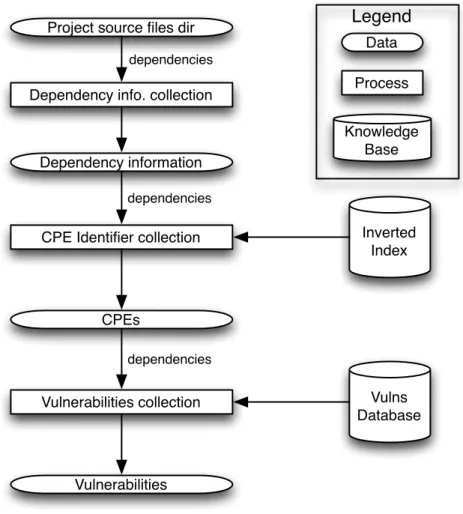
dependencies dependencies dependenciesFigure 4.2: DependencyCheck scanning process
OWASP Dependency Check fits into the Vulnerability Alert Service process as the vulnerability checker application. It overlaps with theextract dependency data,recognize dependenciesandmatch dependency with known vulnerabilitiessteps outlined in Figure 4.1. In terms of its software architecture, Dependency Check resembles the Pipes and Filters [30] pattern. The scanning process is represented graphically in Figure 4.2. The data that flows through the application is composed oflists of dependencies. This list of dependencies is received as parameter at each step of the scanning process, and every step is represented by an
analyzer. Every analyzer has a well-defined task: enrich the individual dependencies in the list with analyzer-specific knowledge. Out of the box, it can extract dependency information (using sources such as JAR files for Java-based applications (JARAnalyzer), DLLs for C#-based applications, etc), recognize them using an Apache Lucene-based inverted index
The Vulnerability Checker
(encapsulated in a CPEAnalyzer) and match recognized dependencies with their respective known CVE vulnerabilities (NVDCVEAnalyzer). We elaborate on each step below.
4.2.4 Extracting dependency information from build manifests
We can not always rely on the JARs being among the software project’s contents. Current best practices suggest the usage of build management applications in which dependencies are declared in build manifest files and integrated at build time. For this reason we extended the already existing analysis functionality for extraction in the context of Java projects.
Maven is the most common build tool for Java systems, which means that we do not exclude many projects on behalf of their build management tool. Therefore we provided the ability to read Maven POM files for extracting dependency information encapsulated in the POMAnalyzer.
POM files
The Project Object Model [6] contains all the configuration information for a project, includ-ing dependency data. Usinclud-ing these files, developers can declare application dependencies on third party libraries using an XML format. At build time, the POM files are inspected and the declared project dependencies are downloaded from internal or external software repositories (with regards to the organization under which the project is developed). The default and principal location for external third-party components is the Maven Central repository1.
A POM file includes project dependencies either under thedependencyManagement
parent tag or under the dependencies parent tag. In the former case, we can specify dependencies which will be inherited by children POM files (this feature is provided in order to allow for POM refactoring for eliminating duplication). In the latter case, we specify dependencies which can not be inherited by children POM files and are relevant only for the current project.
An example of a POM file [50] is presented in Figure 4.4. For the POM given as example, the developers have included two third-party dependencies, namely, Acegi Security version 1.0.0 and the testing framework Junit, version 3.8.1. This information can be extracted from within the “coordinates” tags – groupId, artefactId,version.
Extension implementation details
Based on the textual contents of POM files and using the specific XML schema for them, relevant Java objects are created using JAXB2. Through their getter methods, these objects provide the necessary information about the input software project’s dependencies.
For this extension we benefitted from the fact that Dependency Check’s architecture enables developers to integrate newanalyzersthrough its plugin-based extension points. We followed the template inferred from investigating the other analyzers and built the POMAnalyzer.
1http://search.maven.org/ 2https://jaxb.java.net/
4. THEVULNERABILITYALERT SERVICE
...
< dep endenci es > < dependency >
< groupId > org . a c e g i s e c u r i t y </ groupId > < artifactId > acegi - security </ artifactId > < version >1.0.0 </ version >
</ dependency > < dependency >
< groupId > junit </ groupId >
< artifactId > junit </ artifactId > < version >3.8.1 </ version >
< scope > test </ scope > </ dependency >
</ dep endenci es > ...
Figure 4.3: Exaple POM file
4.2.5 Dependency Recognition
The inverted index enables efficientsimple keyword-based matching. To show how it works, we provide the example of Jetty (version 6.1.22), a popular Java open source web server. In the Maven POM files, developers would integrate this component in the following way, under thedependencytags, as discussed in Section 4.2.4:
...
< dep endenci es > < dependency >
< groupId > org . m o r t b a y . jetty </ groupId > < artifactId > jetty </ artifactId >
< version >6.1.20 </ version > </ dependency >
</ dep endenci es > ...
Figure 4.4: Jetty 6.1.20 in the POM file
The POMAnalyzer would extract “org.mortbay.jetty”, “jetty” and “6.1.20”. They would then be tokenized into the set: {“org”,“mortbay”,“jetty”}and a query will be formed with its elements for index lookup. The query would retrieve a positive result: a CPE identifier (cpe:/a:mortbay:jetty:6.1.20) as both its tokens (“mortbay” and “jetty”) are present in the query. We place one under the other for better illustration:
Vulnerability checker reliability
org.mortbay.jetty jetty6.1.20 cpe:/a:mortbay:jetty:6.1.20
4.2.6 Matching with known vulnerabilities
The list of CPEs are used to query an embedded data base which mirrors the NVD dataset. It is used to retrieve the CVEs for each CPE in the list. After creating a list of matches it then creates vulnerability reports in various formats such as HTML, XML or plain text.
4.3
Vulnerability checker reliability
At this point we have a software application which can be used on Maven projects to obtain the known vulnerabilities associated with the set of third-party dependencies expressed in the POM file. We were interested then in understanding how much can the output of this tool can be trusted when being deployed to scan real software applications, before doing so. Therefore, we have designed a study with the purpose to obtain insight on the tool’s reliability using realistic inputs. This study is motivated also because accuracy was mentioned as being a requirement.
Within the GQM [14] format, our goal for this study is:
The goal of this study is evaluating the tool’s reliability in the context of Maven applications scanning from the perspective of the user.
The first thing we did when studying reliability is locate the process steps (extract, recognize and match) which can generatewrongresults in the vulnerability reports. Wrong results may mean either a:
• false positive– a component which for whichothercomponent’s vulnerabilities are assigned
• false negative– vulnerabilities are not successfully assigned to a project component which for which the vulnerabilities should have been assigned
These faults can be created by the recognizing step, due to the fact that the organizations that propose the identification schemes for CPEs and third-party components are different. This means that differences in naming the same application may exist. The other two steps, extraction and matching are straightforward. Extracting means adjusting the tool such that it can extract dependency data from the build manifest files for different programming languages. Matching means retrieving CVE vulnerabilities for a CPE which is a facile task given that all the CVEs in NVD make referece to their respective CPE, the applications which they refer to.
4.3.1 Precision and Recall
One way to study false positive and false negative rate is using the precision and recall measures[41]. Precision isthe fraction of retrieved results which are relevant. Recall
4. THEVULNERABILITYALERT SERVICE
isthe fraction of the relevant results which are retrievedfrom the data set.
4.3.2 Study design
The precision study needs a dataset of third-party component identification elements that may potentially output false positives after being used as input for scanning. From the scanner output files, we create a list of matched pairs, in which one component identification element list was matched with one or multiple CPEs. We manually label a random selection of 50 matches as being either true positive or false positive, and then aggregate these in order to get the false positive rate to be used in the formula for Precision. The labelling procedure consists of looking for left-hand side elements that would be more appropriate as a match for the right-hand side.
For studying recall, we need to contruct a dataset of components identification elements for which wealready knowthat it has already one or more CVE entries assigned. This way, we can create specific inputs for which we expect the tool to flag vulnerabilities, and see how many of the expected flags actually get raised. The false negative rate will be determined by how many of these input elements do not get flagged, when in fact they should have.
4.3.3 Datasets
Maven component
identifiers
Token set intersection Token set All CPEs
Common tokens
search.maven.org NVD web interface
Ground truth dataset
Figure 4.5: Process for obtaining the ground truth dataset for recall study
We reused a dataset of 148,253 components hosted in Maven Central from previous work [54] [56] [55] by Raemaekers et al.
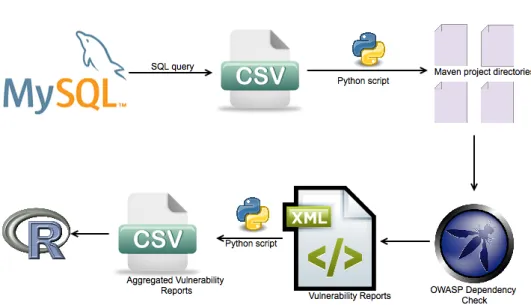
The procedure to find the Maven components for which we know that vulnerabilities have been disclosed is illustrated in Figure 4.5 and can be summarized in the following steps:
– Tokenize the Maven components information elements into individual words and constructing a set of tokens with them. By tokenization, we mean splitting the
Vulnerability checker reliability
strings at the “dot” character and removing the common prefixes, such as “org”, “com”, which do not distinguish components. Example: groupid:org.acegisecurity,
artefactid:acegi-security, version:1.0.7=>add “acegisecurity” and “acegi-security” to the set of tokens.
– In the same way, create a set of tokens which appear in the identification elements for vulnerable applications. In this case, tokenization means splitting according the colon character. Example:cpe:/a:acegisecurity:acegi-security:1.0.0 =>add “acegisecurity” and “acegi-security” to the set
– Execute a set intersection, and obtain the list of tokens which appear in both token sets. Example: “acegi-security” and “acegisecurity”.
– Manually investigate the resulting intersected set and reconstruct the set of pairs. Example:
(org.acegisecurity,acegi-security,
cpe:/a:acegisecurity:acegi-security)
Following this procedure, we have constructed our ground truth dataset, composed of the previously mentioned pairs found.
4.3.4 Results Precision
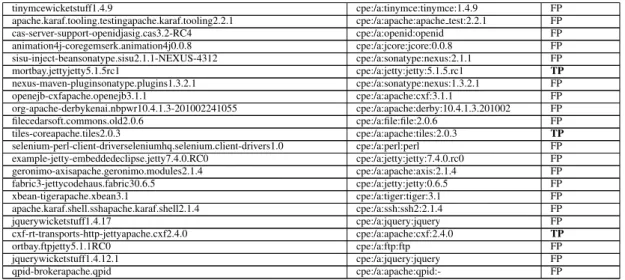
As we can see from Table 4.1, most of the matches are false positives. Among the total of 50 matches, 7 were matched correctly, yielding a precision value of 7/50≈0.14.
Maven Component CPE Type of match
mule-transport-jettymule.transports2.1.1 cpe:/a:jetty:jetty:2.1.1 FP alarm-snmp-raow2.jasmine.monitoring1.2.1 cpe:/a:snmp:snmp FP jetty-ioeclipse.jetty7.2.0.RC0 cpe:/a:jetty:jetty:7.2.0.rc0 FP maven-jboss-pluginmaven1.3 cpe:/a:jboss:jboss FP wicketapache.wicket1.5-M2.1 cpe:/a:apache:wicket:1.5.m2 TP acegi-security-jettyacegisecurity0.8.1.1 cpe:/a:acegisecurity:acegi-security:0.8.1.1 FP apache.felix.karaf.shell.sshapache.felix.karaf.shell1.6.0 cpe:/a:ssh:ssh:1.6.0 FP example-jetty-embeddedeclipse.jetty7.4.2.v20110526 cpe:/a:jetty:jetty:7.4.2.v20110526 FP struts2-coreapache.struts2.0.14 cpe:/a:apache:struts:2.0.14 TP cvsjvnet.hudson.plugins1.2 cpe:/a:cvs:cvs:1.2 FP org-netbeans-api-progressnetbeans.api cpe:/a:progress:progress:- FP miniswicketstuff1.4.9 cpe:/a:minis:minis:1.4.9 FP apache.servicemix.bundles.jetty-bundleapache.servicemix.bundles6.1.12rc1 1 cpe:/a:jetty:jetty:6.1.12.rc1 FP acegi-security-tigeracegisecurity1.0.5 cpe:/a:acegisecurity:acegi-security:1.0.5 FP util-fileow2.util1.0.22 cpe:/a:file:file:1.0.22 FP xfire-aegiscodehaus.xfire1.2.6 cpe:/a:codehaus:xfire:1.2.6 FP cargo-core-container-jettycodehaus.cargo0.7 cpe:/a:jetty:jetty:0.7 FP cargo-core-container-jbosscodehaus.cargo1.0-beta-1 cpe:/a:jboss:jboss FP enunciate-xfirecodehaus.enunciate1.9-RC1 cpe:/a:codehaus:xfire:1.9.rc1 FP mysql-connector-javamysql5.1.16 cpe:/a:mysql:mysql:5.1.16 FP jettymortbay.jetty6.1.12rc1 cpe:/a:jetty:jetty:6.1.12.rc1 TP jquerywicketstuff1.4.9.2 cpe:/a:jquery:jquery FP vaadinvaadin6.4.0 cpe:/a:vaadin:vaadin:6.4.0 TP flex-messaging-coreadobe.flex3.2.0 cpe:/a:adobe:flex: sdk:3.2 FP lift-paypalliftweb1.0.2 cpe:/a:liftweb:lift:1.0.2) FP apache.servicemix.bundles.jetty-bundleapache.servicemix.bundles6.1.14 1 cpe:/a:jetty:jetty:6.1.14.1 FP jettymortbay.jetty6.1.14 cpe:/a:jetty:jetty:6.1.14 TP ssh-slavesjvnet.hudson.plugins0.13 cpe:/a:ssh:ssh:0.13 FP
4. THEVULNERABILITYALERT SERVICE
tinymcewicketstuff1.4.9 cpe:/a:tinymce:tinymce:1.4.9 FP apache.karaf.tooling.testingapache.karaf.tooling2.2.1 cpe:/a:apache:apache test:2.2.1 FP cas-server-support-openidjasig.cas3.2-RC4 cpe:/a:openid:openid FP animation4j-coregemserk.animation4j0.0.8 cpe:/a:jcore:jcore:0.0.8 FP sisu-inject-beansonatype.sisu2.1.1-NEXUS-4312 cpe:/a:sonatype:nexus:2.1.1 FP mortbay.jettyjetty5.1.5rc1 cpe:/a:jetty:jetty:5.1.5.rc1 TP nexus-maven-pluginsonatype.plugins1.3.2.1 cpe:/a:sonatype:nexus:1.3.2.1 FP openejb-cxfapache.openejb3.1.1 cpe:/a:apache:cxf:3.1.1 FP org-apache-derbykenai.nbpwr10.4.1.3-201002241055 cpe:/a:apache:derby:10.4.1.3.201002 FP filecedarsoft.commons.old2.0.6 cpe:/a:file:file:2.0.6 FP tiles-coreapache.tiles2.0.3 cpe:/a:apache:tiles:2.0.3 TP selenium-perl-client-driverseleniumhq.selenium.client-drivers1.0 cpe:/a:perl:perl FP example-jetty-embeddedeclipse.jetty7.4.0.RC0 cpe:/a:jetty:jetty:7.4.0.rc0 FP geronimo-axisapache.geronimo.modules2.1.4 cpe:/a:apache:axis:2.1.4 FP fabric3-jettycodehaus.fabric30.6.5 cpe:/a:jetty:jetty:0.6.5 FP xbean-tigerapache.xbean3.1 cpe:/a:tiger:tiger:3.1 FP apache.karaf.shell.sshapache.karaf.shell2.1.4 cpe:/a:ssh:ssh2:2.1.4 FP jquerywicketstuff1.4.17 cpe:/a:jquery:jquery FP cxf-rt-transports-http-jettyapache.cxf2.4.0 cpe:/a:apache:cxf:2.4.0 TP ortbay.ftpjetty5.1.1RC0 cpe:/a:ftp:ftp FP jquerywicketstuff1.4.12.1 cpe:/a:jquery:jquery FP qpid-brokerapache.qpid cpe:/a:apache:qpid:- FP
Table 4.1: Precision Table
Recall
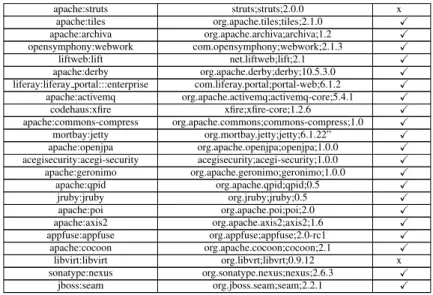
As we can see from Table 4.2, the majority are correct matches. The recall value for this dataset is 47/59≈0.80.
CPE Maven Group ID;Artefact ID;Version Matched caucho:resin com.caucho;resin;3.0.9 X geoserver:geoserver org.geoserver;geoserver;1.5.2 x jasig:uportal org.jasig.uportal;uportal;4.0.1 X jcraft:jzlib com.jcraft;jzlib;0.0.6 X apache:shindig org.apache.shindig;shindig;2.5.0 X apache:syncope org.apache.syncope;syncope;1.0.0 X apache:sling org.apache.sling;sling;2.1.0 X redhat:resteasy org.jboss.resteasy;resteasy-jaxrs-all;1.0.0 x zkoss:zk framework org.zkoss.zk;zk;5.0.0 x
sun:javamail javax.mail;mail; x
jgroups:jgroup org.jgroups;jgroups;3.0.0 x netty project:netty io.netty;netty;3.6.0 x apache:james org.apache.james;james-project;1.8.2 X
neo4j:neo4j org.neo4j;neo4j;1.9.2 X jsecurity:jsecurity org.jsecurity;jsecurity;0.9.0 X apache:solr org.apache.solr;solr;1.0.0 X apache:zookeper org.apache.zookeeper;zookeeper X springsource:spring framework org.springframework;spring-core;3.0.0 x
apache:coyote http connector org.apache.tomcat;coyote;1.1 x apache:cloudstack org.apache.jclouds.api;cloudstack;2.0.1 X
apache:myfaces org.apache.myfaces;myfaces;2.0.0 X apache:commons fileupload commons fileupload;commons fileupload;1.3 x
apache:jackrabbit org.apache.jackrabbit;jackrabbit;1.4 X apache:tomcat org.apache.tomcat;tomcat;8.0.1 X apache:httpclient org.apache.httpcomponents;httpclient;4.0 X apache:continuum org.apache.continuum;continuum;1.1 X apache:hbase org.apache.hbase;hbase;0.92.2 X apache:xalan-java xalan;xalan;2.7.1 x apache:axis org.apache.axis;axis;1.3 X apache:wicket org.apache.wicket;wicket;1.4.0 X xfire:xfire xfire;xfire;1.2.4 X apache:cxf org.apache.cxf;cxf;2.4.0 X vaadin:vaadin com.vaadin;vaadin;4.1.1 X apache:hadoop org.apache.hadoop;hadoop-main;1.0.0 X jfacets:jfacets net.sourceforge.jfacets;jfacets; X apache:camel org.apache.camel;camel;1.0.0 X
Conclusion apache:struts struts;struts;2.0.0 x apache:tiles org.apache.tiles;tiles;2.1.0 X apache:archiva org.apache.archiva;archiva;1.2 X opensymphony:webwork com.opensymphony;webwork;2.1.3 X liftweb:lift net.liftweb;lift;2.1 X apache:derby org.apache.derby;derby;10.5.3.0 X liferay:liferay portal:::enterprise com.liferay.portal;portal-web;6.1.2 X apache:activemq org.apache.activemq;activemq-core;5.4.1 X codehaus:xfire xfire;xfire-core;1.2.6 X apache:commons-compress org.apache.commons;commons-compress;1.0 X mortbay:jetty org.mortbay.jetty;jetty;6.1.22” X apache:openjpa org.apache.openjpa;openjpa;1.0.0 X acegisecurity:acegi-security acegisecurity;acegi-security;1.0.0 X apache:geronimo org.apache.geronimo;geronimo;1.0.0 X apache:qpid org.apache.qpid;qpid;0.5 X jruby:jruby org.jruby;jruby;0.5 X apache:poi org.apache.poi;poi;2.0 X apache:axis2 org.apache.axis2;axis2;1.6 X appfuse:appfuse org.appfuse;appfuse;2.0-rc1 X apache:cocoon org.apache.cocoon;cocoon;2.1 X libvirt:libvirt org.libvrt;libvrt;0.9.12 x sonatype:nexus org.sonatype.nexus;nexus;2.6.3 X jboss:seam org.jboss.seam;seam;2.2.1 X
Table 4.2: Recall Table
4.3.5 Discussion
The approach can also be applicable to other build tools than Maven, with the condition that they work in a similar fashion – third-party dependencies are included in build manifest files by name which are read by the build tool at build time.
From what we can see, the precision value is low for Dependency Check in the context of Maven component identifiers. This is the result of the naming overlaps that happen in the case of Maven components:org.acegisecurity,acegi-securitycontains the token “acegi-security” and “acegisecurity” but the same goes fororg.acegisecurity,
acegi-security-jettywhich would yield an incorrect match.
The recall is high, with only a few failed expected matches, we can be reasonably confident that the tool would find most of the vulnerable libraries which should be flagged.
How these values translate into actual usefulness in practice is still an open question, because libraries are not of equal popularity, some appear more often in projects than others.
4.4
Conclusion
This chapter has presented the elements of the Vulnerability Alert Service, our tool-based process to track vulnerable components in the context of external software product quality monitoring. We started with introducing the process steps, then focused on the ones which are automated using a software tool. We then continued