This conference paper has not been peer reviewed. Any opinions stated herein are those of the author(s)
Pro-poor Livestock Development: Analysis of performance of projects and
Lessons
The importance of livestock as a pathway out of poverty is widely recognized, but debate continues on the effectiveness of pro-poor livestock development projects. A study was conducted on a random sample of livestock development projects in order to draw lessons and identify best practice in pro-poor livestock development. Cluster analysis was used to generate groups of successful and unsuccessful projects based on performance indicators (selected after a review of literature on project performance evaluation in development agencies) and also effects of projects on market access and utilization. Descriptive statistics and regression (OLS, Logit and Ordered Probit) were used to identify features of projects that influence success. A big proportion of livestock development projects (about 60%) were categorized as having not been successful. Results also suggested a positive relationship between success on one hand and size of project, diversity of direct project beneficiaries, institution development activities in projects, and effective monitoring and evaluation activities. Unreliability of government partners, and having other agricultural activities included together with livestock activities in projects undermine success.
Introduction
The positive contribution of livestock to the livelihoods and assets of the poor is widely recognized. Livestock also plays an important role in employment generation (directly and indirectly) and in overall economic growth in the developing world. It is also well recognised that the rising demand for livestock products in the developing countries as a result of rapid growth in population, income and urbanization, presents a great opportunity for demand-led poverty reduction. The observed surges in prices for livestock and products throughout the developing world (FAO, 2009: 109) demonstrate this opportunity.
Notwithstanding, unfavourable views of livestock as a pathway out of poverty have abounded. For instance, it has been argued that the livestock sector and its recent growth and significance in the activities of the poor pose threats to development by way of resource degradation, environmental pollution, and health hazards (Heffernan et al., 2004). Quality of implementation, and performance of livestock development projects have also been questioned: Ashley et al. (1999) in a review of (four) donors’ and (three) funding agencies’ experience with livestock-related development projects concluded that there was “little evidence of widespread sustainable impact on the livelihoods of the poor”.
Ashley et al. (1999) cite numerous published conclusions that authenticate the poor performance of livestock development projects. Livestock development projects tended not to be targeted at poverty alleviation, but rather at other national priorities such as production levels, export promotion, or control of specific diseases. Also, majority of the projects focused on cattle (with implications for gender and environment), and they drove or were driven by technologies and associated organisational forms that were inappropriate. Such development projects may not have provided for much impact on poverty, as a consequence of their design.
Against this background, a debate has ensued on livestock-related pro-poor development, cantered on identifying the factors affecting performance of investment in pro-poor livestock development. In order contribute to this debate, this study examines a sample of livestock development projects completed during the last 9 years so as to draw lessons and identify best practice in designing projects that are successful. For a definition of what a successful project actually means, and how such success can be measured, it is useful to examine the practice of project performance evaluation in development agencies.
Performance evaluation in development agencies
The effectiveness of development aid is currently being addressed on an internationally-concerted basis by the Development Aid Committee (DAC) of the Organization of Economic Co-operation and Development (OECD), yielding DAC guidelines on poverty reduction. However, there are various definitions of aid and assistance effectiveness available. According to the United Nations Development Programme (UNDP) (2001: 11), in order to assess the effectiveness of an intervention or organization, two questions need to be answered in tandem. “Have the immediate goals of assistance been achieved? And have those goals enhanced the development process?”
The OECD (2008) definition of the “purpose of evaluation” is: “assessment, as systematic and objective as possible, of an ongoing or completed project, program or policy, its design, implementation and results. The aim is to determine the relevance and fulfilment of objectives, developmental efficiency, effectiveness, impact and sustainability. An evaluation should provide information that is credible and useful, enabling the incorporation of lessons learned into the decision-making process of both recipients and donors”.
UNDP’s and OECD’s definitions and others’ not shown here, implicate both the activity-output-objective satisfaction sequence, as well as outcomes and impacts. Foresti (2007) further
identifies an increasing trend in inclusion of impacts in evaluations. Such change however remains a work in progress because as Foresti notes most agencies are undergoing reviews, reforms and reorganizations. Foresti reports that few agencies employ a uniform evaluation methodology within the agency and that no common cross-agency model exists, but that most agencies embrace DAC guidelines. The study further reports that some agencies have no formulated policy on evaluation, and that there is no standard organizational positioning of evaluation units, despite a unanimous stated desire for independence of evaluations. Few agencies are reported to have a communication and dissemination policy.
At the operational level, Foresti reports that few evaluation units address individual projects: most evaluate at the level of country, program, or policy. EuropeAID (2004) differentiates “two types of evaluation” addressing separately projects and programs, and Norwegian procedures feature both “reviews” and “evaluations” which refer to programs or policies, rather than to projects (Norwegian Agency for Development Cooperation (NORAD), 2005). In the context of research, Arnold (2005) questions the sense of evaluation at the level of projects because it gives insufficient consideration to project environment, while Maredia et al. (2007) express doubts about the practicality of evaluation at project level due to the difficulty of attribution of impacts (as above), and even of resource use. Those authors maintain that as research programs are typically portfolios of activities that include failures as well as successes, isolation of individual projects is not appropriate. Evaluation of individual projects has also been criticized on the grounds of cost-effectiveness: pragmatism suggests that a detailed process, and the institutions and infrastructure to support it, may be more expensive than tolerance of a limited number of failures. It is notable that these authors do not define what constitutes project “failure”. The Food and Agriculture Organization (FAO) (2001) provides a performance “checklist” for evaluation, which emphasizes achievement of goals, impact on target populations, and the suitability of design. The logic also seeks out linkages inherent in a logical framework approach.
In line with the FAO checklist, explicit project evaluation criteria employed by funding agencies consistently advocate sustainability, efficiency, impact, relevance and effectiveness (NORAD, 2005; EuropeAID, 2004).
Documentation of projects commonly specifies performance indicators, and target values for these indicators. Logical framework matrices often contain these, which are compiled during project preparation and appraisal, usually in relation to project objectives. The Canadian International Development Agency (CIDA), 2002) cite monitoring & evaluation (M&E) as the data source for evaluating whether a project or program is achieving the intended results. EuropeAid (2004) provides a succinct set of boundaries amongst monitoring, evaluation and audit, primarily related to timing within and beyond the project cycle, and to audience and purpose. For such ex post evaluation, NORAD (2005) differentiates between the Project Completion Document (a formal closure, with technical and administrative focus) and the more intervention-relevant Final Report.
Efforts to integrate performance indicators with M&E fuelled studies of development impacts of project work by the World Bank 1992-1995 (World Bank, 1996), and extended to a joint FAO-World Bank publication in 2008 (FAO-World Bank, 2008). This re-invigorated the (older) sector approach to development, assembling macro-economic sector-level indicators that were set against a backdrop of on-going development. For specific sectors (featuring crops, livestock, agribusiness, and others) this work nominated indicators for short and medium term outcomes. The key livestock indicators from World Bank (2008) focused on access to high quality services in the short term, growth in value addition in the medium term, and productivity and asset growth in the long term.
FAO (2001) provides a review of data sources for M&E, primarily featuring project reports and financial summaries, centred on their logical framework matrices. Recent developments in M&E relate to the increased emphasis on accountability and aid effectiveness by both development
agencies and governments: the adoption of the “management for development results” approach (Stem et al., 2003).
Guided by the above review and the objective of the current study, 5 categories of indicators of success were used to evaluate ex post the performance of livestock-related development projects in this study:
(a) relevance of projects to the poor, and to national and local development objectives (b) extent of satisfaction of project objectives through successful completion of activities (c) sustainability in delivery of project benefits
(d) market access and utilization enabled by the project (e) value addition enabled by the project.
This study examines a sample of livestock-related development projects in order to draw lessons and identify best practice in designing projects that are successful according to these criteria.
Materials and Methods
Source of data
The study’s relevant sample frame is recent livestock-related development projects. Sixty-one funding agencies were approached for inclusion in the study, with (purposive) selection based on available information of such agencies’ involvement with pro-poor livestock development. The agencies participating in the study were requested to provide a list of all projects1 completed in the period between 2000 and 2008 that involved livestock. This period was chosen because of its relevance to current challenges, the likelihood of availability of electronic documentation, and
1 Telephone discussions with agencies emphasised the importance of private sector involvement in projects, so
the likelihood of agencies’ staff having personal memory of, or involvement in, the projects. A total of 162 projects were obtained, from which 60 were randomly selected and 58 usable observations were obtained. A semi-structured questionnaire was used to extract data from project documents.
This approach to sampling data collection may be associated with several forms of bias. The potential sources of bias include selectivity in treatment of funding agencies (particularly locally-active non-governmental organizations (NGO), new philanthropies, and agencies not well-represented in English language media), and exclusion of some projects implemented by the agencies due to inability to identify livestock content in projects. Enumerator bias is possible where judgment calls are required on subjective observations. Finally, sample randomness might be questioned where the bulk and quality of data provided in a report is correlated with the extent to which the report’s author considered or assumed the project to be a success.
To address these problems, this study strived to ensure that all livestock-related projects sponsored by every agency approached were included in the sampling frame; and every effort was also made to clarify and standardise data recognition. However it must be recognised that project documents take a great variety of forms and so the quality, packaging and forms of data also vary: in some cases project documents used ratings systems that were simply transposed into the rating used in this study; in others, the ratings required enumerator assessment. Just two enumerators were used for the entire sample, with oversight by the authors. Moreover, the questionnaire underwent several re-specifications which meant that project documents were frequently re-visited, allowing for further checking. Finally, even if an element of enumerator bias still remains, its nature can be assumed to be constant across observations (projects).
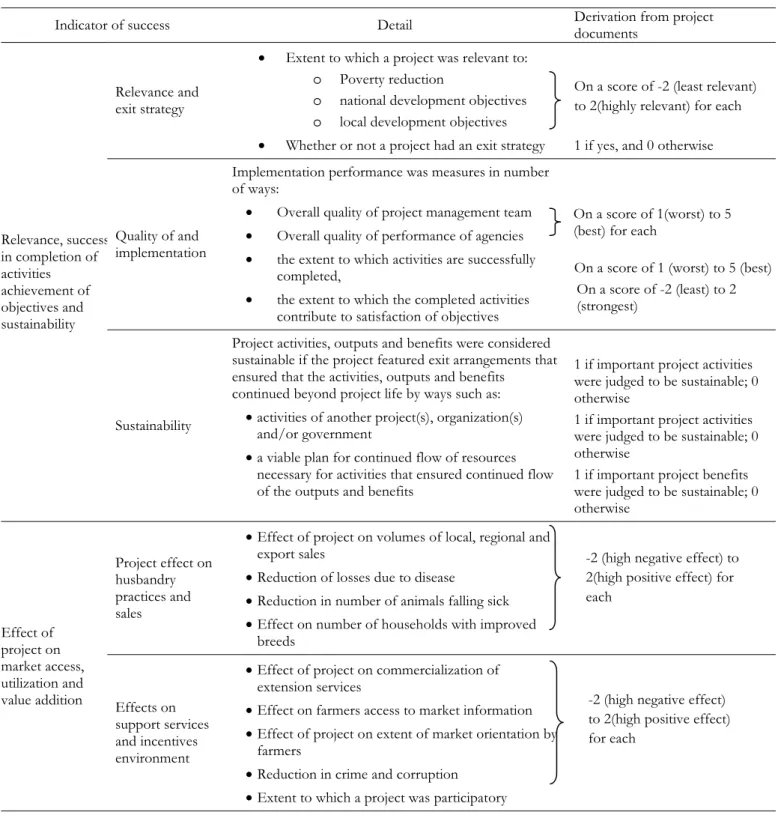
Cluster analysis was used to categorize the sampled projects into groups of those that were successful, and those that were not. Table 1 presents the project success indicators on which the clustering was based, and the scale used. The first category of indicators (project relevance, exit strategy, quality of implementation and sustainability) draws heavily on FAO’s (2001) checklist for project evaluation. To address the objectives surrounding market access and utilization by smallholder livestock keepers, additional indicators were used, related to the World Bank (2008), and drawing on existing models of market access and utilization.
As the indicators used as the basis for clustering were numerous (23) factor analysis was used to reduce them into some few factors which were then used as the basis for clustering. This procedure ensures that no information is lost and offers the possibility for generation of scores of generated factors for further analysis: in this case clustering of projects based of degree of success.
Descriptive statistics were used to determine the features of the clusters of projects generated. To determine factors influencing success, regression analysis was used. Following the clustering of projects, a Logit model was estimated with the dependent variable having a value of 1 if the project was successful and zero otherwise. Other types of regression models were also estimated to determine the factors influencing various individual aspects of project success including:
a) An OLS model with the dependent variable as score representing both the extent to which project activities were completed and the degree to which the completed activities contributed to the satisfaction of project objectives (SUCCESS). The extent to which an activity was completed and also the degree to which the activity contributed to the satisfaction of project objectives were measured on a scale of 1 (worst) to 5 (best). For each of these 2 variables, mean score was computed across the various project activities and the values multiplied together.
b) A binomial dependent variable model (LOGIT) with a value of 1 if either project activities, outputs and benefits were sustainable and zero otherwise.
c) An ordered probit model with the dependent variable as the effect of a project on number of households with increased sales. The effect of a project on number of households with increased sales was measured on a scale of -2 to 2 wherein -2 is a strong negative project effect, 0 represents no effect and 2 a strong positive effect.
d) An ordered probit model with the dependent variable as the effect of a project on number of households with access to increased numbers of buyers. The effect of a project on number of households with increased numbers of buyers was measure on a scale of -2 to 2 wherein -2 is a strong negative project effect, 0 represents no effect and 2 a strong positive effect.
e) An ordered probit model with the dependent variable as the effect of a project on number of households achieving higher sales prices. These variable too was measures on a scale of -2 (strong negative effect) to 2 (strong positive effect).
The set of independent variable included in these models included: project design variables (size, species focus, institution-building content, risks identified); Project staffing and task allocation amongst partners; and Project management quality, the risks encountered relative to those anticipated, and the nature of targeting; and Project elements related to market access and utilization (where not employed as dependent variables).
Results
Factor analysis
As noted in the methodology section, during cluster analysis, factor analysis was first applied on the indicators of project success and the factors generated used as the basis for clustering. Factor analysis yielded 4 factors designated as F1, F2, F3, and F4 (Table 2). F1 (26% of the variation)
loaded heavily and positively on volumes of sales, orientation of farmers and also extension toward markets. F1 therefore seems to represent the “effect of a project in empowering beneficiaries to participate in markets”. F2 (20%) loaded heavily and positively on sustainability of project activities, outputs and benefits beyond project life. F2 therefore seemingly represents “sustainability of effects of projects”. F3 (18%) loaded heavily and positively on relevance of the project to the poor, national and local development objectives, quality of project management, quality of performance of implementing agencies, and the extent to which a project was participatory. F3 thus seems to represent the “quality of projects in terms of contextual appropriateness and implementation”. F4 (17%) loaded heavily and positively on reduction in number of sick animals, and reduction of livestock losses due to disease. F4 thus seemingly represents the “effects of projects on husbandry and productivity”.
Using the 4 factors as clustering criteria, three clusters (i, ii and iii) were generated comprising 18, 12 and 19 projects respectively (Table 3). F1, F2 and F4 exhibited high correlation with the clusters, but F3 did not. Moreover, the mean scores of F1, F2 and F4 were significantly different across clusters while the mean scores for F3 were not. This result suggests that on average, projects in the different clusters achieved the same level of success in terms of contextual and implementation quality.
Cluster iii on average comprised the most successful projects, as shown by the positive values of means and also partial correlation coefficients for F1, F2 and F4. This indicates that the projects in cluster iii performed well in enhancing husbandry and productivity, and market participation by the poor, and in being sustainable. Conversely, cluster i’s projects on average were the least successful as evidenced by the negative values of means of factors 1, 2 and 4 and also negative correlation between this cluster and the 4 factors. Although projects in cluster ii scored well in terms of contextual and implementation quality and also sustainability, they had little effect on enhancing husbandry and productivity, and on market participation by the poor.
Table 4 presents a summary of features of projects in the 3 clusters. Projects in cluster iii (most successful) tended to have relatively high budgets, feature a large number of types of beneficiary, and to have a national government as the budget holder. The majority of projects (61%) in the least successful cluster (cluster i) featured grant funds while in the “best” cluster (iii) 63% of projects were financed by loans. A relatively large proportion of projects in cluster iii (26%) involved contribution by beneficiaries, compared to just 8% and 11% of projects in clusters i and ii, respectively. Projects in clusters ii and iii often encompassed a market-related objective, unlike projects in cluster i. In addition, exit strategy in nearly 70% of projects in cluster iii was found to have been formulated in a participatory manner, compared to about 60% of projects in cluster ii and only 33% of cases in cluster i.
The logit results of the effects of different factors on whether or not a project was classified as successful during clustering are presented in table 5. As is widely predicted in the literature, institutional development activities are strongly positively associated with a project being successful. Project structures featuring generalised agriculture, with a part involving livestock, are seen to be a negative influence on project success. As indicated in descriptive statistics, larger projects are likely to be more successful perhaps because such projects actually tended to be programs implemented over long periods and in which lessons learnt in early phases were incorporated in subsequent phases. The most dangerous risk to project success appears to be unreliable government partners. The only indication of species effects is a negative influence on project success of poultry. Objectives of human nutrition and poverty reduction have no statistically significant effect on success.
A research component designed into a project is positively associated with its success, possibly through mechanisms whereby M&E is an active process feeding management information back to the project managers during a project’s life. Another notable result is that the number of types of beneficiary of a project is positively associated with its success. This result is in line with
the increasing trend for project design to feature a “value chain approach” whereby many value chain actors are targeted by, and involved in, project activities.
Factors influencing various individual aspects of project success
Table 6 presents results of the 5 econometric models estimated to determine the factors influencing separate individual aspects of project success. This is in contrast to the cluster analysis that employs many variables in defining membership of a “successful cluster”. Although the five models use the same set of independent variables, constraints on degrees of freedom required a stepwise estimation approach, so that in each model a number of variables have been eliminated as not contributing to its explanatory power. All models demonstrated reasonable goodness-of fit, and were significant at 1% or 5% levels of test. There is substantial agreement amongst the models regarding significance of explanatory variables. Nevertheless a few items of inconsistency appear, but for most of these a partial explanation is available.
The variable SUCCESS, measured by activity-output-objective scoring, is the dependent variable in the OLS model, and appears as an explanatory variable in the other regression models. While apparently not significant in the model of sustainability of project benefits, it is significantly positively associated with measures of projects’ contribution to households’ market utilization. This is to say that projects that fulfill their objectives by way of successful completion of their activity-to-output design are also likely to have a positive effect on some market-related development indicators. This is a strong result: most pointedly indicating that project activities need not necessarily feature marketing-related activities to deliver market-related results; rather that a well-implemented project will do so regardless of its content.
To further strengthen that argument, variables measuring project design issues (objectives and stakeholder targeting) show a reasonably consistent pattern of sign and significance. The variable indicative of project objectives including “improvements in marketing” is insignificant
across all the models, including the market-related ones. An interesting result is that, in contradiction of previous commentary, projects including nutrition and food security are positively associated with success in terms of market utilization by households.
Earlier commentators also have expressed doubts about the development efficacy of livestock projects’ objectives concerning technical improvement. This concern is borne out by the econometric results, which feature just one significant parameter estimate: a negative association with projects’ sustainability. A related issue is targeting within the value chain: no significant association with any measure of project success was detected. However, attention is drawn to the cluster-based estimation that indicated that targeting of multiple value chain actors (a “whole-chain approach” was a feature of projects assigned to “successful” clusters.
Project size is seen to be positively associated with all measures of success used in the models, and this supports observations from the cluster analysis which repeatedly assigned larger projects to “successful” clusters. Previous commentary on livestock project success emphasized the importance of institutional development and support and this was supported by the results of the cluster based regression results. The empirical support in the case of the individual aspects of project success is limited to a significant and positive association with market access. This is however explicable because market access (positive value) is more requiring of developments in the marketing environment than are either of market utilization or value addition.
The impact of a research component in a livestock development project’s success is ambiguous. It is highly (positively) significant in improving market utilization and value addition, but an insignificant influence on sustainability or activity-output-objective success. This result is interesting in that the kinds of knowledge, and the kinds of user, that might be utilized by market-related research are quite different from those associated with technical or theoretical research – one constraint on uptake of technical livestock research is the long generation interval, and seasonal sales patterns, of species such as cattle and camels. Hence, future
examination of this relationship might address (a) the type of the research and (b) the potential for stakeholders to absorb and utilize the knowledge within the life of a given livestock project. As variables in the regression models, the livestock species addressed by projects provides some reasonably consistent result. Contrary to previous commentary, there is no evidence that cattle projects are less successful than those featuring other species. Indeed, a positive significant result was obtained for cattle’s contribution to value addition. This may reflect the ready salability of cattle and the number available from project participants in most project settings (as opposed, for example, to pigs and small ruminant projects that might seek to increase numbers and/or intensify). The negative parameter estimates of these species’ association with market-related measures of success may reflect this “stocking up” emphasis of projects.
Project partners’ roles are difficult to interpret from the regression results. The strongest result is that sustainability is supported by national governments’ working with farmers. The form of livestock projects’ budget holders also offers an influence that is difficult to interpret. However, three quite different budget holders are reported as positive influences on project success as measured by activity-output-objective success.
Much emphasis in this study was placed on participation in livestock project preparation and management, by stakeholders. As expected, this contributes significantly to project sustainability. However a surprising result is that it does not appear as significant in any other models of success. The related variable of (perceived) quality of project communication is also insignificant across the models.
Analysis of risks associated with projects yields a complex pattern of results. Summary statistics and cluster analysis identified the importance of risks associated with unreliable government partners. This result is not repeated in the econometric models, and the widely-feared “political change” is seen as a threat (albeit statistically insignificant) to sustainability but not to success.
One fully expected result is that poorly functioning markets are negatively associated with sales (our measure of market utilization). A disappointing result is that measures of “quality of project management” enter the models hardly at all.
Conclusions and recommendations
Findings from this study confirm that a large proportion of livestock development projects (about 60%) cannot be classified as having been successful which makes a case for research on how this situation can be arrested. The results from this study invite further research on projects’ design and its relationship to success in impact on poverty. Nevertheless, results from the study provide clue on some of the issues that need to be addressed to foster the success of livestock development projects.
In support of much conventional wisdom institution building, participatory management, and capacity building for government partners, are all recommended. Results also seem to favor bigger projects (which often tended to be programs in nature) that are not add-ons to agriculture projects. A value chain approach in livestock development projects is also favored. Effective monitoring and evaluation authenticated by the positive effect of research components should also be incorporated in project design as it has a positive influence on success. While results from the study show that functioning markets play a key role in project success these may not be able to be delivered from project activities. Hence project designers should target project environments featuring functioning markets (whether formal or informal) for products and inputs.
References
Arnold, E. (2005). “Evaluating Public-Private Partnerships: the Competence Centre Movement in the Netherlands and Other Countries” Presentation at the international workshop on the evaluation of publicly funded research 26-27 September 2005, Wissenschaftszentrum Berlin, Germany. Co-organized by the Organization for Economic Cooperation and Development (OECD) and the Federal Ministry of Education and Research (BMBF).
Ashley, S., S. Holden and P. Bazely (1999).Livestock in poverty-focused development. Livestock in Development, Crewekerne, Somerset. CIDA (Canadian International development Agency) (2002). Review of Current RMB and Accountability Practices in CIDA”
(May 14). Prepared for CIDA by Anne Gillies et al.
EuropeAID (2004). Project Cycle Management Guidelines. Brussels. FAO (2009): The State of Agricultural Commodity Markets: High Food Prices and the Food Crisis: Experiences and Lessons Learned.
Foresti, M. (2007). A comparative study of evaluation policies and practices in development agencies Département de la Réserche, Division Évaluation et capitalization, Agence Franşaise de
Développement. Paris.
Heffernan, C. (2004). Livestock and the Poor: Issues in poverty-focused livestock development. Chapter 15, in: Responding to the Livestock Revolution: the role of globalization and implications for poverty alleviation. Eds. E. Owen, T. Smith, M.A. Steele, S. Anderson, A.J. Duncan, M. Herrero, J.D. Leaver, C.K. Reynolds, J.I. Richards, J.C. Ku-Vera. British Society of Animal Science, publication 33.
Maredia, M., D. Byerlee and J. Anderson (2007). “ex-poste Evaluation of Economic Impacts of Agricultural Research Programs: a tour of good practice” Paper presented to the Workshop on “The Future of Impact Assessment in CGIAR: Needs, Constraints, and Options”, Standing Panel on Impact Assessment (SPIA) of the Technical Advisory Committee, Rome, May 3-5, Rome.
NORAD (2005).Development co-operation manual. Norwegian Ministry of Foreign Affairs. Oslo.
OECD DAC(2002). Network on Development Evaluation, “Glossary of Key Terms in Evaluation and Results Based Management.” Paris
Stem, C., R. Margoluis, N. Salafsky and M. Brown (2003). Foundations of Success - A Review of Monitoring and Evaluation Approaches and Lessons Learned in Conservation. Wildlife Conservation Society (WCS) and Conservation International (CI)
UNDP (2001). Development Effectiveness: Review of Evaluative Evidence, UNDP Evaluation Office. New York.
World Bank (1996). Performance Monitoring Indicators: A handbook for task managers. World Bank, Washington D. C.
World Bank (2008). Tracking results in agricultural and rural development in less-than-ideal conditions Global Donor Platform for Rural Development. FAO and World Bank.
Table 1: Indicators of project success
Indicator of success Detail Derivation from project documents
Relevance, success in completion of activities achievement of objectives and sustainability Relevance and exit strategy
• Extent to which a project was relevant to:
o Poverty reduction
o national development objectives o local development objectives
• Whether or not a project had an exit strategy 1 if yes, and 0 otherwise
Quality of and implementation
Implementation performance was measures in number of ways:
• Overall quality of project management team • Overall quality of performance of agencies • the extent to which activities are successfully
completed,
• the extent to which the completed activities contribute to satisfaction of objectives
On a score of 1 (worst) to 5 (best) On a score of -2 (least) to 2 (strongest)
Sustainability
Project activities, outputs and benefits were considered sustainable if the project featured exit arrangements that ensured that the activities, outputs and benefits
continued beyond project life by ways such as: •activities of another project(s), organization(s)
and/or government
•a viable plan for continued flow of resources necessary for activities that ensured continued flow of the outputs and benefits
1 if important project activities were judged to be sustainable; 0 otherwise
1 if important project activities were judged to be sustainable; 0 otherwise
1 if important project benefits were judged to be sustainable; 0 otherwise Effect of project on market access, utilization and value addition Project effect on husbandry practices and sales
•Effect of project on volumes of local, regional and export sales
•Reduction of losses due to disease
•Reduction in number of animals falling sick •Effect on number of households with improved
breeds
Effects on support services and incentives environment
•Effect of project on commercialization of extension services
•Effect on farmers access to market information •Effect of project on extent of market orientation by
farmers
•Reduction in crime and corruption •Extent to which a project was participatory
On a score of -2 (least relevant) to 2(highly relevant) for each
On a score of 1(worst) to 5 (best) for each
-2 (high negative effect) to 2(high positive effect) for each
-2 (high negative effect) to 2(high positive effect) for each
Table 2: Rotated factor loadings during factors analysis
Variable Factor 1 Factor 2 Factor 3 Factor 4 Uniqueness
Sustainability of project activities beyond project life 0.2 0.9 0.01 0.1 0.2 Sustainability of project output beyond project life 0.1 0.9 -0.04 0.1 0.1 Sustainability of project benefits beyond project life 0.05 0.9 0.04 0.03 0.1 Successful completion of activities 0.2 0.3 0.1 0.1 0.8 Successful satisfaction of objectives 0.2 -0.02 0.4 0.3 0.7 Overall quality of project management 0.1 0.3 0.7 0.01 0.4 Overall quality of performance of agencies 0.1 0.1 0.5 -0.2 0.7
Exit strategy 0.3 0.3 0.3 0.1 0.8
Relevance to poverty relevance 0.01 -0.1 0.8 0.3 0.3
Relevance to national development 0.2 -0.2 0.7 0.1 0.5
Relevance to local development 0.04 0.1 0.5 0.4 0.6
Effect of project on farmers access to market information 0.5 0.2 -0.01 0.3 0.6 Effect of project on volume of local sales 0.9 0.1 0.04 0.1 0.1 Effect of project on volume of sales in the regional market 0.9 0.1 0.1 0.2 0.2 Effect of project on volume of exports 0.4 -0.2 -0.1 0.2 0.8 Effect of project on losses due to disease 0.2 0.1 0.1 0.9 0.1 Effect of project on number of sick animals 0.2 0.1 0.1 0.9 0.1 Effect of project on households with improved breeds 0.5 0.04 0.3 0.3 0.6 Effect of project on households served by extension 0.4 0.1 0.3 0.4 0.6 Effect of project on extension commercialization 0.6 0.3 0.3 0.4 0.3 Effect of project on market orientation by farmers 0.9 0.2 0.03 0.2 0.1 Effect of project on exposure to crime and corruption 0.4 0.2 0.2 -0.01 0.8 Extent to which project was participatory in nature 0.3 0.4 0.5 0.1 0.6
Eigen value 6.8 2.7 2.1 1.4
Amount of variation accounted for 4.1 3.2 2.9 2.7 Proportion of variation accounted for 26% 20% 18% 17%
Number of observations 49
Table 3: Mean scores of factors and partial correlation coefficients between the factors and clusters in Projects Clusters
Name of cluster Cluster i Cluster ii Cluster iii
Rating of success of projects forming the cluster Worst Intermediate Best
Number of projects 18 12 19
Effect of project fostering market orientation (f1)*** -0.1 (-0.1) -1.0 (-0.6) 0.8 (0.6) Sustainability of effects of projects (f2)*** -1.2 (-1.0) 0.9 (0.5) 0.6 (0.5) Contextual and implementation quality (f3) 0.05 (0.04) 0.2 (0.1) -0.2 (-0.2)
Table 4. Summary of features of projects in different clusters
cluster Cluster features
Cluster i (Poor) • Relatively smaller budgets (mean=US$12.7 million)
• Few different types of beneficiaries
• Financing in majority of projects (61%) feature a grant/aid
• Only few projects(8%) featured contribution by beneficiaries
• Feature a market related objective less often
• Majority (55%) feature funding agency as the budget holder
• Only a few projects have a participatory exit strategy (33%)
Cluster ii
(Interme-diate) •• Relatively smaller budgets (mean=US$12.7 million) Involved relatively few different types of beneficiaries (mean=1.3)
• Financing in a modest proportion (42%) featured a grant/aid
• Only some few projects(8%) featured contribution by beneficiaries
• Featured a market related objective less often
• National government was most frequently (50% of cases) the budget holder
• Exit strategy was participatory in majority of projects (58%)
Cluster iii (Best) • Relatively larger budgets (mean=US$88.3 million)
• Involved relatively many different types of beneficiaries (mean=1.3)
• Financing in a modest proportion of projects (42%) featured a grant while loan funds were
most common (63% of projects)
• About a quarter of the projects featured contribution by beneficiaries
• Often featured a market related objective
• National government was most frequently (47% of cases) the budget holder
• Exit strategy was participatory in majority of projects (68%)
Table 5: Logit results of factors determining whether a projects was classified as successful
Coef. Std.
Err. z P>z
Intercept term* -8.67 4.68 -1.85 0.06
Stated project
Objective Improved human nutrition / food security Reduction in poverty/vulnerability -2.32 1.41 3.13 2.99 -0.74 0.47 0.46 0.64 Project activities
Institutional development** Research component** 3.15 4.34 1.35 2.14 2.33 2.03 0.02 0.04 Project also had an agriculture component** -3.60 1.77 -2.03 0.04 Risks
encountered Market Dysfunction Reliability of government partners* -3.51 2.73 3.15 1.77 -1.98 0.87 0.39 0.05 Species included
Small ruminants Pigs 0.27 1.33 1.54 3.07 0.18 0.43 0.86 0.67
Poultry* -4.85 2.61 -1.86 0.06
Partners’ Roles National government works with farmers 0.07 1.48 0.05 0.96 Other variables
Project financed through a loan Size of project budget (millions of US$)* -2.50 1.99 2.57 1.05 -0.97 1.91 0.33 0.06 Number of types of beneficiaries* 1.79 0.93 1.91 0.06 Number of observations =47
LR chi2(12)= 40.58
Pseudo R2= 0.63
Log likelihood=-11.41
Table 6: Regression results for factors influencing various individual aspects of project success
Model type OLS model LOGIT model Ordered PROBIT models
SUCCESS SUSTAINABILITY MARKET UTILIZATION MARKET ACCESS VALUE ADDITION
Success by
activity-output-objective Sustainability of project benefits Number of Hh increasing sales No. of Hh with access to increased numbers of buyers
No. of Hh achieving higher sales prices
Issue Dependent variable Coefficient Coefficient Coefficient Coefficient Coefficient
Project objectives
Features nutrition and food security -1.08 -0.66 1.48* 0.02
Features improvements in marketing 0.94 -0.06 -0.94
Features technical livestock production 0.51 -10.6* 0.31 0.25 -0.44
Project targeting Non-farm, non-trader actors Farmers 0.72 1.12 -1.01 1.04 0.52
Traders 0.04 -0.08 -0.08
Partners’ Roles
International NGO leads project co-ordination 0.83 -10.08
International NGO works with farmers -1.08 0.14 0.75
National government leads project co-ordination -1.76* -6.91 -0.22 -0.39
National government works with farmers 4.54* -0.88 0.14 -0.48
Budget holder
International actor 10.64**
National government agency 9.12** -2.62
Funding agency 11.16**
Management
Quality of project communication Overall quality of project management 0.72 6.17
Risks encountered
Price and cost changes 11.11
Market dysfunction -1.49 -2.68*
Political change -0.68
Species included
Species: cattle 9.77 -0.18 0.94**
Species: small ruminants -1.71**
Species: pigs 1.52 -12.71* -0.23
Species: poultry 1.04 -1.72 -1.57* -0.17
Species: others -0.74 -1.56* -0.55
Other project features
Extent to which project was participatory 2.54* -0.7
Institutional component -0.72 -4.84 0.42 1.28* -0.52 Research component 2.96** 1.25** Project success 0.43** 0.24 -0.02 Project size 0.02*** 0.01 0.003 0.01* 0.003 Intercept term -7.98* -13.57 Number of observations 44 46 46 46 47 Diagnostic parameters
F( 14, 29)=3.31*** LRchi2(18)= 35.31 LRchi2(18)=36.85 LRchi2(18)=24.36 LRchi2(18)= 19.96
Prob > F=0.003 Pr. > chi2 =0.0086 Pr. > chi2=0.004 Pr. > chi2=0.02 Pr. > chi2 =0.096
R-squared=0.62
Adj R2=0.43 Ps. R2 =0.59 Ps. R2=0.49 Ps. R2=0.37 Ps. R2 =0.22