Running head: PROFESSIONAL DEVELOPMENT FOR PRINCIPALS
Professional Development for Principals in Manitoba Dorothy Y. Young
The University of Manitoba, Faculty of Education
Abstract
This paper examines the different types of professional development available to principals in Manitoba; who is responsible for providing it; and its level of effectiveness using Guskey’s (2003) criteria for effective professional development. Professional development is provided by the Council of School Leaders (COSL), the Manitoba Teachers’ Society (MTS), the Manitoba Council for Leadership in Education (MCLE), school divisions and regional groups; however, not all groups responsible for providing the professional development opportunities in the province have promoted professional development in the area of instruction as equitably as they have other more traditional professional development related to management, leadership or personnel. The paper argues that professional development is available in Manitoba and contributes to the development of effective principals.
Introduction
The breadth and knowledge of skills needed in the principalship today has grown considerably due to the demands in education for accountability and measurable results in student achievement, driven in part by the No Child Left Behind legislation in the United States. In Canada, the changing demographics of the population with attendant growth in diversity and student learning needs also has had an impact on the skills needed by effective school leaders and therefore on the provision of quality professional development opportunities for principals. LeTendre and Roberts (2005) report that “prior to 1900, formal preparation programs for school administrators had not yet developed” (p. 4) and that “1900 to 1945 encompassed a period of vast growth in administrative programs” (p. 4). It was during this time that many states required that principals be certified (LeTendre & Roberts, p. 4) as certification was considered evidence of professional growth and training for the position. Although Manitoba has a Level I and Level II certification process, it is not mandatory that administrators be certified, though most often school divisions have begun to require it as a way of narrowing the administrative pool and of providing evidence of professional growth in the area of leadership.
In the United States, because of the focus on credentialing and the quality of educational administration preparation programs (Levine, 2005; Young, Crow, Orr, Ogawa, & Creighton, 2005), much of the professional development of principals has been developed around the Interstate School Leaders Licensure Consortium (ISLLC) standards, used by 40 states as a platform for their preparation programs and licensure (Council of Chief State School Officers [CCSSO], 2008; English, 2000; Orr, 2006; Peterson, 2002). The professional growth opportunities for administrators continue to develop as research and scholarship in the area fluxes with changes in demographics, educational context, and global changes.
Other parts of the world are reviewing the professional development of administrators as well. In England and Wales, the National College for School Leadership (NCSL) was launched in 2000 as a national program to further enhance the development of educational leadership (Brundrett, 2006). While this program is not a university program, two of its objectives are: “to find, analyse and celebrate good practice in school leadership in order to build a usable knowledge base for school leaders to share; and to demonstrate the impact of the NCSL on school leadership” (Brundrett, 2006, p. 473). This program has been in place for only ten years so it is too early to determine its effectiveness; however, similar national programs have been developed in New Zealand and Hong Kong (Brundrett, Fitzgerald & Sommefeldt, 2006; Wong, 2004).
Because Canada is the only country in the developed world that does not have a federal department of education, and because each province has different jurisdictional requirements for professional development of administrators, providing a national perspective on professional development of administrators in Canada is very difficult. However, given that the United States, England, Wales, New Zealand and Hong Kong are all reviewing professional development of administrators, it appears to be timely for a similar review to occur within our provinces and territories. This paper will consider the nature of professional development of administrators in Manitoba, with a focus on the leadership development opportunities available for the professional development of principals (including vice principals), and prospective administrators. As such, the following questions guide the purpose of the paper:
1. What makes professional development for administrators effective?
2. What types of professional development are available to principals generally and in Manitoba specifically?
3. What are the major focus areas of the professional development particularly in Manitoba and who is responsible for providing it?
4. To what extent do these opportunities align with Guskey’s (2003) criteria of effectiveness?
The paper concludes with recommendations for professional development for principals suited to the Manitoba leadership context and the development of effective principals.
Effective Professional Development
Fullan (2001) states “that leaders will increase their effectiveness if they continually work on the five components of leadership – if they pursue moral purpose, understand the change process, develop relationships, foster knowledge building, and strive for coherence – with energy, enthusiasm, and hopefulness” (p. 11). However, such effectiveness does not occur as a consequence of obtaining an administrative position; it is learned over time as leaders engage in professional learning experiences that help develop their knowledge, skills and dispositions for leadership. In fact, Fullan, Hill and Crévola (2006) use the term professional learning when they describe professional development activities because they perceive effective professional development as that which is focused and ongoing, and which promotes authentic learning. Thus leadership and professional development (professional learning) are inextricably linked and are of importance in the development of effective principals.
What makes professional development effective? Thomas Guskey (2003) has written extensively on professional development and indicates that practitioners and researchers do not agree on the characteristics of effective professional development. In a review of thirteen different lists of the characteristics of effective professional development for teachers, Guskey (2003) found the following characteristics to be most common:
enhancement of teachers; content and pedagogical knowledge;…provision of sufficient time and other resources as essential to effective professional development;… promotion of collegiality and collaborative exchange; evaluation procedures;…and professional development activities to be aligned with other reform initiatives and to model high-quality instruction. (p. 749)
In Guskey’s view, time for professional development needs to be purposefully directed, well organized and structured. Such structure and organization is also important to foster collaboration on shared strategies, exchange of ideas, and working together. Given the importance of data-based decision-making and student achievement in today’s educational context, it is important to note that fewer than half of the lists Guskey (2003) reviewed listed “the importance of using analyses of student learning data to guide professional development activities” (p. 749). Since there was no actual agreement on the criteria for effective professional development, Guskey developed three criteria of his own in addition to evaluation which he indicated was important in any professional development activity.
The fundamental goal and the principle criterion for effectiveness of professional development must be “improvements in student learning outcomes” (Guskey, 2003, p. 750). The second criterion Guskey (2003) identifies as context because: “real-world contextual differences profoundly influence the effectiveness of professional development endeavours” (p. 750). The third criterion is using research-based decision-making. In his earlier work, Guskey (2002) also makes a strong case for the evaluation of professional development as being a key to effective professional development. Guskey (2002) concludes that “by including systematic information gathering and analysis as a central component of all professional development activities, we can enhance the success of professional development efforts everywhere” (p. 51). Though Guskey
discusses these criteria as being necessary to professional development in general, they could certainly be applied in particular to professional development for principals, particularly as they relate to Fullan’s content related to moral purpose, understanding change, developing relationships, fostering knowledge building, and striving for coherence.
In order to determine whether or not professional development is effective, then, one could use Guskey’s criteria and Fullan’s content as a lens through which to make judgements about particular professional development activities for principals. For the first criterion, one could consider the standards upon which principal preparation and development are based, and question the extent to which such standards focus on student learning. For example, the 2008 ISLLC standards state that “the ultimate goal of these standards, as with any set of education standards, is to raise student achievement” (CCSSO, 2008, p. 5). In Manitoba, the Council of School Leaders developed a position statement on administrative certification which suggested that its focus on leadership standards had the purpose to “guide aspiring, emerging and exemplary Manitoba public school leaders to facilitate continuous improvements to ensure all students succeed, not only today, but well into the future” (Cann, 2005, p. 3). These statements corroborate Guskey’s first criterion that the goal of professional development must be the improvement of student learning outcomes, though the Manitoba standards appear to be more esoteric and not as immediately focused on student achievement per se. In terms of the second criterion of context, principals deal with real-world differences every day that vary depending on school location. Therefore, effective professional development for principals should take into account the differences between schools and divisions. In Manitoba, there are various organizations with differing mandates that foster leadership development, including provincial groups, regional consortia of school divisions, or individual school divisions that design and
provide professional development opportunities that meet provincial, regional or local needs. The third criterion is in evidence as more research is being based in schools and principals are making data-based decisions (Young, Levin, & Wallin, 2007). Such principals benefit from sharing their information and problem solving with their colleagues during professional development activities. Much of this focus on data-based decision making has been fostered in Manitoba with the provincial mandating of school planning that aligns with school division and provincial goals that are created along the SMART framework (Specific, Measurable, Achievable, Realistic and Timely). Finally, as Guskey suggests, professional development needs to be evaluated to see if it is effective and to determine if it is meeting the needs of the participants. The same position holds for principal professional development, which has been highly criticized by leading scholars in the field (Hess & Kelly, 2007; Levine, 2005; Murphy & Vriesenga, 2006; Murphy, 2003, 2005, 2007; Young, Crow, Orr, Ogawa, & Creighton, 2005) and will be discussed further as it relates to the Manitoba context in the subsequent sections. The following section will further outline some of the professional development initiatives available to principals as well as some of the criticisms and recommendations raised in the literature.
Professional Development for Principals
School systems recognize the need for administrators to learn about their work (Young, Levin, & Wallin, 2007). In a recent study, it was reported that principals “agree that they need to be more effectively prepared for their jobs” (Hess & Kelly, 2007, p. 245). In fact, principals participate in a variety of formal and informal professional development activities including conferences/in-services, workshops, mentoring and university courses, each of which will be examined in the subsequent sections.
Conferences are held across the continent on a variety of topics. Some are sponsored by universities and private organizations (Solution Tree The Educator’s Professional Development Provider), but many are sponsored by the leading professional organizations in education: Association for Supervision and Curriculum Development; American Association of School Administrators; National Staff Development Council; National Association of Elementary School Principals; National Association of Secondary School Principals, and the Canadian Association of Principals, to name a few. At the provincial level in Manitoba, conferences and workshops are organized and/or sponsored by the Council of School Leaders (COSL), the Manitoba Teachers’ Society (MTS), the Manitoba Council for Leadership in Education (MCLE) and Manitoba Education Citizenship and Youth (MECY). Conferences are usually centered on a theme and have both keynote speakers and break-out sessions from which the participants choose the sessions they want to attend. For example, the theme for the COSL conference in 2008 was “The Changing Role of the School Leader”. A sample of the break-out sessions offered at the 2008 COSL Conference included: Realistic Optimism: Rural Education and the Changing Nature of Leadership; Supporting New Administrators/Mentorship and Coaching; and, Does Reasonable and Appropriate = Meaningful?
Workshops
Workshops are held across the continent as well but they tend to be held locally for participants from the state or province and are smaller in scope than larger conferences. Frequently participants are active participants in the workshops and often a certificate is presented at the end of the workshop which indicates the hours spent in the session. Principals use these certificates for proof of upgrading their skills and/or for provincial certification purposes. Some school divisions also provide professional development for principals and vice
principals and for teachers interested in becoming administrators; many of these sessions can be used for certification as well.
Some school divisions are taking a leadership role in the ongoing professional development of principals particularly in the areas of instruction, assessment and organizational management to ensure that their educational leaders are capable of working in diverse settings (Grogan & Andrews, 2002; Orr, 2006; Peterson, 2002; Sherman, 2005). In Manitoba, workshops are organized by the Council of School Leaders (COSL), the Manitoba Teachers’ Society (MTS), the Manitoba Council for Leadership in Education (MCLE), and by individual school divisions. The workshops organized by COSL, MTS and MCLE are open to anyone in the province whereas the workshops offered by school divisions are usually open only to those individuals working in the division. However, in rural Manitoba where divisions are small, regional workshops are held, often financially supported by MCLE. These workshops are available to individuals from the region and have included topics such as peer assisted leadership; walk through supervision; and positive behaviour supports.
Mentoring
Mentoring is being viewed more and more as valuable professional development for administrators (Crippen & Wallin, 2008; Kline, 1987; Mitang, 2007; Young, 2009). Administrators tend to report positively on the value of both being mentored and being a mentor. Mitang (2007) reported that:
Mentoring should be seen as only one stage—albeit an important one—in a continuum of professional development of principals that begins with pre-service training and, ideally, continues throughout leaders’ careers. And it is only one piece among many that must be
in place if states and districts are to increase the likelihood that principals can eventually become effective leaders of learning. (p. 20)
A pilot study conducted by the author of this paper found that in Manitoba “mentoring and being mentored play an important role in the development of effective educational leaders and the benefits are felt throughout the school system” (Young, 2009, p. 20). Both those acting as mentors and those being mentored reported that they found mentoring to be very beneficial to them. In fact, mentoring contributes to the development of self-efficacy and collective-efficacy, which assists administrators to become more effective school leaders (Leithwood & Jantzi, 2008). Because of this recognition, many school divisions in Manitoba have developed mentoring programs for their administrators, though not many have instituted evaluation procedures to determine their effectiveness.
University Courses
The value of educational administration preparation programs in the United States has been hotly debated (Hess & Kelly, 2007; Levine, 2005; Young, Crow, Orr, Ogawa and Creighton, 2005). For example, Hess and Kelly (2007) conducted a study of 31 principal-preparation programs including “influential elite programs, large programs that train the most candidates, and more typical programs” (p. 250) in the United States. Hess and Kelly (2007) used the following seven areas in the rubric for the study of course content in preparation programs: “managing for results, managing personnel, technical knowledge, external leadership, norms and values, managing classroom instruction, and leadership and school culture” (p. 246). These categories are not new to researchers in educational leadership (Donmoyer, Imber, & Scheurich, 1995; Reeves, 2006). Findings suggested that the content of the courses analyzed by Hess and Kelly trained principals for the traditional role of administrators and really did not
prepare them for the role of the 21st century leader. Instead, Hess and Kelly suggested that the following areas of concern should be included in effective principal preparation: “accountability, managing with data, and utilizing research; …hiring, recruiting, evaluating, and terminating personnel; …overseeing an effective instructional program; and…exposing candidates to diverse views regarding educational and organizational management” (p. 246). Hess and Kelly argue that these areas of concern underpin the knowledge and skills that principals of today require though other researchers acknowledge their absence in university and college programs (Murphy & Vriesenga, 2006; Murphy, 2007).
Hess and Kelly (2007) noted that the programs did not pay attention to data, accountability, productivity and how to deal with parents, thus leaving principals unprepared for their responsibilities. These researchers reported that “all but 4 percent of practicing principals report that on-the-job experiences or guidance from colleagues has been more helpful in preparing them for their current position than their graduate studies” (p. 245). This is a sad commentary on the state of university and college courses for administrators. Hess and Kelly (2007) also noted that “typical leadership programs in graduate schools of education are out of touch with the realities of what it takes to run today’s school districts” (p. 245). This leaves principals unprepared to exercise their responsibilities effectively in the world today. Further comment on the criticisms in the literature on the university and college programs in the United States have been made most notably by Levine (2005) and the University Council for Educational Administration response written by Young, Crow, Orr, Ogawa and Creighton (2005).
The results of a study conducted in England and Scotland by Cowie and Crawford (2007) indicated that “emphasis on competence and attaining an identified standard suggests movement
more towards employers, practitioners and other providers rather than universities” (p. 138). Thus it appears that the responsibility for providing professional development and possible certification is moving away from the universities. Nevertheless, the standards contain a vision which constitutes “a vision of a profession rooted in learning and committed to the well being of youngsters and their families” (Murphy, 2003, p. 39). This vision is supported by the ongoing commitment to professional development by administrators.
Perhaps partly due to the lack of a federal department of education in Canada, and possibly because there are relatively few administrative preparation programs in the country as compared to elsewhere, there has been no nation-wide comprehensive study of preparation programs conducted in Canada. In Manitoba, both the University of Manitoba and Brandon University offer thesis-based and course-based Masters of Education in Educational Administration programs. Brandon University also offers a project route program. The University of Manitoba also offers a Post-Baccalaureate Program which allows principals to take courses that are accreditable towards certification. Commentary on these programs will be made further on in this paper.
Focus of Professional Development
In Manitoba, principals participate in a variety of professional development activities including conferences, workshops, mentoring and university courses. This section of the paper will discuss professional development activities including conferences, workshops, and university courses in Manitoba. Mentoring will not be discussed in this paper as the information on what mentorship opportunities are provided varies greatly from school division to school division and would entail an extensive review of individual school divisions. School divisions also provide professional development for administrators but this information will not be
included as the information varies greatly and cannot be comprehensively described within the scope of this paper.
In Manitoba, a school principal must be a certified teacher but does not need to be certified as a principal (Manitoba Education, Citizenship and Youth [MECY], 2008, p. 3). However, the government does provide guidelines for the certification of administrators and issues two certificates, Level 1: School Administrator’s Certificate and Level 2: School Principal’s Certificate once the guidelines have been met (MECY, 2008). The four areas of focus for this certification are: “leadership, instruction, management and personnel” (MECY, 2008, p. 4). Principals can obtain these certificates by participating in professional development opportunities offered and sponsored by a number of different organizations. Interestingly, these topics, though they may be broadly conceived to include aspects of Fullan’s content areas of moral purpose, understanding the change process, developing relationships, fostering knowledge building, and striving for coherence, they appear, at least on the surface, to be more aligned with traditional content areas supported in preparatory programs that have lately been critiqued in the literature.
In Manitoba, professional development opportunities for principals are provided by the universities of Manitoba and Brandon in their Masters of Educational Administration or Post-Baccalaureate programs, the Council of School Leaders (COSL), the Manitoba Teachers’ Society (MTS) and the Manitoba Council for Leadership in Education (MCLE), and to a smaller extent the Canadian Association of Principals (CAP). The information referred to in this section of the paper was obtained directly from COSL, MTS and MCLE by contacting representatives of these organizations and by obtaining copies of brochures advertising their professional development events. Principals generally attend CAP’s annual conferences when they are held in
their own province as travel and accommodation costs in other provinces are quite high. CAP’s annual conferences were held in Manitoba in 1986, 1994, 2001 and 2009 (http://www.cdnprincipals.org/past_conferences.htm).
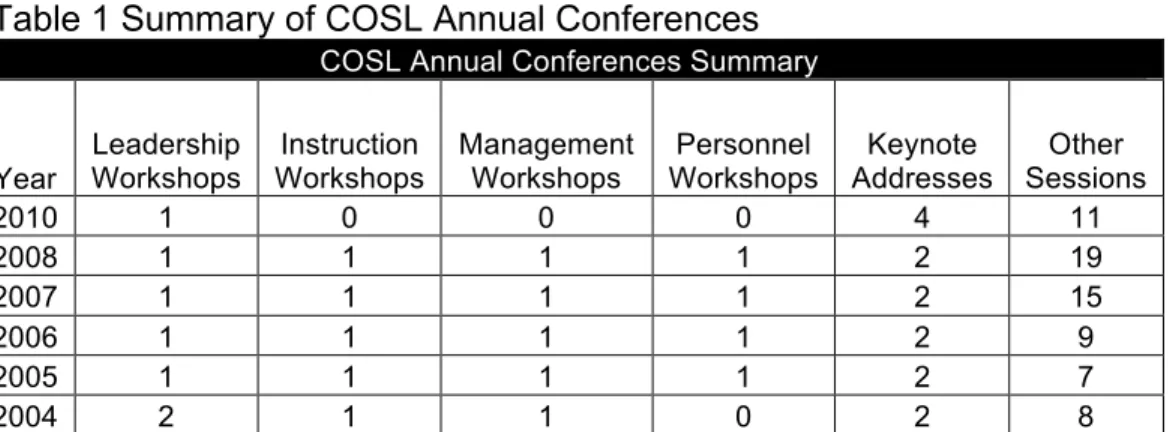
COSL provides professional development for administrators through its annual conference, usually held in the spring, and through the Special Area Group Conferences offered by the Manitoba Teachers Society (MTS) held in the fall. This is due to the fact that in Manitoba, vice-principals and principals remain with teachers in the same collective bargaining units. Table 1 below summarizes the COSL annual conferences for the last five years and reports on how many two-day workshops for certification were held as well as the number of keynotes addresses (eg. Terrence Deal - Shaping School Culture (2006); Kevin Cameron - Creating the Open School Dynamic – Making our Schools Safe for Students, Staff and Family Involvement (2007); Ian Jukes - Windows on the Future Revisited: New Schools For the New World (2008), and other sessions held which varied in length and were on many different topics (eg. Leading from Behind (2006); Protecting our Children from Online Victimization (2007); Engaging Student, Teacher and Community Voices in Dialogue toward Change for our High Schools (2008)). The two day workshops provide 10 hours of credit towards certification in one of the four areas of focus: Leadership, Instruction, Management and Personnel.
Table 1 Summary of COSL Annual Conferences COSL Annual Conferences Summary
Year Leadership Workshops Instruction Workshops Management Workshops Personnel Workshops Keynote Addresses Other Sessions 2010 1 0 0 0 4 11 2008 1 1 1 1 2 19 2007 1 1 1 1 2 15 2006 1 1 1 1 2 9 2005 1 1 1 1 2 7 2004 2 1 1 0 2 8
Note: In 2009 the COSL Annual Conference was not held. Instead COSL supported the CAP Conference held in Winnipeg in Many 2009.
The certification workshops held annually covered all four of the focus areas other than in 2004 when no personnel workshop was held but two leadership workshops were held rather than one and in 2010 when only a leadership workshop was held.
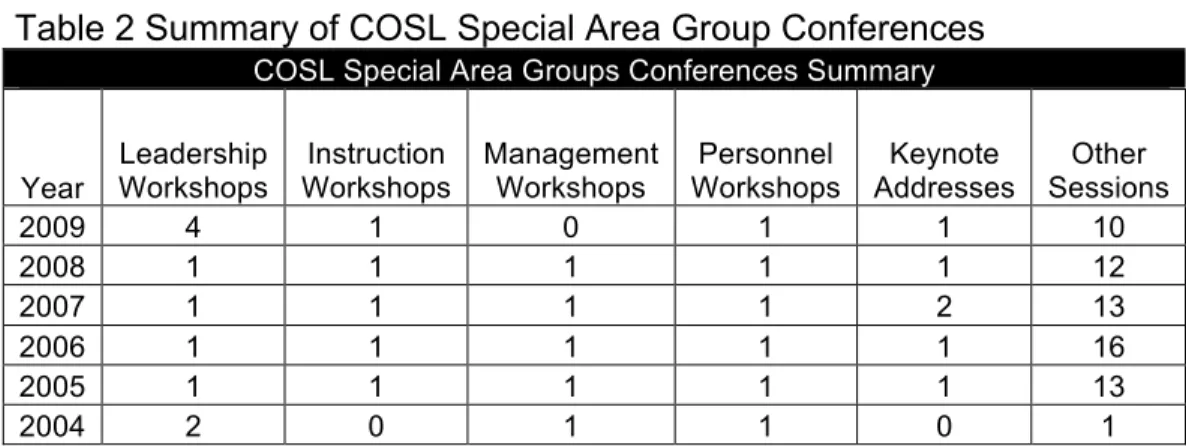
As well, COSL provides professional development for administrators through the Special Area Group (SAG) Conferences held annually in the fall. Table 2 below summarizes the COSL annual SAG Conferences for the last five years and reports on how many two-day workshops for certification were held as well as the number of keynotes addresses (eg. Dr. Bruce Ferguson –
Strategies for Students At Risk (2006); Robin Chestnut - Professional Life: A Juggling Act
(2007); Wayne Hulley - Harbours of Hope: Schools Where Learning By All is a Reality (2008)), and other sessions held which varied in length and were on many different topics (eg. Creating Safer School Environments: Proactive Strategies and Processes (2006); Media Relations 101
(2007); Effective Behaviour Systems = Effective Behaviour Schools (2008)). The two day workshops provide 10 hours of credit towards certification in the area of focus.
Table 2 Summary of COSL Special Area Group Conferences COSL Special Area Groups Conferences Summary
Year Leadership Workshops Instruction Workshops Management Workshops Personnel Workshops Keynote Addresses Other Sessions 2009 4 1 0 1 1 10 2008 1 1 1 1 1 12 2007 1 1 1 1 2 13 2006 1 1 1 1 1 16 2005 1 1 1 1 1 13 2004 2 0 1 1 0 1
The certification workshops held annually covered all four of the focus areas other than in 2004 when no instruction workshop was held but two leadership workshops were held rather than one.
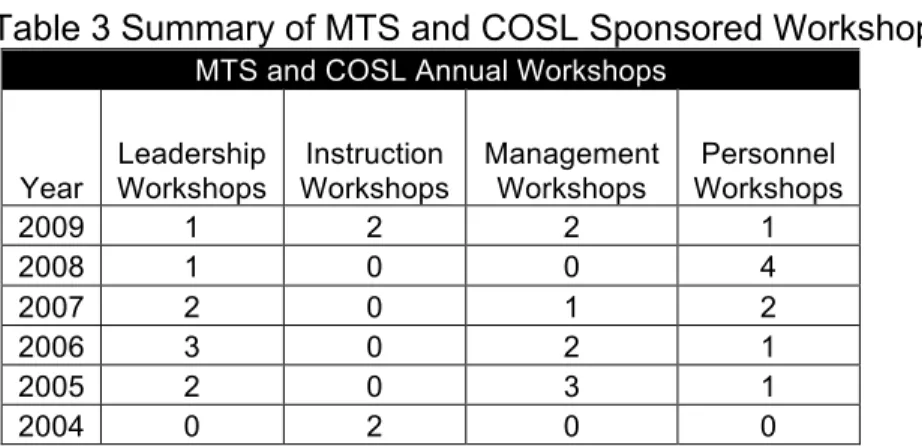
The MTS and COSL jointly sponsor workshops for certification throughout the year. Table 3 below summarizes the workshops held during the last five years. The two day workshops
provide 10 hours of credit towards certification in one of the four areas of focus. These workshops are held at various times during the school year and participants could take more than one during the year if they were able to get release time to attend from their school divisions.
Table 3 Summary of MTS and COSL Sponsored Workshops MTS and COSL Annual Workshops
Year Leadership Workshops Instruction Workshops Management Workshops Personnel Workshops 2009 1 2 2 1 2008 1 0 0 4 2007 2 0 1 2 2006 3 0 2 1 2005 2 0 3 1 2004 0 2 0 0
Note: This table includes the sessions that were held as some sessions were cancelled.
The certification workshops held annually did not cover all four of the focus areas. Instruction workshops were been held 2005 and 2008; a leadership workshop was not held in 2004; a management workshop was not held in 2004 or 2008; and a personnel workshop was not held in 2004. The focus on instruction, which is Guskey’s primary criterion if one considers the immediate relationship between instruction and student achievement, does not appear to have been a priority for MTS and COSL given the lack of sponsorship of instruction workshops by these organization since 2004.
MCLE also provides professional development opportunities through its annual summer leadership institute jointly sponsored by COSL. The institutes last for five days and participants obtain 10 hours of credit in each of the four areas of focus: leadership, instruction, management and personnel, for a total of 40 hours. In 2008, MCLE turned the responsibility for the summer institute over to COSL as it was ready to assume more responsibility for the professional development of school leaders. The format was similar to past institutes and attendees were able to obtain a total of 40 hours of credit towards certification. MCLE continues to support the
summer institute financially by providing sponsorships to a number of participants. MCLE also provides financial support to school divisions and regional areas for their professional development endeavours. Examples of sessions supported include Walk Thru Supervision, Linking Literacy Leaders, and Positive Behaviour Supports. MCLE also sponsors sessions on
Peer Assisted Leadership that are open to leaders from all parts of the province. It also has begun offering localized financial support for leadership initiatives conducted by individual divisions or regional consortia as a means of developing local capacity within school divisions, and to offset some of the travel and access issues faced by rural school divisions in their attempts to access professional development opportunities.
Both the University of Manitoba and Brandon University offer thesis-based and course-based Masters of Education in Educational Administration programs. Brandon University also offers a project route program. The University of Manitoba also offers a Post-Baccalaureate Program which is highly flexible and allows principals to take courses that are accreditable towards certification. A summary of the required courses listed in both universities respective Masters of Educational Administration brochures is summarized in Table 4 below. The programs at both universities focus on leadership; however, without examining the course outlines it is difficult to determine if there is a focus on improving the achievement of learning outcomes. Based on a review of the course titles, the points raised by Hess and Kelly (2007) in their paper on effective principal preparation are included in the courses offered at the two universities above, and represent the knowledge and skills that principals of today require. Each of the universities requires a research component as well which is vital to the emphasis on data-based decisions and school improvement facing principals today. The program at the University of Manitoba recently received a very positive review for its Masters of Education program, and is
currently reviewing the Post-Baccalaureate Program. Therefore, in the opinion of the researcher, the educational administration Masters programs at the two universities in Manitoba appear to provide strong and effective professional development. It must be mentioned, however, that although participants are allowed electives in the course-based Masters route, and the courses offered may emphasize moral purpose, understanding the change process, developing relationships, fostering knowledge building, and striving for coherence within the overview of content, the names of the courses themselves relate quite consistently with most university preparation programs in the United States and Canada.
Table 4. Summary of Requirements for Masters of Educational Administration Required Courses in the Masters of Educational Administration Program
University of Manitoba Brandon University
Thesis-Based Route (18 credit hours plus thesis) Thesis Route (27credit hours plus thesis)
Core Courses (6 credit hours) Educational Core (9 credit hours)
Educational Administration as a Field of Study and Practice Graduate Scholarly Writing
Theoretical Perspectives in Educational Administration Interpreting Educational research
Overview of Educational Issues
Research Courses (6 credit hours) Research Course (3 credit hours) selected from:
Introduction to Educational Research Educational Research Methods
3 additional credit hours of research methodology Quantitative Research Methods
Qualitative Research Methods
Concentration (6 credit hours) selected from: Administration Specialization (15 credit hours)
Personnel Administration in Education Introduction to Educational Administration
Issues in the Administration of Education Administrative Leadership in Educational Institutions
Politics of Education Supervisory Policy and Practice
Educational Finance School Administration and the Law
Legal Aspects of Education Introduction to Curriculum
Organizational Planning and Development in Education
The Analysis of Educational Organizations
Electives Electives
none none
Thesis Thesis
Course-Based Route (30 credit hours) Course Work Route (36 credit hours)
Core Courses (9 credit hours) Educational Core (12credit hours)
Educational Administration as a Field of Study and Practice Graduate Scholarly Writing
Theoretical Perspectives in Educational Administration Interpreting Educational research
3 credit hours from: Overview of Educational Issues
Philosophy of Education Graduate Summative Seminar
Seminar in Cross Cultural Education
Research Courses (3 credit hours)
Introduction to Educational Research
Concentration (12 credit hours) selected from: Administration Specialization (15 credit hours)
Personnel Administration in Education Introduction to Educational Administration
Issues in the Administration of Education Administrative Leadership in Educational Institutions
Politics of Education Supervisory Policy and Practice
Educational Finance School Administration and the Law
Legal Aspects of Education Introduction to Curriculum
Organizational Planning and Development in Education
The Analysis of Educational Organizations
Electives (6 credit hours) Electives (9 credit hours)
Choose 6 credit hours Choose three for 9 credit hours
Comprehensive Examination
Note: University of Brandon's Project Route (36 credit hours) is the same as the Course Route except the project is worth 6 credit hours, only two electives are chosen and the Graduate Summative Seminar does not have to be taken.
Conclusions and Recommendations
The major focus areas of professional development in Manitoba include: leadership, instruction, management and personnel. These four foci also are the areas of focus for principal certification. The organizations that provide the majority of the professional development for administrators in Manitoba (COSL, MTS, and MCLE) include workshops for certification in all of their programs, and a Masters degree in Educational Administration from either the University of Manitoba or Brandon University is included in provincial certification. Leadership preparation and professional development in Manitoba is therefore not just the responsibility of the individual; it also is the responsibility of the universities, school divisions and professional organizations.
This paper has examined what makes professional development effective for principals and aligns with Guskey’s (2003) first criteria that one of the primary goals of principals must be improving student learning outcomes. Therefore, professional development must move principals towards that goal. If one examines the options available from the primary organizations in Manitoba that offer professional development to principals, it seems fair to say
that these groups are ensuring that student learning outcomes are embedded in professional development activities to the extent that conferences and workshops align with the instructional focus of the four elements outlined as being necessary for principal preparation in Manitoba. The one area for which this has not been the case since 2004 is that of MTS and COSL sponsored workshops. This is problematic to the extent that these are the school-based groups that represent teachers and in-school administrators, who would therefore seemingly benefit the most from workshop professional development that deliberately focuses on student learning. Although the groups sponsor conferences that include sessions in the area, it is often workshops that provide the most practical and contextually focused “hands-on” kind of training for principals according to those that attend.
In relation to Guskey’s second criteria of context, administrative professional development activities must be practical as well as theoretical, be researched based and examine real world contextual differences. Evaluating professional development activities is essential to ensuring effective professional development. There are many types of professional development opportunities available to principals at the divisional, provincial, national and international levels. Most principals participate in activities at the divisional and provincial levels because they require less time away from their schools and are not as costly. However, principals should be encouraged and financially supported to attend national and international conferences to broaden their outlook and to assist them in thinking outside of the box. At times an individual has to be away from a familiar situation for awhile to truly see what is happening and to develop a plan for improvement. Many of the sessions offered at conferences have keynote speakers who are highly regarded in areas of current research. A number of key-note speakers provide breakout sessions for participants to further their knowledge. Conferences tend to be somewhat more
general in their focus. Workshops on the other hand, given the nature of the sessions found in Manitoba, appear to provide more contextually based information. They also tend to occur as a way of extending the “big ideas” begun in conferences, and localized into workshop sessions that carry on the conversations. The writer believes from her forty years of experience in education that because most sessions encourage dialogue and questions related to context the sessions allow people to contextualize their understandings; however, further research is needed to determine this. The university programs offered by the University of Manitoba and Brandon University are deliberately focused on theory and the dissemination of research and scholarship in the area of educational administration. The Post-Baccalaureate Program at the University of Manitoba tends to be more practical in nature than the Masters programs, though attempts are made to link theory to practice in all coursework. What is perhaps most necessary is that the program coursework be examined and perhaps updated to ensure that it includes a focus on current areas of need for Manitoba principals and promotes a focus on student learning. To this end, discussions with the various professional organizations that offer professional development should ensue. In addition, a research project that would review the current professional development needs of principals in Manitoba that could then inform the development or augmentation of coursework would be beneficial to the design of relevant and meaningful professional development.
The programs offered by Brandon University and the University of Manitoba could be more readily available to administrators or individuals interested in administration if more cohorts or online opportunities were developed within school divisions or regions. It is recommended that the universities explore cost-sharing measures with school divisions as they too would benefit from having well prepared principals. It is recommended that school divisions
continue to provide professional development opportunities to current and prospective administrators both locally and/or regionally and that financial support be provided to individuals to assist with their development.
Based on an examination of the professional development opportunities available to principals in Manitoba over the last five years, and, using Guskey’s criteria as a lens, it appears that the professional development of principals in Manitoba attempts to focus on students, is research-oriented and contextually focused. All conferences, workshops and even preparatory programs at the respective universities include an evaluation component. However, the extent to which evaluations are authentic, become embedded within the work of principals in schools, or include a measurement of growth or change over time is dubious, particularly because conferences or workshops are “one-stop shops” of professional development. Certainly many school divisions begin to align their local professional development initiatives within the frames offered by the professional organizations in Manitoba, but whether these initiatives become embedded in the daily practice of leaders and/or ultimately promote student learning is an area that needs extensive study.
In conclusion, it is recommended that when professional development activities are provided in Manitoba, they should be evaluated against Guskey’s (2003) criteria for effective professional development: the focus on improving student learning outcomes, linking theory and practice, real world application aligned with contextual need, and include an evaluation component that begins to align systematic professional development opportunities to what is the actual practice of principals in schools.
References
Brundrett, M. (2006). Evaluating the individual and combined impact of national leadership programmes in England: Perceptions and practices. School Leadership and Management, 26(5), 473-488. Retrieved http://www.tandf.co.uk/journals/titles/13632434.asp
Brundrett, M., Fitzgerald, T., & Sommefeldt, D. (2006). The creation of national programmes of school leadership development in England and New Zealand: A comparative study.
International Studies in Educational Administration (Commonwealth Council for Educational Administration & Management (CCEAM)), 34(1), 89-105. Retrieved from http://works.bepress.com/tanya_fitzgerald/4/
Cann, B. (2005). Leading educators and educating leaders: Professional standards and guidelines for successful leadership in Manitoba’s public schools. Paper prepared for the Council of School Leaders of The Manitoba Teachers’ Society.
Council of Chief State School Officers (2008). Educational Leadership Policy Standards: ISLLC
2008. Washington, DC. Retrieved from
http://www.ccsso.org/content/pdfs/elps_isllc2008.pdf
Council of School Leaders Annual Leading and Learning Conference. (2004, February). Closing the gap: The bridge between high and low achievers [Brochure]. Winnipeg, MB: Author. Council of School Leaders Annual Leading and Learning Conference. (2005, February).
Professional learning communities: The school leader’s role [Brochure]. Winnipeg, MB: Author.
Council of School Leaders Annual Leading and Learning Conference. (2006, February).
Building capacity and culture [Brochure]. Winnipeg, MB: Author.
Council of School Leaders Annual Leading and Learning Conference. (2007, February). Safe and healthy learning communities [Brochure]. Winnipeg, MB: Author.
Council of School Leaders Annual Leading and Learning Conference. (2008, February). The changing role of the school leader [Brochure]. Winnipeg, MB: Author.
Council of School Leaders Specials Area Groups Conference. (2004, October). Certification, certification, certification and collective bargaining [Brochure]. Winnipeg, MB: Author. Council of School Leaders Specials Area Groups Conference. (2005, October). Safety, inclusion
and legal aspects of a safe school [Brochure]. Winnipeg, MB: Author.
Council of School Leaders Specials Area Groups Conference. (2006, November). Strategies for students at risk [Brochure]. Winnipeg, MB: Author.
Council of School Leaders Specials Area Groups Conference. (2007, November). The school reality: A juggling act [Brochure]. Winnipeg, MB: Author.
Council of School Leaders Specials Area Groups Conference. (2008, November). Leadership for success and student success [Brochure]. Winnipeg, MB: Author.
Council of School Leaders Summer Institute. (2008). The leadership challenge: Creating reflective learning communities [Brochure]. Winnipeg, MB: Author.
Cowie, M., & Crawford, M. (2007, Apr). Principal preparation: Still an act of faith? School Leadership & Management, 27(2), 129-146.
Crippen, C., & Wallin, D. (2008). Manitoba superintendents: Mentoring and leadership.
Education Management Administration and Leadership, 36(4), 546-565.
Donmoyer, R., Imber, M., & Scheurich, J.J. (Eds.) (1995). The knowledge base in educational administration: Multiple perspectives. Albany, NY: State University of New York Press.
English, F. (2000, Apr/June). Pssssst! What does one call a set of non-empirical beliefs required to be accepted on faith and enforced by authority? [Answer: a religion, aka the ISLLC standards]. International Journal of Leadership in Education, 3(2), 159-167
Fullan, M. (2001). Leading in a culture of change. San Francisco, CA: Jossey-Bass.
Fullan, M., Hill, P., & Crévola, C. (2006). Breakthrough. Thousand Oaks, CA: Corwin Press. Grogan, M., & Andrews, R. (2002). Defining preparation and professional development for the
future. Educational Administration Quarterly, 38(2), 233-256. Retrieved September 17, 2008, from ERIC database (CSA Illumina).
Guskey, T. (2002). Does it make a difference? Evaluating professional development. Educational
Leadership, 59(6), 45-51. Retrieved from
http://web.ebscohost.com.proxy2.lib.umanitoba.ca/ehost/pdf
Guskey, T. (2003). What makes professional development effective? Phi Delta Kappan, 84(10), 748-750. Retrieved from http://web.ebscohost.com. proxy2.lib.umanitoba.ca/ehost/pdf Hess, F. M., & Kelly, A.P. (2007). Learning to lead. Teachers College Press, 109(1), 244-274. Kline, W. A. (1987). A collegial approach to developing leadership. Educational Leadership,
45(3), 70-71. Retrieved from http://asacd.org/publications/educational leadership.aspx Leithwood, K., & Jantzi, D. (2008, Oct). Linking leadership to student learning: The
contributions of leader efficacy. Educational Administration Quarterly, 44(4), 496-528. LeTendre, B. G. & Roberts, B. (2005, November). A National view of certification of school
principals: Current and future trends. Paper presented at the University Council for Educational Administration, Convention, Nashville, TN. Retrieved from http://coe.ksu.edu?ucea/2005/LeTendreUCEA2005.pdf
Levine, Arthur. (2005). Educating School Leaders. NY: Teachers College Press.
Manitoba Council for Leadership in Education and the Council of School Leaders Summer Leadership. (2004). The school principal: Leadership in today’s realities: Challenges and opportunities [Brochure]. Winnipeg, MB: Author.
Manitoba Council for Leadership in Education and the Council of School Leaders Summer Leadership. (2005). Leading in a time of change [Brochure]. Winnipeg, MB: Author. Manitoba Council for Leadership in Education and the Council of School Leaders Summer
Leadership Institute. (2006). The challenges and opportunities of school leadership in Manitoba [Brochure]. Winnipeg, MB: Author.
Manitoba Council for Leadership in Education and the Council of School Leaders Summer Leadership Institute. (2007). Educational leadership in Manitoba: What really matters
[Brochure]. Winnipeg, MB: Author.
Manitoba Council for Leadership in Education and the Council of School Leaders Summer Leadership. (2004). The school principal: Leadership in today’s realities [Brochure]. Winnipeg, MB: Author.
Manitoba Education, Citizenship and Youth. (2008, May 9). Guidelines: Level 1: School Administrator’s Certificate, Level 2: School Principal’s Certificate. Retrieved from www.edu.gov.mb.ca/k12/profcert/ pdfdocs /adminguide
Manitoba Teachers’ Society Administrator Workshops 2004-2005. (2004, September). [Brochure]. Winnipeg, MB: Author.
Manitoba Teachers’ Society Administrator Workshops 2005-2006. (2005, September). [Brochure]. Winnipeg, MB: Author.
Manitoba Teachers’ Society Administrator Workshops 2006-2007. (2006, September). [Brochure]. Winnipeg, MB: Author.
Manitoba Teachers’ Society Administrator Workshops 2007-2008. (2007, September). [Brochure]. Winnipeg, MB: Author.
Manitoba Teachers’ Society Administrator Workshops 2008-2009. (2008, September). [Brochure]. Winnipeg, MB: Author.
Manitoba Teachers’ Society Administrator Workshops 2009-2010. (2009, September). [Brochure]. Winnipeg, MB: Author.
Mitang, L. D. (2007). Getting principal mentoring right: Lessons from the field. New York: The Wallace Foundation. Retrieved from http://www.wallacefoundation.org
Murphy, J. (2003). Reculturing Educational Leadership: The ISLLC Standards Ten Years Out.
Paper prepared for the National Policy Board for Educational Administration. Retrieved from http://www.npbea.org/Resources/ ISLLC_10_years_9-03.pdf
Murphy, J. (2005) Unpacking the foundations of ISLLC Standards and addressing concerns in the academic community. Educational Administration Quarterly, 41(1), 154-191.
Murphy, J. (2007, Apr). Questioning the core of university-based programs for preparing school leaders. Phi Delta Kappan, 88(8), 582-585.
Murphy, J., & Vriesenga, M. (2006, Apr). Research on school leadership preparation in the United States: An analysis. School Leadership & Management, 26(2), 183-195.
Orr, M.T. (2006). Mapping innovation in leadership preparation in our nation’s schools of education. Phi Delta Kappan, 87(7), 492-499. Retrieved from http://www.pdkintl.org/kappan/index.htm
Orr, M.T., & Pounder, D. (2006, Nov). UCEA/TEA-SIG Taskforce on evaluating leadership preparation programs. Taskforce report: Six years later and future directions. University Council on Educational Administration.
Peterson, K. (2002). The professional development of principals: Innovations and opportunities.
Educational Administration Quarterly, 38(2), 213-232. Retrieved from http://eaq.sagepub.com
Reeves, D. B. (2006). The learning leader: How to focus school improvement for better results. Alexandria: VA: Association for Supervision and Curriculum Development.
Sherman, W.H. (2005, Dec). Preserving the status quo or renegotiating leadership: Women’s experiences with a district-based aspiring leaders program. Educational Administration Quarterly, 41(5), 707-740.
Wong, Ping-man. (2004). The professional development of school principals: Insights from evaluating a programme in Hong Kong. School Leadership& Management, 24(2), 139-162. Retrieved from http://www.tandf.co.uk/journals/titles/13632434.asp
University of Brandon. (2008, July). Master of education: Educational Administration
[Brochure]. Brandon, MB: Author. Retrieved from
http://www.brandonu.ca/academic/education/gradStudies/Brochure/Brochure-Educational_Administration.pdf
University of Manitoba. (2007, August). University of Manitoba/Faculty of education: Graduate program: Master of education, doctor of philosophy [Brochure]. Winnipeg, MB: Author.
Retrieved from
http://www.umanitoba.ca/education/prospective/documents/Grad_book_Aug23_07.pdf Young, D. Y. (2009, in press). All over again: A report on the reflections of retired principals,
their preparation and development as principals. Paper presented at the Tenth Faculty of Education Graduate Student Symposium, University of Manitoba, Canada.
Young, J., Levin, B., & Wallin, D. (2007). Understanding Canadian Schools: An Introduction to Educational Administration (4th ed.). Canada: Nelson.
Young, M.D., Crow, G., Orr, M.T., Ogawa, R. & Creighton, T. (2005). An educative look at ‘Educating School Leaders’, UCEA Review, Spring, 1-4.