Procedia - Social and Behavioral Sciences 190 ( 2015 ) 471 – 476
ScienceDirect
1877-0428 © 2015 Published by Elsevier Ltd. This is an open access article under the CC BY-NC-ND license (http://creativecommons.org/licenses/by-nc-nd/4.0/).
Peer-review under responsibility of Academic World Research and Education Center. doi: 10.1016/j.sbspro.2015.05.028
2nd GLOBAL CONFERENCE on PSYCHOLOGY RESEARCHES, 28-29, November 2014
The job satisfaction as a regulator of the working behaviour
Alexandra Hajdukova
a*, Jarmila Klementova
a, Jarmila Klementova jr.
aaTechnical University in Zvolen , T. G. Masaryka 24, 960 53 Zvolen, Slovak Republic
Abstract
The level of job satisfaction of employees is reflected in the working behaviour of the man. The low level of job satisfaction may be reflected by reduced stability, discipline, responsibility, as well as lower power, fluctuation, lack of staff and so on. The aim of this paper is to determine the level of satisfaction with selected factors through the research of employees’ job satisfaction. The factors of job satisfaction were divided into three dimensions–requirements and benefits of labour, status and relationships in the workplace and organizational settings. The theory of job satisfaction indicates a very strong relationship between employee age and its relationship to work (satisfaction with aspects of the work). In theory for the young respondents are the main factors of job satisfaction the career prospects and the nature of the work. For the older workers the nature of the relationship between employees and management is becoming less important. For this reason, the intention of the research was to verify the validity of conclusions theories on employees operating in Slovakia. Within the research was used the method of questioning (interview).To evaluation of the data were used statistical tools and methods (analysis of variance, Duncan test).
© 2015 The Authors. Published by Elsevier Ltd.
Peer-review under responsibility of Academic World Research and Education Center.
Keywords: the job satisfaction, the satisfaction factors, analysis of variance;
1. Introduction
The importance of working in human life is undeniable. Job satisfaction of the working-age person plays one of the most important tasks in terms of its motivation, performance, work efficiency, not least in terms of mental health (Potkany, 2008; Potkany, & Giertl, 2013). The assessment of the man’s work conditions is reflected in the attitudes, which are the unit of measurement of job satisfaction. During the investigation of job satisfaction, it is necessary to distinguish whether a person is completely satisfied at work, or is satisfied only by several factors, the extent to which various aspects of the work are important to him (intensity), the still and current ones, and equally to recognize when it is only current state of satisfaction / dissatisfaction of man. Many authors of job satisfaction researches see the essence of the approach to different aspects of the employment situation, many of which have social and psychological nature (Nakonecny, 2005; Kollarik, 2010; Malloy, & Penprase, 2010). There are also studies that seek to affect the relationship between job satisfaction and organizational culture (Lovas, 2007; Fleskova, & Podolcova, 2010), socially responsible business and job satisfaction (Vagnerova, 2007;Fleskova, 2011) *Alexandra Hajdukova. Tel.: +421 45 520 64 32
E-mail address: [email protected]
© 2015 Published by Elsevier Ltd. This is an open access article under the CC BY-NC-ND license (http://creativecommons.org/licenses/by-nc-nd/4.0/).
but also between the job satisfaction and the leadership style of the working group (Havig, Skogstad, Veenstra, & Romoren, 2011).
2. Definition of job satisfaction and its interpretation
The first studies of man’s work satisfaction appeared in the 30th years of 20th century (following the findings of E. Maya). The studies considered the problems of human work, human inclusion in the labour process and his relationship to his work. Research of job satisfaction in Slovakia was paid particular attention from the sixties to the eighties, which dealt mainly Jurovsky (1976), Kollarik (1979;1986), Dubayova (1976) and others.
Currently, we meet with a few differences in the perception of the term "Job Satisfaction". Luthans in Vyrost and Slamenik (1998) define job satisfaction as favorable or emotional condition that results from the evaluation of work or work experience. Kollarik (1986) means a summary value that reflects a number of factors related to work and non-work and work conditions under job satisfaction.
In the literature, we also meet with an equivalent term "job satisfaction". Arnold (2007) sees job satisfaction as an indicator of psychological well-being of man, or mental health. Pauknerova et al. (2006) assumes that, right job satisfaction encourages and motivates a person to perform better, and is a precondition for the efficient use of labour.
The means of identifying and expressing satisfaction in work are the attitudes. The attitudes are evaluating relationships to people, subject, phenomena and events and in the human personality play an important role. Kolesarova (2010) states that to the shaping of job satisfaction sub-stances are involved. Jurovsky (1971) reflected the relationship between attitudes and job satisfaction. He states that certain relationships to work with the individual stopped, and so they wins in content, directedness and durability that can be observed from the outside as well as relatively stable and its hallmark mental laws that determine more - less sustained focus on work. Therefore Jurovsky (1971) understood the job satisfaction as "a generalized attitude" of people to their work and to everything related to it and can be estimated and measured. Positive attitudes are associated with job satisfaction and the dissatisfaction with the negative ones.
But there are some specifics between job satisfaction and attitude. Vyrost and Slamenik (1998) indicate that satisfaction is usually less stable than attitudes that are firmly anchored and connected to each other. The satisfaction varies in relation to the change of age. That argument is also evidenced by studies that deny that job satisfaction was constant throughout the all life of the individual. It is important to note that the opinions of experts are partially divided on the age range question of employees in which job satisfaction is declining. The study results of Clark, Oswald and Warr (1996) on a sample of 5000 respondents indicate that the degree of satisfaction with the work during the life changing. According to research, by teenagers job satisfaction has risen, by the twenties decreased, and by the forty again soared. For the young respondents the main factors of job satisfaction are possibilities of a term process and the nature of the work. For older workers is becoming less important nature of the relationship between employees and management, which results from their greater independence and their greater prestige in the working collective. According to Sutekova (2012) job satisfaction tends to increase with age, but conducted researches have shown a decline in satisfaction in the age group from 40 to 50 years of age. According to Sheppard and Herrick (1972), Vagnerova (2007) is again the largest share of disgruntled employees just among young people aged 20-29 years. A s a proof they state that after the initial enthusiasm, which young people inserted to work at the beginning of their working life comes a significant drop in satisfaction, with the largest drop in the 3rd decade of life. From about 30 years satisfaction increased again (Crites, 1963). One explanation is that satisfaction is related to the expectations with which young people starting their work. At the beginning of their careers are highly unrealistic about their expectations, and very soon they face barriers of reality, which results in dissatisfaction with working conditions. With age, it is believed that people's expectations are more realistic and also more people adapt to the working environment, thereby is diminishing their dissatisfaction.
Since a person is satisfied with their work / dissatisfied determines subjective view of the individual nature of the work and other aspects of employment, which we call the factors of job satisfaction.
2.1 Factors of job satisfaction
Mozny (1971) defines satisfaction factors as elements to which overall feeling of job satisfaction layout. Jurovsky (1971) states that job satisfaction is determined by those experiential components that a person has in
relation to the content of their work. Kolesarova (2010) divided the factors of job satisfaction in 3 dimensions as they "where a person walks," "what gives him work," and "what man is." The basis for identifying factors and their inclusion were studies of Mozny (1971;1974), Vecernik (2003), Mares (2001), Mares Banovcova (2002). Kolesarova named dimensions of job satisfaction as follows:
x 1. dimension of "organizational settings"
Work is where a person walks. Whether it goes into with pleasure and that feels good in it determine the elements of the work environment (e.g. room equipment, lighting, noise, safety, etc...), that are often the norm for humans.
To the elements affecting job satisfaction include the organization of work, that means employee attitudes, whether his work is well organized, planned, or employee meets the employment relationship, work schedule, randomly assigned tasks and etc.
x 2. dimension 'requirements and benefits of working "
In the first place the work brings certain benefits to the man. On the other hand, it put some rights on a man and needs to spend some effort, when we talk about the workload.
At work uses a person acquired knowledge, experience and skills to which brings to work and the result of its activities are products and services. In this case we are talking about the possibility of applying the professional skills of the employee.
One would not spend too much effort and effort at work, if he was not interested in and did not enjoy the work. If it does not do what he wants to do what it fills therefore interesting of work ranks among the factors of job satisfaction.
A person is not just giving to an organization, but also expects some reward for their efforts (as would appear from the expectations theory). Important form of remuneration is wage, earnings, that man as involves overall job satisfaction and if it does not, it is looking for another job.
To work a person brings their skills and knowledge which he had acquired in school or other employment and he expects that he will be able to continue developing. Therefore work may be a means of self-realization.
With self-realization is closely linked career advancement, which man wants to achieve by making some effort and knowledge. Progress brings many benefits such as prestige, responsibility, self-determination and the like to a man.
x 3. dimension "status and relationships in the workplace"
Work has supra-individual character; it is a place where there is a proliferation of differing social relations and cooperation. Therefore the work is the place where the formal and informal relationships between colleagues are. Individual in his assessment takes into account the functioning, respectively dysfunctional relationships in the workplace and creates a position for them.
To the concept of work also includes the organizational structure and hierarchy of power, which is set in the organization. Therefore employee is not only a colleague but also subordinates and his relationships in the organization affect the attitude of the supervisor.
3. The research results of job satisfaction of employees working in Slovakia
Job satisfaction research was conducted in Slovakia in the period from January 2013 to January 2014 by the questionnaire form. In the research were followed dimensions of job satisfaction as further described in the chapter 1.2. From a wider conceived research we choice only some aspects of the assumptions and the related results, which is given to the magnitude of the contribution. The research goal of the paper was to determine the level of satisfaction of employees working in companies located in Slovakia. The differences between expert opinion on the age range of employees in which decreases their job satisfaction the research has also looked at the relationship between age and employee satisfaction. The research group was formed by 1919 employees who were randomly selected from among employees working in Slovakia. It has been in the research file represented by 29% of respondents fewer than 30 years, 30% of respondents from 31 to 40 years, 27% of respondents from 41 to 50 years and 14% of respondents over 50 years old. The respondents expressed satisfaction with the agents with a 5 point grade scale from 1 to 5 (with 1 being dissatisfied with the factor, 5 = very satisfied with the factor). The results of
the questionnaire survey were processed in the form of arithmetic means and evaluated by analysis of variance and followed by Duncan's test, used to determine the significance of differences between the age groups of employees.
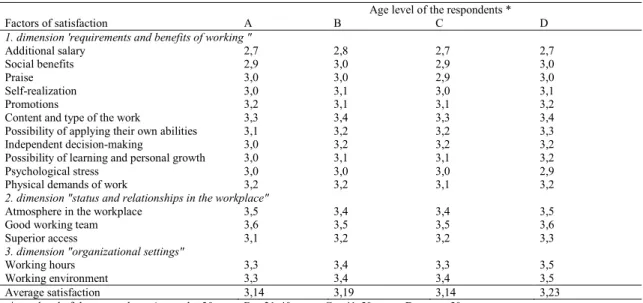
The satisfaction of the respondents with work factors are captured in Table 1. Based on the average values of employee satisfaction with work-related factors it can be concluded that there is no single factor to which the employees were specifically dissatisfied but not a single factor with which they were very satisfied. For most work factors there were recorded neutral value of employee satisfaction. The research results in Table 1 confirm the results of research of Sutekova (2012). It can be concluded that employee satisfaction with the work tends to increase with age. However it has to be counted with a decline in satisfaction in the age group from 40 to 50 years of age. It was also confirmed by Sutekova (2012) argument that the possibility of workflow and content and type of work are among the main factors of job satisfaction among young workers (under 30 years). In addition to these factors are among the main factors also the satisfaction factors the atmosphere in the workplace, a good working team and factors of the third dimension. Research has shown that the main factor of job satisfaction of older workers is not the nature of the relationship between employees and management, on the contrary. The main factor in job satisfaction of older workers is a good working team.
Table 1. The average employee satisfaction of various ages with work factors Age level of the respondents *
Factors of satisfaction A B C D
1. dimension 'requirements and benefits of working "
Additional salary 2,7 2,8 2,7 2,7
Social benefits 2,9 3,0 2,9 3,0
Praise 3,0 3,0 2,9 3,0
Self-realization 3,0 3,1 3,0 3,1
Promotions 3,2 3,1 3,1 3,2
Content and type of the work 3,3 3,4 3,3 3,4
Possibility of applying their own abilities 3,1 3,2 3,2 3,3
Independent decision-making 3,0 3,2 3,2 3,2
Possibility of learning and personal growth 3,0 3,1 3,1 3,2
Psychological stress 3,0 3,0 3,0 2,9
Physical demands of work 3,2 3,2 3,1 3,2
2. dimension "status and relationships in the workplace"
Atmosphere in the workplace 3,5 3,4 3,4 3,5
Good working team 3,6 3,5 3,5 3,6
Superior access 3,1 3,2 3,2 3,3
3. dimension "organizational settings"
Working hours 3,3 3,4 3,3 3,5
Working environment 3,3 3,4 3,4 3,5
Average satisfaction 3,14 3,19 3,14 3,23
Note: * age level of the respondents A = under 30years, B = 31-40 years, C = 41-50 years, D = over 50 years.
The results of the variance analysis for the factor "age of the employees” shows Table 2. Statistically significant differences were confirmed among the most common category of 31-40 years and 41-50 years employees. In the area of discretionary first category of youngest workers (under 30 years) differed significantly from other ages. The effect of age was not confirmed as statistically significant even when one of the factors of satisfaction in the second dimension. The third dimension of satisfaction factors were confirmed statistically significant differences in factor "working hours" and that the first category of employees (under 30 years) and a group of employees between 31-40 years. The category of staff over 50 years and under 30 years category also differed significantly in perceptions of satisfaction with this factor. Between the last two categories of employees (41-50 years old vs. above 50 years old) was just confirmed a statistically significant difference in perceptions of satisfaction with these factors.
Table 2. Results of variance analysis
Factors of satisfaction p-level
A vs. B A vs. C A vs. D B vs. C B vs. D C vs.D
1. dimension 'requirements and benefits of working "
Additional salary 0,449 0,491 0,683 0,000 0,317 0,344
Social benefits 0,244 0,915 0,582 0,298 0,694 0,645
Praise 0,975 0,327 0,778 0,301 0,752 0,606
Promotions 0,057 0,267 0,915 0,000 0,109 0,330
Content and type of the work 0,071 0,789 0,157 0,259 0,993 0,249
Possibility of applying their own abilities
0,234 0,367 0,100 0,000 0,501 0,363
Independent decision-making 0,017 0,044 0,004 0,843 0,277 0,215
Possibility of learning and personal growth
0,167 0,430 0,315 0,992 0,910 0,958
Psychological stress 0,746 0,636 0,389 0,278 0,103 0,490
Physical demands of work 0,860 0,731 0,118 0,000 0,924 0,279
2. dimension "status and relationships in the workplace"
Atmosphere in the workplace 0,404 0,545 0,705 0,837 0,294 0,390
Good working team 0,235 0,192 0,939 0,860 0,309 0,270
Superior access 0,348 0,333 0,117 0,952 0,402 0,444
3. dimension "organizational settings"
Working hours 0,036 0,719 0,016 0,091 0,480 0,038
Working environment 0,372 0,499 0,187 0,850 0,529 0,448
Note: * age level of the respondents A = under 30years, B = 31-40 years, C = 41-50 years, D = over 50 years; highlighted factors are significant at the significance level 0.05
4. Conclusion
The present paper deals with the issue of job satisfaction of employees in Slovakia. Results of the survey show that the main dimensions of job satisfaction are the factors of the 2nd dimension "status and relationships in the workplace." The factors "the atmosphere at work" and "a good working team" all ages of employees means as the main factors of their job satisfaction.
The research results confirm the theoretical assumption about the variability of the level of employee satisfaction with work during their working lives. Based on the research results it can be concluded that employee satisfaction with the work tends to increase with age. The exception is the category of 40-50 years old employees when the job satisfaction decreases. The analysis results of variance for the factor "age of the employees” point to the fact that significant differences exist between the most common category of 31-40 years and 41-50 years employees.
Acknowledgements
This paper is the partial result of the Ministry of Education of Slovak Republic grant project VEGA No. 1/0268/13,„Perspectives of facility management application for the increasing of competitiveness within the wood processing and forestry companies in the context of outsourcing principles”.
References
Arnold, J. et al. (2007). Psychologie prace pro manazery a personalisty. Brno: Computer Press.
Clark A., Oswald, A. & Warr, P. (1996). Is job satisfaction U–shaped in age? In Journal of Occupational Psychology, 1996, 69, p. 57-81. Crites, J. O. (1963). General Job Satisfaction from a Developmental perspective: Exploring Choice-Job Matjes at Two Carem Stages. The Carem
Development Quarterly , 52, 162-169.
Dubayova, T. (1976). Osobnostne faktory vo vzťahu k potencialnej stabilite a fluktuacii pracovnikov hutnych a strojnych prevadzok. In Psychologie v ekonomicke praxi, 2-3, 1976, roc. XI, s.149-150.
Fleskova, M. & Podolcova, M. (2010). Podnikova kultúra a pracovna spokojnosťzamestnancov. In Búgeľova, T., KravFakova G. (Eds) Hodnota dusevnej prace pre organizaciu a spoloFnosť. Kosice: UPJS, 2010. s .86-98. ISBN 978-80-7097-847-4.
Fleskova, M. (2011). Spokojnosťzamestnancov verejnej spravy s pracovnymi podmienkami ako jeden zo socialnych aspektov spoloFensky zodpovedneho podnikania. In Economic, Social, Enviromental and Legislative Aspects of the Corporate Social Responsibility I. Banska Bystrica: EF UMB, 2011. ISBN978-80-557-0268-1 CD.
Havig, A. K., Skogstad, A., Veenstra, M. & Romoren, T. I. (2011). The effects of leadership and ward factors on job satisfaction in nursing homes: a multileveled approach. In Journal of Clinical Nursing, 20, 2011, s. 3532-3542. ISSN 1365-2702.
Jurovsky, A. (1971). Spokojnosť s pracou a jej cinitele. Bratislava, Alfa, 1971. Jurovsky, A. (1976). Spokojnosť s pracou a jej cinitele. Bratislava: CSVÚP.
Kolesarova, K. (2010). Spokojnosť a stabilizacia zamestanancov v spolocnosti. [online] Januar 2014. [cit. 2014-01-10]. Dostupne na < http://is.muni.cz/th/342943/fss_m/diplomova_praca.pdf>.
Kollarik, T. (1986). Spokojnosť v praci, Bratislava, Praca, 1986.
Kollarik, T. (2010). Socialna psychológia prace. Bratislava: UK, 2010. 190 s. ISBN 978-89-223-2782-1.
Lovas, L. (2007). Relationship of organizational culture and job satisfaction in the public sector. In Studia Psychologica, 2007, 49, 3, s. 215-221. ISSN 0039-3320.
Malloy, T. & Penprase, B. (2010). Nursing leadership style and psychosocial work enviroment. In Journal of Nursing Management, 2010, 18, p. 715-725. ISSN 1365-2834.
Mares, P. & Banovcova, L.(2002). Spokojenost s praci – stav vnitrnich dimenzi 1967-2002. Sbornik praci Fakulty socialnich studii brnenske univerzity. Socialni studia, c. 8, s. 39.
Mares, P. (2001). Cesi: zamestnani a prace. Sbornik praci Fakulty socialnich studii brnenske univerzity. Socialni studia, c. 6, s. 91-109. Mozny, I. (1971). Analyza faktoru spokojenosti v praci. Sbornik praci Filozoficke fakulty brnenske univerzity, G15, s. 75-91.
Mozny, I. (1974). Vyznam sfery prace pro vytvareni socialistickeho zpusobu ţivota. Sbornik praci Filozoficke fakulty brnenske univerzity, G18, s. 41-51.
NakoneFny, M. (2005). Socialni psychologie organizace. Praha: Grada, 2005. 225 s. ISBN 80-247-0577-X.
Olasupo, M. O. (2011). Relationship between organizational culture, leadership style and job satisfaction in a Nigerian manufacturing organization. In IFE Psychologia, 2011, 19, 1, s. 159-176.
Pauknerova, D. et al. (2006). Psychologie pro ekonomy a manazery. Praha: Grada Publishing.
Potkany, M. & Giertl, G. (2013). Statistical prognosis of basic business performance indicators in the wood processing industry of the Slovac Republic. In: Markets for wood and wooden products, Zagreb : WoodEMA, 2013. - ISBN 978-953-57822-0-9. p. 31-56.
Potkany, M. (2008). Personnel outsourcing processes. In Ekonomie a management : vedecky ekonomicky casopis. - roc. 11, c. 4/2008, vyd. TU Liberec, 2008, str. 53-62, ISSN 1212-3609.
Sheppard, H. L. & Herrick, N. Q. (1972). Where have all the robots gone? New York: Free Press.
Sutekova, H. (2012). Analyza motivacnych preferencii zamestnancov vo vybranom podniku. In Acta academica karviniensia 3/2012, s. 151- 160, ISSN: 1212-415X.
Tziner, A., Bar, Y., Oren, L. & Kadosh, G. (2011). Corporate Social Responsibility, Organozational Justice and Job Satisfaction: How do They Interrelate, If at All? In Revista de Psicologia del Trabajo y de las Organizationes, 27, 1, s. 67-72. ISSN 1576-5962.
Vagnerova, M. (2007). Vyvojova psychologie II: Dospelost a stari. Praha: Karolinum.
Vecernik, J. (2003). Work and Job Values in CEE and EU countries. Praha: Sociologicky ústav AV CR. Vyrost, J. & Slamenik, I. (1998). Aplikovana socialni psychologie I. Praha: Portal.