Technical Report
DSL Forum
TR-058
Multi-Service Architecture &
Framework Requirements
September 2003
Produced by:
Architecture & Transport Working Group
Editors:
Mark Elias, SBC and Sven Ooghe, Alcatel
Working Group Co-Chair: David Allan, Nortel Networks
Working Group Co-Chair: David Thorne, BT
ABSTRACT:
This documents describes the Marketing requirements for Multi-Service Architecture & Framework in the DSL Forum. These requirements include the need for network interconnection standards for DSL accesses, QoS standards, Bandwidth on Demand, QoS on demand and increased bandwidth.
Notice:
The DSL Forum is a non-profit corporation organized to create guidelines for DSL network system development and deployment. This Technical Report has been approved by members of the Forum. This document is not binding on the DSL Forum, any of its members, or any developer or service provider involved in DSL. This document is subject to change, but only with approval of members of the Forum.
DSL Forum technical reports may be copied, downloaded, stored on a server or otherwise re-distributed in their entirety only.
Notwithstanding anything to the contrary, the DSL Forum makes no representation or warranty, expressed or implied, concerning this publication, its contents or the completeness, accuracy, or applicability of any information contained in this publication. No liability of any kind shall be assumed by the DSL Forum as a result of reliance upon any information contained in this publication. The DSL Forum does not assume any responsibility to update or correct any information in this publication.
1. SCOPE ... 5
1.1. PURPOSE... 6
1.2. TERMINOLOGY OF REQUIREMENTS... 7
2. WHY THE CURRENT DSL ARCHITECTURE CAN’T PROVIDE WHAT IS NEEDED ... 7
3. APPLICATIONS DRIVING EVOLUTION ... 8
3.1. CONTENT DELIVERY NETWORKS... 8
3.2. MULTICAST... 9
3.3. QUALITY OF SERVICE ENABLED APPLICATIONS...9
4. SERVICE FEATURES REQ UIREMENTS TO SUPPORT APPLICATION EVOLUTION...12
4.1. SERVICE GOALS...12
4.2. SERVICE FEATURE DEFINITIONS...12
5. EVOLUTION IMPROVEMEN T REQUIREMENTS ...16
5.1. MORE BANDWIDTH...16
5.2. BANDWIDTH ON DEMAND...17
5.2.1. Use of Line Rates by Connection Access Control (CAC)...17
5.3. MULTI APPLICATION / MULTI DESTINATION SELECTION...19
5.4. QOS SUPPORT...19
5.4.1. QoS differentiation between business and residential customers ...20
5.5. QOS ON DEMAND...20
5.6. USER-SERVICE UNBUNDLING...21
5.7. SERVICE MANAGEMENT...21
5.7.1. Mandatory “common enabling services” for the Regional/Access Network Provider ...23
5.7.2. Optional “common enabling services” for the Regional/Access Network Provider ...24
5.7.3. End to end service provisioning...26
5.8. SERVICE LEVEL MANAGEMENT...27
5.9. CURRENT DSLACCESS TECHNOLOGY...28
5.9.1. ADSL...28
5.9.2. SHDSL (G.991.2)...28
5.9.3. VDSL...28
5.10. SECURITY IN EVOLVING DSLMULTI-SERVICE ARCHITECTURES...29
5.10.1. Security functions of the regional network ...30
5.10.2. Security Functions of ASP/NSP ...30
5.10.3. Security Functions of CPN...30
6. CURRENT DSL ARCHITEC TURES ...31
6.1. LOGICAL REFERENCE ARCHITECTURE...31
QoS support in heterogeneous environments ...33
6.2. ACCESS NETWORK...33
6.2.1. Access Node ...33
6.2.2. U reference point ...34
6.2.3. Customer Premises Network ...34
T reference point ...35
7. SERVICE PROVIDER INT ERCONNECTION MODELS ...36
7.1. APPLICATION SERVICE PROVIDER NETWORK...39
7.1.1. Description of the ASP network...39
7.1.2. Capabilities of the ASP network ...39
7.2. NETWORK SERVICE PROVIDER NETWORK...40
7.2.1. Description of the NSP network...40
7.2.2. Capabilities of the NSP Network ...40
7.3. REGIONAL/ACCESS NETWORK PROVIDER NETWORK...40
7.3.2. Capabilities of the Regional / Access Network...40
8. NETWORK INTERFACE DESCRIPTIONS ...41
8.1. REQUIREMENTS AT THE S AND T REFERENCE POINT...42
8.2. REQUIREMENTS AT THE U REFERENCE POINT...42
8.3. REQUIREMENTS AT THE V REFERENCE POINT...43
8.4. REQUIREMENTS AT THE A10 REFERENCE POINT...43
8.4.1. A10-ASP Interface...43 8.4.2. A10-NSP Interface...43 8.5. CONTROL INTERFACE...43 9. DEFINITIONS...44 10. REFERENCES ...46 Table of Figures Figure 1 – DSL Network Components ...5
Figure 2 - Relationship to other documents...6
Figure 3 - Line rates, CAC and probability in rate adaptive DSL networks ... 18
Figure 4 - Three-layer logical/functional architecture for support of advanced services ... 23
Figure 5 - Service Management Relationships ... 25
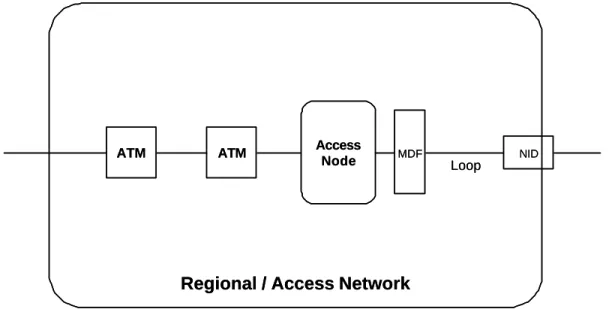
Figure 6 - ATM based Regional and Access Network Providers ... 31
Figure 7 - IP Enabled Regional Network ... 32
Figure 8 - Access Node Architecture Variations ... 34
Figure 9 - T reference point... 36
Figure 10 - DSL Network Components (Voice and application components not shown for clarity) ... 37
Figure 11 - Many-to-Many Access... 37
Figure 12 - Multi Service Reference Model... 42
Table of Tables Table 1 - TV delivered applications ... 10
Table 2 - PC Delivered Applications ... 11
1. SCOPE
This document discusses the requirements of a Multi-Service DSL architecture and evolution from currently deployed DSL architectures.
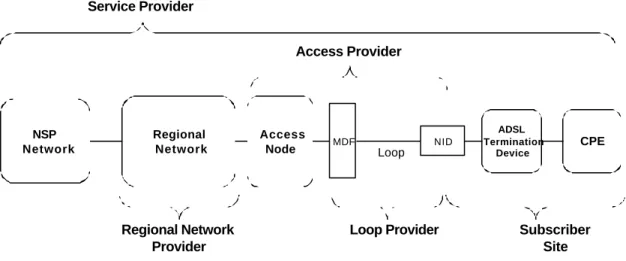
Figure 1 – Example DSL Network Components
First, the current DSL architecture is outlined; then the DSL market requirements that set a target set of capabilities and drive the migration of existing networks to a Multi-Service Architecture are discussed. Based on these drivers, a set of architectural requirements is introduced that need to be supported in a Multi-Service Architecture. These requirements include the following:
• Support for a new service model (in addition to the existing service models) and associated network interconnection standards;
• Support for new service features to be used with the new service model, including: ð IP-based services and QoS;
ð Bandwidth and QoS on Demand;
ð Distinct network and application control planes interfacing with a common data repository; ð Alternative network transport technologies.
The prevalent service model, where subscriber connections are delivered on a best effort basis over ATM PVCs, will continue to exist. However, the new service model will be able to support the mentioned improvements and benefits.
The new architecture will become the foundation for many new applicat ions and services, such as: • Interactive gaming
• Voice services
• Video on Demand
• Bandwidth on Demand via a “Turbo” button or per application • Multicast audio and video
• Remote education Subscriber Site Regional Network Provider CPE Access Node ADSL Termination Device Loop MDF NID Loop Provider Access Provider NSP Network Service Provider Regional Network
The requirements put forward in this document are intended to address the mass market, and do not preclude additional niche or custom services that could be provided using the same infrastructure. While this document does address the Application Service Provider (ASP) network and the content delivery network drivers for information purposes, it does not expect secondary standards (i.e. digital rights management, security, etc.) to be developed in this framework.
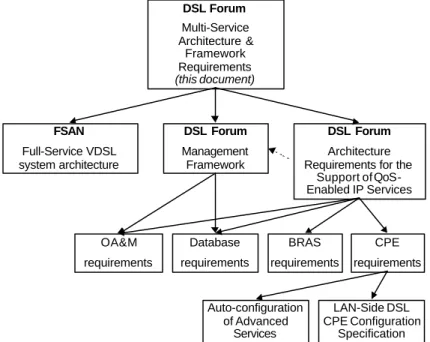
The relation of this document to companion documents describing the architecture implementation details is shown in Figure 2. The standards must satisfy the early adopter customer requirements for an unmanaged service and the basic customer requirement for a fully managed solution. The fully managed solution requires the access provider to be accountable for the customer modem, set top box (STB) or other terminals. DSL Forum Multi-Service Architecture & Framework Requirements (this document) DSL Forum Architecture Requirements for the
Support of QoS-Enabled IP Services CPE requirements FSAN Full-Service VDSL system architecture Auto-configuration of Advanced Services LAN-Side DSL CPE Configuration Specification BRAS requirements DSL Forum Management Framework Database requirements OA&M requirements
Figure 2 - Relationship to other documents 1.1.Purpose
ADSL service providers are highly interested in advancing DSL to be the preferred broadband access technology by growing their networks, increasing the value provided by those networks, and
expanding the market they can address. To do this they must address several critical needs, particularly:
• The service must become more accessible to end- users and to wholesale and retail partners. • The service must address a wider market with:
• Variable speeds,
• Some applications and traffic types having precedence over others, • Specific support for IP applications (e.g. IP -QoS and multicasting),
• Support for new business models that can include more types of service providers, and • Support for these new service parameters across multiple connections to different service
providers from a single DSL subscriber.
While VDSL may also fulfill these needs, perhaps even better than ADSL, it is also important to realize that much ADSL has already been deployed, and that the current business imperatives may cause ADSL service providers to try to make more of what they already have than to try massive network upgrades. Therefore, there is also a critical need to provide a standard evolution path for the embedded base of ADSL.
The purpose of this work and the new service models is to provide a more common architecture and set of service interfaces to address these critical needs. Adhering to this architecture and to the services and service models set forth simplifies and unifies the way for all types of service providers to obtain new ADSL end-user customers, irres pective of whether they provide access to networks, applications, or content. It is noted that there might be local regulations about the architecture, for example allowing governments to request legal wiretaps to be made at any level of the network stack (cf. CALEA/FIP security requirements). These should be taken in account in the implementation of such an
architecture.
1.2.Terminology of Requirements
In this document, several words are used to signify the requirements of the specification. These words are often capitalized.
MUST This word, or the adjective “REQUIRED”, means that the definition is an absolute requirement of the specification
MUST NOT This phrase means that the definition is an absolute prohibition of the specification. SHOULD This word, or the adjective “RECOMMENDED”, means that there may exist valid
reasons in particular circumstances to ignore this item, but the full implications must be understood and carefully weighted before choosing a different course.
MAY This word, or the adjective “OPTIONAL”, means that this item is one of an allowed set of alternatives. An implementation that does not include this option MUST be prepared to inter-operate with another implementation that does include the option. 2. WHY THE CURRENT DSL ARCHITECTURE CAN’T PROVIDE WHAT IS NEEDED While the current DSL architecture is well established, it will not be able to meet all expected future requirements of the new services / applications and the user-service centric architecture.
Local Conversational Applications
Applications such as two-player gaming often occur between friends that live in the same geographic area. After the gaming application has been initiated and the locality relationship has been determined there is no need for gaming traffic to traverse a distant centralized gaming server. Similar applications with typically high local traffic probabilities include fixed voice telephone conversations.
The current client-server architecture for Internet access does not explicitly provide for the necessary local switching / routing required to support local conversational services in an efficient manner. Flexibility to address new kinds of services
The current installed base is founded on permanent virtual connections which remain static and are provisioned one time only. The typically deployed connection ADSL is one that is predominantly a best effort UBR fixed connections at a preset upstream and downstream speed that cannot meet all possible future service and interconnection requirements.
Increasing flexibility should enable Bandwidth on Demand and/or QoS on Demand in a dynamic manner rather than today’s static configurations. In addition, new service activation should be automated and not require a complex or length service order process. Automatic service activation should enable timely configuration of the application, the Routing Gateway (RG), and, where applicable, end-to- end network transport with various levels of service quality.
This means the new architecture will be able to support new high bandwidth services in an efficient manner.
MUST support non -ATM network interfaces
While the current architecture adequately supports ATM based interfaces (e.g. E1/T1/E3/DS-3/STM-1/OC-3c/STM-4/OC-12) it cannot always support other network interface types such as Gigab it Ethernet, 100BaseT, and Packet over SONET (POS). These non-ATM transports MUST also be supported in the new network architecture.
MUST continue to support existing services & applications and future services and applications While the current architecture adequately supports existing services, in many cases it may not support some future services (see reasons above) in the most desirable manner. The new architecture should be able to support both existing and future services
Service Level Management re quirements
Not only is the usage of business services expected to increase, but the number of entertainment applications that require increased bandwidth or differentiated delivery treatment are also expected to increase. The existing architecture does not currently have the functionality to meet future service level management requirements. In addition the move from permanent to dynamic connections for some services means that the OSS back-office will be affected. The new architecture should be able to cope with service level management in the context of dynamic service configuration (see section 5.8). 3. APPLICATIONS DRIVING EVOLUTION
3.1.Content Delivery Networks
This is an architecture discussion for the industry at large and requires sharing of network and investment.
Some of the drivers towards CDNs are:
q Number, frequency, and impact of streaming events is growing
q Content delivery industry is growing and innovating
q Internet technologies will dominate application space, including streaming applications
q Video compression technologies continue to improve, providing better quality over lower bandwidth connections
q New generation of video servers taking advantage of Moore’s law
q The rising threat of cable companies and their ability to offer a video, data, and voice bundle is causing reaction amongst ILECs and DLECs
q Digital Broadcast Satellite has affected user’s appetite (and expectations) for channel surfing in the digital video domain
q FTTx is often not an easy near term business proposition (although service usage per household continues to grow)
• Service Providers: Increases demand and value of broadband access services while increasing bandwidth efficiency
• End-Users: Enhances end-user experience (i.e. 50%+ decrease in download time) Enables new content services
• Content Providers: New delivery channel for content offers
3.2.Multicast
Multicast can bring a number of advantages to both the application provider and the network provider. These benefits are related to efficiency of use of resources of various sorts:
• The processing load on the CPU of the application provider equipment decreases: this decrease will be proportional to:
- the average number of receivers per multic ast group - the bandwidth of the multicast stream
- the number of multicast streams
• The bandwidth and forwarding savings in the network provider equipment is proportional to: - the average number of hops, i.e. the network size
- the number of content sources
- the average number of receivers per multicast group - the bandwidth of the multicast streams
- the access link bandwidth.
Note that all of these parameters have the tendency to grow over time, which shows that the driver to use multicast will also increase over time.
Some applications that can benefit from a multicast service are:
- Bringing broadcast-type high bandwidth multimedia information to residential users via an access/regional network. Since terminals are multicast aware, multicast is probably the best candidate to offer this service.
- In a Content Distribution Network (CDN) an Origin Server copies its content to multiple Surrogate Servers that are located closer to the end-user. This communication is one-to-many. - Software Updates have the same characteristic s as CDNs, except that for the case of updates for
end-users the number of receivers can be larger. 3.3.Quality of Service enabled applications
The evolution from high-speed Internet services to QoS-enabled applications is a key part of the network and applic ation providers’ strategy going forward. These applications necessitate predictability from the network, which in turn requires various related functions in the network: - The ability to differentiate between various service classes at the network level, for both upstream
and downstream traffic is a necessity.
- The ability to offer relative QoS for some service classes and guaranteed QoS for other service classes, depending on the needs of the application.
- The ability to enforce QoS parameters for the different services (e.g. bandwidth, latency, etc.) by allocating resources in the access, regional and core networks.
- The ability to collect statistics from the network to report on contractual guarantees.
- Since not all users are expected to concurrently use their maximum bandwidth at all times, many of the operators involved in delivering QoS-enabled services over these networks want to share network resources between different users and allocate them only if required.
- Controlling the resources within the network for those applications offered by ASPs that require some form of guaranteed QoS to ensure good perceived service behavior. Since many ASPs can be connected to the access network, the ASPs should use this access network in a controlled way. Therefore, the operator may divide the bandwidth between the applications delivered by the ASPs and perform some admission control onto its network to avoid conflicts between end users and/or applications originating from different ASPs.
- For both cases, some form of netw ork resource control is required.
- These controls also need to include a feedback function that can inform the subscriber whether the requested bandwidth or QoS is available as requested or not and whether it will degrade other services that might be active at the same time.
- Also, high reliability in networks is growing in importance. - The ability to bill/account for the used services
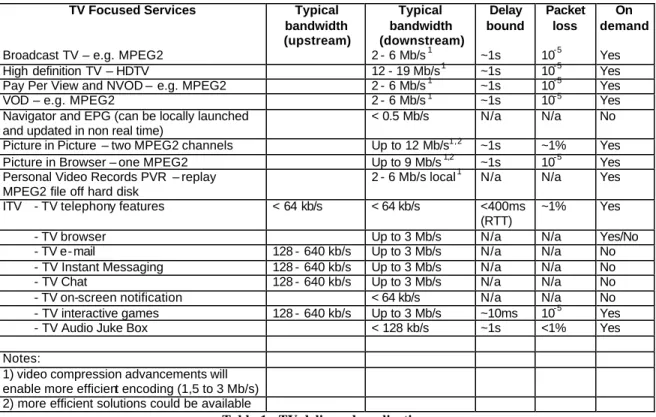
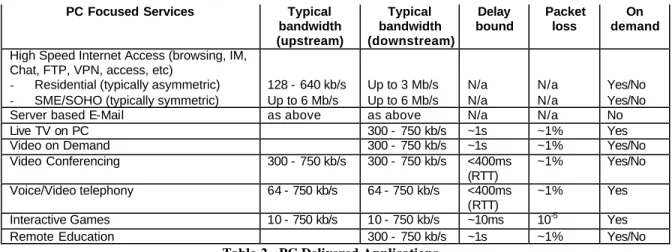
Customer applications, as identified in Table 1 and Table 2, w ill be the main drivers for the type of DSL access, bandwidth limitations, Bandwidth on Demand and the QoS needed to provide these applications. Residential and Business Customers requiring basic Internet access will continue to be provided the Best Effort ADSL service, while enhanced applications, such as video, interactive games, remote education, etc., require ADSL or VDSL service with additional QoS characteristics. SME and SOHO customers with requirements for large file transfers, upstream or downstream, require increased bandwidth or Bandwidth on Demand using either ADSL or SHDSL. Initially, the main devices to which new applications will be delivered are the PC and the Television but it is expected that home networking with broadband access will lead to an increase in the number of connected devices in the customer premises network (e.g. DSL gateway, gaming consoles, set-top boxes, printers, scanners, cameras, web appliances, home automation equipment, etc).
Access providers MAY also require the DSL technology, Bandwidth and QoS as an alternative to provision legacy Private line and Frame access.
TV Focused Services Typical bandwidth (upstream) Typical bandwidth (downstream) Delay bound Packet loss On demand
Broadcast TV – e.g. MPEG2 2 - 6 Mb/s1 ~1s 10-5 Yes
High definition TV – HDTV 12 - 19 Mb/s1 ~1s 10-5 Yes
Pay Per View and NVOD – e.g. MPEG2 2 - 6 Mb/s1 ~1s 10-5 Yes
VOD – e.g. MPEG2 2 - 6 Mb/s1 ~1s 10-5 Yes
Navigator and EPG (can be locally launched and updated in non real time)
< 0.5 Mb/s N/a N/a No
Picture in Picture – two MPEG2 channels Up to 12 Mb/s1,2 ~1s ~1% Yes
Picture in Browser – one MPEG2 Up to 9 Mb/s1,2 ~1s 10-5 Yes
Personal Video Records PVR – replay MPEG2 file off hard disk
2 - 6 Mb/s local1 N/a N/a Yes
ITV - TV telephony features < 64 kb/s < 64 kb/s <400ms
(RTT)
~1% Yes
- TV browser Up to 3 Mb/s N/a N/a Yes/No
- TV e- mail 128 - 640 kb/s Up to 3 Mb/s N/a N/a No
- TV Instant Messaging 128 - 640 kb/s Up to 3 Mb/s N/a N/a No
- TV Chat 128 - 640 kb/s Up to 3 Mb/s N/a N/a No
- TV on-screen notification < 64 kb/s N/a N/a No
- TV interactive games 128 - 640 kb/s Up to 3 Mb/s ~10ms 10-5 Yes
- TV Audio Juke Box < 128 kb/s ~1s <1% Yes
Notes:
1) video compression advancements will enable more efficient encoding (1,5 to 3 Mb/s) 2) more efficient solutions could be available
PC Focused Services Typical bandwidth (upstream) Typical bandwidth (downstream) Delay bound Packet loss On demand
High Speed Internet Access (browsing, IM, Chat, FTP, VPN, access, etc)
- Residential (typically asymmetric)
- SME/SOHO (typically symmetric)
128 - 640 kb/s Up to 6 Mb/s Up to 3 Mb/s Up to 6 Mb/s N/a N/a N/a N/a Yes/No Yes/No
Server based E-Mail as above as above N/a N/a No
Live TV on PC 300 - 750 kb/s ~1s ~1% Yes
Video on Demand 300 - 750 kb/s ~1s ~1% Yes/No
Video Conferencing 300 - 750 kb/s 300 - 750 kb/s <400ms (RTT) ~1% Yes/No Voice/Video telephony 64 - 750 kb/s 64 - 750 kb/s <400ms (RTT) ~1% Yes
Interactive Games 10 - 750 kb/s 10 - 750 kb/s ~10ms 10-5 Yes
Remote Education 300 - 750 kb/s ~1s ~1% Yes/No
Table 2 - PC Delivered Applications
Definition of application – In this text “applications” are those entities listed in Table 1 and Table 2. Applications are service offerings as experienced by the end-user via a device with a user interface (e.g. audio, visual display screen, joystick, remote control) typically located on or near the customer premises.
Definition of service feature - In this text “service features” are the underlying attributes necessary to support applications. These include (but are not limited to): Type of DSL access, Bandwidth on Demand, QoS on Demand, many-to-many access.
For each application, the ideal QoS requirements are given in terms of bounds on delay and packet loss. Some values are shown as orders of magnitude. For example, “~1s” means “order of seconds”. The order of magnitude is sufficient to show the differences in some of the QoS requirements for different applications. For interactive communication services, the delay bound shown is the value as proposed by [G.114]. For each application it is also indicated whether an “on demand” behavior (either Bandwidth on Demand or QoS on Demand) may be beneficial.
The listed applications will drive the adoption of new service features by access network providers, regional network providers, network service providers and application service providers. The introduction of QoS in the network can be done according to two approaches or phases:
- In a first phase, applications are given differentiated traffic treatment, thereby enabling relative QoS differentiation. This approach enables support for new applications in a relatively short timeframe. The levels of QoS offered to applications can either be statically configured, semi-dynamic (i.e. policy based) or “on demand” via Bandwidth on Demand or Relative QoS on Demand.
- A second phase would include the features outlined above, but additionally could provide
guaranteed QoS to those applications for which this is beneficial. This can also be done in either a static fashion or “on demand” via Guaranteed QoS on Demand.
The terms Relative QoS and Guaranteed QoS will be described in more details in section 4.2. The individual service features will be discussed in more details in sections 5.2, 5.4 and 5.5.
4. SERVICE FEATURES REQ UIREMENTS TO SUPPORT APPLICATION EVOLUTI ON 4.1.Service Goals
DSL services have historically been bounded by the limitations specified when the service was first established. Subscribers placed orders for service based on a set speed profile purchased for a fixed amount of money recurring on a monthly basis. As newer applications became available, the typical subscriber may or may not be able to access these new applications depending upon how their initial connection was established, the limitations of the technology, and the availability of these new applications through their existing service provider. Further, if the subscriber desired to modify their service to add more bandwidth, a new service profile had to be put into place or, in the worst case, new equipment is required in the Access Node and a new DSL termination device in the Customer Premise Network (CPN). This type of service change is not a dynamic process. It takes time to place, review, and process these service orders and involved some degree of service downtime before the subscriber was able to benefit from the increased bandwidth. Even with these new services there is no ability to prioritize traffic from different providers or applications.
These marketing requirements require an increase in the number of service configuration parameters available (such as Speed or DSL type) and make these service configuration parameters more
dynamic. Aside from variable dynamic bandwidth, these new requirements include Quality of Service (QoS) and multi-application/multi- destination selection. Service Providers benefit in that they will only need to develop one set of system interfaces for any and all carriers that adopt the resultant architecture. By subscribing to these int erfaces, Service Providers will now be able to develop applications that can take advantage of variable bandwidth and better than “best effort” data traffic delivery and do so in a consistent fashion from one access network to another. Subscribers will be able to realize greater potential of their broadband data connections. This means that a subscriber can still use their Internet access as it exists today; yet additional bandwidth on their DSL line can be used to deliver other applications, potentially even from multiple service providers, such as direct corporate access, video chat and video conferencing, and various content on demand, be it movies, games, software, or time-shifted television programs. Finally, these applications can be given traffic delivery characteristics (i.e. QoS treatment) according to their needs, so that business access, online gaming, and casual Internet access all share bandwidth appropriately. Both subscribers and Service Providers will be able to decide among connections, who provides the best service for a specific application, and what applications add the most value.
4.2.Service Feature Definitions
This document presents a proposal for evolving DSL deployment and interconnection. It will outline a set of requirements for a common methodology for delivering QoS-enabled applications to DSL subscribers from multiple Service Providers. These service features will become the foundation for many new applications and services. These service features and many of the applications using these service features are intended to address the mass market, and do not preclude additional niche or custom services that could be provided using the same infrastructure.Also provided is a set of architectural requirements to support the proposed new service models. Some of the highlights including:
♦ IP-based services and QoS
♦ Distinct network and application control planes interfacing with a common data repository. ♦ The migration of DSL to leverage newer, alternative network transport technologies
The preva lent existing service model, where subscriber connections are delivered in a best effort fashion over ATM PVCs, will continue to exist. However, this service model in its currently deployed form will not be able to support all of the improvements and benef its desired, including IP QoS, Bandwidth on Demand, and nor will service providers be able to utilize newer, alternative transport options for these legacy connections. Therefore, new service models for interconnection are also required. New and emerging service models are expected to provide the benefits as listed.
A new service model is proposed to more efficiently manage scarce IP network address resources. For Service Providers that are more interested in providing their applications (like gaming, content, etc.) rather than a network infrastructure, there will be a common public infrastructure through which addressing and network access mechanisms will be included. Application Service Providers (ASPs) will not need to manage IP addresses, nor authenticate subscriber access to the network, however they will still authorize user access to their applications in conventional ways.
In order to support these new products, the DSL service MUST be more than just a basic transport mechanism.
New architectural requirements will be needed to enable these service features. The following is a list of some of the new capabilities of these service features.
Multi-Service Architecture High Level Service Feature Requirements:
DSL Service Type The ability to provide the customer with a DSL service that suits their needs. This could include existing (ADSL, SHDSL, VDSL) and future DSL technologies. The DSL technologies MUST include a migration framework with minimal impact to the customer.
Bandwidth on Demand: The ability to dynamically change the effective DSL line bandwidth based on the application or destination selected. This service feature permits the subscriber to typically use a lower speed connection for functions like Internet access and to occasionally request a dynamic increase in bandwidth based on application, Service Provider, or even a “Turbo” button. Note that Bandwidth on Demand is not, by itself, used to achieve QoS (i.e. the bandwidth increase is still best effort), but may be combined with other QoS mechanisms.
Quality of Service (QoS) Quality of Service or QoS refers to the nature of the differentiated traffic delivery service provided, as described by parameters such as achieved bandwidth, packet delay, and packet loss rates. Traditionally, the Internet has offered a Best Effort delivery service, with available bandwidth and delay characteristics dependent on instantaneous load.
There are different types of QoS:
Relative QoS: this term is used to refer to a traffic delivery service without absolute bounds on the achieved bandwidth, packet delay or packet loss rates. It is used to handle certain classes of traffic differently from other classes;
Guaranteed QoS: this term is used to refer to a traffic delivery service with certain bounds on some or all of the QoS parameters. These bounds may be hard ones, such as those encountered through such mechanisms as an ATM Call Admission Control (CAC) function or RSVP reservation. Other sets of bounds may be contractual, such as those defined in service
level agreements (SLAs) that often typically define a monetary penalty should a certain threshold be crossed or missed.
NOTE: Within this document (and hopefully all derivative documents), the generic terms “QoS” and “QoS on Demand” will be used to describe the general concept of differentiated traffic delivery implemented by means of traffic parameters, without regard to any specific parameter or bound / guarantee. Wherever possible, the qualifying adjectives “Relative” and “Guaranteed” should, at a minimum, be used when describing the needs of a particular service. Ideally, the full definition of the QoS requirements of an application or service should define the various parameters (priority, delay, jitter, etc), any boundaries and the type of boundaries (engineered or contractual) involved.
QoS on Demand: The ability for individual application sessions to request traffic delivery characteristics according to their perceived needs, and to dynamically change the desired traffic delivery service. This allows the network to treat traffic dissimilarly to and from the subscriber based on specific usage characteristics of the product or service. This will permit high priority guaranteed traffic to take precedence over other traffic destined for a specific subscriber. This may also be used to provide an optimized delivery through the Access Network, and may provide different Qualities of Service to different applications. Specifically, the term “Relative QoS on demand” is used to refer to requests to change the relative traffic delivery service, without requiring specific bounds on delay, loss and throughput.
Many-to-Many Access: The ability for multiple users using a single DSL line to access more than one Service Provider simultaneously. Additional destinations can be corporations or ASPs. As shown in Figure 11, this will permit the subscriber to maintain their current ISP relationship, yet allow other users of the same DSL service to have access to other applications that may not be available over their ISP connection.
Content Distribution: The ability to support content storage (caching) and IP multicasting at the edge of the network to reduce backbone resource requirements. This will permit efficient use of network resources without overtaxing the Service Provider connections or the Core Network.
Network Service Providers will be able to benefit from the aggregation capabilities of these new DSL Access Networks. Specifically, the architecture will also permit:
Traffic Aggregation: The ability to aggregate application-specific traffic together into logical traffic groupings (e.g. L2TP tunnels, MPLS label stacking, MPLS VPN, VLAN tagging, etc) at the V interface, and across the RBN and A10 interfaces, ensuring Layer 2 (L2) and Layer 3 (L3) scalability & efficiency.
Layer 2 traffic aggregation has previously been available by aggregating subscriber VCs into a VP permitting upstream ATM switches to switch VPs instead of individual VCs per subscriber. In the proposed architecture a new IP aware network element is deployed at the edge of the access network. This device can function as an ATM switch and continue to support this type of layer 2 aggregation.
L2TP access concentration (LAC) of PPP sessions provides further scalability benefits by combining many subscriber PPP sessions into one or more L2TP tunnels per service provider. These tunnels can be carried over ATM virtual circuits or over IP regional backbones.
The termination of protocols such as PPPoE and PPP at the edge of the network, in addition to permitting aggregation of traffic will also decrease the overall traffic volumes by reducing the number of protocol layers through conversion of end user traffic into basic IP packets.
Improved Transport: Support higher application & service related traffic volumes over more scalable and effective L2 technologies that could be used at the V interface, across the RBN and at the A10-NSP and A10-ASP interfaces. These include such technologies as 100Mbps and Gigabit Ethernet services and Packet over SONET (POS).
Simpler Provisioning: Traffic that has been aggregated into logical application-specific traffic groupings can reduce the level of per subscriber provisioning.
Additionally, since subscriber traffic is now going through a centralized aggregation system, it should be easier to migrate subscribers from one ISP to another, with little or no downtime.
Differentiated Services: Up until now, almost all DSL transport has been best effort delivery at a fixed rate. To support differentiated treatment for high priority traffic the new architecture MUST support a traffic management methodology that supports both Relative and Guaranteed QoS.
Increased Access: In previous architectures, Service Providers could only reach those subscribers with whom they had a direct relationship. These new architectures permit a subscriber to connect simultaneously to multiple Service Providers for a variety of services. Service Providers no longer need to enter into complex business relationships in order to be the sole provider for all their subscribers’ needs. Likewise, a Service Provider that can offer a unique service no longer needs to go through a costly
acquisition process to become an end user’s sole supplier – it can offer its services to the entire installed based of subscribers.
Standard Connections: Up until now, each access provider has had their own set of interfaces for Service Providers. This proposal defines common interfaces for NSPs and ASPs. This means that the Service Provider need only develop a single interface, using a common suite of protocols and signaling mechanisms, to access all of these service features from many access providers. Also, subscriber connections will be similar among Access Providers, allowing common CPE to be more widely deployed and to permit the end-user to use existing CPE when moving from one access provider to another. Support for these new capabilities requires a new set of network management and billing interfaces. Both Service Providers and Subscribers will use these interfaces. Service Providers will be able to examine the network and see how their subscribers are provisioned. NSPs will also be provided an interface to control and troubleshoot subscriber connections.
Subscribers will be provided mechanisms for requesting these new service features and signaling their specific needs.
These service features will support applications like: ♦ Multicast audio and video media applications ♦ Video on demand applications
♦ Voice services ♦ Interactive gaming ♦ Remote education
♦ Variable bandwidth, both on demand (“Turbo” button) and by application
5. EVOLUTION IMPROVEMENT REQUIREMENTS
Evolution of DSL networks is driven by several factors: a) Business case to deploy/maintain, and b) services support/creation. The rest of this sec tion is dedicated to capturing some of the catalysts for DSL network evolutions.
a. Current generation systems may not have enough capacity to scale to the bandwidth demands of services being researched for the future.
b. Current generation networks/systems may not have the resiliency to offer 5-9s type services. c. Services provided require several systems that each provides a function. The number of
systems required for service is burdensome from a maintenance perspective, and a reduction in the number of elements should reduce management system burden.
d. Current systems / networks may not allow providers enough flexibility to address the services that are being demanded by or created for their customers.
e. Current systems / networks may not adequately address provid ing DSL to all types of access lines that exist in a carriers network.
In general the new service features needed to support applications described in the previous section are driving the evolution towards a new architecture.
• 5.1 More bandwidth
• 5.2 Bandwidth on Demand (dynamic bandwidth) • 5.3 Multi application / multi destination selection • 5.4 QoS support
• 5.5 QoS on demand
• 5.6 User-Service unbundling • 5.7 Service Management • 5.8 Service Level Performance • 5.9 Current DSL Access Technology • 5.10 Security
5.1.More Bandwidth
Due to the continuously rising DSL uptake, the regional broadband network will gradually become more and more loaded with traffic over time. This trend is even more apparent, since the average bandwidth per user also increases, due to a shift towards more bandwidth hungry services. In order to anticipate this evolution, a capacity increase is required across all interfaces in the access and regional broadband network.
On the other hand, a large amount of the newly offered bandwidth hungry services typically have a relatively short- lived session duration. This means that there is no real need to permanently provision the required resources for all users. Instead, by taking statistical multiplexing into account, the network can be dimensioned in a more optimal way and intelligent QoS mechanisms can be used to control the resource usage in the network.
5.2.Bandwidth on Demand
Bandwidth on Demand results in a more or less dynamic behavior of the actual throughput over the DSL access network. This influences the QoS control mechanisms at higher layers, both for pre-configured connections as well as dynamically changing connections.
Bandwidth on Demand MUST be coordinated with static provisioning of permanent guaranteed services (e.g. virtual leased lines) to enable a coherent connection and session admission control scheme. Provisioning of the access line to the maximum sustainable bandwidth is also necessary to insure that the additional bandwidth can be made available on a dynamic basis when requested by applications or end users.
Bandwidth on Demand MUST also be coordinated with the dynamic QoS mechanisms (if present) such that the layer 1 throughput mechanisms are correctly integrated with the higher layer QoS mechanisms (e.g. for session based services). Specifically, in this case, the application driven approach to offer QoS on Demand may be integrated with the application driven approach to offer Bandwidth on Demand.
5.2.1. Use of Line Rates by Connection Access Control (CAC)
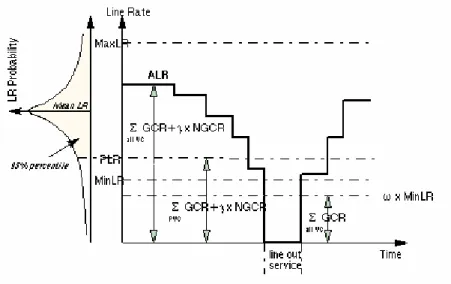
Connection Access Control (or CAC) uses the Minimum, Planned and Actual Line Rates as boundary conditions for traffic management. These rules follow principles that are illustrated in the figure below for the most complex case of an ADSL line with Dynamic Rate Adapt ation. In many instances
operators set a fixed upstream and downstream line rate which is well below the theoretical maximum. In this case a much simpler traffic management scheme exists where the planned line rate (PLR) = actual line rate (ALR). In the figure below GCR means the Guaranteed Cell Rate. This is a general term which means the guaranteed portion of the connection. In case of ATM, the GCR will be the Peak, Minimum or Sustainable Cell Rates depending on the ATM service class. For example GCR is the PCR for CBR, SCR for VBR, MCR for GFR, MDCR for UBR+. The Guaranteed Cell Rate may be generalized to a guaranteed bitrate.
Figure 3 - Line rates, CAC and probability in rate adaptive DSL networks 5.2.1.1.Minimum Line Rate
The MinLR is the line rate that is always guaranteed when there is service. Therefore the Minimum Line Rate is used to bound the guaranteed bit rate. This makes the guaranteed bit rate invulnerable to rate adaptation.
5.2.1.2.Planned Line Rate
The PLR is the line rate that is very likely achieved. Therefore the Planned Line Rate is used to bound the total bit rate for all permanently established connections (e.g. ATM PVCs). The probability that PVCs are affected by rate adaptation is thus very small but not zero. When rate adaptation happens, the non-guaranteed bit rate portion may experience additional loss and a worse jitter.
5.2.1.3.Actual Line Rate
The ALR is the instantaneous line rate. Given the relatively short-term character of dynamically established layer 2 connections (e.g. ATM SVCs), the Actual Line Rate is used to bound the total bit rate for permanent and dynamic connections, if dynamic connections are present. When Dynamic Rate Adaptation happens, the non-guaranteed bit rate portion of the permanent and dynamic connections may experience additional loss and worse jitter. In the case of Rate Adaptation at Start-up, dynamic connections can be released because of line re-initialization. However, the QoS of permanent connections is not affected in this case.
If no dynamic connections are present, provisioning of permanent connections should not normally be restricted by the short-term ALR (which could drop below the PLR); the previous principle is
sufficient in this case.
If dynamic connections are present, they may influ ence the provisioning process of permanent connections: new permanent connections should not hinder the QoS contract of existing dynamic connections (i.e. permanent connections have the same priority as dynamic connections, and this priority is based on the normal mechanisms such as service class).
5.3.Multi application / multi destination selection
There is a need for multiple users to simultaneously access different NSPs and ASPs over a common layer 2 connection. Additional destinations can be other NSPs (e.g. a corporation) or ASPs. This will permit the subscriber to maintain their current ISP relationship, yet allow these users to have access to other applications that may not be available from their current ISP connection. The subscriber should be able to select a new service or destination via a user interface.
Each service provider connection can have a fixed set of service parameters that are implemented at session startup such as bandwidth and default QoS. Each session may also take advantage of dynamic service features such as Bandwidth on Demand and QoS on Demand.
5.4.QoS support
The new architecture MUST support those QoS mechanisms that are needed to achieve the desired perceived service behavior for the customers and their applications. QoS is required for applications that require a stable behavior, i.e. for which an occasionally worse behavior cannot be accepted. In other words, QoS is required for those services where the addition of future services MUST NOT disrupt existing services.
Depending on the perceived service behavior that is to be achieved, one or more QoS features need to be supported in the network. These features include relative QoS, guaranteed QoS, QoS on demand (and related Bandwidth on Demand). The introduction of QoS in the network can be done according to two approaches or phases:
- In a first phase, relative QoS is introduced in the network. Using this feature, applications are given differentiated traffic treatment, which allows some applications to have a better behavior than others. As such, this feature allows to support a number of new applications for which best effort behavior is not sufficient. The levels of QoS offered to applications can either be statically configured or semi-dynamic (i.e. policy based). Additionally, some applications may benefit from an “on demand” behavior. This can be done achieved by supporting Bandwidth on Demand and/or Relative QoS on Demand. This approach also permits QoS to be offered without implementing complex signaling and reservations protocols across disparate equipment
- A second phase offers the features outlined above, but additionally provides guaranteed QoS to those applications for which this is beneficial. This allows differentiated traffic treatment and ensures that the QoS requirements of those applications are met. The levels of QoS can be provided in a static fashion, or “on demand”. The latter would be done via Guaranteed QoS on Demand.
Achieving end-to- end Guaranteed QoS requires the appropriate mechanisms to be in place in each of the involved networks, i.e. the access network, the Regional Broadband Network (RBN) and the core. These mechanisms may include request or reservation schemes to dynamically support technical guarantees, or simply data collection algorithms that can be coupled with reporting tools to provide measurements as to whether a contractual guarantee has been met. Clearly, in this model, the end-to-end QoS problem is only as strong as the weakest link.
Relative QoS can be used for applications that can cope with an occasionally degraded perceived service behavior or where there is a conscious decision on the part of the end user to overbook the available bandwidth of their connection. Relative QoS allows the network to give certain classes of traffic a relatively better/worse traffic delivery service than other classes. This can also be beneficial for applications that require a stable behavior, as outlined above.
The network MUST support static provisioning of permanent (very long duration) services and dynamic provisioning of services with finite session times (e.g. gaming, Video on Demand). To deliver the new dynamic service provisioning should be done in a manner which avoids adversely impacting the existing network, and which minimizes the burden on the management system. Dynamic service provisioning should be sufficiently fast to achieve smooth service activation and deactivation.
To date most DSLAMs still carry residential Internet access (UBR) as the main traffic type and (still) remain lightly loaded. New services such as Business Internet Access, VPN (Various types), and Video services are increasingly being deployed. Both require the appropriate mechanisms to be in place such that each customer gets the desired QoS behavior for the entire duration of its service( s). Since QoS (other than best effort) can be defined part of a new session start-up, and the subscriber line can carry multiple sessions, it is important that there be a feedback mechanism in place to confirm that there is sufficient bandwidth available for delivery of all QoS enhanced traffic. For some QoS levels, this can be an offshoot of an integral CAC mechanism. For other QoS “flavors”, the network control mechanisms should be able determine if the requested services exceed the capacity of the access line and inform the requestor if the requested service can be delivered as expected.
5.4.1. QoS differentiation between business and residential customers
Business customers typically require higher QoS guarantees than residential subscribers. Part of the bandwidth offered to business customers may as such be constantly available in the network, and cannot be overbooked for other customers. This can be regarded as an “always on” virtual leased line service.
On the other hand, business customer may also benefit from a best effort service, in which case its traffic will be pooled with the residential best effort traffic in network. This allows efficient use of network resources but also requires the appropriate fairness mechanism to be built in to make correct differentiation between business and residential customers. One way of doing this is to still assign a minimal guaranteed bandwidth to the best effort connection of business customers. This ensures that at times of congestion, they will still experience the m inimal bandwidth and as such have a better QoS than residential customers. However, this method has the disadvantage that this guaranteed portion of the bandwidth cannot be overbooked and as such the network may run out resources to offer even this minimal guaranteed bandwidth to a large number of customers.
Another mechanism to ensure appropriate fairness is to make sure that, at times of congestion, traffic is being discarded in an intelligent way. In other words, customers requiring a higher QoS for their best effort connection should experience a smaller packet/cell loss than other customers. This in turn means that at times of congestion, the average throughput for these customers will be better than that for customers with a lower QoS.
Intelligent traffic discard mechanisms should work in combination with fair scheduling techniques such as weighted fair queuing (WFQ) or weighted round robin (WRR). This ensures that customers with the same level of QoS will get their even share of the available remaining bandwidth.
5.5.QoS on demand
Certain types of services (e.g. Video on Demand) require high guaranteed bandwidth for a reasonably short and finite period of time. These services are bandwidth hungry and if bandwidth was
permanently reserved and guaranteed for every user or potential user of a given service, then the network would need to be over dimensioned several times. An alternative to over dimensioning a network to ensure Guaranteed QoS is to build in a dynamic QoS capability in the network.
To offer Guaranteed QoS on Demand requires additional intelligence capability in the network, which enables dynamic allocation of resources for the service at the time the service is requested, and to release these resources at the time the service is terminated. This means that in some point(s) in the network, resource admission control functionality needs to be present. Although this makes the network more complex, it avoids the static over -provisioning of guaranteed traffic and efficiently uses existing network resources. Dynamic allocation of network resources is necessary if efficient resource usage is to be achieved across a Guaranteed QoS enabled access and regional broadband network. Other services don’t require Guaranteed QoS but could still benefit from a temporary enhancement of the relative service behavior (e.g. temporarily moving from bronze to gold subscription profile for a specific service). This may also be performed by means of QoS on Demand, albeit for Relative QoS. This also requires additional intelligence capability in the network, which will dynamically
reconfigure some QoS settings for the requestor and will return to the original configuration once the Relative QoS service is terminated. To some extent, this can be compared to the Bandwidth on Demand feature used to increase the best effort throughput on a DSL line.
Like the basic QoS service feature, attempts to change the QoS for a given service on demand need to also check the subscriber line and see if this change can be implemented without degrading other services. If so, then a feedback mechanism must be in place to inform the requestor about the potential service impact.
5.6.User-service unbundling
Today a number of different types of DSL unbundling exist. The most common types are copper (PHY layer) and ATM PVC L2 unbundling. This new architecture should be capable of quickly enabling new services and applications. To do this unbundling to application service providers requires a new user-service approach to unbundling at the A10-ASP interface. It is envisioned that the ASP environment will have user-level rather than network-access-level identification. To enable user level identification the ASP may interface with a common repository hosted by the Regional/Access Network Provider, providing user identification, line characteristics, and subscriber preferences. 5.7.Service Management
Service Management is defined as the set of mechanisms for provisioning new subscribers and service providers, controlling network feature delivery, advertising new services and applications and
collecting the application data necessary to generate billings. These mechanisms need to interface with a well- defined data repository. In addition to standard protocols used within the network to facilitate feature delivery, a set of end user signaling protocols are needed to permit subscribers and service providers to request network features and resources.
The architecture proposed in this document clearly needs management and control systems to configure the underlying network service features or “building blocks”.
To support new services and their underlying service features requires a new set of network management and control interfaces. In this working text, we use the term “network management” when talking about the pro visioning of services, which typically happens at a relatively long time-scale. “Network control” refers to a real-time capability of the network to react to specific service requests. ASPs, NSP, and subscribers will all use these network control interfaces. Application Service Providers will be able to use these interfaces to agree on service levels offered by the Regional/Access Network providers. Network Service Providers will be able to examine the network and see how their subscribers are provisioned. NSPs will also be provided an interface to control and troubleshoot subscriber connections. Subscribers will use these interfaces to invoke new service features such as Bandwidth on Demand and Multi Application access. In all cases, appropriate billing rec ords will need to be created for a wide variety of service features and services usage. These billing records will need to be created for static as well as dynamic usages.
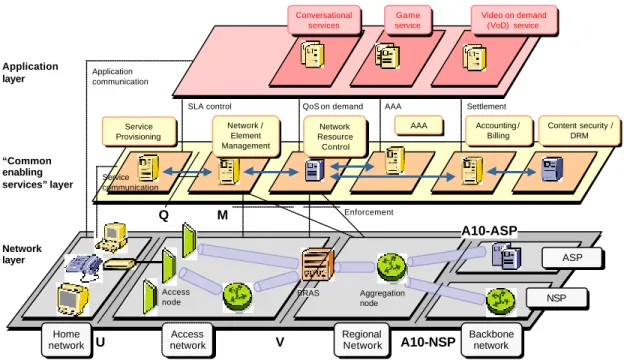
A “three-layer logical/functional architecture” can be used as the base architecture to support the delivery of advanced QoS-enabled services. This approach is sufficiently generic to support a wide range of advanced services. In Figure 4 the three-layer logical architecture for support of services such as media-on- demand or conversational services is shown. It identifies the following layers:
- The network layer: This layer has to support predictability, reliability and QoS enforcement. The capabilities required from the Regional/Access Network Provider to support these features are described throughout section 5. To date, most DSL network diagrams, such as those referenced by [TR-025], show four (4) different providers. These include the Loop Provider, the Access
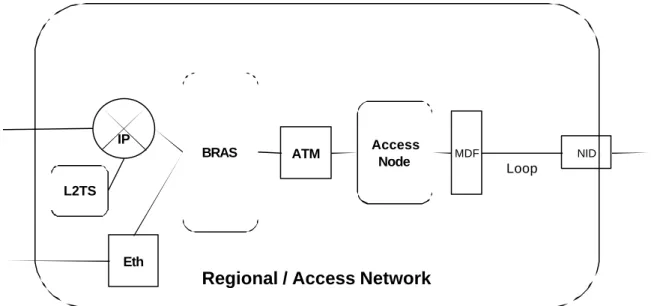
Network Provider, the Regional Broadband Network Provider, and the Network (or Application) Service Provider. In this framework described in this document, the Regional and Access Network Providers are believed to be services offered by the same entity. Because of this blurring of the Access and Regional Broadband Networks, this document will now refer to this conglomeration as the Regional / Access Network Provider. As shown in Figure 4, the BRAS is positioned between the Access Network and the Regional Network. Furthermore, it may be beneficial to implement the BRAS as close to the access nodes as possible. In that case there is little or no intervening aggregation between the access nodes (DSLAM or RT) and the BRAS.
- The “common enabling services” layer: This layer provides a set of “common enabling services” that can be used by or shared among various applications and/or ASPs. Some of these services may be linked to the Regional/Access Network Provider (and to be provided by them in a mandatory way), while others may be provided by the NSP or ASP, depending on the business model chosen. The services are represented as “logical functional blocks” in Figure 4, without specifying how or where these services are implemented. Various network elements may be used to implement any or all of these services, depending on the specific instantiation of the three- layer architecture. It is at this layer that the common data repository used by the network and application control planes will be found.
- The application layer: This layer interacts with the “common enabling services” layer. For example, for conversational services, this layer could be implemented through a SIP server, while for media-on-demand one could implement a video-on-demand portal. Subscribers will directly interact with the application layer through a number of different protocols. Typically, only the ASP is assumed to be aware of the application- layer interaction.
Home network Home network Access node BRAS Regional Network Regional
Network Backbonenetwork Backbone network ASP ASP NSP NSP Network Resource Control Network Resource Control Network / Element Management Network / Element Management AAA AAA Accounting / Billing Accounting / Billing Service Provisioning Service Provisioning Video on demand (VoD) service Video on demand (VoD) service Conversational services Conversational
services serviceGame
Game service Application layer Content security / DRM Content security / DRM “Common enabling services” layer Network layer M Q Settlement QoS on demand V U Application communication AAA SLA control Service communication Aggregation node A10-NSP A10-ASP Access network Access network Enforcement
Figure 4 - Three-layer logical/functional architecture for support of advanced services The three- layer architecture is a logical architecture, showing the mandatory and optional functions present in each layer of the architecture for advanced QoS-enabled services delivery. The architecture does not mandate that the implementation of any of these functions must be done in any specific network element in the actual network instantiation.
In the following paragraphs, the common enabling services are further discussed from the point of view of the Regional/Access Network Provider; some of these services are mandatory, while others are optional:
5.7.1. Mandatory “common enabling services” for the Regional/Access Network Provider - Network and element management: This is an essential service in order to provision and
monitor the network. Usually within this realm, the operator may define and provision different classes of traffic that will be available to interconnect subscribers to NSPs and ASPs.
Additionally, QoS monitoring and SLA verification can be expected to become even more important.
- Network Resource Control (NRC): This is an essential service in order to be able to set policy rules for traffic coming from different ASPs (which in turn allows for enforcement of the business model) and to avoid conflicts in traffic going to and coming from subscribers in a generally bandwidth-constrained environment. Network Resource Control allows support for Bandwidth and/or QoS on Demand. The requests for bandwidth usage can come from multiple sources, e.g. the application layer provided by the ASP, or the subscriber.
- Accounting/Billing: Network Resource Control is an active part of the business enforcement process and therefore likely linked to an accounting system that will keep track of the ASP’s and/or subscriber’s network usage, both from a static (provisioned) and dynamic (“on demand”) point of view. It is expected that some services will be offered for a fixed fee, no matter how long the service duration or how many times the service is used in a month (or other fixed timeframe), while other services will be charged on a “per hour” or “per usage” basis. The Accounting / Billing system needs to be capable of capturing and reporting all these events.
- Common Data Model: Managing the service includes keeping track of the parameters associated with subscribers and service providers. This can be done by means of a common data model, stored in a data repository. This is a shared resource, controlled by the Regional/Access Network Provider, and accessed by ASPs, NSPs, and end users. It will contain control values used by the all these entities when offering value added services. For example, the end user’s maximum
sustainable line rate will be stored here and can be used to permit access to high bandwidth applications. If the end user’s DSL line is not capable of a sustained bandwidth of 1Mbps, it makes no sense to permit the end user to order a streaming movie that requires 1.5Mbps.
Likewise, if there are contractual relationships with one service provider that prohibit an end user from accessing certain other service providers, this will also be tracked in the data repository. Please see the text in section 5.7.3 for more examples of the types of data expected to reside in the data repository.
5.7.2. Optional “common enabling services” for the Regional/Access Network Provider The following (non- exhaustive) list of services could be provided through either the network provider(s) or the ASPs. The implementation of these services on a given access network could obviously be different for different applications and/or ASPs:
- Service provisioning: At this level, the detailed service mix that an end user is subscribed to, will be provisioned. The end user can remain with best-effort service or can choose to upgrade the service package, which then will have to be reflected at the network layer. This service does not relate to application-specific service configurations but will rather make sure that there is an infrastructure that allows for easy flow-through network and element provisioning in line with the end user requirements.
- Authentication, Authorization, and Accounting (AAA): Conceptually similar to AAA used for high-speed Internet access today, but some changes may be needed due to the introduction of QoS-enabled services. Given that many ASPs don’t want or need to support IP addressing, the Regional Backbone or Network Access Provider will need to create the infrastructure to provide basic network connectivity, including network authentication and IP address assignment and administration.
- Accounting and billing: The network provider could either be accounting for the usage that ASPs are making of its infrastructure (e.g. volume based accounting) or do the billing function on behalf of some of the ASPs (e.g. content-based accounting and billing) that do not wish to engage in that process;
- Digital Asset Management: The network provider could choose to include content distribution nodes (e.g. for audio and/or video) in its network and may require to actively manage the content over these nodes;
- Content integrity and security and Digital Rights Management: This service makes sure that the content is delivered in a secure way to the end user in an acceptable way for the content owners.
- Service Level Management: The data collection portion of an overall service level agreement system is located at this layer. It is this data, coupled with reporting and billing mechanisms that could be used to document network performance in relation to contractual guarantees.
It is currently unsure what level of optional services network providers will commonly implement in the near future. Moreover, various ASPs may have different strategies in teaming up with network providers. Nevertheless, a number of mandatory services are tied to the network provider regardless of the business model. The most realistic approach consists in focusing initially on these services, that a network provider has to bring to deliver the QoS -enabled services. Without any doubt, the
differentiation and enforcement of the new QoS -enabled services brings some new challenges; specifically, the Network Resource Control service is the crucial piece to cater to the different applications and/or ASPs and to inform the accounting proces s if required.
If we split the “common enabling services” layer into its mandatory and optional constituents, we can easily map a few common business models encountered today:
- The Access/Regional Network Provider limits itself to the mandatory services only (element and network management and network resource control). In this case, the ASPs will deliver all optional services described above. We assume that the Network Provider offers either L2 (e.g. ATM), PPP or IP wholesale. Therefore, the AAA server may or may not belong to the Network Provider.
- The Network Provider controls the service delivery, but still some other ASPs can be connected to this service delivery platform. This is the typical deployment in some “walled-garden” multimedia delivery projects.
- Ultimately, the goal of this architecture is to enable an Access/Regional Network Provider to deploy a flexible mix of the enabling services. This mix can be different depending on the application considered and therefore, this framework should ultimately be open to accommodate different business models applicable to different ASPs.
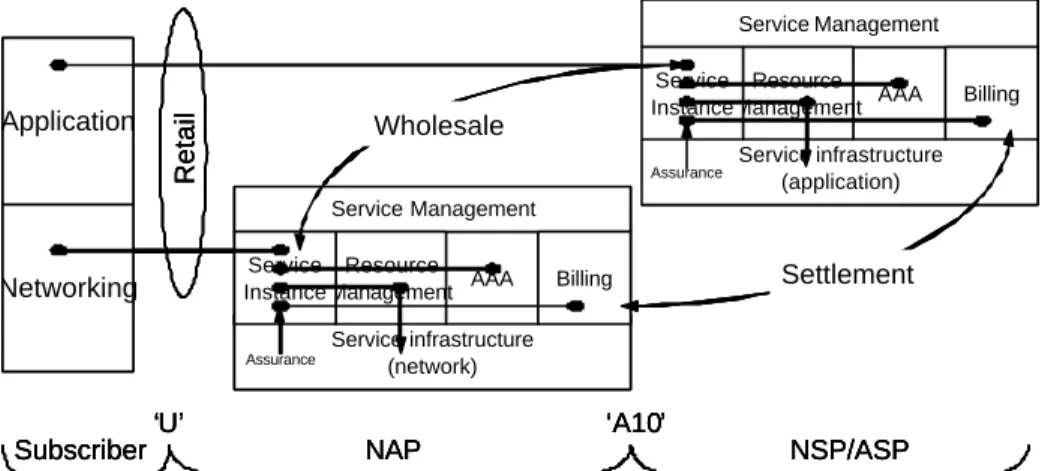
Many of the functionalities required (AAA, billing, resource management) are replicated in each business entity or exist in multiple layers in the architecture and in the supp ly chain suggesting that an element of recursion may be necessary when a service is requested. An abstract representation of this is shown in the following diagram:
Application Networking Service infrastructure (application) AAA Service Management Billing Resource Management Retail Service Instance Service infrastructure (network) AAA Service Management Billing Resource Management Service Instance Settlement Wholesale Subscriber ‘U’ ‘A10’ NAP NSP/ASP Assurance Assurance Application Networking Service infrastructure (application) AAA Service Management Billing Resource Management Retail Service Instance Service infrastructure (network) AAA Service Management Billing Resource Management Service Instance Settlement Wholesale Subscriber ‘U’ ‘A10’ NAP NSP/ASP Application Networking Service infrastructure (application) AAA Service Management Billing Resource Management Retail Service Instance Service infrastructure (network) AAA Service Management Billing Resource Management Service Instance Settlement Wholesale Subscriber ‘U’ ‘A10’ NAP NSP/ASP Assurance Assurance
Figure 5 - Service Management Relationships
As the diagram above illustrates, there may be multiple entry points into the supply chain depending on the services that each entity offers. There is can be a retail relationship between the subscriber and the Network Provider. Likewise, the retail relationship may be between the subscriber and the Service Provider, with a corresponding wholesale relationship between the Service Provider and the Network Provider.
This triggers a number of actions (some of which may be null functions). • The service request is authenticated and authorized.
• Resources to provide the service are allocated. The resource allocation process may recurs as the service entity obtains services from subsidiary entities in the supply chain. This is especially true when the subscriber requests a service from the Service Provider who, in turn, needs to issue a complementary request to the Network Provider.
• Service assurance information is collected from the service infrastructure, and subsidiary service entities.
• Billing information is logged for future billing and settlement.
Understanding how each service entity in the food chain will have common functional requirements for interactions for both initial service invocation, service assurance and billing and settlement will guide the evolution of the requisite interfaces.
5.7.3. End to end service provisioning 5.7.3.1.Definition of Service
♦ DSL services (ADSL, SHDSL, VDSL)
♦ Service speeds ♦ Usage caps 5.7.3.2.Subscribers
Because of the changes in how DSL is provisioned and managed, there are a number of new data points that MUST be tracked for each subscriber. Among these are:
♦ Maximum sustainable subscriber bandwidth ♦ Maximum number of sessions allowed ♦ Permitted destinations
♦ Default protocol ♦ Default destination ♦ Default bandwidth
♦ Single host or subnet needed
♦ Restricted subscriber (single destination only) ♦ Total reserved bandwidth
5.7.3.3.Service Providers
Because of the changes in how DSL is provisioned and managed, there are more details needed per Service Provider. When various choices listed for an option, these are to be considered as examples only and not a definitive list of the choices for a given option.
♦ Minimum bandwidth needed
♦ Minimum QoS characteristics ♦ Various protocol metrics