Volume 25
Number 3 - Fall 1992 Number 3 - Fall 1992
Article 7
October 1992
Control of Aphids on Spring Oats and Winter Wheat With Slow
Control of Aphids on Spring Oats and Winter Wheat With Slow
Release Granular Systemic Insecticides
Release Granular Systemic Insecticides
Jaime E. Araya
Purdue University
Sue E. Cambron
Purdue University
Follow this and additional works at: https://scholar.valpo.edu/tgle Part of the Entomology Commons
Recommended Citation
Recommended Citation
Araya, Jaime E. and Cambron, Sue E. 1992. "Control of Aphids on Spring Oats and Winter Wheat With Slow Release Granular Systemic Insecticides," The Great Lakes Entomologist, vol 25 (3)
Available at: https://scholar.valpo.edu/tgle/vol25/iss3/7
This Peer-Review Article is brought to you for free and open access by the Department of Biology at ValpoScholar. It has been accepted for inclusion in The Great Lakes Entomologist by an authorized administrator of ValpoScholar. For more information, please contact a ValpoScholar staff member at [email protected].
1992 THE GREAT LAKES ENTOMOlOGIST 223
CONTROL OF APHIDS ON SPRING OATS AND WINTER WHEAT WITH SLOW RELEASE GRANULAR SYSTEMIC INSECTICIDESl
Jaime E. Araya2 and Sue E. Cambron3
ABSTRACT
Aphid infestations (Homoptera: Aphididae) on spring oat (Avena sativa) cv. 'Ogle', and during the fall on winter wheat (Triticum aestivum) cv. 'Clark', composed mainly of Rhopalosiphum padi and Macrosiphum avenae, were
reduced with applications at the 2-3 lations of acephate, carbofuran, and disulfoton, compared with carbofuran leaf stage of slow release granular formu 15G and
untreated controls, in field trials during 1990-1991 in northwestern Indiana. These field results corroborated those obtained by previous studies with the same formulations and dosages in the
laboratory.
In
oat, all insecticide treatments reduced aphid populations and percent age
aphid~infested
plants, with a residual action of ca.
25 d. Barley yellow dwarf virus-like visual symptoms were reduced with disulfoton.
In winter
wheat,
the
residual action of all insecticide treatments in
the fall lasted up
to 19
d. The carbofuran treatment on winter wheat seedlings caused earthworms
to move
out
of the soil, where they died; an effect
requirin~ further study. Percentage of aphid-infested plants revealed relatively
Wlder differences among
tratments than
total number of aphids in both
test crops. Predation
by Coleomegilla maculata (Coleoptera: Coccinellidae) contributed to the overall
reduction of spring populations of cereal aphids in wheat and oat. Aphid
mummies parasitized by
micro-hymenopterans were common in oat
plants.
Cereal aphids (Homoptera: Aphididae), specifically
the bird cherry-oat aphid,
Rhopalosiphum padi (L.), and English grain aphid, Macrosiphum (S#o bion) avenae (F.), are important pests of small grains (Rabbinge and Rijsdijk 1984, Araya et al. 1986). They damage plants direct feeding on phloem by sap and are vectors of
plant
viruses (Hinz et
al. 1979), most importantly barley yellow dwarf virus
(BYDV)
(Bruehl 1961, Stern 1967, Kolbe 1973). Severe losses due
to
BYDV infection have been reported (Caldwell
et al. 1959,
Tothman
et
al. 1959, Palmer and Sill 1966, Gill 1980, Carrigan
et al. 1981).
Damage may
be
severe when winged migrants colonize winter wheat in
the fall
(Endo and Brown 1963)
or
in early spring (Arretz and Araya
1978). Economic infestations of cereal aphids can be controlled easily with
foli age sprays of various insecticides. Araya
et al. (1990a) summarized
that the
lPurdue Univ. Agr. Exp. Stn. Journal Paper No. 13,121.
2Research Associate, Small Grain Insects and Weed Control Research Unit, USDA· ARS, Department of Lafayette, Entomology, Purdue University, W. IN 47907. Current address: Facultad de Ciencias Agrarias y Forestales, Universidad de Chile, Casilla 1004,
Santr,go, Chile.
Research Assistant, Department of Entomology, Purdue University, W. Lafay· ette,
224 THE GREAT LAKES ENTOMOLOGIST Vol. 25, No.3
most important advantages of using granular formulations of systemic insec ticides applied to the
soil, compared with foliage sprays, are the protection of
natural enemies of aphids and
the
reduced exposure of toxicants and effective placement of formulated chemicals
to control
the target pest.
Acephate, carbofuran, and disulfoton were selected for
this study because
of their acceptability
and
wide solubility in water (Oetting
et aI. 1984).
Acephate has low toxicity
to
non-target organisms, including diverse hyme nopteran parasitoids (Fitzpatrick
et aI. 1978, Lange et aI. 1980, Flanders et a.
1984, Hsieh and Allen 1986)
and
predators (Whalon and Elsner 1982). Acephate residues decline rapidly in
plants (Frank et aI. 1984) and even faster in the soil (Szeto et aI. 1979, Yamazaki et aI.
1982). Soil applcations of granular carbofuran and disulfoton have systemically controlled cereal aphids (DePew 1974, van
Rensburget
aI.1978, Arretz and
Araya 1978,1980,
Mizeet aI. 1980,
Araya et aI.
1990b). Insect predators are spared with soil incorporated carbo furan (e.g. Gholson
et aI.
1978, Semtner 1979, Edwards
et aI. 1980), while
spray residues of carbofuran are highly toxic
to parasitoids (Dumbre and Hower 1977).
Our research studied
the
effects of
the
slow release granular formulations of systemic insecticides tested in the laboratory by Araya et aI. (1990a, 1990b)
on cereal aphids on spring
oat (Avena sativa), and winter wheat (Triticum
aestivum) under field conditions in northwestern Indiana.
MATERIALS AND METHODS
Field trials using spring oat
and winter wheat, both
at the Purdue Univer
sity
Agronomy Farm, located northwest of West Lafayette, Tippecanoe Co., Indiana, were conducted during 1990-1991.
I. Spring oat.
The insecticide
treatments
listed (formulation, concentration, and g/plot) were applied on 8 May 1990, on
2-3 leaf stage 'Ogle' spring oat seedlings (growth stage 1-2
of Feekes scale [Large 1954]) with 23% of
the plants infested (mean: 3 aphids/100 plants), using 0.5 x
1 m plots (0.5
m 2
) and 5
replicates. All dosages were adjusted to lOG. The description, preparation and effectiveness of these formulations standard of 10 kg/ha of carbofuran a have been described
by Araya et aI. (1990a, 1990b), Shasha et aI. (1984),and Win~ et aI (1987),
respectively. The granular insecticide
treatments
were applied
by hand
with a 0.5 I plastic cylindrical container. Granular clay was used
as
inert carrier
to
facilitate an even distribution of
the formulation over the respective plots. t1. Acephate ps (pearl starch granules; 10.1 %; 0.495 g). t2. Acephate cf
(corn flour granules; 9.7%; 0.516
g). t3. Carbofuran ps (pearl starch granules; 8.1 %; 0.618 g). t4. Carbofuran cf
(corn flour granules; 8.3%; 0.603
g). t5. Carbofuran (15G; 0.334 g). t6. Disulfoton ps (pearl starch ganules; 2.7%; 1.853 g).
t7. Disulfoton (wax granules; 12.9%; 0.338
g).
1992 THE GREAT LAKES ENTOMOLOGIST 225
II. Winter wheat. In the
winter wheat test, the
cv. Clark and 0.75 x
1 m plots were used; 2
leaf seedlings (growth stage
1 of Feekes
scale [Large 1954]) on 2 were treated
Nov. 1990. Treatment No.6 (t6: disulfoton) was applied (0.938 at 8% AI gl
plot); all the
other treatments were the same as in the spring oat test.
Periodic counts of cereal aphids and percentage aphid-infested
plants in
the test plots were recorded in
both tests
when aphids were present
in the field. Results were analyzed statistically using single factor ANOVAs with
repeated measures (percentage
data
were previously normalized with the
In(l+x)
transformation); significantly different (PsO.05) means were sepa
rated using Fisher's
PLSD tests
(Statview
512+T'Statistkal Software, Aba
cus Concepts, Inc. 1986).
RESULTS AND DISCUSSION
Both R. padi and M avenae were commonly found. Bird cherry-oat aphids were usually more abundant
late in the
fall and early in the spring
than English grain aphids, revealing a probable
better
adaptation to cooler temper
atures of the former species;
the later was more abundant later in spring, and was concentrated, but was not
exclusively on the heads of
maturing plants. A
few greenbugs,
Schizaphis graminum Rondani, were found in late spring, as
this species 1983). may better to adapted warmer temperatures (Araya be et al.
I.
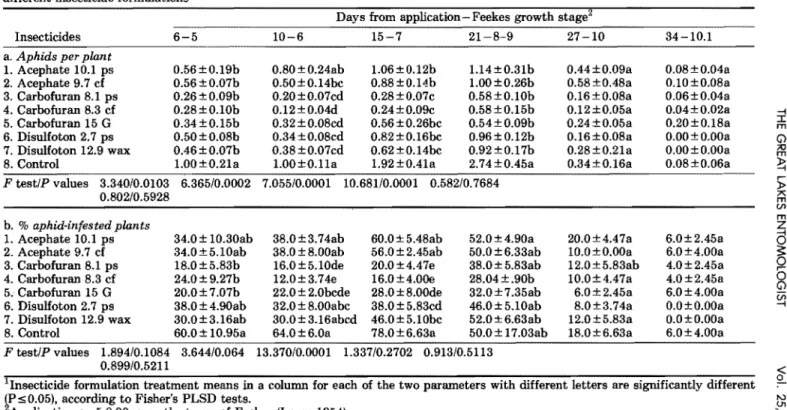
Spring oat. All insecticide treatments
reduced significantly (PsO.05) aphid popula tions and the percentage of aphid-infested oat plants (Table 1), with resldual action lasting ca.
25
days. Rain 1
d after application may have accelerated the incorporation of the active ingredients (AI) in effects were noticed soil, so insecticide the the
at the
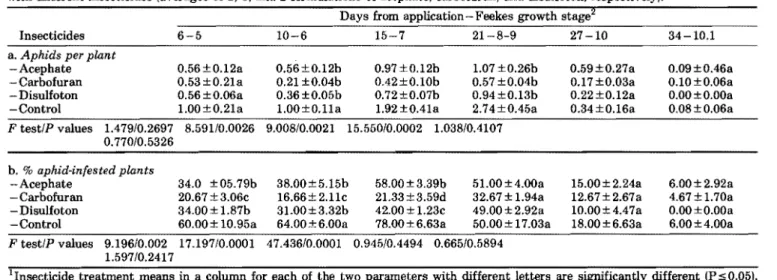
first aphid count, 6 days after applicaton. When the effects of the insecticide treatments were averaged by AI to visualize the average effect of the AI (Table 2), carbofuran ((t3+t4+t5)/3 = average of three formulations] offered the best
protection, followed by
disulfoton and
acephate [averages of two formulations each: (t7
+t8)/2 and (tl+t2/2), respectively]. On 4 June 1990 (27
days after application), some
plants at the
growth
stage 10
(booting) of
the
growth scale of Feekes (Large 1954) exhibited barley yellow dwarf virus (BYDV)-like symptoms. An ANOVA showed
that both formulations of disulfoton presented less
plants
with these symptoms
than the other treatments (Table 3). Thus, disulfoton may
have prevented BYDV infection.
It
is unclear, however, whether these visual symptoms
may
have been caused
by
plant infection with BYDV alone or in conjunction with one or more small grain viruses. Further tests are required. Observations of natural
enemies of aphids, including counts of aphids wih mycelia of
Enthomophthora, mummified aphids, and the different stages of the
ladybird beetle, Coleomegilla maculata DeGeer, are presented on Table 4.
Counts of dead aphids covered with Enthomophthora are not quantitative
because and
unknown number of these infected aphids fall to the ground. They provide, however, an indication of
the period when this beneficial control agent was detrimental to cereal aphids. Aphid mummies parasitized
by
microhymenopterans were common in
the oat
test, from plant growth
stages
6
through
'"
Table 1. - mean percentage plant, Mean number aphid·infested of aphids with ± S.E. in field per and of spring oat plants plots treated
'"
0different insecticide formulations l
Days from application - Feekes growth stage2
Insecticides 6-5 10-6 15-7 21-8-9 27-10 34-10.1
a. Aphids per plant
1. Acephate 10.1 ps 0.56±0.19b 0.80±0.24ab 1.06±0.12b 1.14±0.31b 0.44±0.09a 0.08±0.04a 2.
Acephate 9.7
cf 0.56±0.07b 0.50±0.14bc 0.88 ±O.14b 1.00 ±0.26b 0.58±0.48a 0.10±0.08a 3.
Carbofuran 8.1 ps 0.26±0.09b 0.20±0.07cd 4. Carhofuran 8.3 0.28±0.07c 0.58±0.10b 0.16±0.08a 0.06±0.04a
cf 0.28±0.10b 0.12±0.04d 0.24±0.09c 0.58±0.15b 0.12±0.05a 0.04±0.02a -t 5. Carhofuran 15 G
0.34±0.15b 0.32±0.08cd 0.56±0.26bc 0.54±0.09b 0.24±0.05a 0.20±0.18a :J: m
6. Disulfoton 2.7 ps 0.50±0.08b 0.34±0.08cd 0.82±0.16bc 0.96±0.12b 0.16±0.08a O.OO±O.OOa G)
7. Disulfoton 12.9 wax 0.46 ± 0.07b 0.38±0.07cd 0.62±0.14bc 0.92±0.17b 0.28±0.21a O.OO±O.OOa i'O
m
8. Control 1.00±0.21a 1.00±0.lla 1.92±0.41a 2.74±0.45a 0.34±0.16a 0.08±0.06a ~
F testJP values 3.340/0.0103 6.365/0.0002 7.055/0.0001 10.681/0.0001 0.582/0.7684
~
0.802/0.5928
m(fl
m
b. % aphid-infested plants
1. Acephate 10.1 ps 34.0 ± 10.30ab 38.0±3.74ab 60.0±5.48ab 52.0±4.90a 20.0±4.47a 6.0±2.45a
Z
o
2. Acephate 9.7 cf 34.0±5.10ab 38.0 ± 8.00ab 56.0 ± 2.45ab 50.0 ± 6.33ab 1O.0±0.00a 6.0±4.00a 3. Carhofuran 8.1 ps 18.0 ± 5.83b 4. Carbofuran 8.3 cf 24.0 ± 9.27b 16.0 ± 5. lOde 20.0±4.47e 38.0±5.83ab 12.0±3.74e 16.0±4.0Oe 28.04±.90b 12.0 ± 5.83ab 10.0±4.47a 4.0±2.45a 4.0±2.45a
~
5. Carbofuran 15 G 20.0±7.07b22.0 ± 2.0bcde 28.0 ± 8.0Ode 32.0 ± 7.35ab
6.0±2.45a 6.0±4.00a 6.
Disulfoton 2.7
ps 38.0±4.90ab
32.0±8.00abc 38.0±5.83cd
46.0±5.lOab 8.0±3.74a O.O±O.OOa ~ 7.
Disulfoton 12.9 wax
30.0±3.16ab 30.0±3.16abcd 46.0±5.10bc
52.0±6.63ab 12.0±5.83a O.O±O.OOa 8.
Control 6O.0±10.95a
64.0±6.0a 78.0±6.63a 50.0±17.03ab 18.0±6.63a 6.0±4.00a
F testlP values 1.894/0.1084 3.644/0.064 13.370/0.0001 1.337/0.2702 0.913/0.5113 0.899/0.5211
~
lInsecticide formulation treatment means ina column for each of
the two parameters with different letters are significantly different IrSO.05), according to Fisher's PLSD tests. !J1
'"
Application on 5.8.90;
growth stages of Feekes (Large 1954). 3F test and P values for treatmentswere obtained from single factor ANOVAS
with repeated measures (Statview
512+"'Statistical P z
IV
:8
Table 2.-Average number of aphids per plant, and average percentage of aphid-infested spring oat plants ±S.E. in field plots treated
with different insecticides (averages of 2,
3, and 2 formulations of acephate, carbofuran, and disulfoton. respectively). Days
from application - Fookes growth stage:! Insecticides
6-5 10-6 15-7 21-8-9 27-10 34-10.1
a. Aphids per plant
-Acephate 0.56±0.12a 0.56±0.12b 0.97 ±0.12b 1.07 ±0.26b 0.59±0.27a 0.09±0,46a - l I m -Carbofuran 0.53±0.21a 0.21 ±0.04b 0.42±0.10b 0.57 ±0.04b 0.17±0.03a 0.10±0.06a Q
- Disulfoton 0.56±0.06a 0.36±0.05b 0.00 ± 0.72±0.07b 0.94±0.13b 0.22±0.12a O.OOa ;0
-Control LOO±0.21a 1.00±0.Ua 1.92±0,41a 2.74±0,45a 0.34±0.16a 0.08 ± 0.06a
~
F test/P values 1.479/0.2697 8.59110.0026 9.00810.0021 15.550/0.0002 1.038/0.4107s;:
0.770/0.5326
7\ m VI b. % aphid-infested plants m Z-Acephate 34.0 ±05.79b 38.00±5.15b 58.00±3.39b 51.00 ± 4.00a 15.00±2.24a 6.00±2.92a -Carbofuran 20.67 ± 3.06c 16.66± 2.11c 21.33 ±3.59d 32.67 ± 1.94a 12.67 ± 2.67 a 4.67 ± 1.70a -Disulfoton 34.00 ± 1.87b 31.00 ± 3.32b 42.00 ± 1.23c 49.00 ± 2.92a 1O.00±4,47a O.oo±O.OOa
~
-Control60.00±10.95a 64.00±6.00a 78.00 ± 6.63a
50.00± 17.03a 18.00 ± 6.63a 6.00±4.00a
F test/P values 9.196/0.002 17.197/0.0001 47.436/0.0001 0.945/0,4494 0.665/0.5894 ~
1.597/0.2417
Ilnsecticide treatment
means in a column for each of the two parameters with different letters are significantly different (P:s0.05), according to Fisher's PLSD tests. ~Application on 5.8.90; growth stages of Fookes (Large 1954). 3F test and P values for
treatments
were obtained from single factor ANOVAS with repeated measures (Statview 512+"'Statistical Software; Abacus Concepts. Inc. 1986).
IV
228 THE GREAT LAKES ENTOMOlOGIST Vol. 25, No.3 Table 3. - Percentage of spring oat plantsl with BYDV·like symptoms 27 days from application 2•
% plants with Treatments averaged
Treatments BYDV·like symptoms by
Active Ingredient - - - - 1. Acephate 10.1 pa 2. Acephate 9.7 cf 14.00±2.45ab 14.00±2.45ab Acephate: (tl +t2i12 14.00 ±1.87b 3. Carbofuran 8.1 ps 16.00±7.48ab 4. Carbofuran 8.3 cf 10.00 ± 5.48ab 5.
Carbofuran 15 G 14.00 ± 4.00ab Carbofuran: (t3+t4+t5)13 13.33 ± 2.58b 6.
Disulfoton 8.0 ps
8.00±3.74b
7.Disulfoton12.9wax 12.00±5.83b Disuifoton:(t6+t7)12 1O.00±3.16b
8. Control 36.00±5.10a Control:
(t8)
36.00±5.10a
P-:::C-te-st-CIP=--val-=-u-ea--'3' ---1-.3:-:6-:-61-0-.2-57-9:---6-:-.95910.0057
IGrowth stage 10 (booting) of Feekea scale (Large 1954). Insecticide formulation treatment means in a column for each
of
the two parameters with different letters are significantly different (PsO.05). according to Fisher's PLSD teats. 2 Application on 5.8.90. test and Pvaluea
were obtained from single factor ANOVAS with repeated measures (Statview
512+
"'Statistical Software; Abacus Concepts. Inc. 1986).
density of mummies occurred on plants during the growth stages 8-9, when aphid counts greatest were declined (Table thereafter, follow1), and gradually
ing the decline in density of aphids and revealing the importance of microhy· menopteran parasitoids in reducing populatons of cereal aphids.
Adult C. maculata ladybird beetles were observed throughout the test, except
for the last
aphid count. Their greatest density
also occurred when aphids were most abundant. Oviposition of these predators, occurrence of larvae,
and pupation started 2, 3, and
4 wk
after the first aphid count, respectively. II. Winter wheat. a. Fall of 1990. Insecticide treatments
were applied on relatively
humid soil 1
d after rain on 2 November 1990, when the population density averaged
0.19 aphids per plant. Even though the
population
density of aphids was low,
the treatments were applied to avoid population growth and provide insecti cide protection to the plants when they were most susceptible to both cereal aphids and BYDV (Endo and Brown 1963, Smith 1967). The initial aphid count, 5 d after
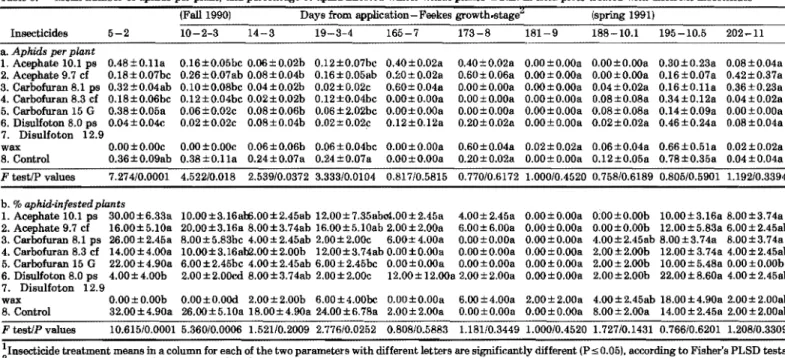
insecticide application, revealed a statistically significant effect of disulfoton, both in the mean number of aphids per plant and
percent age aphid-infested plants (Table 5). The low population
density may have contributed to mask the
effect
of the other treatments,
which were not signifi cantly different from the control in both parameters measured. The average insecticide effect of
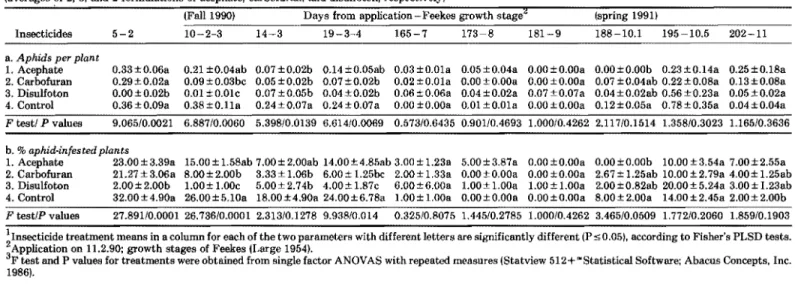
the treatments grouped by AI
(Table 6) was clear at the first aphid count, 5
d after application. The residual action of all insecticide treatments in the
fall lasted up to
19 d.
Aphid counts wre stopped afterwards due to
cold weather.
Winter migrant aphids are particularly
lIDportant in the fall for the transmission of BYDV (Araya et a. 1987), a virus disease that can severely damage crops when
the plants are inoculated at the seedling stage (Endo and Brown 1963, Smith 1967). Thus, the protection period of at least 3 wk
obtained with the
insecticide
treatments is a
very valuable result. Overall,
the lowest aphid
numbers and percentage
of aphid-infested wheat plants (Tables 5 and 6) were observed with the formulations of disulfoton [(t6+t7)/2].
-0 -0
tv Table 4. - Aphids infected with Entomo~hthora sp. and aphids mummified with parasitoids observed on 40 sprin
a
oat and winter wheat field plots (10 plants per plot), and num er of Coleomcgilla maculata present on all plots (total of 20 m2 per fiel trial).Days after No.
aphids
No. of Ladybird beetles Other insects2
treatment and infected with mummified egg adult ch larvae
plant stagel
Entomophthora aphids adults masses larvae pupae mh larvae om
a. Spring oat, 1990 6-5 0 0 1 0 0 0 1 0 0 10-6 4 1 10 0 0 0 0 0 0 --l 15-7 21-8-9 27-10 34-10.1 6 1 0 0 8 35 8 1 2 17 3 5 1 5 10 4 0 4 3 0 0 0 14 19 0 33 3 3 1 0 1 0 0 0 0 2 I m Q ;0 m 41-10.4 0 0 0 3 0 0 0 0 0 ~ b. Winter wheat, 1990-91 5-2 10-2-3 14-3 0 0 0 0 2 1 0 0 0 0 0 0 0 0 0 0 0 0 0 0 0 0 0 0 0 0 0 ): ;;0; m <.n m Z 19-3-4 Winter recess 165-7 173-8 181-9 188-10.1 0 0 0 0 1 0 0 0 0 0 0 3 3 15 10 0 0 0 0 0 0 0 0 0 0 0 0 0 0 0 1 0 0 0 1 0 04 0 0 0 0 0 0 0 0
0
s:
0 . 0 Q Ui --l 195-10.5 202 11 4 6 0 0 32 3 1 0 2 11 0 3 0 0 00 6 0 1I ~plied to oat and wheat on may 8, and Nov. 2, 1990, respect.; Feeked growth stages ( Large 1954).
2
=
mycrohymenopterans observed yin f1h
near the plants; ch=
chrysopid; om Oulema melanopB L. 30ne of these mummies was parasitized by sp. Bon40ne Nabis sp.
'This speciment was parasitized by Perilitus sp. BOne syrphid larva.
~ ~
Table 5. -field plots treated with different insecticidesMean number of aphids per plant, and percentage of aphid-infested winter wheat plants ± S.E. in 1 Wall 19901 Days from application-Feekes growth.stage Z (spring 1991)
Insecticides 6-2 10-2-3 14-3 19-3-4 165-7 173-8 181-9 a. 188-10.1 195-10.5 202-11
Aphids
per
plant
1. Acephate 10.1 ps 0.48±0.l1a 0.16±0.05bc 0.06±0.02b 0.12±0.07bc 0.40±0.02a 0.08±0.04a 0.40±0.02a O.OO±O.OOa O.OO±O.OOa 0.30±0.23a 2.
Acephate 9.7 cf 0.18±0.07bc 0.26±0.07ab 0.08±0.04b 0.16±0.05ab 0.:W±0.02a 0.60±0.06a O.OO±O.OOa O.OO±O.OOa 0.16±0.07a 0.42±0.37a
3. Carbofuran8.1 ps 0.32±0.04ab 0.10±0.08bc 0.04±0.02b 0.02±0.02c 0.60±0.04a O.OO±O.OOa O.OO±O.OOa 0.04±0.02a 0.16±0.lla 0.36±0.23a
- i
4. Carbofuran 8.3 cf 0.18±0.06bc 0.04±0.02a 0.12±0.04bc 0.12±0.04bc 0.02±0.02b 0.08±0.08a O.OO±O.OOa O.OO±O.OOa O.OO±O.OOa 0.34±0.12a :c
5. Carbofuran 15 G 0.38±0.05a 0.06±0.02c 0.08±0.06b
0.06±2.02bc
O.OO±O.OOa O.OO±O.OOa O.OO±O.OOa 0.08±0.08a 0.14±0.09a O.OO±O.OOa m
6. Disulfoton 8.0 ps 0.04±0.04c 0.02±0.02c 0.08 ± 0.04b 0.02 ± 0.02c 0.20±0.02a 0.08±0.04a 0.12±0.12a O.OO±O.OOa 0.02±0.02a 0.46±0.24a (j)
;:0
7. Disulfoton 12.9 m
wax 0.00 ± O.OOc 0.00±0.00c 0.06±0.04bc 0.06±0.06b 0.60±0.04a 0.02±0.02a O.OO±O.OOa 0.02±0.02a 0.06±0.04a 0.66±0.51a ~ 8.
Control 0.36 ± 0.09ab 0.38 ± O.lla
0.24 ± 0.07 a 0.24 ± 0.07 a
O.OO±O.OOa 0.20±0.02a
O.OO±O.OOa 0.12±0.05a 0.78±0.35a 0.04±0.04a
s;:
F testIP values 7.274/0.0001 4.522/0.018 2.539/0.0372 3.333/0.0104 0.817/0.5815 0.770/0.6172 1.000/0.4520 0.758/0.6189 0.805/0.5901 1.192/0.3394'"
m (I) m b. % aphid-infested plants Z1. Acephate 10.1 ps 30.00±6.33a 10.oo±3.16alX).00±2.45ab 12.00±7.35abol.OO±2.45a 4.00±2.45a O.OO±O.OOa O;OO±O.oob 10.00±3.16a 8.00±3.74a
2. Acephate 9.7 cf 16.00±5.lOa 20.00±3.16a 8.00±3.74ab 16.oo±5.10ab 2.00±2.00a 6.00±6.00a O.OO±O.OOa O.OO±O.OOb 12.00±5.83a 6.00±2.45ab
a
3. Carbofuran 8.1 ps 26.00±2.45a S.00±3.74a 2.00±2.0Oc 8.00±5.83bc 4.00±2.45ab 4.00±2.45ab 6.00±4.00a O.oo±O.OOa O.OO±O.OOa 8.00±3.74a
~
4. Carbofuran 8.3 cf 14.00±4.00a 10.00±3.16ab2.00±2.00b 12.00±3.74ab 0.00 ± O.OOa 0.00 ± O.OOa 0.00 ± O.OOa 2.00 ± 2.00b 12.00 ± 3.7 4a 4.00 ± 2.45ab5
5. Carbofuran 15 G 6.00±2.45bc 22.00±4.90a 2.00±2.00b 10.00±5.48a 6.00±2.45bc 0.00 ± 4.00±2.45ab O.OO±O.OOa O.OOa O.OO±O.OOa O.OO±O.OOb (j)
6. Disulfoton 8.0 ps 4.00±
4.oob 2.00±2.00cd
8.00±3.74ab 2.00±2.0Oc 12.00±12.00a 2.00 ± 2.00a
O.oo±O.OOa 2.00 ± 2.00b 22.00±8.60a 4.00 ±2,45ab 7. Disulfoton 12.9 wax ~ O.OO±O.OOb O.OO±O.OOd 2.00±2.00b 6.00±4.00bc O.OO±O.OOa 6.00±4.00a 2.00±2.00a 4.00±2.45ab 18.00±4.90a 2.00±2.00ab 8. Control 32.oo±4.90a 26.00±5.10a 18.00±4.90a 24.00±6.78a
2.00±2.00a O.OO±O.OOa O.OO±O.ooa
S.00±2.00a 14.00±2.45a 2.00±2.00ab F
testiP
values 10.615/0.0001 5.360/0.0006 1.521/0.2009 2.776/0.0252 0.808/0.5883 1.18110.3449 1.000/0.4520 1.727/0.1431 0.766/0.6201 1.208/0.3309
1Insecticide treatment means in two parameters with different letters are significantly different a column for each of Fisher's PLSD 0.05), according the (Ps to tests.
2 Application on 11.2.90; growth stages Feekes (Large 1954). of
~
3F
testand P values for
treatments
were obtained from single factor ANOVAS
with
repeated measures (Statview 512+"'Statistical Software; Abacus Concepts, Inc. 1986).
~
z
?:8
t>.)
Table 6.-Average number of aphids per plant, and percentage of aphid·infested winter wheat plants ±S.E. in field plots treated with different insecticides
(averages of 2, 3, and
2 formulations of acephate, carbofuran,
and disulfoton, respectively)l (Fall 1990) Days from application-Feekes growth stage2 (spring 1991) Insecticides 5-2 10-2-3 14-3 19-3-4 165-7 173-8 181-9 188-10.1 195-10.5 202-11 - I ::r rn
a. Aphids per plant Q
1. Acephate 0.33±0.06a 0.05±0.04a 0.21 ±0.04ab 0.07±0.02b 0.14±0.05ab 0.03±0.0Ia O.OO±O.OOa O.OO±O.OOb 0.23±0.14a 0.25±0.18a ;;0
rn
2. Carbofuran 0.29±0.02a 0.07±0.02b 0.09 ± 0.03bc 0.05±0.02b 0.07±0.04ab 0.02±0.0Ia O.OO±O.OOa O.OO±O.OOa 0.22±0.08a 0.13±0.08a ~
3. Disulfoton 4. Control 0.00±0.02b 0.36±0.09a 0.01 ±O.Olc 0.38±0.l1a 0.07±0.05b 0.24±0.07a 0.04±0.02b 0.24 ±0.07a 0.06±0.06a 0.00 ±O.OOa 0.04±0.02a 0.01 ±O.01a 0.07±0.07a 0.00 ±O.OOa 0.04±0.02ab 0.56±0.23a 0.12 ±0.05a 0.78±0.35a 0.05±0.02a 0.04±0.04a
;;
F
testl P values 9.06510.0021 6.88710.0060 5.398/0.0139 6.61410.0069 0.57310.6435 0.90110.4693 1.00010.4262 2.11710.1514 1.35810.3023 1.16510.3636rn
rn Z b. % aphid·infested plants 1. Acephate 23.00±3.39a 15.00 ± 1.58ab 7.oo±2.00ab 14.00±4.85ab
3.00±1.23a 5.00±3.87a O.OO±O.OOa O.OO±O.OOb 10.00±3.54a 7.00±2.55a
o
2. Carbofuran 21.27±3.06a 8.oo±2.00b 3.33±1.06b 6.00±I.25bc 2.oo±1.33a O.OO±O.OOa O.OO±O.OOa 2.67±1.25ab 1O.00±2.79a 4.00±1.25ab~
3. Disulfoton
2.00±2.oob 1.00±1.ooc
5.00±2.74b4.00±1.87c 6.00±6.00a 1.00±1.00a 1.00±1.00a 2.00±0.82ab 20.00±5.24a 3.00±I.23ab 4. Control 32.00±4.90a
26.00±5.10a 18.00±4.90a 24.00±6.78a
1.00±1.00a O.OO±O.OOa O.OO±O.OOa 8.00±2.00a 14.00±2.45a 2.00±2.00b
5
QF testlP values 27.89110.0001 26.736/0.0001 2.31310.1278 9.938/0.014 0.325/0.8075 1.44510.2785 1.000/0.4262 3.465/0.0509 1.77210.2060 1.85910.1903 ~
1 Insecticide treatment
means in a column for each of the
two parameters with different letters
are significantly different (P s 0.051, according to Fisher's PLSD tests.
2Application on 11.2.90; growth stages of Feekes (Large 1954).
3F test
and P values for
treatments
were obtained from single factor ANOVAS with repeated measures (Statview 512
+~Statistical Software; Abacus Concepts, Inc. 1986).
232 THE GREAT LAKES ENTOMOLOGIST Vol. 25, No.3
E
10 0'" tn-
tnE
8 :... 03:
.£:...
6 :... CIS (I) "'C 4 CIS (I) "'Cs::
2 CIS (1):!
Treatments (aLlLl!. 11.2.90) acephate: (t1 +t2)/2 carbofuran: (t3+t4+t5)/3 disulfoton: (t6+t7)/2 control: (t8) (11 +t2)/2 (t3+t4+t5)/3 (t6+t7)/2 18Means of insecticide groups
Figure 1. Mean number of dead earthworms per surface of the square meter on the plots, 5 d after application of different insecticide treatments
on winter wheat [columns with different
letters
are significantly (P:50.05) different, according to
single factor ANOVAS
with
repeated measures and Fisher's PLSD
test
(Statview
512+
"'Statistical Software; Abacus Concepts, Inc. 1986)].
The average effect of the disulfoton number of aphids and on treatments the
percentage of aphid-infested elants
was noted
at the first aphid count, 5
d
after application (Table 6), [(tl +t2)/2] and carbofuran while those of acephate
[(t3+t4+t5)/3] started to show later.
In the natural fall,
enemies were almost nonexistent; a total
a 3 mummi fied aphids and 1 adult mycrohymenopteran parasitoid were observed on
the plants
randomly selected for aphid counts
at this time (Table 4). This low density of natural enemes may
favor a rapid growth of populations of cereal aphids during the fall, at a stage when plants are most susceptible to damage by
these BYDV vectors.
If
environmental conditions are favorable for cereal aphids,
they
will also be so for
natural enemies, but because of the time-lag produced betwen the
growth of populations of aphids and their natural ene mies, most of the damage caused by these aphids during the fall will be done before they are controlled
by
beneficial arthropods. Infestation of Hessian fly,
Mayetiola destructor (Say), during the fall in
these plots was minimal, as d after applicaonly two dead larvae were found 5
tion in one of the plants
sampled from the control plots. A number of dead earthworms,
Lumbricus sp., were counted 5 dafter
application (Figures 1 and 2)
over the surface of the plots treated with the three formulations of carbofuran. The three formulations of
this insecticide caused statistically significant earthworm mortality, with a relative greater effect of carbofuran 8.3 cf. Reduced populations of lumbricid earthworms were reported
by Martin (1978)
on carbofuran-treated plots of
pasture in New
1992 THE GREAT LAKES ENTOMOlOGIST 233 15
a
E Treatments C" (aI2R!, 11 ,2.l;)Q)~
10 t1 : acephate 10.1 ps E .... t2: acephate 9.7 cf 0:s:
t3: carbofuran 8.1 ps .c:-
t4: carbofuran 8.3 cf....
t5: carbofuran 15G ct\ (I)"
ct\ (I) t6: disulfoton 8.0 ps t7: disulf. 12.9 wax 5"
t8: control r::::: ct\ (I) :Ec
c
c
c
t1 t2 t3 t4 t5 t6 t7 t8 TreatmentsFigure 2. Mean number of dead earthworms per square meter on the surface of the plots, 5 d after application of different insecticide treatments
on winter wheat (averages of
2,
3, and
2 formulations of acephate, carbofuran, and
sidulfoton, respectively) [columns with different letters are significantly (PsO.05) different, according to single factor ANOVAS with repeated measures and Fisher's
PLSD test
(Statview 512+
"'Sta tistical Software; Abacus Concepts, Inc.
1986)]
Zealand. It is not known whether carbofuran or the caused eathworm other AI
mortality below the
soil surface.
Further tests are required.
b. Spring of 1991. Aphid counts were stopped during winter
and resumed in
spring. Aphid populations were small, with a relatively minor increase from days 188 through
202
after application (plant growth stages 10.1
and 11 of
the Feekes scale [Large 1954], respectively) (Tables 5 and
6). Population density
peaked on day 195, when plants were
at the 10.5 Feekes growth stage. Aphids killed
by Enthomophthora were observed in late spring (Table 4), on maturing wheat plants. No activity of microhymenopteran parasitoids was
observed, but
adult
C. maculata ladybird beetles were often observed as soon as
cereal aphids were found in the field. The other sta~es
occurred later, as observed
the
previous year on spring oat. This coccinellid may play an impor
tant role
in
reducing cereal aphid populations on winter wheat during
the spring, making it unnecessary to protect the maturing
plants with organosyn thetic aphicides.
Using slow release formulations of acephate encapsulated in pearl corn
c
234 THE GREAT LAKES ENTOMOLOGIST Vol. 25, No.3
starch or corn flour granules in laboratory studies, Araya et (1990a) aI.
achieved >50%
mortality of
R. pOOi from days 15 and 17 through days 31.5 and
32.8 after seeding, respectively. The corresponding granular formulations
of carbofuran provided control ( > 50%
mortality) from days 13.3 through 17.9 and
31.6
and 35.5
after
seeding, respectively. Foliar sprays of acephate and carbofuran applied 12
dafter seOOling
emergence provided control for 18.3 and 36.2 d from application, respectivly.
Further laboratory studies (Araya
et aI. (1990b), testing similar formulations
and
dosages of acephate and carbofuran
and
higher dosages of disulfoton encapsulated in pearl corn starch granules, controlled
R. padi, the Russian wheat aphid, Diuraphis noxia (Mordvilko), and rose-grain aphid, Metopolophium dirhodum (Walker), corroborating results obtained first with R. padi.
ACKNOWLEDGMENTS The authors express their appreciation to
Rick Foster,
John J. Roberts,
and Stanley
G.
Well so for critically reviewing
the manuscript.
LITERATURE CITED
Abacus Concepts, Inc. 1986. Statview 512+ Statistical Software. BrainPower, Inc., Calabasas, California.
Abbott, W.
S. 1925. A method for computing the effectiveness of an insecticide. J. Econ. Entomol. 18:265-267. Araya, J. E., and J. E.
Foster. 1983. A key for identification of some economically important species of cereal aphids (Homoptera: Aphididae). Purdue Univ., Agric. Exp. Stn. Bull. 429:1-11. Araya, J. E., J. E. Foster, and S. E. Cambron. 1987. A study of the biology of Rhopalo siphum padi (L.) (Homoptera: Aphididael in winter wheat in northwestern Indiana. Great Lakes Entomol. 20:47-50. Araya, J. E., J. E. Foster, M. M. Schreiber, and R.
Wing. Residual action of slow 1990a
release systemic insecticides on Rhopalosiphum padi (Homoptera: Aphididae) on wheat. Great Lakes Entomol. 23:19-27. Araya, J. E., J. E. Foster, M. M. Schreiber, R. Wing, A.. Fereres, J. Tadeo, and P. Castaera. 1990b.
[Early control of aphid vectors of barley yellow dwarf virus with slow release systemic insecticides in granular formulations.] Boletn Sanidad Vegetal, PIa· gas (Spain) 1:178-186. (in Spanish). Araya, J. E.,
J. E. Foster, and S. G. Wellso. 1986. Aphids as cereal pests. Purdue Univ., Agric. Exp. Stn. Bull. 509:1-27.
Arretz, P., and J. E.
Araya. 1978. [Control of aphids on barley with systemic insecticides applied to the soil, seed, and foliage, in two localities of the central zone of Chile.]
Investigacin Agrcola (Chile) 4:79-86. (in Spanish). ~
1980. [Aphid control on wheat with granular systemic insecticides applied to the soil, seed treatments,
and
foliage sprays.] Simiente (Agron. Soc. of Chile) 50:50-56 (in Spanish).
Bruehl,
G. W.
1961. Barley yellow dwarf, a virus disease of cereals and grasses. Mono graph No. I, Amer. Phytopath. Soc. 52 pp. Caldwell, R. M.,
J. F. Schafer, L. E. Compton, Patterson. 1959. Yellow dwarf and F. L. infection on oats and wheat in Indiana in 1959. Plant
Dis. Rep. Suppl. 262:333. Carrigan, L. L., H. W. Ohm, J. E. Foster, and
F. L. Patterson. 1981. Response of winter wheat cultivars to barley yellow dwarf virus infection. Crop Sci. 21:377-380. DePew,
L. J.
1974. Controlling greenbugs in grain sorghum with foliar and soil insecti cides.
THE GREAT LAKES ENTOMOLOGIST
1992 235
Dumbre, R. B., and A. A. Hower. 1977. Contact mortality of the alfalfa weevil parasite
Microctonus aetiopoides from insecticide residues on alfalfa. Environ. Entomol. 6:893-894.
Duncan, D.
B. 1955. Multiple range and multiple F tests. Biometrics 11:1-42. Edwards, C. R., E. C. Berry, and T.
A. Brindley. 1980. Effect of insecticide applications on insect predators of
the
European corn borer
(Ostrin,a nubilalis) in central Iowa. Iowa State J. Res. 54:361-366. Endo, R. M., and C. M.
Brown. 1963. Effects of barley yellow dwarf virus on yield of oats
as influenced by variety,
virus strain, and developmental stage of plants at inoculation. Phytopathology 53:965-968.
Fitzpatrick, G., R.
H. Cherry, and R.V.
Dowell. 1978. Short-term effects of three insecti cides on predators and parasites of the citrus blackfly. Environ. Entomol. 7:553-555. Flanders, R. V., L. W. Bledsoe and C. R.
Edwards. 1984. Effects of insecticides on
Pediobus {oveolatus (Hymenoptera: Eulophidae), a parasitoid of the Mexican bean
beetle (Coleoptera: Coccinellidael. Environ. Entomol. 13:902-906. Frank, R., G.
Ritcey, H. E. Braun, and F.L. McEwen. 1984. Disappearance of acephate residues from beans. carrots, celery, lettuce, peppers, potatoes, strawberries
and tomatoes. J. EcolL Entomol. 77:1110-1116. Gholson, L. E .• C. C. Beegle, R. L. Best, and J. C. Owens. 1978. Effects of several commonly used insecticides on cornfield carabids in Iowa.
J. Econ. Entomol.
71:416-418. Gill.
C. C.
1980. Assessment of losses on spring wheat naturally infected with barley
yaUow dwarf virus. Plant Disease 64:197-203.
Hinz, B., F. Daebeler, and
W.
Lucke. 1979. [Injurious effects of the cereal aphid
(Rhopa losiphum padi (L.II and barley yellow dwarf virus on spring barley and oats.] Archiv fr Phytopathologie und Pflanzenschutz 15:405-413. (in
German). Hsieh. C. Y .• and W. W.
Allen. 1986. Effects of insecticides on emergence. survival, longevity. and fecundity of the parasitoids
Diaeretiella rapae (Hymenoptera: Aphidi dae) from mummified Myzus persicae (Homoptera: Aphididae). J. EcolL Entomol. 79:1599-1602.
Kolbe. W.
1973. Studies on the
occurrence
of cereal aphids and the effect of feeding
damage on yields in relation to infestation density levels and control. Pflanzenschutz Nachrichten bayer 26:396-410. Lange, W. H., G. G. Agosta, K. S. Goh, and J. S. Jishiyama. 1980. Field effect of insecticides on chrysanthemum leafminer
(Phytomyza syngenesiae) and a primary parasitoid, Chrysocharis ainsliei on artichokes (Cynara scolimus) in California, USA. Environ. Entomol. 9:561-562. Large, E. C. 1954. Growth stages in cereals. Illustrations of the Feekes scale. Plant Pathol. 3:128-129. Martin, N. A.
1978. Effect of four insecticides
on the pasture ecosystem: VI. Arthrop oda dry-heat-extracted from small soil cores. and
conclusions. New Zealand
J. Agric. Res. 21:307-320. Mize. T .• G. Wilde. and M. T.
Smith. 1980. Chemical control of chinch
bug (Bliss us leucopterus leucopterus) and greenbug (8chizaphis graminum) on seedling sorghum with seed, soil and foliar treatments. Econ. Entomol. 73:544-547. J.
Oetting. R. D.
1984. Systemic activity of acephate, butoxycarboxim, and butocarboxim for control of
Myzus persicae on ornamentals. J. 17:433-438. Georgia Entomol. Soc.
Palmer, L.
T., and W.
H. Sill, Jr.
1966. Effect of BYDV on wheat in Kansas. Plant Dis. Rep.
50:
234-238. Rabbinge, R., and F.
H. Rijsdijk. 1984. Epidemiological and crop
physiological founda tion of EPIPRE.
Chapter 26:
227-235,
In: Gallagher, E. J. (ed.), Cereal Production. Proc. 2nd IntI. Summer School in Agriculture, The Royal Dublin Soc.
Rothman, P.
G., D. H. Bowman, and S.
S. Ivanoff. 1959. Occurrence of barley yellow dwarf on oats in Mississippi. 1959. Plant Dis. Rep. Suppl. 262:348-350.
Semtner, P. J.
1979. Insect predators and
pests
of tobacco following applications of systemic insecticides. Environ. EntomoL 8:1095-1098.
236 THE GREAT LAKES ENTOMOLOGIST Vol. 25, No.3 Shasha, B. S., D. Trimnell, and F.
H. Otey.
1984. Starch-borate complexes for EPTC encapsulation. J.
Appl. Polym. Sci. 29:67-74.
Smith, H. C. 1967. The effects of aphid numbers and stage in determinof plant growth ing
tolerance to barley
yellow dwarf virus
in cereals. New Zealand J. Agric. Res. 10:445-466. Steel, R. G. D., and J. H. Torrie.
1960. Principles and procedures of statistics, with special reference to the
biological sciences. McGraw-Hill, New York. 481 pp.
Stern, V.
M. 1967. Control of aphids attacking barley and analysis of yield increases in the
Imperial Valley, California. J.
Econ. Entomol.
60: 485-490.
Szeto, S. Y., H. H. MacCarthy, Shepherd. Oloffs, P. C. and R. F. 1979. The fate of acephate and carbaryl in water. J.
Environ. Sci. Health, Part B, Pestic. Food Contam. Agric. Wastes 64:635-654.
van Rensburg, J. B. J., M. Walters, G. C. and P. Stemmet. 1978. A preliminary study on the application of carbofuran granules to the soil for the control of grain sorghum pests. Phytophylactica 10:28-30. Whalon, M. E., and E. A. Elsner. 1982. Impact of insecticides on Illinoia pepperi and its predators. J. Econ. Entomol. 75:356-358.
Wing, R. E., S. Maiti, and W.
M. Doane.
1987. Factors affecting release of butylate from calcium ion modified starch-borate
matrices. J. Controlled Release 5:79-89. Yamazaki, M., M. Sakai, and F. Goto. 1982. [Behavior of acephate and metamidophos in
tobacco plants treated
with granular
formulations.] J.
Pestic. Sci. (Nihon Noyaku Gakkaishi)
7:175-180.