Nationaal Lucht- en Ruimtevaartlaboratorium
National Aerospace Laboratory NLR
NLR-TP-2013-553
Collaborative multi-partner modelling & simulation
processes to improve aeronautical product design
Dealing with Security and Intellectual Property in the
Behavioural Digital Aircraft
Nationaal Lucht- en Ruimtevaartlaboratorium
National Aerospace Laboratory NLR Anthony Fokkerweg 2 P.O. Box 90502 1006 BM Amsterdam The Netherlands Telephone +31 (0)88 511 31 13 Fax +31 (0)88 511 32 10 www.nlr.nl
UNCLASSIFIED
Executive summary
Nationaal Lucht- en Ruimtevaartlaboratorium
National Aerospace Laboratory NLR
This report is based on a presentation held at the 4th CEAS Air & Space Conference,
Report no. NLR-TP-2013-553 Author(s) E.H. Baalbergen J. Kos W.F. Lammen Report classification UNCLASSIFIED Date June 2014 Knowledge area(s)
Collaborative Engineering and Design
Computational Mechanics and Simulation Technology
Descriptor(s)
secure collaborative engineering cross-organisational workflows surrogate modelling
CRESCENDO, BDA
Collaborative multi-partner modelling & simulation processes to
improve aeronautical product design
Dealing with Security and Intellectual Property in the Behavioural Digital
Aircraft
Problem area
Modern aircraft design, including all its systems and components, is a comprehensive collaborative engineering activity involving teams of engineers from various disciplines working concurrently across organisational and geographical boundaries. To achieve the challenging objectives of contemporary and future
aeronautics, and to maintain global industrial leadership, a high level of integrated system design of the aircraft and its subsystems is needed. This requires a
continuously increased level of collaborative engineering through modelling and simulation along the supply chain to improve cost and time efficiency.
Description of work
To achieve a step change in the way multi-disciplinary teams in an extended enterprise carry out modelling and simulation processes, the ‘Behavioural Digital Aircraft’ (BDA) concept has been developed in the context of the EU FP7 CRESCENDO project. The concept paves the way for application of
UNCLASSIFIED Collaborative multi-partner modelling & simulation processes to improve aeronautical product design
Dealing with Security and Intellectual Property in the Behavioural Digital Aircraft
Nationaal Lucht- en Ruimtevaartlaboratorium, National Aerospace Laboratory NLR
innovative collaboration
technologies as well as advanced modelling and simulation
technologies that supports cost and time-efficient development of new aeronautical products. However, collaborative engineering activities are often hampered by security constraints and measures that serve to protect intellectual property rights. Effective collaborative engineering methods that fit company security regulations are needed.
Results and conclusions
This report presents a practical interoperability solution that supports multi-partner and cross-organisational engineering
activities. The solution conforms to and gracefully deals with the security constraints and measures. This report also describes the application of surrogate modelling as an effective method to enable industrial collaboration in aerospace preliminary design, while allowing partners to protect their intellectual properties. The interoperability solution and surrogate modelling fit in the BDA concept. The report finally describes how both
technologies have been
demonstrated - in an integrated way - in an aircraft and engine
preliminary design case. The technologies have been proven successful and valuable in the context of cross-organisational secure collaborative engineering, and contribute to more efficient development of new aeronautical products.
Applicability
The competitive engineering solutions presented in this paper support efficient collaboration between the aeronautics industry and its suppliers, including small to medium enterprises, in the context of increasingly integrated
development processes of aircraft and their parts and components. The solutions support the Dutch industry and its suppliers to develop
aeronautical products in a cost and time effective way that is compliant with the latest developments in collaborative engineering at the European aeronautic industry, and hence to become increasingly more competitive in their areas.
Nationaal Lucht- en Ruimtevaartlaboratorium
National Aerospace Laboratory NLR
NLR-TP-2013-553
Collaborative multi-partner modelling & simulation
processes to improve aeronautical product design
Dealing with Security and Intellectual Property in the
Behavioural Digital Aircraft
E.H. Baalbergen, J. Kos and W.F. Lammen
This report is based on a presentation held at the 4th CEAS Air & Space Conference, Linköping, Sweden, September 2013.
The contents of this report may be cited on condition that full credit is given to NLR and the authors. This publication has been refereed by the Advisory Committee AEROSPACE VEHICLES.
Customer NLR
Contract number - - -
Owner NLR
Division NLR Aerospace Vehicles
Distribution Unlimited
Classification of title Unclassified June 2014 Approved by: Author E.H. Baalbergen Reviewer R. Wiegers Managing department A.A. ten Dam
NLR-TP-2013-553
Summary
Designing a modern aircraft, including all its systems and components, is a tremendous collaborative engineering activity involving teams of engineers from various disciplines working concurrently across organisational and geographical boundaries. To achieve the
challenging objectives of contemporary and future aeronautics, and to maintain global industrial leadership, a high level of integrated system design of the aircraft is needed. This requires a higher level of collaborative engineering through modelling and simulation along the supply chain to improve cost and time efficiency.
To achieve a step change in the collaborative way multi-disciplinary teams in an extended enterprise carry out modelling and simulation processes, the ‘Behavioural Digital Aircraft’ (BDA) concept has been developed. This paper presents the concept and the emerging needs for innovative collaboration technologies as well as advanced modelling and simulation
technologies. Furthermore the security constraints that teams of collaborating engineers face in practice are discussed. Also a practical interoperability solution is introduced to deal with the security constraints that may disturb multi-partner collaborative engineering efforts. Finally the application of surrogate modelling as an effective method to enable collaborative modelling and simulation activities in the extended enterprise, while allowing partners to protect their
intellectual properties is described. The effectiveness of the surrogate modelling and the
NLR-TP-2013-553
Contents
1 Introduction 4
2 The Behavioural Digital Aircraft 5
3 Security constraints 6
4 Interoperability solution respecting security constraints 8 5 Surrogate modelling to facilitate industrial collaboration 13
6 Conclusion and future work 17
Acknowledgements 19
NLR-TP-2013-553
1
Introduction
During the past century, aircraft have evolved into complex systems comprising multiple and even more complex subsystems. Building aircraft evolved from pioneering by a single man in a barn, into tightly orchestrated multi-disciplinary, multi-engineer, and multi-partner concurrent and collaborative engineering activities that cross organisational and national boundaries. Key steps in the concurrent and collaborative engineering process are the transfer of requirements and the sharing of the digital mock-up along the aircraft development life-cycle.
To meet society’s needs with respect to safety, comfort and environmental impact, such as formulated in European Aeronautics: a vision for 2020[7] and Flightpath 2050 Europe’s Vision for Aviation[6], and to maintain global industrial leadership, a higher level of cost and time efficient integrated system design of the aircraft is needed.
Modelling and simulation by multi-disciplinary teams in the collaborative multi-partner
enterprise enables to achieve cost and time-efficient development of new aeronautical products. However, collaborative modelling and simulation activities are often hampered by the
protection of intellectual property rights (IPR) and the variety of practices and constraints of different companies in aeronautical industry. The Behavioural Digital Aircraft (BDA) concept proposes using essentially distributed dataset and platforms to collaboratively mature the definition of aircraft behavioural characteristics, while respecting the company practices and constraints in aeronautical industry [5].
Mastering the aircraft’s behaviour collaboratively considerably impacts the way of working of many engineers from different organisations and disciplines involved in the design of a new aircraft type and its systems and components. It impacts both the frequency and the contents of the exchange of information. For example, joint behaviour analysis of the aircraft
manufacturer’s overall design and the suppliers’ detailed designs is a step change in the exchange of information compared to current practices. Such simultaneous analysis allows maturing the requirements earlier in the design process, thereby reducing the risk of potential rework later. Specific BDA supporting technologies addressing the increased frequency and type of information exchange are needed to respect the security constraints in aeronautical industry as well as the protection of the intellectual property contained in detailed behaviour models.
NLR-TP-2013-553
This paper explains the notion of the BDA and discusses the security constraints that teams of collaborating engineers are involved with. Moreover two complimentary solutions that enable engineering teams to collaborate in the context of the BDA are discussed.
2
The Behavioural Digital Aircraft
New possibilities of collaborative engineering and modelling and simulation technologies have been investigated and demonstrated in the EU FP7 CRESCENDO project [3][5]. The
CRESCENDO project initiated a step change in the way multi-disciplinary teams working collaboratively in an extended enterprise carry out modelling and simulation activities by developing the notion of the BDA [12]. The BDA consists of three key concepts, namely BDA data set, platforms, and users, as illustrated in Fig. 1.
Fig. 1 Illustration of the Behavioural Digital Aircraft concept as developed in CRESCENDO [5]
The BDA data set is a multi-partner, multi-level, multi-disciplinary and multi-quality
behavioural digital representation of the evolving aircraft design and its constituent systems and sub-systems designs. A single, but distributed and federated BDA data set would typically exist and evolve for a given major aircraft development program.
NLR-TP-2013-553
BDA platforms implement collaborative services and behavioural multi-physics simulation capabilities to manage, manipulate, preserve, reuse and enrich the models and associative data needed to create, evolve and mature the BDA data set. CRESCENDO defined a generic BDA architecture specification that any given BDA platform implementation should comply with. Only certain part of the full functional specification will be used by different aircraft and engine manufacturers, partners and suppliers. Parties may choose different vendor solutions to
implement the BDA platform within their organisations. Typically, multiple interoperable BDA platforms will exist across the extended enterprise.
To create and evolve the BDA data set, thousands of BDA users may collaborate in teams across the extended enterprise, creating and sharing their information more efficiently through the BDA platforms.
Dozens of developed realistic multi-partner collaborative scenarios along various stages of the aircraft development lifecycle have been demonstrating the BDA concept at the CRESCENDO Forum [4][11][18]. In addition, Industrial Deployment labs were set up, providing Information and Communication Technology (ICT) infrastructures that facilitate the implementation of the demonstrators in true industrial settings.
3
Security constraints
The implementations of the BDA platforms are largely enabled by state-of-the-art digital analysis and modelling and simulation tools and technologies. ICT not only supports the ever more complex design activities in terms of increasing computing power and data storage capacity, but also provides collaboration capabilities among teams of aeronautical engineers. Over the past decades, the collaboration capabilities have evolved from e-mail, simple file exchange, and dedicated network connections into integrated multi-user facilities such as web conferencing, extended enterprises, collaborative product life-cycle support tools and workflow systems.
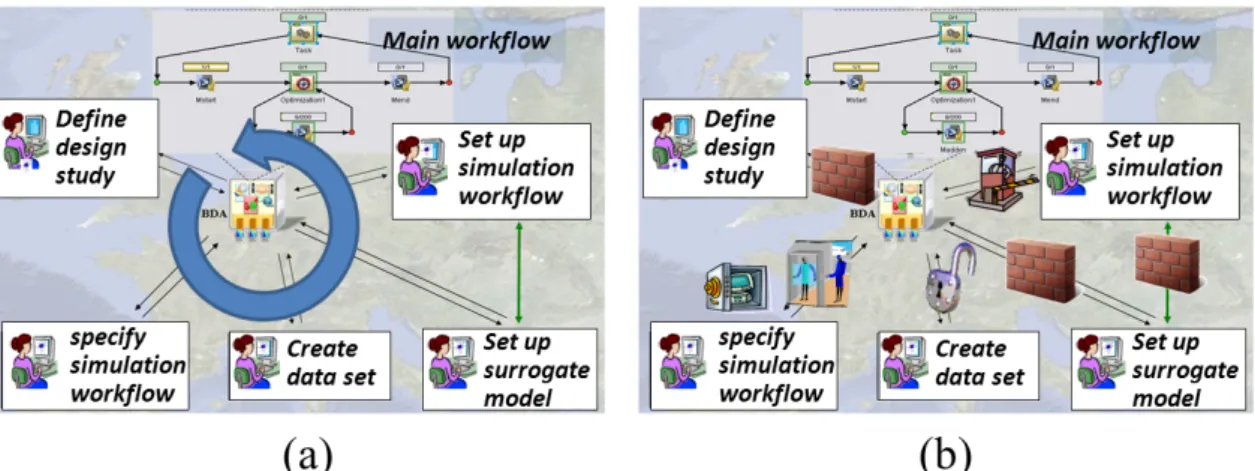
Despite the available collaboration support, security constraints often disturb the seamless execution of collaborative engineering activities across organisational boundaries, and hence threaten the interoperability among BDA platforms. For example, multi-partner workflows ideally span the networks of the partners involved and run smoothly across their organisations. In practice, however, security measures impose restrictions that prohibit seamless
NLR-TP-2013-553
actual situation are depicted with the help of a realistic collaborative scenario in Fig. 2. A solution to deal with the actual situation is presented in section 4.
Fig. 2 Example collaborative scenario. Ideally, the activity and data flow runs smoothly across the organisations (a), but in practice security measures such as firewalls hamper a seamless flow (b)
Security constraints are of paramount importance to protect an organisation’s assets, and hence may not, and generally cannot, be bypassed. The constraints serve to ensure IPR, to protect ownership, to safeguard the ICT infrastructure against viruses and illegal access, to comply with regulations such as export controls, to maintain security policies, trust, and non-disclosure agreements that apply for particular customers, and in specific secure collaboration contexts, and to maintain licensing policies (e.g., commercial software licenses generally prohibit third parties to use the licensed software). Simply requesting or even requiring a collaborating partner to loosen its security constraints and corresponding protection measures to enable engineers to cross organisational boundaries is not an option.
Engineers already have to deal with the security constraints in their daily work such as badges and passwords, security rules included in employment contracts, the impossibility to quickly install non-standard software on the workplace PCs, and ICT security measures such as firewalls and proxy servers. In practice, security constraints, and in particular the network access restrictions that support those constraints, throw up barriers for smooth cross-organisational collaborative engineering.
Solutions for collaboration over organisational boundaries have been developed and applied throughout the years in collaboration projects. These solutions typically require extensive tailoring to the collaborative situation, such as special contracts and agreements for accessing an
NLR-TP-2013-553
organisation’s resources through, for example, a combination of virtual private networking, web services, special fire-wall settings, and dedicated protocols and software. Such solutions, however, are only valid for specific situations and generally are costly and require the involvement of security officers, juridical experts and ICT network specialists.
In the CRESCENDO project, the experiences with respect to collaboration barriers posed an urgent need for a quick solution that enables engineers to collaborate across organisational boundaries, thereby dealing with the network access restrictions while still obeying the security constraints. A practical technical solution to support seamless execution of collaborative cross-organisational workflows while respecting the most common security constraints has been developed in the BDA context. This solution is described in the next section. In addition, a complementary solution for protecting the company’s IPR, namely taking detailed modelling and simulation capabilities into a distributable black-box surrogate model, is described in section 5.
4
Interoperability solution respecting security constraints
As indicated in the previous section, situation-specific solutions that support the execution of cross-organisational workflows involving network restricted partners have been developed, particularly in projects that involved collaborative engineering, such as the EU projects CESAR[2] and VIVACE[9]. In the context of CRESCENDO, promising solutions have been further combined, generalised and matured into the so-called ‘Building blocks for mastering network Restrictions involved in Inter-organisational Collaborative engineering Solutions’ or ‘BRICS’ for short. BRICS facilitates smooth execution of collaborative engineering workflows across organisations and BDA platforms [1].
BRICS comprises a protocol and supporting software that may be used in combination with existing workflow management systems and secure data sharing repositories to transform local workflows into cross-organisational collaborative workflows. Such workflows define and orchestrate multi-user collaborative engineering activities in terms of the chain of tools and processes to be executed by various engineers from various disciplines working at various organisations. BRICS supports the coordinated, efficient and secure execution of collaborative workflows by enabling the execution of tools or parts of the chain to be assigned to engineers working in other organisations.
NLR-TP-2013-553
One of the key features of BRICS is the ability of enabling remote engineers, including those who “suffer” from network access restrictions, to fully participate in collaborative workflows. Here, BRICS deals with and obeys the security constraints, policies, rules, and measures of the participating organisations. To allow an organisation to have full control over their own resources, BRICS supports a man-in-the-loop to decide upon whether or not to allow a workflow that runs elsewhere to trigger tools, to access information and to use computing resources within the organisation. To achieve this, BRICS notifies a remote engineer when applicable, and enables the notified engineer to either initiate the execution of a single-task job or to arrange for automated repeated execution of similar tasks in a multi-task job under his or her own control. BRICS keeps the extra burden placed on the engineers involved to a minimum by automating actions such as sending and handling notifications and transferring data as much as possible, yet within the security constraints of the involved organisations.
BRICS is based on a simple protocol that arranges the execution and data flow between the orchestrating workflow in one organisation and a remote engineer in another organisation who is assigned to execute a tool from or part of the workflow. A sequence diagram for this protocol is depicted in )LJ. An ‘end user’ application is illustrated in Fig. 5.
The diagram shows two actors Workflow and Remote engineer, with a Shared data repository in between. The cross-organisational collaborative Workflow acts as ‘master’ that issues a
NLR-TP-2013-553
BRICS provides the master with three commands for outsourcing the execution of a tool or part of the workflow to the slave and to handle the notification and data transfers involved: Start, Wait, and End. The Shared data repository serves to exchange the data files involved among the master and the slave.
The Start command uploads the specified input data for the remote task to the Shared data repository. Next, it sends a notification (e.g., an e-mail message) to the Remote engineer. Upon receipt of the notification, the Remote engineer may decide upon whether or not to execute the task. The engineer typically decides to participate based on earlier agreements and knowledge of the remotely orchestrated job. The engineer next fetches the input data, and performs the job using the local BDA platform. Finally, the results are uploaded to the Shared data repository. The slave’s part of the protocol can be handled manually as well as automatically, under the Remote engineer’s control.
The Wait command polls the expected results of the remote task to be present on the Shared data repository. The master uses the Wait command to synchronise the Workflow execution with the remote task.
The End command retrieves the outputs from the Shared data repository. The master uses the End command to fetch the outputs of the remote task, and next proceeds with the execution of the workflow using the outputs as if the task was executed locally.
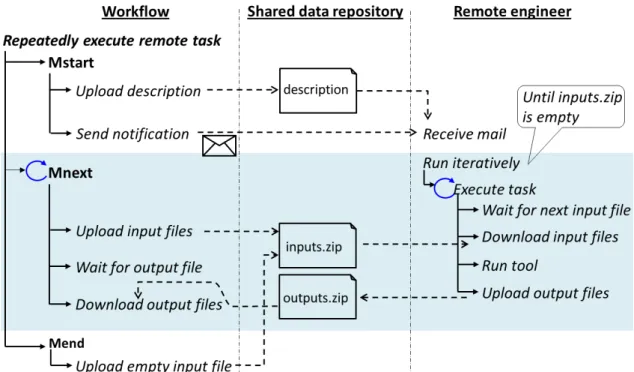
The protocol described so far is suitable for the execution of single-task jobs. If the same protocol were applied for a loop, the Remote engineer would repeatedly be notified to execute the same task again with slightly different input data. Since the handling of a consecutive series of similar notifications is cumbersome, time consuming and error prone, BRICS has an
extended protocol for gracefully dealing with multi-task jobs (cf. Fig. 4).
This protocol is based on the three commands Mstart, Mnext and Mend. The master uses the Mstart command to notify the Remote Engineer once, who is expected to repeatedly (and possibly automatically) execute the same task with different successive inputs. The master iteratively uses the Mnext command to upload the inputs for each of the iterations and waits for the results to be presented, to finally fetch the results. The sequence of iterations is terminated using the Mend command.
NLR-TP-2013-553
Fig. 4 Simplified sequence diagram of the BRICS protocol for multi-task jobs
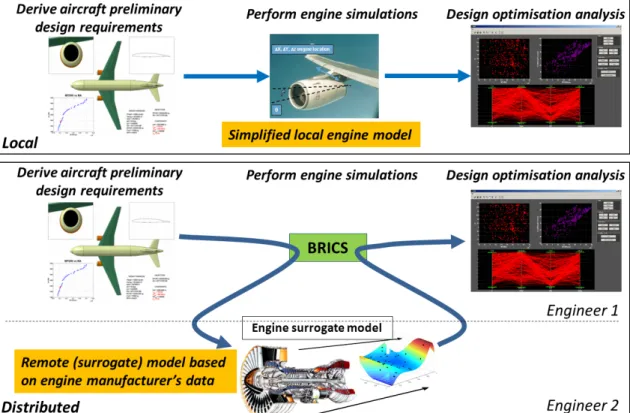
The BRICS commands support the application of the protocols for single-task and multi-task jobs in workflows, tools and scripts that orchestrate the execution of (engineering) tools across multiple organisations. Workflows may be equipped with the Start, Wait, and End (and Mstart, Mnext, and Mend) commands to outsource the execution of particular tools or parts of the workflow, and can be transformed from local into cross-organisational collaborative workflows. An example transformation is illustrated in )LJ
BRICS makes use of existing data repositories and notification mechanisms. Example data storage and exchange solutions that may play the role of Shared data repository are shared file systems, File Transfer Protocol (FTP) servers, products such as Microsoft SharePoint, and the CRESCENDO BDA server based on Eurostep Share-A-space [12]. These servers typically provide the means for settings up a secure shared data repository. The basic notification
mechanism used by BRICS is e-mail. BRICS can directly link to Simple Mail Transfer Protocol (SMTP) servers in several configurations. It also provides means for relaying notifications if e-mail traffic is restricted.
NLR-TP-2013-553
Fig. 5 BRICS supports the transformation of a local tool chain (upper) into a distributed tool chain (lower), where a local simplified model is replaced by a remotely available surrogate model
In the CRESCENDO project, BRICS has been successfully applied during the development of collaborative scenarios and solutions as well as in the final results of these efforts. Although most of the engineers involved in the development had to deal with network access restrictions, BRICS enabled them to quickly use and test their in-house solutions with other partners’ solutions in an interoperable way. As such, the engineers were enabled to work collaboratively from the very beginning of the development phase. The final results have been demonstrated in several cross-organisational collaborative aeronautical design workflows that were realised as BDA implementations and that involved an aircraft manufacturer and its suppliers, including:
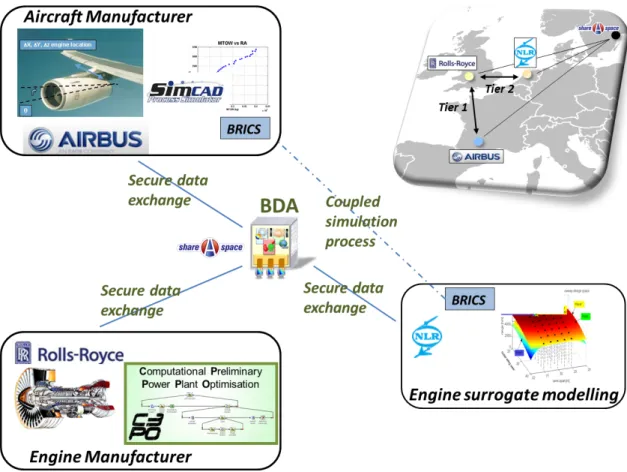
• A coupled modelling and simulation process among Airbus and NLR as part of the aircraft and engine preliminary design workflow[11]. This process is used as example in the next section. Cranfield University and Dassault Systèmes provided the simulation tooling on aircraft level running at Airbus. During the test phase, these partners used BRICS to test their solutions.
• In coupled modelling and simulation processes as part of demonstrators for the ‘Collaborative approach to manage Pylon Trade-Off Studies and Aerostructural Optimization monitoring’, among Airbus and the Onera premises in Lille and
NLR-TP-2013-553
Paris[17][18]. SAMTECH provided the optimisation tooling on aircraft level running at Airbus. During the test phase, SAMTECH used BRICS to test its tooling.
• Virtual testing & virtual certification, enabling Airbus to link with shared BDA data models[13].
BRICS has been used within, and integrated with commercial as well as proprietary tools to transform optimisation loops and other ‘low and medium frequency’ workflows [14][15] into cross-organisational collaborative workflows. BRICS has been applied from within (Shell) scripts, Visual Basic (VBA) scripts, MATLAB code, and the workflow and optimisation products Isight/SEE, BOSS Quattro, AirCADia, and SPINEware. BRICS has been installed and used in industry (Airbus and SAAB), at research institutes (NLR, DLR, ONERA in Paris as well as Lille, and Cranfield University), at software providers (SAMTECH and Dassault Systèmes), and a Small to Medium enterprise (PARAGON).
5
Surrogate modelling to facilitate industrial collaboration
As explained in section 2, the BDA concept gives rise to application of innovative collaborative modelling and simulation processes, enabling cost and time efficient aircraft development. Present models and simulation processes have been advanced to take the full advantages of the BDA concept. Some of these advancements have been illustrated and achieved on a preliminary design case that was developed in the CRESCENDO project [11], in which the aircraft and engine requirements are matured collaboratively.
During the aircraft preliminary design phase, the aircraft manufacturer needs to provide the engine manufacturer with a set of engine requirements for driving the development of consequential engine configurations. In the meantime, the engine manufacturer is required to develop future engine design concepts aligned with requests from the aircraft manufacturer. The product design process can be improved if the behaviours of the aircraft and engine designs are analysed simultaneously and in an integrated way: optimising the aircraft design using a flexible engine model, referred to as a ‘rubber engine’ [16]. The application of a rubber engine is a common step during the preliminary design stage but usually does not involve detailed engine behaviour as predicted by the engine manufacturer.
Aero-engines are complex systems and their behaviour can be predicted sufficiently and accurate only after the particular engine design has been reviewed and evaluated by engine experts. Therefore it is inconvenient to integrate this process into the aircraft design process
NLR-TP-2013-553
directly. Furthermore since mostly the engine is developed by a company other than the aircraft manufacturer, it makes the integration of the processes even more difficult if not impossible. On the other hand the protection of intellectual property prevents the engine manufacturer from sharing the complete engine design analysis process with the aircraft manufacturer.
A solution to this problem is the use of surrogate modelling to support the collaboration [11]. In this context, a surrogate model is considered a black-box abstraction of a database of detailed (rubber) engine simulation inputs and results representing the engine design and behaviour. The Surrogate model is ready to use with very low computational time. With a surrogate model, the aircraft manufacturer has the flexibility to evaluate various engine designs, while the intellectual property of the engine manufacturer is respected and kept in-house. The engine surrogate model is specifically useful for extensive trade-off studies at aircraft level since it requires low
computational effort.
In the context of the aircraft and engine preliminary design case, the engine surrogate model is defined as an analytical expression of the behaviour of an engine. The behaviour of the engine itself can be predicted by conducting real-world experiments with the engine or by means of simulation using detailed system simulation models. Since the real-world experiments are too expensive, simulation is used as source for the surrogate model. Several engine system
simulations are performed for various input settings, resulting in a data set of listed input-output combinations, called data points. One data point represents, for example, one design
configuration with the corresponding engine behaviour represented in the output values. The sampling of the data points is based on a so-called Design-of-Experiment (DoE), which should provide sufficient variability in the input values to cover the desired input range of the surrogate model. Once the data set has been produced, a surrogate model can be derived that matches the input-output combinations using data fitting techniques, such as polynomial regression. The surrogate model predicts the system output in the available data points but it also enables the prediction of output values in between these data points. This is useful to evaluate (theoretical) designs that have not been simulated yet using the detailed engine models.
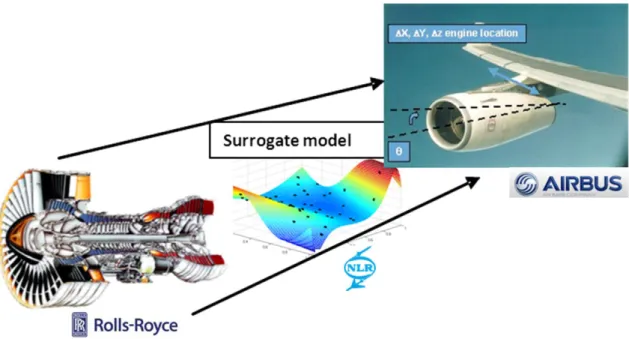
The development of the engine surrogate model to be used in the aircraft and engine preliminary design workflow contains three steps performed by the three involved partners (cf. Fig. 6):
(1) Creating a data set of detailed engine simulations, by Rolls-Royce Deutschland; (2) Creating the surrogate model, by NLR; and
(3) Integrating the surrogate model with the aircraft preliminary sizing tool used by the aircraft manufacturer, as by Airbus France.
NLR-TP-2013-553
Fig. 6 Integration of the engine surrogate model into the aircraft sizing tool as applied by the aircraft manufacturer
For the engine surrogate model, Rolls-Royce performed simulations of 400 engine configurations, using their own automated preliminary design process (Computational Preliminary Power Plant Optimisation, C3PO[10]). Six input parameters (Maximum take-off thrust, Maximum climb thrust, Maximum cruise thrust, Fan diameter, Stator outlet temperature, and High pressure compressor exit temperature) have been varied within predefined ranges using a Latin hypercube sampling DoE method. After the automated calculation of the 400 engine configurations, the results were reviewed and filtered by an engine performance specialist. Finally, a data set, including the seven output parameters Engine weight, and both Specific fuel consumption and By-pass ratio at take-off, climb and cruise, was produced.
NLR created the engine surrogate model. Based on the produced data set, a 6-dimensional input space and a 7-dimensional output space have been identified. The NLR data fitting tool
MultiFit [19] was used for analysing the application of various data fitting methods, in order to produce the best fit for the engine surrogate model. The surrogate model was next validated and improved iteratively in collaboration with Rolls-Royce, by evaluating additional engine
configurations ‘outside’ the original data set.
Airbus used the preliminary sizing tool SIMCAD for preliminary design optimisation of a conceptual aircraft configuration. The engine surrogate model has been integrated in the SIMCAD tool using the AirCADia model-based design and optimisation tool from Cranfield University [8], to account for robust optimisation and variability of engine performance
NLR-TP-2013-553
requirements respectively. The engine surrogate model, which predicts important design parameters such as engine weight, enables the aircraft sizing model to take advantage of the inclusion of a more detailed engine model during the optimisation.
To prepare for deployment in industrial preliminary design processes, the engine surrogate modelling method has been integrated in a cross-organisational aircraft and engine preliminary design workflow between Airbus as aircraft manufacturer, Rolls-Royce as engine manufacturer, and NLR as simulation service provider; see Fig. 7.
Fig. 7 Cross-organisation aircraft and engine preliminary design workflow containing engine surrogate modelling
In the CRESCENDO project, the workflow has been set up according to the BDA paradigm, and has been demonstrated in an industrial setting. The cross-organisational workflow
demonstrates collaboration on two different levels: the creation and the execution process of the engine surrogate model.
The creation process of the engine surrogate model as explained above has been performed by sharing several iterations of the engine data set between Rolls-Royce and NLR through the
NLR-TP-2013-553
BDA. Furthermore the reviewing and approval process of the surrogate model by the engine manufacturer and finally publishing it to the aircraft manufacturer has been performed through the BDA.
The actual execution process of the engine surrogate model has been performed in a cross-organisational co-simulation. The interfaces of the surrogate model have been integrated into the SIMCAD/AirCADia program that runs the aircraft preliminary design optimisation loop at Airbus while the surrogate model resides at NLR. This cross-organisational optimisation loop is a practical example of a BRICS enabled collaborative workflow, in which the IPR protection of the simulation provider and that of the engine manufacturer are respected. The loop combines the two complementary methods (surrogate modelling and interoperability respecting security constraints) presented in this paper into one demonstration.
The workflow illustrated a new collaborative approach in which the aircraft and engine
manufacturers and simulation service providers collaboratively mature the engine requirements during the preliminary design phase. This approach eliminates the non-value added rework cycles in early and later design stages. Specifically the application of an engine surrogate model is advantageous at aircraft level since it allows extensive trade-off studies due to low
computational effort while respecting the intellectual property of the engine manufacturer. The engine surrogate modelling workflow has been developed as a demonstrator in the context of the CRESCENDO test case scenario: ‘A collaborative approach to manage the maturity indicator for design convergence between the Airframe- & Engine-Manufacturer’. A total of eleven partners were involved in the setup of this scenario.
6
Conclusion and future work
The overall Behavioural Digital Aircraft (BDA) concept provides innovative approaches to improve collaboration in simulation process orchestration and associated data management to help developing new aeronautical products with less cost and timely manner.
This paper described BRICS solutions for secure collaborative multi-partner modelling and simulation processes in the BDA context. The results show how aeronautical engineers experience the benefits of seamless collaborative modelling and simulation across
organisational boundaries for their daily work. One of the conclusions that can be drawn from the experiences is that BRICS successfully supports cross-organisational secure collaborative engineering, thereby catering for participation of partners with network restrictions while
NLR-TP-2013-553
obeying the increasingly strong security constraints. The solutions realised with BRICS are suitable for collaboration among industry and its suppliers, including small to medium enterprises.
The aircraft and engine preliminary design case involving engine surrogate modelling illustrated that surrogate modelling is a key technology for collaborative modelling and simulation
activities in the extended enterprise. It caters extensive trade-off studies at aircraft level and it reduces non-value added rework cycles in early and later design stages, while respecting intellectual property rights of the involved partners.
Further exploration and application of the BDA concept in aircraft preliminary design will radically improve the way in which modelling and simulation is performed within aircraft design processes. The European Framework Project TOICA (‘Thermal Overall Integrated Conception of Aircrafts’), which is envisaged to start in September 2013, has gathered 32 partners to work on this radical improvement in the thermal domain by simultaneously modelling and simulating in a collaborative environment the thermal behaviour of aircraft airframe systems, equipment and components. TOICA’s ambition is to:
• Develop the means to improve and optimise the whole aircraft thermal behaviour and deduce the relevant change to bring in the overall architecture of the systems.
• Transform the current thermal analysis to a complete transverse and collaborative thermal process impacting the overall aircraft design thanks to early collaborations of system and equipment providers.
• Improve the collaborations among all actors for a deeper integration of the thermal constraints in the architecture and preliminary design phases.
• Extend the Behavioural Digital Aircraft environment with new capabilities able to support architect decisions during the trade-off to hold at aircraft and component levels.
Benefitting the results from a range of previous European projects, such as the collaboration results presented in this paper, TOICA is a key part of the overall roadmap to create and manage the behavioural modelling of aircraft, thereby supporting the Vision 2020 and FlightPath 2050 Vision.
NLR-TP-2013-553
Acknowledgements
The research leading to these results has received funding from the European Union’s Seventh Framework Programme FP7/2007-2013 under grant agreement no. 234344 (CRESCENDO). The authors would like to acknowledge all colleagues from the CRESCENDO project partners who contributed to the success of the collaborative design studies that provided valuable input for the research described in this paper. The authors also thank the TOICA Consortium for providing its information.
References
[1] Baalbergen E.H., Lammen W.F. and Kos J.: “Mastering Restricted Network Access in Aeronautic Collaborative Engineering across Organizational Boundaries”, PDT Europe 2012, The Hague, the Netherlands, 25-26 September 2012.
[2] Baalbergen E.H., Vankan W.J. and Kanakis A.: “A practical approach for coordination of multi-partner engineering jobs in the design of small aircraft”, CESAR Special Issue of Journal Czech Aerospace Proceedings / Letecký zpravodaj, Journal for Czech Aerospace Research, No. 3, November 2009, p.5-9.
[3] Coleman P.: “Innovations in collaborative modelling and simulation to deliver the Behavioural Digital Aircraft: A summary of results from the CRESCENDO project”, PDT Europe 2012, The Hague, The Netherlands, 25-26 September 2012.
[4] Coleman P.: CRESCENDO consortium partners, Innovations in collaborative modelling and simulation to deliver the Behavioural Digital Aircraft, CRESCENDO Forum Participants Handbook, Toulouse, France, June 2012.
[5] Coleman P. and Tabaste O.: “The behavioural digital aircraft vision for simulation in collaborative product development”, 2013 MSC Software Users Conference, Irvine, USA, 7-8 May 2013, and Gaydon, UK, 15-16 May 2013.
[6] EU High Level Group on Aviation Research: Flightpath 2050. Europe’s Vision for Aviation: Maintaining Global Leadership & Serving Society’s Needs, European Commission, 2011.
[7] EU Sherpa Working Group: European Aeronautics: European Aeronautics: Vision for
2020: Meeting Societies Needs and Winning Global Leadership, European Commission, 2001.
[8] Guenov M.D., Nunez M. and Gondhalekar A.C.: “Comparing Design Margins in Robust and Deterministic Design Optimisation”, in, C. Poloni, D. Quagliarella, J. Périaux, N. Gauger and K. Giannakoglou (Eds.), EUROGEN 2011. Evolutionary and
NLR-TP-2013-553
Deterministic Methods for Design, Optimisation and Control with Applications to Industrial and Societal Problems, Capua, Italy, 2011
[9] Kesseler E. and Guenov M. (eds.): Advances in Collaborative Civil Aeronautical Multidisciplinary Design Optimization, Progress in Astronautics and Aeronautics Series, 233, American Institute of Aeronautics and Astronautics, Reston, VA, 2010.
[10] Kupijai P., Bestle D., Flassig P. and Kickenweitz D.: “Automated multi-objective optimisation process for preliminary engine design”, ASME 2012 turbine technical Conference & Exposition (TurboExpo 2012), GT2012-68612, 2012..
[11] Lammen W., Kickenweitz D., Laudan T. and Kupijai P.: “Integrate Engine
Manufacturer’s Knowledge into the Preliminary Aircraft Sizing Process”, Airtec 7th International Conference “Supply on the Wings” Aerospace – a leading innovator, Frankfurt/Main, Germany, 6-8 November 2012.
[12] Murton A. and Shaw N.: “Developing an Architecture and Standard to Support Innovations in Collaborative Modelling and Simulation”, PDT Europe 2012, The Hague, The Netherlands, 25-26 September 2012.
[13] Ölvander J. and Steinkellner S.: “Model Based Collaborative Engineering from Requirements to Verification and Validation”, presented at 6th MODPROD Workshop on Model-Based Product Development, Linköping, Sweden, and 7-8 February 2012.
[14] Parchem R., Flassig P. and Wenzel H.: “Collaborative Robust Engine Design
Optimization”, presented at SIMULIA Community Conference 2013, Vienna, Austria, 21 May 2013.
[15] Parchem R. and Wenzel H.: “Executing Optimization Processes in the Extended Enterprise”, NAFEMS World Congress 2013, 1st SPDM Conference, Salzburg, Austria, 9-12 June 2013.
[16] Raymer D.P., Aircraft Design: A Conceptual Approach, Fourth edition, AIAA, Reston, VA, USA, 2006.
[17] Tabaste O., Laudan T., Grihon S. and Arbez P.: “Being Prepared for the Future: Trade-off Management Technology for Architects within Designing the Robust Virtual Aircraft”, presented at Global Product Data Interoperability Summit, Phoenix, 2012; also presented at NAFEMS North America Conference ’12, Washington, DC, USA, 11-12 September 2011-12.
[18] Tabaste O., Arbez P, Grihon S., Laudan T., Thomas M.: “Illustration Of Comprehensive Behavioural Digital Aircraft Enablement through Use Cases”, NAFEMS World
Congress 2013, 1st SPDM Conference, Salzburg, Austria, 9-12 June 2013.
[19] Vankan W.J., Lammen W.F. and Maas R.: “Meta-modelling and multi-objective optimization in aircraft Design”, in [9], chapter 6, 2010.
![Fig. 1 Illustration of the Behavioural Digital Aircraft concept as developed in CRESCENDO [5]](https://thumb-us.123doks.com/thumbv2/123dok_us/89440.2510188/9.892.171.806.525.952/fig-illustration-behavioural-digital-aircraft-concept-developed-crescendo.webp)