for Scene Classification
Xin Li and Yuhong Guo
Department of Computer and Information Sciences Temple University
Philadelphia, PA 19122, USA {xinli, yuhong}@temple.edu
Abstract. Semantic scene classification is a challenging problem in com-puter vision. In this paper, we present a novel multi-level active learn-ing approach to reduce the human annotation effort for trainlearn-ing robust scene classification models. Different from most existing active learning methods that can only query labels for selected instances at the target categorization level, i.e., the scene class level, our approach establishes a semantic framework that predicts scene labels based on a latent object-based semantic representation of images, and is capable to query labels at two different levels, the target scene class level (abstractive high level) and the latent object class level (semantic middle level). Specifically, we develop an adaptive active learning strategy to perform multi-level la-bel query, which maintains the default lala-bel query at the target scene class level, but switches to the latent object class level whenever an “unexpected” target class label is returned by the labeler. We conduct experiments on two standard scene classification datasets to investigate the efficacy of the proposed approach. Our empirical results show the proposed adaptive multi-level active learning approach can outperform both baseline active learning methods and a state-of-the-art multi-level active learning method.
Keywords: Active Learning, Scene Classification.
1
Introduction
Scene classification remains one of the most challenging problems in computer vision field. Different from the classification tasks in other fields such as NLP, where the meanings of features (e.g., words) are perceivable by human beings, the low-level features of an image are primarily built on some signal responses or statistic information of mathematical transformations. Though these low-level features are useful and powerful as proved by numerous works for decades, the
semantic gapbetween the semantically non-meaningful low-level features and the high-level abstractive scene labels becomes a bottleneck for further improving scene classification performance. Recent advances on scene classification [24, 19] and other related tasks such as semantic segmentation [29, 3, 12] and object
(a) coast/city (b) mountain/coast (c) field/airport
(d) theater/auditorium (e) airport/mall (f) terminal/auditorium Fig. 1: Examples of ambiguous scene categories. (a)-(c) are confusing examples of outdoor scenes and(d)-(e) are examples of indoor scenes.
detection/recognition [32, 11, 5] have demonstrated the importance of exploiting semantic information and extracting high-level scene label structures, where a scene label (e.g., coast) can be viewed as a semantic concept comprising of a set of important high level visual objects (e.g., sky, sand and sea). The work in [14] particularly demonstrated the strength of predicting scene labels based on the high-level object-based representations of images. However, this work requires supervised training of object detectors, which can significantly increase the demand for human annotation effort. Moreover, to produce a good scene classification model, a sufficient amount of target scene labels need to be acquired as well, which induces expensive human annotation cost. In this work, we address the important problem of reducing human annotation effort for learning scene classification models.
Active learning is a well studied technique for reducing the cost of manual annotations by performing selective instance sampling. In contrast to “passive” learning where the learner uses randomly generated labeled instances, “active” learners iteratively select the most informative instances to label in an inter-active learning process [25]. Traditional inter-active learners query labels for the se-lected instance at the target prediction label level, which however is not the best strategy in many cases of scene classification tasks. Scene labels are highly abstractive and semantic labels. Without accurately identifying their high level object-based semantic representations, some scene labels can be very difficult to be distinguished from each other even by a human labeler in many scenarios. For example, it is hard to tell for a human labeler whether the image in Figure 1(b) is indeed a mountain scene or a coast scene; similarly, it is hard to tell whether the image in Figure 1(e) is the seating area of a mall or an airport terminal. From Figure 1 we can see that such ambiguities exist not only among outdoor scenes but also in indoor scenes. However, the objects contained in these images
are much more easier to be identified by a human labeler. The object level la-bels may successfully infer the scene lala-bels based on the object-based statistical semantic scene structure induced from the labeled data.
Based on these observations, in this paper we develop a novel multi-level adaptive active learning approach to reduce the annotation effort of learning accurate scene classification models. This approach is based on a latent object-based hierarchical scene classification model, which involves both scene classifier and object classifiers. It selects both instance and label types to query, aiming to reduce the overall prediction uncertainty of the multi-class scene classification model over all labeled and unlabeled instances. By default, it performs label query at the target scene class level and selects instance based on a maximum conditional mutual information criterion. But whenever an “unexpected” target scene label is returned by the labeler in a given iteration, it will switch to per-form label query at the latent object class level in the next iteration for once. After querying for a scene label, only the scene classifier will be updated. But if an object label is queried, both object and scene classifiers will be updated. We conduct experiments on two standard scene classification datasets to investigate the efficacy of the proposed approach. Our empirical results show the proposed adaptive multi-level active learning approach can outperform a few baseline ac-tive learning methods and a state-of-the-art multi-level acac-tive learning method.
2
Related Work
In this section, we present a brief review over the related scene classification and active learning works developed in computer vision field.
Scene classificationhas long gained its popularity in the literature. Previ-ous works on scene classification can be categorized into two main groups: data representation centered methods and classification model centered methods. In the first group, mid-level representations built from low-level features such as SIFT [17] or HOG [2] features have been exploited for scene classification. For example, [4] introduces a bag-of-words (BoW) model based on low-level features to represent a natural scene image. [13] proposes a spatial pyramid matching model to further improve the BoW model by taking the spatial relationship between the visual words into account. [33] proposes a novel holistic image de-scriptor for scene classification. More recent efforts have centered on representing a scene with semantically meaningful information rather than statistic informa-tion of low-level hand-designed features. [24] proposes an image representainforma-tion based on discriminative scene regions detected using a latent SVM model. [14] proposes an object-centered approach called object bank, where each image is represented as the response map to a large number of pre-trained generic ob-ject detectors. Our classification model shares similarity with this work on using the presence of objects as attributes for scene classification. However, the object bank method requires supervised training of a large number of object detec-tors which is extremely expensive in terms of annotation cost, while the object classifiers in our model are learned on the fly in a semi-supervise manner and
require very limited annotations. Moreover, the object detectors of the object bank model take the whole image as input, while our object classifiers pursue patch-based training. Another work [22] also proposes an attribute based scene representation which contains binary attributes to describe the intra- and inter-class scene variations. But similar to the object bank method, their attribute learning is quite expensive and they predict the presence of attributes using the sliding window technique which further increases the computational cost.
For methods centered on classification model development, we would like to mention a few works with widely used techniques [19, 23, 20]. In [19], a de-formable part-based model (DPM) has been applied to address scene categoriza-tion. [23] proposes a prototype based model for indoor scenes that captures the characteristic arrangements of scene components. [20] proposes a latent struc-tural SVM for the reconfigurable version of a spatial bag of words model. These methods also demonstrate the usefulness of exploiting mid-level representations for scene classification. Nevertheless, all these methods are passive learning meth-ods and require a large number of labeled instances for training.
Active learningmethods have been widely used in computer vision field to reduce human labeling efforts in image and video annotation [10, 34], retrieval [31], recognition [7–9] and segmentation [29]. These active learning methods iter-atively select the most informative instance to annotate according to a given in-stance selection criterion. Recently, some researchers have observed that exploit-ing sexploit-ingle criterion for instance selection lacks the capacity of handlexploit-ing different active learning scenarios, and an adaptive active learning strategy that integrates strengths of different instance selection criteria has been proposed in [15]. Nev-ertheless, all these active learning methods are limited to querying labels in the target prediction label space, and lack sufficient capacity of handling the highly semantic scene classification problems and exploiting advanced scene classifica-tion models, especially when the scene images are ambiguous to categorize as demonstrated in Figure 1. Our proposed active learning approach will address the limitation of these current methods by exploiting a latent object-based scene classification model and performing multi-level adaptive label querying at both the scene class level and the object class level.
There are a number of existing active learning methods that query the label-ers for information beyond the target image labels. For example, [18] considlabel-ers attributed based prediction models and asks users for inputs on the attribute level to improve the class predictions, while assuming fixed attribute configura-tions for each give image class label. [30] treats the overall object classification problem as a multi-instance learning problem and considers the same type of labels at two levels, instance level (segments) and bag level (images). These works [18, 30] nevertheless are still limited to exploiting the same type of stan-dard queries, while another few works [1, 21, 27, 11] have exploited semantic or multiple types of queries. [1, 21] introduces a new interactive learning paradigm that allows the supervisor to additionally convey useful domain knowledge using
relativeattributes. [27] presents an active learning framework to simultaneously learn appearance and contextual models for scene understanding. It explores
three different types of questions: regional labeling questions, linguistic ques-tions and contextual quesques-tions. However, it does not handle scene classification problems but evaluate the approach regarding the region labels. [11] presents an active learning approach that selects image annotation requests among both object category labels and the object-based attribute labels. It shares similarity with our proposed approach in querying at multi-levels of label spaces, but it treats image labels and attribute labels in the same way and involves expensive computations. Nevertheless, these active learning works tackle object recogni-tion problems using pre-fixed selecrecogni-tion criteria. Our proposed approach on the other hand uses an adaptive multi-level active learning strategy to optimize a latent object-based hierarchical scene classification model.
3
Proposed Method
In this section, we first establish the hierarchical semantic scene classification model based on latent object level representations in Section 3.1 and then present our multi-level adaptive active learning method in Section 3.2.
3.1 Hierarchical Scene Classification Model
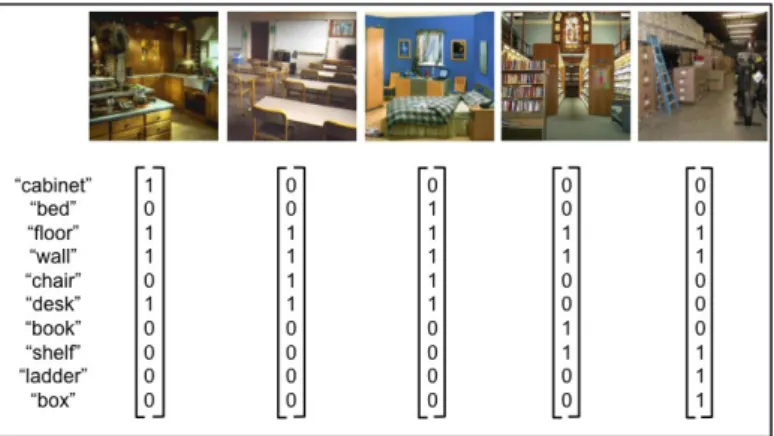
Learning mid-level representations that capture semantic meanings has been shown to be incredibly useful for computer vision tasks such as scene classifi-cation and object recognition. In this work, we treat object category values as high level scene attributes, and use a hierarchical model for scene classification that has a mid-level object representation layer. The work flow of our approach has four stages: Firstly, we preprocess each image into a bag of patches and a bag of low-level feature vectors can be produced from the patches. For the sake of computational efficiency, we only used aligned non-overlapping patches. We expect each patch presents information at the local object level. Secondly, we perform unsupervised clustering over the patches using a clustering method K-Medoids and then assign an objectclass nameto each patch cluster by querying the object level labels for the center patch in each cluster. Thirdly, we train a set of binary object classifiers based on these named clusters of patches using the one-vs-all scheme. Then for each image, its mid-level object-based representa-tion can be obtained by applying these object classifiers over its patches. That is, each image will be represented as a binary indicator vector, where each entry of the vector indicates the presence or absence of the corresponding object category in the image. Figure 2 presents examples of this mid-level object-based repre-sentation of images. Finally, a multi-class scene classifier is trained based on the mid-level representation of labeled images. To further improve the scene classi-fier, we have also considered using hybrid features to train the scene classifier. That is, we train the scene classifier based on both the mid-level representa-tion features and the low-level features of the labeled images. This turns out to be more robust for scene classification than using the mid-level representation alone. More details will be discussed in the experimental section.
Fig. 2: Examples of the mid-level semantic representation employed in our scene classification model. Each 1 value indicates the presence of an object and each 0 value indicates the absence of an object in a given image.
Our system uses logistic regression as the classification model at both object and scene levels. Given the patchlabels produced by clustering, for each object class, we have a set of binary labeled patches{(˜xi,z˜i)}Ni=1o with ˜zi ∈ {+1,−1}. We then train a probabilistic binary logistic regression classifier for each object class to optimize a`2-norm regularized log-likelihood function
min u −C No X i=1 logP(˜zi|x˜i) + 1 2u Tu (1) where P(˜zi|˜xi) = 1 1 + exp(−z˜i˜xTi u) (2) For scene classification, given the labeled data L = {(zi, yi)}Ni=1, where zi is the mid-level indicator representation vector for the i-th imageIi, andyi is its scene class label, we train a multinomial logistic regression model as the scene classifier. Specifically, we perform training by minimizing a`2-norm regularized
negative log-likelihood function
min w −C N X i=1 logP(yi|zi) + 1 2w Tw (3) where P(yi=c|zi) = exp(zT iwc) P c0exp(zTi wc0) (4) The minimization problems in both (1) and (3) above are convex optimization problems, and we employ the trust region newton method developed in [16] to perform training.
We can see that our hierarchical scene classification model has similar capac-ity with the object bank method regarding exploiting the object-level representa-tions of images. For object-based representation models, one needs to determine what object classes and how many of them should be used in the model. The ob-ject bank model chooses obob-ject classes based on some statistic information drew from several public datasets and their object detectors are trained on several large datasets with a large amount of object labels as well. However, our model only requires object labels for a relatively very small number of representative patches produced by K-Medoids clustering method to automatically determine the object classes and numbers involved in our target dataset. In detail, for each cluster center patch, we will seek an object label from a human labeler through a crowd-sourcing system and take it as the class label for the whole cluster of patches. However, due to the preferences of different labelers, the labels can be provided at different granularity levels, e.g., “kid” vs “sitting kid”. Moreover, typos may exist in the given labels, e.g., “groound” vs “ground”. We thus apply some word processing technique [28] on the collected object labels. When the given label is a phrase, we will not process it as a new category if one of its component words is already a category keyword. Hence “sitting kid” will not be taken as a category if “kid” is already one. After object labels being purified, we merge the clusters with the same object labels and produce the final object classes and number for the given data. In our experiments, the numbers of object classes resulted range from 20 to 50, which fits into the principle of Zipf’s Law and implies that a small proportion of object classes account for the majority of object occurrences.
3.2 Multi-level Adaptive Active Learning
Letzi denote the mid-level feature vector for imageIi,Y ={1. . . Ky} denote the scene class label space,L={(z1, y1), . . . ,(zN, yN)}denote the set of labeled instances, and U denote the large pool of unlabeled instances. After initializing our training model based on the small number of labeled instances, we perform multi-level active learning in an iterative fashion, which involves two types of iterations, scene level iterations and object level iterations. In ascene level it-eration, it selects the most informative unlabeled instance to label at the scene class level, while in an object level iteration, it selects the most informative un-labeled instance to label at the object class level. An adaptive strategy is used to perform switch between these two types of iterations.
Scene level iteration. In such an iteration, we select the most informative un-labeled instance to label based on a well-motivated utility measure, named max-imum conditional mutual information (MCMI), which maximizes the amount of information we gain from querying the selected instance:
z∗= arg max
z∈U
where the data set entropy is defined as H(L) =− |L∪U | X i=1 |Y| X l=1 PL(yi=l|zi) logPL(yi =l|zi) (6)
which measures the total entropy of all labeled and unlabeled instances.PL(y|z)
denotes the probability estimate produced by the classification model that is trained on the labeled dataL. Note the first entropy termH(L) remains to be a constant for all candidate instances and can be dropped from the instance selection criterion, which leads to the selection criterion below:
z∗= arg min
z∈U
H(L ∪(z, y)) (7)
Though Equation (7) provides a principled instance selection criterion, it is im-possible to compute given the true labely is unknown for the unlabeled query instancez. We hence adopt the “optimistic” strategy proposed in [6] to pursue an alternative optimistic selection criterion below:
(z∗, l∗) = arg min
z∈U
min
l∈Y H(L ∪(z, l)) (8)
which selects the candidate instancez∗and its a label optionl∗that leads to the smallest total prediction uncertainty over all instances. Once the true labely∗of the select instancez∗being queried, we added (z∗,y∗) into the labeled setLand retrain the scene classifier. This optimistic selection strategy however requires retraining the scene classifier forO(|U |×|Y|) times to make the instance selection decision: For each of the |U | unlabeled instances, one scene classifier needs to be trained for each of its |Y| candidate labels. The computational cost can be prohibitive on large datasets. To compensate this drawback, one standard way is to use random sub-sampling to select a subset of instances and label classes to reduce the candidate set in Equation (8).
Object level iteration. Querying labels at the object class level raises more questions. First, what, image vs patch, should be presented to the human la-beler? What information should we query? A naive idea is to present a patch to the human labeler and query the object class label of the patch. However, it will be very difficult to select the right patch that contains a perceivable and discriminative object. Hence, instead of presenting patches to the annotators, we present a whole image to the labeler and ask whether the image contains a particular set of selected objects. Such specific questions will be easy to answer and will not lead to any ambiguities.
Next, we need to decide which image and what objects to query. We em-ploy a most uncertainty strategy and select the most uncertain image (with the maximum entropy) to query under the current scene classification model:
z∗= arg max z∈U − |Y| X l=1 PL(y=l|z) logPL(y=l|z) (9)
For the selected image z∗, we then select the top M most important objects regarding the most confident scene label ˆl∗ofz∗under the current scene classifier to query (We used M = 5 in our experiments later). Specifically, ˆl∗ will be
determined as ˆl∗= arg maxlPL(l|z∗). Then we chooseMobjects that correspond
to the largestM entries of the weight parameter vector|wˆl∗|under the current
multi-class scene classifier. Our query questions submitted to the annotators will be in a very specific form: “Does object oi appear in this image?” We will ask
M such questions, one for each selected object.
The last challenge in the object level iteration is on updating the scene clas-sification model after the selected object labels being queried. If the answer for a question is “No”, we simply re-label all patches of the selected image as neg-ative samples for that object class, and retrain the particular object classifier if needed. On the other hand, if the answer for a question is “Yes”, it means at least one patch in this image should have a positive label for the particular object class. We hence assign the object label to the most confident patch within the selected image under the current particular object classifier. Then we will refine our previous unsupervised patch clustering results by taking the newly gathered patches into account. Our clustering refine scheme is very simple. Given the pre-vious clustering result with K clusters, we set the new labeled patch as a new cluster center and perform K-Medoids updates withK+ 1 clusters. Note two of theseK+1 clusters share the same object label and we will merge them after the end of the clustering process. Finally, all object classifiers will be updated based on the new clustering results. Consequently, the mid-level representations of each labeled image changes as well, and the scene classifier needs to be updated with the new mid-level features.
Adaptive active learning strategy. The last question one needs to answer to produce an active learning algorithm is how do we decide which type of iterations to pursue. We employ an adaptive strategy to make this decision: By default, we will perform active learning with scene level iterations, as most traditional active learners pursued. In each such iteration, an instancez∗and its optimisticl∗ will be selected, and its true label y∗ will be queried. However, once we found the true labely∗ is different from the optimistic guessl∗, which means the strategy in the scene level iteration has been misled under the current scene classifier, we will then switch to the object level iteration in the next iteration to gather more information to strengthen the scene classification model from its foundation. We will switch back to the traditional scene label iteration after that. The overall multi-level adaptive active learning algorithm is summarized inAlgorithm 1.
4
Experimental Results
We investigate the performance of the proposed active learning approach for scene classification on two standard challenging datasets, Natural Scene dataset and MIT Indoor Scene dataset. Natural scene dataset is a subset of the LabelMe dataset, which contains 8 scene categories (coast, forest, highway, inside city,
Algorithm 1Multi-level Adaptive Active Learning
1: Input: Labeled setL, unlabeled setU, and record setV= Ø; 2: M: number of objects to query on each image,
3: K: number of patch clusters. 4: Procedure:
5: Apply K-Medoids clustering on patches{˜xi∈ L}.
6: Query object labels for each cluster center patch. 7: Merge clusters with the same object labels. 8: Train object classifiers based on the clusters.
9: Obtain mid-level representation for each imagez∈ L ∪ U. 10: Train a scene classifier onL.
11: Set itype = 1. %scene level=1, object level = 0 12: repeat
13: if itype == 1then
14: Select (z∗, l∗) from the unlabeled setU based on Equation (8) and purchase its true labely∗.
15: Dropz∗fromU and add (z∗, y∗) intoL. 16: Retrain the scene classifier on the updatedL. 17: if y∗6=l∗ then
18: Set itype =0. 19: end if
20: else
21: Selectz∗∈ U \ Vaccording to Equation (9). 22: Predict most confident scene label ˆl∗ forz∗.
23: Query the topM most important objects based on the absolute weight values|wˆl∗|for scene class ˆl∗.
24: Update the clustering result if necessary. 25: Update object classifiers.
26: Addz∗intoV.
27: Update the mid-level representation for all images. 28: Update scene classifier on L.
29: Set itype =1. 30: end if
31: untilrun out of money or achieve the aim
mountain, open country, street, and tall building) and each category has more than 250 images. We randomly selected 100 images from each category and pooled them together into a training set and used the rest as the test set. We further randomly selected 5 images per category (40 in total) as the initial labeled set. MIT indoor scene dataset contains 67 indoor categories and a total of 15,620 images. The number of images varies across categories, but there are at least 100 images per category. We randomly selected 50 images per category to form the training set and the rest are used for testing. Within the training set, 2 images are randomly selected from each category as labeled instances and the rest images are pooled together as unlabeled instances.
The natural scene dataset has object level annotations available to use and the MIT indoor scene dataset also has object level annotations for a proportion
of its images. We thus simulated the human annotators’ answers based on these available object level annotations for our multi-level active learning. For the MIT indoor scene dataset, we further preprocessed it by discarding the categories that contain less than 50 annotated images (at the object level). After this preprocessing, only 15 categories were left. We produced all non-overlapping patches in size of 16×16 pixels that cover each image. We used the 128-dimension SIFT feature as the low-level features in our experiments.
In our experiments, we compared the proposed Multi-Level Adaptive ac-tive learning (MLA)method to three baselines: (1)Single-Level Active learning (SLA)method, which is a variant of MLA that only queries the scene labels; (2)
Single-Level Random sampling (SLR)method, which randomly selects an image from the unlabeled pool in each iteration and queries its scene label; and (3)
Multi-Level Random sampling (MLR)method, which randomly selects an image from the unlabeled pool in each iteration and then randomly chooses to query its object labels or scene label with equal probability. Moreover, we have also com-pared to the method, Active Learning with Object and Attribute annotations (ALOA), developed in [11]. This ALOA method is the state-of-the-art active learner that utilizes both attribute and image labels. We usedK= 200 (for the
K-Medoids clustering) and M = 5 for the proposed and the baseline methods. For the trade-off parametersCin Eq.(1) and Eq. (3), we setC as 10 for the ob-ject classifiers and 0.1 for the scene classifier, aiming to avoid overfitting for the scene classifier with limited labeled data at the scene level. Starting from the ini-tial randomly selected labeled data, we ran each active learning method for 100 iterations, and recorded their performance in each iteration. We repeated each experiment 5 times and reported the average results and standard deviations.
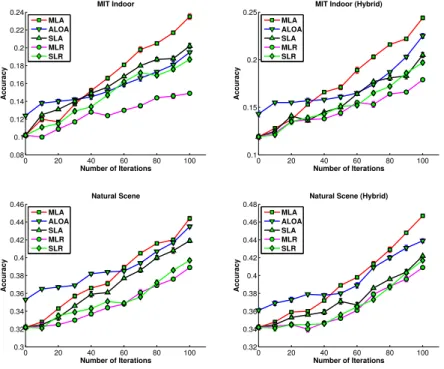
Figure 3 presents the comparison results in terms of scene classification ac-curacy on the MIT Indoor scene dataset and the Natural scene dataset. For the proposed approachMLAand the baselines SLA, MLR, SLR, we experimented two different ways of learning scene classifiers.1A straightforward way is to learn
the scene classifier based on the mid-level semantic representation produced by the object classifiers. Alternatively, we have also investigated learning the scene classifier based on hybrid features by augmenting the mid-level representation with the low-level SIFT features. Such a mechanism was shown to be effective in [26]. Specifically, we built a 500-words codebook with K-Means clustering over the SIFT features and represented each image as a 500-long vector with vector quantization. This low-level representation together with the mid-level represen-tation form the hybrid features of images for scene classification. The comparison results based only on mid-level representation are reported on the left column of Figure 3 for the two datasets respectively; and the comparison results based on the hybrid features are reported on the right column of Figure 3. We can see in terms of scene classification accuracy, our proposed methodMLAbeats all other comparison methods, especially the baselines, across most of the comparison range, except at the very beginning. At the beginning of the active learning pro-cess,ALOAproduces the best performance with very few labeled images. Given
0 20 40 60 80 100 0.08 0.1 0.12 0.14 0.16 0.18 0.2 0.22 0.24 MIT Indoor Number of Iterations Accuracy MLA ALOA SLA MLR SLR 0 20 40 60 80 100 0.1 0.15 0.2 0.25
MIT Indoor (Hybrid)
Number of Iterations Accuracy MLA ALOA SLA MLR SLR 0 20 40 60 80 100 0.3 0.32 0.34 0.36 0.38 0.4 0.42 0.44 0.46 Natural Scene Number of Iterations Accuracy MLA ALOA SLA MLR SLR 0 20 40 60 80 100 0.32 0.34 0.36 0.38 0.4 0.42 0.44 0.46 0.48
Natural Scene (Hybrid)
Number of Iterations Accuracy MLA ALOA SLA MLR SLR
Fig. 3: The average and standard deviation results in terms of scene classification accuracy on both MIT Indoor scene dataset and Natural Scene dataset. thatALOA[11] uses the state-of-the-art latent SVM classifier, and our approach uses a simple logistic regression model, this seems reasonable. But the gap be-tween ALOAand the proposedMLAquickly degrades with the active learning process; after a set of iterations, MLA significantly outperforms ALOA. This demonstrates that our proposed multi-level adaptive active learning strategy is much more effective and it is able to collect most useful label information that makes a simple logistic regression classifier to outperform the state-of-the-art latent SVM classifier. Among the three baseline methods,SLAalways performs the best. On MIT-Indoor dataset, it even outperformsALOAwhen only seman-tic representation is used. This suggests the MCMI instance selection strategy we employed in the scene level iterations is very effective. On the other hand, the random sampling methods MLRandSLRproduce very poor performance. Another interesting observation is that at the start of active learning, though we only have very few labeled instance available for each category, the accuracy of our latent object-based hierarchical scene classification model already reaches around 12% on 15-category MIT indoor scene subset and reaches around 34% on Natural scene dataset. This demonstrates the mid-level representation is very descriptive and useful for abstractive scene classification. By comparing the two versions of results across columns, we can see that with hybrid features, the proposed MLA produces slightly better results, which suggests that low-level features and mid-level representation features can complement each other.
0 20 40 60 80 100 1545 1550 1555 1560 1565 1570 1575 1580 1585 MIT Indoor Number of Iterations
Entropy of the system MLA SLA MLR SLR 0 20 40 60 80 100 1540 1550 1560 1570 1580 1590
MIT Indoor (Hybrid)
Number of Iterations
Entropy of the system MLA
SLA MLR SLR 0 20 40 60 80 100 2150 2160 2170 2180 2190 2200 2210 Natural Scene Number of Iterations
Entropy of the system MLA
SLA MLR SLR 0 20 40 60 80 100 2080 2090 2100 2110 2120 2130 2140
Natural Scene (Hybrid)
Number of Iterations Entropy of the system MLA
SLA MLR SLR
Fig. 4: The entropy reduction results on both MIT Indoor Scene dataset and Natural Scene dataset.
In addition to scene classification accuracy, we have also measured the per-formance of the comparison methods in terms of system entropy (i.e., data set entropy). We recorded the reduction of the system entropy with the increasing number of labeled instances. TheALOAmethod from [11] uses a Latent SVM model, the system entropy of which is contributed by both the image classifier and the model’s inner attribute classifiers. However, the entropies of all other methods are only associated with the target image label predictions, which makes the computed entropy ofALOAand others not comparable. Therefore, we only consider the other four methods in this experimental setting. The results are reported in Figure 4. It is easy to see that the proposedMLA method reduces the entropy much quickly than other baselines, which verifies the effectiveness of our proposed adaptive active learning strategy. The curve ofMLAis monotone decreasing, indicating that every query is helpful in terms of entropy reduction. The curves of the other baselines nevertheless have fluctuations. Among them,
SLAis almost always the runner-up except on the MIT indoor dataset with hy-brid features. By comparing the two versions of results across columns, we can see the system entropy with hybrid features is relatively lower than its counter-part with mid-level semantic representation alone, which again suggests that the low-level features can provide augmenting information for the mid-level semantic representations.
1 2 3 4 5 6 7 8 0 5 10 15 20 25 30 Natural Scene
scene class index
Number of Instances 1 2 3 4 5 6 7 8 9 10 11 12 13 14 15 0 5 10 15 MIT Indoor
scene class index
Number of Instances
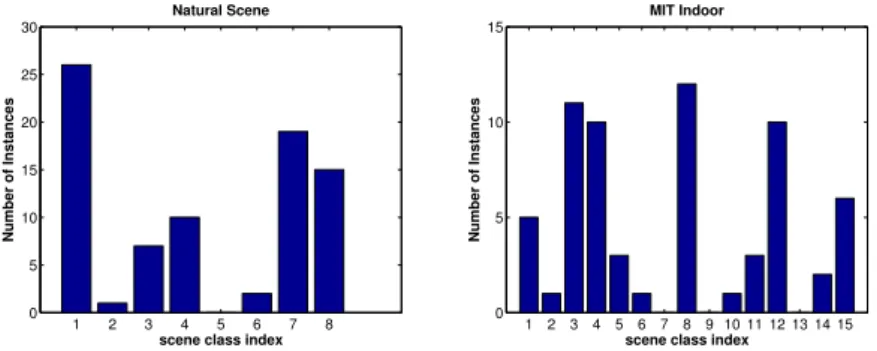
Fig. 5: Distribution of queried instances in scene label space for the proposed approach on MIT Indoor and Natural Scene datasets.
Finally, we collected the number of queries in each scene category on the two datasets for the proposed approach and presented the results in Figure 5. We can see, obviously the instances are not selected according to a uniform distri-bution across categories. The total numbers of scene level label queries among the 100 iterations are 65 and 80 on the MIT Indoor and Natural scene datasets respectively. The remaining querying effort is on the object-level annotations. On the MIT indoor dataset, the ratio between the numbers of queries on scene labels and object annotations is about 2 : 1. In contrast, this ratio is 4 : 1 on the Natural scene dataset. This observation indicates that our model can adaptively switch query levels based on the complexity of the data. When the object layout is easy, it will put more effort on querying scene labels; when the scene becomes complicated and ambiguous, it will ask more questions about object annotations.
5
Conclusions
In this paper, we developed a novel multi-level active learning approach to reduce the human annotation effort for training semantic scene classification models. Our idea was motivated by the facts that latent object-based semantic repre-sentations of images are very useful for scene classification, and the scene labels are difficult to distinguish from each other in many scenarios. We hence built a semantic framework that learns scene classifiers based on latent object-based semantic representations of images, and then proposed to perform active learn-ing with two different types of iterations, the scene level iteration (abstractive high level) and the latent object level iteration (semantic middle level). We em-ployed an adaptive strategy to automatically perform switching between these two types active learning iterations. We conducted experiments on two standard scene classification datasets, the MIT Indoor scene dataset and the Natural Scene dataset, to investigate the efficacy of the proposed approach. Our empir-ical results showed the proposed adaptive multi-level active learning approach can outperform both traditional baseline single level active learning methods and the state-of-the-art multi-level active learning method.
References
1. Biswas, A., Parikh, D.: Simultaneous active learning of classifiers & attributes via relative feedback. In: Proceedings of CVPR (2013)
2. Dalal, N., Triggs, B.: Histograms of oriented gradients for human detection. In: Proceedings of CVPR (2005)
3. Farabet, C., Couprie, C., Najman, L., LeCun, Y.: Scene parsing with multiscale feature learning, purity trees,and optimal covers. CoRR abs/1202.2160 (2012) 4. Fei-Fei, L., Perona, P.: A bayesian hierarchical model for learning natural scene
categories. In: Proceedings of CVPR (2005)
5. Gould, S., Gao, T., Koller, D.: Region-based segmentation and object detection. In: Proceedings of NIPS (2009)
6. Guo, Y., Greiner, R.: Optimistic active learning using mutual information. In: Proceedings of IJCAI (2007)
7. Jain, P., Kapoor, A.: Active learning for large multi-class problems. In: Proceedings of CVPR (2009)
8. Joshi, A., Porikli, F., Papanikolopoulos, N.: Multi-class active learning for image classification. In: Proceedings of CVPR (2009)
9. Kapoor, A., Grauman, K., Urtasun, R., Darrell, T.: Active learning with gaussian processes for object categorization. In: Proceedings of ICCV (2007)
10. Kapoor, A., Hua, G., Akbarzadeh, A., Baker, S.: Which faces to tag: Adding prior constraints into active learning. In: Proceedings of ICCV (2009)
11. Kovashka, A., Vijayanarasimhan, S., Grauman, K.: Actively selecting annotations among objects and attributes. In: Proceedings of ICCV (2011)
12. Kumar, M., Koller, D.: Efficiently selecting regions for scene understanding. In: Proceedings of CVPR (2010)
13. Lazebnik, S., Schmid, C., Ponce, J.: Beyond bags of features: Spatial pyramid matching for recognizing natural scene categories. In: Proceedings of CVPR (2006) 14. Li, L., Su, H., Xing, E., Fei-Fei, L.: Object bank: A high-level image representation for scene classification & semantic feature sparsification. In: Proceedings of NIPS (2010)
15. Li, X., Guo, Y.: Adaptive active learning for image classification. In: Proceedings of CVPR (2013)
16. Lin, C., Weng, R., Keerthi, S.: Trust region newton method for logistic regression. J. Mach. Learn. Res. 9 (Jun 2008)
17. Lowe, D.: Distinctive image features from scale-invariant keypoints. Int. J. Comput. Vision 60(2) (Nov 2004)
18. Mensink, T., Verbeek, J., Csurka, G.: Learning structured prediction models for interactive image labeling. In: Proceedings of CVPR (2011)
19. Pandey, M., Lazebnik, S.: Scene recognition and weakly supervised object local-ization with deformable part-based models. In: Proceedings of ICCV (2011) 20. Parizi, S., Oberlin, J., Felzenszwalb, P.: Reconfigurable models for scene
recogni-tion. In: Proceedings of CVPR (2012)
21. Parkash, A., Parikh, D.: Attributes for classifier feedback. In: Proceedings of ECCV (2012)
22. Patterson, G., Hays, J.: Sun attribute database: Discovering, annotating, and rec-ognizing scene attributes. In: Proceeding of CVPR (2012)
23. Quattoni, A., Torralba, A.: Recognizing indoor scenes. In: Proceedings of CVPR (2009)
24. Sadeghi, F., Tappen, M.: Latent pyramidal regions for recognizing scenes. In: Pro-ceedings of ECCV (2012)
25. Settles, B.: Active Learning. Synthesis digital library of engineering and computer science, Morgan & Claypool (2011)
26. Sharmanska, V., Quadrianto, N., Lampert, C.: Augmented attribute representa-tions. In: Proceedings of ECCV (2012)
27. Siddiquie, B., Gupta, A.: Beyond active noun tagging: Modeling contextual inter-actions for multi-class active learning. In: Proceedings of CVPR (2010)
28. Sparck Jones, K., Willett, P. (eds.): Readings in Information Retrieval. Morgan Kaufmann Publishers Inc. (1997)
29. Vezhnevets, A., Buhmann, J., Ferrari, V.: Active learning for semantic segmenta-tion with expected change. In: Proceedings of CVPR (2012)
30. Vijayanarasimhan, S., Grauman, K.: Multi-level active prediction of useful image annotations for recognition. In: Proceedings of NIPS (2008)
31. Vijayanarasimhan, S., Grauman, K.: Large-scale live active learning: Training ob-ject detectors with crawled data and crowds. In: Proceedings of CVPR (2011) 32. Wang, Y., Mori, G.: A discriminative latent model of object classes and attributes.
In: Proceedings of ECCV (2010)
33. Wu, J., Rehg, J.: CENTRIST: A Visual Descriptor for Scene Categorization. IEEE Transactions on PAMI 33 (2011)
34. Yan, R., Yang, L., Hauptmann, A.: Automatically labeling video data using multi-class active learning. In: Proceedings of ICCV (2003)