T
AX COMPETITION
1. Do EU member states compete with each other over corporate tax rates?
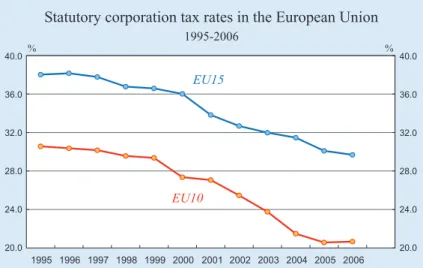
Those who believe that there is tax competition within the EU have some powerful circumstantial evidence to support their case. Figure 5.1 describes what has hap-pened to rates of corporation tax in the EU over the last ten years, showing the average for old and new members separately. There is a clear difference between the two groups: on average the tax rate of the old members exceeds that of the new members by nearly 10 percent-age points. Equally significant is that there is a clear downward trend for both groups of countries. The old member states reduced their tax rates, on average, from around 38 to 30 percent between 1995 and 2006, while the new member states reduced their average from around 30 to just over 20 percent.
These reductions are not simply the result of major reforms in a few countries. In fact, as shown in Table 5.1, 16 out of the 25 members reduced their tax rates in the last four years 2003 to 2006 (and no country increased its rate). Many of these reductions have been substantial, and they are continuing.
Of course, on their own, reductions in tax rates are not conclusive evidence that tax competition is taking place.
There are possible explanations of such reductions that do not involve tax competition: for example, it may sim-ply be the case that a new view of the potential harm of high corporate tax rates is sweeping through Europe, inducing governments to follow similar policies. And if there is tax competition, there is the question of why rates are falling now. Certainly the EU15 have had free mobility of capital for many years. If competition were important, then we might have expected them to have reached very low – or even zero – tax rates by the mid 1990s, before the period shown in Figure 5.1. One clue to the “why now?” question is, however, the role played by the new members who joined the EU in 2004. Figure 5.1 shows that the average tax rate in these coun-tries is substantially below the average for the older members. Figure 5.2 shows that the differences between these two groups in 2006 are striking. With three excep-tions, the distribution of tax rates among the new mem-ber states is entirely below the distribution amongst the older members. Nine of the countries with the lowest eleven rates are new member states (the exceptions are Ireland and Austria), and only one new member (Malta) has a tax rate comparable to the older members. So it is certainly plausible that the EU enlargement in May 2004 has led to a more aggressive form of tax com-petition within the EU, which is consistent with the pat-tern of tax rate reductions since 2003.
Another clue is the introduction of the euro. The euro has created a common capital market among the euro countries, which came along with a nearly perfect equalisation of interest rates, more international transparency, the elimination of exchange rate risks and, in general, more cross-border mobility of cap-ital. If high tax countries were afraid of losing out in the competi-tion for mobile capital, then their fear may have led to actions after the advent of the euro.
There is one puzzling feature of the recent development of corporation
taxes in the EU, however. Despite the substantial falls in tax rates, tax revenues have held up. Figure 5.3 shows what has happened to the ratio of corporation tax rev-enues to GDP over the last ten years.1The ratio is again
averaged separately over the old and new members. Usually, corporation tax revenues rise in good times, when profit rates are high, and fall in bad times when profit rates are low. So we would not expect the ratio to GDP to be very constant over time.
Nevertheless, the pattern shown in Figure 5.3 is surpris-ing. Tax revenues in the older members actually rose over this decade, beginning at 2.7 percent of GDP and rising to 3.7 percent before falling back to 3.1 percent.
Tax revenues in the new member states were more stable, beginning at 2.9 percent before holding a fair-ly constant position between 2.5 and 2.7 percent of GDP.
There may be several explanations for the different patterns observed in Figures 5.1 and 5.3, with falling tax rates but stable revenues. One factor is that countries have tended to expand the definition of taxable profit at the same time as reducing rates – for example, by removing special allowances intended to boost investment. This also implies that the effective tax rates – which take into account changes to the tax base and which are therefore more likely to affect flows of capital – have not fallen by as much as the headline rates shown in Figure 5.1. However, these effective tax rates have also fallen, which suggests that this cannot be the only explanation for the strong perfor-mance of corporation tax revenues. Another possible explanation is the rise in profits that has taken place in many EU countries. There is also evidence that an increasing proportion of corporation tax revenues is coming from the financial sector, which has been highly profitable over much of this period.
An important issue here is the location of profit. Multinational corporations are able – within limits – to shift both real economic activity and taxable profits between countries. Indeed, it is to attract both of these that govern-ments may compete with each other, as discussed below. The evi-dence in Figure 5.4 suggests that such shifting may be very impor-tant. This figure examines the tax base of corporation tax as a per-centage of GDP in each country (calculated by grossing up corpo-ration tax revenues by the tax rate). It compares this to the statu-tory tax rate in the same country. Each point in the diagram repre-sents an EU country, based on averages over the ten-year period 1995 to 2004.
Chapter 5
Table 5.1
Corporation tax rate reductions in the EU for retained earnings, 2003–06a) Reduction ( percent) Year of reform
Austria 34 to 25 2005 Belgium 39 to 33 2003 Cyprus 25 to 15 to 10 2003, 2005 Czech Republic 31 to 28 to 26 to 24 2004, 2005, 2006 Denmark 30 to 28 2005 Estonia 26 to 24 to 23 2005, 2006 France 35.4 to 34.9 to 34.4 2005, 2006 Germany 32 to 30.5 2004 Greece 35 to 32 to 29 2005, 2006 Hungary 18 to 16 2004 Italy 36 to 34 to 33 2003, 2004 Latvia 22 to 19 to 15 2003, 2004 Netherlands 34.5 to 31.5 to 29.6 2005, 2006 Poland 28 to 27 to 19 2003, 2004 Portugal 30 to 25 2004 Slovak Republic 25 to 19 2004
a) Reductions shown are for national tax rates only. The diagrams also include local taxes on profit.
Figure 5.2
If a higher tax rate induces real economic activity and profit to shift out of the country, then we might expect there to be a negative relationship between these two variables. This indeed appears to be the case – but the size of the effect is remarkable. At one extreme, Germany had the highest tax rate over this period, aver-aging nearly 50 percent; its taxable income averaged only just 2 percent of GDP. At the other extreme, Ireland had a 10 percent tax rate (strictly only on manufacturing activities) for most of the period; its taxable income averaged 32 percent of GDP. The other countries lie between these two extremes, with a clear, and large, neg-ative relationship.
It is clear that the trends in statutory rates are strongly consistent with an ongoing process of competition. This is supported by econometric evidence that in choosing their tax rates governments do take account of the levels
of tax rates in other countries.2,3
The cross section differences in taxable income reinforce the likeli-hood of competition. We would normally think of a reduction in the tax rate as causing a reduction in tax revenue, which would repre-sent a cost to the strategy of reduc-ing the rate to attract inward investment and profit. But there seems to be a reasonable chance of revenue actually increasing fol-lowing a tax rate reduction in a country: given such evidence, it is perhaps surprising that the process of tax competition has not already developed further.
2. What are governments competing for?
It is worth considering in a little more detail the question: “What are governments competing for?” As suggested above, there are two (or more) possible answers: (a) real economic activity: flows of firms and capital, attracted by low effective tax rates; and (b) taxable income, attracted by low statutory (or headline) tax rates. There is plenty of empirical evidence that flows of cap-ital and flows of taxable profit are both affected by dif-ferences in taxes across countries. For example, De Mooij and Ederveen (2005) have conducted a meta-analysis of a large number of empirical studies of the effects of tax on flows of foreign direct investment between countries. Based on a sample of 427 esti-mates, they find that, at the median, flows of foreign direct investment rise by 2.7 per-cent in response to a one perper-cent- percent-age point fall in the effective cor-poration tax rate. Of course, there is a great deal of variation across
Figure 5.3
Figure 5.4
2See Devereux, Lockwood and Redoano (2005).
3One argument suggests that tax rates will not fall to zero. Because some of the larger capital exporting countries (the US and the UK) tax worldwide income with a credit for foreign taxes, capital importing countries have some incentive not to reduce their rates below the rates of the capital exporters. However, a counter example appears to be Ireland, which has benefited from a low tax rate – with large inflows of capital and prof-it from US corporations. That suggests that deferral of repatriation, or other profit shift-ing, enables US companies to benefit from the low Irish rate, and implies this credit argument for maintaining higher tax rates is weak.
studies, but this conclusion suggests that taxes can play a significant role in affecting capital flows. Broadly, a new member state with a tax rate 10 percentage points lower than an older member, might expect to have inward capital flows 27 percent higher as a result of the lower tax rate. The effects on the aggregate capital stock in the country are less clear. If there are no off-setting effects on domestic investment, then the capital stock would rise, though in the short run by much less than the change in investment. But it is also possible that new inward investment could either crowd out some domestic investment, or stimulate higher domes-tic investment.
But some evidence suggests that the effect is even larger for capital flows into the new member states. Bellak and Leibrecht (2005) found a response for flows to new member states to a one percentage point increase in the corporation tax of between – 3.3 percent and – 4.6 per-cent. More aggressive tax competition arising from the accession of the new member states is certainly consis-tent with the allocation of capital between new and old member states being particularly sensitive to corporation tax rates.
There is also considerable evidence that multinational companies are able to shift profits between countries in order to take account of more generous tax provisions.4
They can do this in a number of ways. For example, a simple approach is for a multinational to place its equity capital in a subsidiary located in a low-tax country while allocating its debt to a subsidiary in a high tax rate coun-try. The borrowing subsidiary can offset the interest pay-ments against tax at a high tax rate, while the equity-using subsidiary pays tax on the return to equity at a low tax rate, creating a gain to the multinational and to the low tax rate country at the expense of the high tax rate country.
Another example concerns the pricing of intra-company trade. If one subsidiary of the multinational company trades with another, then the company typically has some discretion over the price at which the good is transferred. Both this transfer price and the use of debt are subject to numerous complex provisions aimed at minimising the extent to which companies can shift tax-able income to lower-taxed countries. However, it is typically difficult for tax authorities to identify and pre-vent tax planning. Certainly the evidence in Figure 5.4 is consistent with significant movement of taxable income between countries.
3. Is competition from new member states unfair?
If, as seems plausible from the evidence presented above, the accession of the new member states has led to a period of more aggressive tax competition, then how should old member states respond?
One possible response is to complain about “unfair” tax competition. For example, at the time of the accession, Gerhard Schröder, the then German Chancellor, claimed that it was unacceptable “that Germany, as the EU’s biggest net payer, finances unfair tax competition against itself”.
Is there a case that tax competition is unfair? It is hard to see what that case might be. In the absence of agreed coordination of corporation tax rates in Brussels, then each member state has sovereignty in setting its own tax rate. And this sovereignty has been jealously guarded by members to such an extent that there has been almost no progress towards coordination, despite many recommen-dations to do so dating back over many decades. It is true that a low tax rate in one country may result in capital or profit shifting to that country from another. If a government acts in its own national interest, the costs incurred by other countries will not be taken into account. Since they do not take into account the full costs of their actions, all countries may end up with lower tax on corporate profit than they would otherwise choose. The result of such competition is that all countries may therefore end up worse off.
But there is nothing specific about this account which applies particularly to new member states. In some ways, they are already an attractive location for new invest-ment, for example with lower wage rates than in the older member states. Offset against that, however, is a weaker infrastructure, an issue to which we will return below. But if the new member states seek to improve the chances of attracting new firms and investment, they are not behaving differently from other members – indeed they could be seen as simply following the example of Ireland, although in a less extreme form.
What Chancellor Schröder seemed to be objecting to is that the new member states also receive regional aid from the EU – which is, in effect, paid for by the older members, Germany as the EU’s largest net payer in par-ticular. To the extent that regional aid could be seen as compensating for lost revenue from aggressive corpora-tion tax setting, then the older members could be thought to be paying for tax cuts in the new member states.
Chapter 5
But there are at least two responses to this claim. First, linking corporation tax and regional aid reflects some confusion in the older member states. On the one hand, they support the principle of regional aid to the new member states, which helps to provide better infra-structure, which will attract more capital, partly from the west, and which ultimately will bring about a process of wage convergence. But if the old member states support that aim, then it is not clear why they should object to low corporation tax rates in new mem-ber states, which is likely to have a similar economic impact. Just because both are happening simultaneous-ly does not give cause for believing the tax competition is unfair.
Second, it is by no means clear that subsidies induce the recipient countries to lower their tax rates, as lower tax rates may well result in higher rather than lower tax rev-enue. Although Figure 5.3 shows that the east European countries are raising a smaller proportion of GDP from corporation tax, the evidence of Figure 5.4 hints that reducing the tax rate may generate such an increase in taxable income that tax revenues may actually rise. Thus, if Schröder wants the recipient countries to charge internationally mobile capital with higher tax rates he might well advocate increasing rather than cutting the subsidies.
That being said, Schröder does have a point insofar as the process of tax competition in general tends to erode the corporate tax revenue. While a single country could possibly increase its tax revenue by cutting its tax rates, all countries together cannot achieve such a result, as the movements of tax bases and equity capi-tal will only result from international differences in tax rates. If all countries cut their tax rates simultaneously, the corporate tax revenue will indeed decline, unless there is a substantial increase in overall investment. Given that the corporate tax is needed as one of the fis-cal revenue raisers, this in itself is an argument for tax coordination among countries, a topic to which we will return below.
4. What are the costs of tax competition?
There is a broad issue here which goes beyond simply considering whether new member states are responsible for increased downward pressure on corporation tax rates. That is the consequence of lower corporation tax rates in terms of economic welfare. As with all taxes, there are two main aspects of their consequences for wel-fare: economic efficiency and equity.
In terms of efficiency, there has been a concern that charging lower taxes on capital will result in higher taxes on labour, and that higher taxes on labour can exacerbate distortions to labour markets, resulting in greater unem-ployment. Indeed, the European Commission (1997) has itself made this type of argument.
Basic economic theory does not support this argument – indeed it supports the reverse. The argument is set out in Box 5.1. It depends on capital being mobile, while labour is not mobile or, at least, not as mobile. Indeed if capital is perfectly mobile, it is optimal for a small open country to tax capital very lightly. To be precise, it is optimal not to impose a tax rate above the marginal congestion cost of infrastructure. We will return to this topic below and assume for a moment for simplicity that the marginal cost of infrastructure is zero. In this case, a tax on capi-tal would have a more severe impact on economic activ-ity, and hence on the demand for labour, than a tax on labour.
Whether the reduction in the demand for labour affects unemployment depends on the extent to which the wage rate is flexible. With strong unions trying to hold up the wage, wage reductions cannot come about without more unemployment. With more flexibility unemployment would be lower.
So, from basic economic theory, a good case could be made that a small, open country acting on its own with-out coordination with other countries should in any case not tax the income on capital located in that country, and by extension should not tax corporate profit located there.
Two caveats to this reasoning should be noted. One con-cerns the “effective tax rate”. The effective tax rate mea-sures the extent to which the tax as a whole raises the pre-tax required rate of return on an investment – as such, it depends not just on the headline tax rate but also on the definition of taxable income. In practice, how taxable income is defined varies considerably across countries; one important factor, for example, is how quickly capital expenditure can be depreciated for tax purposes.
It is worth noting here that in principle it is possible to design a corporation tax which does not affect this pre-tax required rate of return. An example of such a pre-tax is a “cash flow” tax, which we discuss further in Section 7 and Box 5.2 below. Essentially, such a tax would define income for tax purposes to be all receipts less all expen-ditures. Thus all capital expenditure could be set against
tax in the year in which it was incurred. However, there would be no relief for the cost of finance. In effect, the government would become a shareholder in each invest-ment; it would contribute part of the cost (through fore-gone tax revenue) and take the same share of the income generated. The net effect is that the rate of return required by investors is unaffected; their expenditure and income is reduced in the same proportion. Since the rate of return on the investment is not changed, the “effec-tive” tax rate – or more strictly, the marginal effective tax rate – is zero. Such a tax has long been favoured by many economists, precisely because the marginal effective tax rate is zero.5
A second caveat is whether capital really is mobile. Here we have to be careful about the definition of capital. A building that houses a car factory is clearly immobile – it would be extremely costly to move it, brick by brick, to another location, and it is inconceivable that anyone would want to. So there is a sense in which capital which
has already been invested, and which cannot easily be moved, falls outside the analysis in Box 5.1. Economists have noted the possibility in these cases of introducing penal taxes on the owners of capital due to a “time consistency” problem: before the investment is undertaken the gov-ernment has an incentive to promise low tax rates on the return to the investment, but after it has been undertaken – when the capital has become immobile – it has an incentive to charge very high rates.
But there are two reasons why governments would not follow this approach in practice. First, although the factory itself might not move, the activity in the facto-ry might. The company could set up another factory elsewhere and move production. This, too, would be costly, but the company is not constrained by the physical immobility of the asset itself. Second, investment and taxation is not a one-off event. Imagine the reaction of future investors if a government did renege on its promises by imposing a high tax rate on already-installed capital. Such future investors would be unlikely to believe any promises made to them by the government, and they would take their capital elsewhere. So it is hardly a sensible strategy for a government.
Despite the theory, of course in practice governments do tax the income generated by activities of corporations located within their country, possibly for some good and some bad reasons. From the perspective of a small open country, one bad reason is a concern about an inequitable distribution of tax. Abandoning a tax on capital income looks like favouring one group of the population (proba-bly a wealthier group, since it has funds to invest) over the rest. Why should earned income be taxed when cap-ital income is untaxed? However, in the context of a small country acting on its own, the answer lies in the analysis in Box 5.1: because the tax on capital does not make the owners of capital worse off, but is passed on to residents. It is more efficient, and no more inequitable, to tax the residents directly.
Chapter 5
Box 5.1
The effects of the taxation of capital in an open economy
Consider a country which allows free movement of capital. Suppose that the return on capital, net of all taxes, required by investors in the rest of the world is 10 percent, and that this country is too small to have any effect on that required rate of return. These conditions apply to most EU members: call this country Belgium. That means that Belgian investors can expect to earn 10 percent on any outward investment from the country. It also means that any other investors in the world will expect to earn 10 percent in Belgium after taxes. If they earn less than 10 percent they will take their capital elsewhere. If the return in Belgium exceeds 10 percent, new capital will flow in, driving down the rate of return until it reaches 10 percent.
What would be the effect of a tax on the return to capital located in Belgium? All investors would continue to require a return of 10 percent after tax, since they can still earn that elsewhere. This implies that the pre-tax rate of return in Belgium must rise. For example if the effective tax rate is 33 percent, then the pre-tax rate of return must rise to 15 percent, leaving the post-tax rate of return at 10 percent. This would be achieved by some investors shifting their capital out of Belgium. As the total capital stock falls, then the marginal return on the remaining capital would rise. A tax in Belgium would therefore reduce investment in Belgium. This is a cost in terms of economic inefficiency.
Now consider the case in which the tax revenue is raised by a tax on labour income. Given the mobility of capital and the relative immobility of labour, the labour force will not be able to pass on the tax burden to the owners of capital, who continue to earn 10 percent after tax. Instead, the labour force must bear the “effective incidence” of the tax, in terms of a lower net wage. The capital stock would be unaffected. That seems to imply that a tax on labour income may be more efficient but less fair. But that is not true. Who bears the “effective” incidence of the corporation tax? Just as with a tax on labour income, it cannot be the owners of capital. Instead the tax must be passed on, in lower gross wage payments and higher output prices, to be borne by Belgian residents. In either case, then, the tax burden falls on domestic residents. But in the case of corporation tax, there is also inefficiency in the form of an economic distortion to the level of investment. This is the basic argument for a small, open country such as Belgium not to have a tax on capital located there.a) a) There is a separate argument that even a closed economy should not tax the returns to capital.
For example, in a closed economy model Lucas (1990) estimates that eliminating capital income taxation in the US would increase the capital stock by 35 percent, and long run consumption by 7 percent. But in this chapter we focus on the issues raised by the mobility of capital in open economies.
5. The role of infrastructure
As with any economic theory, there are real world complexities which are not taken into account in Box 5.1, apart from those mentioned above. One is worth considering in more detail, especially in the context of the EU. That is the role of infrastructure – in particular, infrastructure which is publicly provided and which enhances productivity of capital. Such infrastructure might include obvious assets such as roads and other transport provision, but also less con-crete goods such as the rule of law and the ability to enforce property rights. It is unlikely that such infra-structure could be categorised solely as supporting production: it is also likely to provide consumption benefits to residents.
To the extent that this infrastructure is free to the user, and supports production, then it causes a complication to the basic analytical framework set out in Box 5.1. Suppose, like a road, that the infrastructure is a public good, but that there are congestion costs – each user adds a small amount to the congestion costs which are imposed on himself and on other users. Each user will use the public good up to the point at which the margin-al benefit of doing so equmargin-als the private congestion cost. But they will ignore the additional costs imposed at the margin on other users. In theory it is optimal for the gov-ernment to impose a tax on users equal to the marginal congestion externality, which is the difference between the marginal social cost and marginal private cost. If the government does so, then effectively each user will take into account the whole marginal social cost and not just his own private cost.
Now suppose that the aggregate social congestion cost depends on the amount of capital used. One form in which such a tax could be imposed would therefore be through a positive tax on the return to capital. But while such a tax could in principle generate the optimal use of the public good, and the optimal amount of capital in the economy, it would not necessarily raise enough rev-enue to finance the provision of the public good.6 If
there are constant returns to scale in the provision of public goods in the sense that doubling the amount of capital, given the user quality of the public good, requires doubling the production cost of public infra-structure, then an efficient congestion tax on capital will just generate enough revenue to finance the cost of the infrastructure. This case is relevant with those kinds of infrastructure that are provided on local levels
assuming that the size of local communities is optimal-ly chosen. Examples are the local police or local roads. However, nation-wide public goods, such as interstate roads, the law system or national defence, are likely to exhibit increasing returns to scale in the sense that the infrastructure cost does not have to double if the amount of capital doubles. With such public goods an optimally designed congestion charge will not be able to fully cover the cost of the public infrastructure. The remaining cost would therefore have to be financed by a tax on residents. It would nevertheless be in the inter-ests of residents to finance the provision of the public good, since it enhances the productivity of capital and hence attracts more capital.
The spirit of this result is similar to the one explained in Section 4, but in a sense it goes even further. Without marginal infrastructure costs, the fiscal revenue that a country can reasonably collect from internationally mobile capital is zero. With such costs the fiscal revenue the country should collect might even be negative, because the revenue from the corporate tax falls short of the cost of providing the infrastructure that this capital uses. However, from a practical perspective, there is some tax revenue after all, and it does not have to be feared that tax competition will wipe out the corporation tax completely. The marginal cost of hosting the mobile capital will always be the lower bound below which competitive forces will not be able to drive the corporate tax revenue.
6. Does competition require a coordinated response?
The central problem identified in this chapter – of com-petition driving down the rate of tax on corporate income – is not necessarily a problem of economic efficiency. Indeed, Box 5.1 indicates that there is a case for allow-ing competition to drive the EU to an efficient outcome in which income from capital is not taxed at all in the country in which the capital is located.
Nevertheless, governments clearly would prefer to con-tinue to raise revenue by taxing corporate profits arising within their jurisdiction. One reason is clear from Figu-re 5.3: governments raise close to 3 percent of GDP in corporation tax. Whatever the economic arguments, they are reluctant to give up such an income stream. A more general difficulty in not taxing the return to capital income is consideration of equity. Whether or not it is justified, many people find it unjust if capital is being taxed at a lower rate than income arising from labour income.
Such a view partly stems from the notion of a compre-hensive income tax – where labour and capital incomes are taxed at the same rate. But some countries have explicitly accepted the principle that capital and labour income should be taxed at different rates. The “dual income tax” system used in Scandinavian countries com-bines a progressive tax on earned income with a low, flat-rate tax on capital income.
Are there other reforms which would improve the fair-ness of the tax system? We first consider in this section whether coordination across EU countries could solve, or at least mitigate, these problems. In the next section, we consider more radical options open to individual governments.
In principle, if all governments agreed to coordinate by charging the same effective rate of tax, then the analysis of Box 5.1 would become redundant. The owners of capital would face the same tax wherever they located their capital, and even if capital were perfectly mobile, they would not be able to avoid paying the tax. In this situation, owners of capital would share at least part of the tax burden through a lower post-tax rate of return. This may then provide the basis for a more equitable tax system.
However, it is not clear that anything short of a single, global tax could achieve this end. As long as some coun-tries – inside or outside of the EU – maintain a different tax system, then there may be opportunities for owners of capital to shift activities and profit to reduce their overall tax liabilities. Even a single tax within the EU would not meet this requirement. And in practice, cer-tainly for the foreseeable future, it seems highly unlikely that there could be a single tax within the EU.
Moreover, harmonising capital income tax rates would have very problematic effects for the provision of public infrastructure, which is also an important element in the location decisions of companies. Clearly countries would shift their attention to the possibility of luring in capital with infrastructure gifts if it is impossible to attract it with lower tax rates. They would overprovide infrastructure for mobile capital if the capital income tax rate is harmonised above the “equilibrium” rate that is the outcome of unbridled tax competition.7As it is
diffi-cult to harmonise infrastructure expenses, one possible solution to this which has been proposed is a self-financ-ing constraint. This would consist of governments agreeing to pay for the public good out of taxes on
cap-ital income. In principle, this could lead to an optimal provision of the public good, paid for by the owners of capital.
However, such a tax would require the self-financing constraint to differentiate between public goods used in production and consumption. In practice it would be very hard to specify how the cost of public goods should be shared among consumers and firms. Basic infrastructure, such as roads and other essential inputs, enforcement of property rights and the rule of law, edu-cation, defence, and health provision are also all used in consumption.
The form of coordination currently being considered within the EU is a “common consolidated corporate tax base”, known as the CCCTB. The idea is that companies could select to have their EU-wide profits determined only once; they would not need to allocate their taxable profit between EU member states. Instead taxable profit would be allocated between countries on the basis of a simple formula, unrelated to profit. This has some advan-tages – there would be no gain to shifting profits between EU countries since it would not affect the tax liability – but it is not designed to combat the problems of tax com-petition considered here. Indeed, under the Commis-sion’s proposal, countries would keep the right to set their own tax rates, and so there would continue to be competition in the setting of statutory rates.
An alternative approach would be to propose that indi-vidual countries agree to harmonise their taxes. But to be effective, this would require harmonisation of effective tax rates, not just the headline rate. This implies setting a single definition of the tax base for all countries, as well as a single tax rate, which would be extremely complex. And even if this were achieved, there remains the prob-lem of competition with countries outside the EU, including from tax havens with very low rates.
So it is unlikely that coordination of corporation taxes within the EU is likely to be able to solve the problems described above, which arise from tax competition.
7. Other potential solutions
To consider alternative solutions, it is useful to begin by noting that we have considered only one particular form of a capital income tax. That is, we have considered only a tax on the income arising from capital located in a par-ticular country – known as a “source-based” tax, since the tax is levied in the location of the source of the
Chapter 5
income. (In practice it may be very difficult to identify the source of income, which is one reason companies are able to shift profit between countries. But we will leave that issue aside here.) One superficially attractive aspect of such a tax is that it may appear to be levied on non-residents (and non-voters), since the owners of the capi-tal located in a country may not actually reside in that country. However, this is likely to be a mirage: as argued in Box 5.1, it is instead likely that a tax levied on capital in a small open country will effectively be borne by domestic residents.
7.1 Residence-based taxation
The most commonly considered alternative to a source-based tax is a tax on the income on capital owned by res-idents, wherever that capital is located: this would be a “residence-based” tax. For example, a German capital owner would be taxed under the German tax system on earnings from all his capital, even if that capital were located outside Germany. A residence-based tax would have very different properties from a source-based tax, particularly with respect to equity. The reason why a source-based tax on capital income is not usually inci-dent on the owner of capital is because the owner is able to move the capital away from a highly taxed jurisdic-tion. But the owner of capital cannot avoid a residence-based tax except by changing residence. Given that indi-viduals are relatively immobile, it is much more likely that the owners of capital would bear the incidence of a residence-based tax.
If such a residence-based tax could be made practical, then it would have two clear advantages over a source-based tax. First, it could be more efficient, in that the location of capital would not affect the tax liability, and hence taxes would not distort the location choice. Second, it may well be more equitable, as capital owners could not avoid the tax by shifting capital between coun-tries. However, there are overwhelming practical diffi-culties in implementing such a tax, since it requires the tax authorities to keep track of capital income earned abroad, and possibly not remitted back to the owner. It is to combat such difficulties that the EU has agreed the Savings Directive, which requires member states to exchange information about interest income earned in another member state. But while the Savings Directive may help in tracking the interest income of EU individ-ual residents, it does not apply to profit earned by corpo-rations.
The “residence” of corporations is in any case ambigu-ous. On the one hand, it could refer to the residence of
the shareholders of the corporation. But it is simply not practical to tax a resident’s share of a non-resident cor-poration’s profit, especially if that profit is not remitted back to the owner in the form of a dividend – indeed the corporation tax exists partly because it is not even prac-tical to do so when both shareholder and corporation are resident in the same country. In principle it might be possible to tax this income through a capital gains tax levied in the shareholder’s country of residence. But this also raises several problems. To be a substitute for taxing profit as it is generated, it would have to be levied on an annual basis, whether or not the shares were sold. It would therefore require an annual valua-tion of all companies in which the individual holds shares (and indeed, if introduced comprehensively, an annual valuation of all assets). It may also cause liquid-ity problems: the taxpayer may have to sell shares to raise the cash to pay tax.
On the other hand, “residence” may refer to the place of incorporation of a company or where the head office is located. It may be possible to tax corporate profit accord-ing to the residence of the corporation itself; indeed many countries attempt to do so. But there are at least three problems with doing so.
First, unless all countries operated a residence basis, then there may be double taxation since the country where the capital is located may impose a source-based tax. (Countries which currently have a form of residence-based tax typically avoid this double taxation by giving credit for any source-based taxation paid.) Second, cor-porations may evade taxes by hiding their profit in another country. The OECD’s recent attempts to encour-age tax havens to agree to an exchange of information with other countries is a step towards dealing with this problem. Third, and most important, the residence of corporations is itself mobile, and somewhat tenuous. A high tax in one country may induce corporations to incorporate in another country. Since they may undertake little business anyway in their country of incorporation, the cost of moving may be small. But if residence is mobile, then moving to a pure residence-based tax on corporations would simply introduce competition in another guise.
7.2 Destination-based taxation
But if source-based taxes are being competed away, and residence-based taxes are not a serious option, then are there any other alternatives? There is one: to con-sider a different location for taxing profit – that of the final consumer of the good or service. This would be a
“destination-based” tax. One could argue that it is at least as reasonable to consider the loca-tion in which profit is made to be where the good or service is sold to a final consumer as where it is produced.
If it were possible to construct a destination-based tax, then it would share an advantage with a residence-based tax, in that the tax would not depend on where the good or service was produced. Since individual consumers are relatively immobile – at least compared to capital – the location of economic activities would be less likely to be affected by the tax. And as a result, the tax should be less susceptible to a process of competition.
Of course, attempting to levy a tax on the profit of a cor-poration according to where it sells its product to the final consumer raises the issue of the allocation of costs. For example, suppose a car plant in Germany sells to consumers all over the EU. How should the costs incurred in Germany be allocated to each destination country to set against income generated there? To explore this, it is useful first to return to the cash flow tax, outlined in Section 4. To recall, one form of such a tax, the so-called tax on the real cash flow, would give full tax relief for all real expenditure in the year in which it was incurred, but not relief for financing costs.8Hence,
for example, there would be no use of depreciation schedules to allocate capital spending against income derived in subsequent years; instead all such expenditure would be written off immediately. But interest payments would not be deductible.
Another variant of a cash flow tax would be one where the financial cash flow is taxed in addition to the real cash flow, which basically means that retained corporate earnings are tax free while dividends, net of the revenue from new share issues, are taxed. The Meade Com-mittee, which first proposed it in 1978, called it the S-base tax.
As described in Box 5.2, cash flow taxes effectively turn the government into a shareholder: the government
con-tributes a share of all investment expenses and collects the same share of all revenues. Such a tax is equivalent to a tax on economic rent and the historically given stock of capital. The economic rent is any profit above the minimum required for the investment. Because of this and as the historic stock of capital is given, the tax is largely non-distorting: it does not affect decisions as to how much to invest, nor how to finance investment. In an international context, though, a source-based cash flow tax would not be efficient, for two reasons. First, there is now considerable evidence that discrete location choices of multinational companies depend on a com-parison between post-tax levels of profit from alternative locations. Suppose a company faced the same pre-tax level of profit in two potential locations. And suppose each country levied a cash flow tax, but at different rates. In this case, the post-tax level of profit would be lower in the country which had the higher tax rate; and the loca-tion choice would depend on these taxes, even though both were on a cash flow basis. Second, corporations would still be able to shift profits between countries in response to differences in statutory rates, just as with the current corporate tax systems. To raise the same revenue from a cash flow tax as existing taxes would require a higher statutory rate; this would worsen the profit-shift-ing problem.
But now let us bring together these two strands: a nation-based tax and a cash flow tax. Applying the desti-nation-base principle to a cash flow tax in fact generates something similar to a very familiar tax: value added tax. Value added is equal to economic rent plus labour
Chapter 5
Box 5.2
A cash flow tax
Consider a risk-free investment which costs 100 euros in period 1 and which generates a return of 110 euros in period 2 – a pre-tax rate of return of 10 percent. Now suppose that a cash flow tax is levied at the rate of 40 percent. The cost of the investment would fall to 60 euros, and the value of the return would fall to 66 euros. The rate of return after tax is still 10 percent – a return of 6 euros on an investment of 60 euros. The government has also made a 10 percent return: in effect, it invested 40 euros and received 44.
Now suppose that the risk-free interest rate is 5 percent; an alternative to the investor would be to save 100 euros in a bank account, generating a return in period 2 of 105 euros. Before tax, the investment is worth 110 euros. This excess of 5 euros over the return from the bank account is a measure of the economic rent of the investment: the return over and above that required to persuade the investor to go ahead with the investment.
With the cash flow tax, the investor only has to invest 60 euros, on which he earns a return of 66 euros. By contrast, putting 60 euros in a bank account would yield 63 euros. So the post-tax economic rent to the investor is 3 euros. The government has also effectively earned an economic rent of 2 euros, since if it had put 40 euros in the bank, it would have earned only 2 euros instead of 4. Overall, 40 percent of the economic rent of 5 euros has been taken by the government.
income. And VAT can therefore be thought of as a tax on economic rent, plus a tax at the same rate on labour income. (Of course, it is not calculated in that way, but it has the same effect.) VAT is also levied on a destination basis. This is achieved by applying a zero rate of tax to exports, while taxing the full value of imports. The net amount of tax collected in the country of production (the source country) is therefore zero. (This is achieved by taxing intermediate stages of production, but rebating all the tax collected if the output of a later stage of produc-tion is exported.) In effect, then, the entire VAT payment is made to the country where the final good or service is sold (the destination country).
Now consider a VAT which allows labour income to be deducted from the tax base. This would be equivalent to a destination-based cash flow corporation tax. If collect-ed in the same way as VAT, then overall it would be a tax on economic rent. Labour costs would be set against tax in the country in which they were incurred. The destina-tion country would therefore charge tax on the value of the final output less any labour costs incurred in that country. The source country would zero-rate the export, but still give relief for labour costs incurred in the source country.
The fact that labour costs of goods which were export-ed would have to be rebatexport-ed by the government in which production took place would greatly increase the payment of such rebates.9And this is certainly a
practical downside if such a new tax were introduced on its own.
However, there is a straightforward way to actually implement such a tax which would not involve such direct rebates. A destination-based cash flow corporation tax could be effectively implemented by increasing the rate of VAT and making an offsetting reduction in the tax rate on labour income. Making such changes would enable governments to reduce the rate of conventional corporation tax. If this rate were reduced to zero, then several benefits could be achieved.
The new tax system would not affect the level of invest-ment nor the type of finance used. It would also not be susceptible to common methods of profit shifting. Interest would not be deductible, and so there is no
rea-son to locate debt in a high tax country; and the only prices which affect the tax liability are those paid by the final consumer, so intra-company transfer prices are also irrelevant. For all of these reasons, the tax should not be subject to competition between countries.
This analysis has glossed over some problems of imple-menting VAT. Cross-border shopping and carousel fraud are issues which certainly concern governments. Relying more heavily on VAT would increase their importance. But the problem of cross-border shopping depends on the mobility of consumers. The European Court of Justice recently upheld that an individual who purchases a good at a lower tax rate in another member state can only benefit from that lower tax rate if he or she actual-ly collects the good in person.10It is not possible to pay
the lower tax rate abroad by ordering it and having it delivered. So while cross-border shopping may be a problem, the mobility of consumers is unlikely to be as great as the mobility of capital. Hence competition aris-ing from this is unlikely ever to be as significant as com-petition for mobile capital and profit which we see under existing corporation taxes.
Finally, it is possible to consider ways in which labour costs could be passed on to the destination country. For example, exports from one member state to another could generate a tax credit, representing the labour costs associated with the export, which could be offset against tax in the destination country. This might generate a more reasonable distribution of tax deductions for labour costs across the EU. However, it would lose some of the simplicity of the VAT system, and could reintroduce tax planning opportunities as companies sought to allocate costs to high tax rate countries.
8. Conclusions
The argument set out here has been that competition for capital among small open countries could ultimately lead to the reduction of taxes on income levied by the coun-try in which the capital is located to a level commensu-rate with matching marginal social congestion costs for the use of public infrastructure goods. Economic theory suggests that such an outcome would be efficient, in the sense that capital would be efficiently allocated between countries.
The most important tax on capital income is the corpora-tion tax. There is certainly evidence that corporacorpora-tion tax 9But the net impact on any country would depend on its balance of trade
and labour costs. Suppose trade was balanced. In addition, suppose that the labour costs incurred in that country (that is, used to produce goods and services which were consumed domestically or exported) were equal to the cost of labour used to produce goods which were consumed in that country. Then in effect the government would be taxing exactly the economic rent generated on goods and services sold in that country. But if domestic labour costs were higher, its tax revenue would be lower,
rates have been falling in the EU, which is consistent with increasingly aggressive competition for capital between member states, and between EU countries and non-EU countries. Corporation taxes in the EU are still some way from zero. However, given the importance of infrastructure costs this is not inconsistent with competi-tion, and the realisation that the size of the tax base is very sensitive to the tax rate may actually encourage more competition.
But competition makes it more difficult to rely on taxes on capital income to help maintain an equitable distribu-tion of taxadistribu-tion. Coordinadistribu-tion of source-based corpora-tion taxes within the EU is unlikely to prove to be a solu-tion to this problem. Partly this is because eliminating competition would intensify the competition with other policy parameters affecting firms’ location decisions and could possibly lead to an overprovision of public infra-structure. Partly because of this, there would remain a problem of competition between the EU and the rest of the world.
There are other potential forms of corporation tax. It may be possible to continue to make use of corporation tax on a residence basis, taxing the owners of capital where they reside, rather than where the capital is located. However, that is also unlikely to generate a long term solution, again for two reasons: it is difficult for tax authorities to identify the tax base if it is generated abroad, and in any case the tax may generate competition for corporate headquarters.
A more radical alternative would be a corporation tax on a destination basis, taxing the income where the final good is sold to a consumer. This would be rather similar to a VAT – and indeed it could be implemented by increasing the VAT rate, but making an offsetting cut to taxes on labour income. Such a system would have con-siderable advantages in terms of efficiency and equity. It would be efficient in that the location and size of invest-ment, the use of different sources of finance, and the location of profit, would be largely unaffected by tax. It would be more equitable in that the tax burden would fall on consumption from unearned income. In sum, the EEAG advises politicians not to interfere with the process of tax competition such that the corporate tax rate will gradually shrink towards the marginal cost of using the public infrastructure, to increase the VAT and to reduce the taxes on labour income.
References
Bellak, C. and M. Leibrecht (2005), “Do Low Corporate Income Tax Rates Attract FDI? Evidence from Eight Central and East European Countries“, GEP Research Paper 05/43,University of Nottingham. De Mooij, R. and S. Ederveen (2005), “Explaining the Variation in Empirical Estimates of Tax Elasticities of Foreign Direct Investment”,
Tinbergen Institute Discussion Paperno. 2005–108/3.
Devereux, M. P. (2006), “The Impact of Taxation on the Location of Capital, Firms and Profit: a Survey of Empirical Evidence”, Oxford University Centre for Business Taxation Working Paper07/02. Devereux, M. P., B. Lockwood and M. Redoano (2005), “Do Countries Compete over Corporate Tax Rates?”, University of Warwick. European Commission (1997), “Towards Tax Co-ordination in the European Union: A Package to Tackle Harmful Tax Competition”, Communication from the European Commission COM(97) 495 final. European Commission (2006), Structures of the Taxation Systems of the European Union, 1995–2004.
Lucas, R. E., Jr. (1990), “Supply-side economics: an analytical review”,
Oxford Economic Papers42, 293–316.
Meade Committee (1978), The Structure and Reform of Direct Taxation,
Allen & Unwin, London.
Sinn, H.-W. (2003), The New Systems Competition,Basil Blackwell, Oxford.