PHD-PROGRAMM DER WIRTSCHAFTS- UND SOZIALWISSENSCHAFTEN
1. Beurteilerin/1. Beurteiler: ao. Univ.-Prof. Mag. Dr. Alexander Kaiser
2. Beurteilerin/2. Beurteiler: ao. Univ.-Prof. DI Dr. Franz-Markus Peschl
Titel der Dissertation:
A Knowledge Perspective on Needs to Enhance Organizational Learning
Dissertation zur Erlangung des akademischen Grades PhD
an der Wirtschaftsuniversität Wien
eingereicht bei
1. Beurteilerin/1. Beurteiler: ao. Univ.-Prof. Mag. Dr. Alexander Kaiser
2. Beurteilerin/2. Beurteiler: ao. Univ.-Prof. DI Dr. Franz-Markus Peschl
von Florian Kragulj, BSc (WU) MSc
Fachgebiet: Informationswirtschaft
Ich versichere:
1. dass ich die Dissertation selbständig verfasst, andere als die angegebenen Quellen und Hilfsmittel nicht benutzt und mich auch sonst keiner unerlaubten Hilfe bedient habe.
2. dass ich diese Dissertation bisher weder im In- noch im Ausland (einer Beurteilerin/ einem Beurteiler zur Begutachtung) in irgendeiner Form als Prüfungsarbeit vorgelegt habe.
3. dass dieses Exemplar sowohl mit der elektronisch abgegebenen als auch mit der beurteilten Arbeit übereinstimmt.
Dissertation
A Knowledge Perspective on Needs
to Enhance Organizational Learning
Florian Kragulj
“With a scientific theory, one knows, even before it is proven, that
it is correct, because it is aesthetically satisfying. Here one makes use
of criteria that go far beyond what is known as logical deduction. What
artists and scientists do is simply to surrender themselves to their
curios-ity and passion for combinatorial play, and detached from the utilitarian
business of everyday life, to pursue this combinatorial play wherever it
takes them. This is how models of the world develop.”
Wolf Singer
11Paraphrase of Singer (2003, pp. 107-108) put on display at the exhibition stand of the University of Applied Arts Vienna at the ‘VIENNAFAIR The New Contemporary’ art fair in October 2013.
Acknowledgements
Claudia
Kragulj
This dissertation is a major milestone of a scientific journey started on November, 9th
2009, when Ikujiro Nonaka’s ideas on knowledge creation caught my attention in the very first lecture on knowledge management I attended. Yet, this journey has not ended, and its destination remains unforeseeable, though, it is envisioned.
The last eight years of this journey were characterized by stability and change. Gregory
Bateson famously illustrates their vital relation by the example of a balancing acrobat: “The acrobat on the high wire maintains his stability by continual correction of his im-balance.” (1979, p. 62) To progress on this wire, the acrobat “must be free to move from one position of instability to another, i.e., [...] position of his arms and the rate of movement of his arms must have great flexibility, which he uses to maintain the stability [...]. If his arms are fixed [...], he must fall.” He continuous, “when the acrobat is learning to move his arms in an appropriate way, it is necessary to have a safety net under him, i.e., precisely to give him the freedom to fall off the wire.” (1987, p. 503)
First and foremost, I would like to express my deep gratitude to my family, my girlfriend, and my friends for giving me the necessary freedom in all respects to freely move along the high wire, i.e., to do the thing I love. Their trust in me and my skills as well as their endless support, which I can always count on, are not a given.
Special thanks are due to my supervisors Prof. Alexander Kaiser and Prof. Markus Peschl for not only teaching me how to reconcile critical thinking and pragmatism in this balancing feat, but particularly for their sympathetic attitude throughout this journey. By giving me intellectual freedom in my work, engaging me in new ideas, and demanding a high quality of work they contributed substantially to this dissertation. I would also like to thank my committee members Prof. Jan Mendling and Prof. Alfred Taudes for their valuable feedback on the research proposal.
Finally, I need to give thanks to all my colleagues and friends I have been working with for continuously challenging my state of balance by asking the right questions, while providing me with the safety net whenever necessary.
Abstract
Organizational learning causes organizational change. Different descriptive models have been proposed, but little research on variables influencing these processes has been done.
Needs govern our behavior and motivate our acting. It has been shown that their iden-tification and satisfaction effect value-creating and knowledge-intensive activities, such as innovation processes, strategy development, and product design. However, needs are usually implicitly anchored in organizations and people can hardly articulate them. Despite the fact that a focus on needs does not prescribe any concrete strategy, but extends opportunities to act, an initial consideration of needs often lacks. Consequently, their role as an influencing variable for organizational learning has not been investigated yet.
Addressing this gap, this dissertation explores the nature of needs and how they can enhance organizational learning processes. It introduces a novel theory on needs for organiza-tional practice which emphasizes the potential of a focus on needs. It argues why considering needs is beneficial for learning initiatives, such as vision or strategy development, in which var-ious expectations which presumably emerge from shared needs have to be combined. Shared needs within a social system can trigger organizational learning and facilitate the design of new consensual satisfaction strategies (satisfiers).
The theory allows for understanding the motivational forces of organizational learning and exploiting the postulated one-to-many relation between needs and satisfiers. Moreover, it points at influencing variables for the organizational transition from needs to need satisfaction and illustrates that by a knowledge perspective resulting in the concept of ‘need-based solution knowledge’. This knowledge enables people to propose viable satisfiers in organizations. We introduce the methodological framework ‘Bewextra’ that targets at the capacity to identify needs in organizations. It rests upon theories from various scientific fields and utilizes ‘learning from an envisioned future’ as a core method. This enables to literally envision a desired future scenario in which all needs are intuitively fulfilled, and thereby allows for the creation of knowledge about needs.
The research follows the action research paradigm which proposes a combinational inter-play between rational and empirical research processes, in which various (qualitative) research methods are used. Besides theoretical considerations, the dissertation reports about four re-search projects in which the theories and methods were applied, reflected, and refined. More specifically, it presents how ‘Bewextra’ was implemented and adjusted and demonstrates that a combination of conventional learning from the past and ‘learning from an envisioned future’ enhances the outcome of organizational learning in various domains. Moreover, it investigates the differences between organizational strategies, that emerge with reference to needs, and strategies, that are developed without explicitly considering needs.
Kurzfassung
Wenn Organisationen lernen, entwickeln sie sich weiter. Bisher wurden mehrere beschreibende Modelle für organisationale Lernprozesse vorgeschlagen, wobei jene Variablen, die diese Lern-prozesse beeinflussen, darin oft vernachlässigt werden.
Die psychologische Forschung geht davon aus, dass Bedürfnisse unser Verhalten motivieren und bestimmen. Die Annahme liegt daher nahe, dass Bedürfnisse auch im Kontext organ-isationaler Veränderung eine bedeutende Rolle spielen. So kann etwa gezeigt werden, dass sich die Identifikation und Befriedigung von Bedürfnissen positiv auf wertschöpfende und wissensintensive Tätigkeiten - wie etwa Innovationsprozesse, Strategie- und Produktentwick-lungen - auswirken. Bedürfnisse sind aber oft nur implizit in der Organisation verankert und Organisationsmitglieder können diese nur schwer benennen bzw. explizit machen. Sie werden häufig unterschätzt, obwohl ihre Identifikation den Handlungsspielraum für die Organisation drastisch erweitern kann.
Das führt auch dazu, dass das Phänomen Bedürfnis und seine Wirkung bisher nur unzure-ichend in den verwandten Forschungsfeldern des organisationalen Lernens und Wissensman-agements untersucht wurde. Diese Dissertation versucht, diese Forschungslücke zu schließen. Dazu wird eine Bedürfnistheorie für die organisationale Praxis entwickelt. Diese beleuchtet die Wirkung von Bedürfnissen auf organisationale Lernprozesse und ermöglicht es, den Zusam-menhang von Bedürfnissen und deren Befriedigungsstrategien als äquifinale Beziehung zu verstehen und konkretisiert diese im Wissenskonzept ‘need-based solution knowledge’.
Anhand empirischer Lernprozesse (Visions- und Strategieentwicklung) wird gezeigt, dass ein Fokus auf die geteilten Bedürfnisse von Organisationsmitgliedern verschiedene Sichtweisen einen und das Lernen unterstützen kann. Dabei kann ‘need-based solution knowledge’ die nachhaltige Entwicklung von bedürfnisbasierten Lösungen anstoßen und leiten. Dazu wird mit ‘Bewextra’ eine Methodologie vorgeschlagen und getestet, die auf die Identifikation von Bedürfnissen und die Generierung von Bedürfniswissen in Organisationen abzielt. ‘Bewextra’ verfolgt einen interdisziplinären Ansatz und nutzt ‘learning from an envisioned future’ als wesentliche Methode, die komplementär zu konventionellen Lernansätzen ist.
Die Dissertation folgt dem Paradigma der Aktionsforschung, welches ein Zusammenspiel aus theoriegeleiteter Reflexion und empirischer Intervention vorschlägt. Es wurden vier em-pirische Forschungsprojekte durchgeführt, in denen ‘Bewextra’ und andere Methoden ange-wandt, evaluiert und adaptiert bzw. erweitert wurden. Dabei konnte u.a. gezeigt wer-den, dass eine Kombination von erfahrungsbasiertem und zukunftsorientiertem Lernen großen Nutzen für organisationales Lernen in unterschiedlichen Domänen hat. Darüber hinaus wur-den Strategien, die basierend auf explizitem Bedürfniswissen erstellt wurwur-den, und solche, die intuitiv entworfen wurden, untersucht und miteinander verglichen.
Table of Contents
1 Introduction 19 1.1 Knowledge . . . 19 1.2 Needs . . . 20 1.3 Organizational Learning . . . 21 1.4 Knowledge Management . . . 22 2 Research Design 25 2.1 Objectives and Research Questions . . . 252.2 Research Paradigm . . . 26
2.3 Empirical Projects and Methods . . . 29
3 Summarized Results 33 3.1 Conceptualization of Need Knowledge . . . 33
3.2 Need Knowledge and Learning . . . 35
3.3 Need Knowledge and Strategies . . . 37
3.4 Coherence of Results . . . 38
4 Key Findings and Conclusion 41
References 45
Appendices 57
Article A:
Conceptualising Needs to Enhance Organisational Learning and Enable
Knowledge-Based Innovation 59
Article B:
A Knowledge Perspective on Needs as a Foundation for Organisational
Learning Processes 79
Article C:
Taking a Knowledge Perspective on Needs: Presenting Two Case Studies
Within an Educational Environment in Austria 97
Article D:
Bewextra: Creating and Inferring Explicit Knowledge of Needs in
Article E:
Learning from an Envisioned Future: An Empirical Account 133
Article F:
Investigating the Impact of Need Knowledge on Strategy Development in
1
Introduction
Knowledge is essential for any organization to grow, develop, and innovate, or, as Nonaka et al. (2000, p. 6) put it, the creation of knowledge is the “raison d’etre” of every organization. Since learning is the key to generating new knowledge, the fields of knowledge management and or-ganizational learning are closely related (Chiva and Alegre, 2005; Firestone and McElroy, 2004). When investigating learning on the organizational level, it would be oversimplified to argue that it is the organization that learns (Easterby-Smith et al., 2000). In fact, learning takes place in the heads of individuals who make collective experiences within a shared organi-zational frame (Argyris and Schön, 1996; Hedberg, 1981; Wang and Ahmed, 2003). Learning is context-dependent and governed by various influences on which little research has been done so far. Arguably, one of them are needs of individuals and/or social systems, which motivate behavior and affect learning. It has been shown that a focus on needs effects value-creating and knowledge-intensive activities, such as innovation processes, strategy development, and product design.
Needs are usually implicitly anchored in organizations and people can hardly articulate them. Identifying and satisfying them can be described as distinct organizational learning processes in which organization members generate new knowledge, which extends opportu-nities to act. However, this has not been done yet. Addressing this gap, this dissertation explores the nature of needs and investigates how they can enhance organizational learning. It contributes to the fields of organizational learning and knowledge management.
To begin with, I introduce knowledge and needs as the two main phenomena of this research.
1.1
Knowledge
Knowledge is a fascinating phenomenon to study, but hard to grasp. It is inherent to human nature and has been subject to philosophical inquiry ever since, however, it only recently entered economic theories. Although it is evidently bound to humans and their cognitive abilities, there is no consensus on its nature, and, thus, there is no common definition of it. Some argue that knowledge is linked to behavior that continuously changes when our organism adapts to its environment. In so doing, cognition is seen as the key element in these ontogenetic (and phylogenetic) learning processes (Arhem and Liljenström, 1997). Taking this evolutionary view into account, knowledge is not a tangible entity, but rather a human-dependent process which is described as “knowing” (Nonaka and Von Krogh, 2009; Polanyi, 1969; Virtanen, 2013). This may well reflect its nature, or as Maturana and Varela (1987, p. 174) put it conspicuously: “to live is to know.” Very broadly argued, knowledge is a condicio sine qua non to produce adequate behavior. It is embedded in adaptive responses,
i.e., effective actions, which is vividly summarized by the maxim “all doing is knowing and all knowing is doing” (Maturana and Varela, 1987, p. 27). This holds for all levels of investigation reaching from simple organisms to large organizations within market(-like) environments.
The importance of knowledge was also decidedly stressed by Peter Drucker (1993, p. 7): “The basic economic resource [...] is no longer capital, nor natural resources [...], nor labor [...] It is and will be knowledge.” At least since then, the ability to create, transfer, store, hence, manage knowledge has become evidently crucial for organizations. As a result, knowledge is recognized as an important source for the firm’s long-term success in theories of competitive advantage (Drucker, 1993; Nonaka et al., 2000; Porter, 2004; Teece, 1981). Different to the evolutionary account, knowledge is seen as an increasingly important commodity to design and produce products and services (‘intellectual asset’). Accordingly, a shift from capital to knowledge intensity has taken place (Spender and Scherer, 2007). In order to gain competitive advantage, firms differ in terms of ‘what they know’; this shall protect their market position. Subsequently, the scientific field of knowledge management emerged in the 1980s (Wiig, 1997) and the knowledge-based theory of the firm (Grant, 1996; Sveiby, 2001) was proposed as an extension of Porter’s (2004) competitive advantage theory.
1.2
Needs
Alike knowledge, human needs are closely bound to our being. “[...]Needs specify the con-ditions under which people can most fully realize their human potentials” (Deci and Ryan, 2000, p. 263). Their identification and satisfaction are crucial for our well-being and flourish-ing (Sheldon et al., 2001).
Needs govern our actions, though, we are mostly unaware of them (McLeod, 2011; Thom-son, 2005). At the same time, marketing and product design scholars among others highlight that successful products are those which effectively meet customer needs (Bayus, 2008). More-over, various authors acknowledge that an understanding of what people need fosters organi-zational change and innovation processes, strategy development, product design, among other value-creating activities (e.g. Altschuld and Watkins, 2014; Bayus, 2008; Carlgren, 2013; Eric-son et al., 2009; Goffin et al., 2010; Patnaik and Becker, 1999; Ulwick, 2002; Van Der Brouwer and Dorst, 2014). Thus, needs play a crucial role in these organizational learning processes.
embraced this and other contexts)” (Culyer, 1998, p. 77). As a consequence, competing concepts covering different realms including psychology (e.g. Deci and Ryan, 2000; Hull, 1943; Maslow, 1943, 1970; Murray, 1938; Ryan and Deci, 2000, 2001), organization and management science (e.g. Altschuld and Watkins, 2014; Goffin et al., 2010; Jost, 2014; Patnaik, 2004; Patnaik and Becker, 1999; Porter and Kramer, 2011; Rosen et al., 2014; Ulwick, 2002; Von Hippel and Von Krogh, 2016; Watkins and Kavale, 2014), social politics and economics (e.g. Bradshaw, 1972; Burton, 1990; Doyal and Gough, 1991; Drakopoulos and Karayiannis, 2004; Hamilton, 2003; Lutz and Lux, 1979; Max-Neef, 1992; McGregor et al., 2009; Menger, 2004; Noor, 1998; Vodopivec, 1992), medicine and health care (e.g. Asadi-Lari et al., 2003; Lasalvia et al., 2005), and philosophy (e.g. McLeod, 2011, 2015; Reader, 2005; Stampe, 1988; Thomson, 2005) have emerged. The phenomenon lacks a common definition, and its position relative to other concepts (e.g. goals, motives, interests, desires, laws etc.) is described non-uniformly (Culyer, 1998; Watkins and Kavale, 2014).
As I am going to argue, most of these theories on needs provide limited use for practical implementation in organizational learning as they either refer to abstract and most funda-mental categories, e.g., food, shelter, water, etc., or their suggestions of what needs are seem to be overlapping with principally different concepts, such as wants or desires. Moreover, needs have only been investigated on micro (individual) and macro (economics) level; a dis-cussion on meso level, i.e., adaptation processes of (small-scale) social systems, such as in organizational learning, is pending.
1.3
Organizational Learning
Irrespectively of the level of analysis (individual versus collective learning), learning starts with experience and follows a cyclical motion of concrete experience (action), observation and reflection, formation of abstract concepts (generalizations), and testing implications of concepts in new situations (Kolb, 2015). Though, organizational learning is more complex than individual learning as it is embedded in a social context and mediates the relationship between experience and learning outcome (Wang and Ahmed, 2003). No unified theory exists (Cohen and Sproul, 1991), but most authors would agree that organizational learning can be seen as an umbrella term for organizational adaptation and knowledge processes. Unlike the “learning organization” perspective (e.g. Senge, 2006), organizational learning theories are
descriptive and focus on the process of learningin or learningof an organization (Rebelo and
Duarte Gomes, 2008; Tsang, 1997). Acknowledging the importance of the ability to learn and adapt for enhancing the organization’s performance and long-term success, organizational learning can be defined as “a change in the organization that occurs as the organization acquires experience. [...] [it is] a change in the organization’s knowledge that occurs as a
function of experience.” (Argote and Miron-Spektor, 2011, p. 1124)
However, except for ‘outside’ needs of customers which act as a given external demand (e.g. considered in TQM Evans and Linsday, 1999; Flood, 1993; Luthans, 1998), the fun-damental questions ‘why do organization members learn collectively?’ and ‘what brings the organizational change about?’ have not been addressed explicitly yet.
Rebelo and Duarte Gomes (2008, p. 302) claim that future work on organizational learning should “develop cumulative empirical research centered on organizational aspects or variables related to learning in the organizational context instead of persisting in promoting general models of what a learning organization should be like.” In the recent, so-called “second stage” (Rebelo and Duarte Gomes, 2008) of research, researchers seek for moderating and mediating variables to better explain learning on organizational level. This dissertation contributes to this ongoing research stream by dealing with the question ‘what role do needs play in organizational learning processes?’. This particular concern has not been tackled yet, even though, it could shed light on possible drives that cause us to learn and change organizational reality.
1.4
Knowledge Management
Although the importance of knowledge and knowing has been evident in other disciplines such as philosophy (e.g. Polanyi, 1958, 1962) or psychology (e.g. Bruner, 1995), it lasted until the early 1980s when first efforts to manage organizational knowledge were undertaken (Wiig, 1997). Theories of organizational learning and knowledge management evolved in parallel and often refer to each other in definitions and practice (Wang and Ahmed, 2003). Still, both fields lacks a common understanding of what knowledge is.
Over the last decades paradigms have shifted repeatedly. “Knowledge management was initially defined as the process of applying a systematic approach to the capture, structuring, management, and dissemination of knowledge throughout an organization to work faster, reuse best practices, and reduce costly rework from project to project.” (Dalkir, 2005, p. 11) It originally followed a techno-centric paradigm and was closely connected to information management in which the handling of data seemed to be most promising in order to generate knowledge (Wiig, 1997). Accordingly, the conception of knowledge as an intangible resource gave rise to the idea of direct managerial interventions to the organizational knowledge base.
neither be easily transferred from one agent to another nor from one context to another. Knowledge processes require interpretation and reflection in order to unfold their potential (Davenport et al., 1998; Sveiby, 1997). This ‘social turn’ is led and heavily influenced by the work of Ikujiro Nonaka who prominently puts the human in the centre of any knowledge creating process (Nonaka and Takeuchi, 1995). Nonaka references to Polanyi’s (1958; 1962) epistemology, and emphasizes the importance of tacit knowledge in organizations. Through the transformation from tacit to explicit knowledge (and vice versa) new knowledge emerges and becomes available to the organization. Since then, it is widely accepted that knowledge creation is mainly a social process (e.g. Chua, 2002). Moreover, Nonaka et al. (2000, p. 6) emphasize that knowledge creation is the “raison d’etre” of any firm, consequently, an
em-phasis on “knowledge-based management” highlights the importance of knowledge for any
managerial intervention.
Shortly after the turn of the century, the field shifted into its third phase: Theorists argue that knowledge is not subject to direct managerial intervention or control as it was seen in earlier approaches. Rather, the creation process of knowledge can only be facilitated and enabled (Von Krogh et al., 2000). In this vein, an alternative conceptualization of the organization as an autopoietic system, which is self-referring and dynamic (Maturana and Varela, 1987), is put forward by Sveiby (1997) and Von Krogh and Roos (1995). They argue that social systems are both open and closed: open for data from outside (environment), but closed to knowledge which is private meaning that it is subject to interpretation. As a result, being open for new experiences allows for learning and variation. Knowledge is not a representation of an outside given reality but internally constructed (Sveiby, 1997). Along this line, it is closely linked to learning processes on different epistemological levels and not subject to any ‘mechanistic’ intervention.
Moreover, as a result of the growing challenges of globalized economy accompanied by the phenomena of decreasing stability and higher uncertainty, the need for new approaches to knowledge management being able to take future demands for new types of knowledge into account has emerged (e.g. Konno et al., 2014; Scharmer, 2001). In this recent perspective, the future is not a probability-based forward projection of the past. Rather, organizations and individuals need the capacity to sense emerging opportunities and adapt accordingly. Approaches are needed that are able to deal with the future and enable individuals as well as organizations to shape the time to come (Nonaka and Toyama, 2007). Accordingly, a vision of the future, i.e., the knowledge vision, has become most prominent in Nonaka’s theory (2016; 2011; 2005). A shared vision can be created in an organizational learning process (Kaiser et al., 2013; Kaiser and Fordinal, 2010; Senge, 2006) and should provide answers to the questions ‘why do we exist?’ and ‘how should the future look like?’ (Nonaka and Toyama, 2005). These questions are crucial for any organization as they determine its long-term strategy and, thus,
mediate knowledge creation. Since Nonaka and Toyama (2005, p. 424) argue that “the firm’s knowledge vision also inspires the intellectual passion of organizational members so that they are encouraged to create knowledge”, it seems to be essential that the vision meets the needs of the people who advocate it (Kaiser et al., 2013; Kaiser and Fordinal, 2010).
In this current stage of knowledge management, state-of-the-art approaches deal with anticipating and shaping the future. Scharmer’s concept of “learning from the future as it emerges” (Scharmer, 2016; Scharmer and Kaufer, 2013) can be seen as a promising strategy to do so. Moreover, research focuses on identifying and cultivating the enabling factors crucial for knowledge creation (e.g. Peschl and Fundneider, 2012).
However, the discrepancy between knowledge as an manipulable object and knowing as a human-dependent process has not disappeared (Ibert, 2007).
2
Research Design
2.1
Objectives and Research Questions
Although the importance of needs has been acknowledged in different fields including orga-nization and management science (e.g. Jost, 2014; Patnaik, 2004; Porter and Kramer, 2011; Rosen et al., 2014; Von Hippel and Von Krogh, 2016; Watkins and Kavale, 2014) and their effect on activities, such as organizational change, innovation, strategy development, product design (e.g. Altschuld and Watkins, 2014; Bayus, 2008; Carlgren, 2013; Ericson et al., 2009; Goffin et al., 2010; Patnaik and Becker, 1999; Ulwick, 2002; Van Der Brouwer and Dorst, 2014) has been demonstrated, needs have not been particularly introduced as a variable or a semantic knowledge category into the fields of organizational learning and knowledge man-agement. As a consequence, the impact of explicit knowledge about needs on organizational learning processes has not been investigated yet.
This research fills this gap. Therefore, I approach the phenomenon of needs for the pur-pose of organizational practice by means of a knowledge perspective. In so doing, I synthesize ‘knowledge’ and ‘need’ in a transdisciplinary way and introduce a knowledge concept of needs to the fields of organizational learning and knowledge management. At the same time, I inves-tigate the generation as well as the effects of this specific type of knowledge on organizational learning processes. Their synthesis, i.e., need knowledge, rests on explicitness (Nonaka and Takeuchi, 1995) or awareness (Polanyi, 1969) of knowledge. By shifting our focal awareness to any instance of knowledge it transforms into explicit shape and is then more easily share-able (Nonaka and Takeuchi, 1995; Polanyi, 1969; Virtanen, 2013). Similarly, needs unfold their potential and become most effective when we are aware of them (Stampe, 1988). This reinforces our seeking for satisfying strategies (Pincus, 2004).
In sum, the objectives of this dissertation are (I) to develop a theory of needs for or-ganizational learning and establish a supplemental knowledge perspective, (II) to enhance organizational learning processes by proposing, applying, evaluating and advancing meth-ods to identify needs, and (III) to investigate the role of explicit knowledge about needs in organizational learning processes. Accordingly, the overall research question is the following: How does explicit knowledge about needs contribute to organizational learning
processes?
To investigate relevant aspects of this leading question, this dissertation is structured along three main research questions:
• RQ-1: How can needs be conceptualized in order to serve understanding for
• RQ-2: How can enhanced organizational learning approaches amplify explicit knowledge about needs?
• RQ-3: How does explicit knowledge about needs condense in collectively created strategies
for the organization?
This research shall not only be relevant for the scientific community, but also for the research partners (people concerned). The organizational learning projects covered in this dissertation help to understand the transformations caused by learning and, at the same time on a practical account, empower people and improve organizational performance by enhancing their “capacity to act” (Stehr and Grundmann, 2012; Sveiby, 1997, 2001).
2.2
Research Paradigm
Heinz von Foerster famously rejected objectivity as “the delusion that observations could be made without an observer” (in Von Glasersfeld, 1996, p. 280). Just as what we know depends on the knowing person, all social behavior, including research, is coined by the values of the persons involved. I conducted this research (partly) with my fellow colleagues; we, the researchers, act intentionally and hold (different) value-loaded mental models of how the world is and how it will evolve. Moreover, what differentiates this research from lab experiments is that organizational learning occurs in social settings and does unavoidably alter these situations. This is a necessary condition to investigate the impact caused in real-world environments (Hult and Lennung, 1980). As a consequence, we were not solely observers and analysts acting from ‘outside’ but part of the organizational learning projects I report about. Rather than neglecting these effects, I reflect on their impact.
The social phenomenon under investigation, i.e., organizational learning, does not comply with the three methodological principles of the natural sciences: reductionism, repeatability and refutation (Checkland and Holwell, 1998). These might hold true for phenomena following physical laws, but the positivistic paradigm reaches its limits when examining social phenom-ena. This is vividly reflected by the “replication crisis” which seizes the social sciences and questions positivistic approaches (John et al., 2012; Lakens and Evers, 2014; Open Science Collaboration, 2015; Schweinsberg et al., 2016; Simmons et al., 2011). Different to natural phenomena, “things are more volatile in the investigation of human and social phenomena”
ity of research. Researchers must conduct research in a way that is recoverable by interested outsiders (Checkland and Holwell, 1998).
In order to approach these social realities, Argyris et al. (1982) suggest that research should be a collaborative process between researchers and people concerned. It should be a critical inquiry focused on social practices and, most importantly, subject to deliberate reflec-tive learning. He refers to this as “action science”. The action research approach originates from social psychology (Lewin, 1947) and relates to this claim. It generates insights that “chal-lenges the claims of a positivistic view of knowledge which holds that in order to be credible, research must remain objective and value-free.” Instead, action research embraces “the notion of knowledge as socially constructed and, recognizing that all research is embedded within a system of values and promotes some model of human interaction [...]” (Brydon-Miller et al., 2003, p. 11). Researchers (inter)act with(in) the social system under investigation, while they also examine how these actions influence the situation. In fact, action research’s in-tention is two-fold: It tries to solve current practical problems and simultaneously expands scientific knowledge (Recker, 2013). Although it is occasionally criticized for its epistemolog-ical assumptions (for an overview see Baldwin, 2012), it is now a well-established qualitative research paradigm (Baskerville and Wood-Harper, 1996).
Action research is a combinational interplay between rational and empirical research pro-cesses (Greenwood and Levon, 2007). Starting with rational considerations, researchers act in a given set of empirical situations and gather situation specific rather than generalizable knowl-edge. Subsequently, reflecting on empirical data may confirm or disconfirm initial concepts and allows for generating or refining theories. The approach follows a cyclic path requiring critical reflection of the research outcome and process: (I) diagnosing, (II) action planning, (III) action taking, (IV) evaluating, and (V) specifying learning (Susman and Evered, 1978). Different to consultancy, action research aims at developing theory to underlie practice. In turn, theories are the basis for designing methodologies and researchers’ interventions (Eden and Huxham, 1996a). In sum, action research is (I) empirical and interpretative - empirical data needs to be interpreted on an intersubjective basis; (II) experimental and multivariate - it is iteratively experimental and occurs under real-world circumstances; and (III) observational and interventionist - scientists do not only observe, but change the system they act in by their interventions, therefore it is necessarily interventionistic (Baskerville and Wood-Harper, 1996).
Action research best reflects this inquiry on knowledge about needs and its effects on organizational learning. The research is designed and conducted to not only meet the re-quirements of the scientific community and expand scientific knowledge, but also to alter the real-life situations of the research partners.
(modified from Eden and Huxham, 1996b) guides this research: 1. Researcher intends to change the organization.
2. There must be implications beyond the specific situation. 3. Research seeks theory as an explicit concern.
4. Any tools, techniques, or models developed need to be linked to the research design. 5. Emergent theory will emerge from both data and initial theory.
6. Theory building will be incremental and cyclic.
7. Presentation should acknowledge prescription and description. 8. There will be orderliness in approach.
9. Exploration of data and theory building should be explainable to others. 10. Later reporting is part of theory exploration and development.
11. 1 - 10 are necessary but not sufficient for valid action research. 12. It is used where other methods are not appropriate.
13. Triangulation (using multiple methods) is used if possible. 14. History and context are given due weight.
15. Dissemination of findings goes beyond those involved in a study.
The epistemological assumptions have to be in line with the paradigm of action research. Therefore, I need to clarify the notion of knowledge used in this research. Although philoso-phers have been inquiring the phenomenon of knowledge for centuries, their enterprise has not ended satisfactorily yet (Emery, 1997). Epistemology is characterized by conceptual plu-rality (for an overview see Martensson, 2000). I employ the proposition of knowledge as the “capacity to act” which was independently proposed by Stehr and Grundmann (2012) (from a sociological perspective) and Sveiby (1997, 2001) (from a strategy management perspective). This is in line with the action research paradigm and consistent with Polanyi’s epistemology
reality” (Stehr and Grundmann, 2012, p. 32, emphasis added). We shape reality by realizing this potential. It is the result of action as well as the capability (and prerequisite) of taking action, but not the action itself. Different to Maturana and Varela’s (1987) notion, it is only the potential and not the actualization of an action (Stehr and Grundmann, 2012). The im-plementation of this potential (= knowledge) is open meaning that knowledge can manifest itself in objectified as well as embodied forms and is, therefore, also reconcilable with Nonaka and Takeuchi’s (1995) theory. However, different to an object, the transmission of knowledge requires intermediary cognitive capacities and skills; the ‘receiver’ of knowledge has to cogni-tively process it (Stehr, 1994). In sum, newly created knowledge expands our opportunities as it raises our potential to act; it enables us to implement and to make informed changes to our reality.
2.3
Empirical Projects and Methods
In order to answer the research questions, this dissertation covers four empirical projects that we conducted. They were processed, analyzed and evaluated as case studies (Yin, 2014).
• Project 1: Austrian Bakers
The Austrian Federal Economic Chamber (WKO) offers various services to their com-pulsory members. In order to develop new and adapt existing services, the WKO wants to understand what its members need. Therefore, the first research project was con-ducted to gain knowledge about the substantial needs of the WKO members to work successfully and flourish as entrepreneurs. The aim was to generate a catalog of the substantial needs of WKO member companies which are in business for more than 10 years (maturity stage) and employ more than 5 and less than 50 people (small and medium-sized enterprises). For this research the Austrian bakers were chosen by the WKO as one important industry. Based on the catalog of validated needs the WKO developed new services which are now offered to their members (not part of the project). Article D (see page 111) reports about this case in detail.
• Project 2: High School in Lower Austria
This project was conducted with a high school in Lower Austria and had two parts: A pilot project with a smaller number of participants (two classes) was conducted to see how the methodological framework ‘Bewextra’ needs to be adjusted to the char-acteristics of (this) school(s) and investigate the qualitative differences of the results from ‘learning from an envisioned future’ versus conventional learning from the past (see subsection 3.2). Article B (see page 79) and Article E (see page 133) report about this in detail.
The main part of the project, which was subsequently conducted, aimed at identi-fying the needs of teachers, pupils (separated by branches within this school), parents, and the private school provider. Prior to the data acquisition, these stakeholder groups were identified as concerned and crucial to be asked. Different to other projects, the stakeholder groups were represented by themselves and the data acquisition was twofold. The vast majority of participants (teachers, pupils) took part in a data acquisition work-shop. Additionally, managers of the private school provider were interviewed separately to gather in-depth data. The interview data was equally combined with the workshop data. Article C (see page 97) and Article D (see page 111) report about this in detail. It turned out that the project’s results are valuable for the quality management initia-tive of the school. So, the research project gained practical relevance for the school’s administration.
• Project 3: Students from the specialization field Information Systems and Operations, Vienna University of Economics and Business
This project was conducted with 25 students from the specialization field Information Systems and Operations at the Vienna University of Economics and Business. The aim was to identify the students’ needs regarding their academic environment. The focus of this study was to analyze the effect of different learning approaches in view of the identified needs. Article E (see page 133) reports about this in detail.
Moreover, the resulting catalog of substantial needs of the students was used as a basis for an experimental inquiry on the effects of explicit need knowledge on collective strategy development. Article F (see page 147) reports about this in detail.
• Project 4: Industry sector Crafts and Trades of the Austrian Federal Economic Cham-ber (WKO)
This project comprised a strategy developing process with around 50 medium and top-level executives of the industry sector Crafts and Trades of the Austrian Federal Eco-nomic Chamber (WKO). The process was framed by four long-term goals predefined by the WKO management. The objective was to collaboratively create a goal-directed strategy for the industry sector with a time scope reaching into the year 2020. There-fore, a widespread catalog of concrete actions to reach the four pre-defined goals was
holds that there are multiple realities and alternative truths based on the subjects’ construc-tion of reality which is constantly changing (Berger and Luckmann, 1981).
Blichfeldt (2006) argues that the case study methodology is reconcilable with action re-search as it complies with the assumptions of action rere-search and allows for investigating social phenomena in-depth. Case studies help “to understand complex social phenomena” because “the case study method allows investigators to retain the holistic and meaningful characteristics of real-life events” such as organizational processes (Yin, 2014, p. 4). In fact, case studies seem to be most suitable when (I) ‘how’ or ‘why’ questions are investigated, (II) the researchers have little control over events, and (III) the focus is on a contemporary phenomenon within a real-life context (Yin, 2014).
The cases outlined describe organizational learning processes in which the researchers’ intervention lead to a shift of knowledge, i.e., to provide a new instance of experience to the members of the social system. As a result, the researchers are part of this alteration process and do unavoidably change the organization they are engaging with.
However, the research was not limited to the case study methodology. It used a variety of different methods including generative listening (Davis, 1997; Scharmer, 2016; Yackel et al., 2003), aspects of grounded theory (Charmaz, 2014; Glaser and Strauss, 1967) and hermeneutic analysis (Gadamer, 2006), learning from an the future (Kragulj, 2014b; Scharmer, 2016), communicative validation (Kvale, 1995), repertory grid analysis (Baxter et al., 2014; Goffin and Lemke, 2004; Goffin et al., 2010; Hassenzahl and Wessler, 2000), and paradigm relatedness framework analysis (Dean et al., 2006; Nagasundaram and Bostrom, 1994). The methods are explained in more detail in the corresponding scientific articles which constitute the following chapter (see section 3) and are enclosed in the appendix (see page 57).
3
Summarized Results
This dissertation is designed as a cumulative thesis which comprises six peer-reviewed sci-entific articles which have undergone critical examinations by the scisci-entific community. The reviews were rigorous and ensured the quality of the dissertation. Moreover, publishing the research results via scientific journals and conference proceedings potentially increases their dissemination.
The main research questions (see subsection 2.1) organize the following subsections. In these, the particular research initiatives are described and answers to the research questions are given. The corresponding articles are enclosed in the appendix (see page 57).
3.1
Conceptualization of Need Knowledge
This subsection is dedicated to RQ-1 ‘How can needs be conceptualized in order to
serve understanding for organizational learning processes?’. Two journal articles and one article published in conference proceedings answer RQ-1 in detail:
• Article A (see page 59): Kragulj, A. (2016). Conceptualising Needs to Enhance
Organisational Learning and Enable Knowledge-based Innovation. Procedia
Com-puter Science, 99, 225-242. ISSN 1877-0509.
• Article B(see page 79): Kragulj, F. (2016). A Knowledge Perspective on Needs as
a Foundation for Organisational Learning Processes. In E. Tomé (Ed.),Proceedings
of the International Conference Theory and Applications in the Knowledge Economy (pp. 196-209). Aveiro, Portugal. ISBN 978-989-20-6806-0.
• Article C (see page 97): Kaiser, A., Kragulj, F., & Grisold, T. (2016). Taking a Knowledge Perspective on Needs: Presenting Two Case Studies within an
Edu-cational Environment in Austria. Electronic Journal of Knowledge Management,
14(3), 115-127. ISSN 1479-4411.
These articles build a novel theory of needs which helps to understand organizational learning, i.e., adaptation processes of social systems. Theory building is done interpretatively and inductively based on findings of a broad range of scientific fields and reinforced by empirical results (Locke, 2007).
• Article A (see page 59) answers the subordinate research question RQ-1-1 ‘How can needs be conceptualized in order to serve understanding for and enhancing organiza-tional learning processes?’ and thereby specifies insights mainly derived from theoret-ical findings. After considering the role of needs in organizational learning processes, it presents key findings from a transdisciplinary literature review (motivational psy-chology, customer-related fields, organization studies, philosophy, social politics, and economics) and evaluates the identified theories in view of their applicability for or-ganizational learning purposes. Based on these insights, it suggests an ontological framework of needs and proposes a notion of needs suitable for the intended purpose: Needs are distinctive from the means of their satisfaction (satisfiers) and defined as “conditional necessities depending on a purpose”. An evaluation of the purpose allows for prioritizing needs (first-order and second-order needs) and isolating them from other claims. To grasp the relation between needs and satisfiers, the ontological framework proposes three layers (needs, reasoning, satisfiers) and depicts an equifinal configura-tion of the phenomena. Finally, it derives three main conclusions from the proposed need concept: (I) Although brought in proposals for action differ, underlying needs within an organization might be the same. Identifying these needs supposedly fosters a consensual morale within an organization. (II) By developing solutions and strategies based on the identified needs, organization members may find alternative possibilities to fulfill their needs and open up for change. It potentially enables to find consensual, innovative and sustainable strategies and solutions. (III) The developed framework al-lows organizations to understand the motivational forces of behavior and exploit the potential inherent to the one-to-many relation between needs and satisfiers.
• Article B (see page 79) answers the subordinate research question RQ-1-2‘Given a
di-chotomy of needs and means of their satisfaction (satisfiers), how can knowledge crucial for the transition from needs to satisfiers be conceptualized in order to drive organiza-tional learning?’. The ontology proposed in Article A (see page 59) has three main implications which are further investigated in this complementary article: (I) We have to be able to identify the needs to target at. (II) We have to know what means of need satisfaction exist and how they come about. (III) We have to be able to judge the specific potential of need satisfaction among the satisfier candidates. To address these,
well as an epistemological dimension and argue why these capacities should be made explicit in groups. Moreover, I reflect on a case example from Project 2 (see section 2.3) and point at possible leverage points to support organizational learning processes.
• Article C (see page 97) answers the two subordinate research questions RQ-1-3-1‘Is an
enhanced organizational learning process including learning from past and future expe-riences applicable to assess the hidden needs in larger social settings; and what types of knowledge are involved in this learning process?’ and RQ-1-3-2 ‘How is our approach applicable to assess the hidden needs in larger social settings and what challenges arise for the management of emerging knowledge?’. Following the hidden needs theory (Goffin et al., 2010) which holds that the identification of hidden needs may provide organiza-tions with competitive advantage, we explain why making needs explicit is crucial for organizational learning processes and extend the epistemological argument presented in Article B (see page 79). For this purpose, we present empirical data from Project 2 and Project 3 (see section 2.3). We briefly outline our methodological framework for identifying needs called ‘Bewextra’, and explain how it was adjusted and applied to these projects (the methodology was first presented in Kaiser et al., 2014; Kragulj, 2014a, and Article D [see page 111] explains it in detail). We conclude that an initial identification of all relevant stakeholder groups is necessary for applying ‘Bewextra’ in
larger social systems (n ≈ 200). Further, the workshop space must be designed as an
enabling space encouraging to think freely and outside the box (Peschl and Fundnei-der, 2012) and a trustful relationship between the facilitator and the participants is necessary for a successful learning intervention.
3.2
Need Knowledge and Learning
This subsection is dedicated to RQ-2 ‘How can enhanced organizational learning
ap-proaches amplify explicit knowledge about needs?’. Three journal articles answer RQ-2 in detail:
• Article C (see page 97): Kaiser, A., Kragulj, F., & Grisold, T. (2016). Taking a Knowledge Perspective on Needs: Presenting Two Case Studies within an
Edu-cational Environment in Austria. Electronic Journal of Knowledge Management,
14(3), 115-127. ISSN 1479-4411.
• Article D(see page 111): Kaiser, A. and Kragulj, F. (2016). Bewextra: Creating
and Inferring Explicit Knowledge of Needs in Organizations. Journal of Futures
• Article E(see page 133): Kaiser, A., Kragulj, F., Grisold, T., & Walser, R. (2016).
Learning From an Envisioned Future - An Empirical Account. Electronic Journal
of Knowledge Management 14(1), 18-30. ISSN 1479-4411.
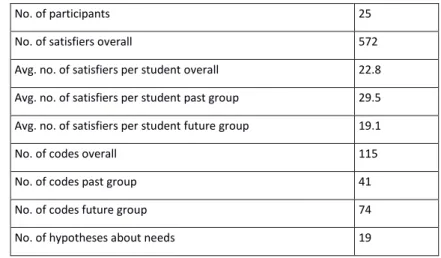
• Article C (see page 97; already mentioned in subsection 3.1) does also contribute RQ-2 ‘How can enhanced organizational learning approaches amplify explicit knowledge about needs?’. We analyze the consequences of the alternative learning approach called ‘learn-ing from an envisioned future’ (also Kragulj, 2014b) which we used in the research projects. Based on empirical data from Project 3 (see section 2.3), we compared learn-ing from past and learnlearn-ing from future experiences. It turned out that a combination of learning from past and future experiences increases the overall number of identified hidden needs.
• Article D (see page 111) answers the subordinate research question RQ-2-1‘How to
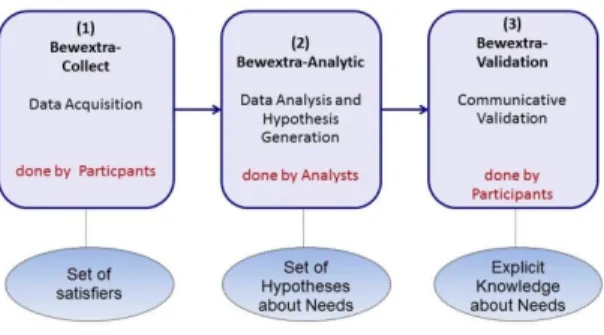
in-fer abductively - in a methodological replicable and consistent way - human needs from observable satisfiers in a non-instantaneous setting using qualitative research methods?’. In this article, we present our advanced methodological framework ‘Bewextra’. Based on theories from several disciplines, including visioning and philosophy of needs, as well as empirical data from Project 1 and Project 2 (see section 2.3), we propose three consecutive phases to generate explicit knowledge about needs in organizations. In ‘Bewextra-Collect’ (phase 1), organization members generate and interact with their ideal future scenarios. The ‘learning from an envisioned future’ approach enables them to imagine ideal future scenarios in which all their needs are intuitively fulfilled (Atance and O’Neill, 2001). Therein, we encourage people not to think of possible restraints that result from current or past limitations to foster the creation of knowledge that is less affected by past experiences. As we demonstrate, the generated reports ‘from the future’ do not represent needs directly, but they embody patterns that point to-wards the persons’ hidden needs. In ‘Bewextra-Analytic’ (phase 2), researchers follow a hermeneutic approach to analyze the reports (Gadamer, 2006). They use generative listening (Davis, 1997; Senge et al., 2005; Yackel et al., 2003) as a method to abduc-tively generate hypotheses about the underlying needs people may try to articulate by
concerned. We ask them to validate the need hypotheses in terms of correctness and completeness. Utilizing information technology (e.g. online questionnaires) allows for increasing the sample of respondents in order to broadly evaluate the data and gain robust insights.
• Article E (see page 133) answers the subordinate research question RQ-2-2 ‘How does
the use of Learning from Interacting with an Envisioned Future as an additional learn-ing mode support the quality and quantity of innovative ideas?’. Complementary to Article D (see page 111), this article reinforces the theoretical background of ‘learning from an envisioned future’ and proposes an enhanced theory of learning which entails this learning source. Therein, tacit need knowledge is crucial, as it is embedded in the scenarios participants imagine and engage with (visions). Moreover, we empirically investigate what impact interacting with and learning from a vision has for meso level interventions. Therefore, data from Project 2 and Project 4 (see section 2.3) are ana-lyzed by means of the paradigm relatedness framework (Nagasundaram and Bostrom, 1994). We conclude that ‘learning from an envisioned future’, i.e., learning from a vision in which needs are intuitively satisfied, enables the creation of creative and innovative solutions. Moreover, the combination of learning from the past with ‘learning from an envisioned future’ leads to a higher number of innovative ideas, both in terms of quality and quantity.
3.3
Need Knowledge and Strategies
This subsection is dedicated to RQ-3 ‘How does explicit knowledge about needs
con-dense in collectively created strategies for the organization?’. This article published in conference proceedings answers RQ-3 in detail:
• Article F (see page 147): Kragulj, F. and Fahrenbach, F. (2016). Investigating the Impact of Need Knowledge on Strategy Development in Organizations. In S.
Moffett and B. Galbraith (Eds.), Proceedings of the ECKM-2016 (17th European
Conference on Knowledge Management) (pp. 485-493). Reading, UK: Academic Conferences and Publishing International Limited. ISSN: 2048-8961. ISBN 978-1-911218-02-9.
In Article F (see page 147), we report about an experimental inquiry to understand the differ-ences between strategies, which are generated with reference to needs, and strategies, which are developed without explicitly considering needs. As part of Project 3 (see section 2.3), we
asked two groups of students to develop strategies for a better learning and teaching environ-ment at their university. While one group developed their strategies with explicit reference to previously identified needs, the other group did the same task intuitively. We used the reper-tory grid analysis (Hemmecke, 2012) to evaluate these strategies and investigate how explicit need knowledge affects the outcome. Based on the results, we draw two conclusions: (I) There is a clear overlap between identified needs and the perception of the developed strategies. This is in line with the assumption that needs govern our behavior (strategy development), even when we are not explicitly aware of them. (II) There is no solid difference between strate-gies with explicit reference to needs and stratestrate-gies intuitively generated. We cannot conclude that need knowledge has a distinct effect on the outcome of a strategy development process. Conclusively, we hypothesize on reasons for the results. One possible reason could be that participants in this experiential setting were free to come up with whatever ideas that came to their minds. They did not have to find a consensual strategy in a ‘real-world’ environ-ment characterized by scarce resources, competing interests, bounded rationality, and other restrictions.
3.4
Coherence of Results
Each empirical project outlined in subsection 2.3 independently followed an action research cycle of diagnosing, action planning, action taking, evaluating, and specifying learning (Sus-man and Evered, 1978). Though, the research articles constituting subsections 3.1, 3.2, and 3.3 report about these projects and focus on different aspects to answer the research questions. Their results feed the overall action research cycle of this dissertation. Figure 1 depicts this
DIAGNOSING Identifying or defining a problem ACTION PLANNING Considering alternative courses of action for solving a problem
ACTION TAKING Selecting a course of action EVALUATING
Studying the consequences of an action SPECIFYING LEARNING
Identifying general findings Article A Article D
Article F
Article E Article C
Article B
How does explicit knowledge about needs contribute to organizational learning processes?
Figure 1: The articles’main contributions to the overall action research cycle (adapted from Susman and Evered, 1978, p. 588)
4
Key Findings and Conclusion
The increasing interest in organizational learning as well as the demand for research on me-diating variables in these processes (Rebelo and Duarte Gomes, 2008) justify this inquiry on the impact of need knowledge on organizational learning. By means of an action research approach, this dissertation contributes several insights to the fields of organizational learn-ing and knowledge management. A summary of key findlearn-ings regardlearn-ing the dissertation’s objectives is presented in table 1.
Table 1: Summarized key findings
Article Key Findings
Article A B The proposed theory of needs allows for (I) understanding the motivational
forces of organizational learning, and (II) exploiting the potential inherent to the one-to-many relation between needs and satisfiers.
B Although concrete proposals and ideas of stakeholders differ significantly, the
underlying needs might be the same, and identifying them supposedly fosters a consensual morale within the organization.
B There is no ‘right’ satisfier to a given need, but many ways ro reach need
satisfaction. Thus, considering shared needs first may facilitate the design of consensual satisfiers. By developing these, stakeholders may recognize new possibilities to fulfill their needs and open up for change.
Article B B The proposed concept of ‘need-based solution knowledge’ encompasses
essen-tial capacities to act for need-driven organizational learning.
B Nonaka and Takeuchi’s (1995) argument reinforces that these capacities are
most powerful when they are made explicit.
B Enhancing and using these capacities enable people to propose viable need
satisfying strategies in organizations which are potentially able to not only meet their own needs but also the needs of other stakeholders.
Table 1: Summarized key findings
Article Key Findings
Article C B Combining conventional past-oriented learning and ‘learning from an
envi-sioned future’ increases the overall number of identified needs.
B Providing an enabling space (Peschl and Fundneider, 2012) is crucial for the
participants’ willingness to engage in ‘learning from an envisioned future’. Es-pecially a trustful relationship between the facilitator and the participants is critical for detaching from current restrictions and thinking outside the box.
B The proposed methodological framework ‘Bewextra’ proves to be efficiently
applicable in larger social systems (n≈200).
Article D B In organizational practice, people are not used to communicate on the level
of needs. Consequently, an initial consideration of needs (not proposals for solutions) often lacks.
B A focus on needs and knowledge about needs drastically extends opportunities
to act, as it does not prescribe any concrete strategy at first.
B By means of ‘Bewextra’ organizations can identify (shared) needs among
their stakeholders without great effort. In the two case studies, the identified needs were assessed as valid by a great majority of the system members.
Article E B ‘Learning from an envisioned future’ facilitates the creation of highly creative
ideas.
B Combining conventional past-oriented learning and ‘learning from an
envi-sioned future’ increases the overall number of innovative ideas, both in terms of quality and quantity.
B The effects of ‘learning from an envisioned future’ hold for diverse domains
Table 1: Summarized key findings
Article Key Findings
Article F B Research reinforces that needs influence our acting, even when we are not
explicitly aware of them.
B Under experimental conditions, there is no solid difference between strategies
with explicit reference to needs and strategies without such reference.
B The repertory grid methodology can be effectively advanced by integrating
semantic clustering to combine data from several interviewees into one data set that can be evaluated by a large population (via an online questionnaire).
The findings of this dissertation reveal that needs are a crucial variable in organizational learning and can drive organizational change. The research contributes to the scientific com-munity and provides practitioners with tested methodologies to enhance organizational learn-ing processes. As outlined in detail, this dissertation results in three main contributions to the scientific fields of organizational learning and knowledge management:
1. It emphasizes the role of needs in organizational learning and thereby contributes to the ongoing discussion on influencing variables for such processes (Rebelo and Duarte Gomes, 2008). It provides a theory of needs appropriate for organizational learning processes, such as vision or strategy development. Based on this theory, it introduces the concept of ‘need-based solution knowledge’ by which leverage points for the trans-formation from needs to satisfiers are highlighted.
2. Based on these, the dissertation presents an advancement of a methodological frame-work to identify needs which proved to be efficient and effective in small to medium-sized organizations.
3. It introduces ‘learning from an envisioned future’ as an additional learning source and embeds it into a state-of-the-art learning theory. Moreover, it empirically shows the benefits of this learning approach in various domains.
In addition to all that, this research, that I together with my colleagues conducted, has directly touched around 400 people and hopefully shifted their organizations in a valuable way.
References
Altschuld, J. W. and Watkins, R. (2014). A Primer on Needs Assessment: More Than 40
Years of Research and Practice. New Directions for Evaluation, (114):5–18.
Argote, L. and Miron-Spektor, E. (2011). Organizational Learning: From Experience to
Knowledge. Organization Science, 22(5):1123–1137.
Argyris, C., Putnam, R., and MacLain-Smith, D. (1982). Action Science: Concepts, Methods
and Skills for Research and Intervention. Jossey-Bass, San Francisco.
Argyris, C. and Schön, D. (1996). Organizational Learning II. Addison-Wesley, Reading.
Arhem, P. and Liljenström, H. (1997). On the coevolution of cognition and consciousness. Journal of Theoretical Biology, 187(4):601–612.
Asadi-Lari, M., Packham, C., and Gray, D. (2003). Need for redefining needs. Health and
Quality of Life Outcomes, 1(34):34.
Atance, C. M. and O’Neill, D. K. (2001). Episodic future thinking. Trends in Cognitive
Sciences, 5(12):533–539.
Baldwin, M. (2012). Participatory Action Research. In Gray, M., Midgley, J., and Webb,
S. A., editors, The SAGE Handbook of Social Work, pages 234–243. SAGE, London.
Baskerville, R. L. and Wood-Harper, A. T. (1996). A critical perspective on action research as
a method for information systems research. Journal of Information Technology, 11(3):235–
246.
Bateson, G. (1979). Mind and Nature. A Necessary Unity. E. P. Dutton, New York.
Bateson, G. (1987). Steps to an Ecology of Mind. Jason Aronson Inc., Northvale, London.
Baxter, D. I., Goffin, K., and Szwejczewski, M. (2014). The repertory grid technique as a
customer insight method. Research Technology Management, 57(4):35–42.
Bayus, B. L. (2008). Understanding Customer Needs. In Shane, S., editor, Handbook of
Technology and Innovation Management, pages 115–142. John Wiley & Sons, New York.
Berger, P. L. and Luckmann, T. (1981). The Social Construction of Reality. A Treatise in the
Sociology of Knowledge. Penguin Books, Harmondsworth.
Blichfeldt, B. S. (2006). Creating a Wider Audeince for Action Research: Learning from
Bradshaw, J. (1972). A taxonomy of social need. In McLachlan, G., editor, Problems and progress in medical care, pages 69–82. Oxford University Press, London.
Bruner, J. S. (1995). Acts of meaning. Harvard University Press, Cambridge.
Brydon-Miller, M., Greenwood, D., and Maguire, P. (2003). Why action research? Action
Research, 1(1):9–28.
Burton, J. W. (1990). Conflict: Resolution and Provention. St. Martin’s Press, New York.
Carlgren, L. (2013). Identifying latent needs: towards a competence perspective on attractive
quality creation. Total Quality Management & Business Excellence, 24(11-12):1347–1363.
Charmaz, K. (2014). Constructing Grounded Theory. Sage, London, 2nd edition.
Checkland, P. and Holwell, S. (1998). Action Research: Its Nature and Validity. Systemic
Practice and Action Research, 11(1):9–21.
Chiva, R. and Alegre, J. (2005). Organizational Learning and Organizational Knowledge:
Towards the Integration of Two Approaches. Management Learning, 36(1):49–68.
Chua, A. (2002). The influence of social interaction on knowledge creation. Journal of
Intellectual Capital, 3(4):375–392.
Cohen, M. and Sproul, L. (1991). Editors’ introduction. Organization Science, 2(1):1–3.
Culyer, A. (1998). Need - is a consensus possible? Journal of Medical Ethics, 24:77–80.
Dalkir, K. (2005). Knowledge Management in Theory and Practice. Elsevier Inc.,
Burling-ton/Oxford.
Davenport, T., De Long, D., and Beers, M. (1998). Successful Knowledge Management
Projects. Sloan Management Review, 39(2):43–57.
Davis, B. (1997). Listening for Differences: An Evolving Conception of Mathematics Teaching. Journal for Research in Mathematics Education, 28(3):355–376.
Denzin, N. K. (2010). Moments, Mixed Methods, and Paradigm Dialogs. Qualitative Inquiry, 16(6):419–427.
Doyal, L. and Gough, I. (1991). A Theory of Human Need. Guilford Press, New York.
Drakopoulos, S. A. and Karayiannis, A. D. (2004). The Historical Development of Hierarchical
Behavior in Economic Thought. Journal of the History of Economic Thought, 26(3):363–
378.
Drucker, P. F. (1993). Post-Capitalist Society. HarperCollins, New York.
Easterby-Smith, M., Crossan, M., and Nicolini, D. (2000). Organizational Learning: Debates
Past, Present and Future. Journal of Management Studies, 37(6):783–796.
Eden, C. and Huxham, C. (1996a). Action Research for Management Research. British
Journal of Management, 7:75–86.
Eden, C. and Huxham, C. (1996b). Action research for the study of organizations. In Clegg,
S., Hardy, C., and Nord, W., editors,The Handbook of Organization Studies. Sage, Beverly
Hills.
Emery, P. (1997). Knowledge management. Inform, 11(10).
Ericson, A., Bertoni, M., and Larsson, T. (2009). Needs and requirements - how TRIZ may
be applied in product-service development. In2nd Nordic Conference on Product Lifecycle
Management, Göteborg.
Evans, J. R. and Linsday, W. M. (1999). The Management and Control of Quality. West
Publishing Company, St. Paul, 4th edition.
Firestone, J. M. and McElroy, M. W. (2004). Organizational Learning and Knowledge
Man-agement: The Relationship. The Learning Organization, 11(2):177–184.
Flood, R. L. (1993). Beyond TQM. John Wiley & Sons, London.
Gadamer, H.-G. (2006). Truth and method. Continuum, London, 2nd edition.
Glaser, B. G. and Strauss, A. L. (1967). The Discovery of Grounded Strategies for Qualitative
Research. Aldine Pub. Co., Chicago.
Goffin, K. and Lemke, F. (2004). Uncovering your customer’s hidden needs.European Business
Goffin, K., Lemke, F., and Koners, U. (2010). Identifying Hidden Needs. Palgrave Macmillan, London.
Grant, R. M. (1996). Towards a knowledge-based theory of the firm. Strategic Management
Journal, 12:109–122.
Greenwood, D. and Levon, M. (2007). Introduction to action research: Social research for
social change. SAGE, Thousand Oaks, 2nd edition.
Hamilton, L. A. (2003). The Political Philosophy of Needs. Cambridge University Press,
Cambridge.
Hassenzahl, M. and Wessler, R. (2000). Capturing Design Space From a User Perspective:
The Repertory Grid Technique Revisited. International Journal of Human-Computer
In-teraction, 12(3&4):441–459.
Hedberg, B. (1981). How Organizations Learn and Unlearn. In Nystrom, P. C. and Starbuck,
W. H., editors, Handbook of Organizational Design, pages 3–27. Oxford University Press,
New York.
Hemmecke, J. (2012). Repertory Grids als Methode zum Explizieren impliziten Wissens in
Organisationen. PhD thesis, University of Vienna.
Hull, C. (1943).Principles of behavior: an introduction to behavior theory.
Appleton-Century-Crofts, New York.
Hult, M. and Lennung, S. (1980). Towards a Definition of Action Research: A Note and
Bibliography. Journal of Management Studies, 17(2):241–250.
Ibert, O. (2007). Towards a Geography of Knowledge Creation: The Ambivalences between
’Knowledge as an Object’ and ’Knowing in Practice’. Regional Studies, 41(1):103–114.
John, L. K., Loewenstein, G., and Prelec, D. (2012). Measuring the Prevalence of Quest