Graduate Theses, Dissertations, and Problem Reports
2014
Development of a Remote Laboratory with the Integration of
Development of a Remote Laboratory with the Integration of
Cloud Applications
Cloud Applications
Jeremy ThompsonWest Virginia University
Follow this and additional works at: https://researchrepository.wvu.edu/etd Recommended Citation
Recommended Citation
Thompson, Jeremy, "Development of a Remote Laboratory with the Integration of Cloud Applications" (2014). Graduate Theses, Dissertations, and Problem Reports. 213.
https://researchrepository.wvu.edu/etd/213
This Thesis is protected by copyright and/or related rights. It has been brought to you by the The Research Repository @ WVU with permission from the rights-holder(s). You are free to use this Thesis in any way that is permitted by the copyright and related rights legislation that applies to your use. For other uses you must obtain permission from the rights-holder(s) directly, unless additional rights are indicated by a Creative Commons license in the record and/ or on the work itself. This Thesis has been accepted for inclusion in WVU Graduate Theses, Dissertations, and Problem Reports collection by an authorized administrator of The Research Repository @ WVU. For more information, please contact [email protected].
Development of a Remote Laboratory with the Integration of Cloud
Applications
Jeremy Thompson
Thesis submitted
to the College of Engineering and Mineral Resources at West Virginia University
in partial fulfillment of the requirements for the degree of Masters of Science in
Mechanical Engineering
Marvin Cheng, Ph.D., Chair Bruce Kang, Ph.D. David Miller, Ph.D.
Department of Mechanical Engineering
Morgantown, West Virginia 2014
Keywords: Remote Laboratory, Distance Learning Copyright 2014 Jeremy Thompson
Abstract
Development of a Remote Laboratory with the Integration of Cloud Applications Jeremy Thompson
Distance learning has been a mode of education since its inception at Pennsylvania State University in 1892. What started as a simple correspondence course has blossomed into a globally accepted method of education. The need for remote laboratories is growing as more lab-intensive programs of study are searching for a distance learning alternative. The goal of this research is to establish the foundation of a remote laboratory in the Mechanical and Aerospace Engineering Department at West Virginia University. The main objectives are to develop simple, easy-to-use graphical user interfaces to enhance the understanding of several concepts presented in the MAE 244: Dynamics and Strength of Materials course and to increase accessibility to data outside of the lab. The integration of cloud applications with access to social media is a unique feature of this research and the key to improved accessibility. Students were asked to participate in a study in which they compared the traditional lab procedure to the procedure utilizing the developed interface for several experiments. The participants were required to fill-out surveys following each experiment and the responses were unsurprisingly positive. Further works based on this research should include more quantitative results and include more experiments with more students to get a more accurate portrayal of the student body. Overall, the research was successful in ascertaining that the developed interfaces were a beneficial addition to the experiments and did, in fact, greatly improve the accessibility to data.
iii
Acknowledgements
First and foremost, I would like to thank God for giving me the ability to succeed and the strength to persevere during the difficult times.
I thank my family and friends for their tremendous support throughout the entirety of my life but especially the last 18 months. They offered financial, emotional, and physical support throughout this endeavor. Special thanks to my grandmother, Edna Thompson, and my girlfriend, Stephanie Singleton.
I would also like to thank the selection committee at Statler College of Engineering and Mineral Resources that afforded me the opportunity to show that I was capable of completing this degree.
I would like to thank all of the faculty members that helped along my journey. I would especially like to thank Dr. Bruce Kang for allowing me to work on this research and for serving on my committee. Along the same lines, I am grateful to have been able to work with Dr.
Marvin Cheng who served as my advisor and committee chair and really pushed me to get things done. I owe a special thank you to Dr. David Miller for helping me with the educational aspect of this research and agreeing to serve on my committee.
Lastly, I was fortunate to find enough willing participants to complete this research and to each and every one of them I am extremely thankful.
iv
Table of Contents
Abstract ... ii
Acknowledgements ... iii
Table of Contents ... iv
List of Tables ... vii
List of Figures ... viii
Chapter 1: Introduction ...1
1.1 Overview ...1
1.2 Motivation ...2
1.3 Objectives ...4
1.3 Organization of This Document ...5
Chapter 2: Background and Literature Review ...6
2.1 Introduction ...6
2.2 Distance Learning ...10
2.2.1 History of Distance Learning ...10
2.2.2 Evolution of Distance Learning ...11
2.2.3 Challenges of Distance Learning ...13
2.2.4 Hands-Off Laboratories ...17
2.3 Laboratories in Engineering Education ...17
2.3.1 Evolution of Engineering Laboratories ...19
2.3.2 Laboratory Type Comparison ...21
2.4 Integration of Cloud Platform ...26
2.5 Conclusion ...27
Chapter 3: Technical Approach ...29
3.1 Introduction to MAE 244 ...29
3.2 Problem Statement ...31
3.3 Setup of Hardware/Software ...34
3.3.1 P3 Strain Gage Hardware/Software ...34
3.3.2 Microsoft Visual Studio 2010 ...37
3.3.3 Google Service ...38
v
3.4.1 Integration of Hardware and Software ...39
3.4.2 Thought Process of Interfaces ...40
3.4.3 Experiment Requirement Comparison ...41
3.4.4 Programming Techniques ...44
3.4.5 Live Video Stream ...46
3.5 Beam Bending ...46
3.5.1 Equipment...48
3.5.2 Interface Development ...49
3.5.3 Lab Procedure Comparison ...52
3.5.4 Summary...54
3.6 Combined Loading ...55
3.6.1 Equipment...57
3.6.2 Interface Development ...58
3.6.3 Lab Procedure Comparison ...61
3.6.4 Summary...62
3.7 Pressure Vessel ...63
3.7.1 Equipment...65
3.7.2 Interface Development ...66
3.7.3 Lab Procedure Comparison ...68
3.7.4 Summary...70
3.8 Tension Test ...71
3.8.1 Equipment...72
3.8.2 Interface Development ...74
3.8.3 Lab Procedure Comparison ...76
3.8.4 Summary...78
3.9 Incorporation of Cloud Storage and Social Media ...79
3.10 Conclusion ...82
Chapter 4: Responses from Students ...83
4.1 Beam Bending Student Survey Responses ...83
4.2 Combined Loading Student Survey Responses ...90
4.3 Overall/General Student Survey Responses ...96
vi
5.1 Contribution of This Work ...105
5.2 Achievement of Integrating Works ...105
5.3 Technical Difficulties and Deviation from Original Plan ...108
5.3.1 Tension Test ...108 5.3.2 Pressure Vessel ...109 5.3.3 Google API ...110 5.3.4 USB Connection ...110 5.4 Future Works ...111 5.4.1 Quantitative Results...111 5.4.2 Administrator Survey ...113 5.4.3 Administrator Interface ...113 5.4.4 Cloud Automation ...113 5.4.5 Interface Improvements ...115 5.5 Overall Summary ...115 Bibliography ...117 Appendix A ...119 Appendix B ...121 Appendix C ...125 Appendix D ...130 Appendix E ...137
vii
List of Tables
Table 2-1: Comparison of Different Types of Laboratories ... 22
Table 2-2: Another Lab Type Comparison ... 24
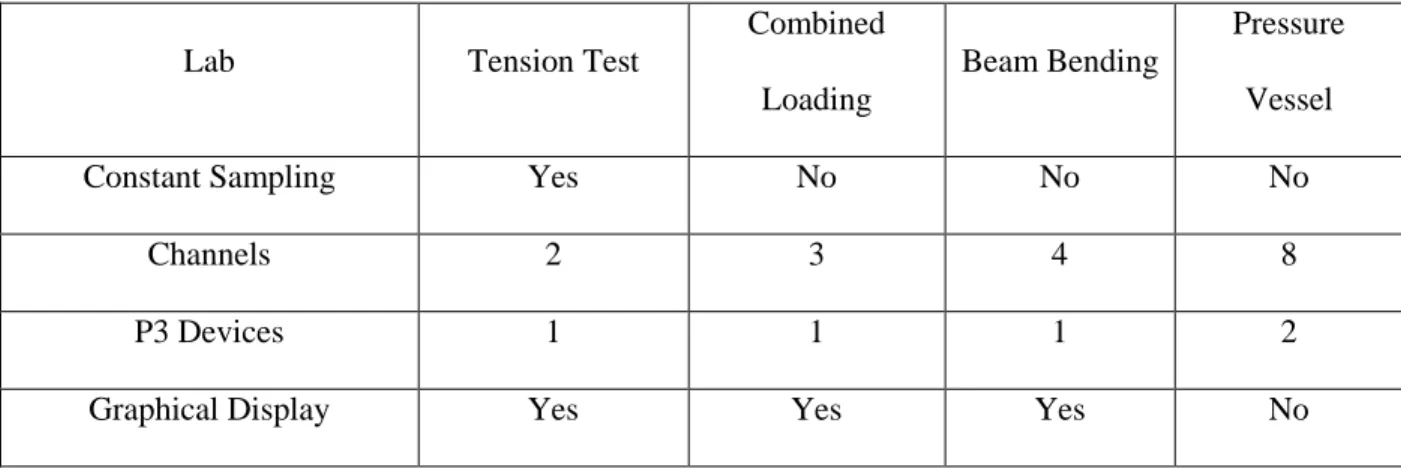
Table 3-1: Requirement Comparison ... 43
Table 3-2: Chart for Beam Bending Data Recording ... 53
Table 3-3: Chart for Combined Loading Data Recording ... 61
Table 3-4: Chart for Pressure Vessel Data Recording ... 69
Table 3-5: Chart for Tension Test Data Recording ... 77
viii
List of Figures
Figure 2-1: Graphical User Interface for NetLab ... 8
Figure 2-2: Screenshot from WebLab... Error! Bookmark not defined. Figure 2-3: Configuration of Typical Setup of Remote Lab ... 27
Figure 3-1: Diagram of Networked Laboratory ... 33
Figure 3-2: Model P3 Strain Gage Indicator and Recorder Hardware ... 35
Figure 3-3: Visual Studio Workspace ... Error! Bookmark not defined.8 Figure 3-4: Integration of Hardware and Software ... 36
Figure 3-5: Flow Chart of the Program... 452
Figure 3-6: Schematic of Cantilever Beam for Beam Bending Experiment ... 47
Figure 3-7: Beam Bending Experimental Setup ... 488
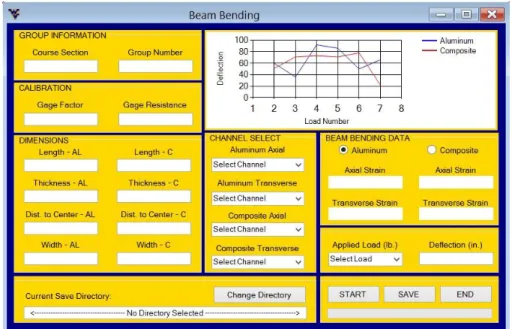
Figure 3-8: Beam Bending Interface ... 50
Figure 3-9: Combined Loading Top-View Schematic ... 56
Figure 3-10: Combined Loading Experimental Setup ... 57
Figure 3-11: Combined Loading Interface ... 579
Figure 3-12: Pressure Vessel Schematic ... 64
Figure 3-13: Pressure Vessel Experimental Setup ... 65
Figure 3-14: Pressure Vessel Interface ... 67
Figure 3-15: Tension Test Schematic ... 72
Figure 3-16: Tension Test Experimental Setup ... 73Error! Bookmark not defined. Figure 3-17: Tension Test Interface ... 74
Figure 4-1: Beam Bending Question 3 ... 84
Figure 4-2: Beam Bending Question 4 ... 825
Figure 4-3: Beam Bending Question 6 ... 836
Figure 4-4: Beam Bending Question 2 ... 847
Figure 4-5: Beam Bending Question 1 ... 869
Figure 4-6: Combined Loading Question 4 ... 91
Figure 4-7: Combined Loading Question 5 ... 92
Figure 4-8: Combined Loading Question 2 ... 903
Figure 4-9: Combined Loading Question 1 ... 914
Figure 4-10: General Question 5... 98
Figure 4-11: General Question 4... 969
Figure 4-12: General Question 6... 100
Figure 4-13: General Question 8... 101
1
Chapter 1: Introduction
1.1 Overview
Distance Learning has grown significantly in the last few decades for several reasons; a main reason being that many people who are already in the work force need a new or different degree for various reasons but cannot afford to quit their job. With that in mind, colleges and universities that wish to stay competitive in the distance learning realm need to continually be creating and improving their distance learning programs. Obviously, there are some curricula that make it easier than others to provide a distance learning option. For example, it can be challenging to implement a distance learning program for an engineering curricula; one of the main reasons for this difficulty is the need for hands-on laboratories.
The importance of the laboratories in the engineering curriculum is considerably less than in the past [11]. There is a movement towards reinstating the lab to its former glory; and, if successful, there will need to be a strong emphasis on creating distance laboratories in order fulfill the necessary laboratory requirements within the modern engineering curriculum for accreditation of a distance learning program. There are two different types of distance learning laboratories: remote and virtual. The importance of the lab in the engineering curriculum and the different types of laboratories will be discussed in Chapter 2. Depending on the type of
laboratory and the experiments associated with it, it may not be possible to create a totally distance-based laboratory option for some of the required laboratories in the engineering curriculum.
2
The plan for this research was to lay the foundation of a remote laboratory for the Mechanical and Aerospace Engineering program at West Virginia University. The goal of this research is to integrate a traditional laboratory environment with state-of-the-art technology, including cloud service and mobile technology. Both students and instructors can benefit from the innovative online laboratory as it can reduce the time of setting up and performing
experiments. The broadest description of our plan is that graphical user interfaces were created for some experiments in a Strength and Dynamics Laboratory to help with data acquisition by using Excel and sharing of data files by utilizing Google Drive. More specifically, each of the experiments that use a P3 Strain Indicator and Recorder from Micro-Measurements will have an interface that will pull the readings from the P3 device into an Excel worksheet, as well as the other parameters for the experiment, and then that Excel worksheet will be saved into Google Drive Desktop which, in turn, will allow the data to be shared with each member of the group almost instantaneously. The interfaces should be easy to use and understand and the Teaching Assistant or Instructor has only to set the sharing controls at the beginning of the course and Google Drive will do the rest.
1.2 Motivation
The purpose of this research is to provide the foundations of a remote engineering laboratory at West Virginia University. This would potentially allow for the creation and
development of a distance learning engineering curriculum with a remote laboratory which could provide a first-rate Mechanical Engineering education to many more people far outside the borders of the great state of West Virginia. The motivating factors of this research are to allow
3
students to perform experiment more quickly and efficiently in an effort to enhance the learning experience as well as create the capability to share resources with other institutions to reduce costs. One aspect of this project that differs from most remote labs that have already been started or completed, is the integration of cloud storage technology and social media.
Most laboratories, in most universities, require the students to be in groups because there simply is not enough room and/or space to allow each student to perform each experiment
individually. In many cases, laboratories are also extremely expensive to equip and by creating a remote laboratory, other institutes can access the laboratory remotely and help share the cost of creating and maintaining the laboratory. These two topics will be discussed in detail in Section 2.4. Using cloud storage allows the students to access their results anywhere they have access to the internet and by utilizing social networks they can communicate and share data to improve the efficiency of writing the laboratory reports. Not only does utilization of cloud storage
technology and integration of social media make storing and sharing data more effective, it also adds a little fun and allows students to display their results with their friends and family thus potentially growing the interest in engineering as whole.
1.3 Objectives
The major objectives of the development of this remote laboratory are to integrate lab resources with modern technologies and improve the efficiency of performing the lab and report writing. The objectives are specifically stated as follows:
1. Create user-friendly interfaces for select laboratory experiments to enhance the data
4
students are able to extract data from these experiments but not to complicate the process. Ideally, the process should also be simplified.
2. Integrate cloud storage technology with laboratory experiment results. Currently,
students must have a flash storage device to transport the data from the laboratory to wherever they will be writing their report. Each student must have their own or one student has to get the data and then share it with the other members of the group. By integrating cloud storage into the user interfaces each student will have the data
available to them as soon as the experiment is over and anywhere that they have access to the internet.
3. Improve the efficiency and effectiveness of students during the experiment by means of
the user-friendly interface. Presently, students have to perform the experiments in a
group so that some students can adjust the equipment as necessary while others write down the data and then the others copy that data. Not only does this give each student a different perspective on the experiment but it also takes more time than should be required. By implementing the user interface, each student can participate and focus on the actual experiment that is taking place and everyone will still get the same data because of the previous bullet point.
4. Improve the efficiency and effectiveness of the students during the laboratory report
writing process due to the utilization of the cloud storage. As mentioned previously,
students now have to use flash storage devices to carry around their data and then import the data into Excel. By using the interfaces, they have access to the data anywhere that has internet and it is already in an Excel format.
5
1.4 Organization of This Document
In Chapter 2, the history and background of remote laboratories will be discussed. Some specific topics covered in this chapter include the history and evolution of distance learning, the role of the lab in the engineering curriculum both past and present, and, lastly, a comparison of different types of remote laboratories. The third chapter discusses the technical approach taken for this research. It begins with an introduction to the platform used for this research, followed by the hardware and software used throughout the process, then a general comparison between the experiments selected for this research, and, finally, each experiment and interface is
discussed in detail. Chapter 4 contains the results of the research which are the student survey responses. The final chapter presents the conclusions drawn from this study, several of the difficulties encountered throughout the process, and the potential future works related to this research.
6
Chapter 2: Background and Literature Review
2.1 Introduction
Distance learning has become a more accepted means of obtaining a higher education degree in the past few decades. Although most people may think that distance learning is relatively new, and a direct result of the internet, distance learning has actually been around for over 100 years. The fast pace and financial obligations of today’s world can make it difficult for a person to enroll in an on-campus educational experience; for some, however, it is a choice to forego the on-campus experience. Some of the main reasons people are attracted to distance learning, especially those that have already entered the work force, can be summarized as follows [8]:
Non-Traditional Experience;
Location Convenience;
Schedule Flexibility; and
Cost.
Like distance learning itself, these reasons are not new but are similar to the reasons why distance learning was created. With the increasing interest in distance learning, universities and colleges are having to overcome the obstacles associated with distance learning in order to create distance learning programs if they wish to compete in this emerging area of education.
Although distance learning definitely has some advantages, it does not come without consequences. The policies and procedures that institutions have in place are based on traditional, on-campus programs of study. Distance learning adds something totally different that requires the administration to review their policies and procedures and make modifications
7
where necessary. One area of policies that has to be modified is how instructors are evaluated because different things are required to run a successful online class and the interaction with the students is considerably different. On a similar note, students that take online courses need to take a different approach in order to be successful and it is up to the institution to make sure the students are well informed of what is required of them. With that in mind, the institution needs to allocate the necessary resources to assure that the quality of the course is similar to the
alternative offered on campus. Most of these issues can be handled if they are addressed early on in the development of distance learning courses. The issues mentioned above apply to all
distance learning courses but there are some courses that have additional problems that need to be considered.
While the majority of distance learning courses vary only in the delivery of the material from those offered in the classroom; there are some courses that are more difficult to convert to a distance learning alternative. One example of this, and the one that this research will be focusing on, is an engineering course that has a lab requirement. In order for the program to gain
accreditation, every course would have to meet the accreditation criteria and this means that the courses that require a lab would need to fulfill this requirement “from a distance”. An
understanding of the role of the laboratory in the engineering curriculum is important when considering an alternative type of laboratory because it is imperative that the integrity of the laboratory is not sacrificed. Remote laboratories are not necessarily new but they have been getting more attention lately and are paramount for any program of study that requires any labs to obtain accreditation. Some examples of remote engineering laboratories are given below.
NetLab– “NetLab is a remote laboratory specialized for experiments in electrical circuits and systems. It has a specially designed Graphical User Interface that
8
uses photographic images of laboratory instruments with animated controls and displays. This enables students to control the instruments in the same way as if they were working in the real laboratory” [7]. Access is available via the Internet.
Figure 2-1: Graphical User Interface for NetLab [7]
WebLab – “WebLab…allows students to do actual (not simulated) laboratory research on state-of-the-art equipment though the Internet” [6]. WebLab consists of laboratory instruments for the characterization of microelectronic devices, together with computer hardware and software that makes this equipment accessible to users through the World Wide Web” [6]. “It enables them to use different processes of learning (intuitive, visual, abstract), and it gave them an opportunity to link individual and collaborative effort in creative combinations” [6].
9
Figure 1-2: Screenshot from WebLab [6]
These two laboratories might provide the same hands-on function in an engineering course but their approaches are very different. One is a simulated environment, NetLab, and the other one, WebLab, is a real experimental setup with a network connection. Clearly, there are two types of distance learning laboratories that can be considered but they are both attempting to fill the same hole in a distance learning program that has laboratory requirements. The first type is a virtual laboratory that uses a simulation of the experimental setup to produce results and the second type is a remote laboratory that uses a remote connection to control the physical lab setup to produce results. Most of the existing on-line engineering courses with laboratory experience adopt one of these two approaches. The ultimate goal of distance learning is to provide access to many people that have a desire to obtain a higher level of education without limiting their
options and sacrificing the integrity of the degree they are seeking to acquire.
10
According to Google [13], distance learning is “a method of studying in which lectures are broadcast or classes are conducted by correspondence or over the Internet, without the
student’s needing to attend a school or college”. Distance Learning started in Pennsylvania in the late 1800’s [8]. Although distance learning has evolved since its inception, many of the reasons people participate in distance learning are the same. Distance learning is not without its
downfalls; there are several issues that need to be considered by the administration, the faculty, the students, and the institution to ensure that the distance learning experience is successful [8]. As communication technology continues to improve, there is no doubt that distance learning will become a monumental part of education worldwide.
2.2.1 History of Distance Learning
The domestic origin of distance learning, or distance education, “can be traced to the development of correspondence study at Pennsylvania State University in 1892” [8]. The original correspondence program developed at Penn State was done so to allow the rural population that desired higher education to be able to complete the necessary degree requirements while still being able to work and support a family [8]. The reasons people participate in distance learning today are the same reasons that distance learning was created in the first place. In fact, given the speed at which life must be lived in today’s society, these reasons are also why the popularity of distance learning is increasing so dramatically.
Obviously, the means of communication between the institution, instructor, and students, have changed radically which is another reason for the substantial increase in enrollment in distance learning courses.
11
2.2.2 Evolution of Distance Learning
The demographic of the higher education student population has changed dramatically over the last several decades and this is just one reason for the increased popularity of distance learning. According to Institute of Education Sciences [12], only 6.4 million of the 19.1 million students, or approximately 34%, are full-time between the ages of 18 and 22 in 2008. That number is down considerably from 1970 when almost 47% of students were full-time and between the ages of 18 and 22 [12]. Consequently, the number of students enrolled above the age of 25 in 2008 was 8 million (42.2%), a significant increase from 1970 when only 27.8% of students were older than 25 years of age [12]. Over 20% of the students enrolled at an
“institution participating in the Title IV programs” in 2008 had, at a minimum, one distance learning course and almost 4% were working a degree entirely through distance education [12]. These statistics suggest that people are either having to go back to college after they have started a career or that they are delaying college until later in life and many of them are choosing
distance education as a means to complete at least some of their degree requirements.
Technological advancements have allowed more people to take advantage of distance learning programs.
The non-traditional experience appeals to two types of prospective students: those that cannot afford the traditional experience and those that prefer the non-traditional experience. People that want to go back to school but cannot stop working due to financial obligations need the non-traditional experience because their available time is very limited; with more people going back to school after they have already entered the work force, this is a huge advantage of distance learning. Those that prefer the non-traditional experience may be able to afford the
12
traditional experience but perhaps do not want to deal with the social aspect of it. Whether they cannot afford to attend school in a traditional manner or just prefer not to, the fact that they can obtain a degree “outside of the classroom” is why people turn to distance learning programs.
The Internet has made the non-traditional experience as close to traditional as it has ever been and is also the reason that students can have access to their course almost anywhere in the world. Travel has become an integral part of today’s society, whether it is for business or pleasure, it seems that more people are traveling now than ever. The convenience of not being forced to be in one spot is another reason why people prefer a distance learning course to an in-class course. The location convenience offered by distance learning ties into the next reason people participate in distance learning: schedule flexibility.
As mentioned before, the pace at which one must live to be successful in today’s society does not leave much free time. The ability to be able to “go to class” when people can fit it into their busy schedules is one of the biggest draws to distance learning programs. There are still deadlines, but people have the freedom to choose their schedule and vary it whenever necessary. Not only does distance learning provide several different types of “freedom” for its students, it is also cheaper than the “on-campus” alternative.
The cost of distance learning programs is another reason people today choose distance learning over traditional higher education experiences. According to Banas and Emory [8], in the mid-1990’s, “At the University of Phoenix, a for-profit educational institution, the cost of providing one credit hour of distance education is $237 compared to $486 for one credit hour of traditional education at the not-for-profit Arizona State University”. The “per labor hour cost” is also significantly lower at the University of Phoenix at $46 compared to $247 at Arizona State University [8]. The reason the University of Phoenix has lower costs is because they do not have
13
to build or maintain residence and dining halls, support low-enrollment programs or high-cost programs such as lab sciences, and they do not have to support faculty research [8]. Due to the lower cost, some questions are raised about the quality of the education and some other problems that distance learning may possess.
2.2.3 Challenges of Distance Learning
Although the effectiveness of a distance learning approach may be questioned, studies have found that there is no significant difference in the learning outcomes when compared to a traditional learning experience [8]. The fact that distance learning programs are academically effective bodes well for the continued growth and interest in distance learning. Even though the concern for the quality of the education in a distance learning program is unwarranted, there are some real issues to be considered with distance learning and they can be categorized as follows: administrative, faculty, student, and institutional [8].
Administrative problems are those that involve the governing bodies at an institution.
Due to the popularity of distance learning, administrators are feeling pressure to at least integrate distance learning programs into traditional curricula to stay competitive. This means that all policies, infrastructure, and resource allocations need to be reviewed and modified if necessary. The policy review is necessary to remove any policy that may hinder the incorporation of distance learning into the traditional education experience. A few of the main infrastructure issues that need to be considered are: “fee assessment, out-of-state versus in-state fees, and access to technology by faculty and students” [8]. Unless the institute has a surplus of funds available, resources will need to be reallocated in order to support the new distance learning
14
programs. Accreditation is a key concern that the administrators need to consider when
implementing a distance learning program. The accreditation requirements for distance learning are noticeably different than those for traditional learning [8]. The recognition criteria for faculty members would also need to be altered since the requirements for teaching a distance learning course are considerably different than those for teaching a traditional style course; compensation and tenure are only two such areas.
Some faculty issues overlap with the administrative issues. Teaching a distance learning course is not the same as teaching a traditional class. Because there is, at most, limited face-to-face interaction between the students and the instructor, the delivery of the material must be altered to maintain its effectiveness. Faculty undertaking a distance learning course need support from several people and professional development before they can be an effective distance learning instructor. When the instructors are designing, or redesigning, a course the delivery technology that is being used is one of the most important factors to consider. Because of the need of a larger support system, instructors may feel a loss of control. Some other concerns a faculty member may experience involve incentives, rewards, evaluations, tenure, and
promotions; and, the best way to combat these is to define how things are going to work early on in the development of these programs. Due to the reliance on technology, which can sometimes be unreliable, the instructor or the student may feel that the instructor is responsible for poor delivery during technical difficulties. These issues may affect how students rate the quality of the instruction which falls on the instructor. The last issue that the faculty may be concerned about is who owns the developed course material. Intellectual property rights are a big issue in higher education systems.
15
Students have their own issues to deal with as well. The best away to avoid issues with
students in a distance learning program is to provide them with an adequate amount of
information up front about what they should expect and what is required of them for successful completion of the course. Students need to have access to all technology and institutional and course information. However, students cannot access resources physically in most cases; thus, student isolation is a major concern not only for the student but also for the institution. The lack of student-to-student interaction can cause the students to lose focus and consequently not perform as well as each party would like. Some ways to remedy this include cameras for each student for video conference type interaction. With this type of interaction, the faculty also needs a monitoring system to preserve the integrity of the course. Because of the personal flexibility that distance learning offers to the students, it can be easy for them to think that they should have full-time access to the instructor (7 days/week, 24 hours/day) and when there is a delay in the response time from the instructor the student may become frustrated. This is why distance learning etiquette education is necessary. It is also important for the students to know who they can talk to about different issues. For example, they should know which issues they need to contact the institution and which ones are the responsibility of the instructor. The lack of student-faculty interaction can also become an impeding factor in the overall learning outcomes of the course.
The institution is responsible for providing technological support for the students and the faculty. As mentioned in the previous section, the relationship with the faculty members needs to be defined early on and the institute needs to collaborate with the faculty in the development and maintenance of the distance learning course. They also need to find a way to reduce the “loss of control” felt by the instructor and ways to provide opportunities for student-to-student
16
interactions. Most importantly, they need to understand the limitations of distance learning and the technology being used, especially for delivery of material, so that reasonable and attainable goals are established.
2.2.4 Hands-off Laboratories
While creating distance learning courses for most programs of study is only a matter of adjusting the material based on the delivery technology; creating distance learning courses for programs of study in some of the STEM areas may be considerably more difficult because of the lab requirements. For example, providing the theory of engineering via an online medium is no more of a challenge than any other course but providing all of the necessary labs (i.e. strengths and dynamics, electronics, Mechatronics, etc.) requires more extensive development. It requires the development of “hands-off” laboratories; “Hands-off” refers to the fact the students do not physically interact with the experimental equipment. “Hands-off” laboratories can be further divided into remote laboratories and virtual laboratories; both types of “hands-off” laboratories are very important to distance learning. In order to obtain accreditation the engineering distance learning program needs to show that they are able to successfully provide the required learning outcomes from the laboratories. In order to do that, the learning outcomes from each lab needs to be clearly defined and in order to do that the role of the laboratory in the entirety of the curriculum needs to be understood.
17
As stated by Feisel and Roase, “Engineering is a practical discipline” [11]. With that in mind, it would make sense that practice “doing” should be more important than theory; and, prior to the creation of engineering curricula in schools and universities, engineers were trained in an apprenticeship program environment [11]. This means that all of the “education” they received was hands-on training. As engineering programs were developed in schools, theory was added to the hands-on practice and a balance between theory and “doing” was created. As more schools added engineering to their list of available programs, this mesh of theory and practice continued; at least until after World War II.
After World War II, many of the new innovations and inventions did not come from engineers but rather from “scientists” [11]. Because of this, many schools, if not all, began focusing more on theory and less on practice. The American Society for Engineering Education (ASEE) was responsible for this shift in focus because they deemed graduating engineers as being “too practically orientated” [11]. This committee formulated a list of what engineers should be taught throughout the curriculum and laboratories, for some reason, were not mentioned.
ABET, formerly ECPD, came about around 1980 and were in charge of the accreditation of institutions, and in order to do that, clearly defined objectives needed to be created [11]. During this time, because of the pursuit of clearly defined objectives and some other reports done by the ASEE, the importance of labs in the engineering curriculum was rediscovered. As the 20th century was starting to wind down, ABET was being criticized for their approach to
accreditation which was leaving the U.S. seemingly uncompetitive from a global standpoint [11]. As a result of the pressure to improve the quality of American engineers, ABET revised their accreditation process before the new millennium. In the early 2000’s, “The Fundamental
18
Objectives of Engineering Instructional Laboratories” was created by a colloquy funded by the Sloan Foundation [11]. These objectives can be found in Appendix B.
At this time, these are the objectives that institutes are expected to satisfy to produce successful engineers. As this section has shown, the role that laboratories play in the engineering curriculum has changed dramatically since its inception into academia in 1802 [11]. The role of the laboratory was not the only thing changing in the lab during this time period; the lab itself was also undergoing an evolution
2.3.1 Evolution of Engineering Laboratories
Before computers, engineering laboratories were simply sessions in which students learning by doing. Everything was done manually as theory was put into practice. “The first electronic digital computer, the ENIAC, became operational in 1946 at the University of
Pennsylvania” [11]. The growth of computer technology was rapid from that time forward and, even today, jumps in computer technology are common place. When computers were first introduced into the laboratory they were only used for very complex and elaborate problems because at that point, they were very slow and the process was rather tedious and lengthy to do even a simple computational processes. The HP-35, and subsequent models that followed, “replaced the traditional slide rule and gave students the capability of analyzing data with far greater speed and accuracy” [11]. When the PC, personal computer, was introduced by IBM in 1981, the laboratories again took advantage of the new technology [11]. Schools started
integrating computers into many labs and creating workstations that were capable of supporting multiple courses. By the late 1980’s, computers were being used in many ways and simulators
19
were being created to add a new way of learning into the curriculum. Computer technology was also being incorporated into the laboratory apparatuses allowing for more complex and detailed experiments. The combination of PCs and more sophisticated equipment allowed students to explore and analyze problems in a way never before imagined.
While the PC was necessary to connect to all of the apparatuses directly in order to utilize the new technology, creating a distance learning laboratory would not have been possible
without internet. The internet created a medium that allowed the PC to connect to equipment without being physically connected. Theoretically, as long as the equipment was connected to the internet and the PC was connected to the internet, it should be possible to control the equipment from the PC remotely. It was at this point in time that the idea of a “remote” laboratory came onto the scene [14].
Remote laboratories may have started as just an idea, as many things do, but that idea was brought to life through hard work and perseverance. Many advancements in the area of remotely controlled laboratories have been made in the last several decades and there are now several high-tech programs that allow for accessing laboratories remotely using a combination of hardware and software. One of the most notable of these systems is LabVIEW by National Instruments [9]. All of these technologies have effectively created two additional classes of laboratories: virtual laboratories and remote laboratories.
2.3.2 Laboratory Type Comparison
As mentioned in the previous section, several new “types” of laboratories were able to be created because of the advancement of computer technology. There are currently three
20
recognized types of laboratories: real laboratories, virtual laboratories, and remote laboratories. Real laboratories are the original type of laboratory and are those in which everything is done “hands-on” and computers have a limited role in the experiments. Virtual laboratories are laboratories that take advantage of computer simulation technology to provide results based on previously done experiments with similar parameters. Remote laboratories implement user interfaces connected to actual laboratory equipment that the user can control remotely to conduct the experiment. Given that the purpose of the virtual and remote laboratories is to emulate the learning outcomes of real laboratories, it is apparent that remote laboratories are the best alternative to real laboratories. A more detailed comparison is required to get a true understanding of the strengths and weaknesses of each type of lab.
Real laboratories are what people think of when they hear the word “laboratory”. Real laboratories contain the physical experiment apparatuses that are used to collect data. The use of computers in today’s real laboratories are generally limited to data acquisition and analysis. The role of computers is the main difference between real laboratories and the other two types. Remote laboratories use computers to connect to real experiment apparatuses whereas virtual laboratories use computers to perform pre-programmed simulations. A comparison among these three types of laboratories is listed in Table 2-1. Although the ultimate goal of each of these types of laboratories is the same, the each offer the participant a unique experience.
21
Table 2-1: Comparison of Different Types of Laboratories [9]
Gaining hands-on experience is one of the main reasons that programs have laboratory requirements; and, this experience is obtained from the interaction with the actual laboratory equipment. Real laboratories are able to provide this type of experience and is actually required for a laboratory to be considered “real”. Remote labs are similar to real laboratories in that they allow the student to use the physical laboratory equipment albeit in more of a virtual sense. Virtual laboratories, by definition, do not connect the students to physical laboratory equipment but rather to an interface that mimics the actual equipment but provides a simulation of the experiment. The interaction between the students and the laboratory equipment is a key factor in determining the type of data the students will receive from the experiment.
The purpose of performing an experiment in a laboratory is to obtain usable data that can be analyzed and compared to theoretical results. In a real lab, the data obtained is a direct result of how the student configures the equipment and executes the experimental procedure. As such, there can be considerable variability in the results from student to student. Similar to real laboratories, remote laboratories allow the students to obtain “real” data but there are limitations on the variability due to the pre-configured options available. On the contrary, virtual labs only
22
produce simulated results which yields ideal data; this is good to help the student understand the concept behind the experiment but limits the actual experience received. Restrictions on
experience are not the only restrictions that need to be considered in this comparison.
Real laboratories are conducted on campus, at a certain time, and in a specified location; this scheduling is essential to avoid any time or location conflicts with other courses for all the students enrolled in the laboratory. Unlike the real labs, remote and virtual laboratories do not have time or location restrictions. Because no experimental devices are involved and the data is simulated, virtual laboratories can be accessed anytime as long as there is an open station available. Remote laboratories, for the most part, do not require scheduling because the
experimentation is done through the use of a network so the students need only wait for a station to become available; however, there may be times when it is necessary for a supervisor to be in the lab while the student performs the experiment.
Supervision is another area of contrast between remote and virtual laboratories and real laboratories. Virtual laboratories do not require any type of physical supervision due to the fact that they are simulated experiments. Remote laboratories would only require supervision if the experiment being performed required physical configuration of the equipment. A line of communication by email or chat software should be available for the students to ask questions while operating the remote or virtual laboratories. Real laboratories require physical supervision and the students must interact with the supervisor to attain instructions for the experiment or to get questions answered. The fact that supervision is required is one reason why students are put into groups in a real laboratory.
23
Table 2-2: Another Lab Type Comparison [1]
Groups allow for collaboration which emphasizes team-work and learning to work in a team is crucial for being successful in the field of engineering. Remote and virtual laboratories do not usually permit collaboration because students perform the experiment at a computer by themselves; however, it is sometimes possible to configure the remote laboratory to allow multiple students to access the equipment at the same time. In a real laboratory, the students must work together to configure the equipment and follow the experimental procedure to allow them to obtain accurate data so that they learn to work in a team towards a common goal.
24
Learning team-work and the fact that students require supervision in a laboratory are not the only reasons students are put into groups, cost is another factor to be considered. While learning to work as a team is necessary, students would probably learn more if they were able perform each experiment alone; however, it would cost entirely too much to allow each student to perform the experiment.
The cost for each type of laboratory varies quite significantly, with real laboratories being the most expensive and virtual laboratories being the least. As one might imagine, real
laboratories cost the most because they require physical laboratory apparatuses, constant
supervision, maintenance, and scheduling. Remote laboratories still require physical equipment and some maintenance but limited supervision and scheduling so they are less expense than real laboratories but still more than virtual laboratories. Virtual laboratories are obviously the cheapest type because there is no lab equipment necessary and therefore no maintenance, scheduling, or supervision. The chief cost for the virtual laboratories is the cost of creating the simulation. Each type of laboratory can be beneficial to students, the determining factor is usually the cost effectiveness for a given institution.
2.4 Integration of Cloud Platform
Technology seems to find its way into every facet of life and academic laboratories are no exception. The term “cloud” is synonymous with the Internet but, in today’s society, it seems to mean much more than that. Cloud computing, which dates back to the 1960s, “allows on-demand network access to fully configurable computing resources” [14],[15]. More simply, the “cloud” allows computational machines access to far more computing power than the machine is
25
capable of itself, by way of the Internet; this reduces energy consumption and expenses of the system [15]. A typical setup of a remote laboratory is illustrated in Figure 2.3. Cloud computing is associated with the following features [14]:
The illusion of infinite computing resources available on demand.
The elimination of up-front commitment by the cloud user.
The ability of paying for use of computer resources on a short term basis as needed. Employing these features, the cloud offers several types of services [14].
Hardware as a Service (HaaS): “Access to complete computer systems, grids, or data centers. The user can install and run their own systems and software as needed.”
Software as a Service (SaaS): “Access to software or applications. The actual hardware and platform remains completely transparent for the user”
Data as a Service (DaaS): “Access to data for storage and semantic access over the net.
26
The “cloud” offers many advantages, but basically, it is faster and more cost and energy
effective; given the limited resources institutions general have available for laboratories, it only makes sense that the “cloud” would be utilized.
2.5 Conclusion
Distance learning has been around since the end of the 19th Century. What started as a simple correspondence program in Pennsylvania has turned into a globally accepted type of learning that is capable of connecting people from all over the world, almost instantaneously. Distance learning is not without its problems but many of them can be avoided if guidelines are clearly defined in the beginning and with distance learning programs comes the need for distance learning laboratories.
Engineering laboratories are essential because practical applications were the foundation of the engineering curriculum at its inception and the accreditation organizations are now
attempting to restore this principle. There are 3 different types of laboratories: real, virtual, and remote. Real laboratories are the best for providing hands-on experience but are expensive; while virtual laboratories are much cheaper, they only provide ideal data from simulations which greatly reduces the experience gained by the student. Remote laboratories seem to be the middle ground by still utilizing real lab equipment by means of a network which reduces cost and allows for more flexible scheduling practices. Virtual and remote laboratories often take advantage of cloud technology because of its increased computing power and reduced cost and energy consumption.
27
The number of students enrolled in distance learning programs has been increasing for the last few decades and this trend will likely continue. As the need for distance learning programs escalates, institutions will be forced to develop these programs in order to stay competitive in the higher education market. Some programs require labs and thus remote or virtual laboratories will need to be created to avoid sacrificing the integrity of the course. As technology continues to progress the possibilities for remote and virtual laboratories is seemingly without bound.
28
Chapter 3: Technical Approach
In order to integrate cloud technology and digital measurement with a traditional hands-on laboratory, several techniques need to be exploited, including: 1) software development, 2) data acquisition, and 3) computer interface between physical mechanism and electronic devices. The course of Dynamics and Strength of Materials Laboratory in the department of Mechanical and Aerospace Engineering is currently in the stage of renovation and needs to be upgraded to a network connected environment. This research utilized the laboratory setups as a platform to implement the cloud-based remote laboratory environment.
3.1 Introduction to MAE 244
Students enrolling in the MAE 244 course are usually third or fourth year students and have already successfully completed Statics, Dynamics, and the first Mechanics of Materials course. According to Sierros and Liu [16], “the purpose of this course is to experimentally examine concepts developed in statics, dynamics, and strength of materials courses”. The students will have a chance to assess theories presented in the prerequisite courses, investigate the legitimacy of the conventions and observe the limitations of the theory [16]. The students are expected to attain hands-on experience from using the laboratory equipment as well as have their writing skills tested through the preparation of laboratory reports [16]. The learning outcomes expected are listed as follows [16]:
An ability to apply knowledge of mathematics, science, and to analyze and interpret data;
29 An ability to communicate effectively; and
An ability to use the techniques, skill, and modern engineering tools necessary for engineering practice.
There are 8 labs total that the students must complete throughout the duration of the course. Each of the labs is related to a topic covered in one of the 3 prerequisite course: Statics (MAE 241), Dynamics (MAE 242), and Mechanics of Materials (MAE 243). Some samples of topics that will be covered include the following [16]:
Mechanical properties and stress-strain curves of materials under tension, shear and tension, shear and torsion;
Electrical resistance strain gages;
Stress concentrations through fringe pattern analysis;
Hardness, fatigue, and fracture of metals; and
Vibration of components.
Although the lab topics are related, each lab is expected to offer a unique learning opportunity. The list of the 8 labs and a brief description of the purpose of each is given below [16].
Beam Bending – to gain an understanding of the relationship between an end load applied to a cantilever beams and the stress caused by load for different types of materials
Tension Test – to gain an understanding of the relationship between stress and strain for different materials being subjected to a tensile force
Impact Test – to gain an understanding of toughness, impact energy, and fracture mechanics for different materials at varying temperatures
Photoelasticity – to gain an understanding of performing a stress analysis of materials with the use of fringe patterns
30
Vibrations – to gain an understanding of the response of a single degree of freedom system under various values for the initial conditions: displacement and velocity
Combined Loading – to gain an understanding of principal directions and stresses in a combined torsion and bending of a circular shaft fixed at one end
Pressure Vessel – to gain an understanding of the strains and stresses experience by a pressure vessel given a certain internal pressure
Hardness and Indentation – to gain an understanding of the hardness of materials by using an indentation method of testing
Upon completion of the Dynamics and Strength of Materials Laboratory, it is expected that the students have been able to apply the theory they have learned in previous courses in a practical manner and, thus, have attained a better understanding of the material.
3.2 Problem Statement
Currently, most of the experimental setups need to be operated and recorded manually. Before students can start to perform the lab procedure, calibration and initial processes need to be completed and without careful operations, the experimental results might not be accurate. Furthermore, the recorded result may be lost from time to time which requires students to redo the experiment under supervision. The purpose of this research is to design graphical user interfaces for selected experiments in an effort to lay the foundation of a remote, or networked, laboratory. Ultimately, the goal is to provide an environment in which authorized students can access the experiments anywhere that they have a network connection. There are two short term goals that this research focuses on with respect to the long term plans:
31
Create graphical user interfaces that will allow students to collect data more efficiently; and
Using an internet service, provide students access to their data anywhere that has an internet connection.
For this application, Google Drive will be the internet service used to provide access to data for students. The reason for this is that the MIX email service used by West Virginia University is powered by Google thus every WVU student also has access to Google Drive. Google also offers a social media service, known as Google Plus, which allows lab group members to connect and interact remotely.
The networked laboratory would require two sides working together: the students and the instructors/TAs/Graders. Both sides would need to fulfill their duties for the system to function properly; the system is explained below.
1) The instructor must initialize the directories for the data to be saved and grant students permission to directories by adjusting the sharing options in Google Drive
2) When the students perform the experiment using the interface a sub-directory will be created within the main directory setup by the instructor for the experimental data to be saved 3) Once the students have finished the experiment, their results will be available on Google
Drive. After completion, the students must submit their laboratory report online so the instructor can grade it.
32
Figure 3-1: Diagram of Networked Laboratory
The part of this research currently being developed is identified in Figure 3-1 by the “rounded-dashed rectangle”. The current setup is capable of providing the following: 1) graphical user interfaces to be used by the students for data acquisition using the P3 Strain Indicator and Recorder, and 2) functions capable of saving the data onto Google Drive directly from the interface. Although the data can be saved directly from the user interface, the
management of this data will still need to be done using the Google Drive interface at this time.
3.3 Setup of Hardware/Software
Of the 8 experiments in the Dynamics and Strength of Materials Laboratory, only labs that employed the P3 device were chosen since the P3 is necessary for the data acquisition component of the system described in the previous section. The reason this was the primary
33
concern was because this device had software that used ActiveX which would be used to connect the physical device to a developed graphical user interface. The 4 experiments that were chosen were: 1) Beam Bending, 2) Combined Loading, 3) Pressure Vessel, and 4) Tension Test. Each of these experiments and their respective interfaces will be described in their own section; however, there were some components that were used in all of the labs. As suggested previously, all of these experiments utilize the P3 Strain Indicator and Recorder, the other common element is the use of Microsoft Visual Studio 2010 to develop the interfaces. With the current software setup, the developed user interface can be ported to future versions of Windows as well as future versions of Microsoft Visual Studio.
3.3.1 P3 Strain Gage Indicator and Recorder Hardware/Software
The P3 Strain Indicator and Recorder, which is manufactured by Micro-Measurements, a division of Vishay Precision Group, Inc., has a hardware and a software component. The
hardware portion includes the actual P3 Strain Indicator and Recorder and the USB cable (shown in Figure 3-2) used to connect the P3 to the computer running the interface. According to Micro-Measurements [17], “the Model P3 Strain Indicator and Recorder is a portable, battery powered precision instrument for use with resistive stain gages and strain-gage-based transducers”. The P3 device is capable of using full-bridge, half-bridge, and quarter-bridge inputs with resistances of 120-ohm, 350-ohm, or 1000-ohm [17]. Modern digital processing allows the P3 device to reject noise well and to be exceptionally stable while also providing unrivaled accuracy [17].
34
Figure 3-2: Model P3 Strain Gage Indicator and Recorder Hardware [http://www.vishaypg.com/]
The Model P3 is an intuitive device that can be controlled directly from the “front panel keypad” or remotely, via a USB connection and can save data to SD cards, MMC cards, or, when using the USB connection, directly onto the computer [17]. One complication that has been experienced when using the USB connection, which is required to provide data to the interface, is a dropped connection between the P3 device and the computer running the interface. When the connection is dropped the user must unplug the device and plug it back in. While this is not a difficult process, it can be an annoyance when trying to perform the experiment with the
interface. There were attempts to determine the cause of this issue but, at this time, the exact cause is unknown (i.e. bad USB cable or software issue); there is hope that the new version of software provided by Vishay Precision Group will allow for better connections. To overcome the connection failure during the experiments, the program needs to check the connection while initializing the device.
One important aspect of the P3 device to consider is the sampling rate. The P3 device is capable of producing 480 samples per second with resolution of 24 bits (noise-free resolution: 18
35
bits typ.). Knowing the sampling rate is important in determining how frequently dynamic measurements can be updated. If the sampling rate was high enough, the system could be considered continuous, but, as it is, it would be categorized as a discrete system. Resolution is critical for the accuracy of the measurements so the higher the better.
The software being used for this research was developed for the P3 firmware, and although there is a more recent software version for the D4 firmware, it was developed after the research was almost complete and there was not time to incorporate the new firmware. The only real advantage that could be gained from the new firmware, other than the possibility of a better USB connection, is that it allows for 2 devices to be connected simultaneously. This will be discussed further in the Pressure Vessel section. The software’s main purpose is to provide the user an easy-to-use interface to control the P3 device and record the values from the strain gages attached to the device. The interface is a display that mimics the look of the front panel of the P3 device as shown below. The interface provides a real look and feel for the user when the device is being controlled remotely; the “front panel” of the interface can be adjusted like the front panel of the actual device. The software also contains an ActiveX driver (.dll) that can be easily accessed by Visual Basic, which is the main reason Microsoft Visual Studio 2010 was used for the development of the interfaces for this research.
3.3.2 Microsoft Visual Studio 2010
The P3 device is capable of being accessed by several software platforms, such as Visual Basic, LabView, MATLAB, and C++ Builder, etc. Visual Basic was the language chosen to create the applications for this research. Along with having an easy-to-use Integrated
36
Development Environment (IDE), Microsoft Visual Studio (shown in Figure 3-4), Visual Basic also has the following benefits: Integration, Recyclability, and Compatibility. Visual Basic works well with ActiveX which is what powers the driver for the P3 device thus making it easy to integrate into the applications. Because the Model P3 Strain Indicator is represented as an object in the source code (shown in Appendix E), when newer versions of firmware are
developed for the P3 device all that is required is to define a new object; the rest of the code can remain unchanged. Visual Basic is also designed to be backward compatible with previous versions. This means that the current source codes should be able to be used with newer versions of Visual Basic which will be needed for never versions of Microsoft Windows as they are developed.
Figure 3-3: Visual Studio Workspace
Currently, the program is developed under Windows 7 using Visual Studio 2010. The code can be ported to Windows 8 platform with Visual Studio 2013 installed easily as long as the ActiveX object and the driver is supported by the operating system. The developed system has the advantage that it can be a “green” software if all the required software and libraries are
37
compiled into a single package. The “green” property makes it easy to switch platforms if upgrading the computer is necessary in the future.
3.3.3 Google Service
Other than the software required by a single PC, the software of cloud services provided by Google include: Google API and management of Google Drive and Google Plus. The functions of management are extremely important. Since the accessibility of directories need to be operated online, the management of the course relies heavily on the interface provided by Google. In addition, to prevent the experimental results or discussion viewed by other students, the instructor/teaching assistant must manage the pages carefully with the pages of the adopted Google services.
3.4 Application Overview
All of the applications developed for this research have some commonalities but they are all unique. The overall “thought process” of the interfaces is the same but each of them is designed specifically for one experiment. Due to the fact that they are experiment specific, they each have different requirements that need to be met in order to successfully acquire the
necessary data. In order to make this happen, several different programming techniques had to be employed.
38
3.4.1 Integration of Hardware and Software
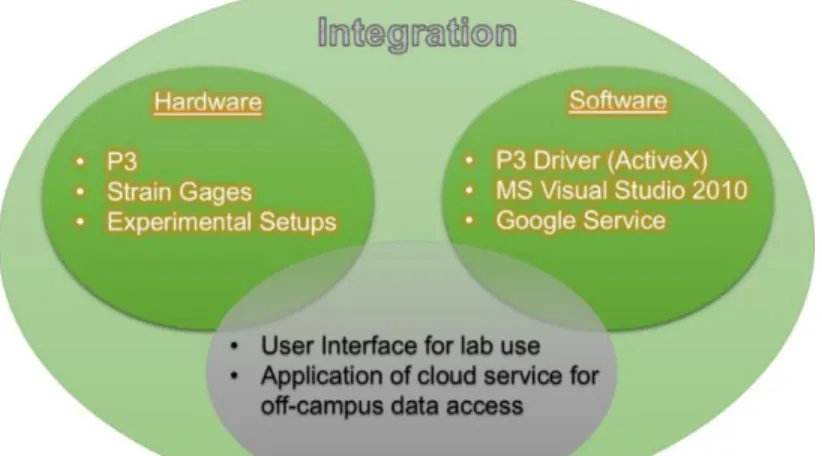
Simply stated, the main objective of this research is to combine hardware and software for data acquisition purposes to enhance the lab experience for the students in MAE 244. The set of hardware included in this process is comprised of the P3 Strain Indicator and Recorders, the strain gages, and all of the apparatuses required for each of the experiments. The software consists of the ActiveX driversfor the P3 device, Visual Basic, and Google services. The
applications combine the hardware and software components into an easy-to-use interface for the lab. The purpose of the interfaces is to transfer the data from the P3 devices to a data format that can more easily be used by the students and be stored on the cloud via Google Drive. Figure 3-5 illustrates the integration of hardware and software.
39
3.4.2 Thought Process of Interfaces
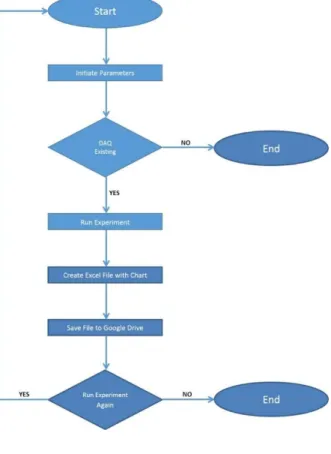
The interfaces all follow a similar progression from start to finish as shown in Figure 3-5. The main differences are what information is required to start the experiment but those will be discussed in the following section. After the interface is open, the initial parameters must be entered before continuing; these parameters will vary from experiment to experiment. The next thing the interface must do is ensure that the P3 device is properly connected via USB so that the P3 Object can be created in Visual Basic thus establishing the connection necessary to transfer data. If the P3 device cannot be detected by the computer then an exception will be thrown in the program and the interface will close and display an error message to notify the user what caused the interface to close. If the P3 is connected correctly then the program will begin according to which experiment is being done and Microsoft Excel will be open and remain running in the background but not visible to the user. As the experiment is being conducted the user inputs the data into the interface and then the interface sends that data to the corresponding cells in the Excel worksheet. Once the experiment is completed, the data will be saved to the location that has been pre-selected by the user. The recommended location is the Google Desktop folder so that the files can be uploaded automatically to Google Drive and then shared with each of the lab group members. If the lab needs to be repeated then the users must reopen the interface and proceed through the steps previously described.
![Table 2-1: Comparison of Different Types of Laboratories [9]](https://thumb-us.123doks.com/thumbv2/123dok_us/11022874.2989564/30.918.144.772.160.412/table-comparison-different-types-laboratories.webp)
![Figure 2-3: Configuration of Typical Setup of Remote Lab [14]](https://thumb-us.123doks.com/thumbv2/123dok_us/11022874.2989564/34.918.262.643.628.905/figure-configuration-typical-setup-remote-lab.webp)

![Figure 3-2: Model P3 Strain Gage Indicator and Recorder Hardware [http://www.vishaypg.com/]](https://thumb-us.123doks.com/thumbv2/123dok_us/11022874.2989564/43.918.185.730.111.390/figure-model-strain-gage-indicator-recorder-hardware-vishaypg.webp)