http://dx.doi.org/10.12988/ams.2014.4140
Observation on Sums of Powers of
Integers Divisible by Four
Djoko Suprijanto
Combinatorial Mathematics Research Group Faculty of Mathematics and Natural Sciences Institut Teknologi Bandung, Bandung 40132, Indonesia
Rusliansyah
Department of Mathematics Teaching Faculty of Mathematics and Natural Sciences Institut Teknologi Bandung, Bandung 40132, Indonesia
Copyright c 2014 D. Suprijanto and Rusliansyah. This is an open access article distributed under the Creative Commons Attribution License, which permits unrestricted use, distribution, and reproduction in any medium, provided the original work is properly cited.
Abstract
Gulliver (2010) considered the sum of powers of integers divisible by two and obtained a simple derivation of some well known sequences as well as construction of many new sequences. Continuing the effort of Gulliver, we consider the sum of powers of integers divisible by four which were not ob-served by him. We obtain a simple derivation of some well known sequences as well as a construction of many new sequences. We also derive several prop-erties of divisibility of the sequences.
Mathematics Subject Classification: 11Y55, 11B50 Keywords: integer sequences, divisibility
1
Introduction
The sums of powers of integers have been the subject of research for many years. Among very recent results is the paper of Gulliver [1] where he introduced a new
method to reconstructed several well known integer sequences in an elementary way. His method is based on an observation to the following sum of the first n of
m-th powers
n
X
k=1
(2k)m (1)
and the property of its divisibility. By looking at the sequences
n X k=1 (2k)m ∞ m=1 ,
for any fixed positive integer n,Gulliver reconstructed several known sequences in
an easy manner, as well as constructed many new sequences. For examples, for
n = 2, and n = 3 the sequences nP2
k=1(2k)m o∞ m=1 and nP3 k=1(2k)m o∞ m=1 are A063376
and A074533, in the On-line Encyclopedia of Integer Sequences [2], respectively.
Moreover, by fixing the value of m he also succeed to reconstruct another known
se-quences. As examples, for m=1 and m=2,he obtained the sequencesPn
k=1(2k) ∞ n=1 and nPn k=1(2k)2 o∞
n=1 which are sequence A002378 and A002492,in the On-line
En-cyclopedia of Integer Sequences [2], respectively.
The purpose of this paper is to further discuss the sequences observed by Gul-liver, namely the sequences generated by the sum of power of integers of the form
n
X
k=1
(4k)m.
By considering sequences of the above form, we succeed to reconstruct several known sequences. We also construct many new sequences which were unknown to exist in [2] before. We follow the method and observation introduced by Gulliver in [1].
2
Results
In this section we consider the sum of the first n of m-th powers of 4k as follows
n
X
k=1
(4k)m. (2)
2.1
Case 1: n fixed
For n = 1,we have{4m}, the sequence A000302 in [2]. For n = 2 to 10, the values
are 12, 80, 576, 4352, 33792, 266240, . . . 24, 224, 2304, 25088, 282624, 3252224, . . . 40, 480, 6400, 90624, 1331200, 20029440, . . . 60, 880, 14400, 250624, 4531200, 84029440, . . . 84, 1456, 28244, 582400, 12493824, 275132416, . . . 112, 2240, 50176, 1197056, 29704192, 757022720, . . . 114, 3246, 82944, 2245632, 63258624, 1830764544, . . . 180, 4560, 129600, 3925248, 12372480, 4007546880, . . . 220, 6160, 193600, 6485248, 22612480, 8103546880, . . . (3)
The first row is the sequence A063481 in [2] while the other rows are new. More-over, the first column is the sequence A046092 in [2] while the other columns are new. Considering the third, fourth, eighth, and ninth, row in (3), we find a regularity in the unit digits, namely
Proposition 2.1 For any positive integer m,
10 n X k=1
(4k)m ⇐⇒ m.0 (mod 4), for n= 4,5,9, and 10. (4)
In order to see Proposition 2.1 more clearly, let us observe the unit digit of sequence (2) in the Table 1:
power n (number of terms)
m 1 2 3 4 5 6 7 8 9 10 · · · 1 4 2 4 0 0 4 2 4 0 0 · · · 2 6 0 4 0 0 6 0 4 0 0 · · · 3 4 6 4 0 0 4 6 4 0 0 · · · 4 6 2 8 4 4 0 6 2 8 8 · · · 5 4 2 4 0 0 4 2 4 0 0 · · · 6 6 0 4 0 0 6 0 4 0 0 · · · 7 4 6 4 0 0 4 6 4 0 0 · · · 8 6 2 8 4 4 0 6 2 8 8 · · · 9 4 2 4 0 0 4 2 4 0 0 · · · 10 6 0 4 0 0 6 0 4 0 0 · · · 11 4 2 4 0 0 4 2 4 0 0 · · · 12 6 0 4 4 4 6 0 4 8 8 · · · .. . ... ... ... ... ... ... ... ... ... ... . . .
Table 1: The residues modulo 10 of the powers of integers
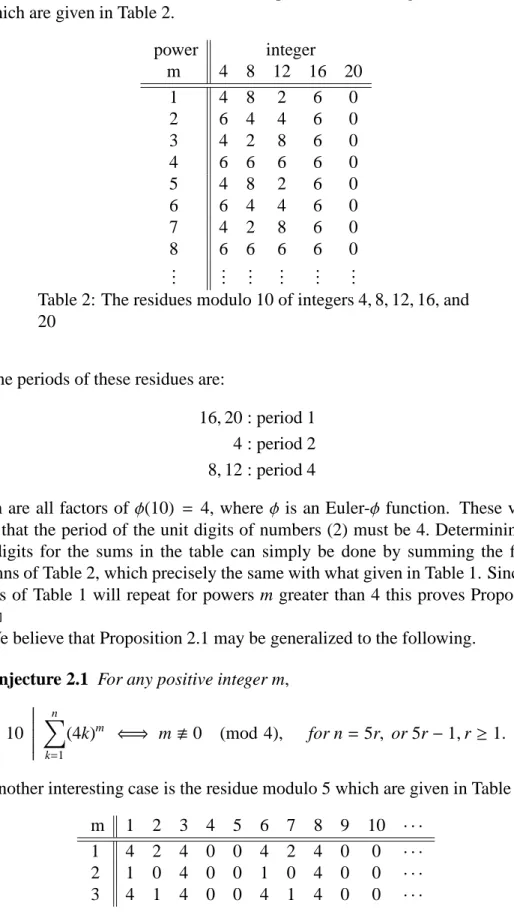
Consider the residues modulo 10 of the powers of the integers 4,8,12,16,and 20 which are given in Table 2.
power integer m 4 8 12 16 20 1 4 8 2 6 0 2 6 4 4 6 0 3 4 2 8 6 0 4 6 6 6 6 0 5 4 8 2 6 0 6 6 4 4 6 0 7 4 2 8 6 0 8 6 6 6 6 0 .. . ... ... ... ... ...
Table 2: The residues modulo 10 of integers 4,8,12,16,and
20
The periods of these residues are:
16,20 : period 1
4 : period 2
8,12 : period 4
which are all factors of φ(10) = 4, where φis an Euler-φ function. These values
show that the period of the unit digits of numbers (2) must be 4. Determining the
unit digits for the sums in the table can simply be done by summing the first n columns of Table 2, which precisely the same with what given in Table 1. Since the entries of Table 1 will repeat for powers m greater than 4 this proves Proposition
2.1.
We believe that Proposition 2.1 may be generalized to the following. Conjecture 2.1 For any positive integer m,
10 n X k=1 (4k)m ⇐⇒ m.0 (mod 4), for n=5r, or 5r−1,r ≥1. (5)
Another interesting case is the residue modulo 5 which are given in Table 3.
m 1 2 3 4 5 6 7 8 9 10 · · ·
1 4 2 4 0 0 4 2 4 0 0 · · ·
2 1 0 4 0 0 1 0 4 0 0 · · ·
4 1 2 3 4 4 0 1 2 3 3 · · · 5 4 2 4 0 0 4 2 4 0 0 · · · 6 1 0 4 0 0 1 0 4 0 0 · · · 7 4 2 4 0 0 4 2 4 0 0 · · · 8 1 0 3 4 4 0 1 2 3 3 · · · 9 4 1 4 0 0 4 2 4 0 0 · · · 10 1 2 4 0 0 1 0 4 0 0 · · · 11 4 2 4 0 0 4 1 4 0 0 · · · 12 1 0 3 4 4 0 1 2 3 3 · · · .. . ... ... ... ... ... ... ... ... ... ... . . .
Table 3: The residues modulo 5 of the powers of integers
If we consider the columns n=4,5,9,and 10,we conclude that
Proposition 2.2 For any positive integer m
5 n X k=1
(4k)m ⇐⇒ m. 0 (mod 4), for n= 4,5,9, and 10.
The expression above is confirmed by the Table 4 that show the residues modulo 5 of (4k)m. m 4 8 12 16 20 24 28 32 36 40 · · · 1 4 3 2 1 0 4 3 2 1 0 · · · 2 1 4 4 1 0 1 4 4 1 0 · · · 3 4 2 3 1 0 4 2 3 1 0 · · · 4 1 1 1 1 0 1 1 1 1 0 · · · 5 4 3 2 1 0 4 3 2 1 0 · · · 6 1 4 4 1 0 1 4 4 1 0 · · · 7 4 2 3 1 0 4 2 3 1 0 · · · 8 1 1 1 1 0 1 1 1 1 0 · · · .. . ... ... ... ... ... ... ... ... ... ... . . .
Table 4: The residues modulo 5 of the integers of the form
(4k)m
The table shows that for k ≡ 4 (mod 5) or k ≡ 0 (mod 5), the period is 1, for
k ≡ 1 (mod 5) the period is 2, while for k ≡ 2 (mod 5) or k ≡ 3 (mod 5), the
period is 4.
Conjecture 2.2 For any positive integer m, 5 n X k=1 (4k)m ⇐⇒ m. 0 (mod 4), for n =5r, or 5r−1,r≥ 1. (6)
The other case is the residue modulo 3,which are given in the Table 5.
m 1 2 3 4 5 6 7 8 9 10 · · · 1 1 0 0 1 0 0 1 0 0 1 · · · 2 1 2 2 0 1 1 2 0 0 1 · · · 3 1 0 0 1 0 0 1 0 0 1 · · · 4 1 2 2 0 1 1 2 0 0 1 · · · 5 1 0 0 1 0 0 1 0 0 1 · · · 6 1 2 2 0 1 1 2 0 0 1 · · · 7 1 0 0 1 0 0 1 0 0 1 · · · 8 1 2 2 0 1 1 2 0 0 1 · · · 9 1 0 0 1 0 0 1 0 0 1 · · · 10 1 2 2 0 1 1 2 0 0 1 · · · 11 1 0 0 1 0 0 1 0 0 1 · · · 12 1 2 2 0 1 1 2 0 0 1 · · · .. . ... ... ... ... ... ... ... ... ... ... . . .
Table 5: The residues modulo 3 of the powers of integers of
the form (4k)m
In term of divisibility, Table 5 shows that
Proposition 2.3 For n=8 or 9, 3 n X k=1 (4k)m . (7)
Again, we believe that Proposition 2.3 may be generalized to the following.
Conjecture 2.3 For any positive integer m,
3 n X k=1 (4k)m, if n=10r−2, or 10r−1,r≥1. (8)
2.2
Cases 2: m fixed
Finally, we consider the sequences from the columns in (2.1). As we mentioned
above, for m= 1 we obtained
n X k=1 4k ∞ n=1 ={2n(n+1)}∞n=1,
which is the sequence A046092 in the On-line Encyclopedia of Integer Sequences
[2], while for m=2,3,and 4 we obtained, respectively the following sequences
n X k=1 (4k)2 ∞ n=1 = ( 8 3n(n+1)(2n+1) )∞ n=1 , n X k=1 (4k)3 ∞ n=1 = n16n2(n+1)2o∞ n=1, n X k=1 (4k)4 ∞ n=1 = ( 128 15 n(n+1)(2n+1)(3n 2+3n−1) )∞ n=1 ,
which are new. Moreover, for m = 5 and m = 6 we obtained also the following
sequences, respectively n X k=1 (4k)5 ∞ n=1 = ( 256 3 n 2(2n2+2n−1)(n+1)2 )∞ n=1 , n X k=1 (4k)6 ∞ n=1 = ( 2048 21 n(n+1)(2n+1)(3n 4+6n3−3n+1) )∞ n=1 ,
which are also new. We may obtain another sequences from another values of m.
We can also investigate the divisibility of the above sequences. For example, we
can show easily that for any positive integer n= 9a+8,we have
9 n X k=1 (4k)2,
while for any positive integer n =3a or n=3a+2,we have
3 n X k=1 (4k)3 , 6 n X k=1 (4k)3 , and 9 n X k=1 (4k)3.
We have also 5 n X k=1 (4k)3, for n= 5a or n=5a+4, and 6 n X k=1 (4k)3 , for n=6a, n= 6a+2, n=6a+3, or n =6a+5.
By a very similar observation, we may also have properties of divisibility of another sequences in an easy way.
3
Remark
As we showed above, what we did in this paper is an observation on the sequences of the form (2.1) and their related properties. We reconstructed several known se-quences as listed in [2] in an elementary way as well as constructed many new sequences. We are now working on rigorous proofs for the above results and con-jectures. These results, which is now in preparation, will be published elsewhere in a separate paper.
Acknowledgement
The authors would like to thank the anonymous referee(s) for careful reading and many helpful comments. The first author was supported in part by Hibah Riset
Ikatan Alumni ITB Tahun 2011 Number 2208b/I1.C01/PL/2011 and Riset dan
Ino-vasi KK ITB Tahun 2012 Number 398/I.1.C01/PL/2012.
References
[1] T. AaronGulliver, ”Divisibility of sums of powers of even integers”,
Inter-national journal of pure and applied mathematics 64(2), (2010), 191-198.
[2] OEIS Foundation Inc. (2011), On-line Encyclopedia of Integer Sequences,
available at http://oeis.org/. Received: January 15, 2014