ADVERTIMENT. L'accés als continguts d'aquesta tesi doctoral i la seva utilització ha de respectar els drets de la persona autora. Pot ser utilitzada per a consulta o estudi personal, així com en activitats o materials d'investigació i docència en els termes establerts a l'art. 32 del Text Refós de la Llei de Propietat Intel·lectual (RDL 1/1996). Per altres utilitzacions es requereix l'autorització prèvia i expressa de la persona autora. En qualsevol cas, en la utilització dels seus continguts caldrà indicar de forma clara el nom i cognoms de la persona autora i el títol de la tesi doctoral. No s'autoritza la seva reproducció o altres formes d'explotació efectuades amb finalitats de lucre ni la seva comunicació pública des d'un lloc aliè al servei TDX. Tampoc s'autoritza la presentació del seu contingut en una finestra o marc aliè a TDX (framing). Aquesta reserva de drets afecta tant als continguts de la tesi com als seus resums i índexs.
ADVERTENCIA. El acceso a los contenidos de esta tesis doctoral y su utilización debe respetar los
derechos de la persona autora. Puede ser utilizada para consulta o estudio personal, así como en actividades o materiales de investigación y docencia en los términos establecidos en el art. 32 del Texto Refundido de la Ley de Propiedad Intelectual (RDL 1/1996). Para otros usos se requiere la autorización previa y expresa de la persona autora. En cualquier caso, en la utilización de sus contenidos se deberá indicar de forma clara el nombre y apellidos de la persona autora y el título de la tesis doctoral. No se autoriza su reproducción u otras formas de explotación efectuadas con fines lucrativos ni su comunicación pública desde un sitio ajeno al servicio TDR. Tampoco se autoriza la presentación de su contenido en una ventana o marco ajeno a TDR (framing). Esta reserva de derechos afecta tanto al contenido de la tesis como a sus resúmenes e índices.
WARNING. Access to the contents of this doctoral thesis and its use must respect the rights of the author. It can be used for reference or private study, as well as research and learning activities or materials in the terms established by the 32nd article of the Spanish Consolidated Copyright Act (RDL 1/1996). Express and previous authorization of the author is required for any other uses. In any case, when using its content, full name of the author and title of the thesis must be clearly indicated. Reproduction or other forms of for profit use or public communication from outside TDX service is not allowed. Presentation of its content in a window or frame external to TDX (framing) is not authorized either. These rights affect both the content of the thesis and its abstracts and indexes.
Running Stream-like Programs
on Heterogeneous
Multi-core Systems
Paul Carpenter
Advisor: Eduard Ayguade Co-advisor: Alex Ramirez Computer Architecture Department Universitat Polit`ecnica de CatalunyaA thesis submitted for the degree of
ACTA DE QUALIFICACI ´O DE LA TESI DOCTORAL
Reunit el tribunal integrat pels sota signants per jutjar la tesi doctoral:
T´ıtol de la tesi: Running Stream-like Programs on Heterogeneous Multi-core Systems Autor de la tesi: Paul Carpenter
Acorda atorgar la qualificaci´o de:
No apte
Aprovat
Notable
Excel·lent
Excel·lent Cum Laude
Barcelona, . . . de/d’ . . . de . . . .
El President El Secretari
. . . .
(nom i cognoms) (nom i cognoms)
El vocal El vocal El vocal
. . . .
Abstract
All major semiconductor companies are now shipping multi-cores. Phones, PCs, laptops, and mobile internet devices will all require software that can make ef-fective use of these cores. Writing high-performance parallel software is difficult, time-consuming and error prone, increasing both time-to-market and cost. Soft-ware outlives hardSoft-ware; it typically takes longer to develop new softSoft-ware than hardware, and legacy software tends to survive for a long time, during which the number of cores per system will increase. Development and maintenance produc-tivity will be improved if parallelism and technical details are managed by the machine, while the programmer reasons about the application as a whole. Parallel software should be written using domain-specific high-level languages or extensions. These languages reveal implicit parallelism, which would be obscured by a sequential language such as C. When memory allocation and program control are managed by the compiler, the program’s structure and data layout can be safely and reliably modified by high-level compiler transformations.
One important application domain contains so-called stream programs, which are structured as independent kernels interacting only through one-way chan-nels, called streams. Stream programming is not applicable to all programs, but it arises naturally in audio and video encode and decode, 3D graphics, and digital signal processing. This representation enables high-level transformations, including kernel unrolling and kernel fusion.
Kernel unrolling coarsens granularity by batching up work into larger chunks, reducing overheads and potentially enabling data reuse and vectorisation. Ker-nel fusion combines multiple kerKer-nels into a single piece of code, which has two benefits. First, it can be used to match the number of kernels to the number of processors, required for static scheduling. Second, it coarsens granularity, which amortises overhead in a dynamic scheduler. Kernel unrolling and fusion are rel-atively straightforward to apply when the program is represented as a stream graph, even though they imply extensive changes to memory allocation and pro-gram control.
This thesis develops new compiler and run-time techniques for stream program-ming. The first part of the thesis is concerned with a statically scheduled stream compiler. It introduces a new static partitioning algorithm, which determines which kernels should be fused, in order to balance the loads on the processors and interconnects. A good partitioning algorithm is crucial if the compiler is to produce efficient code. The algorithm also takes account of downstream compiler passes—specifically software pipelining and buffer allocation—and it models the
compiler’s ability to fuse kernels. The latter is important because the compiler may not be able to fuse arbitrary collections of kernels.
This thesis also introduces a static queue sizing algorithm. This algorithm is important when memory is distributed, especially when local stores are small. The algorithm takes account of latencies and variations in computation time, and is constrained by the sizes of the local memories.
The second part of this thesis is concerned with dynamic scheduling of stream pro-grams. First, it investigates the performance of known online, non-preemptive, non-clairvoyant dynamic schedulers. Second, it proposes two dynamic schedulers for stream programs. The first is specifically for one-dimensional stream pro-grams. The second is more general: it does not need to be told the stream graph, but it has slightly larger overhead.
This thesis also introduces some support tools related to stream programming. StarssCheck is a debugging tool, based on Valgrind, for the StarSs task-parallel programming language. It generates a warning whenever the program’s be-haviour contradicts a pragma annotation. Such bebe-haviour could otherwise lead to exceptions or race conditions. StreamIt to OmpSs is a tool to convert a stream-ing program in the StreamIt language into a dynamically scheduled task based program using StarSs.
The main contributions of this thesis are:
The Abstract Streaming Machine (ASM), a machine model and coarse-grain
simulator for a statically scheduled stream compiler.
A new partitioning heuristic for stream programs, which balances the load
across the target, including processors and communication links. It consid-ers its effect on downstream passes, and it models the compiler’s ability to fuse kernels.
Two static queue sizing algorithms for stream programs, which determine
the sizes of the buffers used to implement streams. The optimal buffer sizes are affected by latency and variability in computation costs, and are constrained by the sizes of local memories, which may be small.
Two new low-complexity adaptive dynamic scheduling algorithms for
stream-like programs.
StarssCheck, a debugging tool for StarSs. This tool checks memory accesses
performed by tasks and the main thread, and warns if the StarSs pragmas are incorrect.
Acknowledgements
First and foremost, I would like to thank my advisor, Eduard Ayguade, and co-advisor, Alex Ramirez. This dissertation could not have been written without their patient guidance throughout. They gave me the freedom to try my own ideas and make my own mistakes, while gently steering me in the right direction when necessary. Alex knows how to take a vague idea, make it real, evaluate it, and produce a clear and compelling set of contributions. He persuaded me to stop describing my work with words like simple and obvious. Eduard had the experience and clarity to make sure I was steadily advancing in the right direction. Both were remarkably generous with their time, and they made research an enjoyable and fulfilling experience.
I am indebted to the Barcelona Supercomputing Center under the warm leader-ship of Mateo Valero. The BSC supported this work by providing a friendly and productive working environment, access to resources and projects, and financial support. Thanks to all the administrative staff, especially Trini Carneros at UPC DAC, who put up with my difficulty in performing even the most undemanding of administrative tasks.
I would like to thank the funding bodies that enabled this work to take place: the Spanish Ministry of Science and Innovation (contract no. TIN2007-60625), the European Commission in the context of the ACOTES project (contract no. IST-34869), ENCORE project (ICT-FP7-248647), and the HiPEAC Network of Excellence (contract nos. IST-004408 and FP7/ICT 217068).
I wish to thank my parents, who have always been there for me. They always believed that everyone should have a passion for something and the opportunity to make their passion into their career. They bought my first computer, a Texas Instruments TI-99/4A, when I was aged eight. They continued to support my interests in science and computing, and my brother’s interests in animal medicine and surgery. Now, both their sons are doing what they enjoy.
Finally, I wish to express my warmest thanks to Anja and our two young sons, Ruben and Daniel. Anja has an extraordinary ability to help others grow. She takes an interest in people, and she gives them the push to send that email, or make that call. She was instrumental in my move from successful professional to graduate student, and she has supported me in uncountable ways while I was writing this dissertation. Every day, Anja and my sons show me what is most important in life.
Contents
1 Introduction 1 1.1 Approaches to parallelism . . . 3 1.1.1 Data parallelism . . . 3 1.1.2 Task-level parallelism . . . 5 1.1.3 Streaming parallelism . . . 61.2 Compile-time vs run-time decisions . . . 7
1.3 The ACOTES stream compiler . . . 8
1.4 Task-level languages . . . 9
1.4.1 StarSs and OmpSs . . . 9
1.5 Streaming languages . . . 12
1.5.1 StreamIt language . . . 12
1.5.2 SPM (Stream Programming Model) . . . 16
1.6 Tool flow and support tools . . . 17
1.6.1 Debugging using StarssCheck . . . 18
1.6.2 Performance visualisation . . . 18
1.6.3 StreamIt to OmpSs . . . 18
1.7 Contributions and publications . . . 19
1.8 Thesis outline . . . 20
2 Abstract Streaming Machine 23 2.1 Scope of the ASM . . . 23
2.2 ASM Machine Description . . . 26
2.3 ASM Program Description . . . 28
2.4 Platform characterisation . . . 32
2.5 Validation of the ASM . . . 35
2.6 Using the ASM . . . 38
2.6.1 Static partitioning . . . 38
2.6.2 Static buffer sizing . . . 39
2.7 Related work . . . 39 3 Compile-time Decisions 41 3.1 Motivation . . . 41 3.1.1 Convexity . . . 42 3.1.2 Connectivity . . . 44 3.1.3 Queue sizes . . . 45
CONTENTS
3.2 Static partitioning . . . 48
3.2.1 The partitioning problem . . . 48
3.2.2 The partitioning algorithm . . . 50
3.2.3 Evaluation . . . 54
3.3 Static buffer sizing . . . 58
3.3.1 The buffer sizing problem . . . 58
3.3.2 The buffer sizing algorithm . . . 59
3.3.3 Evaluation . . . 64
3.4 Related work . . . 65
3.5 Conclusions . . . 68
4 Run-time Decisions 69 4.1 The dynamic scheduling problem . . . 70
4.1.1 Interface to the dynamic scheduler . . . 70
4.1.2 Throttle policy . . . 71
4.1.3 Objective function: comparing schedulers . . . 72
4.2 Survey of DAG scheduling techniques . . . 72
4.2.1 The online scheduling policies . . . 73
4.2.2 Theoretical evaluation . . . 76
4.3 Adaptive schedulers . . . 81
4.3.1 Intuition . . . 81
4.3.2 Monitoring . . . 83
4.3.3 Updating priorities forapriority . . . 84
4.3.4 Updating priorities forgpriority . . . 85
4.4 Experimental evaluation . . . 88
4.5 Conclusions . . . 93
5 Support Tools 97 5.1 Debugging using StarssCheck . . . 97
5.1.1 Common StarSs errors . . . 98
5.1.2 How StarssCheck works . . . 99
5.1.3 Evaluation . . . 103
5.1.4 Related work . . . 106
5.2 Performance visualisation using Paraver Animator . . . 107
5.3 StreamIt to OmpSs conversion . . . 108
5.3.1 The conversion process . . . 109
5.3.2 Example: simplified FM Radio . . . 112
5.3.3 Current limitations . . . 115
5.3.4 High level transformations . . . 117
6 Conclusions 121
Glossary 123
Bibliography 125
Index 137
List of Figures
1.1 Metrics for Intel processors . . . 2
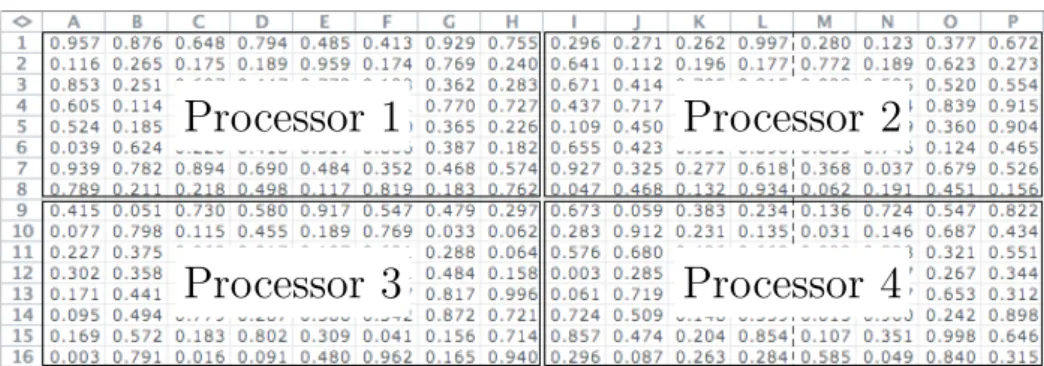
1.2 Data parallelism: four cores updating an array of data . . . 4
1.3 Gantt chart illustrating task-level parallelism . . . 4
1.4 Streaming parallelism: GNU radio FM demodulation . . . 4
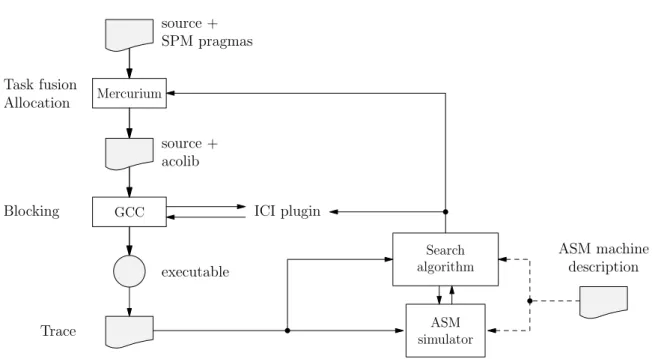
1.5 The ACOTES iterative stream compiler . . . 9
1.6 Example StarSs code (bmod function) . . . 10
1.7 Extracts from StarSs code for Cholesky decomposition . . . 11
1.8 Dependency graphs for Cholesky decomposition . . . 11
1.9 StreamIt components: pipelines, splitjoins, and feedback loops . . . 13
1.10 Example StreamIt 2.1 program, based on FMRadio5 . . . 14
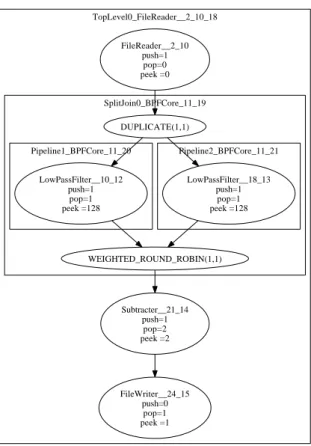
1.11 Stream graph for the example StreamIt 2.1 program . . . 15
1.12 Example SPM program from [M+11] . . . 16
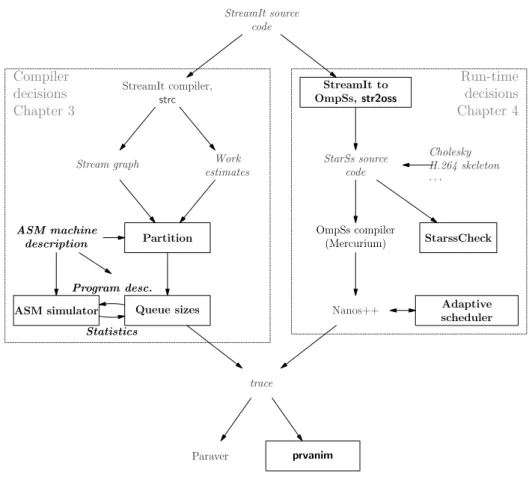
1.13 Tool flow used in this thesis . . . 17
1.14 Thesis structure . . . 21
1.15 Timeline . . . 22
2.1 The ACOTES iterative stream compiler, reproduced from Figure 1.5 . . . 24
2.2 Topology of three example targets . . . 25
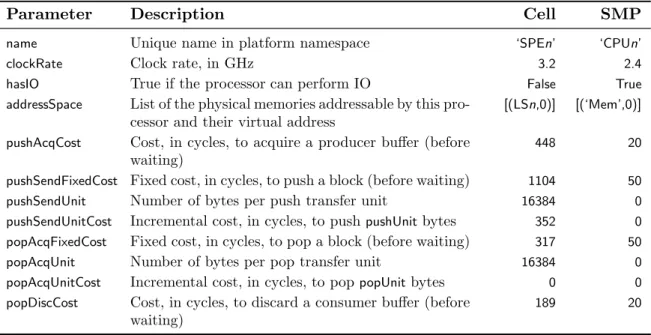
2.3 Processor and interconnect parameters of the ASM and example values . . . 27
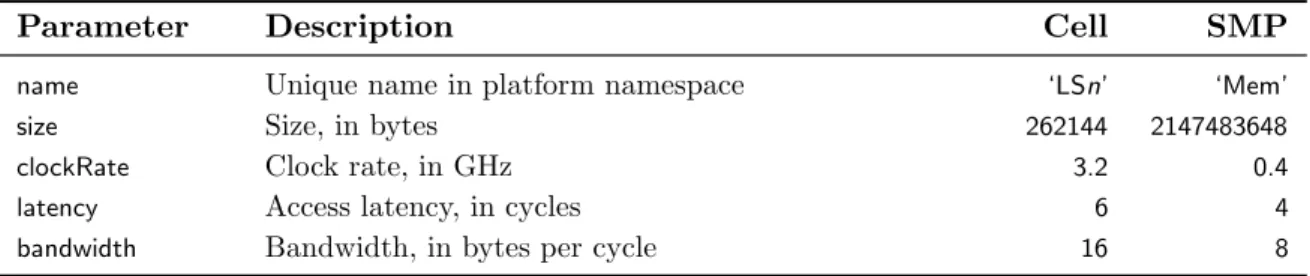
2.4 Memory parameters of the ASM and values for two example targets . . . 28
2.5 Cost and latency of communication between tasks . . . 29
2.6 Building tasks from subtasks . . . 30
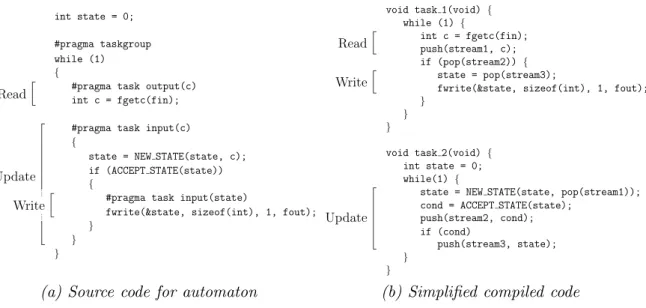
2.7 Example stream program with data-dependent flow . . . 31
2.8 Representation of data-dependent flow between tasks and subtasks . . . 32
2.9 Synthetic stream benchmarks . . . 33
2.10 Results for producer-consumer benchmark on Cell B.E. . . 33
2.11 Time per iteration for the chain and chain2 benchmarks on Cell B.E. . . 34
2.12 Comparison of real and simulated traces . . . 36
2.13 Detail on the main phases in the search algorithm . . . 38
2.14 Memory constraint graph for the Cell Broadband Engine . . . 39
3.1 Example partitions of the StreamIt filterbank benchmark onto a 3-core SMP 42 3.2 Traces for five iterations of filterbank, scheduled using SGMS . . . 43
3.3 Motivation of connectivity . . . 45
LIST OF FIGURES
3.5 Effect of consumer queue length on chain8 and producer-consumer . . . 47
3.6 Memory-performance tradeoff . . . 48
3.7 The mapping phase of the ACOTES compiler . . . 49
3.8 Topology of the targets used in this section . . . 50
3.9 First level partition in the initial partition algorithm . . . 51
3.10 Convergence of the refinement phase as a function of the number of iterations 55 3.11 Normalised execution time for the StreamIt 2.1.1 benchmarks for the three variants of the heuristic algorithm . . . 55
3.12 Vocoder benchmark on SMP 3 with accelerator using software pipelining. . . 57
3.13 Memory constraint graph for the Cell Broadband Engine . . . 58
3.14 Example timed event graph used by the critical cycle algorithm . . . 59
3.15 Example weighted wait-for graphs . . . 60
3.16 Example where baseline fails . . . 62
3.17 Token algorithm: bichain4 example . . . 63
3.18 Comparison of the buffer size update and cycle detection algorithms . . . 66
4.1 Example traces with static and dynamic scheduling . . . 70
4.2 Dynamic scheduler in context . . . 71
4.3 Number of ready tasks: channelvocoder, using oldest-first . . . 72
4.4 Metrics used by the scheduling policies . . . 73
4.5 Lattice of ready queues for a heuristic . . . 75
4.6 Worst case examples for exhaustion . . . 77
4.7 Worst case examples for back pressure . . . 78
4.8 Illustration foroldest back pressure . . . 80
4.9 Motivation for busyness statistic . . . 82
4.10 Example statistics after three iterations . . . 83
4.11 Example showing why all kernel statistics should be reset . . . 85
4.12 Example that shows the benefit from updating the ancestors . . . 86
4.13 Kernel dependency graph for H.264 decoder skeleton . . . 88
4.14 Scalability of the benchmarks . . . 90
4.15 Average and worst case results . . . 92
4.16 Worst case results: detail of efficiency of most robust schedulers . . . 93
4.17 Comparison of the scheduling heuristics: StreamIt . . . 94
4.18 Comparison of the scheduling heuristics: non-StreamIt . . . 95
5.1 Example mistakes found by StarssCheck . . . 100
5.2 Structure of StarssCheck . . . 100
5.3 Translated version of the bmod function from Figure 1.6 . . . 101
5.4 Starssgrind Contexts . . . 102
5.5 VEX IR for a single store instruction . . . 103
5.6 Performance results for Sparse LU factorisation . . . 103
5.7 Worst case “nasty” benchmark . . . 105
5.8 Potential false negatives and false positives . . . 106
5.9 Three instants during the execution of the H.264 decoder on 25 processors . . 107
5.10 Main phases in StreamIt to OmpSs conversion . . . 109
5.11 Output from the build program . . . 110
LIST OF FIGURES
5.12 Translation of an example StreamIt function . . . 111 5.13 Various FIFOs . . . 111 5.14 Non-peek version of the example StreamIt 2.1 program in Figure 1.10 . . . . 113 5.15 Translated code exactly as generated by str2oss: part 1 . . . 114 5.16 Translated code exactly as generated by str2oss: part 2 . . . 115 5.17 Example str2osscontrol file . . . 116 5.18 An example wherestr2ossgenerates a function with too many arguments . . 118
LIST OF FIGURES
List of Tables
1.1 Selection of task parallel languages and libraries . . . 5
1.2 Selection of stream programming languages . . . 6
2.1 Kernels and mappings of the GNU radio benchmark . . . 37
3.1 The number of pipeline stages . . . 56
4.1 Known DAG scheduling heuristics . . . 73
4.2 Online scheduling policies and cost . . . 74
4.3 Throughput for one-dimensional stream programs . . . 76
4.4 Statistics for adaptive schedulers . . . 83
4.5 Benchmarks used in the evaluation . . . 89
5.1 StarssCheck client requests . . . 101
LIST OF TABLES
Chapter 1
Introduction
All major semiconductor companies are now shipping multi-cores. Phones, PCs, laptops, and mobile internet devices already contain multiple processors instead of just one, and will re-quire software that uses an increasing number of them effectively. Writing high-performance parallel software is difficult, time-consuming and error prone, increasing both development time and cost. Software outlives hardware; it typically takes longer to develop new soft-ware than hardsoft-ware, and legacy softsoft-ware tends to survive for a long time, during which the number of cores per system will increase. Development and maintenance productivity will be improved if parallelism and technical details are managed by the machine, so that the programmer can concentrate on the application as a whole.
This thesis develops techniques to automatically map a certain class of program, known asstream programs, to multiple processors. Stream programs are significant subcomponents of many important applications, including those involving audio and video encoding and decoding, software radio, and 3D graphics. Moreover, due to their modularity and regu-larity, they ought to work well on multiple processors. In addition to investigating how to automatically map stream programs to multi-processors, this thesis introduces some tools that can be used to find bugs and improve performance.
Putting multiple CPUs into the same system is by no means new. The Burroughs D825 was the first Symmetric Multiprocessor; it had four processors, and it was launched in 1962 [AHSW62]. What is new, however, is that mainstream computing is currently being forced into multiprocessing. There are, in general, three ways through which computers become faster. First, transistors have been getting faster and smaller at an exponential rate, so last year’s design, on today’s semiconductor process, will be faster.1 Second, smaller transistors give more room for complicated mechanisms to speed up a single processor, either through increasing the clock rate by overlapping instructions in a pipeline, or through super-scalar issue, by doing several unrelated instructions at once [HP07]. Both these techniques are limited, however, by excessive power consumption [OH05]. Third, an effective way to use an increasing number of transistors is to have on the same chip, several processors.
Figure 1.1 illustrates these trends, using data for Intel processors. Figure 1.1(a) shows that the total number of transistors has been doubling roughly every two years, consistently for about forty years, and that the trend is continuing still. Figure 1.1 (b) shows that clock
1The various parts of the semiconductor industry have been coordinating their capital and research
1. INTRODUCTION 1970 1980 1990 2000 2010 0.01 1.00 100.00 Year of introduction Number of tr ansistors (millions) ++ + + + + + + ++++ + + + ++ + + ++ + +++ + + + + 4004 8086 80186 80386DX Pentium−P5 Pentium−IV Core2−Duo Core−i7 + Intel microprocessors Moore’s law 1970 1980 1990 2000 2010 0.5 5.0 50.0 500.0 5000.0 Year of introduction Frequency (MHz) + + + + + + + + + +++ + + + + + + + + + ++2224 4 6 4004 8086 80186 80386DX Pentium−P5 Pentium−IV Core−i7 + 2 4 6 One core Two cores Four cores Six cores
(a) Number of transistors (b) Frequency (MHz) and
number of processor cores Figure 1.1: Metrics for Intel processors, using a logarithmic y axis
frequency has been doubling roughly every three years, but that the trend has flattened in recent years, with transistors instead being used for multiple processor cores. Multiprocessing has been common in embedded systems and standard in supercomputing for many years, the former for power consumption and specialisation1 and to isolate subsystems from each other, and the latter because it is the only way to get the necessary performance. All supercomputers in the biannual TOP500 ranking [TOP] have had two or more processors ever since 1997, and the average number of processor cores in the machines in the November 2010 list is about 13,000.2
Multiple processors are pointless if they are not all kept busy, ignoring the benefits from specialisation for now; and they need to run, in parallel, on their own relatively large pieces of work. It is hard to write programs that do this. The first reason is that many computations, like many human activities, cannot easily be broken up into parts that can be done at the same time. An example is shown later in this section, in Figure 1.8(a). One way to find parallelism in such a program is to use a different algorithm. Another way is to use speculation to exploit the parallelism that exists but is hard to describe.
The second reason is that, with some exceptions, breaking a single program into parts and managing their execution in parallel currently has to be done by the programmer. More-over, doing so exposes some unpleasant technicalities [Lee06]: primarily, the need to lock
data structures so two threads don’t try to change the same data at the same time and mess it up, andweak memory consistency, where interactions between processors reveal that
1An example is the TI OMAP1 series, containing a TI DSP for signal processing and an ARM core for
applications, and benefiting from lower power consumption through specialisation [CCG+00].
2The average could be criticised since it is dominated by the top few machines, but it is less dependent
on the arbitrary number “500”. The most cores is 294,912 and the median is 6,372.
1.1 Approaches to parallelism
they are not the sequential machines they pretend to be [AG02]. The programmer must manage all this, while also presumably thinking about the big picture, in terms of what the application is ultimately trying to do. Interactions between multiple processors are inher-ently non-deterministic, because the program’s behaviour can depend on the precise timing. Many bugs will therefore happen intermittently, and be difficult to reproduce, diagnose, and fix.
1.1
Approaches to parallelism
The parallelism that exists in software often has some kind of structure. A parallel program-ming model is a way for the application programmer to reveal this structure to the machine. The machine should then assign work to processors and deal with technicalities, allowing the programmer to concentrate on whatever the program is trying to achieve, which is probably also rather challenging. The main benefits are a shorter development time and lower cost, similar to the advantages of higher-level languages such as C or Python, compared with assembly language.
This thesis uses the three types of parallelism described in the following subsections.
1.1.1 Data parallelism
Data parallelism [HS86] exists when the same operation has to be done, independently and many times over, on a large amount of data. Examples are doubling every entry in a large table of numbers and finding the sum of a list of values. The latter is an example of a reduction, the bulk of which is data parallel, if the sum is broken into parts using associativity of addition. Data parallelism can be found in linear algebra, manipulating vectors and matrices, and many scientific applications, including modelling physics and predicting the weather.
Data parallel operations can be distributed across multiple processors quite easily, con-ceptually at least, as illustrated in Figure 1.2. Crucially, the allocation of work to processors is done by the machine, rather than the programmer. At the small scale, data parallelism can also be exploited within a single instruction, using SIMD instructions,1 such as those in Intel MMX and SSE, IBM/Motorola AltiVec, and ARM NEON.
Data parallel programs can be written in languages such as OpenMP [Org08] and High-Performance Fortran (HPF) [HPFF93; HPFF97]. OpenCL [Khr10] and CUDA [NVI08] support data parallelism on GPUs. Google’s MapReduce [DG08] is a form of data parallelism at the large scale.
An alternative is to have the machine look for data parallelism in an ordinary sequential program. If a sequence of similar operations, in a loop, and supposedly to be done in order, do not depend on each other, then they can be done in parallel, and the result will be the same. The earliest work on data dependence analysis dates back to the 1970s [Lam74; KM+72; Mur71], and a considerable amount of research has been done since then [AK02].
1. INTRODUCTION
Processor 1
Processor 2
Processor 3
Processor 4
Figure 1.2: Data parallelism: four cores updating an array of data
Time Task 1 Task 4 Task 7 Task 10 Task 13 Task 16 Task 19
Figure 1.3: Gantt chart illustrating task-level parallelism
Demodulation 407-tap FIR Lowpass (m) 407-tap FIR Bandpass 813-tap FIR Carrier recovery Frequency shift 407-tap FIR Lowpass (s) Sum Input x Output l r
Figure 1.4: Streaming parallelism: GNU radio FM demodulation
1.1 Approaches to parallelism
Language Year† Nesting Dependencies
Cilk [BJK+95] 1995 Yes Parent can wait for children
pthreads [iee99] 1995 Yes Shared data and locks High Performance Fortran (HPF) 2.0 [HPFF97] 1997 Yes Yes
Jade [RSL02] 2002 Yes General DAG1
StarSs [SP09; BPBL06; PBL08] 2004‡ Yes General DAG
Sequoia [FHK+06] 2006 Yes Parent waits for children
Intel Threading Building Blocks [Rei] 2007 Yes General in Version 3 Update 5 OpenMP 3.0 [Ope09] 2008 Yes Parent can wait for children Task Parallel Library (TPL) [LSB09] 2009 Yes General DAG using futures StarPU [ATNW09; ATN10] 2009 No General DAG using tags
OpenCL 1.1[Khr10] 2010 No General DAG
OoOJava [JED10] 2010 Yes General DAG from static analysis Tagged Procedure Calls (TPC)[TKA+10] 2010 No Master can wait for tasks
Apple Grand Central Dispatch [App] 2010 Yes Tasks can wait for other tasks Intel Cilk Plus [Int10] 2010 Yes Parent can wait for children
†Date of first significant publication
‡GridSs
Table 1.1: Selection of task parallel languages and libraries
1.1.2 Task-level parallelism
Another way to write parallel programs, known as task-level parallelism, is to have one thread, running on one processor, delegate self-contained pieces of work, known astasks, to a pool of interchangeable workers. The workers are normally threads running on different processors. This is easy for people to understand because it resembles concurrency in the real world, and it can be very efficient. Figure 1.3 illustrates task-level parallelism using a Gantt chart.
One of the earliest task-level programming languages is Cilk [BJK+95]. In a Cilk program, any thread may spawn children, which potentially run in parallel with their parent. If a parent needs some value computed by one of its children, then it should first wait for its children to complete. There can be no dependencies between children; i.e. one child cannot wait for another child to finish, but parallelism can be nested, meaning that children can have children of their own.
In this thesis, task parallelism will be defined using StarSs [SP09; BPBL06; PBL08], which will be described briefly in Section 1.4.1. StarSs supports dependencies between tasks: one task may be dependent on the outputs from other tasks, itspredecessors, meaning that it cannot start until they have finished.
Table 1.1 lists some other languages and libraries for task parallelism, including OpenMP 3.0 [Ope09], TPL (Task Parallel Library) [LSB09] for .NET, Apple’s Grand Central Dis-patch [App] in Mac OS X 10.6, and Intel Threading Building Blocks [Rei]. Task parallel programming is also used for specific applications; for example dense linear algebra in the PLASMA [Uni09] and FLAME [FLA10] projects. MPI Microtask [OIS+06] for the Cell B.E. breaks a message-passing program into non-blocking units of computation, which are dynamically scheduled as tasks.
1. INTRODUCTION
Language Year† Graph structure Dimensions
Gedae [LBS] 1987 General directed graph One-dimensional Gabriel [BGH+90] 1990 General directed graph One-dimensional
Ptolemy II [EJL+03] 2003 General directed graph One-dimensional
StreamIt [TKA02; CAG06] 2001 Series-parallel One-dimensional StreamC/KernelC [Mat02] 2002 General directed graph One-dimensional DataCutter [BKSS02] 2002 General directed graph One-dimensional Brook [Buc03] 2003 General directed graph Multi-dimensional S-Net [GSS06] 2006 Series-parallel One-dimensional SPM [CRM+07; ACO08] 2007 General DAG One-dimensional
Fractal [MRC+07] 2007 General directed graph Multi-dimensional
XStream [GMN+08] 2008 General DAG One-dimensional
GRAMPS [SFB+09] 2009 General directed graph One-dimensional
IBM InfoSphere SPL [IBM11] 2009 General directed graph One-dimensional DUP [GGR+10] 2010 General directed graph One-dimensional
†Date of first significant publication
Table 1.2: Selection of stream programming languages
1.1.3 Streaming parallelism
Another, more specialised, way to write parallel programs is known asstreaming parallelism. Unlike data and task parallelism, which are applicable to many different types of problem, streaming parallelism is domain-specific. Domain-specific languages (DSLs) have long been used to improveproductivity. They let the program be described at a higher level, although they lack the generality of a general purpose language such as C. For example, Matlab is for scientific computing, and YACC is for writing parsers of context-free grammars. Other examples include BPEL, Make, Excel, SQL, and DiSTil [SB97; VDKV00].
There has recently been considerable interest in the use of domain-specific languages for parallelism. The high-level description reveals implicit parallelism, which would be obscured by a sequential language such as C [DYDS+10; CSB+11]. Examples of domain-specific languages that expose implicit parallelism include Make, OpenGL [Khr] and SQL [CHM95]. Stream programming is suitable for applications that deal with long sequences of data; these sequences are known asstreams. Streams arise naturally in time-domain digital signal processing, where the streams are discrete-time signals, and 3D graphics, where the streams are long sequences of vertices and triangles. The objective is usually to maximise throughput, or to reduce power or energy consumption for a given throughput. These applications can usually tolerate a large latency compared with the rate at which data arrives.
It is either impossible or impractical to store the entire streams, so computation is done online, on local subsets of the data. Computation is done inside kernels, which communi-cate in one direction, from producer to consumer, through the streams. In digital signal processing, many of the kernels are digital filters. This representation exposes modularity and regularity to the compiler, enabling the compiler transformations discussed below. It is easy to understand stream programming because it is also like concurrency in the real
1Directed acyclic graph
1.2 Compile-time vs run-time decisions
world: a new gadget is being produced at the factory, while older ones are in the hands of the consumers.
Streaming programs can be represented graphically, as in Figure 1.4. This is a picture of an FM stereo demodulation example,1 which is based on GNU radio [GNU]. Each box represents a kernel, and each edge is a stream that carries data from its producer to its consumer. The seven kernels interact in no other way, so they could be working at the same time, on seven different processors.
Digital-signal processing and 3D graphics are examples of one-dimensional streaming, meaning that the streams are inherently one-dimensional. The kernels are therefore either stateless, in which case each stream element is processed independently from the others, or stateful, in which case dependencies between elements mean that the kernel must be done sequentially. Video encode and decode are examples of multi-dimensional stream program-ming. Some of the kernels iterate over a two- or three-dimensional space, and contain data parallelism that can only be exploited using wavefronts.
The reason to write an application as a stream program is that a machine can do a good job of mapping a stream program to the hardware. First, it often happens that some kernels involve much less work than others, and it makes sense to combine several small kernels into one. The programmer can safely write many small kernels, knowing that when there are few processors, small kernels will be merged, and the performance will be as good as if the programmer had done it. Deciding which kernels to fuse together is known as partitioning, and is addressed in Section 3.2. Second, unlike task-level programming, there is no master thread that can become the bottleneck. Third, the compiler can choose to batch work up into larger chunks, benefiting from lower overheads, and economy of scale through data reuse and vectorisation. This process is known as unrolling. Larger pieces of work have disadvantages too: they require more working memory, so might not fit in cache, and they cause data to take longer to go through the stream program, causing a longer latency.
Fourth, it often happens that some kernels themselves contain data parallelism, so can be divided up to run on several processors in parallel. An example is a volume control, which multiplies each audio sample by some slowly changing value that represents the volume. Since each sample has no influence on any other, there is no state, and the work could be shared among several processors. The FM demodulation example in Figure 1.4 contains several Finite Impulse Response (FIR) filters, which are also stateless.
Streaming parallelism can be reduced to task-level parallelism, by breaking each kernel up into a sequence of tasks. It is usually not possible, however, to go the other way: it is hard for a compiler to deduce kernels and streams from the program source, and then use the optimisation techniques mentioned above.
1.2
Compile-time vs run-time decisions
The programmer’s job is to write the source code, the human readable instructions to the computer. The computer translates the source code to machine readable object code, a process known as compilation, and will usually perform optimisations at the same time. Op-timisations at compile time are effective because redundant or unnecessary work is removed
1This example is from the ACOTES project (Advanced Compiler Technologies for Embedded
1. INTRODUCTION
for good, regular operations can be collected to run in parallel using SIMD instructions ( vec-torisation [LA00]), and program fragments can be customised for a particular context using constant folding [Muc97], polyhedral optimisations [CGT04] and so on. Moreover, analysis costs are paid just once. A second opportunity for optimisation is at install time, when the executable can be tweaked for the specific machine it is going to run on. This thesis will not distinguish between compile time and install time, and will assume that the compiler knows precisely what the target machine will be. The machine is described to the compiler using the ASM (Abstract Streaming Machine), defined in Chapter 2.
The final opportunity for optimisations is at run time, while the program is actually running. This is when the most information is available, when the program’s behaviour can be observed, and the environment is known: whether other programs need the CPUs, the power source, battery level and CPU temperatures, and so on. Optimisation at run time is effective because it can take account of this extra information, but CPU time is spent doing run-time analysis rather than real work, and program fragments cannot be customised at compile time.
In brief, predictable parts of the stream program will bestatically partitioned and sched-uled; i.e. the decisions will be made at compile-time. Chapter 3 addresses the compile-time decisions. The poorly balanced and unpredictable parts of the stream program will be broken up into tasks to be handled as task-level parallelism, and scheduleddynamically, at run time. This is especially important for video applications, including H.264. Chapter 4 addresses dynamic scheduling of stream programs.
1.3
The ACOTES stream compiler
This work was partly supported by the ACOTES project [ACO; M+11],1 which defined a stream compiler framework, and developed a demonstration stream compiler. The ACOTES compiler framework partitions a stream program to use task-level parallelism, batches up communications through blocking, and statically allocates communications buffers. The stream program is written using the Stream Programming Model (SPM) [CRM+07; ACO08; M+11], an extension to the C programming language, developed for the ACOTES project and described in Section 1.5.2.
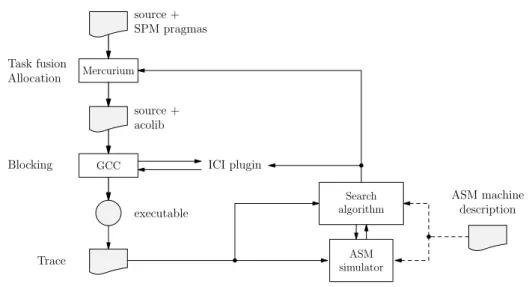
Figure 1.5 shows the compilation flow. The source program is converted from SPM to C, using the Mercurium [BDG+04] source-to-source converter. This step translates pragma annotations into calls to theacolib (ACOTES library) run-time system, and inserts calls to the trace collection functions. It fuses kernels that are mapped to the same processor, encap-sulating them into routines, and inserts statically sized communication buffers, as required, between kernels on different processors. The mapping is determined by the partitioning algorithm described in Chapter 3. The resulting multi-threaded program is compiled us-ing GCC, which was extended within the ACOTES project to perform blockus-ing, polyhedral transformations, and vectorisation. Additional mapping information is provided to GCC using the Iterative Compilation Interface (ICI) [FC07]. The ACOTES compiler is iterative, meaning that the program may be compiled several times, as the search algorithm adjusts the mapping.
1Advanced Compiler Technologies for Embedded Streaming (contract no. IST-34869)
1.4 Task-level languages source + SPM pragmas Task fusion Allocation Mercurium source + acolib
Blocking GCC ICI plugin
executable Trace Search algorithm ASM simulator ASM machine description
Figure 1.5: The ACOTES iterative stream compiler
The ASM simulator executes a mapped stream program at a coarse granularity, and generates statistics which are used to improve the mapping. The inputs to the simulator are theASM machine description, which describes the target, and the ASM program model, which describes the program. The ASM simulator is driven by a trace, which allows it to follow conditions and model varying computation times.
The ASM simulator is used inside the small feedback loop in the bottom right of Fig-ure 1.5; for example in determining the size of the stream buffers, using the algorithm in Section 3.3 [CRA10b]. The trace format has been designed to allow a single trace to be reused for several different mappings. Section 2.6 describes in more detail the partitioning algorithm and its interaction with the ASM.
The ASM simulator allowed work to start on the mapping heuristics before the compiler transformation infrastructure was completed. Additionally, and experiments are repeatable because there is no experimental error.
1.4
Task-level languages
1.4.1 StarSs and OmpSs
Task-level parallelism will be expressed, in this thesis, using Star Superscalar (StarSs), an extension of the C programming language, developed at BSC–CNS.1 The extensions are “pragmas” that tell the compiler about tasks, but they don’t change what the program does. If a StarSs program is given to an ordinary compiler, that does not support StarSs, it will ignore the pragmas, and the program will still work—just not in parallel.
1. INTRODUCTION
1 #pragma c s s task input (row , c o l ) inout ( inner )
2 void bmod (f l o a t row [ 3 2 ] [ 3 2 ] ,
3 f l o a t c o l [ 3 2 ] [ 3 2 ] , 4 f l o a t i n n e r [ 3 2 ] [ 3 2 ] ) 5 { 6 f o r (i n t i =0; i<32; i ++) 7 f o r (i n t j =0; j<32; j ++) 8 f o r (i n t k =0; k<32; k++) 9 i n n e r [ i ] [ j ] −= row [ i ] [ k ]*c o l [ k ] [ j ] ; 10 }
Figure 1.6: Example StarSs code (bmod function from LU factorisation)
StarSs is an umbrella term for the common parts of GRID Superscalar [SP09], Cell Su-perscalar (CellSs) [BPBL06], and SMP SuSu-perscalar (SMPSs) [PBL08], plus generalisations for GPUs (Graphics Processing Units) and clusters. CellSs targets the Cell Broadband Engine [CRDI05], which has distributed memories, and needs the run-time system to pro-gram DMA transfers to get data from one processor to another. SMPSs targets Symmetric Multiprocessors, which have a global shared address space, so DMA transfers are not re-quired. For more information please refer to the conference publications cited above and the CellSs [Bar09] and SMPSs [Bar08] manuals.
OmpSs is an implementation of StarSs, which also integrates the OpenMP standard. The OmpSs compiler accepts both the StarSs syntax and the newer OmpSs syntax [DFA+09].
Figure 1.6 shows a short function, the bmod function from LU factorisation, annotated with its StarSs pragma. This function works on subblocks of larger arrays: the subblocks calledrow andcol are inputs, and therefore not modified by the function, and the subblock calledinner is read and modified (inout). Pragmas contain some extra information, beyond the direction of data transfer. First, a pragma says that the function should be a task in the first place; i.e. that it is big enough, and worth offloading to another processor, given the overheads of a software run-time.1 Second, when the formal parameter is a pointer rather than an array, the pragma gives the array’s size (an example is given in Figure 5.12(b) on page 111). This information is needed, but otherwise not given by the C source.
The program starts executing on one processor, in the master thread. When the master thread calls a function likebmod marked as a task, the function does not execute right away. Instead, a task, to do that function, is added to a run-time dependency graph, to be executed some time in the future in a worker thread.
The dependency graph tracks dependencies between tasks, since some of the inputs to bmod may not be ready yet. They may be outputs from tasks that haven’t yet been done. Not all task-level languages allow tasks to depend on earlier tasks, instead needing the main thread to wait for the predecessors to complete before it can fire off any task that needs their outputs. Supporting dependencies is an important feature of StarSs, and it is easy to imagine that it might improve performance.
Figure 1.7 shows the function prototypes and part of the compute function from the Cholesky decomposition benchmark. Figure 1.8 shows dependency graphs for two different problem sizes.2 The different colours correspond to the four functions, and the numbers in subfigure (a) show the order in which the tasks were created. In practice, the whole
1Task Superscalar [ERB+10] and D2NOW [KET06] propose hardware support for fine-grained tasks. 2The problem size is given by the value of Nin the source code.
1.4 Task-level languages
1 #pragma c s s task input (a , b) inout ( c )
2 void sgemm t (f l o a t a [M] [M] , f l o a t b [M] [M] ,
3 f l o a t c [M] [M] ) ;
4
5 #pragma c s s task inout (a )
6 void s p o t r f t (f l o a t a [M] [M] ) ;
7
8 #pragma c s s task input (a ) inout (b)
9 void s t r s m t (f l o a t a [M] [M] , f l o a t b [M] [M] ) ; 10
11#pragma c s s task input (a ) inout (b)
12 void s s y r k t (f l o a t a [M] [M] , f l o a t b [M] [M] ) ; 13 14 . . . 15 16 f l o a t A[N ] [ N ] [M] [M] ; // NxN b l o c k e d matrix , 17 // w i t h MxM b l o c k s 18 19 f o r (i n t j = 0 ; j<N; j ++) 20 { 21 f o r (i n t k = 0 ; k<j ; k++) 22 f o r (i n t i = j +1; i<N; i ++) 23 sgemm t (A[ i ] [ k ] , A[ j ] [ k ] , A[ i ] [ j ] ) ; 24 25 f o r (i n t i = 0 ; i<j ; i ++) 26 s s y r k t (A[ j ] [ i ] , A[ j ] [ j ] ) ; 27 28 s p o t r f t (A[ j ] [ j ] ) ; 29 30 f o r (i n t i = j +1; i<N; i ++) 31 s t r s m t (A[ j ] [ j ] , A[ i ] [ j ] ) ; 32 }
Figure 1.7: Extracts from StarSs code for Cholesky decomposition
1 2 3 4 5 6 7 8 9 14 15 18 23 26 12 11 13 31 10 16 19 24 17 27 32 21 22 20 25 28 33 30 29 34 35
(a) 5×5 blocks (b)12×12 blocks
1. INTRODUCTION
dependency graph may never exist in this complete form, because tasks appear only after they have been created, and are removed once they have been done.
Since several versions of one particular array may be in flight at once, the OmpSs run-timerenames arrays to break false dependencies, in a similar way to register renaming in a superscalar processor.1 Even if taskB modifies an array that is going to be needed by task
A, taskB can be offloaded and even start executing before taskAhas finished. Task Awill always read the version it was supposed to, even if that version has since been superseded by a new one. If the main thread needs the output of some task, it must request the data using a pragma. The pragma waits for the task to complete and ensures that the live data is copied back.
The compiler could potentially have looked through the function in Figure 1.6, and written the pragma itself, without a person having to do it. This function is rather easy to analyse statically, but other functions are harder.2 Alternatively, it could watch the function, while the program is running, and see that it never seems to modifyrow, for example, guessing that the annotation should beinput(row). This approach needs a lot of test cases to ensure that no special cases are overlooked. StarSs could therefore be used as a form of intermediate language, to separate machine analysis from the run-time system.
In any case, we are interested here in using the OmpSs runtime to implement dynamic scheduling for a streaming language, by splitting kernels into tasks. So the pragmas are going to be generated by the machine anyway.
1.5
Streaming languages
1.5.1 StreamIt language
StreamIt [TKA02; CAG06] is a programming language for streaming applications, developed at MIT. All computation is performed byfilters, connected together byFIFOs, with decen-tralised control rather than a master thread. Each FIFO carries data from a single producer filter to a single consumer filter. Data arrives at the consumer in the order sent; that is first-in first-out.
The stream graph is built hierarchically, using pipelines, splitjoins, and feedback loops. These components3 are illustrated in Figure 1.9. All components, including filters, have a single input FIFO and a single output FIFO.
A pipeline connects its children in sequence, so the output of each child component is the input to the next—see Figure 1.9(a). A splitjoin connects its children in parallel, as shown in Figure 1.9(b). The input FIFO is split among its children, either by duplication, or by distributing its elements in a weighted round robin fashion. The output FIFOs are always joined using weighted round robin. Splits and joins are the only vertices in the stream graph
1The current implementation of OmpSs does not support renaming.
2Deciding whether an argument is inout rather thaninput, for instance, is NP-hard, since a function
could modify an argument only after discovering that an NP-hard decision problem can be solved. A pointer passed tosprintf is written through only in the uncommon case that the format directive is%n, something that the compiler may not easily be able to rule out.
3The StreamIt term for a filter, pipeline, splitjoin, or feedback loop is a “stream”. Since in this thesis,
streams are the edges that carry data, this section uses the word component instead.
1.5 Streaming languages
child
child
child
split
child child child
join
join
body loop
split
(a) Pipeline (b) Splitjoin (c) Feedback loop
Figure 1.9: StreamIt components: pipelines, splitjoins, and feedback loops
that can have more than one predecessor or successor; but they only distribute or gather data, rather than being free to do arbitrary work.
A feedback loop introduces a feedback path from the output of itsbody child back to its input, as shown in Figure 1.9(c). The feedback path optionally contains a component, referred to as theloop. It may need one or more elements prequeued onto the output of the loop component so that it does not deadlock.
Figure 1.10 shows an example StreamIt program, which is a bandpass filter, implemented as the difference of two lowpass filters.1 The stream graph is deduced at compile time, and is shown in Figure 1.11. The top level of the program is the pipeline defined in lines 54 to 65. It contains four children, inserted using the add statements, which in turn read the input, calculate the two lowpass filters, subtract elements in pairs to get the difference, and write the output.
The two lowpass filters are contained in the splitjoin called BPFCore, defined in lines 40 to 45. The splitter duplicates each element on the input FIFO to go to both filters, the filters happen on its two branches, and the joiner interleaves their outputs.
The lowpass filter is defined in lines 15 to 38. It is of typefloatfloat, meaning that its
input FIFO holds elements of type float, and so does its output FIFO. Line 16 declares its local data: a coefficient array whose number of elements is equal totaps. This array is built by the initialisation function in lines 17 to 28.
Every filter has awork function that keeps getting called, until the program has finished. In this case the work function is defined in lines 29 to 38. Each time this work function is called; i.e. each time it fires, it pops a fixed number of elements from its input FIFO and pushes a fixed number of elements into its output FIFO. The StreamIt 2.1 language supports work functions that push or pop a variable number of elements; in which case, the programmer may specify the minimum, maximum, and average number of elements. All StreamIt benchmarks, however, currently have fixed rates.
Here, the number of elements popped is equal to 1 + decimation. The exact number must be determinable at compile time. Since the filters are added in lines 42 and 43, both times withdecimation equalling zero, both filters pop one element each time they fire. This is known in Figure 1.11, which was produced by the StreamIt compiler. Similarly, they both
1This is inefficient because the two filters could be merged into one, using linearity, but the example is
1. INTRODUCTION
1 /*
2 * C o p y r i g h t 2001 M a s s a c h u s e t t s I n s t i t u t e o f T e c h n o l o g y
3 *
4 * P e r m i s s i o n t o u se , copy , m o d i f y , d i s t r i b u t e , and s e l l t h i s s o f t w a r e and i t s
5 * d o c u m e n t a t i o n f o r any p u r p o s e i s h e r e b y g r a n t e d w i t h o u t f e e , p r o v i d e d t h a t 6 * t h e a b o v e c o p y r i g h t n o t i c e a p p e a r i n a l l c o p i e s and t h a t b o t h t h a t 7 * c o p y r i g h t n o t i c e and t h i s p e r m i s s i o n n o t i c e a p p e a r i n s u p p o r t i n g 8 * d o c u m e n t a t i o n , and t h a t t h e name o f M. I . T . n o t b e u s e d i n a d v e r t i s i n g o r 9 * p u b l i c i t y p e r t a i n i n g t o d i s t r i b u t i o n o f t h e s o f t w a r e w i t h o u t s p e c i f i c , 10 * w r i t t e n p r i o r p e r m i s s i o n . M. I . T . makes no r e p r e s e n t a t i o n s a b o u t t h e 11 * s u i t a b i l i t y o f t h i s s o f t w a r e f o r any p u r p o s e . I t i s p r o v i d e d ” a s i s ” 12 * w i t h o u t e x p r e s s o r i m p l i e d w a r r a n t y . 13 */ 14 15 f l o a t−>f l o a t f i l t e r L o w P a s s F i l t e r (f l o a t r a t e , f l o a t c u t o f f , i n t t a p s , i n t d e c i m a t i o n ) { 16 f l o a t[ t a p s ] c o e f f ; 17 i n i t { 18 i n t i ; 19 f l o a t m = t a p s − 1 ; 20 f l o a t w = 2 * p i * c u t o f f / r a t e ; 21 f o r ( i = 0 ; i < t a p s ; i ++) { 22 i f ( i −m/2 == 0 ) 23 c o e f f [ i ] = w/ p i ; 24 e l s e 25 c o e f f [ i ] = s i n (w*( i−m/ 2 ) ) / p i / ( i−m/ 2 ) * 26 ( 0 . 5 4 − 0 . 4 6 * c o s ( 2*p i*i /m) ) ; 27 } 28 }
29 work pop 1+ d e c i m a t i o n push 1 p eek t a p s {
30 f l o a t sum = 0 ; 31 f o r (i n t i = 0 ; i < t a p s ; i ++) 32 sum += p eek ( i ) * c o e f f [ i ] ; 33 push ( sum ) ; 34 f o r (i n t i =0; i<d e c i m a t i o n ; i ++) 35 pop ( ) ; 36 pop ( ) ; 37 } 38 } 39 40 f l o a t−>f l o a t s p l i t j o i n BPFCore (f l o a t r a t e , f l o a t low , f l o a t h i gh , i n t t a p s ) { 41 s p l i t d u p l i c a t e ; 42 add L o w P a s s F i l t e r ( r a t e , low , t a p s , 0 ) ; 43 add L o w P a s s F i l t e r ( r a t e , h i gh , t a p s , 0 ) ; 44 j o i n r o u n d r o b i n ; 45 } 46 47 f l o a t−>f l o a t f i l t e r S u b t r a c t e r {
48 work pop 2 push 1 {
49 push ( p eek ( 1 ) − p eek ( 0 ) ) ;
50 pop ( ) ; pop ( ) ; 51 } 52 } 53 54 void−>void p i p e l i n e S i m p l i f i e d F M R a d i o 5 { 55 f l o a t s a m p l i n g R a t e = 2 5 0 0 0 0 0 0 0 ; // 250 MHz 56 f l o a t c u t o f f F r e q u e n c y = 1 0 8 0 0 0 0 0 0 ; // 108 MHz 57 f l o a t l ow = 5 5 . 0 ; 58 f l o a t h i g h = 9 7 . 9 9 8 8 5 6 ; 59 i n t t a p s = 1 2 8 ; 60 61 add F i l e R e a d e r<f l o a t>(” i n p u t . i n ” ) ;
62 add BPFCore ( sam p l i n gR at e , low , h i gh , t a p s ) ;
63 add S u b t r a c t e r ( ) ;
64 add F i l e W r i t e r<f l o a t>(” o u t p u t . ou t ” ) ;
65 }
Figure 1.10: Example StreamIt 2.1 program, based on FMRadio5
1.5 Streaming languages TopLevel0_FileReader__2_10_18 SplitJoin0_BPFCore_11_19 Pipeline1_BPFCore_11_20 Pipeline2_BPFCore_11_21 FileReader__2_10 push=1 pop=0 peek =0 DUPLICATE(1,1) LowPassFilter__10_12 push=1 pop=1 peek =128 LowPassFilter__18_13 push=1 pop=1 peek =128 WEIGHTED_ROUND_ROBIN(1,1) Subtracter__21_14 push=1 pop=2 peek =2 FileWriter__24_15 push=0 pop=1 peek =1
1. INTRODUCTION
1 i n t main ( )
2 {
3 char c ;
4#pragma acotes taskgroup
5 while ( f r e a d (&c , s i z e o f( c ) , 1 , s t d i n ) )
6 {
7#pragma acotes task input ( c ) output ( c )
8 i f ( ’A ’ <= c && c <= ’Z ’ ) 9 c = c − ’A ’ + ’ a ’ ;
10
11#pragma acotes task input ( c )
12 f w r i t e (&c , s i z e o f( c ) , 1 , s t d o u t ) ; 13 } 14 return 0 ; 15 } taskgroup if(’A’... fwrite c(line 7) c(line 10)
(a) SPM source code for tolower (b) Streaming graph
(flattened) Figure 1.12: Example SPM program from [M+11]
push one output element each time they fire, and they look ahead, or peek 128 elements in the stream, counting from the starting point. That is, they need 127 elements in addition to the one they will pop.
Each filter is stateless, meaning that the calls to their work functions are independent, so the filter contains data parallelism. A stateful filter has dependencies from one firing of the work function to the next, because its work function writes to local data. For example, it could be an adaptive filter that modifies its coefficient array, coeff. The compiler would see that the work function modifies local data, and make sure that it is done sequentially.
This example illustrates the features of StreamIt that are important in this thesis. For more information about StreamIt, refer to the language definition [CAG06], which is only twenty pages in length. The example does not illustratestatic blocks, which contain read-only data visible to all filters. It also does not illustrate some of the more advanced features unused by the StreamIt benchmarks, and not supported by our conversion tool: feedback loops, described above, messaging, which is a mechanism for asynchronous messaging between tasks, prework functions, which replace the work function the first time a kernel fires, or support forvariable push and pop rates.
This dissertation uses the StreamIt 2.1 language definition [CAG06], and the compiler and benchmarks from the StreamIt 2.1.1 distribution, dated January 2007.
1.5.2 SPM (Stream Programming Model)
The SPM [CRM+07; ACO08; M+11] (Stream Programming Model) is an extension to the C programming language to support stream programming, developed in the ACOTES project. Whereas StreamIt is a new language that requires the program to be restructured to look like a streaming program, SPM uses pragmas to annotate an ordinary C program. The pragmas identify parts of the program to be made into kernels. Like StarSs, if an SPM program is given to an ordinary C compiler, which doesn’t support SPM, it will ignore the pragmas, and the program will still work. That is, SPM maintains the sequential semantics of C.
1.6 Tool flow and support tools StreamIt source code StreamIt compiler, strc StreamIt to OmpSs,str2oss
Stream graph Work
estimates StarSs source code Cholesky H.264 skeleton · · · Partition
Queue sizes Nanos++ Adaptive
scheduler ASM simulator OmpSs compiler (Mercurium) StarssCheck trace Paraver prvanim Program desc. Statistics ASM machine description Compiler decisions Chapter 3 Run-time decisions Chapter 4
Figure 1.13: Tool flow used in this thesis. Items in bold are contributions of this thesis. Figure 1.12 shows an example program using the SPM, and its stream graph. The streaming part of a program is known as a taskgroup, and it comprises the loop following
the acotes taskgroup pragma, here on lines 5 to 13. This taskgroup has two tasks, each of
which contains the statement or block following an acotes task pragma. The task’s inputs and outputs are identified using theinput and output clauses.
The SPM program begins running in a single thread. When execution reaches the taskgroup, all of its tasks are created, each becoming a kernel in the language of this thesis, and the program starts processing data in streams, passing inputs and outputs through the streams. More information can be found in the ACOTES documentation [CRM+07].
1.6
Tool flow and support tools
Figure 1.13 shows the tool flow used in this thesis, with the contributions of the thesis shown in bold. The left-hand side of the diagram is for the compile-time decisions in Chapter 3, and the right-hand side is for the run-time decisions in Chapter 4.
On the left, the StreamIt source code is compiled using the StreamIt compiler, which, in addition to creating an executable, also creates a file representing the stream graph, in
dot format [GKN06], and a text file giving its estimate, for each filter, of the amount of work per firing. These files are the input, together with the ASM machine description, to
1. INTRODUCTION
the partitioning algorithm in Section 3.2. After partitioning, the buffer sizes are determined using the buffer sizing algorithm in Section 3.3.
The right-hand side of the diagram is for the run-time decisions in Chapter 4. The StreamIt source code is first translated to StarSs, using the tool described in Section 5.3. The StarSs source code is built using the Mercurium OmpSs compiler.
The various dynamic scheduling techniques, including the two proposed adaptive tech-niques, were compared using a set of OmpSs benchmarks built in this way.
1.6.1 Debugging using StarssCheck
When people start using a new programming language and compiler, they will soon discover that some of their programs don’t work. They will need to find out why, before they can fix them. A programming language without debug tools may be a fine research vehicle, but it is unlikely to be widely adopted, as users become frustrated by bugs in their code, blame the compiler, and think that the language is hard to use.
Section 5.1 describes a debugging tool, StarssCheck [CRA10a], that was developed as part of this thesis. It finds bugs in StarSs programs, but similar ideas could be used in a tool supporting SPM. StarssCheck was used, for example, to check the output of the StreamIt to OmpSs converter described in Section 5.3. The reasons for targeting StarSs rather than the SPM are that StarSs is more mature, and it already has real users.
1.6.2 Performance visualisation
In this thesis, the main reason to bother to write and compile an application to run in parallel is to improve its performance. When the performance is disappointing, or in some way surprising, it is important to understand why, and this requires some way to see how the application progresses.
The main tools used for this purpose in this thesis were Paraver [CEP] and prvanim
(Paraver Animator). Paraver is a trace visualisation tool, developed at BSC–CNS. Paraver reads a trace in a straightforward format [CEP01], which is a text file that can be easily created either using custom code or the Mintaka library [Nanb].
Section 5.2 describes theprvanimtool, which was developed in the course of this thesis. It takes a Paraver trace, and produces an animation that shows the progress of the application through time. It is a simple tool, which has, nonetheless, proven quite useful.
1.6.3 StreamIt to OmpSs
In order to use the same StreamIt benchmarks throughout the thesis, these benchmarks had to be translated to StarSs, so they could be compiled by the OmpSs compiler. For that purpose, we developed str2oss, a source-to-source compiler that translates from StreamIt to StarSs. This tool is described in Section 5.3. It does not support kernel fusion, but it does support unrolling, using a control file given by the user.
Each filter is translated into a work function, and, if required, an initialisation function. The work function does the work required by one firing of the filter, and is marked as a StarSs task. The tool creates a main thread, which allocates memory for the streams, and implements the steady state by calling the tasks in sequence.
1.7 Contributions and publications
1.7
Contributions and publications
The main contributions and publications of this thesis are:
The Abstract Streaming Machine (ASM), a machine model and coarse-grain sim-ulator for a statically scheduled stream compiler.
[CRM+07] Paul Carpenter, David Rodenas, Xavier Martorell, Alejandro Ramirez, and Eduard Ayguad´e. A
streaming machine description and programming model. Proc. of the International Symposium on Systems, Architectures, Modeling and Simulation, Samos, Greece, July 16–19, 2007.
Early versions of the ASM and SPM, giving an example machine description and program description in Python syntax. The sections related to the SPM do not describe a contribution of this thesis.
[ACO08] ACOTES. IST ACOTES Project Deliverable D2.2 Report on Streaming Programming Model and Abstract Streaming Machine Description Final Version. 2008.
The final version of the ASM from the ACOTES project. Chapter 2 is based on the material in this report.
[CRA09b] Paul M. Carpenter, Alex Ramirez, and Eduard Ayguade. The Abstract Streaming Machine: Compile-Time Performance Modelling of Stream Programs on Heterogeneous Multiprocessors. In SAMOS Workshop 2009, pages 12–13. Best paper award.
A condensed version of the ACOTES Deliverable D2.2.
[CRA11] Paul M. Carpenter, Alex Ramirez, and Eduard Ayguade. The Abstract Streaming Machine: Compile-Time Performance Modelling of Stream Programs on Heterogeneous Multiprocessors. Transactions on HiPEAC, 5(3).
Extended version of the paper in the SAMOS Workshop 2009, similar to the ACOTES Deliverable D2.2.
[M+11] Harm Munk et al. ACOTES Project: Advanced Compiler Technologies for Embedded Stream-ing. International Journal of Parallel Programming, 39:397–450, 2011.
Paper presenting the outcomes of the whole ACOTES project. Only the parts relat-ing to the ASM describe a contribution of this thesis.
A new partitioning heuristicfor stream programs, which balances the load across the target, including processors and communication links. It considers its effect on downstream passes, and it models the compiler’s ability to fuse kernels.
[CRA09a] Paul M. Carpenter, Alex Ramirez, and Eduard Ayguade. Mapping Stream Programs onto Heterogeneous Multiprocessor Systems. In CASES ’09: Proceedings of the 2009 International Conference on Compilers, Architectures, and Synthesis for Embedded Systems, pages 57–66, 2009.
1. INTRODUCTION
Two static queue sizing algorithms for stream programs, which determine the sizes of the buffers used to implement streams. The optimal buffer sizes are affected by latency and variability in computation costs, and are constrained by the sizes of local memories, which may be small.
[CRA10b] Paul M. Carpenter, Alex Ramirez, and Eduard Ayguade. Buffer Sizing for Self-timed Stream Programs on Heterogeneous Distributed Memory Multiprocessors. In High Performance Em-bedded Architectures and Compilers, 5th International Conference, HiPEAC 2010, pages 96– 110.
Two new low-complexity adaptive dynamic scheduling algorithms for stream-like programs.
StarssCheck, a debugging tool for StarSs. This tool checks memory accesses per-formed by tasks and the main thread, and warns if the StarSs pragmas are incorrect. [CRA10a] Paul M. Carpenter, Alex Ramirez, and Eduard Ayguade. Starsscheck: A Tool to Find Errors
in Task-Based Parallel Programs. Euro-Par 2010–Parallel Processing, pages 2–13, 2010.
Figure 1.15 shows a timeline, which places the contributions of this thesis in context. It also shows the two European projects that supported this work. The ACOTES project, which ran from mid-2006 to mid-2009, partially supported the ASM and compile-time heuristics. The ENCORE project, which started in March 2010, partially supported the run-time work, which includes StarssCheck and str2oss. The timeline also shows some external milestones, related to the Cell B.E., StarSs and StreamIt.
1.8
Thesis outline
Figure 1.14 shows the structure of the rest of this thesis. Chapter 2 describes the ASM, the Abstract Streaming Machine, that characterises the machine on which the stream program is going to run. The ASM tells the compiler how many processors there are, and how they are connected. Chapter 3 concerns the decisions made at compile time: the partitioning algorithm, and an algorithm that decides how big the communications buffers should be. The output from the compiler is an executable using the Nanos++ library [Nana]. This library includes an implementation of the OMP Superscalar runtime. Chapter 4 deals with run-time scheduling of stream programs.
1.8 Thesis outline Stream-like applications SPM,· · · §1 Introduction Validation §5.1, StarssCheck
Stream graph annotations
Compile time decisions §3, Partitioning and
buffer sizing ASM
§2, Abstract Streaming Machine
Executable
Nanos++ run-time library
Run time decisions §4, Scheduler
in Nanos++ Feedback (Open research)Queue occupancy, topology
graph,· · ·
Homogeneous target
Number of processors
1 . IN T R O D U C T IO N 1999 2000 2001 2002 2003 2004 2005 2006 2007 2008 2009 2010 2011
SIFt compiler (MEng thesis that led to StreamIt)
StreamIt 1.0 in ICCC2002
StreamIt 2.1 language specification
CellSs publication SMPSs publication GridSs first publication
Cell B.E. in ISSCC 2005
Enrolled in UPC PhD program
ASM+SPM deliverable (§2) Partitioning (§3.1) Buffer sizing (§3.2) StarssCheck (§5.1) ACOTES project IST-34869 ENCORE project ICT-FP7-248647 StreamIt StarSs Platforms Projects This thesis F ig u re 1. 15 : T im eli n e 22