TO THE
D
ATA
P
LANE
A Master’s Thesis
Submitted to the Faculty of the
Escola T`ecnica Superior d’Enginyeria de Telecomunicaci ´o de Barcelona
Universitat Polit`ecnica de Catalunya
presented by
A
lbert
G
ran
A
lcoz
In partial fulfilment
of the requirements for the degree of
M
aster in
T
elecommunications
E
ngineering
accepted on the recommendation of
Prof. Dr. Laurent Vanbever
Prof. Dr. Jos´e Antonio L´azaro
E
idgen
ossische
¨
T
echnische
H
ochschule
Z ¨
urich
N
etworked
S
ystems
G
roup
, 2018
Scheduling is one of the main active players in the quest for programmable networks. Despite the numerous research efforts that have been dedicated in latest years, not a single scheduling framework has resulted to be powerful enough to outperform the rest in a wide variety of scenarios. A new perspective to the problem has been therefore recently brought up, which suggests abandoning the pursue of a global scheduling solution, and moving into a more flexible and programmable conception. Network equipment should be designed to support different algorithms, from which it could select and configure the most appropriate one at each moment to face the instantaneous requirements of the dynamic nature in traffic demands. With the idea of making scheduling more programmable, new abstractions have been already defined, based on decoupling the process in two steps: a programmable-pipeline determining the order in which packets should be transmitted, and a fixed-logic push-in first-out (PIFO) queue draining packets in the desired arrangement. While PIFO abstraction is innovative and deeply promising, its hardware implementation is not straightforward. To the intrinsic difficul-ties of such a complex queuing design, adds the fact that ASIC production is by definition a multi-year process, propelling the release of a hardware built-in PIFO too far from expectations. Aiming to fill this temporal problem, in this thesis, a novel approach is proposed. Would it be possible to achieve a PIFO-behavior with the current resources available in nowadays networks? By trying to answer this question, we will embark in a journey that will span from revising the first quality of service proposals introduced at early networks, to discussions on how to reach predictability in potential future generations. Altogether, with the focus centered on squeezing the maximum benefit from the recent advances in network programmability, with special emphasis in the latest proceedings for programmable forwarding data planes.
First and foremost, I would like to express my deepest thanks to Professor Laurent Vanbever, for having given me the opportunity to be part of the Networked Systems Group during these months. For having believed in me since the very first day, and for all the time devoted, inspiring advice and endless support throughout all the project. You have been a reference for me, and working with you during these months has been a pleasure and an immense privilege. I would also like to thank Professor José Antonio Lázaro, for having been always there and for all the efforts in trying to make this stay possible.
To the NSG fellows. Thank you Edgar, for all the insights, discussions and late-night talks. To Thomas, for the wise words and reflections towards my professional career, for all theholycows
anduni-mensas; to Rudi, for the permanent good humor and positive vibes; and to Roland, Maria, Tobias and Ahmed, for having opened all the doors to me. I have always felt as one more in the family, and I will be forever grateful.
To the best office-mates, Max, Andrea, Amine, Ferdinand, Alex and Markus. All those hours locked in the lab would not have been the same without your company. Thanks for sharing this experience with me. Let’s keep pushing.
I would also like to thank everyone who has brought this experience far beyond the academic world. Sergi Caelles, for being my big brother during these months. Vas ser tu el que em va fer conèixer l’ETH, el que m’ha guiat professionalment. M’has ajudat a re-encendre la flama de voler seguir aprenent cada dia, apuntar el més amunt possible i escollir sempre el millor camí. Estic orgullós de tenir-te com a amic. Pablo, Yash, Yashveen, John, Guus, Daniel, Jay, thanks for being the best roommates I could have never asked for.
Thanks to all my friends and family back home, for the continuous care and best wishes. And finally, to the two most important people in my life, my parents, tot el que sóc avui és gràcies a vosaltres, no em cansaré mai de dir-vos que, no hi ha paraules que expressin tot el que us estimo. Aquesta tesis és per vosaltres.
1 Introduction 1
2 What About Predictable Networks? 3
2.1 Introduction . . . 3
2.2 Evolution of scheduling algorithms . . . 8
3 Our Algorithm 15 3.1 Introduction . . . 15
3.2 On strict priority PIFO’s . . . 16
3.3 What is a good strategy and what makes it good? . . . 18
3.4 Design of a dynamic allocation algorithm . . . 22
3.5 Proposed solution and why it works . . . 23
3.6 Pros, cons and discussions . . . 25
3.7 Wrap-up. . . 29
4 Experiments and Results 31 4.1 Introduction . . . 31
4.2 Setting ranks . . . 32
4.3 Single-hop algorithms . . . 32
4.3.1 First Come - First Served . . . 32
4.3.2 Strict Priority . . . 34
4.3.3 Shortest Flow First: Minimizing average flow completion times (FCT) . 39 4.3.4 Weighted Fair Queuing: Achieving short and long term fairness . . . 43
4.4 Multi-hop algorithms . . . 51
4.4.1 FIFO+: Reducing tail packet delays . . . 51
4.4.2 Least Slack Time First: Optimizing deadlines from the end-host . . . 56
4.5 Limitations and constraints . . . 58
4.6 Implementation in real networks: Barefoot Tofino . . . 60
4.7 SP-PIFO for predictable networks. Next steps and open challenges . . . 61
5 Conclusions and Future Work 65
1
Introduction
With the Internet growth in the late 1990s, a wide range of services and applications began to appear, and started sharing the limited resources of the networks. Each of these applications had been designed for a completely different purpose, and therefore came accompanied with a particular set of requirements in terms of mainly bandwidth, latency and jitter. This broad diversity of applications with distinctive demands, encountered a highly decentralized network that was being governed by a non-guaranteeing ’best effort’ policy. A new challenge for the research community had been born: how to optimally distribute the finite network resources throughout the different application flows, so that they could maximize their performance demands. And, in case not all the traffic objectives could be satisfied, which services should be chosen to be prioritized.
During the following years, and up to today, the field has been widely studied, with several proposals presented, and even some of them implemented. The first attempt came under the umbrella of Internet Engineering Task Force (IETF) Integrated Services architecture (IntServ), in which application flows were prescribed to perform individual reservations of the resources intended to use, before they could gain finally access. Several problems of scalability, derived from the fact that each router in the network had to be compliant with the protocol, together with the amount of state required to be stored, and the difficulty in keeping track of all network wide reservations, made this architecture not practical at the end. It was then the turn of differentiated services (DiffServ), a highly simplified QoS architecture, aiming to provide flows personalized treatment by just classifying them under a 6-bit Type of Service range. DiffServ is what most of nowadays network equipment support, but, as the number of applications has kept increasing, it has become more evident that a finer granularity protocol is still highly needed. While those two proposals have been the ones reaching further in terms of deployment and implementation, a great number of alternatives have been also suggested and deeply discussed by the academia. After all the research efforts, however, nowadays most services still use the de-facto best-effort model, evidencing the poor success that the various presented options have achieved. QoS remains therefore an open problem that, regardless the great advance that network engineering has experienced in the latest years, and the amount of effort devoted by the research community, is still waiting to be properly solved.
However, recent advances in network programmability, together with the increased flexibility of forwarding data planes, seem to suggest that all the tools required to face the objections of such an urgent challenge, have been finally made available. It might be now the appropriate moment to make a definitive attempt in trying to find a robust solution to the problem. When thinking about the next generation of networks, one would like to dream on intelligent systems capable of distributing their resources among the instantaneous demands of various flows. Doing it, with complete awareness of the results that a particular allocation would sup-pose. Understanding what each decision would mean in terms of quality of experience for the
2 Introduction
end-users, and being able to quantify the costs and implications of a given arrangement. One, that would dynamically adapt and rapidly react to changes in configurations and performance objectives. An intelligent system that could know how much resources would it require to achieve, for instance, a certain queuing delay, or which levels of utilization could optimize the threshold between efficiency and congestion. Such a system that, in result, would be able to predict, plan and accommodate guaranteed services to demands, would be the one finally driving us to a new world of what we could call predictable networks.
This thesis is about that. With the focus put on bringing the next grain of salt in the path to-wards predictable networks, we will work on improving QoS management in current networks, starting from one of its main pillars which is scheduling. Following the document structure, in Chapter2we will overview the state-of-the-art in scheduling algorithms, and revise the evolution of the different techniques, analyzing their best performance scenarios and principal drawbacks. By going through the various proposals, we will observe that there is not a master scheduling algorithm, outperforming all the others in all situations. That will bring us to believe that networks will have to support and adapt schedulers according to their needs, which will drive us to the idea of making scheduling programmable. At the same time, we will see that scheduling has not taken part of the data plane programmability revolution, and we will dis-cuss what techniques should be required to make it possible. In Chapter3, our new approach for facing scheduling programmability limitations will be presented. By using strict priority hardware, intrinsic in most of current network switches, we will implement a push-in-first-out queuing approximation that will allow us to deploy a broad range of programmable scheduling algorithms. Chapter4will focus on evaluating the proposed solution, with detailed simulations to illustrate the main characteristics but also demonstrating its limitations and disadvantages. A variety of performance objectives, from flow completion times to minimizing tail delays, will be tested and accurately verified. Finally, Chapter5will be left for discussions on our proposal, further steps to be considered, as well as future challenges and opportunities.
2
What About Predictable Networks?
2.1 Introduction
Recent years have supposed a revolution in networking. The first change of paradigm came with Software Defined Networking (SDN) and the idea of decoupling the network control plane from the data plane, giving a broader flexibility in the management and network op-erations. The global view of the topology could be used from a controller to optimize the network functions, distributing those policies on the forwarding plane through protocols like OpenFlow [MAB+08]. With SDN, however, all the programmability was being centralized at the control plane, implemented in software, leaving the data plane as a group of hardware-based forwarding equipment limited to obey the guidelines received. Some years after, diverse peo-ple started to consider the benefits that giving also programmability to the data plane could provide. The distributed nature in which the Internet had been created, together with the vulnerabilities that supposed having a unique centralized network brain, seemed to suggest that giving more flexibility to the data plane could offer a new spectrum of opportunities. That is how, after some years of progress, data plane programming languages started to appear. In 2014, Programming Protocol-independent Packet Processors (P4 programming language) was finally proposed [BDG+14], together with the Protocol Independent Switch Architecture (PISA), a framework providing the basic abstractions for the definition of programmable data plane solutions. With them, a new generation of programmable network switches, into which specialized programs could be built, defining manners in which packets should be treated, and run on top, started to be developed by the different silicon industries. Those new hard-ware equipments allowed rapid iterations between protocol design and implementation, as the usually-multi-year-process of creating a new fixed-function equipment could be reduced to just writing a new program and pushing it to existing architectures. And, contrary to the conventional belief, programmable switches showed that they could not only reach, but also improve the performance of fixed-function switches. With a rate of 6.5Tb/s Barefoot Tofino was proved to be the fastest switch in the world, with the same cost and power than tradi-tional fixed-function chips, and with the greatest advance of being completely programmable through software written in P4 [McK17]. Some of the new functionalities derived from this new paradigm, like having access to application-and-above layers to perform forwarding, or the ability of saving state information in each switch along the path, made clear that, with data plane programmability through platforms like P4, an immense range of new possibilities had definitely been released.
That is also how this thesis started. While aiming to look for which applications, traditionally implemented in a centralized manner, could be interesting to offload into a distributed philos-ophy through programmable data planes, it resulted quite evident that the most urgent one was quality of service. Recent studies had envisioned, that under a centralized environment with knowledge of the traffic, forwarding of packets could be optimally arbitrated to avoid
con-4 What About Predictable Networks?
gestion and maximize traffic performance [POB+15]. Although such a centralized architecture could be easily perceived as impractical, the promising results motivated our idea of trying to move towards predictable networks. And with the latest results in data plane programmability and the possibility of offloading solutions into distributed scenarios, we started to explore the elements that our concept of predictable networks should explicitly include.
Predictable networks can be defined as those systems able to anticipate, plan, adapt, update and react to the continuously-changing and highly-diverse traffic demands. To sustain that the idea of predictable networks is actually feasible, there is the fact that network behaviors are, by nature, continuous over short periods of time. With high probability, the traffic that a network experiences during a small interval of time (less than a second), will be highly correlated to the one experienced in previous and following seconds. Application flows usually act in a repetitive manner over a short span of time.
Achieving predicting behaviors, however, is not expected to be an easy-task. Throughout this first chapter, we will propose, discuss and analyze the major players that, in our view, should be primarily considered when trying to work towards this new paradigm. The first ingredient that should be deeply understood is the nature of traffic running on top of nowadays networks. We can find different type of connections, with a remarkable range of performance objectives. In order to be capable of defining techniques aiming to face those objectives, it is clearly needed to understand them correctly in advance.
• Traffic types and requirements: Application flow demands can usually be reduced into specific amounts of throughput, delay and jitter, although each metric can be expressed in finer demeanors. Throughput can be defined as the rate of bits successfully transmitted during a specific interval of time (this is, the bits transmitted during the time period [t, t + T), divided by the time T). Usually the word bandwidth generates confusion with the throughput. The bandwidth, also called capacity, is the maximum rate at which a sender can transmit data along a link, and it is an intrinsic physical property of the wire. However, it is closely tight to the throughput, as a higher bandwidth share allocated to a flow, means that this flow will be able to achieve higher throughput in its transmissions. The relation between the link bandwidth, and the aggregation of flow throughputs sharing the link in a specific moment, is the called link utilization. The delay or latency of a bit (or a packet) is the time required for the bit (or the packet) to go from source to destination. In other words, is the difference in time between the instant in which the bit reaches the destination, and the instant in which the bit departs from the source. This delay or latency can be divided in different contributions: the propagation delay, that is the time it takes for the signal to travel throughout the link, the processing delay, which is the time that it takes for the routers/switches to process the packet headers, manage memory, and select the appropriate output ports, and finally the queuing delay, that is the time spent by the packet in the queues, waiting for previous packets to be served before being finally transmitted. Other metrics of higher order, derived from the delay, can be the packet transmission time (i.e. the time that it takes the sender to transmit all the bits forming a packet), or the flow completion time, that is the amount of time that it takes to complete a transmission of a group of packets forming a flow or connection. As can be seen, requirements specified by using these metrics can be easily converted to their equivalents based on delay.
Finally, the jitter describes the variability in delay, as perceived by consecutive packets on a flow. Supporting big amounts of jitter, for example in playback applications, requires
big-sized buffers in reception to store all the packets arrived, before they can be correctly reproduced at the adequate rate.
When treated individually, it is not extremely hard to know the tools and components available today that should be used to answer those requirements with a solid amount of guarantees. For example, in order to achieve low delays, it is required to separate big flows (also called elephants) from small ones (or mice), so that the last ones are not blocked in queues along the path and they can finish transmissions the sooner possible. Moreover, queues have to be designed with very little buffer size, so that they can stay almost-empty and buffer-bloats are not produced. For this reason, queuing disciplines and buffer management techniques are extremely important for delay. Concerning bandwidth, on the contrary, it is important to perform a proper selection of paths, with the use of routing protocols designed to provide quality of service or creating virtual circuits from the source. Mechanisms like load-balancing or multi-path selection can be used to efficiently distribute flows throughout available link resources. In reference to the queues, the solution for throughput is opposite to the one for delay. Long-buffered and deeply-filled queues are the best option to guarantee high levels of utilization for output links. It looks therefore, that throughput and delay have almost orthogonal requirements. An optimal solution should try to isolate them as much as possible, emphasizing the protection of short flows with very tight delay constraints.
For jitter minimization, traffic shaping or conforming is required. As it will be seen in Section4.1, most scheduling algorithms are based on prioritizing some packets over the others. Those algorithms usually suppose a big source of jitter, as packets need to wait for others to be served, and the number and type of packets encountered in switches is not constant throughout the path. Not performing any type of scheduling (i.e. using the default FIFO behavior of queues) is the best solution in terms of jitter. But again, FIFO queues play against the requirements of delay, making jitter and delay almost orthogonal requirements as well. Regarding path selection for jitter, the best results are achieved when stability on the network is maintained. Intuitively, this means that all packets of a flow should try to be forwarded through the same path, to maximize the chances of finding the same congestion conditions, minimizing this way their difference in delays. Path stability also favors the fight against reordering needs, a very important factor to be considered in the design. Summarizing, dynamically adapting the routes to achieve better paths in terms of delay and throughput, if done at a very high rate, can play completely against in terms of jitter.
As can be clearly seen, delay, throughput and jitter requirements are quite orthogonal from each other, and although individually can be treated with the correct design of networks and tools, the challenge comes when various of those demands have to be treated together. In some restricted environments, it may be possible to draw orthogonal paths trying to isolate traffic of different demands. But that is not usually the case in common scenarios. When flows with different requirements have to share resources in the network, the question of how to optimally distribute them to maximize performance arises. In very few cases, it will be possible to guarantee service to all entering flows. In a wider range of situations, the network will have to choose (i.e. prioritize) which flows from all the candidates will be the ones achieving guaranteed quality of service, and which ones will have to be driven under a best-effort approach.
A good design for a predictable network should consider two types of requirements: hard-requirements and soft-requirements. Hard-requirements are those which need to be strictly satisfied in order to guarantee a correct performance of the service. Those are
6 What About Predictable Networks?
the requirements that the network has to prioritize above all. A clear example of such requirements can be found in voice services. For a conversation to take place, it is needed to guarantee a minimum of 30Kbps throughput (assume fore a given codec, overhead definition, and sampling rate), and a maximum of 30ms of jitter, 150ms of one-way delay and 1% of packet drops. With a lower service than that, the conversation would be not acceptable and the service would become useless. In this case, the resources allocated would be completely wasted, so satisfying the hard requirements is of crucial importance to be sure that the service will, at least, take place in a correct manner. Hard-constraints are given as detailed magnitudes. For example, a critical delay could be defined as, at most, 1ms for an urgent application, or 5ms for a more-relaxed one.
Soft-requirements can be seen as just resource extensions to make the service better. Once having covered the hard basic needs, soft-requirements enhance the user experi-ence. Those are not the biggest priority, but once all the hard requirements have been met, the network should consider how to distribute the remaining resources to satisfy application flows in a fair manner. An example of a soft-requirement for a file transfer protocol would be to maximize the throughput. It is not crucial for transferring the file to have a very high throughput, but doing it will make the transmission finish faster, which will be received with satisfaction from the end-user side. Once the basic demands have been covered, soft-requirements enter to action. They are given as maximizations: maximizing throughput, or minimizing flow completion time. With this distinction, the network task can be described as an optimization.
For all flows in the network, with an origin-destination tuple clearly specified, and a set of hard and soft constraints, assuming a clearly defined and stable network topology, the objective is to minimize the difference between targeted performance and the average result finally achieved.
Formally, let there be a set of flows f ∈F, in which each flow is constrained by a hard performance target, ph, which can be decoupled in delay, throughput and jitter re-quirements {dh,th,jh}, plus some softly-desired demandsps={ds,ts,js}. The network objective is to minimize the difference between target performance and the average performance resulting from the allocation resources received,pa ={da,ta,ja}, while guaranteeing that the hard-requirements are strictly satisfied.
min pa ∆ ps−a where: ∆ps−a=ps−pa s.t. pa>ph. (2.1)
The optimization can be decoupled in three different optimizations, each concerning to one of the previously-defined requirement types.
min da,ta,ja ∆ds−a,∆ts−a,∆js−a where: ∆ds−a=ds−da ∆ds−a=ts−ta ∆ds−a=js−ja s.t. da>dh ta>th ja>jh. (2.2)
As a conclusion, a predictable network can be defined as a one-block system, with a clearly described input and output.
– Input:
* Workload (set of flows with requirements)
* Topology of the network (assuming stability throughout the optimization: no link failures, no capacity variability)
· Links with capacity
· Switches, specifying if programmable and the set of queuing disciplines supported
– Output:
* Circuit building through tagging mechanism * Instantiation of queuing disciplines
* Such that workload achieves QoS requirements
• Centralized vs. distributed approaches: Interesting debate has recently arisen, dis-cussing that the quality of service challenge has probably appeared due to the distributed nature of networks, in which decisions need to be taken at the local perspective of in-dividual routers or end-hosts, loosing the sense of control over the packets experience throughout their journeys. Two type of philosophies appear: the ones thinking on a centralized solution to overcome those difficulties, and the supporters of a distributed approach, strongly moved by the recent advances in data plane programmability, spe-cially in terms of saving-state capabilities and dynamic packet processing, who believe that recovering control in the inherited distributed nature is still possible, allowing us to keep the scalability, flexibility, and fault-tolerance advantages that have defined the way networks have been thought and brought where they are.
• End-to-end solutions vs. critical switch: Another consideration is the one between the strict necessity of an end-to-end framework or a plug-an-play solution that can be effective even implemented on a single switch. It is clear that, in terms of performance, end-to-end solutions will theoretically provide more robustness and therefore better performance results. However, if the change requires replacing existing infrastructure, complex configurations or exigent user contribution, then the solution is with high prob-ability not going to succeed. A fair reasoning is to dream about an end-to-end solution as a long term objective, but realistically focusing on a solution design to be implemented on progressive steps, and where the benefits can be realized even if it is only adopted on some of the network most critical switches. Any valid idea should be ambitious enough to work at an end-to-end level, not only taking action on every switch, but considering them all in a global manner. Again, when gathering control of the whole network, an immense range of possibilities emerge. By taking and structuring the network as one, it is possible to not only think of working with queues and schedulers in a single switch, but on carrying information between consecutive switches to perform network-wide optimizations throughout the path. This can be combined with monitoring and network telemetry to dynamically configure the best schedulers at each hop, or adopting conges-tion control mechanisms. Even more, routing could also contribute by determining the optimum links to use according to their capacities and utilization. Load-balancing could also enter and, with it, multi-path techniques. Dreaming big is easy, and sometimes is needed. Although the idealistic solution should be always kept in mind, any objective can only be fulfilled when sufficiently small steps are taken in a progressive manner.
8 What About Predictable Networks?
• Key players and techniques: Achieving predictable networks requires precise puzzling of different components. Everyone could increase the complexity as much as desired when thinking about the perfect solution. But, as considered in the previous lines, sometimes is important to focus on the principal actors taking the biggest part of the stake. Scheduling and path allocation are, without any doubt, the two big players in quality of service. In this thesis we will mainly focus on scheduling. The reason behind is the sense that path selection can depend on the scheduling algorithms supported around, and the background idea of merging route selection with dynamic configuration of programmable scheduling throughout the path.
Being scheduling the crucial point towards predictable networks, our first objective is the analysis of different algorithms that have been implemented until now, to learn which are the challenges they try to solve and what are their advantages and weaknesses. These learnings will allow us to describe the best scenarios in which they can be used, which will be fundamental in the future to achieve predictable networks. At the end, not only will it be important to understand which queuing mechanisms should be used to achieve each type of quality of service, but also determining correct ways to combine them, not having to depend on a global algorithm for all situations, but designing combinations of them for maximizing performances in different scenarios.
2.2 Evolution of scheduling algorithms
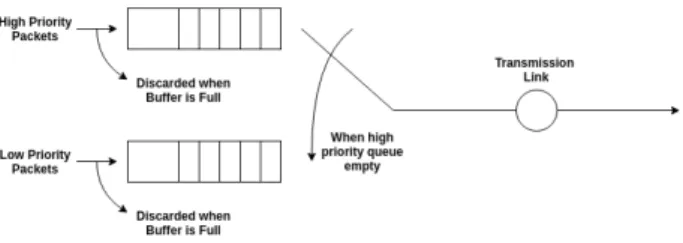
Scheduling just consists on determining the order in which packets should be transmitted at each switch or router throughout the network. And even being a super small piece of the whole QoS provisioning field, it has been extendedly researched since early days1. The first and most common algorithm isFirst Come First Served (FCFS), in which the order of arrivals defines the resource allocation. All packets share the same buffer, with the packets arriving first being also the ones departing first. If the buffer gets full, new coming packets will be discarded. The main problem of FCFS is the non-guarantee of fairness between defined entities (for instance flows or users). A flow transmitting at high speed can capture an arbitrarily high fraction of the available bandwidth, or even block the transmission of other flows. A set of different FCFS queues, can work together under a Head of Line (HoL) Priority Queuing regime. A priority scheme is defined as the one in which low priority queues can only transmit when higher priority queues have finished draining all their packets. The same philosophy can be extended to separate the treatment of different types of traffic (e.g. real time and non-real time). In 1987, J. Nagle proposedFair Queuing (FQ)[Nag87], an algorithm that consisted on main-taining a separate queue for the packets coming from different instances, and serving those queues in a round-robin manner. This mechanism would prevent malicious sources to send packets at a too high throughput, which would just increase their personal queue. Although the idea of fairness was of crucial importance, the original FQ had several flaws. It did not consider that in a scenario with different packet sizes, although serving packets from different sources in a round-robin manner, big-size packets would still achieve higher throughput than smaller packets from other sources in the same round.
1Scheduling is just one more technique, that added to buffer management, congestion control and traffic engineering, form the basis of quality of service. If scheduling by itself has been a widely studied area, with numerous contributions since early times, one can clearly note that a detailed study of the QoS approaches and techniques would demand far more time and effort than the sufficed in this document. Curious readers are encouraged to follow materials in [Zho18] for a more extended study on those matters.
Figure 2.1: Strict priority scheduling.
Some other possibilities started to be explored. InWeighted Round Robin (WRR)[Sem01], the technique was similar to traditional Round Robin [HG86], with the main difference that each queue was given a certain weight. The way to proceed was just to normalize those weights so that they could become integers. The scheduler would then iterate in a Round Robin fashion among queues, serving as many packets as the converted-to-integer weight specified. This technique maintained max-min fairness only if the packets had the same size. In case the packets had variable size, then the weight-per-byte needed to be computed by dividing each queue weight by the average packet size of the queue and then this weight-per-byte could be finally converted to integer and proceeded in the same manner (serving as many packets per queue as their normalized weights specified). However, this required the knowledge of the mean packet size per each session, as a dedicated queue per session was being assumed, making complex its implementation. To solve the challenge of needing the mean packet size in advance,Deficit Round Robin (DRR)[SV95] was later proposed. The idea behind DRR was to set a counter per each queue that would track the amount of bytes sent by each flow. At each round, all counters would be set to a configured amount, defining the number of bytes that could be transmitted. Packets would be sent until this deficit was spent. Remaining packets would have to wait until the next round, when the deficit could be increased again. Those packetized versions of RR and DRR were able to achieve fairness in the long term. With the idea of providing instantaneous fairness,Fluid Flow Fair Queuingor
Generalized Processor Sharing (GPS)[PG93], assumed that traffic arrived in a fluid manner and the scheduler rotated the queues while serving an infinitesimal amount of information from each queue at each round. It was obviously just a theoretical hypothesis, as such a fluid model was not implementable, but it has served until today as basis for a wide range of packetized algorithms, which try to approximate this fluid fair behavior.
In 1989 Shenker et al. presentedWeighted Fair Queuing (WFQ)[DKS89], also called Packetized-GPS (P-Packetized-GPS), an improved version of FQ which simulated a hypothetical bit-by-bit round-robin fashion. The round at which the last packet of each flow would be transmitted if the bit-by-bit round-robin technique was followed, was computed per each packet in the flow. Packets were then ordered in increasing finishing-round value (or virtual finish time). Whenever a packet finished its transmission, the following one would be the one with the smallest finishing-round value. With this mechanism, they attempted to provide isolated and equitable access trans-mission bandwidth, preventing high rate flows from taking all the resources. Two different possibilities were allowed according to preemption. The preemptive version, in which if a new packet with smaller finishing-round value arrives while a bigger finishing-round value is being transmitted, the transmission should be stopped to give the opportunity to the new-coming one. They also presented the possibility of giving more promptness (less delay) to flows uti-lizing less than their fair share of bandwidth, by including a new variable when computing finishing-round values.
10 What About Predictable Networks?
Figure 2.2: Finishing time computation in Weighted Fair Queuing.
Weighted Fair Queuing was specially designed to allow slow-speed links to provide fair treat-ment to different flows of traffic. By prioritizing low-bandwidth traffic over high bandwidth one, malicious input streams could not starve other flows of link bandwidth by generating large amounts of traffic, as that would not provide the requested portion, but just harm his own transmission until the requested bandwidth was decreased. This way, WFQ forced each flow to transmit at a fair share of the available capacity. Weighted Fair Queuing was fair in the sense that its departure times, and the ones in Fluid Flow Fair Queuing remained bounded by the maximum size of the packet divided by the output link capacity. The biggest complain to this algorithm was, however, that each flow required its own queue, which would suppose numerous memory references, making them unfeasible for operating in high speed networks. Even today, this type of approximations is rarely seen implemented in core networks, as the number of flows is very large (potentially thousands) and maintaining the state information for all of them supposes a significant level of complexity.
In 1990,Stochastic Fair Queuing (SFQ)[McK90] was presented, as a probabilistic variant of Shenker’s algorithm to diminish its computational complexity inherent from the switch need of mapping source-destination pairs to a certain queue on a per-packet basis. In SFQ, the use of a hash function was proposed to easily map source-destination address tuples into fixed sets of queues. By periodically perturbing the hash function, the likelihood of hash collisions occurring during consecutive time intervals was substantially decreased. The general challenge remained the need of computing virtual finishing times, which required keeping track of the state for all backlogged users, posing a problem in terms of the real time computations. Further mechanisms to achieve fairness with smaller levels of complexity were therefore still required. New algorithms likeSelf-Clocked Fair Queuing (SCFQ), Start time fair queuing (STFQ)and
Worst-case fair weighted fair queuing (WF2Q)[Sah08] [Gol94] presented alternative ways to make less tedious the computation of termination virtual times in WFQ. However, the price to pay was a reduction in the obtained fairness. A discussion on the main differences in their implementation details can be found in Section4.3. Other techniques, such as resource reservation algorithms, also called reservation services, in which connections were forced to negotiate with the network resource scheduler the maximum and average throughputs at which they were allowed to transmit, and providing best-effort services to the rest of connections by using the remaining bandwidth counterparts, were also deeply discussed.
With the rise of modern commercial operations, such as web services, cloud computing and storage, new challenges needed to be faced. In particular, data-centers experienced that most of their applications (financial services, social networking, recommendation systems and web search) often had very demanding latency requirements. Commonly adopted fair sharing schemes were far from optimal in terms of latency. This was mainly because latency-sensitive
flows often got queued up behind bursts of packets from large flows of coexisting workloads (like backup, replication, data mining etc.). Several protocols and algorithms were therefore presented trying to decrease the flow completion times in those scenarios, the called real-time schedulers. It is important to remark that in data centers the majority of the flows are mice (reduced sized with strict latency requirements), while only a few are elephant (throughput requirements). Traditional real-time scheduling techniques likeEarliest Deadline First (EDF), which focused on minimizing the number of missing-deadline (late) flows andShortest Job First (SJF), which minimized mean flow completion times, adopted priority queuing schemes to give preference to flows in terms of deadline (tighter deadline first) and flow sizes (short flows first) respectively. Their application in data centers was not completely straightforward because of the following reasons:
• They were presented as centralized algorithms, which meant that they required global knowledge of flow information.
• Prioritizing flows ideally would require each of the concurrent flows to have a unique priority class. Data centers could allocate thousands of flows, while modern switches only supported around 10 priority classes.
• They assumed preemption, allowing newly arriving tasks with smaller deadlines to be completed before already scheduled tasks of lower priority levels.
Still in the group of real-time schedulers,Shortest Remaining Processing Time (SRPT)was demonstrated to be the optimal algorithm for minimizing average FCT when scheduling over a single link. By prioritizing flows with least work remaining, it had the main advantage of achieving per-packet granularity, something that SJF had not been able to do. Its principal drawback, however, was the lack of consensus on how to optimally specify the deadline of each packet. Several recent algorithms based on SRPT, like pFabric, suggest using the received TCP acknowledgements to estimate these deadlines, and trying to make use of new programmable switches to update them as packets travel along the path.
In 2011,D3 [WBKR11] proposed a new technique to meet flow deadlines, in this case by following a first-come first-reserve (FCFR) basis. Every arriving flow to the switch would request a certain rate, wherer at e_r equest edis defined as f l ow_si ze/f l ow_d ead l i ne. If the rate requested was available in the output link, the switch would allocate it to the flow. D3 results depended highly on the flow arrival order, and its performance was still far from the desired.
With the idea of moving the complexity of priority scheduling to the end host,Preemptive Dis-tributed Quick flow scheduling (PDQ) [HCG12]was presented in 2012. To avoid the problem of having a large number of flows and not enough queues to distinguish them all, it proposed adapting directly the flow transmission rates. By controlling each flow’s sending rate, PDQ regulated the traffic to retain packets from low-priority flows at senders, being able to achieve finer priority granularity with only FIFO tail-drop queues in the schedulers along the path. PDQ was presented as a distributed protocol instead of a scheduling algorithm, and was able to approximate a range of scheduling disciplines, specially designed to adapt traditional real time schedulers (EDF and SJF) to the distributed nature of data-centers. Its performance was based on letting switches explicitly communicate with end-hosts to let them know the available rate in their outputs, so that end-hosts could compute expected flow transmission times and packets could be scheduled accordingly. Although achieving great performance, it was quite a
12 What About Predictable Networks?
complex protocol, which required a lot of synchronization between all parties as well as saving and exchanging a lot of information, both on switches and end-hosts.
For the scheduling algorithm to work in a distributed manner, flow information needed to be exchanged via explicit feedback in the packet headers. The main idea was that a scheduling header could be added in the transport layer of each data packet, in which the end-host would send information to the switches about the flow ready to be transmitted, and the switches would return information about the available rate at which the flow could be (at most) transmitted. When a new flow needed to start communicating, the sender would send a probe (a packet with no data), with the scheduling header specifying the new flow information (size and maximum rate that the sender could achieve). The switch would then specify the achievable rate in the header, which would be received by the sender through the acknowledgement. Every time a the receiver would get a packet, it just had to copy the scheduling header received in the acknowledgement. Switches in the path monitored the incoming traffic they had in each of their queues. They would explicitly ask the sender to transmit data at a specific rate or to pause transmissions by only modifying the scheduler header.
In 2013,pFabric[AYS+13], suggested that all research efforts towards the latency problem in
data-centers had been trying to use rate control to reduce FCT for short-flows. Some solutions had tried to do it implicitly, by keeping queues near empty through adaptive congestion con-trols and ECN-based feedbacks (like DCTCP [AGM+10], D2TCP [VHV12], and HULL [AKE+12]).
Although with those solutions, FCT was improved, they could not precisely determine the right flow rates. Moreover, keeping empty queues was challenging due to the bursty nature of traffic. The other solutions had tried to explicitly compute and assign rates from the network to each flow, to try to schedule them based on size or deadlines (like D3or PDQ). This last approach, although providing good performance, demanded too complex implementations. Believing that flow scheduling should be kept independent from rate control, pFabric proposed a simple transport design which managed to achieve near theoretically optimal FCTs.
• End-hosts were required to specify a number on the header of each packet, which would represent its priority (e.g. the flow’s remaining size or the deadline). Priority would be set independently for each flow, with no need for coordination across flows or hosts. • Switches would base their scheduling by just following the priority number on the header.
Buffers would be given very little size and preemption would be considered: if a packet arrived with a full buffer, the packet with less priority would be dropped.
• Decoupled rate control was also simplified: flows would start transmitting at line-rate and would only decrease the rate in case of high and persistent packet loss detected. These two simple mechanisms would be sufficient for providing next-to-optimal performance.
Although the idea of using packet headers in order to specify scheduling priorities was in-teresting, and would be incorporated a bit later in the PIFO proposal, the rank definitions that pFabric suggested were based on SRPT. They assumed transport layer knowledge when performing scheduling, fundamental to compute remaining flow time deadlines through TCP acknowledgement information. Despite the outstanding results of this configuration, SRPT deadline definition was not expected to be an easy task, as will be investigated throughout this thesis.
While the algorithms summarized in this section just suppose a very brief collection of all the alternatives presented in latest years, the amount of efforts devoted by the research community on the field, evidenced the common believe that it was possible to find a single algorithm which could perform well in all types of situations, in all different case scenarios. After pFabric, however, one big question was put on the table. Is there actually a universal packet scheduling? Is there an algorithm which outperforms all the others in all situations? A final solution, that would solve all the challenges in packet queuing and scheduling field at once? First Anirudh Sivaraman et. al. in "No Silver Bullet" [SWSB13], and then Raddhika Mittal et. al. in "Universal Packet Scheduling" [MARS15], suggested that there is not a single technique achieving best results in all possible cases.
"No Silver Bullet" was first in stating the non-existence of a key algorithm to be used everywhere, anywhere, claiming that an election of the best scheduling candidate would strictly depend on what demands the applications running on top of the end-points would have. On a computer backup application requiring high throughput, the best way to process the packets would be completely different than the one for an interactive website demanding low page loading times. Following the same direction, "Universal Packet Scheduling" insisted that, although certain algorithms , when customized in particular manners, could be able to accurately replicate behaviors of other techniques, being the greatest Least Slack Time First (LSTF), there was not a universal packet scheduling outperforming the others in all type of situations on a strict sense. Both results enforced the need of changing the general research direction, and trying to work on making scheduling programmable. Instead of pouring efforts in the design of a single superstar algorithm, acting as a wildcard for all possible desired behaviors, the focus should be put on figuring out which technique, or combination of techniques (existing or new ones still to appear), would be the best ones to achieve the solicited specific requirements for every particular case scenario. Switches in the network would have to support a wide range of algorithms, with the flexibility enough to select the most adequate one at each moment to handle the diverse and continuously-changing application demands.
Recent advances in programmable switches, make us believe in the possibility of having chips supporting multiple schemes and being able to dynamically select the appropriate ones through the programs running on top of them. Making scheduling programmable is the natural next step of nowadays networks, but until reaching that point there is still a lot of progress to be done.
3
Our Algorithm
3.1 Introduction
While the latest changes in network programmability were quite promising and gave some fresh air to the networking sector, the scheduling field was not being part of this revolution. Anirudh Sivaraman et al. (MIT), thought that the reason why scheduling had not been made programmable in this new wave of arising programmable switches, was due to a lack of consensus in defining a proper abstraction, which could allow new schedulers to be defined and implemented under a common basis, serving as a reference for the research community to paddle in the same direction. In SIGCOMM ’16, they proposed a new framework, aiming to make from scheduling programmability in switches a reality [SSA+16].
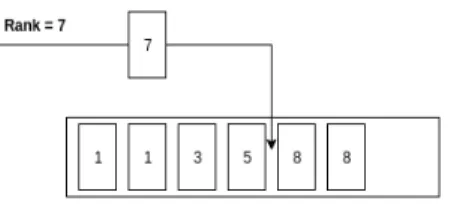
They argued that, on its base, any scheduling algorithm could be decoupled in two main steps. The first, was defining the time at which each packet should be transmitted, with relation to the other packets. This is what they called ’ranking process’. In it, each packet had to be given an appropriate rank value, identifying the ideal position that the packet should occupy in the queue before being finally transmitted. Ranks could be just seen as relative positions to be occupied by new packets, with respect to the ones already enqueued at the time of the scheduling decision. The second step, once the packet ordering had been defined, was to place the packet in the queue following this rank. For that, the key player was what they defined as the Push-In First-Out queue. A PIFO queue could be described as a "data structure that allowed packets to be pushed into arbitrary locations in the queue, but only dequeued from the head". If achieving such type of queue structure was possible, then the biggest majority of packet scheduling algorithms could be implemented by just designing the appropriate ranking arrangements among them.
With this new abstraction, scheduling in switches could be made completely programmable. Algorithm designers would only have to define a new ways of ranking packets according to the new requirements aimed to face. PIFO queues would do the rest, serving packets in the orders specified. As the PIFO mechanism could be shared by all algorithms, and the only variable component was the ranking definition, switches with PIFO implemented would allow scheduling programmability by just running new software in which new rankings were defined. In P4 switches, new P4 programs would be created, with scheduling algorithms tagging packets with the desired locations, so that every time a new packet arrived the intrinsic PIFO queue of the hardware could execute these policies by allocating the packets in the corresponding orders. While this proposed abstraction was really outstanding and will, for sure, suppose an inflection point in the scheduling history, Anirudh’s work kept the focus on the design of this new type of queues in hardware, pushing the vendors and silicon foundries to start working towards this new paradigm. Knowing that ASIC design is really tough, and that hardware production is usually a multi year process, it is reasonable to think that some time will need to elapse until
16 Our Algorithm
Figure 3.1: Push In First Out (PIFO) queue.
we can enjoy a definitive hardware-based PIFO implementation.
It is for this reason, that we asked ourselves the following question. Is it possible to implement an approximation of PIFO queue, with the tools supported in nowadays network equipment? If the answer is a yes, this means that we don’t need to wait until new hardware is released to work with this new PIFO abstraction. And this means, that we can easily deploy new scheduling algorithms in an easy manner by just writing new tagging mechanisms, even in the switches deployed in current networks. If we can achieve an accurate approximation of PIFO with, for example, priority queues or FIFO queues, then theoretically we can do it in all kind of switches, not only Barefoot programmable ones. So giving answer to this question is undoubtedly of remarkable value.
3.2 On strict priority PIFO’s
Let’s define the working scenario as follows. Assume that we have a list of packets, in the header of which there is a field with their given ranking. This ranking defines the position these packets will need to occupy in the queue, and can measure a wide variety of parameters, depending on which objective the ranking-definition was designed for. Just for the sake of example (we will further analyze detailed algorithms for different performance objectives later on), in Start-Time Fair Queuing (STFQ), which is an approximation of the theoretical fluid model of WFQ, the ranking value would be the virtual start time, at which packet transmission should start1:
Algorithm 1Start Time Fair Queuing Rank Example 1: f = flow(p);
2: iff in last_finish:then
3: p.start = max(virtual_time, last_finish[f ]); 4: else
5: p.start = virtual_time; 6: end if
7: last_finish[f ] = p.start + (p.length / f.weight); 8: p.rank = p.start;
STFQ computes the theoretical virtual start time at which a new coming packet should start its transmission. This time is selected as the virtual time at which the last packet from the same flow should finish transmitting, or the current virtual time in case the new packet’s flow has no previous packets in the queue. As can be seen, in this case the packet ranking selected by the scheduling algorithm has the meaning of a virtual time, but another algorithm could select the rankings according to the packet length, with the rank meaning being bits, or just assigning
simple weights. The importance is not what the ranking actually means, but how this ranking is assigned to different packets and which is their relation. At the end, PIFO queue will have to order coming packets based on this ranking without having any clue of where does this ranking come from and what it actually means, just as a mere ordering definition.
The ideal PIFO queue receives the packet with the assigned ranking, and places it in the position specified by the rank, pushing it in between of previously enqueued packets with higher and lower ranks respectively, without modifying the relative order of the packets already in the queue. Now the question is, how can we approximate this behavior with the type of queues we have in current switches? The majority of them support several FIFO queues, which can be configured (at most) to have different priorities, meaning that the queues with lower priority will not start draining packets until higher priority queues have been completely emptied. While a single FIFO queue does not provide us any opportunity to exploit, priority queues allow having some control about which packets will be scheduled first and which ones will have to spend more time in the queue until being finally served. We will take advantage of this control to try to approximate the behavior of the ideal PIFO queue.
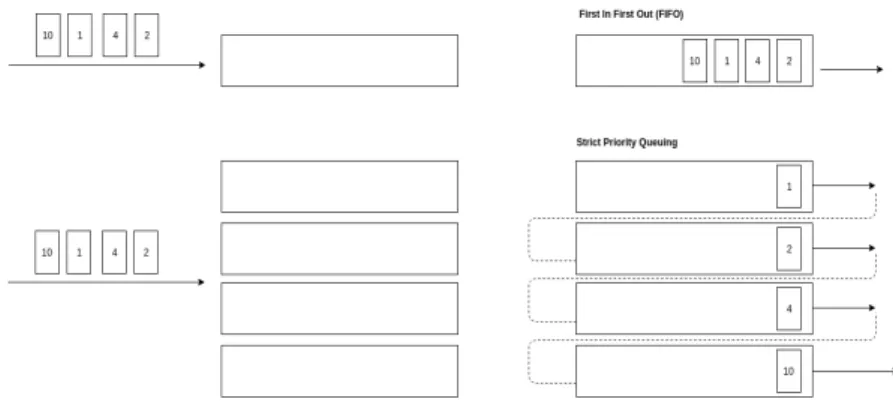
Let’s assume the following example, in which four consecutive packets are received, with rankings 2, 4, 1, and 10 (milliseconds if we continue with the STFQ algorithm, although we have already seen that the metric is not important). If we have a single FIFO queue, the first packet arriving (the one with ranking 2), will be enqueued in the first position; the second one in second position; the third in third position and the fourth in the last position of the queue. The output order we will obtain is the order of packet arrival. Instead, we would have liked our queue to dequeue the thirdly arriving packet (with ranking 1) in first position, then the firstly arriving packet (with ranking 2) in second position, then the secondly arriving packet (with ranking 4) in third position, and finally last arriving packet (with ranking 10) in last position. With just a single queue there is no way to achieve this result. But what happens now if we have four queues with four different priorities. Now intuition tells us that if we put the first packet in the second queue, leaving the first for the third packet, and placing the latest packets in the remaining lower priority queues, we will achieve the order that we want. Also intuitively, one can start to see that if we have a number of queues equal to the number of ranks, a perfect approximation can be achieved, as one should just assign each ranking to a queue, according to their priorities. But note that in order to do that, both with a limited number of queues or non-limited, knowledge of ranking of future coming packets is required. If a complete knowledge of the coming packets and their respective ranks is available, then scheduling the packets in priority queues in a strategic manner to leave room for higher priority ones that will come afterwards is quite straightforward. The problem comes when there is no knowledge about future packets (which is the case we have in networks), and some prediction needs to be done. In the same direction, if the range of rankings that you can expect can vary with the time (as application flows with strict requirements arise and vanish), the allocation of those rankings to the strict priority queues is not easy anymore. Following the example we had, with 4 queues we can achieve the required granularity for the 4 orders of ranking. But what if a new packet joins the scenario with a rank assignment of 3 (corresponding to a new application just started, for instance)? Now ranking number 3 will have to share queue with any of the previous ranking orders. And then we will not have complete granularity in the output. If rank 3 shares queue with rank 4, we will not be able to guarantee that all packets from rank 3 will depart before than the ones from rank 4, as the queue-sharing will provoke blocking situations among the two packet types. And the opposite situation is also bad. If with these 5 types of ranking, now arrivals of type 1 packets stop coming, the queue previously assigned to this type of packets
18 Our Algorithm
Figure 3.2: Strict Priority queues can be used to achieve finer ordering.
will become empty. If no update is performed in the packets distribution to the queues, this empty queue will suppose a loss of resource efficiency for ourselves. And that resource could be very useful, for instance, to give room to packets of type 3 and 4 to enjoy a private queue each of them and achieve this way the finer granularity we were desiring since the beginning. This toy example allows us to illustrate two interesting remarks. The first one is that it is possible to implement an approximation of the ideal PIFO behavior by just using priority queues. With the insight that the bigger the number of queues, the finer the granularity we can achieve (the better the approximation). And the second is that finding the right way to distribute packets with different ranks among the different queues available is not an easy problem. A good solution would be the one that adapts to possible changes in the ranking definitions of the packets, intrinsic from the dynamic nature of the network, as well as trying to maximize resource efficiency at every moment.
3.3 What is a good strategy and what makes it good?
If we want to design a proper algorithm, we first need to be able to define what distinguishes a good allocation strategy from a bad one. We have multiple ways of allocating a limited number of packets to a limited number of queues. How can we compare two different strategies? How can we know which one is better? And more importantly, how much better is one from the other? If we are able to define what makes an allocation strategy a good or a bad strategy, we will be able to find mechanisms to continuously achieve good strategies for our solution. One way of evaluating if the allocation strategy is good or bad is to analyze the sequence of packets derived at the output. At the end, the final objective of a PIFO queue is not other than ordering packets. In a dynamic way, yes, as packets come and leave. But the objective is to send them in order of ranking. The traditional mechanism to define whether a sequence is properly ordered, or to quantify how properly ordered a sequence is, is the called inversion number. We can define an inversion in a sequence of elements, as a pair of consecutive elements which appear out of order according to a sorting mechanism clearly specified. In a formal manner: Let A(1), A(2), ... , A(n) be a sequence of n numbers. If A(i)>A(j) and i<j, then the pair (i,j) is referred as an inversion of A. The inversion number of a sequence is a common measure of its sortedness. The inversion number can be defined as just the number of inversions that can be found in a sequence. Inv(A) = # {(A(i), A(j)) | i<j and A(i)>A(j)}.
As an example, the sequence {9, 5, 7, 6} has an inversion number of 4, with inversions (9-5), (9-7), (9-6) and (7-6). Although the inversion number has been broadly used in a variety of fields, in our case it is important to distinguish inversions between close rankings in a sequence, and those rankings more away from each other. For instance, it is not the same achieving an output sequence in which a packet of rank 2 has been enqueued previous to a packet of rank one, than if the inversion occurs between packets of rank 1 and 15. In order to measure this case distinction, we will define a new metric, which we will call weighted inversion number, in which each inversion will not add a value of one to the inversion number, but the difference between the inverted elements respective ranks will be added instead. In the sequence example {9, 5, 7, 6}, the inversion (9-5) will have a weight of 4, the inversion (9-7) will have a weight of 2, the inversion (9-6) will have a weight of 3 and the inversion (7-6) will have a weight of one, adding up to a final weight inversion number of 10. These two metrics will allow us to determine if a packet allocation strategy is good or not. We will always look for low inversion (and weighted inversion) numbers. Those numbers will be the ones expressing if, whatever it was the sequence in which the packets entered the scheduler, the scheduler was able to correctly order them following the rankings specified, and the final output sequence has a good level of sortedness.
Now that we know how to evaluate an allocation strategy and we have the metrics to quantify how good it is, which allocation strategies can we follow? In a scenario in which we receive k consecutive packets and we have n available queues (suppose of unlimited length), we have nk different allocation possibilities. Obviously, determining if an allocation has been good or bad can only be done a posteriori, when all the packets have been allocated and we can measure how good is the output sequence obtained as result. We can never guess how good is the allocation of a certain packet to a specific queue until we can see which packets will come next and how that choice will affect. Although finding all the possible allocations is not useful in a practical sense, analyzing the different behaviors can bring us an idea of which kind of problems will need to be faced when trying to design a proper solution algorithm.
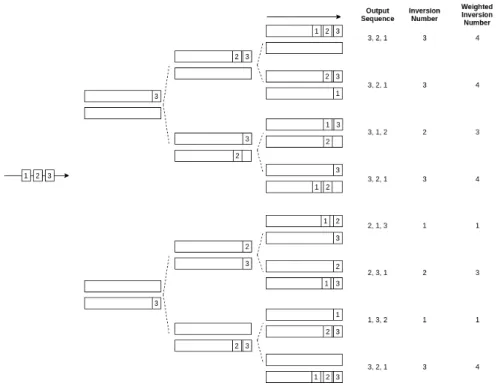
For this reason we have created the small program that we will describe in the following lines. It is a small Java-based simulator, that allows the user to compute all the possible allocation strategies that one can follow in order to place a certain amount of packets (to be received consecutively) into a number of queues. The software not only gives all the different strategies that can be performed, but also analyzes them in terms of both, the inversion number and the weighted inversion number. Its functioning is quite simple. Just imagine a scenario with two different queues, and an incoming sequence of packets with ranks 3, 2 and 1 in this order of arrival. When the first packet arrives (the one with ranking 3), we have two allocation possibilities, placing the packet in either the first or the second queue. When a second packet arrives, we can also put it in the first or the second queue. Combining the first and the second packets allocation, we have a range of four different possibilities. The same applies for the third packet, giving now room for 23possible allocations, and again for all subsequent packets. The software just implements this iteration in the form of a tree, in which each time a new packet comes, the current distribution of packets in the queue is replicated multiple times according to the number of positions into which the new packet can be placed. Figure3.3exemplifies this behavior with the illustrated example.
From all the possible packet allocations, we have two candidates which outperform the others (i.e. the ones with inversion number of 1). The key of their success is that they place the packet with ranking 3 in a lower priority queue, allowing following packets with lower ranking to be allocated in higher priority queues and to be transmitted in first place. This shows again, that
20 Our Algorithm
Figure 3.3: Possible packet allocations for a number of available queues.
Algorithm 2Pseudo-code to compute all possible allocations for a given number of packets and strict priority queues.
1: /*Random packet sequence generation*/ 2: for(j<num_packets)do
3: Packet p = new Packet(rand.nextInt(max_rank)); 4: packets.add(p);
5: end for
6: /*Creation of tree root*/
7: Node root = new Node(num_queues);
8: /*When a new packet arrives, leaves are forked with children inheriting existing queues, and new packet possibilities are computed*/
9: for(i<packets.size())do 10: forkLeaves(root); 11: Packet pk = packets.get(i); 12: addPacketLeaves(root, pk); 13: end for 14: /*Print result*/ 15: traverseTree(root);
the main challenge we will have to deal with is predicting future packet ranks. As knowing which packets will come in the future is realistically not possible, what we will do instead is try to minimize the possibility of collision, where a collision occurs when a lower rank packet has to be placed after a higher rank one, generating an inversion in the output sequence.
Another interesting perspective to the problem is trying to answer the following question. How many queues would we need, to avoid collision for a specific sequence of packets? As the origin of collisions is the fact that most of the times we can not dedicate a queue for each specific rank level, it makes sense to analyze how many queues are needed for a given sequence to avoid congestion. The direct answer is the number of ranks contained in the sequence. Thats the PIFO ideal case. But, can we specify a more tighter bound? For the sequence {3, 2, 1} we will need 3 different queues to achieve a perfect ordering, and thats the best we can do. But for the sequence {3, 1, 2}, with the same ranking levels, only two queues are needed to achieve a perfect ordering. In the same direction, {1, 4, 2, 4, 3}, also needs just two queues, while the ranking levels are four. Which is the rationale behind that?
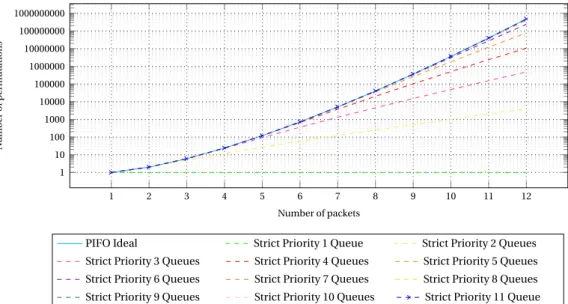
It is clear that by having a specific queue for each rank level, we can prevent our system from collisions. The key point is trying to analyze if different rank levels can share the same queues without this creating collisions. By defining the maximum (and minimum) position of a rank level in a sequence as the position held in the sequence, following arrival order, of the last (and first) packet pertaining to the rank, we can state that consecutive rank levels will be able to share the same queue without collision occurring if and only if, the minimum position on the sequence of the higher rank is higher than the maximum position on the sequence of the lower rank. By analyzing the maximum and minimum positions of each rank in the sequence, we can compute the number of queues required in the strict priority scenario to achieve a perfect ordering at the output, equivalent to the ideal PIFO one.
Knowing how many queues do we need to achieve a perfect sorting can provide us some interesting insight. With this knowledge we can compute the number of permutations, for a given set of packets (now ignoring the rankings they have attached) that we are able to achieve with a given algorithm. One could consider each algorithm as a system providing a specific output for a given input sequence, If a given inputσcan produce a particular outputτ, then (σ,τ) it is said to be an allowable pair. Computing the amount of allowable pairs that a system is able to provide can give insight on how good or bad an algorithm can be in terms of sorting. With PIFO, for example, n! different sequences can be achieved at the output, given that the input is a sequence of n packets. For n=1, the input set is {1}, and therefore there is only one possible permutation. For n=2, the set is {1,2} and accepts two different permutations: {1,2} and {2,1}. For n=3, the set is {1,2,3} and the possible permutations are {1,2,3}, {1,3,2}, {2,1,3}, {3,1,2}, {2,3,1} and {3,2,1}, which are 3! in total. As PIFO is able to perform perfect ordering of packets entering the queue, all the different permutations at the output are achievable from the original set {1,2,3}. Therefore, for n=3, PIFO achieves 6 allowable pairs. With strict priority queuing instead, depending on the number of queues available, some outputs will not be achievable. For instance, the permutation {3,2,1} is not achievable with a strict priority scheme of 3 queues. The pair {1,2,3}, {3,2,1} is not an allowable pair for the strict priority scheme under 3 queues scenario. We have computed the number of allowable pairs when the input has n packets. The resulting graph can be observed in Figure3.4, and clearly showcases that the bigger the number of queues available in the strict priority algorithm, the better the PIFO approximation it can be. This gives us confidence to think that it is possible to approximate PIFO with strict priority. Now the next objective will be designing an algorithm that correctly decides the best permutation to compute according to the input sequence and its requirements.