Computer Science Publications
Computer Science
6-3-2019
A Comprehensive Study on Deep Learning Bug
Characteristics
Md Johirul Islam
Iowa State University
, [email protected]
Giang Nguyen
Iowa State University
, [email protected]
Rangeet Pan
Iowa State University
, [email protected]
Hridesh Rajan
Iowa State University
, [email protected]
Follow this and additional works at:
https://lib.dr.iastate.edu/cs_pubs
Part of the
Software Engineering Commons
The complete bibliographic information for this item can be found at
https://lib.dr.iastate.edu/
cs_pubs/38
. For information on how to cite this item, please visit
http://lib.dr.iastate.edu/
howtocite.html
.
This Article is brought to you for free and open access by the Computer Science at Iowa State University Digital Repository. It has been accepted for inclusion in Computer Science Publications by an authorized administrator of Iowa State University Digital Repository. For more information, please [email protected].
A Comprehensive Study on Deep Learning Bug Characteristics
Abstract
Deep learning has gained substantial popularity in recent years. Developers mainly rely on libraries and tools
to add deep learning capabilities to their software. What kinds of bugs are frequently found in such software?
What are the root causes of such bugs? What impacts do such bugs have? Which stages of deep learning
pipeline are more bug prone? Are there any antipatterns? Understanding such characteristics of bugs in deep
learning software has the potential to foster the development of better deep learning platforms, debugging
mechanisms, development practices, and encourage the development of analysis and verification frameworks.
Therefore, we study 2716 high-quality posts from Stack Overflow and 500 bug fix commits from Github about
five popular deep learning libraries Caffe, Keras, Tensorflow, Theano, and Torch to understand the types of
bugs, root causes of bugs, impacts of bugs, bug-prone stage of deep learning pipeline as well as whether there
are some common antipatterns found in this buggy software. The key findings of our study include: data bug
and logic bug are the most severe bug types in deep learning software appearing more than 48% of the times,
major root causes of these bugs are Incorrect Model Parameter (IPS) and Structural Inefficiency (SI) showing
up more than 43% of the times. We have also found that the bugs in the usage of deep learning libraries have
some common antipatterns that lead to a strong correlation of bug types among the libraries.
Disciplines
Computer Sciences | Software Engineering
Comments
This is a pre-print made available through arxiv:
https://arxiv.org/abs/1906.01388
.
A Comprehensive Study on Deep Learning Bug Characteristics
Md Johirul Islam
[email protected] Iowa State University
Ames, IA
Giang Nguyen
[email protected] Iowa State University
Ames, IA
Rangeet Pan
[email protected] Iowa State University
Ames, IA
Hridesh Rajan
[email protected] Iowa State University
Ames, IA
ABSTRACT
Deep learning has gained substantial popularity in recent years. Developers mainly rely on libraries and tools to add deep learning capabilities to their software. What kinds of bugs are frequently found in such software? What are the root causes of such bugs? What impacts do such bugs have? Which stages of deep learning pipeline are more bug prone? Are there any antipatterns? Under-standing such characteristics of bugs in deep learning software has the potential to foster the development of better deep learning platforms, debugging mechanisms, development practices, and en-courage the development of analysis and verification frameworks. Therefore, we study 2716 high-quality posts fromStack Overflow
and 500 bug fix commits fromGithubabout five popular deep learning librariesCaffe,Keras,Tensorflow,Theano, andTorchto understand the types of bugs, root causes of bugs, impacts of bugs, bug-prone stage of deep learning pipeline as well as whether there are some common antipatterns found in this buggy software. The key findings of our study include: data bug and logic bug are the most severe bug types in deep learning software appearing more than 48% of the times, major root causes of these bugs are Incorrect Model Parameter (IPS) and Structural Inefficiency (SI) showing up more than 43% of the times. We have also found that the bugs in the usage of deep learning libraries have some common antipatterns that lead to a strong correlation of bug types among the libraries.
KEYWORDS
Deep learning software, Q&A forums, Bugs, Deep learning bugs, Empirical Study of Bugs
ACM Reference Format:
Md Johirul Islam, Giang Nguyen, Rangeet Pan, and Hridesh Rajan. 2019. A Comprehensive Study on Deep Learning Bug Characteristics. InProceedings of The 27th ACM Joint European Software Engineering Conference and Sym-posium on the Foundations of Software Engineering (ESEC/FSE 2019).ACM, New York, NY, USA, Article 4, 11 pages. https://doi.org/10.475/123_4
Permission to make digital or hard copies of part or all of this work for personal or classroom use is granted without fee provided that copies are not made or distributed for profit or commercial advantage and that copies bear this notice and the full citation on the first page. Copyrights for third-party components of this work must be honored. For all other uses, contact the owner/author(s).
ESEC/FSE 2019, 26–30 August, 2019, Tallinn, Estonia
© 2019 Copyright held by the owner/author(s). ACM ISBN 123-4567-24-567/08/06. . . $15.00 https://doi.org/10.475/123_4
1
INTRODUCTION
A class of machine learning algorithms known asdeep learning
has received much attention in both academia and industry. These algorithms use multiple layers of transformation functions to con-vert input to output, each layer learning successively higher-level of abstractions in the data. The availability of large datasets has made it feasible to train (adjust the weights of) these multiple lay-ers. While the jury is still out on the impact of deep learning on overall understanding of software’s behavior, a significant uptick in its usage and applications in wide ranging areas combine to warrant research on software engineering practices in the presence of deep learning. This work focuses on the characteristics of bugs in software that makes use of deep learning libraries.
Previous work on this topic generally fall under two categories: those that have studied bugs in the implementation of machine learning libraries themselves, and those that have studied bugs in the usage of a specific deep learning library. A key work in the first category is Thunget al.[21] who studied bugs in the implementation of three machine learning systems Mahout, Lucene, and OpenNLP. In the second category, Zhanget al.[25] have studied bugs in software that make use of theTensorflowlibrary. While both categories of approaches have advanced our knowledge of ML systems, we do not yet have a comprehensive understanding of bugs encountered by the class of deep learning libraries.
This work presents a comprehensive study of bugs in the usage of deep learning libraries. We have selected top five popular deep learning librariesCaffe[12],Keras[7],Tensorflow[1],Theano[20],
andTorch[8] based on the user counts from developers Q&A forum
Stack Overflow. While each of these libraries are for deep learning
they have different design goals. For example,Tensorflowfocuses on providing low-level, highly configurable facilities whereasKeras
aims to provide high-level abstractions hiding the low-level details.
TheanoandTorchare focused on easing the use of GPU computing
to make deep learning more scalable. Thus, studying them simul-taneously allows us to compare and contrast their design goals
vis-à-visbugs in their usage.
We have used two sources of data in our study: posts about these libraries onStack Overflowand alsoGithubbug fix commits. The first dataset gives us insights into bugs that developers encounter when building software with deep learning libraries. A number of these bugs would, hopefully, be fixed based on the discussion in Q&A forum. The second dataset gives us insights into bugs that were found and fixed in open source software. Our study focuses
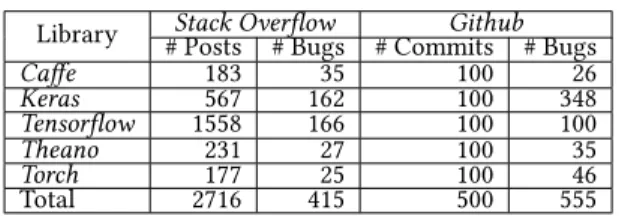
Table 1: Summary of the dataset used in the Study
Library # PostsStack Overflow# Bugs # CommitsGithub# Bugs
Caffe 183 35 100 26 Keras 567 162 100 348 Tensorflow 1558 166 100 100 Theano 231 27 100 35 Torch 177 25 100 46 Total 2716 415 500 555
on following research questions and compares our findings across the five subject libraries.
RQ1: (Bug Type)What type of bugs are more frequent?
RQ2: (Root cause)What are the root causes of bugs?
RQ3: (Bug Impact)What are the frequent impacts of bugs?
RQ4: (Bug prone stages)Which deep learning pipeline stages are more vulnerable to bugs?
RQ5: (Commonality)Do the bugs follow a common pattern?
RQ6: (Bug evolution)How did the bug pattern change over time?
Findings-at-a-glance. Our study show that most of the deep learning bugs areData BugsandLogic Bugs[5], the primary root causes that cause the bugs are Structural Inefficiency (SI) and In-correct Model Parameter (IPS) [5], most of the bugs happen in the Data Preparation stage of the deep learning pipeline. Our study also confirms some of the findings ofTensorflowconducted by Zhanget al.[25]. We have also studied some antipatterns in the bugs to find whether there is any commonality in the code patterns that results in bugs. Our findings show that there is strong correlation among the distribution of bugs as well as in the antipatterns. Finally, we conclude with a discussion on our findings suggesting immediate actions and future research directions based on these findings.
2
METHODOLOGY
2.1
Data Collection
In our study two different data sources are used.Stack Overflow
posts andGithubbug fix commits are the sources of data we used for studying the bugs in deep learning software. A summary of the dataset is shown in Table 1.
2.1.1 Stack Overflow Data Collection.To study bugs in deep learning software, we have collected data fromStack Overflow, a well-known Q&A site for developers to discuss software develop-ment problems. The data collection process consists of two steps.
In the first step, we select candidate posts discussing deep learn-ing libraries. We focus on five deep learnlearn-ing libraries:Caffe,Keras,
Tensorflow,Theano, andTorch. These are the five most discussed
deep learning libraries onStack Overflow. We did that by searching for posts tagged withCaffe,Keras,Tensorflow,Theano, andTorch. When posts are about specific libraries, they are more likely to talk about bugs in using deep learning libraries. Using these criteria, we selected all posts about these five libraries. We further filtered the posts that did not contain any source code because posts about bugs usually contain code snippets. Moreover, we reduced the num-ber of posts by selecting the posts whose scores, computed as the difference between the number of its upvotes and the number of its downvotes, were greater than 5 to focus on the high-quality posts and keep the manual effort manageable. After this step, in
total, we selected 183, 567, 1558, 231, and 177 posts forCaffe,Keras,
Tensorflow,Theano, andTorch, respectively.
In the second step, we manually read these candidates to iden-tify the ones about bugs. After that, the second and the third au-thors manually reviewed the candidates. For each post, we read the question and all answers focusing on the best-accepted one. If the best-accepted answer was to fix the usages of the deep learning API(s) in the question, we considered that post as talking about deep learning bugs. After this step, we found 35, 162, 166, 27, and 25 bugs forCaffe,Keras,Tensorflow,Theano, andTorchrespectively.
2.1.2 Github Data Collection.Githubis a large source of deep learning repositories. We mine theGithubcommits to study the change in the commits and to check and confirm the bug patterns that we studied fromStack Overflow. The data collection process consists of two steps.
First, we collect all the repositories ofCaffe,Keras,Tensorflow,
Theano, andTorch. After that, we mine all the commits whose title
contain word"fix"of these libraries. Then, we randomly select 100 commits for each libraries from mined commits and classify them.
Secondly, we use the same process that we used forStack Over-flow. Specifically, the second and the third authors manually studied the 500 commits and separately label them. After that, these two au-thors compare their results to fix the conflict in the labeling process. We study every line of change in each commits; therefore, some commits have more than one bugs and some commit does not have bug. Overall, we got 26, 348, 100, 35, and, 46 bugs for the commits
ofCaffe,Keras,Tensorflow,Theano, andTorch, respectively.
2.2
Classification
In our classification, we focus on three criteria which are bug types, root causes and effects of bug. The classification scheme used for labeling of the bugs in each of these three criteria discussed in §2.4, §2.5, and §2.6. We have also classified the bugs into different deep learning stages [24].
To label the bug types we followed the classification from an already existing well vetted taxonomy [5] and appended on top of that. The added types were based on the data that we studied following an open coding scheme.
The bugs may have different root causes and effects. A supervised pilot study and open coding schemes were used to identify the effects that are possible through these bugs. We have adapted the classification scheme of root causes and bug effects from [25] and added on top of that as found from the study of the posts. The third author studied the posts initially to finalize the classification scheme for bug types, root causes and effects. We followed the open coding scheme and pilot study was conducted to get agreement on the classification.
We also classified the bugs into different stages of the pipeline to understand which stages are more vulnerable to bugs. Deep learning process can be divided into seven stage pipeline [24]. The stages are data collection, data preparation, choice of model, train-ing, evaluation, hyper parameter tuning and prediction. Among the seven stages, the first one is not related to software development.
A Comprehensive Study on Deep Learning Bug Characteristics ESEC/FSE 2019, 26–30 August, 2019, Tallinn, Estonia
The other stages are related to software development, and are sup-ported by the deep learning libraries through their APIs. We use these stages to label the bugs into different stages.
2.3
Labeling the Bugs
Once we have all the classification criteria, we used those criteria to label the posts. The second and the third authors independently studied the posts. We measured the inter rater aggrement among the labellers using Cohen’s Kappa coefficient [22] when 5%, 10%, 20% , 30%, 40%, 50%, 60%, 70%, 80%, 90% and 100% of the posts were labeled. After 5% labeling, the Cohen’s Kappa coefficient was close to 0. Then we conducted a training session among the raters to clarify the labeling and what they mean. After the training session, we conducted another pilot study at 10% including the first 5%. This time the Cohen’s Kappa coefficient was 82%. We again discussed the results and find out the reasons for major disagreements. We then discussed those cases further through examples and continued labeling. The Cohen’s Kappa coefficient was more than 90% in subsequent pilot studies.
The labeling effort was continuously being monitored with the help of Kappa coefficient to understand the agreement. We con-ducted reconciling efforts ideally at every 10% interval of the label-ing. The posts where there was disagreement between the raters were further discussed in the presence of a supervisor. After dis-cussion and arguments a common label was given. Finally all the bugs were given a common label.
2.4
Types of Bugs in Deep Learning Software
Developers often confront different types of bugs while trying to write deep learning software. To understand those bugs and their root causes, we have classified them into different categories. The classification has been done on the basis of all theStack Overflow
posts that we analyzed. The classification is adapted from [5], where a well organized taxonomy of bugs is presented.
2.4.1 API Bug.This group of bugs is caused by deep learning API. Generally, when a developer uses a deep learning API, dif-ferent bugs associated with that API are inherited automatically without the knowledge of the user. The prime causes for triggering of deep learning API bugs can be because of the change of API definition with different versions, lack of inter-API compatibility and sometimes wrong or confused documentation.
2.4.2 Coding Bug.This kind of bugs originate due to mistakes in coding syntax. This in turn, introduces other types of bugs in the software which lead to either run time error or incorrect results. A big percentage of the deep learning bugs that we have checked arises from syntactic mistakes or a certain scenario which cannot be fixed by changing only some lines of code; hence, needs to change the whole module. Though a robust compiler usually takes care of the basic coding mistakes, in certain scenarios, this type of bugs are not captured by the compiler resulting in wrong output.
2.4.3 Data Bug.This bug may arise if an input to the deep learning software is not properly formatted or cleaned well before processing in any deep learning model. This type of bug occurs before data enters into the deep learning model. It is not because of the wrong deep learning model, rather it is purely based on the
type and structure training or test data. Similar to coding bugs, data bugs are usually flagged by the compiler, but in some scenarios, it can pass unchecked through the compilation process and generate erroneous results.
2.4.4 Structural Bug(SB). A vast majority of the deep learning bugs are occurring due to incorrect definitions of the deep learning model’s structure. These include mismatch of dimensions between different layers of deep learning models, the presence of anomaly between the training and test datasets, use of incorrect data struc-tures in implementing a particular function, etc. This type of bugs can be further classified into another four categories.
Control and Sequence Bug.This subclass of the bug is caused
by the wrong structure of control flow. In many scenarios, due to wrong if-else or loop guarding condition, the model does not perform as expected. This type of bug either leads to a crash when a part of deep learning model does not work or, leads to incorrect functionality due to mishandling of data through the layers.
Data Flow Bug.The main difference between the Data Flow Bug
and the Data Bug is the place of origination. If a bug occurs due to the type or shape mismatch of input data after it has been feed to the deep learning model, it will be called Data Flow Bug. It includes the scenarios when model layers are not in synchronization because of different data shape used in consecutive layers. To fix these bugs, developers need to modify the model or reshape the data.
Initialization Bug.In deep learning, Initialization Bug means the
parameters or the functions are not initialized properly before they are used. This type of bugs would not necessarily produce run time error but it will simply make the model perform worse. Here, the definition of functions includes both user-defined and API defined. We also categorize a bug into this category when the API has not been initialized properly.
Logic Bug.In deep learning, the logical understanding of each
stage of the pipeline is an integral part of the coding process. With an incorrect logical structure of the deep learning model, the out-put of a program may result in either a runtime error or a faulty outcome. These bugs are often generated in the absence of proper guarding conditions in the code or trying to implement a feature which is not possible in the given structure of the deep learning model.
Processing Bug.One of the most important decisions in the deep
learning model structure is to choose the correct algorithm for the learning process. In fact, different deep learning algorithms can lead to different performances and outputs [11]. Also, to make different layers be compatible with each other, the data types of each layer need to follow a contract between them. Processing Bugs happen due to the violation of these contracts and wrong choice of algorithms.
2.4.5 Non Model Structural Bug(NMSB).Unlike SB, NMSB is created outside the modeling stage. In other words, this bug can happen in any deep learning stage except the modeling stage such as the training stage or the prediction stage. NMSB has similar subcategories with SB. Subcategories of NMSB are Control and Se-quence Bug, Logic Bug, Processing Bug, and Initialization Bug. We
do not define Non Model Structural Data Flow Bug like Structural Data Flow Bug because Data Bug already covers the meaning of Non Model Structural Data Flow Bug.
Control and Sequence Bug.This subclass is similar to Control and
Sequence Bug in SB. The bug is caused by an incorrect structure of control flow like wrong if-else condition; however, this kind of bug happens outside modeling stage.
Initialization Bug.This subclass is similar to Initialization Bug
in SB. The bug is caused by initializing a parameter or a function in a wrong way; however, this kind of bug happens outside modeling stage.
Logic Bug.This subclass is similar to Logic Bug in SB. The bug
is caused by misunderstanding how case statements and logical operators behave singly; however, this kind of bug happens outside modeling stage.
Processing Bug.This subclass is similar to Processing Bug in SB.
The bug is caused by an incorrect choice of algorithm; however, this kind of bug happens outside modeling stage.
2.5
Classification of Root Causes of bugs
2.5.1 Absence of inter API compatibility. The main reason for these bugs is the inconsistency of the combination of two different kinds of libraries. For example, a user cannot directly useNumpy
function inKerasbecause neitherTensorflowbackend norTheano
backend ofKerashas the implementation ofNumpyfunction.
2.5.2 Absence of type checking.The major effect of the bugs is crash. This kind of bugs involves a type mismatch problem when calling API methods. These bugs are usually mistakes related to the use of wrong type of parameters in an API.
2.5.3 API Change.The reason for these bugs is the release of the new version of a deep learning library. In other words, the bug happens when the new API version is not backward compatible with its previous version. For example, a user updates the new version of a deep learning library which has new API syntax; however, the user does not modify his/her code to fit with the new version, which leads to the API change bug.
2.5.4 API Misuse. This kind of bugs often arises when users use a deep learning API without fully understanding. Missing condi-tions can be one kind of API misuse, and this bug occurs when a usage does not follow the API usage constraints to ensure certain required conditions. Crash is the main effect of these bugs.
2.5.5 Confusion with Computation Model.These bugs happen when a user gets confused about the function of deep learning API, which leads to the misuse of the computation model assumed by the deep learning library. For instance, a user gets confused between the graph construction and the evaluation phase.
2.5.6 Incorrect Model Parameter or Structure (IPS).IPS causes problems with constructing the deep learning model, e.g. incor-rect model structures or using inappropriate parameters. IPS is a common bug in the deep learning software because of both the
lack of deep learning knowledge among the users and the incom-prehension of deep learning models. This kind of bugs causes the functional incorrectness; thus, the effect of this bug is crash.
2.5.7 Others.These bugs are not related to deep learninng soft-ware. In other words, these bugs are mostly related to mistakes in the development process like incorrect syntax.
2.5.8 Structure Inefficiency (SI).SI causes problems related to modeling stage in deep learning software like IPS; however, SI leads to bad performance of the deep learning software while IPS leads to crash.
2.5.9 Unaligned Tensor (UT).These bugs often occur in the computation graph construction phase. When a user builds the computation graph in deep learning process, they have to provide correct input data with required specifications to a deep learning API; however, many users do not know exactly their specifications, or they misunderstand API signature, which leads to UT bugs.
2.5.10 Wrong Documentation.Incorrect information in library documentation leads to these bugs. Deep learning library users may face this kind of bugs when they read an incorrect definition or an incorrect usage of a deep learning API from documentation.
2.6
Classification of Effects of bugs
2.6.1 Bad performance. Bad performance or poor performance is one of common kind of effect in deep learning software. Further-more, the major root causes of this effect are SI or CCM that are related to model construction. Even though developers can use the deep learning libraries correctly, they still face deep learning model construction problems because APIs in these libraries are highly abstract.
2.6.2 Crash.Crash is the most frequent effect in deep learning. In fact, any kind of bugs can lead to Crash. A symptom of crash is that the software stops running and prints out an error message.
2.6.3 Data Corruption.Data corruption happens when the data is corrupted as the data flows through the network. This effect is a consequence of misunderstanding the deep learning algorithms or APIs. When Data Corruption occurs, a user will receive unexpected outputs.
2.6.4 Hang.Hang effect is caused when a deep learning soft-ware ceases to respond to inputs. Either slow hardsoft-ware or inappro-priate deep learning algorithm can lead to Hang. A symptom of Hang is that the software runs for a long period of time without providing the desired output.
2.6.5 Incorrect Functionality. This effect occurs when the soft-ware behaves in an unexpeced way without any runtime or compile-time error/warning. This includes the incorrect output format, model layers are working desirably, etc.
2.6.6 Memory out of bound.Deep learning software often halts due to unavailability of the memory resources. This can be caused by, either the wrong model structure or, not having enough com-puting resources to train a particular model.
A Comprehensive Study on Deep Learning Bug Characteristics ESEC/FSE 2019, 26–30 August, 2019, Tallinn, Estonia 0% 10% 20% 30% 40% 50% 60% 70% 80% 90% 100%
Caffe Keras TF Theano Torch
API Bug Data Bug NMSB.Initialization Bug NMSB.Logic Bugs NMSB.Processing Bug NMSB.Control and Sequence Bug SB.Control and Sequence Bug SB.Data flow Bug SB.Initialization Bug SB.Logic Bugs SB.Processing Bug
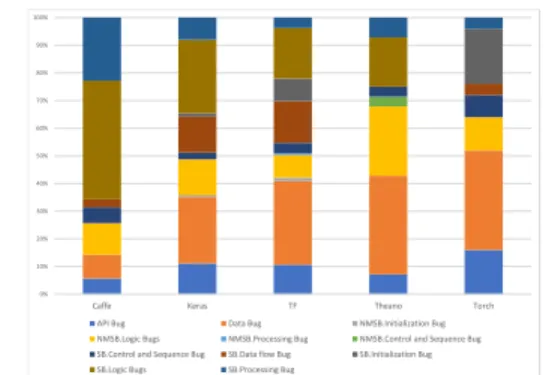
Figure 1: Distribution of Bug Types inStack Overflow
3
FREQUENT BUG TYPES
In this section, we explore the answer toRQ1through statistically analyzing the labeled data. The normalized distribution of bug types
inStack Overflowdata is shown in Figure 1. The distribution of
bugs shown in Figure 1 and theStack OverflowandGithubdata in Table 2 shows the presence of different kinds of bugs in both
Stack OverflowandGithubfor the deep learning libraries we have
studied. We present some of the key findings related to bug types in the following subsections.
3.1
Data Bugs
Finding 1: Data Bugs appear more than 26% of the times.
From Figure 1 we see that among the bug types the Data Bugs appear most of the time (26%) in all the libraries. In the studied
Stack Overflowdata, we have seen 30% of the posts inTensorflow,
24% posts inKeras, 36% posts inTorch, 35% posts inTheano, and 9% posts inCaffehave Data Bugs. Data bugs mostly appear due to the absence of data pre-processing like feature engineering, data validation, data shuffling, etc.
The large percentage of Data Bugs indicate data pre-processing related difficulties are appearing quite often which could be ad-dressed by some data verification tools. If we can provide some static analysis tools using modern abstract data types likeDataFrameand the properties of the model, that would help the deep learning com-munity. For example, a developer is trying to read some image files using the following method1.
1 d e f _ r e a d 3 2 ( b y t e s t r e a m ) :
2 d t = numpy . d t y p e ( numpy . u i n t 3 2 ) . n e w b y t e o r d e r ( ' > ' )
3 r e t u r n numpy . f r o m b u f f e r ( b y t e s t r e a m . r e a d ( 4 ) , d t y p e = d t )
The developer eventually got stuck with the following error while trying to train the model using the data returned by the previous library call.
1 T y p e E r r o r : o n l y i n t e g e r s c a l a r a r r a y s can be c o n v e r t e d t o a s c a l a r i n d e x
An expert suggested an answer to change the last return statement with the following, which solved the problem and was accepted by the developer:
1 r e t u r n numpy . f r o m b u f f e r ( b y t e s t r e a m . r e a d ( 4 ) , d t y p e = d t ) [ 0 ]
1https://tinyurl.com/y3v9o7pu
Table 2: Statistics of Bug Types inStack OverflowandGithub
Caffe Keras TF Theano Torch P value
SO
GitHub SO GitHub SO GitHub SO GitHub SO GitHub
API Bug 6% 0% 11% 57% 11% 72% 7% 3% 16% 2% 0.3207
Data Bug 9% 49% 24% 8% 30% 0% 35% 17% 36% 15% 0.3901
NMSB.Control and Sequence Bug 0% 8% 0% 0% 0% 0% 4% 0% 0% 7% 0.3056
NMSB.Initialization Bug 0% 0% 1% 0% 1% 0% 0% 3% 0% 0% 0.7655
NMSB.Logic Bugs 11% 0% 13% 2% 8% 0% 25% 6% 12% 7% 0.0109
NMSB.Processing Bug 0% 0% 0% 0% 1% 0% 0% 3% 0% 7% 0.2323
SB.Control and Sequence Bug 6% 12% 2% 0% 4% 0% 4% 3% 8 % 9% 1.0000
SB.Data flow Bug 3% 8% 13% 26% 15% 0% 0% 14% 4% 16% 0.2873
SB.Initialization Bug 0% 0% 1% 0% 8% 1% 0% 23% 20% 11% 0.8446
SB.Logic Bugs 42% 15% 27% 3% 18% 23% 18% 14% 0% 13% 0.3442
SB.Processing Bug 23% 8% 8% 4% 4% 4% 7% 14% 4% 13% 0.8535
The bug is hard to fix by just looking at the error message. It is difficult to identify the exact reason of bug which led the developer to post a question onStack Overflowand the question was upvoted by other fellow developers as a qualified post.
3.2
Structural Logic Bugs
Finding 2: Caffe has 43% Structural Logic Bugs.
The second major bug type is Structural Logic Bug inStack Over-flowwhich was expected from our initial hypothesis based on a pilot study.Caffehas more Structural Logic Bugs inStack Overflow
compared to other libraries. This indicates that the majority of the bugs inCaffeare made during construction and logical organiza-tion of the model. Other libraries also have significant pororganiza-tion of Structural Logic Bugs ranging from 0% - 27%.
3.3
API Bugs
Finding 3: Torch, Keras, Tensorflow have 16%, 11% and 11% API bugs respectively.
In deep learning libraries API changes sometimes break the entire production code. The implicit dependence between libraries cause problems when one library has some major changes. For example, whenNumpyis updatedTensorflow,Kerassoftware may fail.Keras
often usesTensorfloworTheanoas backend and hence update of
TensorfloworTheanocan cause the software developed usingKeras
to crash. API bugs are seen to appear more often inKeras and
Tensorflowas shown in Figure 1. More than 81% of the API bugs
are fromKerasandTensorflow. For example, in the following code snippet extracted fromStack Overflowwe see a scenario where the developer trying to train a model fails due to the upgrade of APIs and changing the keyword names in the API signature ofKeras. 1 model . f i t ( t r a i n X , t r a i n Y , e p o c h s = 1 0 0 , b a t c h _ s i z e = 1 , v e r b o s e = 2 )
The developer will get the error becauseepochskeyword does not exist in version 2+ ofKeras.
1 model . f i t ( t r a i n X , t r a i n Y , b a t c h _ s i z e = 1 , v e r b o s e = 2 , e p o c h s = 1 0 0 ) F i l e
2 " / u s r / l o c a l / l i b / p y t h o n 2 . 7 / s i t e−p a c k a g e s / k e r a s / m o d e l s . py ", l i n e
6 1 2 , i n f i t
3 s t r( kwargs ) ) E x c e p t i o n : R e c e i v e d unknown keyword a r g u m e n t s : {'
e p o c h s ': 1 0 0 }
To fix this error, the developer needs to change fromepochsto
nb_epoch
0% 10% 20% 30% 40% 50% 60% 70% 80% 90% 100%
Caffe Keras TF Theano Torch
Absence of type checking API Change API Misuse Confusion with Computation Model Incorrect Model Parameter or StructureStructure Ineffciency Unaligned Tensor Absense of inter API compatibility Others
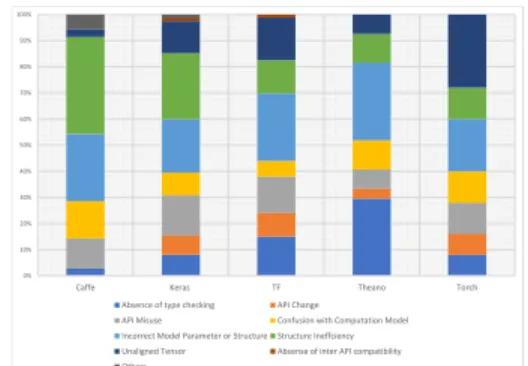
Figure 2: Stack Overflow Root Cause Classification
3.4
Bugs in
Github
projects
We have also analyzed the distributions of bugs in someGithubbug fix commits. The distribution of bugs across different libraries in
Githubdata is shown in Table 2. We computed the P value using
t-test where one distribution is bug type inGithubfor all the libraries and the other distribution is bug type for all the libraries inStack
Overflow.
Finding 4: All the bug types have a similar pattern in Github and Stack Overflow for all the libraries.
We analyze theStack OverflowandGithubresult using the t-test to find whether the distributions differ significantly. We use 95% significant level to find the difference beweenStack Overflow
andGithubresults for each of the bug type In our analysis the
null hypothesis is:H0: The distributions are same. If we fail to
reject this null hypothesis using the t-test then we can say the distributions follow the same pattern in bothStack Overflowand
Githubdata.
We see that for all the bug types except Non Model Structural Logic Bug the P value is greater than 5% indicating they have a similar pattern as we fail to reject the null hypothesis.
4
ROOT CAUSE
In this section, we present the analyses and findings to answerRQ2
identifying major root causes of bugs in deep learning software. The normalized distribution of root causes inStack Overflowcode snippets is shown in Figure 2. The data in Table 3 shows the presence of different categories of root causes in bothStack Overflowand
Githubfor the deep learning libraries and presents P value showing
the similarity of distributions using t-test. We discuss the significant root causes in the following subsections.
4.1
Incorrect Model Parameter (IPS)
Finding 5: IPS is the most malicious root cause resulting in average 24% of the bugs across the libraries.
IPS results in bugs that causes the program to crash at runtime and the execution does not succeed. InTensorflowandTheanoIPS leads other root causes in causing bugs having 26% and 26% of the total share of root causes, respectively.
Table 3: Statistics of the Root Causes of Bugs
Caffe Keras TF Theano Torch P value
SO
GitHub SO GitHub SO GitHub SO GitHub SO GitHub Absense of inter API compatibility 0% 0% 1% 0% 1% 0% 0% 0% 0% 0% 0.1411
Absence of type checking 3% 12% 8% 3% 15%15%30%20% 8% 13% 0.9717
API Change 0% 0% 7% 51% 9% 58% 4% 0% 8% 2% 0.2485
API Misuse 11% 0% 15% 4% 14% 0% 7% 3% 12% 2% 0.0003
Confusion with Computation Model 14%28% 9% 1% 6% 10%11% 3% 12% 4% 0.7839 Incorrect Model Parameter or Structure26%31%21%30%26%16%30%14%20%19% 0.5040
Others 0% 0% 0% 0% 0% 0% 0% 0% 0% 2% 0.3466
Structure Ineffciency 37%12%26% 5% 13% 1% 11%26%12%38% 0.7170
Unaligned Tensor 3% 19%12% 5% 16% 0% 7% 34%28%20% 0.7541
Wrong Documentation 6% 0% 1% 1% 0% 0% 0% 0% 0% 0% 0.3402
4.2
Structural Inefficiency (SI)
Finding 6: Keras, Caffe have 25% and 37% bugs that are resulted from SI.
SI bugs do not cause the program to crash. These bugs often yield suboptimal performance of the deep learning model. These bugs have more relation to QoS or non-functional requirements. For example, a programmer is trying to train a model to recognize handwritten digits but the accuracy does not improve and stays constant from epochs 2 - 10.2
1 Epoch 1 / 1 0 2 2 3 9 4 / 2 3 9 4 [==============================] − 0 s − l o s s : 0 . 6 8 9 8 − a c c : 0 . 5 4 5 5 − v a l _ l o s s : 0 . 6 8 3 5 − v a l _ a c c : 0 . 5 7 1 6 3 Epoch 2 / 1 0 4 2 3 9 4 / 2 3 9 4 [==============================] − 0 s − l o s s : 0 . 6 8 7 9 − a c c : 0 . 5 5 2 2 − v a l _ l o s s : 0 . 6 9 0 1 − v a l _ a c c : 0 . 5 7 1 6 5 . . . . 6 Epoch 1 0 / 1 0 7 2 3 9 4 / 2 3 9 4 [==============================] − 0 s − l o s s : 0 . 6 8 7 7 − a c c : 0 . 5 5 2 2 − v a l _ l o s s : 0 . 6 8 4 9 − v a l _ a c c : 0 . 5 7 1 6 8 1 0 2 7 / 1 0 2 7 [==============================] − 0 s
The problem that was pointed out by an expert, which solved the performance degradation bug is following:
1 # I n summary , r e p l a c e t h i s l i n e : 2 model . c o m p i l e ( l o s s = " c a t e g o r i c a l _ c r o s s e n t r o p y " , o p t i m i z e r = " adam " ) 3 # w i t h t h i s : 4 from k e r a s . o p t i m i z e r s i m p o r t SGD 5 o p t = SGD ( l r = 0 . 0 1 ) 6 model . c o m p i l e ( l o s s = " c a t e g o r i c a l _ c r o s s e n t r o p y " , o p t i m i z e r = o p t )
The answer suggested to changeoptimizerfor enhancing the performance.
4.3
Unaligned Tensor (UT)
Finding 7: Torch has 28% of the bugs due to UT.
In deep learning, tensor dimensions are important for successful construction of the model.Tensorflow,Keras,Torch,Theano,Caffe
have respectively 16%, 12%, 28%, 7% and 3% of bugs due to UT respectively. InTorchUT is the highest root cause of bugs.
4.4
Absence of Type checking
Finding 8: Theano has 30% of the bugs due to the absence of type checking.
Most of the deep learning libraries are written in Python. Due to the dynamic nature of Python, the problem of the absence of type
A Comprehensive Study on Deep Learning Bug Characteristics ESEC/FSE 2019, 26–30 August, 2019, Tallinn, Estonia
Absence of type checking Absense of inter API compatibility API Change (APIC) API Misuse (APIM)
Confusion with Computation Model(CCM) Incorrect Model Parameter or Structure (IPS) Others Structure Ineffciency (SI) Unaligned Tensor (UT)
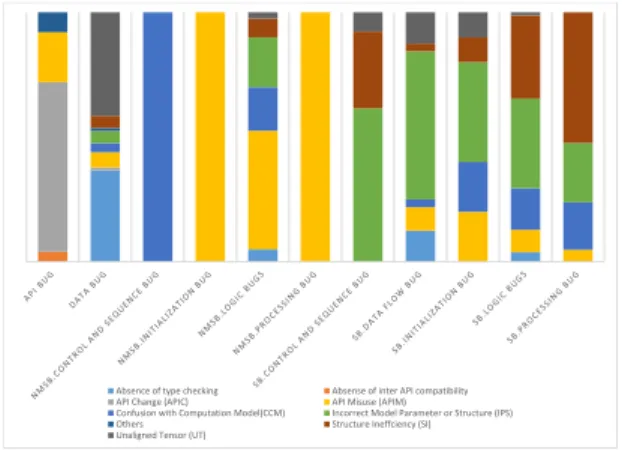
Figure 3: Relation between Root Causes and Types of Bugs
checking is felt strongly in these libraries. The absence of type checking leads to 30% of the bugs inTheano, 8% of the bugs inKeras
and 15% of the bugs inTensorflow.
4.5
API Change
Finding 9: Tensorflow and Keras have 9% and 7% bugs due to API change.
In deep learning libraries, API change tends to have a drastic effect. These libraries are interdependent. So, API change in one library breaks other libraries.
4.6
Root Causes in
Github
data
Finding 10: Except API Misuse all other root causes have similar patterns in both Github and Stack Overflow root causes of bugs.
We computed the P value at 95% significant level for both theStack
OverflowandGithubdata for all the root causes in the five libraries.
We see that, P value for API Misuse root cause is much less than 5% indicating API Misuse inStack OverflowandGithubhas different distribution compared to other root causes as we reject the null hypothesis. The other root causes are similar for bothStack Overflow
andGithubdata as their P value is greater than 5%.
4.7
Relation of Root Cause with Bug Type
Finding 11: SI contributes 3% - 52% and IPS contirbutes 24% - 62% of the bugs related to model.
We have seen from Figure 3 that most of the non model related bugs are caused by API Misuse (6% - 100%). Non Model Structural Initialization Bugs and Non Model Structural Processing Bugs are caused by API Misuse in 100% of the time in our studied data. Interestingly in API Bug API Change plays the vital role (68%) compared to API Misuse (20%); however, the model related bugs are more vulnerable to IPS and SI root causes. We see from Figure 3 that Structural Control and Sequence Bug, Structaral Data Flow Bug, Structural Initialization Bug, Structural Logic Bug, Structural Processing Bug which are related to model are caused by SI 31%,
0% 10% 20% 30% 40% 50% 60% 70% 80% 90% 100%
Caffe Keras TF Theano Torch
Bad Performance Crash Data Corruption Hang Incorrect FunctionalityMemory Out of bound Unknown
Figure 4: Distribution of Bug Effects inStack Overflow
3%, 10%, 33% and 53% of the times respectively and caused by IPS 62%, 59%, 40%, 36%, 24% of the times respectively.
5
IMPACTS FROM BUGS
In this section, we explore the answer toRQ3to understand the major effects of bugs in deep learning software. The normalized distribution of effects ofStack Overflowis shown in Fig. 4. The data in Table 4 shows the presence of different kinds of effects in
bothStack OverflowandGithubfor the deep learning libraries. We
discuss some of the major effects of bugs in deep learning software in the rest of this section.
5.1
Crash
Finding 12: In average more than 66% of the bugs cause crash of the programs.
Our analysis reveals that, the most severe effect of bugs is Crash. In deep learning, the bugs mostly cause total failure of the program. In all the libraries Crash is the top impact ranging from 40% - 77% as shown in Figure 4.
5.2
Bad Performance
Finding 13: In Caffe, Keras, Tensorflow, Theano, Torch 31%, 16%, 8%, 11%, and 8% bugs caused bad performance respectively.
Bad performance is often a concern for deep learning software developers. Even though the model trains successfully, during the evaluation or prediction phase the model may give very poor accu-racy in classifying the target classes.
For example, in the following code snippet the user had low accuracy after traning because of the use of incorrect value of parameternb_words. The user should usenb_words + 1instead ofnb_wordsas answered by an expert.3
1 embedded = Embedding ( nb_words , o u t p u t _ d i m = h i d d e n , i n p u t _ l e n g t h = maxlen ) ( s e q u e n c e )
5.3
Incorrect Functionality
Finding 14: 12% of the bugs in average in the libraries cause Incorrect Functionality .
Incorrect functionality happens when the behavior of the software reflects some unexplainable outcome which is not expected from the logical organization of the model or from previous experience of the developer.
Table 4: Effects of Bugs inStack OverflowandGithub
Caffe Keras TF Theano Torch P value
SO
GitHub SO GitHub SO GitHub SO GitHub SO GitHub
Bad Performance 31% 19% 16% 14% 8% 8% 11% 6% 8% 24% 0.9152
Crash 40% 69% 61% 86% 77% 92% 70% 20% 60% 16% 0.7812
Data Corruption 6% 4% 5% 0% 6% 0% 4% 6% 4% 16% 0.948
Hang 0% 0% 0% 0% 1% 0% 0% 0% 0% 0% 0.3466
Incorrect Functionality 23% 8% 13% 0% 7% 0% 11% 59% 16% 42% 0.5418
Memory Out of bound 0% 0% 3% 0% 1% 0% 4% 0% 0% 0% 0.0844
Unknown 0% 0% 2% 0% 0% 0% 0% 9% 12% 2% 0.8419
For example, in the following code snippet the user wants to convert the image to a 28∗28Numpyarray; however, the output is a black image.4
1 w i t h t f . S e s s i o n ( ) a s s e s s :
2 f i r s t _ i m a g e = m n i s t . t r a i n . i m a g e s [ 0 ]
3 f i r s t _ i m a g e = np . a r r a y ( f i r s t _ i m a g e , d t y p e = ' u i n t 8 ' )
4 p i x e l s = f i r s t _ i m a g e . r e s h a p e ( ( 2 8 , 2 8 ) )
5 p l t . imshow ( p i x e l s , cmap = ' gray ' )
The user got incorrect output because of casting a float array to uint8, which will convert all the pixels to 0 if they are less than 1. To fix the problem, the user can multiply the array with 255 as suggested by an answer.Theanohas a higher percentage of posts about incorrect functionality problems more common than bad performance.
5.4
Effects of Bugs in
Github
Finding 15: For all the libraries the P value for Stack Overflow and Github bug effects reject the null hypothesis to confirm that the bugs have similar effects from Stack Overflow as well as Github bugs.
The P value is shown in Table 4 shows that Bad Performance in
Stack OverflowandGithubhave 79% of P value which indicates that
they are very similar. Crash has P value of 50% inStack Overflowand
Githubindicating they also can not reject the null hypothesis with
strong confidence. None of the impacts reject the null hypothesis at 95% significance level.
6
DIFFICULT DEEP LEARNING STAGES
In this section, we answerRQ4by studying the bugs happening at the different stage of the deep learning pipeline. We use the categorization of the posts about deep learning stages to analyze
RQ4.
6.1
Data Preparation
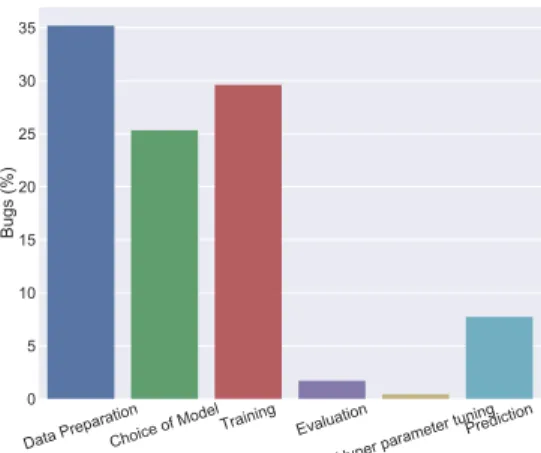
Finding 16: 32% of the bugs are in the data preparation stage of the deep learning pipeline.
From Figure 5 we see, most of the bugs in deep learning program-ming happen at the data preparation stage.
6.2
Training stage
Finding 17: 27% of the bugs are seen during the training stage.
The next stage where most bugs happen is the Training stage which is kind of expected. A lot of bugs related to IPS and SI are from the training stage. 4https://stackoverflow.com/questions/42353676/display-mnist-image-using-matplotlib 'DWD3UHSDUDWLRQ&KRLFHRI0RGHO 7UDLQLQJ (YDOXDWLRQ +\SHUSDUDPHWHUWXQLQJ 3UHGLFWLRQ 6WDJHVLQWKHSLSHOLQH %XJV
Figure 5: Bugs at different stages of the Deep Learning pipeline
.HUDV 7HQVRUIORZ &DIIH 7RUFK 7KHDQR
7KHDQR 7RUFK &DIIH 7HQVRUIORZ .HUDV &RUUHODWLRQRI%XJ7\SH
Figure 6: Correlation of Bug Types among the libraries
6.3
Choice of model
Finding 18: Choice of model stage shows 23% of the bugs.
Choice of model is the third stage in terms of the likelihood to have bugs. In choice of model stage, we construct the model and chose the right algorithm. Major root causes of bugs in this stage are IPS, SI, and UT.
7
COMMONALITY OF BUG
In this section, we try to explore the answer toRQ5to identify whether there is any relationship among the bugs in different deep learning libraries. Our primary hypothesis was that the libraries will be strongly correlated based on the distribution of bugs as they are doing the similar tasks.
Our analysis confirms that hypothesis as shown in Figure 6. We see that the libraries have a strong correlation coefficient close to 1. SurprisinglyTorchhas shown very weak correlation with other libraries in terms of bug type. We then randomly studied the 30 posts having codes for each of the libraries to see whether we notice any common antipatterns that can lead to this strong correlation of bug type.
A Comprehensive Study on Deep Learning Bug Characteristics ESEC/FSE 2019, 26–30 August, 2019, Tallinn, Estonia 0 5 10 15 20 25 30 35 40 45 50 Continuous Obsolescence
Cut and Paste Programming
Dead Code Golden Hammer Input Kludge Mushroom Management Sphagetti Code % o f A n tipat te rn Caffe Keras Tensorflow Theano Torch
Figure 7: Distribution of different antipatterns
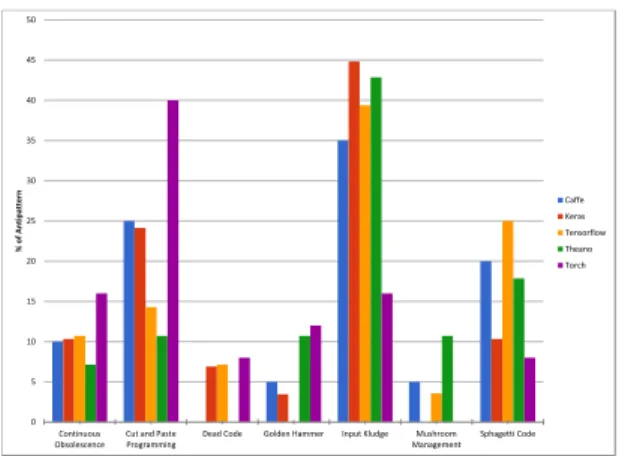
Finding 19: Tensorflow and Caffe have a similar distribution of antipatterns while Torch has different distributions of antipatterns.
We have identified the antipatterns through deeper analysis of
theStack Overflowbuggy codes for further investigating the strong
correlation ofTensorflowandCaffeas well as the weak correlation
ofTorchandCaffe. The antipatterns found areContinuous
Obso-lescence, Cut-and-Paste Programming, Dead Code, Golden Hammer, Input Kludge, Mushroom Management, Spaghetti Code. This classification is taken from [2]. The distribution of differ-ent antipatterns across the libraries is shown in Figure 7. We see that
inTensorflowandCaffe30%+ of the antipatterns are Input Kludge.
On the other hand, inTorch40% of the bugs happen due to the Cut-and-Paste Programming antipattern. This shows that the strong correlation between the distribution of bugs inTorchandCaffecan be explained from the similarity of common antipatterns for these two libraries. The weak correlation between the distribution of
TorchandCaffebugs can be the result of a dissimilar distribution
of antipatterns between these two libraries. For example, we see
Stack Overflowcode snippets of Input Kludge antipatterns from
TensorflowandCaffein the example shown in Figure 8. Both of
these programs can be easily broken by user input and the program does not perform sanity check on the inputs.
8
EVOLUTION OF BUGS
In this section, we explore the answer toRQ6to understand how the bug patterns have changed over time.
8.1
Positive growth of Structural Logic Bugs
Finding 20: In Keras, Caffe, Tensorflow Structural logic bugs are showing increasing trend.
From 2015 - 2018 Structural logic bugs inCaffeare respectively 30%, 32%, 67%, 100% indicating structural logic bugs are being discussed more by the developers since 2015. It is expected as deep learning started gaining increasing attention since 2015 and more developers started to use deep learning libraries to write software.
8.2
Decreasing trend of Data Bugs
Finding 21: Data Bugs slowly decreased since 2015 except Torch.
InTorchData Bugs stayed almost consistent maintaining close
to 50% of the bugs in discussed in 2016-2018. InKerasData Bugs slowly decreased from 27% - 15% since 2015. InTensorflowData Bugs slowly decreased from 30% - 10% since 2015 - 2018. In the other two libraries also, the Data Bugs slowly decreased reaching close to 0. The possible reason for this trend is the development of popular specialized data libraries likepandasthat enable exploratory data analysis to understand the properties of data better. Besides, the use of Tensor data type having type and shape information helps to get rid of some of the Data Bugs. Still more verification support in these libraries will help to get rid of these bugs.
9
THREATS TO VALIDITY
Internal threat. One internal threat to the validity of our results could be our classification of the bugs. We used the classification scheme from a vetted taxonomy [5, 25] to classify the bugs. We also followed open coding scheme to add more types if needed. One PhD student was initially dedicated to go over all the posts to come up with additional classification scheme, if necessary. This whole process was monitored using pilot study. Another possible source of the threat is that the labeling of the data can be biased. To mitigate this threat two trained Ph.D. students independently studied the misuse posts to label them. The inter-rater agreements was mea-sured using Cohen’s Kappa coefficient and the disagreements were reconciled under the monitoring of an expert. We conducted pilot study to continuously monitor the labeling process and conducted further training at 5% and 10% of the labeling where the Kappa coefficient was close to 0% and 80%.
External threat. An external threat can be the trustworthiness of the dataset we collected. To avoid low-quality posts we only collected the posts that have score of at least 5. A score of 5 can be a good metric to trust the post as a good discussion topic among the programmer community that cannot merely be solved using some Google search. The reputation of the users asking question about deep learning can be another reason to question the quality of the posts. To alleviate this threat we have only studied top scored posts which are from users with different range of reputations (1 -150K+). This indicates that the posts are from users ranging from newbie to experts.
10
DISCUSSION
We have seen in the analysis of RQ1 that most of the bugs in deep learning programming are Data Bugs. These type of Bugs can have drastic effect causing the program to crash as well as leading to bad performance. In general, we see the programmers have very limited or no access to data verification tools. It is often confusing whether the data is in right format needed by the model, whether the variables are properly encoded or not, whether there are missing data that can cause the model to fail, whether the train test split is good enough, whether the data is shuffled properly to avoid training bias etc. This finding suggests that development ofdata verification toolscan help programmers solve a large number of data bugs. As deep learning models are strongly coupled with
(a) Tensorflow Example of Input Kludge (b) Caffe Example of Input Kludge
Figure 8: Example of similar antipattern inTensorflowandCaffe
Figure 9: Timeline of Evolution of Bugs
data,model analysistool to explore whether a particular model is the right fit for the data in hand can help to resolve these strong coupling of data and model related problems.
We have also seen while exploring RQ1 that structural logic bugs are the second major type of bugs. This happens due to wrong logical organization of the model, hidden layers, using wrong codes, etc. These kind of problems can be solved by someautomated model and parameter recommendationtools. How to develop these kind of tools need further research. A methodology could be to mine large scale open source code repositories and identify the common code patterns and suggest examples from common code patterns used in qualified code bases.
11
RELATED WORKS
Empirical Study on Bugs. Thunget al.[21] studied three machine learning systems, Apache Mahout, Lucene, and OpenNLP and man-ually categorize the bugs into different categories. They focused on bug frequencies, bug types, severity of the bug, bug-fixing duration, bug-fixing effort, and bug impact. Different from them, we focus on bug types, bug root causes, and bug impact of five deep learning libraries which are Tensorflow, Keras, Torch, Caffe, and Theano.
Zhanget al.[25] investigated bugs from deep learning applica-tions built on top of Tensorflow. They collected bugs from Stack Overflow questions and Github commits. Then, they manually stud-ied the collected bugs based on three perspectives which are root
cause, bug type, and impact. While Zhanget al.have certainly charted the course, we have studied a cross-section of five deep learning libraries with different design constraints. Furthermore, besides root cause, bug type, and impact, we also focus on bugs in deep learning stages which includes data preparation, modeling, training, evaluation, tuning, prediction. We have also studied some common antipatterns to explain the strong correlation of bugs in these libraries as bugs have strong relation to antipatterns [19].
There are some empirical studies focused on specific types of bugs. Luet. al.[17] studied real-world concurrency bug character-istics. Gaoet. al.[10] conducted an empirical study on recovery bugs in large-scale distributed systems. API changes problems was studied by [4, 9, 14, 15]. Our work focuses on the bugs in the usage of deep learning libraries.
Bugs classification. Classification of API-misuse from different perspectives and domains have been done previously. Classification of software defects by IEEE served as the basis for IBM’s orthogonal defect classification (ODC) as discussed in [6]. The defect types include conceptual program elements which arefunction,check,
documentation,assignment,algorithmandviolation type. More
re-cently, [23] presents a Python predictive analysis. Their tool is able to detect 46 bugs with 16 unreported before and they also classify those bugs base on their defect in the Python program. Our study focus on deep learning bugs, we classify the bugs based on bug type, root cause, and effect.
Stack OverflowandGithubstudy. Meldrumet. al.[18] studied
266 papers usingStack Overflowplatforms to show the growing impact ofStack Overflowon software engineering research. Kavaler [13, 16] usedStack Overflowto analyze Android APIs. Baruaet. al.
[3] analyzed the textual content ofStack Overflowdiscussions to understand the thoughts and needs of developers. These works have not studied bugs in deep learning software.
12
CONCLUSION
Although deep learning has gained much popularity and strong developer community in recent years, developing software using existing deep learning libraries can be error-prone. In this paper, we have presented an empirical study to explore the bugs in software using deep learning libraries. In our study we have studied2716
A Comprehensive Study on Deep Learning Bug Characteristics ESEC/FSE 2019, 26–30 August, 2019, Tallinn, Estonia
qualifiedStack Overflowposts and500Githubbug fix commits to identify the bug types, root causes of bugs, effects of bugs in usage of deep learning. We have also performed an inter-stage analysis to identify the stages of deep learning pipeline that are more vulnerable to bugs. We have also studied the buggy codes in
Stack Overflowto find antipatterns leading to bugs to understand
the strong correlation of the bug types in deep learning libraries. Our study found that data bug and logic bug are the most severe bug types in deep learning software appearing more than 50% of the times. Major root causes of these bugs are Incorrect Model Parameter (IPS) and Structural Inefficiency (SI). Last but not least, bugs in the usage of deep learning libraries are strongly correlated.
REFERENCES
[1] Martín Abadi, Paul Barham, Jianmin Chen, Zhifeng Chen, Andy Davis, Jeffrey Dean, Matthieu Devin, Sanjay Ghemawat, Geoffrey Irving, Michael Isard, et al. 2016. TensorFlow: A System for Large-Scale Machine Learning.. InOSDI, Vol. 16. 265–283.
[2] Alexander Shvets. 2017. Software Development AntiPatterns. (2017). https: //sourcemaking.com/antipatterns/software-development-antipatterns. [3] Anton Barua, Stephen W Thomas, and Ahmed E Hassan. 2014. What are
devel-opers talking about? an analysis of topics and trends in stack overflow.Empirical Software Engineering19, 3 (2014), 619–654.
[4] Gabriele Bavota, Mario Linares-Vasquez, Carlos Eduardo Bernal-Cardenas, Mas-similiano Di Penta, Rocco Oliveto, and Denys Poshyvanyk. 2015. The impact of api change-and fault-proneness on the user ratings of android apps. IEEE Transactions on Software Engineering41, 4 (2015), 384–407.
[5] Boris Beizer. 1984.Software system testing and quality assurance. Van Nostrand Reinhold Co.
[6] Ram Chillarege, Inderpal S. Bhandari, Jarir K. Chaar, Michael J. Halliday, Di-ane S. Moebus, Bonnie K. Ray, and Man-Yuen Wong. 1992. Orthogonal Defect Classification-A Concept for In-Process Measurements.IEEE Trans. Softw. Eng.
18, 11 (Nov. 1992), 943–956. https://doi.org/10.1109/32.177364
[7] François Chollet et al. 2015. Keras. https://github.com/fchollet/keras. (2015). [8] Ronan Collobert, Samy Bengio, and Johnny Mariéthoz. 2002.Torch: a modular
machine learning software library. Technical Report. Idiap.
[9] Danny Dig and Ralph Johnson. 2006. How do APIs evolve? A story of refactoring.
Journal of software maintenance and evolution: Research and Practice18, 2 (2006), 83–107.
[10] Yu Gao, Wensheng Dou, Feng Qin, Chushu Gao, Dong Wang, Jun Wei, Ruirui Huang, Li Zhou, and Yongming Wu. 2018. An empirical study on crash recovery bugs in large-scale distributed systems. InProceedings of the 2018 26th ACM Joint Meeting on European Software Engineering Conference and Symposium on the Foundations of Software Engineering. ACM, 539–550.
[11] David Gómez and Alfonso Rojas. 2016. An empirical overview of the no free lunch theorem and its effect on real-world machine learning classification.Neural
computation28, 1 (2016), 216–228.
[12] Yangqing Jia, Evan Shelhamer, Jeff Donahue, Sergey Karayev, Jonathan Long, Ross Girshick, Sergio Guadarrama, and Trevor Darrell. 2014. Caffe: Convolu-tional architecture for fast feature embedding. InProceedings of the 22nd ACM international conference on Multimedia. ACM, 675–678.
[13] David Kavaler, Daryl Posnett, Clint Gibler, Hao Chen, Premkumar Devanbu, and Vladimir Filkov. 2013. Using and asking: Apis used in the android market and asked about in stackoverflow. InInternational Conference on Social Informatics. Springer, 405–418.
[14] Raula Gaikovina Kula, Ali Ouni, Daniel M German, and Katsuro Inoue. 2018. An empirical study on the impact of refactoring activities on evolving client-used APIs.Information and Software Technology93 (2018), 186–199.
[15] Jun Li, Yingfei Xiong, Xuanzhe Liu, and Lu Zhang. 2013. How does web service API evolution affect clients?. In2013 IEEE 20th International Conference on Web Services. IEEE, 300–307.
[16] Mario Linares-Vásquez, Gabriele Bavota, Massimiliano Di Penta, Rocco Oliveto, and Denys Poshyvanyk. 2014. How do api changes trigger stack overflow dis-cussions? a study on the android sdk. Inproceedings of the 22nd International Conference on Program Comprehension. ACM, 83–94.
[17] Shan Lu, Soyeon Park, Eunsoo Seo, and Yuanyuan Zhou. 2008. Learning from mistakes: a comprehensive study on real world concurrency bug characteristics. InACM SIGARCH Computer Architecture News, Vol. 36. ACM, 329–339. [18] Sarah Meldrum, Sherlock A Licorish, and Bastin Tony Roy Savarimuthu. 2017.
Crowdsourced Knowledge on Stack Overflow: A Systematic Mapping Study. In
Proceedings of the 21st International Conference on Evaluation and Assessment in Software Engineering. ACM, 180–185.
[19] Seyyed Ehsan Salamati Taba, Foutse Khomh, Ying Zou, Ahmed E Hassan, and Meiyappan Nagappan. 2013. Predicting bugs using antipatterns. In2013 IEEE International Conference on Software Maintenance. IEEE, 270–279.
[20] The Theano Development Team, Rami Al-Rfou, Guillaume Alain, Amjad Alma-hairi, Christof Angermueller, Dzmitry Bahdanau, Nicolas Ballas, Frédéric Bastien, Justin Bayer, Anatoly Belikov, et al. 2016. Theano: A Python framework for fast computation of mathematical expressions.arXiv preprint arXiv:1605.02688
(2016).
[21] Ferdian Thung, Shaowei Wang, David Lo, and Lingxiao Jiang. 2012. An empiri-cal study of bugs in machine learning systems. In2012 IEEE 23rd International Symposium on Software Reliability Engineering. IEEE, 271–280.
[22] Anthony J Viera, Joanne M Garrett, et al. 2005. Understanding interobserver agreement: the kappa statistic.Fam med37, 5 (2005), 360–363.
[23] Zhaogui Xu, Peng Liu, Xiangyu Zhang, and Baowen Xu. 2016. Python predic-tive analysis for bug detection. InProceedings of the 2016 24th ACM SIGSOFT International Symposium on Foundations of Software Engineering. ACM, 121–132. [24] Yufeng Guo. 2017. The 7 Steps of Machine Learning. (2017). https:
//towardsdatascience.com/the-7-steps-of-machine-learning-2877d7e5548e. [25] Yuhao Zhang, Yifan Chen, Shing-Chi Cheung, Yingfei Xiong, and Lu Zhang.
2018. An empirical study on TensorFlow program bugs. InProceedings of the 27th ACM SIGSOFT International Symposium on Software Testing and Analysis. ACM, 129–140.