Institut za poljoprivrednu tehniku Naučni časopis POLJOPRIVREDNA TEHNIKA Godina XXXVIII Broj 2, 2013. Strane: 45 – 53
Institute of Agricultural Engineering Scientific Journal AGRICULTURAL ENGINEERING Year XXXVIII No. 2, 2013. pp: 45 – 53
UDK: 631.4 Originalni naučni rad
Original scientific paper
VARIABLE RATE CONTROL SYSTEM DESIGNED FOR
SPINNER DISC FERTILIZER SPREADER – “PreFer”
Arif Behiç Tekin*, Kamil Okyay Sındır
Ege University, Faculty of Agriculture, Department of Agricultural Engineering, Bornova, Izmir, Turkey
Abstract: The objectives of this study were: development of fertilizer rate control system which allows applying of granular fertilizer at variable rates, adopting it into a commercial granular fertilizer spreader, and then investigation and evaluation of its performances. A control program in C++ software environment, using the Raisonance 8051 IDE tool was developed. The system was tested in laboratory conditions. Each of rollers released fertilizers almost equally at different application rates. The system can easily be attached to local made spreaders with some mechanical modification. Further tests are needed to verify systems performance in field conditions.
Key words: precision agriculture, spinner disc fertilizer spreader, variable rate fertilizer application
INTRODUCTION
During the past few decades, in order to increase the productivity and profitability, agriculture-related studies have been directed toward the introduction of new high–yield and pest-resistant varieties as well as finding the best ways to use agricultural inputs more effectively due to the recent focus on environmental concerns [8].
Modern agricultural systems, along with preserving the quality of world’s environmental sources, must increase the productivity and profitability for farmers.
* Corresponding author. E-mail: [email protected]
The authors would like to thank the Ege University Research Fund (projects 2002 ZRF 023, and 014) and Türkay Agricultural Machinery, LLC for their support.
Limiting profit margins and strategic planning for farm production system has become more important and difficult. To find the best solution for the complex problems they are facing, farmers have to consider the integrated approach in production. Integrated agriculture management is dynamic, as opposed to being limited to certain rule-structures.
To be succeed in this dynamic environment, farm managers have to mine data and process it so that data can be converted to knowledge and/or existing knowledge can be used in the decision-making stage and the consequent application. In this case, the agricultural data, its quantity and quality, its sources and the process of converting it to knowledge are of importance [11]. The critical point is that the necessary information would be generated, accessed and utilized only by using ICT. Parallel to this necessity and thanks to the recent advancements in information technologies, technology has secured a place in agriculture.
Variability that exists in growing conditions (soil, crop, disease etc.) has to be considered while managing through a new approach called “Precision Agriculture” and its related technologies (GIS, GPS, VRT). Precision Agriculture is an approach for producing food and fiber in a sustainable way by assigning information technologies. Precision agriculture approach has made a deep impact on the world’s agriculture, and although the principals of this trend are the same, the tools and machines should be modified, based on the country and also each farm’s conditions.
Many studies in the past were conducted to develop prototype variable rate applicators. Some of them focused on applying fertilizers. Sensor-based or map-based variable rate technologies have also been considered. When using sensor-based technology, sensors are employed in order to determine the amount of fertilizer requirement for a particular location and then actuators vary the input rate based on the fertilizer needs. Map-based technology uses digital maps endowed with location data. The map is generated by analyzing the data obtained by soil-sampling, yield-mapping, etc. [11].
Spinner disc type spreaders are common, due to the fact that they are simple in design and user-friendly; and also that they are cheap and require little maintenance while field work rates are high [5, 10, 12, 7, 9 ]. Earlier studies on variable rate granular fertilizer application were performed by Fulton et al. (2001) [6]., who modified a granular spreader truck equipped with a commercially available controller and a GPS system. The controller varied the speed of the belt hydraulically and fertilizer was supplied to the two discs by an apron belt.
Cerri et al. (2002) [4] designed and built a system for variable rate lime application. The system included a computer to obtain the coordinate information from GPS and to look up prescription map in order to find the exact rate to instant location, and then send signals to step motor to control the fertilizer flow.
Recently, some researchers have focused on electromechanical control system. There are also commercial products in the world market that have such a system. But, there is no similar system on the spreaders produced by national companies. Akdemir et al. (2007)[1]developed a variable rate controller for centrifugal fertilizer spreader. They employed step-motors to control the fertilizer application rate by varying the outlet area of windows at the bottom of the spreader hopper. Step motors were connected to the rate control levers of spreader.
The objectives of this study included designing a system (considering country-specific conditions) which allows applying granular fertilizer at variable rate by employing rollers and building the VRT attachment, then testing and evaluating it in laboratory condition.
MATERIAL AND METHODS
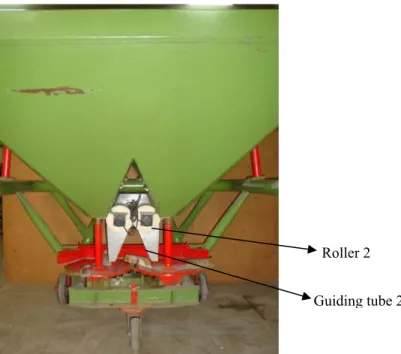
In this study, commercially manufactured spinner disc granular fertilizer spreader was used. The spreader was a mounted type (Fig. 1). The machine was supplied by local agricultural machine and tool manufacturer. In performance test of prototype and calibration of metering units, Calcium Ammonium Nitrate (26% CAN) and composite 20.20.20 fertilizer were used as test materials.
Figure 1. Rollers on spinner disc fertilizer applicator
During the performance tests of designed variable rate control system, electronic balances (Sartorius BL610, with a range of 610 g and 0.01g precision; Tamtest TTS 2010 with a range of 50 kg, and 20 g precision) were used in weight measurement.
RESULTS AND DISCUSSION
Metering efficiency of rollers was determined at different rotation speeds using two fertilizers (CAN and Composite) in laboratory condition. The physical properties of the fertilizers used in the tests are tabulated in Table 1.
Roller 2 Guiding tube 2
Table 1. Physical properties of fertilizers Properties 20:20:0 Compose Fertilizer 26% CAN
Volume Weight 956.44 kg m-3 988.74 kg m-3
Moisture 4.24% 3.11%
Sieze range % fertilizer
> 3.15 mm 25.90 0 3.15 - 2.50 mm 37.79 32.88 2.50 - 2 mm 23.87 52.64 2-1 - 60 mm 7.24 6.09 1.60 - 1 mm 3.16 5.01 1 - 0.8 mm 0.51 2.21 < 0.8 mm 1.50 1.15
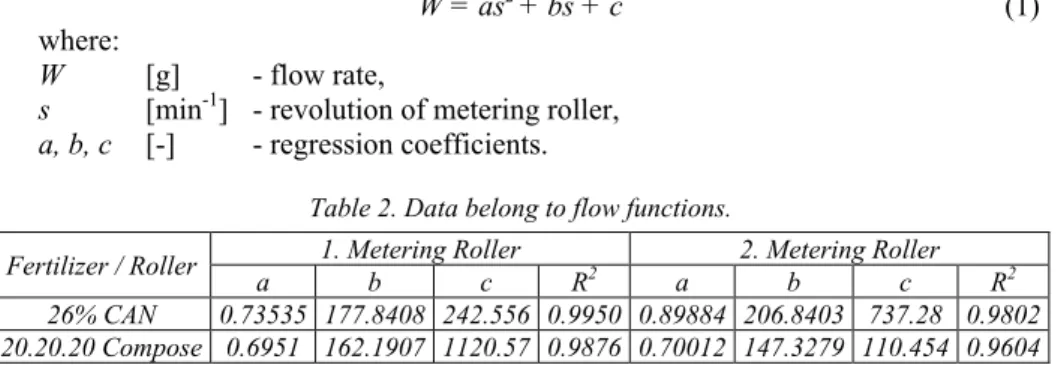
Quadratic functions (1) written below were developed for each roller for metering different fertilizers (Table 2). The coefficients of determination (R2) of the functions are greater than 98%, except one. Although the equations developed for dosage were found the same, they release different amount of fertilizers. This case is valid for (both) fertilizer types. These differences occurred due to the friction forces on bearings. Preliminary tests showed that mixing agitators failed in properly feeding the rollers. As a result, the agitators were redesigned and manufactured.
W = as2 + bs + c (1)
where:
W [g] - flow rate,
s [min-1] - revolution of metering roller, a, b, c [-] - regression coefficients.
Table 2. Data belong to flow functions.
Fertilizer / Roller a b c 1. Metering Roller R2 a b c R2. Metering Roller 2
26% CAN 0.73535 177.8408 242.556 0.9950 0.89884 206.8403 737.28 0.9802
20.20.20 Compose 0.6951 162.1907 1120.57 0.9876 0.70012 147.3279 110.454 0.9604
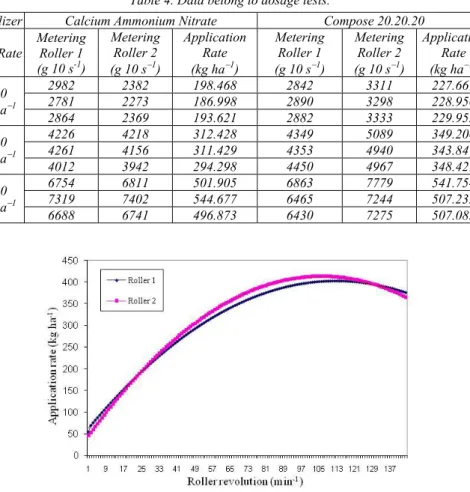
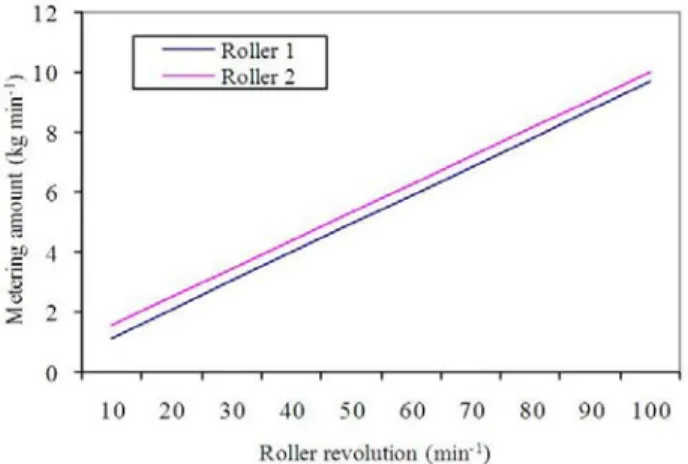
As seen in Figure 2 and 3, the relationship between the dosage and revolution of the rollers was parabolic. Hence, the revolution ranges of rollers were delimited considering the top points of curves and the practical fertilizer application rate. In practical conditions, fertilizer application in the field is not achieved in a single operation and at each application the fertilizer rate is no more than 400–500 kg ha-1. As a conclusion, the maximum application rate of 400 kg ha-1 was chosen and calibration data were reanalyzed (Table 3). The analyses resulted in linear functions with high R2, and they were used in control algorithm (Fig. 4 and 5). Function was defined as below:
si= dwi + e (2)
where:
si [min-1] - metering roller revolution, wi [g] - flow rate,
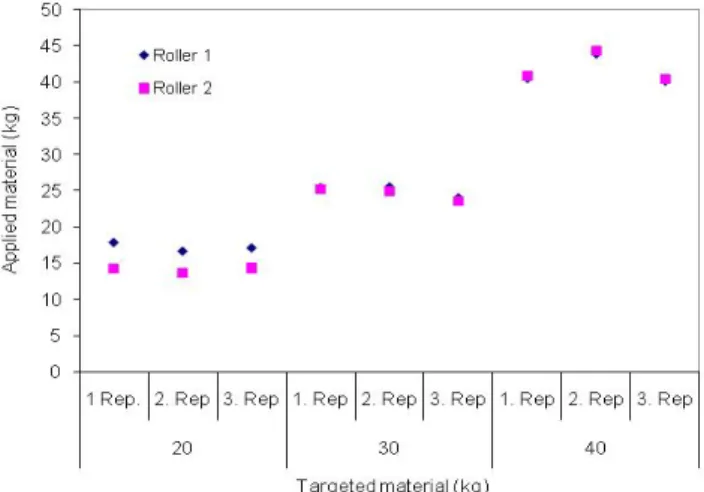
It was found that there was a difference between two rollers while pouring the same amount. Roller 2 poured more than roller 1 under the same conditions (Table 4). In calcium ammonium nitrate metered at 200 kg ha-1 rate, the difference was almost 4 kg (0.02%). As the rate increases, the difference became smaller; it reached to 50 kg (11%). On the other hand, the difference was high in composite fertilizer as compared to ammonium. It increased dramatically when the composite fertilizer was used.
Table 3. Data belong to linear flow function. Fertilizer /
Roller
1. Metering Roller 2. Metering Roller
d e R2 d e R2
26% CAN 0.0099 -11.6116 0.9514 0.0083 -5.42 0.9545
20.20.0
Compose 0.0105 -1.7194 0.9709 0.0106 -6.21 0.9618
Table 4. Data belong to dosage tests.
Fertilizer Calcium Ammonium Nitrate Compose 20.20.20
Test Rate Metering Roller 1 (g 10 s-1) Metering Roller 2 (g 10 s−1) Application Rate (kg ha−1) Metering Roller 1 (g 10 s−1) Metering Roller 2 (g 10 s−1) Application Rate (kg ha−1) 200 kg ha−1 2982 2382 198.468 2842 3311 227.661 2781 2273 186.998 2890 3298 228.956 2864 2369 193.621 2882 3333 229.955 300 kg ha−1 4226 4218 312.428 4349 5089 349.206 4261 4156 311.429 4353 4940 343.841 4012 3942 294.298 4450 4967 348.429 450 kg ha−1 6754 6811 501.905 6863 7779 541.754 7319 7402 544.677 6465 7244 507.233 6688 6741 496.873 6430 7275 507.085
Figure 3. Dosage efficiency of rollers in 20:20:0 Composite application (kg ha-1)
Figure 4. Calcium ammonium nitrate metering function (Roller 1 and 2)
A prototype of variable rate fertilizer spreader using a frame of commercially available spinner disc fertilizer spreader was developed considering the country-specific conditions in this study. The machine was mechanically modified and equipped with metering rollers, an electronic control unit, a speed control unit, and a DGPS module. Each roller can be controlled individually and this helps in the use of only one roller, as it is the case for applying fertilizers to the field’s border.
As expected, the dosage efficiency showed variations depending upon the physical properties of the fertilizers used in the study. Beside them, filling efficiency was another important phenomenon for rollers in terms of metering. So, the dosage amount of rollers in certain revolutions for composite fertilizer (with a different volume weight, granule size and shape) differed from that of calcium ammonium nitrate: The amount for calcium ammonium nitrate is less than that of composite fertilizer (Fig. 6 and 7). In the light of these contributions, it is necessary to generate flow functions for different types of fertilizers.
Figure 6. CAN dosage test (Roller 1 and 2)
As seen in Figures 6 and 7, the relationship between the dosage and revolution of the rollers was parabolic. This means that the dosage amount peaks and then decreases due to the filling efficiency of rollers as the rpm increases. Hence, the revolution ranges of rollers should be delimited considering the peak points of curves. This negative effect of rollers due to speed and fertilizer were eliminated in the software by modifying the dosage functions so that rollers release the corresponded rate to the entered rate to control the unit precisely up to 400 kg ha-1, but there were small variations beyond this rate.
CONCLUSIONS
In this study, a variable rate fertilizer system was developed which allows releasing the target fertilizer rate to match the crop and soil requirements and places the fertilizer as accurately as possible in the fertilized zone. A control program in C++ software environment, using the Raisonance 8051 IDE tool, was developed. The results of the study revealed that the system can be attached to local made spreaders with some mechanical modification to adjust fertilizer application rate effectively. Quadratic functions were developed for each roller for metering different fertilizers. The coefficients of determination (R2) of the functions are greater than 98%. Further developments are intended for practical use. Experimental tests are planned in field conditions to investigate the performance of the system, optimize settings, and to verify if any modifications are required before the system can be used in farm conditions.
BIBLIOGRAPHY
[1] Akdemir,B., Sağlam, N., Bellitürk K., Aydogdu, B. 2007. Development a variable rate controller for centrifugal fertiliser (Design the system), 4th Intenrational Symposium on Intelligent information technology in Agriculture, 26-29 October 2007, Beijing, China. [2] ASAE S358.2. 2003. Moisture measurement. St. Joseph, Mich. ASAE Organization, USA. [3] ASAE S281.3. 2004. Capacity designation of fertilizer and pesticide hoppers and containers.
St. Joseph, Mich. ASAE Organization, USA.
[4] Cerri, D.G.P., Balastreire, L.A., Amaral, J.R. 2002. Development of a variable rate lime application system. In: Proceedings of the World Congress of Computers in Agriculture and Natural Resources, Brazil, p.p. 238-243
[5] Çarman, K. 1988. Santrifüjlü Kimyasal Gübre Dağıtma Makinalarında Bazı Yapısal Özelliklerin Dağılım Düzgünlüğüne Etkisi Üzerine Bir Araştırma. Doktora Tezi. Selçuk Üniversitesi, Fen Bilimleri Enstitüsü, p: 151.
[6] Fulton, J.P., Shearer, S.A., Stombaugh, T.S., Higgins, S.F. 2001. Pattern assessment of a spinner disc variable-rate fertilizer spreader. In: ASAE Annual International Meeting
California. pp: 20.
[7] Grift, T.E., Kweon, G. 2006. Development of a uniformity controlled granular fertilizer spreader. In: 2006 ASABE Annual International Meeting. Portland, Oregon. pp: 14.
[8] Lal, R. 2008. Soils and world food security. Soil and Tillage Research 102, 1-4.
[9] Önal, İ. 2006. Ekim, Bakım, Gübreleme Makinaları. Ege Üniversitesi, Ziraat Fakültesi Yayınları, No: 490, İzmir. p: 606.
[10]Taşer, Ö.F. 1988. Diskli Gübre Dağıtma Makinalarında Farklı Tip Kanat Profillerinin Gübre Dağılım Desenine Etkileri. Doktora Tezi. Ankara Üniversitesi, Fen Bilimleri Enstitüsü. p: 108.
[11]Tekin, A.B. 2005. Değişken Düzeyli Uygulamaya Yönelik Mineral Gübre Dağıtma Makina Tasarımı Üzerine Bir Araştırma. Doktora Tezi. Ege Üniversitesi, Fen Bilimleri Enstitüsü, p:135.
[12]Yıldıran, Y. 2002. Diskli Gübre Dağıtma Makinalarında Dağılım Düzgünlüklerinin İyileştirilmesi Üzerine Bir Araştırma. Doktora tezi. Atatürk Üniversitesi, Fen Bilimleri Enstitüsü
SISTEM KONTROLE PROMENLJIVIH NORMI ZA DISKOSNI RASIPAČ ĐUBRIVA – “PreFer”
Arif Behiç Tekin, Kamil Okyay Sındır
Ege Univerzitet, Poljoprivredni fakultet, Institut za poljoprivrednu tehniku, Bornova, Izmir, Turska
Sažetak: Ciljevi ove studije bili su: razvoj sistema kontrole norme đubrenja koji omogućava primenu granuliranog đubriva sa promenljivim normama đubrenja, njegovu primenu sa komercijalnim rasipačem granuliranog đubriva i zatim ispitivanje i ocena njegovih performansi. Razvijen je program kontrole u C++ softverskom okruženju, koristeći alat Raisonance 8051 IDE. Sistem je testiran u laboratorijskim uslovima. Svaki od valjaka je pri različitim normama aplikacije skoro podjednako oslobađao đubrivo. Sistem se može lako ugraditi na lokalno pravljene rasipače uz neke mehaničke modifikacije. Dalja ispitivanja su potrebna da bi se potvrdile performanse sistema u poljskim uslovima.
Ključne reči: precizna poljoprivreda, diskosni rasipačđubriva, promenljive norme đubrenja Prijavljen: Submitted: 31.05.2013. Ispravljen: Revised: Prihvaćen: Accepted: 10.06.2013.
Tekin A.B., et al.: Sistem kontrole promenljivih normi.../Polj. tehn. (2013/2), 45 - 53