Open Access
Open Journal of Big Data (OJBD)
Volume 3, Issue 1, 2017
http://www.ronpub.com/ojbd
ISSN 2365-029X
Technology Selection for
Big Data and Analytical Applications
Denis Lehmann, David Fekete, Gottfried Vossen
ERCIS, University of Muenster, Leonardo-Campus 3, 48149 Muenster, Germany,
[email protected],{david.fekete, gottfried.vossen}@ercis.de
A
BSTRACTThe term Big Data has become pervasive in recent years, as smart phones, televisions, washing machines, refrigerators, smart meters, diverse sensors, eyeglasses, and even clothes connect to the Internet. However, their generated data is essentially worthless without appropriate data analytics that utilizes information retrieval, statistics, as well as various other techniques. As Big Data is commonly too big for a single person or institution to investigate, appropriate tools are being used that go way beyond a traditional data warehouse and that have been developed in recent years. Unfortunately, there is no single solution but a large variety of different tools, each of which with distinct functionalities, properties and characteristics. Especially small and medium-sized companies have a hard time to keep track, as this requires time, skills, money, and specific knowledge that, in combination, result in high entrance barriers for Big Data utilization. This paper aims to reduce these barriers by explaining and structuring different classes of technologies and the basic criteria for proper technology selection. It proposes a framework that guides especially small and mid-sized companies through a suitable selection process that can serve as a basis for further advances.
T
YPE OFP
APER ANDK
EYWORDSRegular research paper: big data, analytics, technology selection, architecture, reference architecture, selection
framework, analytical applications
1
I
NTRODUCTIONThe Big Data era started just a couple of years ago and has meanwhile seen an abundance of tools for processing and managing data in various applications such as searching, stream processing, recommendations, or sentiment analysis. Most of these software tools are open source and hence can be employed by anybody who feels capable of arranging them into appropriate solution architectures for any problems at hand. However, the sheer mass of tools often makes it difficult to come up with reasonable selections, and beyond that with proper organizational and technical arrangements that best serve a given application.
Data has become the most important asset for companies [38]. It is the new oil [48] that lubricates business processes and helps companies evolve towards data-driven decision making [16]. Being in line with labor, natural resources and capital, Big Data has become the next important production factor [16]. At its essence, it is all about predictions and simulations
[45]. Facebook predicts friends, Amazon predicts
purchases, government agencies predict crimes as well as terrorist attacks, and Netflix predicts movies. Big Data analytics even enables to forecast people’s behavior and emotional moods [16], as some predictions aim at customer personalization, satisfaction [42], and even online dating [4].
This vast amount of data requires new technologies and mechanisms for storage, processing, management,
and analysis. It is commonly accepted that Big
Data is too large, fast, and diverse for traditional Relational Database Management Systems (RDBMSs) [25]. Hence, new technologies are required that include a wide range of novel database systems, file systems, programming paradigms and languages, and machine learning tools, among other components [53]. According to DEMCHENKO, DELAAT, and MEMBREY[21], there
is no comprehensive analysis of such emerging Big Data technologies in the literature, yet. Instead, most discussions are happening in blogs between contributors and early adopters of open source solutions.
As a consequence, Big Data concepts, tools and their implications for technology selection and system
architectures are still poorly understood [36]. FEKETE
[27] has already identified the need for a structured technology selection approach in the context of the
complexity of this tool landscape. The proposed
Goal-oriented Business Intelligence Architecture (GOBIA)
method emphasizes the selection of technologies as key to transforming business needs into customized analytics architectures. However, no specific process has been
proposed, yet [27]. MARR proposes a framework
for organizational change towards Big Data, driven by strategy, but does not focus on specific technologies
[43]. In a nutshell, companies are still increasingly
confused with hundreds of different available tools and unsure about how to build an analytics architecture for their needs. In fact, building a suitable infrastructure comes with significant integration challenges, as each technology has its own functionality, performance, and scalability strengths and weaknesses [38].
This paper is based on [41] and provides artifacts that aim to guide technology selection processes for creating customized analytical architectures in the Big
Data era. Specifically, it develops a guideline for
technology selection and a regulatory framework that structures current technologies into distinct classes for a better overview. Overall, it explains essential selection criteria and technology differentiating dimensions. The resulting framework can also be used to complement existing approaches such as the aforementioned GOBIA method.
The remainder of this paper is structured as follows. First, the layered reference framework as a means to structuring technologies is outlined in Section 2. Section 3 introduces the technology selection framework
and describes its process-based approach. Section 4
illustrates technology selection using an application scenario. The paper concludes with Section 5.
2
L
AYEREDR
EFERENCEF
RAMEWORKThis section introduces a layered reference framework that can be used to ease the classification and assessment of new technology. It maps technologies to different service layers and serves as a guide for selecting suitable technology mixes for given use cases. It is the foundation of the technology selection framework to be presented in Section 3. As such, it inherits Big Data technologies at different service layers for data generation, acquisition, storage, processing, and analytics [21].
A common way to visualize the process of value generation is known as the Big Data value chain. It usually consists of four sequential phases [16] [33]: data generation, data acquisition, data storage, and data analytics. However, reality shows that data storage is not always mandatory. Some scenarios require direct processing and analysis without previous storage. Thus, the adaptive Big Data value chain allows storage to be optional and adaptive with regard to the requirements of the use case at hand (see Figure 1).
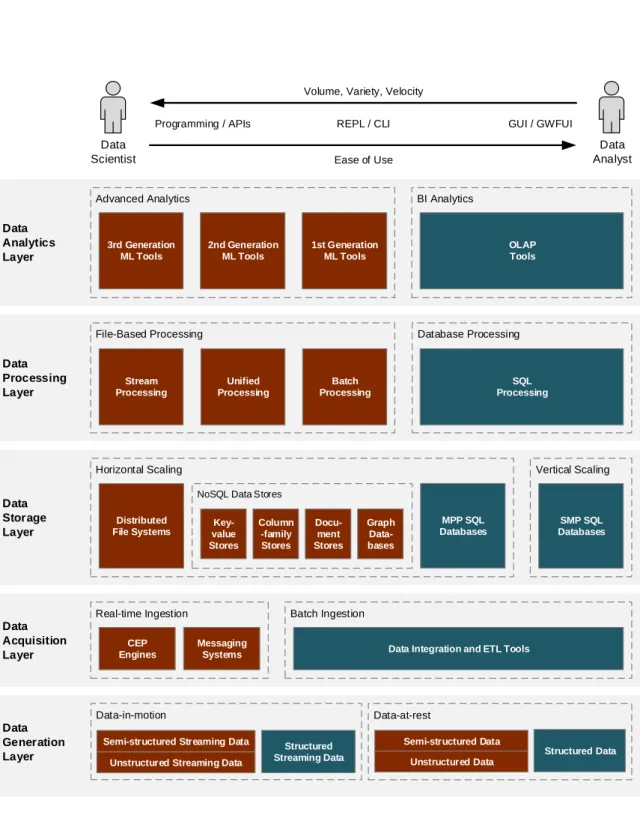
The five layers of the layered reference framework correspond to the process steps of the adaptive Big Data value chain (see Figure 2). As notable differences, the framework handles the technologies corresponding to the data acquisition and preprocessing step from the value chain individually in two separate layers. Layer elements are ordered with increasing volume, variety,
and velocity from right to left. While traditional
BI technologies are indicated in blue (right side), components associated with advanced analytics are colored red (left side). However, the transition between BI and advanced analytics is smooth, as components sometimes belong to both groups, depending on the use case.
While advanced analytics requires input of data scientists [1], traditional BI technologies are usually set up by data analysts without profound mathematical
knowledge [59]. Thus, the former usually requires
good programming skills and knowledge on analytical tools using Application Programming Interfaces (APIs), Read-Eval-Print Loops (REPLs), and Command-Line Interfaces (CLIs), while the latter can often be employed using Graphical User Interfaces (GUIs) or Graphical Workflow User Interfaces (GWFUIs). This corresponds to the easy of use structuring from left to right.
The layered reference framework does not visualize single technologies, but classifies them by their type into different structural elements such asDistributed File SystemsandOLAP tools. As there are lots of tools and projects arranged in each of these elements, there is not a single solution for a given use case [38, p. 41].
Data Generation Data Acquisition and (Pre-) Processing Data Analytics Data Storage
Figure 1: Adaptive Big Data Value Chain (based on [16], [33], and [11])
2.1
Data Generation Layer
The data generation layer deals with different types of data sources. The main differentiating dimensions are variety and velocity. While velocity differentiates between data-in-motion and data-at-rest [28], variety determines among structured, semi-structured, and unstructured data.
Data-in-motion summarizes all data that is constantly generated at low and high velocities, also known under the umbrella term streaming data. It describes events
that need to be analyzed as they happen. Examples
include social media streams (e.g., Twitter APIs such
as Firehose1, Facebook2 or Xing3.), sensor data, and
log files for security access, as well as multimedia streams from music and video platforms and surveillance
cameras. Other examples include high-frequency
financial or transactional structured data streams. The counterpart of data-in-motion is data-at-rest [28]. This term summarizes historically generated data at fixed locations with no velocity. It includes all data that needs to be stored prior to analysis.
The distinction between data-in-motion and data-at-rest influences technology selection. Business use cases usually put requirements on response times and latency
of analysis results. For instance, an earthquake or
tsunami warning system is required to provide warnings in real-time, not on the next business day. Consequently, the velocity of data generation and its required analysis latency have a reasonable impact on the selection of suitable technology.
Notably, more than 95% of all data is unstructured
or semi-structured and thus requires additional
preprocessing [29]. This work also uses the term
1 http://www.brightplanet.com/2013/06/
twitter-firehose-vs-twitter-api-whats-the-difference-and-why-should-you-care/
2 See https://developers.facebook. com/docs/graph-apifor further information.
3 Seehttps://dev.xing.com/docs/resources
multi-structured data as a generalization of
semi-structured and unsemi-structured data. All of these data
can be data-in-motion (streaming data) or data-at-rest,
depending on the use case at hand. The share of
multi-structured data is constantly growing as everyday contents such as video, images, documents, log files, and e-mails contribute to these groups [6]. The resulting data is diverse as it includes unstructured text, logs, scientific data, pictures, voice and video records as well as sometimes metadata [38]. However, currently, structured input data has still a major role in analytical tasks, even with Big Data (e.g., cf. [50]).
2.2
Data Acquisition Layer
The data acquisition layer deals with technologies for an ingestion of data into Big Data infrastructures [38].
The main differentiating dimension is velocity. It
distinguishes between batch and real-time ingestion. Real-time ingestion is sub-divided into messaging systems and Complex Event Processing (CEP) engines, while batch ingestion includes traditional Extract-Transform-Load (ETL) data integration tools. Sample technologies for the different layer elements are given in Table 2.
Batch ingestion has been done for decades in traditional Business Intelligence and Analytics (BI&A)
environments (cf. [36]), is very well researched (cf.
[23]) and is widely understood. Usually, data flows
like ETL, Load-Transform (ELT), or Extract-Transform-Load-Transform (ETLT) are specified (cf.
[38, 19]). Which of these order variations to use is
determined by the use case and its data characteristics
[28]. Most traditional tools such as Microsoft SQL
Server Integration Services (SSIS) and Pentaho Data Integration (PDI) allow integration of both, structured and multi-structured content, between traditional file systems and RDBMSs. Connections to new, distributed types of Big Data storages such as Hadoop Distributed
Data Acquisition Layer Data Generation Layer Data-in-motion Data-at-rest Structured Streaming Data Semi-structured Data Structured Data
Real-time Ingestion Batch Ingestion Data Storage Layer Data Processing Layer Data Analytics Layer
Horizontal Scaling Vertical Scaling
SMP SQL Databases MPP SQL
Databases
NoSQL Data Stores
Distributed
File Systems value Key-Stores Column -family Stores Docu-ment Stores Graph Data-bases Stream Processing Unified Processing Batch Processing
Advanced Analytics BI Analytics
OLAP Tools
CEP Engines
Messaging
Systems Data Integration and ETL Tools
Database Processing File-Based Processing Data Analyst Data Scientist
Programming / APIs GUI / GWFUI
Ease of Use Volume, Variety, Velocity
REPL / CLI SQL Processing 1st Generation ML Tools 3rd Generation ML Tools 2nd Generation ML Tools Unstructured Data Semi-structured Streaming Data
Unstructured Streaming Data
Table 1: Layered Reference Framework – Data Generation Layer
Layer Element Examples
Structured Data Tabular, transactional, inventory, and financial data
Semi-structured Data XML files, JSON documents, e-mails
Unstructured Data Text, images, videos, and log files
Structured Streaming Data High-frequency transactional and financial data
Semi-structured Streaming Data Sensor and event data, Twitter streams
Unstructured Streaming Data Log files for security, audio, video, and live surveillance
Table 2: Layered Reference Framework – Data Acquisition Layer
Layer Element Exemplary Technologies
Data Integration Tools Apache Sqoop(http://sqoop.apache.org/)
Microsoft SQL Server Integration Services Pentaho Data Integration
Talend Open Studio for Big Data
Messaging Systems Apache Kafka(http://kafka.apache.org/)
CEP Engines Apache Flume(http://flume.apache.org/)
Apache Storm(http://storm.apache.org/)
File System (HDFS)4 and HBase5 can be established
using new technologies such as Apache Sqoop6.
Real-time ingestion of data-in-motion differs severly from batch-processing and pushes processing and analytics down to the acquisition layer such that the data is essentially processed before it is stored [28]. This is done because it is not reasonable to store all incoming events, due to the velocity of up to millions of events per second and the associated large data volume [13].
Supporting technologies for real-time ingestion
include CEP engines that search streams of data for predefined events and compute results on the fly as they
arrive.7 Such systems allow essential operations such as
aggregation, union, joins, and filtering on input streams to perform predefined analysis, automatic decisions
and actions in real-time. By filtering events prior
to ingestion, only the information needed is assessed, analyzed, and eventually stored [28] [19]. Typical use cases are early warning systems [8], fraud detection (e.g., large withdrawal from bank accounts), mouse clicks on website, security systems, and the assessment of new tweets. In general, this is used when the system must decide immediately whether to disregard an event or perform an action as the situation does not allow to wait for human interaction [28].
4 http://hadoop.apache.org/; see also [22]. 5 https://hbase.apache.org/
6 https://sqoop.apache.org/docs/1.4.6/ SqoopUserGuide.html
7 This can be compared with an ETL pipeline that has near-zero latency [19].
In between CEP engines and traditional batch-oriented ETL tools are messaging systems. They do not provide functionality for processing of data streams but rather serve as a messaging queue between systems to ensure that no message gets lost. Such tools are oftentimes used to enqueue events and messages from external sources before they are processed by a CEP engine. They furthermore allow communication using a publish-subscribe paradigm between loosely coupled parts of a system [24].
2.3
Data Storage Layer
The data storage layer deals with technologies for persistent data storage in Big Data infrastructures. The main differentiating dimensions are volume and
variety. Variety distinguishes among different types
of storages, namely distributed file systems, Not-Only SQL (NoSQL) data stores, and RDBMSs. These are ordered with increasing data structure flexibility from right to left within the layered reference framework. While structured data is well supported by RDBMSs, multi-structured data requires NoSQL or distributed
file systems. NoSQL data stores are particularly
sub-divided into key-value, document, graph-based and column family stores. The expected overall data volume determines if horizontal or vertical scaling systems are required [55]. In case of horizontal scaling (see [55]) for multi-structured data, the maximum supported data volume is used to order NoSQL and distributed file systems with increasing capabilities from right to left.
Exemplary technologies for different layer elements are given in Table 3. The ones in brackets are not explicitly included in the selection framework introduced later, but will be introduced in future versions.
RDBMSs can be categorized as Symmetric Multi Processing (SMP) RDBMSs and Massively Parallel Processing (MPP) RDBMSs [28] [33]. SMP RDBMSs make use of vertical scaling, while MPP RDBMS scale horizontally (cf. [52]).
MPP RDBMS are best suited for large Data
Warehouse (DWH) applications and in-database
analytics, in particular for Big Data environments, while they still exploit the commonly known and well understood relational data model [28] [33]. This is, among other reasons, because of the horizontal scaling which increases performance and throughput
[55] through inter-node parallelism [10]. Also, they
can be combined with traditional Online Analytical
Processing (OLAP) tools.8. However, MPP databases
typically require their own special purpose hardware [28, p. 16] and need specialized linkage [10] which result in higher costs. Examples for MPP databases are Teradata, Netezza, Greenplum, Vertica and SAP Hana [33] [14]. MPP RDBMS are designed for structured data, not multi-structured data [16, 33]. Nevertheless, MPP RDBMSs are still relevant for Big Data, as long as the workload focusses on structured data.
For multi-structured data, other techniques like
NoSQL data stores and distributed file systems are more promising. The latter usually allow any kind of workloads stored within files [16]. This makes them most suitable for exploratory analysis, which can be used to extract structure from multi-structured data, that can be stored and analyzed using other technologies such as MPP RDBMSs [28]. Distributed file systems allow multiple clients to access files and directories provided on several hosts sharing a computer network. A prominent example for such a system is the HDFS. Key features are automatic data distribution, high availability, fault tolerance, and high throughput access [5]. It allows to dynamically scale up and down while the system
automatically re-distributes the data [33]. Compared
to MPP RDBMSs, HDFS storage is cheap, requires no licensing costs, and runs on commodity hardware.
In between MPP RDBMSs and distributed file systems are NoSQL data stores. They represent a new category of database systems that includes four different types: key-value, document, and column-family stores as well as graph databases [54, p. 122] [48]. Each of them is specialized for specific purposes and workloads (e.g.,
8 Microsoft SQL Server Analysis Services (SSAS) can for instance directly connect to Teradata. See https:// msdn.microsoft.com/en-us/library/ms175608.aspx for further information.
cf. [2]). Therefore, NoSQL gave rise to the polyglot persistence approach, where different data stores are used depending on situation and workload [51]. Features of NoSQL include low latency, low-cost commodity nodes, and the ability to deal with multi-structured data [39]. On the one hand, they allow to easily increase performance linearly with number of nodes. Yet they lack standards and are reported to have bad analytical performance [39].
High performance real-time support for read and write operations can be achieved by using in-memory
storage functionality. The key idea is to eliminate
slower storages on lower levels of the storage hierarchy [31]. In-memory databases load their entire data into memory on startup and use it as their primary storage to achieve permanent higher velocity and lower latency
on read operations [31]. Because of their enhanced
speed, they enable processing of higher data volumes in shorter time such that they are most suitable for data-in-motion scenarios (e.g., streaming data from sensors). In combination with horizontal partitioning, their performance increases almost linearly to the number of nodes. Overall, databases with in-memory capabilities are highly relevant in the context of Big Data as they directly address the volume and velocity dimensions of the original 3 Vs (Volume, Variety, and Velocity) [58].
A survey by KING and MAGOULAS with data
analysts and scientists from 2014 [37] reveals that Structured Query Language (SQL) is used by 42% of the respondents while HDFS is only used by 23%. Similarly, a Jaspersoft survey shows, that most popular storage systems within enterprises are RDBMS (56%), MongoDB (23%), MPP RDBMSs (14%), and HDFS
(12%) [53]. Conclusively, RDBMSs have not been
replaced by other tools. They are still the cornerstone of data analytics, even in the Big Data era.
2.4
Data Processing Layer
This layer includes technologies that are responsible for the execution of data operations such as read, write, and delete, where the main differentiating dimensions
are velocity and variety. Variety determines between
database and file-based processing. While structured
data can be processed using database processing of RDBMSs, multi-structured data is usually stored as files and processed within distributed file systems or NoSQL stores. File-based approaches are particularly sub-divided into batch, unified, and stream processing, depending on the velocity requirement for first results in descending order. Associated processing technologies are abbreviated as Batch Processing Engines (BPEs),
Table 3: Layered Reference Framework – Data Storage Layer
Layer Element Exemplary Technologies
SMP RDBMS Microsoft SQL Server, (MySQL)
MPP RDBMS Greenplum, (Vertica, Teradata)
NoSQL Key-value Store Riak
NoSQL Document Store MongoDB
NoSQL Column-family Stores HBase
NoSQL Graph Databases Neo4J
Distributed File Systems HDFS
Processing Engines (SPEs) respectively. As the data
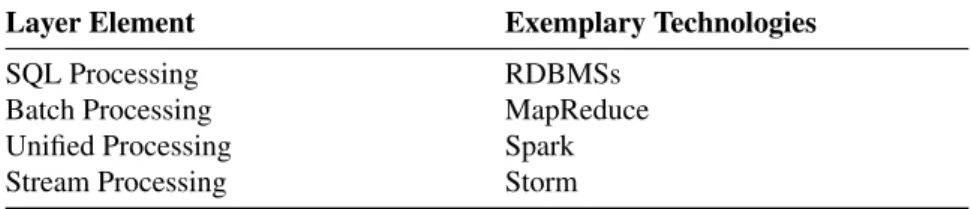
generation speed must fit the data processing speed for some applications [33], they must be carefully chosen with regard to the use case at hand. Exemplary technologies for different layer elements are given in Table 4.
A distributed processing engine can be seen as an
infrastructure rather than a tool. It is an enabling
technology that can be used or build upon, for instance by analytical tools, which employ large scale machine learning algorithms. Big Data necessitates the use of distributed technologies [8]. New distributed processing technologies constantly emerge [17].
Database processing utilizes functionalities of
underlying databases to perform operations over data within their repositories [22]. Costly data movement is not necessary. Functionalities includes typical SQL
operations such as joins or aggregations (e.g.,Sum) and
groupings [22, p. 356]. Some databases also support enhanced functionalities such as regular expressions [22] or user-defined functions (UDF) [22].
When combined with MPP RDBMSs, database processing is considered even faster and more efficient than file-based in-memory processing with large datasets
[22]. It is therefore a reasonable choice for the
deployment of machine learning algorithms. In contrast, file-based processing cannot be done with off-the-shelf
software [38]. As the data is rarely structured and
diverse, it requires custom coding to derive structure and meaningful insights, as in the approaches described next. Batch processing is used in situations where the entire data is stored prior to analysis [33]. BPEs are capable to handle large amounts of data-at-rest. Algorithms divide data into chunks and process each of them individually on its own machine to generate intermediate results, which are eventually aggregated to a final result. Such execution jobs are predefined by programmers, given to the system, and executed over a longer period of time. They cannot be adjusted while execution is in progress. MapReduce [20] is a representative for BPEs.
Stream processing handles high frequency
data-in-motion and is used in situations where immediate
results are required [17]. Although it is considered
challenging to build a real-time streaming architecture [5], organizations frequently move towards collecting
and processing real-time data [53]. Apache Storm9 is
a representative for SPEs.
Unified processing aims to combine the advantages of batch and streaming into a single system for processing both data-at-rest and data-in-motion. UPEs provide a single programming model for all purposes and usually employ micro-batches to simulate stream processing. Such systems do not provide real-time but near-real-time processing. While the former seeks to guarantee results within application-specific time constraints, the
latter does not. Unified processing furthermore aims
to provide users with interactive query capabilities and fast answers, even for large amounts of data-at-rest [5]. Thus, engines in this category employ in-memory storage to better support low latency queries and iterative workloads such as machine learning [40]. This is also
denoted as iterative-batch processing [40]. A
well-known representative for UPEs is Apache Spark10.
2.5
Data Analytics Layer
The data analytics layer comprises technologies
responsible for the value generating process of the
adaptive Big Data value chain. Such technologies
uncover hidden patterns and unknown correlations to improve decision making [33] and are a means for
implementing Big Data use cases. Data analytics is
differentiated by two dimensions: the type of data
analytics and the generation of machine learning. The former distinguishes (cf. [57] [56]) technologies by their support for descriptive (cf. [56]), predictive (cf. [57] [56]), and prescriptive (cf. [56]) methods, which are eventually condensed to Business Intelligence (BI) and advanced analytics. BI analytics focuses on descriptive
analytics (e.g., OLAP), while advanced analytics
9 http://storm.apache.org 10http://spark.apache.org/
Table 4: Layered Reference Framework – Data Processing Layer
Layer Element Exemplary Technologies
SQL Processing RDBMSs
Batch Processing MapReduce
Unified Processing Spark
Stream Processing Storm
focuses on predictive and prescriptive analytics [32]. Advanced predictive or prescriptive analyses typically employ machine learning (cf. [57] [42] [22]). Machine
learning methods, among others, include11classification
(cf. [26, 34]), regression (cf. [46]), topic modeling (cf. [15] [22]), time series analysis (cf. [22]), cluster analysis (cf. [22], [18, 26]), association rules (cf. [46] [22]),
collaborative filtering (cf. [4, 34]), and dimensional
reduction (cf. [49, 60]). Advanced analytics can be further described by a maturity model proposed by AGNEESWARAN [3], which distinguishes analytical tools into three generations of machine learning as follows:
1st Generation Machine Learning (1GML)requires the data workload to fit into memory of a single
machine. Such tools are restricted to vertical
scaling (cf. Section 2.3), which is a drawback when
considering Big Data. Tools in this group were
usually developed before Hadoop and are referred
to astraditional analytical tools. Usually, vendors
try to enhance or re-engineer their products in a way that allows the usage of Big Data. Mostly, connectors are added that allow read and write operations to HDFS while the analysis is still performed within the tool. Hence data is exported from storage, analyzed, and later re-imported12. 2nd Generation Machine Learning (2GML)
enhances 1GML with capabilities for distributed
processing across Hadoop clusters. In contrast
to 1GML, data remains at its location while the code execution is divided and processed on each required data node in parallel13. Tools in this class
are denoted asover Hadoop[3]. Many algorithms
do not translate easily into MapReduce [40]. While non-iterative algorithms can be translated into efficiently performing series of MapReduce operations, iterative algorithms such as machine learning cannot. Thus, the expected performance for such workloads is poor.
11http://machinelearningmastery. com/a-tour-of-machine-learning-algorithms/
12This is referred to asdata-to-code. 13This is referred to ascode-to-data.
3rd Generation Machine Learning (3GML)
enhances 2GML with capabilities to efficiently
perform distributed processing of iterative
algorithms. This class is referred to as beyond
Hadoop. Associated tools such as Spark use more advanced distributed processing methods or in-database execution to cope with some of the disadvantages that come with MapReduce.
Sample technologies for different layer elements and machine learning generations are given in Table 514.
Usually, tools evolve over time due to re-engineering
efforts by vendors. For instance, Mahout just
recently evolved from 2GML to 3GML as it now
supports processing on Spark, Flink and H20 along
with MapReduce. As these engines support efficient
execution of iterative machine learning algorithms, Mahout is classified into two layer elements.
The distinction between BI and advanced analytics
is supported by a study of KING and MAGOULAS
[37]. According to them, traditional data analysts use commercial tools such as Excel, Microsoft SQL Server, and Tableau for explanatory BI for descriptive analytics.
On the other hand data scientists (cf. [59]) utilize
open source tools like R, Apache Hadoop, and scalable
machine learning such as Apache Mahout15.
BI analytics is about dicing, slicing, drill-up,
drill-down, and drill-through operations over cleaned historical data using a predefined multidimensional model [22] [13]. This can be done using server-based OLAP Engines such as Microsoft SSAS and Pentaho
Mondrian16. For small amounts, simple off-the-shelf
software like Excel can be sufficient.
Big Data analytical solutions can be differentiated as offline and online analytics [16] as well as combined
approaches (cf. [55]). Online analytics is used for
real-time environments that require low latency for results, especially with data-in-motion. Offline analytics
14All tools are classified without extensions. Extensions could allow to tools be classified in a higher tier, e.g., Microsoft R (https:// mran.microsoft.com/open/, formerly Revolution R), which enables distributed execution over Hadoop clusters
15http://mahout.apache.org/
16See http://community.pentaho.com/projects/ mondrian/.
Table 5: Layered Reference Framework – Data Analytics Layer Layer Element Exemplary Technologies
OLAP Tools Microsoft SSAS, Pentaho Mondrian
1GML R, RapidMiner, KNIME, SAS, WEKA
2GML Mahout (MapReduce)
3GML Mahout (Spark / H2O / Flink), MLlib, H2O ML, Flink-ML SAMOA, MADlib
usually employs batched processing for ingestion, transformation, and analytics.
While latency (cf. [40]) is the most important
factor for online-analytics, throughput is essential
for offline-analytics [12]. Latency highly depends
on the technologies for processing and storage on the corresponding layers of the layered reference
framework. While online-analytical systems usually
operate on SMP, MPP, and NoSQL databases using in-database, stream, or unified processing, offline-analytical tools usually employ distributed file systems in combination with batched processing [28].
A survey among data analysts and data scientists from 2014 [37] reveals that in-database analytics with SQL is used by 71% of the respondents, while the next high ranked tool, R, is only used by 43%. Only 7% of the respondents use Mahout. NoSQL and Hadoop may have solved the storage problem for large amounts of raw data, but still seem unable to sufficiently fulfill needs of business users with regard to data analytics.
3
T
HES.T.A.D.T. S
ELECTIONF
RAMEWORKThis section introduces our Strategy, Time, Analytics,
Data, and Technology (S.T.A.D.T.) Selection
Framework (abbreviated as SSF), which aims to guide technology selection in the Big Data era. It seeks to find a set of valid solutions for given Big Data use cases. SSF is based on the layered reference framework presented in Section 2 and consists of two parts: a business and a selection process. Figure 3 provides an overview of the framework.
The business process is partly based on Marr’s
SMART Model [43], which can be used as a guideline on how to evolve towards a Big Data driven smart
business. However, the S.T.A.D.T.SSF as presented
here is fundamentally different, except for the general
idea of the first two process steps of strategy and
measures (here: data). The SSF aims at selection of technology, not at business transformation, and hence
reinterprets and renames the process steps by MARR
to reflect this change (Strategy, Time, Analytics, Data,
and Technology). In this way, it is similar to the
GOBIAmethod of [27], which also combines a reference
architecture with a development process. Notably, the process of technology selection could be extracted from the SSF and be seamlessly embedded as final step in the
GOBIA method development process (GOBIA.DEV, cf.
[27]).
The business process of the Strategy, Time,
Analytics, Data, and Technology (S.T.A.D.T.) Selection Framework (SSF) serves as a roadmap for companies who want to select appropriate technologies for their Big Data use cases at hand. It starts with the overall strategy, i.e., business objectives to be achieved [43]. Depending on the strategy, measures of input data, suitable analytics and required response times are derived and used to select suitable classes of storage systems, analytical tools, and processing engines respectively. Finally, a suitable technology mix is selected that corresponds to the input use case.
All steps of the SSF’s business process have
implications on technology selection. They filter the
layered reference framework and thereby narrow the
search space for valid solutions. First, the overall
strategy is used to select relevant layers. Secondly,data
measures, analytical requirements, and response times
determine relevant layer elements. Finally, the remaining technologies are filtered by their interdependencies (e.g., compatibilities), individual properties as well as user preferences to derive the final solution space.
There is no single decision tree that determines the right technology mix with respect to all conceivable circumstances [51]. Thus, our SSF aims to find the set of best suited technologies in each selection step. It does not seek a complete list of possible technology sets for a use case. As the great potential for Big Data arises when different technologies are used in concert, it attempts to recommend at least one tool on every required layer for further investigation.
The remainder of this section follows the structure
of the SSF business process. It starts with strategy
(cf. Section 3.1), defines requirements on (response)
times (cf. Section 3.2), decides on analytics
(cf. Section 3.3), then continues with data (measures) (cf. Section 3.4), and finishes with selection of suitable
technologies (cf. Section 3.5). Each process step is
T
A
D
T
ime nalytics ata echnologyS
trategy Layer Selection Layer Element Selection Technology Selection Business Process Selection ProcessFigure 3: The S.T.A.D.T. Selection Framework
resulting implications on technology selection. The
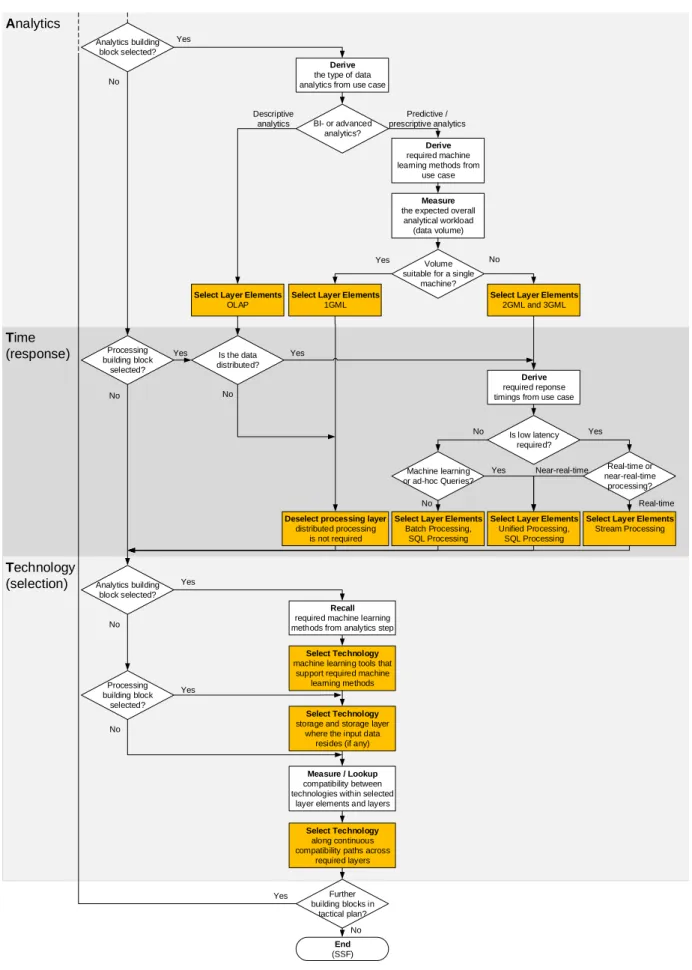
complete SSF process is illustrated in 5 and 6, in the form of flow charts.
3.1
Strategy
This section deals with Big Data strategies and their transformation into executable tactical plans. It describes different building blocks and associates each with required layers and steps of the SSF’s business process. While the development of a specific Big Data strategy is out of scope, this section still provides a brief strategy guideline as well as a description of organizational requirements and impacts.
Overall, strategy is essential and drives the selection of technology [27]. Big Data initiatives need to be aligned with the overall business strategy [28]. Prior to analysis of Big Data, it is essential to derive relevant and business
related questions that need to be answered17 (see also
[43] [21] [28]).
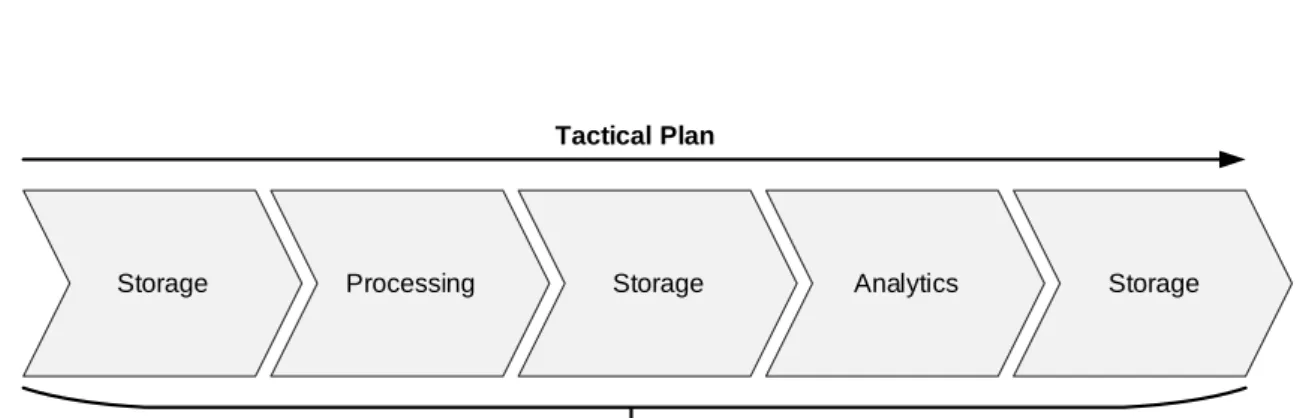
Once a strategy has been settled and a business relevant question has been derived, it can be translated into an executable tactical plan. Initial building blocks are storage, processing, and analytics, because they represent categories for typical Big Data use cases respectively Big Data products used in these use cases. These building blocks can be arranged in any sequence of arbitrary length to solve a business relevant question. Each block starts a new iteration of the SSF process and covers a unique functionality. Storage for instance
17http://practicalanalytics. co/2015/05/25/big-data-analytics-use-cases/
acquires and stores data from any sources. It makes sure that the data is stored in an appropriate data store that fits the data at hand. Processing transforms data from one state to another within the data source it resides, e.g., from multi-structured data to structured data. Finally, analytics performs machine learning algorithms to create additional value. Figure 4 provides an sample tactical plan.
Firstly, a storage building block acquires for instance multi-structured data from an external source and stores it in a suitable storage system within the infrastructure,
e.g., HDFS. Secondly, a processing building block
transforms the data into a structured format, while it
remains within HDFS. The third iteration takes the
processed data from HDFS as source and stores it in the most suitable storage system of the infrastructure, e.g., into a RDBMS. The subsequent analytics building block performs machine learning algorithms on the data stored in the RDBMS. Such blocks may also employ a distributed processing engine to fulfill their task. Finally, the storage building block seeks the best suited system to store the analytical outcome.
Each type of building block seeks technologies at different layers of the layered reference framework (cf. Section 2). The assignment of building blocks to layers is given in Table 6.
Storage for instance seeks compatible technologies on two layers: the data acquisition layer and the data storage layer. Analytics searches for compatible technologies on the data processing and the data analytics layer while considering a specific storage system as input source. This is indicated by using parentheses. Processing can
Storage Processing Storage Analytics
Building Blocks Tactical Plan
Storage
Figure 4: Building Blocks for Tactical Plans: Storage, Processing and Analytics
Table 6: Building Blocks – Layer Assignments Layer Storage Processing Analytics
Data Analytics 6 6 4
Data Processing 6 4 4
Data Storage 4 (4) (4)
Data Acquisition 4 6 6
be described analogously. Note that the data generation layer is not listed in Table 6 as it does not contain technologies but data characteristics, which are used for filtering layer elements in Section 3.4.
Different types of building blocks also require other SSF process steps. Their mappings are given in Table 7. For each building block, the associated steps need to be executed in their corresponding top-down order to receive a suitable technology mix. This is automatically taken care of by the process flow charts in figures 5 and 6.
Storage building blocks for instance rely solely on the data and technology steps, while analytics building blocks require the latter three steps of analytics, time, and technology. Required steps for processing building blocks can be derived analogously.
The decomposition of a use case into sequences of storage, processing, and analytics has at least two
advantages. Firstly, it narrows the search space for
each block, which makes especially large and extensive
Big Data use cases more tangible. Secondly, the
decomposition only requires to understand the purpose of each building block and can be carried out by business staff without extensive IT expertise.
However, decomposition may lead to an over-optimizing of solutions as building blocks are handled in isolation. The result may be many “locally optimal” pieces of technology, which each require specially
Table 7: Building Blocks – Process Step Assignments SSF Process Step Storage Processing Analytics
Measures 4 6 6
Analytics 6 6 4
Response 6 4 4
Technology 4 4 4
trained staff and integration. Trade-offs have to be
made to select few, yet manageable ones. But this
consideration is out of scope of this work and not yet covered by the SSF.
3.2
Time
This section handles the selection of best-suited layer elements with regard to processing in distributed environments. Hence it is only needed in cases where the underlying data is stored in distributed storage systems
[48]. In such cases, the selection depends on the
assessment of required response times to be derived from
the use case. If the data is not stored in distributed
storage systems, then distributed processing is also not required. In such cases, the whole processing layer is deselected and not used in the final technology selection
step (cf. Section 3.5). The process is illustrated in
Figure 6 and elaborated upon in subsequent paragraphs. In case of distributed data, users need to specify their requirements for latency (cf. Section 2.5). Essentially, they need to determine if the latency of a result is a
fundamental measure for their use case at hand. If
so, the use case needs to be assessed to determine if specific time constraints are prescribed that must be guaranteed. In cases where real-time results are needed (i.e., where short response times must be guaranteed), SSF selects stream processing as the most suitable
layer element. In cases where near-real-time results are sufficient and small random time gaps (e.g., a few seconds) between data arrivals and processing results are acceptable, SSF selects SQL [55] and unified processing. The latter uses micro-batches to simulate streaming (cf. Section 2.5). This comes with more latency but also with less complexity compared to stream processing. Unified processing furthermore unifies the programming model for batch and streaming, which makes it a more
universal tool. As such, it should be preferred over
stream processing where possible [40].
If low latency results are not fundamental for a given use case, it is not recommended to use SPEs due to their complexity [40]. In such situations, batch or iterative-batch processing are more suitable (cf. Section 2.4). Such engines come with higher latency but allow high throughput [44]. The choice between the two depends
on the need for iterations. Ad-hoc queries and most
machine learning algorithms are iterative in nature [55]. Thus, SSF selects unified and SQL processing in case of their presence. In all other cases, the usage of batch processing is sufficient, such that the corresponding layer element is selected.
3.3
Analytics
This section prepares the selection of suitable machine learning tools. It aims to select best suited layer elements on the corresponding layer of the layered reference framework. The selection depends on three factors: the required type of analytics, the expected data volume and the required machine learning methods (cf. Section 2.5). The process is illustrated in Figure 6 and discussed in the following paragraphs.
The first decision determines between BI and
advanced analytics (cf. Section 2.5). The former
represents descriptive methods while the latter
emphasizes predictive and prescriptive analytics. In
case of descriptive analytics, traditional BI technologies such as OLAP tools are naturally supportive and thus selected. In case of predictive or prescriptive analytics, the required machine learning methods need to be derived to select appropriate tools in the later technology selection step of the SSF [55]. For instance, if a use case aims to provide recommendations, then it usually employs collaborative filtering. Clustering can be used if a use case needs to find similar entities, e.g., groups of customers.
The expected data volume determines the minimum required generation of machine learning for a given task (cf. Section 2.5). While 1GML tools are sufficient for data workloads that can be analyzed on a single machine, 2GML or 3GML are required in situations that determine horizontal scaling (cf. Section 2.5). The latter two need
distributed processing engines while 1GML does not. Such tools process data in local memory and just connect to arbitrary storage systems for read / write operations. If a task can be analyzed on a single machine, then that is the recommended solution. 1GML tools are easier to handle, more mature, and more extensive in their machine learning capabilities than horizontally scaling
tools [40]. So, 2GML and 3GML technologies are
only recommended in situations that require distributed
processing due to high volumes. The actual choice
between the two is implicitly further refined in the
time-step of the SSF by selection of processing types
(cf. Section 3.2).
There is a variety of different tools for advanced analytics available on the market. Because of their large numbers, it is not reasonable to handle them in this work simultaneously. Instead, a representative subset
is selected and evaluated. KDNUGGETS18 considers
itself as one of the top web resources for analytical software and conducts a poll about their usage every
year. The results for 2015 are based on 2,800 votes
by users of the data mining community, who have
chosen from a record of 93 different predefined tools
[47]. With some adjustments, these results can serve as the foundation for tool selection in the work at hand. Firstly, formal languages like SQL, Python, Perl,
Pig, and Lisp are removed from the list. Secondly,
all 1GML tools other than the top 3 with regard
to usage are removed. The same holds for Big
Data processing engines and analytical tools without capabilities for advanced analytics (i.e., predictive or
prescriptive methods) (cf. Section 2). Furthermore,
spreadsheet tools with a focus on office users like Excel are excluded. Finally, the list is extended by promising findings during literature research and interviews for this work. Examples for such include MADlib, Flink ML and SAMOA. Additionally, Microsoft SSAS is included as a representative for OLAP engines.
The gap between 1GML and 2GML / 3GML tools with regard to their usage suggests that most analytical use cases are still solved with traditional tools, even in the Big Data era.
3.4
Data
This section deals with measurements of data
characteristics, which are used to select layer elements on the data acquisition and the data storage layer. The overall goal is to find layer elements that are best suited for the data at hand. For this, a proper understanding of data characteristics is key to success [30].
A starting point are the well-known 3 Vs of Big
Data [22]: volume, variety, and velocity. While velocity distinguishes between in-motion and data-at-rest [55], variety distinguishes between structured and multi-structured data [22] (see also Section 2.1). Furthermore, the volume dimension determines how
much scalability is needed. It distinguishes between
horizontal and vertical scaling (cf. Section 2.3) [40]. As the desired infrastructure must be scalable for the future, all decisions on data characteristics have to support the current and the future dataset [16]. Thus, not the current state needs to be measured, but the expected one.
The assessment of the 3 Vs follows a three-step process, as illustrated in Figure 5. Firstly, the velocity
dimension is inspected. It determines between
data-in-motion and data-at-rest. Both require fundamentally different technologies and methods for data acquisition
(cf. Section 2.2). While data-in-motion leads to the
selection of CEP engines and messaging systems [44], data-at-rest selects the layer element for traditional data
integration tools. The respective flow chart part in
Figure 5 highlights all process steps for selections with orange color.
Secondly, the volume dimension needs to be
inspected. It determines whether a Big Data platform is required or whether the data can be processed on a single machine [55]. Big Data technologies should not
be used if there is no need to do so [5] [51]. It is
a magnitude easier to solve problems with traditional SQL based systems or by using script-based processing of multi-structured data on the local file system of a
single machine [40]. These tools are less complex
[51], more mature, widely understood, and broadly
available. In a nutshell, if the data volume allows
storage and processing on a single machine, then that
is the recommended solution. In this case, SSF
selects RDBMSs and recommends to use local non-distributed file systems in combination with scripts for
data transformation. Notably, through the years, a
typical server’s capabilities have continuously increased, making a volume-based decision between a distributed
system and a single machine time-dependent. For
instance, single machine servers can easily possess
several TB of main memory nowadays19,20, whereas it
was only hundred or a few hundred GB less than 10 years ago21.
In cases where the overall expected volume exceeds a single machine’s capacity with regard to storage, CPU, or memory [5], the variety dimension needs to be
19http://www.alphr.com/news/enterprise/387196/ intel-xeon-e7-v2-servers-support-6tb-of-ram 20https://www.theregister.co.uk/2017/05/16/
aws ram cram/
21http://www.pcworld.com/article/161822/ article.html
inspected to select a best suited storage system. While structured data is well-suited for MPP RDBMSs, multi-structured data requires NoSQL stores or distributed file systems. The selection for multi-structured data can be further refined by assessing the expected number and
size of files [51]. For small numbers of large files,
it is suggested to use distributed file systems. For
large numbers of small files, the recommendation is to
use NoSQL stores. MARZ [44] explains that Hadoop
can be a magnitude slower for processing of many small files compared to few big files, although both scenarios have the same overall volume. Reasons for this include high latencies for individual record lookup in HDFS [10]. The framework therefore suggests to select distributed file systems for large files and NoSQL stores for large amounts of small files in accordance with the mentioned authors. However, there are newer distributed file systems with in-memory capabilities for random and fast data access such as Alluxio22. For such systems, the
distinction for number and size of files is less important. If they win recognition, they possibly form a new class of storage systems in the layered reference framework for further distinction. However, this is not yet included in its current version.
The choices for layer elements are derived from interviews [41] and from a comprehensive literature
review. BEGOLI and HOREY [7] for instance provide
some principles for good Big Data architectures. The authors especially give advice on the influence of data
variety on technology selection. They suggest to
use Hadoop for unstructured data, MPP RDBMSs for structured data, and NoSQL stores for semi-structured
data. Similarly, FERGUSON [28] suggests to align
data characteristics with storage and recommends to use MPP RDBMSs for complex analysis of structured data and Hadoop for multi-structured data, especially for storage and processing tasks of archive data. He also discusses the differences between data-at-rest and data-in-motion and their relation to CEP engines, stream
and batch processing. CHAN [10] contributes to the
discussion and argues about the impact of velocity
on technology selection. The author introduces an
integrated conceptual architecture for stream and batch
processing. Finally, MARZ [44] suggests the Lambda
Architecture, which unifies processing of data-at-rest and data-in-motion on a conceptual level.
3.5
Technology
This section handles the final step of the SSF business process, which eventually selects a suitable technology
mix. The selection follows a three-step process as
illustrated in the lower part of Figure 6. Firstly, suitable machine learning tools are selected in cases where
analytics is required. Secondly, the storage system
that holds the input data is selected if the current SSF iteration handles an analytics or processing building block. Finally, interdependencies are inspected to find compatible technology mixes between required layers of the layered reference framework. The results can be further refined by investigation of technology-specific characteristics. Each process step is described in the following paragraphs.
If the current SSF iteration handles a building block for analytics, suitable analytical tools must
be selected. Recall the assessment for machine
learning methods performed in the analytics-step
(cf. Section 3.3). A suitable tool must support the
identified required methods. For proper selection,
Table 8 and Table 9 provide mappings between analytical tools and supported machine learning methods. The SSF process requires all technologies that enable the required methods of the use case to be selected for the later compatibility check.
Note that all assessed 1GML tools support any of
the machine learning methods. As most Big Data
analytical tools offer less functionality compared to solutions that operate in-memory on a single machine, Big Data technologies are less promising for small data [40], which is another indication that they should only be used when certainly needed (cf. Section 3.3).
The mappings in Tables 8 and 9 are based on the
work by LANDSET et al. [40] and RICHTER et al.
[49] who assess analytical tools with regard to machine learning support. This work enriches their findings with additional tools and methods. It furthermore refines their results with information collected from the individual websites and documentations of the tools.
For simplicity, SSF only uses machine learning methods for mappings. However, each of these methods may include several different specific algorithms that are
suitable to fulfill the task. For instance, classification
can be performed with decision trees, linear and logistic regression, Na¨ıve Bayes, Support Vector Machines (SVMs), gradient boosted trees, random forests, adaptive model rules, and generalized linear models [40]. The framework indicates a tool’s support for a machine learning method if one of the enabling algorithms is
included. A more comprehensive list of available
machine learning algorithms as well as their coverage by processing engines is given by the formerly mentioned authors [40] [49]. If needed, SSF can easily be extended with specific algorithms. However, this is out of scope of the work at hand.
The next process step requires to select the input
storage system where the data is located. This is
mandatory for processing and optional for analytical building blocks. While the former always performs on data within the local infrastructure, analytical tasks can also be executed on a data stream without prior storage. This is also explained with the adaptive Big Data value chain in Section 2. If the data to be analyzed is located within the local infrastructure, a specific storage system needs to be selected, thus given as input. In case the data is not stored prior to analysis, the storage layer can be omitted for the subsequent compatibility check.
4
A
NA
PPLICATIONS
CENARIOThis section examines an application scenario for SSF and thereby demonstrates the technology selection, which is based on continuous paths through the layered reference model and technology capability mappings. The application scenario is first introduced. It features a retailer with an existing traditional data warehouse that has been created based on traditional requirements. These prerequisites are used to infuse the SSF process
to find a suitable technology mix. This section
shows which technological choices SSF suggests in the context of current technologies, and if and to which extend they deviate from the existing choices. Finally, the application scenario is revisited with a new requirement to determine required changes to the underlying technologies to remain compliant with requirements.
4.1
ShopMart
Scenario Characteristics
The usage of a traditional data warehouse with traditional requirements is illustrated using fictitious
German retailer ShopMart. Although the scenario
and its assumptions are fictitious, they represent
common elements in warehouse architectures and related requirements (e.g., reporting or OLAP), which have evolved over time in both research and practice. Thus, the application scenario presented could be applicable to other traditional setups that rely on similar technologies.
The long term goal of ShopMart is to become the
most profitable retailer in the low price segment in Germany with the highest profit margin. The product
selection offered by ShopMart appeals to a broad
customer base (i.e., not too expensive). To achieve
these long term goals, strict cost control mechanisms are employed. This strategy is implemented in its data warehouse with two analytical tools that are represented
as tactical plans in SSF. We outlineShopMart’sgoals and
requirements next; subsequently, the current warehouse implementation is described. With this, the necessary information for the SSF process can be derived (rather
Strategy Analytics Data Select Layers depending on building block Start (SSF) Storage building block selected? Measure
the expected overall data volume
Select Layer Elements
SMP SQL Databases, (and use a local
filesystem)
Measure
data variety Volume
suitable for a single machine?
Structured or multi-structured
data?
Select Layer Elements
NoSQL Data Stores
Select Layer Elements
MPP SQL Databases Data-in-motion
or data-at-rest?
Measure
data velocity
Select Layer Elements
CEP Engines, Messaging Systems
Select Layer Elements
Data Integration Tools Data-at-rest Data-in-motion Yes No Structured Multi-Structured Number and size of input files?
Small amount of large files Large amount
of small files
Select Layer Elements
Distributed File Systems
Derive
tactical plan from strategy
Select
next building block
Analytics building block selected?
Yes No
Time (response) Analytics
Measure
the expected overall analytical workload
(data volume)
Volume suitable for a single
machine?
Select Layer Elements
1GML BI- or advanced
analytics?
Select Layer Elements
OLAP
Select Layer Elements
2GML and 3GML Descriptive analytics Predictive / prescriptive analytics Yes No Derive
the type of data analytics from use case Analytics building
block selected? Yes
Derive
required reponse timings from use case
Is low latency required?
Select Layer Elements
Stream Processing
Select Layer Elements
Unified Processing, SQL Processing
Select Layer Elements
Batch Processing, SQL Processing Machine learning or ad-hoc Queries? Real-time or near-real-time processing? Is the data distributed?
Deselect processing layer
distributed processing is not required Yes No Yes Near-real-time No Real-time Processing building block selected? No Yes Yes No Technology (selection) Select Technology
machine learning tools that support required machine
learning methods Analytics building block selected? Yes No End (SSF) Measure / Lookup compatibility between technologies within selected
layer elements and layers
Select Technology
along continuous compatibility paths across
required layers
Recall
required machine learning methods from analytics step
Select Technology
storage and storage layer where the input data
resides (if any) Processing building block selected? No Yes Further building blocks in tactical plan? Yes No No Derive required machine learning methods from
use case
Table 8: Supported Machine Learning Methods for 1 GML and OLAP Tools (based on [35])
ML Method RapidMiner KNIME R Microsoft SSAS
Regression 4 4 4 4 Time Series 4 4 4 4 Classification 4 4 4 4 Topic Modeling 4 4 4 6 Cluster Analysis 4 4 4 4 Association Rules 4 4 4 4 Collaborative Filtering 4 4 4 6 Dimensional Reduction 4 4 4 6 ML Generation 1GML 1GML 1GML OLAP
Table 9: Supported Machine Learning Methods for 2/3 GML Tools (based on [40] and [49])
ML Method Mahout (MR) Mahout (Spark) Mahout (H2O/Fl) H2O ML Flink ML
MLlib MADlib SAMOA
Regression 6 6 6 4 4 4 4 4 Time Series 6 6 6 4 6 6 4 6 Classification 4 4 6 4 4 4 4 4 Topic Modeling 4 4 6 6 6 4 4 6 Cluster Analysis 4 6 6 4 6 4 4 4 Association Rules 4 6 6 6 6 4 4 4 Collaborative Filtering 4 4 6 6 4 4 6 6 Dimensional Reduction 4 4 4 4 6 4 4 6 ML Generation 2GML 3GML 3GML 3GML 3GML 3GML 3GML 3GML
abstract tactical plans and, based on these, data, time, analytics process part information).
1. ShopMart points out profit and cost as Key Performance Indicator (KPI) for each subsidiary,
each product, and the combination of the
aforementioned. These are used for daily and
quarterly reports. To this end, ShopMart has
an Enterprise Resource Planning (ERP) system, which collects all transactions (e.g., a customer
buying a product) from the subsidiaries. The
cash registers push their data either in real-time
or asynchronously to the ERP system. From
there, the data warehouse receives the data via ETL processes, which perform data cleaning and transformation procedures to generate materialized views that prepare the data for report generation. 2. ShopMart monitors and analyses current and
historical prices of its various suppliers to select the most cost-efficient supplier for short-term and
long-term contracts. The response time requirements
are stated as “as fast as possible” so that new orders can be placed exactly when the time is right.
The available warehouse technology allows for a response of one day (daily ETL with analytics in
the warehouse) when ShopMart built it. To this
end, ShopMart has various systems in place to
capture current prices. For instance, wholesaler
B2B online shops are scraped regularly to acquire prices for products purchased via wholesales. The captured data is loaded via an ETL process and the placed in the data warehouse for enhanced
analytics. ShopMartcurrently employs time-series
analysis to forecast price trends for its products. The results are saved in materialized views, which are refreshed daily, and supplied to a tool that can access these data via SQL.
These requirements are used to derive two more abstract tactical plans as proposed by SSF (see Figure 7
and Figure 8). These do not refer to specific
technologies, only to the requirements at hand. That way, the technology selection can be done with SSF, after it is introduced in the following section.
(1.1) Storage Acquire and store
facts (sales and purchases) and dimensions (e.g., products) (1.2) Analytics Compose aggregate revenue
and cost KPIs per subsidiary and
product
Figure 7: ShopMartTactical Plan for Profit and Cost KPI Goal (1)
4.2
Technology Selection Approach
Generally, once relevant layers, layer elements and perhaps input data sources have been determined with the SSF process, a suitable technology mix
can be selected (cf. Figure 6). However, it is
necessary that those technologies, which are on adjacent layers in the layered reference model, are compatible
to each other. A continuous path of compatible
technologies along the various layers ensures that a
valid technology mix is proposed. The selection
process checks for compatibilities between candidate technologies within selected layer elements and searches for continuous compatibility paths from the topmost to the lowest selected layer of the layered reference model. Conclusively, every continuous path is a valid solution. Figure 9 provides a scenario that represents an analytical building block with persistent input storage.
In this example, previous process steps have already selected best suited layer elements. Unselected layers and layer elements are faded out and not considered
for the final result. The sample use case requires
machine learning method {1} and data storage {7},
which have been provided as input in the corresponding steps of the SSF process. With this preselection, valid solutions include the sets{1, 2, 4, 7} and{1, 2, 5, 7}as both represent a continuous path from the topmost to the lowest selected layer. The candidate solution{1, 3, 6, 7}
is interrupted, as the analytical tool named{3}does to
support the required machine learning method. Thus it is not a valid solution.
This concept of technology selection requires
compatibility mappings between technologies at
adjacent layers. One example for such is given in
Table 10. It provides mappings for analytical tools and
distributed processing engines. SAMOA for instance
can be employed in combination with Storm or Flink, while MLlib only supports Spark.
The general idea for mappings is based on LANDSET
et al. [40] who also provide a graph-based compatibility mapping between processing engines, machine learning
methods, and analytical tools. This work extends their idea to other layers such as storage and data acquisition to provide a more comprehensive mapping, which can be used for diverse and more customized technology selections.
Valid sets of technologies can be further refined with user preferences and technology specific individual
properties. Storage systems can for instance be
filtered with regard to their preference for consistency, availability and partition tolerance as proposed by the
CAP theorem [9]. In case of distributed systems,
partition tolerance is mandatory [48]. Thus, users can decide between consistency and availability for their use case at hand and filter results accordingly.
4.3
ShopMart
Technology Selection
Applying the SSF technology selection approach to the
ShopMartscenario at hand yields the following results.
Tactical plan for profit and cost KPI goal (1) (1.1) Storage. Storage building blocks work with
storage and acquisition layers (cf. Section 3).
The only input storage here is an operational ERP system out of scope of the analytical system. To decide for layer elements, data velocity, overall volume, and variety need to be clarified upon.
ShopMart uses a traditional ERP solution (SAP ERP), which uses a structured data format. Data Integration Tools are a suitable choice for data acquisition, considering dealing with data-at-rest. For ShopMart the size of an ERP currently fits
inside a single server machine, therefore anSMP
SQL databaseis selected for storage.
As for Oracle and SAP ERP products, for instance, accessing their relational SQL databases to extract
data is considered possible, albeit challenging23.
Furthermore, specialized APIs and connectors can be used to access ERP systems like SAP ERP (e.g., Oracle Business Warehouse offers a connector for
SAP24). Some ETL tools also offer SAP connectors
(e.g., Pentaho Data Integration25).
(1.2) Analytics. For this case, an analytics building
block is selected. To select it, one must decide
between BI and advanced analytics. Standard
reporting with KPIs is a typical BI analytics task. Therefore, OLAP is selected. Besides dedicated OLAP engines, some data warehouses can be SMP
23https://www.quora. com/Can-I-access-SAP-Oracle-and-most-of-the-ERP-by-SQL
24http://docs.oracle.com/cd/E11882 01/owb.112/ e10582/sap integrate.htm#WBDOD30500
25http://wiki.pentaho.com/display/EAI/ Connecting+with+SAP+Systems
![Figure 1: Adaptive Big Data Value Chain (based on [16], [33], and [11])](https://thumb-us.123doks.com/thumbv2/123dok_us/10132373.2914181/3.892.197.713.183.329/figure-adaptive-big-data-value-chain-based.webp)