Procedia - Social and Behavioral Sciences 64 ( 2012 ) 332 – 341
1877-0428 © 2012 Published by Elsevier Ltd. Selection and/or peer-review under responsibility of The Association Science Education and Technology doi: 10.1016/j.sbspro.2012.11.040
INTERNATIONAL EDUCATIONAL TECHNOLOGY CONFERENCE
IETC2012
Constructing an Adaptive Mobile Learning System for the
Support of Personalized Learning and Device Adaptation
Ho-Chuan Huang
a, Tsui-Ying Wang
b,*, Fu-Ming Hsieh
aaDepartment of Information Management, National Kaohsiung University of Applied Sciences, Kaohsiung 807, Taiwan, ROC bDepartment of Occupational Therapy, National Cheng Kung University, Tainan 710, Taiwan, ROC
Abstract
This paper presents an adaptive mobile learning system (AMLS) that provides learners with adaptive content according to their knowledge levels, learning styles, and heterogeneous learning devices. The aim of the proposed work is to provide learners with an adaptive learning environment according to learner's individual capability and the learning device used. The proposed system exploits Bayesian networks and content adaptation technologies to support both learner adaptation and device adaptation, which allows each learner to construct a personalized and adaptive learning environment.
© 2012 Published by Elsevier Ltd. Selection and/or peer-review under responsibility of [name organizer]
Keywords: Adaptive learning; Content adaptation; Bayesian networks; Learning styles; Mobile learning.
1. Introduction
Mobile learning has received a lot of attention in education with the emergence of an increasing number of new types of mobile devices, such as notebooks, personal digital assistants (PDAs), and smart phones. Learners often wish to use various types of learning devices to access the same content without sacrificing usability and accessibility. However, most of the content in Web-based educational systems is
* Corresponding author. Tel.: +886-6-275-7575 ext. 5903; fax: +886-6-237-6604.
E-mail address: [email protected].
© 2012 Published by Elsevier Ltd. Selection and/or peer-review under responsibility of The Association Science
Education and Technology Open access under CC BY-NC-ND license.
typically designed and optimized for desktop computers, which make it unsuitable for use with other types of learning devices to view the content. Even though some of the Web-based educational systems support mobile learning, they may offer content only on specific types of devices. Because content adaptation is one of the technologies that support adaptive versions of content for heterogeneous devices, there is an increasing demand for content adaptation for a Web-based learning environment. In addition to the discrepancies of learning devices, learners may have different abilities, preferences, motivations, and knowledge. Some Web-based systems are devoted to develop the techniques of content adaptation for the problem of device heterogeneities (Laakko & Hiltunen, 2005). However, learner profiles (e.g., learning styles and knowledge levels) should be considered for the design of personalized learning assistance. From a learner's point of view, adaptation results not only should satisfy individual demands (i.e., learner adaptation) but should also solve the problem of device discrepancies (i.e., device adaptation). Therefore, it is both important and challenging to adapt content so that it satisfies individual demands and fits the requirements of learning devices in a mobile learning environment.
In summary, learner adaption and device adaption are considered as two important factors to facilitate mobile learning environments for learners with various abilities and learning styles. This paper presents an adaptive mobile learning system (AMLS) that exploits both learner adaptation and device adaptation to construct a personalized learning environment according to the individual characteristics and abilities. The adaption technology used in AMLS is not new but this study proposed a novel approach which combines both learner adaption and device adaptation for the support of personalized mobile learning environment. Learner adaptation is defined as matching content to the abilities and preferences of individual learners. Device adaptation is defined as automatically adapting content to the capacities of heterogeneous learning devices. In this paper, learner adaptation refers to individual differences in both knowledge levels and learning styles, and device adaptation refers to the heterogeneities of learning device specifications.
2. Related Works
Different AES have been developed for various purposes of education. Adaptive Hypermedia Architecture (AHA) is a Web-based adaptive hypermedia system, which can support on-line courses with different adaptive features, such as conditional explanations and links (De Bra et al., 2003). The learner model in Adaptive Hypermedia Architecture (AHA) is based on concept knowledge obtained and evaluated by Web-based courses and testing (De Bra, Aroyo, & Cristea, 2004). Karampiperis and Sampson (2005) proposed an adaptive educational hypermedia system, which supports adaptive learning resource sequencing based on a decision model that chooses an adaptive learning resources by evaluating learner's abilities. Henze and Nejdl (2004) introduced a logical characterization for the definition of adaptive educational hypermedia systems (AEHS) as a quadruple (DOCS, UM, OBS, AC): DOCS (Document Space) describes documents and knowledge topics; UM (User Model) stores, describes, and infers individual user's information, knowledge, preferences; OBS (Observations) observes individual user's knowledge state and interactions with the system for updating UM; AC (Adaptation Component) contains rules for the describing the adaptive functionality of the system.
ANDES used BN (Bayesian Network) technologies to model learners' knowledge in Physics (Gertner & VanLehn, 2000). If a BN model diagnoses a learner who did not understand a knowledge concept, the learning assistance for that concept would automatically appear on the screen to help the learner. BITS, a Web-based Bayesian intelligent tutoring system, uses BN to model problem domains in programming languages and creates adaptive learning sequences for learners according to their knowledge levels (Butz, Hua, & Maguire, 2006). All of the above proposed systems have used BNs or probability computing
technologies to assist learners in mastering content, but none of them has considered both learner adaptation and device adaptation.
Content adaptation solves the problems of adapting content to heterogeneous device capabilities and supporting individual user preferences (Canali, Cardellini, Colajanni, Lancellotti, & Yu, 2003). Odyssey Systems (Noble, 2000) used static adaptation technologies to create pre-adapted content versions for specific learning devices. The advantage of static adaptation approach is that content transformation causes no delay in content delivery. One serious problem of this approach, however, is that it requires a new version of the content new type of learning device accessing the system. The more heterogeneous learning devices that the static adaptation approach must support, the more expensive and time-consuming it becomes to create different versions of the same content. On the other hand, dynamic adaptation dynamically generates the desired content based on the specifications of heterogeneous devices. Multiple pre-adapted versions of the content need not be created or stored, but a transcoding mechanism is required for dynamic content transformation (Liang et al., 2006). The major advantages of the dynamic adaptation approach are that it offers great flexibility in the support of heterogeneous learning devices and avoids the inconsistent content almost certain to appear in multiple versions made for different devices. Kim and Lee (2006) proposed a content adaptation architecture that integrates Composite Capabilities/Preference Profiles (CC/PP) files and annotation mechanisms to dynamically construct Web pages by annotating and reconstructing the structure of Web elements for mobile devices. They also developed a navigation map to decide which elements should be contained in the adapted content.
3. System Overview
3.1. System architecture
The architecture of the AMLS consists of six modules (see Fig. 1):
• The user interface module is a graphic interaction interface between AMLS and the device on the client side.
• The context detection module is responsible for detecting context information, which includes the monitoring of a learner's progress and behavior and the detection of learning devices.
• The learner profile module manages information related to an individual learner's demographic details, such as learning preferences and learning styles. It also manages a learner's states obtained from both the context detection module and the learning diagnosis module.
• The learning diagnosis module is composed of a knowledge-diagnosis mechanism and a style-diagnosis mechanism. The knowledge-style-diagnosis mechanism evaluates learner's knowledge levels by comparing learner's knowledge in the learner model against the expert knowledge in the knowledge model. The style-diagnosis mechanism identifies individual learning styles based on the information obtained from the learner profile module.
• The expert knowledge module stores the expert knowledge in the knowledge database to support knowledge diagnosis. This module also contains the learning materials and relevant pedagogical strategies to assist individual learners.
• The content adaptation module is responsible for presenting the adapted learning content. The adaptation process includes learner adaptation and device adaptation.
i
Fig. 1. System architecture
3.2. Learner adaptation
Leaner adaptation employs a learner model, which contains learner's individual characteristics including demographic information, knowledge levels, and learning preferences. In the present study, a learning diagnosis consists of a knowledge diagnosis and a learning-style diagnosis that enables an evaluation of an individual's learning preferences and their knowledge levels.
3.2.1. Knowledge diagnosis
In AMLS, knowledge diagnosis evaluates learner's knowledge levels and discovers probable misconceptions by tracing back the nodes of the network graphs in BN models. To discover what probable misconception causes misunderstanding of a certain concept; it then provides adaptive learning assistance tailored to the individual. Knowledge level is used to evaluate a learner's knowledge state about a knowledge topic or concept. A knowledge concept is identified as the misconception variable if the value of the knowledge level for the concept is low (i.e., MKj< 0.6). When the AMLS has identified all the variables of the misconception (e.g., MK1, MK2,…, MKi-1) in a test, a diagnosis process will automatically make a probabilistic inference of the probable misconception (e.g., MKi) by referring to the conditional probability tables (CPTs) in the BN model. The joint probability distribution of the inference mechanism, P(MK1,MK2,…,MKn), is expressed as follows:
∏ = ni= i n P MK pa MK MK MK MK P( 1, 2,..., ) 1 ( | ( )) (1)
In Equation 1, pa(MKi) is a set of misconception variables. It is also the parent set of the variables MKi. The assignment of values to the observed variables pa(MKi) is called evidence. In a knowledge diagnosis,
the evidence is obtained from the result of the knowledge evaluation. For example, three concepts modeled in the BN model are as follows: "Loop" (L), "While loop" (W), and "For loop" (R). The probabilistic model P(L|R= 'T', W= 'F') represents a BN diagnosis process that calculates the probability of understanding the concept "Loop" (L) when someone understands the concept "For" (R) but misunderstands the concept "While loop" (W). Based on the information of the CPT, the diagnosis mechanism will diagnose that the learner should not understand the concept "Loop". Therefore, our knowledge diagnosis mechanism can identify the misconceptions first and then deduce the probable misconceptions using the BN inference mechanism.
3.2.2. Learning style diagnosis
Learning style is the individual preferred behavior in which a learner observes and interacts with the learning environment to obtain knowledge and skills. Learning styles help learners understand their own strengths for more efficient learning (Papanikolaou, Andrew, Bull, & Grigoriadou, 2006). Soloman and Felder (2003) proposed the Index of Learning Style (ILS) questionnaire for evaluating learning styles. The Felder-Silverman theory classifies learning styles into four dimensions: (1) perception: sensitive/intuitive dimension, (2) input: visual/verbal dimension, (3) processing: active/reflective dimension, and (4) understanding: sequential/global dimension (Felder, 1993; Felder & Silverman, 1988). This study adopted the Felder-Silverman learning-style model to develop a learning-style diagnosis approach in a Web-based learning environment.
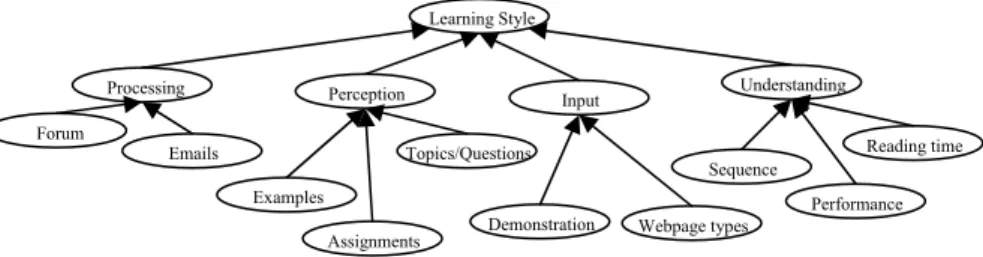
For learning-style diagnosis, another BN model was constructed to identify individual learning styles by detecting Web-based learning behavior, independent learning activity on the Web. This behavior may be a learning-related manner or event, such as reading emails, reading content, and discussing content with peer groups. To identify individual learning styles, key features of the individual's Web-based learning behavior (e.g., the frequency of reading emails) are collected and represented as BN variables for analysis. Fig. 2 shows a brief example of the learning style in the BN model. The evaluated features of the processing dimension include the numbers of emails and questions responded to, and the frequency with which forums were accessed. The evaluated features of the perception dimension (sensing/intuitive) include the number of Web pages visited, the number of questions posted, and the number of assignments submitted. The evaluated features of the input dimension include the types of Web pages and the number of demonstration page visited. Finally, the evaluated features of the understanding dimension include the sequence ratio of Web pages visited, learning performance, and the mean time spent per Web page.
After the learning-detection mechanism has collected the required information from learners' behavior, the learning-diagnosis module will calculate the values of all evaluated features (i.e., the random variables in BN models) for each dimension. If the value of the random variable is greater than the threshold value, a true value is assigned to the random variable in the BN model; otherwise, a false value is assigned. In the beginning, the threshold value of individual variable is assumed as the mean value of all the individually evaluated features. When the values of all random variables (true or false) have been obtained, the inference mechanism for learning styles is activated. Learning style (LS) consisting of m dimensions (namely Di) can be expressed as . The expression of learning style dimension Di is as
follows: ∏ = ⊆ m i 1Di LS (2) X X X D p D X X X P D n j j i i j i= ( 1, 2,..., , )=∏ =1 ( | 1, 2,..., ))
Fig. 2. A brief BN model for learning-style models
For each learning style dimension Di, there exist some attributes (i.e., behavior features) X1,…,Xj, such that Di and {X1,…, Xj} are conditionally independent given {X1,…, Xj}. The diagnosis result in each dimension Di can be false or true (i.e., mild or strong preference). As a result, 16 combinations of learning styles can be generated based on the four learning-style dimensions (see Table 1). For a new or unidentified learner, AMLS will offer a learning-style stereotype for system access. This stereotype is a general style template that contains the most popular learning style for viewing the content. Although learners with unidentified styles are offered the same learning-style options in the beginning, individual styles will be identified after the learners have created their own profiles in AMLS.
Table 1. The combinations of learning styles
{A, S, V, Q} {A, I, V, Q} {R, S, V, Q} {R, I, V, Q} {A, S, V, G} {A, I, V, G} {R, S, V, G} {R, I, V, G} {A, S, B, Q} {A, I, B, Q} {R, S, B, Q} {R, I, B, Q} {A, S, B, G} {A, I, B, G} {R, S, B, G} {R, I, B, G} A/R: active/reflective, S/I: sensing/intuitive, V/B: visual/verbal, Q/G: sequential/global
3.3. Content adaptation
The content adaptation mechanism contains a Java-based transformation engine that transforms required content into tailored content. The transformation engine uses device profile information to guide content transformation that supports heterogeneous learning devices. It can meet the capabilities of individual learning devices, enabling device-specific delivery of content in real time. New devices are supported simply by adding device profiles into the device profile database. When the adaptive mobile learning system receives a request from a learning device, the device detection mechanism accesses the database to identify the device's specifications. If the content does not match the specifications, the device detection mechanism finds a best-match version of the content in the device profile.
Content adaptation is based on the two elements of the Web content: texts and graphs. The content adaptation mechanism analyzes content elements (a text element or a graph element) and then consults the device profile to decide the content adaptation approach. Two different technologies were employed for content adaptation: the page splitting approach for solving the issue of text content adaptation and the transcoding approach for the problem of graph content adaptation. Page splitting is a technique for dividing a long text into a series of smaller fragments (i.e., sub-pages) that can be properly displayed on the small client screen. The page splitting approach was used to solve the issue of text content adaptation for mobile learning devices. If a Web page contains more than one sub-section, an index page that contains hyperlinks to its sub-pages will be generated after all the sub-pages have been created (see Fig.
Perception Input Understanding
Processing Emails Forum Reading time Webpage types Demonstration Sequence Performance Topics/Questions Assignments Examples Learning Style
3). With the page splitting approach, the learner can click on any link to access the corresponding sub-page while browsing the index sub-page.
Fig. 3. The page-splitting approach for hypertext partitions
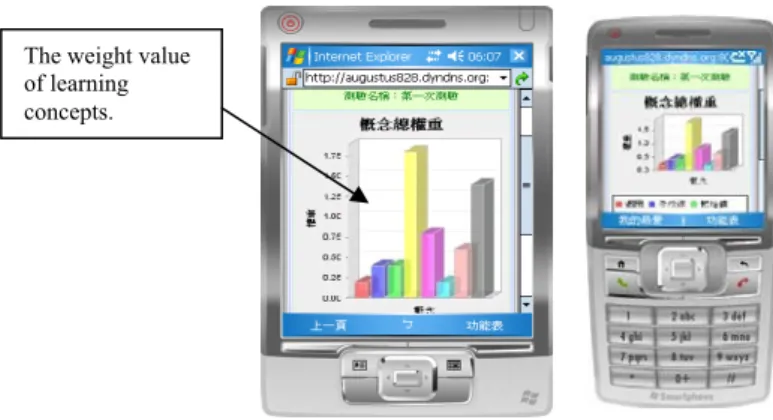
For graph transformation, CC/PP specifications, such as Model, BitsPerPixel, ColorCapable, ScreenSize, ImageCapable, and CcppAccept, have been implemented in the device profile database. A color JPEG in the server can be transcoded into a small, grayscale image in the mobile learning device to comply with low network bandwidth or display resolutions in the device. For example, if a mobile learning device supports only an 8-bit per pixel image and the screen size is 200 × 200, then AMLS will transform the original image (e.g., a 1024 × 768 image with 24 bits per pixel) to a 200 × 200 pixel in an 8-bit grayscale image. Fig. 4 shows an example of a bar graph about the weight ratio of the concepts in a knowledge evaluation in the mobile learning device.
The weight value of learning concepts.
Fig. 4. Content adaptation in mobile devices
Learning content is constructed and stored in XML format in the learning content database. However, an XML file shown as a single page on a desktop computer might not be suitable to present in a mobile learning device due to the limitation of the display screen size or device's capabilities. The content adaptation mechanism invokes the content transformation engine that will dynamically generate adapted content for mobile learners. When a content page contains both text and graphs, AMLS identifies the properties of both types of frames and then transforms both into the appropriate format for user's device.
To transform the content for different devices, the content transformation engine also uses XSL (eXtensible Stylesheet Language) and XSLT (XSL Transformations) to display or transform XML documents in a Web browser. For example, if a learning device cannot support XML format, AMLS will automatically transform XML-based Web pages to other compatible formats of Web pages (e.g., WML, HTML, or XHTML). To use transcoding technology in content adaptation, a content exchange protocol is required to build a communication mechanism between learning devices and content servers. Composite Capabilities/Preference Profiles (CC/PP) is one of the most popular exchange protocols. CC/PP is a proposed standard by the W3C for describing device capabilities and user preferences for a wide variety of mobile learning devices, such as smart phones and PDAs. A CC/PP profile is based on a Resource Description Framework (RDF) model written in XML (eXtensible Mark-up Language) with a two-level structure. A CC/PP profile created by a learning device is transmitted to an adaptation server and the server uses the profile to create and deliver appropriate content to the learning device.
4. Experiment and results
4.1.őarticipants
Thirty undergraduate students majoring in information management volunteered to participate in the system usage questionnaire. Each participant could use mobile devices, such as smart phones or PDAs, to read learning content during the experimental period. Twenty-five participants had finished the experimental procedure and completed the system-usage questionnaires after system operation.
4.2. Experimental designs
After a one-week experimental tried, the participants were designed a system-usage questionnaire to evaluate the AMLS. The questionnaire contained 5 questions that asked about their satisfaction with mobile learning. The purpose of the questionnaires was explained to the participants, and they were asked to anonymously complete and return them in order to ensure confidentiality and increase the return rate. Both questionnaires used a 5-point Likert scale for responses (1 = strongly disagree, 2 = disagree, 3 = neutral, 4 = agree, 5 = strongly agree). It took approximately 3-5 minutes to complete the questionnaire.
4.3. Results
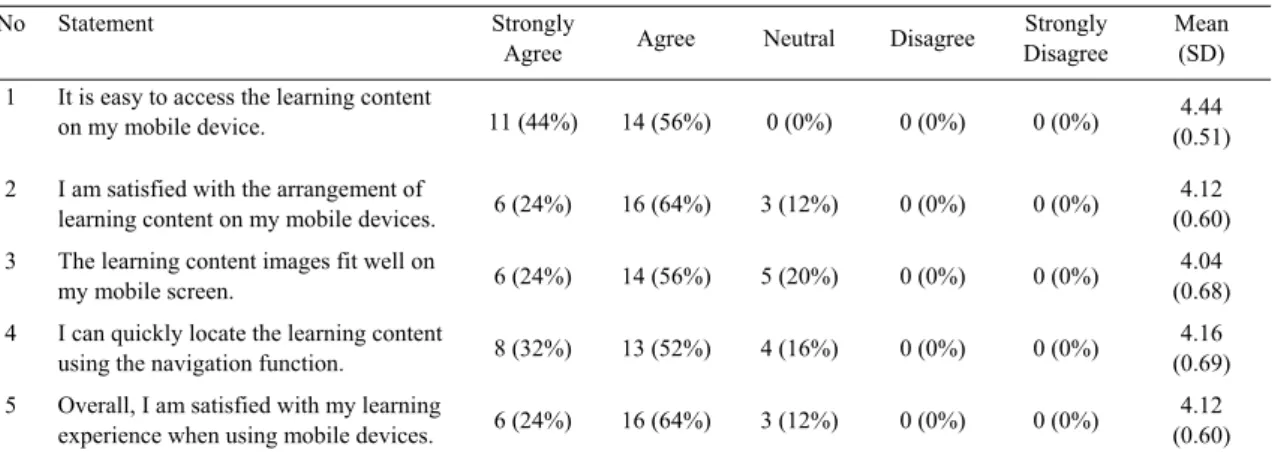
The questionnaire data were analyzed via SPSS software using descriptive analysis (percentage, mean, and standard deviation). The mean score (see Table 2) for all participants on the entire survey (5 items) was 4.18 (SD = 0.62). For Item 1, 25 (100%) participants agreed that the learning content was easy to access using mobile learning devices. Two aspects of content adaptation were asked in the survey: the adapted presentation of the text and of image frames in mobile learning devices. For Item 2, 22 (88%) participants were satisfied with the adapted content in mobile learning devices. Twenty (80%) participants agreed that the resized images fit well on the screen of their mobile learning devices (Item 3). This showed that the image transformation function and presentation (i.e., screen size and display resolution) met the requirements of most (20; 80%) participants when using different mobile learning devices. It also showed that content adaptation indeed increased the presentation flexibility of content on mobile learning devices. For Item 4, 21 (84%) participants agreed that it was easy for them to locate the target content using the navigation function in the system. Finally, for Item 5, 22 (88%) participants felt generally positive about the system for mobile learning.
Table 2. Questionnaire result for participants (n=25)
No Statement Strongly
Agree Agree Neutral Disagree Strongly Disagree
Mean (SD) 1 It is easy to access the learning content
on my mobile device. 11 (44%) 14 (56%) 0 (0%) 0 (0%) 0 (0%) (0.51) 4.44 2 I am satisfied with the arrangement of
learning content on my mobile devices. 6 (24%) 16 (64%) 3 (12%) 0 (0%) 0 (0%)
4.12 (0.60) 3 The learning content images fit well on
my mobile screen. 6 (24%) 14 (56%) 5 (20%) 0 (0%) 0 (0%)
4.04 (0.68) 4 I can quickly locate the learning content
using the navigation function. 8 (32%) 13 (52%) 4 (16%) 0 (0%) 0 (0%)
4.16 (0.69) 5 Overall, I am satisfied with my learning
experience when using mobile devices. 6 (24%) 16 (64%) 3 (12%) 0 (0%) 0 (0%)
4.12 (0.60)
5. Conclusions
The support of heterogeneous mobile devices is important for increasing learning convenience and efficiency in a mobile learning environment. By identifying individual device capabilities, content adaptation provides a solution to the heterogeneity of devices for learners. In an adaptive educational system, content adaptation offers appropriate learning content suited both to the device's specifications and to the learner's abilities. Therefore, learning diagnosis is an important procedure for identifying the preferences and knowledge levels. This study proposes an adaptive mobile learning system that uses adaptation to both the learner and the learning device to create a personalized and adaptive learning environment suited to the learners' abilities and the device's specifications. A learning diagnosis mechanism was constructed to diagnose each learner's knowledge levels and identify each learner's learning styles. In addition, content adaptation technologies were also used to automatically adjust content to match the specifications of learning devices. Further research is encouraged to improve the inference capability when managing a learning context and arranging content in heterogeneous learning devices.
Acknowledgements
This work was supported in part by National Science Council (NSC), Taiwan, under the Grants NSC100-2511-S-151-001-MY2.
References
Butz, C. J., Hua, S., & Maguire, R. B. (2006). A web-based bayesian intelligent tutoring system for computer programming. Web Intelligence and Agent Systems: An International Journal,4(1), 77-97. Canali, C., Cardellini, V., Colajanni, M., Lancellotti, R., & Yu, P. (2003). Cooperative Architectures and
Algorithms for Discovery and Transcoding of Multi-version Content. Paper presented at the Eighth
International Workshop on Web Content Caching and Distribution.
adaptive hypermedia architecture. Paper presented at the fourteenth conference on Hypertext and Hypermedia, Nottingham, United Kingdom.
De Bra, P., Aroyo, L., & Cristea, A. (2004). Adaptive Web-based educational hypermedia. In M. Levene & A. Poulovassilis (Eds.), Web Dynamics, Adaptive to Change in Content, Size, Topology and Use (pp. 387-410). Heidelberg, Germany Springer.
Felder, R. M. (1993). Reaching the second tier: learning and teaching styles in college science education.
Journal of College Science Teaching,23(5), 286-290.
Felder, R. M., & Silverman, L. K. (1988). Learning styles and teaching styles in engineering education.
Engineering Education,78(7), 674-681.
Gertner, A., & VanLehn, K. (2000). Andes: A coached problem solving environment for physics
Intelligent Tutoring Systems (pp. 133).
Henze, N., & Nejdl, W. (2004). A logical characterization of adaptive educational hypermedia. New
Review of Hypermedia and Multimedia,10(1), 77-113.
Karampiperis, P., & Sampson, D. (2005). Adaptive Learning Resources Sequencing in Educational Hypermedia Systems. Educational Technology & Society, 8(4), 128-147.
Kim, H.M., & Lee, K.H. (2006). Device-independent web browsing based on CC/PP and annotation.
Interacting with Computers,18(2), 283-303.
Laakko, T., & Hiltunen, T. (2005). Adapting Web content to mobile user agents. IEEE Internet Computing,9(2), 46-53.
Noble, B. (2000). System Support for Mobile, Adaptive Applications. IEEE Personal Communications, 44-49.
Papanikolaou, K., Andrew, M., Bull, S., & Grigoriadou, M. (2006). Designing learner-controlled educational interactions based on learning/cognitive style and learner behaviour. Interacting with
Computers,18(3), 356-384.
Soloman, B. A., & Felder, R. M. (2003). Index of learning styles questionnaire. Retrieved May, 2012, from http://www.engr.ncsu.edu/learningstyles/ilsweb.html.