The opinions expressed in the AJAP are not necessarily those of the Editorial Committee, the Actuaries Institute or the reviewers of submissions. The Editorial Committee, the Actuaries Institute and reviewers of the submissions do not accept any responsibility for the opinions or the accuracy of any statements appearing in the AJAP. © Institute of Actuaries of Australia 2014
The Australian Journal of Actuarial Practice is published by The Institute of Actuaries of Australia
Level 2, 50 Carrington Street, Sydney NSW 2000 Australia T +61 (0) 2 9239 6100
W www.actuaries.asn.au E [email protected]
Editorial Committee
Colin O’Hare (Editor), Anthony Asher, Bridget Browne, Timothy Kyng, Rade Musulin and David Pitt
Design
Kirk Palmer Design
ISSN 2203-5354
Editorial Policy
The following types of articles will be considered for publication:
• Papers of generally between 2,000 and 5,000 words that deal with some aspect of professional practice relevant to members of the Actuaries Institute and where the author(s) bring insights into how this aspect could be improved or better interpreted. Papers may focus on new applications of actuarial skills or on improving actuarial practice in more traditional areas, on the interpretation and implementation of substantial regulatory issues relevant to members and on the application of newly developed theory, methods or techniques from other disciplines to actuarial work.
• Notes of generally between 250 and 1,000 words that comment on matters of interest to members of the Actuaries Institute with the intention of bringing to members a new idea or understanding of a topic.
• Discussions on published papers and notes of between 100 and 500 words. Discussions can be emailed to [email protected]
All submissions to the AJAP are peer reviewed.
Full guidelines for authors are available from the Actuaries Institute.
Important Information for Contributors
The Editorial Committee reserves the right to accept, reject or request changes to all submissions as well as edit articles for length, basic syntax, grammar, spelling and punctuation.
Thank You to Reviewers
The AJAP relies upon the goodwill and effort of many people to review papers and notes prior to publication. The Editor is grateful for the help of the reviewers of papers and notes throughout 2014.
CONTENTS
2
From the EditorDR COLIN O’HARE
Guest Editor
DR ANTHONY A SHER
PAPERS
5
The essence of social security: debunked mythsDR ROBERT L BROWN
13
Redistribution and capital market impacts of social security retirement systems: principles and scope for actuarial involvementDR ANTHONY A SHER
21
How should the adequacy of pension coverage be balancedagainst financial sustainability?
DR KRZ YSZ TOF HAGEMEJER AND JOHN WOODALL
33
Sustainability of the French first pillar pension scheme (CNAV): assessing automatic balance mechanismsDR FREDERIC GANNON, DR S TEPHANE HAMAYON, REC TOR FLORENCE LEGROS AND DR VINCENT TOUZÉ
47
What can we learn from population ratiosDR DOUG ANDREWS
55
Sustainability of pension systems in Europe – the demographic challengeCHRIS DAYKIN
NOTES
63
Research highlights from the International Congress of Actuaries 2014BRIDGE T BROWNE
AJAP
2014 VOLUME 2
FROM THE EDITOR
A
s populations age and more individuals in our society become dependent onretirement provisions, two of the key questions we face as a society are these: How do we fund for retirement, and how should the risks associated with retirement savings be shared between the various stakeholders? As actuaries, we have a major role to play in this space, not only due to our long history in the retirement and life insurance areas, but also because of our ability to take an unbiased and long-term view of the risks associated with each approach to funding for retirement.
While the editorial policy of the AJAP is to publish papers of interest to practitioners, and on occasions to publish papers from events of interest to members, this edition arises from a conference around the actuarial issues involved with the management of retirement and social security systems that will be of interest to members.
Dr Colin O'Hare PhD, FIA, FIAA, FHEA
EDITOR
GUEST EDITOR
DR ANTHONY ASHER
T
his volume arises from a discussion I had with Rob Brown at the InternationalCongress of Actuaries in Cape Town in 2010. At one of the sessions, we had made separate presentations on the design of social security retirement systems (SSRS) and used rather different criteria to judge their success. We therefore raised the possibility of some debate in the future. The 2013 Pension Benefits and Social Security (PBSS) Colloquium in Lyon provided a good opportunity to continue the discussion.
PBSS colloquia provide an ideal venue for a hard and careful review of the major actuarial challenges in retirement systems, and how they can best be addressed. The colloquia provide these opportunities because they draw together a wide range of member actuaries, with a variety of perspectives, general expertise in the field, and detailed knowledge of the mechanics of schemes operating in their own countries. Few other fora offer these opportunities.
In recruiting participants for this volume, the debate seemed to resolve itself into a discussion of balancing mechanisms in SSRSs. Balancing mechanisms are more obviously required by defined benefit (DB) schemes (whether funded or not), but defined contribution (DC) schemes cannot really be said to have solved the problem. The market prices of the underlying assets provide an automatic balancing mechanism that is widely regarded as unsatisfactory, in that it potentially exposes pensioners to excessive risk. Notional defined contribution plans (NDC), which lie between pure DB and pure DC schemes, also have some form of automatic balancing mechanism, but with greater need for judgement. In Australia, the Age Pension, Medicare and the long-term care packages available to retirees and the elderly also require mechanisms to ensure affordability over the long term.
The balancing questions are fraught, not just because they can be technically
complicated, but also because they affect the personal financial interests of every adult. The role of actuaries is in unravelling some of the complexity by quantifying costs and benefits, and identifying trade-offs. In order to do so, actuaries have to not only make the mechanics comprehensible, but also identify competing interests, being particularly aware of their own personal interests (both as participants in, and servants of, the system) and of the interests of the decision makers.
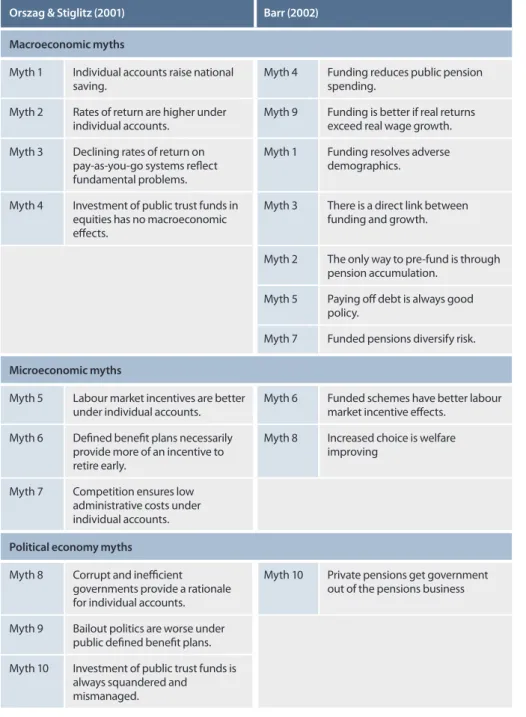
Australians are perhaps prone to believe our fully funded DC scheme is superior to unfunded DB schemes, but this belief is not shared universally. Two different sets of 10 myths about the funding question were published independently about a decade ago. They are summarised – and contrasted – in the following table.
Table 1: Two sets of 10 myths about retirement funding Orszag & Stiglitz (2001) Barr (2002) Macroeconomic myths
Myth 1 Individual accounts raise national
saving. Myth 4 Funding reduces public pension spending. Myth 2 Rates of return are higher under
individual accounts. Myth 9 Funding is better if real returns exceed real wage growth. Myth 3 Declining rates of return on
pay-as-you-go systems reflect fundamental problems.
Myth 1 Funding resolves adverse demographics.
Myth 4 Investment of public trust funds in equities has no macroeconomic effects.
Myth 3 There is a direct link between funding and growth.
Myth 2 The only way to pre-fund is through pension accumulation.
Myth 5 Paying off debt is always good policy.
Myth 7 Funded pensions diversify risk. Microeconomic myths
Myth 5 Labour market incentives are better
under individual accounts. Myth 6 Funded schemes have better labour market incentive effects. Myth 6 Defined benefit plans necessarily
provide more of an incentive to retire early.
Myth 8 Increased choice is welfare improving
Myth 7 Competition ensures low administrative costs under individual accounts. Political economy myths
Myth 8 Corrupt and inefficient
governments provide a rationale for individual accounts.
Myth 10 Private pensions get government out of the pensions business Myth 9 Bailout politics are worse under
public defined benefit plans. Myth 10 Investment of public trust funds is
always squandered and mismanaged.
Another myth that may be added is the view that funded pensions lead to more developed capital markets, and better allocation of capital. The Kay (2012) review of UK equity markets and long-term decision making questions these assumptions. Indeed, doubts about the desirability of the current size of the financial sector seem to be growing: Philippon and Reshef (2013) suggest that “the available evidence at present suggests that at the very high end of financial development, rapidly diminishing social returns may have set in”.
The papers in this volume take some different perspectives on the issues. Rob Brown addresses some of the myths and suggests that DC schemes do not really resolve the problems with DB schemes, given the “costs in terms of increased risks to individuals, and the possibility that governments will be required to provide additional support to those who are left in relative poverty”.
unfairness of many DB schemes, and how they can be manipulated by powerful interest groups. DC schemes at least avoid these pressures, although tax concessions provide plenty of scope for lobbying benefits.
The paper by Krzysztof Hagemejer and John Woodall looks particularly at the vulnerability of the less powerful when benefits are reduced under fiscally necessary, but unbalanced, mechanisms. This emphasis on coverage and adequacy of the minimum benefits is an important contribution from the International Labour Organization.
Two papers look specifically at the mechanisms of automatic balance mechanisms (ABM). The paper by Frédéric Gannon, Stéphane Hamayon, Florence Legros and Vincent Touzé is an adaptation of a paper presented at the colloquium, and provides an example of how an ABM can be developed that applies to both benefits and contributions – in their case to the French SSRS. Doug Andrews’ paper was not presented at the colloquium, but analyses some single figure population ratios and their application to the Swedish ABM particularly.
Finally, Chris Daykin has written about the contribution that the Actuarial Association of Europe (previously the Groupe Consultatif) has played in the ongoing debate about the sustainability of pensions in Europe. Chris is chairman of the sub-committee set up in 2012 specifically to develop an actuarial contribution to this issue, and he reports on the significant progress of the last two years. The initiative provides a positive illustration of how actuaries can become involved in public policy involving SSRS.
The papers in this volume touch on only a few issues, and there is much work to do. One field is the need to project the interaction between growing longevity, increasing retirement ages and the changing costs of long-term care. Another is the design of funded benefits, the impact of ageing on capital markets, and the governance of the investments. Yet another is the design of unfunded benefits, their funding and assuring fairness between different groups, including future generations. The challenges to the profession are to ensure that the necessary data are collected; that our technical abilities are adequate to the analysis of the data; and that we have the integrity, courage and wisdom to intervene in the public debate on the side of the public good.
Bibliography
Barr, N. (2002). Reforming pensions: myths, truths and policy choices. International Social Security Review, 55(2): 3-36.
Kay, J. (2012). The Kay review of UK equity markets and long-term decision making. Final Report http://www.bis.gov.uk/kayreview.
Orszag, P.R., & Stiglitz, J.E. (2001). Rethinking pension reform: ten myths about social security systems. In R. Holzmann & J.E., Stiglitz, New ideas about old age security. World Bank, Washington, DC 17-56. Philippon, T., & Reshef, A. (2013). An international look at the growth of modern finance. Journal of
Economic Perspectives, 27(2): 73-96.
My thanks go to CEPAR (The ARC Centre of Excellence in Population Aging and Research) and the Institute of Actuaries of Australia for financial support for this project.
Dr Anthony Asher B BusSc (UCT), PhD (Wits), FIA, FASSA, FIAA [email protected]
Dr Anthony Asher is Associate Professor in the School of Risk and Actuarial Studies at the University of New South Wales in Australia. His current research interests include regulation – particularly issues related to complexity and professional ethics.
ABSTRACT
This paper attempts to focus the definition of a social security system
at its most basic level. In doing so, it discovers a number of truths:
1. PAYGO systems are not remarkably different from fully funded
systems.
2. Fully funded systems are not demographically immune.
3. Fully funded systems are not inherently more stable than
PAYGO systems.
4. The least desirable design for a social security system is an
individual account defined contribution system.
KEYWORDS
social security, pension reform, individual accounts, defined contribution, pay-as-you-go
Dr Robert L Brown
The essence of social
security:
debunked myths
DR ROBERT L BROWN
1
THE ESSENCE OF SOCIAL SECURITY
A social security system is a social contract that sets out a process to decide what proportion of a country’s gross national product (GNP) its elderly residents can consume without any need for them to be in the active workforce. That is its essence on a macroeconomic level. On a microeconomic level it is a process to decide what proportion of each worker’s output will be transferred to its non-active elderly population for their consumption.
That is the entire story. But, once understood, many myths underlying today’s social security policies and procedures are easily seen to be just that: myths. The primary myth that this paper will debunk is that a fully funded social security system is different to, and better than, a pay-as-you-go (PAYGO) social security system.
2
HOW DIFFERENT IS PAY-AS-YOU-GO
(PAYGO) SOCIAL SECURITY FROM
FULLY FUNDED SOCIAL SECURITY?
First, I acknowledge that there are an infinite number of alternatives available between purely PAYGO social security and fully funded social security. However, by analysing what is true at these two polar-opposite end points, we can resolve most of the supposed funding issues for systems in between.
I will start with PAYGO financing. Note, first, that social security needs to be financed; it does not necessarily need to be funded. It is beneficial to have its financing be sustainable and stable. To do that may require carrying some reserves, but pure PAYGO financing is a perfectly acceptable method of running a social security system.
The Samuelson-Aaron theorem explains that, in a PAYGO system, contributors earn a rate of return equal to the growth g of covered wages, while contributors in funded systems earn the rate of return r
on accumulated pension assets (Samuelson 1958; Aaron 1966). Funded pension systems are thus more efficient, in a Pareto sense, and provide higher pension payments for the same amount of contributions made if and only if r > g. Otherwise, PAYGO financing is preferable to funded pension schemes.
In a pure PAYGO system, workers forgo a certain amount of take-home pay (which is a proxy for ability to consume) by making contributions to the social security system. Assume a worker makes a 10% contribution. This is absolutely the same as saying that a worker takes one half day of production and passes it over to a retired person, who is normally not in the workforce, for them to consume. The money (representing goods and services not consumed by the worker) comes in in the morning and goes out
in the afternoon, allowing for an equal amount of consumption of goods and services by the retired.
The workings of a fully funded program are slightly more complex, but virtually equivalent. Again, let’s assume our system will require 10% contributions from each worker to be fully funded. What happens in this system is that the worker forgoes 10% of his or her consumption in order to buy assets (such as stocks and bonds) that are kept in some safe retirement savings vehicle managed by some financial institution (the assets may be housed internally to the social security system). When the worker retires, he or she then liquidates these assets, turning them into money to buy goods and services for consumption.
If we look at this through a microscope, on a certain day there are workers searching for owners of assets (such as stocks and bonds) who want to sell them for money and there are retired people who have assets (such as stocks and bonds) who are looking for buyers so as to get money to purchase goods and services.
Almost identically to the PAYGO system, the worker forgoes consumption (say 10%) and transfers money to a retired asset owner to acquire his or her assets. The retired person, in turn, sells certain assets to get money to pay for consumption. But the end result is identical. The worker gives up consumption of a certain portion of his or her output and transfers the right to this consumption to a retiree.
But a question may remain: “Do fully funded social security systems increase national savings and thus assist economic growth?” There is a large volume of classical literature addressing this question (see, for example, Aaron 1982; Rosa 1982; Barr 1987; Orszag & Stiglitz 2001). There is no conclusive evidence to support the contention that a fully funded social security system increases national savings. There are two reasons for this. Because individuals save through their social security system, they may offset those dollars of savings by saving fewer dollars in individual investments. The result is no net gain in national savings. Or, if the “savings” in the social security systems are offset by increased government borrowing (which might be expected to the extent that the assets of the social security system are government bonds) then, again, there is no increase in national savings.
This latter outcome deserves greater scrutiny. Consider a system where the financing is to have assets backing the system (either partially or fully funded), but those assets are all government bonds. Now if the country’s economy is a closed economy and workers are the source of both social security contributions and income taxes, then the impact on the economy of this country and its workers/ producers is identical, both as to the size of the demand for money (that is, forgone consumption) and as to the timing of that demand
for money, whether the system is purely PAYGO (no assets), or fully funded, or any alternative in between. It is only a choice of whether the worker pays taxes out of his or her right pocket to buy back the bonds as needed or whether the worker pays contributions to the social security system out of his or her left hand pocket. But the systems are identical both as to the size of the cash flow demand and its timing.
Now, if the country’s economy is not closed, and if any assets of the social security system are invested offshore (which may be difficult politically), then the different funding mechanisms will not be absolutely identical, but will be so close as to only be of academic interest. Further, investing offshore creates currency exchange risk.
Finally, if one is wise in investing offshore, one needs to find a country that does not have the same demographics as the home country. Otherwise, you have not mitigated the “funding” risk.
3
ARE FULLY FUNDED SOCIAL
SECURITY SYSTEMS
DEMOGRAPHICALLY IMMUNE?
It is well known that PAYGO social security systems come under financing pressures when the ratio of retirees to the labour force rises. We can see clearly from the previous discussion, however, that fully funded social security systems are not demographically immune, as many argue. The aged dependency ratio (often defined as the ratio of those aged 65 and over to those aged 20 to 64) is as important to a fully funded system as it is to a PAYGO system. This ratio will decide how easy or hard it will be for workers to find persons trying to liquidate assets (for example, those 65+) or alternatively how easy or hard it will be for the retired to find buyers of their assets (for example, those 20–65) and thus how much gross national product will be effectively transferred.
The fallacy that fully funded systems are demographically immune can be explained through the fallacy of composition. An analogy will illustrate this nicely. If you are an individual at a concert and your view is blocked, you can see better if you stand up. But, if the entire audience stands up, you are no better off.
To take it to an extreme, if there are no workers, then there will be no production of gross national product. There will be no contributions to a PAYGO system, but also no ability to sell one’s assets in a fully funded system. In short, there has to be production of gross national product before it can be distributed. Wealth brings high wages; high wages do not bring wealth. Clearly, the best environment for a healthy and sustainable social security system is a healthy and growing economy.
To determine the required contribution rate for a PAYGO social security system, the rate of return that
is implicit in the calculation is the growth rate of the earnings base on which contributions are paid. This is effectively the rate of growth of the economy that, in turn, is a function of the growth rate of the labour force and the rate of productivity growth.
To determine the required contribution rate for a fully funded social security system, the rate of return that is implicit in the calculation is the rate of return on invested assets. Thus, there will be times when a PAYGO system will require lower contribution rates than a fully funded system (most of the second half of the last century), and there will be times when a fully funded system will require lower contribution rates than a PAYGO system (most of the first half of this century). There is nothing to say in advance that one system is inherently cheaper than the other.
4
WHICH SYSTEM IS MORE VOLATILE:
PAYGO OR FULLY FUNDED?
As was mentioned above, a goal for a sound social security system is sustainable and stable financing. By definition, are PAYGO systems more stable or are fully funded systems?
The volatility in the cost/contributions for a fully funded system will be the volatility of the rates of return of its invested assets. As we all know, volatility of investment returns is very high. They are not highly predictable even in the relatively short run (such as ten years). They are certainly not predictable over the longer range.
The volatility in a PAYGO system is the size of the wage base upon which contributions are made. This is turn depends upon a number of demographic and economic variables including the following: fertility rates, migration rates, labour force participation rates and productivity improvement rates. Life expectancy (mortality rates) was not included in this list because it has an equal impact on either or both PAYGO and fully funded systems. Further, many systems have now introduced automatic balancing mechanisms, which make these systems highly immune to changes in life expectancy (for a deeper discussion of automatic balancing mechanisms, see Vidal-Melia 2012).
I would suggest that it is easier to predict the cumulative impact of the above list of demographic and economic variables, long term, than to predict rates of investment returns into the future. The above demographic variables can be influenced somewhat by government policy, and some shifts in one variable can offset unexpected moves in another variable (for example, using migration to replace non-births).
But, to conclude, there is nothing inherent in a system being fully funded that makes it more stable or more predictable than a PAYGO system.
5 WHAT SHOULD WE AVOID IN
DESIGNING A SOCIAL SECURITY
SYSTEM?
We have discovered that there is not as much of a difference between PAYGO social security systems versus fully funded systems as the myths would lead us to believe.
That being the case, is there any reason why we should care how the systems are financed?
The answer is a definite yes. One must design the financing of the system in a manner that absolutely minimises the expense burden on the participants and the risks that the participants must assume. That being the case, it becomes rapidly apparent that the worst way to design a social security system is as an individual account defined contribution system.
Such a system makes a number of assumptions that are patently false.
1. Workers are capable of optimal investing and asset management.
2. If workers are not capable themselves, then they can purchase asset management at a very low expense ratio.
3. Workers, if given investment fund options, will choose wisely and will also follow a life-cycle model of investing where they slowly move from a high equity portfolio to more fixed income as they near retirement (or, even better, they buy deferred annuities as they near retirement). 4. Workers can buy individual life annuities as
a fair actuarial price. Each of these assumptions is false.
5.1 Workers are capable of optimal investing and asset management
How can an individual worker who has no training or education in business or economics be expected to invest wisely and manage their assets prudently?
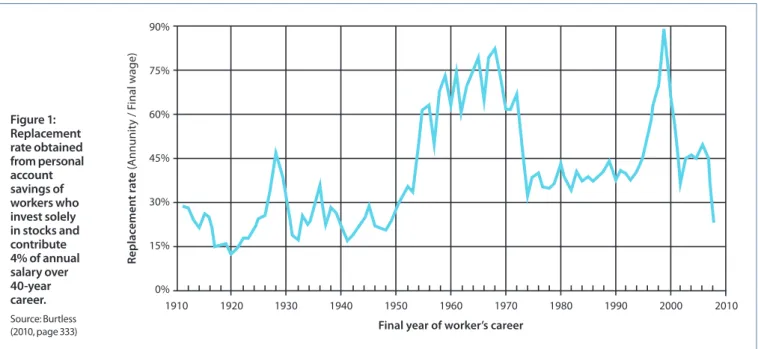
As Figure 1 shows, the choice of one’s investment portfolio and the timing of the cash flows can clearly have a huge impact on one’s standard of living upon retirement.
In Figure 1, we see a replacement rate as high as 90% and as low as 14%. And the only variable is the period over which the individual is working and saving.
Clearly, the worker can decrease the investment risk by choosing less volatile investments, such as government bonds. While it is true that the volatility decreases markedly, so too do the replacement rates, as seen in Figure 2.
That is, the worker has two choices. Invest heavily in stocks and face a level of volatility that is probably unacceptable, or invest more heavily in bonds and fixed-income securities and mitigate the volatility risk, but guarantee a much lower standard of living in retirement.
The replacement ratios in Figures 1 and 2 also indicate the impact of the timing risk. This is the risk of being forced to liquidate your assets at depressed values while also buying an annuity when interest rates are low and annuity prices are, therefore, high (as in 2009).
The responsibility of investing and liquidating assets is one for which the average worker has little capability. The literature indicates that if individuals are responsible for managing their own capital accumulation, they do so conservatively and achieve lower rates of return.
Figure 1: Replacement rate obtained from personal account savings of workers who invest solely in stocks and contribute 4% of annual salary over 40-year career. Source: Burtless (2010, page 333)
5.2 If workers are not capable
themselves, then they can purchase asset management at a very low expense ratio
One can legitimately argue that there are professionals who can be paid to manage the funds even in the de-accumulation phase. While that is true, it comes at a high cost. In Canada and the United States, it is not unreasonable to assume that a professional fund manager will charge 2% of assets each year as their management fee. A 2% per annum fee decreases the ultimate retirement fund (assuming a 35-year experience) by 31.7% (Ambachtsheer 2008; Ontario Ministry of Finance 2014).
Looked at in a slightly different manner, Table 1 tracks the impact of investment expense ratios and shows how profoundly they can affect the aggregate pension benefits and working income replacement ratios of retired plan members. The data assume an annual contribution to a plan of $10,000 over 40 years for a worker making $50,000 per year.
Even the highly regarded Australian superannuation funds have investment expenses ranging from 1.28% to 1.92% for not-for-profit funds and 2.03% to 2.73% for retail funds. Add to that operational expenses of 0.33% to 0.64% for not-for-profit funds and 0.72% to 1.27% for retail funds and we have results very similar to those from Canada and the United States (Cummings 2012).
Munnell et al (2013) found that:
“fees have a significant effect on how much an individual will have at retirement. An additional 100 basis points over a 40-year period reduces final assets by about one fifth. Many studies have also shown that actively-managed funds underperform index funds, even before accounting for the higher fees charged by the former. But broker-sold mutual funds perform worst of all. One estimate is that broker-sold funds underperform average actively-managed stock funds by 23 to 255 basis points a year. The problem is big because the number of people rolling over into IRAs has increased dramatically.
The rollover of balances from 401(k)s to IRAs is extraordinary given that participants are typically passive in their interactions with their 401(k) plans. They rarely change their contribution rate or rebalance their portfolios in response to market fluctuations or as they age. Some households may be attracted by the opportunity to obtain a wider menu of investment options or to consolidate their account holdings. But others may be seduced by advertisements from financial service firms urging participants to move their funds out of their ‘old,’ ‘tired’ 401(k) plan into a new IRA.”
Figure 2: Replacement rate obtained from personal account savings of workers who invest in alternative portfolios and contribute 4% of annual salary over a 40-year career. Source: Burtless (2010, page 334)
Table 1: Impact of investment expense ratios on pension adequacy
Expense ratio 0% 0.4% 1.5% 3% 5%
Accumulated value
after 40 years $777,000 $707,000 $551,000 $400,000 $272,000 Annual pension payout $45,000 $41,000 $32,000 $23,000 $16,000 Replacement ratio 90% 82% 64% 46% 32% Sources: Ambachtsheer (2008). See also Ontario Ministry of Finance 2014.
Finally, if we are going to design a defined contribution social security system, at the least it should be run as a large, “collective” fund. This is because size matters.
Table 2: Investment fees by size of pension fund Size of pension fund Investment fees for
large-cap equities Individual account 250–300 basis points $10 million 60 basis points $1 billion 42 basis points $10 billion 28–35 basis points Source: Ambachtsheer (2008).
Further, and importantly, a large collective fund can invest more widely than any individual account, in, for example, private equity or infrastructure. This effectively gives the worker a less risky portfolio.
5.3 Workers, if given investment fund options, will chose wisely and will also follow a life-cycle model of investing where they slowly move from a high equity portfolio to more fixed income as they near retirement (or, even better, they buy deferred annuities as they near retirement)
There is no support in the literature for this contention (see Munnell et al 2013). The more choice of investment funds you give for individual accounts, the more likely it is that savings end up in the default option. In Australia, 80% of participants went to the default investment option. This does not have to be totally negative. For example, in Sweden, which initially (1998) offered 456 investment options, the majority of participants ended up in the default fund, but the default fund outperformed nearly all of the other funds, so the story ended well.
Nor is there any support in the literature for any evidence that workers use a life cycle approach to the management of their portfolio (Munnell et al 2013).
Finally, buying fair market value life annuities may be very difficult.
5.4 Workers can buy individual life annuities at a fair actuarial price
When we move into the de-accumulation phase, the worker can always manage the longevity risk by buying a life annuity. Simple enough, until we look at the cost, especially given today’s very low interest rates. However, wherever interest rates happen to be at a given moment, a consistent cause of the high price of life annuities is the factor that the insurance company
must include to cover anti-selection (James et al 2008). Anti-selection occurs because the insurance company can never know as much about the annuitant’s health and life expectancy as does the annuitant purchaser (the principle of information asymmetry). Under this principle, workers who know they are in good health are more likely to buy life annuities or to buy larger amounts. Those who know they are in poor health will not buy life annuities at all. Thus, the insurance company must price the annuity assuming a five-star risk. That is, they price the annuity assuming the purchaser will have very high life expectancy.
In most countries, there is no risk classification for annuities (except in extreme cases where the seriously ill or injured can purchase what are called “settlement annuities”). Thus, the norm is that a coal miner who is over-weight and smokes pays the same price for an annuity as a non-smoking schoolteacher who jogs. Clearly they are not equivalent risks, but they are normally priced as if they are both five star applicants.
This has the further negative impact of being regressive. There is clear data (Brown & Prus 2004; Whitehouse & Zaidi 2008) that wealthier people live longer. And this is not because healthier people make more money. It is because of the stability, socialisation and access to care that result from wealth and education (Brown & McDaid 2003). Thus, if you charge the same rate for all life annuities, you are penalising the poor who, it might be argued, are those in most need of being able to transfer the longevity risk. It is thus debatable as to whether a poorer worker should annuitise at retirement.
If the worker does not buy an annuity, effectively, they must self-annuitise. That is, they must determine a program of income withdrawal that is optimal for them. Depending on their desire to leave a bequest (which we ignore here), they will want to take out the maximum income possible without creating the threat of outliving their assets. That is a lot to ask. Who knows their life expectancy? And covering your life expectancy is not enough. One would be wise to cover at least one’s life expectancy plus one standard deviation. So, if workers want to be sure that they will not outlive their assets, they make conservative withdrawals. That means they live at a lower standard of living than is necessary. If they take more aggressive withdrawals, then they increase the probability of outliving their assets and thus becoming dependent on friends and family, or on government programs for their continued consumption. (This should also be a concern to taxpayers who will pay those welfare benefits.)
Individual accounts also create a counter-cyclical macroeconomic bias. For example, when a country’s economy is hot, one would expect asset values to rise,
but also one would expect increased demand for labour. When the stock market is hot, holders of individual accounts will see an ability to retire and will then leave the labour force, exactly what the economy does not want. The reverse holds when the economy cools. Individual account values go down and the account holders see that they must remain in the workforce, just when you would like them to leave (MacDonald and Cairns 2007).
In short, in the case of a system based on individual accounts where the workers invest their funds, inadequate education of the public, lack of any smart default option, and inadequate regulation and supervision of the investment managers may result in poor investment choices, high transaction costs, and thus lower than expected net returns. To conclude, there appears to be little economic support for individual accounts social security retirement systems (see Beattie & McGillivray 1995; de Mesa, 1997; Gill, Packard & Yermo 2004; Diamond, 2004; Diamond & Orzag 2004; Sinha & Yanez 2008).
6 CONCLUSION
This paper has attempted to focus the definition of a social security system at its most basic level. In doing so, we have discovered a number of truths.
1. PAYGO systems are not remarkably different from fully funded systems.
2. Fully funded systems are not demographically immune.
3. Fully funded systems are not inherently more stable than PAYGO systems.
4. The least desirable design for a social security system is an individual account defined contribution system.
It is the expectation of the author that many of the points made in this paper will prove to be contentious. By debating a wide variety of viewpoints, it is hoped that one can all arrive at a more complete understanding of the essence of social security.
Bibliography
Aaron, H. (1966). The social insurance paradox, Canadian Journal of Economics and Political Science, 32(3), 371-376. Aaron, H. (1982). Economic effects of social security. The
Brookings Institute, Washington, DC.
Ambachtsheer, K. (2008). The Canada supplementary pension plan (CSPP). C.D. Howe Institute Commentary, No. 265, Toronto.
Barr, N. (1987). The economics of the welfare state. Stanford University Press, Stanford, California.
Beattie, R., & McGillivray, W. (1995). A risky strategy: reflections on the World Bank Report “Averting the old age crisis”, International Social Security Review, 48(3): 5-22. Brown, R.L.& McDaid, J. (2003), ‘Factors Affecting Retirement
Mortality’. North American Actuarial Journal, 7(2): 24-43. Brown, R.L. & Prus, S.G. (2004). Social transfers and income
inequality in old-age: a multi-national perspective. North American Actuarial Journal, 8,(4): 30-36
Burtless, G. (2010). Lessons of the financial crisis for the design of national pension systems. CESifo Economc Studies Vol 56(3) 323-249.Munich
Cummings, J.R. (2012). Effect of fund size on the performance of Australian superannuation funds. APRA Working Paper. Sydney, Australia.
de Mesa, A.A. (1997). Learning from the privatization of the social security pension system in Chile: macroeconomic effects, lessons and challenges. PhD thesis, University of Pittsburgh.
Diamond, P. (2004). Social security. Presidential address delivered at the 115th meeting of the American Economic Association, San Diego, CA. www.atyponlink.com/AEAP/ doi/pdf/10.1257/000282804322970670?cookieSet=1. Diamond, P., & Orszag, P. (2004). A summary of Saving social
security: a balanced approach. Adapted extract from Peter Diamond & Peter Orszag, Saving social security: a balanced approach. Brookings Institution Press. Washington, DC. Gill, I.S., Packard, T.G., & Yermo, J. (2004). Keeping the promise
of social security in Latin America. Stanford University Press for the World Bank.Redwood City, CA
Hohn, C. (1987). Population policies in advanced societies: pronatalist and migration strategies. European Journal of Population, 3: 459-81.
James, S., Pesando, J., Arnold, J., Ilkiw, J. (2008). The fair value of the Canada pension plan: the role of risk and cost structure. Canada Pension Plan Investment Board, Working Paper, Third Draft. Toronto.
MacDonald, B.J., & Cairns, A.J.G. (2007). The impact of DC pension systems on population dynamics. 11(1) North American Actuarial Journal, [VOL11(1): 17-48. Munnell, A.H., Webb, A. & Vitagliano, F.M. (2013). Will
regulations to reduce IRA fees work? Boston College: Center for Retirement Research, IB#13-2.
Ontario, Ministry of Finance. (2014). Retirement income security. Ontario’s long-term report on the economy.
[Ontario Ministry of Finance, Queen’s Park, Toronto. Orzag, P.R., & Stiglitz, J.E. (2001). Rethinking pension reform:
10 myths about social security. In R. Holzmann & J.E. Stiglitz (eds), new ideas about old age security: toward sustainable pension systems in the 21st century, The World Bank, Washington, DC.
Rosa, J. (1982). The world crisis in social security. Transaction Publications, New Brunswick, NJ.
Samuelson, P. (1958). An exact consumption-loan model of interest with or without the social contrivance of money.
Journal of Political Economy, 66(6): 467-482. Sinha, T., & Yanez, M. (2008).a decade of
government-mandated privately run pensions in Mexico: what have we learned? In S. J. Kay and T. Sinha (eds), Lessons from Pension Reform in the Americas, Oxford University Press, New York City, US.
Vidal-Melia, C., del Carmen Boado-Penas, M. & Settegren, O. (2009). Automatic balance mechanisms in pay-as-you-go pension systems. Geneva Papers on Risk and Insurance Palgrave Macmillan
Whitehouse E.R., & Zaidi, A. (2008). Socio-economic differences in mortality: implications for pensions policy. OECD Publishing No. 71. Paris.
Dr Robert L Brown PhD FCIA, FSA, ACAS, FIA (Hons) [email protected]
Rob retired from the University of Waterloo (Canada) program in Actuarial Science in 2010 after 39 years. In that time, Rob wrote seven books and more than 50 refereed papers focusing on the design of financial security programs in times of rapidly shifting demographics. Rob was President of the Canadian Institute of Actuaries in 1990–91, of the Society of Actuaries in 2000–01 and in 2014, of the International Actuarial Association.
ABSTRACT
This paper in part responds to Rob Brown’s “The essence of social
security: debunked myths” in this volume. As in that paper, social
security retirement systems (SSRS) refer to arrangements that provide
non-labour income to the elderly.
It makes the argument that SSRS need actuarial monitoring and
spells out the principles that should inform such monitoring. The
first two sections identify and suggest principles for addressing the
problematic issues of income redistribution and the impact of SSRS on
capital markets.
Section 3 considers the redistribution implicit in defined benefit
(DB) schemes, and how actuaries should play a role in making such
redistribution transparent in both DB and defined contribution (DC)
arrangements.
Section 4 suggests that there is a place for more comprehensive
reporting to ensure that the schemes meet their objectives.
The fifth section considers the impacts of all types of SSRS on
investment markets. There is an obvious actuarial role in the projection
of the effect of demographic changes, and. a potentially enhanced role in
the governance of the financial system and particularly in much more
intensive data collection and analysis.
Section 6 expands on the possible role of actuaries in monitoring
SSRS and section 7 summarises and concludes.
KEYWORDS
social justice, defined benefit, financialisation, aging, governance
Dr Anthony Asher
Redistribution and capital
market impacts of social
security retirement systems:
principles and scope for
actuarial involvement
DR ANTHONY ASHER1
ACTUARIES AND SOCIAL SECURITY
RETIREMENT SYSTEMS (SSRS)
Rob Brown argues that the essence of an SSRS is a financial transfer from workers to the retired; that many accepted opinions of the relative merits of funded systems are myths; and that the risks to which members of individual account systems are exposed make these the worst of all systems. But perhaps like democracy, the system that seems to devolve power to relatively incompetent individuals is the worst of all systems – except all the others that have been tried.
Before addressing this question, however, we have to consider the two main sets of issues that can interfere with the essential functions of an SSRS:
•
The first is the question of how the redistribution from workers to the retired will be effected – both within and between generations. In defined benefit (DB) funds, benefits are not necessarily distributed proportionately to contributions – whether or not allowance is made for the time value of money. As the distribution does not depend on personal consent, it requires the power of the state, and that power is always open to abuse and should be subject to appropriate oversight. In defined contribution (DC) funds, the redistribution depends on investment choices and the random effects of market movements, creating considerable volatility that raises questions about the suitability of these schemes for providing incomes in retirement.•
The second set of issues relates to the effects of the cash flows on the economy generally and on capital markets particularly. There are potential unintended, and unrecognised, consequences. These issues are of interest to actuaries as citizens, but members of the profession bear a personal responsibility because of their insights into the mechanics of the systems and an even greater responsibility if they are directly involved in management or oversight. Moreover, the Institute of Actuaries of Australia itself, and in many countries the actuarial professional bodies, recognise their responsibility for the public interest. Professional responsibility goes beyond the scope of our principals’ instructions: as with the doctors’ Hippocratic Oath, actuaries should be sure that we “do no harm”.The issues at stake are not just technical. Vast amounts of money are at stake in SSRS. Franco et al (2012) record that SSRS absorb more than 20% of GDP in the European countries they investigated. They report different estimates of the present values of these liabilities as multiples of GDP. It is difficult to approach
discussion of such large amounts dispassionately, even more so as everyone is personally affected financially in one way or another.
However complex and politically fraught, it can be argued that the management of SSRS is just the standard actuarial problem writ large on a national scale. Balancing inflows with outflows, and allocating costs and the benefits equitably are fundamental to all insurance and retirement schemes. Where the arrangements are subject to the discipline of a competitive market, questions of equity can be replaced by those of economic viability but, in both cases, the use of the actuarial toolkit is invaluable.
The role of actuaries is to develop and implement the techniques required to manage financial security systems. We identify and measure the key driving influences and project them as best we can.
2
REDISTRIBUTION AND JUSTICE
Redistribution is a zero sum game and different parties are likely to defend, or seek to extend, their shares whether or not they are justified in doing so. In arguing their position, parties may appeal to the need for greater equality, more efficiency, a focus on the poorest or for a closer relationship between the value of contributions and benefits (which the economists often call “actuarial equity” – a term that I shall use here). I suggest that reconciling these legitimate, but conflicting, objectives is a function of the principle of justice (or equity). I make a more detailed defence of its application to social security systems in Asher (2010).
In essence, it seems to me that justice requires a balancing of different criteria, which in the context of redistribution are as follows:
•
There should be equality of treatment: horizontally, in that people with the same characteristics should be treated in the same way; and vertically, in that the treatment of people with different characteristics should be proportional to their differences. Equality of outcomes is desirable because all people are equal.•
People’s needs for poverty relief or insuranceagainst longevity risks should be considered
•
Schemes should be actuarially equitable. Peoplewho have contributed more have a real claim to higher benefits based on realistic assumptions and fair interest rates.
•
Governments should not interfere without goodcause in any aspect of their citizens’ lives, and so compulsory membership of retirement systems needs good justification. Not only should individuals be given as much liberty as possible, the accompanying principle of subsidiarity is
that power should be devolved to the lowest local level consistent with meeting the system’s objectives.
•
Efficiency should also be considered. Actuaries are not experts in questions of justice or redistribution, and it seems to me that there is a good argument for arguing that these are democratic choices. The other professional experts in this field (philosophers and lawyers, for instance) are, however, less concerned about precise outcomes than about the justice of the process and the need to consider the full range of stakeholders and criteria listed above. Actuaries can use their understanding of the mechanics of SSRS and of other redistributive mechanisms (tax and means tests especially) to inform public debate; as members of the public, actuaries are also entitled to participate (as long as their personal interests are identified and disclosed).Williams (1997) provides a warning:
There is a regrettable tendency for equity arguments to be conducted within a rhetorical framework in which it appears possible to “do good” at no opportunity cost whatever. It generates a great deal of righteous self-satisfaction for the romantic escapists and it puts economists back in the role of the dismal scientists always stressing the sacrifices, but it does not help the hard-pressed decision-makers who grapple with the issues in real-life every day ... [we need] ... to bring home the fact that giving priority to one group inevitably disadvantages others, a consequence which many advocates of particular equity principles fail to make clear (and they rarely state who will be called upon to make what sort of sacrifice even when they do acknowledge this implication). (128)
Actuaries may have to play the role of dismal scientists: we do need to identify winners and losers.
3
DB BENEFIT RATIOS ARE OPAQUE
AND CAN BE MANIPULATED
In particular, the manner in which DB schemes lead to redistribution needs to be explained by actuaries. If actuarial equity is a principle, then it is of some concern that the internal rates of return obtained by individuals in DB schemes are arbitrarily determined. The original rules were often based on simple, and therefore tractable, formulae that were easy to administer in
a pre-computerised environment. It can, however, be suspected that they were adopted because of their being that much more attractive to wealthier and more influential groups of members.
3.1 Longevity
In the first place, wealthier groups live longer and obtain benefits for longer. While Rob Brown is correct that some annuity markets can be criticised in that they do not allow for socio-economic mortality differentials, there is invariably no distinction within private and public DB schemes. Some DC arrangements allow those with lower life expectancies to opt out of the cross subsidies, but at least in the UK, insurers now offer enhanced annuity rates to those with lower life expectancy. The cross-subsidy to the wealthy has long been recognised, for example, in one of Brown’s papers (1998), but as he shows, the cross subsidy is often more than compensated by greater social benefits to lower income individuals. I would suggest, however, that the extent of the cross subsidies needs to be continually monitored to ensure that there is no “benefit creep” at the expense of poorer and often less vocal members of the SSRS.
3.2 Different rates of salary increase
Less often recognised is the fact that greater weight is invariably given to later years of income in the determination of benefits. This is not only true for final average schemes, but also for career average arrangements revalued by an inflation rate lower than the average rate of salary growth. Workers from lower socio-economic groups have a flatter wage profile than those with higher incomes, and therefore their contributions to the SSRS at earlier ages have more time to earn a return. The same flatter salary scales apply to those who suffer from ill health later in their working lives. Both groups are not likely to be well represented amongst decision makers and may be not be adequately compensated by other means. Kaye (1985) reports some calculations by David Wilkie, which suggest that just 2% a year increase in salary relative to the average will yield a pension worth 50% more than the average. Coronado et al (2011) find that, under certain assumptions, the US system can be seen as regressive – even with apparently significant non-earnings related benefits.
This particular cross subsidy would appear to need greater monitoring.
3.3 Demographic change
One could design PAYGO schemes so that the ratios between contributions and benefits are based on a more or less constant real return. Notional defined contribution (NDC) funds fall into this category. More frequent are schemes where the contributions or the
benefits are adjusted with demographic change so that the return to each generation is dependent on the rate of growth of the population and changes to longevity. The adjustments to the benefits and contributions – whether based on rules or on ad hoc changes – require some justification. Such justifications require very careful analysis as the changes may otherwise impose unfair burdens on different groups – and give unjustifiable windfalls to others.
One might respond by saying, as Robert Myers (1998) did in a response to Brown (1998), that the rates of return or money’s worth ratios are not relevant to the purpose of SSRS, which are to meet economic and social needs in retirement and are based on solidarity. Solidarity is not achieved however by pandering to the interests of powerful groups, nor by exposing the system to structural strains that may require traumatic adjustments.
These arguments apply particularly to contributory DB schemes, but are also relevant to flat-rate schemes such as the Australian Age Pension. They are obviously progressive, particularly if they are means tested, but higher ages of entitlement can significantly reduce the benefits to lower socio-economic groups, who have lower life expectancy.
Whatever the design, regular actuarial monitoring seems to be important to ensure balance and equity.
4
DC SCHEMES ARE VOLATILE
Actuaries can also highlight the random
“redistribution” created by DC schemes. While DC arrangements objectively allocate benefits, funds invested in equity markets produce very volatile results. Brown makes the case that the range of replacement ratios provided by DC schemes is extreme. (He shows that they would have varied by a factor of almost 6 over the past century in the US). Cannon and Tonks (2013) confirm this for 16 countries in the OECD over the same period. Both sets of calculations, however, show that investment in equity markets would invariably have outperformed investment in bond markets – sometimes significantly. It could be argued that an economically neutral DB or NDC scheme should give a return on contributions equal to that of government bonds. The benefits of a DC arrangement invested in equities are volatile, but the volatility for the members appears, at first sight, to be almost all on the upside.
A number of economists and others have used these facts to argue for a switch to DC arrangements. Feldstein and Liebman (2002) provide a good
summary of the issues and arguments. One underlying assumption is that private markets will allocate capital more effectively and that state control over companies
and investment projects should be avoided if possible. Engelen (2003) suggests that this assumption may be based on a biased and overoptimistic view of the size of the equity risk premium. (See Damodaran (2011) for evidence of considerable overoptimism amongst academic economists in the 1990s particularly.)
The upside of DC schemes can also appear higher because the return on government bonds is often artificially depressed. Reinhart et al (2011) provide evidence that the interest rate on government borrowing has been artificially depressed for a large part of the past century – as part of a strategy of “financial repression” to reduce the size of the debt. Even in normal times, the shorter term government debt held by banks is held largely for liquidity purposes and is not a good measure of the returns on capital in society. Insurers and retirement funds may also hold longer term government debt for regulatory reasons rather than as pure
investments, which may also lead to artificially lower returns. Artificially lower returns on government debt helps explain the puzzle that equity risk premiums are too large to be explained by risk aversion alone.
Even allowing for overstatement, the arguments for investment freedom and the existence of a smaller but still significant equity risk premium do suggest that there is some role for DC arrangements with investment freedom. Brown, however, makes the widely accepted point that too much freedom – particularly if members are encouraged to have individual accounts – leads to higher expense charges and poor investment decisions. This provides an argument for group schemes with sensible investment default options, which actuaries are well placed to design.
The issues of balance and equity that are important in DB schemes are replaced in DC arrangements by issues of expense management and investment strategy, as well as issues of financial planning, such as how much to save, the retirement date and annuitisation. These calculations are not peculiarly actuarial skills, but actuaries are already providing advice to the managers of these funds and are able to make important contributions in this area. The area does appear to be underserviced currently and could perhaps benefit from the development of international actuarial standards.
5
MANDATORY CONTRIBUTIONS
DISTORT INVESTMENT MARKETS
Actuaries can also comment on the direct and indirect impacts of demographic change on all the pillars of an SSRS on investment markets. A purist free market view would hold that both PAYGO and compulsory funded schemes distort what would be a natural capital market. In the absence of any government SSRS, people
would “naturally” save something for retirement and one would expect the development of a capital market to allocate these savings to the most productive investments. Those holding this free market view would argue that free capital markets will allocate investments more efficiently than if they are “crowded out” by large PAYGO schemes or distorted by artificially stimulated funded schemes (either by compulsion or tax concessions). One could go further and argue that the latter may also distort efficient markets by driving asset prices up and investment returns down.
Few take this purist view; those who do adopt the view appear to be acting as lobbyists for a larger financial sector. McGrattan and Prescott (2013), for instance, argue that all taxes on investment income distort decision making and should be removed, that a mandated retirement system with investment freedom would “dramatically increase welfare” and that:
Mandatory savings and insurance, which are not binding for most people, do not distort the labor-leisure and intertemporal consumption choices. They do overcome some of the problem of some people not saving for retirement and relying on others for financing their retirement consumption.
Underlying their model, and all the arguments for more funding, are highly speculative counterfactual assumptions about the productivity of investment – assuming that investment returns in private markets will greatly outperform those in the public sector and that members of SSRS will be able to enjoy such benefits. These assumptions are obviously debatable and would appear to be coloured by an interest in a large financial sector. As participants in the sector, actuaries should be aware of the possibilities that our views can be similarly coloured.
5.1 Financialisation
Financialisation has been used to describe this colouring of the thinking of those in the financial sector particularly. A number of observers see the increased funding of SSRS as contributing artificially to the growth of the finance industry, both ideologically and in its share of GNP. Outside the finance industry, this growth can be viewed with some alarm as contributing to both inequality of incomes and greater speculation. Engelen (2003) refers to “increasingly speculative behaviour and a frantic search for financial innovations”.
Adair Turner (2009), then head of the UK Financial Services Authority, takes a similar view:
And, indeed, there are good reasons for believing that the financial industry, more than any other sector of the economy, has an ability to generate unnecessary demand for its own services – that more trading and more financial innovation can under some circumstances create harmful volatility against which customers have to hedge, creating more demand for trading liquidity and innovative products; that parts of the financial services industry have a unique ability to attract to themselves unnecessarily high returns and create instability which harms the rest of society.
There are other reasons for the growth of the financial sector, and there is evidence that it contributes to economic development. Philippon (2007), for instance, finds the growth arises rather from technological change in that growing firms in the last 30 years have required more outside capital than previously. Rajan and Zingales (2003) document the contribution to economic development, but note the role of private interest groups in obstructing development in various countries of the world during the twentieth century. They suggest that one way of limiting the power of such interest groups is “public awareness of the hidden costs of policies that ostensibly promote economic stability”.
More concerning is the relatively invisible
interconnectedness of the system. Vitali et al (2011) were able to investigate the ownership and control of 43,000 trans-national companies and found that “nearly 4/10 of the control over the economic value of TNCs in the world is held, via a complicated web of ownership relations, by a group of 147 TNCs in the core, which has almost full control over itself”. The authors point out the systemic risks that such interconnectivity creates.
Results like theirs also suggest the possibility of using the greater data processing power now available to better understand and monitor these risks. Farmer et al (2012) “outline a vision for an ambitious program to understand the economy and financial markets as a complex evolving system of coupled networks of interacting agents”. They envisage the use of existing micro-data on households, firms and particularly financial transactions (that is currently not collected and analysed) to produce forecasting tools.
It seems to me that the implementation of such models is a function for which actuaries are well suited. While the models would be expensive to create and run, the costs would be a minute proportion of the amounts being managed, and would justify the creation of significant actuarial functions within government.
This is a long-term goal. In the shorter run, further thought can be given to ensuring greater diligence in the selection of investments and involvement in the corporate governance of the companies in which shares are held. Clark and Hebb (2004) suggested that there was a trend towards more active retirement fund management, and there may be evidence that this continues with social and environmental investment management principles being more widely accepted. Actuaries involved in the governance of retirement schemes will inevitably be involved. The Institute of Actuaries of Australia has identified “investment advice and governance” as a core capability of actuaries (Actuaries Institute, 2012), and so there would seem to be support for further development of actuarial skills and standards in this area.
5.2 Demographic distortions
Another distortion that can arise is that, as a population begins to age, more assets are acquired by pension funds, pushing asset prices higher but if aging continues and populations decline, dissaving reduces asset prices – as recognised most clearly in Japan (Nishimura 2011). It seems that, when there is an abundance of savings, interest rates can be pushed very low and even become negative, so requiring more savings (certainly with matched DB schemes), creating further pressure on interest rates.
This distortion can arise whether the SSRS is funded or not. If contributions exceed benefits temporarily, then the surplus needs to be disposed of or invested. This applies obviously to privately managed DC accounts. If a PAYGO scheme has no explicit assets, then the surplus is effectively lent to the state. Governments may use the money in a variety of ways. In both cases, there is a risk that the additional money is being taken from consumption and used to bid up the price of existing assets.
Is such an increase in asset prices unavoidable? Birkeland and Prescott (2007) calculated that the assets required to fund a SSRS in the USA (with its particular demographic and investment conditions) would amount to some five times GNP. This would exceed the available assets and so would require government to create additional government borrowing – or create asset price inflation. McGrattan and Prescott (2013), however, argue that if one includes the value of all land and intangible business assets, the asset markets are big enough to provide the base for a funded SSRS.
Whatever the theoretical possibilities, it does seem that funded schemes are vulnerable to capital market enthusiasms that can throw unseemly amounts of money at poor investments. This has been illustrated recently by the technology bubble at the turn of the century and the US housing bubble and its associated derivative
instruments that led to the financial crisis of 2008. Would the excesses be mitigated if there were greater awareness of the size and direction of
demographically governed cash flows? It does seem to me that, in a scientific age when we have a huge capacity to measure and manage, our national economic statistics could be considerably more detailed. They should include projections of cash flows into and out of the financial sector, allowing governments and investors to adjust their capital spending accordingly.
6
PRACTICAL ACTUARIAL
INVOLVEMENT IN MANAGING
A SOCIAL SECURITY SYSTEM?
Brown is not alone in recommending a multi-pillared SSRS that includes a provision for basic needs and then some, and perhaps an element of investment smoothing for wealthier pensioners who participate in an earnings-related component.
Such a system must include a centrally managed component if it is to have a redistributive function. The argument of section 3 is that the redistribution needs to be subject to intense and ongoing scrutiny, or it will be exploited by powerful groups. I doubt whether it is possible to develop rules for redistribution that will be robust enough not to require adaptation over time. It seems necessary to determine, regularly, the extent of the redistribution, both within and between generations, and the relative needs of beneficiaries and contributors. I believe government treasury or finance departments should have the actuarial resources to collect the necessary data, and perform and publish these analyses. Franco et al (2012) make some suggestions as to how this could be done, although they do not seem to appreciate that most of the work is of a largely actuarial nature. International standards could perhaps be developed to set out appropriate assumptions and methodologies.
The standards could perhaps include the following. Measurement must be regular: triennially before computers, but now at least annually. The reports should cover:
•
the total liabilities of the SSRS (all relevant elements, or pillars) and the accrual over the past year – in total and by distinguishable groups of beneficiaries•
the assets available to pay the liabilities, including future contributions, government taxes, and the “returns” over the period•
the “emerging costs”, showing the extent to whichcash flows from the assets (including envisaged sales) will meet cash flows from the liabilities